FIGHT FOR YOUR RIGHT TO FRUIT©: DEVELOPMENT AND TESTING OF A MANGA COMIC PROMOTING FRUIT INTAKE IN MIDDLE-SCHOOL YOUTH
May May Leung
A dissertation submitted to the faculty of the University of North Carolina at Chapel Hill in partial fulfillment of the requirements for the degree of Doctor of Philosophy in the Department of Nutrition.
Chapel Hill 2010
Approved by:
Advisor: Alice S. Ammerman
Reader: Marci K. Campbell Reader: Deborah F. Tate
Reader: Jane D. Brown
ABSTRACT
MAY MAY LEUNG:Fight for Your Right to Fruit©: Development and testing of a Manga comic promoting fruit intake in middle-school youth
(Under the direction of Alice S. Ammerman)
Innovative interventions addressing childhood obesity are needed to capture the attention
of youth living in a multi-media environment. Manga comics (Japanese comic art) may be a novel platform to promote positive health behaviors in youth. The purpose of this
study was to develop a Manga comic promoting fruit intake and evaluate its impact on related psycho-social variables in middle-school youth. This dissertation followed three
aims. Aim 1 consisted of a content analysis of nutrition and physical activity (PA)-related behaviors in fourShonen(Boys) and fourShojo(Girls) Manga comics. Most common positive health behaviors represented were fruit/vegetable consumption, family
meals and moderate/vigorous PA, while large portion sizes, intake of high energy-dense foods and television/other screen time usage were the most frequent negative health
behaviors depicted. In Aim 2, seven focus groups and two interviews (N=28) were
conducted with youth to better understand such topics as enjoyable components of Manga comics and important health concepts. Most frequently mentioned themes related to
enjoyable Manga comic components were detailed graphics and artistic style of text used to convey sound effects. Majority said eating fruits/vegetables was the most important
nutrition behavior for proper health. Aim 3 consisted of a three-group, randomized single-session study with middle-school students. Participants (n=263) were randomly
(Newsletter group), or a newsletter about ancient Greece (Control group). Psycho-social variables related to fruit consumption were measured at baseline and immediately after
reading. Post-intervention focus groups were conducted to evaluate acceptability and
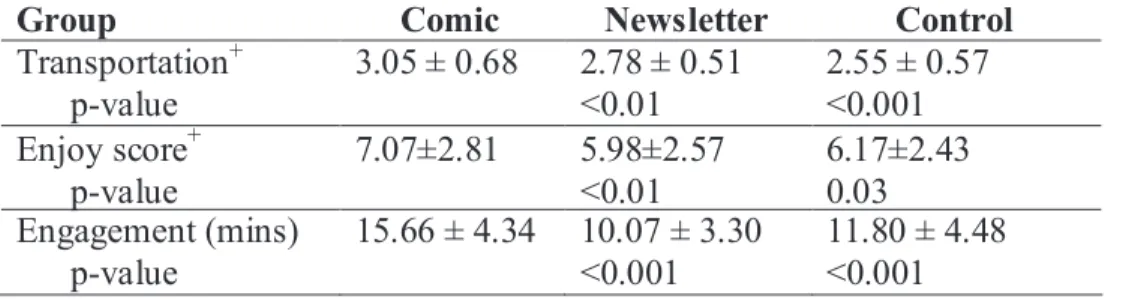
comprehension of the comic. Outcome expectations tended to be different in Comic group compared to Control group (p=0.03), while Comic group reported greater
transportation (p<0.01), enjoyment (p<0.05) and engagement (p=0.00) than Newsletter
and Control groups. Focus group data show majority of Comic group participants enjoyed the graphics and storyline, understood the main message and felt like eating
more fruit. Results are promising and suggest that Manga comics may create an entertaining and informative learning environment that has potential to help promote
ACKNOWLEDGEMENTS
I would like to express my sincere thanks to my advisor, Alice Ammerman, who allowed
me to explore my creativity and own research interests. I am also grateful for the support and mentoring I have received from my committee members: Jane Brown, Jianwen Cai,
Marci Campbell, Melanie Green and Deb Tate. I am also thankful to my parents, whose
TABLE OF CONTENTS
Chapter
I. INTRODUCTION………..…...1
A. Overview………...1
B. Specific Aims………..….2
II. LITERATURE REVIEW ……….………….…....4
A. Significance……….……….…….4
B. Contributing Factors of Childhood Obesity…..…………..……….…….5
C. Narrative Communication……….…7
D. Narrative versus Fact-based Communication.….…….…..………..7
E. Manga Comics………...………..………..…….………..9
III. THEORETICAL FRAMEWORK…...………..…………...14
A. Transportation-Imagery Model………..……….………....14
B. Social Cognitive Theory……..………..…….………....17
C. Summary……….…18
IV. NUTRITION AND PHYSICAL ACTIVITY MESSAGES IN MANGA COMICS: A CONTENT ANALYSIS ………..…………...21
A. Abstract……….……….………...21
B. Introduction………...……….………...…..22
C. Methods……….……….………..…...24
E. Discussion………..……….29
V. “HE'D BE A TROUBLE MAKER, BUT WOULD HAVE A HEART OF GOLD.”: FORMATIVE RESEARCH FOR DEVELOPMENT OF A MANGA COMIC PROMOTING HEALTHY EATING IN YOUTH RESPONSES….….……….….…37
A. Abstract………...37
B. Introduction……….….…...38
C. Methods………...41
D. Results………..………...44
E. Discussion………..….50
VI. FIGHT FOR YOUR RIGHT TO FRUIT©: PSYCHO-SOCIAL OUTCOMES OF A MANGA COMIC PROMOTING FRUIT INTAKE IN MIDDLE-SCHOOL YOUTH……..……….…..…..58
A. Abstract………...…58
B. Introduction……….…...….59
C. Methods………...62
D. Results……….…68
E. Discussion………...71
VII. SUMMARY AND RECOMMENDATIONS………..81
A. Summary of findings………...81
B. Theoretical implications………..83
C. Recommendations………...84
D. Future research………..………..87
APPENDIX A: CONTENT ANALYSIS CODEBOOK AND INSTRUCTIONS……...91
APPENDIX B: CONTENT ANALYSIS DATABASE INPUT SHEET…...…………...97
APPENDIX D: AIM 2 STUDENT ASSENT FORM……….102
APPENDIX E: AIM 2 PARTICIPANT SURVEY…...………..…...………….105
APPENDIX F: AIM 2 FOCUS GROUP MODERATOR’S GUIDE..………...….107
APPENDIX G: FIGHT FOR YOUR RIGHT TO FRUIT©MANGA COMIC...….110
APPENDIX H: FRUIT NEWSLETTER……….…….………..……...…………..140
APPENDIX I: ANCIENT GREECE NEWSLETTER..……….….…...………….145
APPENDIX J: AIM 3 PARENTAL CONSENT FORM (ENGLISH)….……….……..150
APPENDIX K: AIM 3 PARENTAL CONSENT FORM (SPANISH)………..….154
APPENDIX L: AIM 3 STUDENT ASSENT FORM…...………..……….158
APPENDIX M: AIM 3 DAY 1 SURVEY…...………....………...….161
APPENDIX N: AIM 3 DAY 2 SURVEY………..….171
APPENDIX O: AIM 3 POST-INTERVENTION EVALUATION MODERATOR’S GUIDE..………..……….177
LIST OF TABLES Table
2.1 Comic panel transition types………..………...…..13
4.1 Storyline and genres of selected Manga comic books.….…………..………..33
4.2 Expert Committee’s targeted behaviors to prevent childhood obesity……...……..34
4.3 Frequency of positive and negative scenes related to nutrition and physical activity………...35
4.4 Characteristics of comic characters involved in scenes related to nutrition and physical activity………36
5.1 Characteristics of participants.………...……….…...……...56
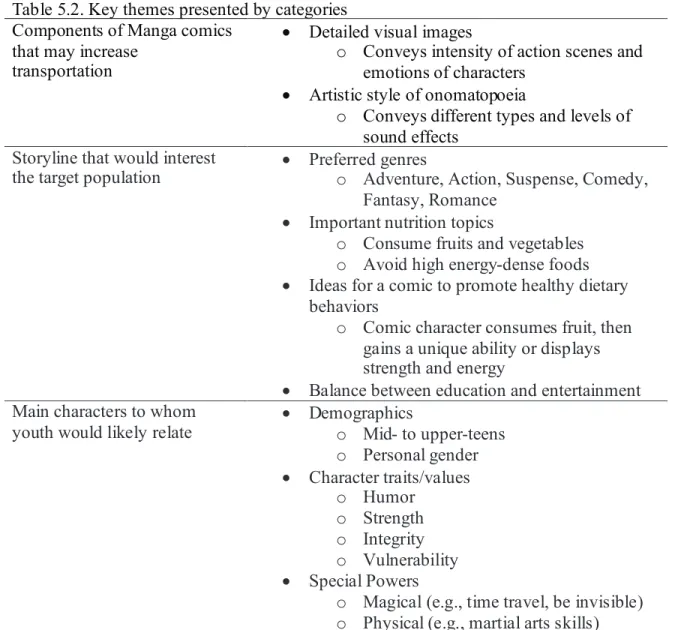
5.2 Key themes presented by categories.……...……….…….………...57
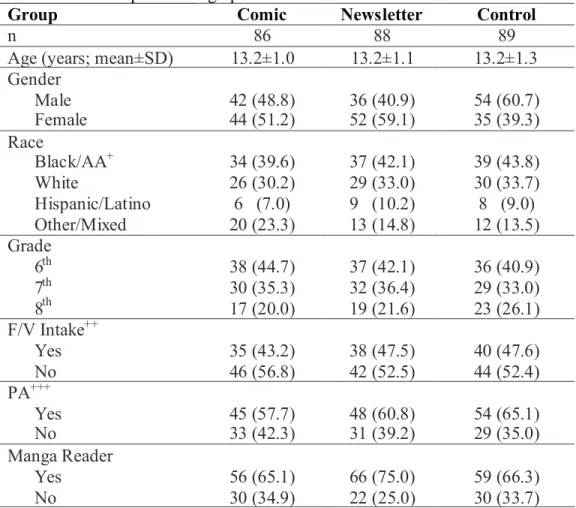
6.1 Participant demographic data at baseline ………...…….…...………..………75
6.2 Change in outcome expectations, self-efficacy and knowledge, by groups…...76
LIST OF FIGURES Figure
3.1 Transportation-Imagery Model………..20
6.1 Front cover of the developed Manga Comic-Zen’Aku: Fight for Your Right to Fruit………....………...77 6.2 Conceptual model of the Manga Comic with a theoretical framework explaining
how it may influence SCT constructs and, ultimately, obesity-prevention
behaviors………...78
6.3 Front page of the Nutrition Newsletter……….………79
CHAPTER I INTRODUCTION I.A. Overview
Childhood obesity is a serious public health crisis in the United States-the rate has
tripled within the last 30 years. Its prevalence has profound psycho-social, physical and economic consequences. Numerous interventions have been designed to promote healthy
behaviors to prevent childhood obesity, however, most interventions have been too costly to maintain or resulted in modest positive outcomes and limited reach.
Innovative interventions are needed to capture the attention of youth living in a multi-media environment. Narrative approaches are emerging as a promising set of tools
for motivating and supporting health-behavior change, particularly ones that evoke vivid
imagery. It is believed that the persuasion to change health-related behaviors occurs because an individual is ‘transported’ into the narrative world, and thus more likely to
believe the story propositions.
Manga, Japanese comic art, have become successful entertainment media in many countries, including the US. Because of its popularity, Manga have been used as a
medium to educate people on history, culture, religion and career advice, across the continents. Furthermore, Manga comics are unique in that they convey stories in such a
way that a reader is likely to become ‘transported’ into a story.
To date, Manga comics have not been used as health promotion vehicles,
comics present a largely untapped mechanism and opportunity to reach youth living in a multi-media world.
The purpose of this research is to develop and evaluate a Manga comic with
embedded messages promoting fruit intake on related psycho-social variables in middle-school youth.
I.B. Specific Aims
Phase 1: Conduct formative research to understand health-related concepts for youth Manga comics.
Aim 1:Conduct a content analysis on nutrition and physical activity (PA) content in popular Manga comics in the US for middle-school youth.
1a.Identify the nutrition and PA-related messages that are being conveyed.
1b. Identify the demographics of the characters, who are modeling the nutrition and PA-related behaviors.
Aim 2:Conduct focus groups with middle-school youth to determine what concepts should be included in aHealthy Mangacomic.
2a.Identify Manga storylines and characters which youth prefer.
2b.Identify core components of Manga comics that make it enjoyable for youth. 2c.Determine which health messages youth would like to be included in aHealthy Mangacomic.
3a.Using a three-group study design, determine if exposure to theHealthy Mangacomic influences outcome expectations, self-efficacy and knowledge related to fruit intake.
CHAPTER II LITERATURE REVIEW II.A. Significance
Childhood obesity continues to be a serious public health issue in the US. Over
the last three decades, the rate of childhood obesity has tripled. More than one-third of 6 to 19 year olds are considered overweight or obese, while children ages 6 to 11 years
have the highest prevalence at 37.2% (Ogden et al., 2006). Mexican American youth have the highest rate of obesity compared to whites and blacks, however, trends in
obesity have increased across all ethnicities, including Native Americans and Asian Americans (Gordon-Larsen, Adair, & Popkin, 2003; Ogden et al., 2006; Zephier, Himes,
Story, & Zhou, 2006).
Obesity has extensive economic, physical and psychosocial consequences,
including long-term consequences leading into adulthood (Daniels, 2006; Guo, Chumlea,
Roche, & Siervogel, 1998; Guo & Chumlea, 1999; Rolland-Cachera, Bellisle, & Sempe,
1989; Trasande, Liu, Fryer, & Weitzman, 2009; Whitaker, Wright, Pepe, Seidel, & Dietz, 1997). Direct economic costs of childhood obesity are estimated at $14.1 billion, while
indirect costs, such as job absenteeism is an estimated $4.3 billion (Cawley, 2010). One of the physical consequences of obesity that is becoming a greater concern in children is
the Metabolic Syndrome, which is a grouping of clinical characteristics, such as insulin resistance, abdominal obesity, abnormal glucose tolerance, elevated blood pressure,
health concern as it is associated with the development of chronic diseases, such as cardiovascular disease and type 2 diabetes (Saland, 2007). In addition, social
consequences can include stigma, negative stereotyping, social discrimination, teasing
and bullying. These factors can result in psychological stresses such as low self-esteem, negative body image and depression, which can affect academic and social functioning,
and persist into adulthood (Daniels, 2006).
II.B. Contributing factors of Childhood Obesity Energy Intake.
Childhood obesity is a complex epidemic with multiple contributing factors. Poor eating habits, including inadequate intake of fruits and vegetables and increased intake of
sugar-sweetened beverages and high energy-dense foods, have all been associated with this serious public health problem (Field, 2008; James, Thomas, Cavan, & Kerr, 2004;
Johnson, Mander, Jones, Emmett, & Jebb, 2008; Ludwig, Peterson, & Gortmaker, 2001).
A longitudinal study that followed children aged 9 to 14 years for four years found that consumption of sugar-sweetened beverages implied small increases in body mass index
(BMI), for both boys and girls (Berkey, Rockett, Field, Gillman, & Colditz, 2004).
Recent research has found that dietary snacking behaviors in youth have become more frequent between 1989 and 2004 (Piernas & Popkin, 2010). Piernas and Popkin (2010)
observed that US children’s snacking trends are shifting towards three snacks per day, while greater than 27% of children’s daily calories are coming from snack intake with
eating fruits and vegetables, eating breakfast daily, having family meals and limiting portion sizes (Barlow & Expert Committee, 2007).
Energy Expenditure.
Physical inactivity is clearly associated with an increase in obesity and related morbidity among youth (Daniels, 2006). It is recommended that children receive at least
60 minutes per day of moderate to vigorous physical activity (MVPA), however, many
youth do not come close to meeting such recommendations (Nader, Bradley, Houts, McRitchie, & O'Brien, 2008). Gender and age appear to be the most important
determinants of MVPA. Nader and colleagues (2008) found that most children at 9 years of age exceeded the recommended 60 minutes per day. By age 15 years, only 31% met
the guidelines. Girls were consistently less active than boys across the ages. This lack of physical activity may be a result of increase television or other media use. Gortmaker
(1996) reported a dose-response relationship between TV time and obesity; children who
watched more than five hours of television per day had a much greater chance of being obese than kids who watched zero to two hours per day (Gortmaker et al., 1996).
Although there isn’t a clear understanding of the association between television or other
media use and weight, it is believed that numerous factors play a role. In addition to media use possibly displacing physical activity, food advertisements on television or
internet may increase the child’s desire for, and ultimately, consumption of energy-dense snacks. Third, snacking behavior is associated with television watching, which could
result in greater consumption of calories.
The highlighted contributing factors have been addressed in many childhood
and community (Doak, Visscher, Renders, & Seidell, 2006). However, regardless of setting or targeted behavior, most interventions have been too costly to maintain and/or
resulted in modest positive outcomes and limited reach (Thomas, 2006).
II.C. Narrative Communication
Innovative methods and interventions are needed to capture the attention of youth
who are living in a world stimulated by video games, computers and television programs.
Interventions that incorporate narratives may engage today’s younger population.
Narratives, which have been used to change beliefs and inspire action, are now emerging
as promising tools to support health-behavior change (Green, 2006; Hinyard & Kreuter, 2007). Health communication has predominantly used fact-based evidence and appeals to
logic and reason to persuade and motivate people to adopt behavior change. Researchers and practitioners are turning to narrative forms of communication, such as education
entertainment and storytelling, to achieve the same objective. Although there is no one
definition ofnarrative communication, it can be defined as “any cohesive and coherent story with an identifiable beginning, middle and end that provides information about
scene, characters, and conflict; raises unanswered questions or unresolved conflict; and
provides resolution” (Hinyard & Kreuter, 2007). II.D. Narrative versus Fact-based communications
There have been numerous studies examining the impact of narrative versus fact-based evidence on persuasion. While narrative communication often refers to a case
story or an example of a single person/character, fact-based communication tends to be a quantitative summary of a large number of cases, such as providing percentages to
narrative and fact-based evidence and found that the majority of studies reported narrative evidence as being more persuasive (Baesler & Burgoon, 1994). On the other
hand, a meta-analyses of 16 studies concluded that fact-based information was more
persuasive (Allen & Preiss, 1997). Findings have been inconsistent, partly due to the varying definitions of a narrative and the methods and measures used for evaluation.
A study by Quintiliani and Carbone (2005) found that change in self-efficacy for
fat, fruit and vegetable intake was higher in participants who preferred and received narratives compared to those who preferred and received fact-based information, related
to cancer prevention messages. However, both groups expressed the desire for more fact-based information. Slater and Rouner (1996) suggest that narratives may be effective at
overcoming resistance as narrative evidence has been shown to be more effective than fact-based evidence, particularly when messages are not similar to one’s own beliefs. For
example, they found that alcohol-education messages based on anecdotal evidence were
considered more persuasive and believable than those based on statistical evidence among college students whose values differed to the educational messages (Slater &
Rouner, 1996). A later study by Slater et al. (2003) explored the effects of different types
of narrative evidence (conversational and testimonial) versus didactic evidence (news article format) in providing nutrition information. Results showed that while all forms of
evidence were equal on ratings of clarity, perceived usefulness and self-efficacy, the conversational form of the narrative evidence was more believable than the other types.
Limited research has been conducted on whether a combination of narrative and fact-based evidence would be more effective than either evidence alone. However,
summary recapping the intended persuasive message of a narrative piece, may be necessary for a communication to be successful (Slater & Rouner, 2002). Campbell and
colleagues have developed health communications combining both narrative and
fact-based information (Campbell, Honess-Morreale, Farrell, Carbone, & Brasure, 1999; Campbell et al., 2004). These health communications targeting low-income women,
included a soap opera, ‘info-mercials’ and tailored dietary feedback. One study found
that the combined health communication resulted in significant increases in knowledge of low-fat foods, self-efficacy in eating healthier foods and stages of change, while some
dietary behavior change was observed in the intervention group compared to the control group (Campbell et al., 1999). In another study with a comparable health communication
piece, Campbell et al. (2004) observed similar results with improved knowledge and self-efficacy, however dietary changes were not found. These results do suggest that a
combined health communication may be more effective than one form of evidence, in
impacting health belief and behavior change.
II.E. Manga Comics
Manga comics, which are Japanese comic art, may be a novel platform to promote
positive health behaviors in youth. They are a unique form of multimodal narrative media that combine detailed visual images and text. Over the decades, Manga comics
have expanded their reach and are now aimed at all ages, from elementary school
children to adults. Subject matter of Manga comics ranges from action/adventure stories
Although Manga originated in Japan, their popularity has spread to other
countries. In China, 10 out of the 11 best selling books in 2006 were Manga (Thompson,
2007). Enthusiasm for Manga has also been adopted by Western countries. In the US,
sales in 2009 topped over $96 million (The Nielsen Company, 2010). Because of their popularity, Manga have been used as a form of education-entertainment for topics, such
as history, culture, religion and career advice, around the world (Berfield, 2008; Hodder
& Stoughton, 2007; Kaplan, 2007). The Chinese government sponsored a 74-volume Manga version of its traditional literary masterpieces, in an attempt to educate the
population about its extensive history, while in the UK, a Manga-version ofThe Biblehas been published (Hodder & Stoughton, 2007). In the US, Kaplan Publishing released a
SAT/ACT vocabulary-building Manga series for teens and aNew YorkTimes bestselling author created a business career guide in Manga format, which stars Johnny Bunko, an
office worker who despises his job, but encounters a Chopstick Genie who guides him
into a more successful career (Berfield, 2008; Kaplan, 2007). However to date, Manga comics have not been used for health behavior change interventions.
Manga comics are unique in several ways, which may explain their cross-cultural
popularity. One unique aspect is its drawing style-the images and perspectives of the characters are drawn in such a way to evoke vivid imagery and in essence, to ‘transport’
the reader into the story. For example, Manga comics often use a technique called ‘masking’ (McCloud, 1994) . With this technique, characters are drawn in a simplified
manner so essential physical features are maintained, therefore, more people are likely to identify with that character, which creates a greater level of audience involvement. A
own race onto a sample of 341 comic characters they were shown, although most of the characters were originally intended to be Asian. While the character’s physical features
may be ‘masked’, psychological and emotional states of the character are clearly
expressed, if not exaggerated (Ito, 2005). Meanwhile, the physical environment or background is drawn in greater realistic detail, which allows the reader to “mask”
him/herself in a character and enter into a vivid and stimulating world. Furthermore,
specific objects, such as a sword related to the storyline may be emphasized, not only displaying its details, but making the reader aware of its weight, texture and physical
complexity, thus creating greater stimulation (McCloud, 1994).
Audience participation is key to the success of comics. Comic panels break both
time and space, presenting “a jagged staccato rhythm of unconnected moments”
(McCloud, 1994). The reader must be a willing and conscious participant to ‘close’ the
unconnected moments. This type of participation does happen in film, however it occurs
much more frequently in comics. Participation is quite powerful as it allows the reader to use his/her imagination, thus perhaps becoming more immersed into a story.
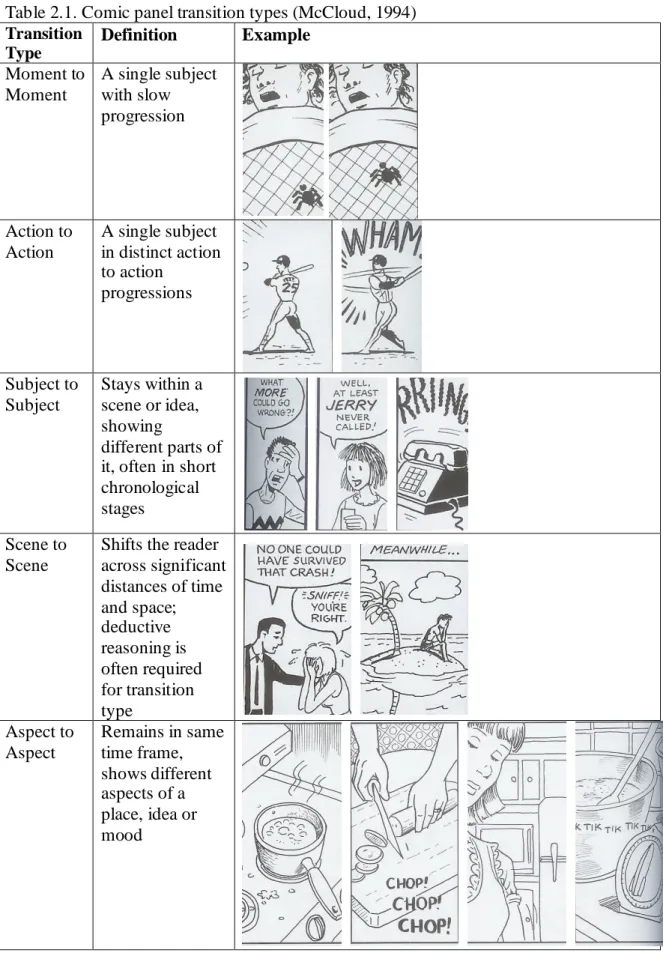
Another aspect that makes Manga comics unique is how they transition from
frame to frame within a comic story. There are five common transition types in comics. Table 2.1 explains each of the transitions. Comics do have patterns in the types of
transitions that are used and how frequent each transition is used. Action,Subjectand Scenetransitions show events of a story happening in concise and efficient ways, which is commonly used in Western comics. In Manga comics,Moment andAspecttransition types are also used. Manga comic books tend to be longer than typical comics as
“being there” as opposed to “getting there”, which creates a unique perspective and vision. TheAspecttransition can create an even deeper sense of “being there”. The
Aspectexample in Table 2.1 shows four frames of a comic in a single kitchen scene. It is clear that the woman is in a kitchen, but as the reader connects the panels together, he/she may begin to use other senses. The reader is more likely to smell, hear, feel and taste
what is going on in the kitchen. The text also may help to create the stimulation of those
senses and increase perceptions of the scene. The unique style and technique of Manga comics tend to promote greater audience participation leading to increased imagery and
use of other senses. These comics tend to focus on establishing a mood or a sense of place. Thus, readers of Manga comics may become immersed into a story and possibly
Table 2.1. Comic panel transition types (McCloud, 1994) Transition Type Definition Example Moment to Moment
A single subject with slow progression
Action to Action
A single subject in distinct action to action
progressions
Subject to Subject
Stays within a scene or idea, showing
different parts of it, often in short chronological stages
Scene to Scene
Shifts the reader across significant distances of time and space; deductive reasoning is often required for transition type Aspect to Aspect
CHAPTER III
THEORETICAL FRAMEWORK III.A. Transportation-Imagery Model
The Transportation-Imagery model (TIM) (Figure 3.1) posits that narrative
persuasion occurs because an individual is ‘transported’ into the narrative world (Green & Brock, 2002). Transportation is defined as “an integrative melding of attention,
imagery and feelings focused on story events” (Green, Garst, & Brock, 2004). TIM applies specifically to narratives, particularly ones that evoke vivid imagery, as opposed
to “didactic rhetoric” (Green & Brock, 2000; Green & Brock, 2002).
Transportation into a narrative world is believed to lead to acceptance of
persuasive messages within a story through multiple mechanisms (Green & Brock, 2002;
Green et al., 2004). The first mechanism is the relationship with characters. If a reader likes or identifies with a specific character, the events experienced or statements made by
the character may have a greater effect in shifting the reader’s beliefs (Green, 2006).
The characters may serve as role models for appropriate behaviors. Furthermore, characters in a narrative may shift beliefs in perceived norms. For example, if a
well-liked television character mentions a preference for healthy foods, viewers may begin to have a positive association towards the food. Characters also help create emotional
responses to narratives. Emotion, which appears to be related to attitude change, is also a major component of narrative impact (Oatley, 2002). Therefore, narratives which create
asserts that identification with the character likely facilitates both transportation and modeling, it is possible that identification may occur separately from transportation.
Identification can be conceptualized as “an audience member imagines
him/herself being that character and replaces his/her personal identity and role as audience member with the identity and role of the character within the text” (Cohen,
2001). This imagination process has both affective and cognitive dimensions. Empathy,
which is characterized by one’s ability to share a character’s emotions, is the most common form of affective identification, while cognitive identification is related to the
reader/viewer’s understanding of a character’s goals and motives and developing an ability to understand the narrative’s events from the character’s perspective (Cohen,
2001).
Transportation may also elicit belief changes by lowering resistance to the
messages in the narrative. Resistance, defined as a reaction against change or a
motivation to oppose persuasive appeals, is a key barrier to changing attitudes and behaviors (Knowles & Linn, 2004). Narratives may be particularly effective at
overcoming resistance as narrative evidence has been shown to be more effective than
fact-based evidence, particularly when messages are not similar to one’s own beliefs, as mentioned in the previous chapter. In addition, individuals seek entertainment products
to meet personal needs, therefore, presenting narratives as entertainment, instead of education, may further enhance the transportation effect. Transportation into the
A third potential mechanism of transportation is coherence, in which a story is logical and consistent. Researchers are learning that readers have different expectations
of a narrative depending on its storyline or genre (M. C. Green, personal communication,
August 2008). While a biography may be expected to describe realistic events, a science fiction narrative may be expected to have more fantastic events. Thus, a consistent and
logical story that meets the expectations of a reader may result in more positive responses
to the story’s messages.
Images have also been frequently used in health communication. TIM suggests
that these images are most impactful when they are embedded in a story, rather than provided in isolation (Green & Brock, 2002), thus visual images relevant to the story’s
messages, such as those incorporated in Manga comics, may further impact attitudes and beliefs.
The three possible mechanisms of transportation combine to facilitate mental
stimulation of new situations (Oatley, 2002). This mental stimulation can serve as a form of “behavioral rehearsal”, which may help change beliefs and behaviors (Gregory,
Cialdini, & Carpenter, 1982). If individuals can imagine themselves going out for a walk
everyday, they may feel more confident in their ability to do so in real life.
The act of being ’transported’ is influenced by multiple factors, which include the
quality and format of the narrative, use of suspense, imagery in the narrative, coherence of the narrative, ability of readers to create vivid images in their minds and propensity for
absorption (Green, Garst, & Brock, 2004; Schank & Berman, 2002). Both factual and fictional narratives have been shown to change beliefs and transportation is proposed as
2004; Strange & Leung, 1999). Green and Brock (2000) found that individuals, who were more transported into the story, reported more story-consistent beliefs, regardless of
the factual status of the narrative they read. Although transportation research has mainly
evaluated narratives in written form, the model suggests that transportation can occur for “any recipient of narrative information” and can be experienced by those who listen or
view narratives (Green & Brock, 2000; Green & Brock, 2002; Green et al., 2004).
III.B. Social Cognitive Theory
Social cognitive theory (SCT), which has informed the design of many behavioral
interventions, highlights another mechanism through which narratives that include characters to whom readers can relate, like Manga comics, could influence
health-behavior change. By observing a role model (observational learning), individuals can learn a behavior and will be more likely to perform it, if they see the model rewarded for
the behaviors in ways that they value (Baranowski, Perry, & Parcel, 2002). The
development of entertainment-education narratives draws greatly on SCT by using role models to perform new behaviors, which aim to improve outcome expectancies, outcome
expectations, behavioral capability and self-efficacy. For example, Rogers et al. (1999)
reported positive effects of a narrative radio soap opera broadcastTwende na Wakati (Let’s Go with the Times)in Tanzania with the intention to change family-planning behavior. Results showed that listeners were able to discern positive, negative and transitional role models and were more likely to identify with the positive role models
portrayed in the program.
As discussed previously, images have been shown to be impactful in conveying
non-graphic materials to capture and focus attention, thereby facilitating observational learning. Graphic literature, including illustrated, entertaining stories such as
photonovellas and comics, has been used to promote healthy behaviors with some
success, using characters and storyline to convey messages to the reader. For example, an internet-based intervention,Fit for Life, focused on promoting physical activity in 10-14 year old Boy Scouts (Jago et al., 2006). Activities included skill building activities at
troop meetings and Internet-based role modeling, goal setting, goal review and problem-solving. There was a weekly animated role-modeling comic in which characters faced
and overcame a physical activity barrier. Results indicated a 12-minute reduction in sedentary behavior approaching significance (p=0.051) and a 12-minute significant
increase in light intensity activity (Jago et al., 2006).
A Manga comic with its storytelling through detailed images and text may
influence the critical SCT constructs associated with behavior change, through
observational learning and transportation.
III.C. Summary
As the rate of childhood obesity remains high, it is important to seek innovative
and wide-reaching methods to connect with youth living in a multi-media world filled with video games, computers and television. Numerous interventions have been
designed to promote healthy behaviors in youth, however, most have resulted in modest positive outcomes and limited reach.
CHAPTER IV
NUTRITION AND PHYSICAL ACTIVITY MESSAGES IN MANGA COMICS: A CONTENT ANALYSIS
IV.A. Abstract
Childhood obesity is a serious public health problem. Multiple factors are
associated with the rise of this epidemic, including media use. Manga comics (Japanese comic art) is a popular form of media among US youth, however, there is no empirical
evidence on obesity-related content in Manga comics. This study content analyzed the
nutrition and physical activity (PA)-related behaviors present in eight popular youth Manga comics. Results showed thatShojo(Girls) comics had more nutrition-containing scenes (N=72 vs. N=39), whileShonen(Boys) comics had more PA-related scenes (N=160 vs. N=!"#$%%&'()(%*(+,(,%*-%.(%/%,011()(+2(%3421=3.26; p=0.07) in frequency of positive and negative nutrition-related%52(+(56%7'08(%/%5 09+0102/+*%,011()(+2(%3421=8.2; p=0.004) in frequency of positive and negative scenes with PA was observed between the comic categories. Fruit and vegetable consumption, family meals and moderate to
vigorous PA were the most frequent positive health behaviors represented, while large portion sizes, consumption of high energy-dense foods and television and screen time
usage were the most frequent negative health behaviors depicted. Findings highlight how
obesity-related behaviors are presented in popular youth Manga comics, which may contribute to our understanding of children’s beliefs and attitudes towards these
IV.B. Introduction
Childhood obesity continues to be a serious public health issue in the US. Over the last three decades, the rate of childhood obesity has tripled, with more than one-third
of 6 to 19 year olds now considered overweight or obese (Ogden et al., 2006). Obesity
has extensive economic, physical and psychosocial consequences, including long-term consequences leading into adulthood (Daniels, 2006; Guo, Chumlea, Roche, & Siervogel,
1998; Guo & Chumlea, 1999; Rolland-Cachera, Bellisle, & Sempe, 1989; Trasande, Liu, Fryer, & Weitzman, 2009; Whitaker, Wright, Pepe, Seidel, & Dietz, 1997).
Multiple factors have contributed to the rise of this complex epidemic resulting in dietary intake patterns and activity-related behaviors that are not in line with national
recommendations and guidelines (Field, 2008; James, Thomas, Cavan, & Kerr, 2004;
Ludwig, Peterson, & Gortmaker, 2001). One factor that has been associated with
childhood obesity is youth’s exposure to media as rates of childhood obesity has risen at
similar time points as the use of television and other forms of media (Escobar-Chaves &
Anderson, 2008). While there is still much to understand in regards to how television and internet may influence youth’s perceptions, other forms of media exist that may also
be shaping children’s attitudes and beliefs towards nutrition and PA behaviors.
One form of media that has yet to be explored is Manga comics (Japanese comic
art). They are a unique form of multimodal narrative media that combine detailed visual images and text. Manga comics are a popular form of entertainment in many countries,
including the US where sales in 2009 topped over $96 million (The Nielsen Company,
narrative (storytelling) format could be effective in influencing attitudes and beliefs. The
Transportation-Imagery Model (TIM) posits that narrative persuasion occurs because an individual is ‘transported’ into the narrative world, which results in “an integrative
melding of attention, imagery and feelings focused on story events” (Green & Brock,
2002; Green et al., 2004). Additionally, images have also been frequently used in health communication. TIM suggests that these images are most impactful when they are
embedded in a story, rather than provided in isolation (Green & Brock, 2002), thus visual images relevant to the story’s messages, such as those incorporated in Manga comics,
may further impact attitudes and beliefs.
Social cognitive theory (SCT) explains how media such as Manga comics could
use observational learning to influence health-behavior change. Readers who relate to
the characters in the comics and see them as role models may be more likely to perform the health behaviors which they model. By observing events or other people displaying
certain behaviors, children may learn undesired health practices. Because storylines in
different media forms, like Manga comics, could influence readers’ knowledge, attitudes and behaviors, it is important to understand what kind of health information is being
conveyed in this form of media. However, to the best of our knowledge, there has been no empirical evidence on obesity-related content in youth Manga comics.
Thus, the purpose of this study was to analyze the nutrition and PA-related content presented in popularShonen(target audience: adolescent boys) andShojo(target audience: adolescent girls) Manga comics in the US and identify the demographic and
IV.C. Methods Sample.
A total of eight popular youth Manga comic books in the US (4Shonenand 4 Shojocomics) across different genres were selected for the content analysis. Popularity of comics was determined by readership circulation. To determine readership circulation of Manga comics, websites of TokyoPop® and Viz Media, the two largest US Manga
publishers, were accessed in January 2009. On these websites, sales of the company’s published Manga comics for different age groups and genres are listed. Manga comics
are also often read on-line, in which Manga fans set up websites where comics are uploaded and can be accessed at no cost. Therefore, three of the most popular on-line
Manga websites were also viewed to determine the most downloadedShonenandShojo Manga comics.
To determine the most popular websites, Manga blogs were visited where simple
questions about the “best” websites to read Manga comics on-line for youth were
presented to Manga fan ‘bloggers’. The three Manga websites we visited were: www.onemanga.com, www.mangafox.com and www.mangahut.com. These Manga
websites have updated data documenting the number of downloads for each Manga comic. The most popular Manga comics were defined as the comics that had the greatest
number of downloads on the day that the website was accessed in January 2009. This information was collated to select the sample of 8 Manga comic books. The selected
Loveless!. Table 4.1 summarizes the storyline for and lists the genres of each selected
comic book. We analyzed the first volume in each of the series.
Measures.
The basic unit of analysis was a scene. A scene change is denoted by a change in
the continuity of action or a disruption in character interaction by other characters or events (Parsons, Rissel, & Douglas, 1999). Each scene containing a nutrition and
PA-related content/behavior (NPCB) was analyzed in the selected sample of Manga comics (Parsons et al., 1999).
The coding instrument developed had three parts. Part 1 focused on descriptive data about the comic book (e.g., title, genre and volume issue). The purpose of Part 2
was to describe each NPCB scene’s content dimensions. This included the type of
content/behavior and message polarity. Part 3 focused on traits of the characters involved. These dimensions are explained in further detail below.
The recommended and suggested targeted behaviors to prevent childhood obesity
devised by the Expert Committee were used as a guide to define what was categorized as a NPCB (Barlow & Expert Committee, 2007). Table 4.2 lists the Expert Committee’s
recommended and suggested targeted behaviors. The polarity of the message was also coded as positive or negative. Positive was defined as a recommended content/behavior
to prevent childhood obesity, while negative was defined as a content/behavior that is positively associated with childhood obesity.
Demographic information of the characters associated with the health content or
determined by the coders coming to together to review a sample of Manga comic
character silhouettes and agreeing upon the silhouettes that best represented each weight category (underweight, normal weight and overweight). Personality traits of the
characters were also collected. Three adjective pairs, that have been used in previous
research to denote traits of characters portrayed in health-related scenes, were used to assess personality traits-smart/stupid, admirable/despicable and powerful/powerless
(Mathios, Avery, Bisogni, & Shanahan, 1998). The possible responses includedVery applicableand Somewhat applicablefor each adjective within the pair. Not applicable was also a response option if the adjective pair did not apply to the situation (Mathios, Avery, Bisogni, & Shanahan, 1998). Similar to determining the definition of weight
status, the coders convened to review a sample of comic characters and scenes in which
they portrayed the selected personality traits. Through multiple discussions and review of sample scenes, definitions of the personality traits were developed and agreed upon by
the coders.
Data Collection.
Two coders were used for the coding process. Multiple training sessions were
conducted in which the two coders pilot coded a sample comic using the developed code book (Appendix A) and coding form (Appendix B). Inter-coder reliability and feasibility
of the coding process was assessed. An inter-coder reliability score of 75% agreement or greater was deemed acceptable to move forward with the data collection process
(Neuendorf, 2002).
any data. Then, the coders coded each scene in the chapter containing NPCB using the
coding form. During this second step, the coders were able to stop and review the chapter as needed to ensure that all relevant information was completely and accurately
recorded. The coder directly inputted data into the electronic form of the coding form to
limit data entry errors. The coders also came together after every two comic books to examine coding reliability. Inter-coder reliability as percent agreement was calculated at
81.0% at the end of the data collection process.
Descriptive statistics, such as the frequency and percentage of positive and
negative NPCB and character demographics of those modeling the behaviors were determined. Chi-squared analyses were also conducted to compare differences in
frequency and polarity of scenes betweenShonenandShojocomics.
IV.D. Results
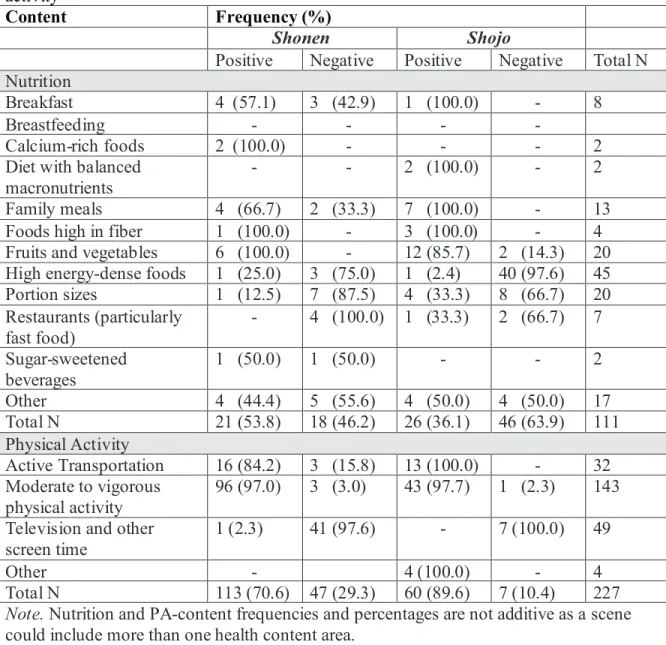
Table 4.3 displays the frequency of NPCB scenes in our sample ofShonenand Shojocomics. The number of nutrition and PA-related scenes significantly differed 3421=36.8; p<0.001) between the two categories of comics asShojocomics had more nutrition-related scenes (N=72 vs. N=39), whileShonencomics had more PA-related scenes (N=160 vs. N=67).
Each NPCB scene was also examined for its polarity (e.g., whether it portrayed a
behavior that was recommended by the Expert Committee). It was not possible to assess the polarity of 28 of the scenes because of its neutrality or because it contained both
positive and negative content. The sample size for each behavior was too small to make
positive and negative nutrition-related scenes between theShonenand Shojocomics (Table 4.3). Slightly more than half (54%) ofShonenand one-third (36%) ofShojo nutrition-related scenes were positive. The most frequent positive nutrition behaviors
depicted in both comic categories were fruit and vegetable consumption and family
meals, while the most common negative nutrition behaviors presented were large portion sizes and consumption of high energy–dense foods inShonenandShojocomics,
respectively.
While there7/5%/%509+0102/+*%,011()(+2(%3421=8.2; p=0.004) in the number of positive and negative scenes related to PA between the two categories of comics, the majority of scenes that included PA content for bothShonenandShojocomics were positive (71% and 90%, respectively). The most frequent positive PA behavior depicted
in bothShonenandShojo comics was moderate to vigorous physical activity (MVPA). However, the frequency of scenes including MVPA was higher inShonencompared to Shojocomics (96 and 43, respectively). The most often presented negative PA behavior for bothShonenandShojocomics was television or screen time usage. However, similar to MVPA frequency, the number of scenes depicting television or screen time usage was
greater inShonencompared to Shojocomics (41 and 7, respectively).
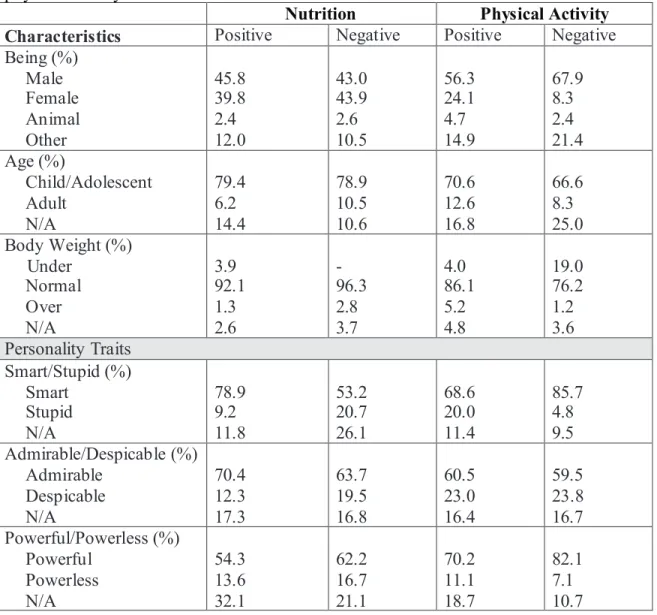
Table 4.4 presents characteristics of comic characters involved in scenes with
nutrition and PA content. Majority of the characters involved in NPCB scenes were children or adolescents, of normal body weight (relative to how body weight is normally
depicted in Manga comics), and were smart, admirable and powerful. Males were
predominantly portrayed in PA-related scenes, regardless of polarity, while there
19% of the characters in negative PA scenes were underweight. There appeared to be no
differences in character demographics or personality traits in positive or negative scenes.
IV.E. Discussion
To the best of our knowledge, this is the first study to examine the nutrition and
PA-content in youth Manga comics. Our results found thatShojocomics contained more nutrition scenes, whileShonencomics had more PA scenes. There also tended to be a difference in the polarity of the nutrition-related scenes withShojocomics presenting more negative nutrition scenes, while a significant difference was observed in the polarity
of scenes with PA content withShonencomics displaying more positive PA scenes. The most frequent positive nutrition behavior depicted in both comic categories
was fruit and vegetable consumption. While fruits and vegetables may have been
presented most often, research has consistently shown that US youth consume well under the recommended amounts of fruits and vegetables (Centers for Disease Control and
Prevention, 2007; Resnicow et al., 1998). The other positive nutrition behavior often
represented was family meals. Previous research has shown that youth who eat meals with their family report healthier dietary practices, such as consumption of breakfast and
fruits/vegetable, in addition to improved psychosocial well-being, while an inverse relationship is found between family meal frequency and childhood overweight
(Fulkerson et al., 2006; Gillman et al., 2000; Neumark-Sztainer, Hannan, Story, & Croll, 2003; Videon & Manning, 2003). About one-half and two-thirds of the nutrition-related
nutrition-related content that does not reflect recommended nutrition guidelines. These results are
consistent with previous studies that have examined nutrition content in other forms of media, such as television or movies (Bell, Berger, & Townsend, 2003; Byrd-Bredbenner,
Finckenor, & Grasso, 2003). Poor dietary habits which are being reflected by the comic
characters and in other media, such as increased portion sizes and consumption of high energy-dense foods have all been associated with childhood obesity (Field, 2008; James
et al., 2004; Ludwig et al., 2001)
Physical activity is a major contributing factor for preventing childhood obesity
(Barlow & Expert Committee, 2007). The majority of PA-related scenes inShonenand Shojocomics were positive, with the most frequent positive behavior for bothShonenand Shojocomics being MVPA. While at least 60 minutes per day of moderate- to vigorous physical activity is recommended (U.S. Department of Health and Human Services, 2000), Nader and colleagues (2008) found that PA decreased significantly between the
ages of 9 and 15 years in US youth with girls dropping below the recommended levels at
a younger age than boys. Thus, the smaller number of positive PA messages embedded inShojocomics may assist in further reinforcing such behaviors by providing a message of limited PA for girls. The most frequent negative PA behavior depicted in both comic categories was television and screen time usage. US youth ages 8 to 18 years spend
roughly 4.5 hours per day watching television (Kaiser, 2010) and a total of 7.5 hours per day using multi-media, including the internet and computers. This amount has continued
to increase over the years, further highlighting concerns related to mixed messages in our
The characters involved in the NPCB scenes most frequently were children or
adolescents, of normal body weight, and were smart, admirable and powerful. The characteristics of the individuals involved in NPCB scenes may be reflective of main
characters in Manga comics in general (Thompson, 2007), but not necessarily reflective
of the U.S. population. For example, majority of the comic characters in our study were of normal weight and some even underweight, while more than one-third of 6 to 19 year
olds in the US are considered overweight or obese (Ogden et al., 2006). Additionally, the personality traits of smart, admirable and powerful represent characteristics that youth
often value or strive to obtain (Cohen, 2006; Schunk, 1986). Interestingly, there were no clear differences in character traits for positive and negative scenes, which further
highlights concerns that the negative behaviors portrayed in Manga comics may be
modeled by readers, particularly as characters can be effective role models when they are perceived to represent what readers wish to be like (Cohen, 2006; Schunk, 1986).
Approximately 19% of the characters in negative PA-containing scenes were considered
underweight, thus inaccurately portraying a serious potential consequence of sedentary behavior.
The images included in Manga comics present information related to important obesity-related behaviors. As a narrative media, Manga comics may provide information
in such a way that the reader is “transported” into the story and responds positively to the story’s messages (Green & Brock, 2002). Such content could provide readers with
important information on recommended behaviors to prevent obesity, like fruit and
consumption of high energy-dense foods or television and screen time use (Barlow &
Expert Committee, 2007).
The findings of this study help to increase our awareness of how important
obesity-related behaviors are presented in popular youth Manga comics, which may
enable health professionals and educators to more fully understand youth’s beliefs and attitudes towards health behaviors. However, it is important to note the limitations of this
study. First, the sample was limited-only eight comics (4Shonenand 4Shojo) were included in the content analysis. Additionally, the sample was too small to determine
differences across genres of youth Manga comics. Finally, only the first volume in each series was included in the sample. It is possible that the first volume may not be
representative of the frequency and types of NPCB that may have been depicted in other
volumes in the series.
Future studies should examine the context of the behaviors that were depicted in
these Manga comics. Furthermore, research should extend beyond content analyses to
examine the perceptions of the readers themselves as the researchers cannot be sure that youth comic readers perceive what the researcher perceives. Despite the limitations of
the study, the findings do highlight how obesity-related information is presented in popular Manga comics and may contribute to our understanding of children’s beliefs and
Table 4.1. Storyline and genres of selected Manga comic books (Thompson, 2007)
Title Genre Storyline
Shonen
Bleach Action, Fantasy A male teenager with the ability to see ghosts is conscripted to fight evil ones and exorcise good ghosts.
Deathnote! Mystery, Suspense A high school male discovers a "Death Note", which has the power to kill anyone whose name is written inside. He attempts to create and rule a world cleansed of evil using the notebook.
Dragonball Comedy, Martial Arts A super-strong monkey-tailed boy is roped into a teenage girl’s quest for the seven mystical Dragon Balls, which when collected will summon a dragon and grant any wish.
Naruto! Action, Adventure, Fantasy
An adolescent ninja searches for recognition and aspires to become a Hokage, the ninja in his village that is acknowledged as the leader and the strongest of all.
Shojo
Fruits Basket! Drama, Fantasy, Romance, Comedy
A teenage orphan girl who lives alone, one day meets a strange family who are cursed to transform into cute talking animals when embraced by anyone of the opposite sex. Kitchen Princess Cooking, Romance An orphan girl with a talent for cooking,
transfers to an academy to follow her dream of being a great chef, and to find her "Flan Prince", a boy who saved her from falling into a river and gave her a cup of flan.
Loveless! Drama, Fantasy, Mystery
A 12 year old latchkey kid is seeking counseling due to child abuse and his older brother’s mysterious death. One day he meets a mysterious young man who once knew the boy’s older brother and vows to protect him.
Vampire Knight Romance, Vampire A girl who was once saved from a vampire when she was young, now attends a
Table 4.2. Expert Committee’s targeted behaviors to prevent childhood obesity
Recommended Suggested
Nutrition
Limiting consumption of sugar-sweetened beverages
Eating a diet rich in calcium
Encouraging consumption of diets with recommended quantities of fruits and vegetables
Eating a diet high in fiber
Eating breakfast daily Eating a diet with balanced macronutrients Limiting eating out at restaurants,
particularly fast food
Encouraging exclusive breastfeeding to 6 months of age and maintenance of it after introduction of solid food to>12 months age
Encouraging family meals in which parents and children eat together
Limiting consumption of energy-dense foods
Limiting portion size Physical Activity
Table 4.3. Frequency of positive and negative scenes related to nutrition and physical activity
Content Frequency (%)
Shonen Shojo
Positive Negative Positive Negative Total N Nutrition
Breakfast 4 (57.1) 3 (42.9) 1 (100.0) - 8
Breastfeeding - - -
-Calcium-rich foods 2 (100.0) - - - 2
Diet with balanced macronutrients
- - 2 (100.0) - 2
Family meals 4 (66.7) 2 (33.3) 7 (100.0) - 13
Foods high in fiber 1 (100.0) - 3 (100.0) - 4
Fruits and vegetables 6 (100.0) - 12 (85.7) 2 (14.3) 20 High energy-dense foods 1 (25.0) 3 (75.0) 1 (2.4) 40 (97.6) 45 Portion sizes 1 (12.5) 7 (87.5) 4 (33.3) 8 (66.7) 20 Restaurants (particularly
fast food)
- 4 (100.0) 1 (33.3) 2 (66.7) 7
Sugar-sweetened beverages
1 (50.0) 1 (50.0) - - 2
Other 4 (44.4) 5 (55.6) 4 (50.0) 4 (50.0) 17
Total N 21 (53.8) 18 (46.2) 26 (36.1) 46 (63.9) 111 Physical Activity
Active Transportation 16 (84.2) 3 (15.8) 13 (100.0) - 32 Moderate to vigorous
physical activity
96 (97.0) 3 (3.0) 43 (97.7) 1 (2.3) 143
Television and other screen time
1 (2.3) 41 (97.6) - 7 (100.0) 49
Other - 4 (100.0) - 4
Total N 113 (70.6) 47 (29.3) 60 (89.6) 7 (10.4) 227 Note.Nutrition and PA-content frequencies and percentages are not additive as a scene could include more than one health content area.
Table 4.4 Characteristics of comic characters involved in scenes related to nutrition and physical activity
Nutrition Physical Activity
Characteristics Positive Negative Positive Negative
Being (%) Male Female Animal Other 45.8 39.8 2.4 12.0 43.0 43.9 2.6 10.5 56.3 24.1 4.7 14.9 67.9 8.3 2.4 21.4 Age (%) Child/Adolescent Adult N/A 79.4 6.2 14.4 78.9 10.5 10.6 70.6 12.6 16.8 66.6 8.3 25.0 Body Weight (%)
CHAPTER V
“HE'D BE A TROUBLE MAKER, BUT WOULD HAVE A HEART OF GOLD.”: FORMATIVE RESEARCH FOR DEVELOPMENT OF A MANGA COMIC PROMOTING HEALTHY EATING IN YOUTH RESPONSES
V.A. Abstract
Innovative interventions addressing childhood obesity are needed to capture the attention
of youth living in a multi-media environment. The purpose of this qualitative study was to inform development of an appealing Manga comic (Japanese comic art) to promote
positive dietary behaviors in youth. Seven focus groups and two interviews (N=28) were
conducted with middle-school students to better understand such topics as enjoyable components of Manga comics and important health concepts. Two researchers
independently reviewed each transcript. Inductive and deductive processes were used to
identify codes (ideas emerging from text); similar codes were grouped into themes. Most frequently mentioned themes related to enjoyable components of Manga comics were
detailed graphics and artistic style of text used to convey sound effects. The majority said eating fruits and vegetables was the most important nutrition behavior for proper
health. When asked about story ideas for a Manga comic to encourage youth to be healthy, many responded with ideas involving comic characters who would consume
fruit, then gain beneficial attributes. Others suggested highlighting more practical
benefits, such as increased focus and energy. Manga comics hold promise for creating an entertaining and informative learning environment that has potential to help promote
V.B. Introduction
Childhood obesity continues to be a serious public health issue in the US. Over the last three decades, the rate of childhood obesity has tripled, with more than one-third
of 6 to 19 year olds now considered overweight or obese (Ogden et al., 2006). Obesity
has extensive economic, physical and psychosocial consequences, including long-term consequences leading into adulthood (Daniels, 2006; Guo, Chumlea, Roche, & Siervogel,
1998; Guo & Chumlea, 1999; Rolland-Cachera, Bellisle, & Sempe, 1989; Trasande, Liu, Fryer, & Weitzman, 2009; Whitaker, Wright, Pepe, Seidel, & Dietz, 1997). Childhood
obesity is a complex epidemic with multiple contributing factors. Poor eating habits, including inadequate intake of fruits and vegetables and increased intake of
sugar-sweetened beverages, have all been associated with childhood obesity (Field, 2008;
James, Thomas, Cavan, & Kerr, 2004; Ludwig, Peterson, & Gortmaker, 2001). Food preferences established in childhood are often maintained into adulthood (Mikkila,
Rasanen, Raitakari, Pietinen, & Viikari, 2004), thus highlighting the importance of
promoting healthy dietary behaviors during childhood and adolescence.
Low cost, large scale interventions are needed to address such a prevalent
problem as many childhood obesity prevention interventions have been too costly to maintain and resulted in modest positive outcomes and limited reach (Thomas, 2006).
Furthermore, innovative programs are needed to capture the attention of youth living in a multi-media environment. Interventions that incorporate narratives may engage today’s
younger population. Narratives, which have been used to change beliefs and inspire
Manga comics, which are Japanese comic art, may be a novel platform to promote
positive health behaviors in youth. They are a unique form of multimodal narrative media that combine detailed visual images and text. Manga comics are a popular form of
entertainment in many countries, including the US where sales in 2009 topped over $96
million (The Nielsen Company, 2010). Because of their popularity, Manga have been used as a form of education-entertainment for topics, such as history, culture, religion and
career advice, around the world (Berfield, 2008; Hodder & Stoughton, 2007; Kaplan, 2007); however to date, Manga comics have not been used for health behavior change
interventions.
Theoretical Framework.
The transportation-imagery model (TIM) explains how narrative communications,
such as Manga, could contribute to changes in health-related beliefs and behaviors (Green, 2006). TIM posits that narrative persuasion occurs because an individual is
‘transported’ into the narrative world (Green & Brock, 2002). Transportation is defined
as “an integrative melding of attention, imagery and feelings focused on story events” (Green, Garst, & Brock, 2004). TIM applies specifically to narratives, particularly ones
that evoke vivid imagery, as opposed to “didactic rhetoric” (Green & Brock, 2000; Green & Brock, 2002).
Transportation into a narrative world is believed to lead to acceptance of
persuasive messages within a story through multiple mechanisms (Green & Brock, 2002;
Green et al., 2004). The first mechanism is the relationship with characters. If a reader
Transportation may also elicit belief changes by lowering resistance to the
messages in the narrative. Resistance, defined as a reaction against change or a motivation to oppose persuasive appeals, is a key barrier to changing attitudes and
behaviors (Knowles & Linn, 2004). Narratives may be particularly effective at
overcoming resistance as narrative evidence has been shown to be more effective than fact-based evidence, particularly when messages are not similar to one’s own beliefs. For
example, Slater and Rouner (1996) found that alcohol-education messages based on anecdotal evidence were considered more persuasive and believable than those based on
statistical evidence among college students whose values differed to the educational messages.
A third potential mechanism of transportation is coherence, in which a story is
logical and consistent. Researchers are learning that readers have different expectations of a narrative depending on its storyline or genre (M. C. Green, personal communication,
August 2008). While a biography may be expected to describe realistic events, a science
fiction narrative may be expected to have more fantastic events. Thus, a consistent and logical story that meets the expectations of a reader may result in more positive responses
to the story’s messages.
Images have also been frequently used in health communication. TIM suggests
that these images are most impactful when they are embedded in a story, rather than provided in isolation (Green & Brock, 2002), thus visual images relevant to the story’s
messages, such as those incorporated in Manga comics, may further impact attitudes and
Social cognitive theory (SCT) highlights another mechanism through which
narratives that include characters to whom readers can relate, like Manga comics, could influence health-behavior change. By observing a role model (observational learning),
individuals can learn a behavior and will be more likely to perform it, if they see the
model rewarded for the behaviors in ways that they value (Baranowski, Perry, & Parcel, 2002). The development of entertainment-education narratives draws greatly on SCT by
using role models to perform new behaviors, which aim to improve outcome
expectancies, outcome expectations, behavioral capability and self-efficacy. A Manga
comic with its storytelling through detailed images and text may influence the critical SCT constructs associated with behavior change, through observational learning and
transportation.
The purpose of this study was to conduct qualitative research that informed the development of an appealing Manga comic to promote positive dietary behaviors, for
preventing childhood obesity in middle-school youth.
V.C. Methods Sample.
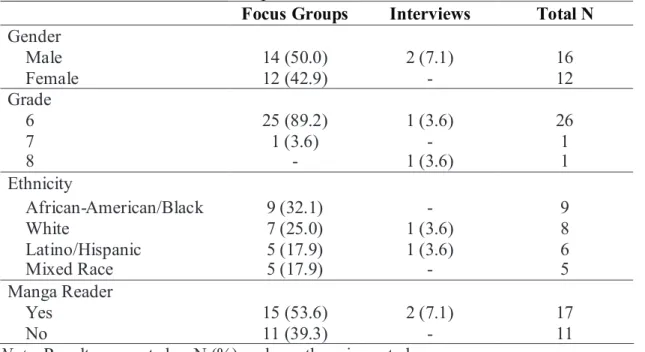
In Spring and Summer 2009, we conducted seven focus group discussions (26 participants total) with sixth to eighth graders in central North Carolina. In addition, two
in-depth interviews were conducted as a result of only one student attending a scheduled group discussion. Recruitment occurred at three middle schools during after-school
programs and gym classes by research staff. The research staff attended the programs
received small gifts (e.g., stationery, water bottles, school supplies) that were valued at
$5. The study was approved by the school districts and the Public Health-Nursing IRB at the University of North Carolina at Chapel Hill.
Data Collection.
The discussion guide (Appendix F) consisted of 30 open-ended questions, probes and follow-up questions, covering topics such as: Manga stories youth prefer to read;
enjoyable aspects of Manga comics; and health concepts youth want to read about. Questions relating to values and ideals of the youth were also included. The
Manga-related questions (eight questions) were only asked to the youth who read Manga comics. Prior to completing the focus groups and interviews, the discussion guide was pilot-tested
by a trained moderator and minor modifications were made based on feedback and
responses. The principal investigator and trained research assistants conducted the discussions and interviews, which lasted approximately 40 to 60 minutes, in a classroom
setting during gym class or after school. Informed consent was obtained from parents,
and informed assent was obtained from students. Prior to the start of the discussion, participants completed a brief socio-demographic questionnaire.
When possible (five out of the seven), focus groups were segmented by gender and grade because previous research indicate that students are more comfortable in
sharing thoughts and opinions related to nutrition and physical activity in similar groups (Leslie et al., 1999; Robbins, Pender, & Kazanis, 2003). Groups were also separated
according to Manga and non-Manga readers. We conducted three focus groups first.
interviews were not intended, however, we took the opportunity to ask the same
questions with the aim to probe for more detail and gain a better understanding of the discussion guide, which helped to refine the questions. The other four focus groups were
then conducted.
Data Analysis.
Focus groups and interviews were audio taped and transcribed verbatim. All
transcripts were reviewed to check for accuracy and completeness against the audiotapes. Transcript texts were loaded into Atlas.Ti, version 5.2, a software program designed to
analyze text-based data. We used inductive and deductive processes to identify codes (ideas emerging from the text), themes (groups of similar codes) and categories (general
domains of information covered).
A preliminary codebook was developed by one researcher upon initial review of the data. The codebook was then reviewed by two researchers to ensure standardized
definitions of the codes. We then independently reviewed each transcript to identify
additional codes and discrete units of text (phrases, sentences, paragraphs) that
corresponded to specific codes. The two reviewers compared their coding and resolved
any discrepancies through discussion and consensus. Upon completion of coding, we merged codes with similar meanings for data reduction. This process also assisted with