AN ARMY OF TEACHERS:
CUBAN WOMEN IN POLITICAL EDUCATION, FROM THE LITERACY CAMPAIGN TO YO SI PUEDO
Ann E. Halbert-Brooks
A dissertation submitted to the faculty of the University of North Carolina at Chapel Hill in partial fulfillment of the requirements for the degree of Doctor of Philosophy in the Department
of History.
Chapel Hill 2017
Approved by: Louis A. Pérez, Jr.
Ó 2017
ABSTRACT
Ann E. Halbert-Brooks: An Army of Teachers: Cuban Women in Political Education, from the Literacy Campaign to Yo Sí Puedo
(Under the direction of Louis A. Pérez, Jr.)
My dissertation examines the role of women in the Cuban Revolution through the lens of the 1961 Literacy Campaign. Using archival sources, print media, oral histories, and other primary source accounts, I argue that the Campaign was a key formative period for the nascent
ACKNOWLEDGEMENTS
This dissertation would not have been possible without the generous support of many individuals and institutions. My research was supported by funding from the Phi Alpha Theta Doctoral Scholarship, the Cuban Heritage Collection’s Graduate Research Fellowship, the Doris G. Quinn Completion Fellowship at the University of North Carolina at Chapel Hill, and the UNC Institute for the Study of the Americas’ Mellon Dissertation Fellowship, Tinker Field Research Travel Grant, and Americas Fellowships. Belkis Quesada Guerra of the Instituto de Historia de Cuba and Shelley Clark of the Institute for the Study of the Americas also provided invaluable assistance in traveling to Cuba to conduct research. I am also grateful to Luisa
Campos Gallardo of the Museo Nacional de la Campaña de Alfabetización who welcomed me to Cuba on my first research trip in 2012, and Catherine Murphy, who opened her archive of interviews about the Literacy Campaign to me.
TABLE OF CONTENTS
LIST OF TABLES ... viii
LIST OF FIGURES ... ix
LIST OF ABBREVIATIONS ... x
INTRODUCTION ... 1
Cuba before the Literacy Campaign ... 4
Structure of the Dissertation ... 12
CHAPTER 1: “THIS WAS ONLY ACCOMPLISHED BY THE REVOLUTION” ... 16
Introduction ... 16
A Rejection of the Past ... 18
Mobilizing Young Adults ... 27
Organizing the Literacy Campaign ... 31
Ideology of the Literacy Campaign ... 39
Conclusion ... 46
CHAPTER 2: THE WORK YET TO BE DONE ... 49
Introduction ... 49
Seguimiento: Lifelong Learning for Men and Women ... 51
FMC: Emulating Earlier Generations ... 61
FMC: Women in a New Era of Cuban History ... 70
Conclusion ... 76
Introduction ... 78
Social Norms Before 1959 ... 81
CDRs and Education ... 86
CDRs and Women ... 98
Conclusion ... 105
CHAPTER 4: IMPELLED TO LEARN AND TEACH ... 108
Introduction ... 108
Parental Approval ... 110
Young Adults Inspired by Revolution ... 117
Personal Independence ... 121
A New Professional Class ... 127
Conclusion ... 133
CHAPTER 5: TESTIMONIOS IN THE ERA OF YO SI PUEDO ... 137
Introduction ... 137
Commitment to the Revolution and a Right to Speak ... 140
Generational Change and Revolutionary Commitment ... 148
Yo Sí Puedo and Cuban Internationalism ... 154
Conclusion ... 160
CONCLUSION ... 162
BIBLIOGRAPHY ... 170
Archives and Manuscript Collections ... 170
Newspapers and Periodicals ... 170
LIST OF TABLES
Table 1: Selected literacy rates across Latin America around 1900 and 1950, as compiled by Javier Núñez. Núñez calculated these rates based on census data collected in different years and attempted to correct for any individuals who were not included in the original census data. In Cuba, for example, he took the official 1899 census figure of 43 percent and argued that it was an under-count, with the true literacy rate closer to 46 percent. By 1950, he found that census data more accurately reflected the demographics of each country. ...5 Table 2: The population of Cuba by province, ca. 1953. Cubans living in rural areas were less
LIST OF FIGURES
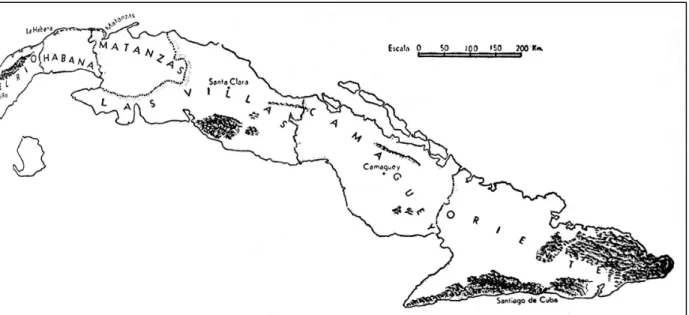
Figure 1: Cuban administrative divisions in the early twentieth century. ... 6
Figure 2: Data on illiteracy rates by province, from the 1953 census. ... 7
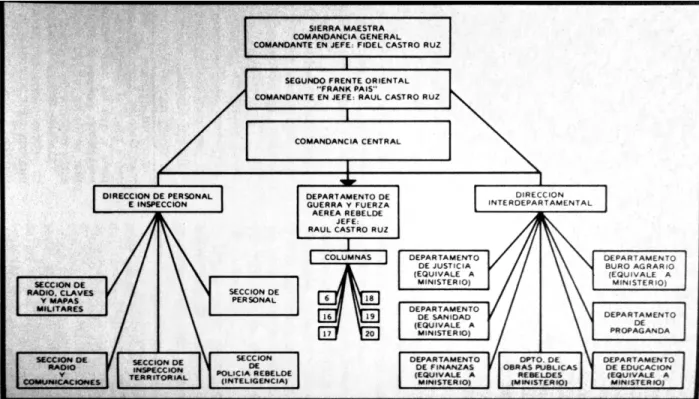
Figure 3: The organization of the Second Front "Frank País" in late 1958 ... 23
Figure 4: An advertisement for maestros voluntarios ... 32
Figure 5: An advertisement for the Conrado Benítez brigadistas. ... 35
Figure 6: The covers of ¡Venceremos! and Alfabeticemos ... 41
Figure 7: An illustration of José Martí from 1961 ... 44
Figure 8: A promotional poster for the Literacy Campaign ... 45
Figure 9: Young brigadistas in the Havana Carnaval parade. ... 46
Figure 10: Adult Education students by type, 1953-4 and 1962-3. ... 55
Figure 11: The logo of the FMC ... 63
Figure 12: CDR membership and number of committees, 1961-1965 ... 90
Figure 13: One typical caricature from the weekly periodical Bohemia. ... 92
Figure 14: As in the Literacy Campaign of 1961, official CDR publications ... 95
LIST OF ABBREVIATIONS
AJR CDR FAR FMC UJC
INTRODUCTION
Since 1959…the works of male writers…have been produced in accordance with the norms of a culture that is not only patriarchal, but also—as a result of the magnificence of the guerrilla struggle and the threats of every sort that menaced the Revolution—a culture that was markedly virile, martial, in which the most prominent topics were “the difficult years,” the war. Thus, the enormous transformations brought about by women’s
incorporation into society were not “interesting,” except insofar as they could be
considered, paternalistically, a concession to women, a concession given to them because the Revolution was generous.1
Accounts of the Literacy Campaign of 1961 often describe it as an achievement for Cuban women, who comprised a majority of the teachers in the Campaign. Photographs from the Campaign concur: young women were a prominent part of the teaching workforce in 1961, appearing in parades, in teaching demonstrations, and in photographs of daily life. Officials asked parents to give their permission for daughters to participate in the Literacy Campaign, promising that they would be protected as they worked. Still, if young women chose to run away from home or forge the signatures of their parents to enroll as teachers, they were able to teach even after the deception became known. Women also comprised the vast majority of all experienced teachers in Cuba in the 1950s and 1960s.2 They were called upon to leave their families—albeit temporarily—to further the Literacy Campaign and, by extension, the revolutionary process begun in 1959.
1 Luisa Campuzano, “Literatura de mujeres y cambio social: narradoras cubanas de hoy.” Reprinted in Las muchachas de La Habana no tienen temor de dios: escritoras cubanas del siglo XVIII al XXI (Leiden: Almenara Press, 2016) 137.
Nevertheless, some of the most visible symbols of the Campaign were men like the martyred teachers Conrado Benítez, Manuel Ascunce, and Delfín Sen Cedre, all of whom were assassinated by counterrevolutionary groups in the Escambray Mountains of central Cuba. Thousands of other young men joined to complete their work, an unprecedented increase in interest in primary education among men.3 This interest in teaching likely drew on the framing of the Campaign. Armando Hart Dávalos, a member of the 26th of July Movement who was
imprisoned for his revolutionary activities, served as Minister of Education and oversaw the project, and Fidel Castro first announced the project, supervised it on a national scale, and was featured in the literacy textbook in writing assignments like the one that directed students to copy out the phrase “united, both old and young, we vow with Fidel: together we will defend Cuba. They will never defeat us!”4 Fictionalized accounts of the Literacy Campaign like Humberto Solas’ 1968 film Lucia and Octavio Cortázar’s 1977 film El Brigadista also feature young men as symbols of the Revolution and the young adults it sought to create.
Despite this martial framing of the Literacy Campaign, young women chose to teach. Furthermore, their work implicitly refuted the idea that their later professional success was a “concession to women, a concession given to them because the Revolution was generous:” young women defied traditional authority figures to join the Campaign, stepped into positions of authority while teaching on the Campaign, and returned from their work with the expectation
3 Though many young adults went on to careers in other fields, it is still notable that young men were recruited in nearly equal numbers for the 1961 Literacy Campaign. In 1953, for example, just 5,777 of the 36,815 elementary schoolteachers in Cuba were men. This gender imbalance persisted among secondary and higher education instructors, suggesting that education was seen as a women’s profession. Oficina Nacional de los Censos Demográfico y Electoral, Censos de población, viviendas y electoral, Table 54, p. 204.
that they had earned access to higher education.5 Furthermore, their work shaped the Cuban state. The revolutionary government needed the labor of young women in the Literacy Campaign to demonstrate that it could effectively deliver social services to all Cubans. The templates that it used to mobilize those young women were adopted by other parts of the Cuban state in
subsequent years to further consolidate their position in Cuban society. Lastly, by focusing on the early years of the Cuban Revolution through the lens of the 1961 Literacy Campaign—a project carried out largely by women and unambiguously one of the “enormous transformations” of that decade—it is possible to explain its lasting significance to participants who have
remained involved in the revolutionary project.
This tension between the male symbols of the Campaign and its female workforce has played out in various forms since the project was officially announced in 1960. During the Campaign itself, it often took the form of women like the Minister of Education for the Rebel Army Asela de los Santos ceding her position to Armando Hart, and young women requesting the permission of their parents to teach. Following the Campaign, young teachers were granted scholarships to enable them to move into the workforce rather than becoming housewives. They were also given special access to the government through organizations like the Federación de Mujeres Cubanas (FMC), where their gender was an explicit requirement for membership, and Comités de Defensa de la Revolución (CDR), where their work was represented on a national stage by men. Despite this, individual women found the Literacy Campaign a liberating
experience, and in the twenty-first century their testimonios have helped to bring new attention to the 1961 Campaign and the contributions of women in the Cuban Revolution. The rise of
women’s testimonios about the Literacy Campaign and the contemporary focus on the work of women like the 1961 Campaign veteran Leonela Relys in Yo Sí Puedo represent a distinct shift toward highlighting women’s narratives of the Cuban Revolution, enabling women to benefit from the revolutionary project and claim to have played an integral role in it, a role that is worthy of respect and admiration by later generations.
Cuba before the Literacy Campaign
In his study of political culture and the Cuban Revolution, Richard Fagen observed “that if the revolutionary leadership was as committed as it seemed to be to achieving a fundamental reorganization of Cuban society...the historic importance of the Cuban case would revolve not around the guerrilla struggle but around the way the revolutionary leadership was going about accomplishing the massive redistribution of goods, services, and opportunities.”6 This
redistribution was portrayed as a continuation of the guerrilla struggle; just as Fidel Castro led the Rebel Army to military victories against the U.S.-backed government of Fulgencio Batista, he would also lead redistribution efforts to return control of property, schools, and utilities to Cubans. These institutions could then be called upon to respond to domestic needs. Like Fagen, other observers of the Cuban Revolution were impressed with the speed with which the
revolutionary government attacked problems that it viewed as priorities: issues like property ownership, electricity and telephone utilities, rents, and access to education. Some of these changes, like rent control laws, were promulgated quickly and helped to cement support for Fidel Castro and the 26th of July Movement. These reforms benefitted both men and women, and did not necessarily challenge gender norms through their implementation. Other reforms, like the expansion of educational access and elimination of illiteracy, required a labor force that could
travel to communities without schools and establish them. They were carried out with the active participation of women, challenging gender norms in the process.
The Literacy Campaign of 1961 was the beginning of this effort: an ambitious project to increase adult literacy rates in Cuba from the 78 percent recorded in the 1953 census to universal adult literacy before the beginning of 1962. In the process, it would confirm that the
revolutionary government was committed to long-term change and social equality. The Campaign was ambitious in its timeline, but also indicative of how the revolutionary government sought to hold itself to a higher standard than other nations. In a regional context,
Cuban literacy rates and
educational access were, if not the highest in the region, among the highest as illustrated in Table 1.7 Literacy rates had also increased rapidly since Cuba received its independence in the early
twentieth century. Nevertheless, by the late 1950s the Cuban public decried what many saw as
unacceptably low literacy rates. In particular, many Cubans found it unacceptable that access to education was sharply curtailed by geography, with residents of cities like Havana having access to education, while those living in rural, often mountainous areas of Pinar del Rio, Las Villas,
7 Javier Núñez, “Signed with an X: Methodology and Data Sources for Analyzing the Evolution of Literacy in Latin America and the Caribbean, 1900-1950,” Latin American Research Review 40 No. 2 (June 2005): 127, 130.
Table 1: Selected literacy rates across Latin America around 1900 and 1950, as compiled by Javier Núñez. Núñez calculated these rates based on census data collected in different years and attempted to correct for any individuals who were not included in the original census data. In Cuba, for example, he took the official 1899 census figure of 43 percent and argued that it was an under-count, with the true literacy rate closer to 46 percent. By 1950, he found that census data more accurately reflected the demographics of each country.
Literacy Rates,
ca. 1900 Literacy Rates, ca. 1950
Argentina 55% 86%
Bolivia 16% 32%
Brazil 29% 49%
Chile 32% 80%
Cuba 46% 78%
Jamaica 43% 72%
Mexico 21% 57%
Puerto Rico 18% 74%
and Oriente provinces often lived far from schools and teachers. Fidel Castro and other members of the revolutionary government concurred, and proposed that universal adult literacy would establish Cuba as a regional leader in the field of education by demonstrating that it could educate its most marginalized citizens.
Urban 152,861 1,406,025 231,737 511,535 307,385 715,085
Rural 295,561 132,778 164,043 518,627 310,871 1,082,521
Province Pinar del Rio Havana Matanzas Las Villas Camagüey Oriente
Table 2: The population of Cuba by province, ca. 1953. Cubans living in rural areas were less likely to have access to schools or other social services.
These marginalized citizens, particularly the residents of rural areas in Oriente province in eastern Cuba, were a bastion of support for Fidel Castro as he and the 26th of July Movement before they took power in January 1959.8 By the late 1950s, Cuba had a population of more than
8 Cuban provinces were laid out in 1879 and subdivided in 1976 into their contemporary administrative divisions. The image in Figure 1 above is drawn from Levi Marrero, Geografía de Cuba, 5th Edition (Miami: Moderna Poesía, 1981) 385. Population data is drawn from the Cuban census of 1953, Oficina Nacional de los Censos Demográfico y Electoral, Censos de población, viviendas y electoral, Table 12, p. 21-22.
4 million. One quarter of those lived in the city and
surrounding province of
Havana, where they had access to many of the best schools. Another quarter of the national population lived in Oriente, the poorest province which also had the lowest literacy rates and access to schools, as shown in Figure 2.9 Teachers recruited to work in regions like Oriente would be confronted with some of the most extreme poverty in Cuba in 1961, and bring the skills necessary to begin lifting their fellow citizens out of it.
This dissertation seeks to evaluate the conclusions of scholars like Richard Fagen about the Literacy Campaign from a historical perspective from the vantage point of more than five decades after the 1961 Campaign.10 Few observers have questioned the overall efficacy of the
9 Oficina Nacional de los Censos Demográfico y Electoral, Censos de población, viviendas y electoral, Table 40, p. 143-148.
10 Fagen, The Transformation of Political Culture in Cuba. Other scholars who have examined the Literacy
Campaign from the disciplines of political science include Jorge I. Domínguez, who offered a wider-ranging view of major revolutionary institutions, ranging from the CDRs to the FMC, youth organizations, the Communist Party, and the army in Cuba: Order and Revolution (Cambridge: Belknap Press, 1978). This wider scope provides a useful picture of the changes that had affected life in Cuba since 1959, but it could be taken to imply that the Cuban government and all of its associated organizations formed a monolithic revolutionary state. This was not true of Cuba in the early 1960s. Cuban scholars writing on the Literacy Campaign have included Ana Núñez Machín, La Epopeya: historia de la campaña de alfabetización (Havana: Editorial de Ciencias Sociales, 1983); Ana Angélica Rey Díaz, Conrado: primer maestro mártir (Havana: Editorial Política, 1987); Felipe de Jesús Pérez Cruz, La Alfabetización en Cuba: lectura histórica para pensar el presente (Havana: Editorial de Ciencias Sociales, 2001); Flora B. Lescaille, Alcira M. Sánchez, María M. Rodríguez, and María de las Nieves Fonseca, Conrado Benítez: Tras las huellas del maestro voluntario (Havana: Editorial de Ciencias Sociales, 2002); Águeda Pérez García, Una proposición cubana de alfabetización desde posiciones de género y ruralidad (Havana: Editorial de Ciencias Sociales, 1979); Jaime Canfux Gutiérrez, Hacia una escuela cubana de alfabetización (Havana: Editorial Pueblo y
10% 11% 6% 19% 12% 42%
Illiteracy by Province, ca. 1953
Pinar del Río Havana
Matanzas Las Villas Camagüey
Oriente
Literacy Campaign as a project to raise literacy rates in Cuba. Furthermore, comparative studies of literacy campaigns have argued that the 1961 campaign in Cuba may be the most successful literacy campaign since the Protestant Reformation.11 Looking beyond literacy rates, the
institutions of Cuban government indicate that the Campaign was a success as well. The Ministry of Education invested heavily in adult literacy classes in the early 1960s, but these courses became largely unnecessary as literacy rates rose and students could transfer into the regular school system. Other institutions also bear out this thesis, and demonstrate that the Literacy Campaign succeeded in other ways as well, gaining influence over daily life in the immediate aftermath of the Campaign.
Earlier scholarship proposed that the Literacy Campaign functioned as a proving ground for the revolutionary government as it sought to gain and maintain the support of the Cuban public despite opposition from the United States and domestic counterrevolutionary insurgents. Fagen, for example, cited the Literacy Campaign, CDRs, and Escuelas de Instrucción
Revolucionaria as key institutional sites in the creation and consolidation of support for the revolutionary government. The Literacy Campaign did serve as a crucial test of the revolutionary government’s organizational capacity. The role of CDRs in Cuban life has likewise been
Educación, 2007); Luisa Campos Gallardo, Oscar Yanes Álvarez, and Rubén Darío Zayas Montalván, Yo soy el maestro (Havana: Editorial Pueblo y Educación, 2008); José Suárez Amador, Maestros de verde olivo (Havana: Editorial de Ciencias Sociales, 2009). Jonathan Kozol and, more recently, Mark Abendroth have also examined the Literacy Campaign in the context of the history of education. Kozol, “A New Look at the Literacy Campaign in Cuba,” Harvard Educational Review 48, No. 3 (1978): 341-377; Kozol, Children of the Revolution: A Yankee Teacher in the Cuban Schools (New York: Delacorte Press, 1978); Mark Abendroth, Rebel Literacy: Cuba’s National Literacy Campaign and Critical Global Citizenship (Duluth: Litwin Books, 2009).
confirmed, with the committees taking on many roles as needed by the national leadership. This dissertation will begin to examine the ways in which CDRs evolved to meet these needs,
focusing only on the immediate aftermath of the Literacy Campaign of 1961 and women, the protagonists of the Literacy Campaign. Escuelas de Instrucción Revolucionaria, in contrast, did not achieve the same levels of influence throughout the Cuban populace as CDRs, the Ministry of Education, or the FMC, other institutions involved in the Literacy Campaign and discussed in this dissertation.
Because he wrote from the United States, many of the young teachers in the Literacy Campaign were quickly caught up in subsequent projects and their own professional careers, and because many of the young adults who were most affected by the Literacy Campaign were women—a gendered component to revolutionary change that Fagen did not address—the familial conflict engendered by the Literacy Campaign and its institutional successors did not appear in early analyses of the project.
realized.12 Accounts like those of Margaret Randall also suggested that women were particularly impacted by the Cuban Revolution, but feminist scholars debated the degree to which it had actually offered institutional support for women’s equality.13 As women were both a majority of the teachers in the 1961 Literacy Campaign, the Campaign was a potentially important and overlooked case study in this debate.14
It is possible and necessary to reevaluate the importance of the 1961 Literacy Campaign in the twenty-first century in part because of the renewed interest in the project from within Cuba. Young adults undoubtedly found some experiences in the Literacy Campaign difficult or “explicitly sanction[ing] the sexual roles and images of men and women consecrated in
patriarchal society…[and] traditional rules of conduct,” as some scholars argue occurred in daily work in the Literacy Campaign, these elements appear to be outweighed in the narratives
12 Douglas Butterworth, a North American colleague of Oscar and Ruth Lewis, collaborated with them on an oral history project in Cuba beginning in 1969. Based on his work, Butterworth observed that “most of the former Las Yaguas families [residents of a notorious Havana slum] had not lived up to the ideals of the Revolution,” though their lives improved in regards to food security, healthcare, and housing. Douglas Butterworth, The People of Buena Ventura: Relocation of Slum Dwellers in Postrevolutionary Cuba (Urbana: University of Illinois Press, 1980) 140. Some of this research was published in the series Living the Revolution: Four Men, Four Women, and Neighbors. These three volumes focused on the biographies of eight individuals and a profile of a small apartment building in the Miramar neighborhood of western Havana. To preserve the anonymity of their research subjects, Lewis and Butterworth used pseudonyms for interviewees and the developments where they lived. This dissertation uses the pseudonyms assigned by Butterworth and Lewis. Oscar Lewis, Ruth M. Lewis, and Susan M. Rigdon, Living the Revolution: Four Men (Urbana: University of Illinois Press, 1977); Oscar Lewis, Ruth M. Lewis, and Susan M. Rigdon, Living the Revolution: Four Women (Urbana: University of Illinois Press, 1977); Oscar Lewis, Ruth M. Lewis, and Susan M. Rigdon, Living the Revolution: Neighbors (Urbana: University of Illinois Press, 1978). 13 Like Butterworth, Margaret Randall arrived in Cuba in 1969, but her research and interviews focused on women who were better integrated into the revolutionary project. Maxine Molyneux, meanwhile, studied socialism from a comparative perspective from outside of Cuba, and became more critical of the promise of socialism for women over time. Randall, Cuban Women Now: Interviews with Cuban Women (Toronto: The Women’s Press, 1974); Molyneux, “Socialist Societies Old and New: Progress Towards Women’s Emancipation?” Feminist Review No. 8 (Summer 1981), pp. 1-34; Molyneux, “Family Reform in Socialist States: The Hidden Agenda,” Feminist Review No. 21 (Winter, 1985), pp. 47-64.
individuals told in the twenty-first century.15 Former literacy teachers, many of them women, joined in a general debate about the value of the Cuban Revolution in the 1990s and 2000s, when the “Special Period” led to drastic declines in standards of living on the island. Adults whose careers had been nurtured through scholarships and dedicated to revolutionary projects were confronted with the reality that conditions in Cuba would not continue improving, and that younger generations did not share their idealism or commitment to the Revolution. To explain their commitment to the Revolution and argue for younger generations to dedicate themselves to the same principles, former literacy teachers began to recount their experiences in the early 1960s for a younger audience.
The Cuban government also found new meaning in the Literacy Campaign, employing it as an intellectual antecedent of the “Yo Sí Puedo” literacy program exported to Haiti in 1999, Venezuela in 2003, and subsequently to other countries. As with Cuban medical missions, which formally began in the early 1960s with the dispatching of doctors to Chile in the aftermath of a 1960 earthquake but took on a new importance during and after the “Special Period.” Where scholars like Jorge Domínguez asserted that the Cuban government of the 1960s, 1970s, and 1980s employed internationalist humanitarian missions of doctors and teachers as a subordinate arm of its military goal of promoting revolution, by the 1990s and 2000s military objectives were no longer feasible.16 The survival of the Cuban Revolution became linked to the degree to which it could offer a skilled workforce of teachers and doctors to other developing nations. In some cases, as with doctors in Venezuela and Brazil, this exchange was explicitly one for oil and cash
15 Luisa Campuzano, “Cuba 1961: los textos narrativos de las alfabetizadoras. Conflictos de género, clase y canon,” Reprinted in Las muchachas de La Habana no tienen temor de dios (Leiden: Almenara Press, 2016) 124.
to support the Cuban economy. In others, as with Cuban missions of doctors and teachers in Haiti, there is less expectation of direct economic remuneration. Efforts to redefine the Cuban Revolution as a proponent of literacy efforts in developing nations also benefit from real connections between “Yo Sí Puedo” and the Literacy Campaign of 1961, most notably in the person of Leonela Relys, a teacher in the 1961 Campaign and the architect of the curriculum, and other leading educational scholars like Jaime Canfux Gutiérrez, another teacher in 1961 who has written extensively on the 1961 Campaign and “Yo Sí Puedo.”17
In this way, some teachers from the 1961 Campaign have explicitly answered the
question posed in the “Special Period” about the importance of the Cuban Revolution as a whole, creating a legacy for the teachers of 1961 in more recent pedagogical scholarship. However, this pedagogical scholarship has also obscured important aspects of the 1961 Campaign’s origins and immediate impact, particularly its origins in the Rebel Army and its role in normalizing a
militant revolutionary culture visible in organizations like the FMC and CDRs in the early 1960s. As a result, it is valuable and necessary to reevaluate both the short- and long-term impacts of the Literacy Campaign to understand the varied meanings of literacy education and mobilization in revolutionary Cuba.
Structure of the Dissertation
This dissertation analyzes the Literacy Campaign at two points in time: from its immediate aftermath in the early 1960s, when its institutional origins and effects were most pronounced, and its long-term effects that have become clearer since the 1990s. It opens with an examination of the pedagogical and institutional origins and goals of the Literacy Campaign of
1961. While propaganda from the revolutionary government promoting the Literacy Campaign emphasized that the Revolution was a break with the past, the beginning of a new era when “we can tell all of the men who died in our struggles for liberty that at last we have arrived at the hour in which their dreams will be realized,” and the goals of nineteenth-century nationalists like José Martí and Mariana Grajales would be fulfilled.18 Nevertheless, the Literacy Campaign drew on older literacy projects like the Triennial Plan organized by Fulgencio Batista in the 1930s and the work of North American Christian missionaries. The Literacy Campaign of 1961 was a far more ambitious project than its institutional and pedagogical forbears, though, recruiting more than 250,000 teachers in an attempt to eliminate illiteracy by the end of 1961 and prepare newly literate Cubans for classes that would bring them to full functional literacy in 1962 and beyond.
Next, I turn to two institutions in the Cuban revolutionary state, the Ministry of Education and the FMC, to analyze how these institutions that played key roles in the 1961 Literacy
Campaign approached women’s education and mobilization during and after the Campaign, when women comprised a majority of all professional and volunteer teachers in Cuba. The Ministry of Education and the FMC sought to bring women from all socioeconomic classes into the workforce, and their methods of doing so often relied on gender-specific recruiting. In the case of the Ministry of Education, this meant recruiting domestic workers and offering them training that allowed them to move into white-collar and technical jobs. In the FMC, this took the form of an increase in daycare centers across the country and an emphasis on women’s
obligation to work outside the home even if her husband did not support that work. These two institutions shared a similar mission, but their vision of the revolutionary citizen in society was
18 Fidel Castro Ruz, “Speech given at at Parque Céspedes,” Santiago de Cuba, 1 January 1959. Available online at
fundamentally different: where the Ministry of Education mobilized women into education and the workforce on the basis of their individual needs and relationship to the larger society, the FMC addressed women as members of a nuclear family unit that mediated their relationship to the rest of the revolutionary state.
In his 1969 study, Fagen identified the CDRs as site for the creation and propagation of revolutionary political culture. Like the Ministry of Education and the FMC, CDRs were an integral part of the 1961 Literacy Campaign, saw a dramatic increase in membership over the course of the Campaign, engaged in educational activities with a political message, and explicitly encouraged women’s participation. However, because they positioned women as teachers and arbiters of revolutionary culture and values, CDRs challenged contemporary gender norms in potentially alarming ways. Where the reputations of ideal middle- and upper-class Cuban woman had once been subject to scrutiny by predominantly male observers, with figures like chaperones safeguarding their honor, after 1960 CDRs empowered these same women to act as gatekeepsers of rumor and gossip in the community, observing their neighbors and bolstering or undermining their reputations as good revolutionary citizens. Because the Literacy Campaign was the first major project of the CDRs, it offers a view of both how the Campaign influenced the institutions that worked on it and the ways in which it influenced gender norms among its participants.
In 1961 they responded critically to propaganda for the Campaign, employing it as a means to assert their agency. Patriotism and enthusiasm for the revolutionary project were major motivating factors for teachers and their parents who gave them permission to leave home, but they were hardly the only reason. Often, young adult teachers drew on their budding political consciousness formed around events like the 1960 explosion of La Coubre or their experiences in the guerrilla struggle of the 1950s in choosing to volunteer for the Literacy Campaign. They also joined with the expectation that their work would have positive effects on their careers after 1961, offering them access to higher education, professional certification, and employment. Accounts of the Literacy Campaign from these teachers emphasize their role as agents in the revolutionary process and the degree to which the Cuban Revolution nurtured the ambitions of young men and—to an even greater degree—young women.
Since the “Special Period” of the 1990s these young female teachers have reasserted the importance of their work as well. Women and men who taught in the Literacy Campaign of 1961 have expressed a new interest in discussing their experiences in the Campaign and articulated a consensus that their work in the Campaign bolstered their faith in the revolutionary project, gave meaning to their later work, and offered a justification for their continued support for the
revolution even as younger generations sometimes questioned its long-term accomplishments. The Cuban government, meanwhile, has found former teachers’ interest in discussing their experiences useful because they support the idea that a key part of the Cuban Revolution is a commitment to internationalist service, whether by doctors or by teachers in the “Yo Sí Puedo” literacy missions. The bridge between these two groups is a group of men and women who began their teaching careers in 1961, and went on to design and work on “Yo Sí Puedo” literacy
CHAPTER 1: “THIS WAS ONLY ACCOMPLISHED BY THE REVOLUTION” REORGANIZING CUBAN SOCIETY THROUGH LITERACY
Introduction
On September 26, 1960, Fidel Castro spoke at the United Nations in New York City. The speech—the longest in the history of the United Nations—was part of a visit that drew
international attention to the aspirations of the new government that had taken power in Cuba the year before. Castro and the rest of the Cuban delegation had come to New York on September 18. Just a few days before the Cubans were set to arrive, U.S. officials announced that the entire Cuban delegation would be confined to the island of Manhattan. The restriction reflected the heightened tensions between the United States and Cuba, with New York papers observing that the Cubans would have the same travel limitations as the delegates from the Soviet Union. In light of the tensions between Cuba and the United States, the management of the midtown hotel where the Cuban delegation planned to stay appeared uneasy, and Castro abandoned the hotel on September 19. The majority-white Cuban delegation relocated to the Theresa Hotel in Harlem, far from most of the other U.N. delegations. English-language newspapers described the move as “a dramatic gesture in a campaign for the support” of African Americans, whom Castro
described as fellow victims of U.S. domestic and international imperialism.1 Upon moving to Harlem, Castro arranged meetings with African-American leaders like Malcolm X to illustrate his point about transnational and Third World solidarity to the press and the public, while Cuban
papers announced that these meetings included heartfelt expressions of “solidarity and support” from Harlem, which was—like Cuba in 1958—a “case of dynamite” created by U.S. policy.2
In the U.N. speech itself, Castro critiqued the international status quo in an “opening salvo in what may be regarded as the death of imperialism.”3 Castro focused on the way wealthy countries held poorer ones in their thrall by controlling access to trade, education, and medical care. Dismantling the imperialist status quo in Cuba, he argued, required changes on all of these fronts. One of the concrete policy proposals embedded in that speech was set to have an
immediate impact: Castro proposed to eliminate illiteracy in Cuba before the beginning of 1962. Castro gave few specifics about the Literacy Campaign in his speech in New York, but informed observers recognized that he proposed an ambitious, yet achievable goal for his country.4 Cuba had a literacy rate of 76 percent at the time of its last census in 1953, on par with wealthier Latin American countries and higher than many larger and poorer ones.5 This placed Cuba in a
favorable position relative to many Latin American nations, but still behind wealthier nations. In the United States, for example, 98 percent of the population had attended school.6 As Castro acknowledged, bringing basic literacy to the more than 1 million illiterate Cubans would not undo imperialism, but if the Literacy Campaign was successful supporters believed it would
2 Max Frankel, “Cuban in Harlem,” The New York Times, 20 September 1960, 16; “Organizaciones negras con nuestra Revolución,” Revolución, 20 September 1960, 14.
3 Juan Arocha, “Fidel en la ONU,” Revolución, 15 September 1960, 2.
4 Contemporary pedagogical experts like Paulo Freire estimated that a small class taught by professional literacy teachers could achieve a first-grade reading level within 2 months. While Freire himself was not a direct influence on the Literacy Campaign, he employed many of the same techniques as the eventual Cuban Literacy Campaign of 1961. His findings on literacy education were later published in Pedagogy of the Oppressed (New York: Herder and Herder, 1971).
5 Argentina and Mexico, for example, had literacy rates of 86 and 57 percent in 1950, respectively. Oficina Nacional de los Censos Demográfico y Electoral, Censos de población, viviendas y electoral (Havana: Tribunal Superior Electoral, 1953), Table 40, p. 143; Javier Núñez, “Signed with an X: Methodology and Data Sources for Analyzing the Evolution of Literacy in Latin America and the Caribbean, 1900-1950,” In Latin American Research Review 40: No. 2 (June 2005): 130.
begin to offer all Cubans the opportunity to access primary, secondary, and higher education regardless of race, gender, or economic background. In the process, students would also develop skills that were prerequisites for work as doctors, engineers, and technicians in a modern
economy free of foreign control.
In Cuba, meanwhile, the populace had spent the previous nineteen months seeing drastic changes that altered day-to-day life and the terms of political discourse. Castro and his
comrades-in-arms were a frequent sight around the country. So too were the young adults recruited into groups like the Asociación de Jóvenes Rebeldes (AJR), a junior division of the Rebel Army for men and women between the ages of 17 and 19. The Literacy Campaign Castro announced in September 1960, though, was far larger than what current members of the
revolutionary government could oversee, with teachers needed in every part of the country. The scope of the Literacy Campaign would also necessitate unprecedented disruptions in the day-to-day life of most citizens, but achieving universal adult literacy would confirm that the
revolutionary government that took power in January 1959 had a firm grasp on power in Cuba, with the capacity to reorganize and mobilize Cuban society, and particularly young adults, in ways that previous governments had failed to do.
A Rejection of the Past
contemporary Cuban life.7 However, the 1961 Literacy Campaign broke with these examples in its emphasis on achieving universal adult literacy at a first-grade reading level in the space of months, not a steady increase in literacy rates over the course of several years. Teaching 1 million Cubans to read and write between the fall of 1960, when pilot groups of teachers were sent to the first placements, and December 1961, when the Campaign concluded, required the revolutionary government to develop a functional, national ministry of education almost overnight from early work by Rebel Army officers, with investigators and teachers in every community, as well as infrastructure and support personnel to assist them.
One long-term educational project echoed in the 1961 Literacy Campaign was the Triennial Plan, an initiative designed by Fulgencio Batista during the presidency of Federico Laredo Brú in the late 1930s. The plan sent sergeants enlisted in the Cuban Army to villages to teach children and adults to read and write. Cuban men with advanced degrees were recruited into the army to join this selective group of teachers, where they were trained in the latest pedagogical techniques and sent to rural areas to serve out their term of enlistment. In the rural communities, their goal was to requisition materials to build a schoolhouse, then to educate all of the children and adults in the village. Organizers may have anticipated resistance to their plan; sergeant-teachers were authorized to force children into their schools even over the objections of their parents.8 Observers from urban areas and abroad viewed the project favorably, but the recruitment of qualified sergeant-teachers was difficult and no plans were made to continue the schools under future governments. A decade later, after the project had been discontinued, rural
7 Robert F. Arnove and Harvey J. Graff, “Introduction,” in National Literacy Campaigns: Historical and Comparative Perspectives (New York: Plenum Press, 1987) 2.
literacy rates remained low, with one sociologist working with the ministry of the interior observing that “Cuba may easily lose its present favorable ranking in the course of the next few years unless efforts are made immediately to improve school attendance for children and to provide new opportunities for adults to learn to read and write.”9 While the Triennial Plan showed some promise, it was not a long-term success.
Fulgencio Batista, who had been a part of Laredo Brú’s government, tried to revive these rural education programs in the mid-1950s, with a focus on both existing schools and the
construction of new ones. Under his government, rural schools merited special attention and a dedicated government department, headed by Blanca Rosa Urquiaga. Urquiaga oversaw 5,000 elementary schools in rural areas, as well as more than 3,000 adult education centers.10 These centers were distributed throughout the country, following the number of illiterate Cubans in each region. Oriente, for example, had just a 50 percent literacy rate among residents of its rural areas.11 In the 1953-54 school year, 856 schools were in operation in the province, serving more than 23,000 students. Overall, between 1952 and 1958, his government also claimed credit for building 370 new schools at which 2756 students learned to read and write.12 These initiatives were laudable, but with more than 1 million illiterate Cubans throughout the country they offered incremental progress in the face of an increasing national population.13 Economists also warned
9 Lowry Nelson, Rural Cuba (Minneapolis: University of Minnesota Press, 1950) 244.
10 4663 of the 4697 schools listed in the annual report on rural education were classed as Escuelas de Enseñanza Primaria-Elemental. Anuario estadístico de la enseñanza rural: Curso escolar 1953-1954 (Havana: Ministerio de Educación, 1955) 5 and 15.
11 Oficina Nacional de los Censos Demográfico y Electoral, Censos de población, viviendas y electoral, Table 40, p. 147.
12 “Realizaciones del Gobierno de FBZ: Cultura Popular,” Batista Collection, Series VI, Cuban Heritage Collection, University of Miami.
that population growth and the school system were ongoing problems, indicative of “unused potential” in an under-educated Cuban workforce.14 The same rural teacher shortages that drove the rural education program were a key factor, as were students who were “eager to learn but discouraged by immediate economic difficulties and poor prospects” if they could attend adult education classes.15 Progress in building and staffing schools was also hindered by the guerrilla insurgency Castro led in the late 1950s, which was focused in Oriente. By early 1958 the
guerrilla insurgency enforced a virtual state of siege in Santiago, the largest city in the province, and teachers outside the city were ordered to abandon many of their schools.16
The 26th of July Movement and the Rebel Army brought a new urgency to these literacy efforts. As early as 1953, Fidel Castro identified education as a major problem, arguing in his speech “History Will Absolve Me” that after the five fundamental revolutionary laws “another series of laws and measures [is needed]…such as agrarian reform, the integral reform of the educational system, the nationalization of the electric trust and telephone trust,” and others.17 A manifesto from 1955 also identified education as a priority, albeit less urgent than issues like decreasing rents and starting a land reform program.18 Upon arriving in the Sierra Maestra in December 1956, members of the 26th of July Movement and Rebel Army were often shocked to
14 Richard Jolly, “Education,” In Cuba: The Economic and Social Revolution, Ed. Dudley Seers (Chapel Hill: University of North Carolina Press, 1964) 180.
15 Richard Jolly, “Education,” In Cuba, 180.
16 Observers like the Peruvian journalist Ciro Alegría, who was based in Santiago de Cuba and wrote for Alerta, had reported on this siege mentality and frequent sabotage operations since 1957. Alegría and his family were nearly caught in part of the final revolutionary offensive on November 4, 1958. Ciro Alegría, La revolución cubana, un testimonio personal (Lima: Ediciones Peisa, 1973) 57-59.
discover that illiteracy was “an evil that afflicted almost the entire population,” and official policy proposals became more specific about the tasks ahead.19 In the Sierra Maestra
“Manifesto” of July 1957, eradicating illiteracy in Cuba was the sixth priority of the proposed revolutionary government. That manifesto called for an “intensive campaign against illiteracy, and civic education,” listing it as a higher priority than industrialization or agrarian reform.20 In early 1958, Castro restated this goal in an essay for Coronet magazine, adding that a lack of education compounded the problem of malnutrition in the countryside, since “no one has ever taught them how to grow tomatoes, lettuce, or corn. No one has ever shown them how to utilize water. No one has ever taught them how to choose a wholesome diet or how to protect their health.”21 Literacy, citizenship, and access to a healthier life were linked in revolutionary propaganda.
Officers arranged impromptu classes for men and women who could not read or write, classes that also incorporated lessons on the goals of the Rebel Army. Accounts from teachers in the Rebel Army observe that it was not uncommon for campesinos to “travel more than five kilometers through rivers, with their shoes in their hands…to come to our classes. Every day they made this trek…without even eating lunch because they would have to return home.”22 Teté Puebla, who served as a lieutenant in the all-female combat unit the Mariana Grajales Brigade, was one of the teachers during this part of the insurgency and recalled that “we’d teach reading and writing to the rebels, the peasants, and the peasants’ children…people were taught equally
19 Asela de los Santos Tamayo, Visión del futuro (Havana: Ediciones Verde Olivo, 2001), 52. 20 Fidel Castro Ruz, “Sierra Maestra Manifesto,” In Revolutionary Struggle, 1947-1958, 347. 21 Fidel Castro Ruz, “Why We Fight,” In Revolutionary Struggle, 1947-1958, 365.
how to handle weapons and how to read and write.”23 Asela Santos Tamayo reaffirmed those goals, writing in one account of her work that even “the few rural public schools [in the Sierra Maestra] were almost always in a state of disrepair…and children were not sent to school out of fear for their lives,” so the Rebel Army offered a service to Cuban families that the national government could not.24 Establishing and reestablishing schools in the midst of the Rebel Army—sometimes using teaching materials from the shuttered rural schools—offered children and their families access to social services.
Enlisted members of the Rebel Army joined classes as well, but by late 1958 officers required the men and women under their command to attend. Some Rebel Army officers set up
23 Teté Puebla, Marianas in Combat: Teté Puebla and the Mariana Grajales Women’s Platoon in Cuba’s Revolutionary War, 1956-1958 (New York: Pathfinder Press, 2003) 33.
24 Santos Tamayo, Visión del futuro (2001) 28.
classrooms in the middle of their camps, symbolically placing education at the heart of the Revolution. Enrique Oltuski, the leader of the urban insurgency in Las Villas, observed that on one visit to the Escambray he and his companions noticed “a faint light in one of the houses, and we went in. It was a vast structure of rubble and roof tiles. On one side were the writing desks. By the teacher's table a young rebel, lieutenant Orlando Pantoja, was sitting.”25 Education took place in a central part of the camp, under the direct supervision of officers. Most teachers in Rebel Army schools were combatant-teachers, described as serving “with a rifle in one hand and a book” in the other.26
Military Order 49, issued in October 1958 by Raúl Castro, the leader of the Second Front “Frank País,” codified the requirement. It established a Rebel Army Department of Education, supervising 400 schoolhouses in eastern Cuba. The Department of Education was integrated into the army alongside departments managing propaganda, sanitation, and finance as shown in Figure 3.27 Asela de los Santos Tamayo and Zoila Ibarra were named as heads of the new
ministry and assigned a headquarters in Mayarí Arriba.28 Military Order 50, issued in November 1958, further promised that primary education in Rebel Army-controlled zones would be
obligatory and free for all.29 In that statement, the Rebel Army also took responsibility for procuring teaching materials. The first textbook published by the new ministry was Bosquejo de
25 Enrique Oltustki, Vida Clandestina: My Life in the Cuban Revolution, Trans. Thomas and Carol Christensen (New York: Wiley & Sons, 2002) 203.
26 Raúl Castro Ruz, speaking in 1988 on the thirtieth anniversary of the creation of the Second Front in eastern Cuba. Reprinted in Santos Tamayo, Visión del futuro (2001) 52.
27 de los Santos Tamayo, Visión del futuro (2001) 28; Antonio Núñez Jiménez, El Segundo Frente oriental “Frank País” (Lima: Industrial Gráfica SA, 1974) 38; image from Núñez Jiménez, El Segundo Frente oriental “Frank País,” 50.
campaña educativa, which laid out the literacy and political education curriculum.30 The Ministry of Education scaled up its operations to deliver textbooks to all of the classrooms it oversaw and distribute students into age-appropriate classes throughout November and
December. This work was interrupted by the flight of Fulgencio Batista on December 31, 1958, as the focus of Rebel Army officers turned to securing the country and bringing the literacy project to the rest of the nation. Nevertheless, estimates suggest that between 60,000 and 100,000 students learned to read through Rebel Army courses between 1958 and 1960.31
As plans for the 1961 Literacy Campaign were announced, officials organizing the project emphasized that the nation was entering a significant new chapter in Cuban history, despite similarities to the Triennial Plan of the 1930s. Castro in particular had peppered his speeches with allusions to Cuban history, setting the tone for other officials. In Santiago on January 1, for example, he proclaimed that “this time…the Revolution will truly take power. It will not be like in 1895, when the Americans came and took the city of Santiago;” he also
concluded his speech saying, “we can tell all of the men who died in our struggles for liberty that at last we have arrived at the hour in which their dreams will be realized.”32 As the victorious Fidel Castro traveled to Havana to take power later that week, he made further references to Cuban history, the coup carried out by Fulgencio Batista on March 10, 1952, the revolution of 1933 carried out against Gerardo Machado, and the election of Ramón Grau San Martín in 1944.33 Contributions of recent governments like the ones that organized the Triennial Plan and
30 de los Santos Tamayo, Visión del futuro (1998), 13. 31 Richard Jolly, “Education,” In Cuba, 194.
32 Fidel Castro Ruz, Speech given at at Parque Céspedes, Santiago de Cuba, 1 January 1959. Transcript available online at http://www.cuba.cu/gobierno/discursos/1959/esp/f010159e.html.
33 Fidel Castro Ruz, Speech given at Plaza de la Ciudad de Camagüey, 4 January 1959. Transcript available online at
rural education department were minimized. In the process, the new Ministry of Education distanced itself from its institutional antecedents and argued for a new national commitment to education.
In his speech in New York, Castro reviewed some of the recent accomplishments of his government that set the stage for this Literacy Campaign, describing a program of reform designed to make the Cuban people “united and…defending a just cause,” working on “settling our housing and educational difficulties…because otherwise our social problems would remain unsolved.”34 Economic and social development went hand in hand with political unity in his vision of Cuba. These reforms were popular. One North American sociologist, Lloyd A. Free, who had extensive experience working in Cuba, traveled to Havana in the spring of 1960 and conducted a public opinion survey on the changes among residents of the island. The Cubans he surveyed were enthusiastic about the reforms they had seen so far, optimistic about future reforms, and determined not to lose the gains that had already been made. He found 86 percent approval rates for conditions in Cuba overall, with respondents in rural areas around Havana reporting a 93 percent approval rating.35 Furthermore, one of the greatest fears among his interviewees was that Cuba might return to the social and economic conditions of the 1950s, not that the reforms would go too far.36 Free mainly surveyed residents of the Havana metropolitan area, but on the basis of the data he collected in early 1960 and his previous studies of Cuban
Castro Ruz, Speech given at Parque de la Libertad de la Ciudad de Matanzas, 7 January 1959. Transcript available online at http://www.cuba.cu/gobierno/discursos/1959/esp/c060159e.html.
34 Fidel Castro Ruz, Speech at the United Nations General Assembly, 15th Session, 872nd Plenary Meeting, New York, 26 September 1960. Transcript available online at
http://www.un.org/ga/search/view_doc.asp?symbol=A/PV.872.
35 Lloyd A. Free, Attitudes of the Cuban People Toward the Castro Regime in the Late Spring of 1960 (Princeton: Institute for International Social Research, 1960), 5.
rural life he proposed that the 93 percent approval rating he found in rural areas was a
conservative estimate of support for the revolutionary government. Castro and the revolutionary government had already addressed many of the existing grievances of rural Cubans, which helped establish public trust.
Mobilizing Young Adults
National propaganda since 1959 had proposed the Rebel Army of the 1950s as a model for how education should work in contrast with the failures of earlier governments. Details of the guerrilla struggle that were reiterated in public discourse after January 1, 1959 combined an interest in practical education and political values, but with a new emphasis on the need for military-style discipline, social unity, and the effective distribution of social services. These goals grew out of the experiences of Rebel Army commanders like Raúl Castro and Ernesto “Che” Guevara as they tried to overthrow the government of Fulgencio Batista throughout the late 1950s, and were integral to the design and aesthetics of the Literacy Campaign as well as the ethos and goals of the AJR, an organization founded by Guevara in December 1959 as a junior auxiliary to the Rebel Army.
The AJR was chartered in August 1959, on the orders of Ernesto “Che” Guevara, and under the authority of Joel Iglesias Leyva, an eighteen-year-old who served with distinction under Guevara and learned to read and write from him. Iglesias was the youngest officer in the Rebel Army, and held up as an example of what the Revolution could do for young adults committed to working and studying for their country.37 Its ideological affiliations were simple: its primary purpose was to “defend the Cuban Revolution, which is inspired by the glorious
independence tradition of José Martí and Antonio Maceo, and by the ideology embodied in the Rebel Army.”38 Work, study, cultural production, and economic development were all dedicated to the service of this ideal.
As it was initially chartered, the AJR would induct young adults between the ages of 13 and 18, young adults of “either sex, social background, religion, and ideology” who supported the Cuban Revolution, recruiting them to work with the Rebel Army to implement the agrarian reform of 1959, create libraries for the public, and engage in public health campaigns promoting a healthy diet.39 As a part of the Rebel Army, young adults were also expected to practice sports and other physical activities, with young adults of at least sixteen years of age receiving more intensive training.40 Young men and women would be incorporated into separate brigades within the organization, attending classes in geography, history, and the philosophy of José Martí together but receiving military instruction and going on group excursions separately.
The official launch of the AJR was on the anniversary of Martí’s birth, January 28, 1960, and in speeches for the occasion, leaders of the Rebel Army emphasized that Martí was the inspiration for the AJR and the Revolution. Guevara, for example, chastised his audience for crying out “Viva el Che Guevara!” but not “Viva Martí!” despite his status as the “direct
inspiration” for the Revolution.41 Guevara continued on to say that Martí was an example for all young Cubans to follow because “he taught us that revolutionaries and leaders cannot have
38 “Ideas en proyecto para crear la Asociación de Jóvenes Rebeldes,” In AJR: Documentos para una historia de futuro, Ed. Inocencia Rodríguez Rodríguez (Havana: Editora Abril, 1989) 11.
39 “Ideas en proyecto para crear la Asociación de Jóvenes Rebeldes,” In AJR, 12. 40 “Ideas en proyecto para crear la Asociación de Jóvenes Rebeldes,” In AJR, 8-9.
pleasures or private lives, that we must give our all for the country…[and so] we dedicate every hour of our days and nights to work for our country, thinking of Martí.”42
The Rebel Army appeared in AJR programming as a more recent example of Martí’s ideas in practice, and by the summer of 1960 AJR brigades were deployed to the Sierra Maestra to work with communities from which the Rebel Army had drawn its strongest support. Their base, the former Rebel Army outpost at Minas del Frío, was expanded and refurbished for the new residents. Their tasks in the mountains included forestry work, building schools and roads, and regular ascents of Pico Turquino, a climb Rebel Army veterans described as a formative experience.43 Admission requirements had been adjusted to reflect the harsher conditions in which the young men and women would work: young adults under the age of 18 required the approval of their parents, and men and women under the age of 22 could participate.44 Young women were encouraged to participate in less strenuous projects within the AJR, however; they were given sole responsibility for teaching classes on dressmaking, housekeeping, and hygiene.45 Despite these different priorities, AJR materials still emphasized that all were welcome to join on an equal footing.
Several months later, the AJR was joined by three groups of young men and women who were training to be teachers. Unlike the AJR brigades, these groups included both young men and young women who received the same instruction. Lilian Delia Navarro Morán, one of these teachers, remembered that “in the first stage [of the Literacy Campaign preparations]...there were
42 Ernesto “Che” Guevara, “Discurso del comandante Ernesto ‘Che’ Guevara,” In AJR, 25. 43 Inocencia Rodríguez Rodríguez, Ed., AJR, 51.
44 “Solicitud de ingreso en las brigadas juveniles de trabajo revolucionario,” In AJR: Documentos para una historia de futuro, Ed. Inocencia Rodríguez Rodríguez (Havana: Editora Abril, 1989) 56.
three contingents, when the first left the second arrived and when the second left the third went and they were sent to placements in different areas.”46 Like members of the Rebel Army and AJR, teachers were expected to complete physical fitness tests, including a climb to the top of Pico Turquino in their coed brigades. By October 1960, 50,000 members of the AJR joined these early brigades of teachers. Some accounts suggest that young women were a minority of these first cohorts of teachers, but their enrollment grew as the AJR turned to recruiting members of the general public.47 In the subsequent year, the AJR partnered with officials running the Literacy Campaign to provide teachers and logistical support for the project.
By April 1962, when the AJR was dissolved, the Cuban Revolution moved toward an explicitly socialist political stance. The founding principles of the AJR committed it to an anti-imperialist, patriotic political outlook, and so the AJR was “converted” into a civilian “Marxist-Leninist organization in the vanguard of Cuban youth” the Unión de Jóvenes Comunistas (UJC).48 Many of the young adults who were part of the AJR migrated to the UJC by the end of that year. While the two organizations both aimed to recruit a select group of promising young adults into leadership roles, the UJC was founded too late to participate in the Literacy Campaign and did not cite the Literacy Campaign as a major influence on its work. Nevertheless, its
predecessor the AJR offered a clear picture of the Revolution’s goals for young adults: political and military mobilization, allusions to Cuban history to explain contemporary politics, and assistance to poor and rural communities.
46 Lilian Delia Navarro Morán, interview conducted by Ivonne Chapman, 2006 (Catherine Murphy Cuban Literacy Archive, Mt. Rainier, MD).
47 Diana Balboa Hernández, the president of the AJR section at her school in 1961, was the only girl in her unit of ten volunteer teachers when she joined a pilot brigade. Diana Balboa Hernández, interview conducted by Catherine Murphy, 8 March 2010 (Catherine Murphy Cuban Literacy Archive, Mt. Rainier, MD).
Organizing the Literacy Campaign
Census data from the 1940s and 1950s indicated that literacy rates were 88 percent in urban areas and 58 percent in rural ones, a finding confirmed by studies conducted in 1960.49 Teachers and school buildings were overwhelmingly in urban areas, however, so the Literacy Campaign would require the mass movement of teachers to their students in the countryside. This would overburden the 43,000 teachers who were already certified and working in early 1960, so the government began recruiting new cohorts of young men and women into teaching programs with the goal of becoming literacy workers—maestros voluntarios—in rural
communities.50 This recruitment was carried out by administrators in a variety of government departments, including the Ministry of Education and the AJR beginning in the spring of 1959 and continuing into early 1960. The revolutionary government relied on the existing population of teachers to supervise new literacy workers, while designing the curriculum and teaching materials for the Literacy Campaign. Revolutionary organizations helped to recruit new teachers, distribute resources, and offered ideological support for the overall project.
49 Census data from 1953 also reported a total of 1,032,849 illiterate men and women across the country, 439,576 of whom resided in Oriente, compared with 192,850 in Las Villas, 127,007 in Camagüey, 116,189 in Havana province, 99,377 in Pinar del Río, and 57,770 in Matanzas. Havana and Oriente were the most populous provinces, wiht a population of more than 1.2 million each. Oficina Nacional de los Censos Demográfico y Electoral, Censos de población, viviendas y electoral, Table 40, p. 143-148.
In April 1959, the Ministry of Education for the new revolutionary government created a special commission on literacy and basic education to study the “enormous educational task”
ahead to reach universal adult literacy—phrasing that already appeared to conclude that a
national literacy rate of 76 percent was unacceptably low.51 This commission began running short training courses for volunteer teachers that employed a variety of teaching styles popular with Cuban educators in the 1950s and early 1960s, as well as the
teachers who worked with the Rebel Army in the rural insurgency of the 1950s.52
From the summer of 1959 to the summer of 1961, the commission oversaw a census of
51 Speech given by Armando Hart Dávalos, Minister of Education, on November 30, 1959, in Santiago. Reprinted in Mensaje educacional al pueblo de Cuba (Havana: Ministerio de Educación, 1960) 49.
52 According to Lorenzetto and Neys, UNESCO observers who documented the Literacy Campaign, these teaching methods included an ideophonic system attributed to Ana Echegoyen, a normal words system by Maria Soler, and Frank Laubach’s “each one teach one” approach. Anna Lorenzetto and Karel Neys, “Report on the Methods and Means Utilized in Cuba to Eliminate Illiteracy,” UNESCO, 1965, 17. The normal words system had been favored in the Rebel Army during the 1950s, but teachers were dissatisfied with students’ slow progress under the system. Asela Santos Tamayo, Visión del futuro (Havana: Ediciones Verde Olivo, 2001) 33.
Figure 4: An advertisement for maestros voluntarios, the first group of
illiterate adult Cubans, collecting data on educational access for citizens of all ages throughout the country. This census found 985,000 prospective students over the age of fourteen.53 Other estimates based on the census suggested that literacy rates reported in the 1950s were overly generous, with 38 percent of all Cubans assessed described as functionally illiterate, instead of the 24 percent reported in the 1953 census.54 The findings of the census confirmed popular beliefs: rural areas were poorly served by the existing school system, and there was stigma around being labeled illiterate.
Once these statistics were gathered, preparations for the Campaign began in earnest, under the direction of experienced, often female teachers.55 Pilot groups of teachers known as maestros voluntarios were recruited using advertisements like the one in Figure 4 and trained in the literacy curriculum at the old Rebel Army base at Minas del Frío in the Sierra Maestra, then sent to teaching placements in some of the more remote parts of the country. The maestros voluntarios’ camp in Minas del Frío was next to the AJR base, whose members had constructed the teachers’ housing. These teachers came from a variety of backgrounds, but many were promising young adults in their early twenties with little chance of attending college because of their socioeconomic background. One of the most important conclusions that organizers drew reinforced the conclusions of Rebel Army teachers: that lessons with an immediate practical benefit were popular and successful with students. When “they wanted to know and they understood very quickly” topics like arithmetic or signing their names.56 These maestros
53 Richard Jolly, “Education,” In Cuba: The Economic and Social Revolution, Ed. Dudley Seers (Chapel Hill: University of North Carolina Press, 1964) 194.
54 La juventud en la revolución (Havana: Dirección de Exposiciones Internacionales, 1964) 7; Oficina Nacional de los Censos Demográfico y Electoral, Censos de población, viviendas y electoral, Table 40, p. 143.
vountarios were just beginning their work in December 1960, and lessons drawn from their experience would shape the next phase of the Campaign. 57
The first four months of the Literacy Campaign, from January to April 1961, offered a practical test of the organization and content of the Campaign’s materials as well as the first large-scale attempts to recruit young men and women from secondary schools into a new cohort of teachers, the brigadistas. Almost immediately, problems arose. On January 5, 1961,
counterrevolutionaries in the Escambray Mountains abducted and assassinated a 19-year-old maestro voluntario named Conrado Benítez, a member of one of the pilot groups. The
kidnapping and assassination was believed to be an attempt to discourage parents from sending their children to teach and to discourage rural Cubans from participating in the Campaign. Official news of his death was released in late January, along with reports that the Cuban military was searching for the perpetrators. The Cuban media and government officials praised Benítez, describing him as a martyr for the Revolution, a young black man who was raised in relative poverty, who tried to help his fellow countrymen, and who was killed as a result of his ambitions. Propaganda for the Literacy Campaign argued that completing his task of teaching illiterate Cubans to read and write would honor his memory and support the revolutionary cause that motivated him. While some parents expressed anxiety about sending their sons and
daughters to teach because of this threat of retribution, overall the enrollment of volunteer teachers continued unabated.