An Empirical Analysis of the Relationship Between Third Party
State Intervention in Civil Conflicts and the Frequency of
Terrorist Reprisals Against the Intervening State
By Stephen Garvey
A Thesis submitted to the faculty
of the University of North Carolina
in partial fulfillment of the require-
ments of a degree with Honors in
Political Science.
Introduction
Since the year 2000, the number of deaths due to terrorism globally has risen from less than five thousand per year to over thirty thousand (Global Terrorism Index, 2015). Though number of annual deaths due to terrorism has shown a general upward trend since 2001, this trend has risen more sharply since 2012, particularly in the Middle East and Africa (Global Terrorism Index, 2015). Such a substantial increase in the global death toll due to terrorism creates humanitarian crises, geopolitical instability, and challenges states’ basic obligations to ensure the security of their citizens. That the death toll inflicted by terrorism has risen so substantially in areas with long histories of foreign intervention suggests a relationship between foreign intervention and the global incidence of terrorism.
This thesis examines the relationship between third party state intervention in civil conflicts and the likelihood that an intervening state will become the target of terrorist attacks by other combatants in that conflict. In doing so, this thesis builds off of the root causes theory of terrorism to examine how different types of intervention might exacerbate or alleviate conditions that foster the emergence of terrorist organizations in civil conflict areas, or affect public support and
recruitment opportunities for terrorist organizations once they emerge. By utilizing principal-agent theory this thesis examines the potential dangers that states may face when enlisting governments or insurgent organizations as agents within an internationalized civil conflict. This thesis considers the effects of direct military support for a belligerent in a civil conflict versus indirect material or logistical support to determine whether different tactics deployed during an intervention affect the likelihood of terrorist reprisals in different ways. Similarly, this thesis examines interventions on behalf of governments and on behalf of insurgent organizations separately to determine if the type of actor that an intervening state supports has differing effects on the incidence of international terrorism against the intervening state.
Existing literature addresses the root causes of terrorism, why domestic populations and states may support terrorist organizations, the motives of terrorist organizations, and the effect of intervention on the incidence of international
goals of terrorism as a tactic may be, and disagree as to whether state intervention to resolve civil conflicts increases or decreases the likelihood of international
terrorism against the intervening state. The literature does not address if whether a state intervenes in support of a government or in support of insurgents, or whether the intervening state utilizes military or non-military forms of intervention, may lead to differing outcomes.
Differentiating between types of actor supported and forms of intervention may clarify disagreement within the literature regarding the effect of state
intervention on the incidence of international terrorism against the intervening state. Additionally, once the true direction of the relationship between different types of intervention and the incidence of international terrorism becomes better understood, it may become easier to explain the underlying motives of terrorist organizations. I hypothesize that intervention on behalf of governments and on behalf of insurgent organizations will both increase the likelihood of terrorist
attacks against the intervening state, but that intervention on behalf of governments will do so to a lesser degree than will intervention on behalf of insurgent
organizations. I also hypothesize that deployment of ground forces in a combat role during a civil conflict will lead to higher rates of terrorism against the intervening state than will allocation of non-military support.
support does not. Contrary to my hypotheses, I found that intervention on behalf of insurgent organizations seems to have either a negative or statistically insignificant effect on the incidence of terrorism against intervening states1. Following this, states
that provide warring support to a belligerent within a civil conflict, or that provide support to a government, may incur a significant risk of terrorist reprisals by belligerents within that conflict. These findings support the general theory of this thesis, which posits that the relationship between intervention in civil conflicts and the incidence of terrorist reprisals against intervening states likely depends on the particular form of intervention that a state pursues.
Literature Review
Extensive literature assesses the root causes of terrorism, the use of domestic terrorism in civil conflicts, and the effectiveness of state responses to instances of international terror. Literature by authors such as Crenshaw (2011), Newman (2006), Pape and Feldman (2010) provides a well-developed theoretical groundwork identifying social and political factors that may encourage domestic support for insurgent organizations that employ terrorist tactics. State support for insurgent organizations or governments as agents in international disputes is also well understood (Bapat 2012). Though it is understood why governments might intervene in civil wars and how these conflicts can foster support for terrorist organizations, authors disagree as to what may motivate belligerents within civil conflicts to utilize terrorist tactics to begin with. Authors also disagree as to how
1 Linear regression models predicted a negative relationship between support for
third party state intervention to resolve civil conflicts influences the likelihood of terrorist attacks against the intervening state.
Mueller (2010), O’Neil (2002), Jett (2012), Carpenter (2006) and others have come to opposing conclusions regarding the relationship between intervention in a civil conflict and the likelihood of terrorist attacks against the intervening state by parties acting as belligerents within that conflict. This disagreement is due, in large part, to disagreement about what underlying strategies motivate insurgent
organizations to utilize terrorist tactics. Though plentiful research attempts to address the effect of intervention in civil wars on the prevalence of international terrorism (Malvesti 2001), the literature does not effectively differentiate between types of state intervention. Importantly, past research has not considered whether a state intervenes in support of a government or in support of insurgent
organizations may have different effects on the incidence of international terrorism, nor has it effectively differentiated between different tactics used during each intervention. This may help to account for the radically opposing conclusions within the literature about the relationship between intervention in civil conflicts and the incidence of international terrorism. This thesis empirically examines if whether a state intervenes on behalf of a regime or on behalf of insurgent organizations, and whether a state utilizes warring or non-warring intervention, may have differing effects on the probability of international terrorism. This differentiation may help to explain the radically different conclusions drawn by past literature.
inequality, modernization, and globalization are widely considered as factors that may encourage individuals to support terrorist organizations (Newman 2006). Poverty and systematic social inequality may act to encourage support for extremist organizations as potential agents of social change (O’Neill 2002). Additionally, an impoverished state likely does not have the capability to adequately police its territory, which may create areas where extremist groups can flourish (Newman 2006). The processes of modernization and globalization may threaten traditional ways of life and introduce foreign value systems, which can further increase support for extremist groups likely to engage in terrorism (Newman 2006). Such
demographic factors should be considered in an analysis of intervention in civil conflicts due to their potential roles as root causes of terrorist activity, and the potential for intervention to alleviate or exacerbate such factors.
insurgent or terrorist threat. More importantly, the principal state may gain
bargaining power within the dispute since the principal state can offer to withdraw support for its agent in exchange for concessions. Similarly, third party states can utilize regimes besieged by insurgent organizations as agents against particular insurgent or terrorist organizations that also threaten the intervening state. Nonetheless, intervention in a civil conflict can pose substantial risks to the
intervening state. Utilizing an insurgent organization as an agent poses risks since, strengthened by the support of the principal state, the insurgent organization may eventually turn against the principal. Despite this risk, insurgent organizations may provide a state with a cost-effective means to increase bargaining power with a geopolitical rival, or to potentially replace that government if insurgents win the civil conflict. States may similarly support a regime in a civil conflict to achieve such favorable outcomes. Principal-agent theory clearly explains why a state may support insurgent organizations or regimes in civil conflicts.
The literature on civil conflicts provides a sound theoretical basis for what factors might motivate a state to intervene in a civil conflict, and how the conditions of such conflicts can foster the emergence of terrorist groups. The decision by insurgent groups to utilize terrorist tactics is less well understood. Some authors suggest that terrorism represents a rational choice that can help an insurgent
lead to the most desirable outcome (Abrahms 2008). Terrorism may help insurgent organizations to achieve stated political goals by decreasing public support for the regime’s war effort. Targeting civilians that support a regime may discourage a much wider audience of civilians from supporting that regime (Stanton 2013). Terrorist tactics increase the civilian cost of war, which may increase civilian pressure on the regime to end a civil conflict quickly, thereby increasing the
bargaining power of insurgent organizations (Stanton 2013). Based on this theory, insurgent organizations that employ terrorist tactics appear as rational actors with clear political goals.
Some authors instead argue that terrorist organizations do not empirically seem to have such clear motives since terrorist tactics rarely lead to terrorist organizations’ stated political goals (Abrahms 2008). Use of terrorist tactics may decrease an insurgent organization’s bargaining power by eroding its legitimacy and reinforcing hardline military responses by target regimes (Abrahms 2008). Based on this, it seems unclear what actually motivates insurgent groups to adopt terrorist tactics. Abrahms suggests that the primary motivation for the use of terrorist tactics is not to achieve stated political goals, but to encourage solidarity among
dissuade belligerents in that conflict from utilizing terrorist tactics domestically and internationally.
Many scholars have debated whether third party state military intervention in civil conflict areas reduces or increases the risk that insurgent groups will deploy terrorist tactics abroad. Supporting regimes embroiled in civil wars may help to prevent terrorism by giving said regimes the capability to combat terrorist organizations operating within their borders, and may help to eventually build stable states where extremism is unlikely to thrive (Carpenter 2006). Conversely, support for undemocratic governments or those responsible for human rights abuses may foster the social conditions necessary for terrorist groups to develop (Jett 2012). Direct military intervention in response to terrorist activity may make the use of terrorist tactics exceptionally costly and unattractive to insurgent organizations, or may further destabilize a civil conflict area and make the intervening state a more viable target for terrorist retaliation (Zulaika 2009).
Though literature examining the use of terrorism in civil conflicts has established the basic demographic and social conditions that lead to support for terrorist organizations, significant debate continues regarding what motivates the use of terrorist tactics by insurgent organizations and how third party state
intervention in civil conflicts affects the likelihood of international terrorist attacks by belligerents in that conflict. My thesis seeks to clarify this argument by
that each type of intervention will have different effects on the incidence of international terrorism, and should therefore be considered as different phenomena. If the effects of different forms of intervention are empirically
understood, it may become possible to more thoroughly understand the motives of terrorist organizations and how their behavior may change in response to state action. My thesis seeks to empirically determine which forms of intervention in civil conflict may be beneficial to international security, and which may be harmful. If this thesis successfully explains why past literature examining intervention and international terrorism has often reached opposing conclusions, much of the seeming ambiguity and unpredictability regarding terrorist organizations as rational actors may also be explained.
Theory
Regimes and insurgent groups embroiled in civil wars often receive political, financial, or military assistance from states. Within the context of the Global War on Terror, states may intervene to support regimes besieged by insurgents classified as terrorist organizations, or to support insurgents combating state sponsors of
Though states may utilize intervention as a tool to combat international terrorism, intervention may actually increase the risk of terrorist attacks against the intervening state. When a state intervenes in a conflict in support of a government, the balance of power in that conflict may shift to the detriment of insurgent
organizations. Insurgent organizations may then view the intervening state as a strategically valuable target for violent reprisals since any action that makes intervention more costly for the third party state may encourage that state to withdraw its support, and thus shift the balance of power in that conflict in favor of the insurgents. Due to asymmetry in the military capabilities of insurgent
organizations and states, such reprisals may include terrorist attacks.
Intervention on behalf of a government or insurgent organizations may also increase the intervening state’s risk of terrorist reprisals by prolonging a civil conflict, and hence fostering the root causes that can encourage the emergence of terrorist organizations. Third party intervention on behalf of insurgent
lead to collateral damage that in turn may lead the population of a conflict area to support terrorist organizations. For these reasons, I predict that intervention on behalf of governments and on behalf of insurgent organizations will both increase the incidence of international terrorist attacks against the intervening state in the short term.
H1: Intervention in a civil conflict in support of a government will increase the probability of terrorist attacks against the intervening state by actors involved in that civil conflict.
H2: Intervention in a civil conflict in support of insurgent organizations will increase the probability of terrorist attacks against the intervening state by actors involved in that civil conflict.
Nonetheless, intervention on behalf of a regime likely increases the incidence of terrorist reprisals against the intervening state to a lesser degree than does intervention on behalf of insurgents, because the former type of intervention allows for the maintenance of existing government structures while the latter does not. Successful third party state intervention may reshape the balance of power in a civil conflict in a way that allows a regime to restore control over its territory and
eliminate terrorist organizations operating there. Because this type of intervention allows for the maintenance of the supported regime’s existing government
its territory may enable the intervening state to utilize the regime as an agent for counterterrorist operations within the conflict area.
By supporting a regime during a civil conflict a state may be able to utilize that regime as a long-term agent to combat a terrorist organization that the
intervening state sees as a threat. Continued aid may be used as political leverage to ensure that the agent state continues to target terrorist organizations operating within its borders. The maintenance of existing power structures within a civil conflict area may lead to more successful state building efforts and application of foreign aid, which may encourage long-term stability. In this way, intervention on behalf of regimes may enable states to promote stability within a conflict area and gain an agent that the principal state can utilize to combat terrorist organizations operating within the conflict zone.
Intervention on behalf of insurgent organizations may be more likely to foster conditions of anarchy and failed states in which terrorist organizations can thrive. Because many insurgent movements are fragmented, non-hierarchical, and aligned in large part by their opposition to a regime, there may not be a clear line of succession if their target government falls from power. Power struggles may then break out among former insurgent organizations leading to longer, more
allows the intervening state to target terrorist organizations directly, while
supporting insurgents combatting a state sponsor of terrorism may only allow third party states to target the terrorist organization indirectly by cutting off its support.
H3: Intervention on behalf of regimes besieged by insurgents will increase the likelihood of terrorist attacks against the intervening state to a lesser degree than would intervention on behalf of insurgent organizations.
The type of support that a state offers to a belligerent in a civil conflict likely has as strong an effect on the incidence of terrorism against the intervening state as does the type of actor that a state chooses to support. If a state wishes to sway a civil conflict without deploying its own military forces, it may choose to employ a regime or insurgent organization as an agent within a given civil conflict. Utilizing a
belligerent as an agent in a civil conflict offers numerous potential benefits to a state since it can influence the outcome of a conflict without placing its own military at risk. Utilizing an agent might also provide a cheaper alternative to direct military intervention since, instead of undergoing a costly military deployment, an
intervening state can instead provide its agent with the means to wage war on its behalf. To influence a civil conflict in this way, states may choose to provide an insurgent organization or a regime with training, weapons, funding, or other material support like vehicles, communications equipment, or medical supplies.
if non-warring support influences the balance of power in a conflict, belligerents opposed to the intervening state may utilize terrorist tactics against the intervening state in order to coerce that state into ceasing its intervention. As previously
discussed, it remains controversial whether actors actually utilize terrorism in pursuit of specific political goals since terrorist tactics rarely affect the behavior of their targets in ways beneficial to the terrorist organization. Even if an actor does not predict that employment of terrorist tactics will dissuade a state from
supporting its opponent, however, it may utilize terrorism in order to foster cohesion and bolster recruitment by achieving a symbolic victory against an intervening state. In any event, any non-warring support that sufficiently weakens an opponent may encourage the use of terrorist tactics by that opponent since actors seem more likely to deploy terrorist tactics as their conventional forces fail.
Non-military support for a belligerent in a civil conflict poses unique dangers to the intervening state since principal-agent theory stipulates that agents may not continue to act in their patron’s best interest as a conflict develops. Agents may grow in power as they benefit from support from the principal actor. If an agent becomes powerful enough, it may no longer depend on the principal actor’s support for success, and the principal actor may lose its ability to constrain the actions of the agent. In a civil conflict environment where actors continually fracture, change sides, and shift their political goals, supporting an agent can become dangerous for a state since that agent may eventually turn against the intervener or pursue
sufficiently to achieve the intervener’s desired outcome. For these reasons, a state may choose to utilize its own military capability by deploying ground forces in support of a regime or insurgents.
Such warring support may increase the likelihood of terrorist reprisals against the intervening state for the same reasons as non-warring intervention, but also poses additional problems. The deployment of ground forces can cause large amounts of collateral damage, which terrorist organizations can utilize for
propaganda purposes in order to bolster their recruitment. If an intervening state becomes unpopular among the populace within a conflict area due to the collateral damage caused by warring intervention, the populace may become increasingly sympathetic to terrorist organizations resisting the intervening state. These factors can combine to create more powerful terrorist organizations that can operate freely amongst a sympathetic population. In such an event, terrorist organizations could draw increased numbers of recruits and other support from the population of a conflict area. For these reasons, I predict that warring intervention will have a greater positive effect on the incidence of terrorism against intervening states than would non-warring intervention.
Methods
I tested my hypotheses using a statistical analysis of data regarding
intervention in civil conflicts and terrorist attacks. This analysis included cases from 2001 to the present. By focusing on this time period I hoped to determine how third party state intervention in civil conflicts may affect the incidence of terrorist attacks during the era defined as the Global War on Terror, since the global incidence of terrorism has increased substantially during this time. Focusing on a relatively narrow time frame also allowed me to partially exclude long-term increases in the frequency of terrorism that are due to changing geopolitical conditions that could skew data if a larger sample size were used.
I compiled information regarding state interventions in civil conflicts from the Uppsala Conflict Data Program’s External Support Dataset. For cases between 2001 and 2010 I utilized the disaggregated supporter-level version of the UCDP external support dataset, because this version coded for various types of
intervention rather than simply indicating whether or not a state intervened in a civil conflict. Because the disaggregated supporter-level dataset only included cases from 2001 to 2010, I utilized the UCDP Armed Conflict Dataset for cases between 2010 and 2015. The UCDP Armed Conflict dataset included only cases in which the intervening state deployed ground forces in combat roles.
whether the intervener supported a government or an insurgent organization using two dummy variables. For cases between 2001 and 2010, I also indicated whether the intervener deployed ground forces in a combat role or provided weapons, training, material, or an unknown type of support to a belligerent in each civil conflict. I coded these variables as five dummy variables that indicated whether or not the intervener had provided any level of each type of support per each dyad year. Because the UCDP external support dataset only included cases up to 2010, cases in my dataset between 2011 and 2015 only included whether the intervener had deployed ground forces.
I hypothesize that intervention should have a latent effect on the number of terrorist attacks against an intervening state that extends well beyond the year of each actual intervention. After a state intervenes in a civil conflict its target likely requires time to both decide to deploy terrorist tactics against the intervening state and to plan and execute such attacks. Because the literature suggests that
combatants seem more likely to utilize terrorist tactics once their conventional military forces fail, it may take time for an intervention to degrade its target to a sufficient degree for that combatant to consider terrorist tactics. To capture the latent effects of intervention on the incidence of terrorist attacks on the intervening state, I included the five years after the conclusion of each intervention as separate dyad-year cases. The value of each intervention variable in these extended cases exactly reflected those of the last actual intervention in each dyad.
with all intervention variables set to zero. This extended the time-window of each dyad to ten years, plus the years of actual intervention. This window did not include dates after 2015, as intervention data was not available for these dates. If, when including cases for the five years before an intervention, the sample included a case before 2001 where an intervention had in fact taken place, I coded the five years after that case of intervention using the same criteria as I would have for cases that occurred after 2001. I did not, however, extend my analysis into the five years before such cases. For this reason, some dyads that reflect the five years before a case of intervention in the 2001-2004 range had positive values for their
intervention variables when they would normally indicate conditions of non-intervention. This occurred in a very small number of cases.
For each case in my dataset, I recorded the number of terrorist attacks that a combatant in that case’s civil conflict had carried out against the intervening state. I coded the number of such attacks as a discreet variable, which I utilized as the dependent variable in my analysis. I utilized the Global Terrorism Database’s three criteria for an instance of terrorism. Accordingly, to qualify as an instance of
terrorism for the purposes of this thesis: The [attack] must be aimed at attaining a political, economic, religious, or social goal, there must be evidence of an intention to coerce, intimidate, or convey some other message to a larger audience (or
audiences) than the immediate victim, and the action must be outside the context of legitimate warfare activities2.
2 These are the exact criteria given by the Global Terrorism Database for cases of
My dataset included a total of 2,536 cases of intervention. I did not include interventions by Tonga or Mongolia since the Global Terrorism Database includes neither country in its data. I included all cases of intervention in which at least one actor qualified as a terrorist organization by GTD standards. I used linear regression to test two models of the relationship between state intervention in civil conflict and the incidence of terrorism against the intervening state. Model 1included dummy variables that indicated whether the intervening state had supported a government or an insurgent organization in each examined case. For cases of non-intervention, I set each variable equal to zero. The “Contiguity” variable indicated whether the intervening state shared a land or sea border of up to 400 miles with the relevant civil conflict area. Model 2 included variables that identified what type of support the intervening state provided. For cases of non-intervention, I coded each
intervention variable as zero. As in the first model, the “Contiguity” variable served as a control variable. In addition to the linear analyses displayed in tables 1 and 2 of the Results section, I also performed logistic regression analyses on Model 1 and Model 2. Results from my logistic regression analyses can be found in tables 3 and 4 in the appendix. My thesis concludes with a case study of the 2015 Paris attacks, which helps to illustrate the empirical findings of my statistical analyses.
Results and Analysis
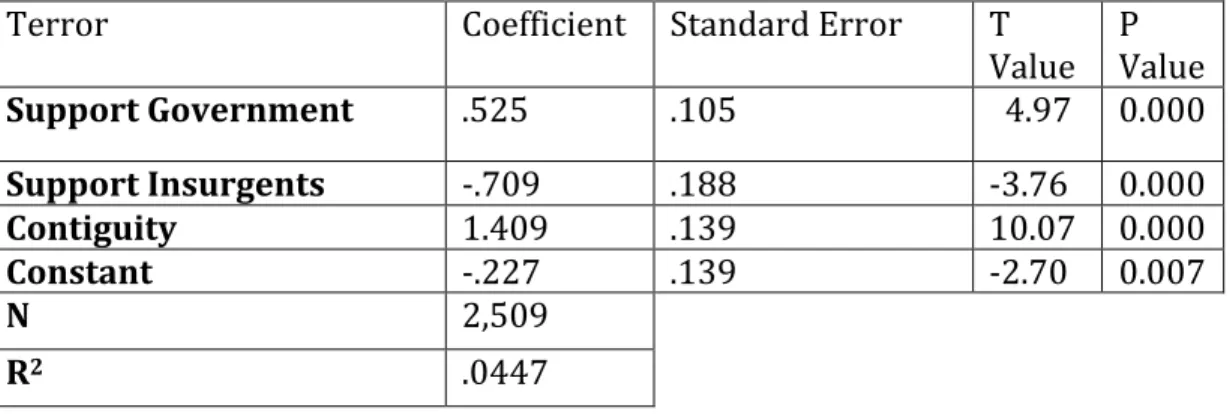
Table 1: Linear regression analysis of the relationship between type of actor supported and the incidence of terrorism against intervening states.
Terror Coefficient Standard Error T
Value P Value
Support Government .525 .105 4.97 0.000
Support Insurgents -.709 .188 -3.76 0.000
Contiguity 1.409 .139 10.07 0.000
Constant -.227 .139 -2.70 0.007
N 2,509
R2 .0447
Model 1 provided support for Hypothesis 1. As anticipated, state
intervention in civil conflicts on behalf of governments proved a strong positive predictor for the incidence of terrorist attacks against the intervening state. Model 1 predicted that, all else held constant, a state that intervened in a civil conflict on behalf of a government would experience .525 more terrorist attacks than would a state that did not intervene. This accords with the theory presented in this thesis, which stated that insurgent organizations might conduct terrorist attacks against a state that intervenes against them in order to make such an intervention excessively costly, and hence encourage the intervening state to withdraw. As previously
discussed, intervention may prolong civil conflicts and lead to increased collateral damage, which may also increase the incidence of terrorism against the intervening state. That Model 1 supports Hypothesis 1 is consistent with each component of the theory presented by this thesis.
organizations and the incidence of terrorist attacks against the intervening state. Model 1 predicted that a state that intervened on behalf of an insurgent organization would experience .709 fewer terrorist attacks by actors in the relevant civil conflict than would a state that did not intervene in support of an insurgent organization. This thesis theorized that, if a government intervened on behalf of an insurgent organization, that intervention could destabilize a civil conflict area sufficiently to allow for terrorist organizations to develop and operate safely. Since insurgent organizations often deploy terrorist tactics, this thesis predicted that allowing such organizations to survive, fragment, or become dominant actors within a conflict could become dangerous for a state since principal-agent theory suggests that supported agents may eventually turn against their supporting actors. Findings from Model 1 indicated that this is probably not typically what occurs.
Possibly, because insurgent organizations do not typically have the conventional military strength of states, they may utilize terrorism to overcome conventional military weaknesses more readily than would organizations aligned to a government. Because many insurgent organizations have extremist ideologies, and many network-based terrorist organizations like Al Qaeda or The Lord’s Resistance Army often take part in multiple civil conflicts, intervening on behalf of a
Of the six independent variables included in Model 2, only deployment of ground forces in a combat role, provision of weapons, and contiguity with a civil conflict area served as statistically significant predictors of the incidence of
terrorism against an intervening state. Table 2 displays results from Model 2’s linear regression.
Table 2: Linear regression analysis of the relationship between type of intervention and the incidence of terrorism against intervening states.
Terror Coefficient Standard
Error T Value P Value Troop Deployment
(Combatants) .332 .145 2.28 0.022
Weapons -.406 .177 -2.29 0.022
Training .166 .141 1.41 0.239
Material -.190 .174 -1.09 0.275
Unknown Support .176 .291 0.61 0.545
Contiguity 1.06 .141 7.49 0.000
Constant -.020 .084 -0.24 0.814
N 2,148
R2 .029
terrorism similarly strengthened Hypothesis 4 since they also indicated various types of non-warring support. This supports my theory that forms of intervention that cause increased collateral damage, and that designate the intervening state as a secondary warring party in the conflict, should lead to higher rates of terrorism against the intervening state.
The findings of this thesis indicate a more complex relationship between third party state intervention in a civil conflict and the incidence of terrorism against the intervening state than my theory anticipated. The strong negative coefficients associated with the “Support Insurgents” and “Weapons” variables suggested that certain types of intervention might in fact decrease the likelihood of terrorist attacks against the intervening state3. Though this contradicts some
aspects of my theory, it does suggest that the relationship between state intervention in civil conflicts and terrorist reprisals against intervening states depends on the specific nature of each intervention.
Though this thesis demonstrated that different types of intervention in civil conflict could affect rates of terrorism against the intervening state in different ways, the bulk of variation in the incidence of terrorist attacks by belligerents in a civil conflict against intervening states likely depends on factors independent of the intervention itself and outside of the scope of this thesis. Model 1 produced an R2
value of .0447 while Model 2 produced an R2 value of .029, indicating that these
models accounted for 4.4% and 2.9% of variation in the incidence of terrorist attacks against intervening states respectively.
3 Logistic Regression indicated that the “Weapons” and “Support Insurgents”
In both models, a state’s contiguity to a civil conflict zone represented the strongest predictor of terrorist attacks by actors within that civil conflict against the intervening state. Model 1 predicted that a state contiguous to a civil conflict would experience 1.4 more terrorist attacks by actors within that conflict than would a state that did not share a border with the state in which the conflict took place. Model 2 produced a somewhat lower coefficient of around 1 for the contiguity variable. The strength of the contiguity variable is likely due to cases in which insurgent organizations actively pursue related political goals in multiple contiguous states. The Taliban’s involvement in both Afghanistan and Pakistan likely presents a typical example of how contiguity can lead a belligerent in one civil conflict to utilize terrorist tactics to pursue goals in a contiguous state not
necessarily related to that state’s intervention in the primary conflict. Though the models examined in this thesis account for only a small percentage of variation in rates of international terrorism against states that intervene in civil conflicts, they sufficiently indicated that intervention in civil conflicts could lead to increased rates of terrorism against intervening states if such interventions provide direct warring support to a belligerent in that conflict, support a government, or if the intervening state shares a border with the civil conflict area.
Case Study
later in Syria in 2015 (France launches first air strikes 2015), in coordination with an international coalition led by the United States (Valls 2015). These airstrikes supported the Iraqi government, as well as moderate insurgents and Kurdish Peshmerga fighters engaged in combat with IS fighters on the ground in Syria (Valls 2015). In 2015 then French Prime Minister Manuel Valls gave a speech to the French parliament, which outlined the general strategy and rationale behind France’s
intervention in Syria. In this speech, Valls identified IS as an imminent threat to French security due to its utilization of terrorist tactics, efforts to recruit French civilians, and destabilizing effect on the middle-east that produced large amounts of refugees from Iraq and Syria (Valls 2015). Many of these refugees eventually sought asylum in France (Valls 2015). That IS often utilized French language social media in its recruitment efforts posed particular concern due its potential capability to
inspire French citizens sympathetic to IS to carry out terrorist attacks against the French state (Valls 2015).
these challenges, the French government decided to utilize the Iraqi government, moderate Syrian rebels, and the Kurdish Peshmerga as agents in its fight against Islamic State. In doing so, however, France may have increased the strategic incentive for IS to utilize terrorist tactics against it since any action that coerced France to end its air campaign could help to restructure the balance of power in Syria and Iraq in IS’s favor.
IS did in fact deploy terrorist tactics against Paris shortly after France began its military campaign in Syria. On November 13, two months after France began its campaign of airstrikes in Syria, seven men armed with assault rifles and explosives conducted coordinated attacks against the Stade de France, restaurants, and the Bataclan concert hall (Callimachi 2015). These attacks killed a total of 130 civilians. The following day, Islamic State published a message online claiming responsibility for the attacks (Callimachi 2015). In this message, Islamic state claimed that it had orchestrated the 2015 Paris attack in retaliation for France’s use of airstrikes in Iraq and Syria, claiming that more attacks would follow if France continued to support the US-led coalition (Dalton et al 2015). French intelligence officials confirmed IS’s claim, and French president Francois Hollande released a statement that
condemned IS as the perpetrators of the attack (Callimachi 2015). French intelligence officials stated that the seven men who carried out the attack had maintained personal correspondence with Islamic State personnel in Iraq and Syria while planning their attack (Dalton et al 2015).
According to the message in which IS claimed responsibility for the Paris attacks, IS intended for these attacks to make the cost of continuing airstrikes sufficiently high that France would cease its campaign. As noted in the literature review, however, it remains unclear whether terrorist organizations’ stated goals actually reflect the underlying strategy behind their use of terrorist tactics. Alternatively, Islamic State may have sought to utilize the Paris attacks to build credibility amongst potentially sympathetic populations, and thus increase their recruitment prospects. The strong positive reaction elicited among extremists on social media in the wake of the Paris attacks lends some credibility to the potential value of such a strategy. Finally, Islamic State may have intended to utilize the Paris attacks to provoke French retaliation, thus increasing collateral damage and the social conditions that can encourage civilians to support extremist organizations. This rationale, however, seems unlikely since Islamic State is not a network-based organization but rather a self-styled caliphate that seeks to govern its territory as a legitimate state, and would thus suffer acutely if its cities and infrastructure were damaged.
Regardless of the strategic intent of the attacks, France’s interventions in Iraq and Syria likely increased the likelihood that Islamic State would utilize terrorist tactics against it. If Islamic State sought to bolster its recruitment potential by achieving a symbolic victory over a perceived enemy, attacking a target actively involved in Iraq and Syria likely had greater political value than attacking an
willingness to intervene. In such a situation the intervening state would merely have to intensify its military campaign, while a state not engaged in the conflict would have to make the initial choice to intervene. Regardless of whether Islamic State orchestrated the 2015 Paris attacks primarily in pursuit of its stated goals or in order to bolster its recruitment capabilities, France’s interventions in Iraq and Syria likely provoked the attack. This would accord with the empirical findings of this thesis.
Conclusion
France’s interventions in Iraq and Syria clearly demonstrate both why a state might intervene in a civil conflict in a calculated attempt to target terrorist
organizations, and how intervention may itself provoke terrorist reprisals. The complexity of the relationship between state interventions in civil conflicts and terrorist reprisals against intervening states, and the abundant disagreement in the literature regarding the nature of this relationship, makes understanding the unique effects of specific types of intervention both an important area of study and a crucial policy concern. The empirical findings of this thesis support my theory that the relationship between third party state interventions in civil conflicts and the
incidence of terrorism against an intervening state depends, in part, on what tactics that state utilizes during its intervention, and on what type of actor the state
supports. Specifically, warring interventions and interventions that support
These findings suggest that states considering warring intervention in a civil conflict or intervention on behalf of a government should carefully consider the potential for terrorist reprisals in their initial cost-benefit analysis prior to
intervention. If such states still calculate intervention as within their best interests, they should take care to strengthen their domestic security apparatuses to prepare for terrorist reprisals. Conversely, states considering a non-warring intervention or intervention on behalf of insurgents may weigh the potential for terrorist reprisals more lightly, though the potential for such reprisals remains present.
Appendix
Tables 3 and 4 respectively display results from Model 1 and Model 2’s logistic regression analyses.
Table 3: Logistic regression analysis of the relationship between type of actor supported and the incidence of terrorism against intervening states.
Terror Coefficient P Value
Support Government 1.91 0.000
Support Insurgents -.168 0.685
Contiguity 2.79 0.000
N 2,509
Table 4: Logistic regression analysis of the relationship between type of intervention and the incidence of terrorism against intervening states.
Terror Coefficient P Value
Troop Deployment (Combatants)
2.53 0.000
Weapons .074 0.836
Training -.525 0.077
Material -.084 0.830
Unknown Support 1.14 0.049
Contiguity 2.47 0.000
N 2,148
Bibliography
Abrahms, M. (2008). What terrorists really want: Terrorist motives and counterterrorism strategy. International Security, 32(4), 78-105.
Bapat, N. (2012) Understanding state sponsorship of militant groups. British Journal of Political Science. 42(1), 1-29.
Callimachi, R. (2015, November 14). ISIS Claims Responsibility, Calling Paris Attacks “First of the Storm”. New York Times.
Carpenter, G. (2006). The imperial lure: Nation building as a US response to terrorism. Mediterranean Quarterly. 17(1), 34-47.
Crenshaw, M. (2011). “Explaining terrorism: Causes, processes and consequences”. Routledge.
Dalton, M., Horobin, W., Varela, T., & Landauro, I. (2015, November 14). Seven Militants Led Deadly Paris Attacks. Wall Street Journal.
France launches first air strikes against ISIL in Syria. (2015, September 27). Al Jazeera. Jett, D. (2012). Losing the war on terror: Who we help is hurting. Middle East Policy. 19(3),
135-141.
Newman, E. (2006). Exploring the 'root causes' of terrorism. Studies in Conflict and Terrorism. 29(8), 749-772.
Mueller, J. (2010). “Reacting to terrorism: Probabilities, consequences and persistence of fear. Coping with terrorism: Origins, escalation, counterstrategies, and responses”. State University of New York Press.
Mueller, J., & Stewart, M. (2012). The terrorism delusion: America's overwrought response to September 11. International Security. 37(1), 81-110.
O’Neill, W. (2002). Conference Report, “Responding to Terrorism: What Role for the United Nations?”. International Peace Academy.
Pape, R., & Feldman, J. (2010). “Cutting the Fuse: The Explosion of Global Suicide Terrorism and How to Stop it” University of Chicago Press.
Stanton, J. (2013). Terrorism in the context of civil war. Journal of Politics. 75(4), 1009-1022. Thomas, J. (2014). Rewarding bad behavior: How governments respond to terrorism in civil
war. American Journal of Political Science. 58(4), 804-818.