CULTURAL HETEROGENEITY AND INTIMATE PARTNERVIOLENCE IN 17 DEVELOPING COUNTRIES: A TEST OF COMPETING THEORIES
Taylor W. Brown
A thesis submitted to the faculty at the University of North Carolina at Chapel Hill in partial fulfillment of the requirements for the degree of Master of Arts in the Department of Sociology
in the School of Arts and Science.
Chapel Hill 2015
Approve by:
Christopher A. Bail
Stephen Vaisey
ABSTRACT
Taylor W. Brown: Cultural Heterogeneity and Intimate Partner Violence in 17 Developing Countries: A Test of Competing Theories
(Under the direction of Christopher A. Bail)
Intimate partner violence (IPV) is a pressing health and gender equality concern
worldwide. A growing body of literature has assessed the risk factors associated with IPV, yet
results have remained mixed and tests of competing theories limited. Moreover, despite the
significant portion of intervention efforts aimed at changing social norms about violence, very
little research has explored the effect of culture on IPV perpetration. In this project I begin to fill
this gap. Using data from 5,437 communities across 22 Demographic Health Surveys in 17 low-
and middle-income countries, I implement multilevel logit models to test two theories that make
opposing claims about the influence of cultural context on the relationship between men's
attitudes toward and their perpetration of IPV. I find a strong positive relationship between the
proportion of people in one's community that condone IPV and the likelihood of that individual
TABLE OF CONTENTS
LIST OF TABLES ……….……vi
LIST OF FIGURES ………..vii
THESIS ………..……….1
Introduction ………...1
Intimate Partner Violence ………...…..……….3
Cultural Context as a Community-level Factor ……….……...…..5
Test of Competing Theories ………7
Theory of Reasoned Action ………8
Theory of Cultural Heterogeneity………9
Data ………...11
Models ………..17
Results ………..19
Descriptive Results ………...19
Multilevel Logistic Regression Results ………20
Sensitivity Analyses ………..23
Discussion ……….23
Conclusion ………28
APPENDIX A: TABLES AND FIGURES REFERENCES ………29
LIST OF TABLES
Table 1: Community (PSU) Sample Size by Country and Year ……….29
Table 2: Comparison of Community Heterogeneity Measure Specification ………..30
Table 3: Individual-level Variables: Perpetration of IPV, Education, Media, and Type of
Residence ………31
Table 4: Individual-level Variables: Male Age ………...….32
Table 5: Community-level Variables: Heterogeneity in and Average Attitudes Toward IPV ….32
Table 6: Correlation Matrix: Heterogeneity in and Average Attitudes Toward IPV ……….…..33
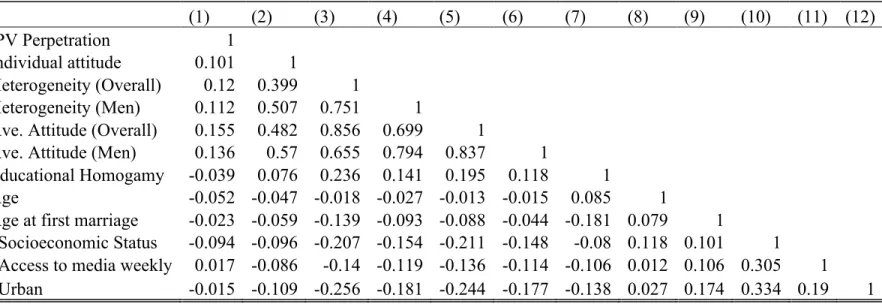
Table 7: Correlation Matrix of Variables Included in the Full Model ………..34
Table 8: Two-Level Logit Models Predicting Perpetration of IPV ………..35
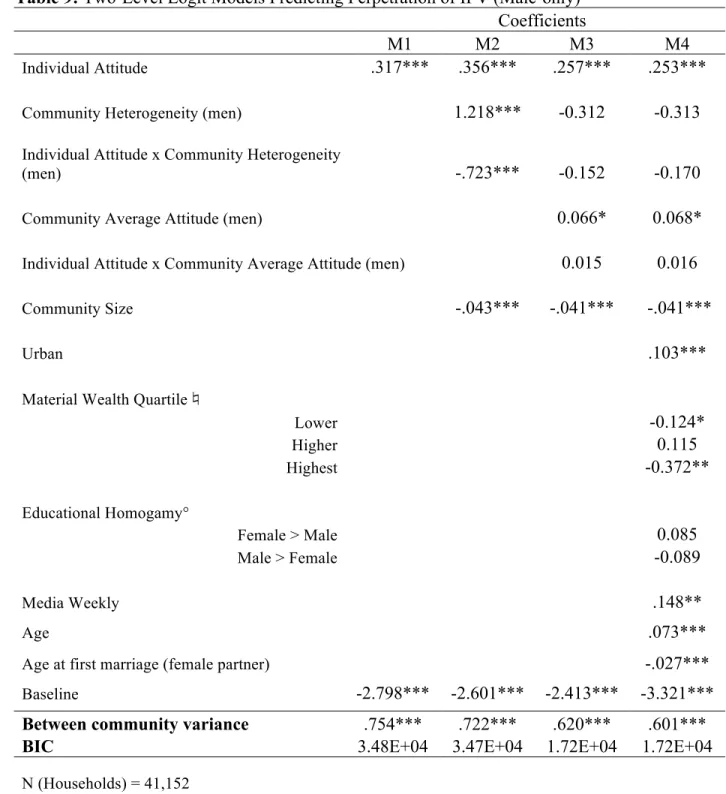
Table 9: Two-Level Logit Models Predicting Perpetration of IPC (Male-only) ………..36
Table 10: Comparing Specifications of the Male Individual IPV Attitude Measures …………..41
Table 11: Comparing Specifications of Community Heterogeneity in Attitudes Toward IPV …42
Table 12: Table of Collinearity (centered and non-centered comparison) ………...43
LIST OF FIGURES
CULTURAL HETEROGENEITY AND INTIMATE PARTNERVIOLENCE IN 17 DEVELOPING COUNTRIES: A TEST OF COMPETING THEORIES
Introduction
Intimate partner violence (IPV) is a pressing health and human rights concern worldwide. For over two decades, health professionals have identified this issue as existing on "epidemic" scale (World Health Organization, 2013; American Medical Association, 1990). It is not only the most common form of violence experienced by women, but also accounts for approximately 1 in 3 female homicides globally (Devries et al., 2013; Stöckl et al., 2013). Assessing the lifetime prevalence of physical and sexual violence against women in fifteen countries, the World Health Organization reports rates ranging from 15% to 71%, with many countries presenting rates above 50% (Garcia-Moreno et al., 2006).
This lack of understanding is especially pronounced in the context of low- and middle-income countries, where empirical research on culture and IPV has been sparse. The small amount of research previously conducted has looked almost solely at men and women's personal attitudes, finding repeatedly that men report rejecting IPV as acceptable behavior at greater rates than women (Pierotti 2013; Speizer, 2009; Uthman, 2009). Yet the correlation between men's reported attitudes and their violent behavior is often inconsistent, begging the question of when and why attitudes and actions align, and whether cultural context plays a part.
This question of how culture affects action is not unique to IPV. There is a longstanding history of inquiry into this relationship in the social sciences, where numerous theories continue to compete. It is at this juncture that my project endeavors to contribute. Using data from 5,437 communities across 22 Demographic Health Surveys in 17 low- and middle-income countries, I implement multilevel logit models to test two theories with competing claims about the influence of cultural context on men's attitudes toward and perpetration of IPV. Specifically, I test the Theory of Reasoned Action (Fishbein & Ajzen, 1975), which posits that individuals will be more likely to align their attitudes and behavior when they perceive their community to lack
consensus, against what I refer to as the Theory of Cultural Heterogeneity, which posits the opposite (Harding, 2007). Both theories have gained support in previous research, yet have been limited in their application to contexts beyond the US. By testing these theories against one another, this project aims to contribute both to our understanding of IPV perpetration and to our grasp of the mechanisms by which cultural contexts affect individual behavior.
my operationalization of cultural heterogeneity, which holds important improvements over the operationalizations of previous studies. The results of my analyses provide little support for either the Theory of Reasoned Action or the Theory of Cultural Heterogeneity on the link
between men's individual attitudes and their violent behavior against intimate partners. That said, I corroborate previous research in finding a strong and significant effect for the average
community attitude toward IPV on the likelihood of perpetrating IPV. This finding lends weight to the notion that cultural context is important and must be considered as a relevant factor in future studies. It also raises questions about how precisely the cultural context of one's
community influences their attitudes and behavior. These questions and implications for future research are detailed in the discussion section of this report.
Intimate Partner Violence
While assessing the influence of cultural context on individuals, this project addresses a specific case of culture and action that has been elevated in attention among policy-makers, health professionals, and the media in recent years. There has been a dramatic increase in worldwide concern for violence against women---especially violence committed by an intimate partner. I define IPV as “any behavior within an intimate relationship that causes physical, psychological, or sexual harm to those in the relationship” (Heise & Garcia-Moreno, 2002). This issue began to receive mass public attention in the US and Europe around the 1970s, largely as a result of grassroots women’s initiatives (Shepard, 2005). In 1993, the United Nations adopted the Declaration of the Elimination of Violence Against Women, a treaty recognizing “the urgent need for the universal application to women of the rights and principles with regard to equality,
security, liberty, integrity and dignity of all human beings.” Before, and increasingly after, the
non-profit efforts have been put forth to prevent violence against women. A large portion of these efforts have aimed at changing the cultural norms that condone violence (Pierotti, 2013). Despite these efforts, however, IPV remains a central health and human rights concern worldwide.
In reaction to this, a large and growing body of research in both the social and health sciences has attempted to identify the risk factors associated with IPV victimization and perpetration. Results, however, have remained mixed and tests of competing theories limited (Yount & Carrera, 2011). A possible reason for this is that studies often concentrate on individual-level correlates alone (Klomegah, 2008), including age, employment, education, income, status inequality, substance abuse, and cohabitation (Anderson, 1997; Hindin 2002; Hindin, 2003; Flake 2005; Flake & Forste, 2006; Friedemann-Sánchez, 2006; Martin et al., 2006; Castro, Casique, & Brindis, 2008; Kaya & Cook, 2010; Abramsky, 2011). The effect of these factors on IPV perpetration often varies across contexts and there remains a need to further examine them (Lawoko, 2008; USAID, 2008).1 Yet there is also a need to contextualize these individual factors within their cultural environments.
Recently, a growing body of research has begun to focus on community-level indicators of IPV perpetration. This work has remained narrow, however. In a 2012 systematic review of the literature, Vanderend et al. stress an over-reliance on a primarily urban, US-based
communities and call for an extention into rural and developing contexts (see also Linos & Kawachi, 2012). Moreover, they emphasize the need to test competing theories about IPV perpetration, with a focus on better understanding the role of cultural norms. The current project sits at the intersection of these scholarly gaps to ask how men's cultural context vis-à-vis IPV !!!!!!!!!!!!!!!!!!!!!!!!!!!!!!!!!!!!!!!!!!!!!!!!!!!!!!!!
impacts the relationship between their personal attitudes and behaviors in 17 low- and middle-income countries.
Cultural Context as a Community-level Factor
Cultural context is defined here as the public attitudes and norms of one's community. There are several reasons for approaching the study of IPV from a perspective that considers cultural context. Although all health issues deserve such a perspective, the fact that IPV, by definition, involves social interaction (i.e. one individual inflicting harm upon another) makes an obvious case for exploring its social determinants. It is surprising, therefore, that so much
academic research on IPV has neglected community-level variables, including cultural context. Sociologists studying the social determinants of health have long called for a shift away from purely individual perspectives on issues of health and well-being (Jones, Jones, Perry, Barclay, & Jones, 2009; Link & Phelan, 1995). Rather than emphasizing individual attributes and actions as the primary drivers of health, these scholars argue that we must contextualize actors and their behavior within the societies of which they are inextricably a part (Rose, 1985; Tesh, 1988; House, Schoeni, Kaplan, & Pollack, 2008). Cultural norms, including those about women and violence, may reasonably be considered one such important societal attribute. Not only are these attitudes assumed to play a role in the perpetration of violence, but also in individual and institutional responses to it (Flood & Pease, 2009).
The idea that cultural context impacts individual outcomes is drawn from the notion that peers serve as a source of information, expectation, motivation, and constraint on one another's behavior (Manski, 1995). Despite their individual agency, actors' choices are limited by what is possible and strongly influenced by the style and symbolic boundaries common to their
deviate from the social norm of their community, therefore, may provide a significant disincentive for engaging in it.
Most previous work on culture and IPV has been conducted in the US. It suggests that individual attitudes are formed via social processes at the micro, meso, and macro level. Indeed, numerous studies point to the influence of peer groups, informal social relations, the media, and ad campaigns on the formulation of individual perspectives about IPV (Barongan & Nagayama, 1995; Johnson, Jackson, & Gatto, 1995; Schwartz & DeKeseredy, 1997, 2000; Strasburger & Wilson, 2002; Flood, 2005-2006; Whitaker et al., 2006). There is also a smaller body of research that explores the effect of community factors on IPV perpetration, though very little looks at a community's cultural context (O'Campo, et al., 1995; Cunradi, 2000; Browning, 2002; Benson 2003).
Less work has been done on this topic in low- and middle-income countries. Pierotti (2013) finds that populations in many developing countries are increasingly condemning IPV, and a handful of studies report that variables such as higher education and occupational status, increased income, urban residency, and access to media are all correlates of individuals
condemning IPV in these countries (Lawoko, 2006, 2007, 2008; Linos, 2010). Such findings about the correlates of individual attitudes are important because women who condone IPV are more likely to experience it (Uthman, 2009; Abramsky, et al., 2011), and the attitudes of
individual men may impact their likelihood of perpetrating IPV (Tolman et al., 1996; O'Hearn & Margolin, 2000).
neighborhood disadvantage moderates the effect of individual disadvantage on attitudes about IPV, while Boyle et al. (2009) find that community attitudes toward IPV mute the protective influence of individual education on the likelihood of personally condemning IPV. A handful recent studies also support the idea that cultural context, as measured by the average community attitude toward IPV, directly affects the likelihood of perpetrating it (Koenig, 2006; Boyle, 2009; Atai, 2011; Uthman, Moradi, and Lawoko, 2011; Linos et al., 2012; Vanderende, Amin &
Naved, 2014). Despite this growing awareness of community level factors, however, we still lack studies that test competing theories or explore the specific mechanisms by which cultural context influences individual attitudes and behavior. This project is an effort to do so.
Test of Competing Theories
Sociologists have long sought to understand how the culture of a community interacts with individuals' ideas and behavior. Marx, Weber, and Durkheim each approached this question directly, with differing conclusions. More recently, cultural sociologists have taken up the task of unpacking the influence of thoughts, beliefs, and even imagination on individual action. Several of these scholars have interlocked with psychology to develop theories about the role of
community, or cultural context, on this relationship (Vaisey, 2009; Emirbayer and Miche, 1998; DiMaggio, 1997; Swidler, 1986). Outstanding debates still marble the field (Patterson, 2014), but it is now commonly accepted that culture is not a monolithic, internally coherent set of values, at either the individual or the community level. Rather, culture is seen as a multifarious---even contradictory---set of beliefs, symbols, boundaries, or notions of "how the world works" (Swidler, 1986; DiMaggio, 1997; Lamont & Molnar, 2002; Hannerz, 2004; Young, 2004).
Ethnographic research largely exempt, this criticism holds true for many macro, quantitative studies of social outcomes. For instance, while nominally recognizing cultural diversity, implementations of World Polity Theory often blanket entire nations with cultural worldviews resting on a spectrum from "traditional" to "modern," while the theory of Development Idealism assumes that homogeneous scripts spread from "developed" to "developing" regions of the world (Parsons, 1951; Meyer et al. 1997; Thornton, 2005). One aim in the present study is not only to recognize the heterogeneity in cultural attitudes that exist within and across communities, but to make it a central attribute of analytic concern.
The fact that community culture is diverse and even contradictory complicates our conceptual and methodological ability to untangle the influence of culture on behavior. How, for example, does the heterogeneity of culture at the community level influence individuals and the connection between their personal attitudes and actions? Two theories exist that have made competing claims about this relationship: the Theory of Reasoned Action and what I here refer to as the Theory of Cultural Heterogeneity. Using data on attitudes toward and acts of IPV, I will compare these theories to test whether and how heterogeneity in cultural context influences the link between men's attitudes toward and perpetration of IPV.
Theory of Reasoned Action
culture more predictive of behavior than individual attitudes. In contrast, when an actor perceives norms to be vaguely defined and/or disagreed upon by their community, this theory argues that they are "free to 'do their own thing'" (Wallace et al., 2005 pg. 216), thereby making individual attitudes a more accurate predictor of behavior.
Although the Theory of Reasoned Action is an explanation for individual behavior, it entails the nuance of cultural context absent in the majority of previous research on IPV. Its claim that heterogeneity in one's community significantly weakens the relationship between individual attitudes and behavior has been tested and supported in the labs of many social
psychological studies (e.g. Zitek and Hebl, 2007; Sechrist & Stangor, 2001). Application beyond the lab, however, has been rare. Concerning IPV, this theory would be validated if the attitudes of men in culturally heterogeneous communities---specifically, communities where attitudes toward IPV were mixed---proved more predictive of their behavior than men in communities where the collective opinion on IPV is more homogenous. Thus the first hypothesis to be tested in this project is as follows:
Hypothesis 1: The individual attitudes of men in culturally heterogeneous communities will be more predictive of their violent behavior than the attitudes of men in culturally homogeneous communities.
By "cultural heterogeneous," I refer here specifically to heterogeneity in, or disagreement about, attitudes toward IPV.
Theory of Cultural Heterogeneity
As an alternative perspective to the Theory of Reasoned Action, Harding (2007) posits what I here refer to as the Theory of Cultural Heterogeneity. This theory claims the exact opposite of the Theory of Reasoned Action; namely, that community heterogeneity in attitudes mitigates the predictive power of individual attitudes on behavior. Testing this hypothesis in the
heterogeneity significantly weakening the correlation between individual adolescents' attitudes toward teenage pregnancy and their engagement in unprotected sex. This finding is especially important to the case of disadvantaged urban youth as it counters the often proffered notion that homogenous "ghetto" culture is the reason that such youth perform poorly in school and
experience other negative social outcomes, such as high rates of premarital childbearing (Frazier, 1966; Moynihan, 1965). In other words, instead of blaming these outcomes on deleterious but supposedly consistent community norms, Harding suggests that the prevalence of cultural heterogeneity in disadvantaged urban neighborhoods fails to provide a single template for youth to follow, thereby weakening the associative strength between their individual attitudes and behaviors. Harding finds further support for this theory in relation to romantic relationship and educational aspirations (2007; 2011).
Significant as this finding is in its potential to expand our understanding of community influences on individuals and their behavior, no test of it has been conducted outside of the US. In this project, the validation of this Theory of Cultural Heterogeneity would be represented if the level of community heterogeneity on attitudes toward IPV mitigated the predictive power of men's individual attitudes on their actual violent behavior. Thus, the second hypothesis to be tested is as follows:
Hypothesis 2: The individual attitudes of men in culturally heterogeneous communities will be less predictive of their violent behavior than the attitudes of men in culturally homogeneous communities.
justification must be made that the behavior assessed is (at least in part) socially determined. The data and case IPV involved in this project fulfill each of these requirements.
Data
The proposed project uses 22 Demographic and Health Survey (DHS) datasets—
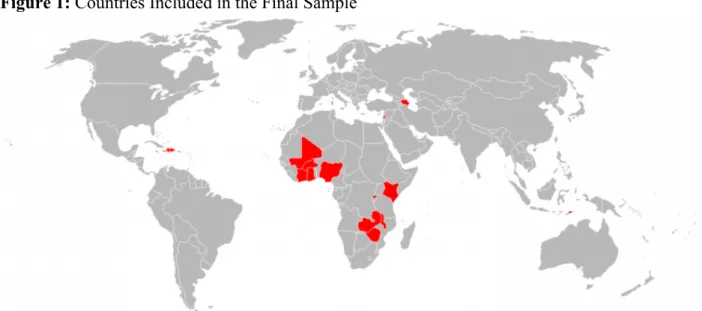
including at least one from each of 17 countries between 2002 and 2013 (See Table and Figure 1 for a map and list of included countries). DHS surveys are sponsored by the United States Agency for International Development (USAID) and other United Nations agencies, and are carried out in low- and middle-income countries with the cooperation of host nations. The primary objective of DHS surveys is to collect up-to-date information on basic demographic and health indicators. In 1999, many countries implementing DHS introduced a Domestic Violence Module, within which men and women are asked questions about their attitudes toward intimate partner violence, and women specifically are asked about their experience of IPV.
DHS datasets are nationally representative, repeated cross-sectional surveys. In most contexts, sampling for these surveys entails two stages. First, primary sampling units (PSUs) are randomly selected from a complete list of units covering the target population (generally census frames). Second, households are randomly selected from within each randomly selected PSU. In most countries all women between the ages of 15- and 49-years-old are eligible to participate and one eligible woman in each household is randomly selected to complete the Domestic Violence Module. Most surveys also include all men between the ages of 15 and 59.
couples, thought the unit of analysis for my purposes are the individual men. These men are nested within 5,437 communities, defined here as the primary sampling unit (PSU), or clusters of individuals within the same geographical living environment (see Uthman et al. 2009, p. 1802).2 On average, a country wave in this study included 247 communities and a community entailed an average sample size of 8.67 households (See Table 1).3
Perpetration of Intimate Partner Violence. The dependent variable is the log odds of a
husband perpetrating intimate partner violence against his spouse, as reported by his female partner in response to the following prompt and five scenarios: "(Does/did) your husband/partner ever do any of the following things to you": (1) push you, shake you, or throw something at you?; (2) slap you?; (3) twist your arm or pull your hair?; (4) punch you with his fist or with something that could hurt you?; (5) kick you, drag you, or beat you up?; (6) try to choke you or burn you on purpose?; (7) threaten or attack you with a knife, gun, or any other weapon?
These seven scenarios are collapsed to create a binary variable coded 1 if the respondent answered ‘Yes’ to any of the scenarios, and 0 otherwise.4 Because of the questions provided by the DHS, IPV is here restricted to physical abuse (i.e. instances of sexual or psychological abuse are not evaluated).
It is important to note that one reason the study of attitudes and experience of IPV have largely been decoupled in the literature to date is the conundrum of causally untangling attitudes from experience. In cross-sectional research it is common to find attitudes used as a predictor of
!!!!!!!!!!!!!!!!!!!!!!!!!!!!!!!!!!!!!!!!!!!!!!!!!!!!!!!!
2!I!follow!here!previous!studies!that!identified!PSUs!as!the!most!consistent!measure!of!community!across!DHS! surveys!(Griffiths,!Madise,!Whitworth,!and!Matthews,!2004).!
3!In!order!to!mitigate!issues!of!low!reliability!in!variables!at!the!community!level,!only!communities!with!five! or!more!sampled!households!are!included.!All!regressions!also!include!a!control!for!community!size.!
!
experiencing IPV (Abramsky et al., 2011; Gage and Hutchinson, 2006; Klomegah, 2008), but a strong argument can be made that experience may also inform attitudes (Koenig et al., 2003). Indeed, both witnessing IPV and attitudes about IPV are jointly associated with experience of IPV. This results in a bidirectional relationship that is hard to assess without long-term longitudinal data. In this study I explore one direction of this relationship, with the aim of providing a theoretical comparison that can guide future research on the impact of culture and community upon individuals.
Individual and Community Attitudes Toward Intimate Partner Violence. The primary
independent variables of this study refer to cultural norms regarding IPV at both the individual and community level. There are, of course, several ideas regarding how best to measure culture (Jepperson & Swidler, 1994; Ghaziani, 2009; Lamont & Swidler, 2014). I draw on the concept of cultural scripts---represented here by a composite index of attitudes toward IPV. As a means to studying culture, scripts are conceptualized as socially-constructed rubrics for temporally and causally sequencing actions (Schank & Abelson, 1977; Patterson, 2014). As such, they are assumed to assist individuals in the identification of problems and problem solutions. Both individuals and communities may hold multiple scripts simultaneously, and competition between the dominance of one script over another in a given situation allows for the possibility of change over time.
if she neglects the children, (3) if she argues with him, (4) if she refuses to have sex with him, and (5) if she burns the food.5
All previous studies utilizing the DHS Domestic Violence Module have collapsed these scenarios into a binary measure coded 1 if the respondent answers ‘Yes’ to any of the scenarios, and 0 otherwise. Such collapsing discards valuable information about the level and type of condoning of IPV that exists. To improve upon this measure, I operationalize cultural scripts toward IPV in three ways: (1) individually as a raw count of the number of scenarios condoned6, (2) communally as the proportion of individuals in a community condoning any form of
violence, and (3) as a heterogeneity measure, discussed in further detail below.
Community Heterogeneity in Attitudes Toward Intimate Partner Violence. In order to test
the theories of reasoned action and cultural heterogeneity, it was necessary to construct a measure of cultural heterogeneity in attitudes toward IPV at the community level. In one of the only previous assessments of cultural heterogeneity as an influence on individual behavior, Harding (2007) operationalized heterogeneity as the variance of a single survey question. This operationalization was limited, however, as it lacks the complexity necessary to capture variation in cultural scripts and cannot easily avoid approaching the average attitude of the community. In !!!!!!!!!!!!!!!!!!!!!!!!!!!!!!!!!!!!!!!!!!!!!!!!!!!!!!!!
5!Out!of!concern!over!survey!response!bias,!Yount!and!Li!(2014)!evaluated!the!Domestic!Violence!modules!of! 67!DHS!surveys!conducted!in!48!countries!between!1995!and!2007.!They!explored!whether!crossYnational! variation!in!women's!affirmative!responses!were!explained!by!crossYnational!variation!in!survey!design,! socioeconomic!status,!or!both.!The!authors!conclude!that!researchers!comparing!countries!with!regard!to! attitudes!about!domestic!violence!should!include!controls!for!crossYnational!variation!in!survey!design.!At!a! minimum!they!should!rely!on!(1)!comparable!samples!of!women,!and!(2)!shared!items!in!the!surveys!when! computing!national!estimates!of!the!percentage!of!women!who!affirm!domestic!violence.!The!project!at!hand! fulfills!both!of!these!suggestions.!The!authors!also!note!that!researchers!should!control!for!variation!in!(1)!the! wording!of!the!preamble!and!(2)!the!wording!used!to!depict!!husband's!violence.!Future!analyses!will!aim!to! include!such!controls,!but!unfortunately!time!constraints!prohibited!their!inclusion!for!the!defense.!
!
6!Measuring!IPV!attitudes!as!a!raw!count!of!the!number!of!scenarios!condoned!assumes!that!all!scenarios! exert!an!equal!influence!on!the!likelihood!of!predicting!violent!behavior.!To!test!this!assumption,!an!
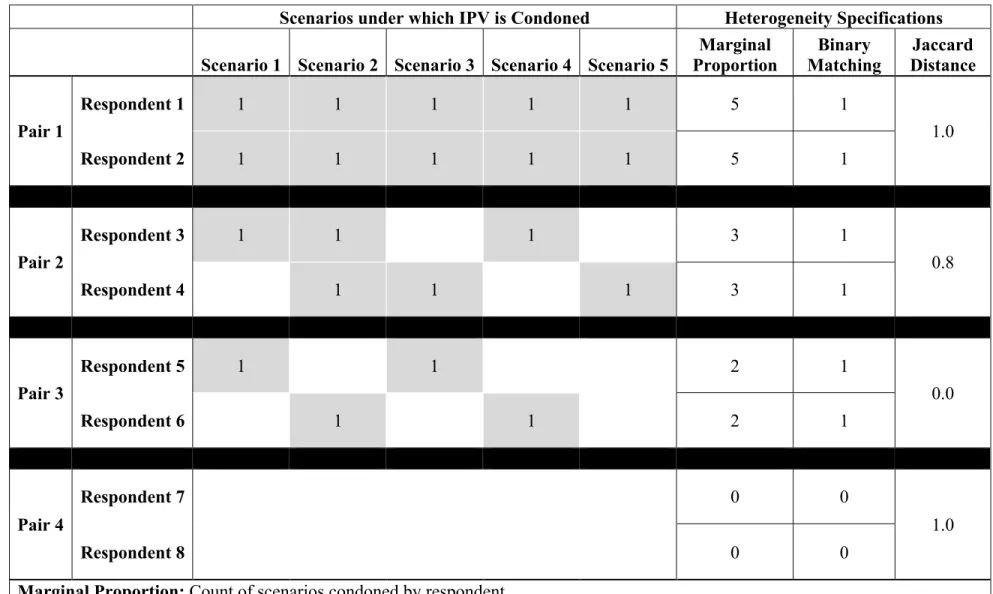
the present project, I improve upon Harding's measure by capitalizing on the five different scenarios under which IPV might be condoned, as provided in the DHS. I calculate the level of disagreement about these scenarios between every dyad of individuals in each community using a Jaccard distance measure.
In detail, the Jaccard distance is a measure of dissimilarity between finite sets of survey questions defined as 1 minus the size of the intersection (i.e. the set of scenarios commonly condoned by both individuals of a dyad) divided by the size of the union (i.e. the total number of scenarios condoned).
Jaccard Distance = 1!−
!
M M01+!M10! 01+!M10+!M11Where M01 represents the sum of scenarios in which member 1 of a dyad does not condone IPV while member 2 does condone. Likewise, M10 represents the opposite situation (wherein member 1 condones IPV but member 2 does not), and M11 represents the sum of scenarios in which both members of a dyad condone IPV. Ultimately, the Jaccard distance measure ranges from 0 (perfect agreement) to 1 (perfect disagreement). For this project, community heterogeneity is operationalized as the mean Jaccard distance across all dyads of a community.7
This measure allows me to differentiate between the overall level of agreement in a community (i.e. the average attitude toward IPV) and the level of intersubjective agreement. Moreover, unlike a mere comparison of the number of scenarios condoned by each individual, or a comparison of binary responses (i.e. condoning any scenario, or condoning none), this measure allows identical portions in the margins of two individuals to remain indicative of partial or complete disagreement, depending on which specific scenarios were condoned by those individuals. See Table 2 for a visual elucidation of this point.
!!!!!!!!!!!!!!!!!!!!!!!!!!!!!!!!!!!!!!!!!!!!!!!!!!!!!!!!
In addition to the focal relationships of this study, several controls found in previous research to be significant predictors of perpetrating IPV are included in the final model. Male age is measured as a continuous count of age at last birthday and also entered quadratically as
age-squared. Age at first marriage is a continuous measure of the age of a man's female partner at first marriage. In previous research it has been found that men are more likely to have
perpetrated IPV against partners married at a young age (Abramsky, et al., 2011; Kishor & Kiersten, 2004).
Educational homogamy is measured with three dummy variables derived by calculating
the difference between a man’s highest level of education and the highest level of education of his female partner. If the partners have the same amount of schooling, the response is coded as “homogamous”; if the male has more schooling, the response is coded as “male has more than female”; if the female has more schooling, the response is coded as “female has more than male” (Flake, 2005). This measure reflects a level of equality within the couple, which in other studies has proven to be a significant predictor of IPV perpetration (Yount and Carrera, 2006; Flake and Forste, 2006). Access to media is measured as a binary variable expressing whether a man has access the media (i.e. magazines, newspapers, television, or radio) at least once per week. The assumption associated with this measure is that with access to media a man may be more exposed to messages condemning IPV and therefore less likely to engage in it. This assumption has gained support in the context of some developing countries (Lowoko, 2008).
Material wealth is a partial consideration of socioeconomic status and is measured by
adding multiple household amenities (electricity, radio, television, refrigerator, bicycle,
total frequency for that score.8,9 Urban residence is measured as a binary variable defined by the survey team in each country. In previous research it has been found that urban residency
significantly increases the likelihood of IPV occurring (Hindin & Adair, 2002). Finally, because different countries and time periods are likely to differ in many respects, the final models in this paper include a dummy variable for each country wave.
Models
To assess the hypotheses named in this project, I implement multilevel logistic regression, with individuals nested within communities (PSU). Because the outcome (male perpetration of IPV) is binary, logistic regression is appropriate. I assume that the log-odds of perpetrating IPV are linearly related to the independent variables. Logistic regression provides maximum likelihood estimates of the net effects of explanatory variables on the dependent variable. The Bayesian Information Criterion statistic is used as a comparative measure between models. All analyses include the weights provided by the DHS to adjust for differences in probability of selection, as well as non-response.
The benefit of a multilevel model in this project is that it allows for individuals to be clustered within communities, and thereby avoids violating the assumption of independence of observations made by traditional ordinary least squares regression. Independence is a
foundational assumption of basic binary regression models. When the structure of clustering in a !!!!!!!!!!!!!!!!!!!!!!!!!!!!!!!!!!!!!!!!!!!!!!!!!!!!!!!!
8!In!future!analyses!weights!for!this!measure!should!be!relative!to!the!amenities;!for!example,!because!a!radio! is!less!expensive!than!a!car!it!will!be!more!prevalently!owned!and!should!be!weighted!less!(Timaeus!&!Lush,! 1995).!
!
sample is not incorporated into the model, however, this assumption is violated and can result in biases in parameter estimates and their standard errors (Guo & Zhao, 2000). Given that DHS surveys are sampled in clusters, and given that variation across these clusters is the focus of my analysis, multilevel models are required for this study.
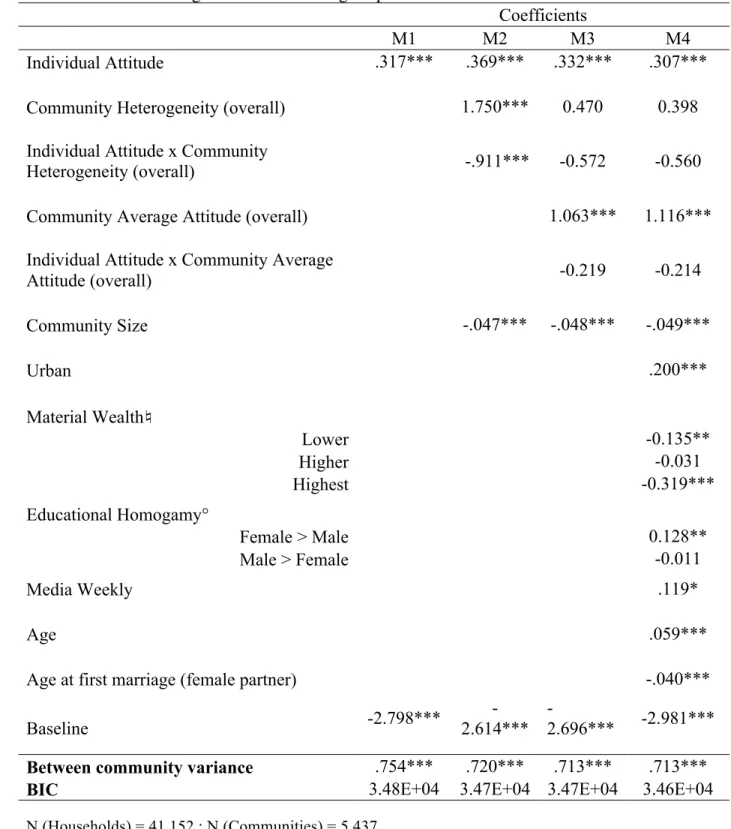
The final model provided in this project is built in four stages, the first of which is a regression of IPV perpetration on men's individual attitudes toward IPV (Model 1). Model 2 adds an interaction between individual attitudes toward IPV and community heterogeneity in attitudes, which tests Hypotheses 1 and 2, distinguishing whether cultural heterogeneity in the community significantly influences the predictive power of individual men's attitudes on their violent behavior. Model 3 assesses the spuriousness of this relationship by including a measure of average community attitude toward IPV and an interaction between average community attitude and men's individual attitude. Finally, Model 4 adds the previously discussed individual-level controls to further assess the possible spuriousness of the findings. The final model can be expressed as follows:
log(Pr!(!!" =1))
= !!!+!!!!!!" +!!!"
Where the left hand of the equation represents the log odds that man i in community j perpetrates IPV against his female partner. !!! is the fixed effect of individual predictors and !!"!represents
the idiosyncratic variation from unobserved variables. The community coefficient is: !!! =!!!!+!!!"!!+!!!
Where !!! is the grand intercept and !!"!! is the effect of community heterogeneity and other community-level variables. Finally, !! represents community-specific variation.
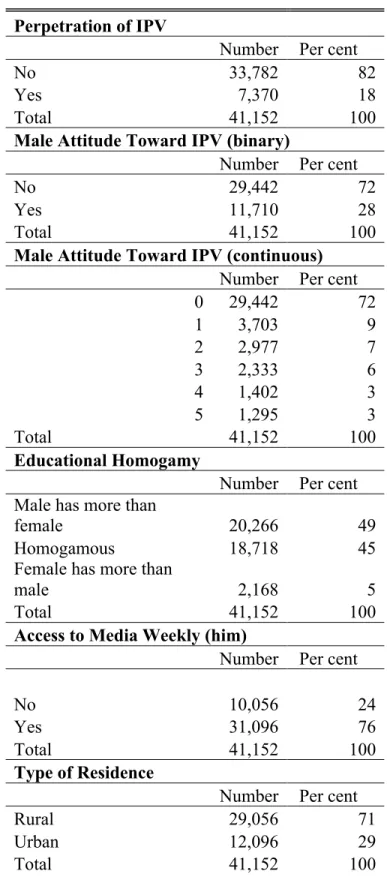
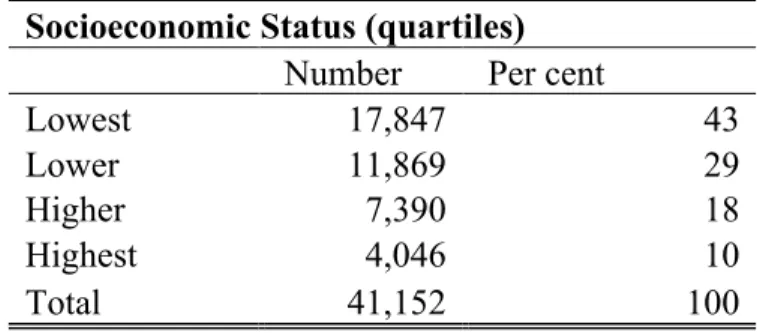
Descriptive Results
Tables 3-7 display descriptive statistics for all variables. Roughly 18% of men in the sample have perpetrated IPV, as reported by their female partner, while 28% report condoning at least one form of violence, with a range of 72% of men condoning no scenarios to 3% of men condoning all five scenarios. Due to significant skew, the natural logarithm of this variable was used in all analysis (See Tables 3-7).
The average age of male respondents in the sample was 36, with a range from 16 to 59. Most men had a higher level of education than their female partner (49%), though a significant proportion were also educationally homogamous (45%). Only 5% of men had less education than their female partner. 76% of men in the sample reported having access to some form of media at least weakly, and the largest proportion of households were in the lowest material wealth quartile (43%). This suggests a skew in the sample toward poorer populations.
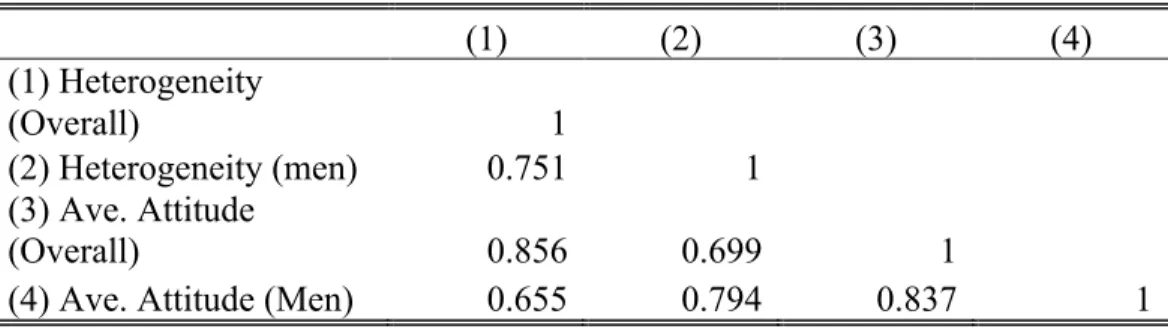
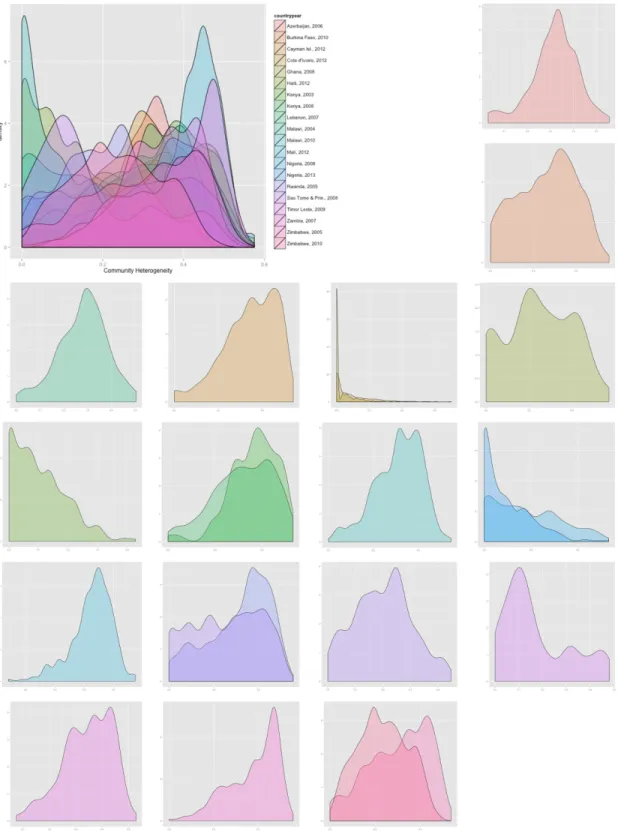
The average level of community heterogeneity in attitudes toward IPV was .244 on a scale from 0 to 1, with 1 being complete disagreement. The standard deviation of this measure is .16, suggesting considerable spread across communities. Figures 3 and 4 show that the average heterogeneity diminished over time for all countries with more than one wave (see also Figure 5 for a visualization of the distribution of heterogeneity by country and year).10 On average, 35.5% of the entire population and 28.5% of men specifically in a community condone at least one form of IPV.
Using the variance inflation factor (VIF), multicollinearity was detected between the measure of community heterogeneity and the measure average community attitude. To correct !!!!!!!!!!!!!!!!!!!!!!!!!!!!!!!!!!!!!!!!!!!!!!!!!!!!!!!!
for this, both variables were centered at their mean, which reduced the VIF to within normal range. (See Appendix C for further detail.)
Multiple imputation for missing data was performed using ten iterations of multivariate regression. After imputation, a correlation matrix (see Table 7) was created to investigate the relationship of the dependent variable across all independent variables.
The final sample size includes 41,152 individual men and their spouses, nested within 5,437 communities. The average country survey wave included 1,870 households in 247 communities, and the average community sample size included 8.68 households (refer again to Table 1). For more detail on community size across time and country, see Figure 4.
Multilevel Logistic Regression Results
Table 8 presents the primary model results. Model 1 is a basic assessment of the bivariate relationship between men's individual attitudes toward IPV and their likelihood of perpetrating it. We see that, net of controls for country, year, and community size, there is significant variation in the perpetration of IPV across communities.11 Moreover, the coefficient on men's individual attitudes is positive and signficant, suggesting that with each additional scenario about IPV that a man condones, his odds of perpetrating IPV are increased by 1.373 (significant at p $<$ .001).
Model 2 adds an interaction between men's individual attitude toward IPV and the level of heterogeneity in attitudes about IPV in his community, thereby providing a test of hypotheses 1 and 2. In order to confirm the Theory of Reasoned Action, we would expect the coefficient on this interaction term to be positive and significant. To confirm the Theory of Cultural
Heterogeneity, on the other hand, we would expect it to be negative and significant. As the
!!!!!!!!!!!!!!!!!!!!!!!!!!!!!!!!!!!!!!!!!!!!!!!!!!!!!!!!
observed coefficient is negative, this provides preliminary support for the Theory of Cultural Heterogeneity.
In Model 3, however, the average community attitude toward IPV is added to the model, along with an interaction between the men's individual attitude and this average community attitude. When these variables are included, the relationship previously observed between community heterogeneity and men's individual attitude goes away. Indeed, only the average community attitude and controls remain significant in this model (OR = 2.895, p $<$ .001). Furthermore, the effect of average community attitude is much larger than the effect of men's individual attitude (OR = 1.393, p $<$ .001). This holds even in Model 4 when individual-level controls are included to test the spuriousness of results.
Ultimately, the large and significant effect of average community attitude corroborates previous research findings and suggests that the more supportive a man's community is of IPV, the more likely hid is to perpetrate IPV (Boyle et al., 2009; Atai, 2011; Vanderende, Amin & Naved, 2014). This underlines the need to embed individuals within their local communities when endeavoring to understand the causes of IPV. Further exploration of this finding is provided in the discussion section.
relationships where the female has more education are more likely to perpetuate IPV (see, similarly, Yount and Carrera, 2006; Flake and Forste, 2006), and men with access to the media are more likely to perpetuate IPV (OR = 1.13, p $<$ .01). Although this latter effect appears contrary to previous research that men with access to media are less likely to condone IPV (Lawoko, 2008), it confirms other research (Oyediran, 2005) and may indicate that men with access to media are exposed not only to messages condemning IPV, but also media depicting and condoning it.
Finally, older men and men with partners who married young are more likely to perpetuate IPV. This is somewhat contrary to prior research indicating that younger men are more likely to perpetrate IPV (Rani, 2004; Klomegah, 2008), but it may be reflective of the fact that older men have been married longer and may have perpetuated IPV at a younger age.
Unfortunately, the DHS provide no information on the frequency or recency of IPV perpetration.
Sensitivity Analyses
To consider the potential of significant gender segregation in many of the communities included in the DHS dataset, I provide sensitivity analysis of all the models previously discussed wherein both heterogeneity and average community attitude include only male responses (see Table 9). The findings of these analyses do not differ significantly from the models in which both men and women are assessed. Merely the significance of the effect of community attitudes is weakened. This might reflect the role of women's attitudes on men's likelihood of perpetrating IPV. However, considering that the outcome variable (perpetration of IPV) is reported by
experiencing it (Uthman, 2009), thus when their attitudes are left out the correlation between average community attitude and IPV perpetration is diminished.
Discussion
In this project I have tested competing theories regarding the influence of cultural context on the relationship between individual attitudes and behavior. Specifically, I have attended to the case of intimate partner violence (IPV) and tested the Theory of Reasoned Action against the Theory of Cultural Heterogeneity. Whereas the former posits that individuals will be more likely to align their attitudes toward IPV and their violent behavior when they perceive their
community to lack consensus, the latter posits the opposite. My final analyses provide no support for either theory. That is, no significant effect was found---in either direction---for the influence of cultural heterogeneity on the ability of men’s individual attitudes to predict their violent behavior. Possible reasons for this lack of support are discussed in conjunction with the strengths and weaknesses of the data below.
Although no support was found for the focal theories of this project with regard to community heterogeneity, a strong positive effect was found for the average community attitude toward IPV on the likelihood of individual men perpetrating IPV. This is an important finding. It not only stresses the necessity of considering community-level and cultural variables in future investigations, but also introduces a number of possible questions for analytic exploration.
and degree of influence upon them. This assumption, in turn, makes permissible the treatment of community influence as a linear function of mean peer attitude or behavior (Hoxby and
Weingarth, 2006). Validation of this perspective has been gained in studies as varied in topic as substance use (Barnes et al., 2006), appearance ideals (Lawler & Nixon, 2011), and school achievement (Carrell, Fullerton, & West 2008).
The strong and significant effect of average community attitude toward IPV in the present study lends preliminary support to this perspective of an average peer effect. It even suggests that such an effect may have a larger impact on behavior than individual attitudes themselves, as the effect is larger than that found for men's personal attitudes toward IPV.12
Caution should be taken in this interpretation, however. Members of the same community in DHS surveys merely reside in geographic proximity to one another. We cannot be sure that these individuals also engage in any kind of direct, interpersonal relationship, i.e. that they are "peers" in a strict sense. This raises questions for future research in that it provides the possibility for a variety of mechanisms by which cultural context influences individual attitudes and
behavior. For example, it may well be the case that individuals apply generalizing heuristics to understand their cultural context at the level of social dynamics beyond the influence of immediate peers. Such mechanisms could be distinct from processes of cultural influence that unfold at a more intimate level, which may include assessment of cultural heterogeneity in one's peers or interpersonal learning. Although such conceptualizations of cultural mechanisms are
!!!!!!!!!!!!!!!!!!!!!!!!!!!!!!!!!!!!!!!!!!!!!!!!!!!!!!!!
distinct from those based on direct peer effects, they are not necessarily mutually exclusive and future research is needed to distinguish between them and differentiate their possible effects.
This idea that cultural mechanisms may work differently depending on the level of society assessed also adds a possible explanation for why this study found no support for Theory of Reasoned Action. Of course, it is possible that the this theory is simply not an accurate
explanation for behavior in the settings assessed in this project, which rest outside both the laboratory and the US (where this theory has gained the bulk of its prior support). However, a more important reason for the lack of support might be found in a conceptual detail. The Theory of Reasoned Action specifically hypothesizes that individuals are influenced by heterogeneity in the attitudes and behaviors of their salient referents. As described above, community members in the DHS are not necessarily closely associated on an interpersonal level. It is therefore possible that the effect of cultural heterogeneity was not captured due to a lack of construct validity. In order to further investigate this issue, network data on the direct ties between actors would be required. More specifically, information on interpersonal ties and on individuals' perceptions of those ties' opinions would be the kind of data needed. Unfortunately, the effort and resources need to gather such data make it difficult to obtain at a scale (within or across communities) comparable to the DHS. That said, recent developments in respondent driven sampling might alleviate costs in gathering representative samples at the level of local communities for future research (Mouw & Verdery, 2012).
give strong support for the Theory of Cultural Heterogeneity measured heterogeneity by the variance of responses to a single survey question (Harding, 2007; 2011). It is likely that
expanding this measure to include variance in a composite index of questions on the same issue made it a more accurate representation of the structure of heterogeneity in a community. Future research should investigate this issue by comparing several measures of heterogeneity against one another.13
Two final limitations should be considered when interpreting the results of this project. The first is the cross-sectional nature of DHS data. Manski (1993) and others express concern with efforts to derive meaningful conclusions about community or peer influence from cross-sectional assessments, noting specifically that one cannot distinguish between exogenous and endogenous social causes, or so-called correlated effects. Prospective longitudinal studies are suggested as a possible improvement for testing reciprocal relations, of which both attitudes and behaviors, and community and individual effects are a type (for further discussion of these issues, see Appendix C).
Lastly, a problem inherent across all studies of IPV is the risk of survey response and social desirability bias due to the sensitive and stigmatized nature of the topic. Underreporting about IPV experience and behavior is common, with higher rates of underreporting likely to exist among specific subpopulations (Ellsberg, et al., 2001). It is reasonable to assume that bias also exists with respect to reported attitudes toward IPV. For this reason, the findings from this study regarding IPV attitudes and experience should be considered conservative estimates of the actual
!!!!!!!!!!!!!!!!!!!!!!!!!!!!!!!!!!!!!!!!!!!!!!!!!!!!!!!!
prevalence. That said, there is reason to believe that the measure of IPV perpetration operationalized in this study (reports by female partners) is superior to self-reports by male partners, as men who perpetrate IPV may be particularly susceptible to social desirability or other forms of reporting bias (Hackert & Gondolf, 2000). Furthermore, trade-offs between data quality and quantity have to be made. Notwithstanding the fact that reporting bias is a hurdle faced even in small-scale, in-depth ethnographic studies of IPV, the breadth of the DHS sample---involving information across 41,152 couples across 5,437 communities---provided an advantage for testing theories of cultural influence against one another in this study.
Despite these limitations, the project at hand makes several important contributions. Substantively, it not only expands the literature on IPV by investigating the role of culture on individual outcomes, but also does so in the context of low- and middle-income countries, where such research has been sparse. Methodologically, this project improves upon the measure of cultural heterogeneity used in prior research, offering a more realistic operationalization of context. Moreover, by implementing multilevel models that nest individuals and their behavior within local communities, it more accurately reflects the structure of society. Although there is a growing body of literature on IPV that implements such models, few have done so on the scale assessed in this project.
Conclusion
Intimate partner violence continues to be a pressing and immense health and human rights issue worldwide. This project has sought to better understand what role cultural context may play in its perpetration. Although support was found for neither the Theory of Reasoned Action nor the Theory of Cultural Heterogeneity, significant evidence was provided for the effect of average community attitude on mens' individual likelihood of perpetrating IPV. This
APPENDIX A: TABLES AND FIGURES Table 1: Community (PSU) Sample Size by Country and Year*
N (Men) # Communities Ave # Households Median Min Max
Azerbaijan, 2006 448 80 5.732 5 5 8
Burkina Faso, 2010 3,356 455 7.787 8 5 12
Cote d'Ivoire, 2012 1,081 160 7.309 7 5 12
Dom Rep., 2002 2,033 350 5.979 6 5 11
Dom Rep., 2007 2,711 371 7.795 8 5 14
Ghana, 2008 271 49 5.649 5 5 8
Haiti, 2012 1,986 291 7.265 7 5 13
Kenya, 2003 422 75 5.773 5 5 9
Kenya, 2008 498 91 5.566 5 5 7
Cayman Isl., 2012 650 113 5.883 6 5 8
Lebanon, 2007 2,028 230 9.862 10 5 19
Mali, 2012 1,548 232 7.045 7 5 11
Malawi, 2004 805 135 6.217 6 5 10
Malawi, 2010 1,864 312 6.18 6 5 10
Nigeria, 2008 6,119 661 10.488 10 5 20
Nigeria, 2013 6,409 682 10.522 10 5 19
Rwanda, 2005 1,113 187 6.184 6 5 10
Sao Tome P., 2008 731 71 15.306 12 5 38
Timor Leste, 2009 825 146 5.785 5 5 8
Zambia, 2007 2,573 267 11.059 10 5 32
Zimbabwe, 2005 1,668 233 7.839 7 5 16
Zimbabwe, 2010 2,049 246 9.387 9 5 17
Average 1,870 247.136 8.678 8 5 38
Total 5,437
30
!
Table 2: Comparison of Community Heterogeneity Measure Specification
Scenarios under which IPV is Condoned Heterogeneity Specifications
Scenario 1 Scenario 2 Scenario 3 Scenario 4 Scenario 5
Marginal Proportion
Binary Matching
Jaccard Distance
Pair 1
Respondent 1 1 1 1 1 1 5 1
1.0
Respondent 2 1 1 1 1 1 5 1
Pair 2
Respondent 3 1 1 1 3 1
0.8
Respondent 4 1 1 1 3 1
Pair 3
Respondent 5 1 1 2 1
0.0
Respondent 6 1 1 2 1
Pair 4
Respondent 7 0 0
1.0
Respondent 8 0 0
Marginal Proportion: Count of scenarios condoned by respondent
Table 3: Individual-level Variables
Perpetration of IPV
Number Per cent
No 33,782 82
Yes 7,370 18
Total 41,152 100
Male Attitude Toward IPV (binary)
Number Per cent
No 29,442 72
Yes 11,710 28
Total 41,152 100
Male Attitude Toward IPV (continuous) Number Per cent 0 29,442 72 1 3,703 9 2 2,977 7 3 2,333 6 4 1,402 3 5 1,295 3
Total 41,152 100
Educational Homogamy
Number Per cent Male has more than
female 20,266 49
Homogamous 18,718 45 Female has more than
male 2,168 5
Total 41,152 100
Access to Media Weekly (him)
Number Per cent
No 10,056 24
Yes 31,096 76
Total 41,152 100
Type of Residence
Number Per cent
Rural 29,056 71
Urban 12,096 29
Socioeconomic Status (quartiles) Number Per cent
Lowest 17,847 43
Lower 11,869 29
Higher 7,390 18
Highest 4,046 10
Total 41,152 100
Note: N = 41,152
Table 4: Individual-level Variables: Male Age
Age (male) Mean 36.561 Median 36
SD 8.772
Skewness 0.2906 Kurtosis 2.368
Range 43
Min 16
Max 59
Note: N = 41,152
Table 5: Community-level Variables: Heterogeneity in and Average Attitudes Toward IPV
Heterogeneity (Overall) Heterogeneity (Men) Ave. Attitude (Overall) Ave. Attitude (Men)
Mean 0.244 0.181 0.355 0.285
Med 0.257 0.15 0.333 0.2
SD 0.162 0.167 0.258 0.276
Skew -0.083 0.545 0.397 0.876
Kurt 1.719 2.079 2.292 2.905
Range 0.575 0.667 1 1
Min 0 0 0 0
Max 0.575 0.667 1 1
Table 6: Correlation Matrix: Heterogeneity in and Average Attitudes Toward IPV
(1) (2) (3) (4)
(1) Heterogeneity
(Overall) 1
(2) Heterogeneity (men) 0.751 1
(3) Ave. Attitude
(Overall) 0.856 0.699 1
Table 7: Correlation Matrix of Variables Included in the Full Model
(1) (2) (3) (4) (5) (6) (7) (8) (9) (10) (11) (12)
(1) IPV Perpetration 1
(2) Individual attitude 0.101 1
(3) Heterogeneity (Overall) 0.12 0.399 1
(4) Heterogeneity (Men) 0.112 0.507 0.751 1
(5) Ave. Attitude (Overall) 0.155 0.482 0.856 0.699 1
(6) Ave. Attitude (Men) 0.136 0.57 0.655 0.794 0.837 1
(7) Educational Homogamy -0.039 0.076 0.236 0.141 0.195 0.118 1
(8) Age -0.052 -0.047 -0.018 -0.027 -0.013 -0.015 0.085 1
(9) Age at first marriage -0.023 -0.059 -0.139 -0.093 -0.088 -0.044 -0.181 0.079 1
(10) Socioeconomic Status -0.094 -0.096 -0.207 -0.154 -0.211 -0.148 -0.08 0.118 0.101 1 (11) Access to media weekly 0.017 -0.086 -0.14 -0.119 -0.136 -0.114 -0.106 0.012 0.106 0.305 1 (12) Urban -0.015 -0.109 -0.256 -0.181 -0.244 -0.177 -0.138 0.027 0.174 0.334 0.19 1
Table 8: Two-Level Logit Models Predicting Perpetration of IPV
Coefficients
M1 M2 M3 M4
Individual Attitude .317*** .369*** .332*** .307***
Community Heterogeneity (overall) 1.750*** 0.470 0.398
Individual Attitude x Community
Heterogeneity (overall) -.911*** -0.572 -0.560
Community Average Attitude (overall) 1.063*** 1.116***
Individual Attitude x Community Average
Attitude (overall) -0.219 -0.214
Community Size -.047*** -.048*** -.049***
Urban .200***
Material Wealth♮
Lower -0.135**
Higher -0.031
Highest -0.319***
Educational Homogamy°
Female > Male 0.128**
Male > Female -0.011
Media Weekly .119*
Age .059***
Age at first marriage (female partner) -.040***
Baseline -2.798***
-2.614***
-2.696*** -2.981***
Between community variance .754*** .720*** .713*** .713***
BIC 3.48E+04 3.47E+04 3.47E+04 3.46E+04
N (Households) = 41,152 ; N (Communities) = 5,437 *p < .05; **p < .01; ***p < .001
` This analysis includes dummies for country-year (not shown). Reference category is the 'lowest' category of SES.
Table 9: Two-Level Logit Models Predicting Perpetration of IPV (Male-only)
Coefficients
M1 M2 M3 M4
Individual Attitude .317*** .356*** .257*** .253***
Community Heterogeneity (men) 1.218*** -0.312 -0.313
Individual Attitude x Community Heterogeneity
(men) -.723*** -0.152 -0.170
Community Average Attitude (men) 0.066* 0.068*
Individual Attitude x Community Average Attitude (men) 0.015 0.016
Community Size -.043*** -.041*** -.041***
Urban .103***
Material Wealth Quartile
Lower -0.124*
Higher 0.115
Highest -0.372**
Educational Homogamy°
Female > Male 0.085
Male > Female -0.089
Media Weekly .148**
Age .073***
Age at first marriage (female partner) -.027***
Baseline -2.798*** -2.601*** -2.413*** -3.321***
Between community variance .754*** .722*** .620*** .601***
BIC 3.48E+04 3.47E+04 1.72E+04 1.72E+04
N (Households) = 41,152 N (Communities) = 5,437
*p < .05; **p < .01; ***p < .001
` This analysis includes dummies for country-year (not shown). Reference category is the 'lowest' category of SES.
Figure 1: Countries Included in the Final Sample
Figure 3: Average Community Attitude Toward IPV Attitudes (Overall) by Country and Year
APPENDIX B: LOGISTICS REGRESSION DIAGNOSTICS
In order to assess the appropriateness of the models implemented in this project, several
diagnostic tests were conducted. For example, in addition to the likelihood ratio tests conducted
to assess the necessity of separate estimates for each country and year in the model (results of
which suggests that separate estimates were not needed), I assessed the final model for
misspecification using the linktest in Stata. Results indicted that this model is not misspecified. I
also evaluated the goodness-of-fit using the Hosmer and Lemeshow's assessment. Results of this
assessment were negative, suggesting that the model fits the data well.
I also evaluated the specifications of several variables used in the final model. For
example, the variables associated with cultural scripts, as measured by an index of attitudes
toward IPV, had several possibilities for specification. In order to choose the measure that best
fit the model, regression analyses and Bayesian Information Criterion statistics were used. There
was no significant difference between the measures as determined by the BIC. Ultimately, a
count of the number of IPV scenarios condoned was used to measure men's individual attitudes,
while a continuous measure of the Jaccard distances was used to measure community
Table 10: Comparing Specifications of the Male Individual IPV Attitude Measure
V1 V2 V3
Attitude (male) - Binary 0.462***
Attitude (male) - Count 0.135***
A man is justified in beating his wife if she:
Argues 0.201***
Burns food 0.008
Goes out 0.182***
Neglects children 0.249***
Refuses sex -0.085***
Size of Community -0.024*** -0.024*** -0.025***
Baseline -2.363*** -2.363*** -2.288***
BIC 3.63 3.63 3.63
N (Households) = 41,152 *p < .05; **p < .01; ***p < .001
Table 11: Comparing Specifications of Community Heterogeneity in Attitudes Toward IPV
V1 V2 V3
Heterogeneity (Binary: High, Low) 0.3724***
Heterogeneity (Quartiles) 0.2436***
Heterogeneity (Continuous) 1.7127***
Size of Community -0.027*** -0.029*** -0.029***
Baseline -2.752*** -2.816*** -2.609***
BIC 3.64 3.63 3.63
N (Households) = 41,152 *p < .05; **p < .01; ***p < .001
`This analysis includes dummies for country-year (not shown), which are significant at the .05 level
In addition to variable specifications, the multilevel models implemented in the final
analysis of this paper were tested for multicollinearity. The two community-level measures of
cultural scripts (average community attitude and heterogeneity in attitudes) displayed significant
multicollinearity. To correct for this, both variables were centered at their mean. A comparison
of the variance inflation (VIF) factor before and after centering is presented below. Centering
Table 12: Table of Collinearity (centered and non-centered comparison)
VIF (pre-centering)
VIF (post-centering)
Tolerance (pre-centering)
Tolerance (post-centering)
Individual Attitude 10.65 2.26 0.0939 0.4416
Community Heterogeneity (overall) 7.62 7.62 0.1313 0.1313
Individual Attitude x Community
Heterogeneity (overall) 19.05 4.06 0.0525 0.2463
Community Average Attitude (overall) 9.65 9.65 0.1036 0.1036 Individual Attitude x Community Average
Attitude (overall) 17.36 5.30 0.0576 0.1887
Community Size 1.11 1.11 0.8986 0.8986
Urban 1.21 1.21 0.8272 0.8272
SES 1.22 1.22 0.8186 0.8186
Educational Homogamy 1.11 1.11 0.8973 0.8973
Media Weekly 1.11 1.11 0.9029 0.9029
Age 1.03 1.03 0.9682 0.9682
Age at first marriage 1.10 1.10 0.9098 0.9098
APPENDIX C: ISSUES TO ADDRESS IN FURTHER SPECIFICATIONS OF THE PROJECT
Rich as the DHS data is, there remain weaknesses that constrain the methods, analyses,
and interpretability of results. Foremost among these weaknesses is the fact that the data are
cross-sectional, thereby barring certain assessments of causality. Nevertheless, social influence
can be detected even within cross-sectional data, and any improvements possible for the models
expressed in this project can be explored in the future work (Bobonis & Finan, 2009). Manski
(1993) and others express concern with efforts to derive meaningful conclusions about
community or peer influence from cross-sectional assessments. This critique rest mainly on the
fact that one cannot tell if similarity between peers is caused by external factors common to each
individual, selection of similar individuals into the same community, or actual peer influence.
Moreover, it is difficult to disentangle issues of simultaneity wherein individual influence their
community and are in turn influenced by them. Although such concerns are valid and rife with
discussion within sociology (e.g. Bramoullé, Djebbari, and Fortin, 2009; Christakis and Fowler,
2007; Cohen-Cole and Fletcher 2008; Fletcher 2012; Steglich, Snijders, and Pearson, 2010;
Balbo and Barban, 2014; etc.), the use of reduced form algorithms similar to the one
implemented in this project have provided substantive results in prior research. Going forward,
this project should consider alternative methods to assuaging the issues causality related to the
APPENDIX D: AVERAGE PEER EFFECT
In order to further investigate the possibility of an average peer effect, I regressed
average community attitude on the likelihood of perpetrating IPV, without measures of cultural
heterogeneity. The effect of this measure was positive and significant. I then included the
measure of individual attitude toward IPV to determine its possible mediating effect. As
expected, the inclusion of this variable diminished the effect of average community attitude,
although it remains highly significant. This result suggests that individual attitudes could be a
mediating factor between the influence of community cultural context on individual behaviors.
Table 13: Two-Level Logistic Regression on Likelihood of Perpetrating IPV (Average Peer Effect)
Coefficients
M1 M2
Ave Community Attitude (overall) 1.392*** 1.146***
Individual Attitude 0.210***
Community Size -0.049*** -0.485***
Urban 0.200*** 0.195***
Material Wealth Quartile♮
Lower -0.139** -0.136** Higher -0.04 -0.037 Highest -0.333*** -0.325***
Educational Homogamy°
Female > Male 0.130** 0.126** Male > Female -0.011 -0.123
Media Weekly 0.113* 0.122**
Age 0.056*** 0.058***
Age at first marriage (female partner) -0.041*** -0.030***
Baseline -2.774*** -2.949***
Between community variance 0.711*** 0.712***
BIC 3.46E+04 3.46E+04
N (Households) = 41,152 N (Communities) = 5,437
*p < .05; **p < .01; ***p < .001
` This analysis includes dummies for country-year (not shown). Reference category is the 'lowest' category of SES.
REFERENCES
Abramsky, T., Watts, C. H., Garcia-Moreno, C., Devries, K., Kiss, L., Ellsberg, M., Heise, L. (2011). What factors are associated with recent intimate partner violence? findings from the WHO multi-country study on women’s health and domestic violence. BMC Public Health, 11(1), 109.
Ainsworth, J. W. (2002). Why Does It Take a Village? The Mediation of Neighborhood Effects on Educational Achievement. Social Forces, 81(1), 117–152.
American Medical Association. (1992). American Medical Association Diagnostic and
Treatment Guidelines on Domestic Violence. Archives of Family Medicine, 1(1), 39–47.
Anderson, E. (1999). Code of the street!: decency, violence, and the moral life of the inner city (1st ed.). New York: W.W. Norton.
Antai, D. (2011). Traumatic physical health consequences of intimate partner violence against women: what is the role of community-level factors? BMC Women’s Health, 11(1), 56.
Balbo, N., & Barban, N. (2014). Does Fertility Behavior Spread among Friends? American Sociological Review, 79(3), 412–431.
Barnes, G. M., Hoffman, J. H., Welte, J. W., Farrell, M. P., & Dintcheff, B. A. (2006). Effects of Parental Monitoring and Peer Deviance on Substance Use and Delinquency. Journal of Marriage and Family, 68(4), 1084–1104.
Barongan, C., & Nagayama, G. C. (1995). The Influence of Misogynous Rap Music on Sexual Aggression Against Women. Psychology of Women Quarterly, 19(2), 195–207.
Benford, R. D., & Snow, D. A. (2000). Framing Processes and Social Movements: An Overview and Assessment. Annual Review of Sociology, 26, 611–639.
Campbell J, Jones A, Dienemann J, & et al. (2002). Intimate partner violence and physical health consequences. Archives of Internal Medicine, 162(10), 1157–1163.
Carrell, S. E., Fullerton, R. L., & West, J. E. (2008). Does Your Cohort Matter? Measuring Peer Effects in College Achievement (Working Paper No. 14032). National Bureau of Economic Research.
Carrera, J. S., & Yount, K. M. (2006). Domestic Violence Against Married Women in
Cambodia. Social Forces, 85(1), 355–387. http://doi.org/10.1353/sof.2006.0151 Castro, R.,