The Health and Economic Impact of Substandard and Falsified Antimalarials in
Myanmar
By Jinah Han
Honors Thesis
UNC Eshelman School of Pharmacy University of North Carolina at Chapel Hill
3/2/20
Approved:
Health and Economic Impact of Substandard and Falsified Antimalarials in Myanmar
Jinah Han1, Colleen Higgins1, Sarah K Laing1, Frank Smithuis2, Sachiko Ozawa1,3*
1Division of Practice Advancement and Clinical Education, UNC Eshelman School of Pharmacy,
University of North Carolina, Chapel Hill, NC, USA
2Myanmar Oxford Clinical Research Unit (MOCRU), Oxford University, Yangon, Myanmar
3Department of Maternal and Child Health, UNC Gillings School of Global Public Health,
University of North Carolina, Chapel Hill, NC, USA
*Corresponding Author
Sachiko Ozawa
Associate Professor
Practice Advancement and Clinical Education
UNC Eshelman School of Pharmacy
University of North Carolina at Chapel Hill
CB#7574, Beard hall, 115H, Chapel Hill NC 27599
Email: [email protected] Tel: 919-966-2626
Keywords
Antimalarial, quality, substandard, falsified, Myanmar
Abstract
Significant efforts have been made in the fight against malaria in the greater
Mekong subregion, but two-thirds of the population in Myanmar still reside in high-risk
regions for malaria infections. Substandard and falsified antimalarial medications pose a
threat to disease transmission, efforts to control antimalarial resistance, and eliminate
malaria from the region. This study is the first to estimate the health and economic impact
of substandard and falsified antimalarials in Myanmar. Malaria illness, care seeking and
health outcomes were simulated using the Substandard and Falsified Antimalarial
Research Impact (SAFARI) model, a probabilistic agent-based model. Myanmar-specific
epidemiologic, demographic and cost inputs were extracted from existing literature. The
total annual cost of malaria in Myanmar was estimated to be $14.084 (95% CI:
$14.040-14.128) million, including $2.719 (95% CI: $2.715-2.722) million in direct costs.
Substandard and falsified antimalarials contributed $2 million to the total annual,
including $16,000 in direct costs. The model estimated that poor-quality antimalarials
contributed to 33% of hospitalizations in Myanmar. In the event of widespread
artemisinin resistance, we simulated an additional $550,000 in yearly costs. The presence
of poor-quality antimalarials are hampering efforts to reduce malarial disease burden,
control the spread of antimalarial resistance, and eliminate malaria in Myanmar and the
Introduction
Malaria is a preventable, infectious disease transmitted by mosquito-borne parasites.
Most uncomplicated malarial cases treated with quality, first-line antimalarials in outpatient
settings result in full recovery. However, inadequately treated symptomatic disease can quickly
progress to complications such as anemia or neurologic sequelae, or result in death (World
Health Organization, 2014b). In 2017, there were an estimated 435,000 deaths worldwide due to
malaria (World Health Organization, 2018). While significant global efforts aimed at malaria
over the last two decades have led to substantial decreases in malaria morbidity and mortality,
the burden largely remains in poor countries (United Nations, 2015). In Southeast Asia, malaria
incidence rates have decreased by more than 40% between 2010 and 2017, where many
countries in the great Mekong subregion are working towards the goal to complete elimination
by 2030 (World Health Organization, 2015a, 2015b, 2016, 2017, 2018). However, countries such
as Myanmar still have two-thirds of its population residing in high risk regions for malaria
infection.
One of the key challenges to malaria elimination in Southeast Asia is the emergence of
malaria parasites that are resistant to effective medicines (World Health Organization, 2016,
2018). Resistance to artemisinin treatment was first reported in Cambodia in 2008, and has since
been accompanied by resistance to artemisinin partner drugs, leading to higher failure rates of
the most effective malaria drugs, artemisinin-based combination therapies (ACTs). Resistance to
ACTs has now been detected in five countries in the greater Mekong subregion (Imwong, Hien,
within the subregion and has confirmed cases of P. falciparum resistance to ACTs
(World Health Organization, 2015b, 2016, 2018).
Substandard and falsified antimalarials are ineffective or harmful and may be
contributing to the emergence of resistance to artemisinin and ACTs (Nayyar, Breman,
Newton, & Herrington, 2012; Ozawa et al., 2018; World Health Organization, 2017). The
World Health Organization (WHO) defines substandard medications as products which
fail to meet quality standards or lack sufficient Active Pharmaceutical Ingredient (API),
and falsified medicines as products which “deliberately misrepresent their identity,
composition, or source” (World Health Organization, 2017). Poor-quality antimalarials
prolong illness, offer inadequate treatments, and increases the risk of adverse events and
antimalarial resistance (Nayyar, et al., 2012; Ozawa, et al., 2018; World Health
Organization, 2017). In Myanmar, studies have demonstrated that 0.0-39.2% of
antimalarial drugs are substandard or falsified (Dondorp et al., 2004; Guo et al., 2017;
Hajjou et al., 2015; Khin et al., 2016; P. Newton et al., 2001; P. N. Newton et al., 2008;
Wondemagegnehu, 1999; Yong et al., 2015).
While poor-quality antimalarials may pose a significant threat towards national
and international plans to control and eliminate malaria in Myanmar and Southeast Asia,
their impact has not been estimated to date. The impact of substandard and falsified
antimalarials have only been presented in Africa, where a sizable burden have been
estimated (Beargie et al., 2019; Ozawa, Evans, Higgins, Laing, & Awor, 2019; Ozawa et
the impact of poor-quality antimalarials in Myanmar to inform efforts to reach the 2030 malaria
elimination targets.
Materials and Methods
We developed and applied the Substandard and Falsified Antimalarial Research Impact
(SAFARI) model to examine the impact of poor-quality antimalarials in Myanmar. This model
simulates malaria infection, patient care-seeking, disease progression, treatment outcomes, and
associated costs. A detailed description of the model can be found in other publications (Beargie,
et al., 2019; Ozawa, Evans, et al., 2019; Ozawa, Haynie, et al., 2019) and modifications specific
to Myanmar are described here (Ozawa, Evans, et al., 2019). We first conducted a literature
search for malaria and Myanmar to identify and utilize relevant accessible data. All model inputs
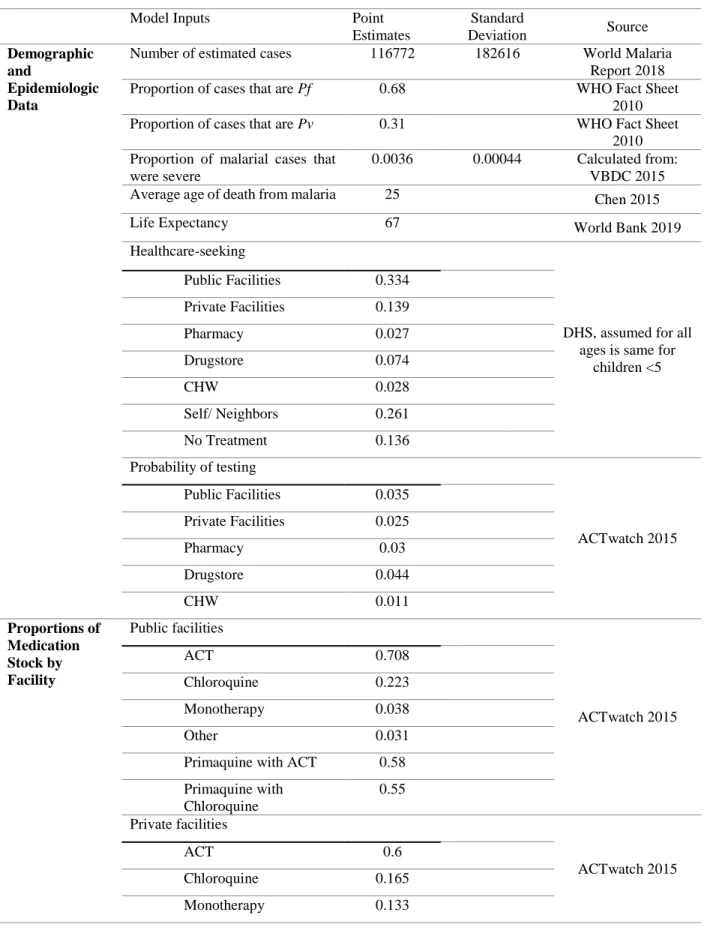
are listed in Table 1. Key data sources we used included the vector borne disease control
program (VBDC) report from the Myanmar Ministry of Health, WHO world malaria report, the
ACTwatch outlet report, and the Demographic and Health Survey (DHS) for Myanmar, in
addition to published literature. Key data inputs were simulated to vary probabilistically to
account for natural variations in epidemiological and cost inputs. Epidemiological data were
varied based on beta distributions and cost data were ranged using gamma distributions.
The model simulates 1,000 individuals of all ages with malaria due to P. falciparum and
P. vivax parasites in a five-day period, accumulated over one-year. We then ran this model
10,000 times. Each modeled case of malaria represented around 24 real world cases in Myanmar.
At the beginning of each five-day period, individuals with symptomatic malaria infection
outcomes. At the end of the week, patients either became healthy, asymptomatic, died, or
remained sick. Outcomes were tracked throughout the model year and averaged at the
model. Sensitivity analysis to validate this method was conducted by increasing the ratio
of modeled cases to actual cases and comparing the outputs to ensure no significant
difference.
We modeled seven options for people to seek treatment for malaria: they could go
to 1) public facilities, 2) private facilities, 3) pharmacies, 4) informal private sector (drug
shops or itinerant drug vendors), 5) community health workers (CHWs), 6) self-treat, or
7) not seek care. Available stock of medications at each location based on national data of
antimalarial market share determined the probability that patients received different types
of treatment, such as ACTs, artemisinin monotherapy, chloroquine, primaquine, and
others (e.g. sulfadoxine–pyrimethamine) (ACTwatch Group and Population Services
International Myanmar, 2016). Current national treatment guidelines for uncomplicated
cases of P. falciparum malaria in Myanmar include three ACTs: artemether lumefantrine
(AL), dihydroartemisinin piperaquine (DHA-PPQ), or artesunate mefloquine (AS-MQ)
(World Health Organization, 2015b). First-line treatment for radical cure of P. vivax
malaria is chloroquine to treat blood stage parasites, accompanied by primaquine to treat
latent liver stage parasites that can cause relapses (World Health Organization, 2015b).
Some individuals received no treatment due to a stock out based on data on frequency of
stock outs of ACTs (ACTwatch Group and Population Services International Myanmar, 2016).
Individuals who did not seek care or received no drug at a facility remained symptomatic into the
treatment outcomes were determined based on the efficacy of the medicine they received,
adjusted by medication quality (amount of API) and patients’ modeled adherence. Adherence
rates were obtained from a study assessing adherence to six-dose regimen of
artemether-lumefantrine in Myanmar (Z. W. Tun et al., 2012).
Treatment efficacy was defined as medication-specific likelihood of adequate clinical and
parasitological response at 28 days based on polymerase chain reaction (PCR) (Chu et al., 2018;
Ejov, Tun, Aung, & Sein, 1999; Htun et al., 2017; Muhamad, Ruengweerayut, Chacharoenkul,
Rungsihirunrat, & Na-Bangchang, 2011; Myint et al., 2017; Na-Bangchang, Ruengweerayut,
Mahamad, Reungweerayut, & Chaijaroenkul, 2010; Nyunt et al., 2017; Phyo et al., 2011; Shwe,
Lwin, & Aung, 1998; Frank Smithuis et al., 2006; Frank Smithuis et al., 2004; F. M. Smithuis et
al., 2010; K. M. Tun et al., 2018; Yuan et al., 2015; Zwang et al., 2009). We incorporated
substandard and falsified antimalarials based on prevalence by medicine from the literature,
where poor quality antimalarials were assigned lower API concentrations found from studies
testing antimalarials (Tabernero et al., 2015).
We used data from the VBDC report on the number of cases of severe malaria and
malaria related hospitalizations to estimate probabilities that treated cases would progress to
become severe (Department of Public Health, 2015). For untreated cases of malaria, we
employed rates of progression to severe disease reported by a Delphi study (Lubell et al., 2011).
Agents that sought care with severe malaria became hospitalized and received inpatient care.
Severe malaria patients faced the probability of dying, resulting in neurologic sequelae, or fully
recovering to become healthy. Rates of progression to neurologic sequalae or death were
(SEAQUAMAT) Group, 2005). Modeled results were scaled to the population of
Myanmar based on the number of new cases simulated to estimate the annual malaria
burden in the country.
Primary model outputs were estimates of health outcomes, direct costs and
productivity losses. Direct costs included costs to patients such as transportation, testing,
medication, consultation, and hospitalization costs, and costs to public facilities and
CHWs for providing treatment (ACTwatch Group and Population Services International
Myanmar, 2016; Naing and Gatton, 2004; World Health Organization, 2010). Indirect
costs included productivity losses for care-seeking, disability, or premature death.
Productivity losses were estimated using the human capital approach where lost earnings
were calculated based on gross domestic product (GDP) per capita and duration of
productivity losses (The World Bank, 2019). Care seeking productivity loss was
estimated to be between three to five days of lost earnings, while lifetime productivity
losses were calculated from the average age of death due to malaria until average life
expectancy, discounted at 3% (Chen, Aung, Thant, Sudhinaraset, & Kahn, 2015).
Disability productivity losses were estimated by applying the disability weights for
neurologic sequelae to discounted lifetime productivity losses. All cost outputs were
rounded to the nearest thousands and expressed in 2017 United States Dollars (USD).
We ran the simulation across three scenarios. The baseline scenario simulates the
overall burden of malaria in Myanmar at current levels of antimalarial quality. A second
baseline to elucidate the health and economic impact of poor-quality antimalarials. Finally, a
third scenario simulated hypothetical widespread ACT resistance in which the cure rate of ACTs
was reduced to that of other antimalarials, and patients receiving ACTs experienced five more
days of prolonged illness (Dondorp, et al., 2004; Khin, et al., 2016; Yong, et al., 2015). These
scenarios were compared to baseline using unpaired two-sample t-tests.
Results
Table 2 presents the annual health and economic burden of malaria in Myanmar. Based
on around 117,000 (95% CI: 116,982-117,018) cases of malaria per year, we estimated that
malaria results in 899 (95% CI: 895-903) severe cases, 449 (95% CI: 447-452) hospitalizations,
and 202 (95% CI: 201-203) deaths annually. Costs of care seeking and productivity losses added
up to $14.084 (95% CI: $14.040-14.128) million annually, which consisted of $2.719 (95% CI:
$2.715-2.722) million in direct costs and $11.365 (95% CI: $11.321-11.409) million in
productivity losses. Direct costs included $2.2 million in care, $71,000 in medications, and
$1,400 in testing. Productivity losses for care-seeking totaled $5.093 (95% CI: $5.086-5.099)
million and lifetime productivity losses from disability or early death was estimated at $6.272
(95% CI: $6.229-6.316) million.
Substandard and falsified antimalarials contributed to 15 (3%) hospitalizations (p <
0.001) and 67 (33%) deaths (p < 0.001) annually. Moreover, substandard and falsified
antimalarials accounted for 15% of the current economic impact of malaria in Myanmar
estimated at $2.04 million (p < 0.001). The impact of poor-quality antimalarials consisted mainly
estimated at around $16,000 annually (p < 0.001), including out-of-pocket costs to the
patient and public facility costs for public facilities.
Our hypothetical scenario of antimalarial resistance reduced the effectiveness of
ACTs and increased the duration of illness. This scenario resulted in a 3.6% increase in
severe cases where 32 more malaria cases became severe each year (p < 0.001), leading
to 16 (3.5%) more deaths annually (p < 0.001). The antimalarial resistance scenario
increased the total economic burden of malaria $550,000 (p < 0.001). This additional cost
due to antimalarial resistance consists of approximately $104,000 in direct costs and
$442,000 in productivity losses.
Discussion
Our results demonstrate the need for Myanmar to ensure antimalarial quality in
order to reduce the burden of malaria and reach 2030 malaria elimination targets. Based
on the best available data, we estimated that substandard and falsified antimalarials
currently contribute to 37% of the deaths each year with an impact of over $2 million
annually, equivalent to around 2.9% of Myanmar’s GDP (The World Bank). This is
substantial as the country’s total expenditure on health was 2.3% of GDP in 2014 in
comparison (World Health Organization, 2014a). The burden of malaria could increase
even further if the prevalence of poor-quality antimalarials continues and resistance to
ACTs increase.
Poor-quality antimalarials directly hinder priorities outlined by Myanmar’s
eliminating P. falciparum malaria with special emphasis on areas of multi-drug and artemisinin
resistance.” Utilizing high-quality medicines leads to shorter and less severe illness, lending to
fewer fatalities and less opportunity for spread of contagious diseases and accumulation of drug
resistance (Bassat, Tanner, Guerin, Stricker, & Hamed, 2016). Antimalarial resistance and
inability to achieve malarial elimination in Myanmar harm neighboring countries in the Greater
Mekong Subregion (GMS) and risk the spread of resistance worldwide where the burden of
malaria is even greater.
Our results are comparable to other estimates of modeled artemisinin resistance in the
region. For example, Lubell et al. modeled artemisinin resistance in Cambodia in 2014 by
assuming the efficacy of artemisinin would be reduced to 70%, resulting in a 28% increase in
direct medical costs.(Lubell et al., 2014) In our model, a reduced efficacy of ACTs to 66%
resulted in an increase of 4.3% in direct medical costs. Lower costs of care in Myanmar and
difference in model structures explain these differences, where Lubell et al. used a simple
decision tree as compared to our dynamic agent-based model, which incorporated variations in
care-seeking and costs.
Compared to our model results from Africa, where we focused on the burden of malaria
among children under age five, this analysis in Myanmar estimated the impact of malaria across
all-ages. The malaria burden in Africa is vastly larger, with estimated cases of 200 million
children in sub-Saharan Africa, where malaria tends to be more severe among children (World
Health Organization, 2018). This analysis simulated 117,000 all-age cases in Myanmar given the
Moreover, unique characteristics of disease epidemiology in the greater Mekong
subregion makes it important to ensure treatment quality. The biting pattern of mosquitos
in Myanmar, which mainly bite in the early evening before children go to bed, makes
insecticide treated nets less effective in preventing malaria (F. M. Smithuis et al., 2013a;
F. M. Smithuis et al., 2013b). Thus for Myanmar, the most effective tool against the
further spread of malaria is early detection and proper use of effective antimalarials.
Unlike sub-Saharan Africa where malaria cases are mainly caused by the P.
falciparum parasite, more than 30% of the malarial cases in Southeast Asia are caused by
P. vivax parasites (World Health Organization, 2016, 2018). This epidemiological
difference poses a unique challenge to elimination in the GMS, as P. vivax infections face
higher rates of relapse. The life cycle of P. vivax parasites include dormant stages in liver
cells which cause asymptomatic infection (World Health Organization, 2015b). This
affects treatment effectiveness, where current recommended treatment is to include
primaquine with chloroquine to prevent recrudescence. However, primaquine should not
be given to people with glucose-6-phosphate dehydrogenase (G6PD) deficiency due to
the risk of red blood cell breakdown. G6PD deficiency is not easy to detect in
low-resourced settings in Myanmar. While ACTwatch data demonstrated a need for
increasing primaquine availability in rural Myanmar, primaquine would be ineffective in
instances where 27% of chloroquine may be substandard and falsified (Khin, et al., 2016;
The main limitation of this study is the availability of quality data for model inputs. We
conducted a literature review to utilize the most recent literature across inputs, but some data
were older or had to be extrapolated across the region. Furthermore, current literature
surrounding malarial treatment in Myanmar most commonly focused on migrant populations of
Myanmar residents who are treated in bordering countries such as Thailand, which may not be
reflective of the broader population. We chose conservative estimates in cases of conflicting or
outdated information. Due to limited data availability, inputs for treatment efficacy, adherence,
and utilization may not reflect the heterogeneity of practice amongst the urban/rural or high/low
malaria transmission regions of Myanmar. Literature regarding availability of medicines in the
public sector were unavailable. To address these data limitations, we varied our inputs
probabilistically over 10,000 model runs to capture the uncertainty in model estimates.
Mitigating the impact of substandard and falsified antimalarials is important to lessen the
current health and economic burden of malaria in Myanmar and meet future malaria elimination
targets. Poor quality medicines not only prolong disease and lead to more severe cases, but also
allow malaria to spread further, contributing to the burden of illness and facilitating the growth
of antimalarial resistance. To make malaria elimination in Southeast Asia a reality, better
surveillance and elimination of poor-quality antimalarials must be a greater priority.
Acknowledgments
We thank malaria experts, Steve Taylor and Jessica Lin who offered insights and feedback into
directors at the Eshelman School of Pharmacy at the University of North Carolina and Kathryn
Morbitzer for guidance and feedback.
Financial Support
No financial support was provided for this study.
Conflicts of Interest
The authors declare no conflicts of interest.
Sachiko Ozawa, Jinah Han, and Colleen Higgins
Division of Practice Advancement and Clinical Education, UNC Eshelman School of
Pharmacy, University of North Carolina, Chapel Hill, NC, USA
[email protected], [email protected], [email protected]
Sarah Laing
Duke Global Health Institute, Duke University, Durham, NC, USA
Frank Smithuis
Myanmar Oxford Clinical Research Unit, Oxford University, Yangon, Myanmar
References
ACTwatch Group and Population Services International Myanmar. (2016). ACTwatch Study Reference Document: Myanmar Outlet Survey. Washington DC:
http://www.actwatch.info/projects/actwatch/myanmar
Bassat, Q., Tanner, M., Guerin, P. J., Stricker, K., & Hamed, K. (2016). Combating poor-quality anti-malarial medicines: a call to action. Malar J, 15, pp. 302-302. doi:10.1186/s12936-016-1357-8 Retrieved from https://www.ncbi.nlm.nih.gov/pmc/PMC4888506/
Beargie, S. M., Higgins, C. R., Evans, D. R., Laing, S., Erim, D., & Ozawa, S. (2019). The economic impact of substandard and falsified antimalarial medications in Nigeria. PLoS One
Chen, I. T., Aung, T., Thant, H. N. N., Sudhinaraset, M., & Kahn, J. G. (2015).
Cost-effectiveness analysis of malaria rapid diagnostic test incentive schemes for informal private healthcare providers in Myanmar. Malar J, 14, p 55. doi:10.1186/s12936-015-0569-7
Chu, C. S., Phyo, A. P., Lwin, K. M., Win, H. H., San, T., Aung, A. A., . . . White, N. J. (2018). Comparison of the Cumulative Efficacy and Safety of Chloroquine, Artesunate, and Chloroquine-Primaquine in Plasmodium vivax Malaria. Clin Infect Dis, 67(10), pp. 1543-1549. doi:10.1093/cid/ciy319 Retrieved from
https://www.ncbi.nlm.nih.gov/pubmed/29889239
Department of Public Health. (2015). Vector Borne Disease Control Programme Annual Report
The Republic of the Union of Myanmar
Dondorp, A. M., Newton, P. N., Mayxay, M., Van Damme, W., Smithuis, F. M., Yeung, S., . . . White, N. J. (2004). Fake antimalarials in Southeast Asia are a major impediment to malaria control: multinational cross-sectional survey on the prevalence of fake antimalarials. Trop Med Int Health, 9(12), pp. 1241-1246.
doi:10.1111/j.1365-3156.2004.01342.x Retrieved from http://onlinelibrary.wiley.com/store/10.1111/j.1365-
3156.2004.01342.x/asset/j.1365-3156.2004.01342.x.pdf?v=1&t=ixhw64go&s=61aa210b02bf231ed68044ac965c5a690ec 73c84
Ejov, M. N., Tun, T., Aung, S., & Sein, K. (1999). Response of Falciparum Malaria to Different Antimalarials in Myanmar. Bulletin of the WHO, 77(3)
Guo, S., Kyaw, M. P., He, L., Min, M., Ning, X., Zhang, W., . . . Cui, L. (2017). Quality Testing of Artemisinin-Based Antimalarial Drugs in Myanmar. Am J Trop Med Hyg, 97(4), pp. 1198-1203.
Hajjou, M., Krech, L., Lane-Barlow, C., Roth, L., Pribluda, V. S., El-Hadri, L., . . . PLukulay, P. H. (2015). Monitoring the Quality of Medicines: Results from Africa, Asia, and South America. The American Society of Tropical Medicine and Hygiene, 92(Suppl 6), pp. 68-74.
Htun, M. W., Mon, N. C. N., Aye, K. M., Hlaing, C. M., Kyaw, M. P., Handayuni, I., . . . Thriemer, K. (2017). Chloroquine efficacy for Plasmodium vivax in Myanmar in
populations with high genetic diversity and moderate parasite gene flow. Malar J, 16(1), p 281. doi:10.1186/s12936-017-1912-y Retrieved from
https://www.ncbi.nlm.nih.gov/pubmed/28693552
Diseases, 17(10), pp. 1022-1023. doi:10.1016/S1473-3099(17)30524-8 Retrieved from https://doi.org/10.1016/S1473-3099(17)30524-8
Khin, C., Myint, H., Thaung, H., Theingi, Z., Lu Lu Kyaw Tin, O., Tin Myo, K., . . . San Myat, M. (2016). Quality assessment of antimalarials in two border areas (Tamu and Muse).
Myanmar Health Sciences Research Journal, 28(1), pp. 48-52. Retrieved from
https://auth.lib.unc.edu/ezproxy_auth.php?url=http://search.ebscohost.com/login.aspx?dir ect=true&db=lhh&AN=20163282802&site=ehost-live&scope=site
email: [email protected]
Lubell, Y., Dondorp, A., Guerin, P. J., Drake, T., Meek, S., Ashley, E., . . . White, L. J. (2014). Artemisinin Resistance - Modelling the Potential Human and Economic Costs. Malar J, 13(452)
Lubell, Y., Staedke, S. G., Greenwood, B. M., Kamya, M. R., Molyneux, M., Newton, P. N., . . . Whitty, C. J. M. (2011). Likely Health Outcomes for Untreated Acute Febrile Illness in the Tropics in Decision and Economic Models; A Delphi Survey. PLoS One
Muhamad, P., Ruengweerayut, R., Chacharoenkul, W., Rungsihirunrat, K., & Na-Bangchang, K. (2011). Monitoring of clinical efficacy and in vitro sensitivity of Plasmodium vivax to chloroquine in area along Thai Myanmar border during 2009-2010. Malar J, 10, p 44. doi:10.1186/1475-2875-10-44 Retrieved from
https://www.ncbi.nlm.nih.gov/pubmed/21324161
Myint, M. K., Rasmussen, C., Thi, A., Bustos, D., Ringwald, P., & Lin, K. (2017). Therapeutic Efficacy and Artemisinin Resistance in Northern Myanmar: Evidence from In Vivo and Molecular Marker Studies. Malar J, 16(143)
Na-Bangchang, K., Ruengweerayut, R., Mahamad, P., Reungweerayut, K., & Chaijaroenkul, W. (2010). Declining in efficacy of a three-day combination regimen of
mefloquine-artesunate in a multi-drug resistance area along the Thai-Myanmar border. Malar J, 9(273)
Naing, C.-M., & Gatton, M. L. (2004). Costs to the Patient for Seeking Malaria Care in Myanmar. Acta Trop, 92, pp. 173-177.
Nayyar, G. M. L., Breman, J. G., Newton, P. N., & Herrington, J. (2012). Poor-quality
Antimalarial Drugs in Southeast Asia and Sub-Saharan Africa. Lancet Infect Dis, 12, pp. 488-496.
Newton, P., Proux, S., Green, M., Smithuis, F., Rozendaal, J., Prakongpan, S., . . . White, N. J. (2001). Fake artesunate in southeast Asia. Lancet, 357(9272), pp. 1948-1950.
doi:10.1016/s0140-6736(00)05085-6 Retrieved from
http://ac.els- cdn.com/S0140673600050856/1-s2.0-S0140673600050856-main.pdf?_tid=932f12cc-
d1ea-11e6-919e-00000aacb360&acdnat=1483471790_255c0d06c97449f5bf673608d37116b7
Newton, P. N., Fernandez, F. M., Plancon, A., Miildenhall, D. C., Green, M. D., Ziyong, L., . . . Palmer, K. (2008). A Collaborative Epidemiological Investigation into the Criminal Fake Artesunate Trade in South East Asia. PLOS Medicine, 5(2), p e32.
Nyunt, M. H., Han, J.-H., Wang, B., Aye, K. M., Aye, K. H., Lee, S.-K., . . . Han, E.-T. (2017). Clinical and molecular surveillance of drug resistant vivax malaria in Myanmar (2009-2016). Malar J, 16(1), p 117. doi:10.1186/s12936-017-1770-7 Retrieved from
https://www.ncbi.nlm.nih.gov/pubmed/28298235
medicines in low- and middle-income countries: A systematic review and meta-analysis.
JAMA Network Open, 1(4), p e181662. doi:10.1001/jamanetworkopen.2018.1662 Retrieved from http://dx.doi.org/10.1001/jamanetworkopen.2018.1662
Ozawa, S., Evans, D. R., Higgins, C. R., Laing, S. K., & Awor, P. (2019). Development of an agent-based model to assess the impact of substandard and falsified anti-malarials: Uganda case study. Malar J, 18(1), p 5. doi:10.1186/s12936-018-2628-3 Retrieved from http://www.ncbi.nlm.nih.gov/pubmed/30626380
Ozawa, S., Haynie, D. G., Bessias, S., Laing, S. K., Ngamasana, E. L., Yemeke, T. T., & Evans, D. R. (2019). Modeling the Economic Impact of Substandard and Falsified Antimalarials in the Democratic Republic of the Congo. Am J Trop Med Hyg doi:10.4269/ajtmh.18-0334 Retrieved from http://www.ncbi.nlm.nih.gov/pubmed/30675851
Phyo, A. P., Lwin, K. M., Price, R. N., Ashley, E. A., Russell, B., Sriprawat, K., . . . Nosten, F. (2011). Dihydroartemisinin-piperaquine versus chloroquine in the treatment of
Plasmodium vivax malaria in Thailand: a randomized controlled trial. Clin Infect Dis, 53(10), pp. 977-984. doi:10.1093/cid/cir631 Retrieved from
https://www.ncbi.nlm.nih.gov/pubmed/22002979
Shwe, T., Lwin, M., & Aung, S. (1998). Influence of Blister Packaging on the Efficacy of Artesunate + Mefloquine over Artesunate Alone in Community-Based Treatment of Non-severe Falciparum Malaria in Myanmar. Bulletin of the WHO, 76(Suppl. 1), pp. 35-41. Smithuis, F., Kyaw, M. K., Phe, O., Aye, K. Z., Htet, L., Barends, M., . . . White, N. J. (2006).
Efficacy and Effectiveness of Dihydroartemisinin-Piperaquine versus Artesunate-Mefloquine in Falciparum Malaria: an Open-Label Randomised Comparison. Lancet, 367, pp. 2075-2085.
Smithuis, F., van der Broek, I., Katterman, N., Kyaw, M. K., Brockman, A., Lwin, S., & White, N. J. (2004). Optimising Operational Use of Artesunate-Mefloquine: a Randomised Comparison of Four Treatment Regimens. Royal Society of Tropical Medicine and Hygiene, 98, pp. 182-192.
Smithuis, F. M., Kyaw, M. K., Phe, U. O., van der Broek, I., Katterman, N., Rogers, C., . . . White, N. J. (2013a). The effect of insecticide-treated bed nets on the incidence and prevalence of malaria in children in an area of unstable seasonal transmission in western Myanmar. Malar J, 12, p 363. doi:10.1186/1475-2875-12-363
Smithuis, F. M., Kyaw, M. K., Phe, U. O., van der Broek, I., Katterman, N., Rogers, C., . . . White, N. J. (2013b). Entomological determinants of insecticide-treated bed net effectiveness in Western Myanmar. Malar J, 12, pp. 364-364. doi:10.1186/1475-2875-12-364 Retrieved from https://www.ncbi.nlm.nih.gov/pubmed/24119994
Smithuis, F. M., Kyaw, M. K., Phe, U. O., Win, T., Aung, P. P., Oo, A. P. P., . . . White, N. J. (2010). Effectiveness of five artemisinin combination regimens with or without
primaquine in uncomplicated falciparum malaria: an open-label randomised trial. Lancet Infect Dis, 10(10), pp. 673-681. doi:10.1016/s1473-3099(10)70187-0
Southeast Asian Quinine Artesunate Malaria Trial (SEAQUAMAT) Group. (2005). Artesunate Versus Quinine for Treatment of Falciparum Malaria: a Randomised Trial. Lancet, 366, pp. 717-725.
The World Bank. (2019). Myanmar. Retrieved Date Accessed, 2019 from https://data.worldbank.org/country/myanmar.
Tun, K. M., Jeeyapant, A., Myint, A. H., Kyaw, Z. T., Dhorda, M., Mukaka, M., . . . Smithuis, F. (2018). Effectiveness and Safety of 3 and 5 day courses of Artemether-Lumefantrine for the Treatment of Uncomplicated Falciparum Malaria in an Area of Emerging Artemisinin Resistance in Myanmar. Malar Journal, 17(258)
Tun, Z. W., Lin, Z., Wai, K., Lin, K., Oung, M. T., Kyaw, T. T., & Thant, K. Z. (2012).
Adherence to the Recommended Regimen of Artemether-Lumefantrine for Treatment of Uncomplicated Falciparum Malaria in Myanmar. The Myanmar Health Sciences
Research Journal, 24(1), pp. 48-53.
United Nations. (2015). The Millennium Development Goals Report. New York, New York Wondemagegnehu, E. (1999). Counterfeit and Substandard Drugs in Myanmar and Viet Nam:
Report of a study carried out in cooperation with the Governments of Myanmar and Viet Nam. Geneva, Switzerland
World Health Organization. (2010). Health Services Delivery Costs. In W.-C. e. o. c. f. i. a. o. h. s. delivery (Ed.). Geneva, Switzerland: WHO-CHOICE.
World Health Organization. (2014a). Myanmar. Retrieved Date Accessed, 2019 from https://www.who.int/countries/mmr/en/.
World Health Organization. (2014b). Severe malaria. Trop Med Int Health, 19 Suppl 1, pp. 7-131. doi:10.1111/tmi.12313_2
World Health Organization. (2015a). Global Technical Strategy For Malaria 2016-2030. Geneva, Switzerland
World Health Organization. (2015b). Guidelines for the treatment of malaria. Third edition. Geneva, Switzerland: https://www.who.int/malaria/publications/atoz/9789241549127/en/ World Health Organization. (2016). Eliminating Malaria in the Greater Mekong Subregion:
United to End a Deadly Disease. Geneva, Switzerland
World Health Organization. (2017). WHO Global Surveillance and Monitoring System for Substandard and Falsified Medical Products. Geneva, Switzerland
World Health Organization. (2018). World Malaria Report 2018. Geneva, Switzerland Yong, Y. L., Plancon, A., Lau, Y. H., Hostetler, D. M., Fernandez, F. M., Green, M. D., . . .
Newton, P. N. (2015). Collaborative Health and Enforcement Operations on the Quality of Antimalarials and Antibiotics in Southeast Asia. The American Society of Tropical Medicine and Hygiene, 92(Suppl 6), pp. 105-112.
Yuan, L., Wang, Y., Parker, D. M., Gupta, B., Yang, Z., Liu, H., . . . Cui, L. (2015). Therapeutic responses of Plasmodium vivax malaria to chloroquine and primaquine treatment in northeastern Myanmar. Antimicrob Agents Chemother, 59(2), pp. 1230-1235. doi:10.1128/AAC.04270-14 Retrieved from
https://www.ncbi.nlm.nih.gov/pubmed/25512415
Table 1. Key Model Inputs, Sources, and Assumptions
Model Inputs Point
Estimates
Standard
Deviation Source
Demographic and
Epidemiologic Data
Number of estimated cases 116772 182616 World Malaria
Report 2018
Proportion of cases that are Pf 0.68 WHO Fact Sheet
2010
Proportion of cases that are Pv 0.31 WHO Fact Sheet
2010 Proportion of malarial cases that
were severe
0.0036 0.00044 Calculated from:
VBDC 2015
Average age of death from malaria 25 Chen 2015
Life Expectancy 67 World Bank 2019
Healthcare-seeking
DHS, assumed for all ages is same for
children <5
Public Facilities 0.334
Private Facilities 0.139
Pharmacy 0.027
Drugstore 0.074
CHW 0.028
Self/ Neighbors 0.261
No Treatment 0.136
Probability of testing
ACTwatch 2015
Public Facilities 0.035
Private Facilities 0.025
Pharmacy 0.03
Drugstore 0.044
CHW 0.011
Proportions of Medication Stock by Facility Public facilities ACTwatch 2015
ACT 0.708
Chloroquine 0.223
Monotherapy 0.038
Other 0.031
Primaquine with ACT 0.58
Primaquine with Chloroquine
0.55
Private facilities
ACTwatch 2015
ACT 0.6
Chloroquine 0.165
Other 0.102
Primaquine with ACT 0.326
Primaquine with Chloroquine
0.338
Pharmacy
ACTwatch 2015
ACT 0.401
Chloroquine 0.283
Monotherapy 0.2
Other 0.116
Primaquine with ACT 0.016
Primaquine with Chloroquine
0.02
Drugstore
ACTwatch 2015
ACT 0.392
Chloroquine 0.290
Monotherapy 0.247
Other 0.071
Primaquine with ACT 0.015
Primaquine with Chloroquine
0.019
CHW
ACTwatch 2015
ACT 0.708
Chloroquine 0.223
Monotherapy 0.038
Other 0.031
Primaquine with ACT 0.58
Primaquine with Chloroquine
0.55
Self/ neighbors
Assumption, same as Drugstore
ACT 0.392
Chloroquine 0.290
Monotherapy 0.247
Other 0.071
Primaquine with ACT 0.015
Primaquine with Chloroquine 0.019 Medication in-stock probabilities Antimalarial in-stock probabilities ACTwatch 2015
Public Facilities 0.83
Pharmacy 0.49
Drugstore 0.312
CHW 0.831
Self/ Neighbor 1
Prevalence of Substandard and Falsified Antimalarials Antimalarial in-stock probabilities ACTwatch 2015
ACT 0.12
Chloroquine 0.27
Monotherapy 0.18
Other 0.24
Primaquine 0
Medication effectiveness
Probability of cure with quality-assured medicines
ACT 0.9798 Myint 2017,
Na-Bangchang 2010, Nyunt 2017, Smithuis 2006, Smithuis 2004, Smithuis 2010, Tun
2018, Zwang 2009
Chloroquine 0.9392 Nyunt 2017, Chu
2018, Ejov 1999, Htun 2017, Muhamad 2011, Phyo 2011, Yuan
2015 Primaquine with ACT or
Chloroquine
0.9770 Smithuis 2010, Chu
2018, Muhamad 2011, Yuan 2015 Oral Artemisinin
Monotherapy
0.8099 Chu 2018, Shwe
1998
Other 0.6552 Smithuis 2004, Ejov
1999
No Treatment 0 Assumption
Medication costs by facility
Public facilities
ACTwatch 2015
ACT --
Chloroquine --
Primaquine --
Monotherapy --
Other --
Private facilities
ACTwatch 2015
ACT $0.18 $0.02
Chloroquine $0.10 $0.01
Monotherapy $2.22 $0.52
Other $0.48 $0.05
Pharmacy
ACTwatch 2015
ACT $0.41 $0.04
Chloroquine $0.17 $0.05
Primaquine $0.30 $0.06
Monotherapy $2.48 $0.21
Other $0.48 $0.05
Drugstore
ACTwatch 2015
ACT $0.37 $0.04
Chloroquine $0.30 $0.03
Primaquine $0.02 $0.04
Monotherapy $3.18 $0.43
Other $0.63 $0.06
CHW
ACTwatch 2015
ACT --
Chloroquine --
Primaquine --
Monotherapy $2.66 $0.63
Other --
Self/ Neighbor --
Non-medication costs
Cost per primary level hospitalization
$9.60 $4.72
WHO CHOICE 2010
Average testing costs $0.07 $0.05 Calculated from
testing costs and market share of testing based on ACTwatch 2015
Transportation costs 19.04 Kyat Naing 2004
Productivity loss per sick day $3.42 Calculated from
World Bank 2019 (GDP per capita/365) Discounted productivity loss per
death
$30,368.30 Calculated from
World Bank 2019 discounted at 3%
Table 2. Estimated Annual Health and Economic Impact of Substandard and Falsified Antimalarials in Myanmar
Burden of Malaria No Substandard and Falsified
Antimalarials Antimalarial Resistance
Baseline 95% CI Potential
Savings Percent Difference P-value Additional Costs Percent Difference P-value Health Impact
Cases 117,000 116,982 -
117,018 -- -- -- -- -- --
Deaths 202 201 - 203 -15 -3.3% <0.001 9 6.6% <0.001
Severe
Cases 899 895 - 903 -23 -2.6% <0.001 32 3.6% <0.001
Hospital-izations 449 447 - 452 -67 -33.1% <0.001 16 14.5% <0.001
Economic Impact† Total Annual Burden $14,084,000 $14,040,000 - $14,128,000 -$2,043,000
-14.5% <0.001 $546,000 3.9% <0.001
Direct Costs $2,719,000
$2,715,000 - $2,722,000
-$16,000 -0.6% <0.001 $104,000 3.8% <0.001
Productivity Losses $10,760,000 $10,699,000 -$10,822,000 -$2,049,000
-17.8% <0.001 $442,000 3.9% <0.001