Recent Work
Title
An immersed boundary method for rigid bodies
Permalink
https://escholarship.org/uc/item/2057k2x1
Journal
Communications in Applied Mathematics and Computational Science, 11(1)
ISSN
1559-3940Authors
Kallemov, B Bhalla, APS Griffith, BE et al.Publication Date
2016DOI
10.2140/camcos.2016.11.79
Peer reviewed
eScholarship.org Powered by the California Digital Library
Bakytzhan Kallemov,1 Amneet Pal Singh Bhalla,2 Boyce E. Griffith,3 and Aleksandar Donev1,∗
1Courant Institute of Mathematical Sciences,
New York University, New York, NY 10012
2Department of Mathematics, University of North Carolina, Chapel Hill, NC 27599
3Departments of Mathematics and Biomedical Engineering,
University of North Carolina, Chapel Hill, NC 27599
We develop an immersed boundary (IB) method for modeling flows around fixed or mov-ing rigid bodies that is suitable for a broad range of Reynolds numbers, includmov-ing steady Stokes flow. The spatio-temporal discretization of the fluid equations is based on a stan-dard staggered-grid approach. Fluid-body interaction is handled using Peskin’s IB method; however, unlike existing IB approaches to such problems, we do not rely on penalty or fractional-step formulations. Instead, we use an unsplit scheme that ensures the no-slip constraint is enforced exactly in terms of the Lagrangian velocity field evaluated at the IB markers. Fractional-step approaches, by contrast, can impose such constraints only approx-imately, which can lead to penetration of the flow into the body, and are inconsistent for steady Stokes flow. Imposing no-slip constraints exactly requires the solution of a large linear system that includes the fluid velocity and pressure as well as Lagrange multiplier forces that impose the motion of the body. The principal contribution of this paper is that it develops an efficient preconditioner for this exactly constrained IB formulation which is based on an analytical approximation to the Schur complement. This approach is enabled by the near translational and rotational invariance of Peskin’s IB method. We demonstrate that only a few cycles of a geometric multigrid method for the fluid equations are required in each application of the preconditioner, and we demonstrate robust convergence of the overall Krylov solver despite the approximations made in the preconditioner. We empiri-cally observe that to control the condition number of the coupled linear system while also keeping the rigid structure impermeable to fluid, we need to place the immersed boundary markers at a distance of about two grid spacings, which is significantly larger from what has been recommended in the literature for elastic bodies. We demonstrate the advantage of our monolithic solver over split solvers by computing the steady state flow through a two-dimensional nozzle at several Reynolds numbers. We apply the method to a number of benchmark problems at zero and finite Reynolds numbers, and we demonstrate first-order convergence of the method to several analytical solutions and benchmark computations.
I. INTRODUCTION
A large number of numerical methods have been developed to simulate interactions between
fluid flows and immersed bodies. For rigid bodies or bodies with prescribed kinematics, many
of these approaches [1–5] are based on the immersed boundary (IB) method of Peskin [6]. The
simplicity, flexibility, and power of the IB method for handling a broad range of fluid-structure
interaction problems was demonstrated by Bhalla et al. [2]. In that study, the authors showed that the IB method can be used to model complex flows around rigid bodies moving with specified
kinematics (e.g., swimming fish or beating flagella) as well as to compute the motion of freely
moving bodies driven by flow. In the approach of Bhalla et al., as well as those of others [1, 3–5], the rigidity constraint enforcing that the fluid follows the motions of the rigid bodies is imposed
only approximately. Here and throughout this manuscript, when we refer to theno slip condition, we mean the requirement that the interpolated fluid velocity exactly match the rigid body velocity
at the positions of the IB marker points. In this work, we develop an effective solution approach
to an IB formulation of this problem that exactly enforces both the incompressibility and no-slip constraints, thus substantially improving upon a large number of existing techniques.
A simple approach to implementing rigid bodies using the traditional IB method is to use
stiff springs to attach markers that discretize the body to tether points constrained to move as a
rigid body [7]. This penalty-spring approach leads to numerical stiffness and, when the forces are
handled explicitly, requires very small time steps. For this reason, a number of direct forcing IB methods [8] have been developed that aim to constrain the flow inside the rigid body by treating the
fluid-body force as a Lagrange multiplierΛenforcing a no-slip constraint at the locations of the IB
markers. However, to our knowledge, all existing direct forcing IB methods use some form of time
step splitting to separate the coupled fluid-body problem into more manageable pieces. The basic
idea behind these approaches is first to solve a simpler system in which a number of the constraints
(e.g., incompressibility, or no-slip along the fluid-body interface) are ignored. The solution of the
unconstrained problem is then projected onto the constraints, which yields estimates of the true Lagrange multipliers. In most existing methods, the fluid solver uses a fractional time stepping
scheme, such as a version of Chorin’s projection method, to separate the velocity update from the
∗
pressure update [1, 3, 5]. Taira and Colonius also use a fractional time-stepping approach in which
they split the velocity from the Lagrange multipliers (π,Λ). They obtain approximations to (π,Λ)
in a manner similar to that in a standard projection method for the incompressible Navier-Stokes
equations. A modified Poisson-type problem (see (26) in [3]) determines the Lagrange multipliers
and is solved using an unpreconditioned conjugate gradient method. The method developed in Ref.
[2] avoids the pressure-velocity splitting and instead uses a combined iterative Stokes solver, and
in Ref. [4] (see supplementary material), periodic boundary conditions are applied, which allows
for the use of a pseudo-spectral method. In both works, however, time step splitting is still used to
separate the computation of the rigidity constraint forces from the updates to the fluid variables.
In the approach described in the supplementary material to Ref. [4], the projection step of the
solution onto the rigidity constraint is performed twice in a predictor-corrector framework, which
improves the imposition of the constraint; however, this approach does not control the accuracy of
the approximation of the constraint forces. Curet et al. [9] and Ardekani et al. [10] go a step closer
in the direction of exactly enforcing the rigidity constraint by iterating the correction until the
relative slip between the desired and imposed kinematics inside the rigid body reaches a relatively
loose tolerance of 1%. The scheme used in Ref. [9] is essentially a fixed-point (Richardson)
iteration for the constrained fluid problem, which uses splitting to separate the update of the
Lagrange multipliers from a fluid update based on the SIMPLER scheme [11]. Unlike the approach
developed here, fixed point iterations based on splitting are not guaranteed to converge, yet alone
converge rapidly, especially in the steady Stokes regime for tight solver tolerances.
An alternative view of direct forcing methods that use time step splitting is that they are penalty
methods for the unsplit problem, in which the penalty parameter is related to the time step size.
Such approaches inherently rely on inertia and implicitly assume that fluid velocity has memory.
Consequently, all such splitting methods fail in the steady Stokes limit. Furthermore, even at finite Reynolds numbers, methods based on splitting cannot exactly satisfy the no-slip constraint
at fluid-body interfaces. Such methods can thereby produce undesirable artifacts in the solution,
such as penetration of the flow through a rigid obstacle. It is therefore desirable to develop a
numerical method that solves for velocity, pressure, and fluid-body forces in a single step with
controlled accuracy and reasonable computational complexity.
The goal of this work is to develop an effective IB method for rigid bodies that does not rely on
any splitting. Our method is thus applicable over a broad range of Reynolds numbers, including
steady Stokes flow, and is able to impose rigidity constraints exactly. This approach requires us
system is not new. For example, (13) in Ref. [3] is essentially the same system of equations that we
study here. The primary contributions of this work are that we do not rely on any approximations
when solving this linear system, and that we develop an effective preconditioner based on an
approximation of the Schur complement that allows us to solve (3). The resulting method has a
computational complexity that is only a few times larger than the corresponding problem in the
absence of rigid bodies. In the context of steady Stokes flows, a rigid-body IB formulation very
similar to the one we use here has been developed by Bringley and Peskin [12]; however, that
formulation relies on periodic boundary conditions, and uses a very different spatial discretization
and solution methodology from the approach we describe here. Our approach can readily handle a
broad range of specified boundary conditions. In both Refs. [12] and a very recent work by Stein
et al. on a higher-order IB smooth extension method for scalar (e.g., Poisson) equations [8], the Schur complement is formed densely in an expensive pre-computation stage. By contrast, in the
method proposed here we build a simple physics-based approximation of the Schur complement that can be computed “on the fly” in a scalable and efficient manner.
Our basic solution approach is to use a preconditioned Krylov solver for the fully constrained
fluid problem, as has been done for some time in the context of finite element methods for fluid
flows interacting with elastic bodies [13, 14]. A key difficulty that we address in this work is the
development of an efficient preconditioner for the constrained formulation. To do so, we construct
an analytical approximation of the Schur complement (i.e., the mobility matrix) corresponding to Lagrangian rigidity forces (i.e., Lagrange multipliers) enforcing the no-slip condition at the positions
of the IB markers. We rely on the near translational and rotational invariance of Peskin’s IB method
to approximate the Schur complement, following techniques commonly used for suspensions of
rigid spheres in steady Stokes flow such as Stokesian dynamics [15, 16], bead methods for rigid
macromolecules [17–20] and the method of regularized Stokeslets [21–23]. In fact, as we explain
herein, many of the techniques developed in the context of steady Stokes flow can be used with the
IB method both at zero and also, perhaps more surprisingly, finite Reynolds numbers.
The method we develop offers an attractive alternative to existing techniques in the context of
steady or nearly-steady Stokes flow of suspensions of rigid particles. To our knowledge, most other
approaches tailored to the steady Stokes limit rely on Green’s functions for Stokes flow to eliminate
the (Eulerian) fluid degrees of freedom and solve only for the (Lagrangian) degrees of freedom
associated to the surface of the body. Because these approaches rely on the availability of analytical
solutions, handling non-trivial boundary conditions (e.g., bounded systems) is complicated [24] and
Green’s functions are replaced by an “on the fly” computation that may be carried out by a standard
finite-volume, finite-difference, or finite-element fluid solver 1. Such solvers can readily handle
nontrivial boundary conditions. Furthermore, suspensions at small but nonzero Reynolds numbers
can be handled without any extra work. Additionally, we avoid uncontrolled approximations relying
on truncations of multipole expansions to a fixed order [15, 34–36], and we can seamlessly handle
arbitrary body shapes and deformation kinematics. For problems involving active [37] particles, it is
straightforward to add osmo- or electro-phoretic coupling between the fluid flow and additional fluid
variables such as the electric potential or the concentration of charged ions or chemical reactants.
Lastly, in the spirit of fluctuating hydrodynamics [38–40], it is straightforward to generate the
stochastic increments required to simulate the Brownian motion of small rigid particles suspended
in a fluid by including a fluctuating stress in the fluid equations. We also point out that our method
also has some disadvantages compared to methods such as boundary integral or boundary element
methods. Notably, it requires filling the domain with a dense uniform fluid grid, which is expensive
at low densities. It is also a low-order method that cannot compute solutions as accurately as
spectral boundary integral formulations. We do believe, nevertheless, that the method developed
here offers a good compromise between accuracy, efficiency, scalabilty, flexibility and extensibility,
compared to other more specialized formulations.
II. SEMI-CONTINUUM FORMULATION
Our notation uses the following conventions where possible. Vectors (including multi-vectors),
matrices, and operators are bolded, but when fully indexed down to a scalar quantity we no longer
bold the symbol; matrices and operators are also scripted. We denote Eulerian quantities with
lowercase letters, and the corresponding Lagrangian quantity with the same capital letter. We use
the Latin indexesi, j, k, l, mto denote a specific fluid grid point or IB marker (i.e., physical location
with which degrees of freedom are associated), the indicesp, q, r, s, tto denote a specific body in the
multibody context, and Greek superscripts α, β, γ to denote specific Cartesian components. For
example, v denotes fluid velocity (either continuum or discrete), with vα
k being the fluid velocity
in direction α associated with the face center k, and V denotes the velocity of all IB markers,
withVα
i being the velocity of markerialong direction α. Our formulation is easily extended to a
collection of rigid bodies, but for simplicity of presentation, we focus on the case of a single body.
1
We consider a region D ⊂Rd (d= 2 or 3) that contains a single rigid body Ω⊂ Dimmersed in
a fluid of densityρ and shear viscosityη. The computational domain Dcould be a periodic region
(topological torus), a finite box, an infinite domain, or some combination thereof, and we will
implicitly assume that some consistent set of boundary conditions are prescribed on its boundary
∂D even though we will not explicitly write this in the formulation. We require that the linear
velocity of a given reference point (e.g., the center of mass of the body) U(t) and the angular
velocityΩ(t) of the body are specified functions of time, and without loss of generality, we assume
that the rigid body is at rest 2. In addition to features of the fluid flow, typical quantities of
interest are the total drag force F(t) and total drag torqueT(t) between the fluid and the body.
Another closely related problem to which IB methods can be extended is the case when the motion
of the rigid body (i.e., U(t) andΩ(t)) is not known but the body is subject to specified external
forceF(t) and torqueT(t). For example, in the sedimentation of rigid particles in suspension, the
external force is gravity and the external torque is zero. Handling this free kinematics problem [2, 41] requires a nontrivial extension of our formulation and numerical algorithm.
In the immersed boundary (IB) method [6, 42, 43], the velocity fieldv(r, t) is extended over the
whole domainD,includingthe body interior. The body is discretized using a collection ofmarkers, which is a set ofN points that cover the interior of the body and at which the interaction between
the body and the fluid is localized. For example, the markers could be the nodes of a triangular
(d= 2) or tetrahedral (d= 3) mesh used to discretize Ω; an illustration of such a volume grid of markers discretizing a rigid disk immersed in steady Stokes flow is shown in the left panel of Fig. 1.
In the case of Stokes flow, the specification of a no slip condition on the boundary of a rigid body
is sufficient to ensure rigidity of the fluid inside the body [21]. Therefore, for Stokes flow, the grid
of markers does not need to extend over the volume of the body and can instead be limited to the
surface of the rigid body, thus substantially reducing the number of markers required to represent
the body. In this case, the markers could be the nodes of a triangulation (d= 3) of the surface of
the body; an illustration of such a surface grid of markers is shown in the right panel of Fig. 1. We discuss the differences between a volume and a surface grid of markers in Section VII.
The traditional IB method is concerned with the motion of elastic (flexible) bodies in fluid
flow, and the collection of markers can be viewed as a set of quadrature points used to discretize
integrals over the moving body. The elastic body forces are most easily computed in a Lagrangian
2
coordinate system attached to the deforming body, and the relative positions of the markers in the
fixed Eulerian frame of reference generally vary in time. For a rigid body, however, the relative
positions of the markers do not change, and it is not necessary to introduce two distinct coordinate
frames. Instead, we use the same Cartesian coordinate system to describe points in the fluid domain
and in the body; the positions of the N markers in this fixed frame of reference will be denoted
withR={R1, . . . ,RN}, whereR⊂Ω for volume meshes or R⊂∂Ω for surface meshes.
Figure 1: Two-dimensional Steady Stokes flow past a periodic column of circular cylinders (disks) at zero Reynolds number obtained using our rigid-body IB method (the same setup is also studied at finite Reynolds numbers in Section VII F). The markers used to mediate the fluid-body interaction are shown as small colored circles. The Lagrangian constraint forcesΛthat keep the markers at their fixed locations are shown as colored vectors; the color of the vectors and the corresponding marker iare based on the magnitude of the constraint forceΛi(see color bar). The fluid velocity field is shown as a vector field (black arrows) in the
vicinity and the interior of the body; further from the body, flow streamlines are shown as solid blue lines. The magnitude of the Eulerian constraint forceSΛis shown as a gray color plot (see greyscale bar). (Left panel) A volume marker grid of 121 markers is used to discretize the disk. The majority of the constraint forces are seen to act near the surface of the body, but nontrivial constraint forces are seen also in the interior of the body. (Right panel) A surface grid of 39 markers is used to discretize the disk, which strictly localizes the constraint forces to the surface of the body.
In the standard IB method for flexible immersed bodies, elastic forces are computed in the
Lagrangian frame and then spread to the fluid in the neighborhood of the markers using a regu-larized delta functionδa(r) that integrates to unity and converges to a Dirac delta function as the
regularization widtha→0. The regularization length scaleais typically chosen to be on the order
of the spacing between the markers (as well as the lattice spacing of the grid used to discretize the
fluid equations), as we discuss in more detail later. In turn, the motion of the markers is specified
to follow the velocity of the fluid interpolated at the positions of the markers.
the markers is known (e.g, they are fixed in place or move with a specified velocity) and the body
forces are unknown and must be determined within each time step. To obtain the fluid-marker
interaction forces Λ(t) = {Λi(t), . . . ,ΛN(t)} that constrain the motion of the N markers, we
solve for the Eulerian velocity fieldv(r, t), the Eulerian pressure fieldπ(r, t), and the Lagrangian
constraint forces Λi(t) the system
ρ(∂tv+v·∇v) +∇π=η∇2v+ N
X
i=1
Λiδa(Ri−r),
∇·v= 0,
Vi =
Z
δa(Ri−r)v(r, t) dr= 0, i= 1, . . . , N, (1)
along with suitable boundary conditions. In the case of steady Stokes flow, we setρ= 0. The first
two equations are the incompressible Navier-Stokes equations with an Eulerian constraint force
λ(r, t) =
N
X
i=1
Λiδa(Ri−r).
The last condition is therigidity constraintthat requires that the Eulerian velocity averaged around the position of marker i must match the known marker velocity Vi. This constraint enforces a
regularized no-slip condition at the locations of the IB markers, which is a numerical approximation
of the true no-slip condition on the surface (or interior) of the body. Observe that flow may still
penetrate the body in-between the markers and this leads to a well-known small but nonzero “leak”
in the traditional Peskin IB method. This leak can be greatly reduced by adopting a
staggered-grid formulation [44], as done in the present work. Other more specialized approaches to reducing
spurious fluxes in the IB method have been developed [45–47], but will not be considered in this
work.
Notice that for zero Reynolds number, the semi-continuum formulation (1) is closely related
to the popular method of regularized Stokeslets, which solves a similar system of equations for Λ
[21, 22]. The key difference 3 is that in the method of regularized Stokeslets, the fluid equations
are eliminated using analytic Green’s functions; this necessitates that nontrivial pre-computations
of these Green’s functions be performed for each type of boundary condition [30, 31].
3
In this work, we treat (1) as the primary continuum formulation of the problem. This is a
semi-continuum formulation in which the rigid body is represented as a discrete collection of markers but
the fluid description is kept as a continuum, which implies that different discretizations of the fluid
equations are possible. One can, in principle, try to write a fully continuum formulation in which
the discrete set of rigidity forces Λ are replaced by a continuum force density field λ(R∈Ω, t).
The well-posedness and stability of such a fully continuum formulation is mathematically delicate,
however, and there can be subtle differences between weak and strong interpretations of the
equa-tions. To appreciate this, observe that if each component of the velocity is discretized with Nf
degrees of freedom, it cannot in general be possible to constrain the velocity strongly at more than
Nf points (markers). By contrast, in our strong formulation (1), the velocity is infinite dimensional
but it is only constrained in the vicinity of a finite number of markers. Therefore, the problem
(1) is always well posed and is directly amenable to numerical discretization and solution, at least
when it is well-conditioned. As we show in this work, the conditioning of the fully discrete problem
is controlled by the relationship between the regularization lengthaand the marker spacing.
The physical interpretation of the constraint forces Λi depends on details of the marker grid
and the type of the problem under consideration. For fully continuum formulations, in which the
fluid-body interaction is represented solely as a surface force density, the forceΛican be interpreted
as the integral of the traction (normal component of the fluid stress tensor) over a surface area
associated with markeri. Such a formulation is appropriate, for example, for steady Stokes flow. In
particular, for steady Stokes flow our method can be seen as a discretized and regularized first-kind
integral formulation in which Green’s functions are computed by the fluid solver. This approach
is different from the method of regularized Stokeslets, in which regularized Green’s functions must
be computed analytically [21, 22].
For cases in which markers are placed on both the surface and the interior of a rigid body,
the precise physical interpretation of the volume force density, and thus of Λ, is delicate even for
steady Stokes flow. Notably, observe that the splitting between a volume constraint force density
and the gradient of the pressure is not unique because the pressure inside a rigid body cannot be
determined uniquely. Specifically, only the component of the constraint force density projected
onto the space of divergence-free vector fields is uniquely determined. In the presence of finite
inertia and a density mismatch between the fluid and the moving rigid bodies, the inertial terms in (1) need to be modified in the interior of the body [35]. Furthermore, sufficiently many markers
in the interior of the body are required to prevent spurious angular momentum being generated
because they do not affect the numerical algorithm, and because we restrict our numerical studies
to flow past stationary rigid bodies, for which the fluid-body interaction force is localized to the surface of the body in the continuum limit.
III. DISCRETE FORMULATION
The spatial discretization of the fluid equation uses a uniform Cartesian grid with grid spacing
h and is based on a second-order accurate staggered-grid finite-difference discretization, in which
vector-valued quantities, including velocities and forces, are represented on the faces of the
Carte-sian grid cells, and scalar-valued quantities, including the pressure, are represented at the centers
of the grid cells [2, 35, 42, 43]. Our implicit-explicit temporal discretization of the Navier-Stokes
equation is standard and summarized in prior work; see for example the work of Griffith [43]. The
key features are that we treat advection explicitly using a predictor-corrector approach, and that
we treat viscosity implicitly, using either the backward Euler or the implicit midpoint method. For
steady Stokes flow, no temporal discretization required, although one can also think of this case as
corresponding to a backward Euler discretization of the time-dependent problem with a very large
time step size ∆t. A key dimensionless quantity is the viscous CFL number β =ν∆t/h2, where
the kinematic viscosity isν =η/ρ. Ifβ is small, the pressure and velocity are weakly coupled, but
for largeβ, and in particular for the steady Stokes limitβ → ∞, the coupling between the velocity
and pressure equations is strong.
We donot use a fractional time-stepping scheme (i.e., a projection method) to split the pressure and velocity updates; instead, the pressure is treated as a Lagrange multiplier that enforces the
incompressibility and must be determined together with the velocity at the end of the time step
[32]; except in special cases, this isnecessary for small Reynolds number flows. This approach also greatly aids with imposing stress boundary conditions [32]. The constraint forceλ(r, t) is treated
analogously to the pressure, i.e., as a Lagrange multiplier. Whereas the role of the pressure is to
enforce the incompressibility constraint,λ enforces the rigidity constraint. Like the pressure, λis
an unknown that must be solved for in this formulation.
A. Force spreading and velocity interpolation
In the fully discrete formulation of the fluid-body coupling, we replace spatial integrals by sums
is discretized using a tensor product ind-dimensional space (see [35] for more details),
δa(r) =h−d d
Y
α=1
φa(rα),
where hd is the volume of a grid cell. The one-dimensional kernel function φa is chosen based on
numerical considerations of efficiency and maximized approximate translational invariance [6]. In
this work, for reasons that will become clear in Section IV, we prefer to use a kernel that maximizes
translational and rotational invariance (i.e., improves grid-invariance). We therefore use the smooth
(three-times differentiable) six-point kernel recently described by Baoet al. [48]. This kernel is more expensive than the traditional four-point kernel [6] because it increases the support of the kernel to
62 = 36 grid points in two dimensions and 63 = 216 grid points in three dimensions; however, this
cost is justified because the new six-point kernel improves the translational invariance by orders of
magnitude compared to other standard IB kernel functions [48].
The interaction between the fluid and the rigid body is mediated through two crucial operations.
The discrete velocity-interpolation operator J averages velocities on the staggered grid in the
neighborhood of marker ivia
(Jv)αi =X
k
vαk φa(Ri−rαk),
where the sum is taken over faces k of the grid, α indexes coordinate directions (x, y, z) as a
superscript, andrα
k is the position of the center of the grid facek in the directionα. The discrete
force-spreading operatorS spreads forces from the markers to the faces of the staggered grid via
(SΛ)αk =h−dX i
Λαi φa(Ri−rαk), (2)
where now the sum is over the markers that define the configuration of the rigid body. These
operators are adjoint with respect to a suitably-defined inner product, J = S? = hdST, which
ensures conservation of energy [6]. Extensions of the basic interpolation and spreading operators
to account for the presence of physical boundary conditions are described in Appendix D.
B. Rigidly-constrained Stokes problem
At every stage of the temporal integrator, we need to solve a linear system of the form
A G −S
−D 0 0
−J 0 0
v π Λ = g
h=0
W =0
which is the focus of this work. The right-hand side g includes all remaining fluid forcing terms,
explicit contributions from previous time steps or stages, boundary conditions, etc. Here, G is
the discrete gradient operator, D=−GT is the discrete divergence operator, andA is the vector
equivalent of the familiar screened Poisson (or Helmholtz) operator
A= ρ ∆tI−
κη h2Lv,
with κ = 1 for the backward Euler method or for steady Stokes, and κ = 1/2 for the implicit
midpoint rule. Here Lv is the dimensionless vector Laplacian operator, which takes into account
boundary conditions for velocity such as no-slip boundaries. Since the viscosity appears multiplied
by the coefficient κ, we will henceforth absorb this coefficient into the viscosity, η ← κη, which
allows us to assume, without loss of generality, that κ=1 and to write the fluid operator in the
form
A=ηh−2 β−1I−Lv
. (4)
We remark that making the (3,3) block in the matrix in (3) non-zero (i.e., regularizing the
saddle-point system) is closely related to solving the Brinkman equations [49] for flow through
a permeable or porous body suspended in fluid [4]. In particular, by making the (3,3) block a
diagonal matrix with suitable diagonal elements, one can consistently discretize the Brinkman
equations. Such regularization greatly simplifies the numerical linear algebra except, of course,
when the permeability of the body is so small that it effectively acts as an impermeable body. In
this work, we focus on developing a solver for (3) that is effective even when there is no regularization
(permeability), and even when the matrix Ais the discretization of an elliptic operator, as is the
case in the steady Stokes regime. This is the hardest case to consider, and a solver that is robust
in this case will be able to handle the easier cases of finite Reynolds number or permeable bodies
with ease.
It is worth noticing the structure of the linear system (3). First, observe that the system is
symmetric, at least if only simple boundary conditions such as periodic or no-slip boundaries are
present [32]. In the top 1×1 block,A%0is a symmetric positive-semidefinite (SPD) matrix. The
top left 2×2 block represents the familiar saddle-point problem arising when solving the
Navier-Stokes or Navier-Stokes equations in the absence of a rigid body [32]. The whole system is a saddle-point
problem for the fluid variables and for Λ, in which the top-left block is the Stokes saddle-point
matrix.
C. Mobility matrix
We can formally solve (3) through a Schur complement approach, as described in more detail in
Section V. For increased generality, which will be useful when discussing preconditioners, we allow
the right hand side to be general and, in particular, do not assume thathand W are zero.
First, we solve the unconstrained fluid equation for pressure and velocity
A G
−D 0
v π =
SΛ+g
h
, (5)
where we recall thatA=ηh−2 β−1I−Lv
. The solution can be written asv=L−1(SΛ+g) +
L−1p h, whereL−1 is the standard Stokes solution operator for divergence-free flow (h= 0), given
by
L−1 =A−1−A−1G DA−1G−1
DA−1, (6)
where we have assumed for now thatA−1is invertible. For a periodic system, the discrete operators
commute, and we can write
L−1 =PA−1=
I−G(DG)−1DA−1, (7)
where P is the Helmholtz projection onto the space of divergence-free vector fields. We never
explicitly compute or formL−1; rather, we solve the Stokes velocity-pressure subsystems using the
projection-method based preconditioner developed by Griffith [32]. Let us define ˜v=L−1f+L−1p h
to be the solution of theunconstrained Stokes problem
A G
−D 0
˜ v ˜ π = f h
, (8)
giving v= ˜v+L−1SΛ.
Next, we plug the velocity v into the rigidity constraint,Jv=−W, to obtain
MΛ=−(W +Jv˜), (9)
where the Schur complement ormarker mobility matrix is
M=J L−1S =S?L−1S. (10)
The mobility matrixM%0is SPD and has dimensionsdN×dN, and thed×dblockMij relates
efficient algorithm for the constraind fluid-solid system is to develop a method for approximating
the marker mobility matrix Min a simple and efficient way that leads to robust preconditioners
for solving the mobility subproblem (9); see Section IV.
Observe that the conditioning of the saddle-point system (3) is controlled by the conditioning
of M. In particular, if the (non-negative) eigenvalues of M are bounded away from zero, then
there will be a unique solution to the saddle-point system. If this bound is uniform as the grid
is refined, then the problem is posed and will satisfy a stability criterion similar to the
well-known Ladyzenskaja-Babuska-Brezzi (LBB) condition for the Stokes saddle-point problem (8). We
investigate the spectrum of the the marker mobility matrix numerically in Section V. In practice,
there may be some nearly zero eigenvalues of the matrixMcorresponding to physical (rather than
numerical) null modes. An example is a sphere discretized with markers on the surface: we know
that a uniform compression of the sphere will not cause any effect because of the incompressibility
of the fluid filling the sphere. This compression mode corresponds to a null-vector for the constraint
forcesΛ; it poses no difficulties in principle because the right-hand side in (9) is always in the range
ofM. Of course, when a discrete set of markers is placed on the sphere, the rotational symmetry
will be broken and the corresponding mode will have a small but nonzero eigenvalue, which can
lead to numerical difficulties if not handled with care.
D. Periodic steady Stokes flow
In the time-dependent context, β is finite, and it is easy to see thatA 0 is invertible. The
same happens even for steady Stokes flow if at least one of the boundaries is a no-slip boundary.
In the case of periodic steady Stokes flow, however, A = −ηh−2Lv has in its range vectors that
sum to zero, because no nonzero total force can be applied on a periodic domain. This means that
a solvability condition is
hSΛ+gi= vol−1
N
X
i=1
Λi+hgi= vol−11TΛ+hgi= 0,
where hi denotes an average over the whole system, 1 is a vector of ones, and vol is the volume
of the domain. This is an additional constraint that must be added to the constrained Stokes
system (3) for a periodic domain the steady Stokes case. In this approach, the solution has an
indeterminate mean velocity hvi because momentum is not conserved. This sort of approach is
followed for a scalar (reaction-diffusion) equivalent of (3) in the Appendix of Ref. [50], for the
Here, we instead impose the mean velocity hvi =0 and ensure that the total force applied to
the fluid sums to zero, i.e., we enforce momentum conservation. Specifically, for the special case of
periodic steady Stokes, we solve the system
A G − S−vol−11T
−D 0 0
−J 0 0
v π Λ = g h W , (11)
together with the constraint hvi=0, where we assume that hgi =0 for consistency. This change
amounts to simply redefining the spreading operator to subtract the total applied force on the
markers as a uniform force density, S ← S −vol−11T. This can be justified by considering the
unit cell to be part of an infinite periodic system in which there is an externally applied constant
pressure gradient, which is balanced by the drag forces on the bodies so as to ensure that the
domain as a whole is in force balance [51–53].
IV. APPROXIMATING THE MOBILITY MATRIX
A key element in the preconditioned Krylov solver for (3) that we describe in Section V is an
approximate solver for the mobility subproblem (9). The success of this approximate solver, i.e.,
the accuracy with which we can approximate the Schur complement of the saddle-point problem
(3), is crucial to an effective linear solver and one of the key contributions of this work.
Because it involves the inverse Stokes operator L−1, the actual Schur complement M =
S?L−1S cannot be formed efficiently. Instead of forming the true mobility matrix, we instead
approximate M≈Mf by a dense but low-rankapproximate mobility matrix Mf given by simple analytical approximations. To achieve this, we use two key ideas:
1. We ignore the specifics of the boundary conditions and assume that the structure is immersed
in an infinite domain at rest at infinity (in three dimensions) or in a finite periodic domain
(in two dimensions). This implies that the Krylov solver for (3) must handle the boundary
conditions.
2. We assume that the IB spatial discretization is translationally and rotationally invariant;
that is,Mdoes not depend on the exact position and orientation of the body relative to the
underlying fluid grid. This implies that the Krylov solver must handle any grid-dependence
The first idea, to ignore the boundary conditions in the preconditioner, has worked well in the
context of solving the Stokes system (8). Namely, a simple but effective approximation of the
inverse of the Schur complement for (8), DA−1G−1
, can be constructed by assuming that the
domain is periodic so that the finite difference operators commute, and thus the Schur complement
degenerates to a diagonal or nearly-diagonal mass matrix [32, 33, 54]. The second idea, to make
use of the near grid invariance of Peskin’s regularized kernel functions, has previously been used
successfully in implicit immersed-boundary methods by Ceniceroset al. [55]. Note that for certain choices of the kernel function, the assumption of grid invariance can be a very good approximation
to reality; here, we rely on the recently-developed six-point kernel [48], which has excellent grid
invariance and relatively compact support.
In the remainder of this section, we explain how we compute the entries in Mf in three
dimen-sions, assuming an unbounded fluid at rest at infinity. The details for two dimensions are given in
Appendix B and are similar in nature, except for complications for two-dimensional steady Stokes
flow resulting from the well-known Stokes paradox.
The mobility matrix M is a symmetric block matrix built from N ×N blocks of size d×d.
The blockMij corresponding to markersiandjrelates a force applied at markerj to the velocity
induced at marker i. Our basic assumption is that Mij does not depend on the actual position
of the markers relative to the fluid grid, but rather only depends on the distance between the two
markers and on the viscous CFL numberβ in the form
f
Mij =fβ(rij)I+gβ(rij) ˆrij⊗ˆrij, (12)
where rij = Ri −Rj and rij is the distance between the two markers, and hat denotes a unit
vector. The functions of distancefβ(r) andgβ(r) depend on the specific kernel chosen, the specific
discretization of the fluid equations (in our case the staggered-grid scheme), and the the viscous
CFL number β. To obtain a specific form for these two functions, we empirically fit numerical
data with functions with the proper asymptotic behavior at short and large distances between the
markers. For this purpose, we first discuss the asymptotic properties of fβ(r) and gβ(r) from a
physical perspective.
It is important to note that the true mobility matrixMis guaranteed to be SPD because of its
structure and the adjointness of the spreading and interpolation operators. This can be ensured
for the approximation Mf by placing positivity constraints on suitable linear combinations of the
Fourier transforms of fβ(r) and gβ(r), which ensure that the kernel M(ri,rj) given by (12) is
empirical fits in practice, and in this work, we do not attempt to ensureMf is SPD for all marker
configurations.
A. Physical Constraints
Let us temporarily focus on the semi-continuum formulation (1) and ignore Eulerian
discretiza-tion artifacts. The pairwise mobility between markersiand j for a continuum fluid is
Mij =η−1
Z
δa(Ri−r00)G(r00,r0)δa(Rj −r0) dr00dr0, (13)
where G(r,r0) is the the Green’s function for the fluid equation, i.e., v(r) = L−1f(r) =
R
G(r,r0)f(r0)dr0, where
ρ
∆tv+∇π−η∇
2v=f, (14)
∇·v= 0.
It is well-known thatG has the same form as (12),
G(R1,R2) =f(r12)I+g(r12) ˆr12⊗rˆ12.
For steady Stokes flow (β → ∞), G ≡ O is the well-known Oseen tensor or Stokeslet 4, and
corresponds tofS(r) =gS(r)≈(8πηr)−1. For inviscid flow,β= 0, and we have thatA= (ρ/∆t)I
and (7) applies, and thereforeL−1 = (∆t/ρ)P is a multiple of the projection operator. For finite
nonzero values of β, we can obtain G from the solution of the screened Stokes (i.e., Brinkman)
equations (14) [23, 49, 56], and corresponds to the “Brinkmanlet” [23, 56]
fB(r) = e−αr
4πηr
1
αr
2 + 1
αr+ 1
!
− 1
4πηα2r3, (15)
gB(r) =− e−αr
4πηr 3
1
αr
2 + 3
αr + 1
!
+ 3
4πηα2r3,
whereα2 =ρ/(η∆t) = βh2−1
. Note that in the steady Stokes limit,α→0 and the Brinkmanlet
becomes the Stokeslet.
We can use (15) to construct Mfij when the markers are far apart. Namely, if rij h, then
we may approximate the IB kernel function by a true delta function, and thusfβ(r) andgβ(r) are
4
well-approximated by (15). For steady Stokes flow, the interaction between markers decays like
r−1. For finiteβ, however, the viscous contribution decays exponentially fast as exp −r/ h√β ,
which is consistent with the fact that markers interact via viscous forces only if they are at a
distance not much larger thanh√β =√ν∆t, the typical distance that momentum diffuses during
a time step. For nonzero Reynolds numbers, the leading order asymptotic r−3 decay offβ(r) and
gβ(r) is given by the last terms on the right hand side of (15) and corresponds to the electric field
of an electric dipole; its physical origin is in the incompressibility constraint, which instantaneously
propagates hydrodynamic information between the markers 5.
For steady Stokes flow, we can say even more about the approximate form of fβ(r) and gβ(r).
As discussed in more detail by Delong et al. [38], for distances between the markers that are not
too small compared to the regularization length a, we can approximate (13) with (12) using the
well-known Rotne-Prager-Yamakawa (RPY) [57–59] tensor for the functions fβ(r) and gβ(r),
fRP Y(r) =
1 6πηa
3a 4r +
a3
2r3, r >2a, 1−329ra, r≤2a,
(16)
gRP Y(r) =
1 6πηa
3a 4r −
3a3
2r3, r >2a,
3r
32a, r ≤2a,
where a is the effective hydrodynamic radius of the specific kernel δa, defined by (6πa)−1 =
R
δa(r00)O(r00,r0)δa(r0) dr00dr0.Note that for r athe RPY tensor approaches the Oseen tensor
and decays like r−1. A key advantage of the RPY tensor is that it guarantees that the mobility matrix (12) is SPD forall configurations of the markers, which is a rather nontrivial requirement [59]. The actual discrete pairwise mobility Mij obtained from the spatially-discrete IB method
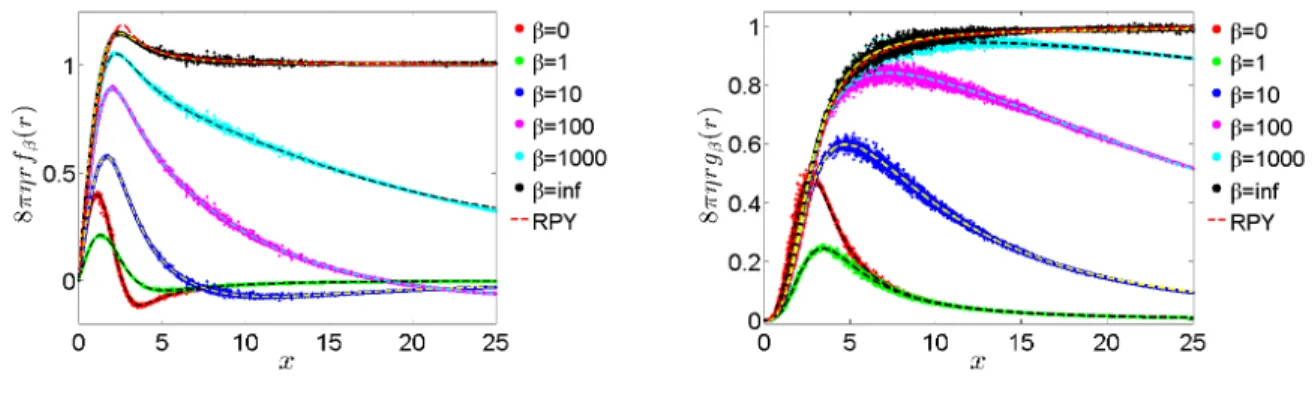
is well-described by the RPY tensor [38] (see Fig. 2). The only fitting parameter in the RPY
approximation is the effective hydrodynamic radius aaveraged over many positions of the marker
relative to the underlying grid [35, 38]; for the six-point kernel used here 6, a= 1.47h. For the
Brinkman equation, the equivalent of the RPY tensor can be computed for r ≥ 2a by applying
a Faxen-like operator from the left and right on the Brinkmanlet (see Eq. (26) in Ref. [56]); the
resulting analytical expressions are complex and are not used in our empirical fitting.
5
In reality, of course, this information is propagated via fast sound waves and not instantaneously.
6 As summarized in Refs. [35, 38], a ≈ 1.25h for the widely used four-point kernel [6], and a ≈ 0.91h for the
B. Empirical Fits
In this work, we use empirical fits to approximate the mobility. This is because the analytical
approximations, such as those offered by the RPY tensor, are most appropriate for unbounded
domains and assume the markers are far apart compared to the width of the regularized delta
function. In numerical computations, we use a finite periodic domain, and this requires corrections
to the analytic expressions that are difficult to model. For example, for finite β, we find that
the periodic corrections to the inviscid (dipole) r−3 contribution dominate over the exponentially
decaying viscous contribution, which makes the precise form of the viscous terms in (15) irrelevant
in practice. For rh, only the asymptotically-dominant far-field terms survive, and we make an
effort to preserve those in our fitting because the numerical results are obtained using finite systems
and thus not reliable at large marker distances. At shorter distances, however, the discrete nature
of the fluid solver and the IB kernel functions becomes important, and empirical fitting seems to
be a simple yet flexible alternative to analytical computations. At the same time, we feel that is
important toconstrain the empirical fits based on known behavior at short and large distances. Firstly, for r h, the pairwise mobility can be well-approximated by the self-mobility (r = 0,
corresponding to the diagonal elementsMfii), for which we know the following facts:
• For the steady Stokes regime (β → ∞), the diagonal elements are given by Stokes’s drag
formula, yielding
f∞(0) = (6πηa)−1∼ 1/ηh and g∞(0) = 0,
where we recall that a is the effective hydrodynamic radius of a marker for the particular
spatial discretization (kernel and fluid solver).
• For the inviscid case (β = 0), it is not hard to show that [35]
f0(0) = d−1
d
∆t ρ V
−1
m ∼β/ηh andg0(0) = 0, (17)
whered= 3 is the dimensionality, and Vm=cVh3 is the “volume” of the marker, where the
constantcV is straightforward to calculate.
• The above indicates thatfβ(0) goes from ∼β/(ηh) for smallβ to∼1/(ηh) for largeβ. At
intermediate viscous CFL numbersβ, we can set
fβ(0) = C(β)
where C(β1) ≈2β/(3cV) is linear for small β and then becomes O(1) for large β. We
will obtain the actual form ofC(β) from empirical fitting.
Secondly, for rh, we know the asymptotic decay of the hydrodynamic interactions from (15):
• For the steady Stokes regime (β→ ∞), we have the Oseen tensor given by
f∞(r h)≈g∞(rh)≈(8πηr)−1. (19)
• For the inviscid case (β = 0), we get the electric field of an electric dipole,
f0(rh)≈ −
∆t
4πρr3 and g0(r h)≈
3∆t
4πρr3, (20)
which is also the asymptotic decay for β >0 for rh√β.
We obtain the actual form of the functions fβ(r) and gβ(r) empirically by fitting numerical data
for the parallel and perpendicular mobilities
µkij = ˆrTijMfijrˆij ≈fβ(rij) +gβ(rij),
µ⊥ij =rˆ⊥ijT Mfijrˆ⊥ij ≈fβ(rij),
where ˆr⊥ij·ˆrij = 0. To do so, we placed a large number of markersN in a cube of lengthl/8 inside
a periodic domain of lengthl. For each markeri, we applied a unit forceΛi with random direction
while leavingΛj = 0 forj6=i, solved (8), and then interpolated the fluid velocityv at the position
of each of the markers. The resulting parallel and perpendicular relative velocity for each of the
N(N −1)/2 pairs of particles allows us to estimate fβ(rij) and gβ(rij). By making the number
of markersN sufficiently large, we sample the mobility over essentially all relative positions of the
pair of markers. For the self-mobility Mfii (rii = 0), we take gβ(0) = 0 and compute fβ(0) from
the numerical data.
If the spatial discretization were perfectly translationally and rotationally invariant and the
domain were infinite, all of the numerical data points for fβ(r) andgβ(r) would lie on a smooth
curve and would not depend on the actual position of the pair of markers relative to the underlying
grid. In reality, it is not possible to achieve perfect translational invariance with a kernel of finite
support [6], and so we expect some (hopefully small) scatter of the points around a smooth fit.
Normalized numerical data forfβ(r) andgβ(r) are shown in Fig. 2, and we indeed see that the data
can be fit well by smooth functions over the whole range of distances. To maximize the quality of the
Figure 2: Normalized mobility functions ˜f(x) (left) and ˜g(x) (right) defined similarly to (A1) as a function of marker-marker distance x=r/h, in three dimensions for the six-point kernel of Bao et al. [48], over a range of viscous CFL numbers (different colors, see legend). Numerical data is shown with symbols and obtained using a 2563 periodic fluid grid, while dashed lines show our empirical fit of the form (A2) for steady Stokes (β → ∞) and (A6) for finiteβ. For steady Stokes flow, the numerical data is in reasonable agreement with the RPY tensor (16) (dashed red line).
make the fits change smoothly asβgrows towards infinity, as we explain in more detail in Appendix
A. Code to evaluate the empirical fits described in Appendices A and B is publicly available to
others for a number of kernels constructed by Peskin and coworkers (three-, four-, and six-point)
in both two and three dimensions at http://cims.nyu.edu/~donev/src/MobilityFunctions.c.
V. LINEAR SOLVER
To solve the constrained Stokes problem (3), we use the preconditioned flexible GMRES
(FGM-RES) method, which is a Krylov solver. We will refer to this as the “outer” Krylov solver, as it must
be distinguished from “inner” Krylov solvers used in the preconditioner. Because we use Krylov
solvers in our preconditioner and because Krylov solvers generally cannot be expressed as linear
operators, it is crucial to use a flexible Krylov method such as FGMRES for the outer solver. The
overall method is implemented in the open-source immersed-boundary adaptive mesh refinement
(IBAMR) software infrastructure [42]; in this work we focus on uniform grids and do not use the
AMR capabilities of IBAMR (but see [2, 41]). IBAMR uses Krylov solvers that are provided by
A. Preconditioner for the constrained Stokes system
In the preconditioner used by the outer Krylov solver, we want toapproximatelysolve the nested saddle-point linear system
A G −S
−D 0 0
−J 0 0
v π Λ = g h W ,
where we recall that A = (ρ/∆t)I−ηh−2Lv. Let us set α = 1 if A has a null-space, (e.g., for
a fully periodic domain for steady Stokes flow) and we set α = 0 if A is invertible. Whenα = 1,
let us define the restricted inverseA−1 to only act on vectors of mean value zero, and to return a
vector of mean zero.
Applying our Schur complement based preconditioner for solving (3) consists of the following
steps:
1. Solve the (unconstrained) fluid sub-problem,
A G
−D 0
v π = g h .
To control the accuracy of the solution one can either use a relative tolerance based stopping
criterion or fix the number of iterations Ns in the inner solver.
2. Calculate the slip velocity on the set of markers, ∆V =−(Jv+W).
3. Approximately solve the Schur complement system,
f
MΛ= ∆V, (21)
where the mobility approximation Mf is constructed as described in Section IV.
4. Optionally, re-solve the corrected fluid sub-problem,
A G
−D 0
v π =
g+SΛ−αvol−11TΛ
h
.
All linear solvers used in the preconditioner can be approximate, and this is in fact the key to
the efficiency of the overall solver approach. Notably, the inner Krylov solvers used to solve the
of iterations using a method briefly described in the next section. If the fluid sub-problem is
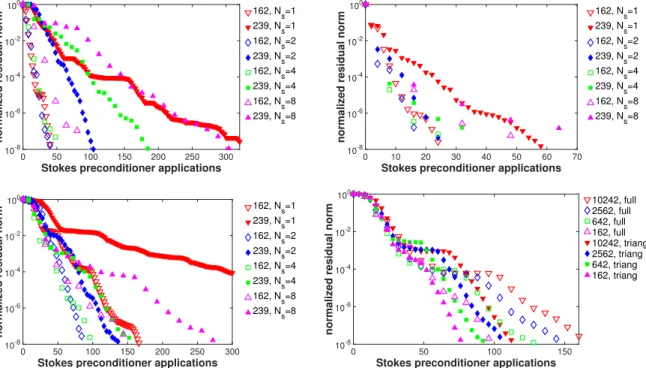
ap-proximately solved in both steps 1 and 4, which we term thefull Schur complement preconditioner, each application of the preconditioner requires 2Ns applications of the Stokes preconditioner (22).
It is also possible to omit step 4 above to obtain a block lower triangular Schur preconditioner [62], which requires onlyNs applications of the unconstrained Stokes preconditioner (22). We will
numerically compare these two preconditioners and study the effect of Ns on the convergence of
the FGMRES outer solver in Section VII A.
B. Unconstrained Fluid Solver
A key component we rely on is an approximate solver for the unconstrained Stokes sub-problem,
A G
−D 0
v π = g h ,
for which a number of techniques have been developed in the finite-element context [62]. To
solve this system, we use GMRES with a preconditioner P−1S based on the projection method,
as proposed by Griffith [32] and improved to some extent by Cai et al. [33]. Specifically, the
preconditioner for the Stokes system that we use in this work is
P−1S =
I h2G
f Lp
−1
0 Be
−1 I 0
−D −I
e A−1 0
0 I
, (22)
where Lp =h2(DG) is the dimensionless pressure (scalar) Laplacian, andAe
−1
and Lfp
−1
denote
approximate solvers obtained by a single V-cycle of a geometric multigrid solver for the vector Helmholtz and scalar Poisson problems, respectively. In the time-dependent case, the approximate
Schur complement for the unconstrained Stokes sub-problem is
e
B−1=−ρh 2
∆tLfp −1
+ηI,
and for steady Stokes flow,Be
−1
=ηI. Further discussion of the relation of these preconditioners
to the those described in the book [62] can be found in [32].
Observe that one application of P−1S is relatively inexpensive and involves only a few scalar
multigrid V-cycles. Indeed, solving the Stokes system using GMRES with this preconditioner is
only a few times more expensive than solving a scalar Poisson problem, even in the steady Stokes
regime [33]. Note that it is possible to omit the upper right off-diagonal block in the first matrix on
and may in fact be preferred at zero Reynolds number since it allows one to skip a sweep of
the pressure multigrid solver [33]. We empirically find that including the Poisson solve (velocity
projection) improves the overall performance of the outer solver.
C. Mobility Solver
From a computational perspective, one of the most challenging steps in our preconditioner is
solving the mobility sub-problem (21). Since this is done inside a preconditioner, and because Mf
is itself an approximation of the true mobility matrixM, it is not necessary to solve (21) exactly.
In the majority of the examples presented herein, we solve (21) using direct solvers provided by
LAPACK. This is feasible on present hardware for up to around 105 markers and allows us to focus
on the design of the approximation Mf and to study the accuracy of the overall method.
Let us denote with s the smallest marker-marker spacing. For well-spaced markers, s/h ' 2,
our approximate mobility Mf is typically SPD even for large numbers of markers, and in these
cases, we can use the Cholesky factorization to solve (21). In some cases, however, there may
be a few small or even negative eigenvalues of Mf that have to be handled with care. We have
found that the most robust (albeit expensive) alternative is to perform an SVD of M, and tof
use a pseudoinverse of Mf (keeping only eigenvalues larger than some tolerance SV D > 0) to
solve (21). This effectively filters out the spuriously small or negative eigenvalues. Note that
the factorization of Mf needs to be performed only once per constrained Stokes solve since the
body is kept fixed during a time step. In cases where there is a single body, the factorization
needs to be performed only once per simulation and can be reused; if the body is translating or
rotating, one ought to perform appropriate rotations of the right hand side and solution of (21).
In some cases of practical interest where the number of markers is not too large, it is possible
to precompute the true mobility M0 with periodic boundary conditions (for a sufficienly large
domain) and to store its factorization. Even if the structure moves relative to the underlying grid,
such a precomputed (reference) mobility M0 is typically a much better approximation to the true
mobility than our empirical approximation M, and can effectively be used in the preconditioner.f
Determining effective approaches to solving the mobility sub-problem in the presence of multiple
VI. CONDITIONING OF THE MOBILITY MATRIX
The conditioning of the constrained Stokes problem (3) is directly related to the conditioning
of the Schur complement mobility matrix M = J L−1S, which is intimately connected to the
relation between the fluid solver grid spacing h and the smallest inter-marker spacing s. Firstly,
it is obvious that if two markers iand j are very close to each other, then the fluid solver cannot
really distinguish between Λi and Λj and will instead effectively see only their sum. We also
know that using too many markers for a fixed fluid grid will ultimately lead to a rank-deficient
M, because it is not possible to constrain a finite-dimensional discrete fluid velocity at too many
points. This physical intuition tells us that the condition number of M should increase as the
marker spacing becomes small compared to the grid spacing. This well-known intuition, however,
does not tell us how closely the markers can or must be placed in practice. Standard wisdom for
the immersed boundary method, which is based on the behavior of models of elastic bodies, is to
make the marker spacing on the order of half a grid spacing. As we show, this leads to extremely
ill-conditioned mobility matrices for rigid bodies. We note that the specific results depend on the
dimensionality, the details of the fluid solver, and the specific kernel used; however, the qualitative
features we report appear to be rather general.
To determine the condition number of the mobility matrix, we consider “open” and “filled”
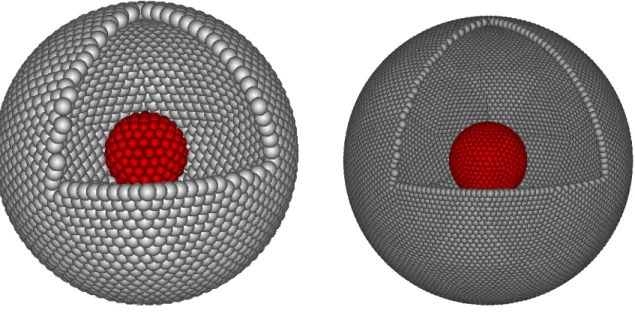
sphere models. We discretize the surface of a sphere as a shell of markers constructed by a recursive
procedure suggested to us by Charles Peskin (private communication). We start with 12 markers
placed at the vertices of an icosahedron, which gives a uniform triangulation of a sphere by 20
triangular faces. Then, we place a new marker at the center of each edge and recursively subdivide
each triangle into four smaller triangles, projecting the vertices back to the surface of the sphere
along the way. Each subdivision approximately quadruples the number of vertices, with thek-th
subdivision producing a model with 10·4k−1 + 2 markers. To create filled sphere models, we
place additional markers at the vertices of a tetrahedral grid filling the sphere that is constructed
using the TetGen library, starting from the surface triangulation described above. The constructed
tetrahedral grids are close to uniform, but it is not possible to control the precise marker distances
in the resulting irregular grid of markers. We use models with approximately equal edges (distances
between nearest-neighbor markers) of length≈s, which we take as a measure of the typical marker
spacing. We numerically computed the mobility matrixMfor an isolated spherical shell in a large
the marker spacing fixed ats≈1; one can alternatively keep the radius of the sphere fixed 7. In
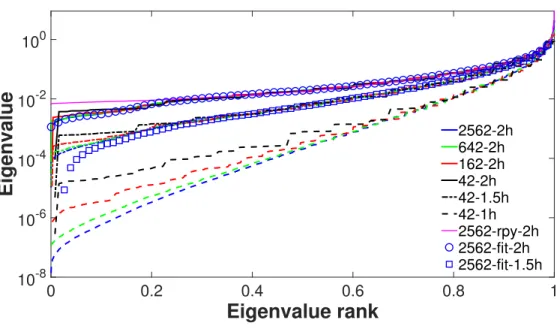
Fig. 3, we show the spectrum of Mfor varying levels of resolution for three different spacings of
the markers, s/h = 1, s/h = 3/2, and s/h = 2. Similar spectra, but with somewhat improved
condition number (i.e., fewer smaller eigenvalues), are seen for nonzero Reynolds numbers (finite
β).
The results in Fig. 3 strongly suggest that as the number of markers increases, the low-lying
(small eigenvalue) spectrum of the mobility matrix approaches a limiting shape. Therefore, the
nontrivial eigenvalues remain bounded away from zero even as the resolution is increased, which
implies that for s/h & 1 the system (3) is uniformly solvable or “stable” under grid refinement.
Note that in the case of a sphere, there is a trivial zero eigenvalue in the continuum limit, which
corresponds to uniform compression of the sphere; this is reflected in the existence of one eigenvalue
much smaller than the rest in the discrete models. Ignoring the trivial eigenvalue, the condition
number ofMisO(N) for this example because the largest eigenvalue in this case increases like the
number of markersN, in agreement with the fact that the Stokes drag on a sphere scales linearly
with its radius. This is as close to optimal as possible, because for the continuum equations for
Stokes flow around a sphere, the eigenvalues corresponding to spherical harmonic modes scale like
the index of the spherical harmonic. However, what we are concerned here is not so much how the
condition number scales with N, but with the size of the prefactor, which is determined by the
smallest nontrivial eigenvalues of M.
Figure 3 clearly shows that the number of very small eigenvalues increases as we bring the
markers closer to each other, as expected. The increase in the conditioning number is quite rapid,
and the condition number becomesO(106−107) for marker spacings of about one per fluid grid cell.
For the conventional choice s≈h/2, the mobility matrix is so poorly conditioned that we cannot
solve the constrained Stokes problem in double-precision floating point arithmetic. Of course, if the
markers are too far apart then fluid will leak through the wall of the structure. We have performed
a number of heuristic studies of leak through flat and curved rigid walls and concluded thats/h≈2
yields both small leak and a good conditioning of the mobillity, at least for the six-point kernel
used here [48]. Therefore, unless indicated otherwise, in the remainder of this work, we keep the
markers abouttwo grid cells apart in both two and three dimensions. It is important to emphasize that this is just a heuristic recommendation and not a precise estimate. We remark that Taira and
7
Eigenvalue rank
0 0.2 0.4 0.6 0.8 1
Eigenvalue
10-8 10-6 10-4 10-2 100
2562-2h 642-2h 162-2h 42-2h 42-1.5h 42-1h 2562-rpy-2h 2562-fit-2h 2562-fit-1.5h
Figure 3: Eigenvalue spectrum of the mobility matrix for steady Stokes flow around a spherical shell covered with different numbers of markers (42, 162, 642, or 2562, see legend) embedded in a periodic domain. Solid lines are for marker spacing ofs≈2h, dashed-dotted lines for spacings≈1.5h, and dashed lines for spacing ofs≈1h. The marker spacing iss≈1 in all cases; fors≈2h, the fluid grid size is 1283 for 2562 markers and 643for smaller number of markers, and scaled accordingly for other spacings. For comparison, we show the spectrum ofMfRP Y for the most resolved model (N = 2562 markers) at s/h ≈2. Also shown is the
spectrum of the empirical (fit) approximation to the mobilityMf for the two larger spacings; fors≈hour
empirical approximation is very poor and includes many spurious negative eigenvalues (not shown).
Colonius, who solve a different Schur complement “modified Poisson equation”, recommends/h≈1
to “achieve a reasonable condition number and to prevent penetration of streamlines caused by a
lack of Lagrangian points.”
It is important to observe that putting the markers further than the traditional wisdom will
increase the “leak” between the markers. For rigid structures, the exact positioning of the markers
can be controlled since they do not move relative to one another as they do for an elastic bodies;
this freedom can be used to reduce penetration of the flow into the body by a careful construction
of the marker grid. In the Conclusions, we discuss alternatives to the traditional marker-based IB
method [46] that can be used to control the conditioning number of the Schur complement and
allow for more tightly-spaced markers.
It is worthwhile to examine the underlying cause of the ill-conditioning as the markers are
nature of the fluid solver, which necessarily limits the rank of the mobility matrix. But another
contributor to the worsening of the conditioning is theregularization of the delta function. Observe that for a true delta function (a→0) in Stokes flow, the pairwise mobility is the length-scale-free
Oseen tensor ∼r−1, and the shape of the spectrum of the mobility matrix has to be independent of the spacing among the markers. In the standard immersed boundary method, a ∼ h, so the
fluid grid scaleh and the regularization scale aare difficult to distinguish.
To try to separate hfrom a, we can take a continuum model of the fluid, but keep the discrete
marker representation of the body; see (1). In this case the pairwise mobility would be given by
(13), which leads to the RPY tensor (16) for a kernel that is a surface delta function over a sphere
of radius a(see (4.1) in [59]). In Fig. 3 we compare the spectra of the discrete mobilityM with
those of the analytical mobility approximation MfRP Y constructed by using (16) for the pairwise
mobility. We observe that the two are very similar for s ≈ 2h, however, for smaller spacings
f
MRP Y does not have very small eigenvalues and is much better conditioned than M(data not
shown). In Fig. 3 we also show the spectrum of our approximate mobility Mf constructed using
the empirical fits described in Section IV. The resulting spectra show a worsening conditioning for
spacing s ≈1.5h consistent with the spectrum of M. These observations suggest that both the
regularization of the kernel and the discretization artifacts contribute to the ill-conditioning, and
suggest that it is worthwhile to explore alternative discrete delta function kernels in the context of
rigid-body IB methods.
We also note that we see a severe worsening of the conditioning ofM, independent ofβ, when
we switch from a spherical shell to a filled sphere model. Some of this may be due to the fact that
the tetrahedral volume mesh used to construct the marker mesh is not as uniform as the surface
triangular mesh. We suspect, however, that this ill-conditioning is primarily physical rather than numerical, and comes from the fact that the present marker model cannot properly distinguish
between surface tractions and body (volume) stresses. Therefore, Λremains physically ill-defined
even if one gets rid of all discretization artifacts.
Lastly, it is important to emphasize that in the presence of ill-conditioning, what matters in
practice are not only the smallest eigenvalues but also their associated eigenvectors. Specifically,
we expect to see signatures of these eigenvectors (modes) in Λ, since they will appear with large
coefficients in the solution of (9) if the right hand side has a nonzero projection onto the
cor-responding mode. As expected, the small-eigenvalue eigenvectors of the mobility correspond to
high-frequency (in the spatial sense) modes for the forces Λ. Therefore, if the markers are too