GUIDANCE IN THE DESIGN AND IMPLEMENTATION OF AN ONLINE MATHEMATICS EDUCATION COURSE
Bryan Fede
A dissertation submitted to the faculty at the University of North Carolina at Chapel Hill in partial fulfillment of the requirements for the degree of Doctorate of Philosophy in the School of
Education.
Chapel Hill 2018
©2018 Bryan Fede
ABSTRACT
Bryan Fede: Guidance in the Design and Implementation of an Online Mathematics Education Course
(Under the direction of Susan N. Friel)
The number of students taking online distance education (ODE) courses as part of their programs of study has steadily increased since 2012 (Seaman, Allen, & Seaman, 2018). This has led to a proliferation of resources related to online teaching pedagogy (Dennen, 2013). In many cases, instructors of ODE courses are left to sort through this information on their own as they decide how to design and implement ODE experiences for their students. The overarching goal of this research is to develop A Field Guide for Mathematics Educators in the Design and Implementation of Learning Environments in Online Distance Education that incorporates what is known about the best practices in teaching ODE courses as well as in applying high leverage teaching practices in mathematics education.
The study addresses two questions:
(1) In what ways does the instructor respond to, interpret, and apply the underlying premises and guidance provided in the Field Guide in course planning and implementation?
(2) What are students’ perceptions of the distance education classroom in terms of any impact they consider it makes on their sense of transactional distance?
design and implementation of her course and collected ‘instances of practice’ that might be used to illustrate principles contained in the Field Guide.
To the friends and family that supported me along the way. I have missed many of the important events in your lives as I completed this degree. Thank you for your
ACKNOWLEDGEMENTS
The completion of this dissertation would not have been possible without the help of a number of people. First, I would like to like to express my gratitude to my advisor, Dr. Susan Friel who spent considerable amounts of her time supporting me as both an academic and as a person. I would not have completed this project without you. I would also like to thank my dissertation committee members, Dr. Peter H. Wilson, Dr. Debora Eaker-Rich, Dr. George Noblit and Dr. Catherine Scott for their comments and support throughout the
dissertation process. In addition to the committee members whose name appears on the front of this dissertation, I would like to thank a number of other of my esteemed colleagues who contributed to my successful completion of this degree. I am grateful to Dr. Marta Civil for serving as my original academic advisor and providing me with a variety of valuable
experiences early on in my career at UNC. I would also like to extend a special thanks to Dr. Gemma Mojica for her “critical friendship” through the process and keeping me going when I wanted to quit. Trips to the River with you and Holt saved me. Thanks also to Dr. Lynda Stone for many thought provoking conversations, particularly the ones we had while preparing Thanksgiving dinners which I will always remember with fondness.
TABLE OF CONTENTS
LIST OF TABLES ...xi
LIST OF FIGURES ... xii
LIST OF ABBREVIATIONS ... xv
CHAPTER 1: INTRODUCTION ... 1
Online Distance Education ... 1
Certification of Elementary Mathematics Specialists ... 3
Purpose of this Study ... 5
Organization of this Dissertation ... 7
CHAPTER 2: LITERATURE REVIEW... 9
Theoretical Underpinnings of the Field Guide ... 12
Transactional Distance: High End Distance Education Theory ... 13
Communities of Inquiry: Middle-range Theory ... 19
Social Presence ... 20
Cognitive Presence ... 21
Teaching Presence ... 22
Online Best Practices: Low-End Theory ... 23
Effective Teaching Practices in Mathematics Education that Support Student Learning ... 25
Asynchronous Interactions ... 33
Participation... 35
Instructor Facilitation and Feedback in Asynchronous Forums ... 40
Elementary Mathematics Specialist Professionals ... 46
Summary ... 49
CHAPTER 3: METHODOLOGY ... 51
Case Study Methodology ... 53
Participants ... 54
Students ... 54
Teaching Team ... 56
The Field Guide ... 57
Developing Best Practices for Online Courses ... 58
Creating the Field Guide ... 61
The Course ... 62
Description ... 62
Data Collection ... 77
Survey Instruments ... 79
CHAPTER 4: FINDINGS ... 85
Section 1: In What Ways Does the Instructor Respond to, Interpret, and Apply the Underlying Premises and Guidance Provided in the Field Guide in Course Planning and Implementation? ... 87
Part A: In What Ways is the Use of Best Practices for Online Teaching Strategies that Support Student Learning Evident in the Course Planning and Implementation? ... 90
Part B: In What Ways is the Use of Effective Teaching Practices in Mathematics Education that Support Student Learning Evident in the Course Planning and Implementation? ... 120
Mathematics Education that Support Student Learning Related to the Components of Transactional Distance in the Course Planning
and Implementation? ... 153
Section 2 (Question 2) What are Students’ Perceptions of the Distance Education Classroom in Terms of any Impact They Consider It Makes on their Sense of Transactional Distance? ... 158
Part A: Using Measure of Student Satisfaction with the Course, What is a Description of Participants’ Response to the Course? ... 159
Part B: Using a Measure of Transactional Distance, What is a Description of Participants’ Perceptions of Transactional Distance Experienced at the End of the Course? ... 179
Part C: In What Ways are Participant Satisfaction and Perceptions of Transactional Distance Related in this Distance Education Learning Experience? ... 180
CHAPTER 5: DISCUSSION... 182
Adapting to the Ecology of Online Learning ... 184
Strengthening Course Design and Implantation in the Field Guide ... 185
A Framework for Online Course Improvement ... 197
Promising Practice ... 198
“Bridging”: Making use of Important Instructional Real Estate ... 199
Issues in Task Design: Choosing the Synchronicity of an Activity ... 202
Managing Participation in Asynchronous Discussions... 204
Limitations, Future Research, and Conclusions ... 206
APPENDIX A: TD SURVEY ... 210
APPENDIX B: SYLLABUS ... 217
APPENDIX C: MODULE SCREENSHOTS ... 221
APPENDIX D: QUESTION PLANNING GRID ... 228
APPENDIX E: ANALYZING STUDENTS WRITTEN WORK ... 229
LIST OF TABLES
Table 4.1. Results of questions 1-3 from the Satisfaction of Online Learning
(SOL) Tool (Davis, 2014) related to the Effectiveness of Feedback. ... 161 Table 4.2. Results of questions 4-6 from the Satisfaction of Online Learning
(SOL) Tool (Davis, 2014) related to the Timeliness of Feedback. ... 164 Table 4.3. Results of questions 7-9 from the Satisfaction of Online Learning
(SOL) Tool (Davis, 2014) Related to the Use of Discussion Boards. ... 166 Table 4.4. Results of questions 10-12 from the Satisfaction of Online
Learning (SOL) Tool (Davis, 2014) related to the Dialogue between
Instructor and Students... 170 Table 4.5. Results of questions 13-15 from the Satisfaction of Online
Learning (SOL) Tool (Davis, 2014) related to the Perceptions of Online
Experiences. ... 171 Table 4.6. Results of questions 16-18 from the Satisfaction of Online
Learning (SOL) Tool (Davis, 2014) related to Instructor Characteristics. ... 172 Table 4.7. Results of questions 19-21 from the Satisfaction of Online
Learning (SOL) Tool (Davis, 2014) related to the Feel of a Learning
Community. ... 173 Table 4.8. Results of questions 22-24 from the Satisfaction of Online
Learning (SOL) Tool (Davis, 2014) related to Computer Mediated
LIST OF FIGURES
Figure 2.1. Low transactional distance situation. ... 16
Figure 2.2. Intermediate levels of transactional distance. ... 17
Figure 2.3. High transactional distance. ... 17
Figure 2.4. Learning supports that mediate transactional distance as students utilize learning resources and implement learning tasks. ... 18
Figure 2.5. Creation of the educational experience within the Community of Inquiry framework... 20
Figure 2.6. The Model of Practical Inquiry ... 22
Figure 2.7. Matrix for determining the cognitive demand of an instructional task. ... 29
Figure 2.8. Various task-related factors that effect learning outcomes. ... 31
Figure 2.9. Levels of online participation. ... 35
Figure 3.1. Domains of Mathematical Knowledge for Teaching. ... 64
Figure 3.2. Modular schedule for the course. ... 68
Figure 3.3. The Blackboard home screen. Student options are displayed in the blue panel on the right of the page. ... 69
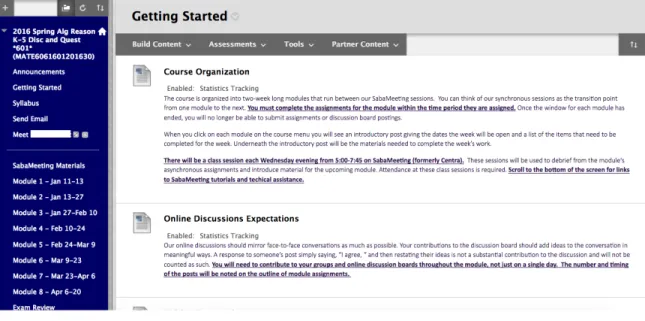
Figure 3.4. Screenshot of the information contained under the ‘Getting Started’ menu. ... 70
Figure 3.5. Module 3 Team Problem-Solving Activity: The Sheep Problem ... 72
Figure 3.6. Rubric for Team Problem-Solving ... 73
Figure 3.7. Module 3 Bringing It All Together prompt. ... 76
Figure 3.8. Research crosswalk that aligns data collection with research question 1. ... 78
Figure 3.9. Research crosswalk that aligns data collection with research question 2. ... 79
Figure 3.10. Eight Factor Comparison Model. ... 81
Figure 4.1. Example of the table used to compile evidences related to
component 1: Preparing students for online learning. ... 88 Figure 4.2. Example of a whiteboard created by small groups during the first
synchronous online activity. ... 96 Figure 4.3. Slide outlining course objectives presented in synchronous online
session 1, January 13, 2016. ... 97 Figure 4.4. Expectations for participation in online discussion forums. ... 103 Figure 4.5. “The Bringing It All Together” (BIAT) prompt from Module 2. ... 104 Figure 4.6. Screen snapshot example of the overview checklist provided at
the top of each page of the new module. ... 109 Figure 4.7. Description of the eight core mathematics teaching practices
identified by the NCTM (2014) ... 123 Figure 4.8. Teaching framework for mathematics highlighting relationships
between the eight effective teaching practices ... 124 Figure 4.9. Screenshots of pages encountered by students as they entered the
group blog to complete the Team Problem Solving activity. ... 127 Figure 4.10. Screenshot of the timeline chart provided by Dr. Spencer at the
beginning of Module 2. ... 128 Figure 4.11. Student response expectations for the group problem solving
tasks. ... 129 Figure 4.12. Coin problem participation by group for January 13 to February
1. ... 131 Figure 4.13. Examples of comments given by the instructor in reaction to
student responses to the coin problem. ... 133 Figure 4.14. Example of instructor interaction in the Coin Problem. ... 137 Figure 4.15. Example of instructor participation in Group Two redirecting the
focus of the problem. ... 138 Figure 4.16. Prompts for Small Group Discussion 3 (SG3) held as part of
Synchronous Session 3. ... 140 Figure 4.17. Example of the Saba Meeting screen during small group
breakout sessions. The area on the left circled in red shows the whiteboard
Figure 4.18. Example of the Saba Meeting interface during small group breakout sessions. The area on the left circled in red is the location of the chat
box. ... 143
Figure 4.19. Big Ideas for the course. ... 148
Figure 4.20. Points of discussion for the first small group breakout discussion of the third synchronous session (February 10, 2016). ... 149
Figure 4.21. Screenshot example of the work produced by group three in the small group discussion centering on conjecturing about odd and even numbers. ... 151
Figure 4.22. Bringing it All Together Prompt for Module 2... 154
Figure 4.23. Level of overall structure for the course... 155
Figure 4.24. Level of overall dialogue for the course. ... 156
Figure 4.25. 3-dimensions of autonomy. ... 158
Figure 4.26. Algebraic reasoning journal prompt. ... 160
Figure 5.1. Guiding Principles for School Mathematics. ... 191
Figure 5.2. High-leverage teaching practices outlining effective teaching of mathematics. ... 193
LIST OF ABBREVIATIONS AIC Akaike information criterion
BIAT bringing it all together
BIC Bayesian information criterion CCK common content knowledge
CCSSM Common Core State Standards for Mathematics CFI comparative fit index
CoI community of inquiry
EMAoL elementary mathematics add-on licensure EMS elementary mathematics specialist
LMS learning management system MKT mathematics knowledge of teaching NCLB No Child Left Behind’
NCTM National Council of Teachers of Mathematics PCK pedagogical content knowledge
PTD perceived transactional distance
PTDBLE perceived transactional distance in blended learning environments QM quality matters
QSWA questioning and student work analysis
QUASAR Quantitative Understanding: Amplifying Student Achievement and Reasoning SCK specialized content knowledge
SRMR standardized root mean residual TLI Tucler-Lewis index
CHAPTER 1: INTRODUCTION
Ernst Haeckel (1834 – 1919) was a German naturalist who is considered by many to be the father of the field of ecology. For Haeckel, ecology was the study of the natural environment, including the relationship of organisms to one another and their surroundings (Haeckel, 1869 in Odum & Barrett, 2004). Although Haeckel’s definition emphasizes the natural environment, a closer look at the origin of the word ‘ecology’ uncovers a close connection to a more humanistic definition. A look at the etymology of the word reveals that it stems from the Greek word oikos, meaning house, dwelling place, or habitation (Online Etymology Dictionary, 2018). This definition implies that ecology, at least to some extent, lends insight into how individuals interact with one another in specific settings, given the various cultural tools and technologies at their disposal. This dissertation aims to take an ecological view of the design and implementation of a blended distance education learning environment that is designed to deliver professional development for practicing elementary teachers who intend to become elementary mathematics specialist professionals.
Online Distance Education
individuals who might not have had access to the classical curriculum to study from home via the mail through monthly interactions with instructors (Simonson, Smaldino, & Zvacek, 2014). Today, online distance education serves a similar purpose. This educational medium allows individuals who are either geographically isolated or temporally restricted by family or profession to further their own educational goals.
Although technology is fundamental to the delivery of online distance education, each new technology brings with it unique pedagogical challenges that compel instructors to adjust the teaching and learning environment in which they engage students (Christopher, Thomas, & Tallent-Runnels, 2004). However, the presence of technology, in and of itself, does not enhance teaching or learning in the classroom. Instead, technology is a ‘vehicle’ (Clark, 1983) for the delivery of instruction. Clark notes that technological innovations “do not influence student achievement any more than the truck that delivers our groceries causes changes in our nutrition” (Clark, 1983, p. 445). The implication of this statement is that it is the quality of the content that drives changes. Technology can be leveraged to deliver content, but it must be used deliberately and appropriately.
ecology of online distance learning, including the kinds of interactions that occur between participants in this environment and how these interactions may be fostered (Moore, 2013d).
Despite this growth in its popularity, in many ways online distance education continues to remain an uncharted frontier for university faculty. In many cases, an ad hoc approach often is taken to the development and implementation of these types of courses as designers and instructors attempt to simply translate face-to-face courses directly to a distance education format. An oft-cited reason for poor planning and implementation of an online distance education course is the lack of instructor support in the development phase (Simonson et al., 2014). Moore and Kearsley (2005) note that one element that is often missing in the planning phase of an online distance education class is the presence of an instructional designer with intimate knowledge of best practices in online learning. In fact, in a comprehensive review of the literature, Tallent-Runnels et al. (2006) found no
comprehensive theory or model to guide the creation of online courses and few guidelines to aide instructors in course implementation, a conclusion that Simonson et al. (2014) note remains a critical weakness of the field.
Certification of Elementary Mathematics Specialists
Given the varied demands and expertise needed by teachers in the elementary grades, there has been a movement in support of training the elementary mathematics specialist (EMS) to lead and provide support for their colleagues who teach math in the elementary grades. These EMS professionals are teacher-leaders with strong preparation and
serving as an on-site resource and leader for teachers, providing school-based and content-specific professional development” (Campbell & Malkus, 2014, p. 214). Although the demand for EMS has increased, programs that prepare these professionals lag behind. Fennell (2011) notes that, in many cases, EMS are appointed by school districts without proper vetting with regard to their knowledge of content, pedagogy, or leadership. In an effort to alleviate this problem, many states have begun to offer credentialing programs and licenses for EMS professionals. Currently, nineteen states offer a licensure endorsement for EMS professionals, with a number of additional states finalizing plans for endorsements. One of the states that offer this sort of certification is North Carolina, which is a focus of this research.
In 2009, the North Carolina Board of Education approved a program of study that allows approved universities in the University of North Carolina (UNC) system to offer teachers who have an existing North Carolina elementary school teaching license an option for an add-on Elementary Mathematics Specialist endorsement. This program of study requires individuals to complete 18 credit hours (six courses) that are designed to address mathematics knowledge for teaching and school-based leadership skills. Although the content of the program has been refined and agreed upon by all participating universities, the mode of delivery varies among universities. Courses may be delivered face-to-face,
completely online and asynchronous, or in some hybrid format that uses either both
Purpose of this Study
Drawing on a combination of the current research into best practices in online distance education as well as in mathematics education, this study addresses ways that instructors might create online educational experiences around mathematical content that are equivalent to learning in a physical classroom. In order to assist instructors in the creation of high quality online experiences, a draft field guide was developed for this research study with the intent to remind instructors of these best practices and to suggest ways that these
practices may be implemented in the online distance education environment. This document, A Field Guide for Mathematics Educators in the Design and Implementation of Learning Environments in Online Distance Education (referred to hereafter as the Field Guide), is organized into two main sections and is intended to provide guidance to instructors about the setup of online distance education courses and the design of mathematical activities to be implemented in an online distance education environment.
This study followed one instructor’s application of material that is addressed in the Field Guide in one iteration of the algebra content course for the K-5 Elementary
Mathematics Add-on Licensure (EMAoL) program. The study utilized a combination of qualitative description (Sandelowski, 2000, 2010) and exploratory case study methodology (Yin, 2009) to investigate two areas of interest. The first area of interest concerns the way that one mathematics teacher educator, experienced in online course delivery, responded to suggested best practices for implementing online teaching as well as high leverage
second area of interest concerns the way that participants1 received the online learning experiences. The expectation was that the course, which was designed and implemented with high leverage mathematics teaching practices and best practices in implementing online teaching in mind, would offer participants satisfying learning experiences. The ultimate goal of this research is to inform a revision of the Field Guide that provides more detailed support for mathematics educators based on the design and implementation of online learning
experiences.
The research questions that guide the investigation that is related to these two areas of interest are as follows:
1. In what ways does the instructor respond to, interpret, and apply the underlying premises and guidance provided in the Field Guide in course planning and implementation? This includes a consideration of:
a. In what ways are the use of best practices in online teaching strategies that support student learning evident in the course planning and implementation? b. In what ways is the use of high leverage mathematics teaching practices that support student learning evident in the course planning and implementation? c. In what ways are the uses of best practices in online teaching strategies and of
effective teaching practices in mathematics education that support student learning related to the components of Transactional Distance in the course planning and implementation?
consideration of:
a. Using measure of student satisfaction with the course, what is a description of participants’ response to the course?
b. Using a measure of transactional distance (see Appendix A), what is a description of participants’ perceptions of transactional distance experienced at the end of the course?
c. In what ways are participant satisfaction and perceptions of transactional distance related in this distance education learning experience?
Both questions involve the evaluation and revision of the original Field Guide. The first question specifically addresses the degree to which the Field Guide is helpful to the instructor as she prepares for and delivers online distance instruction. The second question looks at participants’ perception of perceived psychological distance between themselves and other participants in the course as well as their satisfaction with the course as a whole, which informs the section on high leverage mathematics teaching practices in general.
Organization of this Dissertation
Chapter 2 of this dissertation reviews research into theories that are relevant to the creation of the Field Guide and includes theory that drives the development of both best practices in online distance education, namely transactional distance theory and communities of inquiry research, as well as high leverage mathematics teaching practices. The chapter also addresses the relationship between these practices and participant satisfaction in online learning settings.
collected and the instruments used in the study.
Findings from the study are presented in Chapter 4. This chapter includes a description of events as they transpired over the online distance education course. For the purpose of this study, events are defined as online modules that include both synchronous and asynchronous online interactions. Selected modules from the beginning, middle, and end of the course were selected for analysis in an effort to provide evidence of ways that the implementation of the course changed over the semester. Results for the student satisfaction survey and student interviews are also presented in order to infer participant experience in the class.
CHAPTER 2: LITERATURE REVIEW
Distance education originally emerged as a viable alternative to in-person university study sometime in the mid- to late-19th century (Wiesner, 1983). Initially facilitated by correspondence through the postal service, the field of distance education grew during the early part of the 20th century as broadcast technologies (radio and television) began to emerge as viable and reliable communication media (Diehl, 2013). Throughout the 1950s, 1960s, 1970s, and 1980s, the popularity of distance education, known at the time as
‘correspondence study’, grew along with the ability of telecommunications technologies to provide relevant and reliable content. In 1992, the invention of the world-wide web began a new era in distance education as the Internet allowed for increased accessibility to content and the emergence of new pedagogical models for remote content delivery (Harasim, 2000).
By the turn of the 21st century, distance education, facilitated by computer-mediated technologies, began to be a significant force in education. In the preface to the first
technology itself and towards “the consequences of separating learners and teachers” (Moore, 2003c, p. xiii). Moore recognized that, although exciting, the technology part of distance education was a relatively simple consideration compared to the pedagogical, organizational, and policymaking (Moore, 2003c, p. xiii) challenges that were created by teaching and learning from a distance.
The overarching agenda of this research is to provide assistance for
mathematics/mathematics education instructors in the design and implementation of online courses. The focus of the research is not necessarily on features of the technological aspects of online mathematics instruction, but rather on the consequences of the separation of teachers and learners in online mathematics classes. This focus led to the development of a field guide that mathematics instructors might use to assist in the creation and execution of their online courses. A Field Guide for Mathematics Educators in the Design and
Implementation Online Distance Education Learning Experiencesaddresses pedagogical issues that lie at the convergence of mathematics education and distance education. Using the Field Guide as a lens, this research centered on observations of the ways one instructor of a semester-long online distance education course in mathematics education set up her online environment, fostered a collegial learning environment, selected and organized
mathematics/mathematics education content, and implemented instruction within a blended synchronous/asynchronous online setting. The literature that is discussed in this chapter was used in the creation of the initial Field Guide as well as to address the following research questions:
implementation? This includes a consideration of:
a. In what ways is the use of best practices in online teaching strategies that support student learning evident in the course planning and implementation? b. In what ways is the use of effective teaching practices in mathematics
education that support student learning evident in the course planning and implementation?
c. In what ways are the uses of best practices in online teaching strategies and of effective teaching practices in mathematics education that support student learning related to the components of transactional distance in the course planning and implementation?
2. What are students’ perceptions of the distance education classroom in terms of any impact they consider it makes on their sense of transactional distance? This includes a consideration of:
a. Using a measure of student satisfaction with the course, what is a description of participants’ response to the course?
b. Using a measure of transactional distance (see Appendix A), what is a description of participants’ perceptions of transactional distance experienced at the end of the course?
c. In what ways are participant satisfaction and perceptions of transactional distance related in this distance education learning experience?
This literature review provides insights into the overarching framework that was used to construct the Field Guide that is at the heart of this study. The literature selected is
effective teaching practices in mathematics education. With regard to online education, the selected literature includes a discussion of Moore’s theory of transactional distance (Moore, 2013b) as well as effective teaching practices in mathematics education that support student learning and are inherent of the community of inquiry model of participant interaction (Garrison, Anderson, & Archer, 2000). In addition to these theoretical constructs for distance learning classrooms, this review presents a collection of literature that concerns effective teaching practices specific to mathematics education. Finally, a discussion of elementary mathematics specialists (EMS) provides context for the participants in the particular class that was investigated in this study.
Theoretical Underpinnings of the Field Guide
As distance education has become increasingly popular, a significant evolution in theoretical perspectives related to the design and implementation of online courses has occurred. Such theories have evolved at three different levels of thought. High-end distance education theory is concerned with the structural complexities of distance education.
Transactional distance theory (Moore, 1993, 2013c), originally conceived as the ‘theory of independent learning’ (Moore, 1973, 1977), serves as a broad theoretical framework that incorporates the complex interplay of course structure, interpersonal dialogue, and student control. For example, the idiosyncrasies of online courses that allow for varying degrees of structure, dialogue, and student autonomy can create psychological spaces of
levels of theory provide solid grounding for instructors as they design their class, facilitate activities, and interact with students.
Transactional Distance: High End Distance Education Theory
Transactional distance describes the physical and cognitive space that is an inherent part of the distance education environment. The ‘distance’ portion of transactional distance is not solely determined by geography but is also influenced by the way instructors and learners interact with one another in the learning environment (Sandoe, 2005). Transactional distance is defined as “a psychological and communication space to be crossed, a space of potential misunderstanding between the inputs of instructor and those of the learner” (Moore, 1993, p. 22). It is interesting to note that misunderstandings may occur just as frequently in traditional face-to-face classrooms as they do in online classrooms (Rumble, 1986). In the online classroom, however, the physical and temporal separation of learner and instructor requires specialized strategies and techniques to accommodate learning and minimize potential miscommunication.
these three dimensions of the ecology of the online environment, the pedagogical complexity of distance education is realized (Moore, 2013).
Dialogue. The concept of ‘dialogue’ has perhaps been the most difficult of the three main aspects of transactional distance to define. Moore (1993) describes dialogue as a particular kind of interpersonal interaction where teachers and learners exchange words and symbols, with the goal being the creation of knowledge in the mind of the learner. Shearer (2009) raises the question of how narrowly or broadly dialogue might be defined. On the one hand, Burbles (1993) suggests a rather narrow conception of dialogue that limits it to the construction of knowledge where dialogic exchanges assist in the restructuring of one’s mental schema of a construct or topic. Shearer (2009), on the other hand, suggests that dialogue might be thought of as broader sets of interactions that not only lead directly to knowledge production, but also support the building of community in the group. For the purposes of this dissertation, the author follows Shearer (2009) and defines dialogue as:
[a]n educational exchange that involves two or more interlocutors. It is marked by a climate of open participation, and is an interaction or series of interactions that are positive. These interactions are purposeful, constructive, and valued by each party and lead to improved understanding of the students. Dialogic interactions are a series of alternating statements (including questions, responses, redirections, and building statements) that are continuous and developmental, and where the interaction persists in the face of disagreement, confusion and misunderstanding. The direction of dialogue in an educational exchange or transaction is guided by a spirit of discovery and is towards improved knowledge, insight, or sensitivity of the student (p. 159). The definition of dialogue offered by Shearer is advantageous for this study because it also incorporates some of the elements of mathematical discourse. Mathematical discourse involves the use of dialogue (both verbal and non-verbal) to share ideas, clarify
Structure. A second dimension of transactional distance that affects educational transaction is the structure of a course. A typical course consists of one or more lessons or units. Each unit contains of a number of elements (course objectives, activities, exercises, discussion questions, etc.) that serve as the foundation for the construction of knowledge (Moore, 1993). Moore suggests that some of these elements might be rigidly defined by the course designer or instructor, whereas others might allow more flexibility based on the needs of the learners in a particular class. Moore (1993) further contends that, although a high degree of structure might be appropriate for some sorts of experiences (technical training, etc.), in many cases, freedom over educational experiences is more appropriate. Structure, then, refers to the elements of the course design, or “the ways in which the teaching
programme [sic] is structured so that it can be delivered through the various communications media” (Moore, 1993, p. 26). Additionally, structure implies the latitude that students are given with regard to learning objectives, educational activities, and assessment of knowledge.
Student autonomy. Student autonomy is an individual characteristic of the learner and refers to a student’s ability, or lack thereof, to be self-directed in his or her own learning (Shearer, 2009). The course structure directly influences the construct of autonomy, as a highly-structured course obscures an individual’s ability to be self-directed in his or her learning. A low-structure educational experience, however, may not allow enough
activity whereas a learner with a low degree of self-direction may become easily frustrated and give up.
The interplay of dialogue, structure, and learner autonomy. Moore (2013c)
emphasizes that teaching/learning programs are not dichotomous; that is, they are not either ‘distant’ or ‘not distant’. Rather, such programs range from more distant to less distant depending on the makeup of the three critical elements of structure, dialogue, and learner autonomy. Transactional distance does not refer to a fixed specified space but varies as the result of the interplay of structure, dialogue, and learner autonomy (Peters, 1998). Scenarios that are both highly structured and contain a high degree of dialogue exhibit low levels of transactional distance (e.g., see Figure 2.1).
Figure 2.1. Low transactional distance situation.
Figure 2.2. Intermediate levels of transactional distance.
Students tend to experience high-level transactional distance in a course that employs little dialogue and low structure (see Figure 2.3). Many of the correspondence classes conducted through the exchange of assignments via the postal service are good examples of such a model.
Figure 2.3. High transactional distance.
It is important to note that distinguishing the levels of transactional distance does not
characterized as ‘bad’ or ‘good’ learning experiences. Rather, the goal is to bring awareness of the implication of structural components of online coursework as designers and instructors construct learning environments.
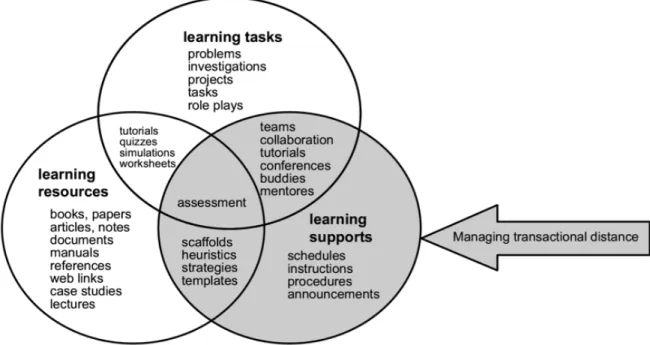
Moore (1993) suggests that there are fundamental structural supports that can affect the level of transactional distance in the online classroom. Building on Moore’s ideas, Benson and Samarawickrema (2009) have suggested general learning supports that manage the effects of transactional distance (Figure 2.4).
Figure 2.4. Learning supports that mediate transactional distance as students utilize learning resources and implement learning tasks. From: Benson, R., & Samarawickrema, G. (2009). Addressing the context of e-learning: Using transactional distance theory to inform design. Distance Education, 30(1), 5-21.
structured classes, they often have greater control over the learning supports in the class. The learning supports that instructors introduce will differ from class to class. Younger students and students who are new to distance education might need more structural supports (online group meetings, schedules and calendars, exemplar material, etc.) than those who have previously experienced this mode of education. As students gain experience, many of these structural supports might be decreased or removed altogether to fit the needs of learners by giving them more control over their learning environment.
Communities of Inquiry: Middle-range Theory
If transactional distance describes the exchange of educational ideas between the student and the instructor, community of inquiry theory (Garrison, Anderson, & Archer, 1999) represents the marketplace in which this transaction takes place. The community of inquiry framework is situated in specific learning theory that addresses learning processes from a collaborative-constructivist point of view to foster critical discourse within a group. An educational community of inquiry is defined as “a group of individuals who
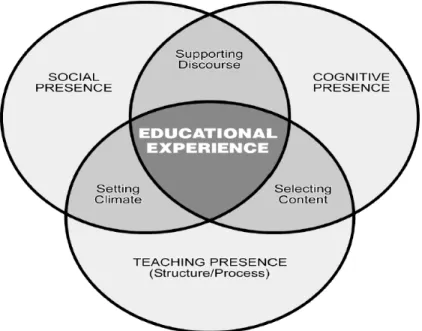
collaboratively engage in purposeful critical discourse and reflection to construct meaning and confirm mutual understanding” (Garrison, 2011, p. 2). Within the community of inquiry framework, the experience of learning is mediated through the development of three
interdependent elements, referred to as ‘presences’: social presence, cognitive presence, and teaching presence. Figure 2.5 illustrates how these elements interact to construct an
Figure 2.5. Creation of the educational experience within the Community of Inquiry framework. From: Garrison, R., Anderson, T., & Archer, W. (2000). Critical inquiry in a text-based environment: Computer conferencing in higher education. The Internet and Higher Education, 2(2), 87-105.
Social Presence
Garrison (2009) defines ‘social presence’ as “the ability of participants to identify with the group or course of study, communicate purposefully in a trusting environment, and develop personal and affective relationships progressively by way of projecting their
be noted that students with different levels of experience in online classes may require different scaffolding with regard to social presence depending on the instructional design of the course, the nature and use of the technology involved, or the level instructor mediation (Garrison & Akyol, 2013). Swan and Shih (2005) provide evidence that students who perceive the highest social presence project themselves more into online discussions and reveal meaningful differences in perceptions of the usefulness and purpose of online
discussions than students who perceive themselves to be socially distant. Other researchers have noted that social interaction is a critical factor in student course completion and retention (Boston et al., 2009). The increase in group cohesion that is fostered by social presence leads to a greater capacity for group collaboration, which in turn optimizes the learning experience.
Cognitive Presence
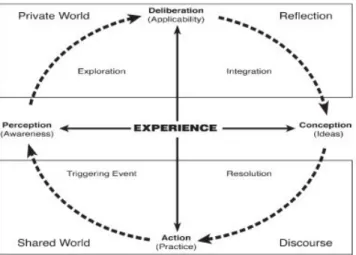
Figure 2.6. The Model of Practical Inquiry. From: Garrison, R., Anderson, T., & Archer, W. (2001). Critical thinking, cognitive presence, and computer conferencing in distance education. American Journal of Distance Education, 15(1), 7-23.
Practically speaking, cognitive presence is perhaps the most elusive of the three presences to operationalize because it relates to the path students take through the learning process. Related to Moore’s (2013) concept of student autonomy, cognitive presence is affected by the student’s approach to the course, which includes how the student approaches problems and seeks to understand difficult content material. However, a student’s approach to a course incorporates issues over which the instructor exercises relatively little control. The instructor can, however, facilitate cognitive presence by the methods that they choose to use to present material and the goals they establish for learners (Garrison, Anderson, & Archer, 2000).
Teaching Presence
presence plays a critical role in realizing the intended educational outcome of a course. Teaching presence also plays a crucial part with regards to establishing social and cognitive presence in a classroom as the main responsibilities of teaching presence overlap the other two in the following areas: course design and organization, facilitating discourse, and direct instruction (Garrison & Akyol, 2013).
The CoI framework flows evenly from the higher-level transactional distance model from which it evolved. Where Transactional Distance theory defined the realms in which perceived distance that can impede student success, CoI theory offers an idea of the types of behaviors and levels of cognitive though that govern these realms. In this model, the
educational experience is personalized as different levels of cognitive, social and teaching presence are enacted in a classroom. It becomes important as a theory of distance education in that teaching presence, social presence and cognitive presence career focus in Mathematics Education
Online Best Practices: Low-End Theory
Coordinating online classwork requires significant effort on the part of the instructor – perhaps more effort than a first-time instructor expects. In addition to developing course activities, the instructor must perform a variety of supporting actions throughout the semester. One of the more time-consuming of these actions is simply creating and
maintaining a course page within a learning management system (LMS) and orchestrating the outside technologies that will be used to deliver content. The time and skill needed to effect this work efficiently underscores the need for a careful and deliberate approach to planning the course. Time that is spent planning activities, choosing technologies, and preparing the course page during the semester is time that the instructor cannot use to monitor his/her student’s progress, manage online discussions, or build intimate relationships with students. As such, the closest student-teacher relationships are likely to develop when planning and other elements of course construction are completed before the start of the semester.
Ultimately, a successful online educational experience requires precise
communication. In the face-to-face classroom, there is often more room for error in this regard as students have a variety of opportunities to have expectations reinforced and to clarify misunderstandings (Dykman & Davis, 2008b). In addition to having opportunities for direct exchanges with the instructor, students in a physical classroom have the ability to check with their peers when they are confused about assignments or timelines. Shearer (2013) notes the existence of a variety of social media, social networking, and mobile learning sites that have the potential to bring some of the immediacy of classroom
interactions to the distance learning environment. Despite the appeal of these technologies, however, Shearer (2013) warns of taking the ‘tool of the day’ approach to their
mix of dialogue, learner autonomy, and structure that are present in the course in addition to the learning curve associated with use of the technology when considering adopting one of these online approaches (Shearer, 2013).
Regardless of the technology used to approach communication-related problems, instructors need to plan for communication and understand that communicating effectively with students is likely to consume a considerable amount of their time in the implementation phase of the course. Ragan (2008) offers thoughts on teacher actions in the online classroom that constitute the best practices in online learning. Many of these actions are directed towards developing the sorts of communication strategies that are necessary for successful online experiences. These actions address elements of communication, such as monitoring student progress, identifying and encouraging students who fall behind, providing feedback and student support, and dealing with conflicts that may arise online. This list of practices may not seem much different than the sorts of practices expected of instructors in face-to-face classrooms, but because all of these communicative skills need to be mediated through technology, they may require significantly more effort than expected.
Effective Teaching Practices in Mathematics Education that Support Student Learning The literature on best practices in distance education promotes the use of learning design that is situated in meaningful contexts and is active in nature (Naidu, 2013). A similar approach is found in mathematics education with regard to the development and
implementation of tasks. Research over the last two decades suggests that student
to suggest that an online ecology alters the nature of the connection between task and achievement. The question, then, is not so much whether tasks that demand high-level thinking and reasoning are appropriate in online contexts, but what are the specific factors of implementation that must be modified for online delivery.
The mathematics reform movement of the 1980s and 1990s directed a curricular shift away from the memorization of facts and procedures and towards one aimed at a conceptual understanding of mathematics. Documents published by the National Council of Teachers of Mathematics (NCTM, 1989, 1991), National Research Council (1989), and the Mathematical Association of America (Leitzel, 1991) promote classroom interactions to help students achieve a complete understanding of mathematics by allowing students to engage in the process of ‘doing math’ rather than merely executing algorithms and memorizing procedures. These documents were followed by NCTM’s Principles and Standards for School
Mathematics (2000), which not only outlined the mathematics that should be included in school curricula, but also made an effort to articulate a fundamental set of principles to describe high-quality mathematics education. Currently, many of these principles are still evident in the Common Core State Standards Initiative’s Standards for Mathematical Practice (National Govonors Association Center for Best Practices, 2010) as well as in NCTM’s own Principles to Action (NCTM, 2014) that revisits its 2000 standards and offers assistance to teachers, schools, and districts with regard to implementing national standards outlined in Common Core.
situations by making conjectures, looking for patterns and connections amongst various mathematical representations, abstracting beyond the immediate situation, and
communicating and justifying their conclusions to others (Stein, Grover, & Henningsen, 1996). Doing mathematics has a purpose well beyond mere accurate calculation, which is to encourage math exploration for its own sake by encouraging students in the process of doing mathematics to work like a mathematician. Often, this work is done by exploring
mathematics that are ‘real-world relevant’
Much work has been undertaken during recent decades to identify the characteristics of mathematical tasks that allow for conditions to do mathematics effectively in the
classroom. Doyle (1988) proposed four essential components of tasks that define academic tasks in the classroom:
(a) a goal state or end product to be achieved, (b) a problem space or set of conditions and resources available to accomplish the task, (c) the operations used in assembling and using resources to reach the goal state or generate the product, and (d) the importance of the task in the overall work system of the class (Doyle 1988, p. 169). Doyle notes that teachers effect tasks by setting expectations for the product of student work and explaining how task goals might be accomplished.
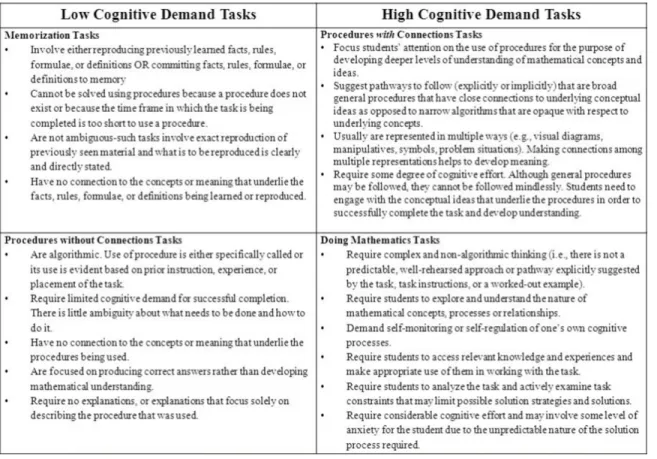
Smith and Stein (1998) define tasks in terms of being either low or high cognitive demand (Figure 2.7). Low demand cognitive tasks rely heavily on a procedural
understanding of mathematics. These tasks are usually straightforward in nature and require little cognitive effort on the part of the student. The goals of a low-level task are usually aimed at the production of ‘correct’ answers and require little explanation by the student beyond stating the procedure that was used. low-level demand tasks usually fall into one of two categories. Memorization tasks involve rote memorization of material and simply ask students to regurgitate previously discovered fact. Tasks that go beyond simple
Figure 2.7. Matrix for determining the cognitive demand of an instructional task.
From: Stein, M. K., Smith, M. S., Henningsen, M. A., & Silver, E. A. (2000). Implementing standards-based mathematics instruction: A casebook for professional development:
Teachers College Press.
Higher-level tasks may require considerable effort on the part of the student. These tasks may require the use of procedures that have close connections to broader mathematical concepts. Solution paths through these problems may be opaque or entirely obscured, thus allowing the student to explore different entry points into the problem as well as a variety of problem-solving methods. Like lower-level tasks, higher-level tasks generally fall into one of two categories. Tasks defined as ‘procedures with connections’ may make use of
algorithms; however, unlike lower-demand tasks, algorithmic thinking cannot be used mindlessly to produce a result. Higher-level tasks may rise to the level of ‘doing
work of mathematicians. This work includes uncovering patterns, making and testing conjectures, constructing viable mathematical arguments, and critiquing the work of others with the goal to strengthen an argument.
Figure 2.8. Various task-related factors that effect learning outcomes. Adapted from Henningsen, M., & Stein, M. K. (1997). Mathematical tasks and student cognition: Classroom-based factors that support and inhibit high-level mathematical thinking and reasoning. Journal for Research in Mathematics Education, 524-549.
Figure 2.2 shows that factors that influence the setup of the problem as well as the students’ implementation of the task can easily alter the task’s cognitive demand and have an effect on student learning outcomes.
Even the best designed tasks do not always become quality learning experiences in the classroom. Tasks that are set up as high-demand cognitive assignments sometimes devolve into low-demand cognitive experiences (Doyle, 1983, 1986, 1988). When faced with challenging tasks that put them in a state of cognitive disequilibrium, students often demand help that pressures the instructor to decrease or remove the demanding features of a task. This phenomenon can happen either when the instructor provides additional
Lastly, the cognitive demand of the task may be affected when an instructor applies pressure on students to perform with accuracy and speed to the detriment of their conceptual
understanding (Doyle, 1988).
Given the potential perils to the cognitive demands associated with such tasks, instructors must find ways to support students in the classroom that do not jeopardize the demands placed on them by the task. The establishment of sociomathematical norms that govern teacher and student interactions in the classroom may be of particular importance to the ecology of the classroom (Doyle, 1988; Kazemi & Stipek, 2001). ‘Sociomathematical norms’ refers to the rules that govern both teacher and student behaviors and expectations in the classroom. Teachers need to be acutely aware of the extent to which they emphasize construction of mathematical meaning as part of the outcome of a classroom event. This emphasis can be managed when instructors make explicit connections between the
mathematical ideas addressed in the task and the activity in which students engage (Doyle, 1988; Henningsen & Stein, 1997; Smith & Stein, 2011).
questioning (Kazemi & Stipek, 2001), students are better able to justify their results by triangulating their arguments using a mix of verbal, graphical, and numerical strategies. In addition to making clearer arguments, students in such high-press classrooms are also reported to be better able to identify similarities and differences amongst various student representations and to verify the validity of responses presented to them by others.
Although many of the factors that support the establishment and maintenance of cognitive demand hold for online environments as well as for face-to-face classrooms, additional online factors that affect cognitive demand are less well understood. Many
researchers in the field of distance education view the connection between learning goals and tasks and activities in online settings as important as it is for face-to-face instruction
(Dennen, 2013; Naidu, 2013; Ragan, 2008; Simonson et al., 2014). However, many of the factors that influence the synchronicity of an event, the management of elapsed time, and the media through which interactions occur might also affect the maintenance of demand
throughout the task (Dennen, 2013). Online instructors will need to have an additional understanding of content and their students to ensure that selected media will transmit key understandings and that students will have the ability to be self-regulated in their learning (Kim, Kozan, Kim, & Koehler, 2013; Ragan, 2008).
Asynchronous Interactions
Asynchronous interactions, often in the form of discussions, are frequently used to complement learning in a variety of online and blended format classes. As such interactions impact the teaching of mathematics, constructing asynchronous discussions that are centered on high-demand mathematical tasks may be the most productive means of facilitating
face-to-face discussions are often spontaneous and ephemeral in nature, online discussions allow participants the time to process information and carefully compose responses that become part of a permanent record of student thinking (Wang & Chen, 2008). Asynchronous online discussions become spaces where students can exchange initial thoughts, discuss mathematical issues, compare results, and collaboratively work towards solutions to problems. These features of asynchronous discussions emphasize issues that surround effective mathematics teaching and learning that are highlighted in Guiding Principles of School Mathematics (NCTM, 2014) as well as in Common Core State Standards for
Mathematical Practices (National Govonors Association Center for Best Practices, 2010). However, quality asynchronous mathematical discussions can be difficult to create. Promoting discussion online is more complicated than merely finding and posting a high-demand mathematical task. A number of problems that are unique to the asynchronous environment can arise. For instance, participation may not be as easily definable as it is in a face-to-face setting. In traditional classroom discussions, visual cues and body language can give hints regarding student engagement in a topic. Such engagement is harder to detect online and is usually measured by behaviors that mark student presence, such as constructing posts. Listening, which is a large part of face-to-face engagement, also is less easily
detected. Once participation is defined, then the issue of facilitation arises. What part does a facilitator play in an online discussion? How ‘present’ should this facilitator be? Related to the instructor’s role in the conversation is the issue of instructor feedback. Providing
Participation
Participation is generally considered to be an essential prerequisite to student learning (Wenger, 1998). In face-to-face classrooms, visual cues and other noticeable student
behaviors can alert instructors as to the level of student participation in a class. A key challenge for online learning is to define both the notion of online participation and the optimal conditions in which participation can occur. In a review of the literature, Hrastinski (2008b) developed a classification scheme to classify the nature and complexity of
interactions in online environments. This six-level classification scheme (Figure 2.9) is constructed on a continuum that ranges from mere student access to an e-learning environment to students’ full participation in a meaningful dialogue with peers.
Figure 2.9. Levels of online participation. From: Hrastinski, S. (2008). What is online learner participation? A literature review. Computers & Education, 51(4), 1755-1765.
difficult. Hrastinski’s classification scheme as well as the work of others who have
attempted to identify and measure online participation (Hrastinski, 2008a; Romiszowski & Mason, 1996; Vonderwell & Zachariah, 2005), challenge long-held notions of online participation as writing and suggest that students in these settings might exhibit other behaviors apart from posting messages that constitute participation.
Although posting messages is perhaps the most visible evidence of student participation, other, less evident, behaviors may also contribute to student participation. Romiszowski and Mason (1996) established a construct that they refer to as ‘lurking’ as a valid form of participation in online classrooms. The same way that traditional classroom students who are reluctant to speak up in class may benefit from open discussion, students in online classes may benefit from forms of passive participation. Romiszowski and Mason (1996) point out that, even in face-to-face classrooms, students spend most of their time as passive consumers (with varying degrees of engagement) and only occasionally make verbal contributions to the conversation. Romiszowski and Mason (1996) suggest that such
behavior is likely a feature of online student conduct as well.
‘Lurking’ may be an unfortunate term for this behavior, given the negative
connotations it provokes, but many teachers have touted its role in group learning. Although sometimes viewed by teachers as ‘freeloading’ behavior, Lave and Wenger suggest that lurking may be a form of legitimate peripheral participation (Lave & Wenger, 1991). Traces of this participation, however, may be harder to detect online than in the traditional
A study by Dennen (2008) looks at students’ perceptions of lurking behavior. Dennen’s findings show that students self-report engaging in reading behaviors more frequently than engaging in posting behaviors. When they did engage in posting behaviors, however, students reported feeling more actively engaged in the discussion than when
reading. Dennen (2008) suggests that this outcome may be the result of some students’ belief that the purpose of the discussion was to show the instructor what they know or to earn participation points rather than to engage in discussion with classmates, and suggests that students are “likely to look to the instructor to specify the motivation and purpose” (Dennen, 2008, p. 1631) of discussions.
Factors that Support or Inhibit Participation in Asynchronous Discussions
Literature examples that include asynchronous collaborative discussions suggest that such discussions provide a variety of benefits to the learner. The benefit that has gained the most attention is scheduling flexibility. Asynchronous online discussions allow students to ‘check into’ the discussion from virtually anywhere at any time, which is a feature of online learning that is attractive to students with busy schedules outside of school. Apart from convenience, a number of benefits might be linked more directly to student learning. One feature that is unique to the asynchronous discussion forum is that the forum structure creates a permanent record of the dialogue. In a face-to-face classroom, discussions are fleeting moments that are difficult for students to capture and process, let alone review at a later date. Asynchronous discussion forums create written records of discussion materials so that
that students only reap the benefits of asynchronous discussions when they are willing to participate in the discussion in the first place.
In a review of the literature, Hew et al. (2010), summarized a variety of factors that influence student participation in asynchronous online discussions. Among the challenges of participation is the student’s lack of belief in the need for discussion. If students feel that they are posting as a mere marker of presence, rather than being asked to discuss a
meaningful prompt, students might not feel properly motivated to participate. Dennen (2008) notes that, often times, the assignment of grades is the primary motivator for student
participation in asynchronous online discussions. She further notes that, although grades may instigate posting behavior, they do not necessarily promote true interaction and dialogue amongst students. Dennen (2008) concludes that, if interaction and dialogue are not the primary objectives of the activity, then the premise for requiring an asynchronous discussion must be reconsidered.
Hew et al. (2010) also suggest that students react to the real and perceived personality traits of other members of the discussion group. They note that students tend to disengage from discussion when they perceive others to be pontificating on a topic. Hewitt (2005) remarks that this situation can be exacerbated when the conversations become emotional and parties feel threatened or overtly challenged. This outcome relates, in part, to the varied personalities of the members who are participating in the forum. Chen and Caropreso (2004) investigated three personality traits (extraversion, agreeableness, and openness) and found that students who tended towards these traits featured more prominently in asynchronous discussions. Students who scored at the low ends of scales of these personality traits participated less frequently and tended to contribute posts that were tangential or only marginally related to the topic of discussion compared to students who reflected these traits.
In addition to intrinsic motivation and personality traits, Hew et al. (2010) also discuss a variety of design aspects that influence participation in asynchronous online
discussion forums. First, the structure of the discussion platform itself may make it easier or more difficult to follow threads. Conversations with multiple threads and multiple
Related to the research collected by Hew et al. (2010), Kim (2013) discusses the influence of the size of the discussion group on student participation in online asynchronous forums. Kim suggests that it is often difficult for students to maintain focus on important topics in large classes. Here, the setup of the space may be a factor in the derailment of the conversation. Kim states that, in many discussion spaces, the newest unread posts are featured in bold at the top of the screen, with older posts further down in the feed. This structure may have the unintentional effect of featuring ideas expressed in newer posts rather than relevant ideas, which can have the result of moving the group discussion off topic. Related to the setup of the space, Kim (2013) also suggests that the hierarchical structure of the space deemphasizes the intricacies of the overall conversation. In most asynchronous discussion spaces, replies can relate to only one initial post. Kim notes that this reply may in fact be related and relevant to other threads as well. This nuance of the discussion can therefore get lost in the posting structure itself. An important overall point mentioned by Kim (2013) is that, without proper facilitation, online asynchronous discussion groups are, by their very nature, divergent discussions. As individuals reply to the initial topic,
conversations can easily become branched. Once such dispersion happens, it is difficult to converge the discussion and synthesize ideas.
Instructor Facilitation and Feedback in Asynchronous Forums
plays in facilitating feedback within the discussion itself (An, Shin, & Lim, 2009; Guo, Chen, Lei, & Wen, 2014). This section briefly addresses these debates.
Different facilitation approaches may impact the cognitive engagement of students in asynchronous discussions. In one study of online discussion forums in an education course for elementary teacher candidates, An et al. (2009) examined the effects of different
facilitation approaches on students’ sense of social presence. They varied two elements of the feedback process. The first variable altered the frequency with which instructors responded to initial student posts. The second variable that was manipulated was the presence of a requirement that asked students to respond to posts by their peers. Three different sections of the same online course were defined. In the first section, the instructor responded to each student’s initial post and required students to respond to at least two of their classmates’ posts. In the second section, the instructor responded to each student’s initial post but did not require additional peer posts. In the third section, the instructor made infrequent responses to student’ initial posts but did require at least two additional posts. The study cites two
significant findings. First, voluntary posts were infrequent. In the section where additional posts were not required, very few additional posts were made. Second, and perhaps more significantly, in the section where instructor intervention was minimal, students tended to express their thoughts and opinions more freely and more cues related to the building of social presence were present in discussions. These findings indicate that students may prefer a discussion environment where public instructor feedback is minimal, at least as far as building social presence is concerned.
were defined. In the experimental group, a tutor was assigned to facilitate the discussion by scoring and giving feedback for each post. Feedback included pointing out the strengths and weaknesses of an argument, probing the student’s thought process, assigning bonus points for additional posts, and providing praise. The treatment group, by contrast, had no tutor
assigned. The results of the study found no major differences in the number of posts made in either group; however, in the experimental group, cognitive engagement was significantly higher than in the control group. Levels of cognitive engagement also improved over the course of the semester in the experimental group.
Although the results from the An et al. (2009) and Guo et al. (2014) studies may seem a little at odds with one another, a couple of generalizations might be made. First, as
demonstrated by Guo et al. (2014), feedback in the form of instructor responses to online posts may help students self-regulate their learning and keep them on task (Conrad & Dabbagh, 2015). Second, when facilitators step back and require students to provide feedback to their peers, closer social bonds are formed, potentially positively impacting student satisfaction. It is likely, however, that a mixed facilitation strategy may provide the best of both worlds. In other words, a heavy or light facilitation strategy may be employed by the instructor, depending on the goal of the task.
Synchronous Interactions
While asynchronous online activities in the form of blogs and forums have played a
featured role in online education, exciting new possibilities for synchronous interactions have
become available with the improvement of video conferencing technologies and other forms
of computer assisted communication. As compared to interactions that happen in the