A SITE OF RESISTANCE AND/OR RECLAMATION?
THE ROLE OF THE BLACK CHURCH IN THE CHARTER SCHOOL MOVEMENT
Danielle Joi Allen
A dissertation submitted to the faculty at the University of North Carolina at Chapel Hill in partial fulfillment of the requirements for the degree of Doctor of Philosophy in the School of
Education.
Chapel Hill 2017
Approved by: Lora Cohen-Vogel Katrina Bulkley Eric Houck
iii ABSTRACT
Danielle Joi Allen: A Site of Resistance and/or Reclamation? The Role of the Black Church in the Charter School Movement
(Under the direction of Lora Cohen-Vogel)
The struggle for equitable educational opportunities for students of color and those from
low income families began well before the seminal Brown case, and continues with each new
wave of education reform. The charter school movement is one such reform rapidly expanding
across the United States and often targeting students from low-income communities of color
(Berends, 2013; Reardon, 2011). Black churches have traditionally played a significant role in
the education of African Americans (Billingsley, 1999; Lincoln & Mamiya, 1990; Pinn & Pinn,
2002), and have become increasingly involved in the charter movement. To date, there has been
little scholarly investigation into the nature of this involvement.
Through a set of three studies, this dissertation examines nine predominantly Black
churches and the ways they have mobilized as sites of resistance and/or reclamation of Black
education through the charter school movement. Article 1 examines the types of Black church
participation in the charter movement, and Article 2 examines discursive claims around their
reasons and motivations for becoming involved. Finally, Article 3, a related case study, examines
a coalition of Black clergy that mobilized politically to defeat legislation that would have
iv
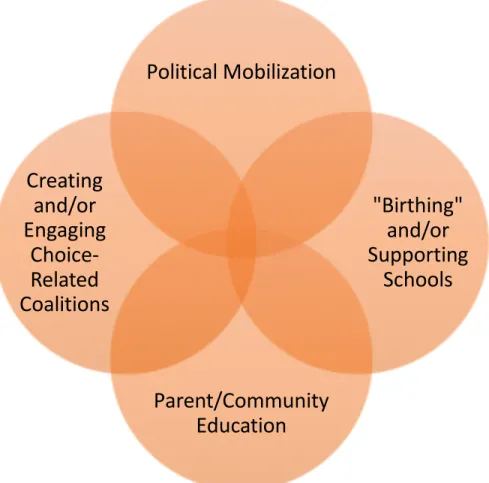
Preliminary findings suggest that Black church participation in the charter movement
falls into four categories: political mobilization, parent and community education, creation and
engagement of school choice-related coalitions, and “birthing” and/or supporting charter schools.
There appear to be two emerging discourses regarding motivations for becoming involved in the
charter school movement: health of the church and community revitalization. These discourses
are not currently included in the literature on African-Americans’ motivations for supporting
school choice, and further research is necessary to determine the extent to which they are
pervasive across Black faith communities. Finally, the related case study reveals that key
strategies of Black church political mobilization in the charter school movement include data
mining and problem identification, resource employment, coalition building, and celebration,
v
ACKNOWLEDGEMENTS
Whatsoever ye do, do all to the glory of God. -1 Corinthians 10:31b
Thank you, Lord, for bringing me to and through this endeavor! When I started this doctoral program, I committed myself to doing all things to the glory of God. I am so thankful for a dissertation topic (and an advisor) that allowed me to study the education reform work God’s people are doing across the country.
To my immediate and extended family- I cannot tell you how much your unwavering support has meant over the past five years. Momma and Daddy, THANK YOU for your prayers, encouragement, and motivation as I “built widgets” hunched over my laptop. To my brother, sister, and brother-in-law, thank you for the laughs, love, and support through this process. To my sweet, sweet nephew, Scoop- I love you more than you know. Your fighting spirit has been a testimony to so many, including your Aun-Thee.
To my advisor, Lora. I could not have completed this program or dissertation without you. From day one, you have been my biggest advocate and cheerleader at UNC, and I thank God for you. To my mentor, Katy Bulkley- I’m so thankful we were matched through Jackson Scholars. You took me under your wing and became a second academic mom. You and Lora formed an absolute dream team and I hope that I’ve made you proud.
vi
Winters, thank you for your support as I wrote the dissertation. I am honored to have been guided through this process by this team of scholars.
To my participants- I cannot thank you enough for sharing your time, experiences, and perspectives with me. Without you, I never could have completed this dissertation. Thank you for all the work you’re doing on behalf of children and the church.
vii
TABLE OF CONTENTS
LIST OF TABLES ... xi
LIST OF FIGURES ... xii
CHAPTER 1: TOWARD A THEORY OF BEHAVIORS EXHIBITED BY BLACK CHURCHES PARTICIPATING IN THE CHARTER SCHOOL MOVEMENT ... 1
Background ... 4
History of charter schools ... 4
Role of religious organizations in charter school movement ... 7
History of Black church involvement in education ... 8
Theoretical Framework ... 12
Typological Analysis ... 12
Dimensions of Typology of Black Church Involvement ... 13
Research Design and Methods ... 17
Participants and Recruitment ... 17
Data Collection ... 24
Data Analysis ... 26
Findings ... 27
viii
Discussion: Towards a Categorization of Charter School Involvement Among Black Churches 53
Implications ... 60
Limitations and Directions for Future Research ... 62
Conclusion ... 63
CHAPTER 2: AN ANALYSIS OF BLACK CHURCH DISCOURSES EXPLAINING MOTIVATIONS FOR INVOLVEMENT IN THE CHARTER SCHOOL MOVEMENT ... 64
Theoretical Framework ... 65
African American Discourses Around School Choice ... 65
Research Question ... 71
Research Design and Methods ... 71
Participants and Recruitment ... 71
Data Collection and Analysis ... 74
Findings ... 77
Extant School Choice Discourses Espoused by Black Churches ... 80
Emerging Discourses ... 96
Discussion ... 99
Implications ... 101
Limitations and Directions for Future Research ... 103
ix
CHAPTER 3: “HERE COME THE GRASSHOPPERS”: A CASE STUDY OF BLACK CLERGY, POLITICAL MOBILIZATION, AND RESISTANCE TO THE POTENTIAL
EXPANSION OF THE CHARTER SCHOOL MOVEMENT ... 105
Background ... 105
Black Clergy Working for Change ... 105
Amendment One ... 109
Theoretical Framework ... 114
Black Churches, Black Clergy, and Political Mobilization ... 114
Research Question ... 116
Research Design and Methods ... 117
Findings ... 123
History of BCWC ... 123
Steps in BCWC’s Political Mobilization Against Amendment One ... 124
Discussion ... 135
Implications ... 138
Limitations and Directions for Future Research ... 139
Conclusion ... 140
APPENDICES ... 141
APPENDIX A. INTERVIEW PROTOCOL- ARTICLE 1 AND ARTICLE 2 ... 141
x
xi
LIST OF TABLES
xii
LIST OF FIGURES
1
CHAPTER 1: TOWARD A THEORY OF BEHAVIORS EXHIBITED BY BLACK CHURCHES PARTICIPATING IN THE CHARTER SCHOOL MOVEMENT
The role of the Black church in the charter movement has been largely overlooked by scholars. In beginning to fill that void, this study determines the types of behaviors exhibited by Black churches participating in charter school reform using data from church histories, sermons, charter school applications, newspaper articles, charter school board meeting minutes, archival records, and interviews. To organize the data and present it in a systematically transparent fashion, I set out to conduct a typological analysis to create a typology of Black church
involvement based on two dimensions: the first, levels of church activism, was previously set out by Billingsley (1999). The second proposed dimension, beliefs about charter schools, was
selected by the researcher based on the research objectives. As the findings will show, the behaviors identified in the data do not fit a typology along beliefs and activism levels; however, there do appear to be several emerging categories of behaviors arising from the data that I contend form the basis for a new theory around Black church involvement in the charter school movement.
2
membership is predominantly Black and the leadership is White (some Catholic churches, for example). Lincoln and Mamiya (1990) note that “Black church” speaks to those “independent, historic, and totally Black controlled denominations” (p. 1), however, I extended this definition to include predominantly Black non-denominational churches that were led by an African-American senior minister. One of the non-denominational churches included in this study began as a Baptist church, and the other was led by a Black pastor with roots in the African-American church. Extending the definition in this way allowed the flexibility of expanding the pool of potential participants while still being able to discuss dynamics of Black self-help, Black power, and Black leadership as they relate to the charter school movement. This bounding of the
definition of “Black church” is necessary in this study, as these three dynamics have historically lent themselves to heightened social activism in the Black church (Wilmore, 1998), as well as in the Black independent school movement.
While embracing this definition, it is critical to acknowledge that there exists no singular, monolithic “Black church.” On the contrary, the Black church is comprised of at least seven separate denominations1, each with distinct histories, agendas, traditions, and governance structures. For example, a number of Black Methodist denominations grew from the Methodist Episcopal church, and all congregations in those denominations are governed by a central body, whereas Baptist congregations may join national bodies, but are generally independent and
1 The seven historically Black denominations are the African Methodist Episcopal (AME) Church, the African Methodist Episcopal Zion (AMEZ) Church, the Christian Methodist Episcopal (CME) Church, the Church of God in Christ (COGIC), the National Baptist
3
governing (Woodson, 1921). One can imagine that this difference in governance may influence the freedom and latitude churches have to make decisions and advocate in controversial issues, including charter schools. During the Civil Rights Movement, for example, leaders of the National Baptist Convention adopted a conservative position and blocked many member churches from participating in protests and strikes (Carter, 2007). This ultimately led to
outspoken Baptist ministers—including Martin Luther King, Jr.—splitting away and forming the Progressive National Baptist Convention. The heterogeneity within and among Black church denominations is important and must be acknowledged at the outset of this dissertation. When I use “Black church” here, I am referring to the “vibrancy of a shared tradition of Christian commitment that has helped shape the collective Black community” (Pinn & Pinn, 2002), however, this should not be construed as homogenizing the diversity that exists within the Black church.
Savage (2008) speaks to this diversity of histories and, perhaps more importantly, the tensions that exist within the Black church as it relates to their political natures. She maintains that “shifting demographic, social, and theological conditions [made] the relationship between African American religion and political activism [...] vexed and contentious” (p. 8). Moreover, she emphasizes that “Black churches [...] are among the most local, the most decentralized, and the most idiosyncratic of all social organizations,” and that “the concept [of the Black church itself] imposes the notion of a unified command, a national entity, a papal-like authority that does not and has never existed” (p. 9). I concede these points and acknowledge them here, in an attempt to account for their significance and still make an important contribution to our
4
recognize the distinctions among each denomination, and to the extent possible, given the limitations of my data, acknowledge those differences in my data collection and analyses.
In the sections that follow, I describe the typological analysis method and follow with a detailed description of how the dimensions of the proposed typology were determined, as these dimensions formed the theoretical framework underpinning data collection and analysis. I then outline the research question for this study, and the methods used to answer it. Next, I detail the steps taken in data collection and analysis, describe the types of data collected, and how I analyzed the data. Finally, I share findings from the data, discuss the emerging theory arising from my analysis, and what implications these findings hold for policy, advocacy, and future research.
Background
History of charter schools
In the early 1970s, education professor Ray Budde developed an idea wherein teachers would be given the freedom to “charter” academic departments or programs of study (Budde, 1996; Kolderie, 2005; Nathan, 1996; Murphy & Shiffman, 2002; Weil, 2009). Groups of teachers would receive charters from their local school board, and these charters would free educators from some state and/or district regulations, give programs 3-5 years to demonstrate success, and then allow programs desiring an extended charter to undergo a stringent review process (Budde, 1998; Kolderie, 2005; Murphy & Shiffman, 2002). The charter school concept found support from a widely varied field of education reform advocates. A number of
5
be that greater autonomy for teachers, greater community control over schools, the “lifting of all boats” through market forces and competition, or greater parent choice in the education of their children (Bulkley, 1998).
In a 1988 address to the National Press Club, educator and American Federation of Teachers President Al Shanker seized upon Budde’s idea of chartering academic departments, and expanded it to chartering small schools, possibly within currently large, existing schools (Nathan, 1996; Shanker, 1988a; Shanker 1988b). Shanker’s vision of charter schools placed teachers’ unions in a much more decisive role, with greater decision-making power and authority over which groups of teachers would be granted charters (Kahlenberg, 2007; Murphy &
Shiffman, 2002). Ultimately, he hoped for charter schools to give teachers themselves greater autonomy, decision-making power, and influence in the educational process (Shanker, 1988a).
After much debate over the scope of charter school autonomy and accountability, the first charter school law was passed in Minnesota in 1991 (Murphy & Shiffman, 2002). This
legislation allowed eight schools to open statewide, required charters to obtain approval from both the state school board and a local school board, and required the majority of charter school board members to also teach in the school (Murphy & Shiffman, 2002; Nathan, 1996). One year later, the nation’s first charter school opened in St. Paul, MN, and by 1996, more than half the states in the US passed charter legislation (Henig, 2008; Weil, 2009). Currently, charter schools are rapidly expanding in the United States, with 43 states and the District of Columbia having charter school laws on the books (National Alliance for Public Charter Schools, 2015).
6
dictating the manner in which public education must serve all children include charters, as they too are funded by public dollars. The degree to which charter schools are truly public is highly debated, with critics contending that the governing and variable accountability structures are but one characteristic of charters that undercut their designation as public, while supporters maintain that charter schools’ government-based funding stream and accountability mandates requiring students at charter schools to take the same standardized assessments as their counterparts in traditional public schools cement their place in the public school system (Lubienski, 2013). Seminal anti-discrimination laws have been passed to ensure that all children, no matter their race, disability, national origin, language, or sex, are afforded equal educational opportunities. Moreover, the Elementary and Secondary Education Act of 1965 (ESEA) stipulated that federal funding be provided to low-income districts to mitigate- or eliminate- the impacts of poverty on student achievement (Lubienski, 2013). In 2002, the federal government issued a mandate that student achievement data be reported disaggregated by subgroup, with schools failing to meet a specific threshold being labeled as “in need of improvement.” Schools labeled as “needs
improvement” for five or more years are required to undergo restructuring, with conversion to a charter school being one allowable manner of restructuring. Scholars have shown that
concentrated poverty often results in lower student achievement, and charters are often heralded as one way for parents to remove their children from substandard schools and give them a greater chance of academic success.
7
which they are located (Dixson, Royal, Henry, 2014; Dixson, Buras, Jeffers, 2015). More specifically, scholars contend that because of the way school choice reforms have been adopted in these particular contexts—with little input from local communities—they have exacerbated racial and educational inequities (Dixson, Royal, Henry, 2012; Dixson, Buras, Jeffers, 2015).
Given the highly contentious nature of charter school reform, it is not surprising that one finds both advocates and opponents of charter schools within the Black community. While a number of grassroots parent and community organizations have been created to spark dialogue and effect change in the charter movement, Black churches are situated in an ideal space in which to engage in the movement. A historical bulwark in the Black community, the Black church may be just the institution to assume an influential advocacy role in the education reform and charter school movement.
Role of religious organizations in charter school movement
8
2009). I contend that the charter schools discussed in this dissertation are not “religious charter schools” as they have no explicit connection to any particular religion or culture.
History of Black church involvement in education
Having developed in response to systems of racial oppression, many Black church denominations are rooted in a tradition of resistance (Dubois, 1903; Frazier, 1974; Lincoln and Mamiya, 1990). The Black church was the site of much activity during the Civil Rights
Movement, and this social activism extends to the education arena. A number of scholars (Barnes, 2005, 2015; Barrett, 2010; Brown & Gadson, 2010; Caldwell, 2012; Childs, 2009; Dubois 1903; Lincoln & Mamiya, 1990; Rubin, Billingsley, & Caldwell, 1994) have investigated the African American church and its involvement in the provision of education services for children, but the extent of Black churches’ involvement in the charter school movement has rarely been examined. Further, the degree to which Black churches’ involvement in the charter school movement reflects a desire to have greater control over the education of their children and those in the surrounding community is yet to be uncovered.
9
publishing houses to produce materials discussing pressing social issues, and these outlets often emphasized the importance of education (Pinn and Pinn, 2002).
Lincoln and Mamiya (2003) maintain that post-emancipation, “freedom meant, among other things, the right to be educated” (p. 4). To that end, Blacks turned to education as a source of liberation. Black churches came together to establish schools, mobilize an all-Black teaching force, and discuss education reform (Anderson, 1988; Billingsley, 1999; Forman, 2005; Frazier, 1974). The Sabbath schools established by Black churches were an important example of freedmen “seeking, establishing, and supporting their own schools” (p. 15). White missionaries such as Julius Rosenwald2 provided funds and teachers for Black schools in the South, and Black pastors, often the most highly-educated men in their community, were encouraged to establish additional schools themselves (Frazier, 1974; Hoffschewelle, 2006; Lincoln and Mamiya, 1990).
This work was all the more significant as southern states severely underfunded public education for Black students during this period of time (Frazier, 1974). Black churches raised a sizeable sum through dinners and other programs to establish schools, provide facilities, pay teachers, and disseminate scholarship funds (Frazier, 1974; Littlefield, 2005). In addition to helping establish elementary and secondary schools, Black churches helped to create the first
10
Historically Black Colleges and Universities (Henig, Hula, Orr, & Pedescleaux, 1999; Littlefield, 2005). Bush (2004) maintains that the AME, AMEZ, and CME churches have served as the most consistent sources of funding for independent Black schools, which have historically shied away from accepting government funding in an attempt to retain control over their schools.
During and after the Civil Rights Movement, African American churches played an integral role in the struggle for equitable educational opportunities for Black children (Henig et al, 1999). Churches served as sites for planning strategies and protests, and ministers assumed roles on local school boards. In cities across the country, Black pastors became vocal school reform advocates (Henig et al, 1999). In Baltimore, Black clergy formed an organization that advocated for education reforms such as “site-based management and [...] neighborhood school autonomy,” and in Atlanta, Black churches partnered with local neighborhood schools through a collaborative between churches and the local school district (p. 140).
Contemporary Black church involvement in education. The contemporary Black church continues to play a role in the provision of educational services such as tutoring
programs, independent schools, and scholarship funds, however, some scholars maintain that it remains an untapped resource within the Black community (Childs, 2009; Brown & Gadson, 2010). Middleton (2001) contends that “the considerable power of the African American church has not been harnessed to speak with a united voice and demand better schools for urban
11
churches were conducting nonreligious educational programs in the community, with the most common programs being tutoring, preschool/daycare services, and field trips. Churches with memberships above 750 tended to offer more non-religious educational programs, and 42% of participants in non-religious educational programs were not members of the church (George et al., 1989). Billingsley and Caldwell (1991) conducted a study on the Black church, family, and school, and found that 70% of Black congregations operated one or more community programs, while almost 50% operated three or more. Of the programs being offered by churches, nearly one-third were focused on children and youth (Billingsley & Caldwell, 1991).
More recent scholarship by Barnes (2010; 2015) shows that Black churches are
continuing to provide educational programs for the surrounding communities; these initiatives include Head-Start programs, GED courses, and SAT preparatory classes. In a national sample of 1,863 predominantly Black churches, 62% sponsored tutoring and literacy programs (Barnes, 2010). Churches that sponsor these types of initiatives often boast a large membership, are led by a formally-educated pastor, sponsor a number of religious programs and have a college-educated congregation (Barnes, 2015). Lincoln and Mamiya (1990) assert that denominations—such as African Methodist Episcopal and Presbyterian—that tend to attract more economically stable and formally educated individuals were more likely to host educational programs; however, Barnes (2010; 2015) finds evidence that Baptist and other non-denominational Black churches also have well-established educational programs.
12
Caldwell, 1991; Childs, 2009). George et al. (1989) maintain that the socioeconomic levels of Black church members is, on average, higher than that of its surrounding community, and churches have a wealth of other resources at their disposal—including space to house programs, access to volunteers, and a tradition of involvement in the community—that makes them ideal providers of education services.
Theoretical Framework Typological Analysis
Typological analysis is a research method that consists of dividing observed qualities or behaviors into categories based on predetermined characteristics (Ayres & Knafl, 2008; Bailey, 1994; Johnson & Christensen, 2008; Hatch, 2002; Kluge, 2000; Kuckartz, 2014). Particularly well-suited for describing clusters of behaviors, a typology is useful in this study precisely because scholars know so little about what Black churches are doing as it relates to the support of and opposition to charter schools. Typologies can be useful for understanding responses to education reforms, and to understand and catalog behaviors and phenomenon before
investigating specific aspects of them (Midkiff & Cohen Vogel, 2015). Moreover, typologies are useful in comprehending and explaining complex social realities (Ayres & Knafl, 2008; Kluge, 2000). Following this logic, I proposed a typology of Black church behaviors in the charter school movement.
13
conceptual models, and/or research objectives (Ayres & Knafl, 2008; Bailey, 1994; Hatch, 2002). Bailey (1994) maintains that researchers identifying categories for a typology must aim for exhaustivity and mutual exclusivity, where each case, action, or behavior being classified has an appropriate class (exhaustivity), but with no case, action, or behavior being a member of two classes (mutual exclusivity). Once all cases have been typified, they can be described on a number of dimensions.
Dimensions of Typology of Black Church Involvement
Beliefs about charter schools. At the study’s outset, I expected that a typology of Black church involvement would highlight churches’ beliefs about charter schools, and churches’ level of activism, as described by Billingsley (1999) (see Figure 1 for graphic representation of
14
Figure 1. Proposed Typology of Black Church Behaviors. This figure illustrates a proposed typology of Black church involvement in the charter movement, along the axes of beliefs and level of activism.
Following Hatch (2002) and Ayres and Knafl (2008), individual Black churches’ beliefs about charter schools—whether their actions are in support, neutral, or in opposition— could form one axis of the typology. These scholars maintain that dimensions may be selected based on the research objectives of a study. Given that this study seeks to identify ways that Black
15
for favorable charter laws, mobilizing community members to support friendly charter policies) could be categorized as support. Any involvement Black churches have that is not in direct support of or opposition to charter schools (e.g., simply informing parents of school age children about both the charter and traditional public schooling options available to them, without
encouraging them to select one type of school over the other) could be classified as neutral. Finally, any collective actions that are in direct opposition to charters (e.g., holding community forums on the dangers of charter growth, participating in anti-charter protests) could be classified as opposition.
Churches’ collective discourses will be used to justify the classification of actions that are not necessarily in support, neutral, or in opposition, in and of themselves. For example, holding a community forum on the importance of investing in traditional public schools is not pro- or anti-charter per se. However, if churches claim they are holding the forums to inhibit the growth and support of charter schools, then these actions will be classified as opposition.
Following Bailey (1994), this first dimension is exhaustive, in that all Black church involvement identified in data collection should fall under one of the three categories. It is also mutually exclusive, as the actions—in conjunction with the discourses—should not fit more than one category on the belief dimension. Church claims and discourses on the charter movement will be used to ensure that types of involvement are accurately classified.
16
not all Black churches will be inclined to attend to these secular concerns, others will be so inclined, and they will respond based on the capacity of the congregation and church leadership. He terms these categories of activism conservative, moderately active, and active.
According to Billingsley (1999), conservative churches will “[confine] themselves to their basic spiritual and religious work, thus ignoring, or seeming to ignore, the social crisis around them” (p. 185). Lincoln and Mamiya (1990) speak to the inclination of churches to prioritize congregants’ spiritual versus secular needs in his privatistic versus communal dialectic. Churches with a privatistic orientation will focus on members’ spiritual well-being and personal relationship with God, whereas those with a more communal orientation will acknowledge and address the social, economic, and political problems its members face. The ability to respond to these needs depends on congregations’ and pastors’ strength, independence, and resourcefulness, according to Billingsley (1999).
Similar to conservative congregations, moderately active churches will largely prioritize their spiritual mission over any obligation to the secular needs of the community, however, they will take some minor actions to address social issues (Billingsley, 1999). Moderately active churches may invite guest speakers, hold forums, or host community meetings on social issues. However, these actions do not take place on a consistent and sustained basis. Billingsley (1999) maintains that these activities take place on “special and irregular” occasions (p. 185).
17
confront the secular crises engulfing the people” (p. 185).
Given the dearth of research on the role of the Black church in the charter school movement, this study seeks to begin to fill that void by creating a typology of involvement present among churches supporting and opposing the charter school movement. Findings from this study will provide community leaders, policymakers, and researchers with knowledge of how Black churches might continue to engage in the charter school movement and how the Black church has and can harness its myriad resources to assume a more influential role in contemporary education reform efforts. To that end, this study asks: What are the various types of Black church involvement in the charter movement?
Research Design and Methods
To answer the question outlined above and create the typology, I conducted a qualitative typological analysis.
Participants and Recruitment
The identification of potential data sources for this content analysis and resulting typology consisted of Internet searches, word-of-mouth, social media searches, and snowball sampling (Marshall & Rossman, 2016; Miles & Huberman, 1994). Participant recruitment began by reaching out via email to head pastors of churches located within the state that I knew were involved in the charter school movement, either through firsthand knowledge or through
informal conversations with colleagues. Interviews were scheduled with these senior pastors, and at the conclusion of the interview I asked if there were additional individuals with whom I should speak in order to learn more about their church’s charter activity.
18
Internet searches of potential participants, specifying a set of keyword combinations, including “Black churches” AND “charter schools” and “African American churches” AND “charter schools” to identify churches that had either started charter schools, had partnered with them in some manner, or had worked to mobilize communities against the expansion of charter schools. These search terms occasionally led directly to websites of Black churches involved in the charter movement, while other times they led to newspaper articles mentioning churches, individuals from churches involved in the charter school movement, or the names of schools being chartered by African-American faith communities. I eventually broadened my search to include terms “African American pastors” AND “charter schools” and “Black pastors” AND “charter schools.”
From these sources, I compiled a list of potential churches and schools, and reached out to senior pastors via phone, email, and/or Facebook message. In an attempt to reach someone from a potential church, I often sent messages to the church’s Facebook page, or to the senior pastor directly, if a personal page existed. I also posted messages on my personal Facebook page soliciting the names of African-American churches, individuals, or community organizations involved in connecting Black churches to the charter school movement. Through this method, I was connected with a number of potential churches and organizations. When attempting to reach individuals on social media with whom I was unacquainted, I occasionally enlisted the assistance of “mutual friends” to introduce us or make a connection. In one case, I consulted a conference program to identify African-American faith leaders who had been involved in actively opposing the charter movement.
19
communities that were comprised predominantly of African-American members. I initially limited recruitment to congregations of the seven historically Black denominations, but eventually loosened this restriction to include two predominantly African-American
nondenominational congregations, both led by African-American senior pastors. “Involvement” was limited to faith leaders and congregations who had taken an active role in advocating either in favor of or in opposition to charter schools. This includes but is not limited to starting or attempting to start charter schools, conducting or hosting community meetings about charter schools, or speaking to elected officials about charter schools. Churches who rented or leased space to charter schools without taking an active role in either the ideation or administration of the school were eliminated from the final sample.
20
school. As the pastor of one of the churches emphasized,
In Connecticut, churches cannot hold charters, so I started a whole separate entity, a whole separate group for [the school]. The connection to the church is literally myself, as the pastor, and the name. I chair the board, I’m the founder of the school, and it’s its own legal entity. So while it may seem like it was church sponsored, or it was birthed from the church, which it was, it is its own organization that has literally nothing to do with the church.
Similarly, the pastor of another church that converted its independent school to a charter
maintained that the school was “never designed to be a church school.” The school always had a separate board from the church, and the charter school was run by an independent non-profit. This nuance is important to articulate, as multiple participants were direct in distinguishing any connections between the church and school. However, that the schools were “birthed” out of these congregations is without question, as participants acknowledge.
At the conclusion of the recruitment phase of this study, the total sample included nine churches: three in the Northeast, all acting generally in favor of charter schools, and six in the Southeast, three involved in the support of charter schools and three involved in opposition. Next I present a brief overview of the final sample for this study, organized by region. Each church has been given a pseudonym, as have each of the interview participants.
Northeast.
21
have attended and spoken at major rallies in support of charter funding, petitioned local and state government officials for support, and held a number of fundraisers to support the school. With 2,000 active members, the church has a yearly summer academic enrichment program as well as thriving children’s and youth ministries. Interviews at this church were conducted with the senior pastor, Eric Matthews, who spearheaded the efforts to obtain a state charter, Cheryl Forest, a public educator who served on the initial planning committee for the charter school and now serves on the Board of Directors, and Tina Pembroke, a member of the church and former youth ministry leader.
Williams CME Church. Established in the northeast United States in the mid-1950s, this church’s previous pastor was a founding member of an organization aimed at educating clergy about contemporary education reforms, including charter schools and vouchers. He has since transitioned into the role of traveling preacher in a different state, but still advocates for increased school choice and continues to serve on the board of directors for the non-profit he helped create. An interview was conducted with the former senior pastor, Joseph White.
New Town Baptist Church. Located in the northeastern United States, this congregation was formed in 1927 in a small storefront. The current pastor assumed his role in 2009 after serving under the tutelage of the previous pastor, who was instrumental in turning the church’s focus towards community uplift and social justice. The church is a member of a coalition of faith communities in its city, and as a part of that coalition has contributed to the building of
22
Under the leadership of the previous pastor, the congregation raised the funds to build and open an independent Christian school, which operated for almost 30 years before closing and being reopened as an all-boys public charter school in 2010. An interview was conducted with the senior pastor of this congregation, Daniel Barnes.
Southeast.
Mt. Vernon Baptist Church. Founded in the late 19th century, this 7,000-member
congregation in the southeast is one of the the largest African-American faith communities in its city. In 2010, the church obtained state approval to convert its independent school into a public charter school. Interviews were conducted with the senior pastor, Kyle Hilliard, the individual primarily responsible for spearheading the charter activity, Jonathan Jones, and a member of the church and former public school educator, Anne Anderson.
Greenville International Christian Church. This predominantly African-American, non-denominational church located in the southeast is the outgrowth of a merger between a
predominantly Black Baptist church and predominantly White non-denominational church. Before the merger, the non-denominational church operated an independent Christian school for over 30 years, however, the school closed in 2013. Since that time, the senior pastor has been working alongside a retired public school administrator to obtain a charter for a new school, but have been unsuccessful in gaining state approval. They recently submitted their fourth
application for a charter, and hope to be approved to open in the fall of 2018. Interviews were conducted with the senior pastor of the church, Andrew Starnes, and the individual primarily responsible for the church’s charter activity, Steve Mindstrom.
23
Africans, this southeastern congregation was the sixth Baptist church to be formed in its city. The senior pastor ran for elected office and served for one four-year term, chairing the board for two of those four years as a vocal advocate against what he felt was the unchecked expansion of charter schools in his city. He continues to advocate on behalf of families whose children are enrolled in charter schools. An interview was conducted with the senior pastor, Thomas Smith, and a member of the church involved in the charter school activity, Diane Burns.
Rocky Mount Christian Church. Located in the southeast, this predominantly Black, nondenominational church was established in 2003. The senior pastor co-founded a (now-defunct) alliance of progressive African-American ministers who sought to promote educational alternatives and choice for students. In addition to petitioning state legislators for charter funding and holding community forums to educate Black parents about school choice options, this minister also began the process of writing an application for a local charter. After realizing the local school board was unlikely to approve them for a charter, his team of writers disbanded and discontinued writing the application. An interview was conducted with the founder and senior pastor of the church, Moses Reeves.
Middlebrooks Baptist Church. Established in 1868, this small, Baptist congregation is located in a rural area of the southeastern United States. The senior pastor has been assigned to this church for seven years, and is a vocal opponent of charter expansion. While the church does not have as many children’s ministries as he would like, he has lent his voice to advocacy efforts on behalf of traditional public schools, traveling across the state to educate pastors and
24 the church, Vernon Stevens.
First Baptist Church. Established in a southeastern urban city in 1984, this Baptist congregation has a membership of approximately 1,500. The senior pastor has been at the helm of the church since 1984, and is a highly respected civil and community rights activist. In addition to sponsoring community forums on the importance of supporting traditional public schools, he has been a vocal opponent of charter expansion. An interview was conducted with the senior pastor, Tony Mackins.
Data Collection
Once a church was officially added to the list of participants (meaning at least the individual primarily responsible for involvement in the charter movement, usually the senior pastor, agreed to participate in an interview), I began collecting additional documents for data collection. Additional sources of data included church histories, church newsletters, newspaper articles around the church and/or its participation in the charter school movement, sermons, charter school applications and mission statements, charter school board meeting minutes, and archival records. The vast majority of this information was available via church websites. However, in a few cases, this information was gathered from participants themselves.
25
Table 1. List of church participants and data used for analysis in Article 1 and Article 2.
Participant Data Analyzed
Mt. Vernon Baptist Church (Southeast) Interviews, church history, church website, newspaper articles, charter school application mission statement, charter school website, charter school meeting minutes
Greenville International Christian Church
(Southeast) Interviews, church history, church website, social media pages, newspaper articles, charter school application, mission statement
Hunters Chapel AME Zion (Northeast) Interviews, church history, church website, newspaper articles, press releases, charter school application, school mission statement, charter school meeting minutes
Williams CME (Northeast) Interview, church history, newspaper articles, event advertisement
New Town Baptist (Northeast) Interview, church history, church website, newspaper articles, charter school application, school mission statement, published
scholarship on church’s/pastor’s community advocacy and activism
Ninth Street Baptist (Southeast) Interviews, church history, church website, newspaper articles
Rocky Mount Christian Church (Southeast) Interview, church history, community
newsletter, church newsletter, church website, newspaper articles
Middlebrooks Baptist (Southeast) Interview, church history
First Baptist Church (Southeast) Interview, church history, church website, newspaper articles, sermon
The interview protocol for this article was drafted based on information from the
literature on church involvement in social justice movements, and piloted with a local pastor who was tangentially involved in the charter school movement. The protocol pilot lasted
26
for additional participants. His feedback was incorporated into the protocol, and the protocol was finalized for use with participants. The full interview protocol is located in Appendix A. With the exception of one, all interviews were conducted by phone, and lasted between 20 minutes to one hour. Interviews were transcribed and coded in Dedoose. Additional data collected from church websites and the Internet were also coded.
Data Analysis
Data analysis occurred in several phases. Immediately following each interview, a summary of notes was written as a basis from which to identify emerging themes. A profile on each church was created, listing important details such as location, date of founding, size of congregation, general educational activities, type and general date of charter involvement, participants interviewed, and summaries/major themes of interviews. This form served as a template from which to begin writing church level analytic memos.
27
participation as identified by participants, capacity of congregation to capture the characteristics of the congregation that participants say had an impact on their ability to participate in the charter movement, and capacity of leadership to capture qualities about the senior pastor him or herself that contributed to a church’s ability to participate in the charter movement.
Findings
As will be shown, the initial findings from data analysis indicated that a typology using the proposed axes of beliefs and level of activism was inappropriate for describing the behaviors of Black churches involved in the charter movement. Moreover, as the data were analyzed, it became clear that the categories themselves do not fit the stipulations of a typology as set forth in the typological analysis literature, as originally thought. Bailey (1994) maintains that while classification is simple, it is the complexity of the cases involved that make creating typologies a complicated endeavor. In the sections that follow, I outline why the data do not fit the definition of a typology, and why these axes are inappropriate for categorizing the behaviors of Black churches involved in the charter school movement.
In establishing categories for a typology, the literature maintains that categories must be exhaustive and mutually exclusive (Bailey, 1994). After analyzing the data for types of behavior, I realized that at least one axis of categories originally proposed, beliefs, was not mutually exclusive. The data reveal that pastors’ and churches’ beliefs about charter schools do not fall neatly into a single box, category, or continuum. Churches’ behaviors were expected to fit into either “supporting,” “opposing,” or remaining “neutral” in the charter school movement.
28
about—and in some cases, opposed—the charter school movement, and would have preferred a different, more independent route to improving educational options for children. These faith leaders found chartering the most feasible avenue given the economic realities of their
communities and congregations. As another example, some behaviors that were essentially in opposition to the charter movement were enacted by individuals who agreed with the basic premise of charter schools, but disagreed with how they were being implemented in their respective cities and states. For these reasons, it is a misrepresentation of the data to simply categorize church behaviors as supporting or opposing, without elaborating on the rationale and nuance of beliefs held by faith leaders and their congregations.
Level of activism was the second proposed axis of the typology, and was ultimately shown to be inadequate for this data, and more specifically for the method of sampling for this study. As previously discussed, the three categories for level of activism were conservative, moderately active, and activist, with conservative churches largely ignoring the social needs of their members, moderately active churches sporadically engaging in social justice issues, and activist churches engaging in sustained, consistent behaviors. The method of sampling for this study ensured that all included churches would at least fall into the moderately active or activist categories. Churches that prioritized members’ spiritual needs over the secular would likely not be involved in an issue such as charter schools, and therefore would be excluded from the
sample. In fact, all of the churches included in the sample engaged in some type of charter school activism.
29
For example, the churches fighting against charter expansion legislation were generally only active in the charter movement up until the day of the election. There was discussion about next steps for their activism, but it was largely centered around defeating a piece of legislation, and therefore essentially ended once the election was over and the proposed initiative had been defeated. On the other hand, churches that started schools had, by default, committed to a more long-term, consistent type of involvement in the way of raising funds, managing debt service on school building mortgages, and other types of support for the schools. Based on the sample for this study, that would have led to a skewed typology, with churches acting in “opposition” to charters mostly being classified as “moderately active,” and churches acting in “support” to charters being classified as “activist.” Perhaps a larger sample of churches—including those not active in the charter school movement—would be more appropriate for distilling types of involvement onto an axis of “level of activism.”
30
congregations ranging from “small country church” to memberships of over 7,000. The level of education of the pastors in the sample ranged from bachelors degrees to doctorates. While these characteristics may have some bearing on specific types of charter involvement (for example, all of the churches in the sample that successfully opened schools had memberships over 3,000), these metrics do not appear to make up the defining characteristics of involvement in the charter school movement overall. The sample size and nature of qualitative research bar the researcher from making any broad, generalizable statements about the defining characteristics of Black church involvement in the charter school movement.
The analysis revealed that the nine Black churches in the study participated in the charter school movement in several key ways. These included convening community and church forums on the negative impact of proposed charter legislation, educating families and communities about successful charter schools and state charter school funding formulas, educating parents about accessing better options for their children, helping parents navigate charter school systems, teaching parents how to advocate for themselves and their children, speaking on radio shows about school choice reform and school choice policies, writing and publishing editorials, raising money for charter schools, writing applications for charter schools, submitting applications for charter schools, opening charter schools, creating school choice coalitions, consulting with education choice reform organizations before applying for charter status, serving as plaintiffs in a lawsuit filed in opposition to charter expansion legislation, speaking at press conferences
31 proposals for a unified school district.
For the purposes of this article, some behaviors have been combined into a more
condensed list of 12 behaviors: convening community and church forums (five of nine churches), advocating for parents of charter school students and teaching parents to advocate for themselves (one out of nine churches), petitioning state lawmakers for charter funding (three out of nine churches), writing and/or submitting charter applications (five out of nine churches), financially supporting charter schools (four out of nine churches), providing volunteers to charter schools (two out of nine), creating and/or engaging school-choice related coalitions (five out of nine churches), delivering public speeches (three out of nine), engaging elected officials (three out of nine), running for public school board office (one out of nine), proposing a unified charter and traditional public school district (one out of nine), and serving as a plaintiff in a lawsuit against charter-related legislation (one out of nine). Next, I describe each of these charter school-related behaviors exhibited by churches in the sample.
Behaviors of Black Churches Involved in the Charter School Movement Convening community and church forums. The most commonly exhibited type of involvement was convening community and church forums on charter related issues. Out of nine churches in the sample, five sponsored and facilitated forums for congregation and community members to attend and learn about charter schools, charter school legislation, and how this type of reform would affect their families and communities. Ninth Street Baptist, Williams CME, Greenville International Christian, Middlebrooks Baptist, and First Baptist all sponsored these types of meetings.
32
the southeast, both traveled (separately) across the state holding forums to educate parishioners and community members about how charter schools could negatively impact traditional public schools. They invited members of the state teacher’s union, the president of the local NAACP, and other prominent pastors to the forums to present information as well. Pastor Stevens, a rural Baptist preacher, stated, “we had [influential people] to come down and to give a presentation to [churches in the area where I pastor] and explaining what this program could do to education…A lot of people suffer from a lack of information.” Pastor Mackins described traveling across the state, educating pastors and their congregations on upcoming charter legislation, and how detrimental it would be for traditional public schools.
We are seekers of truth. We want the people to know the truth, have the knowledge, be armed with the facts. We had several luncheons, breakfast meetings, forums, rallies, just about all of them at churches, just so we could get the information to our people. We met all across the state.
33
Members of Pastor Smith’s congregation at Ninth Street Baptist in the southeast met at the church for focus groups where they could share their experiences in charter schools. Mrs. Burns, a long time member of the church and community advocate stated,
In the church, we had focus groups [for what we wanted public education to look like]. People are having a range of living experiences around what’s happening [in terms of education reform] and what’s happened to public education. They have certainly been willing to add their voices and their experiences to broader advocacy efforts to impact how the system was evolving.
When asked about why she felt it was important that the church be a central location for these focus group sessions, Mrs. Burns emphasized the “highly politicized,” “deeply visceral,” and “very polarized” nature of education reform in her city. Many community members saw the church as a safe space wherein they could share their experiences with charter school reform without fear of retribution from employers, school administrators, and other members of the community.
Using radio and print as a medium through which to educate the community about charter school reform and charter policies was also used by churches active in the charter school
movement. Pastor Starnes from Greenville International Christian Church and his colleague, retired educator Mr. Mindstrom, used radio broadcasts to spread the word about the new charter school they are hoping to gain state approval to open. Pastor Smith from Ninth Street Baptist in the southeast regularly participated in a weekly community radio broadcast to discuss education choice reform as it unfolded in his city and state.
34
both wrote and published school choice related editorials. Pastor Mackins submitted an essay to the local paper outlining the dangers of charter legislation being proposed in his state, asserting that the legislation would strip local control from schools and reduce accountability and
community involvement. At New Town Baptist in the northeast, Pastor Barnes’ predecessor, Pastor Young, wrote and submitted an editorial to the local newspaper in 2002, asserting that the school system was continuing to fail its most vulnerable students. Pastor Young, who
spearheaded New Town’s efforts to open a private, Christian school, encouraged a “hostile takeover” of the city’s public schools, and advocated for mayoral control over the school system. In a published essay, Pastor Young advocated that the city’s mayor work to “create a space bank for innovative public and charter school expansion” (Young* & Maire, 2002).
Advocating for parents of charter school students, and teaching them to advocate for themselves. In addition to serving as a safe space where members of the congregation and community could come and voice their concerns about education reform, Pastor Smith, maintained that his church also advocated for parents, and taught them to advocate for themselves. When asked how his church could best serve kids, he stated,
35 that process.
Helping parents and students work with other families in similar situations to find a solution to systems of inequality was also a major thrust of his church’s involvement:
36
funding as an act of reciprocity for a large charter proponent organization that lent support for his application for a state charter.
Pastor Reeves from Rocky Mount Christian in the southeast also petitioned state lawmakers for charter funding in the form of tax credits. He discussed sponsoring at least two events on the State House grounds that were initially aimed at obtaining tax credits for
businesses that contributed to a fund that would offset costs that the public felt they were losing to charter schools. Businesses could contribute charitable dollars to either a single fund to be disbursed to charter schools, or to charter schools themselves. This fund would supplant the amount of money disbursed to charter schools from the state, and in return, businesses would receive tax credits. Charter schools were still a highly politically charged issue at the time, with much of the criticism revolving around the concern that charter schools drained funding from traditional public schools. Pastor Reeves maintained that after his work proposing tax credits for businesses and corporations that donated monies to these funds (as a compromise for charter opponents), the legislature began to seriously consider charter schools for their state.
Writing and/or submitting charter applications. Four out of nine churches formed teams that wrote and submitted applications for charters, and one additional church formed a team that began writing an application for a charter but stopped writing before the application was completed. Pastor Reeves from Rocky Mount Christian in the southeast described gathering a team of individuals from his church and local community to write an application for a charter school. When their group convened in 2007, Pastor Reeves maintained that state charter
37
writers started writing the application for a charter, and once they got halfway through, they began to check the temperature of the local school board to determine how open they would be to approving the application for a charter. At that time, there was only one charter in the area, geared towards teens with emotional disabilities. The writing team determined that the local school board was not likely to approve their application, and decided to stop the writing process.
Pastor Starnes and Dr. Mindstrom at Greenville International Christian Church in the southeast decided to partner in the efforts to open a charter school. Mr. Mindstrom had been unsuccessful in locating a building in which to house the charter school he wanted to open (as well as unsuccessful in gaining approval for a state charter), and Pastor Starnes had “absorbed a [private] school that was fledgling” as a result of a merger between his congregation and another congregation nearby. Eventually the independent Christian school closed, and Pastor Starnes and his congregation began to consider other options, “realizing that the need [had] not diminished for [them] to be educationally minded and driven.” They began looking into chartering a school, and mutual community acquaintances joined Pastor Starnes and Dr. Mindstrom together. Not only did Pastor Starnes agree to house the school, as previously mentioned, but he also agreed to eventually build a facility for the charter school. The team of partners is currently working to obtain a state charter; they just recently submitted their fourth application to the state advisory board for approval.
In speaking about the difficulty the team has been encountering in gaining approval, Pastor Starnes stated,
38
at that level of difficulty that they’ll face, they’ll shy away. I think that’s something to consider. I won’t call it wrong, I don’t think it should be a cakewalk, but I do believe it should not be something that you’re discouraged from doing. And I think there are powers that be that are deliberately trying to be discouraging. The same individuals who would like to discount and disqualify persons like Mr. Mindstrom or the church are not desirous to acknowledge the underperforming results.
Out of nine churches in the sample, three completed charter applications and gained approval to open charters. A common thread through each case was that each church either operated an independent school, or considered opening an independent school before deciding that the charter route would be more sustainable and more feasible for the population of students they sought to serve.
Pastor Matthews from Hunters Chapel initially considered opening an independent school, after observing the dire circumstances of youth in his community and the gap in achievement between students of color in Connecticut’s schools and their white peers. He realized, however, that the families of students he felt needed to be served simply could not afford anything other than an entirely public school.
39 state charter route.
According to Dr. Forest, a member of Pastor Matthews’ original planning team and now a member of the charter school’s board of directors, the planning team decided to pilot how their school would operate by expanding the church’s annual summer camp into an academic
enrichment program.
We started modeling what our school would look like through the summer camps. We even did the basement of our church’s sanctuary and fellowship hall. Gave it classrooms to make it look like a school, just to see what draw we would get from kids in the
community and church. We got a good number of kids…we started tracking the data and tracking the kids.
In addition, Dr. Forest “was familiar with the politics and grantwriting that it takes to open a school,” so the team began “positioning [themselves] politically, getting in the right circles, and doing outreach across the state.” Pastor Matthews took inspiration for the school from a former enslaved African who rose to prominence as an orator and civil rights leader. This individual delivered his final public address from the pulpit of Hunters Chapel and founded a school for Black teachers next to the church, so the pastor and his planning team thought it fitting to honor him through the creation of the school.
After withdrawing the first application because they felt that it needed to be stronger to successfully gain approval from the state, the planning team submitted a second. Pastor
40
the application was approved with a unanimous decision.
At Mt. Vernon Baptist in the southeast, their independent, Christian school was converted into a charter. Pastor Hilliard said he was inspired to start a tuition-free, independent school after a vision that he termed “divine.” Similar to Hunters Chapel, Mt. Vernon had a previous academic enrichment program that served as a model for how Pastor Hilliard wanted the school to
function, complete with wraparound services for students in grades 6-8. A prominent local professor and member of the church, Dr. Jones, partnered with Pastor Hilliard to sponsor the enrichment program and cultivated corporate sponsorships that yielded millions of dollars in private funding for the school. Dr. Jones was interested in building the school as a “beta test site for more ideas on innovation and how to educate vulnerable children.” School leaders added innovative ideas to the school’s blueprint, including nutrition education, character development, entrepreneurship, global awareness, and economic literacy. Moreover, Dr. Jones sought out this partnership because “it’s the largest Black church in the city, with a very dynamic leader who advocates community based ministries and was concerned about the communities around the church.”
41 found it difficult to keep the school afloat.
School and church leaders began considering the charter route as a way to keep the school in operation. Pastor Hilliard stated that the school always had a separate board from the churches’ Board of Trustees, and was always a separate non-profit organization. It was under this organization that the school applied for charter status. They met with a former governor who was highly respected for the progress he made in the state’s education sector to discuss their plan to convert their independent school to a traditional public charter, and gained his support. In 2010, the board applied for a charter from the state and was approved, obtaining the last of 100 charters designated by the State Board of Education. In 2011, the school opened as a charter.
New Town Baptist was the third church in the sample to write and submit an application for a charter, and ultimately gain state approval. Like Mt. Vernon, New Town Baptist in the northeast previously operated an independent school, although New Town’s school was in operation for more than two decades. The school ceased operations in June 2008. Pastor Barnes stated,
We had a Christian school here and the church was supporting that school, and we are in one of the poorest neighborhoods in [the entire state]. The average income of a family in walking distance to this church is $34,000…so for many it’s just not feasible to pay tuition and the church had to support that. It became very challenging for the church to continue that in the economic realities in which we live.
42
hours of [his] life. They argued over everything, because educators have different ideologies. I got frustrated, said nevermind, and ended the meeting.” He later decided to reconvene the group of educators and reframe the discussion, instead asking them, “What type of student do you want?” They began listing characteristics they wanted to see in their students, and it ultimately revolved around leadership. Pastor Barnes attributes much of the vision to the sense of hope and excitement during President Barack Obama’s presidency. “It was during the time of President Obama’s inauguration. There was a great sense of hope and aspiration in the nation, and belief that we could be anything we wanted to be.”
Pastor Barnes explained that both the chancellor of the department of education and the governor were charter advocates, so his planning team felt it was an opportune time to apply for a state charter. He maintains that they “struggled with writing the charter,” because it was difficult for some of the public school educators on the team to “see something new, want and think something different.” They attempted to hire a consultant to write the application for them, but were unsuccessful. Ultimately, the team elected to write the application themselves. “I’m not saying it was a masterful piece, but it got through. And we’ve had to revise it since.”
43
to start charter schools led churches that previously operated independent schools, and understood first-hand the financial strain associated with keeping a school afloat. Drops in enrollment and a lack of funding contributed to these churches’ decisions to either convert to or re-open as a charter school. Pastor Starnes from Greenville International Christian Church in the southeast stated,
We had a Christian school for 33 years but it began to suffer in enrollment…We absorbed a school that was fledgling and I wasn’t able to resuscitate it. We began to consider some other options…and the charter is something we began to investigate. Hunters Chapel AMEZ, Mt. Vernon Baptist, and New Town Baptist all sponsored fundraisers to support the charter schools birthed from their congregations. Taking up a church offering was one of the more common ways pastors raised funds. At New Town Baptist, Pastor Barnes preached a sermon on boys’ education, where he maintained young Black boys were a “population that no one wants to help.” By the end of the day the congregation had raised $100,000, which served as seed money for the all-boys charter school he opened a year later (Marshall, 2013). In addition to the cash raised for the new charter school, New Town Baptist also had an existing school building for the charter school to occupy, thereby lessening some of the burden for school officials to locate and finance a building. This was a common characteristic of the synergistic relationship between Black churches and the charter schools that were