Improving Coreference Resolution by Learning Entity-Level Distributed
Representations
Kevin Clark
Computer Science Department Stanford University
Christopher D. Manning Computer Science Department
Stanford University
Abstract
A long-standing challenge in coreference resolution has been the incorporation of entity-level information – features defined over clusters of mentions instead of men-tion pairs. We present a neural net-work based coreference system that pro-duces high-dimensional vector represen-tations for pairs of coreference clusters. Using these representations, our system learns when combining clusters is desir-able. We train the system with a learn-ing to search algorithm that teaches it which local decisions (cluster merges) will lead to a high-scoring final coreference partition. The system substantially out-performs the current state-of-the-art on the English and Chinese portions of the CoNLL 2012 Shared Task dataset despite using few hand-engineered features. 1 Introduction
Coreference resolution, the task of identifying which mentions in a text refer to the same real-world entity, is fundamentally a clustering prob-lem. However, many recent state-of-the-art coref-erence systems operate solely by linking pairs of mentions together (Durrett and Klein, 2013; Martschat and Strube, 2015; Wiseman et al., 2015). An alternative approach is to use agglomer-ative clustering, treating each mention as a single-ton cluster at the outset and then repeatedly merg-ing clusters of mentions deemed to be referrmerg-ing to the same entity. Such systems can take advantage of entity-level information, i.e., features between clusters of mentions instead of pairs. As an exam-ple for why this is useful, it is clear that the clusters {Bill Clinton}and{Clinton,she}are not referring to the same entity, but it is ambiguous whether
the pair of mentionsBill Clinton andClintonare coreferent.
Previous work has incorporated entity-level in-formation through features that capture hard con-straints like having gender or number agreement between clusters (Raghunathan et al., 2010; Dur-rett et al., 2013). In this work, we instead train a deep neural network to build distributed represen-tations of pairs of coreference clusters. This cap-tures entity-level information with a large number of learned, continuous features instead of a small number of hand-crafted categorical ones.
Using the cluster-pair representations, our net-work learns when combining two coreference clusters is desirable. At test time it builds up coref-erence clusters incrementally, starting with each mention in its own cluster and then merging a pair of clusters each step. It makes these decisions with a novel easy-first cluster-ranking procedure that combines the strengths of cluster-ranking (Rah-man and Ng, 2011) and easy-first (Stoyanov and Eisner, 2012) coreference algorithms.
Training incremental coreference systems is challenging because the coreference decisions fac-ing the model depend on previous decisions it has already made. We address this by using a learning to search algorithm inspired by SEARN (Daum´e III et al., 2009) to train our neural net-work. This approach allows the model to learn which action (a cluster merge) available from the current state (a partially completed coreference clustering) will eventually lead to a high-scoring coreference partition.
We run experiments on the English and Chi-nese portions of the CoNLL 2012 Shared Task dataset. The cluster-ranking model significantly outperforms a mention-ranking model that does not use entity-level information. We also show that using an easy-first strategy improves the per-formance of the cluster-ranking model. Our final
systems achieve CoNLL F1 scores of 65.29 for
English and 63.62 for Chinese, substantially out-performing other state-of-the-art systems despite using little manual feature engineering.
2 System Architecture
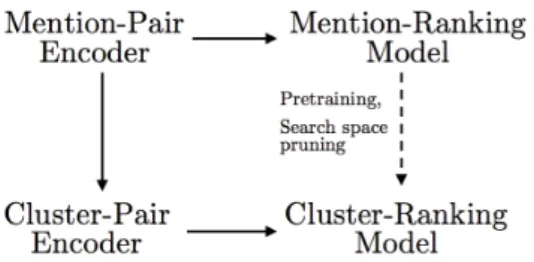
Our cluster-ranking model is a single neural net-work that learns which coreference cluster merges are desirable. However, it is helpful to think of the network as being composed of distinct com-ponents. Themention-pair encoderproduces dis-tributed representations for pairs of mentions by passing relevant features through a feedforward neural network. The cluster-pair encoder pro-duces distributed representations for pairs of clus-ters by applying a pooling operation over the rep-resentations of relevant mention pairs, i.e., pairs where one mention is in each cluster. The cluster-ranking model then scores pairs of clusters by passing their representations through a single neu-ral network layer.
We also train a mention-ranking model that scores pairs of mentions by passing their repre-sentations through a single neural network layer. Its parameters are used to initialize the cluster-ranking model, and the scores it produces are used to prune which candidate cluster merges the cluster-ranking model considers, allowing the cluster-ranking model to run much faster. The sys-tem architecture is summarized in Figure 1.
Figure 1: System architecture. Solid arrows indi-cate one neural network is used as a component of the other; the dashed arrow indicates other depen-dencies.
3 Building Representations
In this section, we describe the neural networks producing distributed representations of pairs of mentions and pairs of coreference clusters. We as-sume that a set of mentions has already been ex-tracted from each document using a method such as the one in Raghunathan et al. (2010).
Figure 2: Mention-pair encoder.
3.1 Mention-Pair Encoder
Given a mention m and candidate antecedent a, the mention-pair encoder produces a distributed representation of the pairrm(a, m) ∈ Rd with a
feedforward neural network, which is shown in Figure 2. The candidate antecedent may be any mention that occurs before m in the document or NA, indicating that m has no antecedent. We also experimented with models based on Long Short-Term Memory recurrent neural networks (Hochreiter and Schmidhuber, 1997), but found these to perform slightly worse when used in an end-to-end coreference system due to heavy overfitting to the training data.
Input Layer. For each mention, the model ex-tracts various words and groups of words that are fed into the neural network. Each word is represented by a vector wi ∈ Rdw. Each
group of words is represented by the average of the vectors of each word in the group. For each mention and pair of mentions, a small number of binary features and distance fea-tures are also extracted. Distances and men-tion lengths are binned into one of the buck-ets [0,1,2,3,4,5-7,8-15,16-31,32-63,64+] and then encoded in a one-hot vector in addition to be-ing included as continuous features. The full set of features is as follows:
Embedding Features: Word embeddings of the head word, dependency parent, first word, last word, two preceding words, and two following words of the mention. Averaged word embed-dings of the five preceding words, five following words, all words in the mention, all words in the mention’s sentence, and all words in the mention’s document.
mention (pronoun, nominal, proper, or list), men-tion posimen-tion (index of the menmen-tion divided by the number of mentions in the document), whether the mentions is contained in another mention, and length of the mention in words.
Document Genre: The genre of the mention’s doc-ument (broadcast news, newswire, web data, etc.). Distance Features: The distance between the men-tions in sentences, distance between the menmen-tions in intervening mentions, and whether the mentions overlap.
Speaker Features: Whether the mentions have the same speaker, whether one mention is the other mention’s speaker as determined by string match-ing rules from Raghunathan et al. (2010).
String Matching Features: Head match, exact string match, and partial string match.
The vectors for all of these features are concate-nated to produce anI-dimensional vectorh0, the
input to the neural network. If a = NA, the fea-tures defined over mention pairs are not included. For this case, we train a separate network with an identical architecture to the pair network except for the input layer to produce anaphoricity scores.
Hidden Layers. The input gets passed through three hidden layers of rectified linear (ReLU) units (Nair and Hinton, 2010). Each unit in a hidden layer is fully connected to the previous layer:
hi(a, m) = max(0,Wihi−1(a, m) +bi)
where W1 is a M1 ×I weight matrix, W2 is a
M2×M1matrix, andW3is ad×M2 matrix.
The output of the last hidden layer is the vector representation for the mention pair: rm(a, m) =h3(a, m).
3.2 Cluster-Pair Encoder
Given two clusters of mentions ci =
{mi1, mi2, ..., mi|c
i|}andcj ={m
j
1, m
j
2, ..., m
j
|cj|},
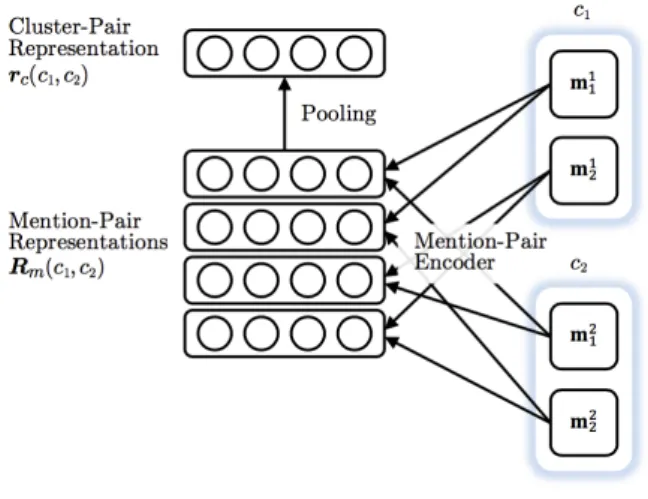
the cluster-pair encoder produces a distributed representationrc(ci, cj) ∈ R2d. The architecture
of the encoder is summarized in Figure 3.
The cluster-pair encoder first combines the information contained in the matrix of mention-pair representations Rm(ci, cj) =
[rm(mi1, m
j
1),rm(mi1, m
j
2), ...,rm(mi|ci|, m
j
|cj|)]
to producerc(ci, cj). This is done by applying a
Figure 3: Cluster-pair encoder.
pooling operation. In particular it concatenates the results of max-pooling and average-pooling, which we found to be slightly more effective than using either one alone:
rc(ci, cj)k = (max{Rm(ci, cj)k,·},
avg{Rm(ci, cj)k,·})
4 Mention-Ranking Model
Rather than training a cluster-ranking model from scratch, we first train a mention-ranking model that assigns each mention its highest scoring can-didate antecedent. There are two key advantages of doing this. First, it serves as pretraining for the cluster-ranking model; in particular the mention-ranking model learns effective weights for the mention-pair encoder. Second, the scores pro-duced by the mention-ranking model are used to provide a measure of which coreference decisions are easy (allowing for an easy-first clustering strat-egy) and which decisions are clearly wrong (these decisions can be pruned away, significantly reduc-ing the search space of the cluster-rankreduc-ing model). The mention-ranking model assigns a score sm(a, m) to a mention m and candidate
an-tecedent a representing their compatibility for coreference. This is produced by applying a sin-gle fully connected layer of size one to the repre-sentationrm(a, m)produced by the mention-pair
encoder:
sm(a, m) =Wmrm(a, m) +bm
whereWmis a1×dweight matrix. At test time,
the mention-ranking model links each mention with its highest scoring candidate antecedent.
Training Objective. We train the mention-ranking model with the slack-rescaled max-margin training objective from Wiseman et al. (2015), which encourages separation between the highest scoring true and false antecedents of the current mention. Suppose the training set consists of N mentions m1, m2, ..., mN. Let A(mi)
de-note the set of candidate antecedents of a men-tionmi(i.e., mentions precedingmiandNA), and
T(mi) denote the set of true antecedents of mi
(i.e., mentions preceding mi that are coreferent
with it or{NA}if mi has no antecedent). Lettˆi
be the highest scoring true antecedent of mention mi:
ˆ
ti = argmax t∈T(mi)
sm(t, mi)
Then the loss is given by
N
P
i=1
max
a∈A(mi)
∆(a, mi)(1 +sm(a, mi)−sm(ˆti, mi))
where∆(a, mi)is the mistake-specific cost
func-tion
∆(a, mi) =
αFN ifa=NA ∧ T(mi)6={NA}
αFA ifa6=NA ∧ T(mi) ={NA}
αWL ifa6=NA ∧a /∈ T(mi)
0 ifa∈ T(mi)
for “false new,” “false anaphoric,” “wrong link,” and correct coreference decisions. The different error penalties allow the system to be tuned for coreference evaluation metrics by biasing it towards making more or fewer coreference links.
Finding Effective Error Penalties. We fix αWL = 1.0 and search for αFA and αFN out of {0.1,0.2, ...,1.5} with a variant of grid search. Each new trial uses the unexplored set of hy-perparameters that has the closest Manhattan distance to the best setting found so far on the dev set. We stopped the search when all immediate neighbors (within 0.1 distance) of the best setting had been explored. We found (αFN, αFA, αWL) = (0.8,0.4,1.0) to be best for English and (αFN, αFA, αWL) = (0.7,0.4,1.0) to be best for Chinese on the CoNLL 2012 data. We attribute our smaller false new cost from the one used by Wiseman et al. (they setαFN = 1.2) to using more precise mention detection, which results in fewer links toNA.
Training Details. We initialized our word em-beddings with 50 dimensional ones produced by word2vec (Mikolov et al., 2013) on the Giga-word corpus for English and 64 dimensional ones provided by Polyglot (Al-Rfou et al., 2013) for Chinese. Averaged word embeddings were held fixed during training while the embeddings used for single words were updated. We set our hid-den layer sizes to M1 = 1000, M2 = d = 500
and minimized the training objective using RM-SProp (Hinton and Tieleman, 2012). To regularize the network, we applied L2 regularization to the model weights and dropout (Hinton et al., 2012) with a rate of 0.5 on the word embeddings and the output of each hidden layer of the mention-pair en-coder.
Pretraining. As in Wiseman et al. (2015), we found that pretraining is crucial for the mention-ranking model’s success. We pretrain the network in two stages, minimizing the following objectives from Clark and Manning (2015):
All Pairs Classification −
N P i=1
[ P t∈T(mi)
logp(t, mi) + P f∈F(mi)
log(1−p(f, mi))]
Top Pairs Classification −
N P i=1
[ max
t∈T(mi)
logp(t, mi) + min f∈F(mi)
log(1−p(f, mi))]
WhereF(mi)is the set of false antecedents formi
andp(a, mi) = sigmoid(s(a, mi)). The top pairs
objective is a middle ground between the all pairs classification and mention ranking objectives: it only processes high-scoring mentions, but is prob-abilistic rather than max-margin. We first pre-trained the network with all pairs classification for 150 epochs and then with top pairs classification for 50 epochs. See Section 6.1 for experiments on the two-stage pretraining.
5 Cluster-Ranking Model
Although a strong coreference system on its own, the mention-ranking model has the disadvantage of only considering local information between pairs of mentions, so it cannot consolidate infor-mation at the entity-level. We address this prob-lem by training a cluster-ranking model that scores pairs of clusters instead of pairs of mentions.
Given two clusters of mentions ci and cj, the
representing their compatibility for coreference. This is produced by applying a single fully con-nected layer of size one to the representation rc(ci, cj)produced by the cluster-pair encoder:
sc(ci, cj) =Wcrc(ci, cj) +bc
where Wc is a 1 × 2d weight matrix. Our
cluster-ranking approach also uses a measure of anaphoricity, or how likely it is for a mentionmto have an antecedent. This is defined as
sNA(m) =WNArm(NA, m) +bNA
whereWNAis a1×dmatrix.
5.1 Cluster-Ranking Policy Network
At test time, the cluster ranker iterates through ev-ery mention in the document, merging the current mention’s cluster with a preceding one or perform-ing no action. We view this procedure as a sequen-tial decision process where at each step the algo-rithm observes the current state x and performs some actionu.
Specifically, we define a state x = (C, m) to consist of C = {c1, c2, ...}, the set of existing
coreference clusters, andm, the current mention being considered. At a start state, each cluster in C contains a single mention. Letcm ∈ C be the
cluster containingmandA(m)be a set of candi-date antecedents form: mentions occurring previ-ously in the document. Then the available actions U(x)fromxare
• MERGE[cm, c], wherec is a cluster
contain-ing a mention inA(m). This combinescm
andcinto a single coreference cluster. • PASS. This leaves the clustering unchanged. After determining the new clusteringC0based on the existing clustering C and action u, we con-sider another mention m0 to get the next state x0 = (C0, m0).
Using the scoring functions scandsNA, we de-fine a policy networkπ that assigns a probability distribution overU(x)as follows:
π(MERGE[cm, c]|x)∝esc(cm,c)
π(PASS|x)∝esNA(m)
During inference, we execute π by taking the highest-scoring (most probable) action at each step.
5.2 Easy-First Cluster Ranking
The last detail needed is the ordering in which to consider mentions. Cluster-ranking models in prior work order the mentions according to their positions in the document, processing them left-to-right (Rahman and Ng, 2011; Ma et al., 2014). However, we instead sort the mentions in de-scending order by their highest scoring candidate coreference link according to the mention-ranking model. This causes inference to occur in an easy-first fashion where hard decisions are delayed until more information is available. Easy-first orderings have been shown to improve the performance of other incremental coreference strategies (Raghu-nathan et al., 2010; Stoyanov and Eisner, 2012) because they reduce the problem of errors com-pounding as the algorithm runs.
We also find it beneficial to prune the set of candidate antecedentsA(m)for each mentionm. Rather than using all previously occurring men-tions as candidate antecedents, we only include high-scoring ones, which greatly reduces the size of the search space. This allows for much faster learning and inference; we are able to remove over 95% of candidate actions with no decrease in the model’s performance. For both of these two pre-processing steps, we use s(a, m) −s(NA, m) as the score of a coreference link betweenaandm.
5.3 Deep Learning to Search
We face a sequential prediction problem where fu-ture observations (visited states) depend on previ-ous actions. This is challenging because it violates the common i.i.d. assumption made in machine learning. Learning to search algorithms are effec-tive for this sort of problem, and have been applied successfully to coreference resolution (Daum´e III and Marcu, 2005; Clark and Manning, 2015) as well as other structured prediction tasks in natu-ral language processing (Daum´e III et al., 2014; Chang et al., 2015a).
We train the cluster-ranking model using a learning to search algorithm inspired by SEARN (Daum´e III et al., 2009), which is described in Al-gorithm 1. The alAl-gorithm takes as input a dataset D of start states x (in our case documents with each mention in its own singleton coreference cluster) and structured labels y (in our case gold coreference clusters). Its goal is to train the pol-icy π so when it executes from x, reaching a fi-nal statee, the resulting lossL(e, y)is small. We
Algorithm 1Deep Learning to Search
fori= 1tonum epochsdo
Initialize the current training setΓ =∅
for eachexample(x, y)∈ Ddo
Run the policyπto completion from start statexto obtain a trajectory of states{x1, x2, ..., xn}
for eachstatexi in the trajectorydo
for eachpossible actionu∈U(xi)do
Executeuonxi and then run the reference policyπrefuntil reaching an end statee
Assignua cost by computing the loss on the end state:l(u) =L(e, y)
end for
Add the statexiand associated costsltoΓ
end for end for
Updateπwith one epoch of batch gradient descent, minimizing P (x,l)∈Γ
P
u∈U(x)
π(u|x)l(u)
end for
use the negative of the B3 coreference metric for this loss (Bagga and Baldwin, 1998). Although our system evaluation also includes the MUC (Vi-lain et al., 1995) and CEAFφ4(Luo, 2005) metrics, we do not incorporate them into the loss because MUC has the flaw of treating all errors equally and CEAFφ4 is slow to compute.
For each example(x, y)∈ D, the algorithm ob-tains a trajectory of statesx1, x2, ..., xnvisited by
the current policy by running it to completion (i.e., repeatedly taking the highest scoring action until reaching an end state) from the start statex. This exposes the model to states at train time similar to the ones it will face at test time, allowing it to learn how to cope with mistakes.
Given a state x in a trajectory, the algorithm then assigns a costl(u) to each actionu ∈ U(x) by executing the action, “rolling out” from the resulting state with a reference policy πref until
reaching an end statee, and computing the result-ing lossL(e, y). This rolling out procedure allows the model to learn how a local action will affect the final score, which cannot be otherwise computed because coreference evaluation metrics do not de-compose over cluster merges. The policy network is then trained to minimize the risk associated with taking each action:P
u∈U(x)π(u|x)l(u).
Reference policies typically refer to the gold la-bels to find actions that are likely to be beneficial. Our reference policyπref takes the action that in-creases the B3score the most each step, breaking ties randomly. It is generally recommended to use a stochastic mixture of the reference policy and the current learned policy during rollouts
when the reference policy is not optimal (Chang et al., 2015b). However, we find only using the reference policy (which is close to optimal) to be much more efficient because it does not require neural network computations and is deterministic, which means the costs of actions can be cached.
Training details. We update π using RMSProp and apply dropout to the mention-pair encoder as when training the mention-ranking model. For most experiments, we initialize the mention-pair encoder component of the cluster-ranking model with the learned weights from the mention-ranking model, which we find to greatly improve performance (see Section 6.2).
Runtime.The cluster-ranking model runs end-to-end slightly under 1 second per document on the English test set when using a GPU. This means the bottleneck for the overall system is the syntax parsing required for mention detection (∼4 sec-onds per document for the English test set). 6 Experiments and Results
Experimental Setup. We run experiments on the English and Chinese portions of the CoNLL 2012 Shared Task data (Pradhan et al., 2012), which is derived from the OntoNotes corpus (Hovy et al., 2006). The models are evaluated using three of the most popular metrics for coreference resolution: MUC , B3, and Entity-based CEAFE (CEAFφ4). We generally report the average F1 score (CoNLLF1) of the three, which is common
All Pairs Top Pairs CoNLL F1
No No 61.41
Yes No 65.23
No Yes 65.01
Yes Yes 65.58
Table 1: CoNLL F1scores of the mention-ranking
model on the English dev set with different pre-taining methods.
most recent version of the CoNLL scorer (version 8.01), which implements the original definitions of the metrics.
Mention Detection. Our experiments were run using system-produced predicted mentions. We used the rule-based mention detection algorithm from Raghunathan et al. (2010), which first extracts pronouns and maximal NP projections as candidate mentions and then filters this set with rules that remove spurious mentions such as numeric entities and pleonasticitpronouns.
6.1 Mention-Ranking Model Experiments The Importance of Pretraining.We evaluate the benefit of the two-step pretraining for the mention-ranking model and report results in Table 1.
Consistent with Wiseman et al. (2015), we find pretraining to be greaty improve the model’s accu-racy. We note in particular that the model benefits from using both pretraining steps from section 4, which more smoothly transitions the model from a mention pair classification objective that is easy to optimize to a max-margin objective better suited for a ranking task.
6.2 Cluster-Ranking Model Experiments
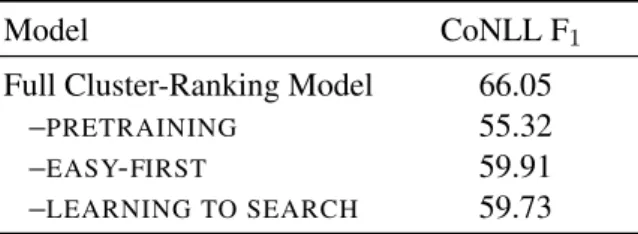
We evaluate the importance of three key details of the cluster-ranker’s training algorithm: initializing it with the mention-ranking model’s weights, us-ing an easy-first orderus-ing of mentions, and usus-ing learning-to-search. The results are shown in Ta-ble 2.
Pretrained Weights. We compare using a ran-dom initialization to using the weights learned by mention-ranking model to initialize the cluster-ranking model’s mention-pair encoder. Using pretrained weights significantly improves perfor-mance. We believe the cluster-ranking model has
Model CoNLL F1
Full Cluster-Ranking Model 66.05 –PRETRAINING 55.32 –EASY-FIRST 59.91 –LEARNING TO SEARCH 59.73 Table 2: CoNLL F1 scores of the cluster-ranking
model on the English dev set with various abla-tions. –PRETRAINING: initializing model parame-ters randomly instead of from the mention-ranking model, –EASY-FIRST: iterating through mentions in order of occurrence instead of according to their highest scoring candidate coreference link, – LEARNING-TO-SEARCH: training on a fixed tra-jectory of correct actions instead of using learning to search.
difficulty learning effective weights from scratch due to noise in the signal coming from cluster-level decisions (an overall bad cluster merge may still involve a few correct pairwise links) and the smaller amount of data used to train the cluster-ranking model (many possible actions are pruned away during preprocessing). We believe the score would be even lower without search-space prun-ing, which stops the model from considering many bad actions.
Easy-First Cluster Ranking.We compare the ef-fectiveness of easy-first cluster-ranking with the commonly used left-to-right approach. Using a left-to-right strategy simply requires changing the preprocessing step ordering the mentions so men-tions are sorted by their position in the document instead of their highest scoring coreference link according to the mention-ranking model. We find the easy-first approach slightly outperforms us-ing a left-to-right orderus-ing of mentions. We be-lieve this is because delaying hard decisions until later reduces the problem of early mistakes caus-ing later decisions to be made incorrectly.
Learning to Search.We also compare learning to search with the simpler approach of training the model on a trajectory of gold coreference deci-sions (i.e., training on a fixed cost-sensitive clas-sification dataset). Using this approach signifi-cantly decreases performance. We attribute this to the model not learning how to deal with mistakes when it only sees correct decisions during training.
Antecedent Anaphor the country’s leftist rebels the guerrillas the company the New York firm the suicide bombing the attack
the gun the rifle
the U.S. carrier the ship
Table 3: Examples of nominal coreferences with no head match that the neural model gets correct, but the Stanford statistical system gets incorrect.
6.3 Capturing Semantic Similarity
Using semantic information to improve corefer-ence accuracy has had mixed in results in previous research, and has been called an “uphill battle” in coreference resolution (Durrett and Klein, 2013). However, word embeddings are well known for being effective at capturing semantic relatedness, and we show here that neural network coreference models can take advantage of this.
Perhaps the case where semantic similarity is most important is in linking nominals with no head match (e.g., “the nation” and “the country”). We compare the performance of our neural network model with the Stanford statistical system (Clark and Manning, 2015) at classifying mention pairs of this type as being coreferent or not. The neu-ral network shows substantial improvement (0.189 F1 vs. 0.107 F1) on this task compared to the
more modest improvement it gets at classifying any pair of mentions as coreferent (0.687F1 vs.
0.661F1). Some example wins are shown in
Ta-ble 3. These types of coreference links are quite rare in the CoNLL data (about 1.2% of the positive coreference links in the test set), so the improve-ment does not significantly contribute to the final system’s score, but it does suggest progress on this difficult type of coreference problem.
6.4 Final System Performance
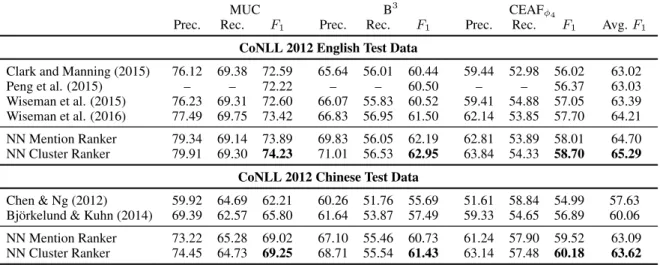
In Table 4 we compare the results of our sys-tem with state-of-the-art approaches for English and Chinese. Our mention-ranking models sur-passes all previous systems, including the neu-ral mention-ranking model from Wiseman et al. (2015). We attribute its improvement over the neu-ral mention ranker from Wiseman et al. to it using a deeper network, pretrained word embeddings, and more sophisticated pretraining.
The cluster-ranking model substantially
im-proves results further across both languages and all evaluation metrics. The improvement is largest with B3, which is unsurprising as this is used as the loss function during training. Interestingly, the gains come more from an increase in preci-sion rather than recall. We believe this is be-cause entity-level information is particularly use-ful for preventing bad merges between large clus-ters, which is very damaging to precision. See Fig-ure 4 for an example.
7 Related Work
There has been extensive work on machine learn-ing approaches to coreference resolution (Soon et al., 2001; Ng and Cardie, 2002), with mention-ranking models being particularly popular (Denis and Baldridge, 2007; Rahman and Ng, 2009). As in our mention-ranking model, many of these view each mention has having a single latent antecedent (Fernandes et al., 2012; Durrett and Klein, 2013; Bj¨orkelund and Kuhn, 2014; Martschat and Strube, 2015).
These systems typically use complex highly en-gineered features to capture relevant syntactic, se-mantic, and discourse-level information (Bengt-son and Roth, 2008; Stoyanov et al., 2010). In contrast, this work uses a much smaller feature set, instead relying on distributed word representations to inform the model.
In the same vein, Wiseman et al. (2015) present a neural-network-based mention-ranking model requiring little feature engineering. We train a similar neural mention-ranking model as a start-ing point, but use it to pretrain a cluster-rankstart-ing model that benefits from entity-level information.
In a following work Wiseman et al. (2016) extend their mention-ranking model by incorpo-rating entity-level information produced by a re-current neural network running over the candi-date antecedent-cluster. This is an augmentation to a mention-mention decision, however, and not fundamentally a clustering model as our cluster-ranker is.
Entity-level information has also been incor-porated in coreference systems using joint infer-ence (McCallum and Wellner, 2003; Poon and Domingos, 2008; Haghighi and Klein, 2010) and systems that build up coreference clusters incre-mentally (Luo et al., 2004; Yang et al., 2008; Raghunathan et al., 2010). For such systems, entity-level information is expressed in the form
MUC B3 CEAF φ4
Prec. Rec. F1 Prec. Rec. F1 Prec. Rec. F1 Avg.F1 CoNLL 2012 English Test Data
Clark and Manning (2015) 76.12 69.38 72.59 65.64 56.01 60.44 59.44 52.98 56.02 63.02 Peng et al. (2015) – – 72.22 – – 60.50 – – 56.37 63.03 Wiseman et al. (2015) 76.23 69.31 72.60 66.07 55.83 60.52 59.41 54.88 57.05 63.39 Wiseman et al. (2016) 77.49 69.75 73.42 66.83 56.95 61.50 62.14 53.85 57.70 64.21 NN Mention Ranker 79.34 69.14 73.89 69.83 56.05 62.19 62.81 53.89 58.01 64.70 NN Cluster Ranker 79.91 69.30 74.23 71.01 56.53 62.95 63.84 54.33 58.70 65.29
CoNLL 2012 Chinese Test Data
Chen & Ng (2012) 59.92 64.69 62.21 60.26 51.76 55.69 51.61 58.84 54.99 57.63 Bj¨orkelund & Kuhn (2014) 69.39 62.57 65.80 61.64 53.87 57.49 59.33 54.65 56.89 60.06 NN Mention Ranker 73.22 65.28 69.02 67.10 55.46 60.73 61.24 57.90 59.52 63.09 NN Cluster Ranker 74.45 64.73 69.25 68.71 55.54 61.43 63.14 57.48 60.18 63.62
Table 4: Comparison with the current state-of-the-art approaches on the CoNLL 2012 test sets. NN Mention Ranker and NN Cluster Ranker are contributions of this work.
Figure 4: Thanks to entity-level information, the cluster-ranking model correctly declines to merge these two large clusters (containing 8 and 5 mentions respectively) when running on the test set. However, the mention-ranking model incorrectly links the Russian PresidentandPresident Clinton’s, which greatly reduces the final precision score.
of hand-engineered features and constraints. In contrast, the coreference system presented in this work uses entity-level distributed representations that are learned from data, which both provide a more expressive representation and reduces the amount of human engineering required.
Prior work on incremental coreference algo-rithms have taken two main approaches: iterat-ing through mentions left-to-right and assigniterat-ing the current mention to a previous cluster each step (Luo et al., 2004; Yang et al., 2008; Ma et al., 2014), or by making more confident cluster merges earlier (Stoyanov and Eisner, 2012; Clark and Manning, 2015). Our work combines the ad-vantages of these two approaches with an easy-first cluster-ranking approach to coreference.
We train our system using a deep learning to search algorithm similar to SEARN (Daum´e III et al., 2009). Learning to search style algorithms have been employed to train coreference resolvers on trajectories of decisions similar to those that would be seen at test-time by Daum´e et al. (2005), Ma et al. (2014), and Clark and Manning (2015). Other works use structured perceptron models for the same purpose (Stoyanov and Eisner, 2012;
Fernandes et al., 2012; Bj¨orkelund and Kuhn, 2014).
8 Conclusion
We have presented a coreference system that cap-tures entity-level information with distributed rep-resentations of coreference cluster pairs. These learned, dense, high-dimensional feature vectors provide our cluster ranking coreference model with a strong ability to distinguish beneficial clus-ter merges from harmful ones. The model is trained with a learning to search algorithm that allows it to learn how local decisions will affect the final coreference score. We evaluate our sys-tem on the English and Chinese portions of the CoNLL 2012 Shared Task and report a substantial improvement over the current state-of-the-art.
References
[Al-Rfou et al.2013] Rami Al-Rfou, Bryan Perozzi, and Steven Skiena. 2013. Polyglot: Distributed word representations for multilingual nlp. Conference on Natural Language Learning (CoNLL), pages 183– 192.
[Bagga and Baldwin1998] Amit Bagga and Breck Baldwin. 1998. Algorithms for scoring coreference chains. In The First International Conference on Language Resources and Evaluation Workshop on Linguistics Coreference, pages 563–566.
[Bengtson and Roth2008] Eric Bengtson and Dan Roth. 2008. Understanding the value of features for coref-erence resolution. InEmpirical Methods in Natural Language Processing (EMNLP), pages 294–303. [Bj¨orkelund and Kuhn2014] Anders Bj¨orkelund and
Jonas Kuhn. 2014. Learning structured perceptrons for coreference resolution with latent antecedents and non-local features. In Association of Compu-tational Linguistics (ACL).
[Chang et al.2015a] Kai-Wei Chang, He He, Hal Daum´e III, and John Langford. 2015a. Learn-ing to search for dependencies. arXiv preprint arXiv:1503.05615.
[Chang et al.2015b] Kai-Wei Chang, Akshay Krishna-murthy, Alekh Agarwal, Hal Daum´e III, and John Langford. 2015b. Learning to search better than your teacher. In International Conference on Ma-chine Learning (ICML).
[Chen and Ng2012] Chen Chen and Vincent Ng. 2012. Combining the best of two worlds: A hybrid ap-proach to multilingual coreference resolution. In
Proceedings of the Joint Conference on Empirical Methods in Natural Language Processing and Con-ference on Computational Natural Language Learn-ing - Shared Task, pages 56–63.
[Clark and Manning2015] Kevin Clark and Christo-pher D. Manning. 2015. Entity-centric coreference resolution with model stacking. InAssociation for Computational Linguistics (ACL).
[Daum´e III and Marcu2005] Hal Daum´e III and Daniel Marcu. 2005. A large-scale exploration of effec-tive global features for a joint entity detection and tracking model. In Empirical Methods in Natural Language Processing (EMNLP), pages 97–104. [Daum´e III et al.2009] Hal Daum´e III, John Langford,
and Daniel Marcu. 2009. Search-based structured prediction. Machine Learning, 75(3):297–325. [Daum´e III et al.2014] Hal Daum´e III, John Langford,
and Stephane Ross. 2014. Efficient programmable learning to search. arXiv preprint arXiv:1406.1837. [Denis and Baldridge2007] Pascal Denis and Jason Baldridge. 2007. A ranking approach to pronoun resolution. In International Joint Conferences on Artificial Intelligence (IJCAI), pages 1588–1593. [Durrett and Klein2013] Greg Durrett and Dan Klein.
2013. Easy victories and uphill battles in corefer-ence resolution. In Empirical Methods in Natural Language Processing (EMNLP), pages 1971–1982.
[Durrett et al.2013] Greg Durrett, David Leo Wright Hall, and Dan Klein. 2013. Decentralized entity-level modeling for coreference resolution. In Asso-ciation for Computational Linguistics (ACL), pages 114–124.
[Fernandes et al.2012] Eraldo Rezende Fernandes, C´ıcero Nogueira Dos Santos, and Ruy Luiz Milidi´u. 2012. Latent structure perceptron with feature induction for unrestricted coreference resolution. In
Proceedings of the Joint Conference on Empirical Methods in Natural Language Processing and Conference on Computational Natural Language Learning - Shared Task, pages 41–48.
[Haghighi and Klein2010] Aria Haghighi and Dan Klein. 2010. Coreference resolution in a modu-lar, entity-centered model. In Human Language Technology and North American Association for Computational Linguistics (HLT-NAACL), pages 385–393.
[Hinton and Tieleman2012] Geoffrey Hinton and Tij-men Tieleman. 2012. Lecture 6.5-RmsProp: Divide the gradient by a running average of its recent mag-nitude. COURSERA: Neural Networks for Machine Learning, 4.
[Hinton et al.2012] Geoffrey E Hinton, Nitish Srivas-tava, Alex Krizhevsky, Ilya Sutskever, and Rus-lan R Salakhutdinov. 2012. Improving neural net-works by preventing co-adaptation of feature detec-tors. arXiv preprint arXiv:1207.0580.
[Hochreiter and Schmidhuber1997] Sepp Hochreiter and J¨urgen Schmidhuber. 1997. Long short-term memory.Neural computation, 9(8):1735–1780. [Hovy et al.2006] Eduard Hovy, Mitchell Marcus,
Martha Palmer, Lance Ramshaw, and Ralph
Weischedel. 2006. Ontonotes: the 90% solution. In Human Language Technology and North Amer-ican Association for Computational Linguistics (HLT-NAACL), pages 57–60.
[Luo et al.2004] Xiaoqiang Luo, Abe Ittycheriah,
Hongyan Jing, Nanda Kambhatla, and Salim
Roukos. 2004. A mention-synchronous coreference resolution algorithm based on the bell tree. In
Association for Computational Linguistics (ACL), page 135.
[Luo2005] Xiaoqiang Luo. 2005. On coreference reso-lution performance metrics. InEmpirical Methods in Natural Language Processing (EMNLP), pages 25–32.
[Ma et al.2014] Chao Ma, Janardhan Rao Doppa, J Walker Orr, Prashanth Mannem, Xiaoli Fern, Tom Dietterich, and Prasad Tadepalli. 2014. Prune-and-score: Learning for greedy coreference resolution. InEmpirical Methods in Natural Language Process-ing (EMNLP).
[Martschat and Strube2015] Sebastian Martschat and Michael Strube. 2015. Latent structures for corefer-ence resolution. Transactions of the Association for Computational Linguistics (TACL), 3:405–418. [McCallum and Wellner2003] Andrew McCallum and
Ben Wellner. 2003. Toward conditional models of identity uncertainty with application to proper noun coreference. InProceedings of the IJCAI Workshop on Information Integration on the Web.
[Mikolov et al.2013] Tomas Mikolov, Ilya Sutskever, Kai Chen, Greg S Corrado, and Jeff Dean. 2013. Distributed representations of words and phrases and their compositionality. In Advances in Neu-ral Information Processing Systems (NIPS), pages 3111–3119.
[Nair and Hinton2010] Vinod Nair and Geoffrey E. Hinton. 2010. Rectified linear units improve re-stricted boltzmann machines. InInternational Con-ference on Machine Learning (ICML), pages 807– 814.
[Ng and Cardie2002] Vincent Ng and Claire Cardie. 2002. Improving machine learning approaches to coreference resolution. InAssociation of Computa-tional Linguistics (ACL), pages 104–111.
[Peng et al.2015] Haoruo Peng, Kai-Wei Chang, and Dan Roth. 2015. A joint framework for coreference resolution and mention head detection. Conference on Natural Language Learning (CoNLL), 51:12. [Poon and Domingos2008] Hoifung Poon and Pedro
Domingos. 2008. Joint unsupervised coreference resolution with markov logic. InEmpirical Methods in Natural Language Processing (EMNLP), pages 650–659.
[Pradhan et al.2012] Sameer Pradhan, Alessandro Mos-chitti, Nianwen Xue, Olga Uryupina, and Yuchen Zhang. 2012. Conll-2012 shared task: Modeling multilingual unrestricted coreference in ontonotes. InProceedings of the Joint Conference on Empirical Methods in Natural Language Processing and Con-ference on Computational Natural Language Learn-ing - Shared Task, pages 1–40.
[Raghunathan et al.2010] Karthik Raghunathan, Heey-oung Lee, Sudarshan Rangarajan, Nathanael Cham-bers, Mihai Surdeanu, Dan Jurafsky, and Christo-pher Manning. 2010. A multi-pass sieve for coref-erence resolution. InEmpirical Methods in Natural Language Processing (EMNLP), pages 492–501. [Rahman and Ng2009] Altaf Rahman and Vincent Ng.
2009. Supervised models for coreference resolution. InEmpirical Methods in Natural Language Process-ing (EMNLP), pages 968–977.
[Rahman and Ng2011] Altaf Rahman and Vincent Ng. 2011. Narrowing the modeling gap: a cluster-ranking approach to coreference resolution. Jour-nal of Artificial Intelligence Research (JAIR), pages 469–521.
[Soon et al.2001] Wee Meng Soon, Hwee Tou Ng, and Daniel Chung Yong Lim. 2001. A machine learning approach to coreference resolution of noun phrases.
Computational Linguistics, 27(4):521–544.
[Stoyanov and Eisner2012] Veselin Stoyanov and Jason Eisner. 2012. Easy-first coreference resolution. In
COLING, pages 2519–2534.
[Stoyanov et al.2010] Veselin Stoyanov, Claire Cardie, Nathan Gilbert, Ellen Riloff, David Buttler, and David Hysom. 2010. Reconcile: A coreference res-olution research platform. Computer Science Tech-nical Report, Cornell University, Ithaca, NY. [Vilain et al.1995] Marc Vilain, John Burger, John
Ab-erdeen, Dennis Connolly, and Lynette Hirschman. 1995. A model-theoretic coreference scoring scheme. In Proceedings of the 6th conference on Message understanding, pages 45–52.
[Wiseman et al.2015] Sam Wiseman, Alexander M Rush, Stuart M Shieber, and Jason Weston. 2015. Learning anaphoricity and antecedent ranking fea-tures for coreference resolution. In Association of Computational Linguistics (ACL), pages 92–100. [Yang et al.2008] Xiaofeng Yang, Jian Su, Jun Lang,
Chew Lim Tan, Ting Liu, and Sheng Li. 2008. An entity-mention model for coreference resolution with inductive logic programming. InAssociation of Computational Linguistics (ACL), pages 843–851.