Chapter 14
The General Addition Rule
When two events A and B are disjoint, we can
use the addition rule for disjoint events from Chapter 13:
However, when our events are not disjoint, this
earlier addition rule will double count the
probability of both A and B occurring. Thus, we need the General Addition Rule.
Let’s look at a picture…
The General Addition Rule (cont.)
General Addition Rule:
For any two events A and B,
The following Venn diagram shows a situation in
which we would use the general addition rule:
Example: Traffic Stops
Police report that 78% of drivers stopped on
suspicion of drunk driving are given a breath test, 36% a blood test, and 22% both tests.
What is the probability that a randomly selected DWI suspect is given:
a. A test?
b. A blood test or a breath test, but not both?
c. Neither test?
Example continued….
1. Draw a picture (Venn Diagram)
2. Figure out what you want to know in words.
3. Translate words to equations.
Example continued….
What is the probability that the suspect is given a
test? P(A or B)=P(A) + P(B) – P(A∩B) = .92
What is the probability that the suspect gets either
a blood test or a breath test but NOT both?
P(A and not B or B and not A)=P(A)P(not B) + P(B)P(not A) = .70
What is the probability that the suspect gets
neither test?
P(neither test) = 1 – P(either test) = 1 – P(A or B)
= 1 – .92 = 0.08
Example
Two psychologists surveyed 478 children in grades 4, 5, and 6 in elementary
schools in Michigan. They stratified their sample, drawing one third each from rural, suburban, and urban schools. They asked the students whether their primary goal was to get good grades, to be popular, or to be good at sports. The results are shown in the table below.
1. What is the probability of randomly picking a girl?
2. What is the probability of randomly picking a student whose goal is to be
popular?
3. What is the probability of picking a student who is a boy and wants to be good
Grades Popular Sports
Boy 117 50 60
It Depends…
Back in Chapter 3, we looked at contingency
tables and talked about conditional distributions.
When we want the probability of an event from a
conditional distribution, we write P(B|A) and pronounce it “the probability of B given A.”
A probability that takes into account a given
It Depends… (cont.)
To find the probability of the event B given the
event A, we restrict our attention to the outcomes in A. We then find the fraction of those outcomes B that also occurred.
Note: P(A) cannot equal 0, since we know that A
has occurred.
P
(
B
|
A
)
P
(
A
B
)
Example: Girls and Sports
In a recent study it was found that the probability that a randomly selected student is a girl is .51 and is a girl and plays sports is .10. If the student is female, what is the probability that she plays sports? 1961 . 51 . 1 . P(F) F) P(S F) |
Example: Boys and Sports
The probability that a randomly selected
student plays sports if they are male is .31. What is the probability that the student is male and plays sports if the probability that they are male is .49?
49 . 31 . P(M)
M) P(S
M) |
Probabilities from two way tables
StuStaff Total American 107105212 European 33 12 45 Asian 55 47 102 Total 195164359
1) What is the probability that the driver is a
student?
Probabilities from two way tables
StuStaff Total American 107105212 European 33 12 45 Asian 55 47 102 Total 195164359
2) What is the probability that the driver drives a
European car?
45 )
(European
Probabilities from two way tables
StuStaff Total American 107105212 European 33 12 45 Asian 55 47 102 Total 195164359
3) What is the probability that the driver drives an
American or Asian car?
Disjoint?
102212 )
(American or Asian
Probabilities from two way tables
StuStaff Total American 107105212 European 33 12 45 Asian 55 47 102 Total 195164359
4) What is the probability that the driver is staff or
drives an Asian car?
Disjoint?
47102 164
)
Probabilities from two way tables
StuStaff Total American 107105212 European 33 12 45 Asian 55 47 102 Total 195164359
5) What is the probability that the driver is staff
and drives an Asian car?
47 )
Probabilities from two way tables
StuStaff Total American 107105212 European 33 12 45 Asian 55 47 102 Total 195164359
6) If the driver is a student, what is the probability
that they drive an American car?
Condition
) 107 |(American Student
Probabilities from two way tables
StuStaff Total American 107105212 European 33 12 45 Asian 55 47 102 Total 195164359
7) What is the probability that the driver is a
student if the driver drives a European car?
33 )
|
(Student European
Example: Conditional Probability
After School Activities
At George Washing HS, after school activities can be
classified into three types: athletic, fine arts, and other. The following table gives the number of students
participating in these types of activities by grade:
9th 10th 11th 12th Total
Athletics 150 160 140 150 600
Fine Arts 100 90 120 125 435
Other 125 140 150 150 565
Example continued…
Is it true from the table that:
There are 160 10th graders participating in
athletic?
The number of senior participating in fine arts
activities is 125?
There are 435 students in fine arts activities?
GWHS has 410 juniors?
Example continued…
What is the probability that a randomly selected student is
a senior athlete? P(senior athlete)=
What is the probability that the selected student is an
athlete, given that the student is a senior? P(athlete|senior)= 09375 . 1600 150 students of number total athletes senior of number 3529 . 425 150 seniors of number total athletes senior of number
(A and B)
( | )
P
Example: GFI Switches
A GFI (ground fault interrupt) switch turns off power to a system in the event of an electrical malfunction. A spa manufacturer currently has 25 spas in stock, each equipped with a single GFI switch. Two
different companies supply the switches and some of the switches are defective as summarized in the table:
Nondefective Defective Total
Company 1 10 5 15
Company 2 8 2 10
Example continued…
Given:
E = event that GFI switch in selected spa is from company 1
D = event that GFI switch in selected spa is defective
Find:
P(E) P(D)
Example continued…
P(E)=15/25 = .6 P(D) = 7/25 = .28
P(E and D) = P(E∩D) = 5/25 = .2
Now suppose that testing reveals a defective switch. How likely is it that the switch came from the first company? P(company 1 given defective switch)=P(E|D)
=5/7 = .714
The General Multiplication Rule
When two events A and B are independent, we
can use the multiplication rule for independent events from Chapter 14:
However, when our events are not independent,
this earlier multiplication rule does not work. Thus, we need the General Multiplication Rule.
The General Multiplication Rule (cont.)
We encountered the general multiplication rule in
the form of conditional probability.
Rearranging the equation in the definition for
conditional probability, we get the General Multiplication Rule:
For any two events A and B,
or
P(A B) P(A) P(B | A)
Independence
Independence of two events means that the
outcome of one event does not influence the probability of the other.
With our new notation for conditional
probabilities, we can now formalize this definition:
Events A and B are independent whenever
Sock Example
In your sock drawer, you know for sure that you have 4 white socks and 4 black socks.
Independent: What is the probability of picking a white sock and then a black in a row with
replacement?
Independent ≠ Disjoint
Disjoint events cannot be independent! Well, why not?
Since we know that disjoint events have no outcomes
in common, knowing that one occurred means the other didn’t.
Thus, the probability of the second occurring changed
based on our knowledge that the first occurred.
It follows, then, that the two events are not
independent.
A common error is to treat disjoint events as if they were
Depending on Independence
It’s much easier to think about independent
events than to deal with conditional probabilities.
It seems that most people’s natural intuition for
probabilities breaks down when it comes to conditional probabilities.
Don’t fall into this trap: whenever you see
Drawing Without Replacement
Sampling without replacement means that once one
individual is drawn it doesn’t go back into the pool.
We often sample without replacement, which doesn’t
matter too much when we are dealing with a large population.
However, when drawing from a small population, we
need to take note and adjust probabilities accordingly.
Drawing without replacement is just another instance of
Tree Diagrams
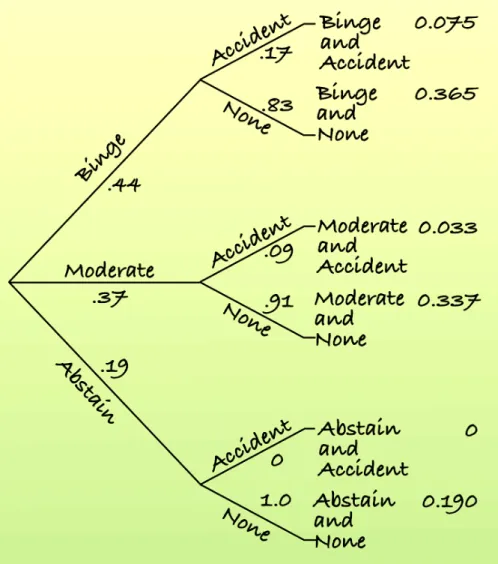
A tree diagram helps us think through conditional
probabilities by showing sequences of events as paths that look like branches of a tree.
Making a tree diagram for situations with
Tree Diagram Example
Best Buy sells two varieties of DVD players. They calculate that 70% of their customers purchase the Sony model and 30% purchase the Samsung brand. Of those who purchase the Sony brand, 20% buy the extended warranty. Of the
customers who buy the Samsung player, 40% buy the extended warranty.
a. What is the probability that a customer buys a Sony and
no extended warranty?
b. What is the probability that a customer buys a Samsung
and extended warranty?
c. What is the probability that a customer buys the
Tree Diagrams (cont.)
This figure is a nice
example of a tree
diagram and shows how we multiply the
probabilities of the branches together.
All the final outcomes
are disjoint and must add up to one.
We can add the final
Example:
Management has determined that customers return
12% of the items assembled by inexperienced
employees, whereas only 3% of the items assembled
by experienced employees are returned. Due to
turnover and absenteeism at an assembly plant,
inexperienced employees assemble 20% of the items.
Construct a tree diagram or a chart for this data.
What is the probability that an item is returned?
If an item is returned, what is the probability that an
P(returned) = 4.8/100 = 0.048
Returned Not
returned Total
Experienced 2.4 77.6 80
Inexperienced 2.4 17.6 20
Reversing the Conditioning
Reversing the conditioning of two events is rarely intuitive. Suppose we want to know P(A|B), and we know only
P(A), P(B), and P(B|A).
We also know , since
From this information, we can find P(A|B):
P
(A|B)
P
(A
B)
P
(B)
P(A B) P(A) P(B | A)
What Can Go Wrong?
Don’t use a simple probability rule where a
general rule is appropriate:
Don’t assume that two events are independent
or disjoint without checking that they are.
Don’t find probabilities for samples drawn without
replacement as if they had been drawn with replacement.
Don’t reverse conditioning naively.
What have we learned?
The probability rules from Chapter 13 only work in
special cases—when events are disjoint or independent.
We now know the General Addition Rule and
General Multiplication Rule.
We also know about conditional probabilities and
What have we learned? (cont.)
Venn diagrams, tables, and tree diagrams help
organize our thinking about probabilities.
We now know more about independence—a
AP Tips
Read conditional probabilities carefully.
Most AP problems use data for probability
problems. Become skilled at finding probabilities from 2-way tables.
Checking independence on a 2-way table is a