The Linux® Networking Architecture: Design and Implementation of Network Protocols in the Linux Kernel
By Klaus Wehrle, Frank Pählke, Hartmut Ritter, Daniel Müller, Marc Bechler Publisher: Prentice Hall
Pub Date: August 01, 2004 ISBN: 0-13-177720-3 Pages : 648
Supplier:Team FLY
The most complete book on Linux networking by leading experts.
• Table of Contents • Index
The Linux® Networking Architecture: Design and Implementation of Network Protocols in the Linux Kernel
By Klaus Wehrle, Frank Pählke, Hartmut Ritter, Daniel Müller, Marc Bechler
Publisher: Prentice Hall Pub Date: August 01, 2004
ISBN: 0-13-177720-3 Pages: 648
Copyright ii
Preface xiii
Organization of this Book xiv
Additional Sources of Information xv
Conventions Used in this Book xvi
Acknowledgments xvii
Part I: The Linux Kernel 1
Chapter 1. Motivation 3
Section 1.1. The Linux Operating
System 4
Section 1.2. What is Linux? 5
Section 1.3. Reasons for Using Linux 6
Chapter 2. The Kernel Structure 9
Section 2.1. Monolithic Architectures
and Microkernels 11
Section 2.2. Activities in the Linux
Kernel 12
Section 2.3. Locking? Atomic
Operations 17
Section 2.4. Kernel Modules 23
Section 2.5. Device Drivers 29
Section 2.6. Memory Management in
the Kernel 31
Section 2.7. Timing in the Linux Kernel 35
Section 2.8. The Proc File System 40
Section 2.9. Versioning 43
Part II: Architecture of Network
Implementation 45
Chapter 3. The Architecture of
Communication Systems 47
Section 3.1. Layer-Based
Communication Models 47
Section 3.2. Services and Protocols 52
Chapter 4. Managing Network Packets in
the Kernel 55
Section 4.1. Socket Buffers 55
Section 4.2. Socket-Buffer Queues 66
Chapter 5. Network Devices 71
Section 5.1. The net_device Interface 73
Section 5.2. Managing Network Devices 82
Section 5.3. Network Drivers 92
Part III: Layer I + II? Medium Access
and Logical Link Layer 115
Chapter 6. Introduction to the Data-Link
Layer 117
Section 6.1. Structure of the Data-Link
Layer 117
Section 6.2. Processes on the
Data-Link Layer 119
Section 6.3. Managing Layer-3
Protocols 127
Chapter 7. The Serial-Line Internet
Protocol (SLIP) 132
Section 7.1. Introduction 132
Section 7.2. Slip Implementation in the
Linux Kernel 134
Chapter 8. The Point-to-Point Protocol
(PPP) 145
Section 8.1. Introduction 145
Section 8.2. PPP Configuration in Linux 148
Section 8.3. PPP Implementation in
the Linux Kernel 150
Section 8.4. Implementing the PPP
Daemon 158
Chapter 9. PPP over Ethernet 161
Section 9.1. Introduction 161
Section 9.2. PPPOE Specification in
RFC 2516 161
Section 9.3. Implementation in the
User Space 163
Section 9.4. Implementation in the
Linux Kernel 164
Chapter 10. Asynchronous Transfer
Mode? ATM 168
Section 10.1. Introduction 168
Section 10.2. Implementing ATM in
Linux 169
Section 10.3. Configuration 177
Chapter 11. Bluetooth in Linux 179
Section 11.1. Host Controller Interface
(HCI) 181
Section 11.2. L2CAP 185
Section 11.3. Other Protocols 188
Chapter 12. Transparent Bridges 189
Section 12.1. Introduction 189
Section 12.2. Basics 190
Section 12.3. Configuring a Bridge in
Linux 199
Section 12.4. Implementation 202
Part IV: Network Layer 221
Chapter 13. The TCP/IP Protocols 223
Section 13.1. The Internet Protocol
Suite 224
Chapter 14. The Internet Protocol V4 227
Section 14.1. Properties of the
Internet Protocol 228
Section 14.2. Implementing the
Internet Protocol 233
Section 14.3. IP Options 250
Section 14.4. Internet Control
Message Protocol (ICMP) 262
Chapter 15. Address Resolution Protocol
(ARP) 273
Section 15.1. Using the Address
Resolution Protocol 274
Section 15.2. The ARP Command 276
Section 15.3. Implementing the ARP
Instance in the Linux Kernel 277
Chapter 16. IP Routing 293
Section 16.1. Introduction 293
Section 16.2. Configuration 301
Section 16.3. Implementation 309
Chapter 17. IP Multicast for Group
Communication 330
Section 17.1. Group Communication 331
Section 17.2. IP Multicast 333
Section 17.3. Internet Group
Management Protocol (IGMP) 339
Section 17.4. Multicast Data Path in
the Linux Kernel 345
Section 17.5. Multicasting in Today's
Internet 355
Section 17.6. Multicast Transport
Protocols 364
Chapter 18. Using Traffic Control to
Support Quality of Service (QoS) 366
Section 18.1. Introduction 366
Section 18.2. Basic Structure of Traffic
Control in Linux 367
Section 18.3. Traffic Control in the
Outgoing Direction 367
Section 18.4. Kernel Structures and
Interfaces 369
Section 18.5. Ingress Policing 378
Section 18.6. Implementing a Queuing
Discipline 378
Section 18.7. Configuration 381
Chapter 19. Packet Filters and Firewalls 383
Section 19.1. Introduction 383
Section 19.2. The Ipchains
Architecture of Linux 2.2 386
Section 19.3. The Netfilter
Architecture of Linux 2.4 391
Chapter 20. Connection Tracking 399
Section 20.1. Introduction 399
Section 20.2. Implementation 400
Chapter 21. Network Address
Translation (NAT) 410
Section 21.1. Introduction 410
Section 21.2. Configuring NAT in Linux 414
Section 21.3. Implementing the NAT
Module 416
Section 21.4. Interfaces to Extend the
NAT Module 422
Chapter 22. Extending the Linux
Network Architecture Functionality? KIDS 426
Section 22.1. Managing Dynamically
Extendable Functionalities 426
Section 22.2. Structure of the KIDS
Construction System 428
Section 22.3. Using the KIDS Example to Extend the Linux Network
Architecture
431
Chapter 23. IPv6? Internet Protocol
Version 6 443
Section 23.1. Introduction 443
Section 23.2. IPv6 Features 443
Section 23.3. IPv6 Implementation 450
Part V: Layer IV? Transport Layer 455
Chapter 24. Transmission Control
Protocol (TCP) 457
Section 24.1. Overview 457
Section 24.2. Implementing The TCP
Protocol Instance 460
Section 24.3. Connection Management 476
Section 24.4. Protocol Mechanisms For
Data Exchange 486
Section 24.5. Timer Management In
TCP 508
Chapter 25. User Datagram Protocol
(UDP) 513
Section 25.1. Introduction 513
Section 25.2. Data Structures 514
Section 25.3. Sending and Receiving
UDP Datagrams 519
Chapter 26. The Concept of Sockets 522
Section 26.1. Introduction 522
Section 26.2. BSD Sockets 522
Section 26.3. Protocol-Specific Sockets 526
Part VI: Layer V? Application Layer 533
Chapter 27. Network Programming With
Sockets 535
Section 27.1. Introduction 535
Section 27.2. Functions of the Socket
API 538
Section 27.3. Examples 548
Part VII: Appendices 549
Appendix A. The LXR Source-Code
Browser 551
Section A.1. Functionality 551
Section A.2. Installation 555
Appendix B. Debugging in the Linux
Kernel 557
Section B.1. Log Outputs From the
Linux Kernel 557
Section B.2. Creating Strings in the
Kernel 561
Section B.3. Information in the /proc
Directory 564
Section B.4. Using a Debugger with
the Linux Kernel 569
Appendix C. Tools and Commands for
Network Operation 572
Section C.1. Using ifconfig to Manage
Network Devices 572
Section C.2. Using ping to Test the
Reachability 575
Section C.3. Using netstat to View the
Network State 576
Section C.4. Using route for Routing
Information 578
Section C.5. Using tcpdump for
Network Analysis 579
Section C.6. USING traceroute TO
TRACE PACKETS 582
Section C.7. Other Tools 584
Appendix D. Example for a Kernel Module 588
Appendix E. Example for a
Network-Layer Protocol 591
Appendix F. Example for a Transport
Protocol 593
Appendix G. Example for Communication
over Sockets 595
Section G.1. SERVER 595
Section G.2. CLIENT 598
Copyright
An Alan R. Apt Book
Library of Congress Cataloging-in-Publication Data CIP DATA AVAILABLE.
Vice President and Editorial Director, ECS: Marcia J. Horton Publisher: Alan Apt
Associate Editor: Toni Dianne Holm Editorial Assistant: Patrick Lindner
Vice President and Director of Production and Manufacturing, ESM: David W. Riccardi Executive Managing Editor: Vince O'Brien
Managing Editor: Camille Trentacoste Production Editor: Irwin Zucker
Director of Creative Services: Paul Belfanti Creative Director: Carole Anson
Art Director and Cover Manager: Jayne Conte
Managing Editor, AV Management and Production: Patricia Burns Art Editor: Gregory Dulles
Manufacturing Manager: Trudy Pisciotti Manufacturing Buyer: Lisa McDowell Marketing Manager: Pamela Hersperger Translator: Angelika Shafir
© 2005 Pearson Education, Inc. Pearson Prentice Hall
Pearson Education, Inc. Upper Saddle River, NJ 07458
Authorized translation from the German language edition entitled Linux Netzwerkarchitektur: Design und Implementierung von Netzwerkprotokollen im Linux-Kern published by Addison-Wesley, an imprint of Pearson Education Deutschland GmbH, München, ©2002.
All rights reserved. No part of this book may be reproduced in any form or by any means, without permission in writing from the publisher.
Pearson Prentice Hall® is a trademark of Pearson Education, Inc. Linux® is a registered trademark of Linus Torvalds.
The author and publisher of this book have used their best efforts in preparing this book. These efforts include the development, research, and testing of the theories and programs to determine their effec tiveness. The author and publisher make no warranty of any kind, expressed or implied, with regard to these programs or the documentation contained in this book. The author and publisher shall not be liable in any event for incidental or consequential damages in connection with, or arising out of, the furnishing, performance, or use of these programs.
Printed in the United States of America 10 9 8 7 6 5 4 3 2 1
Pearson Education Ltd., London
Pearson Education Australia Pty. Ltd., Sydney Pearson Education Singapore, Pte. Ltd. Pearson Education North Asia Ltd., Hong Kong Pearson Education Canada, Inc., Toronto Pearson Educación de Mexico, S.A. de C.V. Pearson Education? Japan, Tokyo
Pearson Education Malaysia, Pte. Ltd.
Pearson Education, Inc., Upper Saddle River, New Jersey
Preface
This book deals with the architecture of the network subsystem in the Linux kernel. The idea for this book was born at the Institute of Telematics at the University of Karlsruhe, Germany, where the Linux kernel has been used in many research projects and its network functionality is modified or enhanced, respectively, in a targeted way. For instance, new services and protocols were developed for the next-generation Internet, and their behavior was studied. In addition, existing protocols, such as the TCP transport protocol, were modified to improve their behavior and adapt them to the new situation in the Internet.
In the course of these research projects, it has been found that the Linux kernel is very suitable for studying new network functionalities, because it features a stable and extensive implementation of the TCP/IP protocol family. The freely available source code allows us to modify and enhance the
functionality of protocol instances easily. In addition, the enhancement of the kernel functionality is very elegantly supported by the principle of the kernel modules. However, many studies and theses in this field showed that familiarization with the Linux network architecture, which is required before you can modify the behavior of a protocol instance, demands considerable work and time. Unfortunately, this is mainly due to the facts that the network subsystem of the Linux kernel is poorly documented and that there is no material that would explain and summarize the basic concepts.
Although there are a few books that deal with the Linux kernel architecture and introduce its basic concepts, none of these books includes a full discussion of the network implementation. This situation may be due to the following two reasons:
• The network subsystem in the Linux kernel is very complex. As mentioned above, it
implements a large number of protocols, which is probably one good reason for the enormous success of Linux. Both [BoCe00] and [BBDK+01] mention that the description of all these protocols and their concepts would actually fill an entire book. Well, you are reading such a book now, and, as you can see, it has eventually turned out to be quite a large volume, although it describes only part of the network functionality, in addition to the basic concepts of the Linux network architecture.
• Operating-system developers normally deal with the classical topics of system architecture? for example, the management of memories, processes, and devices, or the synchronization of parallel activities in a system? rather than with the handling of network packets. As you go along in this book, you will surely notice that it has been written not by system developers, but by computer-science specialists and communication engineers.
While considering the facts that there was little documentation covering the Linux network architecture and that students had to familiarize themselves with it over and over again, we had the idea of creating a simple documentation of the Linux network architecture ourselves. Another wish that eventually led to the more extensive concept of this book was a stronger discussion of important communication issues: design and implementation of network protocols in real-world systems. Networking courses teach students the most important concepts and standards in the field of telecommunication, but the design and implementation of network functionality (mainly of network protocols) by use of computer-science concepts has enjoyed little attention in teaching efforts, despite the fact that this knowledge could have been used often within the scope of studies and theses. The authors consider the description of the implementation of the Linux network architecture and its structure, interfaces, and applied concepts a step towards strengthening the informatics component in networking classes.
The authors hope that this book will help to make the processes and structures of the Linux network architecture easier to understand, and, above all, that our readers will have fun dealing with it and perhaps learn a few things about the networking concept and its practical implementation.
The content of this book corresponds to our knowledge of the Linux network architecture. This knowledge is neither comprehensive nor exhaustive. Nevertheless, we have tried to represent the processes and structures of the Linux network architecture in a fashion as easily understandable and detailed as possible. We are thankful for all hints, suggestions for improvement, ideas, and comments, and we will try to consider them in later editions. Updated information about the Linux network
architecture and this book is available online at http://www.Linux-netzwerkarchitektur.de.
Organization of this Book
Chapter 1 will deal intensively with the motivation behind Linux in general and the Linux network architecture in particular; Chapter 2 is an introduction into the basic mechanisms and components of the Linux kernel. To keep the volume of this book manageable, we will discuss only those components that are important for understanding the Linux network architecture. With regard to the other
components of the Linux kernel, we refer our readers to other books (e.g., [BBDK+01]). Chapter 3 is an introduction to the general architecture of communication systems and the
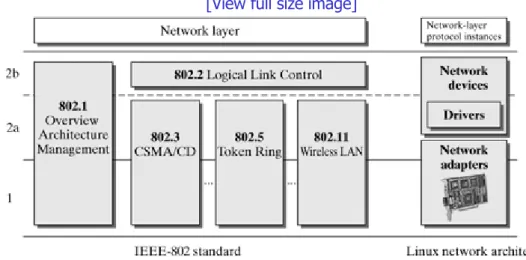
functionality of protocols and protocol instances. It includes an introduction to the popular TCP/IP and ISO/OSI layering models.
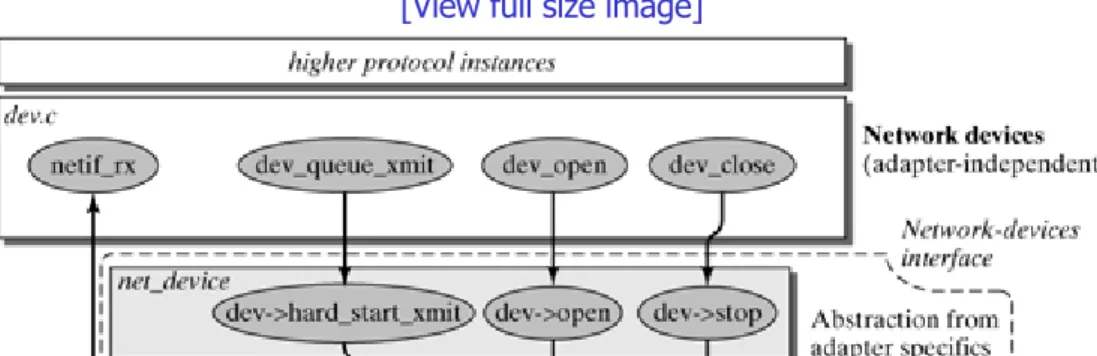
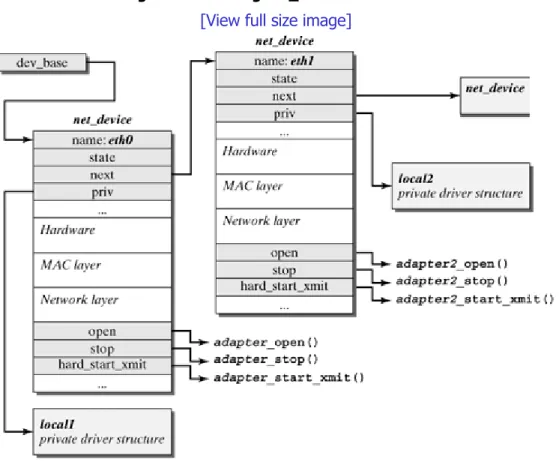
Chapters 4 and 5 discuss fundamental concepts of the Linux network architecture, including the representation and management of network packets in the Linux kernel (see Socket Buffers?A class="docLink" HREF="0131777203_ch04.html#ch04">Chapter 4) and the concept of network devices (Chapter 5). Network devices form the links between the protocol instances on the higher layers and hide the particularities of the respective network adapters behind a uniform interface.
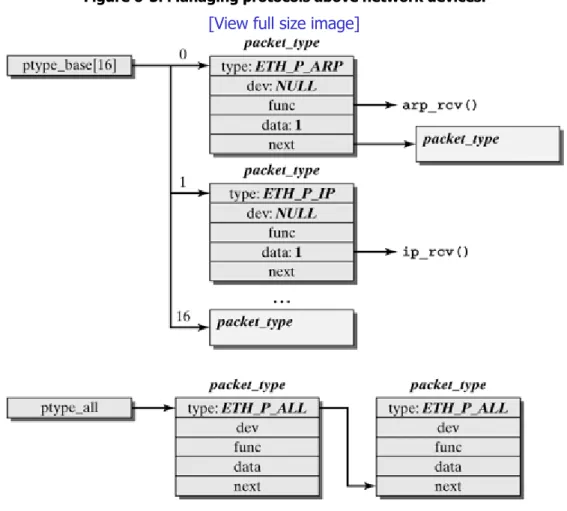
Chapter 6 gives an overview of the activity forms in the Linux network architecture and the flow of transmit and receive processes. In addition, this chapter introduces the interface to the higher-layer protocol instances.
Chapters 7 through 12 discuss protocols and mechanisms of the data link layer. More specifically, it describes the SLIP, PPP, and PPP-over-Ethernet protocols and how the ATM and Bluetooth network technologies are supported in Linux. Finally, we will describe how a Linux computer can be used as a transparent bridge.
Our discussion of the TCP/IP protocols starts with an overview of the TCP/IP protocol family in Chapter 13. We will begin with a brief history of the Internet, then give an overview of the different protocols within the TCP/IP protocol family. Chapter 14 will deal with the Internet Protocol and its mechanisms in detail. In addition, it introduces the IP options and the ICMP protocol. Chapters 15 through 23 discuss the following protocols and mechanisms on the network layer: ARP, routing, multicasting, traffic control, firewalls, connection tracking, NAT, KIDS, and IPv6.
Chapters 24 and 25 describe the TCP and UDP transport protocols, respectively. We will close our discussion of the kernel with an explanation of the socket interface, in Chapter 26, then end with a short overview of the programming of network functionality on the application level.
The appendix includes additional information and introduces tools facilitating your work with the Linux network architecture. The issues dealt with include the LXR source code browser, debugging work in the Linux kernel, and tools you can use to manage and monitor the Linux network architecture.
Additional Sources of Information
This section lists a few useful sources of information where you can find additional information about the Linux network architecture.
Magazines
• The Linux Magazine (http://www.Linux-mag.com) is probably the best-known Linux magazine. It features articles about all issues that are of interest when you deal with Linux. Of special interest is the Kernel Corner column, which regularly publishes articles about the architecture and implementation of components of the Linux kernel? most of them by developers themselves.
• Linux Focus (http://www.linuxfocus.org) is an online magazine publishing articles in many different languages. It also includes a Kernel Corner.
• The Linux Gazette (http://www.linuxgazette.com) is another online magazine dedicated to Linux.
Useful Links in the World Wide Web
• Linux Headquarters: http://www.linuxhq.com
• Linux Documentation Project: http://www.linuxdoc.org
• Linux Weekly News: http://www.lwn.net
Other Information
• Howtos include a lot of information about different Linux issues. Most deal with the
configuration and installation of various Linux functionalities. Especially for the Linux kernel, there are also a few howto documents? for example, how to use locks in the kernel
[Russ00b], and general information on hacking in the Linux kernel [Russ00c]. Of course, we should not forget to mention the networking howto, which includes a wealth of tips and information about configuring the network functionality in Linux [Drak00].
• The source code of the current kernels is found at ftp.kernel.org. There are also mirrors
of this FTP server, a list of which can be found at http://www.kernel.org/mirrors/.
• Information about components and drivers of the Linux kernel are also included directly in the source code of a kernel version, in the Documentation subdirectory. In addition, the file
Documentation/kernel-docs.txt includes a list of current information about the Linux kernel? for example, documentation, links, and books. (It's worth taking a look at this file!)
Conventions Used in this Book
This book uses the following typographical conventions to emphasize various elements of the Linux kernel, source texts, and other things.
Functions
A gray bar denotes important functions. A bar describes the function name on the left and the file name (within the kernel's source-code tree) on the right.
When giving a function name in such a place and throughout the body of this book, we normally leave out the parameters, because they would take up much space and impair the readability and text flow. In general, when introducing a function, we describe the entire parameter set and give a brief description. The variable type is normally left out. For example, the description of the function int ip_rcv(struct sk_buff *skb, struct net_device *dev, struct packet_type *pt) from the file net/ipv4/ip_input.c is denoted as follows:
ip_rcv() net/ipv4/ip_input.c
Throughout the body of this book, we would then refer to this function as ip_rcv() or ip_rcv(skb, dev, pt).
Variables, Function Names, Source Text Excerpts, and so on
A sans-serif font is used for excerpts from the source code, variable and function names, and
other keywords referred to in the text.
Commands, Program Names, and so on
A sans-serif font is used for the names of programs and command-line tools. Parameters that
should be passed unchanged are also printed in sans-serif; those parameters that have to be
replaced by values are printed in sans-serif italic.
Direct input in the command line is often denoted by a leading shell prompt? for example,
Files, Directories, Web Links, and so on
A sans-serif font is used for files and directories. We generally give the relative path in the kernel
source code for files of the Linux kernel (e.g., net/ivp4/ip_input.c). Web links are also printed
in sans-serif font (e.g., http://www.Linux-netzwerkarchitektur.de).
Other Conventions
Italic text denotes emphasis, or an introduction to a key term or concept.
Acknowledgments
Many people's contributions were indispensable in the creation and production of this book. First and foremost, we would like to thank all students who studied the structure of the Linux network
architecture in their papers and theses. They contributed enormously to collecting knowledge about the Linux network architecture at the Institute of Telematics:
Nasieh Abdel-Haq, Paul Burczek, Michael Conrad, Frank Dinies, Paul Hankes Drielsma, Jérôme Freilinger, Carolin Gärtner, Stefan Götz, Karsten Hahn, Artur Hecker, Tobias Hinkel, Michael Hofele, Verena Kahmann, Vera Kießling, Stefan Klett, Andreas Kramm, Jan Kratt, Eckehardt Luhm, David Metzler, Ulrich Mohr, Rainer Müller, Sven Oberländer, Vincent Oberle, Jan Oetting, Torsten Pastoors, Christian Pick, Christian Schneider, Steffen Schober, Marcus Schöller, Achim Settelmeier, Uwe Walter, and Jürgen Walzenbach.
The authors wrote this book mainly for their students.
Much appreciation is due to Professor Gerhard Krüger, who has always supported our activities, given us the freedom necessary to write this book, and assisted us with valuable advice. His support also allowed us to procure a Linux test network, which served as the basis for our research activities at the Institute of Telematics in the field of services for the next-generation Internet.
Our special thanks go to all the folks at the publishing houses who published the original German version of this book and the English translation that you are currently reading. Particularly, we would like to thank our editors, Sylvia Hasselbach and Toni Holm. Their admirable patience helped shepherd us through this book-writing process. The English translation was done by Angelika Shafir, whom we would also like to thank in this place. We also thank all the people who read the manuscript, especially Mark Doll, Sebastian Döweling, Thomas Geulig, Thorsten Sandfuchs, Marcus Schöller, Bernhard Thurm, Uwe Walter, Anja Wehrle, Kilian Weniger, and Friederike Daenecke.
Last but not least, we gratefully acknowledge the support, encouragement, and patience of our families and friends.
KARLSRUHE · BERKELEY · BERLIN · BRAUNSCHWEIG
KLAUS WEHRLE · FRANK PÄHLKE · HARTMUT RITTER · DANIEL MÜLLER · MARC BECHLER
Part I: The Linux Kernel
Chapter 1. Motivation
Chapter 2. The Kernel Structure
Chapter 1. Motivation
Digital data transmission and processing form the basis of our today's information society. Within a short time, the Internet has penetrated all areas of our daily lives, and most of us can surely not imagine everyday life without it. With its new services, it offers us ways to communicate, fascinating all social strata, but corporations and organizations also use the possibilities of the Internet as a basis for internal exchange of information and for communication and handling business with customers and partners.
The technique of the Internet has been developed during the past twenty years; the actual boom began with the introduction of the World Wide Web at the beginning of the nineties. Development has progressed since then; new protocols and standards have been integrated, improving now both the functionality and the security in the "global net."
As developments in the Internet progressed, so did the technologies of the underlying network: The first e-mails were sent over telephone lines at 1200 bits/s in the eighties, but we can now
communicate over gigabit or terabit lines. In addition, new technologies for mobile communication are emerging, such as UMTS and Bluetooth.
All these technologies have one thing in common: They are integral parts of digital communication systems, allowing spatial communication and interaction of distributed applications and their users. Modern communication systems decompose these extremely complex tasks into several layers, and the instances of these layers interact via predefined protocols to supply the desired service.
Telematics[1] is a field that handles both the development and research of telecommunication systems
(and their basic mechanisms) and the implementation and realization of these systems by using means of computer science. This means that, in addition to the design of communication systems and
protocols, the implementation of these mechanisms is an important task within the telematics discipline. Unfortunately, many universities and academic institutions neglect this point. For example, during coverage of the basics and the current standards with regard to communication protocols in detail, only very little knowledge is conveyed as to how these principles can be used (e.g., which basic principles of computer science can be used when implementing communication protocols).
[1] Telematics is the subdiscipline of informatics that deals with the design and implementation of telecommunication systems by use of information technologies.
With this book, the authors? who themselves teach computer-science students? attempt to contribute to promoting the computer-science component in telematics. Using the Linux operating system as an example, which the authors employ mainly for research purposes, in addition to the usual office applications (e-mail, World Wide Web, word processing, etc.), we will introduce the practical
realization of communication systems and communication protocols. Essentially, the structuring of the network subsystem in the Linux kernel, the structuring of interfaces between network components, and the applied software methods will be used to show the reader various ways to implement protocols and network functionality.
In addition to its teaching use, of course, this book is also intended to address all those interested in the architecture of the network subsystem in the Linux kernel, taking a look behind the scenes at this poorly documented part of the Linux kernel. The following section discusses the Linux operating system and the reasons for its use in offices, companies, networks, and research.
1.1 The Linux Operating System
Linux is a freely available multiuser, multitasking, multiprocessor, and multiplatform UNIX operating system. Its popularity and the number of users increase continually, making Linux an increasingly serious factor in the operating-systems market. Thanks to the freely available source code that everybody can obtain over the Internet and to the fact that everybody can participate in and contribute to the further development of the Linux system, many developers, all over the world, are constantly busy further developing this system, removing existing errors, and optimizing the system's
performance.
The fact that most developers do this very time-consuming work for free in their spare time is a sign of the great fun working with Linux and mainly with the Linux kernel can be. As we progress in this book, we will try to pass some of this enthusiasm on to our readers. The large number of research projects at the University of Karlsruhe that have used, enhanced, or modified the Linux network architecture experienced a high motivation of all participating students. The reason was mainly that this offered them a way to participate in the "Linux movement."
The development of Linux was initiated by a student by the name of Linus B. Torvalds, in 1991. At that time, he worked five months on his idea of a new PC-based UNIX-like operating system, which he eventually made available for free on the Internet. It was intended to offer more functions than the Minix system designed by Andrew S. Tanenbaum, which was developed for teaching purposes only [Tane95]. With his message in the Minix newsgroup (see page 1), he set a movement in motion, the current result of which is one of the most stable and widely developed UNIX operating systems. Back then, Linus Torvalds planned only the development of a purely experimental system, but his idea further developed during the following years, so that Linux is now used successfully by many private people, corporations, and scientists alike. Mainly, the interoperability with other systems (Apple, MS-Windows) and the ability to run on many different platforms (Intel x86, MIPS, PA-RISC, IA64, Alpha, ARM, Sparc, PowerPC, M68, S390) make Linux one of the most popular operating systems. Not only the extensive functionality of Linux, but also the freely accessible source code of this operating system, have convinced many private people and companies to use Linux. In addition, the German government, with its program for the support of open-source software, promotes the use of freely available programs with freely available source code. The main reason for this is seen not in the low procurement cost, but in the transparency of the software used. In fact, anyone can view the source code and investigate its functionality. Above all, anyone can check what? perhaps security-relevant? functionalities or errors are contained in an application or operating system. Especially with
commercial systems and applications, there are often speculations that they could convey information about the user or the installed applications to the manufacturer.
You do not have such fears with freely developed software, where such a behavior would be noticed and published quickly. Normally, several developers work concurrently on an open-source project in a distributed way over the Internet, monitoring themselves implicitly. After all, free software is not aimed at maximizing the profit of a company or its shareholders. Its goal is to develop high-quality software for everybody. Linux is a very good example showing that freely developed software is not just the hobby of a handful of freaks, but leads to serious and extremely stable applications.
The authors of this book use Linux mainly for research work in the network area. The freely available source texts allow us to implement and evaluate new theories and protocols in real-world networks. For example, Linux was used to study various modifications of the TCP transport protocol [WeRW01, Ritt01], to develop a framework for the KIDS QoS support [Wehr01b], and to develop the high-resolut ion UKA-APIC timer [WeRi00].
1.2 What is Linux?
Originally, the term Linux described only the operating-system kernel that abstracts from the hardware of a system, offering applications a uniform interface. Over time, the term Linux has often come to mean the kernel (the actual Linux) together with the entire system environment, including the following components:
• the operating-system kernel (currently version 2.0, 2.2, or 2.4);
• the system programs (compiler, libraries, tools, etc.);
• the graphical user interface (e.g., XFree) and a window manager or an application environment (KDE, Gnome, FVWM, etc.);
• a large number of applications from all areas (editors, browsers, office applications, games, etc.).
Different components not forming part of the kernel originate largely from the GNU project of Free Software Foundation, which explains why the complete system environment is often called "GNU/Linux system." A characteristic common to the Linux kernel and GNU programs is that they may all be freely distributed under the GNU Public License (GPL), provided that the source text is made publicly
available. To the extent that enhancements or modifications have been effected to the programs, then these are automatically governed by the GNU license (i.e., their source text must also be made freely available). Since the advent of Linux, this has had the effect that the system has been further
developed free from corporate policy interests and that it has been more strongly oriented to word its users' needs than are other, commercial operating systems. Anyone can participate in the
development and implement new capabilities, ones based on the freely available source texts. This means that Linux is always involved in the support of international standards, and no attempt is made to enforce corporate or proprietary standards to secure a market position.
Errors made during the development of a piece of software are normally removed quickly. In addition, there is a continual effort to keep the system performing as well as possible. This has become very clear in the example of the network implementation in the last kernel version: After it had become known that the performance of Linux in the area of protocol handling on multiprocessor systems suffers from a few flaws, the network part was extensively rewritten to remove these faults. This means that Linux is an example that clearly shows the benefits of open-source projects:
• stability,
• performance, and
• security.
1.3 Reasons for Using Linux
The previous section introduced the important properties and objectives of Linux as a free software project. This section will discuss a number of general properties of the Linux kernel, offering more reasons for its use:
• Linux supports preemptive multitasking: All processes run independently in different protected memory spaces, so that the failure of one process does not in any way impair the other processes. When a process claims too much computing time, its processor can be taken and allocated to another waiting application. Preemptive multitasking is a fundamental requirement for stable systems.
• Multiprocessor: Linux is one of the few operating systems supporting several processors in SMP (Symmetric MultiProcessing) operation. This means that several processes can be handled concurrently by different CPUs. Since kernel version 2.0, multiprocessor systems with Intel and Sparc processors are supported. Version 2.2 and the current Version 2.4 additionally improved the performance and parallelism in the Linux kernel.
• Multiuser: Several users can work concurrently in one system, when they are logged in over different consoles. In addition, users can work easily on several graphical user interfaces.
• Multiplatform: properties of: Linux was originally developed only for the personal computer (Intel 80386), but it runs on more than ten processor architectures today. The bandwidth of supported platforms extends from small digital personal assistants over the standard personal computer to mainframe architectures: Intel x86, MIPS, PA-RISC, IA64, Alpha, ARM, Sparc, PowerPC, M68, and so on.
• Linux is a UNIX system: It is compatible with the POSIX-1300.1 standard[2] and includes large
parts of the functionality of UNIX System V and BSD. This means that you can use UNIX standard software under Linux.
[2] Portable Operating System Interface based on UniX? POSIX 1300.1 defines a minimum interface that each UNIX-like operating system must offer.
• Rich network functionality: The Linux network architecture makes available an extensive choice of network protocols and functionalities in the networking area. The development of the Internet and its services is inseparably linked to UNIX systems. This is why the properties of the TCP/IP protocol family and its behavior can best be studied and controlled in a UNIX system. Other PC operating systems would be unsuitable for this, especially those with source code not publicly available.
• Open source: The source code of the entire Linux kernel is freely available and can be used according to the GNU Public License. A large number of programmers work on the further development of the Linux kernel all over the world, continually enhancing and improving it. Linux is distributed over the Internet so that each user can test the kernel and make
improvements or enhancements. The development of Linux in this dimension would not have been possible without the Internet.
Formerly, users had to put up with defects in software they purchased; Linux now allows everyone to remove such defects. And it really works. An often heard criticism has been that the driver support for Linux is one of its major problems. This situation has changed
dramatically during the past years. For instance, all actually available network cards are supported by Linux. In fact, we can rely to the Linux community to such an extent that there will soon be a matching driver for each new device.
• Efficient network implementation: Meanwhile, the Linux kernel makes available a
well-structured implementation of the network functionality, which will be our main focus of discussion in the next 27 chapters of this book. The functions can be adapted to the special requirements of the desired system and meet the specifications of the Internet Engineering Task Force (IETF), IEE, and ISO better than many other systems.
In the creation of a new kernel, its desired functionality can be individually configured. For instance, you can enable a large number of optimization options or add specific functionalities (e.g., multicast support and various protocols). While the system is running, you can also use the Proc file system (see Section 2.8) to change parameters? For example, various timeout values for the TCP transport protocol or configuration parameters of other protocol instances. There is even a way to use the Proc file system to enable and disable certain functions at runtime, such as packet forwarding.
• IP Next Generation: Since Version 2.1.38, the Linux kernel provides a stable and relatively complete implementation of the new Internet Protocol IPv6. (See Chapter 23.)
• And, finally, the best argument: Linux is free of charge. Everyone can download it from the Internet or buy it on CD for a few dollars, usually with a few gigabyte applications (some of them being more useful, some less) and with extensive installation instructions and free su pport. This means that, for very little money, you can get a high-performing, extremely stable, and easily adaptable operating system that turns a Pentium PC into a high-performing
workstation, a highly reliable server, or an individually configurable Internet router. This chapter has been a brief introduction to Linux; the next chapter will introduce the internal structure of the Linux kernel. We will then discuss the basic structure of communication systems in general and the structure of the Linux network architecture in particular.
Chapter 2. The Kernel Structure
This chapter deals with the basic architecture of the Linux kernel and its components. It provides an overview of the most important areas of the kernel, such as the different forms of activity in the kernel, memory management, device drivers, timers, and modules. Each of these issues will be discussed briefly in this book, to give you an insight into the tasks and processes of each component. Detailed information about each of these issues is found in other books and references. A choice of corresponding sources is given in the bibliography, where we particularly recommend [RuCo01], [BBDK+01], and [BoCe00].
The goal of this chapter is to describe the framework in which the Linux network architecture
operates. All areas described below offer basic functions required to offer network services in the first place. This is the reason why knowing them is an essential prerequisite for an understanding of the implementation of the Linux networking architecture.
Figure 2-1 shows the structure of the Linux kernel. The kernel can be divided into six different sections, each possessing a clearly defined functionality and offering this functionality to the other kernel components. This organization is reflected also in the kernel's source code, where each of these sections is structured in its own subtree.
Figure 2-1. Structure of the Linux kernel according to [RuCo01].
[View full size image]
Here we briefly describe these components.
• Process management: This area is responsible for creating and terminating processes and other activities of the kernel (software interrupts, tasklets, etc.). In addition, this is the area where interprocess communication (signals, pipes, etc.) takes place. The scheduler is the main component of process management. It handles all active, waiting, and blocked processes and takes care that all application processes obtain their fair share of the processor's
computing time.
• Memory management: The memory of a computer is one of the most important resources. A computer's performance strongly depends on the main memory it is equipped with. In addition, memory management is responsible for allowing each process its own memory section, which has to be protected against access by other processes.
• File systems: In UNIX, the file system assumes a central role. In contrast to other operating systems (e.g., Windows NT), almost everything is handled over the file-system interface. For example, device drivers can be addressed as files, and the Proc file system (see Section 2.8) allows you to access data and parameters within the kernel. These two functionalities can be used very effectively and elegantly, so that they are often used for debugging purposes. (See Appendix B.)
• Device drivers: Device drivers abstract from the underlying hardware in every operating system, and they allow you to access this hardware. The modular concept of Linux we will introduce in Section 2.4 offers a way to add or remove device drivers during a running operation, despite its monolithic kernel.
• Network: All network operations have to be managed by the operating system, because certain network operations cannot be allocated to a specific process, such as handling an incoming packet. Incoming packets are asynchronous events. They have to be collected, identified, and forwarded before a process can handle them. This is the reason why the kernel is responsible for the handling of packets across program and network interfaces.
Within the kernel, defined interfaces are used to facilitate the design of new functionalities. For instance, there is an interface to the virtual file system, which can be used to add new file systems. The availability of more than a dozen supported file systems shows clearly that this interface was a good design decision by the Linux developers, because no other operating system provides such a large supply of supported file systems. The Linux network architecture also includes many interfaces supporting the dynamic enhancement of the wealth of protocols and network drivers.
The components shown on dark background in Figure 2-1 provide interfaces for the dynamic registration of new functionalities, so that such functionalities can be easily implemented in modules.
2.1 Monolithic Architectures and Microkernels
In contrast to current operating-system developments tending toward a microkernel architecture, the Linux operating system is based on a monolithic kernel. In microkernel architectures, such as the Mach kernel [Tane95] or the Windows NT kernel, the operating system kernel represents merely the absolute necessary minimum of functionality. Good examples are interprocess communication (IPC) and memory management (MM). Building on the microkernel, the remaining functionality of the operating system is moved to independent processes or threads, running outside the operating system kernel. They use a defined interface to communicate with the microkernel, generally via system calls. In monolithic kernels, to which the Linux kernel belongs, the entire functionality is concentrated in one (large) kernel. In addition to the basic mechanisms known from microkernels, the Linux operating system kernel also includes device drivers, file system drivers, most instances of the network protocols, and much more. (See Figure 2-1.) Compared to microkernel architectures, the use of a monolithic kernel has both benefits and drawbacks, as we will see below.
The benefits include the fact that the entire functionality of the operating system is concentrated in the kernel, allowing the system to work more efficiently. You can access resources directly from within the kernel, so costly system calls and context changes are needed less frequently. One major drawback is that the source code for the operating system kernel can quickly become rather complex, even messy, because no defined interfaces are required within the kernel. In addition, the development of new drivers can be made more difficult by the lack of an interface definition. For example, if you install a new device, you have to retranslate the entire kernel to ensure that this device driver can be compiled with the kernel, a need avoided by microkernel architectures.
That Linux is based on a monolithic operating-system kernel is due to historical reasons. A system that had not been planned to become such a big project, at the beginning, has continually been developed further, so that it became impossible, at some point in time, to migrate to a microkernel architecture. However, since Version 2.0, Linux has made a step towards microkernel architectures. More
specifically, the possibility was created of moving certain functionalities into modules, which are loaded into the kernel at runtime, from which they can be removed again.
This removed an important drawback of monolithic kernels and opened the way to loading drivers or other functionalities at runtime. In addition, modularization offers another benefit: Uniform interfaces are defined. This feature had previously been characteristic only of microkernel architectures. Linux has a number of such interfaces, allowing the kernel to be dynamically enhanced by a number of functionalities. This very flexibility and openness of its interfaces is one of the most important benefits of Linux.
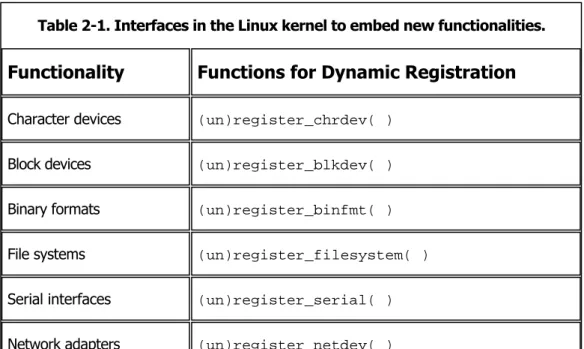
Table 2-1 shows a selection of the most important interfaces, including the pertinent methods used to register and unregister functionalities.
Table 2-1. Interfaces in the Linux kernel to embed new functionalities.
Functionality
Functions for Dynamic Registration
Character devices (un)register_chrdev( )
Block devices (un)register_blkdev( )
Binary formats (un)register_binfmt( )
File systems (un)register_filesystem( )
Serial interfaces (un)register_serial( )
Network adapters (un)register_netdev( )
Layer-3 protocols dev_add_pack( ), dev_remove_pack( )
Layer-4 protocols (TCP/IP) inet_add_protocol( ), inet_del_protocol( )
Console drivers tty_(un)register_driver( )
Symbol tables (un)register_symtab( )
Modules init_module( ), cleanup_module( )
Despite its modularization, Linux has preserved a major benefit of monolithic kernels: All functions implemented in modules run in protected kernel mode, which means that they do not require any context change when called from within the kernel. This can be seen as a clever combination of the benefits from both main operating-system architectures.
The following sections briefly introduce the kernel components, to better explain the Linux network architecture. You should know the structure and properties of these components to understand how the Linux network architecture works. We refer again to [RuCo01, BBDK+01, BoCe00] for an in-depth study of the Linux kernel components described below.
2.2 Activities in the Linux Kernel
Linux is a multitasking system. This means that several application processes can be active, and several applications can be used, simultaneously. In multiprocessor systems, which have been supported since kernel Version 2.0, even several applications or their processes can be processed in parallel. However, a process is not the only form of activity you can execute in the Linux kernel.
2.2.1 Processes and System Calls
Processes are normally activities that are started to run a specific application, and they are terminated once the application is through. Creating, controlling, and destroying of processes are tasks handled by the kernel of an operating system. Processes operate exclusively in the user address space (i.e., in unprotected mode) of a processor, where they can access only the memory section allocated to them. An attempt to access memory sections of other processes or the kernel address space leads to an exception, which has to be dealt with by the kernel.
However, when a process wants to access devices or use a functionality of the operating-system kernel, it has to use a system call to do this. A system call causes the processor to change to the protected mode, and access to the kernel address space is a function of the system call. All devices and memory sections can be accessed in protected mode, but only with methods of the kernel.
The work of processes and system calls can be interrupted by other activities. In such a case, their current state (contents of CPU registers, MMU registers, etc.) is saved; then it is restored when the interrupted process or system call resumes its work. Processes and system calls can be stopped voluntarily or involuntarily. In the first case, they cede processing voluntarily? for example, when they wait for a system resource (external device, semaphore, etc.) and go to sleep until that resource becomes available. Involuntary cession of processing is caused by interrupts, which tell the kernel that an important action has taken place, one that the kernel should be dealing with. This could be a notification about availability of a previously busy resource.
In addition to normal processes and to processes within a system call, we distinguish between further forms of activity in the Linux kernel. These forms of activity are of decisive importance for the Linux network architecture, because the network functionality is handled in the kernel. We will explain the following forms of activity in more detail in the next sections, when we will be discussing mainly their tasks within the Linux network architecture:
• Kernel threads;
• interrupts (hardware IRQs);
• software interrupts (soft IRQs);
• tasklets; and
• bottom halves.
When thinking of the different forms of activity in the kernel (except processes in the system call and kernel threads), an important point will be the parallel execution of the respective form of activity. On the one hand, this concerns the question of whether the instance of a form of activity can be executed concurrently on several processors; on the other hand, of whether two different instances of one form of activity can be executed concurrently on several processors. Table 2-2 shows an overview of these possibilities.
Table 2-2. Concurrent execution of same activities on several processors.
Same Activity
Different Activities
HW IRQ ?/P> •
Soft IRQ • •
Tasklet ?/P> •
Bottom half ?/P> ?/P>
Another interesting thing about the individual forms of activity is to know by what other forms of activity they can be interrupted; Table 2-3 gives an overview. This information is important mainly for protection from undesired side effects caused by concurrent or overlapping operations of two activities on a jointly used data structure. This problem and possible solutions are discussed in detail in Section 2.3. That section will introduce locking mechanisms that, though offering protection against undesired side effects, can reduce a system's performance when used too cautiously. For this reason, it is important to know when which locking mechanisms are required. Note that the possible parallelism and interruptability of different forms of activity play an important role.
Table 2-3. Interruption of activities by other forms of kernel activities.
HW-IRQ
Soft-IRQ Taskle
t
Bottom Half
HW IRQ +/?sup class="docFootnote">[1] ?/P> ?/P> ?/P>
Soft IRQ + ?/P> ?/P> ?/P>
Tasklet + ?/P> ?/P> ?/P>
Bottom half + ?/P> ?/P> ?/P>
System call + + + +
Process + + + +
[1] Only slow interrupts can be interrupted by other interrupts, as we will see in Section 2.2.2.
2.2.2 Hardware Interrupts
Peripherals use hardware interrupts (often abbreviated as HW IRQs) to inform an operating system about important events (e.g., that the mouse has been moved, a key has been pressed, or a packet has arrived in the network adapter). Hardware interrupts interrupt the current activity in one of the processors and execute the pertinent interrupt-handling routine.
The handling routine for a specific interrupt can be registered at runtime by using the function
request_irq(). Details about the registration and management of interrupts are described in
[RuCo01]. free_irq() is used to release the handling routine of an interrupt, so that it is no longer
executed.
We distinguish between two types of interrupts in the Linux kernel:
• Fast interrupts are characterized by the fact that they have a very short interrupt-handling routine and so interrupt the current activity only very briefly. One characteristic of fast interrupts is that all other interrupts in the local CPU are locked while it is executed, so that the interrupt-handling routine cannot be interrupted. Fast interrupts are designated by the flag
SA_INTERRUPT when they are registered with request_irq().
• Slow interrupts can be interrupted by other interrupts during their execution. They normally have a much longer-interrupt handling routing than fast interrupts and so would claim the processor for too long. This is the reason why only the repeated execution of that interrupt is stopped when a slow interrupt is executed.
Interrupts can generally stop all other activities when they are executed. (See Table 2-3.) At the same time, various interrupts in several CPUs can be handled concurrently, but the interrupt-handling routine of a specific interrupt can be executed only in one CPU at a time.
You can call the function in_irq() (include/asm/hardirq.h) to check whether the current
activity is an interrupt-handling routine (see details in [Russ00b]). Top Halfs and Bottom Halfs
Interrupt-handling routines should be executed as soon as possible after the interrupt was triggered and interrupt the current activity only briefly. But not every task can be executed by few instructions. For example, handling of a packet arrived in a network adapter requires several thousand ticks, until the packet can be passed on to the relevant process in the user address space. Though it is triggered by an interrupt, this task cannot be done in an interrupt-handling routine.
To keep interrupt handling as short as possible, such time-consuming tasks are divided into two parts:
• The so-called top half runs only the most important tasks after a triggered interrupt. The top half corresponds to the interrupt-handling routine. As we will see in Chapter 6, for example, the interrupt-handling routine of a network adapter might just copy the arrived packet to the kernel, where it will be buffered in a queue pending detailed handling by the corresponding protocol instances.
• The bottom half runs all operations that are not time-critical and which could not be executed within the interrupt-handling routine for time reasons. The bottom half is scheduled for execution while the top half is running, and, as soon as the scheduler is called again upon completion of the interrupt, it will most likely run the bottom half (depending on the bottom half's type).
For example, if a packet arrives, then the tasks of the bottom half are run by the software interrupt
NET_RX_SOFTIRQ. (See Chapter 6.)
The following sections introduce three possible activities that can be used as the bottom half in the interrupt-handling process.
2.2.3 Software Interrupts
Software interrupts (or soft IRQs for short) are actually a form of activity that can be scheduled for later execution rather than real interrupts. Software and hardware interrupts differ mainly in that a hardware interrupt actively interrupts another form of activity: Triggering the interrupt causes the (immediate) interruption of the running activity (but, of course, only if the triggering of interrupts is currently allowed).
In contrast, a software interrupt is scheduled for execution by an activity of the kernel and has to wait until it is called by the scheduler. Software interrupts scheduled for execution are started by the function do_softirq() (kernel/softirq.c). This means that the running activity is not
interrupted when a soft IRQ is activated by __cpu_raise_softirq(). The corresponding handling
routine is triggered when do_softirq() is called. This occurs currently only when a system call (in schedule()) or a hardware interrupt (in do_IRQ()) terminates.
A maximum of 32 software interrupts can be defined in the Linux kernel. Note that only four were defined in the Versions 2.4.x. This includes the soft IRQs NET_RX_SOFTIRQ and NET_TX_SOFTIRQ,
which have ensured efficient protocol handling since kernel Version 2.4, and the soft IRQ
TASKLET_SOFTIRQ, which is used to implement the concept of tasklets, further described later in
this chapter.
Software interrupts differ clearly from the tasklet and bottom half forms of activity, as we have seen in Tables 2-2 and 2-3. The most important properties of software interrupts are the following:
• A software interrupt can run concurrently in several processors. This means that the handling routine has to be implemented reentrantly (e.g., with net_rx_action). If critical sections
exist in a software interrupt (e.g., any global variable it accesses), then these have to be protected by locks.
• A software interrupt cannot interrupt itself while running on a processor.
• A software interrupt can be interrupted during its handling on a processor only by a hardware interrupt.
Calling in_softirq() (include/asm/softirq.h) causes a function to check immediately on
whether it is currently in a software interrupt; see details in [Russ00b].
2.2.4 Tasklets
Tasklets are a combination of parallel executable (but lock-intensive) software interrupts and the old
bottom halfs,[1] where we can talk neither of parallelism nor of performance. Tasklets were
introduced to replace the old bottom halfs.
[1] In this connection, we have to differentiate between the general concept of a bottom half that can be implemented by a tasklet (a soft IRQ) and a bottom half in the Linux kernel. In contrast, the
form of activity of a bottom half is Linux-specific and denoted by sans-serif font in this text.
Tasklets have the following properties:
• The function tasklet_schedule(&tasklet_struct) can be used to schedule a tasklet
for execution. A tasklet is run only once, even if it was scheduled for execution several times.
• A tasklet can run on one processor only at any given time.
• Different tasklets can run on several processors concurrently.
The macro DECLARE_TASKLET(name, func, data) can be used to define a new tasklet, where name denotes a name for the tasklet_struct data structure and func denotes the tasklet's
handling routine. When the tasklet is to run, then the pointer data, pointing to private data, if applicable, are passed to the function func().
Tasklet_schedule() is used to schedule a tasklet for execution; tasklet_disable() can be us
ed to stop a tasklet from running, even when it is scheduled for execution. It remains scheduled for execution or can be rescheduled. Tasklet_enable() is used to reactivate a deactivated tasklet.
However, if that tasklet was not scheduled for execution, it will not run when you activate it. The following example shows how easy it is to define and activate a new tasklet:
#include <linux/interrupt.h>
/* Handling routine of new tasklet */ void test_func(unsigned long);
/* Data of new tasklet */
char test_data[] = "Hello, I am a test tasklet";
/* Definition of tasklet_struct structure of tasklet */
DECLARE_TASKLET (test_tasklet, test_func, (unsigned long) &test_data); void test_func(unsigned long data)
{
/*Do here what you think you have to do, e.g.:*/ printk(KERN_DEBUG "%s\n", (char *) data);
} . . .
/* Use an activity to activate the tasklet */ tasklet_schedule(&test_tasklet);
2.2.5 Bottom Halfs
Bottom halfs (BHs) had been the main form of activity in the kernel in early kernels. For
example, NET_BH was responsible for handling of network protocols and sending of packets. There
can be a maximum of 32 BHs, which are scheduled for execution by the mark_bh() function.
BHs are the form of activity with the smallest parallelism in the kernel, as mentioned in previous sections. The following property shows the major drawback of BHs:
• Only one bottom half can run concurrently on all processors of a system at one time.
Because BHs are inflexible and because they are to be replaced by tasklets or software interrupts in future Linux kernel versions, we will not discuss them further here. Information on BHs is found in the literature (e.g., [RuCo01], [BBDK+01] or [BoCe00]).