A 2-Year Pragmatic Trial of Antibiotic Stewardship
in 27 Community Nursing Homes
Philip D. Sloane, MD, MPH,*
†Sheryl Zimmerman, PhD,
†‡Kimberly Ward,
†Christine E. Kistler, MD, MASc,*
†Deborah Paone, DrPH, MHSA,
§David J. Weber, MD, MPH,
¶∥Christopher J. Wretman, PhD,
†and John S. Preisser, PhD**
See related editorial by Furuno et al. in this issue.
OBJECTIVES: To determine if antibiotic prescribing in community nursing homes (NHs) can be reduced by a mul-ticomponent antibiotic stewardship intervention implemented by medical providers and nursing staff and whether imple-mentation is more effective if performed by a NH chain or a medical provider group.
DESIGN: Two-year quality improvement pragmatic imple-mentation trial with two arms (NH chain and medical pro-vider group).
SETTING: A total of 27 community NHs in North Carolina that are typical of NHs statewide, conducted before announce-ment of the US Centers for Medicare and Medicaid Services antibiotic stewardship mandate.
PARTICIPANTS:Nursing staff and medical care providers in the participating NHs.
INTERVENTION:Standardized antibiotic stewardship qual-ity improvement program, including training modules for nurses and medical providers, posters, algorithms, communica-tion guidelines, quarterly informacommunica-tion briefs, an annual quality improvement report, an informational brochure for residents and families, and free continuing education credit.
MEASUREMENTS:Antibiotic prescribing rates per 1000 res-ident days overall and by infection type; rate of urine test
ordering; and incidence ofClostridium difficileand methicillin-resistantStaphylococcus aureus(MRSA) infections.
RESULTS: Systemic antibiotic prescription rates decreased from baseline by 18% at 12 months (incident rate ratio [IRR] = 0.82; 95% confidence interval [CI] = 0.69-0.98) and 23% at 24 months (IRR = 0.77; 95% CI = 0.65-0.90). A 10% increase in the proportion of residents with the medical director as primary physician was associated with a 4% reduction in prescribing (IRR = 0.96; 95% CI = 0.92-0.99). Incidence ofC. difficile and MRSA infections, hospitaliza-tions, and hospital readmissions did not change significantly. No adverse events from antibiotic nonprescription were reported. Estimated 2-year implementation costs per NH, exclusive of medical provider time, ranged from $354 to $3653.
CONCLUSIONS: Antibiotic stewardship programs can be successfully disseminated in community NHs through either NH administration or medical provider groups and can achieve significant reductions in antibiotic use for at least 2 years. Medical director involvement is an important ele-ment of program success.J Am Geriatr Soc 68:46-54, 2020.
Key words: antibiotic stewardship; infections; nursing homes; quality improvement
L
eaders in infectious diseases and public health have called for improved antibiotic stewardship programs that, by promoting appropriate use of antimicrobials, will improve patient outcomes and decrease the spread of infections caused by multidrug-resistant organisms (MDROs).1-4 Stewardship programs have been widely introduced in hospitals,5with con-siderable evidence of impact on prescribing rates and some evi-dence of reduction in antibiotic-resistant infections.6-8Nursing homes (NHs) are recognized as a key reservoir of antibiotic resistance, in large measure due to the chronically ill population, frequent antibiotic use, and the fact that they are From the *Department of Family Medicine, University of North Carolina at
Chapel Hill, Chapel Hill, North Carolina;†Cecil G. Sheps Center for Health Service Research, University of North Carolina at Chapel Hill, Chapel Hill, North Carolina;‡School of Social Work, University of North Carolina at Chapel Hill, Chapel Hill, North Carolina;§Paone and Associates LLC, Minneapolis, Minnesota;¶Division of Infectious Disease, School of Medicine, University of North Carolina at Chapel Hill, Chapel Hill, North Carolina;∥Department of Epidemiology, Gillings School of Global Public Health, University of North Carolina at Chapel Hill, Chapel Hill, North Carolina; and the **Department of Biostatistics, Gillings School of Global Public Health, University of North Carolina at Chapel Hill, Chapel Hill, North Carolina.
Address correspondence to Philip D. Sloane, MD, MPH, Department of Family Medicine, Cecil G. Sheps Center for Health Service Research, University of North Carolina at Chapel Hill, 590 Manning Dr, Chapel Hill, NC 27514. E-mail: [email protected]
increasingly being used for posthospitalization management.9-11 Furthermore, many antibiotic prescriptions in NHs are thought to be unnecessary.12To address this issue, the US Centers for Medicare and Medicaid Services (CMS) recently mandated that all NHs initiate antibiotic stewardship programs, with the goal of reducing inappropriate overprescribing and, ultimately, of slowing the development of resistant bacteria and the occurrence of infections with MDROs.13
Sustainable antibiotic stewardship requires changes in administrative policies and procedures.14The NH industry is a complex adaptive system, characterized by diverse, interre-lated, yet independent, stakeholders.15,16A potential barrier to antibiotic stewardship dissemination is the industry’s fragmen-tation into administrative units ranging from individual homes to chains of up to 380 homes, with the majority of residents cared for in medium-sized, often regional, NH chains.17,18
Med-ical services are also fragmented, increasingly provided by long-term care provider groups that serve multiple homes.19Prior studies have demonstrated that NH medication reduction can be either nursing administration20 or physician led,21 and suggested that medical practices specializing in long-term care may more effectively implement quality improvement19,22; however, it is not known whether and to what extent working within one administrative system or the other is more likely to effect system change and improve outcomes, and which approach is more cost effective. Therefore, a major goal of our research was to answer this question within the context of a dis-semination research study. On the one hand, we hypothesized that a nursing administration-led effort, introduced and supported by the corporate nursing director, by virtue of hav-ing the ability to change systems of education, communica-tion, nursing practice, and documentation related to infection management, might be more effective in promoting antibiotic stewardship. On the other hand, we hypothesized that a med-ical provider group might be more effective in promoting antibiotic stewardship, by virtue of their prescribing ability and influence in the NHs.
Building on an efficacy study that achieved a 24% reduction in antibiotic prescribing with education, monitor-ing, and feedback by a university-based research team,22we
sought to determine whether similar reductions in prescrib-ing could be implemented and sustained if responsibility for education and monitoring was largely delegated to NH staff or medical providers. We, therefore, recruited two groups of NHs, a NH chain arm and a medical provider group arm, to (a) estimate the overall change in total systemic antibiotic prescribing rates and (b) evaluate differences by study arm. As secondary aims, we sought to identify char-acteristics related to changes in prescribing, to determine if hospitalization and adverse event rates were affected, and to estimate implementation costs.
METHODS Sample
NHs were recruited into two study arms: a NH chain arm and a medical provider arm. The NH chain was recruited in consultation with staff of our state long-term care associa-tion; the medical provider group was selected in consultation with the Carolinas Society for Post-Acute and Long-Term Care Medicine. The participating NH chain is for profit and
had 21 NHs in North Carolina. The NH medical provider group had medical directorship in 20 North Carolina NHs and employed 12 physicians, 13 nurse practitioners, and 6 physician assistants. Six NHs were ineligible because they were in both arms; two additional NHs were ex-cluded because they were participating in an unrelated clinical trial; four declined to participate; and two became ineligible because the medical provider group relinquished medical directorship, yielding a final sample of 27 homes (14 in the NH chain arm and 13 in the medical provider group).
Intervention
The project’s multicomponent intervention provided the same resources to both arms; however, the mode of delivery differed by study arm. The entry point for information and training within the NH arm was the corporate Vice President of Clini-cal Services and nursing leadership; within the mediClini-cal pro-vider NHs, it was the medical director and other medical care providers (physicians, nurse practitioners, and physician assis-tants). The intervention was conducted actively for 18 months, with 6 months of postintervention follow-up data collection.
Intervention components included: an optional stan-dardized system for recording and reporting antibiotic pre-scribing; two 1-hour in-service training modules for nurses; two 1-hour case-discussion audiocasts on CD-ROM mailed to all medical providers; posters for placement within NHs; pocket information and reminder cards containing an algo-rithm to guide staff in determining when to obtain/not obtain urine cultures and guidelines for gathering clinical information before contacting on-call medical providers; pocket cards for medical providers containing common rea-sons for antibiotic overprescribing and infection control guidelines; periodic quality improvement reports to nurses and medical directors demonstrating and comparing their NH-specific rates with other (deidentified) NHs; an informa-tional brochure for residents and families; and free internet access to training modules and continuing education credit. Table 1 summarizes the components of the study intervention; examples of key components are included in Supplementary Appendix S1. In addition, the entire 10-module nurse training is available (including free continuing education credits for nurses) at https://nursinghomeinfections.unc.edu/ by clicking on“for nurses.”A feature of the intervention approach was a focus on when not to prescribe antibiotics, in contrast to most antibiotic stewardship interventions in the literature, which have tended to focus on guidelines on when to prescribe.23
The study was conducted between May 1, 2015, and April 30, 2017, terminating 6 months before the CMS mandate for antibiotic stewardship was announced.
Data Collection and Measures
infections; the rate of urine culture ordering (an activity linked to overprescribing)24; the incidence of infections with methicillin-resistant Staphylococcus aureus (MRSA) and
Clostridium difficile; and the rates of hospitalization and of 30-day rehospitalizations. Study staff periodically visited participating NHs to verify data, review records, and con-duct retraining in record-keeping procedures if preventionist turnover had occurred.
Data regarding resident and NH characteristics were collected from each NH administrator, to characterize the sample. These included turnover rates of NH administra-tors, directors of nursing, infection preventionist (nurses), and medical directors. Study methods were approved by the Institutional Review Board of the University of North Carolina at Chapel Hill.
Sample Size and Data Analysis
Power estimates focused on a two-sided test for an outcome difference between the two study arms (because no direc-tionality was hypothesized), using a 3-month observation period (which the study ultimately expanded to 4 months), and controlling for clustering, modeling the degree of differ-ence observed in our prior, smaller study and using assump-tions about interclass correlation based on prior research. Calculations demonstrated that sample size of 16 sites in a single arm would have 80% power to detect a reduction in antibiotic prescription rate within treatment arm of 14% from the baseline rate of 1.53 per 100 resident days.
Preliminary analyses computed means, proportions, and frequencies to characterize the NHs and residents and identify differences between the two study arms. Changes in year 1 and year 2 outcomes relative to baseline were com-pared across the study arms using Wilcoxon rank-sum tests. Testing was also performed without distinction of study arm, as no evidence was found for statistically significant differences between study arms. Statistical significance was defined asP< .05.
Estimation of factors associated with changes in pre-scribing rates was addressed by a multivariable analysis of antibiotic prescription counts using a random-effects nega-tive binomial regression. The initial model specified the number of antibiotic prescriptions as the outcome, afixed effect for study arm, twofixed effects for study period, with baseline period as the reference, two arm× period interac-tion effects, a random effect to account for repeated mea-sures of NH rates, and an offset variable equal to the natural log of estimated resident days/1000 days to account for differences in exposure across NHs and periods. Empiri-cal sandwich SEs were used to provide robustness against possible misspecification of the model covariance structure (ie, random intercepts model). Relative reductions in pre-scribing rates in years 1 and 2 vs baseline were summarized with incident rate ratios (IRRs) and their 95% confidence intervals (CIs) for each arm. As arm × period interactions were not significantly different from zero, they were dropped, and afinal main effects model wasfitted to esti-mate IRRs and their 95% CIs. All baseline characteristics
Table 1. Components of the Antibiotic Stewardship Training and Quality Improvement Intervention
Intervention Description/Example
Standardized system for recording antibiotic prescribing
Monthly reporting of each antibiotic start, including drug, dose, duration, and indication.
10-Module, 2-h prerecorded video training for nursing staff
Available free at https://nursinghomeinfections.unc.edu/nurses.
Two 1-h training CDs distributed to all medical providers
Included case examples of common issues in antibiotic stewardship in NHs. These are downloadable as audiocasts from https://nursinghomeinfections.unc. edu/medical-providers/.
Informative posters for nursing staff, changed on a quarterly basis
Poster topics included antibiotic stewardship, urinary tract infections, respiratory tract infections, and skin and soft tissue infections. See Supplementary Appendix S1.
Pocket information and reminder cards for nursing staff
Included SBARs for common situations,acommon reasons for antibiotic
overprescribing, and an algorithm regarding recommendations for when to obtain urine cultures. See Supplementary Appendix S1.
Pocket information and reminder cards for medical providers
Includes common reasons for antibiotic overprescribing, plus NH infection control guidelines. See Supplementary Appendix S1.
Information brochure in lay language about antibiotic stewardship for residents and families
Includes the reasons why antibiotics are sometimes not needed and the need for antibiotic stewardship. See Supplementary Appendix S1.
Quarterly quality improvement 1-page newsletters to medical providers and nursing directors and a baseline and 1-year quality improvement poster for nursing staff
Included prescribing data individually for each participating NH (with deidentified comparison data from other participating facilities). For an example, see Supplementary Appendix S1.
Note: Implementation differed between study arms as follows: (a) planning in the NH chain arm was conducted in collaboration with the corporate lead nurse, whereas in the medical provider arm, it was conducted in collaboration with the practice medical director; (b) the NH chain arm implemented a stan-dardized system for recording antibiotic prescribing, whereas the medical provider arm used the systems that were already in place in the various homes; (c) the nursing training used standardized videos in both arms, but in the NH chain arm, a supervisory nurse presided over the training, whereas in the medical provider group, the medical director or a designated nurse practitioner or physician assistant presided over the training; and (d) in the medical arm, initial training was conducted in a group setting, whereas in the NH chain arm, medical directors received a training CD.
Abbreviations: NH, nursing home; SBAR, situation, background, assessment, recommendation.
(Table 2) that differed between the study arms at P≤.15 were included in multivariable models (excluding variables with empty cells).
Implementation costs were determined at the NH level under the presumption that, as in this and any broad dissemina-tion project, costs of intervendissemina-tion development would not be borne by the individual NH. Labor costs associated with staff training were estimated using data on involvement and time spent by staff type, number of training sessions attended, and reported time for record review; and results for individual NHs were aggregated by study arm. Minutes spent were mul-tiplied by the statewide average wage, using the 25th percen-tile of the 2016 North Carolina Annual Wage/Salary Survey for healthcare professionals (2015 data) as the average wage.25Nonlabor costs per NH were calculated by dividing the cost of reproducing training materials by the number of participating NHs.
RESULTS
Participating NHs were largely for profit, had a mean bed size of 102, had 16% of beds licensed for short-term reha-bilitation, and had an average overall rating of 2.8 on the CMSNursing Home Comparewebsite (Table 2).26None of
the NH characteristics differed significantly from all NHs in North Carolina or between the two study arms, except that the medical provider group’s NHs includedfive homes that were not for profit and four that had dementia units, whereas the NH chain was for profit and had no dementia units. Age, sex, racial background, and insurance status of the residents did not differ significantly between the arms; however, provider group medical directors served as pri-mary physician to a larger proportion of their NH residents (93% vs 69%;P= .03).
During the 2-year intervention and follow-up period, staff turnover tended to be higher in the NH chain arm. The mean turnover rates for the administrator, director of nursing, and infection preventionist over 2 years for the NH chain arm were 0.6, 1.5, and 2.2 position changes, respectively; the correspondingfigures for the provider arm were 0.3, 0.8, and 1.0 (P= .18,P= .17, andP= .03, respectively). Medical direc-tor turnover was also greater in the NH chain arm (0.4 vs 0.0;P= .02).
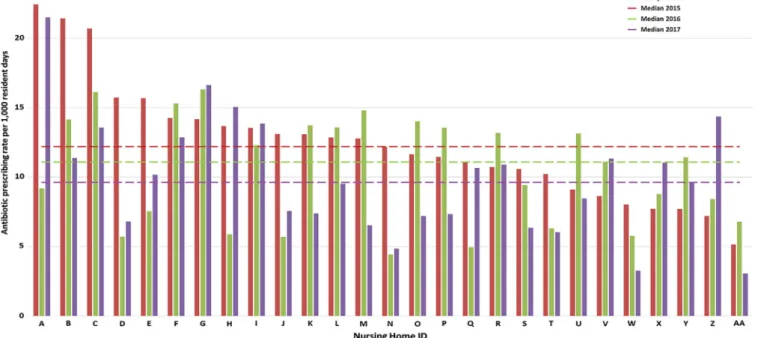
Comparison of the facility-level antibiotic prescribing rates at baseline, year 1, and year 2 demonstrated marked variation within study NHs from one year to the next, even within the same NH (Figure 1). In two-group comparisons, however, none of the primary or secondary outcomes significantly
Table 2. Baseline Characteristics of Participating NHs Overall and by Study Arm (N = 27)
Variable
Entire sample (N = 27)
NH chain (N = 14)
Provider group (N = 13)
Pvalue for difference between study armsa
NH Characteristics
For-profit ownership 22 (81) 14 (100) 8 (62) .02
Time in operation under current owner/corporation, y 13.3 (8.5) 11.8 (6.7) 14.9 (10.1) .34
Total No. of licensed NH beds 102 (41.3) 97 (39.7) 108 (43.9) .50
No. of licensed subacute or short-term beds 28 (16.1) 26 (15.4) 29 (17.3) .71
Dementia unit on site 4 (15) 0 (0) 4 (31) .04
Ventilator unit on site 1 (4) 0 (0) 1 (8) .48
Average overall rating onNursing Home Compareb 2.8 (1.2) 2.7 (1.1) 2.8 (1.4) .92
Average quality rating onNursing Home Compareb 3.2 (1.4) 3.4 (1.2) 3.0 (1.7) .53
Average time infection preventionist (nurse) devotes to infection control, h/wk
8.2 (6.3) 8.3 (5.9) 8.1 (6.8) .93
NH Residents
Aged≥85 y 40.6 (20.3) 37.7 (15.8) 43.7 (24.5) .45
Male sex 29.5 (12.3) 27.6 (8.8) 31.5 (15.4) .44
Race
Black or African American 32.1 (24.0) 34.6 (20.8) 29.3 (27.7) .56
White 66.9 (24.3) 64.6 (21.1) 69.5 (28.0) .61
Other 1.6 (5.2) 2.3 (7.2) 0.9 (1.6) .48
Dementia diagnosis 43.0 (19.9) 48.2 (15.7) 37.5 (22.9) .17
Primarily covered by Medicaid 53.7 (27.8) 54.6 (24.6) 52.7 (31.8) .85
Primarily covered by Medicare 20.9 (15.2) 23.6 (16.1) 17.6 (14.1) .29
Medical Providers
Residents with medical director as primary physician, %
80.9 (29.5) 69.4 (35.9) 93.2 (13.3) .03
Length of time current medical director at NH, y 6.4 (6.2) 9.1 (6.6) 3.6 (4.3) .19
No. of medical providers in NH 5.1 (3.8) 5.5 (4.5) 4.7 (3.1) .59
Physicians 3.2 (3.4) 3.8 (3.6) 2.5 (3.0) .29
Nurse practitioners or physician assistants 1.9 (1.4) 1.6 (1.5) 2.2 (1.1) .27
Note: Data are given as number (percentage) or mean (SD). Abbreviation: NH, nursing home.
differed across study arms with respect to change in prescrib-ing rates from baseline (Table 3).
Bivariate analyses found significant reductions in pre-scribing across the majority of the outcomes, with reduc-tions after 24 months generally being greater than those
after 12 months (Table 4). For the primary outcome, total sys-temic antibiotic prescriptions per 1000 resident-days, NHs experienced a 16% decrease at 12 months (P = .16) and a 20% decrease at 24 months (P= .004). This reduction largely related to a significant difference in prescribing for presumed
Figure 1. Antibiotic prescribing rates by nursing home (NH) at baseline, 1 year, and 2 years after implementation of antibiotic stewardship program. Each of the 27 NHs is represented by three vertical bars corresponding to the antibiotic prescribing rate per 1000 resident days during January to April of 2015, 2016, and 2017. ID indicates identification.
Table 3. Comparison of Temporal Changes between Intervention Arms in their Rates of Prescribing, Resistant Infections, and Hospitalizations
Variablea
Baseline rates Change from baseline after 1 y Change from baseline after 2 y
NH chain (N = 14)
Provider group (N = 13)
NH chain (N = 14)
Provider group (N = 13)
Pvalue (baseline/1 y)a
NH chain (N = 14)
Provider group (N = 13)
Pvalue (baseline/2 y)a
Site-specific prescription rate/1000 resident-days Total systemic
antibiotic prescriptions
11.92 12.91 -20.1 -11.8 .72 -11.6 -28.8 .06
UTI prescriptions 4.77 5.02 -17.4 -29.1 .52 -18.0 -39.4 .13
Respiratory tract infection prescriptions
3.13 3.91 -18.9 -15.9 .94 -6.4 -27.7 .24
Skin infection prescriptions
1.59 1.63 5.7 3.1 .98 -5.5 -13.0 1.00
Time between prescriptions, d
94.85 85.43 29.4 19.1 .87 28.2 48.6 .28
Treated infections per 10 000 resident-days
Clostridium difficile 3.89 2.37 -23.1 36.7 .79 -38.9 -10.7 .82
MRSA 2.58 0.85 -11.6 68.2 .09 -23.2 89.6 .37
Hospitalization rate per 1000 resident-days
All hospitalizations 3.58 2.72 -15.4 -9.2 .84 1.9 -10.8 .30
Readmissions within 30 d
1.93 1.09 -26.9 -31.2 .30 -12.3 -20.1 .73
Abbreviations: MRSA, methicillin-resistantStaphylococcus aureus; NH, nursing home; UTI, urinary tract infection.
aWilcoxon rank-sum test comparing temporal changes in outcome rates between study arms; one chain NH had its data excluded for 1 month in year 1
urinary tract infections (UTIs). Incidence of C. difficile and MRSA infections, hospitalizations, and hospital readmissions did not change significantly. Additionally, no cases were reported of sepsis associated with a decision to not give an anti-biotic based on program-associated training.
In the initial multivariable model for total systemic antibi-otic prescriptions, the arm×period interactions were not sig-nificant by a joint 2 df Wald test (P = .202). As there was insufficient evidence for the existence of such differences, the interactions were removed and a main effects multivariable model wasfitted to estimate temporal changes assumed to be common across arms. This final model also found that both the 12-month (P= .029) and 24-month (P= .001) period effects were statistically significant, indicating an overall reduc-tion in total systemic antibiotic prescribing. Specifically, relative to the baseline rate, the adjusted rate of antibiotic prescribing was an estimated 18% lower in months 9 to 12 of the interven-tion period (IRR = 0.82; 95% CI = 0.69-0.98) and 23% lower in months 19 to 24 (IRR = 0.77; 95% CI = 0.65-0.90). One baseline characteristic remained in the model—percentage of residents with the medical director as primary physician, with a 10% increase in residents with the medical director as primary physician associated with a 4.1% reduction in antibiotic pre-scribing (IRR = 0.96; 95% CI = 0.92-0.99).
Staff turnover and antibiotic prescribing were not signifi -cantly associated in the total sample, but for the NH chain arm, there was a significant negative correlation between nurse turn-over and prescribing changes during year 1 (ρ= -0.58;P= .03) and between medical director turnover and year 2 change (ρ= -0.68;P= .007). When included in multivariable models, however, neither staff turnover variable was significant.
During the intervention, the mean rate of urine culture ordering across the 27 NHs reduced from 4.15 cultures per 1000 days at baseline to 3.11 per 1000 resident-days during intervention months 21 to 24 (P= .03).
We estimated 2-year implementation costs for on-site staff training to range from a low of $151 (medical provider group NH, where no training was documented) to a high of $3459 (chain NH, where all staff attended in-service train-ing). Chain NHs had an average cost of $1270 for the live training, and medical provider homes had an average cost of $383, due to differential participation in formal training ses-sions. In addition, two chain homes and four medical pro-vider homes had zero costs, due to no documentation that training occurred. This difference between the study arms was significant (two-tailed t-test with unequal variances;
P= .01). An additional cost was $194 per NH for the training materials (brochures, posters, audiocasts) provided by the research team. Based on these estimates, if the program was broadly implemented in a similar manner, the total training and material costs per NH would range from $354 to $3653, depending on labor force participation in the training. Medical provider time (eg, listening/reading training materials, meeting with nursing staff, and reviewing reports) would be additional.
DISCUSSION
This 2-year implementation trial in 27 NHs demonstrated that, even in highly varied, community NHs, significant reductions in antibiotic prescribing can be achieved by a low-cost, standardized antibiotic stewardship program. Fur-thermore, it demonstrated that an antibiotic stewardship
Table 4. The 1- and 2-Year Changes in Rates of Prescribing, Resistant Infections, and Hospitalizations among all 27 Community Nursing Homes Participating in the Antibiotic Stewardship Intervention
Variable Baseline
At end of intervention year 1 At end of intervention year 2
Observed value
Absolute difference from baseline,
mean (SD)
% Change from
baseline Pvaluea Observedvalue
Absolute difference from baseline,
mean (SD)
% Change from
baseline Pvaluea
Site-specific prescription rate/1000 resident-days Total systemic
antibiotic prescriptions
12.40 10.42 1.98 (4.87) -16.0 .16 9.89 2.50 (4.13) -20.2 .004
UTI prescriptions 4.89 3.76 1.13 (2.15) -23.1 .02 3.49 1.39 (1.79) -28.6 <.001 Respiratory tract
infection prescriptions
3.51 2.91 0.59 (1.71) -17.1 .11 2.88 0.62 (1.78) -18.0 .15
Skin infection prescriptions
1.61 1.67 -0.06 (1.04) 3.7 .54 1.46 0.15 (0.89) -9.3 .22
Time between prescriptions, d
90.32 112.61 -22.29 (53.76) 24.7 .22 124.20 -33.89 (55.84) 37.5 .004
Treated infections per 10 000 resident-days
Clostridium difficile 3.16 3.11 0.05 (4.59) -1.6 .44 2.25 0.91 (4.61) -28.8 .49
MRSA 1.75 1.87 -0.12 (2.35) 6.9 .91 1.80 -0.05 (3.10) 2.9 .87
Hospitalization rate per 1000 resident-days
All hospitalizations 3.16 2.75 0.42 (1.61) -13.0 .27 3.05 0.11 (1.43) -3.5 .98 Readmissions
within 30 d
1.59 1.20 0.38 (0.91) -24.5 .10 1.29 0.34 (1.15) -18.9 .39
Abbreviations: MRSA, methicillin-resistantStaphylococcus aureus; UTI, urinary tract infection.
aWilcoxon signed-rank test comparing temporal change relative to baseline rates without distinction by study arm; one chain nursing home had its data
program can be successful when primary responsibility for dissemination is through either a NH chain or a medical provider group. However, as exemplified by our results showing greater improvement in the physician arm in year 2, and the association we noted between the proportion of residents cared for by the medical director, engaging physi-cians and other medical providers is likely to be especially critical in achieving long-term success. This is because NH staff turnover rates are high, thereby creating a need for intensive and ongoing reeducation to maintain knowledge of and enthusiasm for antibiotic stewardship efforts.
There are many reasons for antibiotic overprescribing in NHs. They house complex, frail residents, in whom infections can evolve rapidly and present atypically.27,28Providers are rarely on site; so, a substantial proportion of treatment deci-sions are made without a physician, nurse practitioner, or phy-sician assistant examining the patient.29,30 Adding to the challenge of obtaining an adequate assessment is the fact that the majority of NH residents have cognitive impairment31and that on-site laboratory testing is rarely available.32 In such decision-making situations, medical providers tend to over-value antibiotics and underestimate their adverse effects.29
Additionally, opinions are prevalent among many nurses and providers that are unsupported by the scientific literature but lead to antibiotic overuse; examples include belief that changes in urine color or odor merit antibiotic treatment,33that asymp-tomatic bacteriuria should be treated,34and that nonspecific status changes, such as weakness or decreased oral intake, should be considered a UTI until proved otherwise.29,35
To address these issues, several expert panels have developed consensus standards for diagnosis of UTI,36,37
and to identify when antibiotic use is appropriate.38,39Most
notable are the criteria of Loeb et al,38which are for antibi-otic initiation, and the criteria of McGeer,39 which were designed for retrospective surveillance. Unfortunately, both have substantial limitations in the clinically challenging NH setting. Loeb himself was unable to reduce antibiotic pre-scribing using his criteria40; other multisite studies have also
had difficulty reducing prescribing using similar methods41;
and our earlier trial, while lowering prescribing rates, found no correlation between Loeb criteria adherence and changes in prescribing.42 Because of these issues, our education focused on when not to give antibiotics rather than when to give them,23 a strategy that had been successfully implemented in our group’s prior efficacy study.22We attri-bute the success of our trial to this approach, and to provi-sion of a range of education and quality improvement modalities across an extended period of time to all parties involved in decision making.
Although our intervention was standardized across both study arms and all NHs, implementation and results were highly variable (Figure 1). Within individual NHs, interest in and adherence to the project would often change markedly after turnover of a key position, such as the infection pre-ventionist, medical director, or administrator. This reflects the reality of community NHs, in that far fewer professionals are present and their time is stretched much thinner than in hospital settings. For example, infection preventionist nurses in study NHs invariably had other roles and typically devoted only 5 to 10 hours a week to all infection-related responsibilities. This allocation contrasts with hospital set-tings, where infection control is typically its own department,
employing a physician or epidemiologist, one or more full-time nurses, surveillance personnel, secretarial staff, and computer support personnel.43Another source of variation in intervention response was uneven interest and enthusiasm on the part of the designated leaders in both arms, as evidenced by the wide variation in the proportion of nursing staff formally trained, based on training logs used to register continuing education credit. Despite these issues, we were able to achieve overall reductions in antibiotic prescribing.
The study has several potential limitations. Because there was insufficient evidence to detect significant differ-ences in antibiotic prescribing changes between the study arms, the main effects model wasfitted to estimate temporal reductions in antibiotic prescribing common across study arms. It is possible that a larger study could have identified a difference between the arms. Additionally, concurrent to this study, national attention to antibiotic prescribing in NHs was building, which could have contributed in part to the program’s success. In addition, the study attempted to gather implementation data from nursing staff and medical providers, but high turnover and nonresponse rates severely limited our capacity to understand the mechanisms by which some NHs were more successful than others.
One goal of antibiotic stewardship is reduction in antibiotic resistance rates and invasive infections with pathogens, such asC. difficile,or MDROs, such as MRSA and carbapenem-resistant Enterobacteriaceae. Here, our study was unable to demonstrate change (Tables 2 and 3). Such a result was not unexpected, however, as such reductions may take years to take effect in the best of circumstances44and reductions inC. difficile
rates are in large measure tied to hospital antibiotic use.45
Fur-thermore, antibiotic stewardship is but one tool in infection pre-vention and control; effective programs must also include hand hygiene, contact precautions, decolonization measures, and environmental decontamination.46All of these underscore the need for greater effort to improve infection management and antibiotic stewardship, as has now been mandated by the CMS and for which implementation is only beginning.
CONCLUSIONS
Antibiotic stewardship programs can be successfully dissemi-nated in community NHs through either NH administration or medical provider groups. Medical director involvement is an important element of program success.
ACKNOWLEDGMENTS
Financial Disclosure:This research was supported by grant R18 HS022846-01 from the US Agency for Healthcare Research and Quality.
Conflict of Interest: All authors report no conflicts of interest relevant to this article.
Author Contributions: All authors made substantial contributions to conception and design, and/or acquisition of data, and/or analysis and interpretation of data; participated in drafting the article or revising it critically for important intellectual content; and gavefinal approval of the version to be submitted.
G. Sheps Center for Health Services Research at the University of North Carolina at Chapel Hill with support from the US Agency for Healthcare Research and Quality (AHRQ). Other than providing funding, the AHRQ had no role in the conduct of the study or interpretation of the results.
REFERENCES
1. Spellberg B, Guidos R, Gilbert D, et al. The epidemic of antibiotic-resistant infections: a call to action for the medical community from the Infectious Diseases Society of America. Clin Infect Dis. 2008;46(2):155-164.
2. Carlet J, Pulcini C, Piddock LJ. Antibiotic resistance: a geopolitical issue. Clin Microbiol Infect. 2014;20(10):949-953.
3. Doron S, Davidson LE. Antimicrobial stewardship. Mayo Clin Proc. 2011; 86(11):1113-1123.
4. Society for Healthcare Epidemiology of America, Infectious Diseases Society of America, Pediatric Infectious Diseases Society. Policy statement on antimi-crobial stewardship by the Society for Healthcare Epidemiology of America (SHEA), the Infectious Diseases Society of America (IDSA), and the Pediatric Infectious Diseases Society (PIDS). Infect Control Hosp Epidemiol. 2012; 33(4):322-327.
5. Pollack LA, van Santen KL, Weiner LM, Dudeck MA, Edwards JR, Srinivasan A. Antibiotic stewardship programs in U.S. acute care hospitals: findings from the 2014 national healthcare safety network annual hospital survey. Clin Infect Dis. 2016;63(4):443-449.
6. Wagner B, Filice GA, Drekonja D, et al. Antimicrobial stewardship programs in inpatient hospital settings: a systematic review. Infect Control Hosp Epidemiol. 2014;35(10):1209-1228.
7. Lawes T, Lopez-Lozano JM, Nebot CA, et al. Effects of national antibiotic stewardship and infection control strategies on hospital-associated and community-associated meticillin-resistant Staphylococcus aureus infections across a region of Scotland: a non-linear time-series study. Lancet Infect Dis. 2015;15(12):1438-1449.
8. Cook PP, Gooch M. Long-term effects of an antimicrobial stewardship pro-gramme at a tertiary-care teaching hospital. Int J Antimicrob Agents. 2015; 45(3):262-267.
9. Trick WE, Weinstein RA, DeMarais PL, et al. Colonization of skilled-care facility residents with antimicrobial-resistant pathogens. J Am Geriatr Soc. 2001;49:270-276.
10. Pakyz AL, Dwyer LL. Prevalence of antimicrobial use among United States nursing home residents: results from a national survey. Infect Control Hosp Epidemiol. 2010;31(6):661-662.
11. O’Fallon E, Kandel R, Schreiber R, D’Agata EM. Acquisition of multidrug-resistant gram-negative bacteria: incidence and risk factors within a long-term care population. Infect Control Hosp Epidemiol. 2010;31(11): 1148-1153.
12. US Department of Health and Human Services, Office of Disease Prevention and Health Promotion. Long-term care facilities. National Action Plan to Prevent Healthcare-Associated Infections: Roadmap to Elimination. https: //health.gov/hcq/pdfs/hai-action-plan-ltcf.pdf. Accessed August 21, 2018. 13. Medicare and Medicaid Programs; Reform of Requirements for Long-Term
Care Facilities [Internet]. Federal Register. 2016 (81 FR 68688). https:// www.federalregister.gov/documents/2016/10/04/2016-23503/medicare-and-medicaid-programs-reform-of-requirements-for-long-term-care-facilities. Accessed November 8, 2016.
14. Centers for Disease Control and Prevention. The Core Elements of Antibiotic Stewardship in Nursing Homes. Centers for Disease Control and Prevention. 2015. https://www.cdc.gov/antibiotic-use/healthcare/implementation/core-elements.html. Accessed April 7, 2018.
15. Rantz MJ, Flesner MK, Zwygart-Stauffacher M. Improving care in nursing homes using quality measures/indicators and complexity science. J Nurs Care Qual. 2010;25(1):5-12.
16. Lanham HJ, Leykum LK, Taylor BS, McCannon CJ, Lindberg C, Lester RT. How complexity science can inform scale-up and spread in health care: understanding the role of self-organization in variation across local contexts. Soc Sci Med. 2013;93:194-202.
17. Oberst J. 2015 Top 50 largest nursing facility companies. Provider. 2015; 45-49.
18. Harris-Kojetin L, Sengupta M, Park-Lee E, et al. Long-term care providers and services users in the United States: data from the National Study of Long-Term Care Providers, 2013-2014. Vital Health Stat. 2016;3(38):x-xii): 1-105.
19. Katz PR, Karuza J, Intrator O, Mor V. Nursing home physician specialists: a response to the workforce crisis in long-term care. Ann Intern Med. 2009; 150(6):411-413.
20. Blozik E, Born AM, Stuck AE, Benninger U, Gillmann G, Clough-Gorr KM. Reduction of inappropriate medications among older nursing-home resi-dents: a nurse-led, pre/post-design, intervention study. Drugs Aging. 2010; 27(12):1009-1017.
21. Monette J, Miller MA, Monette M, et al. Effect of an educational interven-tion on optimizing antibiotic prescribing in long-term care facilities. J Am Geriatr Soc. 2007;55(8):1231-1235.
22. Zimmerman S, Sloane PD, Bertrand R, et al. Successfully reducing antibiotic prescribing in nursing homes. J Am Geriatr Soc. 2014;62(5):907-912. 23. Khandelwal C, Lathren C, Sloane PD. Ten clinical situations in long-term
care for which antibiotics are often prescribed but are rarely necessary. Ann Longterm Care. 2012;20(4):23-29.
24. Sloane PD, Kistler CE, Reed D, Weber DJ, Ward K, Zimmerman S. Urine culture testing in community nursing homes: gateway to antibiotic over-prescribing. Infect Control Hosp Epidemiol. 2017;38(5):524-531.
25. United States Department of Labor. May 2016 State Occupational Employment and Wage Estimates - North Carolina [Internet]. Bureau of Labor Statistics. 2017. https://www.bls.gov/oes/current/oes_nc.htm. Accessed April 14, 2018. 26. Medicare.gov/Nursing Home Compare. The Official US Site for Medicare.
https://www.medicare.gov/nursinghomecompare. Accessed August 20, 2017. 27. Wang HE, Shah MN, Allman RM, Kilgore M. Emergency department visits by nursing home residents in the United States. J Am Geriatr Soc. 2011; 59(10):1864-1872.
28. Ginde AA, Moss M, Shapiro NI, Schwartz RS. Impact of older age and nurs-ing home residence on clinical outcomes of US emergency department visits for severe sepsis. J Crit Care. 2013;28(5):606-611.
29. Nace DA, Drinka PJ, Crnich CJ. Clinical uncertainties in the approach to long term care residents with possible urinary tract infection. J Am Med Dir Assoc. 2014;15(2):133-139.
30. Sloane PD, Ward K, Weber DJ, et al. Can sepsis be detected in the nursing home prior to the need for hospital transfer? J Am Med Dir Assoc. 2018; 19(6):492-496.
31. Helvik A, Engedal K, Benth J, Selbaek G. Prevalence and severity of demen-tia in nursing home residents. Dement Geriatr Cogn Disord. 2015;40(3-4): 166-177.
32. Nicolle LE. Antimicrobial stewardship in long term care facilities: what is effective? Antimicrob Resist Infect Control. 2014;3(1):6.
33. Midthun S, Paur R, Bruce AW, Midthun P. Urinary tract infections in the elderly: a survey of physicians and nurses. Geriatr Nurs. 2005;26(4):245-251. 34. Ouslander JG, Schapira M, Schnelle JF, et al. Does eradicating bacteriuria
affect the severity of chronic urinary incontinence in nursing home residents? Ann Intern Med. 1995;122(10):749-754.
35. Sundvall PD, Ulleryd P, Gunnarsson RK. Urine culture doubtful in determin-ing etiology of diffuse symptoms among elderly individuals: a cross-sectional study of 32 nursing homes. BMC Fam Pract. 2011;12:36.
36. van Buul LW, Vreeken HL, Bradley SF, et al. Hertogh CMPM The develop-ment of a decision tool for the empiric treatdevelop-ment of suspected urinary tract infection in frail older adults: a Delphi consensus procedure. J Am Med Dir Assoc. 2018;19(9):757-764.
37. Nace DA, Perera SK, Hanlon JT, et al. The Improving Outcomes of UTI Management in Long-Term Care Project (IOU) consensus guidelines for the diagnosis of uncomplicated cystitis in nursing home residents. J Am Med Dir Assoc. 2018;19(9):765-769.e3.
38. Loeb M, Bentley D, Bradley S, et al. Development of minimum criteria for the initiation of antibiotics in residents of long-term-care facilities: results of a con-sensus conference. Infect Control Hosp Epidemiol. 2001;22(2):120-124. 39. Stone ND, Ashraf MS, Calder J, et al. Surveillance definitions of infections in
long-term care facilities: revisiting the McGeer criteria. Infect Control Hosp Epidemiol. 2012;33(10):965-977.
40. Loeb M, Brazil K, Lohfeld L, et al. Effect of a multifaceted intervention on number of antimicrobial prescriptions for suspected urinary tract infections in residents of nursing homes: cluster randomized controlled trial. BMJ. 2005;331(7518):669.
41. Feldstein D, Sloane PD, Feltner C. Antibiotic stewardship programs in nurs-ing homes: a systematic review. J Am Med Dir Assoc. 2018;19(2):110-116. 42. Olsho LE, Bertrand RM, Edwards AS, et al. Does adherence to the Loeb
minimum criteria reduce antibiotic prescribing rates in nursing homes? J Am Med Dir Assoc. 2013;14(4):309.e1-309.e7.
43. Sydnor ER, Perl TM. Hospital epidemiology and infection control in acute-care settings. Clin Microbiol Rev. 2011;24(1):141-173.
45. Pawar D, Tsay R, Nelson DS, et al. Burden ofClostridium difficileinfection in long-term care facilities in Monroe County, New York. Infect Control Hosp Epidemiol. 2012;33(11):1107-1112.
46. Hughes C, Tunney M, Bradley MC. Infection control strategies for preventing the transmission of meticillin-resistant Staphylococcus aureus (MRSA) in nursing homes for older people. Cochrane Database Syst Rev. 2013;11:CD006354.
SUPPORTING INFORMATION
Additional Supporting Information may be found in the online version of this article.