• No results found

Unit-4 Switching, Error Detection & Correction.ppt

N/A
N/A
Protected

Academic year: 2020

Share "Unit-4 Switching, Error Detection & Correction.ppt"

Copied!
57
0
0

Loading.... (view fulltext now)

Full text

(1)

Unit-4

Switching, Error Detection &

Correction

(2)

Contents

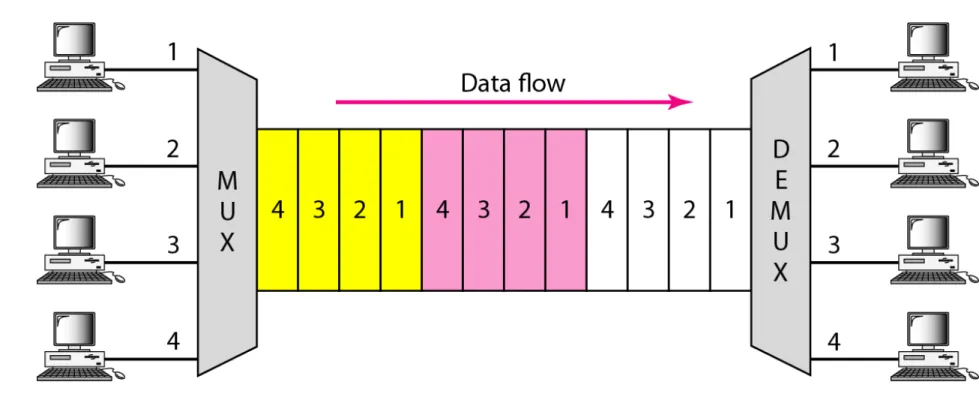
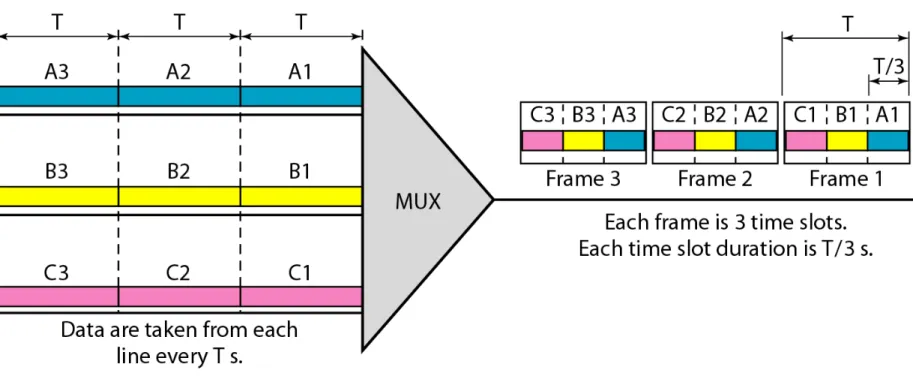
Multiplexing

Switching

Circuit Switched Networks

Datagram networks

Virtual Circuits Networks

Dial-up MODEMS

Digital Subscriber Line

Error Detection & Correction

Block Coding

(3)

Multiplexing

Whenever the bandwidth of a medium linking two devices is greater than the bandwidth needs of the devices, the link can be shared. Multiplexing is the set of techniques that allows the simultaneous transmission of multiple signals across a single data link. As data and telecommunications use increases, so does traffic.

(4)
(5)
(6)
(7)
(8)
(9)
(10)
(11)
(12)

Switching

 When ever we have multiple devices, we have the problem of how to

connect the devices to make them one to one communicate.

 One solution is to make point-to-point connection between each

devices. But these are impractical and wastage of resources.

 A better solution is switching.

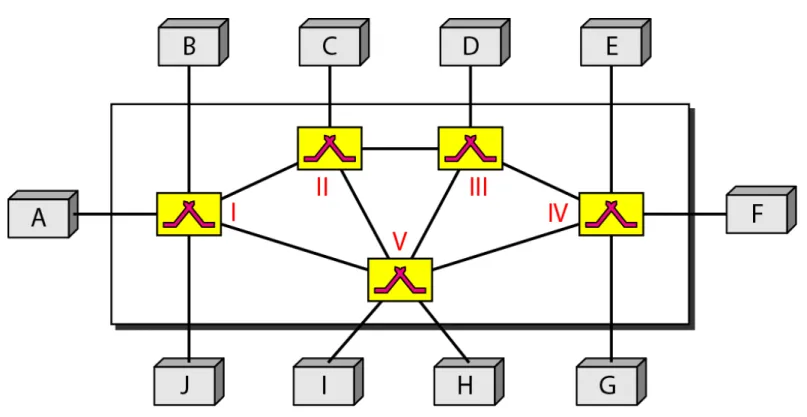
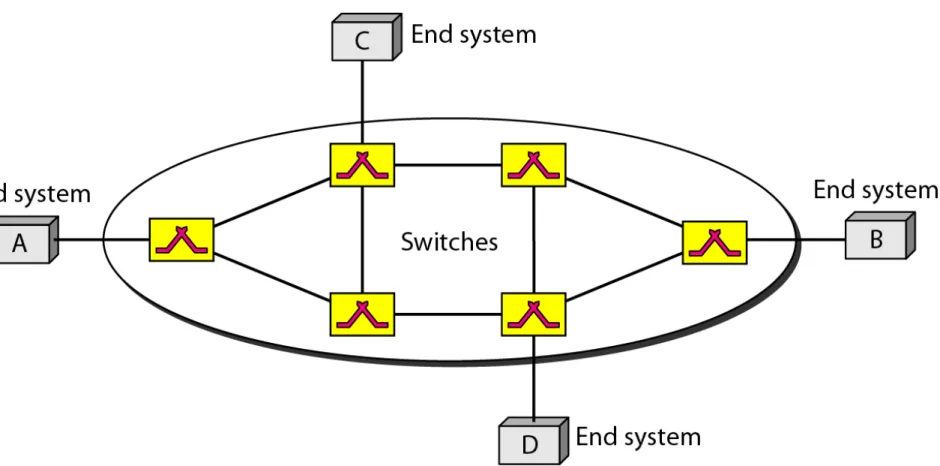
 A switched network consists of a series of interlinked nodes, called

switches.

 Switches are devices capable of creating temporary connections

between two or more devices linked to the switch.

 In a switched network, some of these nodes are connected to the end

(13)
(14)
(15)

CIRCUIT-SWITCHED NETWORKS

 A circuit-switched network consists of a set of switches connected by physical links.

 A connection between two stations is a dedicated path made of one or more links. However, each connection uses only one dedicated channel on each link.

 Each link is normally divided into n channels by using FDM or TDM.

 Circuit switching takes place at the physical layer.

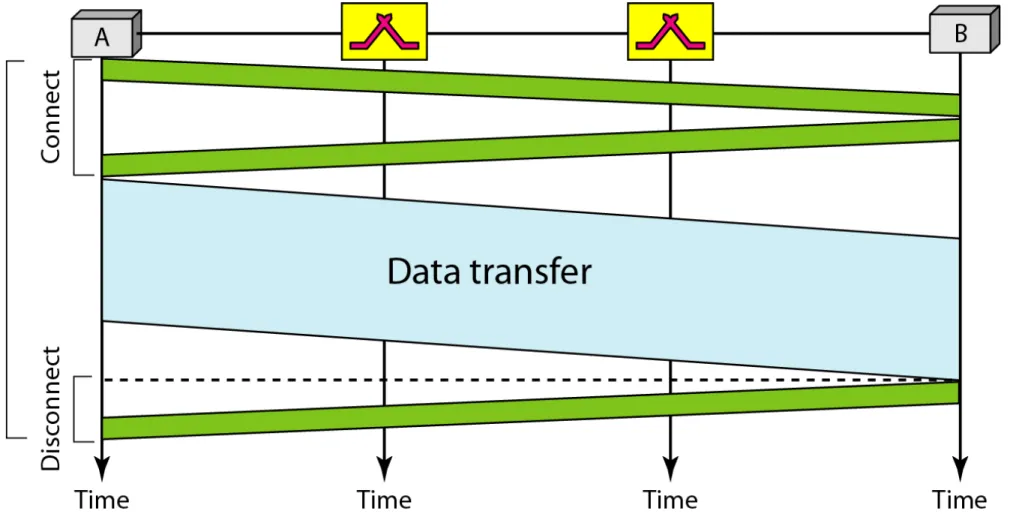
 Before starting communication, the stations must make a reservation for the resources to be used during the communication. This is called as setup phase.

 These resources must remain dedicated during the entire duration of data transfer.

 Data transfer between two stations is not packetized. The data are a continuous flow sent by the source station and received by the destination station. This is known as data transfer phase.

(16)
(17)
(18)

Packet-Switched Network

 In data communications, we need to send messages from one end system to another.

 If the message is going to pass through a packet-switched network, it needs to be divided into packets of fixed or variable size.

 The size of the packet is determined by the network and the governing protocol.

 In a packet-switched network, there is no resource reservation; resources are allocated on demand.

(19)

Datagram Networks

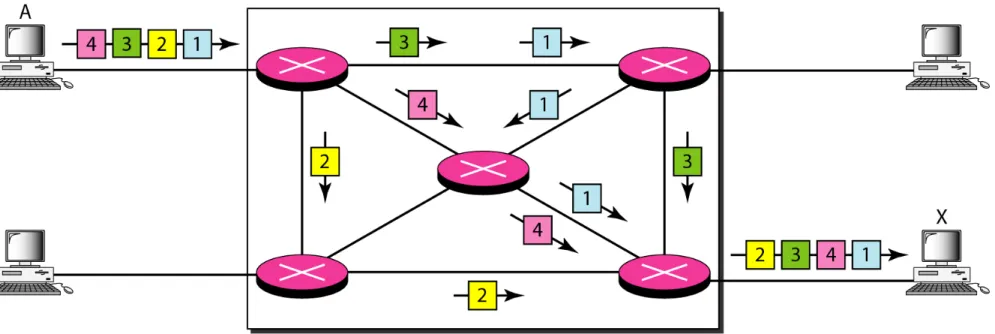
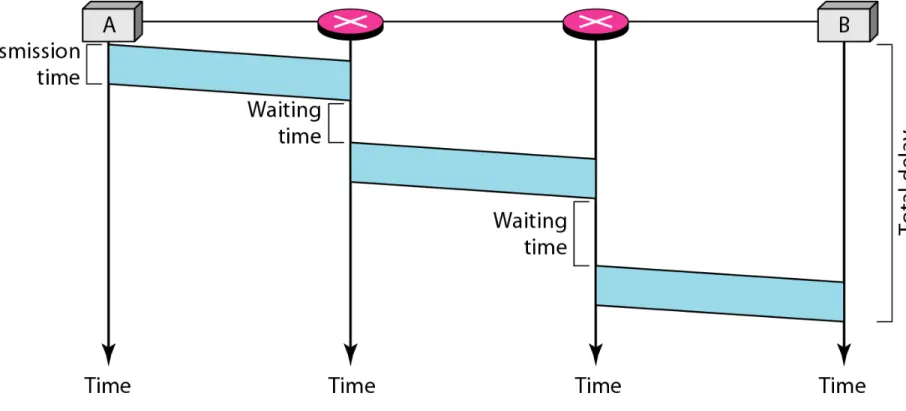
 In a datagram network, each packet is treated independently of all

others, even the packet is a part of multipacket transmission.

 Packets in this approach is known as datagrams.  Datagram switching is done at networking layer.

 In most protocols, it is the responsibility of an upper layer protocol

to reorder the datagrams.

 The datagram networks are sometimes referred to as connectionless

network.

 The connectionless here means that the switch does not keep

information about the connection state.

(20)

Figure 13

A datagram network with four switches (routers)

A switch in a datagram network uses a

routing table that is based on the

(21)

Figure 14

Routing table in a datagram network

(22)
(23)

VIRTUAL-CIRCUIT NETWORKS

VIRTUAL-CIRCUIT NETWORKS

 A virtual-circuit network is a cross between a circuit-switched network and a datagram network. It has some characteristics of both.

 In this also there are setup & teardown phases in addition to the data transfer phase.

 Resources can be allocated during the setup phase, as in circuit-switched network, or on demand as in datagram network.

 As in circuit switch, all packets follow the same path established during the connection.

As in datagram network, the data are packetized an each packet

carries an address in the header. However the address in the header is the address of next switch and the channel on which the packet is being carried, not the end to end address.
(24)
(25)
(26)
(27)
(28)
(29)
(30)

In virtual-circuit switching, all packets

belonging to the same source and

destination travel the same path;

but the packets may arrive at the

destination with different delays

if resource allocation is on demand.

(31)
(32)

Switching at the data link layer in a

switched WAN is normally

implemented by using

virtual-circuit techniques.

(33)

DIAL-UP MODEMS

Traditional telephone lines can carry frequencies

Traditional telephone lines can carry frequencies

between 300 and 3300 Hz, giving them a bandwidth of

between 300 and 3300 Hz, giving them a bandwidth of

3000 Hz. All this range is used for transmitting voice,

3000 Hz. All this range is used for transmitting voice,

where a great deal of interference and distortion can

where a great deal of interference and distortion can

be accepted without loss of intelligibility.

be accepted without loss of intelligibility.

(34)
(35)
(36)

DIGITAL SUBSCRIBER LINE

After traditional modems reached their peak data rate,

telephone companies developed another technology,

DSL, to provide higher-speed access to the Internet.

Digital subscriber line

(

DSL

) technology is one of the

most promising for supporting high-speed digital

communication over the existing local loops.

(37)
(38)
(39)

Figure 28

ADSL modem

(40)
(41)

In a single-bit error, only 1 bit in the data

unit has changed.

Error Detection & Correction

Data can be corrupted

during transmission.

(42)

Figure 29

Single-bit error

Figure 29 (A)

Burst error of length 8

(43)
(44)

BLOCK CODING

BLOCK CODING

In block coding, we divide our message into blocks,

In block coding, we divide our message into blocks,

each of k bits, called

each of k bits, called datawords

datawords

. We add r redundant

. We add r redundant

bits to each block to make the length n = k + r. The

bits to each block to make the length n = k + r. The

resulting n-bit blocks are called

resulting n-bit blocks are called codewords

codewords

.

.

(45)
(46)

LINEAR BLOCK CODES

LINEAR BLOCK CODES

Almost all block codes used today belong to a subset

Almost all block codes used today belong to a subset

called

called linear block codes

linear block codes

. A linear block code is a code

. A linear block code is a code

in which the exclusive OR (addition modulo-2) of two

in which the exclusive OR (addition modulo-2) of two

valid codewords creates another valid codeword.

(47)
(48)
(49)
(50)
(51)
(52)

CYCLIC CODES

CYCLIC CODES

Cyclic codes

Cyclic codes

are special linear block codes with one

are special linear block codes with one

extra property. In a cyclic code, if a codeword is

extra property. In a cyclic code, if a codeword is

cyclically shifted (rotated), the result is another

cyclically shifted (rotated), the result is another

codeword.

(53)
(54)
(55)
(56)
(57)

Figure

Figure 7   TDM
Figure 8   Synchronous time-division multiplexing
Figure 9   Switched network
Figure 10   Taxonomy of switched networks
+7

References

Related documents

One of the biggest challenges in personalized medicine is how to convert clinical research and product development into a financially sustainable business strategy which can project

Although it is not reflected in the average percentage of participants who provided correct responses in the Written- Terminal Probe condition, the follow-up questioning

This field trial was designed to test the feasibility of the use of intranasal midazolam as an alternative to rectal diazepam in a cohort of patients with severe epilepsy who

The new debtor ID (customer number) that the creditor wants his debtor to have instead of the debtor ID stated in field 9. See Collection Service Implementation Guide

Connect through COM Port is used for MGate PROFIBUS Gateways, such as the MGate 4101-MB-PBS series,.. which are discovered via RS-232 serial

Thus, in this study we developed a nested multiplex polymerase chain reaction (PCR) to detect and identify A2058G and A2059G mutations in 23S rRNA geneT. Methods: Three primer

This Part 380 contains terms and regulations adopted by the Copyright Royalty Judges (Judges) in the context of a rate determination proceeding, Determination of Royalty Rates and