IBM
Informix
Guide
to
SQL:
Tutorial
Version10.0/8.5
IBM
Informix
Guide
to
SQL:
Tutorial
Version10.0/8.5
Note!
Beforeusingthisinformationandtheproductitsupports,readtheinformationin“Notices”onpageB-1.
FirstEdition(December2004)
ThisdocumentcontainsproprietaryinformationofIBM.Itisprovidedunderalicenseagreementandisprotectedby copyrightlaw.Theinformationcontainedinthispublicationdoesnotincludeanyproductwarranties,andany statementsprovidedinthismanualshouldnotbeinterpretedassuch.
WhenyousendinformationtoIBM,yougrantIBManonexclusiverighttouseordistributetheinformationinany wayitbelievesappropriatewithoutincurringanyobligationtoyou.
Contents
Introduction. . . . . . . . . . . . . . . . . . . . . . . . . . . . . . . xi
AboutThisManual . . . xi
TypesofUsers . . . xii
SoftwareDependencies . . . xii
AssumptionsAboutYourLocale . . . xii
DemonstrationDatabase . . . xiii
NewFeaturesinDynamicServer,Version10.0 . . . xiii
DocumentationConventions . . . xiv
TypographicalConventions . . . xiv
Feature,Product,andPlatform . . . xv
SyntaxDiagrams . . . xvi
ExampleCodeConventions . . . xx
AdditionalDocumentation. . . xxi
InstallationGuides . . . xxi
OnlineNotes . . . xxi
InformixErrorMessages . . . xxiii
Manuals . . . xxiv
OnlineHelp . . . xxiv
Accessibility . . . xxiv
IBMInformixDynamicServerVersion10.0andCSDKVersion2.90DocumentationSet . . . xxiv
CompliancewithIndustryStandards . . . xxvii
IBMWelcomesYourComments . . . xxviii Chapter1.DatabaseConcepts. . . . . . . . . . . . . . . . . . . . . . . . 1-1 IllustrationofaDataModel . . . 1-2 StoringData . . . 1-3 QueryingData. . . 1-4 ModifyingData . . . 1-5 ConcurrentUseandSecurity . . . 1-6 ControllingDatabaseUse . . . 1-6 CentralizedManagement . . . 1-7 ImportantDatabaseTerms. . . 1-8 TheRelationalDatabaseModel . . . 1-8 Tables. . . 1-9 Columns. . . 1-9 Rows . . . 1-10 Views . . . 1-10 Sequences . . . 1-10 OperationsonTables . . . 1-10 TheObject-RelationalModel(IDS). . . 1-11 StructuredQueryLanguage . . . 1-12 StandardSQL. . . 1-12 InformixSQLandANSISQL . . . 1-13 InteractiveSQL . . . 1-13 GeneralProgramming . . . 1-14
ANSI-CompliantDatabases . . . 1-14 GlobalLanguageSupport(GLS) . . . 1-14 Summary . . . 1-14 Chapter2.ComposingSELECTStatements . . . . . . . . . . . . . . . . . . . 2-1 IntroducingtheSELECTStatement . . . 2-2 OutputfromSELECTStatements . . . 2-3 SomeBasicConcepts . . . 2-4 Single-TableSELECTStatements. . . 2-8 UsingtheAsteriskSymbol(*). . . 2-9 UsingtheORDERBYClausetoSorttheRows. . . 2-10 SelectingSpecificColumns . . . 2-14 UsingtheWHEREClause . . . 2-22 CreatingaComparisonCondition . . . 2-22 UsingaFIRSTClausetoSelectSpecificRows . . . 2-38 ExpressionsandDerivedValues . . . 2-41 UsingRowidValuesInSELECTStatements. . . 2-48 Multiple-TableSELECTStatements . . . 2-49 CreatingaCartesianProduct . . . 2-50 CreatingaJoin . . . 2-52 SomeQueryShortcuts. . . 2-59 Summary . . . 2-62 Chapter3.SelectingDatafromComplexTypes(IDS). . . . . . . . . . . . . . . . 3-1 SelectingRow-TypeData . . . 3-2 SelectingColumnsofaTypedTable . . . 3-3 SelectingColumnsThatContainRow-TypeData . . . 3-4 SelectingfromaCollection. . . 3-8 SelectingNestedCollections . . . 3-9 UsingtheINKeywordtoSearchforElementsinaCollection. . . 3-10 SelectingRowsWithinaTableHierarchy . . . 3-11 SelectingRowsoftheSupertablewithouttheONLYKeyword . . . 3-13 SelectingRowsfromaSupertablewiththeONLYKeyword . . . 3-13 UsinganAliasforaSupertable. . . 3-14 Summary . . . 3-14 Chapter4.UsingFunctionsinSELECTStatements . . . . . . . . . . . . . . . . 4-1 UsingFunctionsinSELECTStatements . . . 4-2 AggregateFunctions. . . 4-2 TimeFunctions . . . 4-8 Date-ConversionFunctions(IDS) . . . 4-13 CardinalityFunction(IDS) . . . 4-17 Smart-Large-ObjectFunctions(IDS) . . . 4-17 String-ManipulationFunctions(IDS) . . . 4-19 OtherFunctions . . . 4-26 UsingSPLRoutinesinSELECTStatements . . . 4-33 UsingDataEncryptionFunctions(IDS) . . . 4-35 Summary . . . 4-36 Chapter5.ComposingAdvancedSELECTStatements . . . . . . . . . . . . . . . 5-1
UsingtheGROUPBYandHAVINGClauses. . . 5-2 UsingtheGROUPBYClause . . . 5-3 UsingtheHAVINGClause . . . 5-6 CreatingAdvancedJoins . . . 5-9 Self-Joins. . . 5-9 OuterJoins . . . 5-13 SubqueriesinSELECTStatements . . . 5-22 CorrelatedSubqueries . . . 5-22 SubqueriesinSELECTStatements . . . 5-23 SubqueriesinaProjectionClause . . . 5-24 SubqueriesinWHEREClauses . . . 5-24 HandlingCollectionsinSELECTStatements(IDS) . . . 5-32 CollectionSubqueries . . . 5-32 Collection-DerivedTables. . . 5-34 SetOperations . . . 5-36 Union . . . 5-36 Intersection . . . 5-43 Difference . . . 5-44 Summary . . . 5-45 Chapter6.ModifyingData . . . . . . . . . . . . . . . . . . . . . . . . . 6-1 ModifyingYourDatabase . . . 6-2 DeletingRows. . . 6-3 DeletingAllRowsofaTable . . . 6-3 DeletingAllRowsusingTRUNCATETABLE . . . 6-4 DeletingSpecifiedRows . . . 6-5 DeletingSelectedRows . . . 6-5 DeletingRowsThatContainRowTypes(IDS) . . . 6-6 DeletingRowsThatContainCollectionTypes(IDS) . . . 6-6 DeletingRowsfromaSupertable(IDS) . . . 6-6 ComplicatedDeleteConditions . . . 6-7 UsingaDeleteJoin(XPS) . . . 6-7 InsertingRows. . . 6-8 SingleRows . . . 6-8 InsertingRowsintoTypedTables(IDS) . . . 6-10 InsertingintoRow-TypeColumns(IDS) . . . 6-11 InsertingRowsintoSupertables(IDS) . . . 6-13 InsertingCollectionValuesintoColumns(IDS) . . . 6-13 InsertingSmartLargeObjects(IDS) . . . 6-15 MultipleRowsandExpressions. . . 6-15 RestrictionsontheInsertSelection. . . 6-16 UpdatingRows . . . 6-17 SelectingRowstoUpdate. . . 6-17 UpdatingwithUniformValues . . . 6-18 RestrictionsonUpdates . . . 6-19 UpdatingwithSelectedValues . . . 6-20 UpdatingRowTypes(IDS) . . . 6-20 UpdatingCollectionTypes(IDS) . . . 6-22 UpdatingRowsofaSupertable(IDS). . . 6-22 UsingaCASEExpressiontoUpdateaColumn . . . 6-23
UsingSQLFunctionstoUpdateSmartLargeObjects(IDS) . . . 6-24 UsingaJointoUpdateaColumn . . . 6-24 PrivilegesonaDatabaseandonitsObjects. . . 6-25 Database-LevelPrivileges. . . 6-25 Table-LevelPrivileges . . . 6-25 DisplayingTablePrivileges . . . 6-26 GrantingPrivilegestoRoles . . . 6-27 DataIntegrity. . . 6-27 EntityIntegrity . . . 6-28 SemanticIntegrity . . . 6-28 ReferentialIntegrity . . . 6-29 ObjectModesandViolationDetection . . . 6-31 InterruptedModifications. . . 6-40 Transactions . . . 6-40 TransactionLogging . . . 6-41 SpecifyingTransactions . . . 6-43 BackupsandLogswithInformixDatabaseServers . . . 6-44 ConcurrencyandLocks . . . 6-45 IBMInformixDataReplication(IDS) . . . 6-46 Summary . . . 6-47 Chapter7.AccessingandModifyingDatainanExternalDatabase . . . . . . . . . . . 7-1 AccessingOtherDatabaseServers . . . 7-1 AccessingANSIDatabases. . . 7-2 CreatingJoinsBetweenExternalDatabaseServers . . . 7-2 AccessingExternalRoutines(IDS) . . . 7-2 RestrictionsforRemoteDatabaseAccess . . . 7-2 SQLStatementsandLoggingModes . . . 7-2 AccessingExternalDatabaseObjects . . . 7-3 Chapter8.ProgrammingwithSQL . . . . . . . . . . . . . . . . . . . . . . 8-1 SQLinPrograms . . . 8-2 SQLinSQLAPIs . . . 8-2 SQLinApplicationLanguages . . . 8-3 StaticEmbedding. . . 8-3 DynamicStatements . . . 8-4 ProgramVariablesandHostVariables . . . 8-4 CallingtheDatabaseServer . . . 8-5 SQLCommunicationsArea . . . 8-5 SQLCODEField . . . 8-6 SQLERRDArray . . . 8-7 SQLWARNArray. . . 8-8 SQLERRMCharacterString . . . 8-10 SQLSTATEValue . . . 8-10 RetrievingSingleRows . . . 8-10 DataTypeConversion . . . 8-11 WorkingwithNULLData . . . 8-12 DealingwithErrors. . . 8-13 RetrievingMultipleRows. . . 8-15 DeclaringaCursor . . . 8-15
OpeningaCursor . . . 8-16 FetchingRows . . . 8-16 CursorInputModes . . . 8-17 ActiveSetofaCursor . . . 8-18 UsingaCursor:APartsExplosion. . . 8-20 DynamicSQL. . . 8-23 PreparingaStatement . . . 8-23 ExecutingPreparedSQL . . . 8-24 DynamicHostVariables . . . 8-25 FreeingPreparedStatements. . . 8-26 QuickExecution. . . 8-26 EmbeddingData-DefinitionStatements . . . 8-26 GrantingandRevokingPrivilegesinApplications . . . 8-26 AssigningRoles . . . 8-29 Summary . . . 8-29 Chapter9.ModifyingDataThroughSQLPrograms . . . . . . . . . . . . . . . . 9-1 UsingDELETE. . . 9-2 DirectDeletions . . . 9-2 DeletingwithaCursor . . . 9-4 UsingINSERT . . . 9-6 UsinganInsertCursor . . . 9-6 RowsofConstants . . . 9-8 AnInsertExample . . . 9-9 UsingUPDATE . . . 9-11 UsinganUpdateCursor . . . 9-11 CleaningUpaTable . . . 9-12 Summary . . . 9-13 Chapter10.ProgrammingforaMultiuserEnvironment. . . . . . . . . . . . . . . 10-1 ConcurrencyandPerformance . . . 10-2 LockingandIntegrity . . . 10-2 LockingandPerformance. . . 10-2 ConcurrencyIssues. . . 10-3 HowLocksWork . . . 10-4 KindsofLocks . . . 10-4 LockScope . . . 10-5 DurationofaLock . . . 10-11 LocksWhileModifying . . . 10-11 LockingwiththeSELECTStatement. . . 10-12 SettingtheIsolationLevel . . . 10-12 UpdateCursors. . . 10-17 RetainingUpdateLocks . . . 10-17 LocksPlacedwithINSERT,UPDATE,andDELETE. . . 10-18 UnderstandingtheBehavioroftheLockTypes . . . 10-19 ControllingDataModificationwithAccessModes . . . 10-20 SettingtheLockMode . . . 10-20 WaitingforLocks . . . 10-21 NotWaitingforLocks . . . 10-21 WaitingaLimitedTime . . . 10-21
HandlingaDeadlock. . . 10-21 HandlingExternalDeadlock . . . 10-22 SimpleConcurrency . . . 10-22 HoldCursors . . . 10-22 UsingtheSQLStatementCache . . . 10-24 Summary. . . 10-25 Chapter11.CreatingandUsingSPLRoutines. . . . . . . . . . . . . . . . . . 11-1 IntroductiontoSPLRoutines . . . 11-3 WhatYouCanDowithSPLRoutines. . . 11-4 SPLRoutineBehaviorforExtendedParallelServer . . . 11-4 WritingSPLRoutines . . . 11-5 UsingtheCREATEPROCEDUREorCREATEFUNCTIONStatement . . . 11-5 ExampleofaCompleteRoutine . . . 11-16 CreatinganSPLRoutineinaProgram . . . 11-16 RoutinesinDistributedOperation . . . 11-17 DefiningandUsingVariables . . . 11-18 DeclaringLocalVariables . . . 11-19 DeclaringGlobalVariables . . . 11-27 AssigningValuestoVariables . . . 11-28 ExpressionsinSPLRoutines . . . 11-31 WritingtheStatementBlock . . . 11-31 ImplicitandExplicitStatementBlocks . . . 11-31 UsingCursors . . . 11-32 UsingtheFOREACHLooptoDefineCursors . . . 11-33 UsinganIF-ELIF-ELSEStructure . . . 11-35 AddingWHILEandFORLoops . . . 11-38 ExitingaLoop . . . 11-39 ReturningValuesfromanSPLFunction . . . 11-40 ReturningaSingleValue . . . 11-41 ReturningMultipleValues . . . 11-41 HandlingRow-TypeData(IDS) . . . 11-43 PrecedenceofDotNotation. . . 11-44 UpdatingaRow-TypeExpression. . . 11-44 HandlingCollections(IDS) . . . 11-45 UsingCollectionDataTypes . . . 11-45 PreparingforCollectionDataTypes(IDS) . . . 11-46 InsertingElementsintoaCollectionVariable . . . 11-48 SelectingElementsfromaCollection. . . 11-51 DeletingaCollectionElement . . . 11-54 UpdatingaCollectionElement . . . 11-57 UpdatingtheEntireCollection. . . 11-59 InsertingintoaCollection . . . 11-63 ExecutingRoutines . . . 11-67 UsingtheEXECUTEStatements . . . 11-68 UsingtheCALLStatement . . . 11-69 ExecutingRoutinesinExpressions . . . 11-70 ExecutinganExternalFunctionwiththeRETURNStatement . . . 11-71 ExecutingCursorFunctionsfromanSPLRoutine . . . 11-72 DynamicRoutine-NameSpecification . . . 11-72
PrivilegesonRoutines . . . 11-74 PrivilegesforRegisteringaRoutine . . . 11-74 PrivilegesforExecutingaRoutine . . . 11-75 PrivilegesonObjectsAssociatedwithaRoutine . . . 11-76 DBAPrivilegesforExecutingaRoutine. . . 11-77 FindingErrorsinanSPLRoutine. . . 11-79 LookingatCompile-TimeWarnings . . . 11-79 GeneratingtheTextoftheRoutine . . . 11-80 DebugginganSPLRoutine . . . 11-80 ExceptionHandling . . . 11-82 TrappinganErrorandRecovering . . . 11-82 ScopeofControlofanONEXCEPTIONStatement. . . 11-83 User-GeneratedExceptions . . . 11-84 CheckingtheNumberofRowsProcessedinanSPLRoutine . . . 11-86 Summary. . . 11-87 Chapter12.CreatingandUsingTriggers. . . . . . . . . . . . . . . . . . . . 12-1 WhentoUseTriggers . . . 12-2 HowtoCreateaTrigger . . . 12-3 AssigningaTriggerName . . . 12-4 SpecifyingtheTriggerEvent. . . 12-4 DefiningtheTriggeredActions . . . 12-4 ACompleteCREATETRIGGERStatement . . . 12-5 UsingTriggeredActions . . . 12-5 UsingBEFOREandAFTERTriggeredActions . . . 12-5 UsingFOREACHROWTriggeredActions . . . 12-6 UsingSPLRoutinesasTriggeredActions . . . 12-8 TriggersinaTableHierarchy(IDS) . . . 12-10 UsingSelectTriggers(IDS) . . . 12-10 SELECTStatementsThatExecuteTriggeredActions . . . 12-10 RestrictionsonExecutionofSelectTriggers . . . 12-11 SelectTriggersonTablesinaTableHierarchy . . . 12-12 Re-EntrantTriggers . . . 12-12 INSTEADOFTriggersonViews(IDS) . . . 12-13 UsinganINSTEADOFTriggertoUpdateonaView . . . 12-13 TracingTriggeredActions . . . 12-14 ExampleofTRACEStatementsinanSPLRoutine . . . 12-14 ExampleofTRACEOutput. . . 12-14 GeneratingErrorMessages . . . 12-15 ApplyingaFixedErrorMessage . . . 12-15 GeneratingaVariableErrorMessage . . . 12-16 Summary. . . 12-17 Appendix.Accessibility . . . . . . . . . . . . . . . . . . . . . . . . . . A-1 Notices. . . . . . . . . . . . . . . . . . . . . . . . . . . . . . . . B-1 Index . . . . . . . . . . . . . . . . . . . . . . . . . . . . . . . . X-1
Introduction
AboutThisManual . . . xi
TypesofUsers . . . xii
SoftwareDependencies . . . xii
AssumptionsAboutYourLocale . . . xii
DemonstrationDatabase . . . xiii
NewFeaturesinDynamicServer,Version10.0 . . . xiii
DocumentationConventions . . . xiv
TypographicalConventions . . . xiv
Feature,Product,andPlatform . . . xv
SyntaxDiagrams . . . xvi
HowtoReadaCommand-LineSyntaxDiagram . . . xviii
KeywordsandPunctuation . . . xix
IdentifiersandNames . . . xix
ExampleCodeConventions . . . xx
AdditionalDocumentation. . . xxi
InstallationGuides . . . xxi
OnlineNotes . . . xxi
LocatingOnlineNotes . . . xxii
OnlineNotesFilenames . . . xxiii
InformixErrorMessages . . . xxiii
Manuals . . . xxiv
OnlineManuals . . . xxiv
PrintedManuals. . . xxiv
OnlineHelp . . . xxiv
Accessibility . . . xxiv
IBMInformixDynamicServerVersion10.0andCSDKVersion2.90DocumentationSet . . . xxiv
CompliancewithIndustryStandards . . . xxvii
IBMWelcomesYourComments . . . xxviii
In
This
Introduction
Thisintroductionprovidesanoverviewof theinformationinthis manualand describestheconventionsituses.
About
This
Manual
Thismanualshowshow tousebasicand advancedstructuredquerylanguage (SQL)toaccessandmanipulatethedatainyourdatabases. Itdiscussesthe datamanipulationlanguage(DML)statementsaswellastriggersand stored procedurelanguage(SPL)routines,whichDMLstatementsoftenuse.
Thismanualisoneofa seriesofmanualsthatdiscussestheInformix implementationofSQL.TheIBM Informix:GuidetoSQLSyntaxcontainsall
thesyntax descriptionsforSQLandSPL.TheIBM Informix:GuidetoSQL Referenceprovidesreference informationforaspectsof SQLotherthanthe languagestatements.TheIBM Informix:DatabaseDesignand Implementation Guideshowshow touseSQLtoimplementand manageyour databases.
Types
of
Users
Thismanualiswritten forthefollowingusers:
v Databaseusers
v Databaseadministrators
v Database-applicationprogrammers
Thismanualassumesthatyouhavethefollowingbackground:
v Aworkingknowledgeofyourcomputer,youroperatingsystem,and the utilitiesthatyour operatingsystemprovides
v Someexperienceworking withrelationaldatabasesorexposuretodatabase concepts
v Someexperiencewith computerprogramming
Ifyouhavelimitedexperiencewith relationaldatabases, SQL,oryour operatingsystem,refertotheIBM Informix:GettingStartedGuideforyour databaseserverforalistofsupplementarytitles.
Software
Dependencies
Thismanualiswritten withtheassumptionthatyouareusingoneofthe followingdatabaseservers:
v
IBM InformixExtendedParallelServer,Version8.50
v IBM InformixDynamicServer,Version10.0
Assumptions
About
Your
Locale
IBM Informix productscansupport manylanguages,cultures,andcodesets. Alltheinformationrelatedto characterset,collation,and representationof numericdata,currency, date,andtimeisbroughttogetherinasingle environment,calledaGlobalLanguageSupport(GLS)locale.
Theexamplesinthismanual arewrittenwith theassumptionthatyouare usingthedefaultlocale,en_us.8859-1.Thislocale supportsU.S.English formatconventions fordate,time,and currency.Inaddition,thislocale supportstheISO8859-1codeset,whichincludestheASCIIcodeset plus many8-bitcharacters suchasé,è,andñ.
Ifyouplantousenondefaultcharactersinyour dataor yourSQLidentifiers, orifyouwanttoconformtothenondefaultcollationrulesofcharacterdata, youneedtospecifytheappropriatenondefaultlocale.
Forinstructionsonhowtospecifya nondefaultlocale,additionalsyntax, and otherconsiderations relatedtoGLSlocales,seetheIBM Informix:GLS User's Guide.
Demonstration
Database
TheDB–Accessutility,whichisprovided withthedatabaseserverproducts, includesoneormore ofthefollowingdemonstration databases:
v Thestores_demodatabase illustratesarelationalschemawith information aboutafictitiouswholesalesporting-goodsdistributor.Manyexamplesin IBM Informixmanualsare basedonthestores_demodatabase.
ExtendedParallelServer
v
Thesales_demodatabaseillustratesa dimensionalschemafor data-warehousingapplications.Forconceptualinformationaboutdimensional datamodeling,seetheIBM Informix:DatabaseDesignand Implementation Guide.
EndofExtendedParallel Server
DynamicServer
v Thesuperstores_demodatabaseillustratesanobject-relationalschema. The
superstores_demodatabasecontainsexamples ofextendeddatatypes,type andtableinheritance,anduser-definedroutines.
EndofDynamic Server
Forinformationabouthowtocreateandpopulate thedemonstration databases,seetheIBM Informix:DB–AccessUser'sGuide.Fordescriptionsof thedatabasesandtheircontents, seetheIBM Informix:GuidetoSQLReference.
Thescriptsthatyouusetoinstall thedemonstrationdatabasesresideinthe $INFORMIXDIR/bindirectoryonUNIXplatformsandinthe
%INFORMIXDIR%\bindirectory inWindowsenvironments.
New
Features
in
Dynamic
Server,
Version
10.0
Thissectionlists newfeaturesrelevanttothismanual.Inadditionto documentingnewfeatures, thismanualcorrects erratathathavebeen identifiedsincethepreviousedition.
Thismanualdescribes thefollowingnew features:
TheSQLsyntax ofCREATEINDEXand DROPINDEXnowsupportsthe newONLINEkeyword.
v Managingdatabase permissionsthroughdefaultroles
Youcancreatea defaultroleand assignthatroletoindividual usersorto PUBLICona per-databaselevel.
v Restrictingregistration ofexternalroutines
TheDBSA(DatabaseServerAdministrator)canusea newbuilt-inrole, calledEXTEND,tospecifywhichuserscanregisterUDRsthatincludethe
EXTERNALNAMEclause.
v Cross-databasesupport forbuilt-inopaque datatypes
Thereisnocross-database supportforcomplexdatatypes. Theycanonly bemanipulatedinlocaldatabases.
v Column-levelencryption
YoucanusethenewSQLstatement, SETENCRYPTIONPASSWORD,to implementcolumn-levelencryptiontoimprovetheconfidentialityofthe data.Newbuilt-infunctionsprovidemethodsforencryptingand decryptingdata.
Fora comprehensivelistofnew databaseserverfeatures,seethe IBM Informix:GettingStartedGuide.
Documentation
Conventions
Thissectiondescribes theconventionsthatthismanualuses.These
conventionsmakeiteasier togatherinformationfromthisand othervolumes inthedocumentationset.
Thefollowingconventionsarediscussed:
v Typographicalconventions
v Otherconventions
v Syntaxdiagrams
v Command-lineconventions
v Examplecodeconventions
Typographical
Conventions
Thismanualusesthefollowingconventionstointroducenewterms, illustrate screendisplays,describecommandsyntax,andsoforth.
Convention Meaning
KEYWORD Allprimaryelementsinaprogramminglanguagestatement (keywords)appearinuppercaselettersinaseriffont.
Convention Meaning italics
italics italics
Withintext,newtermsandemphasizedwordsappearinitalics. Withinsyntaxandcodeexamples,variablevaluesthatyouareto specifyappearinitalics.
boldface boldface
Namesofprogramentities(suchasclasses,events,andtables), environmentvariables,fileandpathnames,andinterfaceelements (suchasicons,menuitems,andbuttons)appearinboldface. monospace
monospace
Informationthattheproductdisplaysandinformationthatyou enterappearinamonospacetypeface.
KEYSTROKE Keysthatyouaretopressappearinuppercaselettersinasansserif font.
> Thissymbolindicatesamenuitem.Forexample,“ChooseTools> Options”meanschoosetheOptionsitemfromtheToolsmenu.
Tip: Whenyouareinstructedto“enter”charactersorto “execute”a command, immediatelypressRETURN aftertheentry. Whenyouare instructedto “type”thetextorto“press” otherkeys,noRETURNis required.
Feature,
Product,
and
Platform
Feature,product,and platformmarkupidentifiesparagraphsthatcontain feature-specific,product-specific,orplatform-specificinformation.Some
examplesofthis markupfollow:
DynamicServer
Identifiesinformationthatisspecific toIBM InformixDynamicServer EndofDynamic Server
ExtendedParallelServer
Identifiesinformationthatisspecific toIBMInformixExtendedParallel Server EndofExtendedParallel Server
UNIXOnly
Identifiesinformationthatisspecific toUNIXplatforms
End ofUNIXOnly
WindowsOnly
Identifiesinformationthatisspecific totheWindowsenvironment
Endof WindowsOnly
Thismarkupcanapplytooneormoreparagraphswithin asection.Whenan entiresectionappliestoaparticularproductorplatform,this isnotedaspart oftheheadingtext, forexample:
Table Sorting(LinuxOnly)
Syntax
Diagrams
Thisguideusessyntax diagramsbuiltwiththefollowingcomponentsto describethesyntax forstatementsandallcommandsotherthansystem-level commands.
Note: Starting in2004,syntax diagramshavebeenreformattedtoconformto theIBMstandard.
SyntaxdiagramsdepictingSQLandcommand-linestatementshavechanged inthefollowingways:
v Thesymbolsatthebeginningandendofstatementsare nowdoublearrows insteadofa verticallineat theend.
v Thesymbolsatthebeginningandendofsyntax segmentdiagramsarenow verticallinesinsteadofarrows.
v Howmanytimesaloopcanberepeatedisnow explainedinadiagram footnoteinsteadofa numberinagatesymbol.
v Syntaxstatementsthatarelongerthanonelinenowcontinueonthenext lineinsteadof loopingdownwith acontinuousline.
v Productorcondition-specificpathsare nowexplainedindiagramfootnotes insteadoficons.
Thefollowingtabledescribessyntax diagramcomponents. ComponentrepresentedinPDF ComponentrepresentedinHTML Meaning
>>--- Statementbegins.
---> Statementcontinueson nextline.
>--- Statementcontinuesfrom previousline.
--->< Statementends. ---SELECT--- Requireditem. ’---LOCAL---’ Optionalitem. +--DISTINCT---+ ’---UNIQUE---’
Requireditemwithchoice. Oneandonlyoneitem mustbepresent.
+--FOR UPDATE---+ ’--FOR READ ONLY--’
Optionalitemswithchoice areshownbelowthemain line,oneofwhichyou mightspecify.
.---NEXT---.
+---PRIOR---+ ’---PREVIOUS---’
Thevaluesbelowthe mainlineareoptional,one ofwhichyoumight specify.Ifyoudonot specifyanitem,thevalue abovethelinewillbeused asthedefault.
ComponentrepresentedinPDF ComponentrepresentedinHTML Meaning .---,---. V | +---index_name---+ ’---table_name---’
Optionalitems.Several itemsareallowed;a commamustprecedeeach repetition.
>>-| Table Reference |->< Referencetoasyntax segment. Table Reference |--+---view---+--| +---table---+ ’----synonym---’ Syntaxsegment.
HowtoReadaCommand-LineSyntaxDiagram
Thefollowingcommand-linesyntaxdiagramusessomeoftheelementslisted inthetable intheprevious section.
CreatingaNo-ConversionJob onpladm create job job
-p project
-n -d device -D database
-t table
(1) Setting the Run Mode -S server -T target
Notes:
1 Seepage17-4
Thesecondlineinthis diagramhasa segmentnamed“SettingtheRun Mode,”whichaccording tothediagramfootnote,isonpage17-4.This segmentisshown inthefollowingsegmentdiagram(thediagramuses segmentstart andendcomponents).
-f d p a l c u n N
Toconstructacommandcorrectly,startatthetopleftwith thecommand. Followthediagramtotheright,includingtheelementsthatyouwant.The elementsinthediagramare casesensitive.
TheCreatingaNo-ConversionJob diagramillustratesthefollowingsteps: 1. Type onpladmcreatejoband thenthenameofthejob.
2. Optionally, type-pand thenthenameoftheproject. 3. Type thefollowingrequiredelements:
v -n
v -dandthenameofthedevice
v -Dandthenameofthedatabase
v -tand thenameofthetable
4. Optionally, youcanchooseoneormore ofthefollowingelementsand repeat themanarbitrarynumber oftimes:
v -Sandtheservername
v -Tand thetargetservername
v
Therunmode.Toset therunmode, followtheSettingtheRunMode segmentdiagramtotype -f,optionallytyped,p,ora,and then optionallytype loru.
5. Followthediagramtotheterminator.
Yourdiagramiscomplete.
KeywordsandPunctuation
Keywordsarewordsreservedforstatementsandallcommandsexcept system-levelcommands.Whenakeywordappears inasyntax diagram,itis showninuppercase letters.Whenyouuseakeywordina command,youcan writeit inuppercaseorlowercase letters,butyoumustspellthekeyword exactlyasitappears inthesyntax diagram.
Youmust alsouseanypunctuationinyour statementsandcommandsexactly asshown inthesyntaxdiagrams.
IdentifiersandNames
Variablesserveasplaceholders foridentifiersandnamesinthesyntax diagramsandexamples.Youcanreplacea variablewith anarbitraryname,
identifier,orliteral, dependingonthecontext.Variablesarealsousedto representcomplex syntaxelementsthatareexpandedinadditionalsyntax diagrams.Whena variableappearsin asyntaxdiagram,anexample,ortext, itisshowninlowercaseitalic.
Thefollowingsyntaxdiagramusesvariablestoillustratethegeneralform ofa simpleSELECTstatement.
SELECT column_name FROM table_name
Whenyouwritea SELECTstatementofthisform,youreplacethevariables column_nameandtable_name withthenameofa specificcolumnand table.
Example
Code
Conventions
ExamplesofSQLcode occurthroughoutthis manual.Exceptasnoted,the codeisnotspecific toanysingleIBM Informixapplication developmenttool.
IfonlySQLstatementsare listedintheexample,theyarenotdelimitedby semicolons.Forinstance,youmightseethecodeinthefollowingexample: CONNECT TO stores_demo
...
DELETEFROM customer WHERE customer_num = 121 ...
COMMITWORK DISCONNECT CURRENT
TousethisSQLcodeforaspecific product,youmust applythesyntaxrules forthatproduct.Forexample,ifyouareusingDB–Access,youmust delimit multiplestatementswithsemicolons. IfyouareusinganSQLAPI,youmust useEXECSQLat thestart ofeachstatementandasemicolon (orother appropriatedelimiter)at theendofthestatement.
Tip: Ellipsispoints inacodeexample indicatethatmorecode wouldbe addedina fullapplication, butitisnotnecessary toshowitto describe theconceptbeingdiscussed.
FordetaileddirectionsonusingSQLstatementsfora particularapplication developmenttoolorSQLAPI, seethemanualfor yourproduct.
Additional
Documentation
Foradditionalinformation,refertothefollowingtypesofdocumentation:
v Installationguides
v Onlinenotes
v Informixerrormessages
v Manuals
v Onlinehelp
Installation
Guides
Installationguides arelocatedinthe/docdirectoryof theproductCDorin the/docdirectoryoftheproduct‘scompressedfileifyoudownloadedit from theIBM Website.Alternatively,youcanobtaininstallationguidesfromthe IBMInformixOnlineDocumentationsiteat
http://www.ibm.com/software/data/informix/pubs/library/.
Online
Notes
Thefollowingsectionsdescribetheonlinefiles thatsupplementthe
informationinthismanual.Pleaseexaminethese filesbeforeyoubeginusing yourIBMInformixproduct. Theycontainvitalinformationaboutapplication andperformanceissues.
OnlineFile Description Format TOCNotes TheTOC(TableofContents)notesfile
providesacomprehensivedirectoryof hyperlinkstothereleasenotes,thefixedand knowndefectsfile,andallthedocumentation notesfilesforindividualmanualtitles.
HTML
DocumentationNotes Thedocumentationnotesfileforeachmanual containsimportantinformationand
correctionsthatsupplementtheinformation inthemanualorinformationthatwas modifiedsincepublication.
HTML,text
ReleaseNotes Thereleasenotesfiledescribesfeature differencesfromearlierversionsofIBM Informixproductsandhowthesedifferences mightaffectcurrentproducts.Forsome products,thisfilealsocontainsinformation aboutanyknownproblemsandtheir workarounds.
HTML,text
MachineNotes (Non-Windowsplatformsonly)Themachine notesfiledescribesanyplatform-specific actionsthatyoumusttaketoconfigureand useIBM Informixproductsonyour computer.
text
FixedandKnown DefectsFile
Thistextfilelistsissuesthathavebeen identifiedwiththecurrentversion.Italsolists customer-reporteddefectsthathavebeen fixedinboththecurrentversionandin previousversions.
text
LocatingOnlineNotes
Onlinenotesareavailable fromtheIBM InformixOnlineDocumentationsite athttp://www.ibm.com/software/data/informix/pubs/library/.Additionally youcanlocatethesefilesbefore orafterinstallationasdescribedbelow.
BeforeInstallation
Allonlinenotes arelocatedinthe/docdirectoryof theproductCD.The easiestway toaccessthedocumentationnotes,therelease notes,andthefixed andknowndefects fileisthrough thehyperlinks fromtheTOC notesfile.
Themachinenotesfileandthefixed andknowndefects fileare onlyprovided intextformat.
OnUNIXplatforms inthedefaultlocale,thedocumentationnotes,release notes,andmachinenotesfiles appearunderthe
$INFORMIXDIR/release/en_us/0333directory.
DynamicServer
OnWindowsthedocumentationandreleasenotes filesappearinthe Informixfolder. Todisplaythisfolder,chooseStart >Programs>IBM InformixDynamic Serverversion>DocumentationNotesorRelease Notes fromthetaskbar.
MachinenotesdonotapplytoWindows platforms. EndofDynamic Server OnlineNotesFilenames
Onlinenoteshavethefollowingfileformats:
OnlineFile FileFormat Examples
TOCNotes prod_os_tocnotes_version.html ids_win_tocnotes_10.0.html DocumentationNotes prod_bookname_docnotes_version.html/txt ids_hpl_docnotes_10.0.html ReleaseNotes prod_os_relnotes_version.html/txt ids_unix_relnotes_10.0.txt MachineNotes prod_machine_notes_version.txt ids_machine_notes_10.0.txt FixedandKnown
DefectsFile
prod_defects_version.txt
ids_win_fixed_and_known _defects_version.txt ids_defects_10.0.txt client_defects_2.90.txt ids_win_fixed_and_known _defects_10.0.txt
Informix
Error
Messages
Thisfileisacomprehensiveindexoferrormessagesand theircorrective actionsfortheInformixproductsandversionnumbers.
OnUNIXplatforms,usethefinderrcommandtoread theerrormessages and theircorrectiveactions.
DynamicServer
OnWindows,usetheInformix ErrorMessages utilitytoreaderrormessages andtheircorrectiveactions.Todisplaythis utility,chooseStart>Programs> IBMInformixDynamicServerversion >InformixErrorMessagesfromthe taskbar.
Youcanalso accessthesefiles fromtheIBM InformixOnlineDocumentation siteat http://www.ibm.com/software/data/informix/pubs/library/.
Manuals
OnlineManuals
ACD thatcontainsyourmanualsinelectronicformatisprovidedwithyour IBMInformixproducts.Youcaninstallthedocumentationoraccessit directly fromtheCD.For informationabouthow toinstall,read,and printonline manuals,seetheinstallationinsert thataccompaniesyourCD.Youcanalso obtainthesameonline manualsfromtheIBM InformixOnlineDocumentation siteat http://www.ibm.com/software/data/informix/pubs/library/.
PrintedManuals
Toorderhardcopymanuals,contactyour salesrepresentativeorvisittheIBM PublicationsCenter Websiteat
http://www.ibm.com/software/howtobuy/data.html.
Online
Help
IBMInformixonline help,provided witheachgraphicaluser interface(GUI), displaysinformationaboutthoseinterfacesandthefunctionsthatthey perform.UsethehelpfacilitiesthateachGUIprovidestodisplaytheonline help.
Accessibility
IBMiscommittedtomaking ourdocumentationaccessibletopersonswith disabilities.Ourbooks areavailableinHTMLformatsothattheycanbe accessedwithassistivetechnologysuchasscreenreadersoftware.Thesyntax diagramsinourmanualsareavailableindotted decimalformat,whichisan accessibleformatthatisavailableonlyifyouare usinga screenreader.For moreinformationaboutthedotted decimalformat,seetheAccessibility appendix.
IBM
Informix
Dynamic
Server
Version
10.0
and
CSDK
Version
2.90
Documentation
Set
Thefollowingtableslistthemanualsthatare partoftheIBMInformix DynamicServer,Version10.0andtheCSDKVersion2.90,documentationset. PDFandHTMLversions ofthesemanualsareavailableat
http://www.ibm.com/software/data/informix/pubs/library/.Youcanorder hardcopyversionsofthese manualsfromtheIBMPublicationsCenterat http://www.ibm.com/software/howtobuy/data.html.
Table1.DatabaseServerManuals
Manual Subject
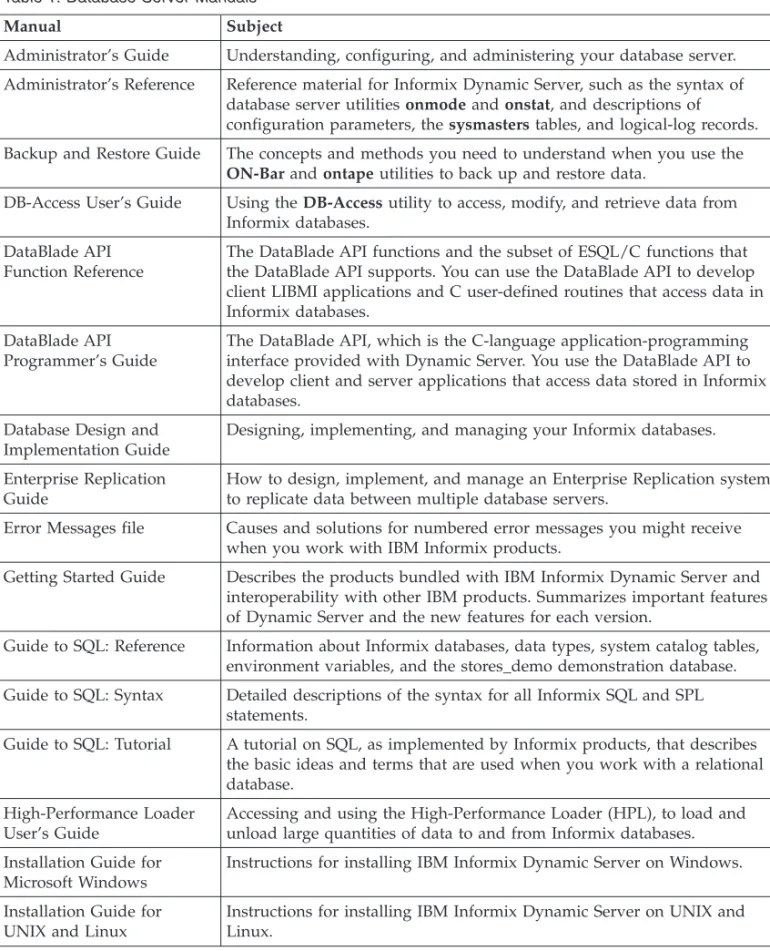
Administrator’sGuide Understanding,configuring,andadministeringyourdatabaseserver. Administrator’sReference ReferencematerialforInformixDynamicServer,suchasthesyntaxof
databaseserverutilitiesonmodeandonstat,anddescriptionsof configurationparameters,thesysmasterstables,andlogical-logrecords. BackupandRestoreGuide Theconceptsandmethodsyouneedtounderstandwhenyouusethe
ON-Barandontapeutilitiestobackupandrestoredata.
DB-AccessUser’sGuide UsingtheDB-Accessutilitytoaccess,modify,andretrievedatafrom Informixdatabases.
DataBladeAPI FunctionReference
TheDataBladeAPIfunctionsandthesubsetofESQL/Cfunctionsthat theDataBladeAPIsupports.YoucanusetheDataBladeAPItodevelop clientLIBMIapplicationsandCuser-definedroutinesthataccessdatain Informixdatabases.
DataBladeAPI Programmer’sGuide
TheDataBladeAPI,whichistheC-languageapplication-programming interfaceprovidedwithDynamicServer.YouusetheDataBladeAPIto developclientandserverapplicationsthataccessdatastoredinInformix databases.
DatabaseDesignand ImplementationGuide
Designing,implementing,andmanagingyourInformixdatabases. EnterpriseReplication
Guide
Howtodesign,implement,andmanageanEnterpriseReplicationsystem toreplicatedatabetweenmultipledatabaseservers.
ErrorMessagesfile Causesandsolutionsfornumberederrormessagesyoumightreceive whenyouworkwithIBMInformixproducts.
GettingStartedGuide DescribestheproductsbundledwithIBMInformixDynamicServerand interoperabilitywithotherIBMproducts.Summarizesimportantfeatures ofDynamicServerandthenewfeaturesforeachversion.
GuidetoSQL:Reference InformationaboutInformixdatabases,datatypes,systemcatalogtables, environmentvariables,andthestores_demodemonstrationdatabase. GuidetoSQL:Syntax DetaileddescriptionsofthesyntaxforallInformixSQLandSPL
statements.
GuidetoSQL:Tutorial AtutorialonSQL,asimplementedbyInformixproducts,thatdescribes thebasicideasandtermsthatareusedwhenyouworkwitharelational database.
High-PerformanceLoader User’sGuide
AccessingandusingtheHigh-PerformanceLoader(HPL),toloadand unloadlargequantitiesofdatatoandfromInformixdatabases. InstallationGuidefor
MicrosoftWindows
InstructionsforinstallingIBMInformixDynamicServeronWindows. InstallationGuidefor
UNIXandLinux
InstructionsforinstallingIBMInformixDynamicServeronUNIXand Linux.
Table1.DatabaseServerManuals (continued)
Manual Subject
J/FoundationDeveloper’s Guide
Writinguser-definedroutines(UDRs)intheJavaprogramminglanguage forInformixDynamicServerwithJ/Foundation.
LargeObjectLocator DataBladeModuleUser’s Guide
UsingtheLargeObjectLocator,afoundationDataBlademodulethatcan beusedbyothermodulesthatcreateorstorelarge-objectdata.TheLarge ObjectLocatorenablesyoutocreateasingleconsistentinterfacetolarge objectsandextendstheconceptoflargeobjectstoincludedatastored outsidethedatabase.
MigrationGuide ConversiontoandreversionfromthelatestversionsofInformix databaseservers.MigrationbetweendifferentInformixdatabaseservers. OpticalSubsystemGuide TheOpticalSubsystem,autilitythatsupportsthestorageofBYTEand
TEXTdataonopticaldisk.
PerformanceGuide ConfiguringandoperatingIBMInformixDynamicServertoachieve optimumperformance.
R-TreeIndexUser’sGuide CreatingR-treeindexesonappropriatedatatypes,creatingnewoperator classesthatusetheR-treeaccessmethod,andmanagingdatabasesthat usetheR-treesecondaryaccessmethod.
SNMPSubagentGuide TheIBMInformixsubagentthatallowsaSimpleNetworkManagement Protocol(SNMP)networkmanagertomonitorthestatusofInformix servers.
StorageManager Administrator’sGuide
InformixStorageManager(ISM),whichmanagesstoragedevicesand mediaforyourInformixdatabaseserver.
TrustedFacilityGuide Thesecure-auditingcapabilitiesofDynamicServer,includingthecreation andmaintenanceofauditlogs.
User-DefinedRoutinesand DataTypesDeveloper’s Guide
Howtodefinenewdatatypesandenableuser-definedroutines(UDRs) toextendIBMInformixDynamicServer.
Virtual-IndexInterface Programmer’sGuide
Creatingasecondaryaccessmethod(index)withtheVirtual-Index Interface(VII)toextendthebuilt-inindexingschemesofIBMInformix DynamicServer.TypicallyusedwithaDataBlademodule.
Virtual-TableInterface Programmer’sGuide
CreatingaprimaryaccessmethodwiththeVirtual-TableInterface(VTI) sothatusershaveasingleSQLinterfacetoInformixtablesandtodata thatdoesnotconformtothestorageschemeofInformixDynamicServer.
Table2.Client/ConnectivityManuals
Manual Subject
ClientProductsInstallation Guide
InstallingIBMInformixClientSoftwareDeveloper’sKit(ClientSDK)and IBMInformixConnectoncomputersthatuseUNIX,Linux,and
Windows. EmbeddedSQLJUser’s
Guide
UsingIBMInformixEmbeddedSQLJtoembedSQLstatementsinJava programs.
Table2.Client/ConnectivityManuals (continued)
Manual Subject
ESQL/CProgrammer’s Manual
TheIBMInformiximplementationofembeddedSQLforC.
GLSUser’sGuide TheGlobalLanguageSupport(GLS)feature,whichallowsIBMInformix APIsanddatabaseserverstohandledifferentlanguages,cultural conventions,andcodesets.
JDBCDriverProgrammer’s Guide
InstallingandusingInformixJDBCDrivertoconnecttoanInformix databasefromwithinaJavaapplicationorapplet.
.NETProviderReference Guide
UsingInformix.NETProvidertoenable.NETclientapplicationsto accessandmanipulatedatainInformixdatabases.
ODBCDriverProgrammer’s Manual
UsingtheInformixODBCDriverAPItoaccessanInformixdatabaseand interactwiththeInformixdatabaseserver.
OLEDBProvider Programmer’sGuide
InstallingandconfiguringInformixOLEDBProvidertoenableclient applications,suchasActiveXDataObject(ADO)applicationsandWeb pages,toaccessdataonanInformixserver.
ObjectInterfaceforC++ Programmer’sGuide
ThearchitectureoftheC++objectinterfaceandacompleteclass reference.
Table3.DataBladeDeveloper’sKitManuals
Manual Subject
DataBladeDeveloper’sKit User’sGuide
DevelopingandpackagingDataBlademodulesusingBladeSmithand BladePack.
DataBladeModule DevelopmentOverview
BasicorientationfordevelopingDataBlademodules.Includesan exampleillustratingthedevelopmentofaDataBlademodule. DataBladeModule
InstallationandRegistration Guide
InstallingDataBlademodulesandusingBladeManagertomanage DataBlademodulesinInformixdatabases.
Compliance
with
Industry
Standards
TheAmericanNationalStandardsInstitute(ANSI)andtheInternational OrganizationofStandardization(ISO)havejointly establishedaset of industrystandardsfor theStructuredQueryLanguage(SQL). IBMInformix SQL-basedproductsarefullycompliantwithSQL-92EntryLevel(published asANSIX3.135-1992),whichisidenticaltoISO9075:1992. Inaddition,many featuresofIBM Informixdatabaseserverscomplywith theSQL-92
IntermediateandFullLeveland X/OpenSQLCommonApplications Environment(CAE)standards.
IBM
Welcomes
Your
Comments
Wewanttoknowaboutanycorrectionsorclarificationsthatyouwouldfind usefulinourmanuals,whichwillhelp usimprovefutureversions.Include thefollowinginformation:
v Thenameand versionofthemanualthatyouare using
v Sectionandpagenumber
v Yoursuggestionsaboutthemanual
Sendyourcommentstous atthefollowingemailaddress:
Thisemailaddressisreservedforreportingerrorsandomissionsinour documentation.Forimmediatehelp withatechnicalproblem,contactIBM TechnicalSupport.
Chapter
1.
Database
Concepts
IllustrationofaDataModel . . . 1-2 StoringData . . . 1-3 QueryingData. . . 1-4 ModifyingData . . . 1-5 ConcurrentUseandSecurity . . . 1-6 ControllingDatabaseUse . . . 1-6 Access-ManagementStrategies . . . 1-6 CentralizedManagement . . . 1-7 ImportantDatabaseTerms. . . 1-8 TheRelationalDatabaseModel . . . 1-8 Tables. . . 1-9 Columns. . . 1-9 Rows . . . 1-10 Views . . . 1-10 Sequences . . . 1-10 OperationsonTables . . . 1-10 TheObject-RelationalModel(IDS). . . 1-11 StructuredQueryLanguage . . . 1-12 StandardSQL. . . 1-12 InformixSQLandANSISQL . . . 1-13 InteractiveSQL . . . 1-13 GeneralProgramming . . . 1-14 ANSI-CompliantDatabases . . . 1-14 GlobalLanguageSupport(GLS) . . . 1-14 Summary . . . 1-14
In
This
Chapter
Thischapterdescribesfundamentaldatabase conceptsand focusesonthe followingtopics:
v Datamodels
v Multipleusers
v Databaseterminology
v
SQL(StructuredQueryLanguage)
Yourrealuseof adatabasebegins withtheSELECTstatement,which Chapter2,“Composing SELECTStatements,”onpage2-1,describes.
Illustration
of
a
Data
Model
Theprincipaldifferencebetweeninformationcollectedin adatabaseversus informationcollectedina fileisthewaythedataisorganized.Aflatfileis organizedphysically;certainitemsprecedeorfollowotheritems.Butthe contentsofa databaseareorganized accordingtoadatamodel.Adatamodel isa plan,ormap, thatdefinestheunitsof dataandspecifieshow eachunit relatestotheothers.
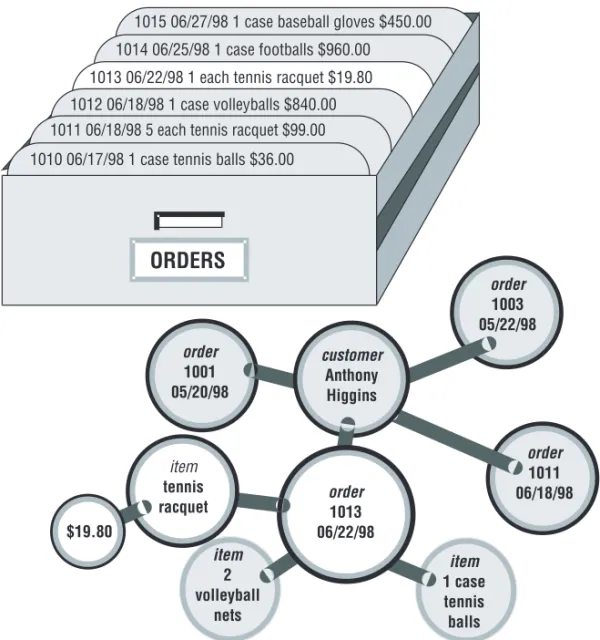
Forexample,anumber canappearin eitherafileora database.Ina file,it is simplya numberthatoccursatacertain pointinthefile.Anumber ina database,however,hasarole thatthedatamodelassignstoit.Therole might bea pricethatisassociatedwithaproductthatwassoldasoneitemofanorder thatacustomerplaced.Eachofthesecomponents,price,product,item,order, andcustomer,alsohasarole thatthedatamodelspecifies.For anillustration ofadatamodel,seeFigure1-1.
Youdesignthedatamodelwhenyoucreatethedatabase.Youtheninsert unitsofdataaccordingtotheplanthatthemodellaysout.Some booksuse theterm schemainsteadofdatamodel.
Storing
Data
Anotherdifferencebetweena databaseanda fileisthattheorganizationof thedatabase isstored withthedatabase.
Afilecanhaveacomplex innerstructure, butthedefinitionofthatstructure isnotwithin thefile;itisintheprogramsthatcreateorusethefile.For example,a documentfilethataword-processingprogramstoresmight containdetailedstructuresthatdescribetheformatofthedocument.
However,onlytheword-processingprogramcandecipherthecontentsofthe file,becausethestructureisdefinedwithintheprogram,notwithin thefile.
1015 06/27/98 1 case baseball gloves $450.00 1014 06/25/98 1 case footballs $960.00
1013 06/22/98 1 each tennis racquet $19.80 1012 06/18/98 1 case volleyballs $840.00 1011 06/18/98 5 each tennis racquet $99.00 1010 06/17/98 1 case tennis balls $36.00
ORDERS
order 1011 06/18/98 order 1003 05/22/98 order 1001 05/20/98 customer Anthony Higgins item 2 volleyball nets item 1 case tennis balls order 1013 06/22/98 item tennis racquet $19.80Adatamodel,however,iscontainedinthedatabaseitdescribes.Ittravels withthedatabaseandisavailableto anyprogramthatusesthedatabase.The modeldefinesnotonlythenamesof thedataitemsbutalso theirdatatypes, soa programcanadaptitselftothedatabase.Forexample,a programcan findoutthat,inthecurrentdatabase,a priceitemisa decimalnumber with eightdigits,twototheright ofthedecimalpoint;thenitcanallocatestorage foranumberof thattype.Howprogramsworkwithdatabasesisthesubject ofChapter8, “Programmingwith SQL,”onpage8-1,and Chapter9,
“ModifyingDataThroughSQLPrograms,”onpage9-1.
Querying
Data
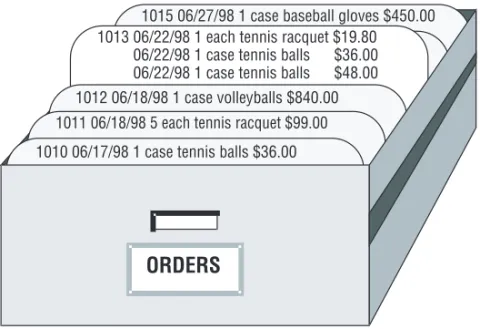
Anotherdifferencebetweena databaseanda fileisthewayyoucanaccess them.Youcansearchafilesequentially,lookingforparticularvaluesat particularphysicallocationsineachlineorrecord.Thatis,youmightask, “Whatrecordshavethenumber 1013inthefirst field?”Figure1-2showsthis typeofsearch.
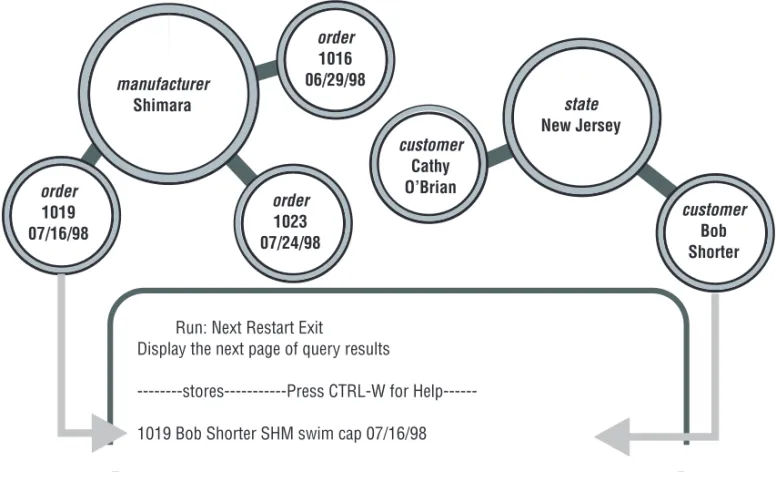
Incontrast,whenyouquerya database,youusethetermsthatthemodel defines.Youcanquerythedatabasewith questionssuchas,“Whatordershave beenplacedforproductsmadebytheShimaraCorporation, bycustomersin NewJersey,withshipdatesinthethirdquarter?”Figure1-3showsthistypeof query.
ORDERS
1015 06/27/98 1 case baseball gloves $450.00 1013 06/22/98 1 each tennis racquet $19.80
06/22/98 1 case tennis balls $36.00 06/22/98 1 case tennis balls $48.00 1012 06/18/98 1 case volleyballs $840.00 1011 06/18/98 5 each tennis racquet $99.00 1010 06/17/98 1 case tennis balls $36.00
Inotherwords,whenyouaccessdatathatisstored inafile,youmust state yourquestionintermsofthephysicallayoutofthefile.Whenyouquerya database,youcanignorethearcanedetailsofcomputerstorageand state yourqueryintermsthatreflecttherealworld,at leasttotheextentthatthe datamodelreflectstherealworld.
Chapter2,“Composing SELECTStatements,”onpage2-1,andChapter5, “ComposingAdvanced SELECTStatements,”onpage5-1,discussthe languageyouusetomakequeries.
Forinformationabouthowtobuildand implementyourdatamodel,seethe IBM Informix:DatabaseDesign andImplementationGuide.
Modifying
Data
Thedatamodelalsomakesitpossibletomodifythecontentsofthedatabase withlesschance forerror.Youcanquerythedatabasewith statementssuch as,“Findeverystockitemwitha manufacturerofPrestaorSchraeder,and increaseitspriceby13percent.”Youstatechanges intermsthatreflectthe meaningofthedata.Youdonothavetowastetimeandeffortthinkingabout detailsoffields withinrecordsina file,sothechancesforerrorarefewer.
order 1016 06/29/98 order 1023 07/24/98 manufacturer Shimara
Run: Next Restart Exit
Display the next page of query results
---stores---Press CTRL-W for Help---1019 Bob Shorter SHM swim cap 07/16/98 order 1019 07/16/98 customer Cathy O’Brian state New Jersey customer Bob Shorter
Thestatementsyouusetomodifystoreddataare coveredinChapter6, “ModifyingData,”onpage6-1.
Concurrent
Use
and
Security
Adatabase canbeacommon resourceformanyusers.Multipleuserscan queryand modifyadatabase simultaneously.The databaseserver(the programthatmanagesthecontentsofall databases)ensures thatthequeries andmodificationsaredoneinsequenceandwithoutconflict.
Havingconcurrentusersonadatabaseprovides greatadvantagesbut also introducesnewproblemsofsecurityandprivacy. Somedatabasesareprivate; individualsset themupfortheirownuse.Other databasescontain
confidentialmaterialthatmust beshared,but onlyamonga selectgroup;still otherdatabasesprovidepublicaccess.
Controlling
Database
Use
Informixdatabasesoftwareprovidesthemeanstocontroldatabaseuse.When youdesigna database,youcanperformanyofthefollowingfunctions:
v Keepthedatabasecompletelyprivate
v Openitsentirecontentstoall usersor toselectedusers
v Restricttheselectionofdatathatsomeuserscanview (differentselections ofdatatodifferentgroupsofusers)
v Allowspecifieduserstoviewcertainitems,butnotmodifythem
v Allowspecifieduserstoaddnewdata,butnotmodifyolddata
v
Allowspecifieduserstomodifyall,orspecifieditemsof,existingdata
v Ensurethataddedormodifieddataconforms tothedatamodel
Access-ManagementStrategies
Adatabase administrator(DBA)cansetrolestostandardizeandchangethe privilegesofmanyusersbytreating themasmembers ofaclass.Whenthe DBAassignsprivileges tothatrole, everyuserofthatrolehasthose privileges.Inordertoenabletheseroles,a usermust issueaSET ROLE statement.TheSQLstatementsusedfordefiningandmanipulatingroles include:CREATEROLE,DROPROLE,GRANT,REVOKE, andSETROLE.
Tocreateandgrantarole:
1. Use theCREATEROLEstatementtocreateanewrole inthecurrent database.
2. Use theGRANTstatementtograntprivilegestothatrole
3. Use theGRANTROLEstatementtogranttheroletoa userortoPUBLIC (all users).
FormoreinformationontheSQLsyntaxstatementsfor definingand manipulatingroles,seetheIBM Informix:GuidetoSQLSyntax.
TheDBAcandefineadefaultroletoassigna roletoindividual usersortothe PUBLICgroupfora particulardatabase.Theroleisautomaticallyactivated whentheuser establishesa connectionwiththedatabase,withouttheuser needingtoissuea SETROLEstatement. Eachuserhaswhateverprivilegesare grantedtotheuserindividually, aswell astheprivileges ofthedefaultrole.
Note: Ifdifferentdefaultrolesareassignedtotheuser andtoPUBLIC, the defaultroleof theuser takesprecedence.
Todefineandgrantprivilegesforadefaultrole:
1. UsetheCREATEROLEstatementtocreateanewrole inthecurrent database.
2. UsetheGRANTstatementtograntprivilegestotherole.
3. Grant therole toauser andsettheroleasthedefaultuser orPUBLICrole usingthefollowingsyntax:
GRANT DEFAULT ROLE rolename TO username or
GRANT DEFAULT ROLE rolename TO PUBLIC
4. UsetheREVOKEDEFAULTROLEstatementtodisassociateadefaultrole froma user.
OnlytheDBAorthedatabaseownercanremovethedefaultrole. 5. UsetheSETROLEDEFAULT statementtoresetthecurrentrolebackto
thedefaultrole.
Forsecurityreasons,theDBAcancreaterolesthathavelimitedaccess. For instance,onlytheDatabaseSystemAdministrator(DBSA)oruserstowhom theDBSAhasgrantedthebuilt-inEXTENDrolecancreateordropUDRsthat aredefinedwiththeEXTERNALkeyword.Formoreinformationonthe ExternalRoutineReferencesegmentorSQLstatementsfordefiningand manipulatingroles,seetheIBM Informix:GuidetoSQLSyntax.
Formoreinformationondefaultroles,seetheIBM Informix:Administrator's Guide.
Formoreinformationabouthowtogrant andlimitaccesstoyourdatabase, seetheIBM Informix:DatabaseDesignand ImplementationGuide.
Centralized
Management
Databasesthatmanypeopleusearevaluableandmustbe protectedas importantbusinessassets.Youcreateasignificantproblemwhenyoucompile astoreofvaluabledataandsimultaneouslyallowmanyemployeestoaccess
it.Youhandlethisproblembyprotectingdatawhilemaintaining performance.Thedatabaseserverletsyoucentralizethese tasks.
Databasesmustbe guardedagainstlossordamage.Thehazardsaremany: failuresinsoftwareand hardware,andtherisksoffire,flood,andother naturaldisasters.Losinganimportantdatabasecreates ahugepotentialfor damage.Thedamagecouldinclude notonlytheexpenseanddifficultyof re-creatingthelostdata,butalsothelossofproductive timebythedatabase usersaswell asthelossofbusinessandgoodwill whileuserscannotwork.A planforregularbackupshelpsavoidormitigatethesepotentialdisasters.
Alargedatabase thatmanypeopleusemustbe maintainedandtuned.
Someonemust monitoritsuseofsystemresources,chartitsgrowth,anticipate bottlenecks,and planforexpansion. Userswillreportproblemsin the
applicationprograms;someonemustdiagnosetheseproblemsand correct them.Ifrapidresponseisimportant, someonemustanalyzetheperformance ofthesystemandfindthecausesofslow responses.
Important
Database
Terms
Youshouldknowanumber oftermsbefore youbeginthenextchapter. Dependingonthedatabase serveryouuse,a differentsetoftermscan describethedatabase andthedatamodelthatapply.
The
Relational
Database
Model
ThedatabasesyoucreatewithanInformixdatabase serverareobject-relational databases.Inpracticaltermsthismeansthatalldataispresentedintheform oftableswith rowsand columnswherethefollowingsimple corresponding relationshipsapply.
Relationship Description
table=entity Atablerepresentsallthatthedatabaseknows
aboutonesubjectorkindof thing.
column=attribute Acolumnrepresentsonefeature,
characteristic,orfactthatistrueofthetable subject.
row=instance Arowrepresentsoneindividual instanceof
thetablesubject.
Somerulesapplyabouthowyouchooseentitiesandattributes,buttheyare importantonlywhenyouare designinga newdatabase.(Formore
informationaboutdatabase design,seetheIBM Informix:DatabaseDesignand ImplementationGuide.)Thedatamodelinanexistingdatabaseisalreadyset. Tousethedatabase,youneed toknowonlythenamesof thetablesand columnsandhow theycorrespondtotherealworld.
Tables
Adatabase isa collectionofinformationthatisgroupedinto oneormore tables.Atableisanarrayofdataitems organizedintorowsandcolumns.A demonstrationdatabaseisdistributedwith everyInformixdatabaseserver product.Apartial tablefromthedemonstration databasefollows.
stock_num manu_code description unit_price unit unit_descr . . . . . . . . . . . . . . . . . .
1 HRO baseballgloves 250.00 case 10gloves/case 1 HSK baseballgloves 800.00 case 10gloves/case 1 SMT baseballgloves 450.00 case 10gloves/case
2 HRO baseball 126.00 case 24/case
3 HSK baseballbat 240.00 case 12/case
4 HSK football 960.00 case 24/case
4 HRO football 480.00 case 24/case
5 NRG tennisracquet 28.00 each each
. .
. ... ... ... ... ...
313 ANZ swimcap 60.00 case 12/box
Atable representsallthatthedatabase administrator(DBA)wantstostore aboutoneentity,onetypeofthingthatthedatabasedescribes.The example table,stock,representsallthattheDBAwantstostore aboutthemerchandise thatasportinggoodsstorestocks.Other tablesinthedemonstrationdatabase representsuchentitiesascustomerandorders.
Thinkofadatabase asacollectionof tables.Tocreateadatabaseistocreatea setoftables.Theright toqueryormodify tablescanbecontrolled ona table-by-tablebasis,sothatsomeuserscanviewormodify sometablesbut notothers.
Columns
Eachcolumnofatablecontains oneattribute,whichisonecharacteristic, feature,orfactthatdescribesthesubjectofthetable.Thestocktablehas columnsforthefollowingfactsaboutitemsofmerchandise:stock numbers, manufacturercodes,descriptions,prices,andunits ofmeasure.
Rows
Eachrowofa tableisoneinstance ofthesubjectofthetable,whichisone particularexampleofthatentity.Eachrowof thestocktablestandsforone itemofmerchandisethatthesportinggoodsstore sells.
Views
Aview isavirtual tablebasedonaspecified SELECTstatement.Aview isa dynamicallycontrolledpictureofthecontentsina databaseandallows a programmertodeterminewhatinformationtheuserseesandmanipulates. Differentuserscanbe givendifferentviewsof thecontentsofadatabase,and theiraccesstothose contentscanberestrictedin severalways.
Sequences
Asequenceisadatabaseobjectthatgeneratesa sequenceofwholenumbers withina definedrange. Thesequenceofnumberscanrunineither ascending ordescendingorder,andismonotonic.Formoreinformationabout
sequences,seetheIBM Informix:GuidetoSQLSyntax.
Operations
on
Tables
Becauseadatabaseisreallya collectionoftables, databaseoperationsare operationsontables.Theobject-relationalmodelsupportsthreefundamental operations:selection,projection,andjoining.Figure1-4showstheselection andprojectionoperations.(Allthreeoperationsaredefinedindetail,with manyexamples, inthefollowingchapters.)
SELECTION
stocktable
P R O J E C T I O N stock_num manu_code description unit_price unit unit_descr
1 HRO baseball gloves 250.00 case 10 gloves/case 1 HSK baseball gloves 800.00 case 10 gloves/case 1 SMT baseball gloves 450.00 case 10 gloves/case
2 HRO baseball 126.00 case 24/case
3 HSK baseball bat 240.00 case 12/case
4 HSK football 960.00 case 24/case
4 HRO football 480.00 case 24/case
5 NRG tennis racquet 28.00 each each
313 ANZ swim cap 60.00 case 12/box
Whenyouselectdatafroma table,youarechoosing certainrowsandignoring others.Forexample,youcanquerythestocktable byaskingthedatabase managementsystemto,“Selectallrowsinwhichthemanufacturercodeis HSKandtheunitpriceisbetween200.00 and300.00.”
Whenyouprojectfroma table,youare choosingcertaincolumns andignoring others.Forexample,youcanquerythestocktable byaskingthedatabase managementsystemto“project thestock_num,unit_descr,and unit_price columns.”
Atable containsinformationaboutonlyoneentity;whenyouwant
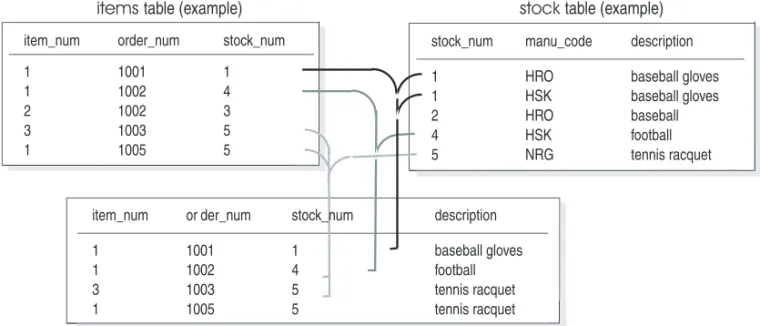
informationaboutmultiple entities,youmustjoin theirtables.Youcanjoin tablesinmanyways.For moreinformationaboutjoinoperations,referto Chapter5,“ComposingAdvanced SELECTStatements,”onpage5-1.
The
Object-Relational
Model
(IDS)
DynamicServerallows youtobuildobject-relationaldatabases.Inadditionto supportingalphanumericdatasuchascharacterstrings,integers,date,and decimal,anobject-relationaldatabaseextends thefeaturesofa relational modelwiththefollowingobject-orientedcapabilities:
v Extensibility.Youcanextendthecapabilityofthedatabaseserverby definingnewdatatypes(andtheaccessmethodsandfunctionstosupport them)anduser-definedroutines(UDRs)thatallowyoutostoreand manageimages,audio,video,largetextdocuments,and soforth.
IBM,aswellasthird-partyvendors,packagessomedatatypesandaccess methodsinto DataBlademodules,orshared classlibraries,thatyoucanadd ontothedatabase server,if itsuitsyourneeds.DataBlademodules enable youtostore non-traditionaldatatypessuchastwo-dimensionalspatial objects(lines,polygons, ellipses,and circles)andtoaccessthemthrough R-treeindexes.ADataBlademodulemightalso providenewtypesofaccess tolargetextdocuments,includingphrasematching,fuzzysearches,and synonymmatching.
Youcanalso extendthedatabase serveronyour ownbyusingthefeatures ofDynamicServer thatenableyoutoadddatatypesandaccessmethods. Formoreinformation,seeIBM Informix:User-DefinedRoutinesandData TypesDeveloper'sGuide.
YoucancreateUDRsinSPLand theCprogramminglanguageto
encapsulateapplicationlogicortoenhancethefunctionalityoftheDynamic Server.Formoreinformation,seeChapter11,“CreatingandUsing SPL Routines,”onpage11-1.
v ComplexTypes.Youcandefinenew datatypesthatcombineoneormore existingdatatypes.Complextypesenablegreaterflexibilityinorganizing dataatthelevelof columnsandtables. Forexample,withcomplextypes, youcandefinecolumnsthatcontaincollectionsofvaluesofasingle type andcolumns thatcontainmultiple componenttypes.
v Inheritance.Youcandefineobjects(typesand tables)thatacquirethe propertiesof otherobjectsand addnew propertiesthatare specifictothe objectthatyoudefine.
DynamicServerprovides object-orientedcapabilitiesbeyondthose ofthe relationalmodelbutrepresents alldataintheform oftableswith rowsand columns.Althoughtheobject-relational modelextendsthecapabilitiesofthe relationalmodel,youcanimplementyour datamodelasatraditional relationaldatabaseif youchoose.
Somerulesapplyabouthowyouchooseentitiesandattributes,buttheyare importantonlywhenyouare designinga newdatabase.Formoreinformation aboutobject-relational databasedesign,seetheIBM Informix:DatabaseDesign andImplementationGuide.
Structured
Query
Language
Mostcomputersoftwarehasnotyetreachedapointwhere youcanliterally askadatabase,“WhatordershavebeenplacedbycustomersinNewJersey withshipdatesin thethirdquarter?”Youmust stillphrasequestionsina restrictedsyntaxthatthesoftwarecaneasilyparse.Youcanposethesame questiontothedemonstration databaseinthefollowingterms:
SELECT * FROM customer, orders
WHERE customer.customer_num = orders.customer_num AND customer.state = ’NJ’
AND orders.ship_date
BETWEEN DATE(’7/1/98’) AND DATE(’9/30/98’)
ThisquestionisasampleofStructuredQueryLanguage(SQL).Itisthe languagethatyouuseto directall operationsonthedatabase.SQLis
composedof statements,eachof whichbegins withoneortwokeywordsthat specifya function.TheInformiximplementationofSQLincludesalarge numberofSQLstatements,fromALLOCATEDESCRIPTORtoWHENEVER.
Youwillusemostofthestatementsonlywhenyouset uportuneyour database.Youwillusethreeorfourstatementsregularlytoqueryorupdate yourdatabase.FordetailsonSQLstatements,seetheIBM Informix:Guideto SQLSyntax.
Onestatement, SELECT,isinalmost constantuse. SELECTistheonly statementthatyoucanusetoretrievedatafromthedatabase.Itisalso the mostcomplicatedstatement, andthenexttwochaptersofthisbookexplore itsmanyuses.
Standard
SQL
SQLandtherelationalmodelwereinventedanddevelopedatIBMinthe earlyandmiddle 1970s.OnceIBMprovedthatitwaspossibletoimplement
practicalrelationaldatabasesandthatSQLwasa usablelanguagefor manipulatingthem,otherimplementationsofSQLwere developed.
Forreasonsofperformanceorcompetitive advantage,ortotakeadvantageof localhardwareorsoftware features,eachSQLimplementationdifferedin smallwaysfromtheothersandfromtheIBMversionof thelanguage.To ensurethatthedifferencesremainedsmall, astandardscommitteewasformed intheearly 1980s.
CommitteeX3H2,sponsoredbytheAmericanNationalStandardsInstitute (ANSI),issued theSQL1 standardin 1986.Thisstandarddefinesa coresetof SQLfeaturesandthesyntaxofstatementssuchasSELECT.
Informix
SQL
and
ANSI
SQL
TheInformiximplementationof SQLiscompatiblewithstandardSQL. InformixSQLisalsocompatiblewith theIBMversionofthelanguage. However,InformixSQLcontains extensionstothestandard;thatis, extra optionsorfeaturesforcertainstatements,andlooserrulesforothers.Mostof thedifferencesoccur inthestatementsthatarenotineverydayuse.For example,fewdifferencesoccur intheSELECTstatement, whichaccountsfor 90percentofSQLuse.
However,theInformixSQLextensionsdoexistand createconflicts.
Thousandsofcustomershaveembedded Informix-styleSQLinprogramsand storedroutines.NowthatInformixproductsarepartof theIBM Data
Managementproductsuite,usersrelyonIBMtokeeptheInformix-styleSQL languagethesame.Other customersrequire theabilitytousedatabasesina waythatconformsexactlytotheANSIstandard,and theyrelyonIBMto changeitslanguagetoconform.
IBMresolvestheconflictwiththefollowingcompromise:
v TheInformix-styleversionofSQL,withitsextensionstothestandard,is availablebydefault.
v Youcanask anyInformix-styleSQLlanguageprocessor tocheckyour use ofSQLandpost awarningflagwheneveryouuseanInformix-style extension.
Whena differenceexistsbetweenInformixandANSIstandard,the IBM Informix:GuidetoSQLSyntaxidentifiestheInformixsyntaxasan extensiontotheANSIstandardforSQL.
Interactive
SQL
Tocarryouttheexamplesinthisbookand toexperimentwithSQLand databasedesign,youneeda programthatletsyouexecuteSQLstatements interactively.DB–Accessissuchaprogram. IthelpsyoucomposeSQL
statementsandthenpassesyour SQLstatementstothedatabaseserverfor executionand displaystheresultstoyou.
General
Programming
YoucanwriteprogramsthatincorporateSQLstatementsandexchangedata withthedatabaseserver.Thatis,youcanwritea programtoretrievedata fromthedatabase andformatithoweveryouchoose.Youcanalsowrite programsthattakedatafromanysourceinanyformat,prepareit,andinsert itintothedatabase.
Youcanalso writeprogramscalled storedroutinestoworkwith database dataandobjects.Thestoredroutinesthatyouwritearestoreddirectlyina databaseintables.Youcanthenexecuteastored routinefromDB–Accessor anSQLApplicationProgrammingInterface(API)suchasIBM Informix ESQL/C.
Chapter8,“Programmingwith SQL,”onpage8-1,andChapter9,“Modifying DataThroughSQLPrograms,”onpage9-1,presentanoverviewofhow SQL isusedinprograms.
ANSI-Compliant
Databases
UsetheMODEANSIkeywordswhenyoucreateadatabasetodesignateitas ANSIcompliant.Withinsuchadatabase,certain characteristicsof the
ANSI/ISOstandardapply.For example,allactionsthatmodifydatatake placewithin atransactionautomatically,whichmeansthatthechangesare madeintheirentiretyornotatall.Differencesinthebehaviorof
ANSI-compliantdatabasesarenoted,whereappropriate,inthestatement descriptionsintheIBM Informix:GuidetoSQLSyntax.For adetailed
discussionofANSI-compliantdatabases, seetheIBM Informix:DatabaseDesign andImplementationGuide.
Global
Language
Support
(GLS)
InformixdatabaseserverproductsprovidetheGlobal LanguageSupport (GLS)feature.InadditiontoU.S.ASCIIEnglish,GLS allowsyouto workin otherlocalesandusenon-ASCIIcharactersinSQLdataandidentifiers.You canusetheGLSfeatureto conformtothecustomsofaspecific locale.The localefilescontainculture-specificinformation,suchasmoneyanddate formatsandcollationorders.For moreGLSinformation,seetheIBM Informix: GLSUser'sGuide.
Summary
Adatabase containsacollection ofrelatedinformationbutdiffersina fundamentalwayfromothermethodsofstoringdata.Thedatabasecontains notonlythedata,but alsoadatamodelthatdefineseachdataitemand specifiesitsmeaningwithrespecttotheotheritemsand totherealworld.