ING GROUP
EMBEDDED VALUE REPORT
2007
20 February 2008
Contents
Introduction... 1
1. Executive Summary – Embedded Value results ING Group life insurance ... 3
1.1 Embedded Value results for ING life insurance & ING Group... 4
1.2 Return on Embedded Value in comparison to 2006 results ... 5
1.3 New Business... 6
1.4 Sensitivity analysis... 8
2. Insurance Europe ... 11
2.1 Embedded Value results for Insurance Europe ... 12
2.2 Return on Embedded Value in comparison to 2006 results ... 13
2.3 New Business... 13
2.4 Sensitivity analysis... 15
3. Insurance Americas ... 17
3.1 Embedded Value results for Insurance Americas ... 18
3.2 Return on Embedded Value in comparison to 2006 results ... 18
3.3 New Business... 19
3.4 Sensitivity analysis... 21
4. Insurance Asia/Pacific ... 23
4.1 Embedded Value results for Insurance Asia/Pacific ... 24
4.2 Return on Embedded Value in comparison to 2006 results ... 25
4.3 New Business... 25
4.4 Sensitivity analysis... 28
5. Review Statement ... 30
Appendix 1. Embedded Value movement analysis ... 31
Appendix 2. Sensitivity analysis – value new business... 39
Appendix 3. Analysis of variances and assumption changes ... 43
Appendix 4. Economic assumptions ... 44
Appendix 5. Methodology... 50
Appendix 6. Exchange Rates ... 57
Appendix 7. Glossary & abbreviations... 58
Disclaimer ... 61
Introduction
Embedded Value (EV) is an indicator of the economic value creation as a consequence of selling and managing long-term contracts such as life insurance, annuities and pensions. ING has used Embedded Value for many years as a management tool for its life insurance operations. ING’s management believes that Embedded Value, together with other publicly disclosed financial information, provides valuable information for investors in order to assess the value embedded in the in-force business.
Embedded Value can be interpreted as the economic value of our current, covered in-force business; future new business that is sold after the valuation date is not included in the analysis, although certain assumptions (e.g. expense assumptions) are on a going-concern basis. Embedded Value is defined as the sum of Adjusted Net Worth (ANW) and the Value of the in-Force covered business (ViF) where
• Adjusted Net Worth equals the sum of Free Surplus (FS) and Required Capital (RC). Required Capital is the amount of assets which ING holds based on its internal capital model over and above the value placed on in-force liabilities and is in aggregate above minimum regulatory capital requirements. The distribution of Required Capital to shareholders is therefore restricted. Free Surplus is defined as the additional capital held in the business in excess of the Required Capital and represents all accumulated, non-distributed profits that are not needed to back the in-force life insurance business; and
• The Value of in-Force (ViF) covered business is defined as the present value of future, after-tax statutory book profits expected to arise from the in-force business, including new business written during the reporting period, less the Cost of Capital (CoC) where the Cost of Capital is the cost related to holding Required Capital.
ING’s Embedded Value will change over time due to the realisation of the expected distributable earnings, the Value of New Business sold during the reporting period and investment income on Free Surplus. In addition, variances from expected earnings can materialise from a variety of sources, some outside of management control (e.g. economic assumption changes) and some under management control (e.g. operational variances).
For internal performance measurement purposes, EV Profit is ING’s primary measure of value creation in our life insurance operations. EV Profit is defined as the change in value during the year in excess of the required return which arises from only those items in Embedded Value that business line management can influence. An additional measure, Return on Embedded Value (RoEV) is also tracked by management. RoEV is defined as the total change in Embedded Value over the period (including EV Profit, required return and assumption changes deemed by ING to be outside management control) divided by the revised EV at the beginning of the year.
Future profits are estimated using actuarial methods and ING’s best estimates for future assumptions except for economic assumptions. Local regulatory accounting restricts the profits that can be distributed to shareholders. ING reflects these constraints by reporting Embedded Values using after-tax book profits calculated according to the local accounting requirements. Note therefore that all figures presented in this document are on an after-tax basis unless otherwise stated.
Coverage
ING calculates Embedded Value for the business sold through its life insurance operations. This business is referred to throughout this report as “life insurance business”. The following products are included:
• Life, health and disability products and their riders, • Deferred and immediate annuity (or pension) products, • Guaranteed Investment Contracts (GICs),
• Pension funds,
All material blocks of life insurance business are included in the 2007 reported Embedded Value results. Under EEV Principles an allowance is required in the Embedded Value for profit or losses arising in other Group companies (such as investment subsidiaries) in respect of services provided to the life insurance businesses. No adjustments have been made to the Embedded Value in this respect as such services are charged to the life insurance businesses on a cost basis and hence do not give rise to material profits or losses outside the covered businesses.
Basis of Preparation
The European Embedded Value (EEV) Principles were published in May 2004 by the CFO Forum, a group representing the Chief Financial Officers of major European insurers. The Principles and associated guidance provide a framework for calculating and reporting supplementary embedded value information.
ING has adopted the EEV Principles in respect of the year-end results from 2004 through 2007. This report also takes account of the Additional Guidance on EEV Disclosures effective for 31 December 2006 reporting.
Embedded Value Report
The report starts with an Executive Summary of the consolidated EV results together with information on the return on EV, the Value of New Business and the Sensitivity of results.
Sections 2, 3 and 4 then provide a breakdown of the results for ING’s businesses in Europe, the Americas and Asia/Pacific respectively.
Watson Wyatt has been engaged to review ING’s Embedded Value. The scope and conclusions of this review are shown in Section 5.
Appendices 1, 2 and 3 set out a more detailed analysis of results covering EV movements, sensitivities for New Business and variances/assumptions changes respectively.
Economic assumptions are approved by the Executive Board of ING. A description of their derivation and the major economic assumptions are included in Appendix 4.
The methodology ING uses to calculate the Embedded Value of life insurance business is discussed in more detail in Appendix 5. This methodology is in compliance with EEV Principles. This includes a description of the way in which ING has developed its’ economic capital assessment that is used to set the level of Required Capital.
Included in Appendix 5 are descriptions of two changes to ING’s methodologies, along with the impact of these changes on EV:
• Clarifications in ING’s expense policy that impacted 2007 Embedded Value and VNB figures and changes to ING’s expense policy that will be reflected in our figures beginning in 2008;
• Recalibration of ING’s Capital Model.
Finally, Appendix 6 sets out the exchange rates used in the calculations followed by a glossary of major terms in Appendix 7.
1. Executive Summary – Embedded Value results ING Group life insurance
•
Embedded Value of covered life businesses increases 20.7% to EUR 33,456 million
before capital injections/(dividends) and currency effects. Including the impact of
currency, the increase is 17.1% to EUR 32,460 million
•
Value of New Business rises 37.9% to EUR 1,113 million
•
The IRR on sales increases to 14.3%, an increase of 1.0% from 2006
Table 1. Analysis of movement
in EUR million
Insurance
Europe Insurance Americas Asia/Pacific Insurance 2007 Total 2006 Total
Free Surplusboy (FS) 7,589 1,170 -4,978 3,781 2,274
Required Capitalboy (RC) 2,826 4,796 6,251 13,873 13,691
ViFboy 5,689 4,305 71 10,064 11,622
Total EVboy 16,103 10,272 1,343 27,718 27,586
Addition of business / (divested business) -580 5 143 -431 407
Currency effects 77 -1,043 -31 -996 -1,164
Model changes 642 -126 -332 185 92
Revised EVboy 16,243 9,108 1,124 26,476 26,921
Value of New Business (VNB) 400 270 442 1,113 807
Financial variances 1,201 -69 40 1,172 1,240
Operational variances 56 271 66 394 -33
Operating assumption changes 125 24 -26 123 -33
Embedded Value Profit (EV Profit) 1,781 498 523 2,802 1,981
Required return - return on RC and ViF 666 701 403 1,770 1,716
Investment return on Free Surplus 557 10 -97 470 968
Discount rate changes 35 81 94 210 -338
Economic assumption changes 275 128 -142 261 -1,534
Embedded Value of business acquired -25 497 0 472 0
Capital injections 135 284 304 723 139
Dividends -5,512 -673 -5 -6,191 -2,134
Subtotal -3,869 1,027 557 -2,285 -1,185
EVeoy - after capital injections/(dividends) 14,156 10,633 2,204 26,993 27,718
EVeoy - before capital injections/(dividends) 19,533 11,022 1,905 32,460 29,714
RoEV% - before capital injections/(dividends) 20% 16% 69% 21% 10%
Major drivers of change in EV 2007 are:
•
Value of New Business, EUR 1,113 million is a large increase over the 2006 figure of EUR 807 million. The VNB of the Americas and Europe increased by 61.7% and 82.6%, respectively. Asia/Pacific increased by 5.0% and remains the largest contributor to VNB of the three regions.•
Financial variances of EUR 1,172 million are down slightly from 2006 and are attributed to realised equity gains in the Netherlands.•
Operational variances of EUR 394 million compare to EUR –33 million in 2006. Better than anticipated reserve development, implementation of US Life reinsurance transaction for redundant reserves and improved general account asset strategies in USFS were the largest contributors to the increase.•
Operational assumption changes of EUR 123 million are primarily due to a better reflection of the US variable annuity fees in the actuarial projection models.•
Total impact of economic assumption changes (EUR 261 million) and corresponding discount rate adjustments (EUR 210 million) was EUR 471 million. Economic assumption changes include interest rates, equity & real estate, and other asset return assumptions, as well as expense and wage inflation.•
Required return on beginning in-force (unwind of discount rate) increased the Embedded Value EUR 1,770 million.The beginning Embedded Value is adjusted for the addition/(divestment) in business, currency effects over the year, and model changes.
•
The addition of business/(divested business) of EUR –431 million primarily reflects a divestment in Belgium and the increase in ING’s ownership percentage of ING Life Korea. Note that the acquisition of Santander’s Latin America pension business is reflected in a separate category – Embedded Value of business acquired.•
Currency effects of EUR –996 million reflect the weakening of currencies in the Americas vs. the Euro.•
Model changes reflect the true-up of year-end 2006 in-force to the actual figures to re-establish the startingpoint for 2007 reporting, changes to Embedded Value that result from asset mix changes, a change in expense policy to include the start-up expenses for Greenfields, and changes to the models used to project distributable earnings. Asset mix changes in the Netherlands account for the large contribution in Europe. Changes to the expense methodology in the US account for EUR -198 million in the Americas. Model changes and the Greenfield expenses (EUR -173 million) account for the reduction in Asia/Pacific.
Note that Financial Options and Guarantees (FOGs) reduced the 2007 Embedded Value by EUR 1,442 million, primarily from Japan, the Netherlands and the United States. FOG costs in 2006 were EUR 1,053 million.
Embedded Value Profit (EV Profit)
Embedded Value profit (EV Profit) is ING’s primary measure of absolute value creation in Life insurance businesses. Intuitively, EV profit is the value of those items in the EV movement over the year in excess of the required return that the business units can influence. EV Profit consists of the following components:
- Value of New Business (VNB) written during the reporting period;
- Variances from current and future expected profits due to performance over the current year (financial and operational performance variances); and
- Operating assumption changes i.e. non-economic assumption changes.
EV profit in 2007 increased 41.4% to EUR 2,802 million from EUR 1,981 million in 2006. The VNB and financial variances were the largest contributors, but the other two components – operational variances and operational assumptions changes – also contributed to the positive result.
Two movement analyses are shown in Appendix 1. The first of these shows the cash flows between Free Surplus and Required Capital plus the Value of in-Force covered business (ViF). The second details the cash flows between Adjusted Net Worth and the VIF. Please refer to Appendix 3 for a more detailed breakdown of the financial and operational variances and operating assumption changes.
1.1 Embedded Value results for ING life insurance & ING Group
The sections below discuss in further detail ING’s Embedded Value results of covered business and Group Embedded Value results. Later sections of this report provide details on these values - the principles and assumptions used and sensitivities to changes in the assumptions. To gain a more complete understanding of the results, the principles, assumptions and sensitivities should be considered.
Embedded Value results for ING life insurance
Embedded Value is the total of the Adjusted Net Worth (which includes Free Surplus and Required Capital) and Value of in-Force of covered life businesses. Before dividends less capital injections, The Embedded Value of life insurance operations increased by EUR 4,742 million to EUR 32,460 million. Except for the divestment of business and currency effects, all components of the Embedded Value movement contributed to the increase. Because of the dividends less capital injections, the effect of which can be seen in the large reduction in free surplus, the overall Embedded Value of the covered business decreased to EUR 26,993 million.
Table 2. Embedded Value - covered life insurance business
In EUR million 2007 2006 % Change
Free Surplus (FS) 1,128 3,781 -70.2%
Required Capital (RC) 13,498 13,873 -2.7%
Adjusted Net Worth (ANW) 14,626 17,654 -17.2%
Present Value of Future (statutory book) Profits (PVFP) 17,102 15,382 11.2%
Cost of holding Required Capital (CoC) -4,734 -5,318 -11.0%
Value of in-Force covered business (ViF) 12,367 10,064 22.9%
Embedded Value (ViF and ANW) 26,993 27,718 -2.6%
Embedded Value results for ING Group
Group Embedded Value is the Embedded Value of the life insurance operations included in this report with the addition of equity of all other operations of ING Group.
The Embedded Value for the life insurance operations is based on local accounts which are not consistent with IFRS reporting in many of the countries in which ING operates. To determine the total Embedded Value for the Group, adjustments need to be made to the reported Embedded Values to account for differences between the local and IFRS reporting.
Table 3. ING Group Embedded Value comparison
In EUR million 2007 2006 % Change
ING Group shareholder’s equity 37,208 38,266 -2.8%
Life insurance adjustments for Embedded Value1 -5,267 -4,844 8.7%
Adjusted capital 31,941 33,422 -4.4%
Present value of future (statutory book) profits (PVFP) 17,102 15,382 11.2%
Cost of holding Required Capital (CoC) -4,734 -5,318 -11.0%
Embedded Value before unrealised pension gains/(losses) 44,309 43,486 1.9%
Pension deficit (after-tax)
Life insurance -24 -194 -87.6%
Non-life insurance and Bank 178 -319 -155.8%
Offsets to pensions deficit included in EV expenses 0 0 -
Group Embedded Value 44,463 42,973 3.5%
1. The adjustments to Embedded Value account for the difference between regulatory accounting and ING GAAP. These include the differences in the valuation of investments/capital gains (EUR -743 mln), policyholder reserves (EUR 4,725 mln), DAC assets (EUR -10,630 mln), tax reserves/assets (EUR 1,228 mln), and EUR 153 mln in misc. differences.
The Group Embedded Value developed in Table 3 is the Embedded Value for the life operations adjusted from regulatory to ING GAAP accounting based on IFRS and added to the Group equity unrelated to the life insurance operations. After deduction for pension deficit, the Table shows a Group Embedded Value of EUR 44,463 million, an increase of 3.5% from EUR 42,973 million in 2006. The pension deficit reflects the actuarial gains and losses that will be amortised in the future (in total EUR –154 million).
1.2 Return on Embedded Value in comparison to 2006 results
Table 4 below shows the Return on Embedded Value (RoEV) after revisions to the year-end 2006 Embedded Value. These revisions include the impact of currency movements versus the Euro, model changes and the inclusion of additional business to the Embedded Value calculation.
The major components that make up the RoEV are shown in the Table: • EV Profit;
• Required return on the in-force and new business; and
Table 4. Change in Embedded Value and EV Profit
In EUR million 2007 2006 % Change
Embedded Valueboy 27,718 27,586 0.5%
Revisions to EV -1,242 -665 86.8%
Revised EVboy 26,476 26,921 -1.7%
Embedded Value Profit (EV Profit) 2,802 1,981 41.4%
Required return - return on RC and ViF 1,770 1,716 3.1%
Other returns 941 -904 -204.1%
Return on EV (RoEV) before capital injections/(dividends)1 5,513 2,793 97.4%
RoEV% - before capital injection/(dividends) 21% 10%
Embedded Value of business acquired 472 0 -
Capital injections / (dividends) -5,468 -1,995 174.1%
EVeoy - after capital injections/(dividends) 26,993 27,718 -2.6%
1. Measured on revised EVboy
The RoEV is calculated using the revised Embedded Value for 2006 as the starting point. This eliminates the beginning of year adjustments such as currency effects, model changes, addition of business and divestitures. ING insurance RoEV increased to 21% in 2007 from 10% in 2006.
1.3 New Business
The profitability of the new life insurance production written in 2007 is measured by the Value of New Business (VNB), which equals the present value of future after-tax distributable earnings generated by the sale of policies during the reporting year. The cost of holding Required Capital associated with the new business is included in the Value of New Business. The Value of New Business is reported using the assumptions applicable in the quarter the products were sold.
The table below includes both the final and the profit-tested Value of New Business. The profit-tested VNB represents the value assuming the business is a mature going concern in normal conditions i.e. no acquisition expense overrun; the final VNB includes any actual expense overruns. The Internal Rate of Return (IRR) is the discount rate at which the present value of the distributable earnings from new business equals the investment in new business i.e. the projected return on the investment in new business with the investment in new business being defined as the negative
projected distributable earnings the first policy year(s). Note that the IRRs presented in this document are adjusted for currency movements relative to the Euro in order to make the IRRs more comparable.
Table 5. Value of New Business – covered life insurance business
Quarterly Results Full Year Results
In EUR million
4Q
2007 2006 4Q change % 2007 3Q change % 2007 2006 Change %
Profit-tested Value of New Business (a) 419 157 166.9% 311 34.7% 1,156 893 29.5%
After-tax acquisition expense &
commission overrun (b) -21 29 - 13 - 44 87 -49.4%
Value of New Business (a-b) 440 128 243.8% 298 47.7% 1,113 807 37.9%
Investment in new business 603 357 68.9% 541 11.5% 2,093 1,831 14.3%
Final IRR on new sales 13.4% 14.3% 13.3%
The Value of New Business for 2007 of EUR 1,113 million compares to EUR 807 million in 2006, an increase of 37.9%. The largest contributions were from the developing markets in Asia/Pacific and Central Europe. The largest increases were in Central Europe, where the Romania Pillar II pension funds added EUR 150 million; and the Americas, where the largest increases occurred in the US Life insurance business and ING Financial Products, and in Mexico’s pension business.
Profitability of the business sold, as measured by the internal rate of return (IRR) improved by 1.0%, to 14.3% on greater volume of business, as measured by the investment in new business. The investment increased by 14.3% from 2006. The higher investment and IRR is consistent with the higher VNB.
Acquisition expense overruns decreased from EUR 87 million in 2006 to EUR 44 million in 2007 – a decrease of 49.4%. This is explained by a combination of 13.3% higher sales, the reallocation of expenses in the US from acquisition to maintenance, and the removal of Greenfield start-up costs from acquisition expenses (EUR 16 million for Asia/Pacific and EUR 4 million for Central Europe Greenfields).
Table 6. New life insurance value by region – quarterly compare
In EUR million
4Q2007 4Q2006 Impact of
Discount change
4Q2006 before change
% change 3Q2007 % change
Insurance Europe 200 45 -26 71 344.4% 92 117.4%
Insurance Americas 111 -12 -31 19 - 73 52.1%
Insurance Asia/Pacific 128 95 15 80 34.7% 133 -3.8%
Total 440 128 -42 170 243.8% 298 47.7%
Table 7. New life insurance IRR by region
In EUR million 4Q2007 4Q2006 change 3Q2007 change 2Q2007 Change 1Q2007 Change
Insurance Europe 15.8% 14.9% 0.9% 14.3% 1.5% 14.3% 1.5% 14.3% 1.5%
Insurance Americas 11.8% 10.3% 1.5% 10.8% 0.9% 10.3% 1.5% 9.5% 2.3%
Insurance Asia/Pacific 16.8% 16.8% 0.0% 16.7% 0.1% 15.6% 1.2% 15.2% 1.6%
Total 14.3% 13.3% 1.0% 13.4% 0.8% 12.8% 1.4% 12.2% 2.1%
The tables above provide quarterly comparisons of the VNBs and IRRs. Because of a large catch-up adjustment in 4Q 2006, which was caused by an increase in the risk discount margin from 2.9% to 3.1%, the 4Q 2006 VNB is also shown before the change was made. The adjusted figures should provide for a better quarter-to-quarter comparison.
In Europe, the Value of New Business increased significantly from 4Q 2006, largely due to Romania Pillar II pension funds, where sales began in September 2007. The Romania pension funds added EUR 116 million in VNB in 4Q 2007 and EUR 34 million in 3Q 2007. Aside from the Romania pension funds, the VNB in Europe in whole and also in Central Europe show gains in VNB.
The IRR in Europe improved from 4Q 2006 and 3Q 2007. The increase is mainly due to higher IRRs in Central Europe and the higher portion of business sold in that region.
In the Americas, the US Life insurance business recorded VNB of EUR 19 million in 4Q 2007, an increase of EUR 38 million from 4Q 2006. Significantly higher sales and implementation of on-shore reinsurance agreements in the US all contributed to this improvement. ING Financial Products in the US also contributed to the increase from 4Q 2006, on higher sales and improved margins. Latin Americas’ improvement comes primarily from Mexico’s pension business. A combination of the acquisition of Santander’s pension business, an improved business environment, and higher quality sales all had a positive impact on the results.
The IRR in the Americas improved compared to prior quarters; both the US and Latin America improved, a result that is in line with the increase in VNB.
In Asia/Pacific the Value of New Business increased 34.7% from 4Q 2006. The 3Q 2007 and 4Q 2007 figures do reflect the change in the Greenfield expense policy that went into effect 3Q 2007 and contributed approximately EUR 8 million to the VNB in each of the two quarters. Also included in the 4Q 2007 figures are the addition of previously unmodelled top-up premiums in Taiwan. The 2007 full year’s sales and VNB are reflected in the 4Q 2007 figures, adding EUR 8 million to the VNB for the quarter.
The IRR in Asia/Pacific is at the same level as one year ago, but the VNB increased due to significantly higher investment in new business. The IRR improved slightly from 3Q 2007.
Table 8. New life insurance production by region – Annualized Premium
Quarterly Results Full Year Results
In EUR million
4Q2007 4Q2006 % change 3Q2007 % change 2007 2006 %
Change
Annualized Premium
Insurance Europe 220 138 59.4% 168 31.0% 643 488 31.8%
Insurance Americas 473 441 7.3% 388 21.9% 1,773 1,817 -2.4%
Insurance Asia/Pacific 503 396 27.0% 485 3.7% 1,777 1,621 9.6%
Total Annual Premium 1,196 974 22.8% 1,041 14.9% 4,193 3,927 6.8%
Single Premium
Insurance Europe 871 836 4.2% 640 36.1% 3,256 3,109 4.7%
Insurance Americas 5,317 4,147 28.2% 5,704 -6.8% 18,983 16,628 14.2%
Insurance Asia/Pacific 2,033 1,193 70.4% 2,647 -23.2% 9,034 5,609 61.1%
Total Single Premium 8,221 6,175 33.1% 8,992 -8.6% 31,273 25,347 23.4%
APE
Insurance Europe 307 222 38.3% 232 32.3% 969 799 21.3%
Insurance Americas 1,004 856 17.3% 958 4.8% 3,671 3,480 5.5%
Insurance Asia/Pacific 706 514 37.4% 750 -5.9% 2,680 2,182 22.8%
Total APE 2,018 1,591 26.8% 1,940 4.0% 7,320 6,462 13.3%
1. Annual Premium Equivalent (APE) = Annual Premium + 10% * Single Premium
The table below shows new business statistics such as new business profit margins (VNB/Present value of New Premiums). The statistic, VNB/PV Premiums is an indicator of the expected margin relative to future premium income. All regions show higher volumes as measured by the PV of Premiums.
Table 9. New business statistics
Quarterly Results Full Year Results
PV of Premiums VNB/PV Premiums PV of Premiums VNB/PV Premiums
In EUR million 4Q2007 4Q2006 4Q2007 4Q2006 2007 2006 2007 2006
Insurance Europe 4,801 1,725 4.2% 2.6% 11,531 7,114 3.5% 3.1%
Insurance Americas 7,066 5,042 1.6% -0.2% 24,848 21,266 1.1% 0.8%
Insurance Asia/Pacific 4,516 3,264 2.8% 2.9% 17,518 13,752 2.5% 3.1%
Total 16,383 10,031 2.7% 1.3% 53,897 42,132 2.1% 1.9%
The table below compares the 2007 Value of New Business production for each quarter of 2007. Europe and the Americas show an upward trend throughout the year, and Asia/Pacific was off marginally from the high level established in 3Q 2007.
Table 10. Development of value of new life insurance production
In EUR million Fourth Quarter Third Quarter Second Quarter First Quarter
Insurance Europe 200 92 55 53
Insurance Americas 111 73 53 33
Insurance Asia/Pacific 128 133 99 82
Total 440 298 207 168
1.4 Sensitivity analysis
Embedded Value calculations rely upon several best-estimates with respect to assumptions including future
investment income and mortality, morbidity and lapse rates. This section gives the impact on EV of changes in these assumptions. The sensitivity results include estimates of the impact of changes in the financial options and
guarantees. Please note that if several changes occurred at once, the results would not necessarily be the sum of the individual sensitivity tests.
Economic assumptions
The tables below show the outcomes of sensitivity analysis of the Embedded Value as at 31 December 2007 to: • One percentage point decrease and increase in new-money interest rates
• One percentage point decrease and increase in the discount rates
• New money rates based on implied market forward rates derived from the swap rates as at 31 October 2007. In Appendix 4 the detailed economic assumptions can be found. The discount rate is adjusted accordingly
• One percentage point decrease in assumed investment returns for equity and real estate investments • Ten percent fall in market value of equity and real estate investments
• Local regulatory minimum capital requirement
In each sensitivity calculation, all other assumptions remain unchanged except
• Where they are directly affected by the revised economic conditions – for example, future bonus crediting rates are automatically adjusted to reflect sensitivity changes to future investment returns; and
• When indicated above that the risk discount rate is adjusted accordingly – in this case the risk margin remains unchanged.
Table 11. Sensitivity of Embedded Value to economic assumptions
in EUR million
Insurance
Europe Insurance Americas Asia/Pacific Insurance Total
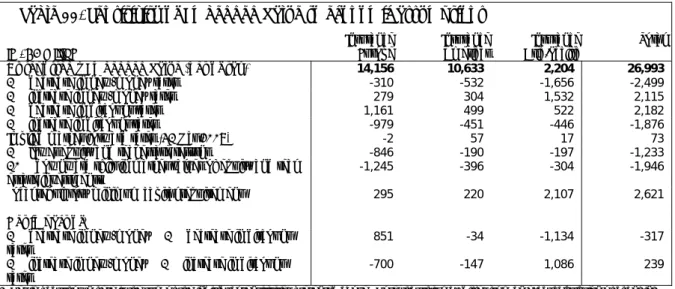
As reported – Embedded Value (net of tax) 14,156 10,633 2,204 26,993
1% decrease in new-money rates -310 -532 -1,656 -2,499
1% increase in new-money rates 279 304 1,532 2,115
1% decrease in discount rates 1,161 499 522 2,182
1% increase in discount rates -979 -451 -446 -1,876
Implied market forward rates (31 Oct 2007) -2 57 17 73
1% lower equity and real estate returns -846 -190 -197 -1,233
10% downward shift in market values of equity and real
estate investments -1,245 -396 -304 -1,946
Local regulatory minimum capital requirement 295 220 2,107 2,621
Net impact of1
1% decrease in new-money & 1% decrease in discount
rates 851 -34 -1,134 -317
1% increase in new-money & 1% increase in discount
rates -700 -147 1,086 239
1. Net impact shown here is the sum of the individual sensitivities presented above. Note that this may differ from an exact calculation of changing both parameters together.
Regarding the above results:
• The net impacts of 1% decrease/increase in new money rate (1% downward/upward parallel shift) and discount rates are largely offsetting. Interest rate guarantees make the results more sensitive to the downward shift. • The impact of using local regulatory minimum capital instead of ING capital model is positive EUR 2,621 million
and primarily due to Taiwan for which ING allocates capital at a significantly higher level than local regulatory level.
For the results of a sensitivity analysis to changes in economic assumptions performed on the Value of New Business please refer to Appendix 2.
Non-economic assumptions
The table below shows the outcomes of sensitivity analysis of the Embedded Value as at 31 December 2007 to the following changes in non-economic assumptions:
• 10% decrease in maintenance expenses throughout the projection period (a 10% sensitivity on a base expense assumption of EUR 100 would represent an expense assumption of EUR 90)
• 10% decrease in lapse rates (a 10% sensitivity on a base assumption of 4% pa would represent a lapse rate of 3.6% pa)
• 5% decrease in both mortality and morbidity rates. Mortality and morbidity assumptions are multiplied by 0.95. The impact of this decrease is shown separately for business where the decrease has a positive impact (life and morbidity business) and where it has a negative impact due to longevity risk (annuities).
In each sensitivity calculation, all other assumptions remain unchanged.
Table 12. Sensitivity of Embedded Value to non-economic assumptions
in EUR million
Insurance
Europe Insurance Americas Asia/Pacific Insurance Total
As reported – Embedded Value (net of tax) 14,156 10,633 2,204 26,993
10% decrease in maintenance expenses 371 252 131 754
10% decrease in lapse rates 187 267 125 579
5% decrease in mortality and morbidity rates – Life 51 166 271 489
5% decrease in mortality and morbidity rates - Annuity -72 -22 0 -94
Regarding the above results:
• The 5% decrease for mortality and morbidity rates is driven by Taiwan, reflecting the product mix and morbidity risk of the in-force business. For Insurance Americas this sensitivity primarily reflects gains in the Life insurance business.
• A 10% decrease in maintenance expenses will lead to a EUR 754 million increase in Embedded Value. • The sensitivity results for a 10% decrease in lapse rates in Insurance Americas are driven by Annuity and
Retirement Services.
• For Insurance Asia/Pacific lower lapse rates have a significant positive impact on the profitability of Japan’s COLI business and for Japan this reduction in lapse rates would result in a EUR 53 million impact or an 8.8% increase in Embedded Value.
For the results of a sensitivity analysis to changes in non-economic assumptions performed on the Value of New Business please refer to Appendix 2.
2. Insurance Europe
•
Embedded Value of covered life businesses increases 21.3% to EUR 19,533 million
before capital injections/(dividends)
•
Value of New Business increases 82.6% to EUR 400 million
•
IRR on new business increases to 15.8% from 14.9% in 2006
Table 13. Analysis of movement – Insurance Europe
in EUR million
Netherlands Belgium &
Luxembourg Europe & Central Spain
2007
Total 2006 Total
Free Surplusboy (FS) 6,791 390 408 7,589 6,407
Required Capitalboy (RC) 1,917 421 488 2,826 2,620
ViFboy 3,325 300 2,064 5,689 5,902
Total EVboy 12,032 1,111 2,961 16,103 14,929
Addition of business / (divested business) 0 -520 -60 -580 31
Currency effects 0 0 77 77 52
Model changes 682 -11 -29 642 -61
Revised EVboy 12,714 580 2,949 16,243 14,951
Value of New Business (VNB) 70 17 313 400 219
Financial variances 1,169 -6 38 1,201 691
Operational variances 29 2 25 56 122
Operating assumption changes -66 10 180 125 -187
Embedded Value Profit (EV Profit) 1,202 23 556 1,781 846
Required return - return on RC and ViF 398 24 244 666 606
Investment return on Free Surplus 528 6 24 557 1,054
Discount rate changes -34 -2 70 35 -399
Economic assumption changes 85 10 181 275 133
Embedded Value of business acquired 0 0 -25 -25 0
Capital injections 0 0 135 135 24
Dividends -5,170 -95 -247 -5,512 -1,111
Subtotal -4,193 -58 382 -3,869 307
EVeoy - after capital injections/(dividends) 9,723 546 3,887 14,156 16,103
EVeoy - before capital injections/(dividends) 14,893 641 3,999 19,533 17,191
RoEV% - before capital injections/(dividends) 17% 11% 36% 20% 15%
The most important items impacting the change in Embedded Value during 2007 were:
• Addition of business /(divested business) is EUR –580 million, primarily due to the sale of Belgium’s Employee Benefits and Broker businesses. Central Europe shows EUR –60 million due to the addition of the Russia Pension Fund in 2007 (EUR –81 million), which is equal to the present value of the initial start-up costs for this new Greenfield. This was partially offset by the increase in ownership for ING Piraeus (EUR 14 million). • Model changes of EUR 642 million are primarily due to a change in the target asset mix at Nationale-
Nederlanden. This asset mix impact of EUR 482 million was included as a model change so that there would be no impact on the RoEV or on the EV Profit. The present value of the Bulgaria Greenfield start-up costs is reflected as a model change (EUR –12 million) because this Greenfield was started prior to 2007.
• Value of New Business is EUR 400 million.
• Financial variances of 1,201 million are primarily due to the realised gains on shares in the Netherlands. • Operational performance variances of EUR 56 million - split between the Netherlands and Central Europe. In
the Netherlands, favourable morbidity experience (EUR 49 million), adjustments to policy terms (EUR 20 million), mix of business (EUR 28 million) were nearly offset by additional benefits granted to unit-linked
policyholders. In Central Europe, the variances primarily reflect better than anticipated premium inflows in the Poland and Bulgaria pension funds (EUR 19 million).
• Operating assumption changes of EUR 125 million. The most significant changes in Central Europe are lower lapse and maturity rates (EUR 98 million), positively impacting Poland, Czech and Slovakia. Favourable changes in the assumed expense and commission levels (EUR 50 million) in Poland and Greece and higher anticipated management fees and premium increases (EUR 40 million) were partially offset by higher anticipated mortality and morbidity claims (EUR –20 million) including higher anticipated costs for reinsurance and FOGs.
• Required return of EUR 666 million.
• Investment return on free surplus of EUR 557 million reflects the gain on shares during the year.
• Economic assumption changes increased EV by EUR 275 million. Two-thirds of that increase is from Central Europe, where changes to the wage and expense inflation assumptions primarily impacted the Hungary and Poland pension funds and accounted for EUR 79 million of this increase; updated fixed income assumptions added EUR 48 million; and a recalibration of the ING Capital Model resulted in an increase of EUR 40 million. The change to a lower corporate tax rate in the Czech Republic added EUR 17 million.
• Dividends, net of capital injections, are EUR 5,377 million.
FOGs reduced the 2007 Embedded Value by EUR 296 million (vs. EUR 262 million in 2006) and the VNB by EUR 13 million.
2.1 Embedded Value results for Insurance Europe
The table provides a high level overview of the Embedded Value for Insurance Europe. The results presented below should be read carefully in connection with the embedded movement shown in Table 13, including the explanations, and also with the sensitivity analysis in Section 2.4.
Table 14. Embedded Value – covered life insurance business
In EUR million 2007 2006 % Change
Free Surplus (FS) 3,621 7,589 -52.3%
Required Capital (RC) 3,286 2,826 16.3%
Adjusted Net Worth (ANW) 6,907 10,415 -33.7%
Present Value of Future (statutory book) Profits (PVFP) 8,162 6,727 21.3%
Cost of holding Required Capital (CoC) -912 -1,038 -12.1%
Value of in-Force covered business (ViF) 7,249 5,689 27.4%
Embedded Value (ViF and ANW) 14,156 16,103 -12.1%
Embedded Value of the covered life business decreased 12.1% to EUR 14,156 million. Free Surplus decreased to EUR 3,621 million from EUR 7,589 million in 2006 because EUR 5,512 million in dividends were up-streamed.
2.2 Return on Embedded Value in comparison to 2006 results
The table below shows RoEV after revisions to the year-end 2006 Embedded Value.Table 15. Change in Embedded Value and EV Profit
In EUR million 2007 2006 % Change
Embedded Valueboy 16,103 14,929 7.9%
Revisions to EV 140 22 536.4%
Revised EVboy 16,243 14,951 8.6%
EV Profit 1,781 846 110.5%
Required return - return on RC and ViF 666 606 9.9%
Other returns 867 788 10.0%
Return on EV (RoEV) before capital injections/(dividends)1 3,314 2,240 47.9%
RoEV% - before capital injection/(dividends) 20% 15%
Embedded Value of business acquired -25 0 -
Capital injections / (dividends) -5,377 -1,087 394.7%
EVeoy - after capital injections/(dividends) 14,156 16,103 -12.1%
1. Measured on Revised EVboy
RoEV% increased from 15% in 2006 to 20% in 2007. Most of the increase is from financial performance variances, which were significant in 2007, nearly twice 2006 levels.
2.3 New Business
The tables below provide an overview of the profitability of the new life insurance production written in 2007 measured by the Value of New Business and internal rate of return. Furthermore the investment in new business is shown and detailed information is provided with respect to sales, measured as annual premium, single premium and annual premium equivalent (APE). Profit margins are shown in Table 20 as percentage of the present value of the new business premiums.
Table 16. Value of New Business – covered life insurance business
Quarterly Results Full Year Results
In EUR million 2007 4Q 2006 4Q change % 2007 3Q change % 2007 2006 Change %
Profit-tested Value of New Business (a) 197 48 310.4% 99 99.0% 413 226 82.7%
After-tax acquisition expense & commission overrun (b)
-2 3 - 7 - 12 7 71.4%
Value of New Business (a-b) 200 45 344.4% 92 117.4% 400 219 82.6%
Investment in new business 128 91 40.7% 106 20.8% 398 322 23.6%
Final IRR on new sales 14.3% 15.8% 14.9%
VNB in Insurance Europe is up by 82.6% to EUR 400 million, with most of the increase coming from Romania pension funds. Removing the Romania pension funds, the VNB for Europe would have been up 14.2% from 2006.
Table 17. New life insurance value by country
Quarterly Results Full Year Results
In EUR million
4Q2007 4Q2006 %
change
3Q2007 % change 2007 2006 %
Change
Netherlands 26 10 160.0% 13 100.0% 70 76 -7.9%
Belgium & Luxembourg 4 6 -33.3% 4 0.0% 17 19 -10.5%
Central Europe & Spain 170 29 486.2% 74 129.7% 313 124 152.4%
Table 18. New life insurance IRR by country
In EUR million 4Q2007 4Q2006 change 3Q2007 change 2Q2007 Change 1Q2007 Change
Netherlands 12.2% 12.8% -0.6% 11.4% 0.8% 11.6% 0.6% 11.1% 1.1%
Belgium & Luxembourg 13.2% 12.3% 0.9% 12.7% 0.5% 11.8% 1.4% 12.1% 1.1%
Central Europe & Spain 18.4% 18.1% 0.3% 16.8% 1.6% 17.9% 0.4% 18.5% -0.1%
Total 15.8% 14.9% 0.9% 14.3% 1.5% 14.3% 1.5% 14.3% 1.5%
The most important items influencing the 2007 results were:
•
The Netherlands VNB for 4Q 2007 of EUR 26 million compares to 4Q 2006 of EUR 10 million and EUR 13 million from 3Q 2007. The normalized VNB for 4Q 2006 before discount rate change was EUR 17 million. Approximately half of the increase from 3Q 2007 is due to lower acquisition expense overruns. The other half is due to higher sales, a shift to the more profitable traditional business, and higher charges for the interest guarantees/cost of capital in the Group business.•
The Central Europe and Spain VNB of EUR 170 million is significantly higher than the 4Q 2006 VNB of EUR 29 million and EUR 74 million in 3Q 2007. The addition of the Romania pension fund accounts for EUR 116 million of the increase from one year ago and EUR 82 million compared to 3Q 2007. Much of the remaining increase in VNB is in line with the increase in sales.•
The change in Greenfield expense policy added EUR 4 million compared to a year ago.Table 19. New life insurance production by country – Annualized Premium
Quarterly Results Full Year Results
In EUR million
4Q2007 4Q2006 %
change
3Q2007 % change 2007 2006 %
Change Annualized Premium
Netherlands 42 41 2.4% 37 13.5% 156 154 1.3%
Belgium & Luxembourg 9 7 28.6% 3 200.0% 22 21 4.8%
Central Europe & Spain 169 90 87.8% 128 32.0% 465 314 48.1%
Total Annual Premium 220 138 59.4% 168 31.0% 643 488 31.8%
Single Premium
Netherlands 300 362 -17.1% 255 17.6% 1,191 1,495 -20.3%
Belgium & Luxembourg 182 209 -12.9% 217 -16.1% 1,037 904 14.7%
Central Europe & Spain 389 265 46.8% 168 131.5% 1,028 711 44.6%
Total Single Premium 871 836 4.2% 640 36.1% 3,256 3,109 4.7%
APE
Netherlands 72 78 -7.7% 63 14.3% 275 304 -9.5%
Belgium & Luxembourg 27 28 -3.6% 24 12.5% 126 111 13.5%
Central Europe & Spain 208 116 79.3% 145 43.4% 568 385 47.5%
Total APE 307 222 38.3% 232 32.3% 969 799 21.3%
1. Annual Premium Equivalent (APE) = Annual Premium + 10% * Single Premium Note: Belgium and Luxembourg figures adjusted to exclude the divested business
Annualized premium equivalent sales for 4Q 2007 are 38.3% above 4Q 2006 levels and 32.3% above 3Q 2007. The increase is driven by Central Europe & Spain, but all three regions increased compared to 3Q 2007.
Annualized Regular Premiums
The Central Europe and Spain annual premiums of EUR 169 million are significantly higher than the 4Q 2006 figure of EUR 90 million and EUR 128 million for 3Q 2007. The addition of Romania Pillar II pension funds explains nearly the entire increase in annual premium sales compared to the prior quarters.
Single Premiums
The Central Europe and Spain single premiums of EUR 389 million are significantly higher than the 4Q 2006 figure of EUR 265 million and EUR 168 million for 3Q 2007. Spain was the largest contributor with an increase of
EUR 72 million from 4Q 2006 and EUR 94 million from 3Q 2007, with sales of the SPVA product and large group sales partially offset by lower unit-linked and traditional sales.
The launch of new UL products in the Czech Republic and in Greece also contributed to the increase, with a combined increase of EUR 72 million compared to both 4Q 2006 and 3Q 2007. The single premium endowment campaign in Poland added EUR 42 million to the increase over the prior quarter. This is a seasonal campaign, occurring in the 2nd and 4th quarters. The 4Q 2007 campaign generated EUR 17 million less in single premiums than it did a year ago.
The table below shows new business statistics such as new business profit margins (VNB/PV NBP), which have increased for Europe overall due to the greater portion of sales in Central Europe, where margins are generally higher than the developed markets of the Benelux.
Table 20. New business statistics
Quarterly Results Full Year Results
PV of Premiums VNB/PV Premiums PV of Premiums VNB/PV Premiums
In EUR million 4Q2007 4Q2006 4Q2007 4Q2006 2007 2006 2007 2006
Netherlands 648 647 4.0% 1.5% 2,433 2,673 2.9% 2.8%
Belgium & Luxembourg 232 321 1.7% 1.9% 1,322 1,335 1.3% 1.4%
Central Europe & Spain 3,921 757 4.3% 3.8% 7,777 3,106 4.0% 4.0%
Total 4,801 1,725 4.2% 2.6% 11,531 7,114 3.5% 3.1%
The table below compares the 2007 Value of New Business production for each quarter of 2007. The increase for Europe largely reflects the Romania Pillar II pension fund activity in the 3rd and 4th quarter of the year.
Table 21. Development of value of new life insurance production
In EUR million Fourth Quarter Third Quarter Second Quarter First Quarter
Netherlands 26 13 17 13
Belgium & Luxembourg 4 4 4 5
Central Europe & Spain 170 74 34 35
Total 200 92 55 53
2.4 Sensitivity analysis
Economic assumptions
The table below shows the outcomes of sensitivity analysis of the Embedded Value as at 31 December 2007 to economic assumptions. For an explanation of the sensitivities please refer to Section 1.4.
Table 22. Sensitivity of Embedded Value to economic assumptions
in EUR million
Netherlands Belgium &
Luxembourg Central Europe & Spain Total
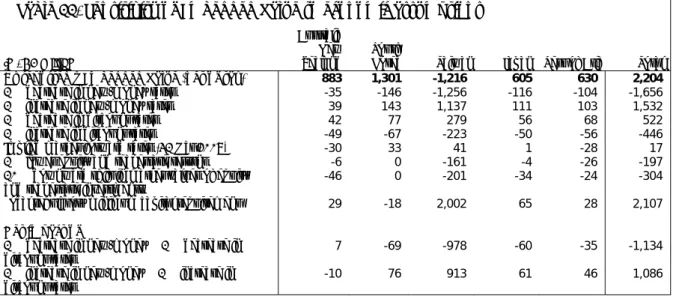
As reported – Embedded Value (net of tax) 9,723 546 3,887 14,156
1% decrease in new-money rates -134 -12 -164 -310
1% increase in new-money rates 113 10 156 279
1% decrease in discount rates 803 18 340 1,161
1% increase in discount rates -672 -18 -289 -979
Implied market forward rates (31 Oct 2007) -8 0 7 -2
1% lower equity and real estate returns -788 -5 -53 -846
10% downward shift in market values of equity
and real estate investments -1,182 -35 -28 -1,245
Local regulatory minimum capital requirement 194 -11 112 295
Net impact of
1% decrease in new-money & 1% decrease in
discount rates 669 6 176 851
1% increase in new-money & 1% increase in
Regarding the above results:
•
1% decrease/increase to the new-money rates in the Netherlands is less sensitive than in 2006. Nationale-Nederlanden’s Group business dampens the sensitivity through profit-sharing and the impact of swaptions.•
The Embedded Value is more sensitive to the equity/real estate returns than in the 2006 Embedded Value,primarily reflecting the fact that for 5% equity holdings no tax offset is taken in the sensitivity testing.
•
For Central Europe & Spain, the net impact of a reduction in new money rate and corresponding reduction indiscount rate is positive, primarily attributable to the pension funds of Poland, Hungary and Romania.
•
The sensitivity to local regulatory minimum capital requirements is negative for Belgium & Luxembourg because these businesses hold less than the regulatory minimum capital. In the Netherlands, Nationale-Nederlanden reflects capital that is higher than the regulatory minimum, but Postbank and RVS reflect less. If RVS and Postbank were to hold the minimum regulatory capital, the Embedded Value would decrease by EUR 22 million. Finally, several business units in Central Europe & Spain hold less than the regulatory minimum. For these business units, holding the regulatory minimum would decrease the Embedded Value by EUR 11 million.For the results of a sensitivity analysis to changes in economic assumptions performed on the Value of New Business please refer to Appendix 2.
Non-economic assumptions
Table 23 below shows the outcomes of sensitivity analysis of the Embedded Value as at 31 December 2007 to the following changes in non-economic assumptions.
Table 23. Sensitivity of Embedded Value to non-economic assumptions
in EUR million
Netherlands Belgium &
Luxembourg Central Europe & Spain Total
As reported – Embedded Value (net of tax) 9,723 546 3,887 14,156
10% decrease in maintenance expenses 290 10 70 371
10% decrease in lapse rates 84 2 101 187
5% decrease in mortality and morbidity rates – Life 11 1 40 51
5% decrease in mortality and morbidity rates - Annuity -70 0 -2 -72
The negative impact of the decrease in mortality and morbidity rates is primarily due to Nationale Nederlanden (EUR – 70 million) as a result of the large portfolio of Group annuity business and the portfolio of immediate annuities. Note that with respect to the mortality tables used for the Embedded Value calculations the latest industry tables have been used including future mortality improvements.
For the results of a sensitivity analysis to changes in non-economic assumptions performed on the Value of New Business please refer to Appendix 2.
3. Insurance Americas
•
Embedded Value of covered life businesses increases 17.5% to EUR 12,065 million
before capital injections/(dividends) and currency effects. Including currency
effects, the Embedded Value increases 7.3%
•
Value of New Business increases by 61.7% to EUR 270 million, with large increases
in US Life insurance and ING Financial Products and in Mexico’s pension funds
•
New sales (as measured in APE) rise 5.5%
Table 24. Analysis of movement – Insurance Americas
in EUR million
USFS Latin
America 2007 Total 2006 Total
Free Surplusboy (FS) 1,136 34 1,170 810
Required Capitalboy (RC) 4,377 419 4,796 5,226
ViFboy 3,862 442 4,305 4,822
Total EVboy 9,376 896 10,272 10,858
Addition of business / (divested business) 0 5 5 376
Currency effects -981 -62 -1,043 -1,134
Model changes -141 15 -126 31
Revised EVboy 8,254 854 9,108 10,130
Value of New Business (VNB) 215 55 270 167
Financial variances -102 33 -69 331
Operational variances 286 -15 271 0
Operating assumption changes 44 -20 24 48
Embedded Value Profit (EV Profit) 443 55 498 546
Required return - return on RC and ViF 596 105 701 708
Investment return on Free Surplus 0 10 10 4
Discount rate changes 60 21 81 -194
Economic assumption changes 157 -29 128 -23
Embedded Value of business acquired 0 497 497 0
Capital injections 216 68 284 0
Dividends -657 -15 -673 -899
Subtotal 371 656 1,027 -404
EVeoy - after capital injections/(dividends) 9,068 1,565 10,633 10,272
EVeoy - before capital injections/(dividends) 9,510 1,512 11,022 11,171
RoEV% - before capital injections/(dividends) 15% 19% 16% 10%
The most important items impacting the change in Embedded Value during 2007 were:
•
Unfavourable currency movements of EUR –1,043 million, reflecting the strengthening of the Euro against US and Latin American currencies.•
Model changes include EUR -198 million due to a methodology change in the US, which resulted in higher expenses being allocated to maintenance from acquisition. The offset to this is a EUR 11 million positive impact on the 2007 VNB.•
Value of New Business of EUR 270 million, which is an increase of 61.7% compared to EUR 167 million in 2006.•
Financial performance variances of EUR –69 million primarily reflects lower than projected equity performance onfund values and fee income of the US Annuity and Retirement businesses. This was partially offset in USFS by favourable credit default experience, and favourable returns on assets backing required capital. The favourable variances in Latin America are attributable to investment gains in Mexico.
•
Operational performance variances of EUR 271 million reflects EUR 145 million from US Annuity related to the actual development of reserves and required capital compared to expected, EUR 66 million in US Life to reflect the retroactive impact of the on-shore reinsurance transactions on business sold in 2006, and EUR 65 million in Retirement Services for improvement in general account asset strategies. Other variances in the US – mortality,persistency and expenses – were largely offsetting, with a EUR 31million variance related to persistency (Group Reinsurance and Retirement Services) offset by EUR –48 million variance from mortality and expenses. In Latin America, the continuation of the transfer war in Peru and additional expenses allocated to Mexico’s pension funds largely account for the EUR –15 million in operating performance variances.
•
Operational assumption changes of EUR 24 million include EUR –163 million for increased maintenance expenses in the US, which are offset by EUR 166 million from improved product fees and fund fee income.•
Required return on beginning in-force (unwind of discount rate) of EUR 701 million.•
Discount rate and economic assumption changes added EUR 81 million and EUR 128 million.Financial Options and Guarantees reduced Insurance Americas Embedded Value by EUR 232 million, driven by USFS. FOG costs reduced the 2006 Embedded Value by EUR 211 million.
3.1 Embedded Value results for Insurance Americas
Table 25 provides a high level overview of the Embedded Value for Insurance Americas. The results presented below should be read carefully in connection with the embedded movement shown in Table 24, including the explanations, and also with the sensitivity analysis in Section 3.4.
Table 25. Embedded Value – covered life insurance business
In EUR million 2007 2006 % Change
Free Surplus (FS) 1,280 1,170 9.4%
Required Capital (RC) 4,623 4,796 -3.6%
Adjusted Net Worth (ANW) 5,903 5,967 -1.1%
Present Value of Future (statutory book) Profits (PVFP) 5,927 5,660 4.7%
Cost of holding Required Capital (CoC) -1,197 -1,356 -11.7%
Value of in-Force covered business (ViF) 4,731 4,305 9.9%
Embedded Value (ViF and ANW) 10,633 10,272 3.5%
Embedded Value of the covered life business increased 3.5% to EUR 10,633 million. Free Surplus increased to EUR 1,280 million from EUR 1,170 million in 2006, an increase of 9.4%. The movement over the year of Free Surplus, Adjusted Net Worth and the Value of in-Force covered business can be found in Appendix 1.
3.2 Return on Embedded Value in comparison to 2006 results
Table 26 below shows RoEV after revisions to the year-end 2006 Embedded Value.Table 26. Change in Embedded Value and EV Profit
In EUR million 2007 2006 % Change
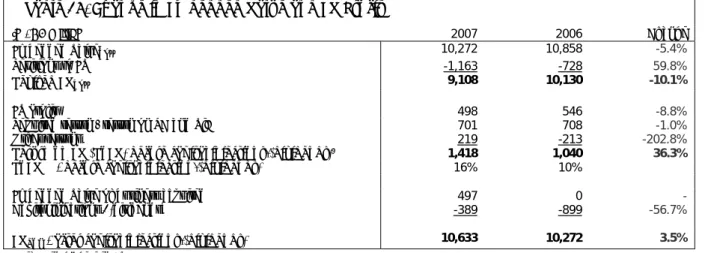
Embedded Valueboy 10,272 10,858 -5.4%
Revisions to EV -1,163 -728 59.8%
Revised EVboy 9,108 10,130 -10.1%
EV Profit 498 546 -8.8%
Required return - return on RC and ViF 701 708 -1.0%
Other returns 219 -213 -202.8%
Return on EV (RoEV) before capital injections/(dividends)1 1,418 1,040 36.3%
RoEV% - before capital injection/(dividends) 16% 10%
Embedded Value of business acquired 497 0 -
Capital injections / (dividends) -389 -899 -56.7%
EVeoy - after capital injections/(dividends) 10,633 10,272 3.5%
EV Profit of EUR 498 million is 8.8% below the 2006 figure. Favourable financial variances in 2006 were replaced by large operational variances and an increase to the VNB.
The RoEV increased by 36.3% to EUR 1,418 million on the revised EV of EUR 9,108 million, a return percentage of 16%. Other return components - changes to discount rates, economic assumption changes and returns on free surplus – added EUR 219 million, in contrast to EUR –213 million in 2006.
3.3 New Business
The tables below provide an overview of the profitability of the new life insurance production written in 2007 measured by the Value of New Business and internal rate of return. Furthermore the investment in new business is shown and detailed information is provided with respect to sales, measured as annual premium, single premium and annual premium equivalent (APE). Profit margins are shown in Table 31 as percentage of the present value of the new business premiums.
Table 27. Value of New Business – covered life insurance business
Quarterly Results Full Year Results
In EUR million
4Q 2007 4Q 2006 % change 3Q 2007 % change
2007 2006 %
Chang e
Profit-tested Value of New Business (a) 113 5 2160.0% 79 43.0% 300 227 32.2%
After-tax acquisition expense & commission overrun (b)
2 18 -88.9% 7 -71.4% 29 60 -51.7%
Value of New Business (a-b) 111 -12 - 73 52.1% 270 167 61.7%
Investment in new business 324 168 92.9% 293 10.6% 1,138 1,031 10.4%
Final IRR on new sales 10.8% 11.8% 10.3%
Value of New Business of EUR 270 million in 2007 is 61.7% higher than full year 2006. In comparing 2007 to 2006, recall that at year-end 2006, the Americas VNB was reduced by EUR 31 million due to the discount rate change, all of which was reflected in the 4Q 2006 results.
Table 28. New life insurance value by country
Quarterly Results Full Year Results
In EUR million
4Q2007 4Q2006 %
change
3Q2007 % change 2007 2006 %
Change
USFS 77 -3 -2666.7% 64 20.3% 215 145 48.3%
Latin America 35 -9 -488.9% 9 288.9% 55 22 150.0%
Total 111 -12 -1025.0% 73 52.1% 270 167 61.7%
Table 29. New life insurance IRR by country
In EUR million 4Q2007 4Q2006 change 3Q2007 change 2Q2007 change 1Q2007 Change
USFS 11.3% 10.3% 1.0% 10.7% 0.5% 10.2% 1.1% 9.3% 2.0%
Latin America 15.8% 10.5% 5.3% 11.9% 3.9% 11.5% 4.3% 11.8% 4.0%
Total 11.8% 10.3% 1.5% 10.8% 0.9% 10.3% 1.5% 9.5% 2.3%
In the US, the most important items influencing the 2007 results are as follows:
•
The US Life insurance business reported VNB of EUR 19 million for 4Q 2007, compared to EUR –19 million in 4Q 2006. In addition to the benefits of sales that more than doubled, a large positive impact on VNB results resulted from the successful completion of on-shore reinsurance agreements. These agreements create value through improving the tax efficiency and reducing the reserve levels for Level Term insurance and Universal Life insurance with secondary guarantees. the impact on the VNB was EUR 11 million in 4Q 2007, including a retroactive impact on sales in the first three quarters of the year.•
Expense assumptions in US Annuity and US Life were revised to increase the maintenance expense assumptions and reduce acquisition expense assumptions. This change added EUR 11 million to the VNBthroughout the year. The adverse impact of this change in maintenance expenses assumptions is reflected as a reduction in the Value of in-Force as a model change.
•
US Annuity benefited from higher Variable Annuity sales when compared to both 4Q 2006 and 3Q 2007. The Annuity VNB of EUR 21 million is a significant increase from VNB of zero in 4Q 2006, but because of lower pricing margins, there was a small decrease in VNB from 3Q 2007.•
US ING Financial Products’ 4Q 2007 VNB of EUR 18 million compares to 4Q 2006 VNB of EUR 2 million, an increase that resulted from sales that are 41% higher, a more profitable product mix, and increased margins. Due to this better mix and margins, VNB decreased slightly from 3Q 2007, despite sales that are 45% lower.
In Latin America, the most important items influencing the 2007 results are as follows:
•
The pension funds acquired from Santander contributed EUR 11 million to the VNB, most of which is in Mexico.•
Mexico’s pension fund business contributed EUR 26 million to the VNB in 4Q 2007, partly due to the acquired business, but primarily due to lower assumed expenses, lapses and higher contribution rates. These changes reflect regulatory changes that make transferring between pension fund companies more difficult and also reflect higher quality business.•
Peru’s pension fund business maintained its VNB, despite a 20% drop in sales. The slowing of the transfer wars is reflected in lower lapses, increasing the value associated with each sale.Table 30. New life insurance production by country – Annualized Premium
Quarterly Results Full Year Results
In EUR million
4Q2007 4Q2006 %
change
3Q2007 % change 2007 2006 %
Change Annualized Premium
USFS 343 338 1.5% 313 9.6% 1,419 1,495 -5.1%
Latin America 129 103 25.2% 75 72.0% 354 322 9.9%
Total Annual Premium 473 441 7.3% 388 21.9% 1,773 1,817 -2.4%
Single Premium
USFS 5,270 4,104 28.4% 5,654 -6.8% 18,791 16,418 14.5%
Latin America 47 43 9.3% 51 -7.8% 193 210 -8.1%
Total Single Premium 5,317 4,147 28.2% 5,704 -6.8% 18,983 16,628 14.2%
APE
USFS 870 749 16.2% 879 -1.0% 3,298 3,137 5.1%
Latin America 134 107 25.2% 80 67.5% 374 343 9.0%
Total APE 1,004 856 17.3% 958 4.8% 3,671 3,480 5.5%
1. Annual Premium Equivalent (APE) = Annual Premium + 10% * Single Premium
Annualized premium equivalent sales for 4Q 2007 are 17% above 4Q 2006 levels and 5% above 3Q 2007. For the US, the Life, Annuity, Employee Benefits and ING Financial Products all contributed to the increase from 4Q 2006. For Latin America, the Santander acquisition is the primary driver.
Annualized Regular Premiums
US Life and Employee Benefits’ regular premium sales more than doubled from 4Q 2006. These were largely offset by a decrease in Retirement Services.
Latin America’s pension funds fuelled the increase in sales for that region. The exception is Peru’s pension funds where the transfer war is subsiding.
Single Premiums
In the US, 4Q 2007 single premium sales were up 28% from 4Q 2006. Life, Annuity and ING Financial Products’ single premium sales are all up significantly. Low Fixed and Variable Annuity sales in the first half of the year were addressed with a number of product and distribution initiatives that significantly increased sales in the 2nd half of the year. ING Financial Products capitalised on an attractive market environment to also increase sales in this period. The positive sales results were somewhat offset by a decline in Retirement Services’ non-core business.
Table 31. New business statistics
Quarterly Results Full Year Results
PV of Premiums VNB/PV Premiums PV of Premiums VNB/PV Premiums
In EUR million 4Q2007 4Q2006 4Q2007 4Q2006 2007 2006 2007 2006
USFS 6,867 4,939 1.1% -0.1% 24,228 20,692 0.9% 0.7%
Latin America 198 103 17.7% -8.7% 620 574 8.9% 3.8%
Total 7,066 5,042 1.6% -0.2% 24,848 21,266 1.1% 0.8%
The above table shows new business statistics such as new business profit margins (VNB/PVNBP). New business profit margins are higher for USFS and for Latin America, which is consistent with the comments regarding VNB that are detailed above.
The table immediately below compares the 2007 Value of New Business production for each quarter of 2007.
Table 32. Development of value of new life insurance production
In EUR million Fourth Quarter Third Quarter Second Quarter First Quarter
USFS 77 64 47 27
Latin America 35 9 6 6
Total 111 73 53 33
3.4 Sensitivity analysis
Economic assumptions
The table immediately below shows the outcomes of sensitivity analysis of the Embedded Value as at 31 December 2007 to economic assumptions. For an explanation of the sensitivities please refer to Section 1.4.
Table 33. Sensitivity of Embedded Value to economic assumptions
In EUR million USFS Latin America Total
As reported – Embedded Value (net of tax) 9,068 1,565 10,633
1% decrease in new-money rates -471 -61 -532
1% increase in new-money rates 239 65 304
1% decrease in discount rates 426 73 499
1% increase in discount rates -388 -63 -451
Implied market forward rates (31 Oct 2007) 57 0 57
1% lower equity and real estate returns -179 -10 -190
10% downward shift in market values of equity
and real estate investments -391 -6 -396
Local regulatory minimum capital requirement 206 14 220
Net impact of
1% decrease in new-money & 1% decrease in
discount rates -46 12 -34
1% increase in new-money & 1% increase in discount rates
-148 1 -147
There is an asymmetry in the sensitivity to new money rates in USFS because interest rate guarantees on many life insurance and annuity products result in a margin squeeze when new-money rates are reduced.
For the results of a sensitivity analysis to changes in economic assumptions performed on the Value of New Business please refer to Appendix 2.
Non-economic assumptions
The table immediately below shows the outcomes of sensitivity analysis of the Embedded Value as at 31 December 2007 to the following changes in non-economic assumptions.
Table 34. Sensitivity of Embedded Value to non-economic assumptions
In EUR million USFS Latin America Total
As reported – Embedded Value (net of tax) 9,068 1,565 10,633
10% decrease in maintenance expenses 192 61 252
10% decrease in lapse rates 232 35 267
5% decrease in mortality and morbidity rates – Life 150 16 166
5% decrease in mortality and morbidity rates - Annuity -10 -12 -22
For the results of a sensitivity analysis to changes in non-economic assumptions performed on the Value of New Business please refer to Appendix 2.