A Framework of Knowledge Management System for Support Decision
Making on Web-enabled Environment
1,2
Wang Jinbo,
3Liu Xuefeng,
4Deng Ming
1Department of Planning and Statistic, Xiamen University, Xiamen, 361005, China
2
Fujian Key Laboratory of Statistical Sciences, Xiamen University, Xiamen, 361005, China,
[email protected]
3
School of Management, Xiamen University, Xiamen, 361005, China,
[email protected]
*4,Corresponding Author
Department of Public Economics, Xiamen University, Xiamen, 361005,
China,
[email protected]
doi : 10.4156/jcit.vol6.issue7.17
Abstract
Knowledge management has become a critical theme in the modern enterprise management field, and good decision making is imperative for organizations to survive. Therefore, building a system of knowledge management for support decision making is very important for organizations. This article presents a combined framework of knowledge management for support decision making on web-enabled environment based on XML, JAVA technologies. In this framework, decision making can be support by knowledge management system in heterogeneous platform and web-enabled environment, so it is possible to prompt the understandability, accessibility, and reusability of knowledge management system.
Keywords
: Knowledge Management, Decision Making, Web-enabled Environment, XML, JAVE1. Introduction
As the era of knowledge economy, people are more profound understanding of the knowledge, that knowledge is the key factor of company’s products and services. Companies have begun to see the importance of properly managing knowledge in order to be competitive. So, in recent years, there has been an explosion of interest in the field of knowledge management (KM).
There are many definitions of KM. Such as: KM is a critical theme in the modern management field and established its domain in the discovery, capture, storage, sharing, and reuse of the organization’s valuable knowledge[1]. KM is concerned with ensuring that the right knowledge is available in the right form to the right processors at the right time for the right cost[2]. KM is the process of acquiring knowledge from the organization or another source and turning it into explicit information that the employees can use to transform into their own knowledge allowing them to create and increase organizational knowledge[3]. These above definitions explain operation process of knowledge in the organization. But there are a lot of questions which need for further research between decision making and KM, especially in how to support decision making and how to make decision making more efficiently on web-enabled environment in KM system.
In this paper, a framework of KM system for support decision making on web-enabled environment will be presented. In this framework, through the integration of KM methods among business processes and decision making, it can be enhanced that the capabilities of business process analysis and decision support in organization, and the purposes of improving the quality of business processes and decision making can be achieved.
2. Decision making and knowledge management
2.1. Decision making
Decision making is the process of selecting from a set of options the alternatives that are most likely to lead to desired outcomes[4]. Decision making is a knowledge-intensive activity with knowledge as its raw materials, work-in-process, by-products, and finished goods. Before decision maker makes decisions, he must obtain information from each possible alternative. Once this information is gathered and culminated in an alternative, this is considered knowledge’s raw materials. When a decision is made from all presented alternatives, this decision making can be considered work-in-process of knowledge. And the alternatives not chosen can be considered as by-products. Which decision making generated by knowledge and decision making regeneration of knowledge are finished goods during the decision making process[5]. Therefore, decision making and knowledge management have very closely relationship.
K.G. Jones defined the decision making process as involving four phase: intelligence, design, choice and implementation[3]. The first phase, intelligence, is the phase when the decision maker is made aware of the need for a decision and where he collects knowledge surrounding organization. The second phase, design, is the phase where alternative courses of action are formed in terms of the organization’s purpose. The third phase, choice, is the phase where the decision maker selects one of alternatives. In this phase, the decision maker can also return to one of the earlier stages to reformulate new alternatives because of additional information[6]. The last phase, implementation, is the phase which put the choice in to action. In this phase, the decision making culminates with implementation. Every decision making process phases need knowledge, and poor knowledge leads poor quality decisions. So, it is very important for organization to support decision making by KM system[7].
2.2. Knowledge management
In organizations, KM is a series of activities which including acquisition of knowledge, using knowledge, creation of knowledge. At the same time, it timely gives the correct knowledge to the members, to help members to take corrective action, so to improve organizational performance[8]. Therefore, Alavi M. and Leidner D.E. think KM systems consist of four sets of function module: knowledge creation/construction, knowledge storage/retrieval, knowledge communication, and knowledge application[1]. And K.G. Jones thinks KM is comprised of five primary activity classes: acquisition, selection, generation, assimilation and emission[3].
According to the research of above scholars, this paper thinks KM process model as shown in Figure 1. The figure demonstrates knowledge can be improved or eliminated with KM.
Figure 1. Knowledge management process model
The activities of KM is constrained and facilitated by a variety of influences factors, and it unfolds in an organization as a pattern of interrelated KM episodes(KME)[9]. The primary KM classes of activities involved in the KME make use of the available knowledge resources in attempting to complete the KME[3]. And a KME involves the execution of some configuration of knowledge manipulation activities by some assortment of processors operating on available knowledge resources to develop the needed knowledge.
2.3. The relationship between decision making and KME
Knowledge acquisition Knowledge storage and retrieval Knowledge communication Knowledge application Knowledge improvement or elimination Information technology
Information technology Knowledge
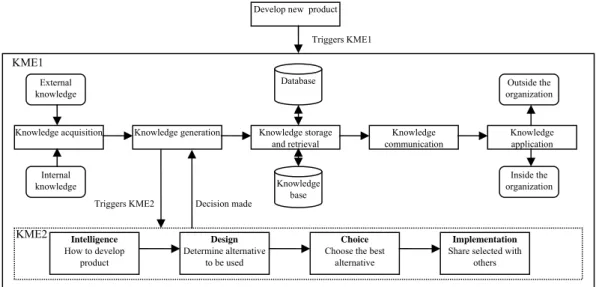
In reviewing the four phases of decision making and the activities of KM process, it can be seen there are some similar relationships. Intelligence and knowledge acquisition all perform similar tasks of need recognition and gathering knowledge. Design, choice and knowledge generation also perform similar basic tasks which are developing alternatives and choosing the best alternative. And implementation, knowledge communication and application all are designed to put a choice into action and alert others who may be affected by the choice[3]. So, decision making can be considered as an important special case of KMEs. Triggered by recognition of the need for a decision, the episode involves one or more decision maker. Decision making can spawn problem-solving episodes, special cases of KMEs at a more micro level, where the knowledge needed is the solution to some problem of interest to the decision maker[9]. When decision maker takes a decision, he has gathered knowledge surrounding the decision. Then, decision maker designs alternative and ultimately choose one. In KME terms, the KME begins with the decision need and ends when the alternative is chosen. Therefore, the relationship between the decision making and KME can be demonstrates in Figure 2[3]. The fig. 2 demonstrates how closely linked the decision making phases and the activities of KM process.
Figure 2. Decision making in KME
3. System framework and design
3.1. System framework
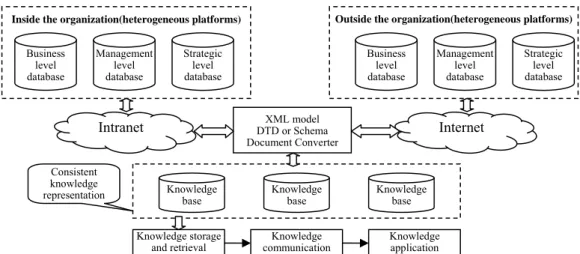
Some web-based KM systems have been presented and discussed[10,11,12]. The advantages and disadvantages of these systems have been stated in these papers. In this paper, we will establish a framework of KM systems on web-enabled environment which developed by XML and Java under the Java interoperable platform[13]. This type of systems has some benefits which including easy-to-install, user-friendly, and component reusable. The framework of this system is exhibited in Figure 3 and Figure 4[14].
Knowledge generation
Develop new product
Knowledge communication Knowledge storage and retrieval Knowledge base Database Knowledge application Intelligence How to develop product Choice
Choose the best alternative
Design
Determine alternative to be used
Implementation
Share selected with others Knowledge acquisition External knowledge Internal knowledge Outside the organization Inside the organization Triggers KME1 Triggers KME2 KME1 KME2 Decision made
Figure 3. Unified KM platform: Combination model of knowledge base based on XML
Figure 4. System architecture
3.2. Framework description
The system is composed of three modules: unified KM platform, problem solving system and human computer interface.
Unified KM platform is the most important module of the KM system. Can be learned from the above, knowledge creation and acquisition is the source of the KM process. And the acquisition knowledge from inside the organization and outside the organization will be stored in multiple physical locations scattered databases or knowledge bases. Inside the organization, they will be interconnected by Intranet. While outside the organization, they will be interconnected by Internet. And they are
Business level database
Inside the organization(heterogeneous platforms)
Management level database Strategic level database Business level database
Outside the organization(heterogeneous platforms)
Management level database Strategic level database
Intranet DTD or Schema XML model Internet
Document Converter Knowledge storage and retrieval Knowledge base Knowledge
base Knowledge base
Knowledge
communication Knowledge application Consistent
knowledge representation
Problem solving system Human computer interface
Knowledge Object
Base Client’s web
browser components Web
Java applets Model base Explanation mechanism Inference engine Knowledge representation
Web servers Interface
engine
End user
JSP Unified KM
Platform (see figure 3)
retrieved through database and knowledge base interfaces via Java database connectivity(JDBC). However, these databases and knowledge bases mostly are heterogeneous, and heterogeneity makes there are differences in the expression of knowledge and disadvantage in the communication and promotion of knowledge. In this paper, we use XML(eXtensible Markup Language) to deal with this problem(see figure 3). XML is a simple data storage language, and it uses a series of tags describe the data. Therefore, XML becomes a popular language with data exchange. In the XML format file, the data type can be defined by designer, and the file can be interpreted by different programming languages[15]. Therefore, in a network environment, the information generated by various heterogeneous platforms through XML, can be easily incorporated into XML documents[16]. Then, the communication and promotion of knowledge in heterogeneous platforms can be implemented with the exchange of XML documents. And further integration of these different types of knowledge with XML, so that all knowledge can be integrated into a unified KM platform.
The second module, problem solving system, is mainly to provide some alternative solutions for user’s problems. From unified KM platform, the problem solving system gets the isomorphic knowledge representation. And these knowledge, model base and inference engine form the explanation mechanism which is the core of problem solving system. Therefore, the processing of problem solving system as follows: firstly, analysis and recognition problems which are provided from client by the end users. Once the problem is recognized, it is defined in terms that facilitate the creation of mathematical models. Then, some alternative solutions are created by explanation mechanism according to models. Lastly, these alternative solutions will send back to the end user by web components, so the end user will choose one according to value guideline, scientific guideline, or effective guideline[17].
As for the module of human computer interface, first of all, the end user accesses the friendly user interface of system by the client’s web browser. And the system web components are developed and implemented as Java applets on the back-end and are stored in Knowledge Object Base[18]. The knowledge objects in the knowledge base are encapsulated as JavaBeans. The structure of knowledge objects such as attributes, operations, access privileges and inheritance relationships are defined by Jess(Java Expert System Shell) defclass method, which ensures the reusability of knowledge objects[13]. So, when the end user opens the web by client’s web browser, the components will be automatically downloaded from Knowledge Object Base and installed by JSP(Java Server Pages). Then the end user can use these components in the client’s web browser, and input semi-structured or unstructured problem to problem solving system(triggers KME). By interaction with problem solving system, the end user can ultimately get decision support from the system.
3.3. System user interface
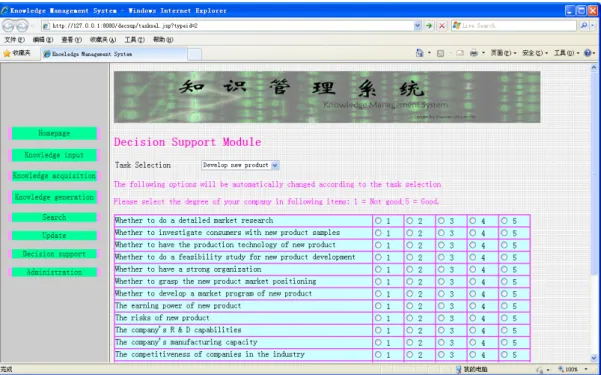
Figure 5 exhibits one of the user interfaces of KM system for support decision making on web-enabled environment. When the end user clicks the item of “Decision support” in the left frame of the window, then a new interface including a drop-down list box will be shown in the right frame of window. And the end user chooses the item of “Develop new product” in the drop-down list box, the interface will be shown as figure 5. In this interface, the end user can input the required information by selecting radio button or checkbox and filling in textbox or text-field listed in the form, and the system will provide some alternatives according to information input by the end user. There are detailed procedures on what new product to develop and how to develop new product in every alternative. At last, the end user will choose the best alternative based on the organization’s need by carefully compare with every alternative.
There are several decision support modules in this system, including “Brand building”, “Develop new product”, “Market development”, “Customer relationship management”, “E-commerce management”, “Risk management”, etc. The end user can use those modules as same as use “Develop new product” module.
Because the system is on web-enabled environment, when the enterprise staff log on to this knowledge management system, he will be able to have knowledge of their input to the system. At the same time, he can also update the input knowledge by communicate with the others. And the administrator is responsible for sorting and classification of the input knowledge, ultimately, the
processed knowledge will be entered into knowledge base and model in the system, which to support the final decision making. However, due to the contents of the knowledge base and model base restrictions, the system can only provide support to several decision support modules in this system which mentioned above.
Figure 5. User interface
4. Summary and conclusion
This study proposes a framework of knowledge management system for support decision making on web-enabled environment. It tries to overcome current KM system’s drawbacks in term of knowledge representation, decision making support, and user-friendly interface on web-enabled environment. At the same time, it can bring greater benefits to the organization of existing KM system, and these benefits are mainly shown in the following areas. Firstly, in term of knowledge representation, this study exploits XML and JDBC technology in order to solve the heterogeneity in the expression of knowledge, so organization’s KM system can be integrated with other organizations KM systems, and it will provide a very convenient way for knowledge communication and knowledge sharing. Secondly, in term of decision making support, because this system uses a unified KM platform that enables knowledge acquisition more convenient, more extensive, and knowledge representation more rule-based, it can be improved the search speed of information and the analysis breadth and depth of information during decision making, thus improving the quality of decision making. Thirdly, in term of human computer interface, because this system uses Java interoperable computing technology, JSP, Knowledge Object Base and Jess development tool to take advantage of object orientation in client, the end user is allowed to simply operate the system with friendly human computer interface via client’s web browser.
Although some limitations of related systems have been overcome in this paper, there is still room for improvement. Nowadays, KM system development tends to operate interactively, such as hyper media or VR(Virtual Reality) intelligent systems, even if the KM system in this study has a friendly human computer interface, but the process of inference engine and explanation mechanism are still static word representations. In addition, the performance of the system inference and execution decreases when the knowledge frame structure gets more complicated. Therefore, to add hyper media or VR human computer interface, to make inference engine and explanation mechanism efficiently to
deal with complicated structure of knowledge, to integrate the JavaBean and Jess efficiently in client will be one of the future works.
5. Acknowledgement
This research is supported by National Natural Science Foundation of China(Grant 70802051 and 70972112) and Humanities and Social Science Foundation of China’s Ministry of Education(Grant 08JC630071). The authors would like to thank the anonymous reviewers for their valuable suggestions and critique.
6. References
[1] Maryam Alavi, Dorothy E. Leidner, “Review: Knowledge Management and Knowledge Management System: Conceptual Foundations and Research Issues”, MIS Quarterly, vol.25, no.1, pp.107-136, 2001.
[2] Clyde W. Holsapple, M. Singh, “The Knowledge Chain Model: Activities for Competitiveness”, Expert Systems with Applications, vol.20, no.1, pp.77-98, 2001.
[3] Kiku Jones, “Knowledge Management as a Foundation for Decision Support Systems”, The Journal of Computer Information Systems, vol.46, no.4, pp.116-124, 2006.
[4] P. Balasubramanian, Kumar Nochur, John C. Henderson, M. Millie Kwan, “Managing Process Knowledge for Decision Support”, Decision Support Systems, vol.27, no.1, pp.145-162, 1999. [5] Clyde W. Holsapple, “Knowledge Management is Decision Making and Decision Support”,
Knowledge and Policy, vol.8, no.1, pp.5-22, 1995.
[6] Clyde W. Holsapple, Andrew B. Whinston, “Decision Support Systems: A Knowledge-based approach”, Thomson Learning Custom Publishing, Cincinnati, USA, 2001.
[7] Ming-Chang Lee, Jung-Fang Cheng, “Development Multi-Enterprise Collaborative Enterprise Intelligent Decision Support System”, Journal of Convergence Information Technology, vol.2, no.2, pp.69-74, 2007
[8] Ming-Chang Lee, “The Combination of Knowledge Management and Data Mining with Knowledge Warehouse”, International Journal of Advancements in Computing Technology, vol.1, no.1, pp.39-45, 2009
[9] Clyde W. Holsapple, K. D. Joshi, “Organizational Knowledge Resources”, Decision Support Systems, vol.31, no.1, pp.39-54, 2001.
[10]Daoliang Li, Zetian Fu, Yanqing Duan, “Fish-expert: A Web-based Expert System for Fish Disease Diagnosis”, Expert Systems with Applications, vol.23, no.3, pp.311-320, 2002.
[11]Zetian Fu, Feng Xu, Yun Zhou, Xiaoshun Zhang, “Pig-vet: A Web-base Expert System for Pig Disease Diagnosis”, Expert Systems with Applications, vol.29, no.1, pp.93-103, 2005.
[12]Yinqing Duan, John S. Edwards, Xianzhong M. Xu, “Web-based Expert Systems: Benefits and Challenges”, Information & Management, vol.42, no.6, pp.799-811, 2005.
[13]Weissor Shiue, Sheng-tun Li, Kuan-ju Chen, “A Frame Knowledge System for Managing Financial Decision Knowledge”, Expert Systems with Applications, vol.35, no.3, pp.1068-1079, 2008.
[14]Rashmi Malhotra, “Meta-modeling Framework: A New Approach to Manage Meta-modelbase and Modeling Knowledge”, Knowledge-Based Systems, vol.21, no.1, pp.6-37, 2008.
[15]Jelena Jovanovic, Dragan Gašević, “Achieving Knowledge Interoperability: An XML/XSLT Approach”, Expert Systems with Application, vol.29, no.3, pp.535-553, 2005.
[16]Harith Alani, Sanghee Kim, David E. Millard, Mark J. Weal, Wendy Hall, Paul H. Lewis, Nigel R. Shadbolt. “Automatic Ontology-based Knowledge Extraction from Web Documents”, IEEE Intelligence Systems, vol.18, no.1, pp.14-21, 2003.
[17]James F. Courtney, “Decision Making and Knowledge Management in Inquiring Organization: Toward a New Decision-making Paradigm for DSS”, Decision Support System, vol.31, no.1, pp.17-38, 2001.
[18]Sheng-tun Li, “A Web-aware Interoperable Data Mining System”, Expert Systems with Applications, vol.22, no.2, pp.135-146, 2002.