AENSI Journals
Australian Journal of Basic and Applied Sciences
ISSN:1991-8178Journal home page: www.ajbasweb.com
Corresponding Author: Mohd Nor Akmal Khalid, School of Computer Sciences, Universiti Sains Malaysia, 11800 Georgetown, Pulau Pinang, Malaysia.
E-mail: [email protected] Ph: +60195079092
A Crowd Modelling Considering Group Cohesion in the Emergency Route Planning
Problems
Mohd Nor Akmal Khalid and Umi Kalsom Yusof
School of Computer Sciences, Universiti Sains Malaysia, 11800 Georgetown, Pulau Pinang, Malaysia
A R T I C L E I N F O A B S T R A C T Article history:
Received 30 September 2014 Received in revised form 17 November 2014 Accepted 25 November 2014 Available online 13 December 2014
Keywords:
Modeling, Crowd, Emergency Evacuation, Emergency Route Planning Problem
Occurrence of disastrous events, either natural (such as fires, earthquakes, rising tides, and hurricanes) or man-made (such as terrorist bombings, chemical spills, and so on), have claimed the lives of thousands for many years. To efficiently evacuate people during this event, however, demands an appropriate model (considered to be a vital study of the research community) as well as an emergency route planning (ERP) system. Several classifications of priory developed approaches for crowd modeling that encompass the needs of various public communities as well as fulfill the complexity of the situation, are summed up and discussed. This paper introduces a new crowd modeling approach which considers the feature of group cohesion and their individual compliance rate within the group itself. The model is validated against previous work while further experimentation reveals the importance of group cohesion, which affects the outcome of an evacuation plan when greater group cohesion is present, with regard to a certain level of assumptions as well as the context of the ERP problems. The findings will be summarized and presented, whereas the potential for future work will be identified.
© 2014 AENSI Publisher All rights reserved. To Cite This Article: Khalid M.N.A. and Yusof U.K., A crowd modeling considering group cohesion in the emergency route planning problems. Aust. J. Basic & Appl. Sci., 8(24): 33-39, 2014
INTRODUCTION
Extreme events or disasters, be it natural or man-made, often lead to emergency situations that require immediate and time-critical action (Chiu et al., 2007). Examples of natural disasters include hurricanes, floods, landslides, and tsunamis. Examples of man-made disasters include terrorist attacks and hazard material releases. These critical events affect populated areas, inducing an immediate or life-threatening situation that triggers an emergency response. In many cases, evacuation is the common response to risk mitigation, requiring immediate mobilization and time-critical actions, primarily efficient coordination, space capacity utilization, and ensuring availability of emergency response resources (Alsnih and Stopher, 2004). Thus, it can be concluded that an emergency evacuation is the most practical option for human survivability, which is paramount in risk mitigation.
Emergency evacuation can be defined as the removal of residents/populations as quickly as possible and with utmost reliability from areas considered as dangerous zones to safe locations (Saeed Osman and Ram, 2011). Understanding the crowd's activity and characteristics during emergency evacuations lead to better planning and management in emergency evacuation (Radianti et al., 2013), enabling real-time updates of immediate threats, identify patterns, and crowd's location relative to hazard source for timely decision making. However, capturing such crowd activity and characteristics requires an appropriate crowd model to improve evacuation efficiency and crowd survivability (Wang et al., 2008).
Literature Reviews:
Crowds are formed by several or thousands of people that move in a bounded environment with respect to their individual goals (i.e. avoiding obstacles, blocking, or stampede, and remaining close to friends or family (Yersin et al., 2008). Generally, the crowds are based on theoretical models, ranging from analytical ones to those based on matrices or cells (Bandini et al., 2005). The crowd is also relative to the formation of groups, where its cohesion is composed and affected based on their sizes. Larger groups tend to have higher cohesiveness as they have access to abundant resources (such as time, energy, and expertise), are more diverse, and have higher influences (Moreland et al., 2013). However, oversized groups may experience the opposite effect due to difficulty in coordination, conflicts, and level of compliance (Moreland et al., 2013). Thus, identifying the suitable group cohesiveness (e.g. size) during an evacuation process is important to effectively and efficiently plan and manage the emergency evacuation.
The most disastrous forms of collective human behavior are stampedes, which creates panic and often leads to serious fatalities (Hajibabai et al., 2007). The ability to assist an efficient movement of people in heavily populated enclosures or structures is vital to the daily operation of large and complex structures. More importantly, it is an essential design feature in the event of emergency situations. To support emergency evacuations, the evacuation model is an essential tool in providing effective decision-making, enhancing the capability of response to disaster, and reducing any adverse impacts on both human beings and surroundings (Lv
et al., 2012).
Radianti et al. (2013) has conducted a study on the existing models which are categorized as microscopic, macroscopic, and mesoscopic models. Microscopic models treat every individual in the crowd as a separate ``particle''. Several variants of the microscopic approach include the encoding of human desires in the form of social force model (Helbing et al., 2000) and representing a pedestrian as a node that occupies a cell known as a cellular automata (Yuan and Tan, 2011). Macroscopic models describe crowds through their average flow and density. The fluid dynamic model (Helbing, 1998), flow tiles (Chenney, 2004), continuum crowd (Treuille et al., 2006), and non-local crowd dynamics (Colombo and Lécureux-Mercier, 2012) are some variants of the microscopic model. Bridging the gap between the former two models, the mesoscopic model introduces a key concept to understand the relationship between local inter-individual interactions (micro) and collective patterns (macro) (Wang et al., 2008; 2009). Most of the studied literatures employed the microscopic model (Amaldi et al., 2010; Kwan and Lee, 2005; Cepolina, 2005; Fang et al., 2011; Guo et al., 2011) and the macroscopic model
(Lu et al., 2003; Kim et al., 2007; Zeng and Wang, 2009; Li et al., 2010; Zong et al., 2010; Lv et al., 2012),
while only some applied the mesoscopic model (Wang et al., 2008; 2009).
Microscopic models are useful in capturing evacuee behaviors such as blocking and pushing (Fang et al., 2011; Guo et al., 2011). On the other hand, macroscopic models express the collective pattern of evacuees during evacuation such as flow rate, relative speed, and emergence (Lv et al., 2012). Despite the microscopic model's ability to obtain good results and successfully capture realistic evacuees behaviors, most had assumed that behaviors are independent of emergency situations (Wang et al., 2008). Meanwhile, macroscopic models highlight the potential risks in emergency evacuation by identifying the bottlenecks in evacuation networks but lack the ability to capture realistic evacuee’s behaviors. To address these concerns, mesoscopic models can be employed and integrated with an uncertainty factor, crowd dynamics as well as the concept of social bond within the groups of evacuees (Wang et al., 2009). Uncertainty implies unforeseen incidents and deviations in the subjective judgments (Lv et al., 2012), while crowd dynamic implies the cognition, decision making, and social behaviors of evacuees (Cepolina, 2005).
The Proposed Crowd Modelling Approach:
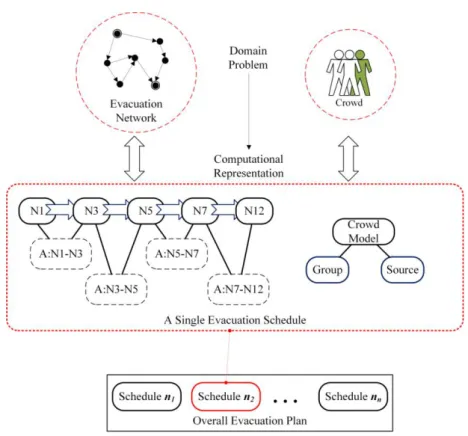
The crowd model involves two components; the evacuation path or network and the crowd. These two components form a single evacuation plan (schedule) which makes up the overall evacuation plan (the scheduling of the crowd egress). The initialization scheme involves generating the collection of available paths or routes in the evacuation network that was considered. This collection of available paths or routes is generated by performing a recursive depth first search algorithm where all the possible source-destination pairs are recorded regardless of the capacity and travel time involved. With information such as the crowd starting location, crowd size, and size of the crowd in a group, the crowd model (group) is generated and is tagged with specific identification.
Fig. 1: The representation of the overall evacuation plan instance.
The Evacuation Network:
The evacuation path or network is composed of a directed graph G (V, A), where V = {v1, v2, … , vn} is the sets of nodes and A is a subset of V × V sets of arcs. Basically, the node represents the rooms or compartmentalized area, exits, or area within a bounded environment. The arc represents the pathway or hallways, corridors, staircases, or any other connective elements of the structure. The disaster origin is assumed to be known and affects the evacuation networks. The emergency network or route represented can vary in length and capture certain parts of the nodes and arcs of the logical graph structure considered, mainly a set of nodes and arcs for a source-destination pair (a single evacuation path p).
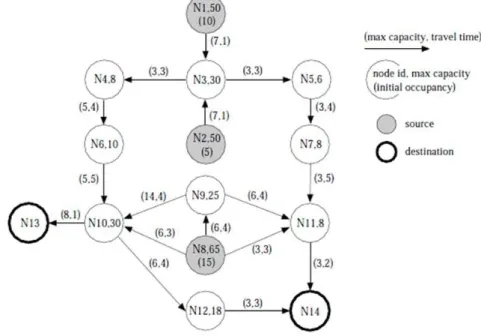
The considered evacuation path or network data is a representation of a two-story building, where detail of the logical graph of the public data is illustrated in Fig. 2. The node-edge logical graph is used to represent the structure where each room, corridor, staircase, and exit is represented as ellipses. Each node has three attributes; the node identity, maximum node capacity, and initial node occupancy. The pathway from one node to another is represented as a directional edge, where the direction is the direction towards the exit(s). Each edge has two attributes; the maximum edge capacity and travel time.
The Crowd Model:
The crowd model considered is a mesoscopic model, where the model considers the relationship between local inter-individual interactions of the evacuees (micro) and collective patterns of the crowd (macro). One of the efforts conducted were the works in Wang et al. (2008 & 2009). Although the local inter-individual interactions of the evacuees are captured, the collective patterns of the crowd are vaguely defined and a clear boundary of the group is not raised. Therefore, the first focus will be to get the apparent group characteristic that is closely related to the work in Saeed Osman and Ram (2011). The author proposed an integer optimization model, in contrast to the previous work conducted by Lu et al. (2003). The size of the group may affect and prolong the evacuation procedure, which potentially increases the evacuee's exposure to danger.
Fig. 2: Logical structures of network considered from Lu et al. (2003).
In order to appropriately model the crowd in evacuation, the basic ingredients of the evacuation are formulated and formalized as graphically depicted in Fig. 3. The base crowd model considers a free flow rate (see details on free flow rate described by Helbing et al. (2000)) where no other dynamics of the crowd is considered (such as blocking, pushing, etc.). However, there are four elements that affect this base crowd model. The first element is the path or route of the network involving a set of source and destination pairs chosen by the evacuee(s). The second element is the capacity of the evacuation network within the path or route. Thirdly, the group factor, which is the group cohesion of the evacuees, is pre-determined and considered. As the first three components are defined, the fourth and last component is formed, which involves the actual flow rate when traversing the chosen path, with respect to the path capacity and the group cohesiveness. Thus, these four components form the proposed crowd evacuation model.
Fig. 3: The graphical crowd evacuation model.
Result Validation, Evaluation and Discussion: Result Validation:
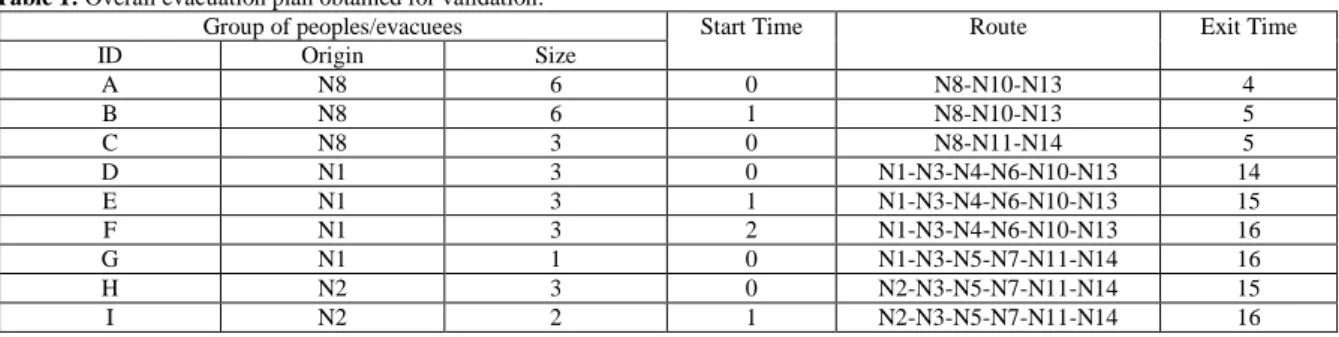
only one of the groups is of size one (denoted as group G) whiles the size of the others are three (denoted as group D, E, and F). At the node N2, two groups denoted as group H and group I with sizes of three and two, respectively, are considered. The NCT obtained from the overall evacuation plan using heuristics, named as the Capacity Constrained Route Planner (CCRP), is 16 units of time. As the table implies, the NCT of the overall evacuation plan using the proposed approach is similar to CCRP, where it is in close agreement with the work presented by Lu et al. (2003). Thus, this crowd evacuation model is validated.
Table 1: Overall evacuation plan obtained for validation.
Group of peoples/evacuees Start Time Route Exit Time
ID Origin Size
A N8 6 0 N8-N10-N13 4
B N8 6 1 N8-N10-N13 5
C N8 3 0 N8-N11-N14 5
D N1 3 0 N1-N3-N4-N6-N10-N13 14
E N1 3 1 N1-N3-N4-N6-N10-N13 15
F N1 3 2 N1-N3-N4-N6-N10-N13 16
G N1 1 0 N1-N3-N5-N7-N11-N14 16
H N2 3 0 N2-N3-N5-N7-N11-N14 15
I N2 2 1 N2-N3-N5-N7-N11-N14 16
Result Evaluation:
The main purpose of this experiment is to evaluate the crowd evacuation model performance, where further experimentation based on effect of the group cohesion is conducted. The network clearance time (NCT) is used to measure the performance of the overall evacuation plan, which indirectly measures the group’s cohesiveness as well. An experiment has been conducted where 40 samples, each consists of 70 overall evacuation plan instances is generated for every group size (1, 2, 3, 4, and 5). The best from the 70 overall evacuation plan instances is taken for each sample. The best, average, and relative standard deviation (RSD) of the samples for each group size is computed where the results obtained is depicted in Fig. 4.
Fig. 4: NCT analysis for different group sizes.
evacuation plan instances is relatively consistent and contains only a small amount of deviations. In addition, the RSD of the samples also appear to be smaller when group size ≥ 3, which means the NCT value obtained throughout the 70 overall evacuation plan instances contains a small ratio of variations and is fairly redundant in nature.
Discussion:
The group size affected the quality of the overall evacuation plan instance, where an increase in the flow rate happened when the group size is increased. When evaluating the flow rate, a group size ≥ 3 has shown to indirectly decrease the NCT value of a particular overall evacuation plan instance. This is possible due to the group cohesion assumption in the crowd model, where evacuees that move in a larger group tend to move better (better flow rate) while conforming to the network capacity. This particular situation simulates strong compliance between the evacuees within a group and cooperative behavior is elicited.
Although the crowd model has successfully captured the group cohesion, this group cohesion is assumed on the basis that everyone within a group completely cooperates with each other without capturing individual compliance rate. In addition, the inter-group relation is also neglected (no social interaction between groups), which has shown to exhibit discrete patterns and small delay in the flow rate of the evacuation. In a real evacuation, group behavior tends to have varying compliances due to different needs and goals (Lee et al., 2007; Sharma, 2009), as well as a certain amount of interaction between groups (causing greater delays and even blocking) (Wang et al., 2008). Although the proposed crowd evacuation model does not capture the dynamic compliance and inter-group relations, the observed group behavior, within a certain degree of assumptions, (assuming 100% compliance of individuals within a group and 0% cooperation of inter-group relations) has successfully demonstrated its role during an evacuation, which is an important component for an effective planning and management of evacuation. As such, this finding serves as a basis for enhancing the crowd model for better evacuation planning in the future.
Concluding Remarks:
This paper offers a crowd evacuation model with a certain degree of assumptions and successfully captures the importance of group cohesion in the emergency evacuation context. The experiments were conducted to further evaluate the proposed crowd evacuation model with respect to the objective of network clearance time (NCT). The insights and findings of the observed results from the experiments has been discussed and presented with respect to the main interest of the study. In future work, further enhancement of the proposed crowd evacuation model (where group cohesiveness will contain dynamic compliances) will be measured and quantified to further support the findings presented in this paper.
ACKNOWLEDGMENT
The authors wish to thank the Ministry of Higher Education (MOHE), Malaysia and Universiti Sains Malaysia for the support it has extended in the completion of the present research through the Long Term Research Grant Scheme (LRGS 203.PTS.6728001).
REFERENCES
Alsnih, Rahaf and Peter R. Stopher, 2004. "Review of procedures associated with devising emergency evacuation plans." Transportation Research Record: Journal of the Transportation Research Board, 1865(1): 89-97.
Amaldi, Edoardo, Stefano Coniglio and Claudio Iuliano, 2010. "Optimization models for injured people evacuation in medium/maxi health-care emergencies." In Health Care Management (WHCM), 2010 IEEE
Workshop on, pp. 1-6. IEEE.
Bandini, Stefania, Sara Manzoni and Giuseppe Vizzari, 2005. "Crowd Modeling and Simulation." In Recent
advances in design and decision support systems in architecture and urban planning, pp. 161-175. Springer
Netherlands.
Carron, Albert V. and Lawrence R. Brawley, 2000. "Cohesion conceptual and measurement issues." Small
Group Research, 31(1): 89-106.
Cepolina, Elvezia M., 2005. "A methodology for defining building evacuation routes." Civil engineering
and environmental systems, 22(1): 29-47.
Chenney, Stephen, 2004. "Flow tiles." In Proceedings of the 2004 ACM SIGGRAPH/Eurographics
symposium on Computer animation, pp. 233-242. Eurographics Association.
Colombo, Rinaldo M. and Magali Lécureux-Mercier, 2012. "Nonlocal crowd dynamics models for several populations." Acta Mathematica Scientia, 32(1): 177-196.
Fang, Zhixiang, Qingquan Li, Qiuping Li, Lee D. Han and Dan Wang, 2011. "A proposed pedestrian waiting-time model for improving space–time use efficiency in stadium evacuation scenarios." Building and
Environment, 46(9): 1774-1784.
Guo, Ren-Yong, Hai-Jun Huang and S.C. Wong, 2011. "Collection, spillback, and dissipation in pedestrian evacuation: A network-based method." Transportation research part B: methodological, 45(31): 490-506.
Hajibabai, L., M.R. Delavar, M.R. Malek and A.U. Frank, 2007. "Agent-based simulation of spatial cognition and wayfinding in building fire emergency evacuation." In Geomatics Solutions for Disaster
Management, pp: 255-270. Springer Berlin Heidelberg.
Helbing, Dirk, 1998. "A fluid dynamic model for the movement of pedestrians." arXiv preprint
cond-mat/9805213.
Helbing, Dirk, Illés Farkas and Tamas Vicsek, 2000. "Simulating dynamical features of escape panic."
Nature, 407(6803): 487-490.
Lee, Kang Hoon, Myung Geol Choi, Qyoun Hong, and Jehee Lee, 2007. "Group behavior from video: a data-driven approach to crowd simulation." In Proceedings of the 2007 ACM SIGGRAPH/Eurographics
symposium on Computer animation, pp. 109-118. Eurographics Association.
Li, Qiuping, Zhixiang Fang, Qingquan Li and Xinlu Zong, 2010. "Multiobjective evacuation route assignment model based on genetic algorithm." In Geoinformatics, 2010 18th International Conference on, pp. 1-5. IEEE.
Lu, Qingsong, Yan Huang and Shashi Shekhar, 2003. "Evacuation planning: a capacity constrained routing approach." In Intelligence and Security Informatics, pp: 111-125. Springer Berlin Heidelberg.
Kim, Sangho, Betsy George and Shashi Shekhar, 2007. "Evacuation route planning: scalable heuristics." In
Proceedings of the 15th annual ACM international symposium on Advances in geographic information systems,
p. 20. ACM.
Kwan, Mei-Po and Jiyeong Lee, 2005. "Emergency response after 9/11: the potential of real-time 3D GIS for quick emergency response in micro-spatial environments." Computers, Environment and Urban Systems,
29(2): 93-113.
Lv, Y., G.H. Huang, L. Guo, Y.P. Li, C. Dai, X.W. Wang and W. Sun, 2013. "A scenario-based modeling approach for emergency evacuation management and risk analysis under multiple uncertainties." Journal of
hazardous materials, 246: 234-244.
Moreland, Richard, L., J.M. Levine and M.L. Wingert, 2013. "Creating the ideal group: Composition effects at work." Understanding group behavior, 2: 11-35.
Radianti, Jaziar, O. Granmo, Noureddine Bouhmala, Parvaneh Sarshar, Anis Yazidi and Jose Gonzalez, 2013. "Crowd models for emergency evacuation: A review targeting human-centered sensing." In System
Sciences (HICSS), 2013 46th Hawaii International Conference on, pp: 156-165. IEEE.
Saeed Osman, M.F. and Bala Ram, 2011. "Evacuation route scheduling using discrete time-based Capacity-Constrained model." In Industrial Engineering and Engineering Management (IEEM), 2011 IEEE International
Conference on, pp. 161-165. IEEE.
Sharma, Sharad, 2009. "Simulation and modeling of group behavior during emergency evacuation." In
Intelligent Agents, 2009. IA'09. IEEE Symposium on, pp. 122-127. IEEE.
Treuille, Adrien, Seth Cooper and Zoran Popović, 2006. "Continuum crowds." In ACM Transactions on
Graphics (TOG), 25(3): 1160-1168. ACM.
Wang, Peng, Peter B. Luh, S.C. Chang and Jin Sun, 2008. "Modeling and optimization of crowd guidance for building emergency evacuation." In Automation Science and Engineering, 2008. CASE 2008. IEEE
International Conference on, pp: 328-334. IEEE.
Wang, Peng, Peter B. Luh, S.C. Chang and Kerry L. Marsh, 2009. "Efficient optimization of building emergency evacuation considering social bond of evacuees." In Automation Science and Engineering, 2009.
CASE 2009. IEEE International Conference on, pp. 250-255. IEEE.
Yersin, Barbara, Jonathan Maïm, Fiorenzo Morini and Daniel Thalmann, 2008. "Real-time crowd motion planning." The Visual Computer, 24(10): 859-870.
Yuan, Weifeng and Kang Hai Tan, 2011. "A model for simulation of crowd behaviour in the evacuation from a smoke-filled compartment." Physica A: Statistical Mechanics and its Applications, 390(23): 4210-4218.
Zeng, Maimai and Cheng Wang, 2009. "Evacuation route planning algorithm: longer route preferential." In
Advances in Neural Networks–ISNN 2009, pp. 1062-1071. Springer Berlin Heidelberg.
Zong, Xinlu, Shengwu Xiong, Zhixiang Fang, and Wanru Lin, 2010. "Multi-objective ant colony optimization model for emergency evacuation." In Natural Computation (ICNC), 2010 Sixth International