Australian Journal of Basic and Applied Sciences
ISSN:1991-8178
Journal home page: www.ajbasweb.com
Corresponding Author: ZahiraYaakob, Department of Chemical and Process Engineering, Faculty of Engineering and Built Environment, UniversitiKebangsaan Malaysia, UKM, Bangi, Selangor, Malaysia 43600 tel: +603-89216148, E-mail: [email protected]
Citric Acid Assisted Facile Synthesis Of Single Phased Crystalline Micro Vanadium
Pentoxide Powder
1ThusharaKandaramath, 2Binitha N.N, 1ZahiraYaakob
1Department of Chemical and Process Engineering, Faculty of Engineering and Built Environment, UniversitiKebangsaan Malaysia, UKM, Bangi, Selangor, Malaysia 43600
2
Department of Chemistry, SreeNeelakanta Govt. Sanskrit College Pattambi, Kerala, India.
A R T I C L E I N F O A B S T R A C T
Article history:
Received 15 April 2014 Received in revised form 22 May 2014
Accepted 25 October 2014 Available online 10 November 2014
Key words:
micro vanadium pentoxide powder, citric acid, crystalline, single phased, spherical nanoparticles.
The increased interest in the synthesis of V2O5 micro/nanostructures is due to their
potential applications in catalysis and in optical and electrochemical devices. Citric acid assisted facile synthesis of highly pure micro vanadium pentoxide powder was done using ammonium metavanadate as the precursor. The method explores the advantage of simple solution mixing of the precursor and the modifier solutions at room temperature followed by thermal decomposition at 400 °C. XRD analysis of the prepared sample established the formation of phase pure V2O5 with an orthorhombic structure. FTIR
spectra confirmed the chemical composition of the formed V2O5 material. FESEM
images at high magnification revealed that the microcrystals with different shapes were formed by the agglomeration of V2O5 nanoparticles which was confirmed by TEM.
© 2014 AENSI Publisher All rights reserved. To Cite This Article: ThusharaKandaramath, Binitha N.N., Citric Acid Assisted Facile Synthesis Of Single Phased Crystalline Micro Vanadium Pentoxide Powder. Aust. J. Basic & Appl. Sci., 8(19): 328-332, 2014
INTRODUCTION
Vanadium oxide nanomaterials and their derivatives attract the attention of researchers because of their distinctive physico-chemical properties and potential applications in numerous areas (Shahid, M. et al., 2010). Because of the rapid increase in the resistivity of vanadium oxides, vanadium pentoxide in particular, they are largely used in the fields of solid state ionics, microelectronics and optoelectronics (Shin, D.H., et al., 2006). Nano-sized vanadium pentoxides of different morphology are used in high-energy lithium batteries to improve the capacity, voltage (versus the anode material), reversibility, and stability in chemical sensorsand photocatalysis (Li, B., et al., 2006). V2O5nanomaterials are also used as catalysts for various reactions, as
cathode for lithium batteries and as electric field-effect transistors (Zhang, G., et al., 1997). Since V2O5 shows
multi coloured electro-chromism, they are applied in different optical devices like colour filters, Electrochromic display (ECD) (Lao, Z.J. et al., 2006) and smart windows (Nagase, K., et al., 1992). The application of vanadium pentoxide electrode for electrochemical capacitors (EC) is because of its capability to exist in different oxidation states and low cost (Lao, Z.J. et al., 2006). The partially filled d-orbitals of vanadium are reasonable for the existence of different oxidation states which is responsible for magnetic, catalytic and electronic properties of V2O5 (Asim, N., et al., 2009). Different physical and chemical methods have been tried
to prepare V2O5 with desired size and morphology. Wang et al. (2011) and Shevchuck et al. (2011) reported that
monodisperisty and the size of V2O5nanomaterials are important factors that to be concerned about their
application in technological and industrial fields. Commonly dry methods like sputtering and vacuum evaporation are adopted for the synthesis of V2O5 powder, but for the production of large scale films, wet routes
like as sol-gel and electrodeposition are found to be more suitable. Synthesis of vanadium oxide nanotubes and gels is a really interesting area because of their improved ionic and electronic properties. In addition, many reports are there on the synthesis of V2O5nanoparticles by various methods like hydrothermal, soft template,
pulsed laser ablation (Asim, N., et al., 2009; Liu, J., et al., 2006; Levi, R. et al., 2010). Self-assembling (NH4)0.5.V2O5 nanowires are prepared by hydrothermal treatment of ammonium metavanadate with water[12].
By using V2O5 sols as precursor and hexadecylamine (HDA) as structure-directing template, Chen et al. (2004)
prepared vanadium oxide nanotubes (VOx-NTs) by a modified sol-gel method followed by hydrothermal
treatment. Hydrothermal treatment of NH4VO3 in the presence of polymer polyethylene glycol 4000 resulted in
There are a number of methods have been developed for the synthesis of micro/nanostructures, but they require high molecular weight surfactants or special instruments (Shahid, M. et al., 2010). So the development of low cost and simple procedure for the synthesis of micro/nano V2O5 material is challenging. In our work, we
provide a low cost, high yielding and facile method for the synthesis of phase pure crystalline micro V2O5
powder with different shapes consisting agglomerated V2O5nanospheres. We made use of citric acid as the
structure modifier since it is non-toxic, less expensive and easily dissolvable in the aqueous reaction medium (Chen, Y., et al., 2011).
METHODS AND MATERIALS
Preparation of the sample:
Ammonium metavanadate and citric acid were purchased from Alfa Aesar and Fisher Chemicals respectively. 1.83g citric acid (C3H8O7) was stirred in 30 ml distilled water for 2 minutes. 1.6 g ammonium
metavanadate (NH4VO3) was added into it under stirring. The whole mixture was then stirred continuously for 8
h. It was then dried overnight at 80°C and was calcined at 400°C.
Characterisation of the V2O5 samples:
Powder X-ray diffraction analysis was performed using Bruker D8 Advance powder diffractometer with Cu Kα radiation of wavelength 0.15406 nm. The samples were scanned from 3 to 80° in 0.025° step rise. The mean crystalline size for each sample was calculated using the Scherrer equation. The surface morphology of the sample was determined by field emission scanning electron microscopy (FESEM) using Carl Zeiss Evo Ma10 apparatus. The scanning electron micrographs were obtained at 10 kV. Fourier Transform-Infrared pattern was recorded on a thermo scientific NICOLET 6700 apparatus in transmission mode in the region 400-4000 cm-1. Transmission electron microscopy (TEM) images were taken by Philips CM-12 operated at a voltage of 100 kV.
RESULTS AND DISCUSSION
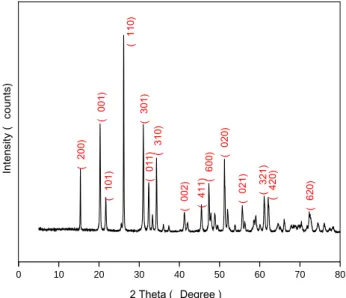
The XRD pattern of the prepared sample is shown in figure 1. All characteristic peaks can be indexed to the orthorhombic phase of V2O5 (space group: Pmmn, a= 11.512 Å, b= 3.564 Å, c= 4.368 Å) which agrees with
reported data according to JCPDS No. 41-1426 24. No peaks of impurities were detected for the sample. Sharp and strong peaks in the XRD pattern indicate the high crystallinity of the sample. The average crystallite size of the sample calculated by applying Scherrer equation was 52 nm.
Figure 2.Indicates FTIR spectra of the prepared V2O5 sample. The V2O5 sample showed four main vibration
modes in the 500-1010 cm-1 region. The terminal oxygen symmetric stretching vibration of V(V)=O was found at 1006 cm-1(Phetmung, H., et al., 2008). The vibrations at 520 cm-1 and 815 cm-1 correspond to bridge oxygen symmetric and asymmetric stretching modes of V-O-V (Reddy, C.V.S., et al., 2008). The FTIR spectra also indicate that the compound contains only the elements V and O and vanadium exists as V(V).
Fig. 1: XRD pattern of the prepared V2O5 sample
0 10 20 30 40 50 60 70 80
(62 0) (42 0) (32 1) (02 1) (02 0) (60 0) (41 1) (00 2) (31 0) (01 1) (11 0) (30 1) (10 1) (00 1) (20 0) In te nsity (co un ts)
Fig. 2: FTIR spectra of the prepared V2O5 sample
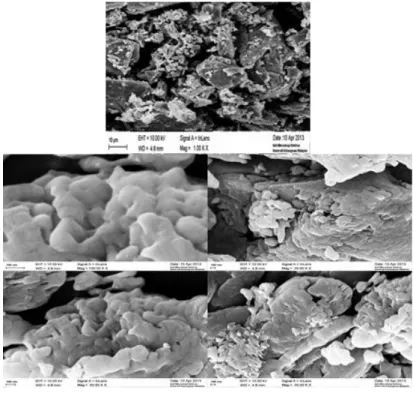
Figure 3.shows the FESEM images of the prepared V2O5 sample at different magnifications. It is observed
from the images that the sample consists of agglomerates with different shapes. The magnified images at 100 nm make it obvious that the structures are formed by the agglomeration of nano particles of V2O5. These
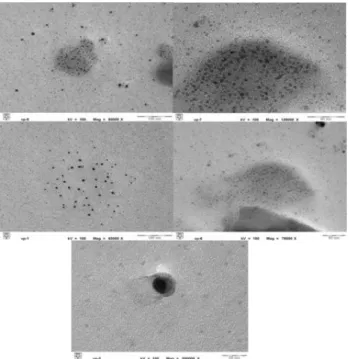
particles are believed to exhibit in agglomerated morphology because of its ultrafine size (Chen, Y., et al., 2011). Large numbers of cavities are generated between the particles because of the release of gases such as CO2 and NH3 at the stage of thermal decomposition (Shahid, M. et al., 2010). The sphere like morphology of the
V2O5 nanoparticles were clearly observed from the TEM images (fig.4). The sphere particles are highly
dispersed with average size <20 nm.
The process of formation of vanadium pentoxide micro structures can be proposed as follows. When ammonium metavanadate was mixed with citric acid solution and dried, ammonium dimeric (citrato)dioxovanadium (V) [(NH4)2[VO2(C6H6O7)2] was formed. When it was thermally decomposed at 400°C,
the complex decomposed to pure spherical V2O5 nanoparticles with the liberation of CO2 and NH3. As the
reaction proceeds, the evolution of gases causes formation of voids or cavities between the particles and smaller particles aggregates to form bigger particles with aggregated morphology.
Fig. 3: FESEM images of the preparedV2O5 sample at different magnifications 4000 3500 3000 2500 2000 1500 1000 500
1006 815
516
Tra
nsm
itta
nce
(%)
Wavenumber (cm-1
Fig. 4: TEM images of the prepared V2O5 sample at different magnifications.
Conclusion:
Single phased and highly crystalline micro V2O5 powder was prepared by simple solution mixing using
citric acid as modifier. The prepared sample was phase pure as evident from XRD analysis. The agglomerated morphology of the prepared sample was observed from FESEM at lower magnification, but at higher magnification it became clear that the V2O5 powder consists of agglomerated V2O5 nanoparticles and the
particles were found to be spherical in shape which was confirmed by TEM pictures. In conclusion we could provide a very simple, high yielding and low-cost method for the synthesis of highly pure micro V2O5 powder.
ACKNOWLEDGEMENT
The authors gratefully acknowledge UniversitiKebangsaan Malaysia, grant no:DIP-2012-04 for financial support.
REFERENCES
Asim, N., S. Radiman, M.A. Yarmo, M.S.B. Golriz, 2009. Vanadium pentoxide: Synthesis and characterization of nanorods and nanoparticle V2O5 using CTAB micelle solution, Microporous and Mesoporous
Materials, 120: 397-401.
Chen, W., J. Peng, L. Mai, Q. Zhu, Q. Xu, 2004. Synthesis of vanadium oxide nanotubes from V2O5 sols,
Materials Letters, 58: 2275-2278.
Chen, Y., H. Zhang, H. Ye, J. Ma, 2011. A simple and novel route to synthesize nano-vanadium carbide using magnesium powders, vanadium pentoxide and different carbon source, International Journal of Refractory Metals and Hard Materials, 29: 528-531.
Lao, Z.J. et al., 2006. Synthesis of vanadium pentoxide powders with enhanced surface-area for electrochemical capacitors, Journal of Power Sources, 162: 1451–1454.
Levi, R. et al., 2010. Stability criteria of fullerene-like nanoparticles: comparing V2O5 to layered metal
dichalcogenides and dihalides, Materials, 3: 4428-4445.
Li, B., Y. Xu, G. Rong, M. Jing, Y. Xie, 2006. Vanadium pentoxidenanobelts and nanorolls: from controllable synthesis to investigation of their electrochemical properties and photocatalytic activities, Nanotechnology, 17: 2560-6.
Liu, J., X. Wang, Q. Peng, Y. Li, 2006. Preparation and gas sensing properties of vanadium oxide nanobelts coated with semiconductor oxides, Sensors and Actuators B: Chemical., 115: 481-487.
Phetmung, H., T.W. Kim, S.J. Hwang, J.H. Choy, 2008. A simple and direct method for synthesis of vanadium oxide ribbon-like nanobelts, Journal of the Iranian Chemical Society, 5: 706-711.
Reddy, C.V.S., S. Mho, R.R. Kalluru, Q.L. Williams, 2008. Hydrothermal synthesis of hydrated vanadium oxide nanobelts using poly (ethylene oxide) as a template, Journal of Power Sources, 179: 854-857.
Shahid, M. et al., 2010. Facile synthesis of single crystalline vanadium pentoxide nanowires and their photocatalytic behavior, Materials Letters, 64: 2458-2461.
Shevchuk, V.N., Y.N. Usatenko, P.Y. Demchenko, O.T. Antonyak, R.Y. Serkiz, 2011. Nano- and micro-size V2O5 structures, Chemistry of Metals and Alloys, 4: 67-71.
Shin, D.H., C.U. Bang, Y.C. Hong, H.S. Uhm, 2006. Preparation of vanadium pentoxide powders by microwave plasma-torch at atmospheric pressure, Materials Chemistry and Physics, 99: 269-275.
Wang, S., Z. Lu, D. Wang, C. Li, C. Chen, Y.J. Yin, 2011. Porous monodisperse V2O5 microspheres as
cathode materials for lithium-ion batteries, Journal of Materials Chemistry, 21: 6365-6369.