AUSTRALIAN JOURNAL OF BASIC AND
APPLIED SCIENCES
ISSN:1991-8178 EISSN: 2309-8414 Journal home page: www.ajbasweb.com
Open Access Journal
Published BY AENSI Publication
© 2016 AENSI Publisher All rights reserved
This work is licensed under the Creative Commons Attribution International License (CC BY). http://creativecommons.org/licenses/by/4.0/
To Cite This Article: Ali Yahya Gheni, Yusmadi Yah Jusoh, Marzanah A. Jabar, Norhayati Mohd Ali., A Performance Measurement Framework for Global Virtual Teams (GVTs) in Global IT Projects. Aust. J. Basic & Appl. Sci., 10(10): 74-80, 2016
A Performance Measurement Framework for Global Virtual Teams
(GVTs) in Global IT Projects
1Ali Yahya Gheni, 2Yusmadi Yah Jusoh, 3Marzanah A. Jabar, 4Norhayati Mohd Ali
1Department of Software Engineering & Information System, Universiti Putra Malaysia (UPM), 43400 Selangor, Serdang, Malaysia;
Department of Computer Science, University of Baghdad, Baghdad, Iraq;
2Department of Software Engineering & Information System, Universiti Putra Malaysia (UPM), 43400 Selangor, Serdang, Malaysia. 3Department of Software Engineering & Information System, Universiti Putra Malaysia (UPM), 43400 Selangor, Serdang, Malaysia. 4Department of Software Engineering & Information System, Universiti Putra Malaysia (UPM), 43400 Selangor, Serdang, Malaysia.
Address For Correspondence:
Ali Yahya Gheni Universiti Putra Malaysia (UPM), Department of Software Engineering & Information System, Faculty of Computer Science & Information Technology, 43400 Selangor, Serdang, Malaysia.
Phone: 0060169578556; E-mail: [email protected]
A R T I C L E I N F O A B S T R A C T Article history:
Received 3 April 2016 Accepted 21 May 2016 Published 2 June 2016
Keywords:
global virtual teams; (GVTs) performance, organizational commitment, pilot test, key performance indicators (KPIs)
In spite of the increasing prevalence of global virtual teams (GVTs), It should be noted that in spite of the advantages of technology provides, most of global IT projects tend to face problems and risks, and great deal of such projects fail to reach all their objectives. According to the literature review we found that there is a lack of communication within global virtual teams in global IT projects and this problem affect the global IT project performance and leads to global IT project failure. So there is a need to develop a framework to measure the performance for global virtual teams in global IT projects. Early stage and before developing the instrument and conducting the pilot test, the researchers conducted a structured interview with 6 experts to validate the proposed framework. In conclusion, The validity and reliability of the instrument were tested through experts, typical respondents, and analyzed by SPSS 22. The results confirmed the validity of the proposed framework and the validity and reliability of the instrument.
INTRODUCTION
Any groups of people working together from different places in the world, may speak different languages with different cultural depending on the information and communication technology to communicate with each other are called global virtual teams (GVTs). These people are working in a team depending on the information and communication technology to complete their tasks (Wildman et al., 2015). Global virtual teams (GVTs) become a hot topic and significant in the field of Information Systems (IS) because they strongly using information and communication technology. More than using technology, GVTs are also consist of persons from different culture. As such, GVTs are challenged not only to collaborate and coordinate the projects in virtual environment, but also to develop a trusting among members (Yousif and Zakaria, 2012).
(parameters) or key performance indicators (KPIs), measures for measuring the virtual team performance in the global IT projects (Erice Baylor et al., 2010; M. Reza Hosseini et al., 2013; Erik Sundqvist et al., 2014). As solution, this research develop a proposed framework to assist the project manager to measure the global virtual teams’ performance involving the online training and development, organizational commitment, motivation based on defined key performance indicators (KPIs) to achieve global IT project success. This paper is structured as follows: firstly, we highlight the main challenges of managing GVTs; Secondly, we briefly review the related works to the study; thirdly, a conceptual framework is proposed, followed by fourthly, the research methodology. Finally, the results and discussion, and conclusion and future research.
Related works:
According to the existing literature review that have been done by (Hosseini, Chileshe 2013), many examples highlighted the importance of GVTs development strategies specifically addressing online training requirements (Torlina and Lichtenstein, 2004) in the existing literature (Duarte and Snyder, 2006; Ebrahim et
al., 2009; Hertel et al., 2005; Powell et al., 2004) also in construction industry papers (Chinowsky and Rojas,
2002). Studies highlighted the importance of online training for GVTs, since they argue that there is a positive relationship between the online training and the global virtual teams’ performance by enhancing the abilities of teams’ members itself. The importance of the online training include many things such as improving the capabilities of members in using the information and communication technology (Godar and Ferris, 2004; Grosse, 2002; Kayworth; Leidner, 2000), and fostering the cohesiveness and relationships between team members, and facilitating resolving cultural issues (Anawati and Craig, 2006; Anderson et al., 2007; Fuller et
al., 2007; Hill, 2007). Some studies have tried to develop a new framework for best practices of online training
GVTs (Rosen et al., 2006). In this (regard et al., 2009) raised the issue of ever changing online training requirements of GVTs members with emphasize on dependency of online training framework on the specific conditions of the team. We came across other studies (Hertel et al., 2005) arguing that there is very significant correlation between online training of team members and effectiveness of the team is not recognizable in conducted studies. The effectiveness of online training of GVTs members via ICTs relied media is also debatable based on some researches (Martins and Schilpzand, 2011). As a result, online training of GVTs needs further research comprising of many different topics. The relevant subjects include defining the online training topics and the subjects applicable to GVTs. Defining the best methods of online training and the best tools for training them is another area for research (Hosseini, Chileshe 2013).
In conclusion, the reviewed literature in global virtual teams’ performance we found that many researcher developed many frameworks to measure the global virtual teams’ performance involving the online training and development.This research develop a framework to assist the project manager to measure the global virtual teams’ performance involving the online training and development, organizational commitment, motivation based on defined key performance indicators (KPIs) to achieve global IT project success.
The proposed framework:
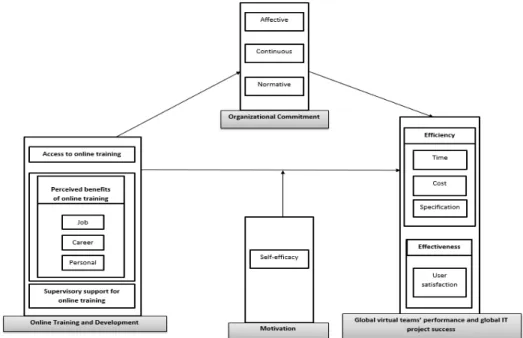
The existing frameworks, which included online training and development and GVTs performance, our proposed framework will adopt a new variables such as: organizational commitment and motivation. Also the researchers find out the measures (evaluation models), metrics (parameters) or key performance indicators (KPIs), measures for measuring the virtual team performance in the global IT projects (see Figure 1). No previous studies have tested the proposed framework involving the online training and development, organizational commitment, motivation to measure the GVTs teams’ performance based on defined key performance indicators (KPIs) to achieve global IT project success. These main variables of the proposed framework are:
a. Online training and development:
Level, 1959, Philips’ Five-level ROI, 1997, Evaluation through behavioral assessment, 1995. Also our online training and development give an attention to the importance of Supervisory of online training and Access to online training.
b. Organizational commitment:
Building the intraorganizational commitment is as an important in the storming and norming stages of the teams’ development. Commitment has been studied by many researchers. Many researchers did many research in the organizational behavior in the literature (Meyer, J.P. and N. J. Allen, 1997).
(Meyer, J.P. and N. J. Allen, 1997). There are two types of commitment: attitudinal and behavioral (Mowday, R. Steers and L. Porter, 1979). Attitudinal commitment related to how the people think about their relationship with the organization. It can be thought of as a “mind set” in which individuals consider the extent to which their own values and goals are congruent with those of the organization. Three forms of attitudinal commitment have been defined and generally accepted: Affective commitment refers to the employee’s emotional attachment to, identification with, and involvement in the organization; Continence commitment refers to an awareness of the costs associated with leaving the organization; normative commitment refers to the feeling of obligation to continue employment (Meyer, J.P. and N. J. Allen, 1997).
c. Motivation:
Motivation is the main factor for the global virtual teams’ success. Distance is negatively affect the motivation of global virtual team members and leads to many problems which affect the performance of global virtual teams. These issues all negatively impact on the level of motivation of team members (Richardsonet al., 2012). Motivation is defined as the excitement level and the drive to work in a global virtual team project. If the global virtual team members feel challenged the project work, the performance will show improvement (Lury and Raisinghni, 2001). In this study, we will measure the motivation of the global virtual teams according to (Noe and Wilk, 1993).
d. Global virtual teams’ performance:
Most of the organizations develop a performance measurement systems to measure the teams’ outcome and individuals’ outcome. Some organizations focus on performance teams’ outcome because they believe that they not jeopardize team cohesiveness by focusing too much on individuals’ performance. Most organizations, however, choose the teams’ outcomes and individuals’ outcome. In face-to-face teams, individual output may be more obvious than in a virtual setting. Thus, global virtual team measures must provide for the explicit determination of individual contributions.
Global virtual teams’ leaders might want to focus on selecting performance measures that sample from each of performance criteria domains obtained by assessing the whole teams and individuals outcome and process measures. For example, from the team outcome perspective, organizations assess typical team outcomes like the quality, quantity, creativity, cost, and timeliness of the team’s deliverables. In the individual outcome domain, organizations assess the same outcomes at the individual level, but they may also assess the extent to which each individual team member meets personal deadlines or milestones to the overall performance of the team. (Cristina B. Gibson et al., 2003).
In this study, we considered the efficiency and effectiveness as our key performance indicators (KPIs) to measure the global virtual teams’ performance. Corroboartes Pibto and Slevan’s (1994) argument that a project is only successful to the extent that it satisfies in project refers to efficiency and effectiveness measures.
• Efficiency measures correspond to the strong management and internal organizational structures (time,
cost, and specification).
• Effectiveness measures refer to user satisfaction and the use of the project.
Fig. 1: A performance measurement framework for global virtual teams (GVTs) in global IT projects
Methodology:
Early stage and before developing the instrument and conducting the pilot test, the researchers conducted a structured interview with 6 experts, two from Academic and four from industries to validate the proposed framework. The draft of expert questionnaire interview was sent to two experts, the first one in English language and the second one in questionnaire design before conducting the structured interview with experts. The structured interview conducted and the results was analyzed. The proposed framework was refined according to the experts’ feedback. Then the questioner was developing according to the refined framework. Before sending the questionnaire, the draft of questionnaire was tested in terms of content, and face validity. This pilot study is conducted in IT companies in Technology Park Malaysia (TPM) who have some staff working virtually was randomly selected. This is in line with the recommendation by (Malhotra, 2008) that the sample size for pilot test is normally small, ranging from 15-30 respondents but it be increased substantially if the test involves several stages. Hence, a total of 40 copies of questionnaire was sending by using online survey (survey monkey) and 25 were competed the questionnaire, the results was analyzed by SPSS 22. The process of the methodology shown in Figure 2. The whole process was completed within four months (January, February, March, and April 2016).
Measurement of proposed framework validity:
A structured interviews use formal standardized questionnaire from 22 questions was conducted with six experts. Two experts from Academic and the other four from industries. A structured interview is made up to three parts. Paret1: consists a set of questions to verify the feasibility and applicability of the proposed framework. Part 2: is to verify the proposed framework with terms of its comprehensive, understand-ability, correctness, and coherence. Part 3: This part established to verify the measures (evaluation models), metrics (parameters) or key performance indicators (KPIs) for proposed framework. In our interview the data gathering in booth face-to face. The interviews took place in meeting rooms or personal offices and lasted between 30 to 60 minutes.
Measurement of Variables in pilot test:
The questionnaire consisting of multiple choice-questions. Likert-type scale is more appropriate and reliable (Alreck and Settle, 1995; Miller, 1991). The instrument is meant to measure the key variables of the research using a 5-point Likert-type rating scale, ranging from strongly disagree to strongly agree. Accordingly, the questionnaire of this study is made up of six parts from 61 questions. Part 1: is a set of questions about the personal information about the responses such as: name, company, country, email address, and phone number. Also the demographic information is included in this part. Part 2: is a set of eight questions targeted at global IT project that the response worked with global virtual teams (GVTs). Part 3: is a set of nineteen questions which attempt to measure the online training and development. Part 4: is a set of nine items that are directed to measure the organizational commitment. Part 5: is a set of four items related to motivation to attend the online training and development by the respondents. Part 6: is a set of twelve questions to measure the respondents’ global virtual teams’ Performance and Global IT Project Success in terms of Efficiency and Effectiveness.
RESULTS AND DISCUSSION
Validity test results for proposed framework:
After the draft of expert questionnaire interview was sent to experts in English language and questionnaire design, expert questionnaire interview was refined and the structured interview conducted then the results was analyzed. The results shows that there is 94% an agreement among experts on the proposed framework feasibility, 96% an agreement on the proposed framework applicability, comprehensive, understand-ability, correctness, and coherence. Also all the experts agree 100% with the measures (evaluation models), metrics (parameters) or key performance indicators (KPIs).All recommendation were considered and necessary changes were made to refine the proposed framework.
Validity and Reliability tests results for instrument: Content and face validity tests:
a. Content validity test: Is concerned with whether the questions are a well-balanced sample of the domain to
be covered (Oates, 2006). After developing the initial set of questionnaire for pilot test, the questionnaire sent to two experts, the first one is an expert in English language and the second one is an expert in questionnaire design for content validity test. The process of getting the experts’ opinion was completed within three weeks period, then the researchers come up on improved/ refined version of the instrument.
b. Face validity test: According to Kumar et al., 2013) the term face validity has similar meaning. However,
face validity generally refers to ‘Non-expert’ judgments of individuals completing the instrument and/ or executive who must approve its use. The questionnaire distributed physically to five typical respondents for face validity test. The process of getting the typical responds’ opinion was completed within one week period, then the researchers come up on improved/ refined version of the instrument.
Reliability test:
Table 1: Reliability Tests
Informant Variables Cronbach’s alpha values
of this study
Results No. of items
1 Online training and development .922 Good 19
2 Organizational commitment .794 Acceptable 9
3 Motivation .723 Acceptable 4
4 Global virtual teams’ performance .886 Good 12
Conclusion and future work:
In this study, the proposed framework was validated by experts then a valid and reliable instrument was tested for all variables adapted. This pilot test will aid the research further investigate the issue in the future. Online survey was conducted to achieve the research objective. The validity and reliability tests results reveal that empirical study can be expanded and lead to final framework validation. The next step would involve selecting a large sample from another IT companies and empirical run the study. Results shows the validity of the proposed framework and the validity and reliability of the instrument. Future research could investigate the various variables employing Structured Equation Modelling (SEM) to validate the research framework. SEM is proposed as it provides framework fit and allows for the simultaneous running of the tested links in this study. Furthermore, this framework is a solution to assist the project manager to measure the global virtual teams’ performance involving the online training and development, organizational commitment, motivation based on defined key performance indicators (KPIs) to achieve the global IT project success.
REFERENCES
Anawati, D., A. Craig, 2006. Behavioral adaptation within cross-cultural virtual teams. IEEE Transactions on Professional Communication, 49: 44-56.
Anderson, A., R. McEwan, J. Bal, J. Carletta, 2007. Virtual team meetings: an analysis of communication and context. Computers in Human Behavior, 23: 2558-2580.
Aaltonen, K., J. Kujala and T. Oijala, 2008, “Stakeholder salience in global projects”, International Journal of Project Management, 26: 509-516.
Bhattacharyya Dipak Kumar, 2015. Training and development. Sage.
Binder, J., 2007. Global Project Management, Communication, Collaboration and Management Across Borders, Gower, Farnham.
Chinowsky, P.S., E. Rojas, 2002. Virtual teams: a guide to successful implementation. A report to Construction Industry Institute, the University of Texas at Austin. Construction Industry Institute.
Cotton, J.L. and J.M. Turtle, 1986. "Employee turnover: A meta-analysis and review with implications for research". Academy of Management Review, 11(55-70).
Duarte, D.L., N.T. Snyder, 2006. Mastering Virtual Teams: Strategies, Tools, and Techniques that Succeed. Jossey-Bass Inc. Pub.
Erice Baylor, Shelley Brown-Philips, Ceriese Coleman, & Kelvin Craig, 2010. Virtual Project Management of Globally Outsourced IT Projects. International Journal of Management & Information Systems.
Erik Sundqvist, Frdrik Backlound and Diana Chroneer, 2014. What is project efficiency and effectiveness? Procedia Social and Behavioral Sciences, pp: 278-287.
Ebrahim, N.A., S. Ahmed, Z. Taha, 2009. Virtual teams: a literature review. Australian Journal of Basic and Applied Sciences, 3: 2653-2669.
Fuller, M.A., A.M. Hardin, R.M. Davison, 2007. Efficacy in technology-mediated distributed teams. Journal of Management Information Systems, 23: 209-235.
Godar, S.H., S.P. Ferris, 2004. Virtual and Collaborative Teams. Idea Group, Hershey, PA.
Grosse, C.U., 2002. Managing communication within virtual intercultural teams. Business Communication Quarterly, 65: 22-38.
Gay, L.R., G.E. Mills and P. Airasian, 2006. Educational research: Competencies for analysis and applications (8th ed.). Uppersaddle River, New Jersey: Pearson Education International, Inc.
Gibson B. Cristina, Cohnen G. Susan, 2003. Virtual teams that work. John Wiey & Sons, Inc.
Hertel, G., S. Geister, U. Konradt, 2005. Managing virtual teams: a review of current empirical research. Human Resource Management Review, 15: 69-95.
Hill, G.M., 2007. The complete project management office handbook. (2nd ed.). Florida: CRC Press. Hair, Jr., J.F., W.C. Black, B.J. Babin, R.E. Anderson and R.L. Tatham, 2006. Multivariate data analysis (6th ed.). Uppersaddle River, New Jersey: Pearson Education International, Inc.
Kumar Mukesh, Abdul Talib Salim, Ramayah T., 2013. Business Research Methods. Oxford.
Lilian Snellman, C., 2014. Virtual teams: opportunities and challenges for e-leaders. Procedia- Social and Behavioral Science, pp: 1251-1261.
Lumsden, G., D. Lumsden, C. Wiethoff, 2009. Communicating in Groups and Teams: Sharing Leadership. Wadsworth Pub Co.
Limsden, G., D. Lumsden and C. Wiethoff, 2009. Communicating in groubs and teams: Sharing leadership. Massachusetts:Cengage Learning.
Lurey, J. and M. Raisinhgani, 2001. An Empirical Study of Best Practices in Virtual Teams, Organization Science, 10(6): 791-815.
Martins, L.L., M.C. Schilpzand, 2011. Global virtual teams: key developments, research gaps, and future directions. Research in Personnel and Human Resources Management 30.
Meyer, J.P. and N.J. Allen, 1997. Commitment in the Workplace. Sage Publications.
Mathieu, J.E. and J.W. Martineau, 1997, “Individual and situational influences on training motivation”, in Ford, J.K., Kozlowski, S.W.J., Kraiger, K., Salas, E. and Teachout, M.S. (Eds), Improving Training Effectiveness in Work Organizations, Erlbaum, Mahwah, NJ, pp: 193-221.
Mowday, R., R. Steers and L. Porter, 1979. "The Measurement of Organizational Commitment". Journal of Vocational Behavior, 14: 224-247.
Mowday, R., L.W. Porter and R. Steers, 1982. Organizational linkages: The psychology of commitment, absenteeism and turnover. San Diego, CA: Academic Press.
Malhotra, N.K., 2008. Essentials of marketing: An applied orientation (2nd ed.). Australia: Pearson Education Miller, C.D., 1991. Handbook of research design and social measurement. Newbury Park, California: Sage publications.
Meyer, J.P. and N.J. Allen, Commitment in the work place: Theory, Research and Application. 1997, Thousand Oaks: Sage Publications.
Noe, R.A. and S.L. Wilk, 1993. “Investigation of the factors that influence employees’ participation in development activities”, Journal of Applied Psychology, 78: 291-302.
Oates Briony, J., 2006. Researching Information Systems and Computing. Sage Publications.
Powell, A., B. Ives, 2004. Virtual teams: team control structure, work processes, and team effectiveness. Information Technology & People, 17: 359-379.
Richardson, I., V. Casyey, F. McCaffery, J. Burton, S. Beecham, 2012. A Process Framework for Global Software Engineering Teams. Information and Software Technology, pp: 1175-1191.
Raisinghani, M., A. Arora, E. Baylor, P.S. Brown, C. Coleman and K. Craig, 2010. Virtual Project Management of Globally Outsourced IT Projects. International Journal of Management and Information Systems, 14: 1-7.
Robert Frese, Vicki Sauter, 2014. Imroving your odds for software projects success. IEEE Engineering Management Review.
Reza, Chileshe, 2013. Global virtual engineering teams (GVETs): A fertile ground for research in Australian construction projects context. International journal of project management. pp: 1101-1117.
Schuman, H. and S. Presser, 1981. Questions and answers in attitude surveys. New York: Academic Press. Sekaran, U. and R. Bougie, 2010. Research methods for business: A skill building approach (5th ed.). Chichester: John Willey & Sons Ltd.
Saafein Oussama and Shaykhian A. Gholam, 2014. Factors affecting virtual teams performance in telecommunication support environment. Telematics and Informatics, 459-462.
Torlina, L., S. Lichtenstein, 2004. Integration of Knowledge Management in Virtual Groups.
Tabachnick, B.G. and L.S. Fidell, 2007. Using multivariate statistics (5th ed.). Boston: Pearson Education Inc.
Unpublished doctoral dissertation, Nova Southeastern University Pallant, J. 2001. SPSS survival manual: A step by step guide to dada analysis using SPSS for windows. Maidenhead, UK: Open University Press.
Vittal Anantatmula, Michael Thomas, 2010. Managing global projects: A structured approach for better performance. Project Management Journal.
Wildman Jessica L., L. Griffith Richard, 2015. Leading Global Teams. Springer.