METHODOLOGY
The chemfp project
Andrew Dalke
*Abstract
The chemfp project has had four main goals: (1) promote the FPS format as a text-based exchange format for dense binary cheminformatics fingerprints, (2) develop a high-performance implementation of the BitBound algorithm that could be used as an effective baseline to benchmark new similarity search implementations, (3) experiment with funding a pure open source software project through commercial sales, and (4) publish the results and lessons learned as a guide for future implementors. The FPS format has had only minor success, though it did influence devel-opment of the FPB binary format, which is faster to load but more complex. Both are summarized. The chemfp bench-mark and the no-cost/open source version of chemfp are proposed as a reference baseline to evaluate the effective-ness of other similarity search tools. They are used to evaluate the faster commercial version of chemfp, which can test 130 million 1024-bit fingerprint Tanimotos per second on a single core of a standard x86-64 server machine. When combined with the BitBound algorithm, a k = 1000 nearest-neighbor search of the 1.8 million 2048-bit Morgan finger-prints of ChEMBL 24 averages 27 ms/query. The same search of 970 million PubChem fingerfinger-prints averages 220 ms/ query, making chemfp one of the fastest CPU-based similarity search implementations. Modern CPUs are fast enough that memory bandwidth and latency are now important factors. Single-threaded search uses most of the available memory bandwidth. Sorting the fingerprints by popcount improves memory coherency, which when combined with 4 OpenMP threads makes it possible to construct an N × N similarity matrix for 1 million fingerprints in about 30 min. These observations may affect the interpretation of previous publications which assumed that search was strongly CPU bound. The chemfp project funding came from selling a purely open-source software product. Several product business models were tried, but none proved sustainable. Some of the experiences are discussed, in order to contrib-ute to the ongoing conversation on the role of open source software in cheminformatics.
Keywords: Molecular fingerprints, Similarity searching, Tanimoto, High-performance, Format, Open source, FOSS, Performance benchmark
© The Author(s) 2019. This article is distributed under the terms of the Creative Commons Attribution 4.0 International License (http://creat iveco mmons .org/licen ses/by/4.0/), which permits unrestricted use, distribution, and reproduction in any medium, provided you give appropriate credit to the original author(s) and the source, provide a link to the Creative Commons license, and indicate if changes were made. The Creative Commons Public Domain Dedication waiver (http://creativecommons.org/ publicdomain/zero/1.0/) applies to the data made available in this article, unless otherwise stated.
Introduction
Molecular similarity search is a fundamental concept in cheminformatics. The most common form is almost cer-tainly a Tanimoto similarity search of bitstring finger-prints. Complete search systems are available from many vendors, or a good programmer can implement a basic system with reasonable search performance in only a few hours. High-performance search systems, which com-bine fast popcount evaluation and pruning algorithms, require significantly more development effort. This paper starts with a review of those approaches, many of which are either described in the cheminformatics literature in an incrementalist fashion which make them difficult to
discover, or only published in the specialist literature of other fields.
The chemfp project started in order to develop a de facto file format for chemical fingerprints. This requires some consideration of why such a format did not already exist, in order to understand which factors to focus on during format development. Two formats were devel-oped; the text-based FPS exchange format, which is sim-ple to read and write, easily compressed, and appropriate for streaming workflows, and the binary FPB application format which is more complex and requires random-access reads, but has significantly shorter load times.
The chemfp package for Python includes optimized threshold and k-nearest implementations FPS file scan search implementations, highly-optimized implemen-tations of the BitBound pruning method to search data
Open Access
sets either loaded into memory or memory-mapped from an FPB file, and OpenMP parallelized BitBound methods for N × M and N × M similarity matrix gen-eration. The file formats and search performance are evaluated using datasets from ChEMBL and PubChem, with fingerprints generated by the Open Babel, RDKit, OpenEye, and CACTVS toolkits. While these datasets were not designed for direct scientific util-ity, it is hoped that they, along with a set of common search tasks, may be a common benchmark for simi-larity search performance. Preliminary results suggest that two of the datasets may be too sparse to provide useful comparisons between dense and sparse search algorithms.
One of the key results is that modern CPUs are extremely fast. The popcount intersection calculation, which was the limiting factor on older hardware, now requires only a few nanoseconds. This is significantly faster than the memory latency time for reading from main memory, which means that memory access issues like cache coherency have become an important lim-iting factor. For example, sorting the queries by pop-count increases multiquery search scalability, likely because the search threads have better temporal local-ity. Most previous work on improved pruning methods did not consider these factors. The machine models used in older publications are discussed, along with the reasons for why their conclusions may need to be re-assessed.
Floating-point precision appears to be a subtle though common source of errors in similarity search systems, even for software written by expert develop-ers. Examples are given as advice to future implemen-tors, along with recommendations for how to avoid floating point calculations.
Free and open source software (“FOSS”) is popular, in part because it is typically available at no cost as the funding often comes either from volunteer con-tributions or indirect research funding. This paper discusses the growing understanding that this sort of funding model often has long-term sustainabil-ity problems. The chemfp project experimented with several approaches for funding the project by sell-ing commercial software under a FOSS license. These approaches are discussed, as well as the conflicts between the economic requirements of FOSS soft-ware development and the expectations of customers used to proprietary software licensing. Chemfp is now available with cheaper proprietary licensing options as the pure FOSS funding model does not appear viable. Other funding models which may be more viable for future projects are discussed.
Background
A fingerprint for chemical similarity is a description of a molecule such that the similarity between two descrip-tions give some idea of the similarity between two mol-ecules. Willett [1], influenced by earlier work [2] showed how the Tanimoto similarity between two bitstring fin-gerprints is a useful mechanism to characterize molecu-lar simimolecu-larity. The Tanimoto simimolecu-larity is identical to the older Jaccard similarity. The continued use of the term reflects the impact of that early work at Sheffield. The term “fingerprint” first appeared in the literature in 1992 [3] to distinguish the then-new enumeration-based Day-light fingerprints from the older substructure dictionary approach.
The late 1980s and 1990s brought an incredible growth of research as people explored ways to generate, com-pare, and cluster fingerprints, to extend the concept to sparse and count fingerprints, and to extend fingerprints beyond 2D substructures [4].
The most widely used fingerprints are variants of the 166-bit MACCS keys [5], Daylight linear fingerprints [6], ECFP circular fingerprints [7], and the 881-bit PubChem/ CACTVS keys [8]. These are fixed-length binary finger-prints, typically with 166, 881, 1024, or 2048 bits, and with a sufficiently high bit density that they are most effi-ciently represented as an uncompressed bitstring instead of sparse encoding methods like an inverted index. Implementations of these fingerprints are available from a large number of tools [9].
While there are a many ways to compare two finger-prints, the vast majority use the Tanimoto similarity:
often simply referred to as “the Tanimoto”.
For binary fingerprints represented as bit strings the Tanimoto calculation can be expressed as:
where “&” and “|” denote bitwise binary-and and -or and “popcount()” is the number of 1 bits in the resulting subexpressions, often called the “population count”. In chemfp, two fingerprints with 0 bits set have a Tanimoto of 0, while some other toolkits have different behaviors.
Similarity search performance can be critical. Humans typically regard response times of under 0.1 s as “instan-taneous”, and start to lose focus if a search takes more a few seconds [10]. Fast search times are important not only for user-directed similarity queries, but also for sec-ondary queries. For example, a web interface for a com-pound database might display a page for each comcom-pound record along with links to its 10 most similar neighbors in the database. This information can be pre-computed, (1) Tanimoto
fp1,fp2
=fp1∩fp2
fp1∪fp2
(2)
popcount
fp1 &fp2
popcount
which typically requires some infrastructure to compute and update the neighbor lists when the database has changed enough. On the other hand, if the search finishes within the response time budget then it can be done on-demand, which may simplify the system design.
Many algorithms are built on top of similarity search, and often the overall algorithm performance depends on the similarity search performance. For example, most of the time for the Taylor–Butina clustering algorithm [11, 12] is spent computing a sparse similarity matrix. The matrix computation is quadratic in the number of finger-prints, so a fourfold performance improvement makes it possible to work with a data set which is twice as large in the same amount of time. Performance improvements may also allow more efficient system architectures; a ten-fold improvement may be fast enough that a task which required a compute cluster can now be run on a single machine, with additional savings from reducing the over-head for task partitioning and network communication.
Approximate methods for search [13] and clustering [14] with controllable error levels and better theoreti-cal stheoreti-calability for large data sets are feasible alternatives when the minimum required similarity is high enough. This paper focuses on exact methods for binary fingerprints.
Faster Tanimoto calculations
Many people have developed techniques to improve Tanimoto similarity search performance for dense fin-gerprints. While many of these techniques are well-known, they have not been described in one place in the literature, and some previous papers describe inefficient implementations.
One approach is to use faster hardware and multiple cores or processors [15], or use specialized hardware like GPUs [16]. This paper focuses on x86-64 CPUs, though many of the techniques are portable to other architectures.
If there will be multiple queries against a set of target fingerprints then one often-used approach precomputes the popcount of each target fingerprint. If the query pop-count is A and the target popcount is B then Eq. (2) can re-written with only the intersection popcount:
which requires only one popcount evaluation per com-parison instead of two.
Another approach is to improve the Tanimoto calcu-lation performance through more efficient use of the hardware. Many search implementations interpret Eq. 1
(3)
c=popcount
fp1 &fp2
Tanimoto=c
(A+B−c)
literally, and represent fingerprints using a set data type and compute the Tanimoto using set operations. This approach often uses a large number of temporary set instances. By comparison, an implementation which represents a fingerprint as a byte string or sequence of machine words uses less memory, has less memory man-agement overhead, and can implement Eq. 2 with a hand-ful of fast bit and arithmetic operations.
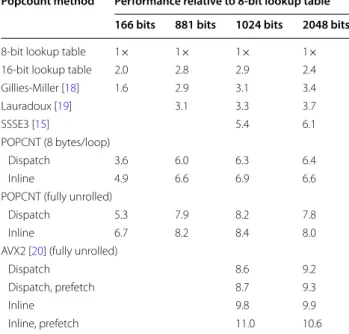
Many popcount algorithms have been developed over the last 70 years [17]. Table 1 compares the relative per-formance of several implementations. Full details are in Additional file 1: Table S1.
Chemfp 1.0 used a lookup table, which may be effective if table lookup is fast, but modern hardware has special methods which are faster than accessing table data even from L2 cache. Fingerprints are typically many machine words in length, so fingerprint popcounts can be com-puted either by summing the popcount of each word or extending a tree-of-adders approach to work on multiple words [17, 19].
While these algorithms can be implemented in stand-ard, portable C code, faster implementations use proces-sor-specific hardware instructions. Effectively all modern x84-64 hardware supports the POPCNT instruction,
Table 1 Relative performance of different popcount implementations
Times are scaled relative to an 8-bit lookup table, as measured by the threshold searches from the chemfp benchmark suite. In most cases the search algorithm uses a function pointer to dispatch to the appropriate popcount function, without memory prefetching. The “fully unrolled” variants implement the fingerprint popcount without using a loop. The “inline” and “prefetch” variants inline the calculation and use memory prefetching, respectively. Timings were made with chemfp 3.3. Chemfp 1.5 does not support inlining, AVX2, or prefetching
Popcount method Performance relative to 8-bit lookup table 166 bits 881 bits 1024 bits 2048 bits
8-bit lookup table 1× 1× 1× 1×
16-bit lookup table 2.0 2.8 2.9 2.4
Gillies-Miller [18] 1.6 2.9 3.1 3.4
Lauradoux [19] 3.1 3.3 3.7
SSSE3 [15] 5.4 6.1
POPCNT (8 bytes/loop)
Dispatch 3.6 6.0 6.3 6.4
Inline 4.9 6.6 6.9 6.6
POPCNT (fully unrolled)
Dispatch 5.3 7.9 8.2 7.8
Inline 6.7 8.2 8.4 8.0
AVX2 [20] (fully unrolled)
Dispatch 8.6 9.2
Dispatch, prefetch 8.7 9.3
Inline 9.8 9.9
which can compute the popcount of a 64-bit word in one machine cycle. Other CPU-specific techniques were available for older consumer hardware [15]. Perhaps sur-prisingly, popcount implementations with AVX2 instruc-tions outperform POPCNT-based implementainstruc-tions for 1024 and 2048 bit fingerprints, because the AVX2 imple-mentation of the Harley-Seal algorithm can fetch and use 256 bits at a time while making more effective use of instruction parallelism [20]. (The POPCNT instruc-tion on most x84-64 chips is limited to a single execuinstruc-tion port). The VPOPCNTDQ instruction in the AVX-512 instruction set computes a 512-bit popcount, which should be faster still.
The fingerprint intersection popcount calculation is often decomposed into the sum of multiple word inter-sections. One optimization is to observe that many of the query words in relatively sparse fingerprints only contain 0 s. Its intersection popcount will always be 0 so does not need to be evaluated. A query-specific optimizer may also be able to merge multiple word evaluations into a single popcount, and replace some word popcounts with simple boolean expressions [21].
Other factors become important once the popcount performance is fast enough. Equation 3 requires an addi-tion, subtracaddi-tion, and division. If all targets with the same popcount are grouped together then the A+B term is constant while processing that group, removing the need for an addition.
Division is a relatively expensive operation, and might be replaced with a small lookup table [21] if table lookup is fast enough, or rewritten to use ration-als and integer operations. For example, the thresh-old test c/(A+B−c) ≥0.75 may be rewritten as
c* 4 ≥ 3 * (A+B−c). A further refinement for grouped fingerprints is to replace the division test with compari-son to the minimum required popcount threshold shown in Eq. 4:
This can be calculated once for each group, which reduces the threshold test to a simple integer comparison.
On some processors, particularly older ones, mis-aligned data may be significantly slower or cause the pro-gram to crash, so should be memory-aligned using zero padding.
Certain fingerprint lengths are particularly common, and specialized intersection popcount functions can be written for each one with a fallback to a general pur-pose implementation. A fully unrolled intersection pop-count for the 166-bit MACCS, assuming zero padded 64-bit words and POPCNT instruction, requires at most 12 assembly instructions and is about 40% faster than a generic loop summing the popcount of the 3 words.
(4) popcount
fp1 &fp2 ≥
T(A+B)
(1+T)
The entire search algorithm can also be specialized for the most important fingerprints sizes. A threshold search for 166-bit fingerprints which inlines the intersection popcount instead of calling a function pointer is about 25% faster because it has no function call overhead and because the compiler has more ability to optimize the code. A fully-inline AVX2 search algorithm may also ini-tialize some of the AVX2 registers once, rather than once for each intersection popcount.
The “roofline model” [22] highlights how memory latency and bandwidth become limiting factors once the popcount performance is fast enough. The absolute mini-mum time for a full linear search of 1 million uncom-pressed 1024 bit fingerprints on a machine with 20 GiB/s memory bandwidth is only 6 ms. This would require about 2.7 billion 64-bit POPCNT instructions per sec-ond, plus the operations to evaluate the Tanimoto, which is not quite achievable on a 3 GHz processor without a high degree of instruction parallelism. In practice, mem-ory latency limitations occur before reaching bandwidth limitation, so faster AVX2 and VPOPCNTDQ imple-mentations must use prefetching to reduce this overhead. Finally, a k-nearest search may use a heap algorithm with O(n log k) performance. Tanimoto scores are ratios of two small numbers, bounded by the number of bits in the fingerprint, resulting in relatively few distinct values. For large values of k a counting sort [21] may be used to eliminate the O(log k) overhead.
While each optimization may only add a small perfor-mance improvements, the overall effect is multiplicative.
Pruning methods
The fastest calculations are those which don’t need to be done. Duplicate fingerprints may be merged into a single record, which can give an appreciable speedup, especially for O(n2) tasks like building a similarity matrix.
Many search tools use BitBound [23] to reject obvious mismatches. If the goal is to find all target fingerprints which are at least t > 0 similar to a query fingerprint with a popcount of A, then the target fingerprint must have a popcount B between B*t and B/t. A value of B may be stored for each fingerprint, or the fingerprints may be organized into bins such that all fingerprints with the same popcount are in the same bin. The latter requires less memory storage and fewer memory accesses. The bounds give linear speedup in threshold searches, with tighter bounds as the similarity increases, and sub-linear speedup for k-nearest neighbors. Empirical testing using the chemfp benchmark data sets confirms that k = 1
nearest neighbor searches of MACCS and FP2 finger-prints scales as O(n~0.65) and the PubChem/CACTVS
fingerprints in the data set (see Additional file 1: Figure S1).
Additional pruning methods include sharper M = 2 bounds [24], xor signatures [25], recursive application of the bounds to fingerprint subsets [26–28], trees [27, 29, 30] and reference points [31, 32]. These papers often demonstrate a mathematical reduction in the number of popcount operations needed, and empirically measure performance improvements over BitBound.
The best improvements occur for high similarities (typically 0.8 or above), while the overall reported per-formance is sometimes worse than BitBound for similar-ity thresholds which are both chemically reasonable and commonly used. It seems impossible to improve upon linear search for an exact similarity search of high dimen-sional space when using a low similarity threshold.
Need for a fingerprint format
The chemfp project started in part to promote the FPS format as the common format for exchanging fingerprint data. Many software packages are available and in wide distribution for working with fingerprint data [9]. These in turn represent a small fraction of the fingerprint soft-ware in use, which includes personal research softsoft-ware and in-house tools. Yet very few tools from different origins are able to work together without some format conversion.
This should be unexpected as the beneficial network effect of an interoperable format generally causes a field to converge on one or a small number of formats in far less than the 30 years of active research on finger-prints. Nearly every tool which works with small mol-ecules supports the SDF or SMILES file format, just like nearly every sequence analysis tools supports the FASTA format.
The success of those three formats was in no small part based on the success of respectively the MACCS II [33], Daylight [34], and FASTA [35] software, so it was clear that providing a fast similarity search tool, along with fin-gerprint generation tools, would help promote the FPS format. It was also clear that fast similarity search tools already existed, without resulting in a common format.
This lead to the question “Why not?”, with the hope that by identifying the factors which weaken the network effect might help improve the chances that a new format would be successful. Foremost, of course, is that most people do not need a fingerprint file format because they work with fingerprints through a database, typically via a chemically-aware database extension.
In general there are two types of fingerprint file for-mats: text and binary. Researchers tend to create text formats because they are easy to read and write, and
to inspect visually. These formats are so simple that it is often faster for the researcher to create a new for-mat and its I/O routines than to find if an appropriate format exists and understand someone else’s software library. It’s also typically easy—a matter of minutes—to write a converter from one format to another.
People with more advanced experience in software development tend to store fingerprints in a binary for-mat, since binary formats are generally faster to read and write than text formats. These are also the sorts of people who write software libraries for both in-house and more general use. These binary formats are typi-cally considered an implementation detail and subject to change as needs change. Instead, file access is medi-ated through command-line programs, or a library API with I/O and search routines.
What happens if a researcher wants to evaluate a new clustering algorithm implemented in R, when the fin-gerprint package library API is only available in C++? While R has good support for C++ bindings, it’s more likely people will write a C++ program to export the fingerprints in a new format and an R function to read that format.
Another aspect of fingerprint software is that there isn’t that much need for interoperability because essen-tially all of the widely-used packages as well as most in-house packages support the most common needs: fingerprint generation using variants of the MACCS, Daylight, or ECFP fingerprint types, Tanimoto similar-ity search for k-nearest neighbors and for finding all neighbors at or above a given threshold, and the N×M
and N×N (symmetric) variants used for clustering and diversity selection algorithms. Most people exchange structures and treat fingerprints as derived data, to be computed when needed.
What about when there is a need? Consider a project to evaluate the relative effectiveness of circular finger-prints from different vendors. Which tool should be used for the evaluation? A surprising number of avail-able packages and associated formats are not designed for interoperability, and cannot easily be used for this task. As two examples, the package may generate fin-gerprints automatically given a structure file or mol-ecule object, but lack a way to accept an externally generated fingerprint value, or the file format may store fingerprint type parameters but not have an easy mech-anism to handle foreign fingerprint types.
library API which could handle most of what people needed from a fingerprint toolkit.
Methods
Hardware
All timings in this paper were made on a machine with a 3700 MHz i7-4770 CPU. Each core has 32 KiB each of L1d and L1i cache and 256 KiB of L2 cache. The four physical cores share 8 MiB of shared L3 cache and 32 GiB of RAM (DDR3-1600 with double channel). The single channel theoretical peak transfer rate is 12,800 MiB/s or 12.5 GiB/s. Measurements with pmbw 0.6 [36] using a single thread show a 54 GiB/s read bandwidth from L1, 35 GiB/s, from L2, 30 GiB/s from L3, and 13.3 GiB/s from RAM. The measured latencies are 1.1 ns from L1, 2.7 ns from L2, 9.6 ns from L3, and 87 ns from RAM. Chemfp was compiled with gcc 5.5.0.
Data sets
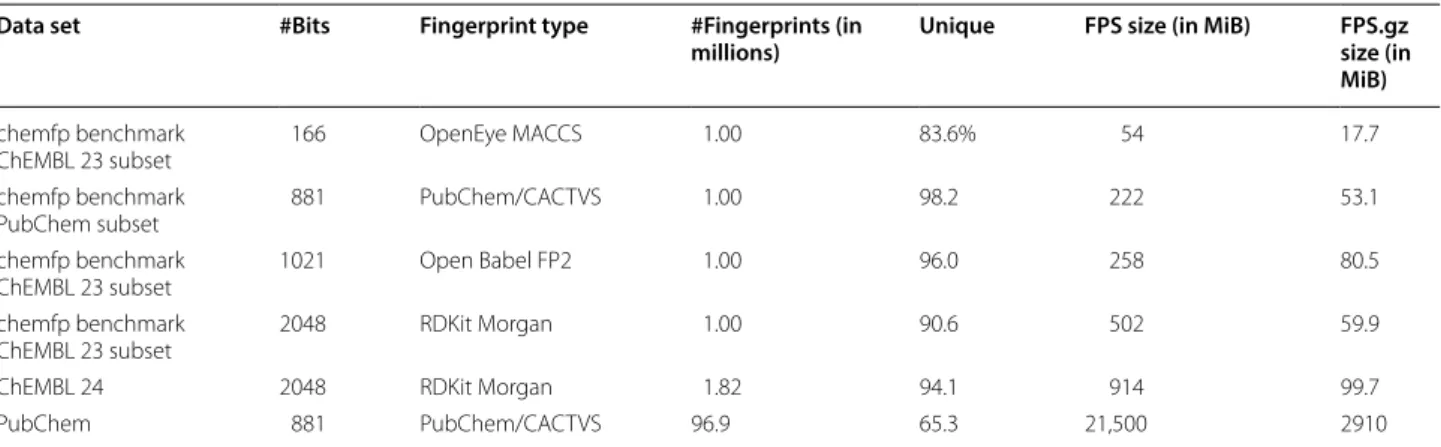
The fingerprint data sets used in this paper are the 2048-bit RDKit Morgan fingerprints distributed as part of ChEMBL 24 [37], the 881-bit PubChem [38] fingerprints extracted from the PUBCHEM_CACTVS_SUBSKEYS tag of a PubChem mirror from 2018-12-07, and the four data sets in the chemfp benchmark. The latter contain four ~ 1 million fingerprint subsets. Three were gener-ated from ChEMBL 23 using respectively the 166-bit OpenEye MACCS implementation, the 1021-bit Open Babel FP2 implementation, and the 2048-bit RDKit Mor-gan fingerprint with radius 2. The fourth contains the 881-bit PubChem fingerprints extracted from a mirror made on 2017-07-12. Table 2 summarizes the content of the search target data sets.
These fingerprint types were chosen because they are relatively popular and well-understood, and to give rep-resentation from each of the underlying toolkits that
chemfp supports. They were not selected for any specific scientific appropriateness, and should only be used for timing purposes.
FPS format
Figure 1 shows an example of the FPS format. It is a line-oriented text format containing an optional header sec-tion followed by zero or more fingerprint records. The header contains an optional version line, followed by zero or more metadata lines. Each header line starts with a ‘#’. Each fingerprint record contains two or more tab-separated fields. The first is the hex-encoded fingerprint and the second is the record id. The remaining fields are unspecified and may be used to store a SMILES string, activity, or other values, though the chemfp toolkit does not yet support these fields.
The most important metadata line, though optional, is “type”. It describes how the fingerprints were gener-ated. While it can be an arbitrary text string, it should follow the format of the examples shown in Fig. 2, with one or more terms separated by a single space. The first term contains the family name and optional version. Any remaining terms are key=value pairs describ-ing the specific fdescrib-ingerprint generation parameters. By
Table 2 Fingerprint target data set sizes in FPS format
“Unique” is the number of distinct fingerprints as a percentage of the total number of fingerprints
Data set #Bits Fingerprint type #Fingerprints (in
millions) Unique FPS size (in MiB) FPS.gz size (in MiB)
chemfp benchmark
ChEMBL 23 subset 166 OpenEye MACCS 1.00 83.6% 54 17.7
chemfp benchmark
PubChem subset 881 PubChem/CACTVS 1.00 98.2 222 53.1
chemfp benchmark
ChEMBL 23 subset 1021 Open Babel FP2 1.00 96.0 258 80.5
chemfp benchmark
ChEMBL 23 subset 2048 RDKit Morgan 1.00 90.6 502 59.9
ChEMBL 24 2048 RDKit Morgan 1.82 94.1 914 99.7
PubChem 881 PubChem/CACTVS 96.9 65.3 21,500 2910
#FPS1 #num_bits=166
#type=OpenEye-MACCS166/3
#software=OEGraphSim/2.2.6 (20170208) chemfp/3.0 #source=chembl_23.sdf.gz
#date=2017-08-08T12:10:38
00000009000400000352468809aa9013d4b07a6e1b CHEMBL3759709 000000090000300001f69edf89fafe838d3e7a7e1b CHEMBL440060 000000090000300081f24ecf99f2fed79d3e7a7e1b CHEMBL440245
convention the family name uses a prefix to indicate the tool used to generate the fingerprints, which helps dis-tinguish between, for example, the MACCS implemen-tations from different vendors.
As a concrete example, the second line of Fig. 2 is a type string for OpenEye’s “Path” fingerprints, version 2. It can be generated by calling OEMakePathFP() with the arguments numbits= 4096, minbonds= 0, etc. The
atype and btype values describe which atom and bond properties are encoded in the fingerprint. The spe-cific syntax is derived from the strings returned from
OEGetFPAtomType() and OEGetFPBondType().
The type has several purposes. First, it records how the fingerprints were generated. It is all too easy to cre-ate a data set then come back to it a few months lcre-ater and forget how it was generated. Second, it should be machine parseable so that software can generate new fingerprints of the same type. This might be used in a search tool to figure out how to convert a new query structure into a compatible query fingerprint. Third, it should be in canonical form, such that the type strings match if and only if they describe the same fingerprint generation options. This makes it possible for even sim-ple tools to detect if two data sets may have incompat-ible types.
The optional “software”, “source”, and “date” lines are primarily for data provenance. The software line records version information for the key fingerprint gen-eration components. Each source line stores a filename or other description of the input to the fingerprint gen-eration. The date line stores an ISO datetime stamp of when the fingerprints were generated.
The optional “num_bits” metadata line records the fingerprint length. If not present then the fingerprint length is calculated from the number of bytes in the fingerprints. Fingerprint types which are not a mul-tiple of 8 bits long, like the 166-bit MACCS keys and the 881-bit PubChem/CACTVS fingerprints, must pad the highest bits with zeros, and should record the actual size in the num_bits field. The value may be used
to compute length-dependent similarity coefficients, or to determine which bits are appropriate for machine learning.
The hex-encoded fingerprint is always a multiple of 2 characters in length. All fingerprints must have the same length, and 0-length fingerprints are not allowed. The bytes are ordered so bit 0 is the first bit of the first byte, that is, the bytes are in little-endian order. Examples of hex-encoded 16-bit fingerprints are: “0100” (bit 0 is set), “2000” (bit 5 is set), and “c218” (bits 1, 6, 7, 11, and 12 are set). Note that the two hex characters for each byte are in big-endian order so the hex representation nibbles are in the order “1032”.
Hex encoding was chosen because the primary goal was to make a format which was easy for most research-ers to read and write with a few minutes of work. Hex encoding is easier to understand and implement than more compact encodings like Base64 and ASCII85, and most widely used programming languages have built-in support for convertbuilt-ing between a byte strbuilt-ing and its hex representation. In any case, gzip compression recov-ers most of the space overhead. Table 2 shows the com-pressed and uncomcom-pressed sizes of the data sets used in this paper.
The tab character is used as the delimiter because IUPAC names and even some corporate ids may contain a space, comma, or other printable character.
The format may be extended by adding new metadata lines so long as they can be ignored without affecting how to interpret an FPS file. For example, a “comment” line might store some extra information about how the fingerprints were generated, and a “stats-24” line might store statistics for bit 24. A future version of the specifi-cation will likely include a way to provide header names for the additional fields of a fingerprint record.
FPB format
The time to parse an FPS file is quite large compared to the in-memory search time. Sometimes the load time adds too much overhead. Consider a web developer fol-lowing the standard edit/reload cycle to create an appli-cation which uses several multi-million fingerprint data sets. Each reload, which is normally a fraction of a second, may take around 10 s as the fingerprints are reloaded. The load time can be deferred until first use, but that will still add noticeable time to the iterative development process.
Chemfp 2.0 added support for the FPB format, which is a more complex binary representation of a fingerprint arena that is quicker to load while still supporting the optimizations for fast similarity search. The structure is a variant of the “FourCC” file format. The file starts with an 8 byte signature followed by a series of chunks. Each
OpenEye-MACCS166/3
OpenEye-Path/2 numbits=4096 minbonds=0 maxbonds=5 atype=Arom| AtmNum|Chiral|EqHalo|FCharge|HvyDeg|Hyb btype=Order|Chiral OpenBabel-MACCS/2
OpenBabel-FP2/1 RDKit-MACCS166/2
RDKit-Morgan/1 radius=2 fpSize=2048 useFeatures=0 useChirality=0 useBondTypes=1
chunk contains an 8 byte length field, followed by a four byte chunk type name, followed by type-specific data.
There are six defined chunk types. The META chunk contains the metadata lines from the header of the FPS format, including the leading ‘#’ and newlines. Processing ends with the FEND chunk.
The AREN, POPC, FPID, and HASH chunks contain the four distinct parts of a fingerprint arena, which will be described in a later section. The AREN chunk stores the fingerprints as a contiguous block, along with infor-mation about the fingerprint length and storage size. It also contains an initial spacer to allow the first fingerprint to be word or cache-line aligned if the file is memory-mapped. The POPC chunk stores the popcount indices into the AREN chunk for sorted arenas.
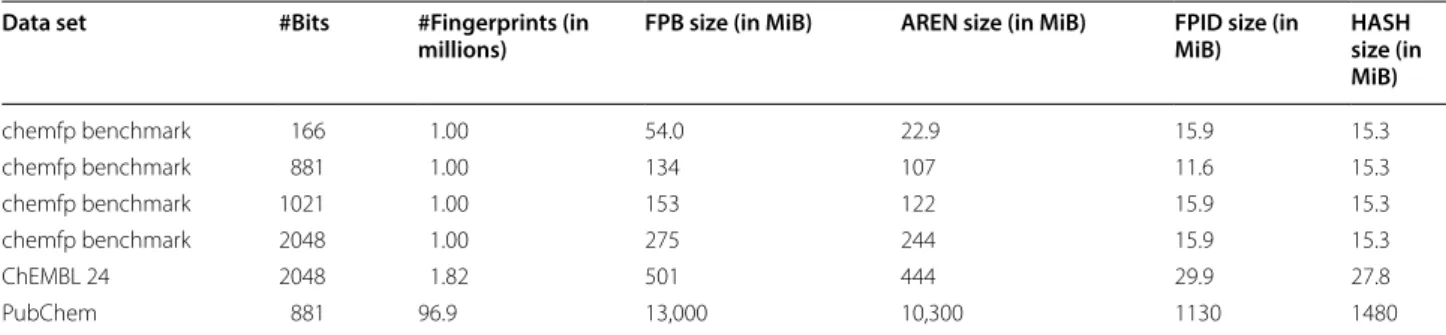
The FPID chunk stores the record identifiers as a sequence of UTF-8 encoded strings, along with an offset table to look up an identifier given its index. The HASH chunk contains a modified form of the cdb hash table [39], where the values are indices into the FPID chunk. Table 3 shows the total size and size of the largest chunks for the data files in this paper.
The load time is significantly shorter because the loader only needs to read enough data to identify which chunks exist and extract basic information like the metadata and fingerprint sizes.
The combination of popcount indexed arenas, Bit-Bound, and memory-mapping work well together. For example, a command-line tool which finds all matches with at least 0.9 similarity to a given fingerprint can limit file access to only the most relevant fingerprints, and since the linear access pattern is easy to predict, the file system can prefetch the data. Tests show that most of the overall time for these sorts of simple tools is spent wait-ing for Python to start, even for multi-million fwait-ingerprint data sets.
Memory-mapped files can also be useful when mul-tiple components use the same FPB file because the
different components may share one copy of the static, read-only memory.
The biggest negative to using the FPB format directly, instead of a fully in-memory representation, is the rela-tive slowness of working with identifiers. It may take several essentially random-access disk reads to get the id for a given index, which is particularly slow on hard disks. Hash table lookups may require several index lookups and so be even slower. In addition, the FPB hash table is not as optimized as the Python hash table, and each identifier lookup creates a new Python string object instead of reusing a previously loaded one. This negative is usually only noticeable when a large number of identifiers are returned.
The FPB format is designed for fingerprint data sets with a few million records, which is typical for most corporate compound collections. It has been tested with the ~ 100 million fingerprints in PubChem, though design consequences of the 32-bit hash table sets an upper limit of slightly more than 250 million finger-prints. The usual way to create an FPB file is to load a fingerprint data set into memory then save the result in FPB format. This does not work for very large data sets; the loader needs more than 30 GiB of RAM for the intermediate data structures to load PubChem. Instead, chemfp’s FPB writer supports an option to write par-tial information to the filesystem, typically as smaller FPB files, which are collated to create the final file. The ~ 10 GiB PubChem FPB file can be created on a machine with only a few GiB of memory, and with rea-sonable performance.
The FPB format allows extensions. New chunks may be added so long as they don’t break compatibility. For example, the sharper M = 2 bounds might be supported by adding a secondary sort to the AREN fingerprints based on the popcount of the odd bits for all fingerprints with the same popcount, and storing the M = 2 indices for the secondary sort in a new chunk.
Table 3 Fingerprint data set sizes in FPB format and largest chunk sizes
The AREN chunk contains the fingerprints, the FPID chunk contains record identifiers indexed by position, and the HASH chunk contains a hash table mapping identifiers to index
Data set #Bits #Fingerprints (in
millions) FPB size (in MiB) AREN size (in MiB) FPID size (in MiB) HASH size (in MiB)
chemfp benchmark 166 1.00 54.0 22.9 15.9 15.3
chemfp benchmark 881 1.00 134 107 11.6 15.3
chemfp benchmark 1021 1.00 153 122 15.9 15.3
chemfp benchmark 2048 1.00 275 244 15.9 15.3
ChEMBL 24 2048 1.82 501 444 29.9 27.8
While the FPS format supports additional fields for each column, there is currently no way to store that information in an FPB file.
chemfp package
Essentially no one will use a fingerprint format sim-ply because a specification exists. The chemfp Python package attempts to overcome the chicken-and-egg problem by distributing a Python library and a set of command-line tools for working with FPS files.
The command-line tools oe2fps, rdkit2fps and ob2fps use respectively OpenEye’s OEChem and GraphSim toolkits [40], the RDKit toolkit [41], and the Open Babel toolkit [42], to parse structure files or records and generate fingerprints. Chemfp also adds a mostly complete PubChem-like fingerprint generation imple-mentation for each toolkit.
The sdf2fps tool extracts record identifiers and pre-computed fingerprints from tags in an SD file. For example, the “--pubchem” option extracts the id from the title line and the fingerprint from the PUBCHEM_ CACTVS_SUBSKEYS tag of a PubChem file. Other supported encodings include hex, Base64, sequences of ‘0’ and ‘1’ characters in different bit orders, and the fingerprint encoding used in Daylight Thor Data Trees (TDTs).
The simsearch tool implements k-nearest and thresh-old searches of an FPS file, using either Tanimoto or Tversky [43] similarity. It supports single query and mul-tiple query searches, as well as the N×N symmetric case.
The fpcat tool can be used to merge multiple FPS and FPB files together. For example, if the sdf2fps tool is used to extract fingerprints from each file in a PubChem dis-tribution, then fpcat can join them together into a single file.
Version 2.0 of the package added Tversky similarity search and support for the FPB binary file format, as well as support for more than 2 GiB of fingerprint data. Each of the above tools supports reading and writing from FPS, gzip-compressed FPS, and FPB files. Fpcat can con-vert between all three formats.
The chemfp package also includes a well-documented toolkit API for working with fingerprints. All of the fea-tures of the command-line tools are available to user-defined programs, along with APIs to help with web services development and to integrate with NumPy and SciPy. The package is designed to work with static data, which is the usual case in research informatics.
The chemfp project also distributes the chemfp_con-verters package, which converts between the chemfp for-mats and the fingerprint forfor-mats used by several other packages.
File scan search
Chemfp supports two similarity search modes: file scan and in-memory. The implementations for both modes expect that there will be few hits relative to the entire data set, so the O(n log k) performance of a priority queue is effectively O(n). File scans are only used to search an FPS file. While the FPB file is faster to load and search, the FPS format is a good fit for workflows which do not need the complexity of the FPB format. The FPS format can also be used in streaming contexts, such as piping the output of sdf2fps to simsearch for a one-off query of fingerprints encoded in the SD file data tags.
A file scan is the default search mode when there is one or a small number of queries. It reads a block of text, and for each line finds the location of the finger-print and id fields. If the fingerfinger-print passes the similar-ity test, the score and id are saved, either to a list for a threshold test, or a bounded priority queue for k -near-est search.
An important goal when chemfp parses an FPS file is to verify that the file is actually in FPS format, and pro-vide a useful error message if it is not. The exception is that k-nearest file scan search terminates early once k
exact matches are found, instead of verifying the rest of the file.
The secondary goal is to demonstrate that good per-formance is possible using a text file. A general pur-pose design might have a file parser which produces a sequence of record objects, and a search algorithm which accepts record objects. This design makes it easy to support multiple file formats by replacing the parser with a new one. However, the intermediate object creation adds unneeded overhead. The similarity can instead be computed directly from the input text. If the score is too low then there’s no need to create a finger-print record at all, and if the score is high enough then only the identifier and score are needed, not the inter-mediate fingerprint object.
Chemfp has four different file scan implementa-tions; one for each combination of {Tanimoto, Tver-sky} × {threshold, k-nearest} searches. This level of specialization is less flexible and has a higher develop-ment and maintenance cost. On the other hand, if the FPS format becomes the de facto standard fingerprint exchange format then there is less need for a design which can handle multiple formats.
In-memory search
If there are more than a few tens of queries against an FPS file then it is faster for chemfp to create and search an in-memory data structure called a “print arena”, which contains four parts. The finger-prints are stored in a contiguous memory block and sorted by population count, such that all fingerprints with 0 bits set come first, followed by those with 1 bit set, and so on. The identifiers are stored in a list in the same order as the fingerprints, such that id[i] stores the id for fingerprint[i]. The population count index con-tains a list of fingerprint indices such that the finger-prints with a population count of b bits have an index
i where popcount_index[b]≤i < popcount_index[b+1]. If no fingerprints have b bits set then popcount_ index[b]=popcount_index[b+1]. Finally, there is a multi-valued hash table mapping each fingerprint id to 1 or more fingerprint indices. Duplicate ids are allowed.
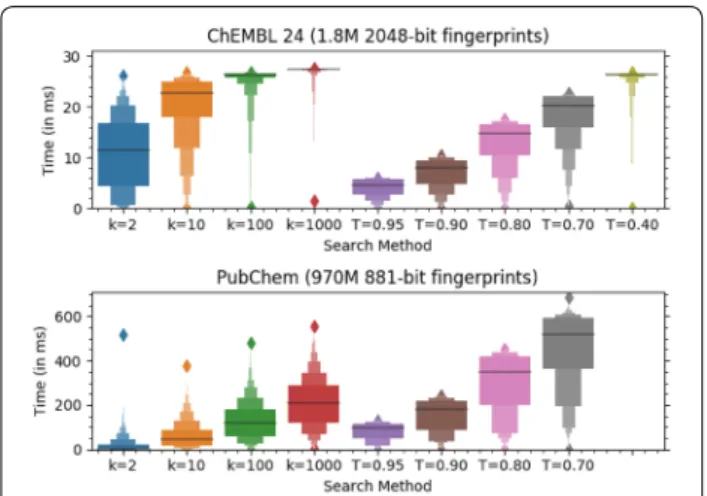
Each fingerprint is num_bytes bytes long and stored in storage_size bytes of memory. Zero padding may be added after the fingerprint bytes, typically so the stor-age size is a multiple of 8 bytes, which lets chemfp use the 64-bit POPCNT instruction. The first fingerprint is located start_padding bytes into the memory block, where the offset is chosen so the fingerprints are word or cache-line aligned. Chemfp determines the start pad-ding based on the fingerprint size: 1024-bit fingerprints are 64-byte aligned for possibly better AVX2/AVX512 performance, while 166-bit fingerprints (which are zero padded to 24 bytes), are 8 byte aligned for possibly bet-ter POPCNT performance. The distribution of 1000 ran-domly sampled single query search timings for ChEMBL 24 and PubChem are shown in Fig. 3. The primary reason for the search time variability is because the BitBound pruning effectiveness depends on the population count of the query fingerprint compared to the distribution of fin-gerprint population counts in the target dataset.
The amount of memory needed for a fingerprint arena is a function of the fingerprint size, alignment, identi-fier size, and number of records. Only a small amount of additional memory is needed to use a memory-mapped FPB file so see the measured FPB file sizes in Table 3 for approximate memory requirements. Additional memory is required when constructing an arena from an FPS file.
The popcount index of a sorted arena is a compact way to store pre-computed popcounts for all of the target fin-gerprints, which means that only the intersection pop-count is needed for each similarity calculation. The index is also used to apply the BitBound limits. A threshold search only needs to test fingerprints i where popcount_ index[floor(b*t)]≤i < popcount_index[ceil(B/t)+1]. The implementation uses a minor variation of the k -near-est algorithm described in [23]. Instead of sorting an
auxiliary array to determine the target popcounts to visit, it does a merge sort of the two monotonically decreasing sides, which can be done in constant memory.
Chemfp also supports unsorted arenas, which are most often used to aggregate multiple small fingerprint sets in a single file. Unsorted searches require a full linear search with both intersection and union popcount calculations.
Chemfp selects the optimal intersection popcount algorithm based on the processor instruction set, finger-print storage size, and alignment. If the AVX2 instruction set is available, it will be used if the storage size is a mul-tiple of 1024 bits. If the POPCNT instruction is available, it will be used if the storage size is a multiple of 64 bits. Other implementations are available for older hardware and other fingerprint sizes.
The fingerprint size is constant for the entire search, so chemfp implements fully unrolled versions of the AVX2 and POPCNT popcount implementations for fingerprints with a storage size of 24, 64, 112, 128, and 256 bytes. These are used for 166-bit MACCS keys, 512-bit fingerprints, 881-512-bit PubChem fingerprints, 1024-512-bit fingerprints, and 2048-bit fingerprints, respectively, when the bits are zero-padded to the next multiple of 64 bits.
The generic threshold and k-nearest search methods use a function pointer to call the appropriate intersection popcount implementation. The function call overhead becomes noticeable for high-performance implementa-tions, so there are specialized versions of the AVX2 and POPCNT implementations which inline the popcount calculation. Inlining may also allow the compiler to apply
Fig. 3 Single query search times for chemfp 3.3. Boxen plots for
more optimizations. The specialized AVX2 versions only need to initialize the register with the nibble table once, and the versions for exactly 128 and 256 bytes also load the query fingerprint into AVX2 registers only once. The fully unrolled and inlined AVX2 version is the only ver-sion which is fast enough for explicit memory prefetching instructions to make a noticeable improvement.
Chemfp does not have special support for handling duplicate fingerprints. If duplicates are removed by an input filter then the k-nearest search becomes a search for the k-nearest distinct fingerprints.
Chemfp represents scores as 64-bit floating point val-ues (“doubles”) because it is designed for Python, which uses doubles as the native floating point type. The 64-bit division required for Eq. 3 is relatively slow, so chemfp includes a fast rejection test using integer mathematics on the assumption that most fingerprints will not pass the rejection test. At the start of the search, the input threshold double is converted into a rational number which is equal to or slightly smaller than the threshold value, resulting in a very effective rejection test. An alter-native under development is to compute the minimum required popcount given the query and target popcount. Preliminary results suggest a 20% speedup for 166-bit fingerprints but a very minor speedup for 2048-166-bit fingerprints.
chemfp benchmark
As Haque et al. [15] highlight, it is difficult to deter-mine if a new search method is effective when the base-line comparison is not well optimized. Authors have an understandable tendency to spend more time optimizing a new algorithm than a seemingly simple linear one, and few have realized that significant gains were possible in linear search.
The authors of some of the published papers com-mendably also distribute their source code, making a head-to-head comparison possible. However, and again for understandable reasons, many of these are written to demonstrate effectiveness and not as general purpose tools. As specific examples, the implementation might only handle fingerprints which are a multiple of 512 bits long, or require the input files use a specific file-system layout, or report timing information but not the match identifiers and scores.
The chemfp project started with a different goal in mind than most other projects. It distributes general-purpose command-line tools and a library API to help promote the FPS format. The similarity search perfor-mance has been improved over time in the expectation that people would use chemfp because of its perfor-mance, and thus help popularize the FPS format.
The author of this paper therefore proposes that crea-tors of new methods use the no-cost/open source version of chemfp as a reference for performance comparisons. This should provide a more rigorous baseline, and may be a useful way to normalize timings across multiple papers.
The chemfp benchmark suite takes that idea one step further by providing a collection of fingerprint data sets and tasks which can be used to evaluate search performance.
In all four cases, 1,002,000 fingerprints were sampled at random, without replacement. Of these, 2000 are desig-nated as queries, and the remaining 1 million are targets. Only the first 1000 queries are used during comparison timings. The remaining 1000 queries may be used to dou-ble-check the stability of the timings.
The benchmark suite includes a set of standard tasks: count or find all matches at or above a given threshold (0.4 for the Morgan fingerprints and 0.7 for the others), and find the k-nearest neighbors (for k= 1 and k= 1000). The 0.4 threshold task emulates a search to select every-thing above a background level of similarity for the Mor-gan similarity. The other threshold levels emulate a more typical search for “good” similarity. These tasks are not meant to be comprehensive, but only to provide an easily interpreted rough estimate of performance.
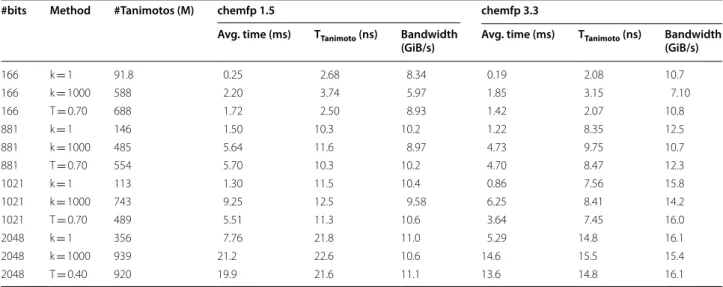
Table 4 shows the single query search times for chemfp 1.5 and chemfp 3.3, which are the current versions of the no-cost and commercial development tracks. A version of chemfp 1.5 was instrumented to record the number of intersection calculations needed and thereby estimate the effective memory read bandwidth, and to count the number of Tanimoto calculations which required a 64-bit division (see Additional file 1: Table S3). The chemfp 1.5 bandwidth of 11 GiB/s approaches the measured pmbw RAM read bandwidth of 13.3 GiB/s. These numbers show that chemfp 1.5 is likely an effective baseline for similarity search comparisons.
Chemfp 3.3 is faster than chemfp 1.5 because of inlin-ing, AVX2, and the use of explicit memory prefetching instructions. The geometric mean of the ratio of their search times is 1.35 indicating that chemfp 3.3 is about 35% faster than chemfp 1.5. Chemfp 3.3 uses 16 GiB/s of memory bandwidth, which is over half of the theo-retical maximum of 25 GiB/s on the test machine and higher than the measured pmbw bandwidth. The current hypothesis is that the chemfp timings include some L3 cache reuse.
Multiquery searches
matrix for clustering, where the fingerprints are used as both queries and targets. In the N×N case the diagonal is not computed.
Chemfp uses the OpenMP “parallel for” pragma to par-allelize each query on its own thread. The N×N thresh-old search computes the upper triangle in parallel then uses a single thread to fill in the lower triangle, which roughly doubles the performance. As a minor complica-tion, the OpenMP implementation with one thread was slightly slower than the non-OpenMP version. Chemfp therefore compiles two code paths, and uses the non-OpenMP version for single-threaded use.
Table 5 shows the scalability in the number of proces-sors for different search methods using the 2048 bit data files from the chemfp benchmark. Several of chemfp cus-tomers with access to more powerful hardware report successful Taylor–Butina clustering of ~ 3 million finger-prints at a threshold of 0.4 within several hours.
Results and discussion
Popcount performance
Some authors of previous papers on this topic argue that if two different algorithms are implemented by the same people then the resulting timing comparison of the implementations fairly characterizes the relative perfor-mance of the algorithms. Table 1 suggests this argument is not very strong. Several earlier papers characterize an 8-bit lookup table as a high performance implementa-tion, but there is a sixfold or larger performance differ-ence compared to a POPCNT-based solution, and an order of magnitude difference compared to an optimized
AVX2 implementation. This highlights the need to com-pare a new algorithm implementation to a well-opti-mized baseline.
The performance difference makes it difficult to assess the validity of many published papers in this field. A paper might show that the authors’ implementation of a new algorithm is twice as fast as their implementation of the BitBound algorithm when both implementations use a 16-bit lookup table to compute the popcount. Yet if the BitBound implementation were replaced with an AVX2 version, the result may be twice as fast as the new algorithm. It’s tempting to believe that replacing the pop-count for the new algorithm would also result in a four-fold speedup, but many of the algorithms perform extra work to avoid a slow popcount calculation. The time for that extra work does not change, reducing the overall speedup, and the extra work might not be as easily opti-mized as the popcount.
Floating point issues
Testing of chemfp and fingerprint tools from other vendors shows that certain floating point issues are often overlooked. If the user specifies a threshold of 0.7 + 1E−17 then most systems will include matches with a score of 0.7 because the above number, when input as the full string and converted to a double or 32-bit float, has the same representation as 0.7. A more realistic ver-sion of this issue occurs in mixed 32/64-bit systems where the similarity search is implemented using 32-bit floats instead of doubles to reduce memory and improve performance. (32-bit division is significantly faster than Table 4 Average performance of 1000 queries against 1 million targets
The timings use three different search methods to search the four different fingerprint types from the chemfp benchmark data set. The total number of Tanimoto evaluations is less than 1 billion because of BitBound pruning. TTanimoto is the average time per Tanimoto evaluation, including storing the hits. The effective read
bandwidth is calculated as #Tanimotos * storage_size (24, 112, 128, and 256 bytes respectively)/TTanimoto. Note that while shorter fingerprints are faster and more
compact, longer fingerprints tend to have better scientific usefulness
#bits Method #Tanimotos (M) chemfp 1.5 chemfp 3.3
Avg. time (ms) TTanimoto (ns) Bandwidth
(GiB/s) Avg. time (ms) TTanimoto (ns) Bandwidth (GiB/s)
166 k = 1 91.8 0.25 2.68 8.34 0.19 2.08 10.7
166 k = 1000 588 2.20 3.74 5.97 1.85 3.15 7.10
166 T = 0.70 688 1.72 2.50 8.93 1.42 2.07 10.8
881 k = 1 146 1.50 10.3 10.2 1.22 8.35 12.5
881 k = 1000 485 5.64 11.6 8.97 4.73 9.75 10.7
881 T = 0.70 554 5.70 10.3 10.2 4.70 8.47 12.3
1021 k = 1 113 1.30 11.5 10.4 0.86 7.56 15.8
1021 k = 1000 743 9.25 12.5 9.58 6.25 8.41 14.2
1021 T = 0.70 489 5.51 11.3 10.6 3.64 7.45 16.0
2048 k = 1 356 7.76 21.8 11.0 5.29 14.8 16.1
2048 k = 1000 939 21.2 22.6 10.6 14.6 15.5 15.4
64-bit division). The 32-bit value of 0.7, when converted to a double, is smaller than the 64-bit value of 0.7. If the user specifies a threshold of 0.7 using a double, then a 32-bit system might end up returning values which, when converted to double, are slightly less than the double value of 0.7.
It is also possible for valid matches to be excluded, such as when the 32-bit value for 0.8 is slightly smaller than the 64-bit value used internally for the threshold test. While it is a direct consequence of mixed 32/64-bit sys-tems, and well-known to programmers, it can be quite unexpected for non-programmers when one tool finds, say, 20 more hits than another due to tiny differences in numerical representation.
The Tversky similarity is perhaps the second most com-mon similarity measure in cheminformatics, though it is a distant second. The Tversky calculation may cause problems even using homogenous floating point types
because IEEE floating point operations do not exactly follow the normal arithmetic distribution rules. Figure 4 shows an example where two seemingly equivalent ways to write the Tversky equation lead to slightly different results. Some values of alpha and beta may even cause the Tversky similarity of a fingerprint with itself to be slightly less than 1.0, which has occurred in both earlier versions of chemfp and other vendor libraries.
Chemfp handles this issue by using integer calcula-tions except for the final division. The values of values of alpha and beta, which are limited to a maximum of 10, are scaled by 10,000 then rounded to the nearest integer. While that introduces a new set of rounding errors, it works because there is no chemically justified reason to have values of alpha and beta with more than two deci-mal digits of precision.
A likely better design would use scaled decimals and rational values rather than floating point numbers. If the fingerprints have no more than 216 bits then the exact
score can be stored in two 16-bit values, with no need for division during search. A post-search step could convert those ratios to 32- or 64-bit floats, as desired. If the Tani-moto threshold is given as a double then it could be con-verted to a ratio of equal value (which may require 64-bit integers for the numerator and denominator), or replaced by a ratio of two small integers constructed so a search Table 5 Multiquery search performance
Time to search the 1 million 2048-bit Morgan fingerprints from the chemfp benchmark data set, for different numbers of threads. A query size of “1000” indicates that the first 1000 benchmark queries were used, “sorted” indicates the same 1000 queries sorted by popcount, and “N × N” generates the full sparse similarity matrix for the 1 million target fingerprints
Method Query size 1 thread 2 threads 4 threads
Time (s) Time (s) Scaling Time (s) Scaling
k = 1 1000 5.31 3.93 1.35 3.69 1.44
k = 1 Sorted 5.24 3.84 1.36 3.50 1.50
k = 1 N × N 7130 (= 1 h 58 m) 5200 (= 1 h 26 m) 1.37 4640 (= 1 h 17 m) 1.54
k = 1000 1000 14.6 10.5 1.39 9.54 1.53
k = 1000 Sorted 14.5 8.42 1.72 6.30 2.30
k = 1000 N × N 15,300 (= 4 h 14 m) 8040 (= 2 h 13 m) 1.90 4690 (= 1 h 18 m) 3.26
T = 0.90 1000 2.95 2.19 1.35 2.03 1.45
T = 0.90 Sorted 2.92 1.65 1.77 1.04 2.81
T = 0.90 N × N 1890 (= 31 m 34 s) 999 (= 16 m 39 s) 1.90 550 (= 9 m 9 s) 3.45
T = 0.80 1000 5.52 4.09 1.35 3.77 1.46
T = 0.80 Sorted 5.47 2.96 1.85 2.03 2.69
T = 0.80 N × N 3490 (= 58 m 9 s) 1830 (= 30 m 25 s) 1.91 1010 (= 16 m 47 s) 3.46
T = 0.70 1000 8.09 5.95 1.36 5.43 1.49
T = 0.70 Sorted 8.07 4.37 1.85 2.80 2.88
T = 0.70 N × N 4930 (= 1 h 22 m) 2580 (= 42 m 57 s) 1.91 1430 (= 23 m 49 s) 3.45
T = 0.40 1000 13.6 9.99 1.36 8.28 1.64
T = 0.40 Sorted 13.6 7.39 1.83 4.54 2.99
T = 0.40 N × N 7120 (= 1 h 58 m) 3710 (= 1 h 1 m) 1.92 2100 (= 34 m 55 s) 3.40
double alpha=0.2, beta=0.8; int a=82, b=92, c=63;
c/(alpha*a + beta*b + c*(1-alpha-beta)) → 0.6999999999999998 c/(c + alpha*(a-c) + beta*(b-c)) → 0.7
with the new ratio gives the same search results as using the original double.
Changed cost model
Many papers use an implicit cost model which minimizes the number of intersection popcount calculations and assumes the data structure overhead is small. One of the few explicit cost models in the literature is in Nasr et al. [26], where it was used to optimize a two-stage filtering process.
This model was reasonable 10 years ago, but mod-ern hardware changes one of the simplifications in that approach. The Tanimoto calculation is now fast enough that memory bandwidth and latency are important fac-tors, so the time to compute a Tanimoto is not a constant nor simple distribution, but is a function of the specific data organization and access patterns used.
As an illustrative example, suppose each fingerprint has an associated value like a BitBound popcount or xor signature which is used in a fast filter test to prune obvi-ous mismatches before doing the fingerprint Tanimoto calculation. Chemfp’s AVX2 implementation for 1024-bit fingerprints takes about 7.4 ns per Tanimoto, but if prefetching is disabled it drops to about 8.3 ns. Prefetch-ing cannot be used with a per-fPrefetch-ingerprint filter because the fingerprint shouldn’t be fetched until the filter test passes, which is exactly when the fingerprint is needed. In the most optimistic scenario, a filter must therefore be able to remove 10% of the candidates just to break even. A more complete analysis must consider the additional memory bandwidth overhead for the filter values and the higher latency (> 50 ns) of effectively random memory accesses once the fingerprint fetches are no longer easily predictable by the memory subsystem. A similar analysis holds for pruning methods which evaluate a partial fin-gerprint to determine if the entire finfin-gerprint should be evaluated.
These extra costs can be amortized by grouping finger-prints with the same signature together, which implies either short signatures or a very large set of fingerprints. This conclusion can be derived from a modified version of the Nasr et al. cost model if TTanimoto is allowed to grow
as a function of M and starts with a value closer to TM=2.
These issues didn’t arise during the empirical testing in earlier papers because the baseline timings (typically brute-force linear search or a simple test like BitBound) did not come close to reaching bandwidth limitations. Chemfp’s BitBound implementation, for example, is roughly 9× faster than the fastest implementation used in Kristensen et al. [27] for a 0.9 threshold search from the reference benchmark (see Additional file 1: Table S4), in part because the latter depends on the relatively slow performance from representing fingerprints as Java set
types. (The TanimotoQuery benchmark was run with OpenJDK 1.8. Additional file 1: Table S5 shows the Kris-tensen KDGrid is faster than chemfp if the minimum threshold is above 0.97). Nasr et al. describe the time to compute the Tanimoto similarity as 48.8 ± 20.4 μs, which is over 1000× slower than chemfp. That paper uses com-pressed fingerprints on a machine which did not support the POPCNT instruction.
An alternative is to use deeper tree data structures, but trees tend to have poor data locality, and the effectively random access memory patterns are about an order of magnitude slower than linear access patterns. To be cer-tain, these tree data structures have a finite depth, with linear search in the leaves, so they will be more effec-tive than BitBound for sufficiently large data sets. It’s not clear, however, where that transition occurs.
Multiquery scaling
Given that a single thread uses about half of the available bandwidth, the prediction is that chemfp’s multiquery search would scale by at most a factor of two, but several benchmarks in Table 5 shows a scaling factor of nearly 3.5 for 4 threads.
The key observation is that the query input order affects the timing. The query sizes of “1000” and “sorted” both use the first 1000 queries from the benchmark data set, though the “sorted” queries are further sorted by popcount. The unsorted queries never scale beyond about 1.6, while the sorted queries often scale beyond 2.0.
The difference can’t simply be due to a more effec-tive use of cache because the single thread time doesn’t change significantly between the sorted and unsorted versions, and because the T = 0.4 search shows good scaling even though the target space is far larger than the ~ 32 K fingerprints which would fit into L3 cache.
target search space is a function of the kth-nearest sim-ilarity score. It also explains why the k= 1000 searches, which by the law of large numbers will tend to explore the same amount of space, scales better than the more variable reads of k= 1 searches.
Some other search tools use more sophisticated meth-ods to handle multiquery searches, for examples by making better use of cache by traversing memory in Morton/Z-order [15] or by query set indexing [44]. These will need to be examined more closely to see if they can be applied to chemfp.
Benchmark data set density
The 1024-bit and 2048-bit fingerprints in the chemfp benchmark appear to be relatively sparse compared to most path fingerprints for the former, and compared to most fingerprints in general for the second. Density was not considered as part of the selection process because most dense search methods are insensitive to density. However, those choices may affect performance compari-sons with sparse methods, which are more sensitive to density.
As a recent paper [45] highlights, the 2048-bit Morgan fingerprints are sparse enough that the RISC algorithm, which uses sparse inverted indices, is faster than chemfp. A closer examination [46] shows that the Morgan finger-print bit density of only 0.024 for the ChEMBL data set is quite sparse compared to most other 2048-bit finger-print types. For example, the standard RDKit fingerfinger-print, based on paths and branches up to 7 bonds, has a density of 0.425, and many other fingerprint types have densities above 0.1.
Earlier work [47] showed that clustering 2048-bit Mor-gan fingerprints using blocked inverted indices was about twice as fast as chemfp 1.1. Together these two papers strongly suggest that sparse methods will outperform dense ones for Morgan fingerprint search—and likely most ECFP-like circular fingerprints. Interestingly, bit position correlations also appear to play a role as RISC and chemfp have comparable performance for a path fin-gerprint data set with similar sparsity to the Morgan data set.
The Open Babel FP2 fingerprints, which are based on linear fragments of length 1 to 7 atoms, are also unusu-ally sparse for a path fingerprint. Each FP2 hashed path sets only one bit of the fingerprint, while the equivalent fingerprint types from RDKit and OpenEye set more than one bit.
Thus, the chemfp benchmark data sets may not be useful for tasks beyond comparing dense fingerprint methods. On the other hand, while they may not be representative of most fingerprint types, circular finger-prints are widely used, so the benchmark may give more
focus to improving their performance. There may also be ways to improve dense approaches to better handle rela-tively sparse fingerprints. One intriguing possibility is to store compressed fingerprints in memory, and decom-press when needed, which has proven useful in other fields when an implementation is memory bandwidth limited [48].
Funding open source
Starting around 15 years ago a number of papers dis-cussed the role of free and open source software (“FOSS”) in cheminformatics [49–53]. Most papers argued that FOSS was essential for scientific reproducibility and economically beneficial to organizations, but said little about how FOSS projects could be funded, or the effect of the funding model on the project. In practice, most projects are developed through direct research funding or through indirect funding of employees who contribute code to a project. One of the goals of the chemfp project was to explore the possibility of “selling free software” [54] as an alternative funding source. Originally chemfp was only distributed under the MIT license, under the principles of free software. This proved to be financially unsustainable, with low income and poor income sta-bility, so the current distribution also includes cheaper though proprietary licensing options. The rest of this sec-tion outlines the issues involved, in hopes of providing insights for future FOSS software projects.
Many FOSS projects are directly funded as part of a research effort. In academic projects, the funding typi-cally comes from grants, and industrial funding typitypi-cally comes from the R&D budget. The main goal of these pro-jects is the scientific result, and often there is no budget for effective end-user documentation, maintenance, or support, or even portability beyond the developers’ own system. Consequently reported bugs do not get fixed, user questions remain unanswered, and the software often “rots” as it gradually becomes incompatible with evolving software development practices. (There are rare exceptions, as when an academic group is funded as a long-term software resource).