Exchange Correlation Functional Investigation of RT-TDDFT on a Sodium Chloride Dimer
Philip Straughn
Abstract
Charge transfer between Na and Cl ions is an important problem in physical chemistry.
However, describing the phenomenon using computational chemistry approaches remains a challenge, especially when using calculations based on density functional theory (DFT). Furthermore, while extension of DFT to the time domain, in principle, allows us to investigate
the quantum dynamics of the charge transfer, the result could depend strongly on the approximated exchange-correlation effects among electrons in such calculations. This project
studies the dependence of real-time time-dependent DFT (RT-TDDFT) calculations on the exchange-correlation approximation. We examine the viability of RT-TDDFT approach to study charge transfer dynamics in a NaCl dimer. Excitation spectra can be related to the changes in
dipole moment in the electron dynamics, and spectral dependence on Na-Cl separation is investigated using various exchange-correlation approximations. In particular, the performance
of the meta generalized gradient approximation (meta-GGA) functional SCAN is found to be similar to the hybrid functional PBE0 for charge separation, excitation spectra, and charge
transfer dynamics calculations at many distances.
Introduction
The Schrödinger equation describes quantum mechanical systems. For systems with three
indeed the reason solving the Schrödinger equation for a systems of quantum-mechanical electrons remains a profound challenge in theoretical chemistry and condensed matter physics. In quantum chemistry, it has been popular to rely on the variational theorem and expanding the
wavefunction in Slater determinants to approximately solve the Schrödinger equation.1 At the same time, density functional theory (DFT) approaches the problem via a completely different
theoretical framework by passing the quantum-mechanical many-body problem associated with the Schrödinger equation. Density Functional Theory enables formulation of a computational method for quantum mechanical modeling. A key advantage of DFT is that it bypasses the need
for many electron wavefunction by formulating the electron density as the fundamental variable. The theoretical framework for DFT is provided by the two Hohenberg-Kohn theorems.2 The first
Hohenberg Kohn theorem states that the external potential Vext(r) is a unique functional of the electron density. The second Hohenberg Kohn theorem applies to the variational principle for the density, meaning that the minimum of the energy occurs at the ground state density for the
system.
The Hohenberg Kohn theorems provide a theoretical framework for DFT, but they do not
provide a mechanism for performing calculations using the theory. Kohn and Sham described a method for calculating the electron density via single-particle Schrödinger-like equation. The resulting Kohn Sham (KS) equation in DFT is:3
ℎ! 𝜌 𝜓! 𝒓 =𝜖!𝜓! 𝒓
and, the electron density is given by KS orbitals,
𝜌 𝒓 = 𝑛! 𝜓!(𝒓) !
!
where the occupation np is equal to either zero or one.
ℎ! 𝜌 = −!!∇!+𝑣
!"# 𝒓 +𝑣! 𝜌 𝒓 +𝑣!" 𝜌 𝒓 . The Hartree (Coulomb) potential is
𝑣! 𝜌 𝒓 =!!!"!(𝒓![!]) = !!(𝒓!) !" 𝑑𝒓𝟐.
The Exchange Correlation potential is
𝑣!" 𝜌 𝒓 =!!!"[!"(𝒓)!].
Unfortunately, the universal XC functional of the density is not known, so we must
approximate the exchange correlation functional, EXC. Exchange Correlation functionals can be organized by how they depend on the electron density, as described in the “Jacob’s ladder in
DFT”.4 At the lowest rung is the local density approximation, which depends only on the electron density values. The next rung up is the generalized gradient approximations (GGA), which depend on the density and the gradient of the density. The meta-GGA functionals occupy
the third rung on the ladder. These meta-GGA functionals have an additional dependence on either the laplacian of the electron density or the local kinetic energy density since these two
properties can be shown to contain comparable information. On the fourth rung of the ladder are the so-called hybrid functionals which mix in some exact exchange from Hartree-Fock theory which is expressed in terms of occupied orbitals. Hybrid functionals in principle are more
accurate than functionals in the lower levels but are up to orders or magnitude more computationally expensive. 5
The Strongly Constrained and Appropriately Normed Semilocal Density Functional (SCAN) is a relatively new exchange correlation functional that was developed by the Perdew group in 2015.6 SCAN is a meta-GGA, and as such has a dependence on the kinetic energy
performs more efficiently than hybrid functionals, as can be seen in the calculations on water by the Perdew group.7
DFT as originally formulated by Hohenberg, Kohn, and Sham is used to calculate ground
state properties. Runge and Gross extended the formulation to time-dependent case, allowing excited-state properties to be investigated. While linear response TDDFT formalism by Casida 8
is widely used for obtaining the excitation spectrum, we focus here on the explicit time integration approach in TDDFT, known as real-time TDDFT approach. For RT-TDDFT, a small numerical integration time is used to integrate the time-dependent KS equations, and the
response of the density during the integration time must be approximated via the XC potential. The so-called adiabatic approximation is to taken when implementing RT-TDDFT, which means
that we assume that EXC depends only on the instantaneous electron density, ignoring any memory dependence9. An important aspect of propagating time-dependent KS equations is that the KS Hamiltonian depends on the density therefore also on the time-dependent KS
wavefunctions. This makes the time-dependent KS equations coupled non-linear partial differential equations.
Computational Details
Calculations were performed using the CP2K code. All calculations use the QZV2P basis
set. The equilibrium distance used for NaCl was obtained from a geometry optimization calculation performed with PBE as the XC functional. The SCF convergance was 10-6 Ry in
every calculation, with most calculations converging to 10-9 Ry.
KS equations were propagated for 1000 steps using the integration time step of 0.2 atomic units. Three calculations were performed, one for applying the kick along each coordinate axis. The dipole moments at each step were Fourier transformed to obtain the linear polarizability tensor.
The real parts of the polarizability in the coordinate matching the kick direction for each calculation, and their sum was used to obtain the excitation spectrum.10
The charge transfer dynamics were studied by using a Mullikan restraint to fix the charge on Na to be 0 at t=0. I was able to successfully fix the charge at less than 0.1 in each case but PBE0 at a distance of 5A, where the charge was constrained to 0.18. The system was then
propagated through time for 2000 steps of 0.2 atomic units with no restraint. The Mulliken charges from each step were used to perform a Fourier transform to generate a plot of the
frequencies of the charge transfer. Mulliken population analysis assigns charges to atoms based on the electronic population of orbitals associated with that atom in the system.
Results
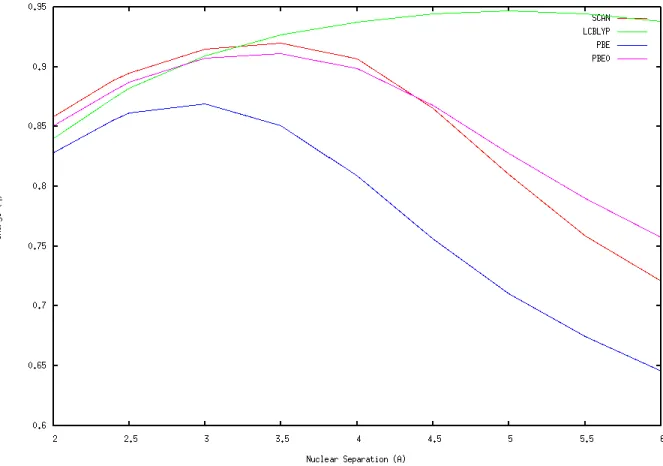
The properties of the model NaCl system depend on the identity of the XC functional
used in the calculation, especially at larger distances. The ground state charge separation calculation used an energy optimization at each distance tested to generate a Gaussian CUBE file, and Bader analysis was used to assign atomic charges on Na and Cl. Bader analysis
separates atoms by minimums in charge density, and then the total charge in the Bader volume is used to indicate the charge on each nucleus.
the sodium cation. PBE0 and SCAN show extremely similar results, which is exciting because meta-GGA functionals are computationally cheaper with large systems. In the model NaCl dimer, performance for each functional was much closer, with every functional being within a
factor of two for CPU time on Killdevil.
Figure 5: Excitation spectra of various functionals at 5 Å NaCl distance.
In the optical excitation spectra, the energies of the excitations becomes lower as the nuclear separation is increased. This result is as expected because the dipole should be changing slower when the bond distance is greater. Of more interest to these investigations is the
differences between functionals. At the equilibrium distance, LC-BLYP performed extremely similarly to CCSD, which is a different computational chemistry method. LDA and the two GGA
functionals used, BLYP and PBE, resulted in extremely similar excitation spectra at each distance. At smaller distances, the three excitation spectra qualitatively appear to have more differences than at larger differences. However, at the 5 Å distance, the excitation spectra all
The meta GGA SCAN and the hybrid functional PBE0 had very similar excitation spectra. As distance increased, the excitation spectra of PBE0 and SCAN diverged. Specifically, the second excitation peak has diverging behavior with distance. The first and third peaks appear
at the same energy in each spectrum. While SCAN does have differences in behavior from PBE0, it is encouraging that a meta GGA has such similar performance to a hybrid functional,
since meta GGA’s are on a lower rung of Jacob’s ladder of functionals which comes along with a lower computational cost.
The LC-BLYP functional has very different behavior from the other functionals in the
optical excitation spectra. The peak energies to not match up with any of the other functionals in the experiment. Since the peak energies change as bond length changes, each of the excitation
bands in these calculations can be attributed as charge transfer bands. A single atom excitation would not show the distance dependence that are a feature of charge transfer excitations.
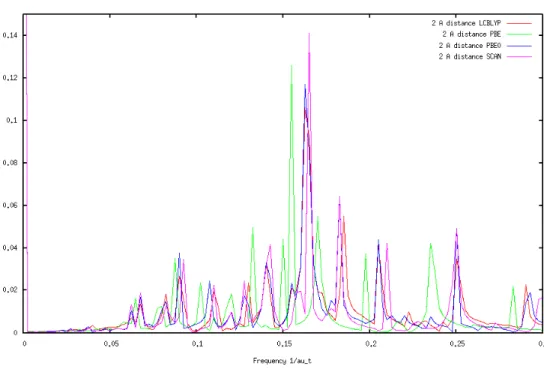
Charge transfer for NaCl showed a strong trend with distance as well. The frequency of
charge transfer decreases as the nuclear separation increases. Consider the tallest peak to be the main charge transfer frequency. The biggest differences in frequency occur at the 4 Å and 5 Å
distance. The frequencies are very low at these two distances. The XC functional that had different behavior was PBE. PBE0, SCAN, and LC-BLYP all had similar results in this experiment. There were slight differences in these three functionals at each distance, but the
differences were not consistent. For example, SCAN at 2.5 Å had peaks that were at slightly higher frequencies than the other functionals. At 5.0 Å, the peaks for SCAN were at slightly
Figure 6: Charge transfer bands at a separation of 2 Å.
Figure 8: Charge transfer bands for bond distance of 2.5 Å.
Figure 9: Charge transfer bands at 4 Å NaCl bond length.
Conclusions
We demonstrate that the meta-GGA SCAN yield results that are very similar to the hybrid functional PBE0 across ground state calculations, calculated excitation spectra, and
charge transfer dynamics. This similar performance is exciting because functionals in the hybrid rung of Jacob’s ladder are generally much more computationally expensive to use than
functionals in the meta-GGA rung.
1 Casida, M. E.; Huix-Rotllant, M. Annu. Rev. Phys. Chem. 2012, 63, 287-323. 2 Hohenberg, P.; Kohn, W. Phys. Rev. 1964, 136, B864-B871.
3 Casida, M. E. J. Mol. Struct.: THEOCHEM 2009, 914, 3-18.
4 (a) Casida, M. E. J. Mol. Struct.: THEOCHEM 2009, 914, 3-18. (b) Medvedev, M. G.; Bushmarinov, I. S.; Sun, J.; Perdew, J. P.; Lyssenko, K. A. Science 2017, 355 (6320), 49-52. 5 Medvedev, M. G.; Bushmarinov, I. S.; Sun, J.; Perdew, J. P.; Lyssenko, K. A. Science 2017, 355 (6320), 49-52.
6 Sun, J.; Ruzsinszky, A.; Perdew, J. P. Phys. Rev. Lett. 2015, 115, 036402.
7 Sun, J.; Remsing, R. C.; Zhang, Y.; Sun, Z.; Ruzsinszky, A.; Peng, H.; Yang, Z.; Paul, A.; Waghmare, U.; Wu, X.; Klein, M. L.; Perdew, J. P., Nat. Chem. 2016, 8, 831-836.