1
Abstract
Objective. To assess participants’ perceptions of the Teaching and Learning Curriculum (TLC) program and identify whether their current careers included teaching as a component.
Design. The University of North Carolina (UNC) TLC program was started in 2009 to expose participants to careers in academia. The program was designed to develop participant’s teaching abilities.
Assessment. A survey was sent to all previous participants of the program with a response rate of 77.2%. Of these, 62.2% reported teaching a class prior to program enrollment. When asked if teaching was part of their career after completion of the program, 77.5% reported that it was a part. In regards to their current position, 31.7% reported having a job in academia. For career impact, 92% of participants agreed or strongly agreed that the program enhanced their teaching skills and 93% agreed or strongly agreed the program was beneficial to their career.
2
Introduction
Many pharmacists incorporate teaching as part of their professional career. Regardless of the area in which they practice, pharmacists frequently educate health care providers and patients. They may also lead continuing education programs or precept students as part of their
responsibilities. Pharmacy residency programs developed Teaching and Learning Curriculum (TLC) programs, previously called Residency Teaching Certificate programs, to help pharmacists become better teachers and educators.
Historically, pharmacists have not been trained as educators. The Accreditation Council for Pharmacy Education (ACPE) standards and the Center for the Advancement of Pharmacy Education (CAPE) outcomes do not require pharmacy students to receive instruction in teaching while in school. However, ACPE expects pharmacy school faculty and teaching assistants to be competent educators able to effectively deliver educational content to students. Graduates hoping to obtain an academic position often seek additional training to gain teaching experience. The lack of pharmacy teaching education prompted the creation of teaching certificate programs and TLC programs for pharmacy residents.
One of the first documented pharmacy teaching certificate programs was at the University of Kentucky in 1999.1 This program prepared pharmacy residents to be educators1. Since then, residencies and post-graduate programs that incorporate education experiences are increasing in popularity. The exact number of teaching certificate programs is unknown.
However, a 2010 report showed 27% of responding pharmacy residency programs had a teaching certificate program.2 A 2007 survey by McNatty et al. evaluated 455 pharmacists that participated
in residency programs between 2003 and 2006 to see if their teaching responsibilities had any effect on their career choice. The results showed former pharmacy residents who had teaching experience during their training were more likely to become faculty members.3
3
for post-graduate teaching programs currently exist, national organizations including the American Association of Colleges of Pharmacy (AACP), American Society of Health-System Pharmacists (ASHP), and American College of Clinical Pharmacy (ACCP) have released recommendations to standardize programs and endorse teaching as part of residency training. Recommendations published by ASHP in 2014 provide guidance for best practices for Teaching Certificate Programs. This report coined the term “Teaching and Learning Curriculum” program to avoid confusion with terminology regarding certificate programs and cites the importance of valuable post-graduate teaching education. The recommendations include knowledge,
application, and practice based core content and support.5
ACCP has also developed guidelines for Pharmacy Residency Education. These guidelines encourage setting educational goals, working with a mentor to develop a portfolio, attending seminars on various teaching topics, and teaching in small and large group settings.6
The UNC Eshelman School of Pharmacy TLC program, formerly referred to as a Teaching Certificate Program, was developed in 2009 to give participants the opportunity to explore education as a career path and to develop skills that they will use with patients, co-workers, and students. This ensured that pharmacists possessed the ability to be educators as part of their post-graduate training. After five years, the program needed to be evaluated to determine if it was meeting the needs of its participants.. The purpose of this project was to assess
4
Background
Since 2009, pharmacy residents, fellows and graduate students have had the opportunity to participate in a formal, organized program at the UNC Eshelman School of Pharmacy that exposes participants to careers in pharmacy education. The TLC program was developed to fill a gap in the host school’s teaching assistants for skills labs and designed to involve other
institutions across the state with pharmacy residents.
The program consists of 8 pre-recorded seminars available on-line covering a variety of teaching topics and 2 live discussion sessions. Participants were expected to develop a teaching philosophy and portfolio, precept students, and conduct didactic teaching in small and large groups. The program also includes one-on-one mentoring by a faculty member. Mentors assist the participants in creating their teaching philosophy and portfolio, evaluate teaching, and provide career guidance.
The teaching methods used in the program include 8 monthly seminars that were available online. The topics included: pursuing academia as a career, teaching philosophy, preparing a teaching portfolio, facilitating small group discussions, assessing student success, preparing a lecture, becoming an effective preceptor, and planning for academic educational courses and distance education. Having modules online meant that participants could complete them at their own pace. This is helpful in a residency setting where participants have many other responsibilities outside of the TLC program and may be based in another part of the state for their residency. In addition, participants were required to attend 2 live group discussion sessions on campus at the end of each semester to discuss experiences and topics related to teaching.
5
outcome: to provide medication and practice-related information, education, and/or training, and the ASHP PGY2 or ASHP Community Pharmacy PGY1 outcome: to demonstrate skills required to function in an academic setting. The program also matches ACCP and ASHPs
recommendations to incorporate teaching into clinical practice.
Interest in the UNC TLC has grown over the last 5 years. The program now serves residents from 9 partnership sites as well as graduate students and fellows. As the potential numbers of participants continues to increase, resources have remained the same and the program is at capacity of 24 participants. In order to be accepted into the program, residents, graduate students, and fellows must submit an application outlining their skills and aptitudes to complete the program. Applicants are also required to submit a curriculum vitae. Applicants with a strong desire for or interest in a career in academia are strongly considered when selecting candidates for the program. The project assessing this program was reviewed by the UNC IRB prior to
beginning the project and determined to be exempt. Methods
Participants in this project are former residents, fellows, and graduate students who completed the UNC TLC program between 2010 and 2013. Residency directors were contacted to gather the 84 former participant’s contact information. Eighty-two participant’s contact
information was collected.
6
The survey was both quantitative and qualitative in nature utilizing both closed and open-ended questions. Demographic information including current practice setting and practice information during the program was collected. The survey asked about current and former teaching experience and included 5-point Likert scale questions concerning perception of the benefit of the program. The frequency that participants engaged in teaching skills related to the outcomes and goals of the program was also assessed. Reflective questions asking what participants felt was the most valuable part of the program and what they wished was different concluded the survey. Data was evaluated using descriptive statistics including incidence of responses expressed in percentages and means.
Results
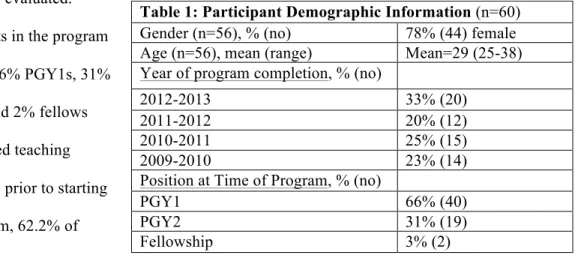
Sixty-one participants completed the survey giving an overall response rate of 77.2%. However, not all participants answered every survey question and some questions allowed for more than one response. Table 1 provides demographic information about the participants. Overall, participants were female, average age was 29 and there was an even distribution between the 4 years evaluated.
Participants in the program included 66% PGY1s, 31% PGY2s, and 2% fellows When asked teaching experience prior to starting the program, 62.2% of
participants reported having previously taught a class, 22.9% took a teaching elective or course in teaching and 4.9% had prior participation in a teaching certificate program.
Immediately after completing the program, 64% of respondents began a full time job and 36% completed additional training after the program. Of those that continued training, 86% went on to a PGY2 program and 14% continued on to a fellowship.
Table 1: Participant Demographic Information (n=60)
Gender (n=56), % (no) 78% (44) female
Age (n=56), mean (range) Mean=29 (25-38) Year of program completion, % (no)
2012-2013 33% (20)
2011-2012 20% (12)
2010-2011 25% (15)
2009-2010 23% (14)
Position at Time of Program, % (no)
PGY1 66% (40)
PGY2 31% (19)
7
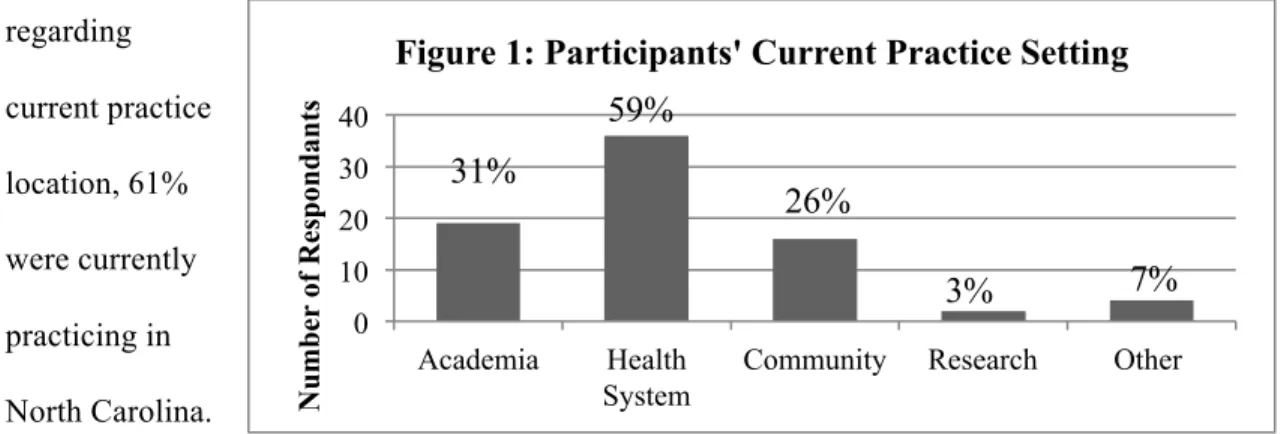
In regards to current practice setting (Figure 1), 31.7% of respondents reported academia, 58% in health system, and 27% in a community setting. When asked about current practice setting respondents had the option to choose multiple settings. Of the participants that responded regarding
current practice location, 61% were currently practicing in North Carolina.
Participants were asked details about their current practice. 40 participants responded when asked if teaching is a component of their job,. Of those responding, 20% reported that teaching was the primary focus and 58% reported that teaching was a component, but not the primary focus.
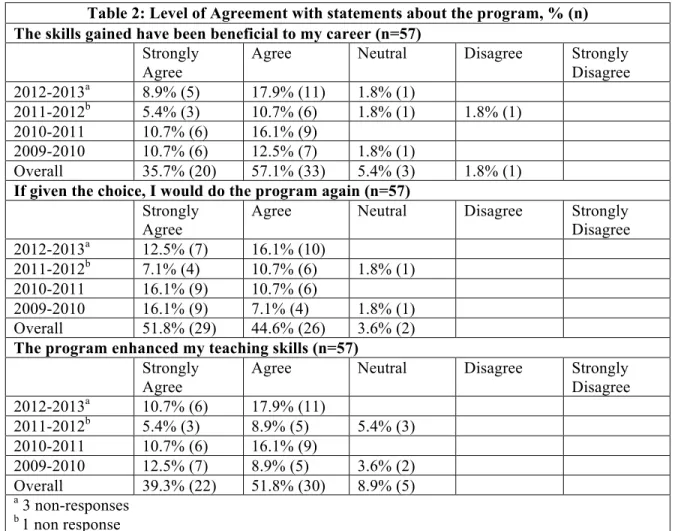
Table 2 describes participants’ perceptions of the program. 93% of participants agreed or strongly agreed the program was beneficial to their career. 97% of respondents agreed or strongly agreed that if given the choice, they would do the program again. 92% agreed or strongly agreed to the statement, “The program enhanced my teaching skills.” In response to the question asking how likely participants were to recommend the program to a colleague, 54% were very likely, 37% were likely, and 7% were somewhat likely while 2% were very unlikely (n=57).
Participants also indicated how many times they had developed a course or been a course coordinator since completing the program and 58 participants responded. For development of a required course 75.8% had never developed a course, 12% had once, 8.6% had developed a course between 2 and 5 times, and 3.4% reported developing a course more than 5 times. For development of an elective course, 77.5% had never developed a course, 13.7% had once, 5.2% had twice, 3.4% had 3 times.
31%
59%
26%
3%
7%
Academia Health
System
Community Research Other
0 10 20 30 40
N
u
mb
er
of R
es
p
on
d
an
ts
8
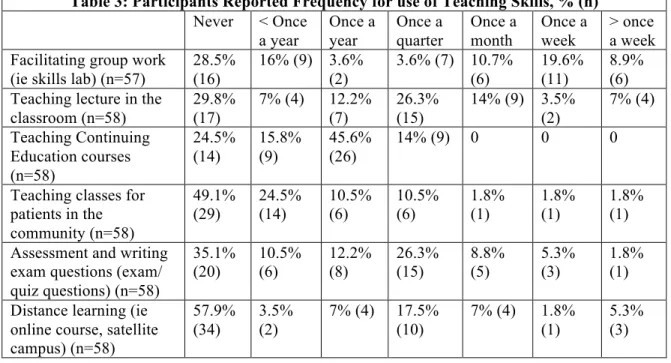
Since completing the program, 29% reported developing or revising their teaching philosophy and 5% reported submitting a promotion dossier (n=58). In the free response section, participants mentioned developing a teaching philosophy was beneficial. Since completing the program, 51% reported precepting 6 or more learners a year, 44% reported 1 to 5 learners per year, and 5% reported none (n=57). Table 3 represents participants’ responses when asked about how often they performed various teaching skills. These skills were part of the objectives of the program. Of the 57 respondents, 72% facilitate group work at least once a year. Out of 58
respondents, 71% teach a lecture in a classroom, 51% teach classes for patients in the community, and 65% perform assessments and write exam questions at least once per year. Responses varied widely but correspond with participant’s probable job responsibilities.
Table 2: Level of Agreement with statements about the program, % (n) The skills gained have been beneficial to my career (n=57)
Strongly Agree
Agree Neutral Disagree Strongly
Disagree 2012-2013a 8.9% (5) 17.9% (11) 1.8% (1)
2011-2012b 5.4% (3) 10.7% (6) 1.8% (1) 1.8% (1)
2010-2011 10.7% (6) 16.1% (9)
2009-2010 10.7% (6) 12.5% (7) 1.8% (1)
Overall 35.7% (20) 57.1% (33) 5.4% (3) 1.8% (1)
If given the choice, I would do the program again (n=57) Strongly
Agree Agree Neutral Disagree Strongly Disagree 2012-2013a 12.5% (7) 16.1% (10)
2011-2012b 7.1% (4) 10.7% (6) 1.8% (1) 2010-2011 16.1% (9) 10.7% (6)
2009-2010 16.1% (9) 7.1% (4) 1.8% (1)
Overall 51.8% (29) 44.6% (26) 3.6% (2)
The program enhanced my teaching skills (n=57) Strongly
Agree
Agree Neutral Disagree Strongly
Disagree 2012-2013a 10.7% (6) 17.9% (11)
2011-2012b 5.4% (3) 8.9% (5) 5.4% (3)
2010-2011 10.7% (6) 16.1% (9)
2009-2010 12.5% (7) 8.9% (5) 3.6% (2)
Overall 39.3% (22) 51.8% (30) 8.9% (5)
9
Table 3: Participants Reported Frequency for use of Teaching Skills, % (n) Never < Once
a year Once a year Once a quarter Once a month Once a week > once a week Facilitating group work
(ie skills lab) (n=57)
28.5% (16)
16% (9) 3.6% (2)
3.6% (7) 10.7% (6)
19.6% (11)
8.9% (6) Teaching lecture in the
classroom (n=58)
29.8% (17)
7% (4) 12.2% (7)
26.3% (15)
14% (9) 3.5% (2) 7% (4) Teaching Continuing Education courses (n=58) 24.5% (14) 15.8% (9) 45.6% (26)
14% (9) 0 0 0
Teaching classes for patients in the community (n=58) 49.1% (29) 24.5% (14) 10.5% (6) 10.5% (6) 1.8% (1) 1.8% (1) 1.8% (1) Assessment and writing
exam questions (exam/ quiz questions) (n=58)
35.1%
(20) 10.5% (6) 12.2% (8) 26.3% (15) 8.8% (5) 5.3% (3) 1.8% (1) Distance learning (ie
online course, satellite campus) (n=58)
57.9% (34)
3.5% (2)
7% (4) 17.5% (10)
7% (4) 1.8% (1)
5.3% (3)
According to free responses, participants reported having a teaching mentor and collaborating with faculty and other residents was valuable to their experience. Other positive feedback included opportunities to teach at the school in the classroom and as a TA for skills labs. Additionally, participants provided feedback about how to improve the program. Suggestions included more didactic teaching experience, exam writing, and more student precepting experience during the program. Participants requested more active learning and information on motivation and feedback for students.
Discussion
10
or residents and many were involved in teaching small groups and classroom lectures.7 The study reported only 3% of respondents had no involvement in teaching activities.7 The results of the
Wisconsin program study validates the results of this study in that participants found the program to be of benefit many years after program completion.
Many other TLC programs have shown similar results about improvement in teaching, however these evaluate participants only up to one year after program completion. A program in Indiana surveyed participants one year after completion of their teaching certificate program and determined that ~50% of graduates felt that having the program helped them obtain their current job and most would recommend the program to others.8 In 2013, 10 years after the program’s
start, quality assurance data was published about this same program. The survey, distributed each year one year after program completion, found that responding participants thought the program was of value.9 A program at Arizona College of Pharmacy evaluated graduates before and after completion of the first 1-year program and found that participants’ confidence in teaching abilities improved after completion of the program.10
While every effort was taken to ensure appropriate project design some limitations are acknowledged. First of all, this project relied on residency and fellowship directors for current contact information. The participants were in the program up to 4 years ago and the directors contact information may not be the most up-to-date address or an email account that the
11
Despite this study’s limitations, the positive findings will be used to modify and grow the TLC Program at UNC. Participants clearly value the program and residency directors use the program as part of their recruitment strategy to candidates. Residency program directors (RPDs) look to the program to help satisfy ASHP residency program accreditation standards and as these standards are revised, the need for the TLC program may further increase. The demand for the program continues to grow while the resources for the program have remained the same.
One of the most unique features of this TLC program is the one-on-one mentoring participants receive from faculty. Ironically what makes the program unique and its most valued strength is also the biggest barrier to expansion. Another barrier to expansion is the shrinking number of traditional teaching opportunities as the curriculum evolves into a more experiential model. Limited precepting opportunities have proven to be a barrier to expansion as well. However, the curriculum change should add plentiful precepting opportunities effectively removing this barrier. Potential solutions that keep the high quality components of the program while allowing for growth include offering different tracks of the TLC program and increasing RPD and preceptor involvement as mentors. A preceptor development track and an academic track have been suggested in prior participant feedback. If the program offered two tracks one could envision RPDs and preceptors providing the mentorship for the precepting track while full time faculty provide the mentoring for the more traditional academic track.
Summary
12
AcknowledgementsJacqui McLaughlin, PhD and Julia Khanova, PhD for their expertise and assistance with the statistical analysis. Former UNC TLC participants for their support of and participation in this project.
References
1. Romanelli F, Smith KM, Brandt BF. Certificate program in teaching for pharmacy residents. AmJHealth-SystPharm. 2001; 58(10):868-898.
2. Stegall-Zanation JD, Rusinko KC, Eckel SF. Availability and characteristics of teaching certificates offered by pharmacy residency programs. Am J Health-Syst Pharm, 2010; Vol 67: 16-17.
3. McNatty D, Cox CD, Seifert CF. Assessment of teaching experiences completed during accredited pharmacy residency programs. AmJ PharmEduc. 2007;71(5):Article 88.
4. Poirier TI, Ferguson M. Academic Pharmacy Practice Fellowships Address Challenges of Evolving
Pharmacist Roles. AmJ PharmEduc 2014; 78 (6) Article 114
5. Wright EA, Brown B, Gettig J et al. Teaching and learning curriculum programs:
recommendations for postgraduate pharmacy experiences in education. AmJHealth-SystPharm. 2014; 71:1292-302.
6. Havrda DE, Engle JP, Anderson KC, et al. Guidelines for Resident Teaching Experiences. Pharmacotherapy 2013;33(7):e147–e161.
7. Wahl KL, Margolis A, Lintner K, et al. Impact and Application of Material Learned in a Pharmacy Residency Teaching Certificate Program. AmJPharmEduc. 2014; 78(6): Article 123. 8. Gettig JP, Sheehan AH. Perceived value of a pharmacy resident teaching certificate program. AmJPharmEduc. 2008;72(5):Article 104.
9. Gonzalvo JD. Ramsey DC, Sheehan AH et al. Redesign of a Statewide Teaching Certificate Program for Pharmacy Residents. AmJPharmEduc. 2013;77(4):Article 79.