1
MEDICATION THERAPY MANAGEMENT AND STATIN ADHERENCE
By
James Yan-Ling Fok, PharmD Candidate
Signature________________________
Advisor: Stefanie Ferreri, PharmD, CDE, BCACP, FAPhA Signature________________________
Honors Essay
UNC Eshelman School of Pharmacy University of North Carolina at Chapel Hill
February 25, 2015
MEDICATION THERAPY MANAGEMENT AND STATIN ADHERENCE
Introduction
Medication therapy management (MTM) is often defined as a “group of services that optimize therapeutic outcomes for individual patients.”1 During a MTM session conducted by pharmacists or other health professionals, medication-related problems such as suboptimal dosing and drug reactions can be identified and addressed.
One medication-related problem that is addressed by pharmacists is medication adherence. Adherence to medication regimens is critical to the management of chronic disease states because disease progression typically results simply with the passage of time.2 In other words, chronic disease state management via medication is all about slowing progression and adherence is the vital key to successful pharmacotherapy. Pharmacists are positioned to assess adherence with MTM because adherence (or lack thereof) is typically observed by one’s pattern of refills at a local pharmacy.
Hyperlipidemia, a risk factor for heart disease, is an example of a disease state in which adherence is essential. Besides the burden that hyperlipidemia places on the health system, its economic costs are also significant to note as it is a contributor to over $38 billion that is used to manage and treat cardiovascular disease.3
statins remains a large problem in patients with hyperlipidemia for reasons such as lack of perceived improvement in health, low health literacy, and adverse effects.5 This is especially relevant since statin adherence is associated with lower medical costs.6 Because MTM aims to assess medication-related problems such as underuse of therapies, MTM is a viable tool that pharmacists and other health professionals can utilize.
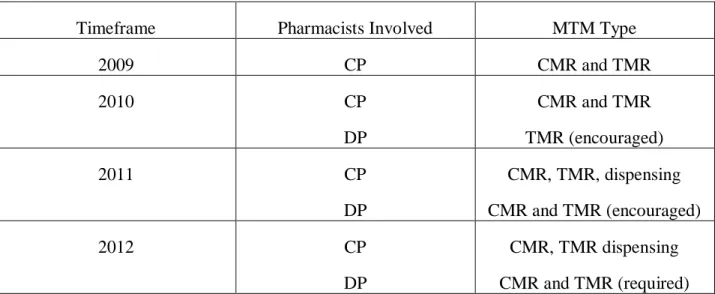
Since 2009, a regional chain pharmacy in North Carolina implemented four MTM models that have utilized both clinical and dispensing pharmacists in conducting comprehensive medication reviews (CMRs) and targeted medication reviews (TMRs). Figure 1 depicts these 4 MTM models. Because a significant portion of the patients take statins to control hyperlipidemia, pharmacists have worked to ensure that patients remain adherent.
Figure 1: MTM Models
Timeframe Pharmacists Involved MTM Type
2009 CP CMR and TMR
2010 CP
DP
CMR and TMR TMR (encouraged)
2011 CP
DP
CMR, TMR, dispensing CMR and TMR (encouraged)
2012 CP
DP
CMR, TMR dispensing CMR and TMR (required)
Objectives
The aim of this study is to examine how MTM affects statin adherence in non-adherent patients. To date, there are limited studies evaluating MTM’s role in managing hyperlipidemia.7
The results from this study may assist in clarifying pharmacists’ future use of MTM.
Methods
Study Design
This study was a multi-site, retrospective study evaluating claims data for patients taking statin medications. The University of North Carolina at Chapel Hill Institutional Review Board approved this study’s protocol.
North Carolina Medicare Part D participants who had statins filled in 2012 were included in this study. All claims needed to have a status of approved/paid to be evaluated. Exclusion criteria included patients on antihyperlipidemics other than statins (including combination products with statin component such as Vytorin) and patients with statin prescriptions with no refills after an MTM intervention.
Procedures
Figure 2: Reasons to Conduct a TMR
Reason Example
Drug interaction Patient is recently prescribed phenytoin from psychiatrist and has been dabigatran for years. Insufficient dose/duration Patient with high risk for cardiovascular
disease on simvastatin 10 mg.
Excessive dose/duration Patient on high dose of transdermal fentanyl experiencing signs of respiratory depression. Administration technique Patient with diabetes not rotating injection sites
when using insulin.
Adverse drug reaction Patient on lisinopril with dry cough.
Patients seen during calendar year 2012 identified by pharmacists as having underutilized their statin therapy (i.e., non-adherent) and having undergone MTM intervention served as the intervention group. Adherence was defined by the proportion of days covered (PDC) measure.8 PDC was measured in this study by calculating the total days’ supply of medication and dividing that number by the number of days a patient has been on that specific days’ supply as
demonstrated by refill history. Per the PDC measure for chronic disease states such as diabetes and hyperlipidemia, adherence is any value > 0.8. PDC values may vary from 0 (meaning no adherence whatsoever) to 1 (complete adherence).
Data Collection and Analysis
All MTM claims from year 2012 were included for analysis. Claims were obtained from a billing platform for MTM interventions. After obtaining claims, they were then downloaded onto
Microsoft Excel spreadsheets where patient information was deidentified. Any statistically significant difference in adherence was measured using McNemar’s test.
Results
A total of 297 patients were assessed for eligibility to be included in this study. After applying the exclusion criteria, 140 patients were evaluated in terms of their adherence before the MTM intervention which provided a power of 0.8208 with a one-sided alpha value of 0.05. The reasons for exclusion and number of patients in each exclusion category are outlined in Figure 3.
About 48.6% of these patients were non-adherent before an MTM session. As a result of MTM, exactly 50% of non-adherent patients (34 out of 68 non-adherent patients) became adherent. Table 1 depicts these results for both non-adherent and adherent patients and outlines any changes that occurred as a result of the intervention.
Table 1
There was a statistically significant increase in adherence in patients who were non-adherent (X2=10.52). The data suggests that even one single MTM intervention can positively impact adherence rates (p=0.0012).
Discussion
This study is important in that it evaluated the effects that MTM interventions may have on patients with hyperlipidemia. Specifically, this study examines the particular role that MTM has on statin adherence in multiple timeframes up to 12 months of therapy. The literature on statin adherence suggests that the vast majority of patients initiated on statin therapy tend to be non-adherent regardless of the medical indication but the literature has not looked specifically into how MTM can be used to affect adherence.6, 9-12 This study provides a foundation for future work examining MTM’s role in increasing rates of statin adherence.
This study’s primary finding that MTM is a viable tool to increase statin adherence in non-adherent patients is crucial given the role that statin therapy plays in reducing rates of
cardiovascular heart disease. In addition to clinical benefits that MTM can confer to patients, there can arguably be various economic savings that have been already been examined in other chronic disease states. In particular, the Asheville Project in North Carolina has already shown that pharmacist consultation regarding cardiovascular health can decrease medical costs and emergency department visits.13 Although there is limited evidence on the cost-effectiveness of MTM, there is potential for MTM to decrease significant costs associated with non-adherence to statins.
There may be a number of reasons that may explain why even a single MTM session can
While this study shows an increased adherence rate in non-adherent patients as a result of an MTM intervention, there are several limitations.
First, refill history through other pharmacies, physician samples, mail order, and other means of obtaining medication were not considered. It has been previously demonstrated that patients often engage in polypharmacy, making the measurement of adherence difficult.15 While
pharmacists are trained to inquire about polypharmacy at each MTM visit, for the purpose of this study, there was no standardization of each MTM session to assess for polypharmacy.
Second, different timeframes were utilized in the analysis of claims data. Patients were analyzed 3, 6 or 12 months. Because it is known that adherence can vary even within several months, one timeframe would have been much more helpful in assessing the effects of MTM.16 However, it is important to note that this limitation is largely due to the retrospective study design.
Third, this study may possibly be inadequate in evaluating the long-term effects of MTM. The maximum timeframe of analysis was only 12 months, a timeframe that may not be predictive of long-term change. Despite the short timeframe, it may also be argued that a patient’s adherence at 12 months may be a good predictor of future adherence as there is some evidence to
demonstrate this.16
illustrate that adherence is a much more nuanced concept than simply meeting a certain numeric threshold.
Despite these limitations, the results of this study reveal promising areas of future research. For instance, there were patients that exhibited overutilization (i.e., PDC > 1). Overutilization can be harmful to patients as the risk of certain adverse effects such as myopathy can increase. Patients that demonstrate overutilization may also have impaired hepatic and/or renal function which only further exacerbates any experienced side effects.17
In the future, other disease states managed by pharmacists are worthy of further consideration such as hypertension and diabetes. Similar results found in this study may possibly be seen in these disease states as the effectiveness of pharmacist involvement in these disease states has been previously been demonstrated in the Asheville Project. Hypertension and diabetes may arguably be more complex than hyperlipidemia as a significant number of patients are often are multiple medications or on more complex regimens (e.g., insulin), but it is a direction that may yield more insight into the role that pharmacists can play in increasing adherence rates.
Conclusion
References:
1. APhA MTM Digest. March 2013.
2. Julius S, Nesbitt SD, Egan BM, et al. Feasibility of treating prehypertension with an angiotensin-receptor blocker. N Engl J Med 2006; 354:1685.
3. Soni, A. Top 10 Most Costly Conditions among Men and Women, 2008: Estimates for the U.S. Civilian Noninstitutionalized Adult Population, Age 18 and Older. Statistical Brief #331. July 2011. Agency for Healthcare Research and Quality, Rockville, MD.
http://www.meps.ahrq.gov/mepsweb/data_files/publications/st331/stat331.shtml 4. Sacks FM, Pfeffer MA, Moye LA. et al. The effect of pravastatin on coronary events
after myocardial infarction in patients with average cholesterol levels. N Engl J Med.1996;335:1001-1009.
5. Gadkari AS et al., Medication nonfulfillment rates and reasons: narrative systematic review. Curr Med Res Opin. 2010;26(3):683-705.
6. Pittman DG, Chen W, Bowlin SJ, Foody JM. Adherence to statins, subsequent healthcare costs, and cardiovascular hospitalizations. Am J Cardiol. 2011 Jun 1;107(11):1662-6.
7. Isetts BJ, Schondelmeyer SW, Artz MB, Lenarz LA, Heaton AH, Wadd WB, Brown LM, Cipolle RJ. Clinical and economic outcomes of medication therapy management services: the Minnesota experience. J Am Pharm Assoc (2003). 2008 Mar-Apr;48(2):203-11
8. Hess LM, Raebel MA, Conner DA, Malone DC. Measurement of adherence in pharmacy administrative databases: a proposal for standard definitions and preferred
measures. Ann Pharmacother. 2006 Jul-Aug;40(7-8):1280-88.
9. Jackevicius CA, Mamdani M, Tu JV. Adherence with statin therapy in elderly patients with and without acute coronary syndromes. JAMA. 2002 July 24-31;288(4):462-7. 10. Insull W. The problem of adherence to cholesterol altering therapy. J Intern
Med.1997;241:317-325.
11. Simons LA, Levis G, Simons J. Apparent discontinuation rates in patients prescribed lipid-lowering drugs. Med J Aust.1996;164:208-211.
12. Ellis JJ, Erickson SR, Stevenson JG, Bernstein SJ, Stiles RA, Fendrick AM.Suboptimal statin adherence and discontinuation in primary and secondary prevention populations. J Gen Intern Med. 2004 Jun;19(6):638-45.
14. Gellad WF, Grenard JL, Marcum ZA. A systematic review of barriers to medication adherence in the elderly: looking beyond cost and regimen complexity. Am J Geriatr Pharmacother. 2011 Feb;9(1):11-23.
15. Hajjar ER, Cafiero AC, Hanlon JT. Polypharmacy in elderly patients. Am J Geriatr Pharmacother. 2007 Dec;5(4):345-51.
16. Benner JS, Glynn RJ, Mogun H, Neumann PJ, Weinstein MC, Avorn J. Long-term persistence in use of statin therapy in elderly patients. JAMA. 2002 Jul 24-31;288(4):455-61.