Power Transitions and Hegemonic Longevity
By Brendan M. Cooley
A Thesis submitted to the faculty of the University of North Carolina in partial fulfillment of the require- ments of a degree with Honors in
Political Science.
2014
Approved by:
_________________________________ Adviser: (Dr. Navin Bapat)
_________________________________ (Dr. Stephen Gent)
Abstract
Table of Contents
INTRODUCTION AND THEORETICAL FOUNDATIONS 1
A CONTEMPORARY CASE STUDY: THAILAND BETWEEN THE UNITED STATES AND CHINA 2
THEORETICAL FOUNDATIONS 5
LITERATURE REVIEW 11
HEGEMONIC STABILITY THEORY 12
POWER TRANSITION THEORY 15
HEGEMONY AND THIRD PARTIES 18
A MODEL OF POWER TRANSITION AND HEGEMONIC LONGEVITY 22
SPECIFYING A THREE ACTOR MODEL OF POWER TRANSITION 23
ASSUMPTIONS AND ALTERNATIVES 26
ANALYSIS AND HYPOTHESES 30
A’S ALIGNMENT DECISION 31
R’S OFFER TO A 33
D’S PREVENTIVE WAR DECISION 34
HYPOTHESES 35
CASE STUDIES 38
EMPIRICAL APPROACH 39
OPERATIONALIZATION OF VARIABLES OF INTEREST 42
HISTORICAL NARRATIVE 44
EMPIRICAL ANALYSIS 50
DIRECTIONS FOR FURTHER EMPIRICAL RESEARCH 53
CONCLUSIONS 54
THEORETICAL CONTRIBUTIONS 55
DIRECTIONS FOR FURTHER THEORETICAL RESEARCH 56
MATHEMATICAL APPENDIX 60
BIBLIOGRAPHY 85
List of Figures and Tables
FIGURE 1: A THREE ACTOR MODEL OF POWER TRANSITION 24 FIGURE 2: A’S MINIMUM OFFER FOR DEFECTION AS A FUNCTION OF ITS COSTS OF WAR 32 FIGURE 3: A’S MINIMUM OFFER FOR DEFECTION AS A FUNCTION OF ITS BELIEF ABOUT R AND ITS
STRATEGIC VALUE 33
FIGURE 4: R’S OFFER AS A FUNCTION OF D/A BELIEF AND A’S STRATEGIC VALUE 34 FIGURE 5: OUTCOMES AS A FUNCTION OF BELIEF ABOUT R AND A’S STRATEGIC VALUE 35 FIGURE 6: ENERGY CONSUMPTION SHARES AMONG CONTENDERS, 1856-‐2007 40
A Contemporary Case Study: Thailand between the United States and China
The Kingdom of Thailand has a long history as an independent polity, but it has long been vulnerable to interference by foreign powers. Thailand was the only
independent state in Southeast Asia at the end of the Second World War. Its former patrons were weak and the international security environment was fluid. As Cold War alliance blocs solidified and competition spread to Southeast Asia, Thailand chose to align its foreign policy with that of the United States, entering into a security relationship that has lasted to this day (Nuechterlein 1965).
The relationship was formalized first in the formation of the Southeast Asia Treaty Organization (SEATO) in 1954 and later in the 1962 Thanat-Rusk communiqué, which pledged the United States to defend Thailand’s independence and territorial
integrity. Thailand has been among the strongest supporters of U.S. military interventions abroad, providing significant assistance in Korea, Vietnam, Iraq (1991), Afghanistan and Iraq (2003). In return, the United States has provided military training and weapons, law enforcement training, and economic assistance. The United States has also been a major market and source of investment for Thailand. The United States designated Thailand a major non-NATO ally (MNNA) in 2003, and Thailand has remained a committed member of the U.S. “hub and spoke” alliance system in Asia.1 It has also fostered
increasingly close ties with China over the last two decades. Concurrently, U.S.
1 Congressional Research Service. Thailand: Background and U.S. Relations. (RL32593; June 5, 2012), by
policymakers have fretted over a rapidly-growing China’s foreign policy intentions and military capabilities.2
Sino-Thai hostility persisted through much of the Cold War. After decades of slow rapprochement, China’s response to the 1997 Asian Financial Crisis signified a new era in China’s relations with Thailand and Southeast Asia broadly (Ba 2008). The crisis began with the collapse of the Thai baht but quickly spread across the region, resulting in severe economic contraction exacerbated by competitive currency devaluations. China, however, abstained from such devaluations, offered standby loans through the
International Monetary Fund (IMF), and initiated a $1.2 trillion infrastructure investment program, privileging domestic spending over exports.3 Thailand’s people were strongly supportive of China’s response and looked unfavorably on that of the United States, which was seen as exerting pressure through the IMF to implement austerity measures without making sufficient contributions to rescue packages.4
Since then, Sino-Thai relations have continued to improve. A China-Association of Southeast Asian Nations (ASEAN) Free Trade Area went into effect in 2010, and China is on pace to become Thailand’s largest trading partner in the coming years.5 China has provided substantial military aid and training to Thailand, and Thailand ranks among the top ten recipients of China’s foreign aid and government-sponsored investment.6
2 For one example, see Julian E. Barnes, Nathan Hodge, and Jeremy Page. “China Takes Aim at U.S. Naval
Might.” Wall Street Journal, January 4, 2012.
3 Congressional Research Service, China’s Response to the Asian Financial Crisis: Implications for U.S.
Economic Interests. (98-220 E, March 3, 1999), by Wayne M. Morrison, accessed through wikileaks.org. 2.
4 Congressional Research Service, Asian Financial Crisis and Recovery: Status and Implications for U.S.
Interests. (RL30517; April 6, 2012), by Richard P. Cronin, accessed through wikileaks.org. 14.
5 Toh Han Shih, “China gaining on top Thai trade spot,” South China Morning Post, February 27, 2013. 6 See Charles Wolf Jr., Xiao Wang, and Eric Warner. 2013. China’s Foreign Aid and
Thailand’s relationship with China mirrors that of many other developing
countries both in Southeast Asia and elsewhere. The international economic ties fostered by China’s appetite for raw materials and growing willingness to invest outside of its borders have led to a commensurate deepening of political ties. But while these states are drawn to the economic opportunities that come from relations with China, many have preserved or deepened their security relationship with the United States. Thailand is one such case. Some analysts argue Southeast Asian states in particular fear that should the United States withdraw from the region, China will not continue to respect their
autonomy and deliver public goods (Ba 2008). As a coping strategy, many of these states have attempted to deepen the U.S. commitment to the region, while maintaining strong ties with China.
U.S. and Chinese officials emphasize prospects for cooperation in the bilateral relationship.7 With the exception of North Korea, no state in the region has had to forfeit
relations with one power in order to preserve relations with the other. But despite this situation, the United States has taken concrete steps to strengthen its alliances with states near China’s borders and China has consistently claimed these actions constitute a strategy of containment.8 Are these strategies compatible? Will U.S. allies remain loyal as they become more dependent on China? How will the latent competition over allies and clients impact the ongoing power transition between the United States and China?
This study seeks answers to these questions. Since A.F.K. Organzski (1958) introduced power transition theory, changes in the distribution of power among the
7 For an influential U.S. perspective, see Robert B. Zoellick. 2005. “Whither China: From Membership to
Responsibility?” Remarks to the National Committee on U.S.-China Relations. For a Chinese perspective, see Zheng Bijian. 2005. “China’s ‘Peaceful Rise’ to Great-Power Status,” Foreign Affairs 84 (5): 18-24.
8 Jane Perlez. “Warm Words From China, With a Subtext of Warning.” New York Times. November 7,
leading powers in the international system have been accepted as a source of systemic change in world politics. Largely absent from this otherwise well-developed literature is an examination of how declining and rising powers utilize third parties in pursuit of their strategic goals, and how these third parties choose to align their foreign policies. Here, I develop and illustrate a theory of power transition and hegemony that seeks to explain how potential shifts in international political alignment impact the likelihood of conflict in a power transition setting, and how the power transition influences the strategic calculus of a third party.
Theoretical Foundations
The distribution of economic and military power among states in the international system has almost always been unequal.9 Even among the major powers in the system, equal distributions of power have rarely been witnessed (Nye 1990, 185). These power inequalities stem from differences in regime type, resource endowments, population, and other factors that provide the foundation for the development of military, economic, and other types of international power.
The international system is often described as anarchic, but these power inequalities serve as the necessary preconditions for the development of hierarchical relations among states. States frequently order themselves into international hierarchies that explicitly or implicitly set rules for interactions among the group (Lake 2007). Further, these hierarchies often take on properties of domestic governments. A leading
9 This discussion and the game theoretic model that follows abstract away from consideration of the
state provides public goods to subordinate states within the hierarchy in exchange for compliance and support (Lake 2009).10
The leaders of these hierarchies are hegemons. Gilpin (1981, 145) defines a hegemon as a state that “supplies public goods (security and protection of property rights) in exchange for revenue.” Gilpin’s definition is useful in that it describes the behavior, rather than the characteristics of a hegemon. Therefore, a hegemon need not be the most powerful or wealthy state in a given system. I adopt Gilpin’s conception of hegemony with two modifications.
First, I argue that hegemony best describes the nature of bilateral relationship between a dominant and subordinate state, rather than a systemic condition. In these relationships, the subordinate state sacrifices some foreign policy autonomy in exchange for benefits from the hegemon. This allows for both partial hegemonies and partial hegemonic transitions, as hegemony is divisible at the state level.
Second, Snidal (1979) argues most states or international organizations and states can both exclude others from consuming and compel others to pay for many goods considered public. He calls goods that have these characteristics “quasi-public goods.” I adopt the phraseology “club goods” to refer to goods that are excludable but non-rival. The provider of a club good can exclude others from consumption of the good, but one state’s consumption does not impair the ability of others to consume it. If most
international goods are of this type, then hegemons provide club goods to their subordinates in exchange for revenue. This study focuses on challenges to the
10 International public goods include “pressures for low tariffs, acceptance of nondiscrimination, and
hegemonies of the dominant state in the international system, the state that possesses preponderant economic and military capabilities.
These characteristics provide dominant states with both the incentive and the capacity to carry out hegemonic activities. Dominant states usually benefit
disproportionately from club goods provision due to their large markets and economic centrality within a given hierarchy. Therefore, they may have an incentive to provide such goods, whether or not others contribute to its production (Olson 1965, 49-50).11 But even if subordinate states have incentives to free ride on the dominant state’s provision of these goods, the dominant state’s power allows it to coerce others to contribute (Gilpin 1982). Krasner (1976), analyzing the relationship between power and trade, argues a potential hegemon has “symbolic, economic, and military capabilities that can be used to entice or compel others to accept an open trading structure.”
The international system is not always organized hierarchically. Uniform
distributions of power among the major actors in the system usually prevent any one state from establishing dominance over all others. However, in these more anarchical
international orders, major powers may organize competing hierarchies, subordinating weaker states in the system. More frequently, an international hierarchy exists alongside local hierarchies, which are led by subordinate states of the larger international hierarchy (Lemke 2002).
Because war is costly, states bargain and reach political settlements that reflect the distribution of power without war, barring incomplete information or commitment problems (Fearon 1995). If the power distribution in the international system is unchanging and this distribution is common knowledge, these hierarchies are
theoretically stable. Subordinate states have no incentive to challenge the leader, and competing hierarchies have little incentive to challenge one another.
The distribution of power in the international system is not unchanging, though. States grow economically and develop their militaries at differing rates. The industrial revolution’s uneven diffusion reinforced this phenomenon (Organski 1958). Other uneven economic and political shocks of various types can also cause states’ growth and power trajectories to diverge. Regardless of their source, varying economic growth rates consistently alter the international power distribution.
These shifts create fluidity in the political arrangements governing international hierarchies. As their relative power grows, states may demand revisions to these
arrangements or go to war in order to compel these revisions. The position of the
dominant state itself may be challenged as a result of these shifts if another state’s power approaches and threatens to surpass its own. This situation puts both the declining hegemon and the rising challenger in a strategic dilemma, particularly when the future power of the challenger is unknown to the hegemon (Powell 1996b). The hegemon must either acquiesce to the accumulating demands of the challenger or fight a costly
preventive war from its position of dominance. To complicate the strategic problem, the hegemon’s chances of winning this war decrease as the transition proceeds. The
challenger must tailor its demands such that it yields concessions without provoking this preventive war early in the transition.
Since Organski (1958), dozens of scholars have studied, evaluated, and reformulated his power transition theory.12 Most choice theoretic formulations of the theory and empirical evaluations of its hypotheses focus on dyadic settings, or assume a
state’s portfolio of subordinates is fixed. States are either satisfied or dissatisfied with regards to the international status quo and align themselves accordingly. They cannot jump from one group to another (Kugler and Lemke 1996). These assumptions reduce the need to develop theories that account for the behavior of third parties.13 Dyadic analyses with slight modifications can capture their possible impact.
Are these assumptions valid? Bueno de Mesquita et al. (2003) posit a domestic model of politics in which competitors for leadership propose allocations of public and private goods in order to attract the support of those necessary to maintain power. If leadership (hegemony) in the international system is valuable and third party support is necessary to sustain hegemony, we can reasonably expect states that have the capacity to lead will likewise have an incentive to compete for the support of third parties in the pursuit of hegemony.14 As a state’s capacity to produce club goods increases, its ability to attract these third parties should also increase, as should the desirability of hegemony. As this state’s capacity to produce these goods approaches that of the hegemon, it may attempt to convince supporters of the hegemon to defect through promises of higher quantities of benefits. A third party must then choose to align with the hegemon or the challenger, if it wants to enjoy the provision club goods.15 If the hegemon and challenger differ only in their proposed provision of club goods, then a third party’s satisfaction is
13 This work assumes that “third parties” are always weaker than the declining dominant state. It also
assumes, following the logic of Lemke (2002), that the rising and declining state are competing to be the most powerful actor in the system.
14 Kindleberger (1981, 248) notes providers of international public goods sometimes accrue private
benefits. “Management of the gold-exchange standard by Britain from 1870 to 1913 and by the United States from 1945 to 1971 can be viewed as provision of either the public good of international money, or the private good for itself of seignorage, which is the profit that comes to the seigneur, or sovereign power, from the issuance of money.”
15 This assertion relies on the relatively strong assumption that consuming the club goods provided by a
endogenous to this model of international politics. A satisfied state is one that has maximized its quantity of club goods, given a set of provisions from which to choose.
In attempting to explain the impact of third parties in power transitions, I build upon three large and well-developed bodies of scholarship—theories of hegemonic stability, theories of power transition, and theories of alliance formation and maintenance. This section reviews these bodies of literature in order to highlight unresolved questions and preview this work’s contribution. Theories of hegemonic stability and theories of power transition provide complementary approaches to questions of systemic stability and change. Theories of hegemonic stability purport to explain why relative peace and the provision or global public goods correlate with the presence of a dominant economic power. Power transition theory attempts to explain under what conditions challenges to these hegemonic orders result in general war. Because this study is focused on the role of third parties in these processes, I also review some literature on alliance formation to explain why states form and maintain security ties with one another.
Hegemonic Stability
Kindleberger (1973), Krasner (1976), Modelski (1978) and Gilpin (1981) provide alternative definitions of a hegemon and differing causal mechanisms to explain
hegemonic stability, but agree on its fundamental conclusion—that a hegemonic power provides stability and order to an otherwise anarchic international system. Their shared logic is (roughly) as follows. Public goods provision in international relations often takes the form of a prisoner’s dilemma. States prefer outcomes in which all cooperate to provide the good. If no individual state is necessary to provide the good, however, each state prefers to free ride off of the contribution of others, rather than contributing to the good themselves. The result of this setting is a collective action problem. No state contributes to the production of the good and it is not produced.
to coerce weaker states, but that economic levers such as market access are generally more effective.
Hegemonic decline is a less-explored topic of HST, but these adherents seem to be in agreement that hegemony is a necessary condition to sustain international regimes. As hegemony erodes, the relative costs to the hegemon of providing international regimes increases, leading the hegemon to seek increasingly large payments from the consumers of its public goods. Concurrently, its capacity to extract these payments declines as its relative power decreases. These complementary pressures inevitably result in the deterioration of international regimes, or the replacement of the hegemon’s system with that of a rising challenger.
Empirical discrepancies motivated many of the critiques of HST that followed its initial presentation. Lake (1984), Conybeare (1984) and Snidal (1985) all argue that hegemony is not a necessary condition to sustain international regimes. Their theoretical objections to HST broadly fall into three categories (Gowa 1989). First, international trade theory holds hegemons should prefer a minimum tariff to a completely open trading structure. Second, small groups of states that together constitute a large portion of the international economy may be able to overcome collective action problems as effectively as a hegemon. Third, many of the public goods cited by HST aren’t public at all. They have both excludable and rivalrous characteristics.
states for realizing cooperative outcomes. Thus, the legacy of hegemony continues to provide ordering principles for the international political economy and helps to facilitate cooperation in a non-hegemonic world.
Critics of these arguments believe their objections are overstated and the security implications of cooperative strategies are underexamined (Gowa 1989; Webb and
Krasner 1989). Because state power influences bargaining outcomes, states must concern themselves with the distributional implications of cooperation (Powell 1991). Gowa highlights a key omission of many accounts of HST and criticisms of the theory.
Keohane (1984, 41) acknowledges his analysis is aimed at explaining relations between members of the U.S. hegemonic system during the Cold War, the many of which were U.S. treaty allies. His account largely ignores the potential impact Soviet Union’s competing hegemony that existed alongside that of the United States during the Cold War. While this analysis gained explanatory power in the post Cold War unipolar world, it may not be sufficient to fully capture the strategic dynamics of other international power structures. In focusing on the competitive aspects of hegemony, this study attempts to fill that void.
Power Transition Theory
characteristics of power-preponderant systems, power transition theorists are interested in changes to power-preponderant systems.
The theory seeks an explanation for when these changes result in general wars, those that involve the largest actors in a system engaged in conflict over governance of that system (Levy 1985, 344). Organski (1958) focuses on the distribution of power and a challenger’s satisfaction with the system in his original theory. In contrast to balance of power theorists, Organski argues power-preponderant systems are generally stable, while those in which power is evenly distributed are relatively unstable and prone to war. Moreover, after the industrial revolution, states grew at varying rates, providing impetus for rapid change in these distributions. The result is frequent power transitions, periods in which power preponderant systems shift to power parity systems. This transition,
Organski argues, is a necessary condition for general war. Organski acknowledges, however, that not all transitions result in these wars. To explain this variance, Organski relies on the level of satisfaction of the challenging state. If a rising power is satisfied with the international status quo, the power transition can occur peacefully. Conversely, if the challenger is dissatisfied, there is a high likelihood of war.
Since Organski, other scholars have focused on clarifying and expounding upon the nuances of the theory and testing it empirically. Empirical work has provided some support for Organski’s original formulation. Organski and Kugler (1980) conducted the original tests for the theory, finding that in the industrial era, a transition was indeed a necessary condition for general war, and that wars occurred in roughly half of the
Siccama 1988; Kim 1992; De Soysa, Oneal and Park 1997). In contrast, Mansfield (1992) finds that both highly concentrated distributions of power and highly equal distributions of power were correlated with peace, providing support for both PTT and its rival balance of power theory. Bueno de Mesquita and Lalman (1988) find no evidence that the
international distribution of power is directly linked to general war.
This mixed empirical record has sparked further theoretical refinements of Organski’s theory. Lemke’s (2002) multiple hierarchy model accepts Organski’s core propositions, but instead posits a system composed of regional hierarchies nested inside a larger international hierarchy. Regional hierarchies are similar in form to the international hierarchy in which leading state sets rules and norms for subordinate states. These sub-hierarchies are liable to outside interference, however, muting some of power transition theory’s explanatory power for intra-regional hierarchy relations. Lemke finds PTT predicts well outcomes in the international hierarchy, but that regional relations are more variable. He explains this variance as a product of differing degrees of great power interference in different regional hierarchies.
Other scholars have formally modeled Organski’s power transition setting using dyadic bargaining models. Kim and Morrow (1992) use a simple timing game in which a rising state challenges the status quo, and a declining state must make concessions or fight in each round. Their model verifies some of Organski’s assertions, but finds a power transition itself is not analytically special. Shifts in power of any type can provide
uncertainty over the extent of the rising state’s demands causes the declining state to adopt a strategy of minimal appeasement. It accepts risk that it will fight from a position of greater weakness in order to probabilistically avoid war.
Kim (1991) revises Organski’s assumption that states do not often use alliances as a means of augmenting their power. He argues states use both internal and external means to increase their power and that states consider the power of both a prospective opponent and its allies when making war decisions. He tests this theory and finds that PTT’s core tenets hold, even when a state’s power is calculated along with that of its allies. Kim’s analysis is somewhat static, however. While he makes an important revision to Organski’s argument, he does not put forth a theoretical argument concerning how states engaged in a power transition form and maintain alliances. He proves alliances matter in power transition settings, but fails to specify exactly how.
Third Parties and Hegemony
This thesis aims to develop the theoretical framework neglected in Kim’s work. In incorporating third parties into the analysis, it is important to understand the ways in which states form and maintain strategic relationships with one another. The literature on alliances and other types of lesser interstate relationships is vast. This section provides a limited survey of work relevant to the strategic setting modeled in this study.
After the Second World War, the United States formalized bilateral and
control the behavior of others” (Lake 1996). The model developed in the next section assumes these sorts of contracts are mutually exclusive—forming one with the challenger means one must abrogate a relationship with the hegemon. Adopting this broad definition surely invalidates this assumption. Thailand has maintained its formal alliance with the United States even as its relationship with China has become increasingly
institutionalized. Nevertheless, this definition captures the wide variety of political arrangements that can govern relations between a hegemon and its subordinates.
Scholars have adopted two broad approaches to explaining the origins, purpose, and longevity of alliances: transactional approaches and public goods approaches.
autonomy in exchange for security benefits. These different but complementary interests provide a basis for trade in security and autonomy between powerful and weak states. The result is “asymmetric alliances” that Morrow finds are more stable than alliances between states of equal strength.
Olson and Zeckhauser (1966) provide the theoretical foundations for the public goods approach to alliances. The public goods approach posits alliances are means by which states coordinate the production of international public goods—specifically, defense or deterrence. Olson and Zeckhauser examine NATO’s production of defense as a public good, and find alliances with large memberships produce suboptimal amounts of public goods and distribute burdens inequitably. This is due in large part to the
characteristics of the good in question. Because public goods are nonrival and
nonexcludable, states struggle to form mechanisms to compel others to contribute to their production. Others contest the characterization of defense as a pure public good (Sandler 1993). Excepting pure nuclear deterrence, defense has rivalrous characteristics. Troops can only be deployed to one border at one time. Additionally, alliances can deny membership to those that don’t contribute to producing defense, excluding them from consuming the good. Born from these modifications, the joint product model indicates alliances should produce closer to optimal quantities of defense and distribute burdens more equitably than the pure public good model.
Lake (1996) synthesizes these approaches in conceptualizing security
determine the specific character of the relationship. Lake also links the literature on alliance formation to systemic theories of international relations (like those described above), noting, “explanations of alliance formation and imperialism share a common focus on capability aggregation” (Lake 1996, 4). In a later article, Lake (2007) finds states in these types of security relationships engage in the sorts of security-autonomy trade offs identified by Morrow (1991). Dominant states assume the defense burdens or their subordinates in exchange for controls on their behavior.
Motivating threats are largely exogenous to the models presented above. Altfeld and Bueno de Mesquita (1979), Powell (1999) and others instead present models in which a third party must choose to form an alliance with one of two other states, or remain neutral. Both models assume an ongoing or prospective war motivates alliance formation. Powell’s model also focuses on the internal bargaining dynamics of an
Specifying a Three Actor Model of Power Transition
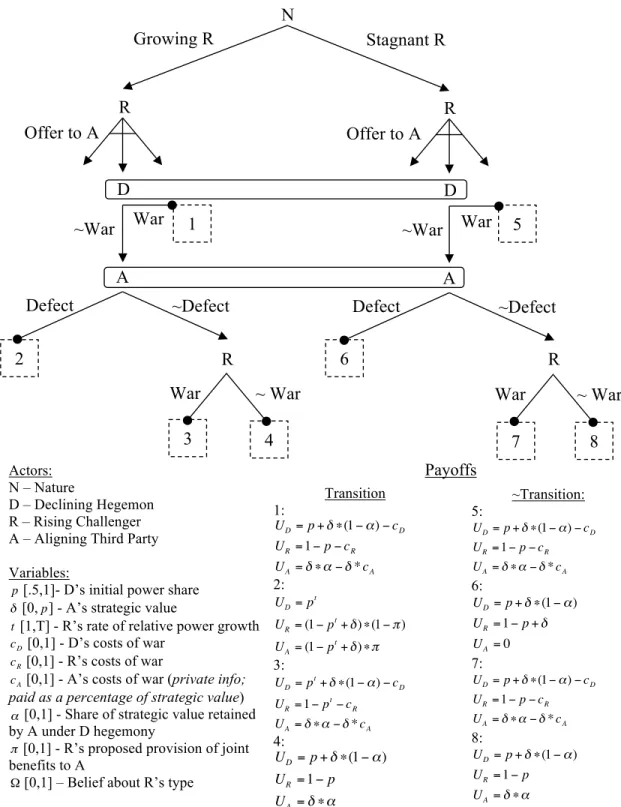
I model these dynamics using a two period game with three actors (see Figure 1). A hegemon (D) and a challenger (R) compete over a fixed set of international benefits. At the beginning of the game, the distribution of benefits between R and D reflects their relative power (D:
€
p; R:
€
1−p).16 As the hegemon, D retains the allegiance of a third
state, A of strategic value
€
δ. D receives a fixed percentage of this strategic value,
€
δ
∗(1−α
), and A receives the remainder,€
δ ∗α. A’s support of D requires it to fight with D should war with R break out. A’s willingness to fight this war (
€
cA) is private
information. D and R’s power are equal to the probabilities that they win a war against one another. If war breaks out, the winner receives a payoff of 1 and the loser a payoff of 0, adjusted for the costs of war and the benefits received from the ally’s support.
In the first move, Nature (N) assigns R to one of two types. With probability
€
Ω, R
is assigned a positive power growth trajectory relative to D (the magnitude of which is determined by
€
t). With probability
€
1− Ω, R’s power remains unchanged for the duration
of the game. R’s type is private information. These specifications attempt to capture the high degree of uncertainty that often surrounds the growth trajectories and ambitions of rising powers. In the game’s first three moves, R’s power equals
€
1−p, regardless of its type. In the final two moves, however, R’s power increases to
€
1−pt if it is of the growing
type, while D’s power decreases to
€
pt (
€
t >1).
After being assigned its type, R can attempt to induce A to defect and gain its allegiance through an offer
€
π. If R makes this offer and A chooses to defect,
€
π
Figure 1: A Three Actor Model of Power Transition
determines the share of joint benefits allocated to A. A only receives these benefits if R is of the powerful type, however. If A defects to the weak R it receives a payoff of 0. If the
!
Actors: N – Nature
D – Declining Hegemon R – Rising Challenger A – Aligning Third Party
Variables:
!
p [.5,1]- D’s initial power share
!
" [0,
!
p] - A’s strategic value
!
t [1,T] - R’s rate of relative power growth
!
cD [0,1] - D’s costs of war
!
cR [0,1] - R’s costs of war
!
cA [0,1] - A’s costs of war (private info;
paid as a percentage of strategic value)
!
" [0,1] - Share of strategic value retained
by A under D hegemony
!
" [0,1] - R’s proposed provision of joint
benefits to A
!
" [0,1] – Belief about R’s type
Transition 1:
!
UD=p+"#(1$%)$cD
UR=1$p$cR
UA="#%$"*cA
2:
!
UD=p t UR=(1"p
t
+#)$(1"%)
UA=(1"p t
+#)$% ! 3:
!
UD=p
t+" #(1$%)$c D UR=1$pt
$cR
UA=" #% $ "*cA !
4:
!
UD=p+"#(1$%)
UR =1$p UA ="#%
Payoffs
~Transition: 5:
!
UD=p+"#(1$%)$cD UR=1$p$cR UA="#%$"*cA 6:
!
UD=p+"#(1$%)
UR=1$p+"
UA=0
7:
!
UD=p+"#(1$%)$cD UR=1$p$cR UA="#%$"*cA 8:
!
UD=p+" #(1$%)
UR=1$p
UA=" #%
D A R War ~Defect ~ War War R Offer to A
~War Defect D A R War ~Defect ~ War War R ~War Defect N Stagnant R Growing R 1 2
3 4
6
5
7 8
growing R’s offer causes A to defect, it assumes hegemony and revises the distribution of benefits between R and D to reflect the new distribution of power (R payoff:
€
(1−pt
+δ)∗(1−π), A payoff:
€
(1−pt
+δ)∗π). If A does not defect and R is growing, it
must go to war with D if it wishes to revise the original distribution of benefits. The stagnant R also prefers that A defect. In this case, R receives
€
δ, but is assumed to be unable to carry out the functions of the hegemonic state, and does not provide A its proposed share of benefits (
€
π). D continues receiving a proportion of A’s strategic value but A ceases receiving the remainder of its strategic value.17R is faced with a dilemma here. First, if it chooses to make an offer, it wants to offer the minimum
€
π that A will
accept, but due to its uncertainty about
€
cA, it does not know this value. Moreover, it wants to ensure that its offer doesn’t threaten D such that it will choose to initiate preventive war.
D considers this decision in the next move, after observing R’s offer to A. Choosing to continue rather than to war is a weakly dominant strategy when R is stagnant, but if R is growing, D may prefer to fight this preventive war to waiting to potentially cede hegemony or fight a more powerful R. D’s strategic problem is made more acute when A’s potential behavior is taken into account. If A defects to a growing R,
D cedes hegemony over A to R. If A defects to a stagnant R, D maintains control over the
17 Note that in this outcome, both D and R profit from their relationship with A, but A receives nothing in
distribution of benefits vis-à-vis R and continues receiving the benefits from its relationship with A. If D chooses to launch a preventive war, it receives a payoff of
€
p+δ ∗(1−α)−cD.
If D passes on the opportunity to initiate preventive war, A must decide whether to maintain its support of D or defect and support R. The model indicates A has two goals when making this decision: first, to avoid a decision that may lead to war and second, to maximize its share of benefits. Its strategic problem is it does not know whether R is growing or stagnant, and thus cannot guarantee that it will receive benefits if it defects, or that R will not war if it chooses to maintain its support of D.
If A maintains its support of D, R decides whether to wage war against the combined power of D and A in pursuit of hegemony. Its odds of winning this war are improved if it is the growing type, but it strictly prefers peace if it is the stagnant type. If
A defects, the game ends peacefully. A growing R revises the distribution of benefits vis-à-vis D and receives the benefits of hegemony over A, while a stagnant R receives only the value of support from A, lacking the power to challenge D.
Assumptions and Alternatives
As is the case with all formal models of international politics, mine is a significant departure from reality. Here, I make explicit the model’s assumptions and comment on alternative ways to represent the same strategic setting. I also speculate on how
representing the model differently might change its findings.
First, the model adheres to a zero sum logic that may not closely reflect the reality of world politics and may predispose the model toward war outcomes. The model
expense of others. Gartzke (2007) argues while competition to control material resources is often zero-sum, states often share interests when competing over policies. If states have similar policy goals, they may choose cooperative paths that result in increased welfare for all. He finds developed economies, which often share interests, are less likely to go to war with one another.
Second, the model does not allow the hegemon and challenger to bargain with one another, instead presenting each with the choice to accept a certain distribution of
benefits or war to change that distribution. This structure creates a set of benefits distributions that both sides might prefer to war, but are unable to attain. While this model captures the commitment problem induced by shifting power (Powell 2006), it may exaggerate the likelihood that this commitment problem leads to war. The model refrains from introducing this type of bargaining for technical simplicity.
Third, the model simplifies the power transition to a two-period setting, in which the power transition occurs instantaneously. This assumption contradicts the power transition models of Powell (1996) and Kim and Morrow (1992), which use repeated games to analyze at which time in a power transition war is most likely. In these games, the players choose to continue or war at each time
€
t. My two-period representation
presents both R and D with a binary choice. D must decide whether to launch a preventive war or accede to a potential power transition. If A doesn’t defect, R must either war to change the distribution of benefits or accept the original distribution.
influence. If A were instead allowed to apportion its foreign policy between R and D in exchange for some benefits from both, R and D may be less likely to choose war. Moreover, this structure may conform closer to reality. Choosing neutrality is also precluded by the structure of the model. While this choice structure may exaggerate R
and D’s incentives for war, it nonetheless captures well the contours of the strategic dilemma facing a weaker state between two powers in transition.
Fifth, the model’s assumptions on information asymmetry may not be valid. R’s growth trajectory may be unknown to itself, in addition to being unknown to D and A. Substantively, I argue it is fair to assume that R has better information than A and D about the state of its economy and its ability to convert domestic resources into power.
Technically, removing R’s private information would also weaken the strategic dynamics as the game, as the behavior of each actor would be based predominantly on their beliefs about R’s type. Its offer would convey little information to D and A. A’s private
information concerning its willingness to fight also raises potential problems of interpretation. This term might instead be argued to be common information, as both R
and D could observe the domestic political conditions in A and infer its willingness to support D in wartime. However, A is likely to have strong incentives to misrepresent this value in order to extract larger offers from R and D (Fearon 1995).18 Therefore, the
international image put forth by A is likely to diverge from its leaders’ true willingness to fight. This divergence provides justification for modeling A’s willingness to fight as private information. This assumption also motivates the strategic calculations of both R
18 Note that these dynamics are not modeled explicitly, but provide support for the assumption that A’s
and D, who must form beliefs on this value and decide how to act in advance of A’s defection decision.
Finally, D’s strategic flexibility is limited by the structure of the model. When faced with a growing R, it cannot contest hegemony if A defects, or bargain to assuage an
R that would prefer to war when A doesn’t defect. This makes its decision to wage preventive war incredibly consequential and may bias it to choose this option more frequently than it would otherwise. Nevertheless, I argue its preventive war decision node accurately captures the strategic dilemma facing a declining hegemon—it must balance concerns about potential power shifts and allies’ defection against a desire to avoid costly war.
Overall, these critiques indicate the model in its present form may be biased toward war outcomes. The incomplete information modeled may work to counteract this bias, however. Because D cannot be sure that R is the growing type, it is less likely to launch a preventive war than it would be under a complete information setting in which R
was always growing. In this way, incomplete information works to ameliorate the
The model yields four unique sets of equilibria, based on D and R’s willingness to fight and the presence of a transition. Both to simplify analysis and to focus on the
specific power transition setting, I analyze just one of these sets. In it, a transition is ongoing and R prefers war to ~war after a transition. This setting describes well the power transitions that are this study’s focus. If the challenger does not achieve hegemony peacefully, it is wiling to fight for that hegemony. The hegemon does not strictly prefer to initiate preventive war, but it may do so in response to certain behavior by the challenger or sets of initial conditions. I solve for this game’s perfect Bayesian equilibrium. Because of the relative complexity of the solution, I use this section primarily to analyze and interpret equilibrium conditions, rather than to explain in detail how these conditions were derived. A full annotated proof and existence demonstrations for each case discussed here is included in the appendix.
A’s Alignment Decision
A seeks to avoid war and maximize its benefits in its alignment decision. This decision is made complicated by uncertainty about R’s type. If R is of the powerful type,
A will wish to defect for sufficiently high offers from R because maintaining its alliance with D will result in war with R. If R is of the weak type, however, A will never prefer to defect because its offers are incredible and maintaining its alliance with D will not result in war. As a result, A’s resolve (cA) and its belief about R’s type play strong roles in its
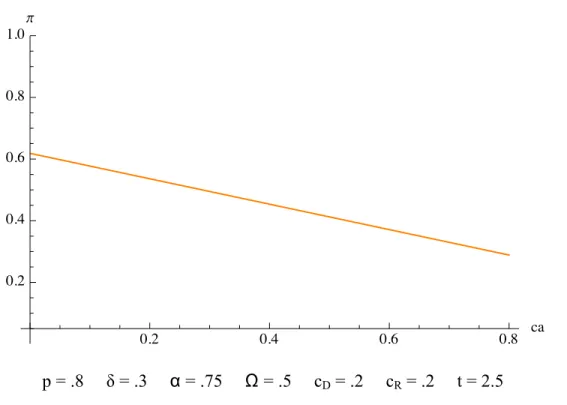
decision. Figure 2 demonstrates that highly resolute As (low cA) require larger offers to
Figure 2: A's Minimum Offer for Defection as a Function of its Costs of War (cA)
p = .8 δ = .3 α= .75 Ω = .5 cD = .2 cR = .2 t = 2.5
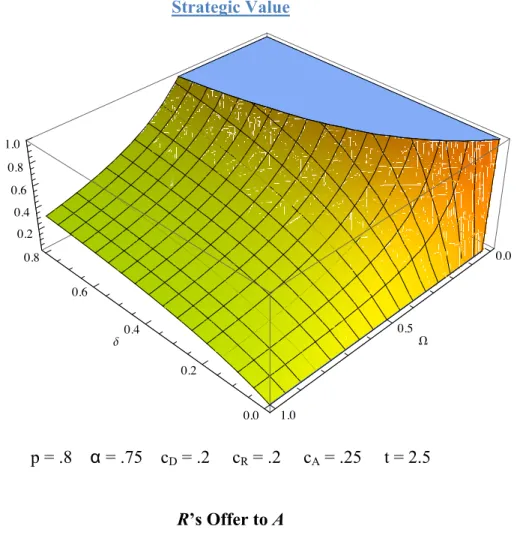
Figure 3 maps A’s minimum offer as a function of its strategic value (
€
δ) and its belief about R’s type (
€
Ω).It requires low offers to defect when it is confident R is of the powerful type. A will never defect if its confidence in R’s power is sufficiently low. The minimum offer A will accept also varies with its strategic value. Figure 4 shows that relatively weak As are the most willing to defect. This is both because the coalition of A
and D is more likely to win in a war when A’s strategic value is high and because A’s of higher strategic value are compensated at a higher level by D.
The logic behind this pattern of behavior is simple. As A’s appetite for war declines, its willingness to fight to defend the status quo also declines, making it more willing to defect in order to avoid war. As A’s confidence in R’s power increases, it also becomes more confident that the challenger will be able to provide the promised
distribution of benefits. If A believes R is weak, it sees R’s offer as cheap talk. Therefore,
A is most willing to defect whenbelieves R will be powerful.
0.2 0.4 0.6 0.8 ca
0.2 0.4 0.6 0.8 1.0
Figure 3: A’s Minimum Offer for Defection as a Function of Belief About R and Strategic Value
p = .8 α = .75 cD = .2 cR = .2 cA = .25 t = 2.5
R’s Offer to A
R’s decision is somewhat less complicated. It wants to offer the minimum that will cause defection, while avoiding offers that will cause D to initiate preventive war.
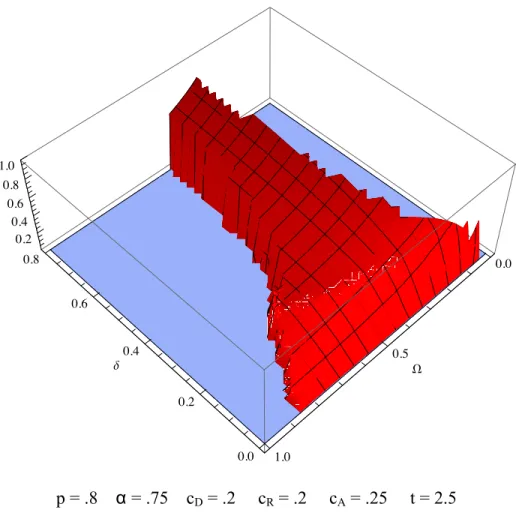
R’s behavior reflects these motives. Figure 4 shows how R’s offer varies as a function of
A’s strategic value (
€
δ) and D and A’s belief about R’s type (
€
Ω). First, note that R makes no offer in regions in which
€
Ω is both large and small. In the region in which
€
Ω is large,
R makes no offer because D prefers initiating preventive war regardless of R’s offer. In the region in which
€
Ω is small, A’s minimum
€
π for defection is greater than 1. In these cases, there is no offer that will cause defection, so R offers 0. R’s offer is increasing in
€
δ, as the benefits to R from inducing defection increase as A’s strategic value increases.
Figure 4: R’s Offer as a Function of D/A Belief and A’s Strategic Value
p = .8 α = .75 cD = .2 cR = .2 cA = .25 t = 2.5
D’s Preventive War Decision
D weighs fears of abandonment by its subordinate and of fighting from a position of weakness in deciding when to initiate preventive war after observing R’s offer to A. D
is most likely to initiate preventive war when it believes R is the powerful type and when the strategic value of its subordinate is relatively high. The logic behind this appraisal is simple. The costs of lost hegemony are higher as the strategic value of D’s subordinate increases, and the perceived likelihood of losing hegemony or fighting from a position of weakness increases as D becomes more confident that R is of the powerful type.
While D’s behavior is highly responsive to changes in exogenous variables, the general trends described above hold in most plausible cases. These patterns suggests that
0.0 0.2
0.4 0.6
0.8
∆
0.0
0.5
1.0
�
D is willing to cede hegemony to R only when the value of its ally is relatively low. Nevertheless, D strictly prefers war when it is sufficiently confident that R is of the powerful type.
Hypotheses
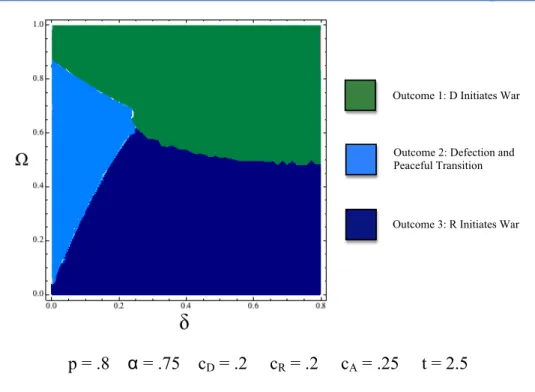
Collectively, these decisions produce three potential outcomes: 1. D initiates preventive war.
2. D chooses not to initiate preventive war and A defects, resulting in a peaceful hegemonic transition.
3. D chooses not to initiate preventive war but A does not defect, resulting in a hegemonic war post-transition.
Figure 5: Outcomes as a Function of Belief About R and A’s Strategic Value
p = .8 α = .75 cD = .2 cR = .2 cA = .25 t = 2.5
Figure 5 maps these outcomes as a function of A’s strategic value (
€
δ) and the belief about R’s type (
€
Ω). D will initiate preventive war when it believes R will be powerful and the value of its ally is sufficiently high. A will maintain its alliance and R
!
Outcome 1: D Initiates War
Outcome 2: Defection and Peaceful Transition
will fight post-transition when A’s strategic value is high and D and A believe itwill be weak. A peaceful hegemonic transition will occur when the strategic value of A is relatively low.
The players’ collective behavior demonstrates several unique characteristics of the three-player power transition game. First, R faces competing pressures on how to present its foreign policy to external audiences. A will only defect if it believes R is sufficiently powerful and capable of providing public goods. However, D is more likely to initiate preventive war if it believes R is the powerful type. While D and A’s beliefs about R’s type are exogenous in this model, these pressures indicate that R will face competing incentives to both present a muscular foreign policy and to hide its capabilities.
Second, R’s offers are rarely sufficient to produce defection. While historical hegemonic challengers are often depicted as strongly revisionist, the model instead predicts conservative behavior from challengers. R rarely makes an offer that produces defection by A, and oftentimes makes no offer. This conservative behavior is largely the result of the threat of preventive war by D. The hegemon’s dominant position allows it to deter challenges to its portfolio of subordinate states, as it can credibly commit to
initiating preventive war if the strategic value of its subordinate is sufficiently high. This pattern of behavior leads to the following prediction:
H1:In a war between a hegemon and challenger, the hegemon’s portfolio of subordinate states will have more strategic value than that of the challenger.
low. Simply, defection by more valuable subordinates is more consequential for the hegemon. As a consequence, D becomes more likely fight a preventive war as the value of its subordinate increases. This leads to the following hypothesis:
Empirical Approach
This study’s primary focus is on the development of a three-actor model of power transition and the derivation of hypotheses from that model. Due to that focus, I have eschewed a rigorous empirical approach in favor of illustrative case studies, designed to demonstrate the feasibility of my hypotheses. This section should be seen as an existence proof of my theory. More research is required to determine the generalizability of the theory and to improve upon its predictive power.
This study’s empirical focus is on the relationship between global hegemons and their challengers. Usually, these states are the two most powerful actors in the
international system. Lemke (2002; 52) provides a theoretical justification for focusing on transitions among the most powerful actors in the international system. Absent interference from larger powers, we should observe similar patterns of behavior from weaker states engaged in power transition. In reality, however, great power interference in the affairs of weaker states is commonplace in international relations. This makes the task of teasing out the impact of the power transition itself a difficult one, as larger power interference, rather than the transition itself, may be driving state behavior in these dyads. Therefore, I restrict my set of potential cases to those that involve the decline of a global hegemon.
Figure 6 shows the energy consumption of the largest four energy consumers in the international system (since 1856)19 as a proportion of the total energy consumption of these states (Singer, Bremer, and Stuckey 1972).20 I use this data to measure hegemonic
19 I choose this date for both its historical significance (the end of the Crimean War) and because the
industrial revolution had begun to diffuse at this point, providing states other than Britain with the technology necessary to compete for hegemony.
potential rather than employing relative capability metrics, as are used in most power transition studies. I adopt this methodology because relative power metrics are likely to better reflect changes in a state’s threat environment, rather than its capacity to engage in hegemonic activities. For example, while Russia and Britain attained similar degrees of relative power in the first half of the 18th century, Britain’s energy consumption was exponentially greater. These differences in domestic conditions were reflected in each states’ foreign policies. While Britain pursued a global foreign policy, seeking markets and raw materials from around the world, Russia focused its attention on its immediate periphery. I argue Britain’s international behavior was clearly more hegemonic, and that energy consumption is a better metric for capturing the capacity to engage in this sort of behavior.
Figure 6: Energy Consumption Shares Among Contenders, 1856-2007
!" !#$" !#%" !#&" !#'" !#(" !#)" !#*" !#+"
$+'!" $+)!" $++!" $,!!" $,%!" $,'!" $,)!" $,+!" %!!!" %!%!" -./01" 231045"
63788/19:53;10<9=58>":53;10<" ?0@/1"
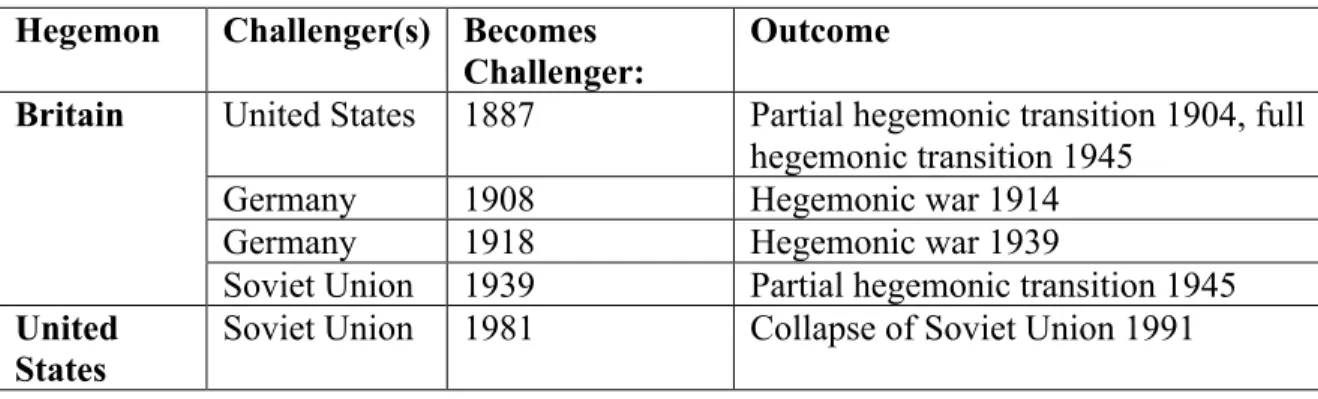
To populate the list of hegemons and challengers, I begin by assuming that Britain was the global hegemon in 1856. From there, any state that attains a level of energy consumption share of at least 80 percent of that of Britain and maintains this relative level for at least three years is considered a hegemonic challenger. I then assume that global hegemony was ceded to the United States in 1945 and reapply this method to populate the list of challengers of U.S. hegemony.21
Table 1: Hegemonic Decline and Potential Cases
Hegemon Challenger(s) Becomes
Challenger: Outcome
United States 1887 Partial hegemonic transition 1904, full hegemonic transition 1945
Germany 1908 Hegemonic war 1914
Germany 1918 Hegemonic war 1939
Britain
Soviet Union 1939 Partial hegemonic transition 1945 United
States
Soviet Union 1981 Collapse of Soviet Union 1991
In order to test my hypotheses (on the relative power of the hegemon and challenger’s portfolios of subordinate states and the necessary conditions for a peaceful transition to occur), I need to examine a case of hegemonic war at relative power parity and a case of peaceful transition. Britian’s hegemonic decline though the end of the 19th century and early 20th century provides these cases. These power transitions – vis-à-vis the United States and Germany – should obviously not be viewed in isolation. The simultaneous power transitions certainly produced strong interactive effects that shaped British foreign policy, and cloud our ability to ascribe the behavior of interest solely to the presence of a given power transition. Additionally, the domestic political institutions
21 This method contradicts this study’s focus on relational hegemony by assuming that hegemony is a
of the United States and Germany, the difference in geographic distance between the powers, and other variables outside of the model had an impact on the foreign policies pursued by these challengers, and are not controlled for in this analysis. These problems will plague any qualitative analysis of my theory. Nevertheless, focusing on these transitions allows us to control for the potential impact of domestic political institutions on the behavior of the hegemon, as both challengers challenged Britain at similar times.
Operationalization of Variables of Interest
H1:In a war between a hegemon and challenger, the hegemon’s portfolio of subordinate states will have more strategic value than that of the challenger.
Here, we must determine which states constitute the hegemon and challenger’s subordinates and those subordinates’ relative strategic value at the time of hegemonic war. My model is designed to explain challenges to hegemonic relationships between a hegemon and its subordinates, adopting the contractual framework described by Lake (1996). In the post-World War II world, many of these relationships have been formalized in the form of alliances. Prior to this, however, alliances were usually employed to structure relations between relatively powerful states. Great powers often employed more coercive apparatuses to exercise control over weaker states’ foreign policies.
In general, challenges to colonial empires – the most coercive of these
This leaves the set of all other self-governed states as potential allies for the larger powers. I use COW’s State System Membership dataset to populate this list. While the previous discussion of security relationships between states demonstrates my hesitancy to equate an alliance with hegemony vis-à-vis a subordinate, indices of relational hegemony are not well-developed, and data limitations for this time period would make constructing one difficult. I therefore use COW’s Formal Alliance dataset and COW energy
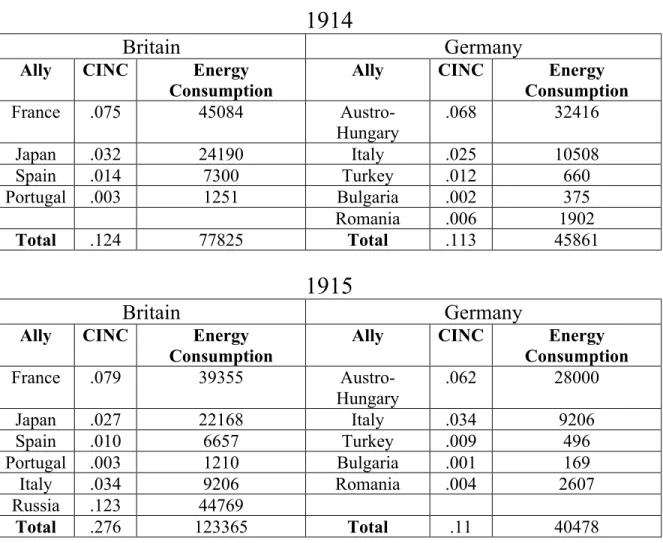
consumption data to classify foreign policy orientation and approximate the strategic values of the hegemon and challenger’s alliance portfolios at the time of hegemonic war.22 In a war setting, this departure is less troubling, as states are likely to reveal their foreign policy preferences at the outbreak of war and align themselves accordingly.
H2: A hegemon is most likely to peacefully transfer hegemony vis-à-vis a subordinate state when the strategic value of that subordinate is relatively low. The preceding discussion highlights the importance of clearly defining hegemony. Hegemony does not describe the capabilities of a potential hegemon, rather the nature of that states’ interactions with other states. Thus a power transition and a hegemonic
transition, while often correlated, are theoretically distinct. A hegemon’s capabilities may erode, but it may simultaneously maintain the allegiance of subordinate states, thus maintaining hegemony. In some ways, this study can be seen as an attempt to understand to what extent hegemonic decline and power transition among the largest states in the international system are correlated. Therefore, it is important to develop independent definitions of power transition and hegemony.
22 Again, I use energy consumption data here rather than CINC scores (measuring relative power) to
The problem with developing an independent definition of hegemony is that it proves very difficult to operationalize. Lake (2007) operationalizes “hierarchy” through a set of security and economic indicators. His approach is useful in that it is a relational approach to defining hegemony, focusing on the nature of the relationship between a dominant state and its subordinate, rather than simply the capabilities of the dominant state. Unfortunately, his dataset only covers the world since 1950. In the absence of an accepted method to operationalize hegemony, I employ an unsatisfying but more descriptively accurate qualitative approach. As defined in the introduction, a hegemon supplies club goods to supporting states in exchange for revenue. Therefore, we should expect a hegemon to assume the exclusive provision of these club goods, such as dispute resolution mechanisms, pressures for low tariffs, and pressures for financial stability. Concurrently, we should expect subordinate states to subordinate to some extent their foreign policies to the preferences of the hegemon.
I use the NMC dataset’s energy consumption data to measure the strategic value of the hegemon’s subordinates. Based on the hypothesis, I anticipate hegemons will peacefully cede hegemony when the value of the states in question is relatively low.
Historical Narrative
In 1871, Britain possessed more than two times the military capabilities of
corresponded with the proliferation of relatively open trading policies around the world, and a commensurate increase in the volume of global trade (McKeown 1983).
A constellation of other large powers occupied the second tier in the international hierarchy. In addition to the United States and Germany, Russia, France, and Austro-Hungary possessed relatively large sums of military power and pursued imperial foreign policies. Over the next 40 years, the United States and Germany rose from this pack of great powers and develop the military and economic might necessary to challenge the hegemonic position of Britain.
At this time, Britain and Germany’s leaders could not envision a war with one another. British leaders considered war with the United States a more likely possibility.23 The key question that this study strives to answer is why these perceptions evolved. Why did Britain ultimately contest German power in Europe and wage war to defend its position, while acceding to an American challenge in the Western Hemisphere?
The German Challenge
Britain declined to intervene in the Franco-Prussian War in 1870. Both the French and the Prussians reached agreements with Britain to refrain from invading Belgium during the course of prosecuting the war, satisfying Britain’s concerns over Belgian neutrality (Kennedy 1980, 22). The war laid the foundation for the unification of the independent German states with Prussia, and the resultant increase in German economic might and political influence.
23 “London occasionally worried about a conflict with Russia, or even with France or the United States.
German Chancellor Otto von Bismarck played a key roll in the high diplomacy of European politics until his resignation in 1890. During this time of fluid foreign policy alignment, Germany signed the Triple Alliance with Austro-Hungary and Italy, and considered forming alliances with both Britain and France. Germany and Britain were brought together by a common fear of Russian expansionism, but German ambitions also instilled antagonistic roots in the bilateral relationship.
Through two centuries of imperial expansion, Britain established a global colonial empire that fed its industries raw materials and served as external markets for British finished goods. As its domestic economy grew, German business interests pressured their government to seek extra-European colonies to provide alternative markets for German goods (Kennedy 1980, 167-168). The problem facing the German government was that there was little remaining territory suitable for colonization – other European powers had already established colonial empires that covered much of the world’s surface. Steadily growing German grievances resulted in some concessions and a set of rules for
colonization established at the Conference of Berlin in 1884 and 1885, however, in general, Britain and the other established powers resisted German colonial claims. The result was that Imperial Germany never attained a colonial empire commensurate with its international political power. This disparity resulted in increased Anglo-German tensions, particularly during the Second Boer War (1899-1902), where British fears of imperial fragility combined with evidence of German collaboration with the Boers to sour bilateral relations.
international political ambitions. The development of a formidable fleet was consistent with the larger German strategy of Weltpolitik, which called for the aggressive pursuit of international influence. In the wake of these developments, Anglo-German relations soured considerably. In 1904, Britain and France concluded the Entente Cordiale, which later evolved into the Triple Entente, incorporating Russia into the alliance (Kennedy 1980, 268). That same year, Italy defected from the Triple Alliance, leaving only German and Austro-Hungary united in Central Europe against an increasingly close nit group of powers arrayed around their borders.
German power continued to grow relative to that of Britain, and 10 years later, these competing alliance blocs would launch themselves into World War I. During these pre-war years, British leaders became increasingly concerned that German power and pressure would result in French defection from the Triple Entente, as the balance of power between these continental powers shifted.24 These leaders reasoned that this would
place the European continent under German dominance, at the expense of British interests.
The American Challenge
In contrast to the relative apathy shown toward newly-unified Germany in 1871, Britain was tangled in a series of disputes with the United States following the U.S. Civil War (1861-1865). British material support for the Confederacy during the war had angered some American leaders, and the U.S. government sought payment for damages in the form of the Alabama Claims. While negotiation over the claims was ongoing, hawkish U.S. politicians agitated for the annexation of Canada (then a British colony)
24 “It was precisely the breakdown of the European equilibrium following Russia’s defeat, and the fear that
and the U.S. government concluded the purchase of Alaska from Russia in 1867
(Campbell 2007, 176). The Alabama Claims were settled with a $15.5 million payment from Britain to the United States, and U.S. President Andrew Johnson’s demobilization of the U.S. military improved the bilateral relationship (Campbell 2007, 182). Still, the two countries frequently came into conflict over the rights of fisherman and hunters on the U.S.-Canadian border throughout the remainder of the 19th century (Campbell 2007, 187-188).
In 1895, independent Venezuela came into conflict with the British colonial government in British Guiana over the boundary between the two entities. The Venezuelan government invoked the Monroe Doctrine and urged the United States government to intervene in the dispute. The British government argued the dispute was strictly bilateral, but U.S. President Grover Cleveland argued the United States had the right to declare and enforce a boundary between the two territories. Ultimately, a commission with both American and British representatives was formed to draw a border. In 1898, the United States provoked and prosecuted the Spanish-American War, resulting in substantially increased U.S. power and authority in the Caribbean (Campbell 2007, 191). In 1901, the U.S. and British governments concluded the Hay-Pauncefote treaty, which gave the United States the exclusive right to construct and administer a canal connecting the Pacific Ocean and the Caribbean Sea across the Central American isthmus (Adams 2005, 34).