Elderly Trauma in Sub-Saharan Africa
Jared R. Gallaher, MD
A Master’s Paper submitted to the faculty of the University of North Carolina at Chapel
Hill in partial fulfillment of the requirements for the degree of Master of Public Health in
the Public Health Leadership Program
Chapel Hill
2016
______________________________________
Advisor
______________________________________
Date
______________________________________
Second Reader
Table of Contents
I.
Master’s Paper Abstract……… .3
II.
Elderly Trauma in Sub-Saharan Africa: A Literature Review………. .4
a.
Introduction………...5
b.
Methods……….. ..6
c.
Results………...7
d.
Discussion………11
e.
Conclusion……….. 12
III.
Injury Characteristics and Outcomes in Elderly Trauma Patients in Sub-Saharan
Africa……….18
a.
Abstract………...19
b.
Introduction………21
c.
Methods……….. 22
d.
Results……….24
e.
Discussion………...27
f.
Conclusion……….. 31
g.
Table 1………32
h.
Figure 1………...34
i.
Figure 2………...35
Abstract
The world is aging rapidly but it is unclear how the world’s growing older population will
affect health care systems in low or middle-income countries. One area of concern is traumatic
injury, which is endemic at all ages, with older patients suffering worse outcomes compared to
younger patients. Consequently, traumatic injury in the elderly is an emerging public health issue
in resource-poor environments. Unfortunately, there is a dearth of data on the characteristics and
extent of this problem in sub-Saharan Africa. This study has two aims. First, it will describe what
data are available on elderly trauma in sub-Saharan Africa and access the quality of published
studies. Second, it will describe the characteristics and outcomes of traumatic injury in the elderly
Elderly Trauma in Sub-Saharan Africa:
A Literature Review
Introduction
It is is yet to be determined how the world’s growing older population will affect health
care systems in low or middle-income countries (LMIC). Globally, the number of elderly people
will grow dramatically over the next 25 years and while LMIC will account for 80% of the global
population older than 60 by 2050, there are limited data on potential differences in elderly health
care needs.1-3 This lack of data is especially pertinent for the management of traumatic injury
because it is a significant source of morbidity and premature death in adults worldwide.
Furthermore, this burden is disproportionately high in LMIC, which bear 90% of global
mortality from traumatic injury.4-6 While trauma mostly affects younger populations, given
increasing life expectancy elderly trauma is emerging as a serious public heath concern. This
concern has been demonstrated in high-income countries with an associated increase in
morbidity and mortality compared to younger patients.7-10
In addition to suffering worse outcomes from injury, elderly trauma patients likely have
different patterns of injury requiring specialized treatment and triage. Recognizing those patterns
and their associated outcomes in LMIC, where resources are limited, allows decision makers to
identify and target critical sources of morbidity and mortality for clinician training or resource
allocation. Due to significant differences in the social and economic structure, we cannot assume
that patterns of injury described in HIC are the same as seen in LMIC. Consequently, in
sub-Saharan Africa, which bears the greatest regional burden of trauma mortality globally, there is a
significant need to describe the extent and significance of the problem.
This review seeks to systematically identify data published data that has been been
Methods
This review of the literature focused on elderly trauma epidemiology and outcomes from
sub-Saharan Africa published since 2010. Elderly is defined in developed countries as patients ≥
65 years but several different definitions have been used in low-income countries due to a shorter
life expectancy with age cutoffs as low as fifty years old.9-13 For this review, studies were permitted
to use any of these definitions. This review used the United Nations definition for sub-Saharan
Africa which includes all countries on the continent of Africa except for “Northern African
countries” comprising Algeria, Egypt, Libya, Morocco, Sudan, Tunisia, and Western Sahara.14
Traumatic injury was defined as physical wounds suffered by an intentional or unintentional
mechanism. Due to significant physiological differences between burn and other forms of
traumatic injury, burn was excluded from this review.
Search Strategy
The review was performed using a MEDLINE search on PubMED. The MESH terms
“Wounds and Injuries” and “Aged” and “Developing Countries” were initially used. Next, a
search using the MESH terms “Wounds and Injuries” and “Aged, 80 and over” and
“Developing Countries” was used. Lastly, each combination of these terms except “Developing
Countries” was used with a text search of “sub Saharan Africa” or “Africa.” Only studies
published in the English language, those that used human subjects, and studies published since
2010 were included. Each abstract from the search was reviewed. Studies that only included
burn patients were excluded and any study that did not publish an abstract was excluded. Studies
reviewing the bibliography of each study included in the final review. Additional studies meeting
the above criteria were then subsequently added to the final review.
Data Abstraction
A standardized evidence table was used to abstract study data. This information included
study year, study location, study design, study population, analysis strategy, and reported results.
Quality Assessment
Studies were assessed for quality using a standard critical appraisal template. A grade of
poor, fair, or good was assigned and reported for the categories of selection bias, measurement
bias, confounding, internal validity, external validity, and overall grade.
Results
The search returned 191 studies for abstract review. Four studies met inclusion criteria.
15-18 Two additional studies meeting inclusion criteria were identified using hand searches.19,20
Three of the studies were conducted in Nigeriawith the other three coming from either Kenyaor
Tanzania.
Study Characteristics
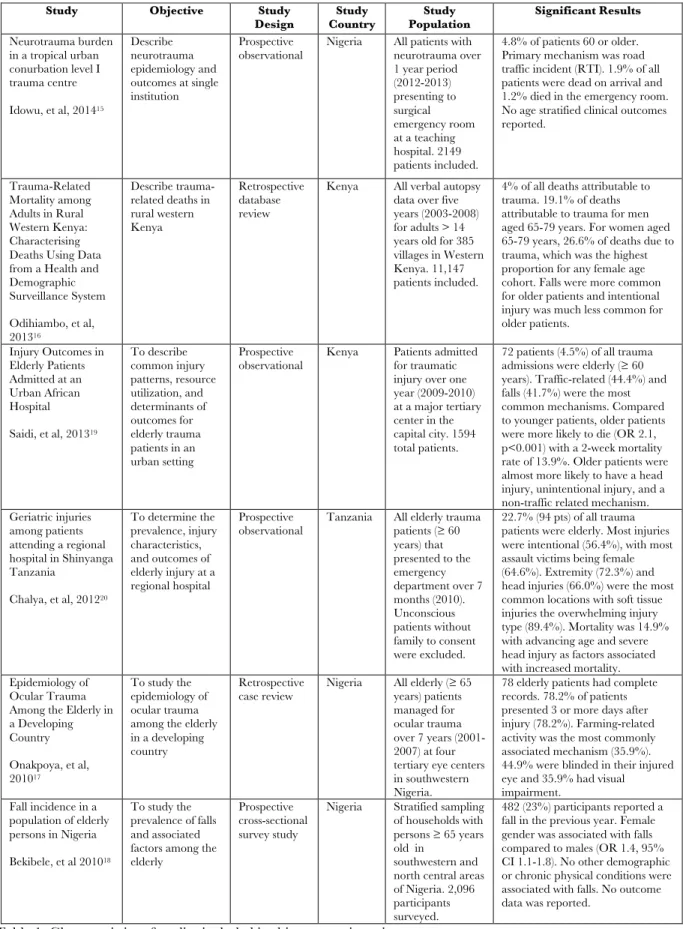
All studies were observational. Three studies examined general trauma epidemiology or
outcomes while the other three studied specific areas of traumatic injury. Saidi et al and Chalya
et al focused on the epidemiology of elderly trauma and reported injury and mechanism
characteristics along with outcomes.19,20 Saidi’s study further compared elderly trauma patient
one year or less in duration and had fewer than 100 elderly patients. Additionally, Chalya’s study
excluded any patients that were unconscious at arrival and did not have family present.
Odihiambo et al performed a retrospective review of all verbal autopsy data from the western
region of Kenya over five years including over 11,000 patients.17 Trauma-related death and
associated factors were stratified by age group.
The three remaining studies examine more specific areas of trauma. Idowu et al
prospectively examined neurological trauma in Nigeria at an urban trauma center over a one
year period.15 2,149 patients were included in the study with 4.8% of patients aged ≥ 60 years
old. Epidemiological data was stratified by age by but clinical outcomes were not. Onakpoya et al
retrospectively studied ocular trauma among the elderly over a seven year period at four tertiary
eye centers in Nigeria.17 Only 78 patients had complete records. They reported patient
characteristics and factors associated with ocular injury as well as vision outcomes. All patients in
the study were elderly so there was no comparison with younger patients. Lastly, Bekibele et al
conducted a prospective cross-sectional survey using a stratified sampling method of households
in several areas of Nigeria to examine the prevalence of falls and associated factors among the
elderly.18 No outcome data was reported and there was no younger cohort for comparison.
(Table 1).
Quality Assessment
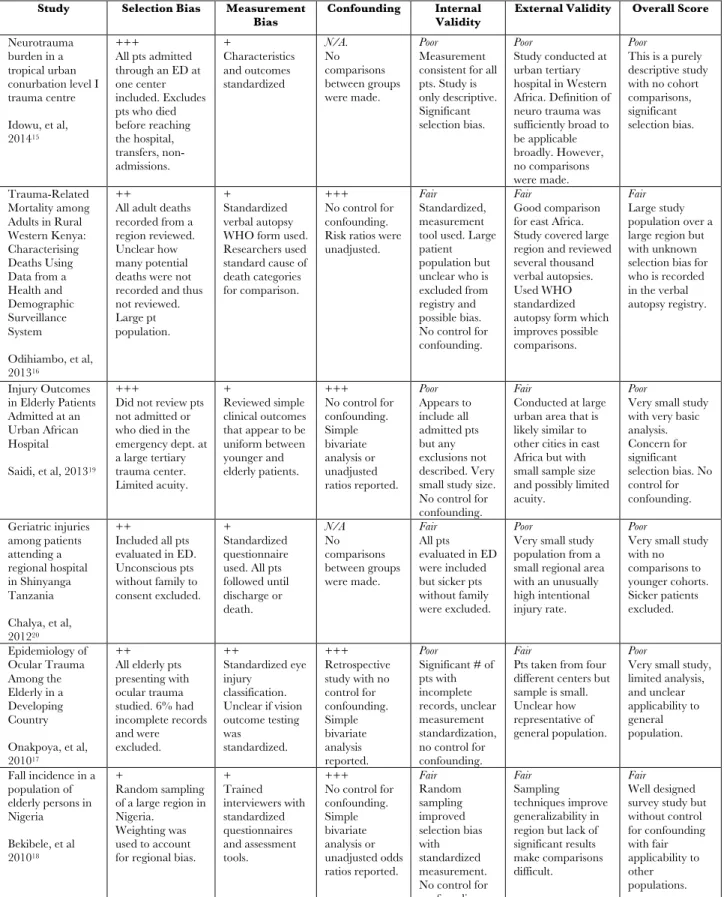
Almost all studies had significant selection bias. Most studies only selected patients from a
small population and or did not make any comparison between groups at all. For example, Saidi
readily available for consent. Bekibele et al’s falls study had the best selection process using a
random sampling strategy for a survey of a large region in Nigeria. Confounding was a problem
for most studies. Idowu et al and Chalya et al did not make any comparisons but provided only
descriptive statistics of their elderly populations. None of the other studies made any attempt to
control for confounding in their analysis providing only unadjusted ratios or simple bivariate
analysis. There was minimal measurement bias in all six studies as most used a standardized
measurement tool for all of their patients.
Internal validity for all the studies was either fair or poor with most studies suffering from
significant selection bias and none attempted to control for any potential confounding variables
in their analysis. External validity was also fair or poor. Due to very small study sizes from
specific regions, it is hard to make comparisons with other populations. Several studies also
excluded patients with higher acuity or patients with simpler injuries making comparisons even
more challenging.
Overall, four of the studies scored as poor in quality, with two scoring as fair. Odihiambo,
et al’s verbal autopsy study and Bekibele, et al’s fall incidence study scored higher because of
their large sample size over a wide region, minimal selection bias, and fair external validity. The
other studies suffered from very small study populations, bias, and a lack of analytic
sophistication. (Table 2)
Significant Findings
Only two studies compared elderly patients with a younger cohort. Saidi et al reported
that 4.5% of all trauma patients at their center were elderly and that this group was more likely
to suffer a head injury or an unintentional injury, and were less likely to suffer a RTI-related
elderly patients were more likely to die (OR 2.1, p<0.001) with a 2-week mortality rate of 13.9%.
Odihiambo et al’s verbal autopsy study found that the proportion of trauma-related deaths was
higher in older age cohorts, especially in females. Trauma was responsible for 26.6% of all deaths
in women aged 65-79 years old compared to the overall rate of 4% for all ages and both genders.
Idowu et al studied all cases of neuro-trauma at their center but did not report age stratified
clinical outcomes. 4.8% of all cases were 60 years or older with an overall in-hospital mortality
rate of 1.2% for all patients.
The three remaining studies all described elderly-specific data only with no comparisons
to younger patients. Chayla et al reported that 22.7% of all trauma patients over a one-year
period were elderly with assault being the most common mechanism (56.4%). Most patients had
a soft tissue injury (89.4%) but extremity (72.3%) and head injuries (66.06%) were also common.
Increasing age and severe head injury were associated with death with an overall mortality rate
of 14.9%. Onakpoya, et al’s findings in ocular trauma showed that most patients had a delayed
presentation with 78.2% presenting at least three days post-injury and despite their older age, the
most common associated activity was farming (35.9%). Only 11.5% of injuries were intentional
and 28.2% required surgery with the rest receiving conservative management. Almost half of
patients were blinded in the injured eye(s) (44.9%) and more than a third had at least some visual
impairment (35.9%). Bekibele, et al revealed a fall incidence of 23% over one year among those
surveyed. Females were more likely to report a fall (OR 1.4, 95% CI 1.1, 1.8) but no other
demographic or comorbid conditions had statistically significant relationships with the likelihood
Discussion
There is a dearth of information about the extent of trauma in the elderly population in
sub-Saharan Africa. This review demonstrates that most published data are from limited, small
observational studies with significant bias. Additionally, only two of the studies made any
comparisons to younger patients in injury characteristics or clinical outcomes. Most these studies
rely on data from one center with relatively low patient volumes and often excluded sicker
patients or patients with less severe injuries limiting their external validity.
Available data are conflicting about the extent of the problem. Most studies that recruited
their elderly subjects from a larger study base had a small proportion of elderly patients, usually
less than 5%. However, this proportion is consistent with that of elderly patients from the total
population in most sub-Saharan African countries. The exception was Chalya’s Tanzania study
which had an elderly prevalence of 22.7%, a much higher number that may be a product of a
very small sample size from a small regional hospital. Bekibele’s fall study showed that nearly
25% of elderly participants had suffered a traumatic fall in the last year.
Evidence from these reviewed studies concur that elderly trauma patients often have poor
outcomes and that may be worse than outcomes in younger cohorts. While their study size was
small, Onakpoya’s ocular trauma study showed a very high proportion of patients presenting late
post-injury with very poor vision outcomes. Odihiambo’s verbal autopsy study, the most inclusive
investigation of trauma-related death, showed that elderly patients had a higher proportion of
trauma-related deaths compared to younger patients, especially for females. Considering the low
prevalence of elderly patients in other studies, this may suggest that many elderly patients are not
surviving long enough to receive medical care, a finding supported by other research in LMIC.12
Saidi’s Kenyan study showed a doubling of the odds of death for older patients compared to
were more common for elderly patients. While head injuries are a major source of mortality in all
ages, if these types of injuries are more common in the elderly population, they are an important
target for resource allocation at tertiary trauma centers.
Limitations
While this literature review was systematic, it is limited by only using the PubMED search
engine. Many medical journals in Africa are not listed on MEDLINE but the sheer volume of
unrelated articles on Google Scholar made using this engine impractical for the scope of this
study. Additionally, non-English studies were excluded. Lastly, sub-Saharan Africa is a
geographically large and diverse region. It is unreasonable to treat it as homogenous but given
the paucity of data from the entire area, it is practical to group these countries together for
clarity.
Conclusion
There is a paucity of data on the epidemiology of elderly trauma and its associated
outcomes in sub-Saharan Africa. What little data that is available comes from very limited
observational studies. These studies suggest that elderly trauma outcomes are very poor and are
worse than younger trauma patients. There is an imperative to study this public health issue in
Table 1. Characteristics of studies included in this systematic review.
Study Objective Study
Design Country Study Population Study Significant Results
Neurotrauma burden in a tropical urban conurbation level I trauma centre
Idowu, et al, 201415
Describe neurotrauma epidemiology and outcomes at single institution
Prospective
observational Nigeria All patients with neurotrauma over 1 year period (2012-2013) presenting to surgical emergency room at a teaching hospital. 2149 patients included.
4.8% of patients 60 or older. Primary mechanism was road traffic incident (RTI). 1.9% of all patients were dead on arrival and 1.2% died in the emergency room. No age stratified clinical outcomes reported.
Trauma-Related Mortality among Adults in Rural Western Kenya: Characterising Deaths Using Data from a Health and Demographic Surveillance System
Odihiambo, et al, 201316
Describe trauma-related deaths in rural western Kenya
Retrospective database review
Kenya All verbal autopsy data over five years (2003-2008) for adults > 14 years old for 385 villages in Western Kenya. 11,147 patients included.
4% of all deaths attributable to trauma. 19.1% of deaths attributable to trauma for men aged 65-79 years. For women aged 65-79 years, 26.6% of deaths due to trauma, which was the highest proportion for any female age cohort. Falls were more common for older patients and intentional injury was much less common for older patients.
Injury Outcomes in Elderly Patients Admitted at an Urban African Hospital
Saidi, et al, 201319
To describe common injury patterns, resource utilization, and determinants of outcomes for elderly trauma patients in an urban setting
Prospective
observational Kenya Patients admitted for traumatic injury over one year (2009-2010) at a major tertiary center in the capital city. 1594 total patients.
72 patients (4.5%) of all trauma admissions were elderly (≥ 60 years). Traffic-related (44.4%) and falls (41.7%) were the most common mechanisms. Compared to younger patients, older patients were more likely to die (OR 2.1, p<0.001) with a 2-week mortality rate of 13.9%. Older patients were almost more likely to have a head injury, unintentional injury, and a non-traffic related mechanism. Geriatric injuries
among patients attending a regional hospital in Shinyanga Tanzania
Chalya, et al, 201220
To determine the prevalence, injury characteristics, and outcomes of elderly injury at a regional hospital
Prospective
observational Tanzania All elderly trauma patients (≥ 60 years) that presented to the emergency department over 7 months (2010). Unconscious patients without family to consent were excluded.
22.7% (94 pts) of all trauma patients were elderly. Most injuries were intentional (56.4%), with most assault victims being female (64.6%). Extremity (72.3%) and head injuries (66.0%) were the most common locations with soft tissue injuries the overwhelming injury type (89.4%). Mortality was 14.9% with advancing age and severe head injury as factors associated with increased mortality. Epidemiology of
Ocular Trauma Among the Elderly in a Developing Country
Onakpoya, et al, 201017
To study the epidemiology of ocular trauma among the elderly in a developing country
Retrospective
case review Nigeria All elderly (years) patients ≥ 65 managed for ocular trauma over 7 years (2001-2007) at four tertiary eye centers in southwestern Nigeria.
78 elderly patients had complete records. 78.2% of patients presented 3 or more days after injury (78.2%). Farming-related activity was the most commonly associated mechanism (35.9%). 44.9% were blinded in their injured eye and 35.9% had visual impairment.
Fall incidence in a population of elderly persons in Nigeria
Bekibele, et al 201018
To study the prevalence of falls and associated factors among the elderly
Prospective cross-sectional survey study
Nigeria Stratified sampling of households with persons ≥ 65 years old in
southwestern and north central areas of Nigeria. 2,096 participants surveyed.
Table 2. Quality assessment of studies included in this systematic review. Definitions: +++ poor, ++ fair, + good.
Study Selection Bias Measurement
Bias Confounding Internal Validity External Validity Overall Score
Neurotrauma burden in a tropical urban conurbation level I trauma centre
Idowu, et al, 201415
+++
All pts admitted through an ED at one center included. Excludes pts who died before reaching the hospital, transfers, non-admissions. + Characteristics and outcomes standardized N/A. No comparisons between groups were made. Poor Measurement consistent for all pts. Study is only descriptive. Significant selection bias.
Poor
Study conducted at urban tertiary hospital in Western Africa. Definition of neuro trauma was sufficiently broad to be applicable broadly. However, no comparisons were made.
Poor
This is a purely descriptive study with no cohort comparisons, significant selection bias.
Trauma-Related Mortality among Adults in Rural Western Kenya: Characterising Deaths Using Data from a Health and Demographic Surveillance System
Odihiambo, et al, 201316
++
All adult deaths recorded from a region reviewed. Unclear how many potential deaths were not recorded and thus not reviewed. Large pt population. + Standardized verbal autopsy WHO form used. Researchers used standard cause of death categories for comparison.
+++ No control for confounding. Risk ratios were unadjusted.
Fair Standardized, measurement tool used. Large patient population but unclear who is excluded from registry and possible bias. No control for confounding.
Fair
Good comparison for east Africa. Study covered large region and reviewed several thousand verbal autopsies. Used WHO standardized autopsy form which improves possible comparisons.
Fair Large study population over a large region but with unknown selection bias for who is recorded in the verbal autopsy registry.
Injury Outcomes in Elderly Patients Admitted at an Urban African Hospital
Saidi, et al, 201319
+++
Did not review pts not admitted or who died in the emergency dept. at a large tertiary trauma center. Limited acuity.
+
Reviewed simple clinical outcomes that appear to be uniform between younger and elderly patients.
+++ No control for confounding. Simple bivariate analysis or unadjusted ratios reported. Poor Appears to include all admitted pts but any exclusions not described. Very small study size. No control for confounding.
Fair
Conducted at large urban area that is likely similar to other cities in east Africa but with small sample size and possibly limited acuity.
Poor
Very small study with very basic analysis. Concern for significant selection bias. No control for confounding. Geriatric injuries among patients attending a regional hospital in Shinyanga Tanzania
Chalya, et al, 201220
++
Included all pts evaluated in ED. Unconscious pts without family to consent excluded.
+
Standardized questionnaire used. All pts followed until discharge or death. N/A No comparisons between groups were made. Fair All pts evaluated in ED were included but sicker pts without family were excluded.
Poor
Very small study population from a small regional area with an unusually high intentional injury rate.
Poor
Very small study with no comparisons to younger cohorts. Sicker patients excluded. Epidemiology of Ocular Trauma Among the Elderly in a Developing Country
Onakpoya, et al, 201017
++ All elderly pts presenting with ocular trauma studied. 6% had incomplete records and were excluded. ++ Standardized eye injury classification. Unclear if vision outcome testing was
standardized.
+++ Retrospective study with no control for confounding. Simple bivariate analysis reported. Poor
Significant # of pts with incomplete records, unclear measurement standardization, no control for confounding.
Fair
Pts taken from four different centers but sample is small. Unclear how representative of general population.
Poor
Very small study, limited analysis, and unclear applicability to general population.
Fall incidence in a population of elderly persons in Nigeria
Bekibele, et al 201018
+
Random sampling of a large region in Nigeria. Weighting was used to account for regional bias.
+ Trained interviewers with standardized questionnaires and assessment tools. +++ No control for confounding. Simple bivariate analysis or unadjusted odds ratios reported. Fair Random sampling improved selection bias with standardized measurement. No control for confounding.
Fair Sampling techniques improve generalizability in region but lack of significant results make comparisons difficult.
References
1. Mathers CD, Stevens GA, Boerma T, White RA, Tobias MI. Causes of international
increases in older age life expectancy. Lancet. 2015 Feb 7;385(9967):540-8.
2. United Nations, Department of Economic and Social Affairs, Population Division. World
Population Ageing 2013. [Internet]. 2013 [cited 11 Jan 2015]; Retrieved from:
http://www.un.org/en/development/desa/population/publications/pdf/ageing/worldp
opulationageingreport2013.pdf
3. World Health Organization. Global brief for World Health Day. [Internet]. 2013 [cited
11 January 2016]; Retrieved from:
http://whqlibdoc.who.int/hq/2012/WHO_DCO_WHD_2012.2_eng.pdf.
4. Mathers CD, Lopez AD, Murray CJL. The Burden of Disease and Mortality by
Condition: Data, Methods, and Results for 2001. In: Lopez AD, editor. Global burden of
disease and risk factors. New York, NY: Oxford University Press; 2006.
5. World Health Organization. Estimates for 2000–2012: Cause-specific mortality.
[Internet] 2012 [23 March 2015]; Retrieved from:
http://www.who.int/healthinfo/global_burden_disease/estimates/en/index1.html.
6. GBD 2013 Mortality and Causes of Death Collaborators. Global, regional, and national
age-sex specific all-cause and cause-specific mortality for 240 causes of death, 1990-2013:
a systematic analysis for the Global Burden of Disease Study 2013. The Lancet.
2015;385(9963):117–171.
7. Perdue PW, Watts DD, Kaufmann CR, Trask AL. Differences in Mortality between
Elderly and Younger Adult Trauma Patients: Geriatric Status Increases Risk of Delayed
8. Sampalis JS, Nathanson R, Vaillancourt J, et al. Assessment of mortality in older trauma
patients sustaining injuries from falls or motor vehicle collisions treated in regional level I
trauma centers. Ann Surg. 2009;249(3):488–495. doi:10.1097/SLA.0b013e31819a8b4f.
9. Hashmi A, Ibrahim-Zada I, Rhee P, et al. Predictors of mortality in geriatric trauma
patients: a systematic review and meta-analysis. J Trauma Acute Care Surg.
2014;76(3):894–901. doi:10.1097/TA.0b013e3182ab0763.
10.Lustenberger T, Talving P, Schnüriger B, Eberle BM, Keel MJB. Impact of advanced
age on outcomes following damage control interventions for trauma. World J Surg.
2012;36(1):208–215. doi:10.1007/s00268-011-1321-2.
11.Joseph B, Pandit V, Zangbar B, et al. Superiority of frailty over age in predicting
outcomes among geriatric trauma patients: a prospective analysis. JAMA Surg.
2014;149(8):766–772. doi:10.1001/jamasurg.2014.296.
12.Wong EG, Trelles M, Dominguez L, et al. Operative procedures in the elderly in
low-resource settings: a review of médecins sans frontières facilities. World J Surg.
2015;39(3):652–657. doi:10.1007/s00268-014-2855-x.
13.Nair PS. Population aging in sub-Saharan Africa: Present and prospects.
Gerontechnology. 2014;13(1). doi:10.4017/gt.2014.13.1.009.00.
14.United Nations. United Nations Statistics Division- Standard Country and Area Codes
Classifications (M49) [Internet]. 2013 [cited 2016Jan4]. Retrieved from:
http://unstats.un.org/unsd/methods/m49/m49regin.htm
15.Idowu OE, Akinbo O. Neurotrauma burden in a tropical urban conurbation level I
Deaths Using Data from a Health and Demographic Surveillance System. Ang D, editor.
PLoS ONE. 2013 Nov 7;8(11):e79840.
17.Onakpoya OH, Adeoye A, Adeoti CO, Ajite K. Epidemiology of ocular trauma among
the elderly in a developing country. Ophthalmic Epidemiol. 2010 Oct;17(5):315–20.
18.Bekibele CO, Gureje O. Fall incidence in a population of elderly persons in Nigeria.
Gerontology. 2010;56(3):278–83.
19.Saidi H, Mutiso B. Injury Outcomes in Elderly Patients Admitted at an Urban African
Hospital. Surgical Science. 2013;04(06):292–7.
20.Chalya PL, Ngayomela IH, Mbelenge N, Dass RM, Mchembe M, Ngallaba SE, et al.
Geriatric injuries among patients attending a regional hospital in Shinyanga Tanzania.
Injury Characteristics and Outcomes in Elderly Trauma Patients in
Sub-Saharan Africa
Abstract
Importance: Traumatic injury in the elderly is an emerging global problem with an associated
increase in morbidity and mortality.
Objective: To describe the epidemiology of elderly injury and outcomes to help inform trauma
care in this growing population in low-resource settings.
Design: We conducted a retrospective analysis of adult patients (≥ 18 years) with traumatic
injuries presenting to Kamuzu Central Hospital (KCH) in Lilongwe, Malawi over five years
(2009-2013). Elderly patients were defined as adults aged ≥ 65 years and compared to adults
aged 18-44 years and adults aged 45-64 years. We used bivariate analysis to compare groups and
propensity score matching and logistic regression to compare the odds of mortality between age
groups using the youngest age group as the reference.
Setting: Public, tertiary hospital.
Participants: 42,816 adult patients with traumatic injuries presented to KCH during the study
period. 1,253 patients (2.9%) were aged ≥ 65 years. 77.4% of patients were male.
Main Outcome Measure: Mortality in the elderly population versus those aged 18-44 years.
Results: Injuries occurred far more often at home as age group increased (25.3, 29.5, 41.1%,
p<0.001) and the injury mechanism was more likely to be a fall (14.1, 23.8, 36.3%, p<0.001) or
as a pedestrian in a road-traffic injuries (8.2, 9.9, 13.2%, p<0.001) for elderly patients. Fractures
were more common in elderly patients (10.6, 21.3, 35.2%, p<0.001). Elderly age group was
associated with a significantly higher proportion of hospital admissions (10.6, 21.3, 35.2%,
p<0.001) and a higher overall mortality prevalence (1.7, 2.5, 5.6%, p<0.001). Upon propensity
score matching and logistic regression analysis, the odds ratio of mortality for patients aged ≥ 65
Conclusions and Relevance: Elderly trauma in a resource-poor area in sub-Saharan Africa is
associated with a significant increase in hospital admissions and mortality. The setting,
mechanism, and pattern of injury differ between elderly and other adult patients and trauma
centers in low-resource settings must be prepared to manage these differences. Significant
improvements in trauma systems, pre-hospital care, and hospital capacity for older, critically ill
Introduction
The world is aging rapidly. From 2000 until 2050, the world's population aged 60 and
over will more than triple from 600 million to 2 billion. Most of this increase is occurring in less
developed countries where the number of older people will rise from 400 million in 2000 to 1.7
billion by 2050.1,2 In fact, low and middle-income countries (LMIC) will account for 80% of
people older than 60 globally by 2050.3 The lack of health care and public health infrastructure
that currently exists in LMIC, especially countries in sub-Saharan Africa, portends an ominous
sign for care of the elderly in the years to come.
Traumatic injury and its associated treatment is a global challenge and it is endemic at
all ages accounting for 16% of all adult morbidity and premature death worldwide.4 The burden
is disproportionately high in LMIC, which bear 90% of global mortality from traumatic injury,
particularly from road traffic injuries (RTI).5,6 Trauma mostly affects the younger segment of
society (<45 years) and more emphasis and resources have understandably been extended to this
group of trauma patients.7 With an increasing life expectancy, traumatic injury in the elderly is
emerging as a serious public heath concern, particularly in the developed world with an
associated increase in morbidity and mortality compared to younger patients.8-10
While traumatic injury in the elderly has been well described in high-income countries,
very little data on elderly trauma have been published from sub-Saharan Africa.11-15 To address
this gap, we evaluated the common mechanisms, patterns of injury, and outcomes associated
with elderly trauma patients compared to other adult trauma patients presenting to our tertiary
Methods
This study is a retrospective analysis of secondary data from the Kamuzu Central
Hospital (KCH) Trauma Registry. KCH is a public 600-bed tertiary care hospital in the capital
city of Lilongwe, which serves as a referral center for approximately 5 million people in the
central region of Malawi. KCH is equipped with four ICU beds and four ventilators and a
surgical step-down unit. Trauma and orthopedic surgical services are available seven days a
week. Surgical consultants and Malawian general surgery registrars staff the trauma service.
The KCH Trauma Registry was established to collect patient demographic information,
clinical characteristics, and outcome data of all patients presenting to the emergency department
with traumatic injuries. Specifically, data points utilized in this study for comparison include age,
sex, date of injury, setting of injury, mechanism of injury, type and location of injury, time to
presentation to hospital, date of admission, clinical scoring systems such as the Alert, Voice, Pain,
Unresponsive (AVPU) Scale, date and type of operative procedures, length of hospital stay, and
outcome (discharge or death). The AVPU scale records a patient’s level of consciousness as either
alert, responding to verbal stimuli, responding to pain stimuli, or unresponsive. It correlates with
GCS and the United States ATLS protocol uses it in its primary survey.16,17 All adult patients (≥
18 years old) who presented to the emergency department with traumatic injuries over five years
between January 2009 and December 2013 were included in this study. Patients less than 18
years old or patients missing a recorded age or birthdate were excluded from analysis.
Elderly age was defined as age ≥ 65 years based on the accepted definition in
high-income countries.9,18 Admittedly, there is debate on the appropriate definition of the elderly in
allowing a comparison between elderly, middle-aged, and younger patients. This resulted in
three age cohorts for comparison: 18-44 years, 45-64 years, and ≥ 65 years. We performed
bivariate analysis using Chi2 tests for categorical variables and one-way analysis of variance tests
for continuous to compare characteristics between our three age groups. When comparing
categorical variables with more than two categories, the aggregate of the remaining categories
was used as the referent for comparison. For time to presentation, we used a Kruskal-Wallis test
to compare medians across the three age groups due to a nonparametric distribution. Overall
crude mortality was calculated using any deaths declared in the emergency department and any
deaths in the hospital against all patients recorded in the trauma registry. In-hospital mortality
excluded any deaths from the emergency department using only deaths recorded for admitted
patients.
Additionally, propensity score matching analysis was performed to determine the relative
odds of mortality due to age in the 18-44 year old group versus both the 45-64 and ≥ 65 year old
age groups. All propensity score analysis was done using the R programming languageand the R
MatchIt package was used to match entries based off of this propensity score.21,22 Patients were
matched using the covariates of gender, initial AVPU score, and their three primary traumatic
injury types. Initially, the 3 different age categories were randomly sorted. Then the first
“treatment” group (patients not in the 18-44 age groups) was matched with the “control group”
(18-44 age group) based on the absolute value of the difference between the propensity score of
the treatment and control groups under consideration. The closest control unit is selected as a
match. The procedure was performed twice. First the dataset was paired down to just patients
ages 18-64. Then, patients ages 45-64 were marked as the treatment group. Next, logistic
regression was repeatedly performed on the new matched dataset with factors eliminated or
statistically significant effect in patient mortality by the Wald z-statistic and the associated
p-value. Odds ratios with 95% confidence intervals are reported for the elderly trauma group
versus the control group as well as for the middle aged group versus the control group.
All other statistical analysis was performed using Stata/SE 13.1 (Stata- Corp LP, College
Station, TX). The University of North Carolina Institutional Review Board and the Malawi
National Health Services Review Committee approved this study.
Results
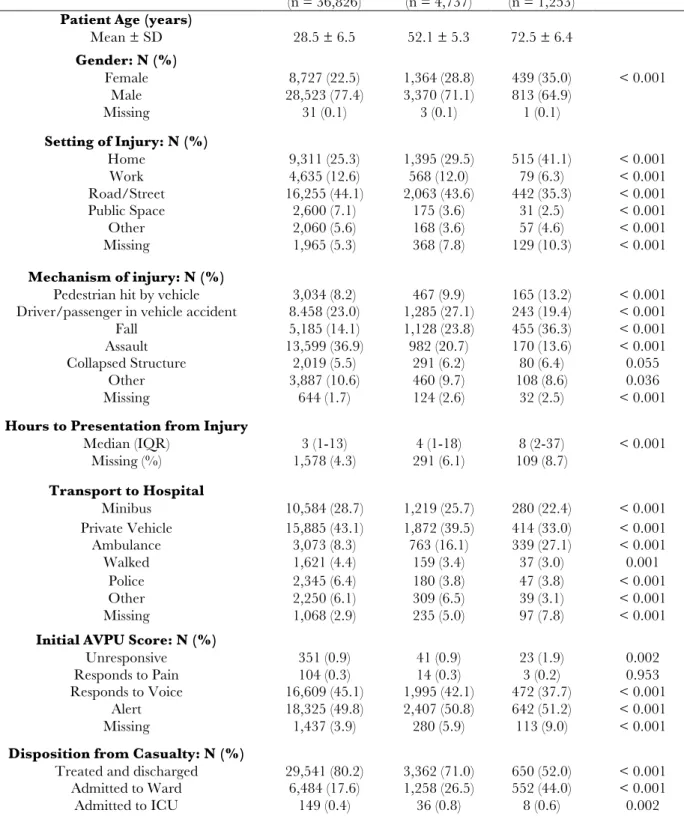
68,162 patients with traumatic injuries presented to KCH during the study period with
42,816 adult patients (age ≥ 18 years). 931 patients (2.1%) were missing a recorded age and were
not included in the analysis. 36,826 (86.0%) patients were aged 18-44 years, 4,737 (11.1%) were
aged 45-64 years, and 1,253 (2.9%) were aged ≥ 65 years with a male preponderance of 77.4%,
71.1% and 64.9% for each age category, respectively (p<0.001). Mean age (± SD) in the 18-44,
45-64, and ≥ 65 years category was 28.5 ± 6.5, 52.1 ± 5.3, and 72.5 ± 6.4 years, respectively
(Table 1).
Traumatic injuries occurred more often at home as patients increased in age (25.3, 29.5,
41.1%, p<0.001) with road traffic associated trauma decreasing as age increased (44.1, 43.6,
35.3%, p<0.001). There were also significant differences in mechanism of injury between groups.
Falls increased dramatically as patients aged (14.1, 23.8, 36.3%, p<0.001) while assaults
decreased (36.9, 20.7, 13.6%, p<0.001). Within motor vehicle related trauma, there were
later compared to other age groups with a median time from injury to presentation of 8 hours
(IQR 2-37 hours) compared to 3 hours (IQR 1-13 hours) and 4 hours (IQR 1-18 hours) in the
18-44 years old and 45-64 years old age groups, respectively (p<0.001). Elderly patients were also
more likely to arrive by ambulance (8.3, 16.1, 27.1%, p<0.001) and less likely by private vehicle
(43.1, 39.5, 33.0%, p<0.001). There were also some significant differences in initial AVPU Score
with slightly more geriatric patients presenting with an “Alert” AVPU score (49.8, 50.8, 51.2%,
p<0.001).
The Glasgow Coma Scale (GCS) score and the Revised Trauma Score (RTS) were not
reliably recorded in the registry until 2011 with approximately 50% of GCS scores missing in
each age category (49.4, 49.3, 49.2%, p=0.99) and slightly more RTS scores missing (56.5, 56.2,
57.5%, p=0.73). For those patients with recorded scores, GCS mean scores (± SD) were 14.9 ±
1.0, 14.9 ± 1.1, and 14.7 ± 1.7 while RTS mean scores (± SD) were 11.2 ± 2.2, 11.1 ± 2.2, and
11.0 ± 2.6 for each age category respectively. These differences were small and not clinically
significant.
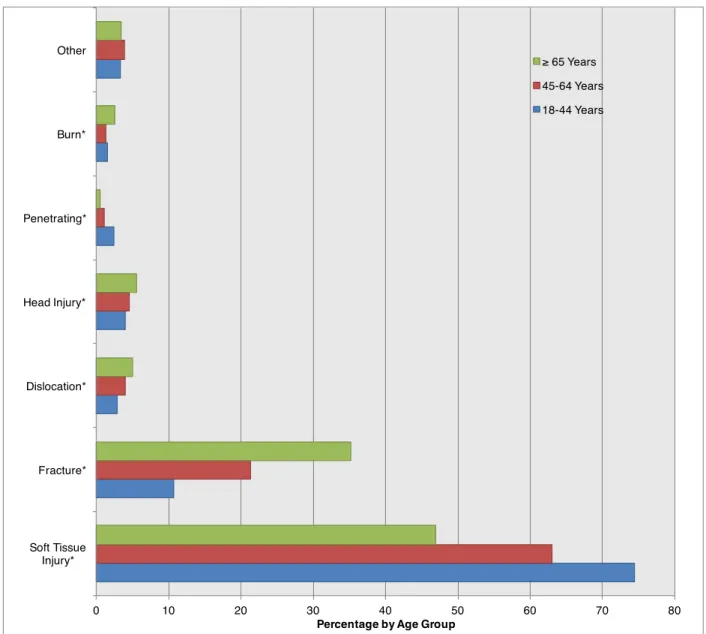
Injury patterns between age groups were very different. In the elderly population,
fractures were three times more common than in the youngest age group (10.6, 21.3, 35.2%,
p<0.001). Notably, penetrating wounds were not common in any group but were especially rare
in elderly patients (2.4, 1.1, 0.6%, p<0.001). (Figure 1) In terms of injury location, the most
significant differences were in head/face and lower extremity injuries. Head and face injuries
were much more common in younger patients (35.7, 27.4, 20.8%, p<0.001) while lower
extremity injuries (21.1, 27.9, 33.8%, p<0.001) and pelvic injuries (2.1, 2.9, 7.3%, p<0.001) were
more common in elderly patients. (Figure 2)
Most patients were evaluated, treated, and discharged home from the emergency
admitted to the hospital compared to the other age groups (10.6, 21.3, 35.2%, p<0.001).
Additionally, there were more deaths declared in the emergency room for elderly patients (1.1,
1.0, 2.5%, p<0.001). Once hospitalized, mean hospital length of stay (± SD) was significantly
longer for elderly patients (10.8 ± 17.1, 13.2 ± 17.9, 18.1 ± 19.3 days, p<0.001). For all patients,
only fractures were associated with an increased length of stay (mean 9.3 ± 16.4 vs. 16.7 ± 18.8
days, p<0.001). There were differences in surgical intervention for admitted patients between the
age groups with a slightly greater proportion of younger patients receiving an operation (15.5,
14.0, 11.9%, p=0.032). Elderly patients underwent a much greater proportion of orthopedic
procedures and fewer wound repairs. The three most common procedures performed by age
group were wound debridement/repair (55.1, 46.4, 23.6%, p<0.001), orthopedic procedures
(21.1, 29.4, 51.4%, p<0.001), and exploratory laparotomy (8.4, 4.1, 2.8%, p=0.034).
The overall mortality prevalence for elderly patients was over three times the prevalence
for the younger age group and two times the prevalence of the middle age group (1.7, 2.5, 5.6%,
p<0.001). (Table 1) After excluding deaths in the emergency department, the inpatient mortality
prevalence was also higher for elderly patients (4.9, 7.6, 9.3%, p<0.001). Upon propensity score
matching, logistic regression analysis revealed an odds ratio of death for elderly patients to be
3.15 (95% CI 1.39, 2.60, p=0.0037) compared to the youngest age group (18-44 years) when
adjusting for severe injury types and initial AVPU score. Middle-aged patients (45-64 years) also
had an increased risk of death compared to the youngest age group with an odds ratio of 1.82
(95% CI 0.94, 2.22, p=0.0109) adjusting for severe injury types and initial AVPU score that was
not statistically significant.
younger patients (21.1, 25.2, 45.7, p<0.001). However, for patients who had a recorded a GCS,
the mean initial GCS (± SD) was lower for older patients (13.5 ± 3.4, 13.0 ± 3.7, 9.7 ± 5.7,
p<0.001). Logistic regression modeling controlling for initial GCS, gender, and hours to
presentation revealed an increased adjusted odds ratio of death of 3.12 (95% CI 1.05, 9.25,
p=0.040) for elderly patients compared to the youngest age group in the presence of a head
injury.
We performed a sensitivity analysis comparing patients missing an outcome with those
who had an outcome recorded to assess if these data variables were missing at random. 2,931
(6.7%) were missing a recorded outcome with more elderly patients missing this variable than
other age groups (5.8, 8.4, 12.8%, p<0.001). For those missing a recorded outcome, there were
no significant differences between admission disposition (p=0.66), length of stay (p=0.29), GCS
score (p=0.67), or RTS score (p=0.20) across age groups. Injury mechanism and injury type had
similar breakdowns to those patients not missing a recorded outcome.
Discussion
The elderly population in sub-Saharan Africa is increasing and will rise exponentially
over the next four decades.1 There is an urgent imperative to understand the impact of this
segment of the population on the health care system, particularly in resource-constrained
environments.
This study shows a significant increase in mortality in the elderly trauma cohort
compared to other adult trauma patients. This observed difference in mortality is primarily
attributable to traumatic brain injury (TBI). Furthermore, in the elderly trauma cohort,
admission rates were double that of the younger cohort as was hospital length of stay. Lastly, our
increased risk of hospital admission and mortality compared to the youngest age group (18-44
years). Our findings are consistent with several studies, which demonstrate that older age is an
independent predictor of trauma-associated mortality, with some studies showing mortality rates
in the elderly to be more than double younger patients.7-10, 23-26 Described mortality rates are
widely variant but a 2014 meta-analysis reported a rate of 14.8%, a finding comparable to ours.9
With regards to TBI, there is clear evidence that mortality is strongly associated with
increasing age, even with less severe injuries, and that the risk may start increasing as early as age
30 years.27-30 Overall mortality rates for TBI have been reported as high as 30%, double the rate
of younger patients in one cohort.31 While our mortality rates are higher than those reported in
the literature, the trend is the same with exceptionally high mortality rates for elderly patients
compared to younger adults, even when controlling for GCS. This demonstrates there is much
room for improvement with regards to TBI management in this environment. At our institution,
we only have four working ventilators available and our data shows that despite a high mortality,
only 0.6% of geriatric patients were admitted to the ICU. In addition to a lack of ICU facilities,
subspecialists such as neurosurgeons are also often not available and geriatricians are virtually
non-existent in sub-Saharan Africa.32
In contrast to our findings, the evidence is conflicting on whether elderly age is associated
with an increase in hospital admissions in developed countries with some data suggesting that the
elderly may have disparate access to care resulting in lower admission and transfer rates to
tertiary trauma centers.25,33 However, it does appear that longer a length of stay can lead to
exceptionally high costs, even for simple falls.34 While our study did not include a cost analysis,
There is a paucity of data on the characteristics and outcomes of the elderly trauma
patient in sub-Saharan Africa. A few studies have been published, mostly with very small cohorts
of elderly patients and most without comparison to younger patients.11-15 The most relevant
studies were from neighboring Tanzania and Kenya. Saidi et al showed similar patterns of injury
to our study with a comparable percent of elderly patients in their trauma population (4.5% vs.
our 2.9%).11 Chalya et al had different findings in neighboring Tanzania where nearly 25% of all
patients were 60 years or older.12 They also had a very high rate of assault (52.1% vs our 13.6%)
with an associated increase in upper extremity injuries. Their high assault rate compared to our
study and Saidi’s report is likely explained by local socioeconomic factors. Despite their small
cohort, like our study, Saidi also found that older patients were more likely to have a head injury,
unintentional injury, and a non-traffic related mechanism. Both studies had similar in-hospital
mortality to our proportion of 9.3% with Chalya’s study at 14.9% and Saidi’s study reporting
13.9% and an unadjusted odds ratio of death of 2.1 compared to younger patients. Odihiambo’s
verbal autopsy study suggested that trauma is a significant problem for the elderly and may be
contributing to death more often in older patients than in younger patients.15
Improvement to the care of the elderly trauma patient will require significant systematic
changes in pre-hospital care including improvement in public health education on prevention,
better ambulance services equipped for older patients, and an increase in the number of trauma
centers. Data from the United States demonstrates that large-scale trauma systems can improve
outcomes in severely injured elderly patients, but these are difficult to implement. 35 In addition,
in-hospital care suffers from a general lack of resources and specialized geriatric care. Recent
management guidelines from the United States for elderly trauma patients focused on aggressive
triage, correction of coagulopathy, and limitation of care in patients with a very poor prognosis.36
departments are understaffed slowing triage, blood banking is often unavailable, and hospice care
and counseling is non-existent. Substantial resources will be required to make meaningful
improvements in these areas.
Our study presents data from the largest published cohort of elderly patients suffering
traumatic injury in sub-Saharan Africa. The size of the patient population and the length of the
study allowed us to describe several patterns of injury and their associated outcome data.
Additionally, by including two large cohorts of younger patients, we are able to make meaningful
comparisons between older and younger patients. By using propensity score matching, we are
able to make more valid comparisons between otherwise heterogeneous groups.
The limitations of our study are consistent with the limitations of retrospective data
analysis methodology. There is likely some selection bias because we do not have data on
trauma-associated pre-hospital mortality for our patients limiting analysis to only those patients
that survived long enough to reach the hospital. There is evidence that elderly patients suffer a
greater pre-hospital mortality than younger patients and thus we may be underrepresenting the
number of elderly patients suffering traumatic injuries and their associated mortality.19 We have
addressed the observational nature of this study and possible selection bias between age groups
with propensity score matching in order to provide a more accurate estimate of the odds ratio of
death for older patients.
Also, we acknowledge the issues of missing data, especially some variables that were only
recorded in the last three years of the study period such as GCS. We are also missing more
outcome data for geriatric patients compared to younger patients, which may mean we are
this limits comparison between older patients with younger ones given that older patients are
more likely to have medical comorbidities that may complicate their traumatic injuries.
However, in this setting most patients do not have access to primary healthcare services and
would not have any known medical conditions. There is conflicting evidence in developed
countries on the importance of medical comorbidities on mortality from traumatic injury with
some data suggesting there is not a significant impact.37
Conclusion
Trauma in elderly patients in sub-Saharan Africa is associated with a significant increase
in hospital admission rate and mortality. The setting, mechanism, and pattern of injury differ
between elderly and other adult patients and trauma centers in low-resource settings must be
prepared to meet the growing needs of aging trauma patients. Significant improvements in
trauma systems, pre-hospital care, and hospital capacity for older, critically ill patients are
Tables
Table 1. Bivariate analysis of background information on adults presenting with traumatic injuries by age group. p
values calculated with Chi2 analysis.
18 - 44 years
(n = 36,826) 45 - 64 years (n = 4,737) (n = 1,253) ≥ 65 years p Value
Patient Age (years)
Mean ± SD 28.5 ± 6.5 52.1 ± 5.3 72.5 ± 6.4
Gender: N (%)
Female 8,727 (22.5) 1,364 (28.8) 439 (35.0) < 0.001
Male 28,523 (77.4) 3,370 (71.1) 813 (64.9)
Missing 31 (0.1) 3 (0.1) 1 (0.1)
Setting of Injury: N (%)
Home Work
9,311 (25.3) 1,395 (29.5) 515 (41.1) < 0.001 4,635 (12.6) 568 (12.0) 79 (6.3) < 0.001 Road/Street 16,255 (44.1) 2,063 (43.6) 442 (35.3) < 0.001
Public Space 2,600 (7.1) 175 (3.6) 31 (2.5) < 0.001
Other 2,060 (5.6) 168 (3.6) 57 (4.6) < 0.001
Missing 1,965 (5.3) 368 (7.8) 129 (10.3) < 0.001
Mechanism of injury: N (%)
Pedestrian hit by vehicle 3,034 (8.2) 467 (9.9) 165 (13.2) < 0.001 Driver/passenger in vehicle accident 8.458 (23.0) 1,285 (27.1) 243 (19.4) < 0.001 Fall 5,185 (14.1) 1,128 (23.8) 455 (36.3) < 0.001 Assault 13,599 (36.9) 982 (20.7) 170 (13.6) < 0.001 Collapsed Structure 2,019 (5.5) 291 (6.2) 80 (6.4) 0.055
Other 3,887 (10.6) 460 (9.7) 108 (8.6) 0.036
Missing 644 (1.7) 124 (2.6) 32 (2.5) < 0.001
Hours to Presentation from Injury
Median (IQR) 3 (1-13) 4 (1-18) 8 (2-37) < 0.001
Missing (%) 1,578 (4.3) 291 (6.1) 109 (8.7)
Transport to Hospital
Minibus 10,584 (28.7) 1,219 (25.7) 280 (22.4) < 0.001 Private Vehicle 15,885 (43.1) 1,872 (39.5) 414 (33.0) < 0.001 Ambulance 3,073 (8.3) 763 (16.1) 339 (27.1) < 0.001
Walked 1,621 (4.4) 159 (3.4) 37 (3.0) 0.001
Police 2,345 (6.4) 180 (3.8) 47 (3.8) < 0.001
Other 2,250 (6.1) 309 (6.5) 39 (3.1) < 0.001
Missing 1,068 (2.9) 235 (5.0) 97 (7.8) < 0.001
Initial AVPU Score: N (%)
Unresponsive 351 (0.9) 41 (0.9) 23 (1.9) 0.002
Responds to Pain 104 (0.3) 14 (0.3) 3 (0.2) 0.953
Responds to Voice 16,609 (45.1) 1,995 (42.1) 472 (37.7) < 0.001 Alert 18,325 (49.8) 2,407 (50.8) 642 (51.2) < 0.001
Death Declared in Casualty 413 (1.1) 48 (1.0) 32 (2.5) < 0.001
Missing 239 (0.7) 33 (0.7) 11 (0.9) 0.586
Mortality: N (%)
Combined Casualty & Inpatient 642 (1.7) 119 (2.5) 70 (5.6) < 0.001 Inpatient Mortality 231 (4.9) 70 (7.6) 38 (9.3) < 0.001
0 10 20 30 40 50 60 70 80 Soft Tissue
Injury* Fracture* Dislocation* Head Injury* Penetrating* Burn* Other
Percentage by Age Group
Figure 2. Most severe traumatic injury type by age group (*p<0.05).Missing values comprise 0.80%, 0.9%, and 0.8% for each age category respectively.
≥ 65 Years
45-64 Years
References
1. Mathers CD, Stevens GA, Boerma T, White RA, Tobias MI. Causes of international
increases in older age life expectancy. Lancet. 2015 Feb 7;385(9967):540-8.
2. United Nations, Department of Economic and Social Affairs, Population Division. World
Population Ageing 2013. [Internet]. 2013 [cited 11 Jan 2015]; Retrieved from:
http://www.un.org/en/development/desa/population/publications/pdf/ageing/worldp
opulationageingreport2013.pdf
3. World Health Organization. Global brief for World Health Day. [Internet]. 2013 [cited
11 January 2016]; Retrieved from:
http://whqlibdoc.who.int/hq/2012/WHO_DCO_WHD_2012.2_eng.pdf.
4. Mathers CD, Lopez AD, Murray CJL. The Burden of Disease and Mortality by
Condition: Data, Methods, and Results for 2001. In: Lopez AD, editor. Global burden of
disease and risk factors. New York, NY: Oxford University Press; 2006.
5. World Health Organization. Estimates for 2000–2012: Cause-specific mortality.
[Internet] 2012 [23 March 2015]; Retrieved from:
http://www.who.int/healthinfo/global_burden_disease/estimates/en/index1.html.
6. GBD 2013 Mortality and Causes of Death Collaborators. Global, regional, and national
age-sex specific all-cause and cause-specific mortality for 240 causes of death, 1990-2013:
a systematic analysis for the Global Burden of Disease Study 2013. The Lancet.
2015;385(9963):117–171.
7. Perdue PW, Watts DD, Kaufmann CR, Trask AL. Differences in Mortality between
8. Sampalis JS, Nathanson R, Vaillancourt J, et al. Assessment of mortality in older trauma
patients sustaining injuries from falls or motor vehicle collisions treated in regional level I
trauma centers. Ann Surg. 2009;249(3):488–495.
9. Hashmi A, Ibrahim-Zada I, Rhee P, et al. Predictors of mortality in geriatric trauma
patients: a systematic review and meta-analysis. J Trauma Acute Care Surg.
2014;76(3):894–901.
10.Lustenberger T, Talving P, Schnüriger B, Eberle BM, Keel MJB. Impact of advanced
age on outcomes following damage control interventions for trauma. World J Surg.
2012;36(1):208–215.
11.Saidi H, Mutiso B. Injury Outcomes in Elderly Patients Admitted at an Urban African
Hospital. Surgical Science. 2013;04(06):292–297.
12.Chalya PL, Ngayomela IH, Mbelenge N, et al. Geriatric injuries among patients
attending a regional hospital in Shinyanga Tanzania. Tanzania Journal of Health
Research. 2012;14(1).
13.Onakpoya OH, Adeoye A, Adeoti CO, Ajite K. Epidemiology of ocular trauma among
the elderly in a developing country. Ophthalmic Epidemiol. 2010 Oct;17(5):315–20.
14.Bekibele CO, Gureje O. Fall incidence in a population of elderly persons in Nigeria.
Gerontology. 2010;56(3):278–83.
15.Odhiambo FO, Beynon CM, Ogwang S, Hamel MJ, Howland O, van Eijk AM, et al.
Trauma-Related Mortality among Adults in Rural Western Kenya: Characterising
Deaths Using Data from a Health and Demographic Surveillance System. Ang D, editor.
16.Kelly CA, Upex A, Bateman DN. Comparison of consciousness level assessment in the
poisoned patient using the alert/verbal/painful/unresponsive scale and the Glasgow
Coma Scale. Ann Emerg Med. 2004;44(2):108-113.
17.American College of Surgeons Committee on Trauma. Advanced Trauma Life Support
for Doctors: Instructor Course Manual. 6th ed. Chicago, Ill. American College of
Surgeons; 1997.
18.Joseph B, Pandit V, Zangbar B, et al. Superiority of frailty over age in predicting
outcomes among geriatric trauma patients: a prospective analysis. JAMA Surg.
2014;149(8):766–772.
19.Wong EG, Trelles M, Dominguez L, et al. Operative procedures in the elderly in
low-resource settings: a review of médecins sans frontières facilities. World J Surg.
2015;39(3):652–657.
20.Nair PS. Population aging in sub-Saharan Africa: Present and prospects.
Gerontechnology. 2014;13(1
21.R Development Core Team. R: A language and environment for statistical computing. R
Foundation for Statistical Computing, Vienna, Austria. 2008. ISBN 3-900051-07-0, URL
http://www.R-project.org.
22.Ho DE, Imai K, King G, Stuart EA. MatchIt : Nonparametric Preprocessing for
Parametric Causal Inference. Journal of Statistical Software J Stat Soft. 2011;42(8).
23.Rzepka SG, Malangoni MA, Rimm AA. Geriatric trauma hospitalization in the United
States. J Clin Epidemiol. 2001;54(6):627–633..
25.Moore L, Turgeon AF, Sirois M-J, Lavoie A. Trauma centre outcome performance: A
comparison of young adults and geriatric patients in an inclusive trauma system. Injury.
2012;43(9):1580–1585.
26.Lee WY, Yee WY, Cameron PA, Bailey MJ. Road traffic injuries in the elderly. Emerg
Med J. 2006;23(1):42–46.
27.Thompson HJ, McCormick WC, Kagan SH. Traumatic brain injury in older adults:
epidemiology, outcomes, and future implications. J Am Geriatr Soc. 2006;54(10):1590–
1595.
28.Rozzelle CJ, Wofford JL, Branch CL. Predictors of hospital mortality in older patients
with subdural hematoma. J Am Geriatr Soc. 1995;43(3):240–244.
29.Susman M, DiRusso SM, Sullivan T, et al. Traumatic brain injury in the elderly:
increased mortality and worse functional outcome at discharge despite lower injury
severity. J Trauma. 2002;53(2):219–23– discussion 223–4.
30.Harris C, DiRusso S, Sullivan T, Benzil DL. Mortality risk after head injury increases at
30 years. J Am Coll Surg. 2003;197(5):711–716.
31.Mosenthal AC, Lavery RF, Addis M, et al. Isolated traumatic brain injury: age is an
independent predictor of mortality and early outcome. J Trauma. 2002;52(5):907–911.
32.Dotchin CL, Akinyemi RO, Gray WK, Walker RW. Geriatric medicine: services and
training in Africa. Age and Ageing. 2012;42(1):124–8.
33.Hsia RY. Factors Associated With Trauma Center Use for Elderly Patients With
Trauma. Archives of surgery (Chicago, Ill : 1960). 2011;146(5):585.
34.Siracuse JJ, Odell DD, Gondek SP, et al. Health care and socioeconomic impact of falls
35.Mann NC, Cahn RM, Mullins RJ, Brand DM, Jurkovich GJ. Survival among Injured
Geriatric Patients during Construction of a Statewide Trauma System. J Trauma Acute
Care Surg. 2001;50(6):1111.
36.Calland JF, Ingraham AM, Martin N, et al. Evaluation and management of geriatric
trauma: An Eastern Association for the Surgery of Trauma practice management
guideline. J Trauma Acute Care Surg. 2012;73(5):S345–S350.
37.Ferrera PC, Bartfield JM, D'andrea CC. Outcomes of admitted geriatric trauma victims.
Acknowledgements
Major Andrew J. Geyer, PhD, USAF performed the propensity score matching and subsequent
logistic regression modeling for mortality analysis.
Basic human body outline image provided for free by ClipArtBest at