The Effect of Tracheostomy on outcome and resource utilization in trauma patients at a Level I trauma center, an investigation with Propensity Score
methodology and systematic review of the literature
By Joshua Gant
A Master’s Paper submitted to the faculty of the University of North Carolina at Chapel Hill in partial fulfillment of the requirements for
the degree of Master of Public Health in the Public Health Leadership Program.
Chapel Hill 2011
__________________________ Advisor:
Date
_________________________________ Second Reader:
Contents:
1. Research Manuscript- The Effect of Tracheostomy on outcome and resource utilization in trauma patients at a Level I trauma center, an investigation using Propensity Score methodology
2. Addendum: Limited Systematic Literature Review 3. References
4. Tables and Figures
Abstract
Background
The use of tracheostomy has long been an accepted option in patients requiring prolonged mechanical ventilation. As its use has continued to increase research has focused primarily on timing, investigating benefits of earlier use and how quickly it should be considered. Less focus has been placed on which patients it should be used for at all. Several recent studies that have investigated this question found none of the assumed survival benefit, with one even showing increased mortality in tracheostomy patients. With the need to better understand which patient populations do benefit more study of specific groups is needed. We studied survival and length of stay outcomes in mechanically ventilated trauma patients in a Level I Trauma Center Intensive Care Unit (ICU) to determine the utility of tracheostomy in this specific population.
Methods
This retrospective cohort study of tracheostomy outcomes used data collected from the University Of North Carolina Hospitals Trauma Registry on adult trauma patients admitted between January 2000 and December 2010. All non-burn patients who were mechanically ventilated in the Surgical ICU for at least 24 hours were included for analysis. Patients who received tracheostomies were compared to all other included patients regarding survival to discharge. Time on mechanical ventilation and ICU and hospital lengths of stay were secondarily analyzed. Logistic regression was used in comparison of primary and secondary outcomes, and derived propensity score matching was used to adjust for confounding.
Results
Of 2489 patients meeting basic inclusion criteria 509 had tracheostomies performed. Prior to any adjustment tracheostomy was statistically significantly associated with greater survival to discharge (90% vs 76% OR 2.99, p<0.001). Logistic regression resulted in an odds ratio (OR) of 5.36 (P<0.001) and propensity score matching yielded an OR 3.84. ICU length of stay (tracheostomy mean 24.9 days, control mean 5.3) and hospital length of stay (mean 42 vs 12.1) as well as time on mechanical ventilation (mean 20.4 vs 3.6 days) were all statistically associated with longer times for the tracheostomy group. Cost was similarly associated, with mean values $193,173 vs 66,174.
Conclusions
Among trauma patients tracheostomy use was associated with greater survival to discharge, but also with longer mechanical ventilation time, ICU length of stay, hospital length of stay and cost. These relationships persisted with propensity score matching to minimize confounding by indication, suggesting a survival benefit from tracheostomy. Longer stays may result in part from lead time before tracheostomy and may be reducible by earlier
The Effect of Tracheostomy on outcome and resource utilization in trauma patients at a Level I
trauma center, an investigation using Propensity Score methodology
Introduction
Tracheostomy has long been an important option in the care of any patient requiring
extended mechanical ventilator support, particularly in severely injured trauma patients, and its
use is increasingly common. In North Carolina the incidence of tracheostomy for prolonged
mechanical ventilation in 2002 was 24.2 per 100,000 patient years, increased from 8.3/100,000
in 1993.1 With the development of less invasive percutaneous placement methods tracheostomy
can be used without a trip to the operating room and there is continuing interest in possible
improved outcomes when done earlier in the mechanically ventilated patient. However, the
overall therapeutic advantage and indications have not been well delineated.
In cases of upper airway obstruction, the need for tracheostomy is apparent, but in other
cases, the assumed benefits offered over laryngeal intubation often originate in clinical reasoning
and basic science physiology research rather than outcome oriented evidence. Several studies
have suggested that tracheostomy use in mechanically ventilated patients can reduce airway
swelling, improve dead space ventilation and significantly decrease work of breathing compared
to prolonged endotracheal intubation 2-5 Physicians generally choose tracheostomy with the
expectation of improved patient comfort, eased ventilator weaning and reduced risk of ventilator
associated pneumonia.6 Studies on patient level outcomes have generally taken these potential
benefits as a starting point and include only patients who receive tracheostomies. They focus on
comparing placement early (often considered less than 7 days) versus late placement in
reduced intensive care unit (ICU) length of stay, easier weaning from ventilators, and reduced
overall cost.7-9
There is significantly less recent work directly comparing outcomes against prolonged
use of a nonsurgical airway (endotracheal intubation). Even trauma departments with their
frequent use of invasive procedures including tracheostomy do not have well defined indications
to standardize tracheostomy tube placement. One large retrospective study of patients from the
national trauma database found significant unexplained variations in use.10 Departing from the
trend several more recent studies have investigated which patients would have better outcomes,
and amid increased efforts at cost reduction or containment, the determination of decreased
resource utilization including reducing ventilator days would be beneficial.11-13
Attempting to explain variations in prior studies as well as unexplained differences in
practice patterns that further confound these studies has been challenging. To account for such
confounders, several studies used matching based on tracheostomy propensity scores derived in
their cohort of unselected patients from the medical ICU, or in one case respiratory care center.
Using propensity scores and other methods to address bias showed little or no survival benefit in
tracheostomy use and in fact post ICU patient care needs increased.11-13 Further exploration of
recent relevant literature including a limited systematic review is presented in the Addendum.
These results illustrate the uncertainties in current understanding of how to best use
tracheostomy and the need for further study to determine which cohort of patients are more
likely to benefit. The trauma population, underrepresented in these recent investigations, could
benefit greatly from better understanding of the true balance of patient benefit with resource use.
premorbid health makes this a unique population in potential tracheostomy use. The high cost of
trauma care delivery makes it all the more important to avoid wasted resources.
In order to delineate the effect of performing a tracheostomy on both cost and patient
outcomes, we conducted a retrospective study of UNC Memorial Hospital trauma ICU patients.
Widely variable patient populations within the trauma cohort and differing injury severity leave
the indications for tracheostomy less well defined. Propensity score matching has been
increasingly utilized as a means to adjust for confounding by indication and this methodology
was utilized in our study. As such this study will use derived propensity scores to match adult
ventilator dependent surgical ICU trauma patients and determine differences in survival, total
Materials and Methods
Study Design and Data Source
This retrospective cohort study was conducted using data from the University of North
Carolina Healthcare System Trauma Registry database to evaluate differences in outcomes
between those with and without tracheostomy. This database, established to meet State and
National reporting requirements, tracks all patients admitted to the UNC system Trauma, Critical
Care and Acute Care surgical service at NC Memorial Hospital. This 800 bed Level 1 Trauma
Center in Chapel Hill cares for greater than 2000 trauma patients each year. The registry is
maintained by trained Trauma Program staff facilitating the transfer of data from the hospital
records system. The full list of data types it contains varies with researcher requests for further
details, but the minimum data set includes basic demographic information, diagnostic and
procedure codes, a range of severity scores and other statistics relating hospital stay including
some billing information.
The data is collected by hand from the various electronic medical record systems used in
the hospital by the registry staff with basic information updated daily and protocols for quality
assurance and data completeness are in place. Because this data is a de-identified limited data set
from the trauma registry informed consent was waived.
Population
This study uses registry data for patients admitted to NC Memorial hospital between
January 2000 and December 2010. Our study cohort included trauma patients age ≥18 years that
were mechanically ventilated in the Surgical Intensive Care Unit for at least one day. Burn
this study population tracheostomy patients were identified by ICD-9 procedure codes 31.1 and
31.29 for tracheostomy placement with the remaining providing the pool of controls. A total of
2489 patients meeting these criteria were provided by trauma registry staff, and of that number
509 had tracheostomies placed.
Variables
Basic demographic variables included race, age, insurance status and year of admission.
Race was coded in 4 categories: white, black, Hispanic and other. It was later dichotomized into
white and nonwhite patients for analysis. Age was represented in quartiles, with blocks of 18-26,
26-38, 38-54 and over 54 years age. Payer status was coded for analysis as self-pay, Medicaid,
worker’s compensation or other.
Injury variables included mechanism of injury (blunt or penetrating), admission Glasgow
Coma Scale (GCS), Abbreviated Injury Score for body region (AIS) , Injury Severity Score
(ISS) and acuity alerts at presentation under a yellow or red trauma alert system. GCS, a
representation of responsiveness, was analyzed in a dichotomized form, split at a score of 9 as
this is generally considered a cut off for severe deficits in consciousness and often head injury.
Abbreviated Injury Severity (AIS) scores are given for head and neck, face, chest, abdomen,
extremities and skin and range from 0 for no injury through severe at 4 and maximum or
non-survivable at 6. Injury Severity Scores (ISS) are a calculated composite score using the sum of
the squares of the greatest 3 AIS body region scores. They are very commonly used to represent
an overall level of injury in the patient. ISS scores range from 0 to 75 and are automatically
scored 75 if any regional AIS is given its maximum of 6. This score has been well correlated
derivative relationship AIS scores are presented for initial comparison, but are not used directly
in modeling results.
Collected outcome variables were mechanical ventilation days, surgical ICU length of
stay, hospital length of stay, and disposition (death or discharge). Total hospital charges at
discharge were also included for analysis. These are only raw charges and not final billing
information; however they give some indication of relative costs. In using the trauma registry all
data is limited to that collected during the patient stay and so no information could be included
beyond that point.
Statistical Tests
Descriptive statistics are given as numbers or patients with percent of exposure group or
means with 95% confidence intervals. Bivariate analysis of the unadjusted data was done using
chi-square tests for categorical data and the Student’s T-test for normally distributed continuous
data. These included age and ISS score. The Wilcoxson Rank Sum method was used for
non-normally distributed data including AIS scores, GCS and admission year. Two sided P values
from respective tests are also given.
We conducted initial bivariate analysis of outcomes with tracheostomy status using Rank
Sum tests for the non-normally distributed length of stay data and chi-square testing for survival
to discharge. We also utilized logistic regression to calculate survival odds ratios. We then
developed a multivariate regression model for predictors of outcomes for comparison to
propensity score matched results. All collected demographic data was included in the initial
model along with GCS and ISS scores, mechanism of injury, trauma alert status, admission year
and payer status of self-pay, worker’s compensation or Medicaid. As noted above, race was
severe (less than 9) or non-severe. We then refined these models dropping non-significant
variables using p<0.05 as a cutoff for significance. We used Logistic regression for survival and
Linear multiple regression for continuous variables (LOS and cost) to calculate a survival odds
ratio and provide mean values for continuous variables with 95% confidence intervals.
Normality of the distribution of residuals was checked graphically in each model.
To address the lack of standardized indications leading to increased chance of
confounding, as well as normal risk of unaccounted confounding in a retrospective study, a
propensity score for tracheostomy was developed. Discussions of advantages and potential
limitations of propensity scores as well as detailed derivation methods and use can be found in
several papers.15-18 Briefly, propensity scores provide a method of collapsing multiple potential
confounders to a single score predictive of the exposure status. Any study subjects with
equivalent propensity scores have the same theoretical chance of being in either exposure group.
This leaves random chance or unmeasured confounders to explain any differences in assignment,
and thus allows some approximation of randomization in a non-randomized study. We
implemented propensity scores using the psmatch2 Stata package.19,20
We developed the propensity scores starting with the same initial set of data used in the
earlier regression study, though it is more important to retain even weaker associated variables in
propensity scoring. Variables were dropped from the propensity score model when they were
worsening the balance of the propensity score model. We used nearest neighbor matching within
a 0.01 caliper with 3 unexposed controls per exposed patient leaving one exposed patient
unmatched. The Stata package was then used to match patients and calculate mean values with
95% confidence intervals and p values for continuous outcome variables and probability of
model and outcomes. Because only charges values were not available for all patients they were
calculated with a separate match, though it used the same model. We then calculated sensitivity
analyses for each outcome using Rosembaum Bounds.21 We used the rbounds Stata package to
implement this testing.22,23 The Rosenbaum bounds sensitivity analysis assumes a hypothetical
unmeasured confounder for the outcome. It then calculates a predicted minimum magnitude of
effect, Γ, that the unmeasured confounder must exert on the odds of a patient being in a
particular exposure group to cause the true answer to fall outside the 95% confidence interval.
Throughout analysis p<0.05 was used as a cut off for significance. All analyses were
Results
Study Population
From the UNC trauma registry, 2489 patients met inclusion criteria for analysis with 509
having had tracheostomies performed. Basic demographic information as well as injury related
variables of both tracheostomy patients and controls are given in Table 1 for comparison along
with p values for inter-group differences. Of note, age was significantly different between the
groups with a larger portion of control subjects under age 30 (35.81%/28.68% p=0.003) and
fewer over age 65 (14.55%/18.07% p=0.048). There was also a significantly higher portion of
‘self-pay’ and lower Medicaid in the control group.
Regarding injury characteristics, mechanism of injury, and portion of subjects with a
GCS less than 9 all AIS scores and ISS scores each had significant differences by P value. The
control group had a larger proportion of its population with GCS scores below 9, but lower mean
ISS score. The GCS score was unavailable for 154 of the unexposed and 48 of the tracheostomy
patients. ISS was unavailable for 14 unexposed patients. Charges data was unavailable for 139
exposed and 34 unexposed patients.
Matching
As psmatch2 based propensity matching only includes subjects with complete data for all
modeled variables 1812 of the 1980 control subjects and 461 of the 509 tracheostomy patients
were candidates for matching. This is the result of the missing ISS and GCS data noted above.
One tracheostomy patient was left unmatched, with 461 trauma patients matched to 3 controls
each. In examining the hospital charges variable, there was a further loss of complete data sets
bringing the matched totals to 1716 control and 428 tracheostomy patients. The variables used in
values and the p value of this bias between treatment groups before and after matching. All
variables had significantly reduced bias and were no longer statistically significant after
adjusting with matching.
Outcomes
Unadjusted results from simple bivariate analysis appear in Table 3 and show strongly
statistically significant differences between the unexposed and tracheostomy groups for each of
the outcomes. For survival to discharge tracheostomy patients had a 90% survival rate compared
to 76% in unexposed patients, equating to a survival odds ratio of 2.99 for tracheostomy patients
over unexposed. The hospital length of stay, days spent on mechanical ventilation and total days
in the ICU were all significantly higher for tracheostomy patients. Hospital stays averaged 42
days for tracheostomy vs 12.1 for controls. Similarly mean mechanical ventilator times were
20.4 and 3.6 days and ICU length of stay was 24.9 and 5.3 for exposed and control patients,
respectively. Total charges averaged $193,173 versus $66,174 for intervention and control
groups, respectively.
Using the multivariate logistic regression model to adjust for confounding resulted in
only minor changes shown in Table 4 to the mean ICU and hospital length of stay, mechanical
ventilation time or charges. Adjustment did significantly strengthen the association of better
survival odds and tracheostomy with the survival odds ratio increasing from 2.99 to 5.36.
Implementing propensity score matching differences in the independent variables
between exposure groups were greatly reduced in the matched model as seen in Table 5. The
change to outcomes was strongest in the control group, with mean length of stay rising from
12.05 to 13.56 days, ventilator days from 3.66 to 4.3 days, ICU days from 5.37 to 6.14 days, and
matched analysis was more modest than the change from the regression model, though it still
increased the odds ratio from 2.99 to 3.84 in favor of tracheostomy patients.
Rosenbaum bounds sensitivity analysis of this model showed that an unaccounted for
confounder would have to bias subject exposure status by an odds ratio of 15 for length of stay or
15.1 for ventilator days to be outside the 95% confidence interval and 17.9 to have an effect on
the number of ICU days. Though still fairly resistant to unmeasured confounding, charges and
survival are more sensitive at 9.5 and 4.2.
Discussion
Our study shows a significant association with greater ICU and overall Hospital survival
in those mechanically ventilated trauma patients who underwent tracheostomy. With the
survival odds 3 times as high before any adjustments and a greater association after controlling
for selection bias this is a strong result, and may be a result of a combination of factors. We
hypothesize one major factor in this result is the acute nature of the critically ill trauma patient,
making them fundamentally different in their response to tracheostomy compared to the broader
ICU populations in most other tracheostomy outcome studies. In the acutely injured setting, it is
likely they need only a limited intervention to bridge them through the worst of their respiratory
compromise to begin recovery than the population of a general ICU.
One such study, Clec’h mentioned above, challenged typical assumptions of benefit in
tracheostomy and found statistically significant association with higher mortality for
tracheostomy patients. Our finding of a survival benefit is consistent with most previous studies
addressing tracheostomy outcomes in general ICU populations.12,24-27 Interestingly, though, these
selected for tracheostomy. In our study, though, while some differences were mildly
non-significant our population tended toward more tracheostomy patients having GCS<9, penetrating
injuries, greater abdominal injury and more were admitted as Yellow or Red traumas with
suspicion of greater injury leading to the movement away from the null with adjustment.
This suggests that selection bias itself likely works differently in different populations.
Even after propensity score adjustments for causes related to survival, some of the benefit is
likely still due to differences between treatment and nontreatment groups. That chance to bridge
patients through the worst of a secondary illness may lead treating physicians’ selection of
tracheostomy patients to be based more on their experience with patients who do at least make it
past their respiratory compromise. If true, this provides some support for current tracheostomy
decision making practices, at least in trauma patients.
One small recent study by Barquist et al did focus on trauma patients and used
randomized treatment assignment, but found no differences in any outcomes. However, this
study was stopped prematurely and only totaled 62 patients. Additionally, 11 of the 31 patients in
the arm not to receive tracheostomy any earlier than day 28 crossed over and received the
intervention, moving results toward the null.28
These differences do become limitations to generalizability. As well as a focus on trauma
patients alone, this study population is derived from a single institution, a Level 1 trauma center
which sees many severely injured trauma referrals from outside hospitals. This is a very different
picture from the majority of hospitals needing to decide on tracheostomy use. Even between
trauma centers, the study’s mix of 90% blunt injured patients is very representative of region
Our results finding increased survival, though, are tempered by longer times spent on the
ventilator, in the ICU and in the hospital in general along with higher costs. Even adjusted for
initial level of illness to be more similar tracheostomy patients had significantly greater time
spent not only in the hospital (mean 42 vs 13 days) but in the ICU (24.9 vs 6 days) and on
mechanical ventilation (20.3 vs 4.3). The difference in hospital and ICU stay lengths appears
primarily driven by longer mechanical ventilation times. One cause of longer ventilation times
may be the higher mortality of non-tracheostomy patients, with early deaths lowering aggregate
stay times. As well, before receiving a tracheostomy most patients would have spent varied time
on a mechanical ventilator. Thus, even if weaned from the ventilator the same day the
tracheostomy was placed these patients may have an extended period of ventilation time due to
delays in tracheostomy placement. A weakness of this study, it is unfortunately not possible to
investigate this with our data, as timing of tracheostomy was not included.
This limitation of available data is inherent in our use of registry data. As the database
was designed first as a system for reporting and quality control, timing of the tracheostomy
relative to intubation or the start of mechanical ventilation are simply not available. Even where
the variables are available, they are at times not collected in categories that are useful for this
research case. The inclusion of time before tracheostomy, DNR status and a better picture of
general health of the patient before the injury could strengthening the adjustment for
confounding as well.
Because of this lack of information on when tracheostomy took place, it is difficult to
draw an overall conclusion on resource utilization. This is, however, an important question to
consider, illustrated by the significant association with higher cost for tracheostomy patients that
assessing this outcome.11,24,26 In the light of a medical system in need of lowering expenses,
spending 5 times as long on mechanical ventilation must be carefully considered. Study of ICU
and mechanical ventilation costs found the mean stay of 14.4 days costing over $31,000 for
mechanically ventilated ICU patients, and less than $13,000 over 8.5 days for those not needing
this level of support. Importantly, daily costs were greatest on the first ICU day with it costing
$10,794 for mechanical ventilation patients ($4796 without) and by day 3 stabilized at
approximately $4000 daily ($3200 without mechanical ventilation).29,30
These costs first highlights the importance of further study focused on more specific
populations, or powered for subgroup analysis to find which patients benefit from tracheostomy.
These findings are most generalizable within the scope of trauma patients, though it does lend
support to other studies that there is likely true benefit in some populations. Beyond this, our
study is also limited in the same way any non-randomized trial of tracheostomy will be. Though
indications may be better defined in some studies than others, there will always be some
influence from expectation of outcomes in real world practice. A truly randomized controlled
trial of significant size would, though difficult to achieve, be the greatest benefit in finding the
true benefit of tracheostomy.
The cost of mechanical ventilation also underscores the important of ongoing studies to
determine the best timing of tracheostomy. If its earlier use is in the right patients is, indeed, able
to decrease ventilation time it may greatly reduce cost difference findings. Tied to this, even
when concerned primarily with overall benefit of tracheostomy as was our work, information on
timing of tracheostomy will allow much better understanding of any benefit it may have in
resource use. In all, this work to find the patients who benefit from tracheostomy has great
Conclusion
In the context of other current research on tracheostomy outcomes, this study provides
significant support for the survival benefits of tracheostomy use in the right patient population,
bridging some of the knowledge gap between previous positive studies and newer studies
showing it may not always help.11 It begins with a population with perhaps the most basic
reasons to benefit from tracheostomy for studies into other specific patient groups to continue
exploring which patient characteristics predict when tracheostomy can be useful. It also
underscores the costs this care incurs, and wastes if improperly targeted. Critical care is an
expensive field with determination of patient benefit often illusive in the complexity of the care,
Systematic Review
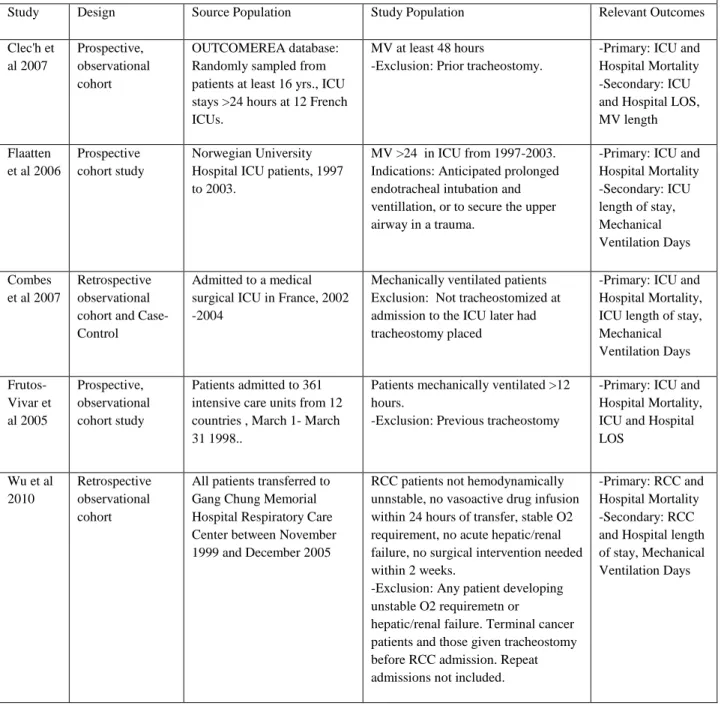
To better place this study in the context of the current understanding of the use of
tracheostomy we conducted a focused systematic review of recent literature. The review
investigated findings on benefits and costs of tracheostomy in critically ill patients in literature
from the last 10 years, focusing on mortality and length of stay. A subjective summary of the
overall evidence of tracheostomy in recent years will then be made.
Methods
Search Strategy and Selection
Initially the Medline MeSH term database was used to identify appropriate MeSH terms
relating to tracheostomy and mechanical ventilation. From this, the terms “tracheostomy”,
“intensive care units”, and “respiration, artificial” were selected. On examining results the
alternate forms “tracheotomy”, “intensive care” and “critical care” were added to the search. As
there is a delay in adding MeSH terms the above terms were also searched without limiting to
MeSH results. Filters were applied to all searches limiting results to only human adult
populations with English language publication in the last 10 years. To best address the question
only those studies with control groups not undergoing tracheostomy and a sample size at least
200 were included. Related to this, studies focused on timing of tracheostomy rather than
benefits of tracheostomy were not included.
Using this search strategy resulting articles were first reviewed by title, with those
clearly not meeting the above criteria excluded from further analysis. Abstracts of the collected
respiratory effort were not included. PubMed cited and related works were then examined and a
hand review of references was done to find any further papers meeting criteria.
Data Abstraction
Abstraction of study data was conducted by the reviewer. A pre-determined set of data
was collected from each paper covering basic study characteristics as well as outcomes.
Characteristics included study design, source and study population, study population
demographics, inclusion and exclusion criteria, and type of analysis done. Outcomes of interest
were those relating mortality or hospital or ICU length of stay.
Analysis
All included studies were analyzed using pre-determined standardized quality measures.
These quality measures include likely risks to both internal and external validity and represent
the general strength of methodology. Source population definition, appropriateness of the study
population and analysis methods, overall quality and generalizability were rated poor, fair or
good. Potential for selection bias, measurement bias and uncontrolled confounding were rated
low, moderate or high. Due to heterogeneity of populations and outcomes measurement no
combined analysis of results was done.
Results
Initial database searches within PubMed using both MeSH and non-MeSH terms but not
yet limited by study age yielded 277 potential articles. Of those, 169 were published in the last
10 years. An initial screen of article relevance by title narrowed the result to 14 studies that may
meet inclusion criteria. A review of the abstracts excluded 7 of these articles for their focus on
intermediate outcomes or tracheostomy timing. A further 2 articles were excluded based on size.
outcomes.13,28 The 5 articles that remained were pulled in full text and reviewed to confirm their
relevance.11,12,25,26,31
Summary Characteristics
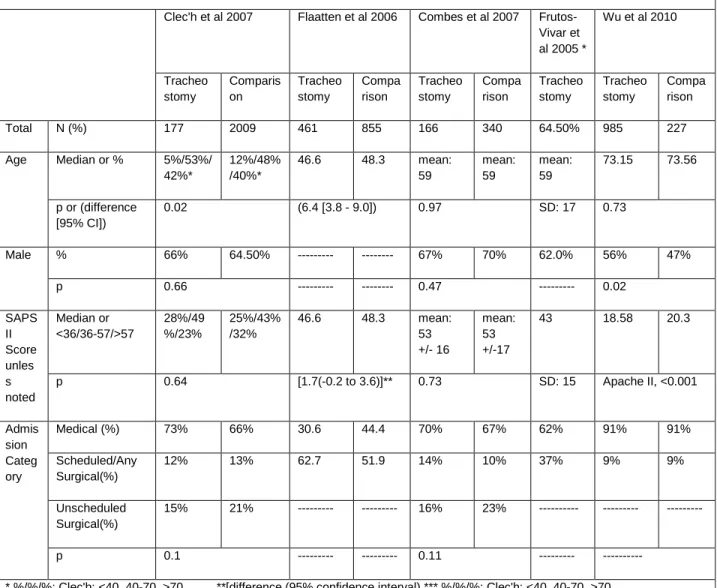
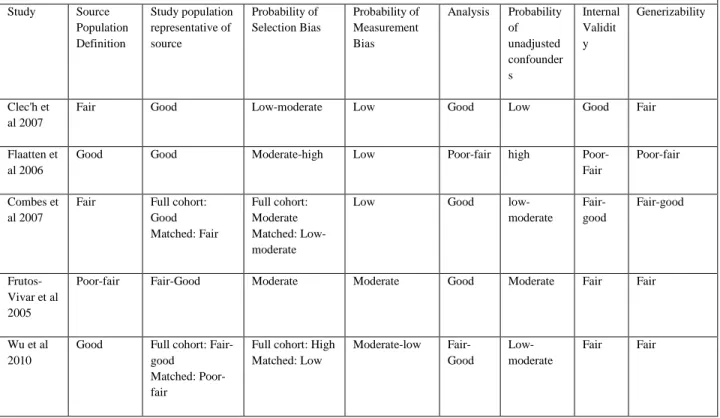
Study characteristics abstracted from each paper are discussed below, and were compiled
and presented in Table A-1, with basic patient demographics following in table A-2. In
summary, of the included studies 2 were retrospective12,26 and the others prospective. Three
studies were conducted at single centers12,26,31 while 2 involved multiple centers. All studies
collected similar basic demographic information along with a variety of disease severity
indicators. ICU and total hospital mortality were primary outcomes for all 5 studies. ICU length
of stay and days of mechanical ventilation were primary outcomes for 2 studies25,26 and
secondary for the others. Hospital length of stay was not given in 2 studies26,31 and secondary in
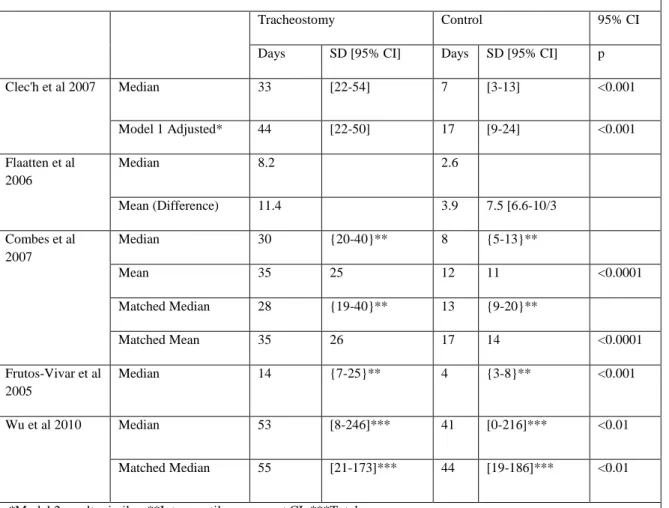
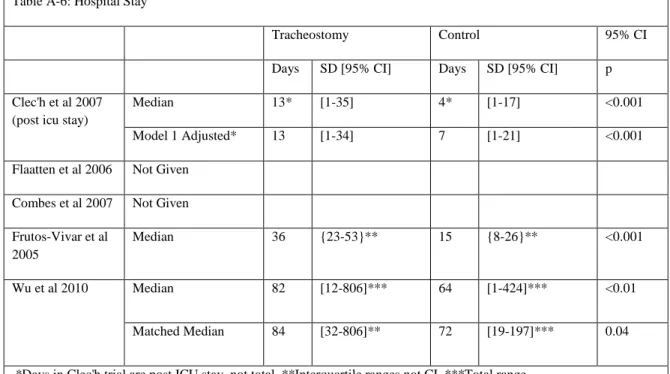
the others. These results are also discussed with each paper and compiled in tables A-3 through
A-6. Finally, evidence quality ratings are presented in Table A-7.
Mortality, Length of Stay and Mechanical Ventilation times
Of the 5 included studies 3 found a lower ICU mortality rate associated with use of
tracheostomy. Though Flatten et al does not give statistical significance measures Combes et al and Frutos-Vivar et al both show statistical significance in adjusted scores.25,26,31 The paper by
Clec’h et al does show statistically significant association with lower mortality (OR 0.65) in the unadjusted model. However, the propensity score matched models in fact shows an association
with higher mortality that is statistically significant (OR 2.57).11 The study by Wu et al did not
give a direct comparison of mortality in the critical care setting, but rather the percentage of
overall deaths that occurred in the RCC. This showed no significant difference between groups
Tracheostomy was found to be associated with lower hospital mortality in Combes, Wu
and Flaaten. Flaaten gives no statistical significance indicators, while Wu and Combes show
statistical significance.12,26,31 Frutos-Vivar et al did not find significant differences between
populations in hospital mortality. In the case of Clec’h the results is given in more detail by
breaking down propensity adjusted post ICU mortality to show all patients, those decannulated
before discharge from the ICU and those discharged with a tracheotomy. Post ICU patients
discharged after decannulation showed no association with mortality, while there was a statistical
association of tracheostomy with higher mortality in both those patients discharged from the ICU
without decannulation and all patients post ICU.
Examining ICU length of stay and days of mechanical ventilation there was a consensus
of strong statistical association between tracheostomy and greater lengths for all each
outcome.11,12,25,26,31 Except for the lack of data from Flaaten and Frutos-Vivar, the same strength
of association is present for greater overall hospital length of stay in the 3 studies which do
include it.
Quality Evaluations
Each included study has strengths and weakness, but all studies in this subject area have
one prominent issue in common. This is the baseline selection bias, sometimes referred to as
confounding by indication, inherent in non-randomized care decisions about tracheostomy. As a
potentially morbid and costly procedure the more unstable patients would be less likely chosen
for tracheostomy directly because they are more likely to die no matter the treatment, leaving the
control group with sicker patients. This may even be increased by observation effects, with
clinicians not wanting to report high mortality rates related to tracheostomy and taking what they
lessen any harm and would be increased by the inconsistent and poorly defined indications
common to use of tracheostomy.
Similarly common in its effects, the importance of measurement bias is dependent on
what non-primary interest variables are used for. Though the outcomes of interest in this review,
mortality and lengths of time, are less likely to be misreported systematically others such as
injury severity and indications may be more open to bias. If these are used to adjust for possible
confounding, they could skew the adjustment.
One other characteristic affecting all included studies, their geographic settings, has some
effect on their generalizability between each other. Two were conducted in France, one in Japan,
one in Norway and one with data gathered across multiple countries. Due to system differences
in intensive care units and the post ICU stay as well as differences in patients populations
admitted to ICUs, there may be some effect on the applicability of these papers to practice
outside their country of origin.
The study by Clec’h et al was a prospective observational cohort conducted using a database made up of patients from 12 ICUs. This database, OUTCOMEREA, is selected from 12
French ICUs and contains only patients at least 16 years of age with ICU stays of at least 24
hours. The sample was done randomly with the selection method chosen by each institution to be
either: consecutive patients in N random chosen beds or consecutive admissions in a randomized
month. Their definition of the source population is adequate, but it should be noted that it is a
relatively diverse and potentially heterogeneous population. Nothing is noted of the types of
institutions making up this database. As the authors exclude only repeat tracheostomy and
include all patient from the database ventilated at least 48 hours this should be well
Of the 2186 patients included in the study, 177 had tracheostomies placed. Patients were
primarily respiratory medical patients (approximately 70%) with surgical patients making up
23% and 34% of the tracheostomy and control groups respectively. The authors note that all
participating ICUs followed recommendations of the Societe de Reanimation de Langue
Francaise for airway management and weaning protocols. This should lessen the likelihood of
inconsistent practices between the many participating institutions. Additionally they place
particular focus on adjusting for this selection bias. Their use of 2 methods of building the
propensity score model leads to their low probability of selection bias and analysis rating of
good. There may still be some uncontrolled confounders but this method, already discussed in
the research manuscript, should lessen their effects. Finally, the lack of blinding of data
collectors or clinicians could result in some measurement bias. As already stated, this is unlikely
to effect the direct data of interest, but the propensity score is based on more potentially
subjective or miss-stated data. This should be minimized, though, as all data is collected through
a standardized form into a database established for much wider goals. The disadvantage of using
a wider database for collection does show some effect by their lack of several variables identified
as pertinent as they built their propensity score model.
Overall, as the authors initiated this study with the hypothesis that bias was behind some
previous results, their use of good statistical methods leads the study to have an overall “good”
strength of evidence. Generalizability is more difficult, though. The study is done in a number of
institutions but it is difficult to say where it can be generalized to without further investigation of
the institutions feeding the database. It may be reasonably generalizable to French ICUs but with
result countering standard assumptions, the need to better define which patients do benefit is well
illustrated.
The second prospective observational cohort included study included, by Flaaten et al, draws its patients from a 10 bed closed ICU in a 900 bed Norwegian University Hospital. The
authors provide a very well defined source population, describing the operation of the ICU and
allowing a clear picture of what patients could have been included in the study. Including case
mixes and demographics of the ICU by year furthers this understanding. From this, the study
population is made up of those who were mechanically ventilated at least 24 hours between 1997
and 2003. This inclusiveness should well represent the source population. Of 2844 admissions
507 patients had tracheostomies placed and 855 made up the control group. Indications used for
these tracheostomies are specifically stated, though they still leave room for bias to effect
treatment leading to the moderate to high risk or selection bias.
The greatest weakness in this study, though, is the analysis of the data. Significance is
shown for mean ventilator days and ICU days by 95% confidence intervals. However, though
mortality is mentioned as a primary focus of the study there is no data given on statistical
significance. Further analysis is given for general demographics but without indication of
significance of mortality results they are of limited utility. As well, there is no analysis presented
adjusting for confounding leading to its rating of high probability of confounding effects and
‘poor-fair’ internal validity. The same rating is given to generalizability as it is difficult to
determine the true internal validity.
The third study reviewed here by Combes et al is a retrospective cohort with a nested matched case control. Here the source population included all patients admitted to the authors’
study population comes from, but receives a fair as there is no information provided to
characterize it further. As to study population, there are 2 to be considered. The primary study
population is that of the main cohort study. This study population includes all patients needing
mechanical ventilation greater than 3 days of mechanical ventilation who were did not have
tracheostomies in place at admission to the ICU. Of the 1629 patients admitted to their ICU
whom 506 were included in the study, with 166 receiving tracheostomies. It would have been
helpful to know how many were excluded because of a tracheostomy in place on admission to
better understand the makeup of the usual patient in their ICU, but with no other exclusion
criteria this should properly represent the applicable patients. The second study population to
consider is the nested case-control, as they were only able to match 120 of the 166 tracheostomy
patients to one control each. Those left unmatched are likely systematically different, perhaps
most likely sicker. The effect this has may be limited as the authors do state that there was no
statistically significant difference in mortality between those patients included and not included
in the match but this does lessen the representation of the source population.
This nested cohort does provide this study’s effort to deal with selection bias. The
decision to tracheostomize a patient is done by clinical consensus of ICU Intensivist at daily staff
meetings and indications used are specifically given. There is some room for the same baseline
selection bias here, with patient likelihood to survive having some influence on determining need
for prolonged intubation. This appropriately matches patients by derived propensity scores, as in
Clec’h et al and overall leads to the analysis being rated ‘good’ and probability of selection bias in the case-control results being low-moderate. The well described matched subset should also
make the risk or uncontrolled confounders fairly low, though with the limited data of a chart
As a retrospective study this paper gathered results through chart review. This leaves it
open to some risk of measurement bias. The authors describe when in the course of an admission
the data was entered into the chart system, but provide no information of the type of database
used or who enters the data. The data used is fairly objective, though, and any error in
measurement is unlikely to be systematic.
Overall this study was given a “Fair-good” internal rating as there is some question of
how representative the better analyzed case control subset is of the source population, but the
general methodology is relatively well done. From this, generalizability was also rated
“Fair-good” for patients mechanically ventilated at least 3 days. As with the Clec’h study this is done
in a French ICU setting, making their results somewhat more comparable to each other than
other studies.
The next of the studies is also the largest, the multi country prospective cohort study by
Frutos-Vivar et al. This study includes patients from 361 ICUs from 12 countries including the United States, Canada and other in Europe and Latin America. The authors do not, unfortunately,
describe how these ICUs were selected for participation and the very wide range of populations
this study draws from makes a well-defined source population beyond the described study
population difficult or impossible. Within the study population, though, there is a fairly good
description of the types of patients that make up the combined group as well as some descriptive
statistics showing differences between regions. The study population likely represents the source
population as a whole, but the heterogeneity makes applying results to any individual location
somewhat more difficult. As well, the authors acknowledge the risk of selection bias in any study
of tracheostomy, a challenge made more difficult to control for by the large scale. The presence
between patient groups. The patients with tracheostomy were significantly more likely to have
had a previously normal functional status, more likely to be in a coma, and more likely to have
neuromuscular disease or be trauma patients. These differences have a mix of likely results, and
also suggest other differences in groups that went unmeasured. However, they also do not have a
strongly apparent pattern of effect, with some such as neuromuscular disease likely increasing
tracheostomy patients length of stay while others such as trauma as a primary admitting
diagnosis may diminish it. This leads to the rating of moderate risk of significant selection bias.
For the same reasons, with the lack of standardization and limited control, measurement
bias must be rated a moderate possibility with its use for linear analysis. The analysis itself,
however, is appropriate and though the logistic regression done is not as thoroughly derived as
some propensity models it still gives the paper a fair-good internal validity. Applying the results
is complicated by the heterogeneity of the study base. General conclusions are likely applicable
with the strong result in ICU mortality and length of stay differences, however the null result
from hospital mortality is as likely to be on either side of null in a given system. Because of this,
overall generalizability is rated fair.
The last retrospective cohort, by Wu et al, examined respiratory care center patient
records at a Taiwanese tertiary medical center between November 1999 and December 2005.
The authors describe the respiratory care center, its staffing and weaning methods, and the
categorization as a respiratory care center narrows its patient base, making this easier to
understand. Eligibility for the center was based on meeting National Health Insurance
requirements including hemodynamic stability, no vasoactive drug infusions in the previous 24
hours, stable oxygen requirements, no hepatic or renal failure in the previous 2 weeks or if the
group all patients mechanically ventilated at least 3 weeks before respiratory care center
admission were admitted if any previous weaning attempts had failed. Patients were excluded if
they had terminal cancer or if they already had a tracheostomy placed prior to admission. These
should leave a fairly representative population, though it makes results of limited use in cancer
patients.
Of the patients remaining with after exclusion of terminal cancer patients 985 had
received tracheostomies and 227 were maintained on translaryngeal intubation. The underlying
selection bias in this study is apparent from the demographic data table, showing statistically
significant differences in gender, origin (transfer from MICU), APACHE II score, reason for
ventilation, ICU ventilation days, modified GCS, PImax, PaO2/FIO2 and BUN levels. Generally
the patients who did not receive a tracheostomy had worse scores and were more likely
transferred from the MICU. To address this the authors use a matched analysis which shows well
matched groups, though it only includes 129 tracheostomy and 129 translaryngeal patients. As a
result of the small portion matched, this analysis becomes a much less representative study
population.
Finally, the matched analysis likely controlled for most confounding, but as the authors
note it may still have left some. The unmatched but more representative population showed
strong signs of confounding. The study was given a rating of ‘Fair’ overall as its results may be
of use in understanding tracheostomy, but they must be carefully considered. While length of
stay and mortality both shifted, none of the outcomes changed direction and had only small
change to significance of the result. This may justify the consideration that most likely what
As to generalizability with the other studies, not only is this a very different setting, in a
Taiwanese hospital, but it is a specialized respiratory care center. This would create a patient
population significantly different from that of a general ICU, with more chronic and refractory
problems. Few patients would only need a short bridge of mechanical ventilation, and any of
those are left out by the requirement for 3 weeks of previous mechanical ventilation. This study
must be applied primarily to patients with similarly longer term respiratory compromise when
considering benefit.
Discussion
With the range of study setting and quality present in the 5 included studies it is useful to
begin from a point of agreement. All 5 studies showed statistically significant associations with
longer hospital and critical care length of stay, and the 3 that reported mechanical ventilation
time showed the same in that case. As none the included studies were randomized they are all
certainly harmed by some selection bias, but several do strong analysis attempting to control for
this as possible. Because of this it seems reasonable to believe the results as a whole, though they
can lead to further research as well. With the very different patient populations, this consistency
gives the group of papers more generalizability than any individual result had.
The results here also agree with several older studies including Kollef et al and
others.24,27,32 While some patients may, in fact, have weaning times and ventilation times reduced
if treated given a tracheostomy as is often cited33 as a reason for its use, this did not appear to
hold true for the general population of mechanically ventilated ICU patients in these studies.
Some of the increased ICU stay length may result from difficulty placing tracheostomy patients
outside of an intensive care environment in some institutions, but in light of the increased
Results of mortality outcomes are more mixed. The 3 studies finding a protective effect
of tracheostomy in ICU mortality; Flatten et al, Combes et al and Frutos-Vivar; are balanced by
the work of Wu et al and Clec’h et al. Though Wu finds no significant difference in the ICU, this
study is the only one to analyze it as a portion of total hospital mortality. As discussed below
there is lower total hospital mortality in the tracheostomy patients in Wu et al, and so there was
in fact a lower mortality rate in the ICU time as well. This comes without direct indication of
statistical significance, however. Clec’h et al also found statistically significant ICU survival
benefit for tracheostomy prior to adjusting. Once matched by propensity score, though, there is
no evidence of difference.
In the case of hospital mortality it must first be noted that Clec’h et al, like Wu in the
previous outcome, is an outlier in reporting. This study reports reports post ICU mortality for its
adjusted findings, while the others analyze overall hospital mortality. Clec’h does report
unadjusted overall hospital mortality, but relies on propensity adjusted scores for main
conclusions. In that light, studies by Combes et al, Wu et al and Flaaten et al. reported a
protective association with tracheostomy on hospital mortality, with Frutos-Vivar finding no
significant difference. Without adjustment Clec’h found no association, but once adjusted by
propensity score, there was again a shift to worse outcomes by tracheostomy patients, finding
statistically significantly higher post ICU mortality.
The drastic difference found by Clec’h in both mortality differences after adjusting for
selection bias may support their claim that much of the apparent survival benefit found by other
studies is artifact of patients more likely to survive from the start. It is of particular interest that
Clec’h et al was a multi-center trial in French ICUs, with Combes also based in a French ICU
admission. Further, both used propensity scores to attempt to counter selection bias. Clec’h,
however, was able to match a much greater portion of the tracheostomy patients (160-169/177
compared to 120/166).11,26
Considering all results, it is difficult to draw strong conclusions on ICU mortality. It
seems likely that there are populations which may survive the ICU better with tracheostomy, but
it is also apparent that strong selection bias is in effect in any non-randomized decision to
employ tracheostomy. Though it has deleterious effect on determining benefit from
tracheostomy, or if any patients not receiving tracheostomy because of selection bias would
benefit, it at least shows that patients having much higher use of expensive ICU and mechanical
ventilation time do survive more often.
References
1. Cox CE, Carson SS, Holmes GM, Howard A, Carey TS. Increase in tracheostomy for prolonged mechanical ventilation in North Carolina, 1993–2002. Critical Care Medicine. 2004;32(11):2219-2226.
2. Loh KS, Irish JC. Traumatic complications of intubation and other airway management procedures. Anesthesiology Clinics of North America. 2002;20(4):953. Available at: http://www.ncbi.nlm.nih.gov/pubmed/12512271 [Accessed January 24, 2011].
3. Lin MC, Huang C, Yang C, Tsai Y, Tsao T. Pulmonary mechanics in patients with prolonged mechanical ventilation requiring tracheostomy. Anaesthesia and intensive care. 1999;27(6):581. Available at: http://www.ncbi.nlm.nih.gov/pubmed/10631410 [Accessed January 24, 2011].
4. Mohr a M, Rutherford EJ, Cairns B a, Boysen PG. The role of dead space ventilation in predicting outcome of successful weaning from mechanical ventilation. The Journal of trauma. 2001;51(5):843-8. Available at: http://www.ncbi.nlm.nih.gov/pubmed/11706329.
5. Diehl JL, El Atrous S, Touchard D, Lemaire F, Brochard L. Changes in the work of breathing induced by tracheotomy in ventilator-dependent patients. American journal of respiratory and critical care medicine. 1999;159(2):383-8. Available at:
http://www.ncbi.nlm.nih.gov/pubmed/9927347.
6. Heffner JE. The Role of Tracheotomy in Weaning. Chest. 2001;120(6 suppl):477S. Available at: http://chestjournal.chestpubs.org/content/120/6_suppl/477S.short [Accessed July 15, 2011].
7. Hsu C-L, Chen K-Y, Chang C-H, et al. Timing of tracheostomy as a determinant of weaning success in critically ill patients: a retrospective study. Critical care (London, England).
2005;9(1):R46-52. Available at:
http://www.pubmedcentral.nih.gov/articlerender.fcgi?artid=1065112&tool=pmcentrez&renderty pe=abstract [Accessed August 18, 2010].
8. Croshaw R, McIntyre B, Fann S, Nottingham J, Bynoe R. Tracheostomy: timing revisited.
Current surgery. 2004;61(1):42-8. Available at: http://www.ncbi.nlm.nih.gov/pubmed/14972170.
9. Kluger Y, Paul D, Lucke J, Cox P. Early tracheostomy in trauma patients. European Journal of. 1996;(3):95-101. Available at:
http://journals.lww.com/euro-emergencymed/abstract/1996/06000/early_tracheostomy_in_trauma_patients.7.aspx [Accessed January 24, 2011].
10. Nathens AB, Rivara FP, Mack CD, et al. Variations in rates of tracheostomy in the critically ill trauma patient. Critical care medicine. 2006;34(12):2919-24. Available at:
11. Clec’h C, Alberti C, Vincent F, et al. Tracheostomy does not improve the outcome of patients requiring prolonged mechanical ventilation: a propensity analysis. Critical care medicine. 2007;35(1):132-8. Available at: http://www.ncbi.nlm.nih.gov/pubmed/17133180. 12. Wu Y-K, Tsai Y-H, Lan C-C, et al. Prolonged mechanical ventilation in a respiratory-care setting: a comparison of outcome between tracheostomized and translaryngeal intubated patients.
Critical care (London, England). 2010;14(2):R26. Available at:
http://www.pubmedcentral.nih.gov/articlerender.fcgi?artid=2887120&tool=pmcentrez&renderty pe=abstract.
13. Blot F, Similowski T, Trouillet J-L, et al. Early tracheotomy versus prolonged endotracheal intubation in unselected severely ill ICU patients. Intensive care medicine. 2008;34(10):1779-87. Available at: http://www.ncbi.nlm.nih.gov/pubmed/18592210 [Accessed September 30, 2010].
14. Foreman BP, Caesar RR, Parks J, et al. Usefulness of the abbreviated injury score and the injury severity score in comparison to the Glasgow Coma Scale in predicting outcome after traumatic brain injury. The Journal of Trauma. 2007;62(4):946. Available at:
http://journals.lww.com/jtrauma/Abstract/2007/04000/Usefulness_of_the_Abbreviated_Injury_S core_and_the.21.aspx [Accessed November 18, 2011].
15. Joffe MM, Rosenbaum PR. Invited commentary: propensity scores. American Journal of Epidemiology. 1999;150(4):327. Available at:
http://aje.oxfordjournals.org/content/150/4/327.short [Accessed June 26, 2011].
16. Rosenbaum PR, Rubin DB. The central role of the propensity score in observational studies for causal effects. Biometrika. 1983;70(1):41. Available at:
http://biomet.oxfordjournals.org/content/70/1/41.short [Accessed June 26, 2011].
17. Rubin DB. Estimating causal effects from large data sets using propensity scores. Annals of internal medicine. 1997;127(8 Part 2):757. Available at:
http://www.annals.org/content/127/8_Part_2/757.short [Accessed June 26, 2011].
18. Agostino RBD. Tutorial in Biostatistics: Propensity Score Mothods for Bias Reduction in the Comparison of a Treatment to a Non-Randomized Control Group. Statistics in Medicine.
1998;2281:2265-2281.
19. Sianesi B. Implementing Propensity Score Matching Estimators with STATA. Fiscal Studies. 2001;(May):1-15.
20. Sianesi B, Leuven E. PSMATCH2: Stata module to perform full Mahalanobis and. propensity score matching, common support graphing, and covariate imbalance testing. Available at: http://ideas.repec.org/c/boc/bocode/s432001.html. Version 1.2.3.
Instruments. Sociological Methodology. 2004;34(1):271-310. Available at: http://doi.wiley.com/10.1111/j.0081-1750.2004.00154.x.
22. Keele L. An overview of rbounds : An R package for Rosenbaum bounds sensitivity analysis with matched data . 2010;(2002):1-15.
23. Sekhon. JS. “‘Multivariate and Propensity Score Matching ## Software with Automated Balance Optimization: The Matching package for R.’” ## Journal of Statistical Software. Journal of Statistical Software.
24. Kollef MH, Ahrens TS, Shannon W. Clinical predictors and outcomes for patients requiring tracheostomy in the intensive care unit. Critical care medicine. 1999;27(9):1714. Available at: http://journals.lww.com/ccmjournal/Fulltext/1999/09000/Clinical_predictors_and_outcomes_for _patients.3.aspx?WT.mc_id=HPxADx20100319xMP [Accessed June 26, 2011].
25. Frutos-Vivar F, Esteban A, Apeztegu??a C, et al. Outcome of mechanically ventilated patients who require a tracheostomy*. Critical Care Medicine. 2005;33(2):290-298. Available at: http://content.wkhealth.com/linkback/openurl?sid=WKPTLP:landingpage&an=00003246-200502000-00002 [Accessed June 28, 2011].
26. Combes A, Luyt C-E, Nieszkowska A, et al. Is tracheostomy associated with better outcomes for patients requiring long-term mechanical ventilation? Critical care medicine. 2007;35(3):802-7. Available at: http://www.ncbi.nlm.nih.gov/pubmed/17255861.
27. Kurek CJ, others. Clinical and economic outcome of patients undergoing tracheostomy for prolonged mechanical ventilation in New York state during 1993: analysis of 6,353 cases under diagnosis-related group 483. Critical care medicine. 1997;25(6):983. Available at:
http://journals.lww.com/ccmjournal/Abstract/1997/06000/Clinical_and_economic_outcome_of_ patients.15.aspx [Accessed November 14, 2011].
28. Barquist ES, Amortegui J, Hallal A, et al. Tracheostomy in ventilator dependent trauma patients: a prospective, randomized intention-to-treat study. The Journal of trauma.
2006;60(1):91-7. Available at: http://www.ncbi.nlm.nih.gov/pubmed/16456441 [Accessed November 12, 2011].
29. Dasta JF, McLaughlin TP, Mody SH, Piech CT. Daily cost of an intensive care unit day: The contribution of mechanical ventilation•. Critical care medicine. 2005;33(6):1266. Available at: http://journals.lww.com/ccmjournal/Abstract/2005/06000/Daily_cost_of_an_intensive_care_unit _day__The.13.aspx [Accessed November 14, 2011].
30. Milbrandt EB, Kersten A, Rahim MT, et al. Growth of intensive care unit resource use and its estimated cost in Medicare•. Critical care medicine. 2008;36(9):2504. Available at:
31. Flaatten H, Gjerde S, Heimdal JH, Aardal S. The effect of tracheostomy on outcome in intensive care unit patients. Acta anaesthesiologica Scandinavica. 2006;50(1):92-8. Available at: http://www.ncbi.nlm.nih.gov/pubmed/16451156 [Accessed July 10, 2011].
32. LoCICERO III J, McCANN B, MASSAD M, JOOB AW. Prolonged ventilatory support after open-heart surgery. Critical care medicine. 1992;20(7):990. Available at:
http://journals.lww.com/ccmjournal/abstract/1992/07000/prolonged_ventilatory_support_after_o pen_heart.15.aspx [Accessed November 14, 2011].
33. MacIntyre N. Evidence-Based Guidelines for Weaning and Discontinuing Ventilatory Support*. Chest. 2001. Available at:
Table 1: Basic subject characteristics
No Tracheostomy Tracheostomy Done
Total or
Mean
Percent total or 95% CI
Total or Mean
Percent total or
95% CI p(tTest)
Total: 1980 79.55% 509 20.45%
Gender
--Male 1466 74.04% 378 74.26% 0.918
--Female 514 25.96% 131 25.74%
Race-
--White* 1140 57.58% 310 60.90% 0.174*
--Black 497 25.10% 126 24.75% 0.291
--Hispanic 213 10.76% 41 8.06%
--Other 130 6.57% 32 6.29%
Age 41.74 40.9-42.6 44.7 43.1-46.4 0.0018
-under 30 709 35.81% 146 28.68% 0.003
-over 65 288 14.55% 92 18.07% 0.048
Age by Quartile 0.004
<26 523 26.41% 100 19.65%
26-38 490 24.75% 119 23.38%
38-54 498 25.15% 143 28.09%
>54 469 23.69% 147 28.88%
Payor
--Self 711 35.91% 131 25.74% <0.001
--Workers Comp 68 3.43% 22 4.32% 0.351
--Medicaid 272 13.74% 87 17.09% 0.055
admission year 2005.3
2005.12-2005.392 2004.7
2004.72-2004.99 0.0004
Mechanism of
Injury:
--Blunt 1750 88.38% 464 91.16% 0.075
--Penetrating 230 11.62% 45 8.84%
Trauma Alerts
--Red 1528 77.17% 396 77.80% 0.763
--Yellow 233 11.77% 44 8.64% 0.545
GCS*** 5.1 4.9-5.3 5.4 5.1-5.8% 0.1183
--GCS<9 1276 64.44% 302 59.33% 0.09
AIS (geometric
mean)
--Head/Neck 3.4 3.36-3.49 3.7 3.62-3.86 <0.0001
--Face 1.9 1.82-1.94 1.9
1.722-1.95 <0.0001
--Chest 3.1 3.02-3.14 3.2 3.09-3.33 <0.0001
--Abdomen 2.7 2.59-2.73 2.6 2.48-2.70 0.0468
--Skin 1.2 1.10-1.13 1.1 1.10-1.17 0.032
ISS 21.3 20.7-21.8 26.3 25.327.8 <0.0001
*P value for dichotomous white/nonwhite **Geometric mean and ranksum P
***Missing data for: 154 nontracheostomy, 48 tracheostomy
Table 2: Propensity model variable response to adjustment, p<0.0001
Mean
%bias % bias
reduction
t-test
Variable Sample Treated Control t p
trach Unmatched 1 0 . . .
Matched 1 0 . . . .
agequart Unmatched 1.6486 1.4443 18.5 3.52 0
Matched 1.65 1.6857 -3.2 82.5
-0.48 0.628
racew Unmatched 0.60954 0.58168 5.7 1.08 0.278
Matched 0.6087 0.61889 -2.1 63.4
-0.31 0.753
moi Unmatched 0.9154 0.88466 10.3 1.89 0.059
Matched 0.91522 0.94032 -8.4 18.3
-1.46 0.146
gcs9 Unmatched 0.6551 0.69702 -9
-1.74 0.083
Matched 0.65652 0.66727 -2.3 74.4
-0.34 0.733
iss Unmatched 26.735 21.389 45.7 8.65 0
Matched 26.63 26.888 -2.2 95.2
-0.34 0.735
selfpay Unmatched 0.2603 0.36203 -22.1
-4.13 0
Matched 0.26087 0.2684 -1.6 92.6
-0.26 0.798
workcomp Unmatched 0.04338 0.03422 4.7 0.94 0.346
Matched 0.04348 0.04466 -0.6 87.1
-0.09 0.931
medicaid Unmatched 0.16703 0.13687 8.4 1.65 0.099
Matched 0.16522 0.14619 5.3 36.9 0.79 0.431
year Unmatched 2004.8 2005.4 -16.8
-3.24 0.001
Matched 2004.8 2004.9 -0.6 96.6
Table 3: Bivariate Outcomes
No Tracheostomy Tracheostomy p
Mean SE 95% CI Mean SE 95% CI
Hospital Length of
Stay (days) 12.1 0.34
11.46-12.77 41.98 1.51 39.0-45.0 <0.0001
Days on Ventilator 3.6 0.11 3.4-3.9 20.4 0.89 18.7-22.2 <0.0001
ICU days 5.3 0.14 5.0-5.6 24.9 0.96 23.0-26.8 <0.0001
Total Charges($)* 66174 1552.7
63128.75-69219.16 195173.9 6012.84
183358.7-206989 <0.0001 Survival to
Discharge
number 1501 75.81% 460 90.37% <0.001
probability 0.76 0.0096 0.74-0.78 0.9 0.01309
0.875-0.929% <0.0001
Odds ratio 2.99 0.48 2.2-4.1 p<0.001
*Missing data: No trach 105, Trach 34
Table 4: Adjusted Regression Models Outcomes
No Tracheostomy Tracheostomy p
Mean SE 95% CI Mean SE 95% CI
Hospital Length
of Stay 12.4 0.47
11.48-12.33 40.58 0.95
38.72-42.44 <0.0001 Days on
Ventilator 3.87 0.23 3.41-4.32 19.46 0.47
18.55-20.38 <0.0001
ICU days 5.61 0.26 5.10-6.12 23.92 0.53
22.88-24.96 <0.0001 Total Charges
($)* 68672.41 1880.88
64985.96-72358.87 187423 3822.94
179930-194815.7 <0.0001 Survived to
Discharge 0.792 0.065
0.77-0.81% 0.95 0.18
0.933-0.966 <0.0001 Odds Ratio,
+trach 5.36 1 3.7-7.7 <0.001
*Missing data: No trach 105, Trach 34
Table 5: Propensity matched Average Treatment on Treated (ATT) and reference unmatched numbers
stat Γ Hospital
Length of Stay
Unmatched 42.00 12.05 29.95 1.06 28.14
ATT 42.01 13.56 28.45 1.70 16.72 15.00
Days on Ventilator
Unmatched 20.29 3.66 16.63 0.52 31.72
ATT 20.25 4.30 15.95 0.95 16.78 15.10
ICU days Unmatched 24.88 5.37 19.51 0.60 32.70
ATT 24.85 6.14 18.71 1.05 17.86 17.90
Total Charges
($)*
Unmatched 195702.47 66607.12 129095.35 4526.81 28.52
ATT 193972.72 75482.31 118490.41 6902.44 17.17 9.50
Survival to Discharge*
Unmatched 0.91 0.76 0.15 0.02 6.95
ATT 0.91 0.72 0.19 0.02 8.62 4.20