
WHAT USE IS AN INFERTILE SPERM?
A COMPARATIVE STUDY OF
SPERM-HETEROMORPHIC
DROSOPHILA
Luke Holman,1Robert P. Freckleton,1and Rhonda R. Snook1,2
1Department of Animal and Plant Sciences, University of Sheffield, Sheffield S10 2TN, United Kingdom 2E-mail: [email protected]
Received August 2, 2007 Accepted October 1, 2007
Sperm size and number are important determinants of male reproductive success. The genusDrosophilaexhibits a remarkable diversity of sperm production strategies, including the production of multiple sperm morphs by individual males, a phenomenon called sperm heteromorphism. Sperm-heteromorphicDrosophilaspecies in theobscuragroup produce large numbers of infertile “parasperm” in addition to fertile eusperm. Parasperm have been hypothesized to perform a number of roles in place of fertilization, predominantly focused on their potential function in postcopulatory sexual selection. However, the evolutionary significance of parasperm remains unknown. Here we measured several male and female morphological, behavioral, and life-history traits in 13obscuragroup species to test competing hypotheses of parasperm function using comparative methods. We found that parasperm size was unrelated to female reproductive tract morphology but was negatively related to our two indices of sperm competition, suggesting that postcopulatory sexual selection may indeed have shaped the evolution of parasperm. We also found abundant coevolution between male and female reproductive traits. Some of these relationships have been found in both sperm-monomorphic and sperm-heteromorphic taxa, but others are dissimilar. We discuss the significance of our results to the evolution of reproductive traits and the elusive function ofDrosophilaparasperm.
K E Y W O R D S : Drosophila, aesperm, life history, parasperm, reproduction, sperm dimorphism, sperm heteromorphism, sperm morphology, sperm polymorphism.
Sperm cells possess a remarkable degree of variation in size and shape, and determining the causative factors of this variability has been the subject of much recent research (e.g., Birkhead and Møller 1998; Miller and Pitnick 2002; Gage and Morrow 2003; Snook 2005; Bjork and Pitnick 2006). Sperm morphology is typi-cally uniform within individuals (Gage 1994; Hosken 1997; Ward 1998; Snook 2001), but in some species males produce ejaculates containing distinct sperm morphs, a phenomenon known as sperm heteromorphism. Sperm heteromorphism is well documented in insects (Swallow and Wilkinson 2002; Till-Bottraud et al. 2005) and molluscs (Buckland-Nicks 1998; Oppliger et al. 2003), and has been found in many other taxa (Till-Bottraud et al. 2005). There are usually two distinct sperm morphs, but in some taxa there may be more. In species in which the fertilization compe-tence of the different sperm morphs has been assessed, only one
morph participates in fertilization (Till-Bottraud et al. 2005). The fertile sperm types are called “eusperm” and the infertile types are “parasperm” (Healy and Jamieson 1981).
A number of hypotheses have been proposed to explain the persistence of a sterile caste of sperm across taxa (Silberglied et al. 1984; Swallow and Wilkinson 2002; Till-Bottraud et al. 2005; Hol-man and Snook 2006). For example, parasperm might transfer nu-triment to the female, her eggs or the fertile eusperm, or facilitate eusperm transport. However, the hypotheses that have received the most attention focus on the potential role of parasperm in post-copulatory sexual selection (e.g., Gage 1994; Snook 1998a; Cook and Wedell 1999; Presgraves et al. 1999; Morrow and Gage 2000; Oppliger et al. 2003). For example, parasperm could increase the success of eusperm in sperm competition, either by depressing female remating behavior (the “cheap filler” hypothesis) or by
displacing, blocking, or killing rival eusperm (Silberglied et al. 1984). Parasperm might also improve eusperm survival inside the female reproductive tract (Holman and Snook 2006) thereby im-proving males’ success in numerical sperm competition (Parker 1998), or allow males to gain extra fertilizations through cryptic female choice (Holman and Snook 2006). Despite both compara-tive (Gage 1994; Presgraves et al. 1999; Morrow and Gage 2000) and intraspecific tests of parasperm function (Snook and Markow 1996; Snook 1998a; Cook and Wedell 1999; Oppliger et al. 2003), there are no sperm-heteromorphic taxa in which the function of parasperm is fully understood (Till-Bottraud et al. 2005; Holman and Snook 2006).
Sperm heteromorphism occurs in theobscuragroup, a mono-phyletic clade in the genusDrosophilathat contains 35 described species (Barrio and Ayala 1997). Every species in this group so far examined produces two types of sperm, a long morph and a short morph (Joly and Lachaise 1994; Snook 1997). The sizes of the two morphs are entirely discrete except inD. subob-scurawhere partial overlap occurs (Snook 1997). The two sperm types have relatively similar ultrastructure and both types carry a normal haploid complement of chromosomes (Takamori and Kurokawa 1986; Pasini et al. 1996). However, the shorter type is infertile; only long sperm are ever found inside eggs (Snook et al. 1994; Snook and Karr 1998; Snook and Markow 2002), and hybrid males (from a cross of twoD. pseudoobscura sub-species) that produce only the short morph are infertile (Snook 1998b). The mechanism for fertilization incompetence is unclear, but the head of the parasperm appears to be wider than eusperm (Takamori and Kurokawa 1986; Pasini et al. 1996) so parasperm may be unable to enter the micropyle of the egg (Snook and Karr 1998).
Infertile sperm in this taxon are unlikely to be nonadaptive errors of spermatogenesis (Harcourt 1991) because, (1) production of the two morphs appears to be tightly regulated (Beatty and Burgoyne 1971; Takamori and Kurokawa 1986), (2) there is both intra- and interspecific variation in the proportion of parasperm in an ejaculate (Joly and Lachaise 1994; Snook 1997; Snook and Markow 2001) and (3) infertile sperm number may negatively covary with fertilizing sperm number, a key component of male reproductive success (Parker 1998). Given (1–3), selection would presumably reduce or cease parasperm production if it was not advantageous. Thus, parasperm are likely to be adaptive in the obscuragroup. However, as in other sperm-heteromorphic taxa, the adaptive function(s) of parasperm has remained elusive. Two adaptive hypotheses have been directly tested and these were not supported. Parasperm do not appear to transfer any nutriment to females, as shown by experiments usingD. pseudoobscurawith radioactively tagged ejaculates (Snook and Markow 1996) and probably do not function as cheap filler in postcopulatory sexual selection as the number of sperm in storage does not differ between
D. pseudoobscurafemales that are either receptive or refractory to a second mating (Snook 1998a).
Here, we address the conundrum of parasperm function in theobscuragroup interspecifically using the comparative method. Comparative analyses have previously been used to uncover pat-terns of evolution in sperm-heteromorphic Lepidoptera (Gage 1994; Morrow and Gage 2000) and Diopsidae (stalk-eyed flies; Presgraves et al. 1999). We build upon this approach by using recently developed comparative techniques and by quantifying more traits than previous studies. We measured several morpho-logical, behavioral, and life-history characters, namely the length and relative abundance of the two sperm morphs, female sperm storage organ dimensions, male reproductive tract mass, female remating rate, age at reproductive maturity, copulation duration, and body size, that allow us to test hypotheses on the functional significance of sperm heteromorphism.
Using these data, we tested for associations between traits that are predicted by competing hypotheses of parasperm function. We estimated the strength of sperm competition by quantifying the relative mass of the male reproductive tract (see Parker et al. 1997) and female remating rate (e.g., Gage 1994). If parasperm function in postcopulatory sexual selection, then we should see an association between these sperm competition measures and parasperm traits such as length and proportion of parasperm. Specifically, if parasperm function as “displacers” of rival eu-sperm or enhance male success in cryptic female choice, then males may produce larger/more parasperm when postcopula-tory sexual selection is strong, assuming a greater quantity of parasperm results in increased functionality (Holman and Snook 2006). Under the hypotheses that parasperm function as either “cheap filler” or blockers, we predict parasperm size and/or abun-dance to have coevolved with female sperm storage organ size across species (Presgraves et al. 1999); parasperm traits may also be related to female remating rate if parasperm are cheap filler. If parasperm protect brother eusperm from spermicide, then males should produce more parasperm as eusperm become more vulner-able to spermicide. We evaluate these predictions and also com-pare trends in the evolution of key reproductive traits among differ-ent sperm-heteromorphic taxa, and between sperm-monomorphic and sperm-heteromorphic taxa.
Methods
FLY CULTURES
We obtained the following species from the TucsonDrosophila Stock Center:D. affinis(stock no. 141.2),D. ambigua(14011– 0091.1), D. guanche (14011–0095), and D. miranda (14011– 0101.7). The other stocks were obtained from a variety of sources; D. athabascaandD. aztecawere collected in the USA in 2000, D. imaii was collected in Sapporo, Japan in 1972, D. obscura and D. tristis were collected in T¨ubingen, Germany in 1981,
D. persimiliswas collected in Mather, California in 1998,D. pseu-doobscurawas collected in Tempe, Arizona in 1998,D. subob-scurawas collected from Valdivia, Spain in 2000, and the source of theD. toltecastock is unknown. All fly cultures were kept in 24×80 mm polypropylene vials in a 12:12 light:dark photocy-cle with an approximately equal sex ratio and we endeavored to minimize inbreeding. All species were provided with live yeast and standard cornmeal, agar, and molasses food medium, except forD. athabasca,D. azteca, andD. tolteca, which were kept on yeasted potato-based instant medium. The flies were incubated at 18◦C, with the exception ofD. affinis,D. persimilis,D. pseudoob-scura, andD. tolteca, which were kept at 22◦C. We attempted to investigate additional species, but some stocks were not available or could not be successfully cultured.
AGE AT REPRODUCTIVE MATURITY
Newly eclosed, virgin flies were collected from the stocks under mild CO2 anesthesia and placed in yeasted single-sex vials to mature. To determine how many days after eclosion males and females became reproductively mature, we conducted a series of mating trials. To find female age at reproductive maturity, we placed one female of known age with two males, estimated to be mature, in each of 25–30 test vials and observed the flies for 2 h. When copulations occurred, the nonmating male was removed by aspiration and the duration of the copulation was recorded to the nearest minute. Female flies were judged to be reproductively mature if 80% or more mated during the 2h observation period (e.g., Pitnick et al. 1995; Snook and Markow 2001). We sought the youngest females that displayed a≥80% mating rate; for example, if we observed that the incidence of mating was 40% in a sample of two-day-old females and 90% in three-day-old females, we would record the female age at reproductive maturity as three days in that species. We repeated this procedure with groups of two females and one male to determine male age at reproductive maturity. If 80% or more of the males mated, we dissected their mates and checked for the presence of mobile sperm in the uterus. Male flies were subsequently judged to be reproductively mature if 80% of them matedandtransferred mobile sperm. After determining male age at reproductive maturity, we verified that no immature males were used in the previous assays of female age at reproductive maturity. If immature males had been used, we repeated the female age at reproductive maturity trials using mature males. In this iterative way, an accurate measure of both male and female age at reproductive maturity was determined. All flies used in subsequent assays were 1 day older than the age at reproductive maturity unless stated otherwise.
MALE REPRODUCTIVE TRACT AND BODY MASS
Male flies were dissected in distilled water on a piece of preweighed foil. The testes, seminal vesicles, accessory glands,
and the ejaculatory bulb were removed and transferred together to another piece of foil. The foils holding the body and reproductive system of the fly were then placed in a drying oven at 60◦C for 18±1 h and weighed on a Mettler Toledo UMX2 balance to the nearest micrograms (Pitnick 1996). Sample size is 25 males per species. We measured the both testes and accessory glands to quan-tify male investment in both sperm and nonsperm components of the ejaculate. Previous studies simply examine testes size relative to body size, however, recent research inDrosophila(Bangham et al. 2002) and diopsid stalk-eyed flies (Rogers et al. 2005a, b) has indicated that accessory gland size positively responds to sperm competition, as does testes size. We therefore included both in our estimate of the strength of sperm competition.
FEMALE MORPHOLOGICAL MEASUREMENTS
Three measurements of the female reproductive tract were made in each species: the length of the ventral receptacle (VR; also known as the seminal receptacle), the area of the spermathecae, and the length of the spermathecal ducts, using a method similar to that of Miller and Pitnick (2003). The reproductive system (minus ovaries) was removed by pulling on the ovipositor then transferred to a 20l drop of phosphate-buffered saline (PBS) on a slide. The tissue surrounding the sperm storage organs, that is, the uterus and the common oviduct, was then excised. After applying a cover-slip, a randomly chosen spermatheca was photographed at 400× magnification. Next, the PBS under the coverslip was drawn off with tissue paper to flatten the reproductive tract. The VR and one randomly chosen spermathecal duct were then photographed at 400×. To assess the repeatability of this method, we measured the VRs of 10 D. affinis females twice (repeatability= 0.85, F9,10=3.02,P<0.001; calculated as in Lessells and Boag 1987). This was accomplished by drawing off the PBS, taking the first picture, removing the coverslip, and adding another 20L of PBS, then drawing off the PBS again and taking a second picture. We also quantified female thorax length. We photographed the dor-sal surface of anaesthetized females at 40×magnification then measured the thorax using Scion Image (repeatability = 0.97; F9,10 =65,P< 0.0001). The sample size was 30 females per species.
FEMALE REMATING RATE
Thirty-five virgin females were each placed in yeasted food vials with two virgin males. When copulations occurred, the nonmating male was removed and the copulation duration was recorded. On every subsequent morning, we introduced two virgin males (aged between one and four days older than reproductive maturity) to each vial and observed the flies for 2 h; remating females were removed from the trial. The trial finished when 50% or more of the females had remated; the number of days between the initial matings and the end of the experiment was used as a measure
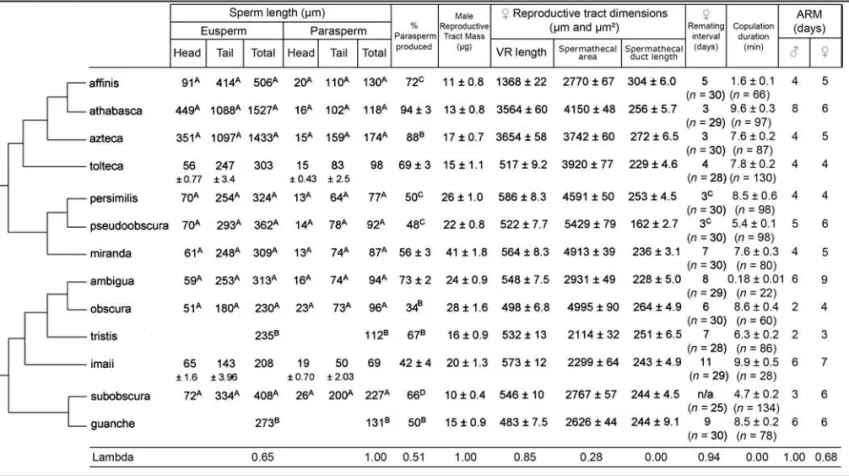
of remating interval (Snook and Markow 2001). We calculated “remating rate” by taking the reciprocal of remating interval for use in the analysis becauseD. subobscurais monogamous (see Table 1); this allowed us to record the remating rate ofD. sub-obscuraas zero (i.e., 1/∞) and place it on a scale with the other species. The food vials in which the females were housed were checked for subsequent progeny production, allowing us to ex-clude females that produced no progeny from their first mating (an indication that the first mating was probably incomplete). We used data from Snook and Markow (2001) to obtain values for remating rate forD. persimilisandD. pseudoobscura. We also obtained values for species mean copulation duration by com-piling data from the remating assays and the age at reproductive maturity trials. Only copulations in which both flies were virgin and reproductively mature were included in the analysis.
SPERM MORPHOLOGY AND DEMOGRAPHY
Where available, we used previously published data on sperm lengths and proportion of parasperm produced. We prioritized publications that measured individual sperm as opposed to sperm bundles. Table 1 gives the origins of the previously published sperm trait data; for the remaining species, sperm head length, tail
Table 1.The table gives mean values±standard error where applicable. Samples sizes aren=30 for the female reproductive tract measurements,n=25 for male reproductive tract mass, andn=10 males for the sperm trait data. VR=ventral receptacle and ARM=
age at reproductive maturity. Data with superscripts were collated from previous publications: A=Snook (1997), B=Joly and Lachaise (1994), C=Snook and Markow (2001) and D=Snook (1995). The table also shows the phylogeny of the group (O’Grady 1999) and the maximum likelihood lambda values of each trait.
length, and number of each type transferred to the female were measured as follows.
Sperm was obtained from the uterus of a female 0.5–1.5 h after mating and diluted in 100L PBS. The sperm mass was gently teased apart with dissecting pins and mixed by drawing it in and out of a pipette. We placed 2.5L of the sperm solu-tion on one slide (for sperm counts) and put the remainder on a second slide with 30L of glycerine, which facilitates the stain-ing of the sperm tail for sperm length measurements. The slides were then processed and stained with DAPI (4 -6-Diamidino-2-phenylindole) for sperm counts (Snook et al. 1994; Snook 1997). We counted sperm from 10 males per species at 400× magnifi-cation under UV illumination (counts were repeatable; eusperm: r=0.84, parasperm:r=0.82, bothP<0.001). To measure eu-sperm and paraeu-sperm length, we photographed 10 eueu-sperm and 10 parasperm from each of 10 males at 400×and measured them using Image Pro Plus software.
PHYLOGENETIC CONTROL AND STATISTICAL ANALYSIS
We used a generalized least squares (GLS) approach to con-trol for phylogenetic dependence (Felsenstein 1985; Harvey and
Pagel 1991), measured by the parameter lambda (), in our log-transformed dataset (Pagel 1999; Freckleton et al. 2002). Lambda is the transformation, estimated using maximum likelihood, that makes the trait data fit the Brownian motion evolutionary model. For traits evolving under Brownian motion, lamda is predicted to be 1; for traits that have evolved entirely independently of phy-logeny lamda is 0. This approach allows a variable degree of phylo-genetic correction, making it preferable to other methods because different traits may not have the same level of phylogenetic de-pendence. The method for estimating lambda, along with worked examples, can be found in Freckleton et al., (2002). Lambda val-ues and GLS models were computed using code written by R.P. Freckleton implemented in R 2.3.1 software. The phylogenetic topology of O’Grady (1999) was used, with branch lengths set equal (i.e., we assumed speciational evolution).
We found that many traits of interest were correlated with body size (see Results) so we controlled for body size in all mod-els by including it as a factor. When examining the relationship between two male traits, body size was measured by male dry body mass (minus the reproductive organs; body mass and male reproductive tract mass are therefore statistically independent); in relationships between two female traits we used female thorax length. When analyzing the relationship between male and female traits, we controlled for male body mass alone to preserve power and avoid collinearity (male body mass and female thorax length were highly correlated;r=0.91). To reduce the chance of com-mitting type II errors, we did not use Bonferroni correction or related techniques (Nakagawa 2004). Instead, we calculated the effect size correlation,r, fromtvalues (Cohen 1977; Colgrave and Ruxton 2003; Immler and Birkhead 2007; Stephens et al. 2007); effect sizes of≥0.5 are considered large for most pur-poses (Cohen 1977). We also present confidence limits (CLs) for effect size to illustrate the range of statistically supported effect sizes.
Results
The means and standard errors of the measured traits are shown in Table 1. Our stock ofD. subobscurawas found to be monogamous, as reported for other cultures (Maynard Smith 1956; Markow and O’Grady 2005); none of the 25 females that survived over the 14-day observation period remated. Also, the copulation du-ration of D. obscura was remarkably brief compared to other Drosophila, lasting an average of 11 sec. We verified that sperm transfer and subsequent offspring production did occur follow-ing these short matfollow-ings. Lambda values were high for most traits (Table 1).
We detected coevolution among many traits in our dataset (summarized in Table 2), with the exception of spermathecal duct length, copulation duration, and both male and female age
at reproductive maturity, which were unrelated to any of the other traits. We will therefore not present further data on these traits.
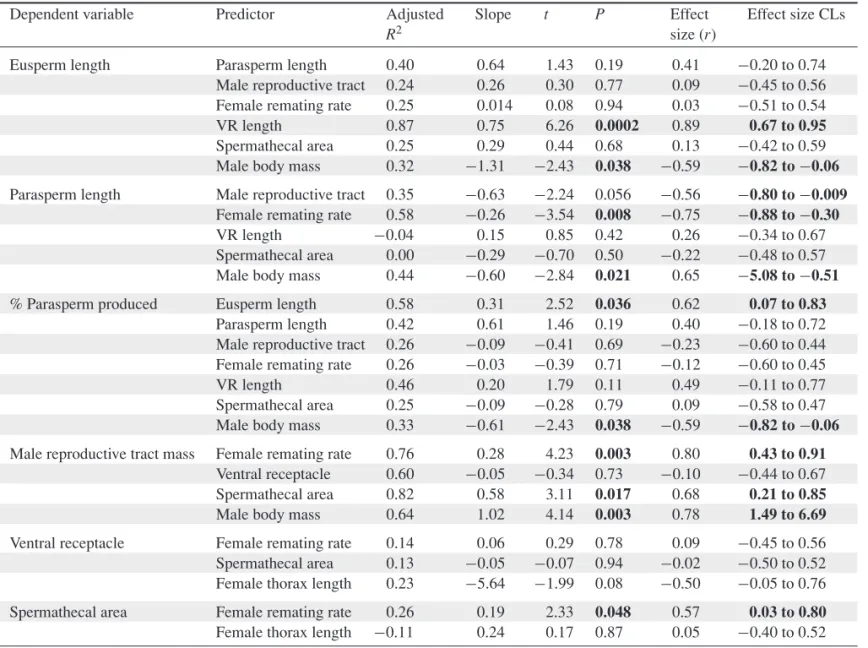
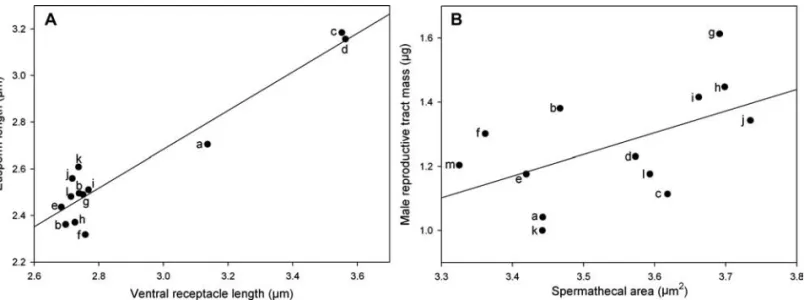
Eusperm length was very strongly correlated with the length of the female VR (Fig. 1A; Table 2), but unrelated to spermath-ecal area. Eusperm length also decreased with male body mass (Fig. 2A), but did not covary with either of our measures of the strength of sperm competition (female remating rate and male re-productive tract mass, which were positively related to each other; Table 2). Eusperm length and parasperm length were not signifi-cantly related (Table 2).
Parasperm length declined as female remating rate increased (Fig. 3A; Table 2), although this relationship was driven byD. sub-obscura, which has the longest parasperm and does not remate. There was also a borderline significant (P=0.056) trend toward a negative relationship between parasperm length and male repro-ductive tract mass (Fig. 3B; Table 2). The observed effect size for this model was large (r=0.56) and the effect size CLs do not span zero; taken together, these results suggest that male reproductive tract mass and parasperm length probably are significantly nega-tively related. None of the measures of female reproductive tract morphology correlated with parasperm length (Table 2). Like eu-sperm length, paraeu-sperm length varied inversely with body mass (Fig. 2B; Table 2).
Parasperm proportion varied with eusperm length such that males with long eusperm had a higher proportion of their ejaculate composed of parasperm (Fig. 4; Table 2). Also, larger species produced a lower proportion of parasperm (Fig. 2C; Table 2). Parasperm proportion was not related to parasperm length, the strength of postcopulatory sexual selection, or the dimensions of the female reproductive tract (Table 2).
Male reproductive tract mass and female remating rate were positively correlated, that is, species with heavy male reproductive systems had females that remated quickly (Table 2). Male repro-ductive tract mass was also positively related to male body mass (Fig. 2D) and spermathecal area (Fig. 1B), but was unrelated to VR length (Table 2).
All female reproductive tract measurements were unrelated to female thorax length (Table 2). VR length and spermathecal area were also unrelated to each other (Table 2). Spermathecal area was positively correlated with female remating rate, but VR length was not related (Table 2).
Discussion
THE EVOLUTION OF SPERM HETEROMORPHISM AND THE FUNCTIONAL SIGNIFICANCE OF PARASPERM
Eusperm size in the obscuragroup is considerably more vari-able than parasperm size; eusperm length varies by greater than
Table 2.Phylogenetically controlled multiple regression models quantifying relationships among reproductive traits inobscuraspecies. All models have male body mass as an additional predictor (statistics for body mass not shown), except where male body mass is the predictor of interest, or in models examining relationships between two female traits (in which female thorax length was used instead). There are 11 degrees of freedom for all tests, except tests in which body size is the only predictor (df=12). The effect sizerand its confidence limits are presented;Pvalues and effect size CLs that indicate statistical significance are shown in bold.
Dependent variable Predictor Adjusted Slope t P Effect Effect size CLs
R2 size (r)
Eusperm length Parasperm length 0.40 0.64 1.43 0.19 0.41 −0.20 to 0.74 Male reproductive tract 0.24 0.26 0.30 0.77 0.09 −0.45 to 0.56 Female remating rate 0.25 0.014 0.08 0.94 0.03 −0.51 to 0.54 VR length 0.87 0.75 6.26 0.0002 0.89 0.67 to 0.95 Spermathecal area 0.25 0.29 0.44 0.68 0.13 −0.42 to 0.59 Male body mass 0.32 −1.31 −2.43 0.038 −0.59 −0.82 to−0.06 Parasperm length Male reproductive tract 0.35 −0.63 −2.24 0.056 −0.56 −0.80 to−0.009
Female remating rate 0.58 −0.26 −3.54 0.008 −0.75 −0.88 to−0.30 VR length −0.04 0.15 0.85 0.42 0.26 −0.34 to 0.67 Spermathecal area 0.00 −0.29 −0.70 0.50 −0.22 −0.48 to 0.57 Male body mass 0.44 −0.60 −2.84 0.021 0.65 −5.08 to−0.51 % Parasperm produced Eusperm length 0.58 0.31 2.52 0.036 0.62 0.07 to 0.83
Parasperm length 0.42 0.61 1.46 0.19 0.40 −0.18 to 0.72 Male reproductive tract 0.26 −0.09 −0.41 0.69 −0.23 −0.60 to 0.44 Female remating rate 0.26 −0.03 −0.39 0.71 −0.12 −0.60 to 0.45 VR length 0.46 0.20 1.79 0.11 0.49 −0.11 to 0.77 Spermathecal area 0.25 −0.09 −0.28 0.79 0.09 −0.58 to 0.47 Male body mass 0.33 −0.61 −2.43 0.038 −0.59 −0.82 to−0.06 Male reproductive tract mass Female remating rate 0.76 0.28 4.23 0.003 0.80 0.43 to 0.91
Ventral receptacle 0.60 −0.05 −0.34 0.73 −0.10 −0.44 to 0.67 Spermathecal area 0.82 0.58 3.11 0.017 0.68 0.21 to 0.85 Male body mass 0.64 1.02 4.14 0.003 0.78 1.49 to 6.69 Ventral receptacle Female remating rate 0.14 0.06 0.29 0.78 0.09 −0.45 to 0.56 Spermathecal area 0.13 −0.05 −0.07 0.94 −0.02 −0.50 to 0.52 Female thorax length 0.23 −5.64 −1.99 0.08 −0.50 −0.05 to 0.76 Spermathecal area Female remating rate 0.26 0.19 2.33 0.048 0.57 0.03 to 0.80 Female thorax length −0.11 0.24 0.17 0.87 0.05 −0.40 to 0.52
sevenfold across our sample whereas parasperm length varies threefold, and there was no correlation between the lengths of the two morphs. These results indicate that eusperm and parasperm size have evolved independently of one another and suggest that different selective pressures have shaped the evolution of the two morphs (Snook 1997), as expected if parasperm are adapted to a novel function.
Parasperm length was negatively correlated with both our measures of sperm competition (remating rate and male repro-ductive tract mass), indicating that if parasperm function in sperm competition, then smaller parasperm are better. Males producing small parasperm could potentially reallocate resources to augment other ejaculatory traits, such as either eusperm or parasperm num-ber, or eusperm length. However, parasperm length is unrelated to either the proportion of parasperm or eusperm length, so we
found no evidence that reduced parasperm size is associated with greater investment in these traits.
Interspecific evidence of sperm competition selecting for re-duced sperm size is rare; in 13 comparative studies of different sperm-monomorphic vertebrates and invertebrates, seven showed a positive relationship between sperm size and sperm competi-tion, five found no relationship and just one detected a negative relationship (reviewed in Snook 2005). In two similar studies of sperm-heteromorphic Lepidoptera, eusperm length increased with sperm competition strength but parasperm size showed no rela-tionship (Gage 1994; Morrow and Gage 2000). Our finding that eusperm length is unaffected by the strength of sperm competition whereas parasperm length is negatively related is therefore sur-prising for two reasons. First, we found selection for smaller sperm under increasing sperm competition, in contrast to the majority of
Figure 1.Coevolution was found between female sperm storage organs and male reproductive traits: (A) ventral receptacle and eusperm length; (B) spermathecal area and male reproductive tract mass. The line is from a GLS regression of the log-transformed data. The letters denote species as follows; a,affinis; b,ambigua; c,athabasca; d,azteca; e,guanche; f,imaii; g,miranda; h,obscura; i,persimilis; j, pseudoobscura; k,subobscura; l,tolteca; m,tristis.
Figure 2.Male body mass is negatively related to the length of both sperm morphs and to parasperm proportion, but is positively corre-lated with male reproductive tract mass: (A) eusperm length, (B) parasperm length, (C) parasperm proportion and (D) male reproductive tract mass. The lines are from GLS regressions of the log-transformed data. See Figure 1 legend for species codes.
Figure 3. Parasperm length varies negatively with both measures of sperm competition: (A) female remating rate and (B) male repro-ductive tract mass. The lines are from GLS regressions of the log-transformed data. See Figure 1 legend for species codes.
other studies. Second, the evolutionary response of heteromor-phic sperm size to sperm competition differs between theobscura group and Lepidopterans, suggesting a difference in parasperm function between these taxa.
In sperm-heteromorphic stalk-eyed flies, both eusperm and parasperm lengths are associated with the size of sperm storage organs (Presgraves et al. 1999). The latter relationship was sug-gested as evidence that parasperm function as cheap filler, filling the female sperm stores to delay her remating (Presgraves et al. 1999). We did not find such a relationship (see also Morrow and Gage 2000), suggesting that parasperm are not cheap filler in Drosophila. The cheap filler hypothesis also predicts: (1) neg-ative associations between either (a) parasperm size and/or (b)
Figure 4. The proportion of parasperm varies with eusperm length. The ejaculates of species with long eusperm contain a higher proportion of parasperm. The line is from a GLS regres-sion of the log-transformed data. See Figure 1 legend for species codes.
abundance and female remating rate, and (2) a positive relation-ship between parasperm abundance and female reproductive tract dimensions. Although we did find a negative relationship between parasperm size and female remating rate, the other predicted rela-tionships were not observed. Therefore, overall, our results sug-gest that parasperm do not function as cheap filler in theobscura group. These results support the conclusion of an intraspecific test of the cheap filler hypothesis inD. pseudoobscura(Snook 1998a). The idea that parasperm are “blockers” that impede entry by rival eusperm to the site of fertilization (Silberglied et al. 1984) would similarly predict coevolution between parasperm size/number and female reproductive tract dimensions, and is therefore not sup-ported by this study (see also Snook 1998a).
The observed trend for smaller parasperm at higher levels of sperm competition allows us to test other hypotheses of parasperm function related to postcopulatory sexual selection. The hypothe-sis that parasperm are produced to enhance males’ success in cryp-tic female choice predicts the production of larger/more parasperm when postcopulatory sexual selection is more frequent (Holman and Snook 2006), which we did not observe. In contrast, a model of the evolution of hypothetical “soldier sperm” (e.g., displacers or killers of rival eusperm) suggested that selection would minimize the size of each soldier (Kura and Nakashima 2000). The idea that parasperm are displacers has not been experimentally tested in the obscuragroup, but our results suggest it may be worth pursuing.
The proportion of parasperm produced by males was pos-itively related to eusperm length, meaning that species with long eusperm produce fewer eusperm and/or more parasperm. A model of the hypothesis that parasperm protect brother eusperm from spermicide in the female reproductive tract predicted that males would produce more parasperm as eusperm became more vulnerable to spermicide (Holman and Snook 2006). Increased
eusperm length could be associated with an increased probability of coming into contact with damaging enzymes in the uterus, meaning that more parasperm are required for adequate pro-tection. This interspecific result motivates experiments to test this idea; it is easily falsifiable by showing that sperm are not killed by contact with the female reproductive tract (Holman and Snook 2006).
REPRODUCTIVE TRAIT EVOLUTION IN SPERM-HETEROMORPHIC AND SPERM-MONOMORPHIC SPECIES
The primary function of eusperm is fertilization. Accordingly, we found that eusperm length has coevolved very closely with the length of the VR, the sperm storage organ used to house sperm that are used first for fertilization (Pitnick et al. 1999). Interspecific correlations between sperm length and female reproductive tract morphology have been found previously in both vertebrate and invertebrate taxa (e.g., Briskie et al. 1997; Minder et al. 2005), including some sperm-heteromorphic insects (Presgraves et al. 1999; Morrow and Gage 2000). These patterns suggest that males may be adjusting sperm length to match evolutionary changes in sperm storage organ size and thereby maximize fertilization success. In support of this interpretation, male success in sperm competition is determined by an interaction between sperm and VR length inD. melanogaster, such that larger sperm are more successful inside females with larger VRs (Miller and Pitnick 2002). This effect is thought to be due to sperm of an appropriate size occupying a superior position near the proximal end of the VR, close to the site of fertilization (Miller and Pitnick 2002; Pattarini et al. 2006). We also found that the area of the spermathecae (where long-term sperm storage occurs; Pitnick et al. 1999), was positively correlated with male reproductive tract mass, just as in sperm-monomorphic dungflies (Minder et al. 2005), further indicating the extent of coevolution between ejaculate size and female sperm storage morphology.
We also found evidence that male investment in the ejaculate varies with the level of female promiscuity, as predicted under sperm competition theory. Similar relationships between testis mass/size and sperm competition have been observed in many other taxonomic groups, including primates, ungulates, amphib-ians, fish, and insects (reviewed in Parker et al. 1997). Males are expected to increase their ejaculatory expenditure under strong sperm competition, and larger testes and accessory glands typ-ically produce more sperm and seminal fluid (Parker and Ball 2005). Thus, our data suggest that females exert selection on males to alter their investment in sperm and/or seminal fluid production in theobscuragroup. We also note that male reproductive tract mass increases with body mass in theobscuragroup as in other Drosophila(Pitnick 1996), and that monogamousD. subobscura males have the lightest reproductive organs in our dataset.
Testis mass and sperm length are highly correlated in sperm-monomorphicDrosophila, which is consistent with the idea that elongated sperm are costly to produce (Pitnick 1996). We did not find a positive relationship between male reproductive tract mass and eusperm length in theobscuragroup, suggesting that longer sperm are not very costly. Additionally, some sperm-monomorphicDrosophilapay for their large sperm with a pro-tracted prereproductive maturation period (Pitnick et al. 1995; Pitnick and Miller 2000), but in this study we found no re-lationship between sperm length and age at reproductive ma-turity. Female investment in elongated VRs comes at the cost of delayed egg-to-adult development and increased mortality in D. melanogaster (Miller and Pitnick 2003). However, we found no relationship between VR length and age at reproductive maturity (i.e., the time between eclosion and reproduc-tive maturity) in the obscura group. These contrasting re-sults between sperm-monomorphic and sperm-heteromorphic Drosophila species raise two possibilities. First, the extreme length of the sperm produced by some sperm-monomorphic Drosophilarelative toobscuraeusperm could elicit correspond-ingly higher and therefore more visible costs. Second, there may be crucial differences in the economics of sperm production be-tween sperm-monomorphic and sperm-heteromorphic taxa.
Assuming that parasperm are cheaper to produce than eu-sperm, sperm-heteromorphic species can hypothetically increase both eusperm length and overall sperm numbers without diverting additional resources to sperm production. They could accomplish this by (1) allocating a greater proportion of the available sperm production resources to making parasperm and/or (2) lowering the cost of each parasperm, for example, by reducing parasperm size or complexity so that more parasperm can be produced (see Holman and Snook 2006). Sperm-monomorphic species do not have these options; to increase sperm length, males have to sacri-fice sperm numbers (Parker 1993) or divert resources away from nonsperm traits (Pitnick et al. 1995; Pitnick 1996; Pitnick and Miller 2000), both of which have associated fitness costs. This potential difference in sperm production strategies may make it more difficult to detect costs of long sperm production in sperm-heteromorphic taxa. In essence, parasperm could allow males to decouple sperm length and number and “have it both ways,” pro-ducing a numerous accessory sperm morph while maintaining large eusperm size and full nonsperm trait function.
We found that all sperm traits varied with male body mass. Larger species had shorter eusperm, shorter parasperm, and produced a lower proportion of parasperm. The obscura group is therefore dissimilar to other spermheteromorphic and -monomorphic insects. In butterflies, both eusperm and parasperm length are positively related to body size (Gage 1994), however, in stalk-eyed flies, body size is unrelated to the length of either sperm morph (Presgraves et al. 1999). In sperm-monomorphic
Drosophilathere is a positive correlation between sperm length and body size (Pitnick 1996). Both sperm length and sperm number are important determinants of sperm competitive abil-ity (e.g., Parker 1993; Gage and Morrow 2003; Snook 2005). The presence of the longest sperm in the smallestobscuraspecies and the highest proportion of eusperm in the largest species is evidence that optimal sperm length and number varies with body size. Our data therefore suggest that smallobscuraspecies benefit most from producing relatively longer eusperm and parasperm, whereas larger species are selected to increase eu-sperm numbers. The positive correlation between eueu-sperm pro-portion and body mass might also indicate that, assuming larger obscuraspecies are more fecund (Honek 1993), males produce more eusperm when females produce more eggs.
These relationships between sperm traits and body size could alternatively be mediated by a correlation between body size and the dimensions of the female reproductive tract. That is, if sperm storage organ morphology covaries with body size, a secondary correlation between sperm size or parasperm proportion and body size could arise if the female reproductive tract imposes selection on sperm traits (as observed in many studies; see above). However, our results do not support this interpretation because the dimen-sions of the female VR, spermathecal area, and spermathecal duct length were not significantly related to female thorax length. Fe-male sperm storage organ size has previously been suggested to increase with body size (Gage 1994), but the results of this study and Presgraves et al. (1999) find no evidence for such a relation-ship. Our results indicate that sperm storage organ evolution may be more strongly affected by other variables, such as female mat-ing frequency and ejaculate volume, compared to body size. In support of this idea, we found that spermathecal area was posi-tively related to both female remating rate, and male reproductive tract mass.
Copulation duration was unrelated to any of the other traits, including sperm length, male reproductive tract mass, female re-mating rate and body size. Variation in copulation duration has been seen as an adaptation to sperm competition (for review, see Simmons 2001; Wedell et al. 2002) and may be a source of sexual conflict (Crudgington and Siva-Jothy 2000). However, our data suggest that copulation duration in this group is not related to sperm competition, the length of sperm or female behavior and morphology in this taxon.
To summarize, many of the reproductive traits we measured were correlated with one another after controlling for the con-founding effects of shared ancestry. We observed patterns of co-evolution that replicate findings from comparative studies of other sperm-monomorphic and sperm-heteromorphic taxa, providing further evidence for candidate universal trends in the evolution of male and female reproductive morphology and behavior. How-ever, we also noted differences in evolutionary responses in both
sperm-heteromorphic and sperm-monomorphic taxa, which may shed light on the functional significance of reproductive trait vari-ation. This study also clarified the potential role of parasperm in theobscuragroup. Our results support previous intraspecific work showing that parasperm are not “cheap filler” and are unlikely to be “blockers” (Snook 1998a), because parasperm did not show the predicted coevolution with sperm storage organs. Our results also suggest that parasperm are not involved in cryptic female choice because we would expect investment in parasperm to be highest when postcopulatory sexual selection occurs frequently, but the reverse was found. We argue that our results are most compati-ble with the hypotheses that parasperm protect brother eusperm inside the female or displace rival eusperm from storage. Both hypotheses predict that parasperm should be comparatively small and cheap, and predict a positive association between eusperm length and the proportion of parasperm as we observed. Future work should investigate these hypotheses intraspecifically to il-luminate the function of parasperm and elucidate the costs and benefits of infertile sperm castes.
ACKNOWLEDGMENTS
We thank N. S. Badcock, H. S. Crudgington, A. Turner, and K. J. Hutchence for their assistance during this project. We are very grateful to W. J. Miller and H. Takamori for supplying fly stocks, and to S. Immler for statistical advice. This work was supported by a NERC studentship to LH and an NSF grant (DEB-0093149) to RRS.
LITERATURE CITED
Bangham, J., T. Chapman, and L. Partridge. 2002. Effects of body size, accessory gland and testis size on pre- and postcopulatory success in Drosophila melanogaster. Anim. Behav. 64:915–921.
Barrio, E., and F. J. Ayala. 1997. Evolution of theDrosophila obscuraspecies group inferred from theGpdhandSodgenes. Mol. Phylogenet. Evol. 7:79–93.
Beatty, R. A., and P. S. Burgoyne. 1971. Size classes of the head and flagellum ofDrosophilaspermatozoa. Cytogenetics 10:177–189.
Birkhead, T. R., and A. P. Møller. 1998. Sperm Competition and Sexual Se-lection. Academic Press, San Diego, CA.
Bjork, A., and S. Pitnick. 2006. Intensity of sexual selection along the isogamy-anisogamy continuum. Nature 441:742–745.
Briskie, J. V., R. Montgomerie, and T. R. Birkhead. 1997. The evolution of sperm size in birds. Evolution 51:937–945.
Buckland-Nicks, J. 1998. Prosobranch parasperm: sterile germ cells that pro-mote paternity? Micron 29:267–280.
Cohen, J. 1977. Statistical power analysis for the behavioural sciences. Aca-demic Press, New York.
Colgrave, N., and G. D. Ruxton. 2003. Confidence intervals are a more useful complement to nonsignificant tests than are power calculations. Behav. Ecol. 14:446–447.
Cook, P. A., and N. Wedell. 1999. Non-fertile sperm delay female remating. Nature 397:486.
Crudgington, H. S., and M. T. Siva-Jothy. 2000. Genital damage, kicking and early death—the battle of the sexes takes a sinister turn in the bean weevil. Nature 407:855–856.
Felsenstein, J. 1985. Phylogenies and the comparative method. Am. Nat. 125:1–15.
Freckleton, R. P., P. M. Harvey, and M. Pagel. 2002. Phylogenetic analysis and comparative data: a test and review of evidence. Am. Nat. 160:712–726. Gage, M. J. G. 1994. Associations between body size, mating pattern, testis size and sperm lengths across butterflies. Proc. R. Soc. Lond. B. 258;247– 254.
Gage, M. J. G., and E. H. Morrow. 2003. Experimental evidence for the evolu-tion of numerous, tiny sperm via sperm competievolu-tion. Curr. Biol. 13:754– 757.
Harcourt, A. H. 1991. Sperm competition and the evolution of nonfertilising sperm in mammals. Evolution 45:314–328.
Harvey, P. H., and M. D. Pagel. 1991. The comparative method in evolutionary biology. Oxford Univ. Press, Oxford, UK.
Healy, J. M., and B. G. M. Jamieson. 1981. An ultrastructural exami-nation of developing and mature paraspermatozoa inPyrazus eben-inus(Mollusca, Gastropoda, Potamididae). Zoomorphology 98:101– 119.
Holman, L., and R. R. Snook. 2006. Spermicide, cryptic female choice and the evolution of sperm form and function. J. Evol. Biol. 19:1660–1670. Honek, A. 1993. Intraspecific variation in body size and fecundity in insects—
a general relationship. Oikos 66:483–492.
Hosken, D. J. 1997. Sperm competition in bats. Proc. R. Soc. Lond. B. 264:385–392.
Immler, S., and T. R. Birkhead. 2007. Sperm competition and sperm midpiece size: no consistent pattern in passerine birds. Proc. R. Soc. Lond. B. 274:561–568.
Joly, D, and D. Lachaise. 1994. Polymorphism in the sperm heteromophic species of theDrosophila obscuragroup. J. Insect Physiol. 40:933–938. Kura, T., and Y. Nakashima. 2000. Conditions for the evolution of soldier
sperm classes. Evolution 54:72–80.
Lessells, C. M., and P. T. Boag. 1987. Unrepeatable repeatabilities—a common mistake. Auk 104:116–121.
Markow, T. A., and P. M. O’Grady. 2005. Evolutionary genetics of repro-ductive behavior inDrosophila: connecting the dots. Annu. Rev. Genet. 39:263–291.
Maynard Smith, J. 1956. Fertility, mating behaviour and sexual selection in Drosophila subobscura. J. Genet. 84:261–279.
Miller, G. T., and S. Pitnick. 2002. Sperm-female co-evolution inDrosophila. Science 298:1230–1233.
———. 2003. Functional significance of seminal receptacle length in Drosophila melanogaster. J. Evol. Biol. 16:114–126.
Minder, A. M., D. J. Hosken, and P. I. Ward. 2005. Co-evolution of male and female reproductive characters across the Scathophagidae (Diptera). J. Evol. Biol. 18:60–69.
Morrow, E. H., and M. J. G. Gage. 2000. The evolution of sperm length in moths. Proc. R. Soc. Lond. B. 267:307–313.
Nakagawa, S. 2004. A farewell to Bonferroni: the problems of low statistical power and publication bias. Behav. Ecol. 15:1044–1045.
O’Grady, P. M. 1999. Reevaluation of phylogeny in theDrosophila obscura species group based on combined analysis of nucleotide sequences. Mol. Phylogenet. Evol. 12:124–139.
Oppliger, A., Naciri-Y. Graven, G. Ribi, and D. J. Hosken. 2003. Sperm length influences fertilization success during sperm competition in the snail Viviparus ater. Mol. Ecol. 12:485–492.
Pagel, M. 1999. Inferring the historical patterns of biological evolution. Nature 401:877–884.
Parker, G. A. 1993. Sperm competition games: sperm size and number under adult control. Proc. R. Soc. Lond. B. 253:245–254.
———. 1998. Sperm competition and the evolution of ejaculates: towards a theory base. Pp. 1–54inT. R. Birkhead and A. P. Møller, eds. Sperm competition and sexual selection, Academic Press, San Diego, CA. Parker, G. A., and M. A. Ball. 2005. Sperm competition, mating rate and the
evolution of testis and ejaculate sizes: a population model. Biol. Lett. 1:235–238.
Parker, G. A., M. A. Ball, P. Stockley, and M. J. G. Gage. 1997. Sperm com-petition games: a prospective analysis of risk assessment. Proc. R. Soc. Lond. B. 264:1793–1802.
Pasini, M. E., C. A. Redi, O. Caviglia, and M. E. Perotti. 1996. Ultrastructural and cytochemical analysis of sperm dimorphism inDrosophila subob-scura. Tissue Cell 28:165–175.
Pattarini, J. A., W. T. Starmer, A. Bjork, and S. Pitnick. 2006. Mechanisms underlying the sperm quality advantage inDrosophila melanogaster. Evolution 60:2064–2080.
Pitnick, S. 1996. Investment in testes and the cost of making long sperm in Drosophila. Am. Nat. 148:57–80.
Pitnick, S., and G. T. Miller. 2000. Correlated response in reproductive and life history traits to selection on testis length inDrosophila hydei. Heredity 84:416–426.
Pitnick, S., T. A. Markow, and G. S. Spicer. 1995. Delayed male maturity is a cost of making long sperm inDrosophila. Proc. Natl. Acad. Sci. USA. 92:10614–10618.
———. 1999. Evolution of multiple kinds of female sperm-storage organs in Drosophila. Evolution 53:1804–1822.
Presgraves, D. C., R. H. Baker, and G. S. Wilkinson. 1999. Coevolution of sperm and female reproductive tract morphology in stalk-eyed flies. Proc. R. Soc. Lond. B. 266:1041–1047.
Rogers, D. W., T. Chapman, K. Fowler, and A. Pomiankowski 2005a. Mating-induced reduction in accessory reproductive organ size in the stalk-eyed fly Cyrtodiopsis dalmanni. BMC Evol. Biol. 5: 37–42.
Rogers, D. W., R. H. Baker, T. Chapman, M. Denniff, A. Pomiankowski, and K. Fowler 2005b. Direct and correlated responses to artificial selection on male mating frequency in the stalk-eyed flyCyrtodiopsis dalmanni. J. Evol. Biol. 18:642–650.
Simmons, L. W. 2001. Sperm competition and its evolutionary consequences in insects. Princeton Univ. Press, Princeton, NJ.
Snook, R. R. 1997. Is the production of multiple sperm types adaptive? Evo-lution 51:797–808.
———. 1998a. The risk of sperm competition and the evolution of sperm heteromorphism. Anim. Behav. 56:1497–1507.
———. 1998b. Sperm production and sterility in hybrids between two subspecies of Drosophila pseudoobscura. Evolution 52:266– 269.
———. 2001. Absence of latitudinal clines in sperm characters in North Amer-ican populations ofDrosophila subobscura(Diptera: Drosophilidae). Pan-Pacific Entomol 77:261–271.
———. 2005. Sperm in competition: not playing by the numbers. Trends Ecol. Evol. 20:46–53.
Snook, R. R., and T. A. Markow. 1996. Possible role of nonfertilizing sperm as a nutrient source for femaleDrosophila pseudoobscuraFrolova (Diptera: Drosophilidae). Pan-Pacific Entomol. 72:121–129.
———. 2001. Mating system evolution in sperm-heteromorphicDrosophila. J. Insect Physiol. 47:957–964.
———. 2002. Efficiency of gamete use in nature: sperm storage, fertilization and polyspermy. Proc. R. Soc. Lond. B. 269:467–73.
Snook, R. R., and T. L. Karr. 1998. Only long sperm are fertilization-competent in six sperm-heteromorphicDrosophilaspecies. Curr. Biol. 8:291–294. Snook, R.R, T. A. Markow, and T. L. Karr. 1994. Functional non-equivalence of sperm inDrosophila pseudoobscura. Proc. Natl. Acad. Sci. USA 91:11222–11226.
Silberglied, R. E., J. G. Shepherd, and J. L. Dickinson. 1984. Eu-nuchs: the role of apyrene sperm in Lepidoptera. Am. Nat. 123:255– 265.
Stephens, P. A., S. W. Buskirk, and C. Martinez del Rio. 2007. Inference in ecology and evolution. Trends Ecol. Evol. 22:192–197.
Swallow, J. G., and G. S. Wilkinson. 2002. The long and the short of sperm polymorphisms in insects. Biol. Rev. 77:153–182.
Takamori, H., and H. Kurokawa. 1986. Ultrastructure of the long and short sperm ofDrosophila bifasciata(Diptera: Drosophilidae). Zool. Sci. 3:847–858.
Till-Bottraud, I., D. Joly, D. Lachaise, and R. R. Snook. 2005. Pollen and
sperm heteromorphism: convergence across kingdoms? J. Evol. Biol. 18:1–18.
Ward, P. I. 1998. Intraspecific variation in sperm size characters. Heredity 80:655–659.
Wedell, N., M. J. G. Gage, and G. A. Parker. 2002. Sperm competition, male prudence and sperm-limited females. Trends Ecol. Evol. 17:313–320.

![4,8 Bis[(4 butylphenyl)amino] 1,5 naphthalenedione](data:image/gif;base64,R0lGODlhAQABAIAAAP///wAAACH5BAEAAAAALAAAAAABAAEAAAICRAEAOw==)