Group Care for the Pediatric Well-Child Population: A qualitative study
By Sarah Brier
A Master's Paper submitted to the faculty of the University of North Carolina at Chapel Hill
in partial fulfillment of the requirements for the degree of Master of Public Health in
the Public Health Leadership Program.
ABSTRACT
Background: The Institute of Medicine and Future of Family Medicine Project encourage
physicians to develop innovative models of care to better meet patients' changing health care needs. Although interest in the group care model is growing, little is known about the practicality and application of group visits for infant well-child care.
We created and implemented a group model of well-child visits, WellBabies. As an initial step to assess well-child group visits, we conducted a study to explore the experiences and perceptions of parents who participated in the WellBabies program. The specific aims of the study were to: (1) understand parents' preferences and rationales for choosing the WellBabies program instead of regular care; (2) determine parents' opinions regarding favorable and
unfavorable aspects ofWellBabies; (3) understand parents' needs and preferences regarding the preventive well-child visits; and (4) elicit feedback for improvement of the WellBabies program. Methods: In preparation for this exploration, a systematic review ofliterature pertaining to pediatric well-child group visits was performed in order to obtain evidence on the development, utilization and progress of the group visit. The MEDLINE database and Cochrane Library were searched, and articles from 1972 - 2007 were selected based on outlined criteria.
Then, individual semi-structured interviews were conducted with mothers who
Results: The systematic review of the literature included seven studies satisfying the outlined
criteria. The studies were of varying quality, used diverse designs and examined a variety of
outcomes. All of the studies found that group visits were at least as efficient and effective as the
individual visits. In two studies examining patient satisfaction or perception, group visits were
found to be a positive experience with at least equivalent satisfaction as individual visits.
In the interviews with WellBabies participants, most frequently given reasons to
participate include additional support from other parents and the provider, additional time with
the doctor, and desire for a social activity. Participants enjoyed many aspects ofthe visit
including the structure of the group visits, the widespread support and having other children to
see and learn from. Few participants had dislikes, but suggestions for improvement included
additional administrative support and patient education materials. Only one of the 13 participants
said that lack of individual time was a disadvantage of the group visits.
Discussion: WellBabies group visits appear to be a positive experience for the participants and a
promising alternative model of care. Next steps include increasing organization and developing
comprehensive education materials for the participants. Future study includes a cost
effectiveness evaluation of the WellBabies program and a prospective comparison of health
INTRODUCTION
Well-child care is an important part of every child's health care. Regular well child visits are organized, starting at birth, to assure that physicians have the opportunity to screen for developmental progress and pediatric health conditions, as well as to provide age-appropriate immunizations. There are also important opportunities for educating the child's parent or
guardian and providing anticipatory guidance at every well-child visit. Therefore, well-child care is an integral part of the health care system for children.
Foundations for health, including physical, emotional, and cognitive health, are established early in life and can be further developed at well-child visits.' Although questions still remain regarding the efficacy of individual recommended interventions for the well-child visit,2 consistent well-child care has been shown to improve health outcomes.
In 200 I, the Institute of Medicine acknowledged the need for a change in the delivery of America's health care in the report, Crossing the Quality Chasm3 These needs relate to
increasing numbers of patients from a variety of cultures, minimal financial resources, and a rising group of uninsured patients.4 The Future of Family Medicine Project (FOFM) also encourages family physicians to develop innovative models of care to better meet patients' changing health care needs5•4 The purpose of this paper is to discuss group visits as a new model
Background on Traditional Well-Child Care
Traditionally, well-child care involves an individual visit scheduled with the child's
primary care provider. The American Academy of Pediatrics (AAP) has issued recommendations
for preventive pediatric health care for each visit during infancy, childhood and adolescence,
which vary depending on the individual health needs of the child and his or her care-givers.
These guidelines extend from the prenatal period to 21 years of age and address elements of
preventive care such as vision and hearing screening, immunizations, cholesterol screening and
anticipatory guidance. 6
Although the efficacy of all elements of the well-child visit is still being investigated, it
has been shown that consistent well-child care in the first two years can decrease preventable
hospitalizations.7 However, studies show that many children do not comply with the schedule
recommended by the AAP.8 A recent study based on evidence from the 2000-2002 Medical
Expenditure Panel Survey showed that only 44 percent of all children had attended one or more
well-child visits in one year preceding the survey, and a mere 61 percent of all children had seen
a provider for a well-child visit in the previous two years. 8 Discrepancies existed based on the
age of the child, insurance status and caregiver's level of education.
With fewer than half of all children seeing a provider armually for preventive care,
traditional well-child care is not addressing the health care needs of those it is setting out to
serve. A study recently showed that 94 percent of parents said they had one or more unmet needs
regarding four specified measures of guidance, education, screening for psychosocial risk and
screening for smoking, drug and alcohol use.9 With financial constraints and the limitations of
the current medical system, physicians are limited in how much guidance and education they can
impossible to cover every recommended item for the physical exam in such a short amount of
time in addition to completing the immunizations, hearing screen and vision screen.10
Although there are recommendations for what should be addressed in well-child visits, no
standards exist for conducting the encounter." With the recommendations' efficacy in question,
the value of a well-child visit as far as insurance coverage and reimbursements are concerned is
at risk.11 Also, with so many parents left feeling their needs were unmet and physicians frustrated
by severe time constraints that limit their ability to provide comprehensive care, it is timely to
examine how well-child care is delivered.
A New Model of Care
One innovation that may address these needs is the establishment of group care.12 Group
visits entail a similar set of components as individual care, but are delivered in a group setting.
The group may be six to eight persons, but varies depending on the purpose of the group visit,
which is often patient education and self-management topics such as medicine management,
nutrition, and exercise.13 By seeing many patients together for a longer period oftime, the time
the provider spends with the patients is increased and in theory it is economically
advantageous.13 Also, by offering alternatives and choices in health care, different types of
patients may gravitate toward one or the other approach.
There are potential drawbacks to this model however. Although the physician is in a
room with the patients for a longer time than with traditional visits, there may be less
individualized attention than in the typical 20-minute appointment for one patient. Other
elements that may hinder group care include finding an adequate space as well as a time
Group visits for chronic diseases
Group visits have to-date generally been of two types: drop-in group medical
appointments (DIGMAs) and diagnosis-specific. Diagnosis-specific group visits have gained attention, particularly within the Chronic Care Model, which was found to improve care and potentially reduce costs for diabetic patients.14• 15 Another study identified advantages of the group visit model for diabetic patients as improved organization, higher educational value, and more frequent visitations.16 This one-year randomized controlled trial compared diabetics' clinical outcomes and quality of care measures for those participating in group models of care to those in traditional, individual care. Although clinical measures, including HbA 1 c, blood
pressure and lipid panels, did not differ significantly between the two groups, over the longer-term, patients receiving group care had higher quality of care indicators and better screening rates for breast and cervical cancers.16
A 2006 review paper on group model practices found improvements over traditional care in patient and provider satisfaction, trust in the provider, utilization of services, quality of care, and provider productivity. The review found few improvements in the cost of care. The authors acknowledged great variability in group model design and outcome measurements as threats to the generalizability of their findings, but noted consistency in improved satisfaction.13
Group visits for prenatal care
individual responsibility for their own health.12 The groups meet regularly with an
interdisciplinary team of providers, and as of 2006, over I 00 sites were participating in group prenatal care throughout the United States and Canada.12• 19 An analysis of CenteringPregnancy© participants found that compared to traditional care, women in the group program had longer gestations and heavier birth weights, especially in preterm births.20 A further benefit of the prenatal group care model is the additional time for each visit as compared to traditional care.Z1
The prenatal group visit model has been shown to be especially attractive for adolescents as it has unique empowerment, peer support, and socialization components not occurring in traditional, individual care. 12• 22 CenteringPregnancy© has also been shown to improve health outcomes of pregnant adolescents and increase patient satisfaction and compliance.23
Applying the group model to pediatric health care
While the group care model has been successful in visits dedicated to chronic diseases of adulthood and in CenteringPregnancy©, ironically little is known about the very first model of group care developed in 1974- group well-child care then known as "cluster visits."24
of 11 groups requested that the group visits continue, and the clinicians delivering the group care
thought the model was effective?6
In contrast to the review findings mentioned above, in which all group-visit models
decreased the utilization of additional health services, Osborn's study of group well-child care
did not show that patients had a significant difference in emergency department visits or calls to
providers related to illness. 26 This trial was small, the population narrow, and realizing the
potential for bias, authors called for further research to examine efficiency, efficacy and other
outcomes relating to group well-child care, as preliminary results were promising.
The author of the aforementioned study, Osborn, published additional articles in 1982
and 1985 describing the format, potential for use, and the benefits of well-child group care.27• 28
Based on 15 years of group model use, in 1989, Osborn then published an article on the
opportunity for patient education in group well-child care?9 She discussed perceived benefits of
the model including the opportunity for lengthy patient education sessions, support groups and
reassurance for the children as they are in a setting with other children.29
However, few articles specifically covering group well-child care have been published
since the 1980s. In the late 1990s, Taylor eta!. published a collection of articles on group care
specifically targeting high-risk children and their mothers. The articles examined maternal-child
interactions and developmental outcomes as well as infant health care utilization, health status
and maternal health outcomes. 30"32 These articles were the result of a randomized controlled trial
including infants qualifying as high risk based on one or more of the follow maternal criteria as
defined by Taylor, eta!.: poverty, single, less than a high school education, less than 20 years of
age at delivery, history of substance abuse or history of physical abuse?0 They concluded that
well-child care was just as good as individual care.30• 32 With respect to health care utilization and health status analysis, high-risk children receiving group care did not differ from those receiving individual care.31 Because there was not an increase in provider time needed to conduct the groups, authors concluded that group well-child care was a promising alternative to individual care.
Group models have been used for pediatric chronic diseases and mental health although neither of these has been well studied. Most of these "group" models were based on patient education, family teaching or therapy. Asthma, a chronic disease of childhood, was a focus of various group models. A Cochrane Collaboration review examined educational interventions for asthma in children.33 They found that individual and group interventions resulted in similar improvements in lung function, self-efficacy and emergency department visits. 15 They note however, that the number of studies available for comparison between individual and group interventions is very small. They reported trials that compared a combination of individual and group interventions but no studies that were a direct comparison of individual versus group care for asthma.15 Although group settings are being used for asthma education, they have little evidence to guide them and support the intervention.
In 2004 an article was published illustrating a new collaborative approach to preventing conduct disorder in at risk rural preschool children by using a group care model.34 This program "Learning, Enjoying, Growing, Support" (LEGS) was designed to develop social skills in participating children and enhance parenting for the caregivers. At the conclusion of the
program, there was a decrease in problem behavior, an increase in children's social skills, and an increased sense of support from the parents' perspectives?4 This study is unlikely to be
care setting can provide support to parents in the health care system and reach a somewhat "unreachable" community.
Following CenteringPregnancy© is yet another model of group child care known as "CenteringParenting."35 Established by The CenteringPregnancy© and Parenting Association (CPPA) in 2001, this group is working to develop a pediatric group care model that will allow mothers involved in CenteringPregnancy© to continue groups for their child's care during the first year of the child's life. No further information regarding this model was available after the proposal in 2004, although the website for CPPA (http://www.centeringpregnancy.comL) does refer to ongoing training workshops for "CenteringParenting."35
In summary, it remains unclear if a pediatric group model will work in the current health care climate for well-child care. The model used by Osborn et al. differs from the newer group models in design. The older model included physical exams in an individual setting with
counseling and education in the group; yet many of the newer group models provide all elements of the visit within the group setting.Z9 Instead of the provider weighing, measuring and
examining each child individually, in many oftoday's models, the caregivers participate in the weighing and measuring, learn to do it on their own, and help each other with the process. Since 1997, the economy of health care is changing, increasing demands and strains are being placed on providers, and an analysis needs to consider well-child group visits in the current
Part I. Literature Review
Systematic Review of Group Well-Child Care
A systematic review of literature pertaining to pediatric group visits was performed in order to obtain evidence on the development, utilization and progress of the group visit. The body of evidence existing for group visits was known to be limited, but it is growing as group visits are becoming more popular and further studied. However, many of the existing articles relate to group visits in the adult population as a model of treating chronic disease.
METHODS
Key Questions
This literature search was focused on pediatric, well-child group visits. The following primary questions were examined:
1. Has a model been developed for delivering group well-child care to the pediatric population?
2. Are parents/caregivers satisfied with the group model of care for well-child visits? 3. Are group models an efficient mode of delivery of well-child care?
Inclusion and Exclusion Criteria
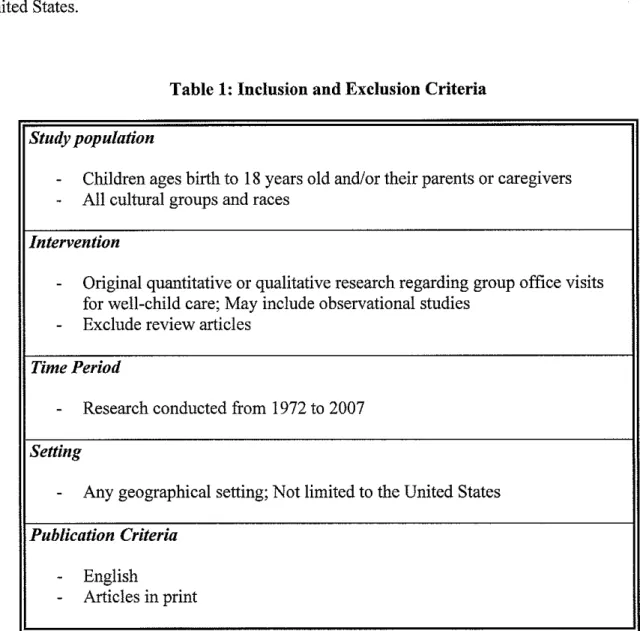
Due to the limited body of evidence, very broad inclusion and exclusion criteria were
generated for this review (Table 1 ). The review included any article relating to group visits
provided that it was original research focused on pediatric well-child care. Although current
practices are evolving, due to the scarcity of the literature a broad range of dates were included
of publication between 1972 and the present. Studies were not limited to those conducted in the
United States.
Table 1: Inclusion and Exclusion Criteria
Study population
-
Children ages birth to 18 years old and/or their parents or caregivers-
All cultural groups and racesIntervention
-
Original quantitative or qualitative research regarding group office visits for well-child care; May include observational studies-
Exclude review articlesTime Period
-
Research conducted from 1972 to 2007Setting
-
Any geographical setting; Not limited to the United StatesPublication Criteria
-
EnglishLiterature Search
Databases and search terms
The search included the MEDLINE database and the Cochrane Library. A wide variety of search terms were used beginning with the seemingly broad term "group visit*." Other terms were used including but not limited to: "group office visit*," "group care," "group appointment," "group well child," "group well baby," and "group model." They were combined in multiple ways with medical subject headings (MeSH). MeSH terms: "models, organizational," "child health services/organization & administration," "health promotion/organization &
administration," and "patient education" were found to be pertinent to the topic of interest. Article selection and review
MEDLINE: No articles were found when using the search terms: "(pediatric* OR
paediatric* OR child OR children) AND ("group visit*")." Searching only "group visit*" yielded few results (n=28). Searching "(pediatric* OR paediatric* OR child or children)" resulted in
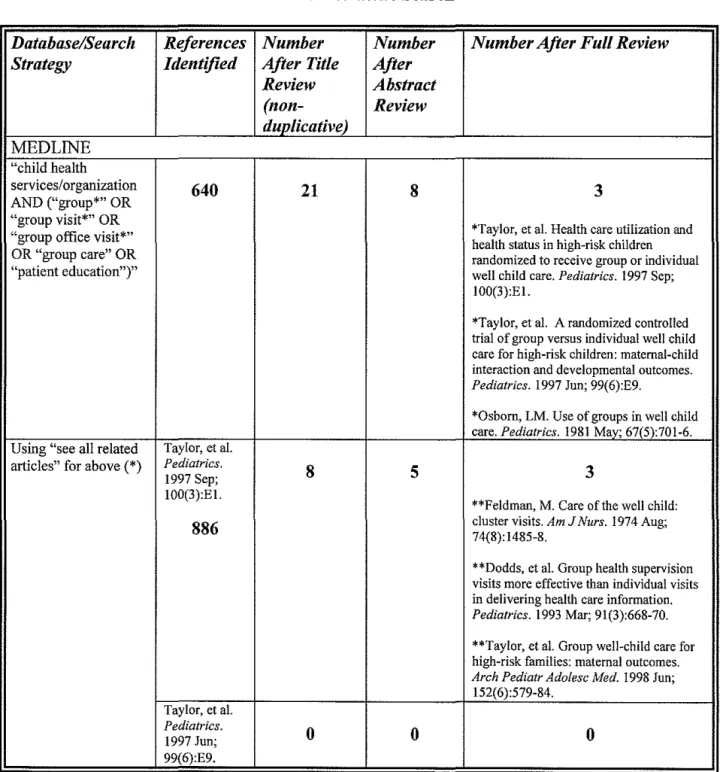
1,503,252 articles. In an attempt to further limit, this search was combined with "("group visit*" OR "group office visit*" OR "group appointment*" OR "group medical appointment*" OR "group well child" OR "group well baby" OR "group model")" (n= 24,285) and resulted in no articles. Using the MeSH term "child health services/organization," 7,524 articles resulted. Searching a combination: "child health services/organization AND ("group*" OR "group visit*" OR "group office visit*" OR "group care" OR "patient education")" yielded 640 results. This was narrowed by title and abstract review to eight articles for full review and three fit the selection criteria.
not duplications of already selected references. The references of the six selected articles were reviewed for additional relevant references. This method resulted in 104 additional articles of which one was relevant. A total of seven articles were finally selected for review (Table 2).
Table 2: Literature Search
l>atabase/~earch References Number Number Number After Full Review
~trategy Identified After Title After Review Abstract
(non- Review
duplicative)
MEDLINE
"child health
services/organization
AND ("group*" OR
640
21
8
3"group visit*" OR
*Taylor, et al. Health care utilization and
"group office visit*" health status in high-risk children
OR "group care" OR randomized to receive group or individual
"patient education")" well child care. Pediatrics. 1997 Sep; 100(3):El.
*Taylor, et al. A randomized controlled trial of group versus individual well child care for high-risk children: maternal-child interaction and developmental outcomes.
Pediatrics. 1997 Jun; 99(6):E9.
*Osborn, LM. Use of groups in well child care. Pediatrics. 1981 May; 67(5):701-6. Using "see all related Taylor, eta!.
articles" for above (*) Pediatrics.
8
5 31997 Sep; 100(3):El.
**Feldman, M. Care of the well child:
886
cluster visits. Am 74(8):1485-8. J Nurs. 1974 Aug;**Dodds, et al. Group health supervision visits more effective than individual visits in delivering health care information.
Pediatrics. 1993 Mar; 91(3):668-70.
**Taylor, et al. Group well-child care for high-risk families: maternal outcomes.
Arch Pediatr Ado/esc Med. 1998 Jun;
152(6):579-84. Taylor, eta!.
Pediatrics.
0
0
0
491
Osbom,LM.
Pediatrics. 2
2 0
1981 May; 67(5):701-6.
126
Using references from Taylor, et al.
above(*, **) Pediatrics.
1997 Sep; 0 0 0
100(3):El.
21 Taylor, et al.
Pediatrics.
1 1 1
1997 Jun; 99(6):E9.
Rice RL, Miles CE, Slater CJ. An analysis
31 of group versus individual health supervision visits. AJDC. 1992;146:488. Abstract only.
Osbom,LM. Pediatrics.
0 0 0
1981 May; 67(5):701-6.
12
Feldman, M.
AmJNurs. 0 0
0
1974 Aug; 74(8):1485-8.
3
Dodds, et a!. Pediatrics.
0 0 0
1993 Mar; 91(3):668-70.
10 Taylor, et al.
Arch Pediatr
0 0 0
Adolesc Med. 1998 Jun; 152(6):579-84:
27
Cochrane Library (group and child or
pediatric and well 1447 2 1 0
child)
"group visit*" 28 0 0 0
Evaluation of Quality
Quality rating
The quality of each selected article was assessed by a numerical grading scale. The scale took into account the study question, the population, the intervention, outcome measures, the adequacy of any statistical measures and the control of potential biases (through blinding, randomization, etc). These domains for evaluation were adapted from information presented by Lohr's summary of review systems.36 Using Lohr and West, eta!., a numerical scale was developed and ratings were assigned to each study as 0 =poor, 1 =fair, 2 = good.36•37
A peer article selection and review process was used. One reader initially searched the databases for articles, and in the case of large returns eliminated based on title. Foil owing this initial step, a second rater became involved at the abstract level reading those that had been eliminated without certainty. If any discrepancy resulted, a third rater served as an adjudicator. After the fmal selection of articles was determined, raters assigned a number to each article and the numbers were averaged for a composite score. This rating process has not been validated and thus is left to careful interpretation, however it is based on evidence for reviews of this type.36• 37
visits, efficiency, effectiveness, content and other health-related outcomes such as health care utilization and immunization rates.
RESULTS
Source Table
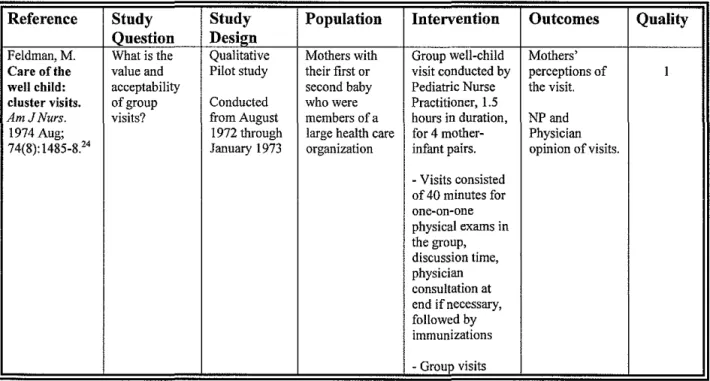
Full search results are illustrated in Table 3. For each of the seven articles fulfilling the inclusion criteria, an evaluation of the study question, the population, the intervention, outcome measures, the adequacy of any statistical measures and the control of potential biases (through blinding, randomization, etc.) was evaluated. Using Lohr and West, eta!., a numerical scale was developed and ratings were assigned to each study as 0 =poor, 1 = fair, 2 = good?6
Table 3: Systematic Review Search Results
Reference Stndy Study Population Intervention Outcomes Quality Question Design
Feldman,M. What is the Qualitative Mothers with Group well-child Mothers'
Care of the value and Pilot study their first or visit conducted by perceptions of l well child: acceptability second baby Pediatric Nurse the visit.
cluster visits. of group Conducted who were Practitioner, 1.5
AmJNurs. visits? from August members of a hours in duration, NPand
1974 Aug; 1972 through large health care for 4 mother- Physician 74(8): 1485-8.24 January 1973 organization infant pairs. opinion of visits.
-Visits consisted of 40 minutes for one-on-one physical exams in the group, discussion time, physician consultation at
end if necessary, followed by immunizations
(four in the first year) were alternated with individual visits
Osborn,LM. To assess the Prospective, 78 Mother- Group visits Efficiency:
Woolley, FR. efficiency, controlled infant pairs including a 45 clinician time 1
Use of groups efficacy, including minute group spent per infant
in well child content, healthy infants discussion
care. process and who are seen by followed by brief Effectiveness:
Pediatrics. patient 8 health care individual patient 1981 May; satisfaction professionals physical exams compliance and 67(5):701-6.26 associated held on the usual utilization of
with group (11 schedule of well- health care
well-child care experimental child visits services
as opposed to groups)
traditional, Content/Process:
individual care Checklist
including, medical, hygiene, behavior, personal, history taking, explanations, anticipatory guidance Satisfaction: assessed by questionnaire of the mother after the second visit and telephone interviews at completion; personal interviews of provider
Rice RL, Miles To compare Prospective, 50 First born Group visits with Knowledge of
CE, Slater CJ. the controlled infants and their 3 or 4 parent- child care and 0.5
An analysis of effectiveness mothers infant pairs lasting development
group versus of group ~I hour questionnaire
individual health visits to conducted at 2, 4, (CDQ),
health individual 6, and 10 months Maternal Social
supervision visits in Support Index
visits. AJDC. teaching about (MSSI) and the
1992;146:488. child care and Center for
Abstract only. 40 development, Epidemiologic
perceived Studies
maternal Depression
support and Scale (CESD)
decreasing maternal depression
Dodds M, (1) Determine Prospective, 31 Pediatricians Group health Infonnation
Nicholson L, the extent to controlled who regularly supervision visits covered in 1 Muse B, et al. which conducted child of 4-6 mother- content areas
supervision cover supervision nutrition,
visits more recommended visits - visits were -45 behavior and
effective than topics during minutes in development,
individual visits preventive duration after family and
in delivering care visits which children parenting, sleep,
health care had an individual immunizations,
information. (2) Compare physical exam and and general
Pediatrics. how much immunizations if health
1993 Mar; material is necessary
91(3); 668-70.'1 covered in and individual visit compared to a group visit
Taylor J, Davis To determine RCT 220 children Group well child Compliance
R,KemperK. if health care conducted less than 4 care with nurse with scheduled 2
Health care utilization and between months old with practitioners at 4, visits,
utilization and health status March 1993 at least one of 5, 6, 7, 10, 12, and emergency
health status in among high- and February the following 15 months of age department
high-risk risk children is 1996 maternal risk visits,
children modified by factors: poverty, - 30-60 minute immunization
randomized to the use of single, age <20 visits consisting rates, time
receive group group well years at of child-rearing per/visit, health
or individual child care as delivery, less issues, physical status using
well child care. compared with than a high exam, screening Stein's
Pediatrics. traditional school and Functional 1997 Sep; one-to-one education, immunizations Status IIR 100(3):EI31 individual well previous
child care substance about, history of abuse
Taylor J, Davis To detennine RCT 220 children Group well child Development:
R, Kemper K. I. if group well conducted less than 4 care at 4, 5, 6, 8, Bayley Scales of I
A randomized child care for between months old with 10, 12 and 15 Infant
controlled trial high-risk March 1993 at least one of months of age. Development
of group versus children and February the following
individual well affects 1996 maternal risk - 30-60 minute Maternal-child
child care for maternal- factors: poverty, visits consisting interaction:
high-risk child single, age <20 of child-rearing Nursing Child
children: interaction and years at issues, physical Assessment
maternal-child development delivery, less exam, screening Teaching Scale
interaction and as compared to than a high and an the Home
developmental these school immunizations Observation for
outcomes. outcomes in education, Measurement of
Pediatrics. children previous the Environment
1997 Jun; receiving substance about, 99(6):E9.30 traditional history of abuse
individual well-child care.
Taylor J, To detennine RCT 220 infants' Group well-child Sense of
KemperK. if health conducted mothers who care from 4 Competence, I
Group well- supervision between had at least one months to 15 Social Isolation
child care for group visits March 1993 of the following months of age. subscale and the
high-risk for infants and February risk factors: Social Support
families: improves 1996 poverty, single, - 30-60 minute Questionnaire
maternal outcomes age <20 years at visits consisting completed by
outcomes. compared with delivery, less of child-rearing mothers
Ado lese Med. visits in high- school exam, screening
1998 Jun; risk mothers education, and
152(6):579- previous immunizations
84.32 substance about,
history of abuse - Social workers met with mothers
during the study
and assessed return to school or work, substance abuse treatment
Findings
Feldman conducted a pilot study in 1974 to explore the perceptions of mothers who participated in a group care model at Kaiser-Permanente.24 She was interested in answering the questions of if patients at the health center "would welcome the innovation," "might mothers be upset by noticing differences between babies," and "would (mothers) fear cross infection between babies in the same examining room?" The qualitative study is limited to women with their first or second child and may be less generalizable to more experienced mothers. At the conclusion ofthe study, perceptions ofthe mothers and the providers participating in the process are questioned. Specific questions asked were not listed although responses reported in the paper allow the questions to be deduced. The exact process of interviewing was not described so an accurate assessment ofthe reliability and validity of the responses cannot be determined.
Osborn and Woolley reported a controlled study comparing women participating in group visits for their infant's well child care to those in traditional, individual care.25 This study has some potential for selection bias as it was not random due to the number of women available. Women chose to participate, but did not know which group they would be assigned to at enrollment. Participants in the study were entirely white, middle class and mostly Mormon contributing to the possibility of bias, confounding and less generalizability. There is also some potential for measurement bias as there were different types of providers conducting the visits. Pediatricians, family practitioners and a family nurse practitioner all provided care and as no attempt was made to standardize the visits, the internal validity may be compromised. However, it is likely more generalizable to general practices.
The measures used in this study included efficiency, process of visit and patient satisfaction. Efficiency was measured by comparing clinician time spent per infant, and
effectiveness was determined by examining the patient's compliance with recommendations and number for visits to health care facilities. Content and process ofthe visits was evaluated by monitoring the provider's way of obtaining and teaching information as well as what information was taught. The content included medical, hygiene, behavior and personal topics, and the process was defined as direct, indirect, explanation and anticipatory guidance. Patient satisfaction was assessed by a questionnaire following the second visit and telephone interviews at the conclusion of the study.
The results of Osborn and Woolley's study showed that group visits were as efficient as traditional, individual visits and required, on average one minute less per patient than individual visits. They found that group visits were more effective than individual visits as mothers
health care services utilized did not vary significantly. The content varied significantly between the group visits and the individual visits. In the group visits, less time was spent on physical aspects of care, and more time was spent on personal issues and daily care. Satisfaction of participants was equivalent whether the mothers participated in group visits or received
individual care. Overall, feedback was positive indicated by eight of the 11 groups requesting to continue the group visits once the study had concluded and 3 7 of 3 8 mothers acknowledging that they would participate in the groups with their next child.
Rice, Miles and Slater describe a comparison of group versus individual care briefly in an abstract.40 The population was over 95 percent white and mostly middle-class and married. This contributes to potential selection bias, confounding and little external validity. It was not random assigrunent, but sequentially determined as to who would participate in the group or individual care. The measurement bias in this study was likely to be low as all of the visits were conducted by the same person. Questionnaires were used to assess the outcomes of knowledge of child care and development, maternal support and maternal depression. The results reported in this abstract, although none were statistically significant, suggest that mothers who participated in group care did obtain more knowledge of child care and development and experienced less depression. The reliability and validity of these scales, CDQ, MSSI, and CESD were not reported in this abstract.
Dodds et a!. examined the effectiveness of group health care by focusing on the amount and extent of information covered by pediatricians in group versus individual care.41 One group of physicians performed only individual visits and the other group held both group and
results. The groups were not evenly distributed and results in potential measurement bias. Also,
the possibility for bias exits as the physician's behavior may be altered when under observation.
The results of this study, however, found that discussions in the group visits addressed
more than half of the recommended content in each category (safety, nutrition, behavioral,
parenting, sleep and toilet training) with no additional time per patient required. However, in
individual visits, except for toilet training, less than half of the recommended content was
discussed.
In Taylor, eta!., "Health care utilization and health status in high-risk children
randomized to receive group or individual well child care," a randomized controlled trial (RCT)
was performed comparing group well-child care to individual well-child specifically in members
of what they define as a "high-risk" population.31 This population was defined as having one or
more of the following maternal risk factors: age <20 years at delivery, poverty, single, less than a
high school education or history of substance or physical abuse. The study was an RCT using
intention-to-treat design to analyze the data. The population was large, but selection occurred
only from urban centers and because of the specific population chosen for this study, it is less
generalizable than desired. In this study, for those patients in experimental and control groups,
the time spent per patient was similar, and there was not a difference in health status (including
immunization rates) or health services utilization. Authors found no benefits unique to the group
visits, but no harms resulted from this model of care. Compliance was low for the group visits
and may bias the results toward the null.
Taylor eta!., in "A randomized controlled trial of group versus individual well child care
for high-risk children: maternal-child interaction and developmental outcomes," a companion to
development and maternal-child interactions.30 The study population was the same as the previous study and has the same limitations. All of the desired outcomes were only obtained on 86 patients thus leading to potential bias and insufficient power. The scales and screening questions have been validated and thus result in reliable information. The main result of this study is that group visits are a feasible option for care in high-risk children. The outcomes were at least equivalent for those children receiving group care as compared to those children in individual care, and no more provider time was needed to accomplish these ends.
Part II: Exploratory Study of Group Well-Child Care
WellBabies program at the University of North Carolina
In 2006, physicians at the UNC Family Medicine Center developed a new group model of care for well-child visits named, "WeliBabies." Two clinicians, with the assistance of the Department of Family Medicine, have implemented the group visits as an alternative way of providing well-child care to their patients. To date, 13 mother-infant dyads have participated in the group visits.
Visits last approximately two hours, and current groups range from four to six
participants. Mothers meet in a large room that is equipped with an examination table, scale, a circle of chairs and play mats. The mothers take turns weighing and measuring their babies and then record this information on the history and physical examination form for the visit. While this occurs, in another area of the same room, providers obtain histories for each individual baby and perform the physical exam. When the group re-convenes, the provider asks what questions the group has for today' s visit. The questions are compiled into a list and recorded on a board in the room. The questions are discussed along with any anticipatory guidance appropriate for the age of the children. Approximately halfway through the visit, the infants are placed on the play mat and allowed to play with toys or interact with each other. During this time, administrative aspects of the visit are conducted, and if the visit requires any routine immunizations they are prepared at this time. The infants then take turns receiving necessary immunizations, the documentation is filled out and any last questions are received by the provider.
Important to any new model of care is how the participants regard the program.
and this study is designed to discover what parents liked, disliked and would change regarding the group model of care. Having the answers to these questions will allow the physicians at the Family Medicine Center to improve their implementation of the group care model. It will also uncover potentially important information for other primary care practices developing group care models for their populations.
METHODS
To fully explore the goals of this study, we analyzed responses from WellBabies group participants to questions posed in a semi-structured interview. The questions were designed to address the following aims: (1) to understand parents' preferences and rationales for choosing the WellBabies program instead of regular care; (2) to determine parents' opinions regarding favorable and unfavorable aspects ofWellBabies; (3) to understand parents' needs and
preferences regarding the preventive well-child visits; and ( 4) to elicit feedback for improvement of the WellBabies program. In an attempt to gain an understanding of the mother's perceptions of the WellBabies groups in its entirety, mothers were also asked to describe their general experience broadly.
The Principle Investigator for this study was Cristy Page, MD, MPH, a Family Medicine physician and Assistant Professor at the University of North Carolina Department of Family Medicine. The study team was comprised of a research assistant to conduct all of the participant interviews and assist in text analysis. A second research assistant also participated in identifying themes of the data. Also involved in the study were two assistants who worked to transcribe the interviews.
Study Design
Study Population and Participant Selection
Participants were recruited from all mothers and infants who participated in the WellBabies group model at the University of North Carolina Chapel Hill Family Medicine Center (UNC FMC) between July 2006 and May 2007. All mothers were made aware ofthe study by UNC FMC physicians who led the WellBabies groups and then contacted personally by the research assistant and asked to participate. To date, 13 mother-infant dyads ofWellBabies participants have been invited.
Data Collection and Analysis
Mother-infant dyads were assigned a unique code number. All information was identified by the code number, and there was no other protected health information linked to the data. A member of the research team contacted the prospective participants by phone describing the purpose of the study and inviting them to participate in an interview about their experiences with well-child group visits at UNC FMC. Interviews were arranged with subjects who agreed and gave verbal consent, and formal consent was obtained at the time of the interview. When participants arrived for the interview, they were again informed of the purpose of the study as well as potential risk and benefits.
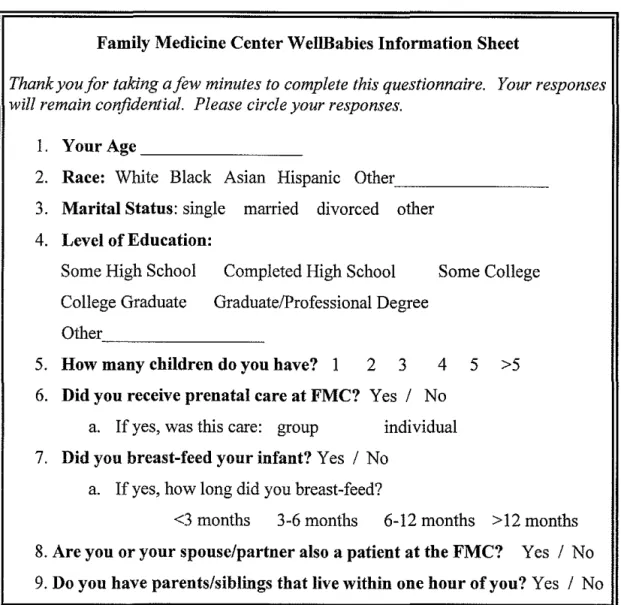
After consent was obtained, participants were asked to provide basic demographic information (Table 4) and then participate in an individual interview. Interviews were held at the UNC Family Medicine Center, the patient's home or other site of their choosing and lasted approximately 30-60 minutes each. All interviews were conducted by one member of the research team, and childcare was available as needed at no cost to the participant. As
interviews.38 The interviews focused on participants' experiences with the infant group visits and any suggestions for improvement (Table 5). The responses were audio-taped to capture all comments, transcribed without link to unique identifiers, and the transcribed document was used for analysis. Consistent with established practice, linguistic notations, pauses, and laughter were omitted
~ithout
compromising the details of the conversation. 38 There was no monetarycompensation for participating.
Table 4: Demographic Information
Family Medicine Center WellBabies Information Sheet
Thank you for taking a few minutes to complete this questionnaire. Your responses will remain confidential. Please circle your responses.
l. Your Age _ _ _ _ _ _ _ _
2. Race: White Black Asian Hispanic Other -3. Marital Status: single married divorced other
4. Level of Education:
Some High School Completed High School Some College College Graduate Graduate/Professional Degree
Other _ _ _ _ _ _ _
5. How many children do you have? 1 2 3 4 5 >5 6. Did you receive prenatal care at FMC? Yes I No
a. If yes, was this care: group individual 7. Did you breast-feed your infant? Yes I No
a. If yes, how long did you breast-feed?
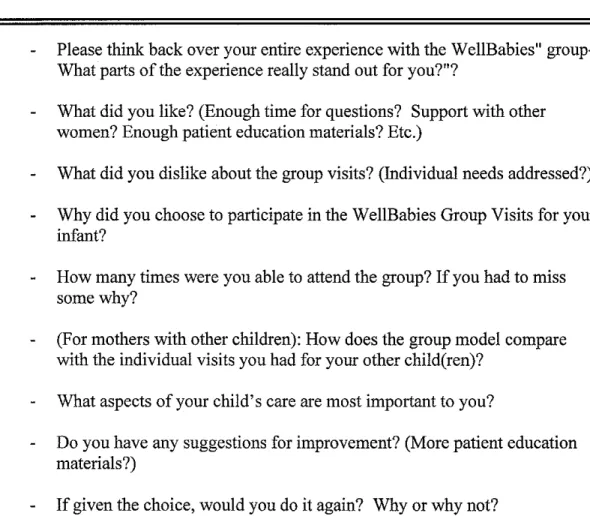
Table 5: Interview Guide
Please think back over your entire experience with the WellBabies" group--What parts of the experience really stand out for you?"?
What did you like? (Enough time for questions? Support with other women? Enough patient education materials? Etc.)
What did you dislike about the group visits? (Individual needs addressed?) Why did you choose to participate in the WellBabies Group Visits for your infant?
How many times were you able to attend the group? If you had to miss some why?
(For mothers with other children): How does the group model compare with the individual visits you had for your other child(ren)?
What aspects of your child's care are most important to you?
Do you have any suggestions for improvement? (More patient education materials?)
If given the choice, would you do it again? Why or why not?
In addition to the caregiver's interview, health behavior and health services data was extracted from the infant's medical record (Table 6).
Table 6: Infant's Health Information
The following was obtained by a medical record review: What was the infant's gestational age at birth? What is the infant's insurance status?
What is the infant's birth order (1 ''child, 2nd child, etc.)?
Consistent with established qualitative methods, editing analysis was used to examine the data, and key words were extracted from the transcriptions to identify analytic categories which were then assigned a code.38• 39 Two members of the research team independently read the interviews and highlighted significant responses relevant to the analytical categories. The team of researchers discussed the themes identified and developed and elaborated on the observations made by reading the interview transcripts. Based on the questions asked in the semi-structured interviews and the stated aims of the study, the responses were identified and grouped to address each area of interest for this study. Where there was disagreement on the assignment of
responses to a particular analytic category or theme, a third member of the team independently reviewed the disputed data. Disagreements were resolved by further discussion of the questioned response and review of the appropriate categories and resultant themes.
RESULTS
Demographic Information
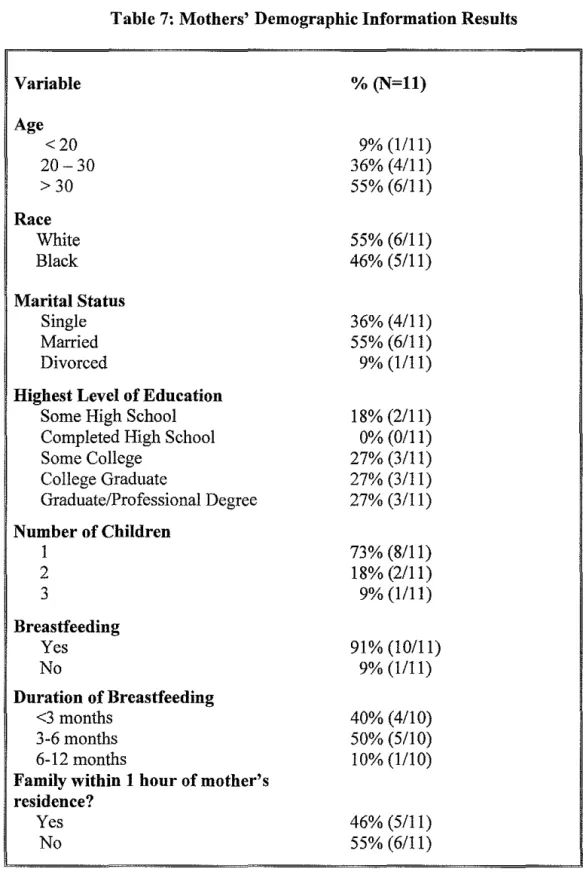
Table 7: Mothers' Demographic Information Results
Variable % (N=ll)
Age
<20 9% (1111)
20-30 36% (4/11)
>30 55% (6/11)
Race
White 55% (6/11)
Black 46% (5/11)
Marital Status
Single 36% (4/11)
Married 55% (6/11)
Divorced 9% (1111)
Highest Level of Education
Some High School 18% (2/11)
Completed High School 0% (0/11)
Some College 27% (3/11)
College Graduate 27% (3/11)
Graduate/Professional Degree 27% (3/11) Number of Children
I 73% (8/11)
2 18% (2/11)
3 9% (1111)
Breastfeeding
Yes 91% (10/11)
No 9% (1111)
Duration of Breastfeeding
<3 months 40% (4/10)
3-6 months 50% (5/10)
6-12 months 10% (1/10)
Family within 1 hour of mother's residence?
Yes 46% (5/11)
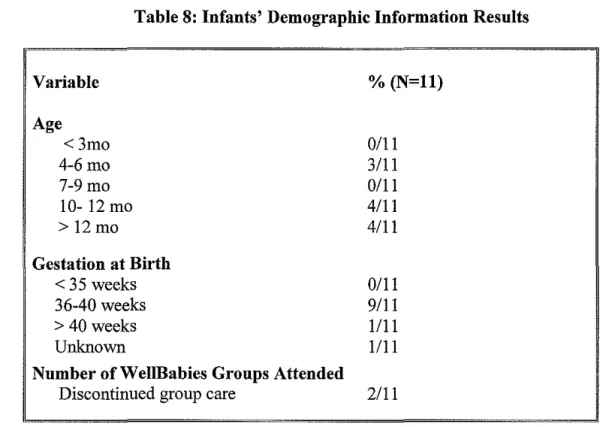
Basic health information for the infants was also obtained for each of the infants who
received group care including date of birth, gestation at birth, and group attendance rate (Table
8).
Table 8: Infants' Demographic Information Results
Variable Age <3mo 4-6mo 7-9mo 10-12mo
> 12mo
Gestation at Birth
<35 weeks 36-40 weeks
> 40weeks Unknown
Number ofWeiiBabies Groups Attended
Discontinued group care
Interview Responses
% (N=ll)
0/11 3/11 0/11 4/11 4/11 0111 9111 1/11 1/11 2/11
All 11 participants interviewed stated that they had an overall positive experience. One
woman summarized her general experience with the WellBabies group by saying, "I enjoy
coming to the groups. I think in general it's nice to see other babies that are around (my baby's)
age as well as to meet with other parents and hear that everyone's coping or having some of the
same successes and obstacles as well." Another woman said her general experience was also
positive: "I thought it was great. Coming in as a new mom I needed direction, and ... I had a lot
One woman recalled her experience by saying, "I also really, really liked the group
setting .. .I really enjoyed that interaction. I actually looked forward to going to the group visits.
I think it was a very, a very positive thing for both me and for (my child)."
Parents' preferences and rationales for choosing Welillabies
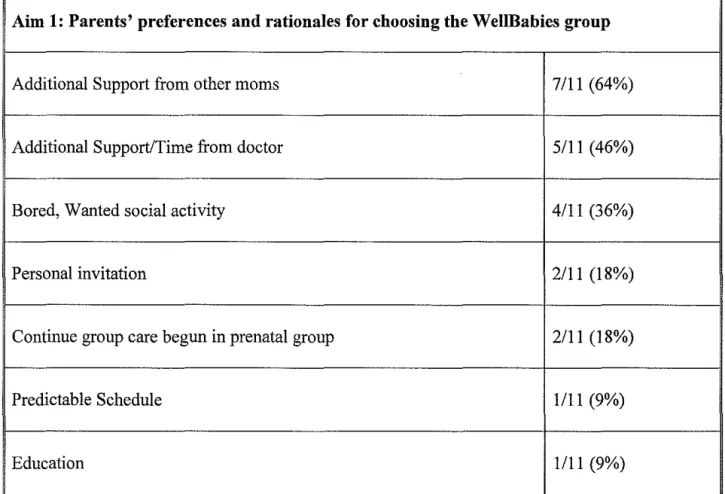
The first defined aim of the study was to understand parents' preferences and rationales
for choosing the WeliBabies program instead of traditional, individual care (Table 9). Reasons
stated for patients' reasons to participate included wanting additional support, education, and
time from the doctor and desire for additional support from other moms.
Table 9: Aim 1- Reason for Choosing WellBabies
Aim 1: Parents' preferences and rationales for choosing the WellBabies group
Additional Support from other moms 7/11 (64%)
Additional Support/Time from doctor 5111 (46%)
Bored, Wanted social activity 4111 (36%)
Personal invitation 2/11 (18%)
Continue group care begun in prenatal group 2111 (18%)
Predictable Schedule 1/11 (9%)
One participant said, "I could see how it would be nice to meet with other women and other babies ... I liked the idea that you got a two hour block of time with the physician."
Another mother realized the potential for additional support as she was a new mom with no other support network. "Because I was new, I didn't know anything ... I wanted to hear other moms and what they are going through to see if I'm going through similar things. I needed that bond with other mothers."
Many ( 4111) participants also stated that they chose WellBabies because they were bored at home during the day or wanted a social activity in which to participate. One woman said, "Honestly, I wasn't doing anything, just sitting here big and bored, so I decided to (participate), and it was actually fun."
Others (2/11) had been personally invited to join the group, and others (2111) wanted to continue a bond with the same mothers who participated in the prenatal group at UNC,
CenteringPregnancy©, who were also continuing with the pediatric well-child groups. Still another noted that her reasons to participate centered on having a very predictable schedule of visits.
Even with the variety of reasons for choosing to participate, all of the women said they would participate again. One mother said, "(I would participate again) because I think that my experiences- my first time experiences- would help somebody else."
Parents' opinions of favorable and unfavorable aspects ofWeiiBabies
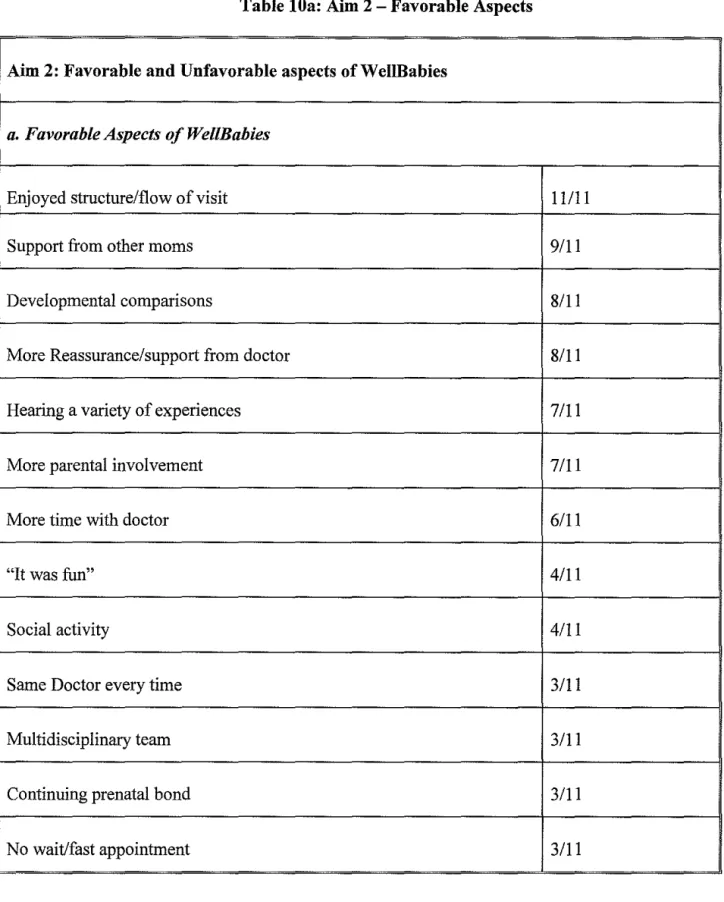
Table lOa: Aim 2- Favorable Aspects
Aim 2: Favorable and Unfavorable aspects ofWelillabies
a. Favorable Aspects of Wel/Babies
Enjoyed structure/flow of visit 11111
Support from other moms 9/11
Developmental comparisons 8/11
More Reassurance/support from doctor 8/11
Hearing a variety of experiences 7/11
More parental involvement 7/11
More time with doctor 6/11
"It was fun" 4/11
Social activity 4111
Same Doctor every time 3/11
Multidisciplinary team 3111
Continuing prenatal bond 3111
Many mothers simply stated that the groups were "fun." Others emphasized the beneficial aspects of additional support from the other mothers and the variety of experiences shared among the group of women. "It's nice," one woman said, "Just to know that you're not out there coping with the stuff all by yourself ... " Another woman, who valued the breadth of experiences shared in the group stated, "It was good (hearing) from so many people. You can get some experience from (other) people who will share it. Especially with a first baby, a first daughter."
Mothers agree that it is helpful to hear the other mothers' concerns as they are often regarding issues that they, themselves have not yet thought of. "I like being with the other moms ... Being a new mom myself, they were able to ask questions that I wouldn't have thought to even ask." Other new mothers wanted not only the experience but support as well. "Just being a first time mom and not really having any family around to help .. .I think it is really important to know what to look out for, and I feel like the questions that other moms ask is very helpful in triggering things for me to ask."
Even for the women who were not first-time mothers, they acknowledged the benefit of sharing experiences and enjoyed being able to help the new mothers. They also realized that these new mothers had valuable insight to share as well. "Being that I wasn't a first time mom, I really felt like I benefited the other moms in there, by having the experience. And then, there were some things they would say that I wasn't aware of, too ... I think it helped both ways." Another mom said, "(The group still benefited me) because some things you go through with your first child you may not go through with your second or third."
with the same doctor every time, longer visits and additional reassurance. One woman said, "The doctor has enough time with the baby to observe her. .. We're in the room for two hours and I'm sure the doctor is paying attention to what is going on with the babies during that whole two hours as opposed to just showing up in the doctor's office for ten minutes and that's the chunk of time you observe."
In addition to the provider, the group setting allowed for multi-disciplinary support that mothers recognized as a benefit. One mother said, "I really enjoyed just learning and knowing what to expect and learning from other moms and learning from the doctor and learning from the nurse. In individual visits you don't have the lactation nurse in there with you, and so that's always helpful to have two brains to pick."
Mothers repeatedly mentioned that they liked seeing their child interacting with other children about the same age and being able to draw developmental comparisons. "We get to learn about each other's babies," one woman said. "They're the same age, but most of them are doing different things .. .It's just good to see everybody and what their babies are doing."
Mothers also identified the participation and involvement in their child's care by
weighing and measuring their own child as a positive element of group visits. One woman said, "I also liked the fact that there was more involvement. When you get a traditional doctor's visit, they take all the vital signs, so getting to put him on the scale and weigh him myself and measure him ... I really enjoyed that aspect of it, too."
appointment. .. You get there, you go in, you have your appointment and you leave. That way you're not just sitting in a waiting room waiting."
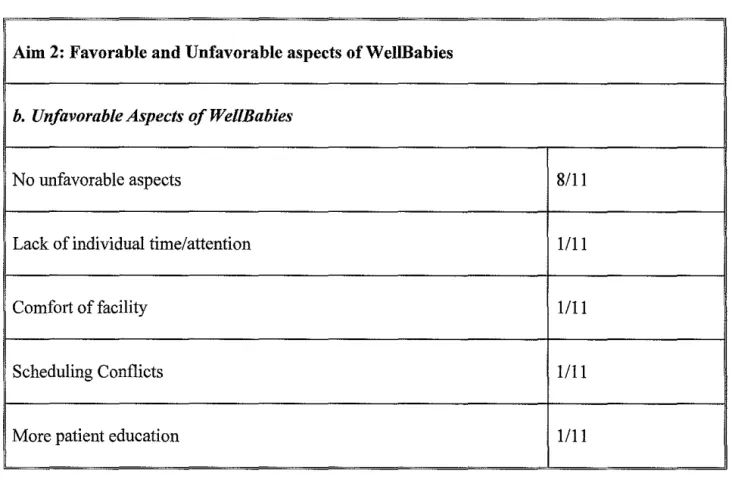
Few mothers expressed specific dislikes about the groups (Table 1 Ob ).
Table lOb: Aim 2- Unfavorable Aspects
Aim 2: Favorable and Unfavorable aspects ofWeiiBabies
b. Unfavorable Aspects of WellBabies
No unfavorable aspects
8/11
Lack of individual time/attention
1111
Comfort of facility
1111
Scheduling Conflicts
1111
More patient education 1/11
some things will get missed." One of 11 thought lack of individual time and attention could be a potential problem but it had yet to arise. "It's open and you can talk about anything you want, but I guess there might be some things that you might not want to bring up to the whole group, and it doesn't seem like you really have that kind of a forum to be one-on-one completely with the physician .. .I haven't had anything that I don't necessarily want to bring up in the whole group, but I'm sure there might be something, sometime."
The remaining nine mothers thought lack of individual time was not a problem. One mother said, "I did (feel like I got enough time for individual attention) .. .if you ever had a personal matter you needed to talk to the doctor about, you could take her aside and do that, and it wasn't a problem." Another mother said, "I feel like I learned a lot more from other mothers and from the doctor and from the nurse. I actually feel like we get more attention then when we were doing the individual (visits)."
Comparison to individual care
Parents' needs and preferences regarding well-child care
The third aim for this study was to understand parents' needs and preferences regarding the preventive well-child visits. Parents were asked what part of their child's care meant the most to them or was the most important part of their care. For preventive care, many mothers placed value on a thorough physical exam (3111 ). They also desired to fee1like they understood the information received in the visit (3111) and to have enough time to ask questions and have their children observed (3/11). Over half of the mothers responded that a good relationship with the doctor was the most important aspect of their child's preventive care (6/11). One mother said, "I like a doctor who can make me feel okay about things." Another respondent said, "I want to feel confident in the abilities of the physician and have a good rapport with them." Going to a practice with a good reputation and convenient location was mentioned by another mother. Suggestions for improvement
The final aim for the study was to elicit feedback for improvement of the WellBabies program. Data suggests a positive response to the model, and two of the eleven mothers had no suggestions for improvement and liked the groups as they currently are structured. Suggestions for improvement that were identified focused on improving contact networks for the mothers outside of the visits (2/11 ), better scheduling of visits (2111) and patient education materials (2/11 ).
doing it as group, is important, but I still think the group is great. Keep the group, but just keep that one-on-one baby attention."
DISCUSSION
WellBabies group visits appear to be a positive experience for the participants and offer parents unique and valuable services. The support provided from the other parents is an aspect of the group model that is not typically provided in traditional well-child care visits. All of the participants interviewed stated that their overall experience with the WellBabies group was a positive one and an acceptable method in which to receive preventive well-child care. The sample of 11 interviews is appropriate for this purpose as the emphasis in this study and other exploratory studies is to gain "detailed data from a relatively small number of respondents."38
Some of the positive themes identified by the mothers recurred in multiple categories. Many of the reasons stated for wanting to participate also were mentioned as favorable aspects of the group. Support from other women, being able to make developmental comparisons, support from provider, learning from other women's experiences and more parental involvement in the actual visit were some of the most common themes.
visits supportive and a social network for parents of infants, WellBabies also provided support and social interactions for the babies.
Another area of support experienced by the participants of the WellBabies groups was the multidisciplinary support available. During most of the visits, there was a nurse and a lactation consultant in addition to the physician. Participants acknowledged this element of the
WeiiBabies groups and pointed to it as a definite advantage of the groups.
In exploring participants' likes, dislikes and preferences for their child's well-child care, many comments drew upon comparisons with traditional, individual care. Although the
participants are in a group setting, the extra time makes the visit feel more personal for the parents. They feel like they have plenty of time for questions, the doctor has more time to observe their children, they get to know other mothers, and they are able to see their child
interacting with other children about the same age. The additional administrative advantages that many women identified, such as not waiting to check in or check out, also made the visits
appealing to patients.
These studies all find that group visits are a promising alternative for well-child care but
their generalizability is limited, and many questions still remain. Feldman's explorations of
mothers' perceptions suggest that women enjoy the group visits, but this study is only first- and
second-time mothers. It is also more than 30 years old, and the needs and preferences of patients
and healthcare providers have evolved. The randomized controlled trials by Taylor eta!. do not
have strong results pointing to group care as a better alternative than individual visits, but they
are not worse. With the limitations to this study, the authors admit that the results are likely
biased toward the null, and if larger, longer studies were to be performed, more of a difference
might become evident.
There are descriptive pieces published on the feasibility, advantages and disadvantages of
group care in the well-child population.Z7• 28• 29• 42• 43 Osborn described a possible format for group
visits as a solution for increasing provider-patient time but still included individual time with
each child as a part of the visit.27 She also explored the advantages, disadvantages and
acceptability of group care.28 The advantages, including more time for education, sharing
experiences, more opportunity for physicians to observe the parent and child and the added
reassurance, are the same advantages proposed and desired in today's climate.28 Thus, something
was lacking more than two decades ago that physicians are still trying to improve upon. The
limits of the acceptability of group visits that Osborn addresses deal mostly with cultural
barriers. While her initial studies included mostly white, middle-class women, the study
described in this paper is more diverse and attempt to explore the suitability of group visits to
mothers of different age, education and cultural backgrounds. Similarly, the disadvantages that
Osborn and Feldman describe are similar to the disadvantages faced today- scheduling and
of the eleven women did suggest a more comfortable setting indicating an element of the group visit that needs to be improved.
Although some of the disadvantages and advantages of group visits have not changed since Osborn's studies in the 1980s, an important part of evaluating and improving the group-care model is adapting it to make it compatible with today's health group-care environment. The groups may have to be somewhat larger than the groups studied in order to be efficient. The groups in this evaluation ranged from three to six participants but averaged four. As currently arranged, groups would need to average five participants in a 90 minute appointment to be more timely than individual visits.
Other options would be to include more material per visit or shorten the visit. Although some mothers acknowledged that the length of the visit was sometimes too long for the
information presented, they enjoyed having the time allotted just incase it was needed. With this large block of time reserved in the doctor's schedule, patients felt they had plenty of time to get their needs addressed. While shortening the time would allow for a more efficient model of care, one of the positive aspects of the visit may be sacrificed.
Other changes may have to be considered in order to fully address today's patients' health care needs. As two of the mothers suggested, although group visits are becoming more widespread, individual time and attention is still something patients may need at some point in their healthcare. Suggestions involved providing one-on-one time during immunization
Developing education materials for the participants of the Wel!Babies group is another step toward making the group a comprehensive, effective model of care. Many of the mothers, although content with the patient education materials is currently provided, said they would appreciate additional materials. The concept of providing all of the education materials for the first year together in a comprehensive notebook was presented to the participants and was well-received.
Based on this evaluation, the group model for well-child care appears to be a promising alternative, and additional research and evaluations should be conducted to further investigate additional elements of group care. Future study includes a cost effectiveness evaluation of the Wel!Babies program and a prospective comparison of health outcomes and quality indicators between patients receiving individual versus group care. One such study could be a randomized controlled trial to answer the question of if children participating in a group model of care have a longer breastfeeding duration than those participating in traditional, individual well-child care. Breastfeeding duration would be used as the primary outcome and indicator of health as despite proven health benefits of breastfeeding less than one-third of infants in 2001 were breastfed long-term (greater than six months). 44 There is much potential for improvement in this indicator and identifying a significant effect of an additional one month ofbreastfeeding could be
and less other health care utilization than those receiving traditional care, and the time spent per
child will be no more, and perhaps less, than what is currently spent in individual traditional
care.
Another area for future research would be an evaluation of provider satisfaction with
group visits conducted through a survey of physicians and other healthcare providers involved in
group visits. It would be helpful to know what the providers who would be involved in
delivering this type of care think of the program, what they like, what they do not like, and where
they see area for improvements.
The parents, as another participant of the visit, have outcomes that may be evaluated in a
further study of group visits. Parent-child interaction, health-care understanding, depression and
other parent-centered outcomes could be the focus. It would be interesting, as well, to involve
fathers, husbands or partners in the evaluation of well-child group care. Some fathers may not
attend group visits as there is not room at the facility, or there may be other reasons more fathers
and partners did not attend the visits. They are encouraged to attend and it would be worth
exploring the barriers to attendance as much of the group visit focuses on family dynamics and
influence on health.
There are limitations to the current exploration presented in this paper on mothers'
perspectives of group visits. A small sample was identified which consisted only of black and
white women. It would be more beneficial to have additional ethnic, racial and cultural groups
represented. This study did have a well-balanced division of marital status, age and education.
Furthermore, some women were personally invited to participate in the WellBabies program