Diagnosing Alarm Fatigue in a Children’s Hospital
Christopher Fry
A Project presented to the faculty of The University of North Carolina at Chapel Hill
in fulfillment of the requirements for Undergraduate Honors
Date Completed: April 10, 2015
Abstract
Background: Alarm safety is one of the most prominent and high profile problems in
hospitals. When alarms sound constantly throughout the day nurses may experience sensory
overload. This desensitizes nurses to alarms, which can create an unsafe, and in some events
even fatal environment for the patients. Methods: Central monitoring data was collected on 4
units throughout the Children’s Hospital. Researchers observed central monitor and nurses’
verbal and nonverbal reactions to those alarms. Nurses were also preliminarily surveyed to
address their perceptions of alarms on the unit. Results: The average number of alarms per bed,
35 an hour, was extremely high. Nurses also stated in the survey they were desensitized to alarms
and the majority believed their coworkers did not handle alarms appropriately. Observations of
the nurses revealed that only 22% of nurse responses to alarms were positive. Conclusion: The results of this study indicate that alarm fatigue is present in the hospital setting. By identifying
the nurses’ response to the alarms (verbal and non-verbal) as well as the frequency of alarms on
the unit, a better understanding of alarm fatigue was achieved. The results of this study indicate a
great need for interventions developed to address alarm frequency and the nurses’ responses to
Background
Every year over 6 million children are hospitalized. This makes up 17 percent of all
hospitalized individuals (HCUP Home, 2015). These children find themselves staying in
Pediatric Units, which are special floors in hospitals reserved for children. Their reasons for
being admitted can vary greatly from mechanical injury to autoimmune disorder to infections.
One element that links all of these children, however, is the fact that they need continuous
monitoring and frequent assessments by the nurses and providers. Physicians, nurses, and staff
must create a delicate balance between providing interventions around the clock while also
giving the patients time to rest. According to the NIH, a lack of sleep may cause an array of
problems including focus issues, mood alterations, and slower response times. In addition,
chronic lack of sleep increases an individual’s risk of obesity, cardiovascular disease, and
infection (2011). Because sleep is also linked to immune functioning and overall healing in
patients, it is essential for nurses to allow patients, especially children, to get the best quality
sleep they can. There are many reasons for the lack of sleep children experience in the hospital,
but one study found that there were three major categories. These categories included noises,
worries/discomfort, and hospital specific variables like pain and vital sign checks. They found
that alarms on medical equipment bothered 42% of children and 66% of parents. The researchers
discovered that alarms were one of the largest, modifiable, disruptors of sleep (Meltzer, Davis, &
Mindell, 2012).
Alarms not only make maintaining sleep difficult, but can also be challenging for the
nurses to manage. One of the essential ways to provide continuous care is the appropriate use of
central monitors. Central monitors are commonly used on acute care units throughout the
oxygen saturation, and cardiac wave forms. However, every time a patient’s vital signs exceed
or fall short of their preset parameters an alarm will sound. According to the Joint Commission
statement on the issue of alarms in hospitals, the number of alarm signals per patient per day can
reach several hundred depending on the unit (Joint Commission, 2013).Accompanied by these
auditory alarms are a barrage of different colored flashing lights and signals, highlighting the
cause of the alarm. This onslaught of beeps, buzzes, and chimes, which were initially intended
to help patients and alert caregivers, may actually be doing just the opposite. When a nurse is
overwhelmed with too many alarms, they may tend to trivialize and possibly even ignore alarms.
This sensory overload that desensitizes nurses to alarms, which can create an unsafe, and in some
events even fatal environment for the patients, is known as alarm fatigue (Cvach, 2012).
The goal of this research is to understand alarm fatigue in a Children’s Hospital by
evaluating central monitors and the reactions of the nurses to those monitors. Clinical alarms
have been atop the ECRI Institute’s list of “Top 10 Health Technology Hazards” ever since the
list was first created in 2007. Over the past 3 years “Alarm Hazards” have been listed as the
number one health device technology hazard. A review of the FDA’s Manufacturer and User
Facility Device Experience database revealed 566 deaths between 2005 and 2008 that directly
mention alarms as a possible contributor to the death of the patients (Cvach, 2012). Furthermore,
in April of 2013 the Joint Commission issued a Sentinel Event Alert due to 98 alarm related
incidents between January 2009 and June 2012. Of these 98 events, 80 resulted in the death of
the patient. The Joint Commission believes that these 98 alarm-related incidents represent less
than 10% of the actual alarm related harms that occurred in the hospital (Mitka, 2013).
Perpetuating the problem of alarm fatigue is the ever-increasing number of monitoring
as possible to ensure any true sentinel event is not missed. However, this has resulted in
extremely sensitive alarms that predict a large number of false positives. In fact, research has
shown that 72-99% of hospital alarms are false (Graham & Cvach, 2010). In addition, further
research has shown that 85-99% of alarm signals do not require intervention (Sendelbach &
Funk, 2013). These are often referred to as nuisance alarms, or alarms that typically do not result
in adverse or potential adverse patient conditions. This may occur due to the fact that parameters
are too narrow, default settings on central monitors are not adjusted, electrocardiogram
electrodes are no longer adequately sticking, or sensors being misplaced (Graham & Cvach,
2010). A study monitoring alarms on Medical/Surgical floors in a community hospital found that
the average patient’s alarms were triggered 95.6 times per day. They found that only 34% of
critical alarms, such as extreme tachycardia, bradycardia, or desaturation were found to be true.
After an analysis of their alarm history, they were able to reduce the number of heart rate alarms
by over 50% with a small adjustment of a max HR from 120 to 130 bpm. In addition, they saw a
36% decrease in desaturation alarms when the parameter was lowered from 90% to 85%. It was
concluded that alarm limits are often too sensitive for their patients, and the number of alarm
triggers could be greatly reduced by creating patient specific parameters on central monitors
(Gross, Dahl, & Nielsen, 2011).
Another instance of widening alarm parameters occurred at Dartmouth-Hitchock Medical
Center. They began implementing surveillance monitoring, which is the continuous collection of
routine vital signs to help recognize trends in patient deterioration. For 11 months they collected
data on rescue events, such as Rapid Responses, as well as transfers to intensive care units.
Through this research they found that an oxygen saturation of less than 80%, rather than the
significant enough to require intervention, without overburdening the nurses. In addition, a 15
second delay was installed. This meant that a patient’s oxygen saturation would have to drop
below 80% for over 15 seconds before the alarm would sound. This helped eliminate nearly all
false positive readings. The results showed a decrease in rescue events from 3.5 per 1,000
patients to 1.2 per 1,000. ICU transfers also decreased from 5.6 per 1,000 to 2.9 per 1,000. This
saved patients a total of about 150 days spent in an ICU. Finally, using this new parameter,
patients averaged only 4 alarm notifications per 24 hours (Taenzer, Avery, Karon, & McGrath,
2013).The ability to widen parameters and delay alarms signals also had a direct impact on
nursing response to the alarms. Once nurses became aware that the incidence of false alarms had
been reduced, they were less likely to ignore the alarms, resulting in faster response to the patient,
and a reduction in adverse events.
Aside from changing alarm parameters, decreasing monitor alarms through the use of
team-based standardized care and processes has also proven to be successful. Research on a
24-bed pediatric unit showed that using 4 components of standardized care helped to drop the
median number of alarms per patient per day from 180 to 40; an 80% decrease. These
components included age-appropriate parameter standards, daily replacement of electrodes, daily
assessment of cardiac monitor parameters, and using a reliable method for appropriate
discontinuation of the monitors. Nurse compliance with these standards increased from 38%
pre-study to 98% post-pre-study. The median number of false alarms on the floor dropped from 95% to
50%. The biggest finding from this study was that families reported an increase in nursing
response time (from 87% to 95%) (Dandroy et al, 2014).
An additional approach to managing clinical alarms came in the form of how the alarm
patient and staff satisfaction scores, by setting ‘crisis alarms.’ Rather than use a typical alarm for
patients who experienced extreme bradycardia (< 45 bpm) or extreme tachycardia (> 130 bmp),
they used “crisis” alarms. These new alarms required the nursing staff to act on the alarm, rather
than simply turn it off. This intervention eliminated the alarms’ abilities to self-reset, which
would have otherwise allowed them to sound on and off multiple times. This intervention
reduced alarm alerts in one week from 62,793 to 3,970 (Whalen, Covelle, Piepenbrink, Villanova,
Cuneo, & Awtry, 2014).
Nurses have also been surveyed to assess their perception of alarm setting and
management. One study found that 93% of nurses interviewed felt that alarm fatigue results in
alarm desensitization and disabling of alarms, while 81% felt that the key factors associated with
alarm fatigue were false-positive alarms and inappropriately set alarms (Christensen, Dodds,
Sauer, Watts, 2014).
Although there is a myriad of research explaining and helping to resolve alarm fatigue, little has been done to address the problem directly with the nurses. Nurses have been given
questionnaires about their feelings and attitude towards alarms, but they have not been observed
to see how they behaviorally and clinically react to the alarms. This gap in observations of nurse
responses to alarms, including the amount of time it takes them to respond, presents a major
problem in our ability to combat alarm fatigue. Additionally, few studies have assessed nurses’
perception of alarms or their self-assessment of alarm fatigue. Therefore, the purpose of this
study is to understand alarm fatigue in a Children’s Hospital by evaluating central monitors and
the reactions of the nurses to those monitors. Research questions to address this purpose include:
1) What is the incidence of alarms during an observed experience in 4 pediatric units?
3) Is there a correlation between nurses’ verbal and nonverbal reactions and alarm data?
4) Based on this data, what unit recommendations are needed to better standardize and
improve their alarm management?
Methods Procedures
In order to examine alarm fatigue in nurses, a mixed-method study was conducted across
four pediatric units at University of North Carolina Hospital in Chapel Hill, NC. Trained
observers from the research team selected four different observation times (0500-0700,
0800-1000, 1700-1900, and 2000-2200) and observed 4 pediatric units over three separate days. This
totaled 12 2-hour observations on each of the 4 units. During the 2-hour observations, the central
monitor and nurses on the unit were observed. Each time a central monitor alarmed, it was coded
as either a red alarm (emergent), or yellow alarm (warning). Observers then recorded if the
nurses responded to a central station or not. Finally, any verbal or nonverbal comments made by
the nursing staff were written down and distinguished as positive, negative, or neutral.
Information from the central monitors was downloaded after observations were complete. This
data included the number of total alarms sounded and why these alarms occurred.
Study Setting: Four acute care units in the Children’s Hospital at the University of North
Carolina Hospital in Chapel Hill, NC participated in this study. The Children’s Hospital at UNC
Hospital is an academic medical center that admits approximately 6700 pediatric patients per
year and treats children from all 100 counties in North Carolina and from 45 states across the
country (N.C. Children’s Hospital, 2015). The researches observed central monitors on four
different Pediatric Units in the hospital (7 Children’s, 6 Children’s, 5 Children’s, and the
7 Children’s is a 24-bed unit dedicated to the care of pediatric surgery and trauma
patients. Its patient population varies from general pediatric surgery, ear/nose/throat,
neurosurgery, burns, transplant cases, and many others. 6 Children’s is also a 24-bed unit
specialized for medicine patients. 5 Children’s is a 16-bed unit dedicated to the care of pediatric
hematology/oncology, bone marrow transplant, and pulmonary patients. The CICC is an 8-bed
unit that focuses on pediatric cardiac patients (unchealthcare.org, 2015).
Sample: Nurses on all four pediatric units participated in this study. A total of 200 nurses
are employed across the 4 units. Nurses were observed in their regular work routines and no
identifying information was collected during observation. All nurses were anonymously
administered a survey to assess their current perceptions of unit alarms.
Measures:
Central Monitors: Each time a central monitor alarmed, it was coded as either a red alarm (emergent), or yellow alarm (warning). Total alarms generated were recorded from each central
monitor in the unit over the observation period. Observers noted if the nurses responded at the
central nursing station or not. Additionally, nurses’ verbal and nonverbal responses to the central
monitors were recorded.
Alarm Fatigue Survey: A 16-item survey was developed by the research team to assess the nurse’s current practice involving alarm management and perception of its effectiveness
(Appendix 1). The survey was administered anonymously online prior to the observation of the
nurses in the unit.
Observation of Nurses: Verbal and non-verbal responses by the nurses to the alarms
were recorded by trained members of the research team over three days (four times a day, at two
PI of the study over a 30-minute period, using a standardized observation tool (Appendix 2).
Observations were then compared to those of the PI, and members of the team received feedback
if discrepancies between the PI occurred. Once the reliability training was complete, each
member of the research team assigned themselves to one of the four pediatric units. Once
assigned to a specific time timeframe, the same observer did the second and third observations in
the same timeframe. The rationale for this approach was to ensure consistency on each unit.
Members of the research team recorded how frequently the alarms were triggered, and the verbal
and non-verbal reactions of the nurses to the alarms. Verbal and non-verbal reactions were
subsequently broken down into positive, negative, or neutral responses. A positive reaction was
described as any comment positive in nature which led to nurses checking on patients or making
changes to alarm limits. Positive nonverbal reactions included prompt responses to alarm and
engaging with the central monitors. Neutral responses were any comments or behaviors related
to silencing the alarm, and taking note of the current alarm sounding. Negative responses were
and comments or body language displaying frustration or annoyance towards alarms or the duties
that needed to be performed because of those alarms.
Data Collection and Analysis: Data was collected over a three-month period (November 2014 –
February 2015) from three sources: the central monitoring system, observer data, and the nursing
survey. Central monitoring data included frequencies of alarms and alarm types such as heart
rate or respiration rate. It also gathered information for each patient like how many times a
particular patient’s alarms sounded. Descriptive statistics (mean scores, and frequencies, ranges,
and patient parameters) were used to analyze the central monitors, non-verbal and verbal
Results Central Alarms:
A total of 8,552 alarms were generated from 123 beds in the four units. This yields an
average of 35 alarms per bed per hour. If this number were representative of a typical hour, there
would be an average of 835 alarms per bed per day throughout the Children’s Hospital. The total
number of alarms, separated by type of alarm generated, over a 3-day period, is presented in
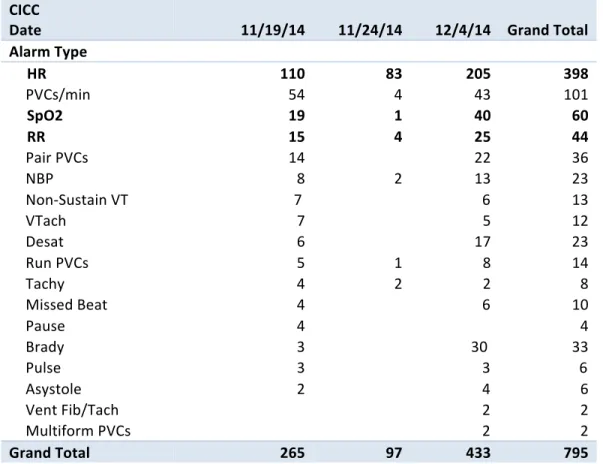
Table 1-4 below. In tables 1-4, the top three producers of alarms, in order, were heart rate
(3,051), respiratory rate (2,809), and pulse oxygenation (1,263).
Total alarms generated ranged (from least to greatest) 795 in the CICC, 1,228 on 5
Children’s, 2,793 on 6 Children’s, and 3,736 on 7 Children’s. Across all observations, there were
14 central monitors observed in the CICC, 37 observed on 5 Children’s, 53 on 6 Children’s, and
56 on 7 Children’s.
Table 1: Total Alarm Numbers for 5 Children's Unit
5 Children’s
Date 11/19/14 11/24/14 12/4/14 Grand Total
Alarm Type
HR 133 54 305 492
SpO2 99 81 65 245
Desat 60 35 38 133
RR 51 75 52 178
Pulse 49 8 13 70
Brady 17 4 29 50
NBP 13 7 8 28
Asystole 12
1 13
Tachy 9
2 11
Vent Fib/Tach 2
4 6
Apnea
2 2
Table 2: Total Alarm Numbers for 6 Children's Unit
6 Children’s
Date 11/17/14 11/24/14 12/2/14 Grand Total
Alarm Type
Apnea 16 5 1 22
Asystole 13 4 3 20
Brady 6 28 5 39
Desat 32 57 48 137
HR 370 139 321 830
NBP 21 14 4 39
Nurse Call
3 3
Pulse 1
34 35
RR 453 517 205 1175
SpO2 220 108 121 449
Tachy 15 4 12 31
Vent Fib/Tach 7 6
13
Grand Total 1154 885 754 2793
Table 3: Total Alarm Numbers for 7 Children's Unit
7 Children’s
Date 11/29/14 12/14/14 12/17/14 Grand Total
Alarm Type
RR 402 602 408 1412
HR 181 297 853 1331
SpO2 118 218 173 509
Desat 104 107 83 294
NBP 15 3 18 36
Tachy 12 31 28 71
Apnea 6 19 3 28 Brady 6 9 11 26
Missed Beat 3
3
Pause 2
2
Vent Fib/Tach 1 2 1 4
Asystole
12 8 20
Table 4: Total Alarm Numbers for CICC Unit
CICC
Date 11/19/14 11/24/14 12/4/14 Grand Total
Alarm Type
HR 110 83 205 398
PVCs/min 54 4 43 101
SpO2 19 1 40 60
RR 15 4 25 44
Pair PVCs 14
22 36
NBP 8 2 13 23
Non-‐Sustain VT 7
6 13
VTach 7
5 12
Desat 6
17 23
Run PVCs 5 1 8 14
Tachy 4 2 2 8
Missed Beat 4
6 10
Pause 4 4
Brady 3 30 33 Pulse 3 3 6 Asystole 2 4 6 Vent Fib/Tach 2 2 Multiform PVCs 2 2
Grand Total 265 97 433 795
Alarm Incidence per Monitor
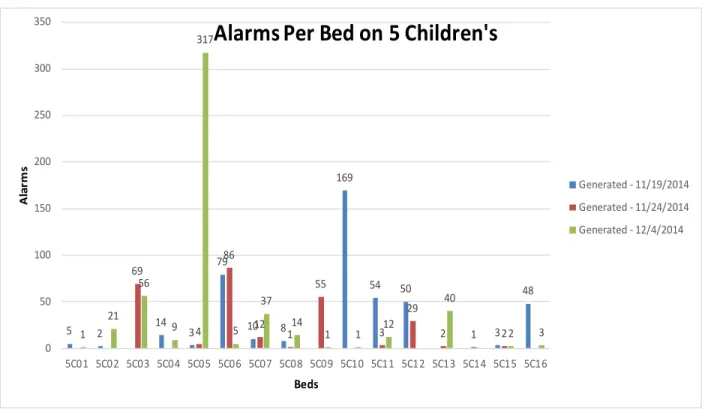
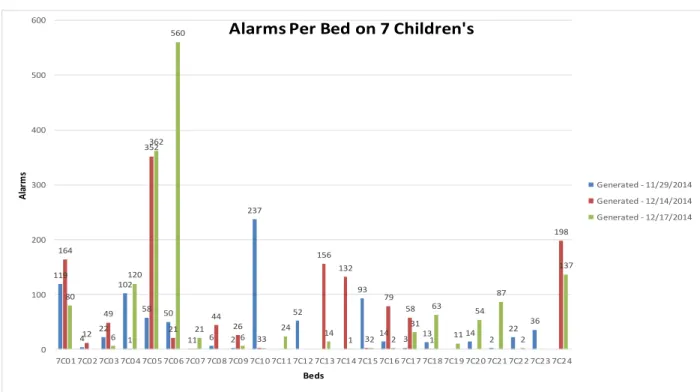
When data from each monitor is taken individually, it is clear there are some large
disparities in the number of alarms generated between each patient. On 5 Children’s, one
monitor produced 317 of the possible 519 alarms, or 61% of total alarms observed that day.
These trends continued throughout the observations. Nearly every observation had at least one
bed that at least tripled what the average alarms generated should have been. Tables 5-8 below
Table 5: Total Alarms per Bed on 5 Children’s Unit
Table 6: Total Alarms per Bed on 6 Children’s Unit
5 2 14 3
79 10 8 169 54 50 3 48 69 4 86 12 1 55 3 29
2 1 2
1 21 56 9 317 5 37 14
1 1 12
40 2 3 0 50 100 150 200 250 300 350
5C01 5C02 5C03 5C04 5C05 5C06 5C07 5C08 5C09 5C10 5C11 5C12 5C13 5C14 5C15 5C16
Al
ar
m
s
Beds
Alarms Per Bed on 5 Children's
Generated -‐ 11/19/2014 Generated -‐ 11/24/2014 Generated -‐ 12/4/2014
239
98
2 6 3 9
97 86
2 3 3 2 6
81 112 55 299 51 22 1 6 20 7 23 44 17 2 23 122 25 27 57 10 79 183
9 2 7 100 99 40 110 1 49 110 127 52 70 15 70 1 1 108 0 50 100 150 200 250 300 350 Al ar m s Beds
Alarms Per Bed on 6 Children's
Table 7: Total Alarms per Bed on 7 Children’s Unit
Table 8: Total Alarms per Bed on CICC Unit
119
4 22 102
58 50
1 6 2 237
52
93
14 3 13 14 2 22 36 164 12 49 1 352 21 1 44 26 3 156 132 3 79 58 1 198 80 6 120 362 560 21
6 3 24 14 1 2 2 31 63 11 54 87 2 137 0 100 200 300 400 500 600
7C01 7C02 7C03 7C04 7C05 7C06 7C07 7C08 7C09 7C10 7C11 7C12 7C13 7C14 7C15 7C16 7C17 7C18 7C19 7C20 7C21 7C22 7C23 7C24
Al
ar
m
s
Beds
Alarms Per Bed on 7 Children's
Generated -‐ 11/29/2014 Generated -‐ 12/14/2014 Generated -‐ 12/17/2014
0 20 40 60 80 100 120 140 160
5C24 5C17 5C22 5C18 5C19 5C20 5C23 5C21
Al
ar
m
s
Beds
Alarms Ped Bed on CICC
Survey of Nurses
Of the 200 nurses that were administered the survey, 55 nurses responded, with a
response rate of 27.5%. Of the 16 questions, 4 questions revealed the most about nurses and their
alarm habits. The majority of nurses surveyed (89%) indicated that alarms were perceived as
background noise. Of the respondents, 78% of nurses indicated that they did not check on their
patient when the alarm sounded. The survey revealed that less than half of nurses (47%) believed
their colleagues handled alarms appropriately. Finally, when directly asked on the survey if they
feel they have been desensitized to alarms, 69% stated they were. The full survey with results is
presented as Appendix 1.
Nurse Responses to Alarms
Over the course of all the observations, nurses responded a total of 50 times at the central
monitoring station. Of these responses, 46% (n = 23) were coded by the observers as negative;
32% (n = 16) were coded as neutral; and 22% (n = 11) were coded as positive. A copy of the
standardized observation tool is available under Appendix 2.
Discussion
The aim of this study was to collect central monitor alarm data and to observe nurses’
verbal and nonverbal reactions to those alarms. The majority of research conducted on alarm
fatigue has focused on the number of alarms per unit, and how to decrease them. Only a few
studies have observed the nurses to see what their reactions actually are when an alarm sounds.
This study worked to identify alarm fatigue by observing nurses’ reactions to the central
monitors, and by preliminarily surveying them on their approaches and beliefs towards alarms.
The results of this study indicate that there is much work to be done on the issue of alarm
sources; heart rate, respiration rate, and oxygen saturation. These three sources of alarms, along
with all of the other alarms, combined to create 8,552 alarms generated throughout the study. If
the number of alarms observed was representative of a typical hour, each patient monitored
would have alarmed 35 alarms every hour. This equates to an average of 835 alarms for every
child on a central monitor throughout the Children’s Hospital. This number is vastly greater than
even the Joint Commission’s statement of several hundred per day (2013), and is highly
indicative of the institution being at risk for alarm fatigue. Interventions to address this
exceedingly dangerous number of alarms must be identified and implemented to reduce nursing
desensitizing and alarm fatigue.
One intervention to reduce the incidence of alarms would be to identify which alarms are
truly necessary, and to set parameters to help reduce false alarms. Researchers at
Dartmouth-Hitchcock found that oxygen saturation parameters should be set at 80%, which they found to be
sensitive enough to find adverse event, but not overly burdensome to the nurses. In addition,
occasional and brief desaturations from a multitude of factors including mild sleep apnea, a
patient clenching their first or even just lifting their hand, are of little importance to the nurses
(Taenzer, et al., 2013). Furthermore, researchers found that while observing false alarms in an
intensive care unit at John Hopkins, the biggest contributor to the number of false alarms was the
pulse oximetry alarm (Cvach, 2010). Because oxygen saturation was in the top 3 reasons for
alarms produced in our study, it must be speculated that these desaturations may be creating a
large number of false positives.
Another finding of this study was that the majority of alarms produced on any given unit
typically emerged from one or two beds. This is best exemplified by an observation on 5
alarms, or 61% of total alarms observed that day. These trends continued throughout the
observations. Nearly every observation had at least one bed that at least tripled what the average
alarms generated should have been. To help curb this problem, a unit coordinator or nurse
manager should be assigned to check the number of alarms generated from each bed could help
distinguish the outliers. This would allow the nurses to determine if the high number of alarms
was out of necessity, or if something should be changed to diminish those alarms in the future.
The preliminary survey distributed to the nurses was the first signal that there was the
potential for alarm fatigue on every floor observed. The vast majority of nurses believed that the
alarms became background noise, and did not check on their patients after every alarm. This then
begs the question; if the nurses are not checking on their patients after every alarm, why are these
alarms evening being used? If the nurses know they will not pay attention to an alarm because it
is not serious enough of an adverse event, or they believe it to be a false positive, there is no
reason for these alarms to be sounding. They are contributing to the overall number of alarms,
and adding to further alarm fatigue. In fact, when asked directly if they felt they were becoming
desensitized to alarms, 69% of nurses stated they were. Before the data collection or observations
even began, the nurses were already admitting they were experiencing alarm fatigue.
The verbal and nonverbal responses observed in the nurses correlated with the
preliminary survey and alarm data. This evidence brings to light two major concerns. The first is
that throughout the entire series of observations, nurses only responded at the central monitor 50
times. That is less than 1% of the times the alarms sounded. The second finding was that nearly
half of all observable nurse responses to alarms were negative. This is another indication that
alarm fatigue is ever present. The use of an alarm fatigue committee could help to diminish these
the number of alarms sounded to check for outliers, and to also hold nurses accountable for their
reactions to alarms.
Limitations of the study
One limitation of this study was the inability to distinguish a generated alarm that
resulted in an intervention versus an alarm that did not require intervention. The alarms captured
from the central monitors provided an excellent representation of the overall alarm situation on
all of the pediatric units, but were quite indistinguishable in terms of nurse intervention. The
validity of the study would improve if it were known exactly to which alarms the nurses
responded, and to see which ones they ignored. Future work could be aimed at linking alarm
sounds and actual nursing intervention. Efficacy of these alarm sensitivity changes and their
effect on patient outcomes are also warranted.
Implications for Practice
The results of this study show that a significant number of nurses fall victim to alarm
fatigue. These finding have direct implications for novice as well as experienced nurses. Nurses
should be more acutely aware of alarm parameters for their patients’ monitors, and must be
cognizant of the alarms around them. Nurses should be advocates for themselves, as well as for
their patients, and address concerns regarding alarm fatigue with management and other leaders
in order to make unit changes that would reduce the incidence of fatigue.
Conclusion
Although alarms are life-saving and a necessary part of hospital monitoring, they can
compromise patients’ safety if they are dismissed. The results of this study indicate that alarm
fatigue is present in the hospital setting. By identifying the nurses’ response to the alarms (verbal
fatigue was achieved. The results of this study indicate a great need for interventions developed
to address alarm frequency and the nurses’ responses to the alarms. Future work should be aimed
at identifying and testing interventions to reduce alarm fatigue and its impact on work
environment and patient outcomes.
References
Christensen, M., Dodds, A., Sauer, J., & Watts, N. (2014). Alarm setting for the critically ill
patient: A descriptive pilot survey of nurses’ perceptions of current practice in an
Australian Regional Critical Care Unit. Intensive and Critical Care Nursing, 30, 204-210.
Retrieved from:
http://ac.els-cdn.com/S0964339714000196/1-s2.0-S0964339714000196-
main.pdf?_tid=16ff1ade-d995-11e4-a3ce-00000aab0f02&acdnat=1428019688_0d4e76040068747be8e9f7f07271a2ff
Cvach, M. (2012). Monitor alarm fatigue: An Integrative Review. Biomedical
Instrumentation & Technology, 46(4), 268-277. Retrieved from: http://www.aami-bit.org/doi/pdf/10.2345/0899-8205-46.4.268
Dandroy, C., Davis, S., Flesch, L., Hayward, M., Koons, C., Coleman, K., Jacobs, J., McKenna,
L., Olomajeye, A., Olson, C., Powers, J., Shoemaker, K., Sonata, J., Alessandrini, E.,
Weiss, B. (2014). A team-based approach to reducing cardiac monitor alarms .
Journal of the American Academy of Pediatrics, 134(6), 1686-1694. Retrieved from: http://pediatrics.aappublications.org/content/134/6/e1686.full.pdf+html
Graham, K.C., & Cvach, M. (2010). Monitor alarm fatigue: standardizing use of physiological
monitors and decreasing nuisance alarms. America Journal of Critical Care. 19(1). 28-34.
Retrieved from: http://ajcc.aacnjournals.org/content/19/1/28.full.pdf+html
medical/surgical floors of a community hospital. Biomedical Instrumentation &
Technology, 45(1), 29-36. Retrieved from: http://www.ncbi.nlm.nih.gov/pubmed/21599479
HCUP-US Home Page. (2015). Retrieved April 2, 2015, from http://www.hcup-us.ahrq.gov/
Meltzer, L.J., Davis, K.F., & Mindell, J.A. (2012). Patient and parent sleep in a children’s
hospital. Pediatric Nursing, 38(2). 64-71. Retrieved from:
http://pediatricnursing.net/ce/2014/article38026471.pdf
Mitka, M. (2013). Joint commission warns of alarm fatigue: Multitude of alarms from
monitoring devices problematic. Journal of the American Medical Association, 309(22),
2315-2316. Retrieved from: http://jama.jamanetwork.com/article.aspx?articleid=1696094
North Carolina Children's Hospital. (2015). Retrieved April 6, 2015,
From https://ncchildrenshospital.org
Sendelbach, S. & Funk, M. (2013). Alarm fatigue a patient safety concern. AACN Advanced
Critical Care.24(4). 378-386.
Taenzer, A., Avery, J., Karon, N., & McGrath, S. (2013). Safeguarding patients with
surveillance monitors: The Dartmouth-Hitchcock Medical Center Experience.
Association for the Advancement of Medical Instrumentation. Retrieved from:
The Joint Commission Sentinel Event Alert. (2013, April 8). Retrieved From,
http://www.jointcommission.org/assets/1/18/sea_50_alarms_4_5_13_final1.pdf
Updated NIH Sleep Disorders Research Plan seeks to promote and protect sleep health. (2014).
Retrieved April 6, 2015, from http://www.nih.gov/news/health/nov2011/nhlbi-09.htm
UNC Health Care. (2015). Retrieved April 6, 2015, from https://www.unchealthcare.org/site
Whalen, D.A., Covelle, P.M., Piepenbrink, J.C., Villanova, K.L., Cuneo, C.L., & Awtry, E.H.
(2014). Novel approach to cardiac alarm management on telemetry units. Journal of
Cardiovascular Nursing 29(5), 13-22. Retrieved from:
http://vb3lk7eb4t.search.serialssolutions.com/?sid=Entrez:PubMed&id=pmid:24365870
Appendix 1: Survey of Nursing Perception of Alarms
7 Children’s
Survey Questions Yes No No Answer
Do you notice every time an alarm goes off? 8 8
Do the alarms become background noise? 16
Do you check your orders for call parameters? 12 4
Do you change your monitors according to ordered call
parameters? 10 6
Have you adjusted the parameters in the monitor on your
patient without contacting the patient's physician? 12 4
Do you use the correct leads and pulse oximeter for the
patient's age and size? 14 2
Do you change the monitors according to the patient's
age (Neonatal,, Pediatric, or Adult)? 10 6
Do you replace leads and pulse oximeters with the
appropriate equipment when you suspect they are not in
working order? 16
Do you always check on your patient when the alarm goes
off? 2 14
Do you tend to silence the alarms and not check on the
patient if you do not think the reading is accurate? 13 3
Do you silence alarms from patients that are not yours? 13 3
DO you check on patients after an alarm goes off if the
patient is not yours? 11 4 1
Do you feel that the monitors can be customized to your
patients’ needs? 13 3
Do you feel you have been desensitized to the alarms? 12 3 1
Do other nurses respond to their alarms appropriately? 6 7 3
Do you ask physicians to discontinue monitors when they
are not clinically necessary? 11 5
Do you initiate cardiorespiratory monitors without orders
from the physician? 11 5
6 Children’s
Survey Questions Yes No No Answer
Do you notice every time an alarm goes off? 11 6
Do the alarms become background noise? 14 3
Do you check your orders for call parameters? 15 2
Do you change your monitors according to ordered call
parameters? 13 3 1
Have you adjusted the parameters in the monitor on your
patient without contacting the patient's physician? 11 6
Do you use the correct leads and pulse oximeter for the
patient's age and size? 16 1
Do you change the monitors according to the patient's
age (Neonatal,, Pediatric, or Adult)? 7 10
Do you replace leads and pulse oximeters with the
appropriate equipment when you suspect they are not in
working order? 17
Do you always check on your patient when the alarm goes
off? 3 14
Do you tend to silence the alarms and not check on the
patient if you do not think the reading is accurate? 15 2
Do you silence alarms from patients that are not yours? 11 6
DO you check on patients after an alarm goes off if the
patient is not yours? 13 3 1
Do you feel that the monitors can be customized to your
patients’ needs? 13 4
Do you feel you have been desensitized to the alarms? 11 4 2
Do other nurses respond to their alarms appropriately? 6 10 1
Do you ask physicians to discontinue monitors when they
are not clinically necessary? 17
Do you initiate cardiorespiratory monitors without orders
from the physician? 9 7 1
5 Children's
Survey Questions Yes No No Answer
Do you notice every time an alarm goes off? 5 3
Do the alarms become background noise? 6 2
Do you check your orders for call parameters? 7 1
Do you change your monitors according to ordered call
parameters? 6 2
Have you adjusted the parameters in the monitor on your
patient without contacting the patient's physician? 7 1
Do you use the correct leads and pulse oximeter for the
patient's age and size? 7 1
Do you change the monitors according to the patient's
age (Neonatal,, Pediatric, or Adult)? 5 3
Do you replace leads and pulse oximeters with the
appropriate equipment when you suspect they are not in
working order? 8
Do you always check on your patient when the alarm goes
off? 3 5
Do you tend to silence the alarms and not check on the
patient if you do not think the reading is accurate? 8
Do you silence alarms from patients that are not yours? 7 1
DO you check on patients after an alarm goes off if the
patient is not yours? 8
Do you feel that the monitors can be customized to your
patients’ needs? 6 2
Do you feel you have been desensitized to the alarms? 6 2
Do other nurses respond to their alarms appropriately? 2 6
Do you ask physicians to discontinue monitors when they
are not clinically necessary? 7 1
Do you initiate cardiorespiratory monitors without orders
from the physician? 7 1
CICC
Survey Questions Yes No No Answer
Do you notice every time an alarm goes off? 7 7
Do the alarms become background noise? 10 4
Do you check your orders for call parameters? 14
Do you change your monitors according to ordered call
parameters? 12 2
Have you adjusted the parameters in the monitor on your
patient without contacting the patient's physician? 7 7
Do you use the correct leads and pulse oximeter for the
patient's age and size? 13 1
Do you change the monitors according to the patient's
age (Neonatal,, Pediatric, or Adult)? 10 4
Do you replace leads and pulse oximeters with the
appropriate equipment when you suspect they are not in
working order? 14
Do you always check on your patient when the alarm goes
off? 2 10
Do you tend to silence the alarms and not check on the
patient if you do not think the reading is accurate? 9 5
Do you silence alarms from patients that are not yours? 10 4
DO you check on patients after an alarm goes off if the
patient is not yours? 14
Do you feel that the monitors can be customized to your
patients’ needs? 13 1
Do you feel you have been desensitized to the alarms? 9 5
Do other nurses respond to their alarms appropriately? 10 4
Do you ask physicians to discontinue monitors when they
are not clinically necessary? 10 4
Do you initiate cardiorespiratory monitors without orders
from the physician? 7 7
Appendix 2: Observation of staff RN response to monitors
Date/Time RED Alarm (Emergent. Does not stop unless physically silenced)
Yellow Alarm (Warning, stops if patient resolves condition within 10 seconds)
Responded to at Central Station (Yes or No)
Verbal Comment made about alarm (Positive response by RN or Negative
response/body language/nonverbal by RN at the
Central Monitor; Place word(s)/phrase that signaled positive or negative response in
box)
Observer responses noted (please note anything important related to alarms that you may have noticed during
your observation
period)
Yes No Positive Negative Neutral
Yes No Positive Negative Neutral
Yes No Positive Negative Neutral