The Distance Between Exons and Alu Elements Influences RNA Circularization Efficiency
By
Jiacheng “Coco” Liu
Senior Honors Thesis
Marzluff Lab, Department of Biology University of North Carolina at Chapel Hill
April 16th, 2019
Approved by:
Dr. William Marzluff, Thesis Advisor
Dr. Terry Furey, Reader
Abstract
Introduction
Ribonucleic acid (RNA) is a single stranded polymer of ribonucleotides. As described in the central dogma, messenger RNA (mRNA) is transcribed from DNA templates, then subsequently processed and translated into proteins. In eukaryotes, after pre-mRNA is transcribed, sequences called introns are spliced out by spliceosomes made up of snRNA-protein complexes (snRNPs). The spliceosomes are assembled on the exons, facilitated by a polypyrimidine tract, a pyrimidine rich sequence located upstream of the exon (Coolidge, Seely, and Patton 1997; Reed 1989), and a splice donor sequence downstream of the exons. First, a branch site in the intron attacks the 5’ splice site (splice donor sequence) to form a lariat intermediate; in the second step, the splice donor attacks the 3’ splice site (splice acceptor) to ligate two exons together (Black 2003). Most of the time, the exons are spliced head-to-tail to form a linear mRNA, along with a lariat intron removal.
In 2012, Will Jeck, a M.D.-Ph.D. student at UNC, published the finding that there are a large number of circular RNAs present in mammalian cells (Jeck et al. 2012). These arise because certain canonical splicing sitesof pre-mRNAs are back-spliced into circRNAs; a splice donor at the 3’ end of the exon, is joined to the splice acceptor at the 5’ end of the same exon, or a more 5’ exon (Jeck et al. 2012; Vicens and Westhof 2014). This can occur when the reverse complementary matches (RCM) present in the intronic regions on the two ends of an exon base pair with each other and form a stem loop (Jeck et al. 2012; Ivanov et al. 2014). The stem loop can therefore bring splice donors and acceptors physically closer to allow splicing.
in the cell is significant, as 15% of actively transcribed genes have a circRNA product in fibroblasts (Jeck et al. 2012; Liang and Wilusz 2014). The ratio of circRNA to linear RNA varies enormously between genes, with some genes producing more circular RNA than linear RNA (Jeck et al. 2012). While the function, if any, of most circRNAs are not known, there are a few studies that have shown that circRNAs function as regulatory molecules. CircRNA can serve as miRNA sponges, presenting miRNA target sites to sequester miRNAs, such as for miR-7 (Hansen et al. 2013). CircRNAs can also serve as protein sponges and hence can act as regulators of pre-mRNA linear splicing (Ashwal-Fluss et al. 2014). Apart from the endogenous functions discovered in cells, circRNA has also been studied as a potential vector for gene therapy delivered by adeno-associated virus (AAV). CircRNAs are much less susceptible to exonucleases compared to their linear counterparts, due to the absence of free 3’ ends, and therefore generally have very long half-lives, surviving at least twice as long (Enuka et al. 2016; Meganck et al. 2018).
Liang and Wilusz 2014). A circRNA reporter construct with an internal ribosomal entry site (IRES) was used that allowed us to visualize circularization with GFP expression (Meganck et al. 2018; Wang and Wang 2015). The distance between exon and Alu elements was modified by inserting randomly generated sequences of different lengths or deleting the original sequences that were not key factors for circularization. The circRNA levels were measured directly by northern blot and by GFP expression, in comparison to the original construct. Our study contributes to knowledge of what intronic elements are required to drive circularization, and what properties regulate this process.
Results
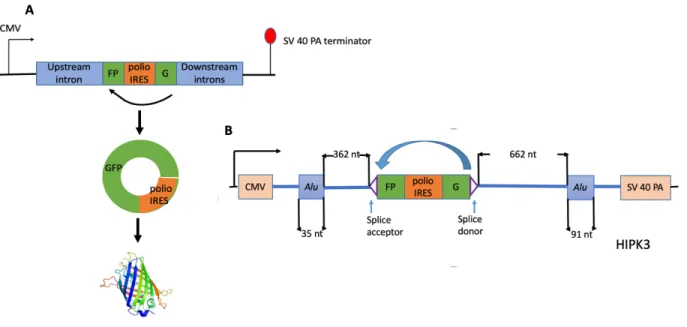
Circular RNA Reporter Design
mRNA was circularized, the split GFP gene can be connected and expressed; if mRNA remained in the linear form, then no green fluorescence was expressed.
Deleting the Alu sequences on either side of the intron drastically decreases RNA circularization and circRNA expression
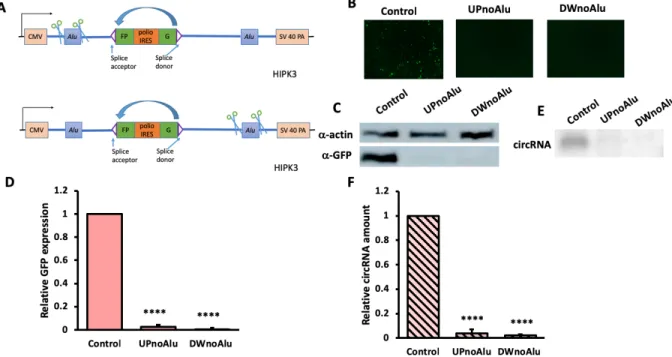
In order to confirm the findings by Liang et. al (Liang and Wilusz 2014) in terms of the necessity of Alu elements, we deleted the Alu sequence on the upstream (UPnoAlu) and downstream (DWnoAlu) exon, respectively. Each construct, along with the control, were transfected into HEK293 cells, and were taken for an assessment four days after. Minimal GFP expression could be assessed with fluorescent images for both deletions, and the Western and Northern blot quantifications showed substantially decreased circularization (figure 2).
Increasing upstream distance of HIPK3 decreases circularization efficiency drastically in HEK293 cells
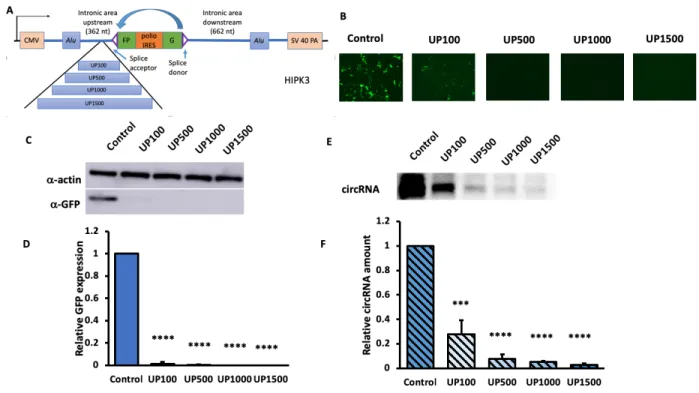
spliceosome assembly, we made a new group of inserts much farther away from the exon. We inserted 100 nt (UP100F), 500 nt (UP500F), 1000 nt (UP1000F), and 1500 nt (UP1500F) into a site 325 nucleotides away from the exon. Both Western and Northern blot quantifications complemented the GFP microscopic images to show significant decrease when distances increased. The similarity of results between the two groups of constructs excluded the possible interference of the polypyrimidine tract, further illustrating that the decrease of circularization efficiency with increasing distance on the upstream side was not affected by the location of insertion, and that circRNA formation and expression efficiency were very sensitive to upstream distance increase.
Increasing downstream distance of HIPK3 did not significantly influence RNA circularization efficiency in HEK293 cells
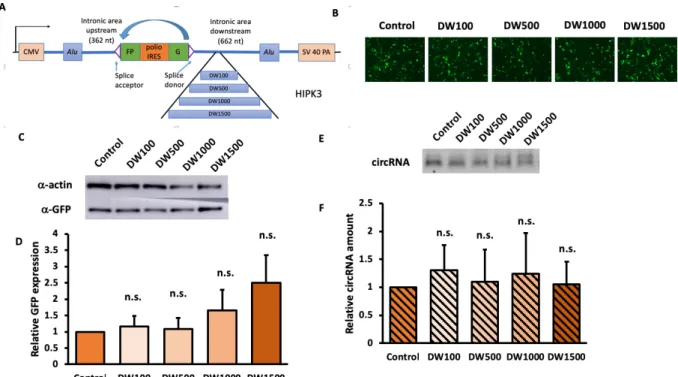
We proceeded to study the influence of increased exon-Alu on the downstream side of the HIPK3 exon. Similarly, we inserted a random sequence of 100 nt (DW100), 500 nt (DW500), 1000 nt (DW1000), 1500 nt (DW1500) into a site 515 base pairs away from the end of the exon. Qualitatively, significant decrease of GFP expression was not observed from the microscopic GFP images (figure 5B). The Western and Northern blot quantification confirmed that there was no significant change of GFP expression or circRNA across the distance gradient. Comparing the downstream insertions to upstream insertion, we saw very different influence by distance gradient.
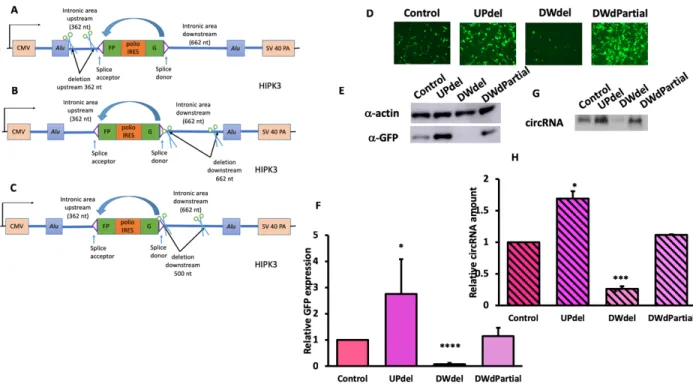
the polypyrimidine tract and the Alu sequence upstream and between exon and the Alu sequence downstream of HIPK3 exon, respectively. For the upstream intron, we deleted 220 nucleotides (UPdel), and for downstream 652 nucleotides (DWdel) (figure 6A-B). We transfected the constructs into HEK293 cells, and took fluorescent images four days after transfection. While the fluorescent images of UPdel did not show significant change, those of DWdel showed a drastic decrease. We then proceeded to create a new construct that deleted 500 nucleotides downstream from the end of the exon (DWdpartial), whose fluorescent images showed in general, a similar amount of GFP expression. We then compared the Western and Northern blot quantifications for our control, UPdel, DWdel, and DWdpartial (figure 6E-H). The Western blot for GFP expression and Northern blot probing for circRNA showed an increase of circularization for upstream deletion (UPdel), but very significant decrease for downstream full deletion (DWdel), as expected. There was with no significant change of GFP expression or circular RNA amount for the downstream partial deletion construct (DWdpartial).
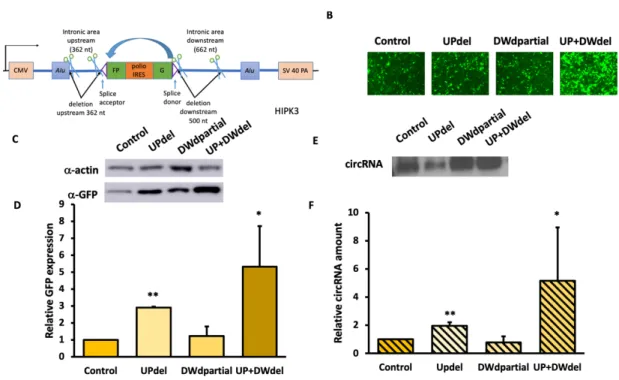
showed an increase of GFP expression and circular RNA amount compared to the control group (figure 7C-F), and the increase was also significant compared to downstream partial deletions only.
Engineered Laccase 2 gene showed similar but less significant results
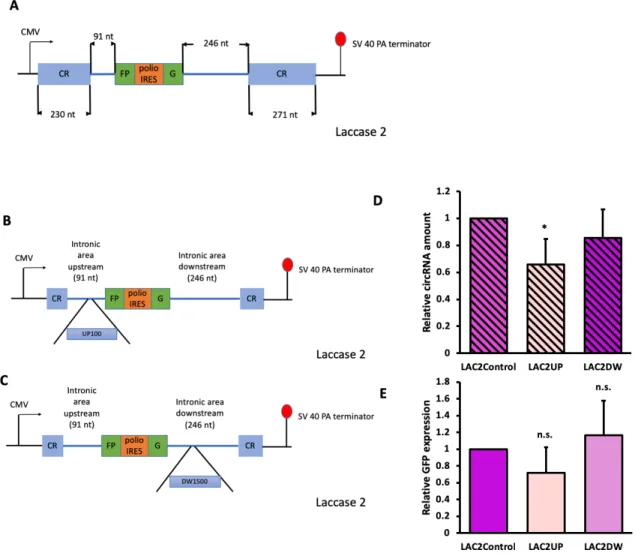
Following, we next asked if the trend we found with HIPK3 gene can be generalized to other genes, so we expanded our query reporter to the Laccase 2 gene from Drosophila. Instead of Alu elements that belong to human SINE element, the Laccase 2 intron has flanking sequences that acts similarly to Alu elements. We tested the two extreme inserts in the laccase 2 gene. Since we found no influence on the maximum (1500 nt) insert downstream of the exon in the HIPK3 gene, we inserted 1500 nt on the downstream of the laccase 2 gene (LAC2DW). However, because we observed a sharp decrease of GFP expression and circularization with only 100 nt inserts on the upstream of the HIPK3 exon, we inserted 100 nt on the upstream of the laccase 2 gene (LAC2UP). We asked if these insertions have the same effects as those in the HIPK3 gene. Similar to HIPK3 constructs, we transfected control, LAC2UP, and LAC2DW into HEK293 cells, and harvested cells four days later. We found a decrease in GFP expression and circular RNA amount in upstream 100 nt insert (LAC2UP), although the effect was not as large as that of HIPK3. We did not find a significant difference in GFP expression or circularization efficiency with 1500 nt downstream insertion. (figure 8D-E).
Discussion
Alu elements has different consequences. The upstream Alu was exceptionally sensitive to an increased distance to the exon, whereas the downstream Alu was resistant to increasing distance. Shortening the Alu-exon distance on either side can increase RNA circularization efficiency, and we were able to engineer a double deletion construct which has the highest circularization and circRNA expression efficiency.
Our study further confirmed the requirement of flanking repeats (in the case of humans, Alu family sequences) for facilitating RNA circularization (Liang and Wilusz 2014), and our results fit the model proposed by Barrett et al. (Barrett, Wang, and Salzman 2015), that circRNAs are generated by exons containing lariat, and Zhang et al. (Zhang et al. 2014) that base-pairing between flanking introns on each side of exon brings splice donors and acceptors physically closer to each other. Furthermore, our study provided a basis for using circRNA as a therapeutic platform proposed by Meganck et al. (Meganck et al. 2018). We showed the possibility to increase packaging efficiency by shortening intronic sequences on both sides to be packaged in the AAV genome, while at the same time reached higher expression of circRNA.
pattern we discovered. We are also going to use the U87 cell line as another model for this study, in order to test whether the circularization with exon-Alu distance is cell type dependent.
In light of the results we observed from modulating intronic distance between exon and Alu sequences, in the future, we hope to further look at other factors that can be modulated to influence circularization efficiency. We will be looking at the exonic sequences can influence circularization and expression efficiency. To do this, we will modulate sizes of exons by inserting sequences in to making bigger circRNA, and test whether increasing the sizes will have an effect on circularization efficiency.
Acknowledgement
I want to thank the Marzluff and Asokan Lab for their support on this project. I thank Dr. Marzluff for his guidance in improving my research methods and training me to become an entry-level scientist. I especially thank Rita Meganck from the Marzluff lab for her close mentorship, guidance on experimental techniques, and scientific thought process. I thank Dr. Marzluff and Rita Meganck for their instructions and help on editing this thesis. I thank Noah Legall for providing the random sequences for the inserts. This project is supported by UNC Summer Undergraduate Research Fellowship (2018) and NIH grant R01NS099371.
Methods
Cloning the construct
generate 100 nucleotides (nt), 500 nt, 1000 nt, and 1500 nt sequence inserts from the random sequence, and restriction enzyme sites overhang were added(Table 2). Two genes which produce circular RNAs, Homeodomain-interacting protein kinase 3 (HIPK3) from human and Laccase 2 (LAC2) from Drosophila, were used as the backbones of the experiments. Both the genes and inserts were digested with restriction enzymes (Table 2) and ligated with T4 ligase (M0202L, New England Biolabs, Ipswich, MA) to generate the constructs with a distance gradient. Site-directed mutagenesis was used in order to delete sequences between Alu elements and exons (Table 2). The constructed HIPK3 gene was then cloned into a pcDNA3.1 plasmid where the plasmids were transformed into DH10B competent cells for mass production. The plasmid DNAs were sequenced after extracted them from the cells using a miniprep kit (27106, QIAprep Spin Miniprep Kit, Hilden, Germany).
In vivo experiment: tissue culture
MA) or and proteins were harvested with Passive Lysis Buffer (5X, E194A. Promega, Madison, WI).
Quantification of circularized RNA
Northern blotting
RNA extracted from cells (5000 nanograms) was resuspended in denaturing buffer (67% deionized formamide, 6.7% formaldehyde, 1×3-morpholinopropane-1-sulfonic acid [MOPS] running buffer (Meganck et al. 2018)) and Northern dye (10X). RNA electrophoresis was run on a 1.15% denaturing agarose gel in 1X MOPS buffer (35V, 22 hours), and was then transferred to a positively charged nylon transfer membrane (RPN303B, GE Healthcare, Chicago, IL) in 10X SSC buffer (overnight). After prehybridization, radiolabeled 32P probe complementary to the reporter (GFP sequence) was generated with Prime-It II Random Primer Labeling Kit (Agilent Technologies, Santa Clara, CA) and hybridized with the RNA in Rapid-hyb buffer (RPN1636, GE Healthcare, Chicago, IL). The blots were washed with wash buffers (2X SSC, 0.1% SDS; 0.1X SSC, 0.1% SDS) and was exposed to film. The radioactivity was quantified with Phospho-imager.
Western blotting
blocked with 5% milk (M0841, LabScientific, Highlands, NJ). GFP was visualized using an anti-GFP antibody (1:1000) (sc-9996, Santa Cruz Biotechnology, Dallas, TX) and the loading control actin was visualized using an anti-actin antibody (1:10000) (GT5512, GeneTex, Irvine, CA). Sheep anti-mouse HRP secondary antibody (1:3000) (NA931V, GE Healthcare, Chicago, IL) was used with the Femto substrate (PI34094, Thermo Scientific, Waltham, MA) to visualize the proteins, and exposed with an ImageQuant camera (General Electric, Boston, MA).
Statistical analysis
GFP expression levels from Western blots were quantified by ImageJ, and circularization levels from Northern blots were quantified by Typhoon software. Actual expression/circularization levels were normalized to the control group to produce relative GFP expression/circularization efficiency. Unpaired two-tailed Student’s t tests were conducted between each experimental group and control group to test for significant difference.
Reference
Ashwal-Fluss, Reut, Markus Meyer, Nagarjuna Reddy Pamudurti, Andranik Ivanov, Osnat Bartok, Mor Hanan, Naveh Evantal, Sebastian Memczak, Nikolaus Rajewsky, and Sebastian Kadener. 2014. “CircRNA Biogenesis Competes with Pre-MRNA Splicing.” Molecular Cell 56 (1): 55–66. https://doi.org/10.1016/j.molcel.2014.08.019.
Barrett, Steven P, Peter L Wang, and Julia Salzman. 2015. “Circular RNA Biogenesis Can Proceed through an Exon-Containing Lariat Precursor.” ELife 4: 1–18.
Review of Biochemistry 72 (1): 291–336.
https://doi.org/10.1146/annurev.biochem.72.121801.161720.
Chen, Ling-ling. 2016. “Ling-Ling Chen -The Biogenesis and Emerging Roles of Circular RNAs” 17 (April): 15–17.
Coolidge, Candace J., Raymond J. Seely, and James G. Patton. 1997. “Functional Analysis of the Polypyrimidine Tract in Pre-MRNA Splicing.” Nucleic Acids Research 25 (4): 888–95. https://doi.org/10.1093/nar/25.4.888.
Enuka, Yehoshua, Mattia Lauriola, Morris E. Feldman, Aldema Sas-Chen, Igor Ulitsky, and Yosef Yarden. 2016. “Circular RNAs Are Long-Lived and Display Only Minimal Early Alterations in Response to a Growth Factor.” Nucleic Acids Research 44 (3): 1370–83. https://doi.org/10.1093/nar/gkv1367.
Hansen, Thomas B., Bettina H. Clausen, Bente Finsen, Jørgen Kjems, Jesper B. Bramsen, Trine I. Jensen, and Christian K. Damgaard. 2013. “Natural RNA Circles Function as Efficient MicroRNA Sponges.” Nature 495 (7441): 384–88. https://doi.org/10.1038/nature11993. Ivanov, Andranik, Sebastian Memczak, Emanuel Wyler, Francesca Torti, Hagit Porath, and
Marta Orejuela. 2014. “Analysis of Intron Sequences Reveals Hallmarks of Circular RNA Biogenesis in Animals.” Cell Reports 10 (2): 170–77.
https://doi.org/10.1016/j.celrep.2014.12.019.
Jeck, William R., and Norman E. Sharpless. 2014. “Detecting and Characterizing Circular RNAs.” Nature Biotechnology 32 (5): 453–61. https://doi.org/10.1038/nbt.2890.
https://doi.org/10.1261/rna.035667.112.
Liang, Dongming, and Jeremy E. Wilusz. 2014. “Short Intronic Repeat Sequences Facilitate Circular RNA Production.” Genes and Development 28 (20): 2233–47.
https://doi.org/10.1101/gad.251926.114.
Meganck, Rita M., Jeremy E. Wilusz, Aravind Asokan, Ruth M. Castellanos Rivera, William F. Marzluff, Miranda L. Scalabrino, and Erin K. Borchardt. 2018. “Tissue-Dependent
Expression and Translation of Circular RNAs with Recombinant AAV Vectors In Vivo.” Molecular Therapy - Nucleic Acids 13 (December): 89–98.
https://doi.org/10.1016/j.omtn.2018.08.008.
Reed, Robin. 1989. “The Organization of 3’ Splice-Site Sequences in Mammalian Introns.” Genes and Development 3 (12 B): 2113–23. https://doi.org/10.1101/gad.3.12b.2113. “SDS Gel-Loading Buffer (2X).” 2006. Cold Spring Harbor Protocols 2006 (1): pdb.rec407.
https://doi.org/10.1101/pdb.rec407 .
Vicens, Quentin, and Eric Westhof. 2014. “Biogenesis of Circular RNAs.” Cell 159 (1): 13–14. https://doi.org/10.1016/j.cell.2014.09.005.
Wang, Yang, and Zefeng Wang. 2015. “Efficient Backsplicing Produces Translatable Circular MRNAs.” Rna 21 (2): 172–79. https://doi.org/10.1261/rna.048272.114.
Zhang, Xiao Ou, Hai Bin Wang, Yang Zhang, Xuhua Lu, Ling Ling Chen, and Li Yang. 2014. “Complementary Sequence-Mediated Exon Circularization.” Cell 159 (1): 134–47. https://doi.org/10.1016/j.cell.2014.09.001.
Figures
Figure 2. Deleting Alu sequences on each side of exon drastically decreased circularization and GFP expression. Constructs were transfected into HEK293 cells, and were harvested four
days after. A) A schematics for Alu sequence deletion; B)fluorescent images of cells; C) Western blot and D) quantifications of GFP of each construct; E) Northern blot and F) quantifications of circularized RNA . (N=3; Error bars indicated standard deviation; significance level using two-tailed Student’s t test was represented by [*]: [*] p<0.05, [**]
Figure 3. Increasing upstream Alu-exon distance drastically decreased circularization and expression efficiency. Constructs were transfected into HEK293 cells, and were harvested four
days after. A) A schematics for upstream inserts; B)fluorescent images of cells with upstream insertion; C) Western blot and D) quantifications of GFP of each insert; E) Northern blot and F) quantifications of circularized RNA . (N=3; Error bars indicated standard deviation; significance level using two-tailed Student’s t test was represented by [*]: [*] p<0.05, [**]
Figure 4. Increasing upstream Alu-exon distance at a farther site showed a similar trend as the more downstream insertion in figure 3. Constructs were transfected into HEK293 cells,
and were harvested four days after. A) A schematics for upstream inserts at a farther site;
Figure 5. Increasing downstream Alu-exon distance did not significantly affect
circularization and expression efficiency. Constructs were transfected into HEK293 cells, and
were harvested four days after. A) A schematics for downstream inserts; B)fluorescent images of cells with downstream insertion; C) Western blot and D) quantifications of GFP of each insert; E) Northern blot and F) quantifications of circularized RNA . (N=3; Error bars indicated
Figure 7. Combining upstream and downstream deletion significantly increased GFP expression. Constructs were transfected into HEK293 cells, and were harvested four days after.
A) A schematics for combining upstream full deletion and downstream partial deletion;
B)fluorescent images of cells; C) Western blot and D) quantifications of GFP of each construct; E) Northern blot and F) quantifications of circularized RNA . (N=3; Error bars indicated
Figure 8. Engineered laccase 2 constructs had similar but less significant effect. Constructs were transfected into HEK293 cells, and were harvested four days after. A) A schematics for laccase 2 control group, CR stands for complementary region; B) A schematics for laccase 2 upstream insert; C) A schematics for laccase 2 downstream inserts; D) Northern blot
Tables
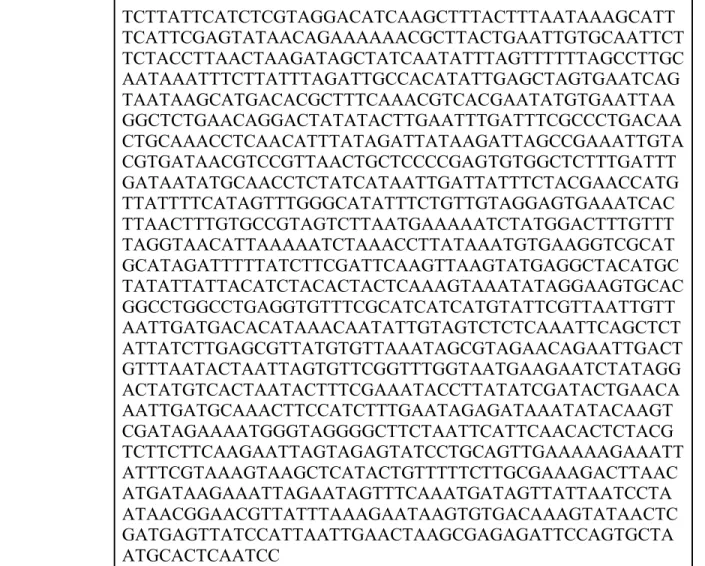
Table 1. The random sequences generated for insertions upstream and downstream
Location Random sequence Upstream to
TCTTATTCATCTCGTAGGACATCAAGCTTTACTTTAATAAAGCATT TCATTCGAGTATAACAGAAAAAACGCTTACTGAATTGTGCAATTCT TCTACCTTAACTAAGATAGCTATCAATATTTAGTTTTTTAGCCTTGC AATAAATTTCTTATTTAGATTGCCACATATTGAGCTAGTGAATCAG TAATAAGCATGACACGCTTTCAAACGTCACGAATATGTGAATTAA GGCTCTGAACAGGACTATATACTTGAATTTGATTTCGCCCTGACAA CTGCAAACCTCAACATTTATAGATTATAAGATTAGCCGAAATTGTA CGTGATAACGTCCGTTAACTGCTCCCCGAGTGTGGCTCTTTGATTT GATAATATGCAACCTCTATCATAATTGATTATTTCTACGAACCATG TTATTTTCATAGTTTGGGCATATTTCTGTTGTAGGAGTGAAATCAC TTAACTTTGTGCCGTAGTCTTAATGAAAAATCTATGGACTTTGTTT TAGGTAACATTAAAAATCTAAACCTTATAAATGTGAAGGTCGCAT GCATAGATTTTTATCTTCGATTCAAGTTAAGTATGAGGCTACATGC TATATTATTACATCTACACTACTCAAAGTAAATATAGGAAGTGCAC GGCCTGGCCTGAGGTGTTTCGCATCATCATGTATTCGTTAATTGTT AATTGATGACACATAAACAATATTGTAGTCTCTCAAATTCAGCTCT ATTATCTTGAGCGTTATGTGTTAAATAGCGTAGAACAGAATTGACT GTTTAATACTAATTAGTGTTCGGTTTGGTAATGAAGAATCTATAGG ACTATGTCACTAATACTTTCGAAATACCTTATATCGATACTGAACA AATTGATGCAAACTTCCATCTTTGAATAGAGATAAATATACAAGT CGATAGAAAATGGGTAGGGGCTTCTAATTCATTCAACACTCTACG TCTTCTTCAAGAATTAGTAGAGTATCCTGCAGTTGAAAAAGAAATT ATTTCGTAAAGTAAGCTCATACTGTTTTTCTTGCGAAAGACTTAAC ATGATAAGAAATTAGAATAGTTTCAAATGATAGTTATTAATCCTA ATAACGGAACGTTATTTAAAGAATAAGTGTGACAAAGTATAACTC GATGAGTTATCCATTAATTGAACTAAGCGAGAGATTCCAGTGCTA ATGCACTCAATCC
Table 2. The sequence source, primers and restriction enzymes for construct preparation
Gene Construct name Source Forward primer Reverse primer Restriction enzymes HIPK3 Control
HIPK3 UP100 upstream
random CTCGCTTAAGTTCTTTAACC TTTTAATTGC TCTC CTAGCTTAAGCA ATCATTTACATG GGACATGCGATC G AflII
HIPK3 UP500 upstream
random CTCGCTTAAGTTCTTTAACC TTTTAATTGC TCTC CTAGCTTAAGAT TGCATTCGATTT TAGATCGATGTA AAGATTGAT AflII
TTTTAATTGC TCTC
TCCTCCAACTTC ATTAC
HIPK3 UP1500 upstream
random
AflII
HIPK3 DW100 downstream
random GCTAACTAGT ATTGTGTTTT TATTATAATA TCAGAATCTT TAAGTCG CGATACTAGTTG AATTATAATTTG TGAGTAATCACA AGATGCGG SpeI
HIPK3 DW500 downstream
random GCTAACTAGT ATTGTGTTTT TATTATAATA TCAGAATCTT TAAGTCG CGATACTAGTAC ATATTCGTGACG TTTGAAAGCGTG SpeI
HIPK3 DW1000 downstream random GCTAACTAGT ATTGTGTTTT TATTATAATA TCAGAATCTT TAAGTCG CGATACTAGTGA GAGACTACAAT ATTGTTTATGTG TCATCAATTAAC AA SpeI
HIPK3 DW1500 downstream random
SpeI
HIPK3 UP100F upstream
random GCCAACATTTTCCCTCAAAT TCTTTAACCT TTTAATTGCT CTCTTAGAAG CTAGACCGGTCA ATCATTTACATG GGACATGCGATC G AgeI
HIPK3 UP500F upstream
random GCCAACATTT TCCCTCAAAT TCTTTAACCT TTTAATTGCT CTCTTAGAAG CTAGACCGGTAT TGCATTCGATTT TAGATCGATGTA AAGATTGAT AgeI
HIPK3 UP1000F upstream
random GCCAACATTTTCCCTCAAAT TCTTTAACCT TTTAATTGCT CTCTTAGAAG CTAGACCGGTGA TTCCCATGTTAA TCCTCCAACTTC ATTAC AgeI
ATCCCAGCA ACTTGGGAG G
GACGTAGCCTT
HIPK3 DWdel
HIPK3 DWdPartial GCCAACTAG
TTAAGCACCC CC
GTTACCTACCTG GACGTAGCCTT
SpeI
HIPK3 UP+DWdel HIPK3 UPnoAlu HIPK3 DWnoAlu Laccase2 Control
Laccase2 UP100 upstream random CTAAGCTAA ATCGAGACT AAGTTTTATT GT CATTATACCCAT AAATCGTACAGT AAAAAGGTATA BlpI