April, 2010. 84 pages. Advisor: Cal Lee
The goal of this paper is to present a historical literature review and analysis of archival reference literature in order to identify what, if any, assumptions the literature suggests that archivists hold, and have held in the past, about users. In order to determine implicit as well as explicit attitudes about users, attention has been focused on words used to refer to users as well as words used to describe users and their uses of archival materials. The paper focuses on North America archival literature from 1938 to 2009. This analysis is an attempt to raise awareness of assumptions archivists have or have had about users in order to facilitate assessment of reference policies and services.
Headings:
Reference services—Archives Archives—Reference
ANALYZING HOW REFERENCE ARCHIVISTS WRITE ABOUT USERS: A HISTORICAL REVIEW OF THE LITERATURE IN NORTH AMERICA
by Rhea M. Hebert
A Master‘s paper submitted to the faculty of the School of Information and Library Science of the University of North Carolina at Chapel Hill
in partial fulfillment of the requirements for the degree of Master of Science in
Library Science.
Chapel Hill, North Carolina April 2010
Approved by
INTRODUCTION
The goal of this paper is to present a historical literature review and analysis of archival reference literature in order to identify what, if any, assumptions the literature suggests that archivists hold, and have held in the past, about users. In order to determine implicit as well as explicit attitudes about users, attention has been focused on words used to refer to users as well as words used to describe users and their uses of archival materials. The focus for this paper is the United States, although some literature from Canada is included.
It is hoped that this paper will assist archivists as they engage in user studies; understanding past attitudes and lingering assumptions can help to target where research and examination is needed. This paper is preliminary and includes suggestions for further research in the conclusion. While the goal is to be representative of the archival reference literature, the paper is not exhaustive. It is important that archivists engage with users based on data and plan and implement services based on data rather than anecdotal or intuitive knowledge. A firmer understanding of users and uses of archives will enable archivists to provide more effective services to the broadest range of users possible. Having solid data about users can also assist archivists beyond the immediate reference interaction—resource allocators, donors, records creators, and policy-making bodies can be more effectively influenced in favor of archival repositories when
LITERATURE REVIEW
The archival literature on reference services falls into three related categories of emphasis: users, education and training, and commentary on the literature itself. In the interests of clarity, these three emphases will be addressed individually here. The majority of the literature under review here comes from The American Archivist,
published by the Society of American Archivists since 1938. Using the searches detailed in this paper‘s Methodology, articles were identified as related to reference services or archival services. In addition to those articles originally identified, footnotes were scanned for overlooked materials.
State of the Literature
lack of education in reference, as evidenced in Duncan‘s (1990) comment that while ―[t]he reference archivist is the public face of the archives‖ (213) there is ―little…written on archival reference services or methods of teaching reference skills‖ (215). Archival reference training and service overall are impacted by the ―dearth of research‖ (2) and ―numerous gaps‖ (2) in the literature still seen by Cox in 1992. Even after almost three decades of articles pointing out the lack of focus on reference topics, archivists in the 2000s continued to state that ―the literature on archival reference is sparse‖ (O‘Donnell 110) and that this was not a recent trend. O‘Donnell‘s literature review shows that the
American Archivist‘s first 12 volumes ―did not include the term reference in the titles of
any of the articles‖ (110). Similarly, she noted the continued scarcity until the mid-1980s (110). As digital technologies began to change reference services in libraries, more literature in the archival field addressed the possibilities of digital archival reference. However, Salzmann still noted that in 2004 ―much less research exist[ed] on the topic‖ (45) of remote reference in archives than on the same topic in libraries. Finally, in 2006, Duff and Fox were still echoing the sentiment that archival reference has gaps by
pointing out that their article on archival reference from the view of archivists has been ―an area traditionally neglected within archival reference literature‖ (129).
state of archival education. The two issues (lack of reference focus and education) are seen as related insofar as a lack of training in reference is seen to result in a need for on-the-job training. This on-on-the-job training leaves less time for archivists less time to pursue research studies on reference services. Thus, articles about reference frequently mention archival education and articles on archival education sometimes mention reference as a particular point of concern for archival education programs.
Archival Reference and Education
Brauer‘s statements highlight a recurrent theme in this segment of the literature: the debate over educational training vs. on-the-job training. Jacobsen (1981), writing with a view toward improving the service toward genealogists, suggested that archivists needed to ―re-educate‖ (341) themselves before they could turn to the task of educating users. Ruth‘s focused treatment concluded with suggestions for study and advocated more formal education in reference services (1988). Disappointingly, nearly ten years after Ruth‘s article Malbin (1997) indicated that reference training was still not being addressed by the archival community. Her call to action was simple and direct: ―[t]he research agendas Ruth described must now be executed‖ (77). Duncan (1990) similarly argued in favor of best practices and communication skills as part of archival training. In a review of Mary Jo Pugh‘s 2005 reference manual, Cliff (2006) still noted that ―public relations may be touched upon in an archival program, but is usually not emphasized‖ (163). Some of these authors were primarily concerned with archival education, while others were more focused on reference in practice. For all of these authors, there was a current of concern flowing through the literature that has not abated. After 72 years of the SAA, archivists are still expressing concerns in their journal publications about the overall state of archival education and reference service education is now becoming a focus in the literature..
Users and User Studies
A final recurrent theme in the archival literature on reference services is the role of users and user studies in archival settings. As early as 1939, McCain was concerned about identifying the variety of user groups in archival settings. Schiller (1948)
In addition to this body of journal literature, the SAA has published three manuals on reference services. The first appeared in 1977 and was followed by another in 1992. The 1992 manual was published in a second edition in 2005. Along with the literature reviewed above, these three manuals are the main texts under consideration in this paper. They represent the direct efforts of SAA to educate and inform archivists of standards and best practices for reference work in archival institutions. Finally, two volumes of
The Reference Librarian are analyzed as distinct from the manuals and other journal literature, as they are also direct efforts from the archival profession to inform and/or train other archivists about reference services. These volumes appeared in 1985 and 1997. To date there is no archival journal specifically devoted to reference or other public services.
METHODOLOGY
The main research question under consideration in this paper is the representation of users in archival literature focusing on reference services in archival settings. In order to approach a fuller understanding of reference services in archival settings, it is
important to understand the history of those services. As part of that history, the
The basis for understanding representations of uses and users in the literature in this study is textual analysis. Terminology applied to users is considered along with characterizations of users and users of archival materials. Terminology and
characterizations are considered historically and trends are identified. The focus of the textual analysis is on word choice for users (inclusive terms versus exclusive terms), gender of word choice for users, and variety of word choice for users.
The scope of this study is North American literature about reference services in archival settings in the United States published1 in English between 1937 and 2010. The majority of the literature is by American authors, though Canadian authors who were frequently cited in the American literature are also included. In addition, studies that included the United States and another country are included. For this study, one article is a study comparing American and British archival reference. The other mixed studies included American and Canadian repositories.
Books and Manuals
To identify manuals or guidebooks on reference services in archives, I searched the UNC-Chapel Hill library catalog. Search terms included ―archival reference,‖ ―reference archivist/s,‖ and ―Society of American Archivists.‖ I also searched the SAA site directly and determined that three manuals existed: Holbert‘s 1977 manual and Pugh‘s 1992 and 2005 manuals.
Journal Literature—Individual Journals
1 . One article (Barth, Christopher D. ―Archivists, genealogists, access, and automation: past and present
In addition to the books and manuals identified above, particular journals were identified as sources of relevant materials on providing archival reference services. The American Archivist and Archivaria are the primary sources for archival articles with a focus on the United States and/or North America. Both are indexed in the databases identified below and figure heavily in the relevant results identified through the database searches. In addition to database searches, issues were browsed when retrieving
identified articles. Finally, in addition to these journals, two issues of The Reference Librarian were identified as special issues focused on archival materials and institutions. These volumes appeared in 1985 and 1997. The journal was also searched online via the UNC-Chapel Hill Libraries, resulting in four additional relevant articles. The online search of The Reference Librarian covered the years 1997-2010, limiting the additional results identified to more recent articles.
Journal Literature—Databases
The journal literature is important in order to get a wider picture of the place of reference services in the archival literature. In order to identify articles that discuss reference services in archives, multiple databases were searched and their results compared. The data collected on the journal literature indicates the amount of attention paid to reference services and contextualizes the three official reference manual
publications.
The first step in identifying journal articles was selecting databases. Working within the Triangle Research Library Network (TRLN) five databases were identified as likely to have articles related to archival practice: Library, information science &
Library Literature and Information Science, Library Literature and Information Science Retrospective, and Education Resources Information Center (ERIC). LISTA, LISA, and ERIC were accessed through North Carolina State University (NCSU) Libraries. Library Lit and Library Lit Retrospective were accessed through UNC-Chapel Hill Libraries. Overlap was expected between various databases; the Library Lit Retrospective was the only database that specifically covered dates back to the founding of the Society of American Archivists (SAA) and was included to ensure that the historical focus of the paper was upheld.
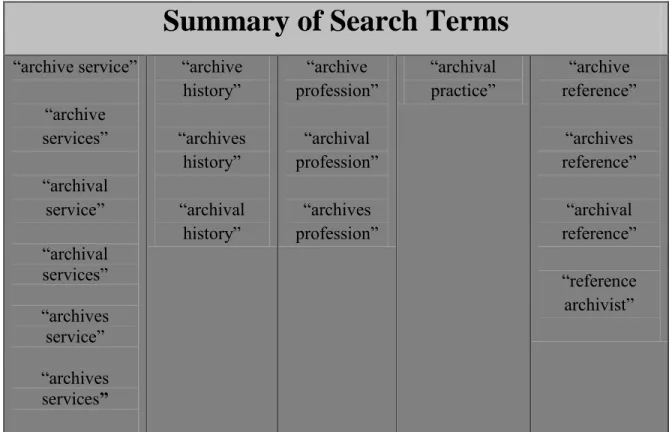
Once databases were identified, search terms were created. A previous search of the literature offered some terms; these were expanded to include variations and an expanded focus from reference to the profession as a whole. This expansion was pursued in order to avoid myopic analyses of the archival profession; reference services may not be the sole focus of an article but the article may include a sustained (a full paragraph or more) discussion of reference services or users. In cases where such articles were
Summary of Search Terms
―archive service‖ ―archive services‖ ―archival service‖ ―archival services‖ ―archives service‖ ―archives services” ―archive history‖ ―archives history‖ ―archival history‖ ―archive profession‖ ―archival profession‖ ―archives profession‖ ―archival practice‖ ―archive reference‖ ―archives reference‖ ―archival reference‖ ―reference archivist‖Table 1: Database search terms used to identify articles, arranged to show term variations
Terms were chosen with variations such as plurals in mind, but preliminary searches determined that some plural variations returned few or no unique results. For the purposes of comparison, these null results are included in my tables of results, included as Appendix A. In order to keep the results relevant to this study, raw results were refined to English-only articles. They were then further refined to include those articles dealing with the United States; as stated above, however, some Canadian authors were included because citation patterns suggested that they had a significant impact on the archival literature in the United States.2 Finally, the remaining results were browsed
to compile a list of articles for review; that is, this initial list consisted of articles with a high probability of relevance, based on the title, subject headings, and abstract.
Relevance was based on whether or not the focus of the article was on reference services or users. If the topic was not mainly reference-focused, the article was browsed to determine if a significant (a full paragraph or more) section related to reference services or users. In addition to the title of the article, subject headings and abstracts were scanned to determine the topic of an article. Additionally, articles that were identified through citations were determined to be relevant if they were cited more than once or if the article citing it was cited more than once. Finally, it is important to note that the focus of the article is the main determining factor of relevance. The focus of this study does not include those studies that use archival materials to write history. This is a necessary distinction to make since searching for ―history‖ and ―archive/s/al‖ leads to a large number of articles describing the use of materials to write histories. These studies are outside of the scope of this study because they are interested in the products of research rather than the processes of research or the users of archival materials.
Limitations
One limitation of this search is the variety inherent in the databases consulted. Of the five, only LISA offers the option to limit by language. Primary language was thus determined by scanning and tallying initial results lists. A primary language was
limitations of scope and time on these database searches, the resulting list of relevant articles is encouraging in its coverage.
A final limitation to this study is the factor of time. Every article that mentions or references reference services cannot be included. Part of the process of selection was a comparison between databases to identify overlap; articles that appeared in many databases or under multiple search terms were considered more relevant for this study than outliers that appeared in a single database or under fewer search terms. This is not to suggest that those articles are unimportant, but rather that they may not have been as widely influential as articles that appeared in numerous databases or numerous footnotes.
RESULTS
JOURNAL LITERATURE
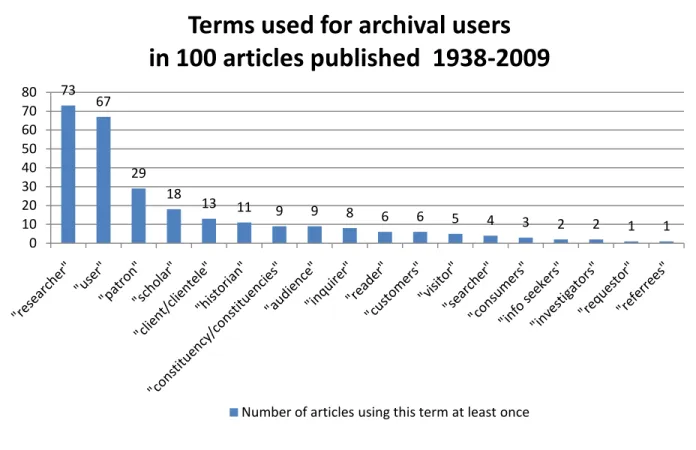
Analysis of the journal literature yielded eighteen terms that were used
generically by authors to refer to archival users. Of these, only two were used only once. Some terms were identified prior to reviewing the literature (―user,‖ ―patron,‖
Figure 1: Terms used for users, arranged by frequency. Numbers correspond to the number of articles using a term at least once.
The chart is arranged to clearly show that that more general and inclusive terms such as ―user‖ and ―researcher‖ are clearly preferred over specific and exclusive terms such as ―historian‖ or ―scholar.‖ It is important to note, however, that while ―user,‖ ―researcher,‖ and ―patron‖ were favored over ―scholar,‖ ―scholar‖ was still more widely used than many other less exclusive terms. The implications of this usage are discussed in more detail below.
Specificity of Terms
General terms have much higher usage overall. ―User‖ and ―researcher‖ were used generically by the majority of authors. This chart shows generic usages of terms for users of archival materials—―researcher‖ was also used more specifically. For example,
73 67
29 18
13 11 9 9
8 6 6 5 4
3 2 2 1 1
0 10 20 30 40 50 60 70 80
Terms used for archival users
in 100 articles published 1938-2009
authors might refer to specific groups as ―historical researchers‖ or ―genealogical researchers.‖ These cases are not reflected in the above chart. Similarly, ―scholar‖ was used generically in only 18% of papers, but was also used more specifically. (To be considered a ―generic‖ use, the author‘s language must suggest that any user would be called a ―scholar.‖ Otherwise, the use was considered specific, suggesting that only scholars used archival repositories rather than suggesting that all users are scholars of some kind.) Some terms suggest influence from business or retail environments (―clientele,‖ ―customer,‖ ―consumer‖) while others suggest a library science influence (―patron,‖ ―information seeker‖). ―Patron‖ was significant in that it was usually used when comparisons were made between libraries and archival repositories. Not all authors used generic terms for users. Instead, they wrote from the perspective of the reference archivist‘s duties and did not use general terms for users. 11% of the articles reviewed had no general terms for users.
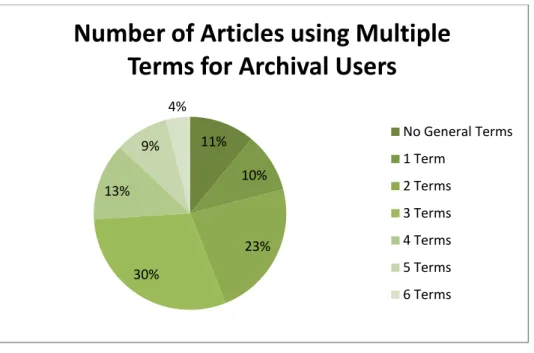
Number of Terms Used
Figure 2: Usage of multiple user terms per article (out of 100 articles)
Gender of Pronouns
No articles used non-masculine generic pronouns for users3 until the 1980s. Most of those that did use mixed gender pronouns in the 1980s (his/her, he/she, she/he) were contributors to the 1985 special issue of The Reference Librarian; other articles in the 1980s generally did not use gendered pronouns at all or used masculine pronouns throughout. By the 1990s, only one article that used gendered pronouns used only masculine pronouns. In the 2000s, no articles that used gendered pronouns used masculine pronouns—all pronoun usage was either female or mixed. Feminine-only usage only occurred once in the 1980s, the 1990s, and the 2000s. The SAA manuals used general masculine pronouns until the 2005 revision of the Series II manual by Mary Jo Pugh. This shift to more inclusive gender terminology indicates that archivists overall adapted their writing styles to social changes.
3. Some articles did include mixed pronouns for archivists, but not for users.
11%
10%
23%
30% 13%
9% 4%
Number of Articles using Multiple
Terms for Archival Users
No General Terms
1 Term
2 Terms
3 Terms
4 Terms
5 Terms
Adjectives
In addition to charting nouns used to identify users, adjectives were also tallied. These were grouped by word modified and by decade to identify trends in usage. They were grouped such that adjectives used to describe users were separated from words used to describe uses or products of archival materials. Adjectives were not separated into those that modified general terms and those that modified specific terms. The main focus is on the kinds of adjectives used for any users (and uses, since this also implies attitudes toward users). The categories4 ―users,‖ ―researchers,‖ and ―patrons‖ were combined; these terms were used in similar ways and combining them shows adjective usage more clearly. For this group of terms, 55 total unique adjectives were identified. There were multiple uses of 21 of the adjectives, with ―academic,‖ ―potential,‖ ―new,‖
―experienced,‖ and ―remote‖ having the largest number of repeated uses. The categories ―public‖ and ―citizens‖ were also combined. These two terms had eight unique terms with only two terms (―general‖ and ―interested‖) repeated. Similarly, ―audiences,‖ ―community,‖ ―constituencies,‖ and ―client/clientele‖ were combined into a single category with 19 unique adjectives identified. Three terms were repeated in this group: ―primary,‖ ―new,‖ and ―scholarly.‖
For uses of archival materials, the categories ―research,‖ ―use,‖ ―purpose,‖ and ―studies‖ were combined. This group had 24 total terms associated with it. Five terms were repeated: ―scholarly,‖ ―serious,‖ ―important,‖ ―historical,‖ and ―nontraditional.‖ Finally, the categories ―questions,‖ ―requests,‖ and ―inquiries‖ were combined and had a
4 . The categories mentioned here are those terms that authors were modifying with the identified
total of six terms, with none repeated. Nineteen other terms were recorded with no repeated terms. These are included in the appendix of adjective groupings. SAA MANUALS
The three SAA manuals included in this study are Sue E. Holbert‘s manual of 1977 and Mary Jo Pugh‘s manuals of 1992 and 2005.
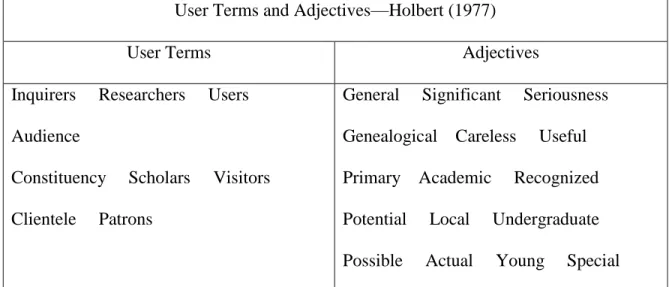
Holbert‘s manual, though only thirty pages, uses more general terms than any of the articles included above. She uses nine distinct terms: ―inquirers,‖ ―researchers,‖ ―users,‖ ―audience,‖ ―constituency,‖ ―scholars,‖ ―visitors,‖ ―clientele,‖ and ―patrons.‖ She uses ―researcher‖ most frequently. Her use of adjectives for users was also varied, reflecting some of the terms seen repeated in the journal literature (e.g. ―potential‖ and ―academic‖). Adjectives used are summarized in Figure 3.
User Terms and Adjectives—Holbert (1977)
User Terms Adjectives
Inquirers Researchers Users Audience
Constituency Scholars Visitors Clientele Patrons
General Significant Seriousness Genealogical Careless Useful Primary Academic Recognized Potential Local Undergraduate Possible Actual Young Special
Figure 3: User terms and adjectives in Holbert’s 1977 SAA manual Archives & Manuscripts: Reference and Access
for users in general: ―users,‖ ―constituencies,‖ ―researchers,‖ ―patrons,‖ and
―clients/clientele.‖ Of these terms, Pugh does not use any one significantly more than any other. This number of terms is closer to the journal literature as a whole. Pugh‘s use of adjectives is higher than Holbert‘s, however, and similar to the journal literature overall. The adjectives used are summarized in Figure 4.
User Terms and Adjectives—Pugh (1992)
User Terms Adjectives
Users Constituencies Researchers Patrons Clients/Clientele
Important Primary Vocational Most Many Changing Potential Public Experienced Effective Efficient Narrow
Young Novice Broader
Independent New Wider Mature Professional Academic Future Avocational Current Repetitive Simplistic Naïve Direct Elitist Patriotic Unskilled Amateur Less important Less justifiable Idle Qualified Most numerous Significant
Figure 4: User terms and adjectives in Pugh’s 1992 SAA manual Providing Reference Services for Archives and Manuscripts
adjectives when discussing users and uses of materials: ―‖major,‖ ―‘accidental,‘‖ ―‘recreational,‘‖ ―‘leisure,‘‖ ―general,‖ ―scholarly,‖ ―defensive,‖ ―casual,‖ ―intensive,‖ ―mundane,‖ and ―routine‖ appear in the second edition. Differences between the two editions will be discussed in more depth later in this paper.
DISCUSSION
In analyzing the journal literature and SAA manuals, a number of continuing assumptions about archival users emerge. The assumptions include distinctions between ―experienced‖ and ―inexperienced‖ users and who they are, slippage between ―scholar‖ and other user terms, assumptions about ―remote‖ or ―digital‖ users and their
expectations, anxiety about genealogical users, and a focus on academic historians in user study research. Each of these will be discussed individually, drawing on both the journal literature and the SAA manuals.
Variety of Terms
71% of authors used two or more terms when referring to archival users. These terms seem to be drawn from a range of other fields, including retail environments. Even though retail terminology (e.g. ―customers‖ and ―consumers‖) has spread beyond retail environments, these terms appear in the archival literature only sparsely. They did not appear in the literature until the 1980s, suggesting a possible influence from the retail sector, but with only eight authors using these terms, it cannot be suggested that the terms have been widely adopted by the archival community.
the rise in user studies in the 1980s and may suggest that archival writers were becoming increasingly aware of the need for accountability to users and a wider community. However, as with most of the terms identified for this study, authors do not define how they employ the term ―constituency‖ or why they adopted it. It is therefore difficult to determine what, if any, significance the use of particular terms is. This is also true of ―client/clientele,‖ which appeared in the literature in the early 1980s. One early use of this term was in an article written by a former nurse who used the term heavily in her article. Other articles were less clear about the possible reasons for adoption of the term.
The overall variety of terms used by writers suggests a lack of consensus in
ambiguity makes it difficult to understand how terms are used, especially since term definition occurred rarely in the literature sampled here.
“Experienced” and “Inexperienced” Users
Many of the adjectives used in the journal literature suggest the assumptions that archivists have about ―experienced‖ versus ―inexperienced users. As early as 1939 Margaret Cross Norton was concerned that ―very few graduate schools seem to be giving even elemental training in the techniques of the use of manuscript materials‖ (105). Norton was concerned about the training of scholars in the social science field, but her observation is telling—with the exception of Richards (1962) most discussions of ―inexperienced‖ and ―experienced‖ users are concentrated in the literature published since 1980. The assumptions appearing in these articles are mixed, but one trend suggests that genealogical/family historian users and/or students are necessarily
―inexperienced,‖ especially in comparison with academic users such as graduate students and faculty members. This implied distinction contrasts with Norton‘s early assertion that graduate programs were not training graduate students to do archival research.
However, Richards does also mention professional genealogists; unfortunately, he later collapses these genealogists into a category of ―amateur users‖ (326) for whom his repository compiled a notebook of tips. Between the time of Norton‘s early article on reference work and Richards article on services for ―amateur‖ researchers, it became possible to think of genealogists as necessarily ―amateurs‖ even when they were pursuing research for pay. The slippage here is not limited to the 1960s. In 1988 Stieg wrote an introduction for a researcher‘s guide to archives. In it she collapses genealogists with novice researchers: ―In pursuing the family tree, novice researchers need to familiarize themselves with the kinds of records‖ (12) which have dates, names, occupations, and addresses. There is no acknowledgement here that genealogical users might be other than novices; this is even after the article by Speakman (a professional genealogist) appeared in 1985. Speakman specifically addresses the needs of professional genealogists in archival settings. In the same 1988 volume, however, Koel specifically writes against the ―old myths‖ about genealogists, including ―the one about genealogists as little old ladies in sneakers...asking endless questions but unwilling or unable to acquire appropriate research skills‖ (124). She specifically writes about the advice that experienced
genealogists have for beginners. While Koel is also not drawing on user studies, she does begin to push back against a particular assumption about genealogists being unskilled or inexperienced researchers per se.
inexperienced researchers. Therefore an archival repository whose constituency is primarily undergraduates and administrators, for example, might need more detailed finding aids than a repository whose primary constituency is the graduate student or scholar‖ (28). The implication here is that undergraduates and administrators are
necessarily inexperienced and that inexperienced researchers need more detailed finding aids. Graduate students and scholars, on the other hand, are assumed to be experienced and able to handle truncated description and arrangement. Oetting does not cite any user studies or empirical evidence for these claims. Interestingly, in the same volume of article, Mason echoed Norton, writing, ―[a]nother related problem which has led to a noticeable increase in the demand for archival reference services over the past 25 years has been the lack of training of graduate students and other younger scholars in the use of archival material‖ (125). Without citing any studies, Mason concludes that ―[i]t is
Similarly, both Teichman and Gildemeister assume that graduate students, faculty, and professional writers have better skills and more experience with archival materials than undergraduates and other students. Teichman states that, ―[t]he [FDR] Library encourages visits by faculty members, professional writers and degree
candidates, and while it does not discourage use by undergraduates, and high school and elementary students, it suggests that they follow certain procedures so as to avoid indiscriminately rummaging through manuscript collections‖ (178). This implies that faculty members, professional writers, and degree candidates do not have this proclivity for ―rummaging,‖ but there is no evidence given for the skills that these groups bring with them to the archives. It may be easy to assume that elementary students are more likely to rummage than graduate students are, but it is hard to believe that Teichman is being literal here—given the level of concern with preservation also evident in the archival literature, it would be surprising to me if archivists allowed rummaging in a literal, physical sense. Teichman‘s assumptions here, however, are similar to others: they are difficult to parse because they are vague—there is no evidence given and no
definition of terms, so it is difficult to know what Teichman means here. Does he really feel that undergraduates are a priori more likely to rummage? Does he feel that faculty will not? What evidence does he have? How might user studies help his repository shape reference and educational services? Without the answer to these questions, it is frustrating to read that users are ―not discouraged‖ but are treated differently because they are younger (in this case) and thus assumed to have certain behavioral
many of those coming from off campus have never been in an archives before‖ (190). The parallelism here implies that simply being from off campus means that a user does not have strong research skills. While it may be true that they have never been in
archives, Gildemeister allows that graduate students and faculty can have strong research skills but only some experience in archives. Is the same true for non-graduate students and non-faculty? These questions are not suggesting that user studies would not confirm these assumptions, but rather that data is preferable to assumption when it comes to providing services to users.
In an early discussion of archival automation Clement suggested that challenges existed when archivists had to simultaneously ―train new people [to use two types of catalogs] while dealing with psychological attachments by experienced patrons to the ‗old and familiar‘ form‖ (132). Here, experience is described somewhat negatively, as a predisposition to prefer something because it is familiar rather than effective. Clement‘s view that ―[a]utomation is insatiable and will not stand still for [the] status quo‖ (133) further suggests that the experienced patrons here are a challenge because they are attempting to maintain the status quo rather than assisting with the progress of automation. Clement does not, however, mention any user studies that might have suggested other reasons for this preference.
There is some middle ground between these two ideas in the 1985 volume. Stewart outlines the services provided in a technical university archives and states that ―[f]irst time users are dealt with uniformly whether they are staff, faculty or off campus visitors‖ (57). Further, he asserts that ―[r]egardless of the type of user, once it is
a reference book—guidelines for using the collection are...reviewed‖ (57). This suggests awareness that archivists cannot assume a level of familiarity with the repository based on the user‘s occupational category. Pugh echoes this sentiment in her 2005 manual, discussed below.
What is interesting about these assumptions about user‘s experience level is that they are contradictory. Some authors suggest that graduate students and faculty members have strong research skills and that other students do not. Other authors express concern about the lack of training for graduate students and thus future faculty members. The collapse of genealogist and novice or naïve is also troubling. However, even this elision is not universal. Moving in the 1990s and 2000s, concern about the experience of users continues.
The 1997 volume of The Reference Librarian also has differing ways of discussing user experience. Cross suggests that administrative tasks can ―seem foreboding to the neophyte‖ and that ―[o]utreach is one way to making visiting an
archives less intimidating to the public and the new user‖ (10). Danielson, countering an assumption that researchers should spend ―weeks or months‖ with documents, comments that the ―Presidential Libraries in the National Archives system...are famous for
graciously helping inexperienced scholars such as high school students find information‖ (118). Danielson goes on to list ―less experienced scholars such as students, journalists, documentary filmmakers, and webmasters‖ (120); the concern is for being aware of the ―pitfalls‖ (120) of providing information from documents rather than about them, ―especially‖ with these groups. Here the group of users assumed to have little or no experience is wider than before, but there is still no study data that has tracked their actual research skills. Finally, Dearstyne echoes Norton and Mason, writing, ―[e]ven experienced researchers may be uncertain about just how to proceed‖ (191) with archival research. Dearstyne does not suggest any particular group as experienced here, but even if we follow the assumptions of other writers, this sentiment counters the idea that an experienced researcher, from any occupational sector, is necessarily equipped to use archival materials.
enthusiasm and excitement that students bring to research can make working with them very rewarding‘‖ (233). In this case, Mazak‘s statements are based on experience
working with specific classes who came to the archives as part of a collaboration between instructors, archivists, and students. However, Mazak also writes that ―the archives‘ staff found that the novice researchers were not unlike those who have used the facility for years‖ (233). This is confusing, since use over many years would make a user no longer a novice—Mazak is unclear in what way novices are like the non-novices. She compares one student to a ―typical problem researcher‖ (233) but otherwise does not expand on her statement. In 2003 Tibbo revisited the question of academic training of graduate
students, including in her study of historians‘ information-seeking behavior an
examination of ―how historians are preparing the next generation of scholars‖ (14). As recently as 2008 Duff was investigating the efficacy of five kinds of archival instruction for students. While these more recent studies focus on a particular group of ―novice‖ or ―inexperienced‖ users, the trend toward user studies for reference services is
encouraging. This trend suggests that archivists in some repositories are interested in determining their user‘s needs and levels of skill through research rather than anecdotal evidence or assumptions based on age or occupational status.
original source material‖ (19). However, she also writes that students questions
―frequently are repetitive, simplistic, or naive (sic)‖ (19). These terms suggest a negative view of students‘ assignments, thinking, or research skills. This section of the 1992 manual is also included in the 2005 revision, suggesting that students are still written about as less critical than would be ideal. She does, however, also credit ―young or novice users‖ with an ―awe‖-inspired respect for materials that rivals or surpasses that of experienced researchers (42-43).
Pugh also, however, points out that scholars do not necessarily have the historical research skills that archivists seem to assume that they have (Pugh 1992 18). Pugh goes on to discuss other user groups, including administrators, teachers, professionals, and avocational historians and genealogists. She thus examines each user group individually rather than suggesting that one is necessarily more experienced than others. If anything, she suggests that many different user groups would benefit from educational reference services. This more balanced approach to user experience is strengthened into the 2000s, when more user studies appear to examine user education. It is important to note that as balanced as Pugh is, she does not draw on research when outlining each user group; in most cases, the research has yet to be done. Overall, however, Pugh agrees with the observation that ―[m]any users, regardless of education, occupation, or nature of inquiry, are not well versed in archival research and need help in conceptualizing the research process‖ (2005 42).
“Scholar” and Other User Terms
concentrated in older publications, as might be expected, given the continual emphasis on broader access from the SAA. Two different uses of ―scholar‖ are evident in the
literature. The first use is in those articles that focus specifically on scholarly users. The second use is the more worrisome, as it is a kind of slippage between ―scholars‖ as a specific user type and ―scholars‖ as all types, which thus excludes those who are not ―scholarly.‖
Posner‘s 1939 article on archival development refers to ―scholars‖ as the only users for whom archival materials are arranged and made available. In 1956,
Schellenberg similarly assumes a scholarly user base, but he does have some room for non-scholars, though they are listed as simply ―others‖ (56). Crittenden and Peckham each contributed an article to the 1956 volume of The American Archivist and address reference services. Crittenden is generally inclusive in his terms, although he does have some slippage between ―scholar‖ and ―historian,‖ suggesting that historians are
attitude is not completely absent from later articles. Evans‘ 1962 article is another example of an article that focuses on academic researchers, whom he calls scholars. In this case, the term ―scholar‖ is meant to be specific, not generic, though Evans, too, has some slippage when he writes of ―scholars‖ as ―historians.‖ This is a narrowing of even the specific user group of academics.
In the 1980s the assertion that ―a trend toward more open use of archives‖
(Whalen 3) appeared in the literature. This assertion suggested that archivists were more open to non-scholarly users and were more inclusive in their access and reference
services policies. However, the literature suggests that there are lingering assumptions about who users are or who archivists would prefer them to be. In 1984 Joyce suggested that ―[r]epositories should establish appraisal procedures in which the review of
documentary characteristics offers an advisory panel of academic scholars an opportunity to present their views of the research value of the documents under review‖ (127). These scholars would then be able to advise on whether or not to retain documents. However, Joyce also suggests that ―[a]rchivists would do well to be less concerned with the status of their users and their place in the hierarchy of researchers than with providing improved access for everyone‖ (132). While this is certainly a laudable comment, Joyce‘s desire to allow ―academic scholars‖ to have a special role in appraisal is troubling, since there is no guarantee that their advice would improve access for ―everyone.‖ Instead, a single user group would be privileged over all others. In his article on Catholic archives
McQuaide assumes an entirely scholarly user—the term ―scholar‖ is used generically and there is some indication that the nature of the archives are such that only ―properly
this is perhaps justifiable, but it does make clear that not all archives are as open as other authors would suggest. Also in 1985 Oetting implies that ―scholars‖ do ―serious
research‖ (32) and states that since ―the explicit primary goal of manuscript collects is to acquire and preserve primary source material in order to make available for serious research or educational purposes‖ the ―majority of patrons of a manuscript collection should be individuals engaged in scholarship, study at the undergraduate or graduate level, or personal research‖ (27). He goes on to differentiate between ―actual
constituencies‖ and this assumed constituency and concludes that while archives and manuscript repositories are different, ―it can safely be stated that most archivists hope to serve the ‗serious scholar‘‖ (29). This ―‘serious scholar‘‖ is thus distinct from the ―actual constituency ... [which] often includes patrons such as lawyers, journalists, architectural consultants and genealogists‖ (27). There is less slippage than hierarchy here, but the hierarchy is equally of concern. If ―serious‖ research is not ―commercial‖ or ―non-educational‖ (27) are academic archivists justified in ―implicitly or
explicitly...tighten[ing] [the] focus [to] the ‗scholarly‘ community‖ (29) and excluding other users? Oetting‘s language would imply that yes, this is acceptable, though overall Oetting seems to be in favor of targeted services for various groups rather than the exclusion of some groups.
In her introduction to Researcher’s Guide to Archives and Regional History
some odd uses of ―scholar.‖ When describing mediation, Dowler writes that ―mediation has generally meant [to archivist] the satisfying vision of the erudite archivist leading a grateful scholar by the hand through the uncharted forest of records to precisely the right material‖ (82). He then goes on to challenge archivists to ―look realistically at how scholars, among other users, actually use archives‖ (84). At this point in his article, he tends to use ―scholar‖ fairly generically but with the sense that ―scholarly user[s]‖ (85) not all users. So, there is an oscillation between ―scholars‖ as all users and some users as ―scholarly.‖
In the late 1990s Strassberg and Danielson use ―scholar‖ with more precision, but there is lingering confusion about how inclusiveness the term is meant to be. Strassberg, writing from a rare book and manuscript collection perspective, rather than a strictly archival one, mentions scholars as users, but does not seem to mean the term generically. On the other hand, he does not mention other user types when discussing procedures for securing materials. Danielson does appear to use ―scholar‖ to encompass all users, whether students, filmmakers, or journalists. This is an unusual usage based on this paper‘s literature sample. Rather than suggesting that the only users are scholars, Danielson‘s usage suggests that all users are scholars.
In the early 2000s, Szary‘s article on encoded archival description (EAD) finding aids was particularly concerned with the ―historical research community‖ (190) which becomes a ―primary user community‖ (190). Szary does consider EAD finding aids‘ impact on other user groups, particularly new users, but his focus on humanities
discussing digital collections. However, this substitution only occurs once and is unclear in its meaning. Finally, Tibbo‘s article on the Primary History project specifically focuses on scholars as a distinct group of users. However, the implications for the project, as described in the article and on the survey form are such that scholars‘
responses would be used to help archivists create ―information systems [that] should be built around user information needs and behaviors‖ (30). The concern here is, as with many other articles, is that it is unclear what other user groups would be surveyed in order to create these systems. It is possible that multiple systems might be designed, but this is not evident in the article. Overall, the literature is certainly moving away from assumptions that users should be or are scholarly; however, there are still instances of undefined and thus unclear word use. It is also true that some archivists continue to write of ―historians‖ (as distinct from other users such as journalists, etc.) as ―preferred‖ users.
Holbert‘s manual has some of the slippage discussed here. She uses ―scholar‖ both generally and specifically, so it is unclear at times how inclusive she intends the term to be. While she cites Brooks‘ statement that exclusive use of materials for ―‘a particular scholar...is now outmoded‘‖ (9) she only ―discourage[s]‖ (9) such use. Overall, she favors ―researcher‖ for users and focuses more on administrative concerns rather than user interactions per se.
are consistent between the two editions of the manual. They are inclusive rather than exclusive and there was no slippage in terminology noted.
“Preferred” Users
In 1981 Jacobsen stated unequivocally that ―historians are the preferred customers of the typical archivist‖ (342). She contextualizes this by comparing archivists‘ attitudes toward genealogists and state officials and historians. She goes on to argue against this attitude, but obviously found it to be evident (at least anecdotally) in the profession. As mentioned above, Oetting (1985) felt that it was ―safe‖ to state that archivists hope to serve ―‘serious scholar[s]‘‖ (29). More than a decade later, Cox (1998) writes that ―we [archivists] know that historians and other humanists, the standard users of archives, are using information technology for new kinds of research methods and tools‖ (26). He goes on to call historians ―our preferred and most friendly researcher[s]‖ (27). Tucker (2006) writes that ―archivists still debate the degree to which historians and public
servants remain, in some cases, preferred users‖ (134). These sentiments are more recent than Peckham‘s obvious preference for academic scholars. However, there are echoes of the FDR Library feeling in the 1980s that students were more likely to ―rummage‖ and thus needed particular guidance. The concern for this paper is the degree to which personal preferences (or institutional) preferences affect reference services policy.
User Studies and Focus
provides an excellent literature review of these studies when contextualizing the
Primarily History Project. Some of the studies are not focused on archival materials, but include libraries and other research processes. In contrast to this body of work, Duff and Johnson (2003) state that ―none of the user studies that have been conducted in the last decade have focused solely on genealogists, one of the most frequent users of archives‖ (79). As recently as 2008 Van Wingen and Bass acknowledged that ―academic historians do not constitute the sole or even the majority of user of archival collections‖ but still focused on ―that special, complex historical relationship between historians and archivists‖ in their study. While user studies were not the focus of this paper, the
literature on reference frequently mentions user studies or the lack thereof. In this case, it is an interesting point that historians seem to have been more studied than other archival groups, although user studies have concluded that they are rarely a large group of archival users. More interesting is the use of terms such as ―special‖ which implies that somehow historians (used narrowly by Van Wingen and Bass to mean academic
historians) are perhaps more important or worthy of study even though they are not a large body of users. Students are also studied, but these studies are also focused on academic institutions, suggesting that archivists need to broader their field of research to encompass a larger range of user groups.
Genealogists
genealogists ―one of the most vociferous groups that engage in research‖ and was concerned that ―the attitudes of custodians of archival materials toward genealogical researchers‖ (239) were ―unwise‖ if and when they agreed with ―a recent statement by an archival official that ‗all genealogists should be hanged‘‖ (238).5
By 1947 Norton was writing that ―[m]any archivists object to genealogical work as requiring a
disproportionate amount of time‖ (64). She firmly states, however, that archivists must not ―question the value of the use to which a record is to be put‖ but must ―be able and willing to give that [genealogical] service‖ (64-65). She insists that archivist-compiled indices will speed genealogical work and urges archivists to compile them ―as soon as his resources permit‖ (65). Since this early egalitarian stance on genealogists, genealogical users have persisted in the literature as a source of discussion and possible anxiety for archivists.
Peckham‘s article, mentioned above, certainly makes it clear that he sees no value in genealogical work being pursued in manuscript repositories. His language clearly implies that he saw genealogical research as ―superficial or of no real significance‖ (225). His desire to exclude genealogists from repositories is cited by Pugh (1992, 2005) as an example of earlier views on genealogists and the exclusivity of archival repositories. As seen with Norton and McCain, however, Peckham is not so much indicative of a single early view; rather, his vitriol suggests that anxiety about genealogists continued to be an issue for archivists even in light of early openness.
Richards (1962) has more in common with Norton than Peckham and advocates for services targeted at ―amateur researchers—that is, the amateur historian and the
5 . McCain does also write that he can ―appreciate‖ (238) but is firmly in favor of treating genealogists
genealogist‖ (323). To this end he describes the notebook guide compiled by archivists in New Jersey for genealogists. In addition to addressing the genealogists‘ needs,
Richards states that ―the guide...proved to be an effective public relations tool‖ and that it helped genealogists ―feel...welcomed‖ (326). He suggests this same type of guide as a solution for other repositories who feel that they have a ―‘genealogist problem‘‖ (326). This willingness to create research tools for genealogists recurs in the literature; so, too, do statements that hint at an ongoing friction between archivists and genealogical users.
Writing in the early 1980s, Jacobsen indicates that archivists in the years since Richards were not completely committed to serving genealogists. He writes that the ―determined and persistent legion known collectively as family historian, or
genealogists‖ have put repositories ―under siege‖ (341) in recent years. However, even given this combat analogy, Jacobsen is dismayed by the ―considerable tension and misunderstanding on both sides‖ (341) of the reference desk. As mentioned above, he wrote that ―after state officials, historians are the preferred customers of the typical archivist,‖ (342) citing anecdotal evidence from another archivist that ―genealogists are the most selfish of all people‖ (342). Jacobsen is generalizing here about archivists, but his dismay implies that at least interpersonally, archivists were still unhappy with the number of genealogists in archival repositories. Jacobsen writes against these attitudes, pointing out that ―genealogists...have as much right to use our archives as anyone‖ and questioning whether genealogists, who are ―taxpayers and citizens all,‖ can legitimately be made to wait while archivists assist ―fellow public servants and superfluous
the appearance of his plea for a ―re-educat[ion]‖ (341) of archivists is evidence in itself that tensions about genealogical users was unresolved by the opening of the 1980s.
A few years later a number of articles appeared that again brought genealogists to the fore. Freeman‘s oft-cited article of 1984 was a call for research in order to ―learn systematically, not impressionistically...who are users are‖ (112). She strongly echoed Jacobsen, calling the interactions between genealogists and archivists ―adversary relationships‖ (113). Freeman also writes that archivists ―tend to be cool‖ to those not professionally trained to do research, even those that ―category probably includes most of our clientele‖ (113). She feels that genealogists are ―one of our largest clienteles‖ (113). Her larger concern with the need for user studies is well-taken. The general feeling that she describes archivists as having toward genealogists is certainly not an attitude
endorsed by SAA ethical codes. How much those attitudes may be reflected in actual practice remains to be seen, however: it is still true that very few studies have been done on genealogical users or archivists.
In the same year, Speakman published an article on reference from the
perspective of a professional genealogist. She urges archivists to ―examine [their] own operation[s]‖ to see if they are ―stagnant in purpose, resistant to change, fearful of progress, and less than pleased when patrons arrive at their door[s]‖ (171). Her comments are directly at reference archivists in relation to users in general, not just genealogists, but she does point out that her work is different ―from that being done by an academic researcher‖ and that it ―must be treated differently‖ (167) for legal and
researchers‖ who need ―very specific‖ historical information and ―are frequently
indifferent to an understanding of the context that is so important to identifying records‖ (132). While he uses the distinction between ―academic‖ and ―applied‖ research to urge archivists to engage in educational outreach, his broad categories overlook the kind of work described by Speakman, in which she must understand context in order to trace inheritances.
In the 1985 Reference Librarian volume, Whalen characterizes the ―past‖ feeling of archivists toward genealogists by quoting McCain‘s anecdote about the official who commented that all genealogists should be hanged. However, she asserts that
―genealogists are not only tolerated today, but generally given the same consideration as other users in both libraries and archives‖ (4). Certainly the literature bears out that fewer writers espoused views such as Peckham‘s; but, an awareness of genealogists as a group that ―often does not achieve favor‖ (Joyce 132) continues to appear in the
literature. In the same volume, O‘Toole describes the genealogical use of diocesan archives and characterizes genealogy as having ―‘gone ethnic‘‖ and ―broadened
singles out genealogical work in his breakdown of services, but little can be made of this given the lack of details in his article.
Later in the 1980s Stieg and Koel contributed to Larsen‘s 1988 researcher‘s guide. They represent two different views on genealogists. Stieg‘s language is more dismissive; she conflates family historians with novice researchers, as described above. She also assumes that all genealogists and family historians ―are after a single, isolated fact rather than more comprehensive information‖ (11). Koel, on the other hand, acknowledges that ―scholarly genealogical research is being done‖ and describes genealogists as ―diligent‖ (125-26). Koel sees genealogy as an ―auxiliary discipline of history‖ (124) and attempts to write against the ―conflict‖ (124) between genealogists and archivists. In view of Whalen‘s claim that genealogists and archivists are on reasonably good terms by the 1980s, Stieg and Koel illustrate that the relationship was still seen as fraught by some writers.
usage Hannestad never clarifies) as recently as the early 1990s. Encouragingly, both Eastwood (1997) and Barth (1997) found evidence through user studies that ―the
antipathy towards genealogists once evident in the literature has all but vanished in favor of more positive attitudes, and these attitudes were confirmed in [Edwards‘] interviews with archivists‖ (Eastwood 31). Eastwood is referring to a Canadian thesis from 1993 here. Similarly, Barth‘s 1997 study of genealogists and archivists found that archivists used the most positive terms when describing genealogists. He concludes that
―[g]enealogists may be the friendliest group in the eyes of archivists‖ (19).
The recent literature suggests that attitudes are indeed changing and are becoming more positive. This does not mean, however, that all anxiety has eased. Duff and
Johnson (2003) conducted a user study on genealogists‘ information-seeking behavior; according to the authors, this was the first study to focus solely on genealogists. The study was small and not generalizable, but it indicates a willingness to investigate genealogists in their own right. By 2006 Tucker still that ―[e]ven today in an era in which the epic nature of history is often closely tied to the individual story, archivists still debate the degree to which historians and public servants remain, in some cases,
preferred users‖ (134). Tucker also cites the reasons archivists find genealogists to be ―problematic users‖ and concludes that ―some of these arguments present the
development of a clear hierarchy in which genealogists fall low in our priorities‖ (133). Duff and Fox (2006) conducted a study on archivists‘ view of reference work. While some archivists indicated that they did create ―a general guide‖ on conducting
(2007) describes the users of NARA‘s electronic records program and cites user surveys that confirmed categories for users. Genealogists were found to be more ―fact-finders‖ than ―analysts‖ (34). Not only is the use of data encouraging here, but O‘Neill‘s language also resists making any assumptions or judgments about the value of either approach. The literature overall suggests that archivists and genealogists continue to have a complex relationship. The overall trend in the literature is toward more acceptance and the few studies on this user group support this trend. However, complacency should not be allowed to set in—archivists must continue to work to overturn assumptions about genealogists and other uses and instead rely on research data when forming policies and services.
Holbert‘s manual (1977) does not address genealogists in a targeted way. She lists them as part of the ―general public‖ (2) and later mentions that ―form letters, duplicated in quantity and filled in as appropriate, are often used to answer genealogical questions‖ (10). She does not make any statements about genealogists as such, however, leaving the debate about genealogical users in the realm of the journal literature and other monographs.
As with scholars and students, Pugh includes an overview of genealogical users in both of her manuals. She writes that ―in some repositories, genealogists are not
educational programs and ―self-help devices‖ (1992, 23). In both editions of the manual Pugh is concerned about archivists who may feel ―that some types of users such as genealogists deserve less help than others‖ (2005, 124). The second edition, even more so than the first, clearly and strongly advocates for archivists to provide equal access and service. The manuals suggest that even as attitudes toward genealogists soften,
guidelines encouraging this trend may still be necessary.
Digital Users
As early as the 1980s archivists have been concerned with the role of digital technologies in reference services. By the 1990s and 2000s, many assumptions about users‘ expectations in an increasingly digital world had appeared in the literature. In the mid-1980s Clement (1985) was concerned that experienced users‘ preference for the ‗old‘ and ‗familiar‘ would create problems for the increased automation of the archival catalog. Automation began to be more wide-spread in the 1980s and into the 1990s; by the late 1990s there were a number of articles specifically concerned with the impact of the Internet on archival users and potential users.
―naïve‖ suggests that Hull expected users to have similar levels of knowledge about digital resources as those who digitize them and make them available. Dearstyne, also contributing to the 1997 Reference Librarian volume, worried that the ―increasing number of people...routinely using the Internet for distance access to information‖ would ―desire, or expect, that they will be able to secure information about, and information in, archival records as a distance without visiting the repository‖ (198). The assumption that users will expect to find all or most information online is echoed by Underhill (2002), Bell (2002), and Salzmann (2004). Cox (1998) urged that information systems should make archival resources more accessible and ―as easy as possible‖ (27) since research indicated that historians, at least, were less likely to use resources if they perceived that ―barriers exist to their [resources] use‖ (27). By 2007 Cox was warning ―archival managers...to guard against remote users being treated as second-class users and [being] given second-class service‖ (1). He also echoed the sentiment that ―our researchers, patrons, and other users have a ‗right now‘ mentality about the service they expect from our repositories, especially from our reference rooms‖ (7).
By 2001 Szary assumed that ―users have become accustomed to using online public catalogs‖ and that EAD finding aids online would perhaps lead to ―more inquiries from...other communities‖ than archives‘ ―expected clientele[s]‖ (191). These
de-contextualized online materials to ―produce superficial digital collections‖ that could ―reinforce dominant master narratives‖ (41) for users whose only exposure to a repository may be remotely. Hedstrom does not make explicit assumptions about users here, but she cautions archivists about the ―few clues‖ (41) provided to users about how online
materials are chosen for digitization/exhibition. The implied assumption here is that users cannot be faulted for not understanding context—archivists must include metadata that resists these ―superficial‖ online collections.
Duff and Fox (2006), Tucker (2006), and O‘Neill (2007) all pursued studies that to differing degrees add to the discussion of remote users. Duff and Fox, in interviewing archivists reported that one respondent characterized remote questions as ―more specific‖ which meant that archivists ―did not need to know about the user‘s background‖ (138). Another respondent felt that ―users who have never visited an archives have a very difficult time searching the archives‘ catalogue remotely‖ (139). While these comments are not generalizable, they do suggest that at least some archivists are concerned about the differences between on-site and remote users. These archivists may not be immune to assuming how much information is needed from a user or how well users navigate a catalog, but they do at least show a concern for remote users as distinct from on-site users. Tucker noted that ―the Web is becoming the basic tool by which [archivists] serve [genealogists]‖ (130) and called for ―serious attention‖ (130) to online usage by
genealogical users. Tucker‘s assertion about the use of the Web by genealogists is presumably based on anecdotal evidence; she cites no studies that indicate this trend. O‘Neill outlines the use of NARA‘s electronic records program. She relates the
between ―fact or information seeking data users‖ and ―researchers‖ (21) is valid. Finally, Botts and Kata (2006) examined Prensky‘s concept of digital natives and digital
immigrants. Both groups are considered more ―technologically savvy than researchers even ten years ago‖ (7). According to Botts and Kata users similarly ―expect that Web access will be available 24/7, include multi-media, provide one-stop shopping, and customized responses for individual users‖ (7). The authors advocate collaboration if archivists hope to ―respond to these expectations‖ (7). This article, along with many others that address remote users and reference services, assumes user expectations that may seem intuitive or logical, but in many cases are untested.
Pugh challenges archivists to meet the needs of all online users since ―even experienced users may rely on reference archivists to provide road maps through the forest of citations provided by online-search services‖ (4). She also warns against blaming users if and when they seem to follow the principle of least effort. Instead, she advocates education and outreach. However, it is important to realize that even the most recent SAA manual on reference services relies on assumptions about digital users because a body of genealizable research has yet to emerge in the field.
CONCLUSION
In considering the archival journal literature and SAA manuals, it is difficult to come to neat conclusions. While the literature indicates that archivists are increasingly aware of the role of users in archival repositories, there are also indications that
assumptions about users continue to appear without studies that examine the assumptions. Lingering assumptions about users‘ level of skills in relation to their occupational status and about the value of genealogical use suggest that archivists have not completely shifted to a user-, rather than a materials-focused, concept of archival practice. On the other hand, archivists are conducting more user studies and are beginning to study a wider variety of user groups. The literature is primarily marked by oscillations between binary oppositions, for example references ―serious‖ vs. ―nonserious‖ use, genealogists as valuable vs. genealogists as a burden. The language that archivists use to write about users suggests that archivists embrace a wide range of users and value them as
groups. The most important conclusion to draw from this analysis of archival reference literature is that more user studies are needed on a wider scale and about more user groups.
Suggestions for future research
This paper attempts to lay a foundation of awareness for reference archivists. It is meant to serve as a representative sample of the ways archivists have written about users and the assumptions that archivists have communicated to each other. Future research should be done to determine if these assumptions appear in practice. If so, it should be determined if, and to what degree, such assumptions may affect user satisfaction,
continued, studies of user behaviors online are warranted before major changes or policies are introduced.
APPENDIX A: DATABASE SEARCH RESULT TABLES