Introduction
Premenstrual Dysphoric Disorder (PMDD) is characterized by extreme mood symptoms that emerge cyclically in the late luteal phase of the menstrual cycle and subside during menses. About 3-8% of women meet the full DSM-5 criteria1,2 for PMDD,
which requires the presentation of five symptoms (at least one being an emotional symptom) following the cyclical pattern per cycle, while another 10-11% of women can be characterized as having a less severe menstrually-related mood disorder (MRMD), which requires just one emotional symptom to follow the cyclical pattern per cycle2.
Women with signs of MRMD have less severe emotional symptoms than those with PMDD. However, both PMDD and MRMD can cause impairment and distress severe enough to warrant treatment.
Diagnosis of PMDD or MRMD must follow strict criteria established by the DSM-5 over a period of at least two months of prospective daily symptom ratings. Since
retrospective reports of these symptoms is highly subjective and inaccurate, valid diagnosis requires prospectively evaluating daily symptoms against the diagnostic criteria3,4. Typically, symptoms are evaluated through visual inspection of daily ratings
across multiple cycles; however, differences in interpretation of the diagnostic criteria during these visual inspections may lead to inconsistencies. Furthermore, the complex diagnostic criteria outlined in the DSM-5 means there is a high risk of diagnostic error due to differing practices and errors in clinical judgment. These concerns suggest the need for a more reliable method for making valid prospective diagnoses. In response to
this need, Eisenlohr-Moul et al. (under review) have developed the Carolina
diagnostic system aimed at creating shared meaning for PMDD and MRMD across
laboratories. Although the C-PASS, described in more detail below, represents an
essential step forward in our standardization of these diagnoses, additional work is
needed to verify that the cut points selected for making the diagnosis are adequate for
identifying the subgroup of women that need treatment. The purpose of the present
paper is to use descriptive statistics and ROC analyses to examine how changes to
these diagnostic cutoffs influence the frequency and appropriateness of diagnoses.
Defining the DSM-5 Diagnostic Dimensions and Mapping Them onto a Widely-Used Assessment Tool
The DSM-5 outlines four key diagnostic dimensions for characterizing PMDD: content, cyclicity, clinical significance, and chronicity. The content dimension requires that five symptoms are met and at least one of those symptoms must be a core symptom such as depression, anxiety, mood lability, or anger/irritability. A MRMD diagnosis only requires that one core symptom is present. The cyclicity dimension refers to the relative symptom elevation and the absolute symptom clearance. Relative premenstrual symptom elevation is met if the symptom shows at least a 30% decrease in severity from the premenstrual week to the postmenstrual week. Absolute symptom clearance is met if a symptom does not exceed a Likert score of three out of a
chronicity dimension requires that the dimensions of content, cyclicity, and clinical significance be present for a majority of the cycles.
The DSM-5 does not provide numerical equivalences for the diagnostic dimensions, which is part of the reason for subjectivity and variability in PMDD diagnostic practices. However, the Daily Record of Severity Problems form (DRSP) allows for the numerical assessment of the criterion described for the four diagnostic dimensions (Table 9). The DSM-5 content for PMDD and MRMD is completely contained within the DRSP’s twenty-one symptoms. The DRSP asks the rater to indicate the daily severity of these twenty-one symptoms on a 6-point Likert scale. A score of one indicates the symptom was not at all present and a score of six indicates an extreme presence of the symptom.
The C-PASS was created to standardize the complicated PMDD diagnosis. While the diagnosis in the C-PASS was created according to the DSM-5, certain numeric threshold decisions were made to ensure that the C-PASS outcome was reasonable and warranted diagnosis and treatment. Although the C-PASS represents an important first step in standardizing the diagnoses of PMDD and MRMD, the present paper examines whether the cutoff values on the DRSP that were selected for the C-PASS criteria are appropriate in terms of selecting a group of women that requires treatment. In this paper, we re-examine the sample of women seeking a diagnosis of MRMD, using descriptive statistics and logistic/ROC analyses to understand whether the current cut points are appropriate for identifying women in need of treatment.
or follicular mean ratings to evaluate absolute clearance (see above). Second, we assessed descriptive changes when altering the thresholds for the number of symptoms needed per cycle, relative symptom elevation threshold, severity and clearance
threshold, and the threshold for duration of severe symptoms. In order to determine the number of symptoms per cycle and the number of severe days (duration) per cycle at which cyclicity of life impairment is present, we also conducted an ROC analyses for these predictors (using the efficiency criterion to select an optimal cutpoint). These analyses will be described and discussed in terms of their relevance for understanding the disorder and improving the C-PASS diagnostic system.
Methods Description of the C-PASS Diagnostic Method
The diagnostic process begins by characterizing each DRSP item in each cycle
(where a cycle is defined as a set of contiguous postmenstrual and premenstrual weeks
from two consecutive menstrual cycles) using the four diagnostic dimensions as described in Table 10 (relative symptom elevation: percent symptom elevation during
premenstrual phase relative to postmenstrual phase >=30%; absolute clearance:
postmenstrual week maximum <=3; absolute severity: premenstrual week maximum
>=4; and duration: severe premenstrual week days >=2). Because DSM-5 diagnosis of
PMDD is clearly defined as a marked on-off pattern occurring in the perimenstrual
timeframe, the C-PASS utilizes the premenstrual week (defined as days -7 to -1, where
-1 is the day prior to menstrual onset) and the postmenstrual week (defined as the 7
menstrual onset). That is, the rationale for comparing the premenstrual week of one menstrual cycle to the contiguous follicular postmenstrual week of the next cycle is to establish the “switch off” of symptoms, as it is critical to demonstrate that the cyclical symptoms do not persist into the follicular phase. Further, the C-PASS requires that at least 3 out of 7 ratings be present in each of the two weeks from each cycle, and
requires at least two cycles (i.e., contiguous pairs of premenstrual-postmenstrual
phases).
Next, cycle-level diagnosis of PMDD is made by counting DSM-5 symptoms
meeting criteria on all four dimensions (see Table 9; Total Symptoms: 1-4 for MRMD
and >=5 for PMDD) and whether a core symptom meets criteria (number of core
symptoms >=1). Next, the C-PASS makes the diagnosis of MRMD or PMDD at the
person level by counting the number of cycles meeting diagnostic criteria for either
MRMD or PMDD (cycles meeting criteria >=2). Finally, the C-PASS concatenates a
visual representation of relevant information for each DRSP item across as many cycles
as provided, along with a determination of cycle-level diagnosis for that symptom in
each cycle. The system also outputs a dataset with individual difference variables for
each diagnostic dimension. In the present study, the research diagnosis of MRMD5 (i.e.,
1-4 symptoms met for at least 2 cycles, of which one must be a core emotional
symptom) was calculated in addition to PMDD.
Participants, Procedure, and Materials
The study sample consisted of 267 naturally cycling women between ages 18
pregnancy, chronic medical disorders, history of certain psychiatric symptoms (mania,
substance dependence, psychosis), or certain prescription medications (any
antidepressant, benzodiazepines, neuroleptics, or any hormonal preparation) were
excluded. All procedures were approved by the IRB, and all participants provided
informed consent. These participants were not paid.
Subjects were recruited at the University of North Carolina using posters, flyers,
and e-mail over a six-year period (2009-2015). All recruitment materials specified that
the purpose of this study was to assess menstrual cycle-related psychological and
somatic problems. An initial telephone screening was conducted to assess inclusion
and exclusion criteria. Baseline visits were also scheduled for eligible participants during
these interviews. During the 45-minute baseline visits, subjects’ medical and medication
histories were recorded, and the SCID-1 was administered to assess for Axis I
psychiatric disorders.
Prospective assessment of menstrual cycle-related symptoms was completed
using 2-4 months of daily participant diaries. Participants completed daily ratings using
the DRSP (see above for description) and reported menstrual flow. Participants were
also able to report external events, circumstances, or stressors they believe may be
associated with their daily well-being. Days where participants reported the occurrence
of a substantial external stressor were treated as missing data. These forms were
mailed in weekly. In the final sample, 200 women had provided sufficient prospective
data and 67 women had been eliminated based upon an insufficient amount of data.
Descriptive tables were produced to compare the use of two different statistics
for the evaluation of absolute premenstrual severity and absolute postmenstrual
symptom clearance: follicular maximum rating versus follicular mean rating. Four
different thresholds were then varied for relative symptom elevation, absolute severity
and clearance, duration, number of severe symptoms. After conducting multilevel
(cycles nested within women) logistic regressions, receiver operating curves were
created to determine the optimal cutpoint for both 1) number of symptoms per cycle and
2) number of severe days per cycle on each DRSP item. The dichotomous outcome
was whether or not the cycle met C-PASS criteria on any impairment item. Impairment
is met when a symptom meets C-PASS criteria for any of the following three DRSP
items: interference with work, interference with hobbies or social life, and interference
with relationships. The symptom must meet C-PASS criteria for at least one of C-PASS
criteria for cyclical impairment to be met. SAS 9.5 ROCPLOT macro was used to
determine the optimal cut points using the efficiency method. The efficiency calculation
utilizes prevalence to weight the specificity and sensitivity and is calculated using the
following formula:
p×Sensitivity + (1-p)×Specificity. 6
While other optimal cut point calculations in SAS 9.3, such as the Youden index,
assume a 50% base rate within the sample, the efficiency method takes the true base
rate of the sample into account. An assumption of a 50% base rate was not deemed
appropriate given the base rates described earlier. Using the base rates within the
sample will provide us with estimates most accurate for women seeking PMDD and
not account for the cost of incorrect diagnosis. Currently, there is little evidence
available on which to conduct a cost-benefit analysis regarding the clinical detriments of
false positives vs. false negatives in PMDD; thus the decision was made to ignore the
cost ratio dimension.
Results Preliminary Analyses
267 women contributed 563 cycles to the analysis. 170 cycles (30.20%) were characterized by significant cyclical impairment, 285 cycles (50.62%) received the C-PASS MRMD diagnosis, and 149 cycles (26.46%) received the more stringent PMDD diagnosis. All analyses were carried out in SAS 9.5. Each cycle also received a dichotomous decision regarding the presence of significant cyclical interference following the C-PASS method for diagnosing symptoms described above.
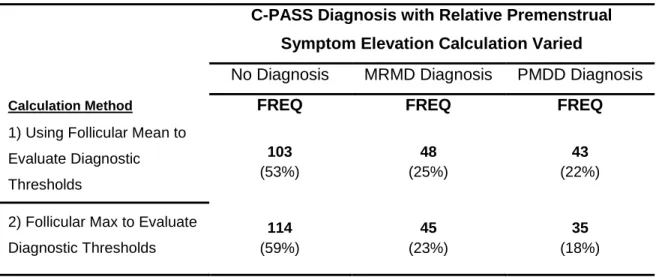
Relative premenstrual symptom elevation may be calculated using either the phase average severity for each symptom or the phase maximum severity for each symptom. Diagnosis frequencies within the sample were compared when each method of
Table 1. Comparing Changes in C-PASS Diagnosis when varying premenstrual symptom elevation calculation
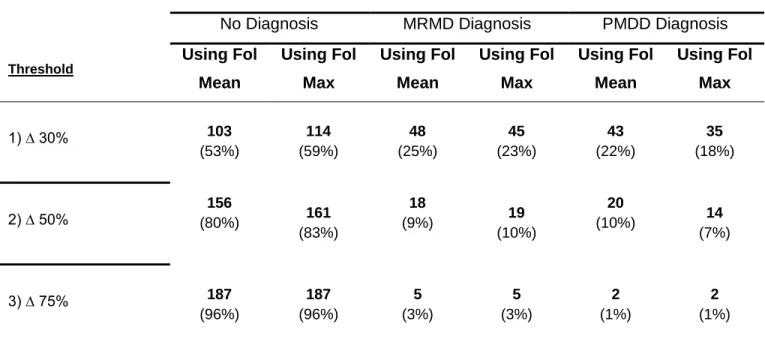
Relative Symptom Elevation Thresholds. Relative symptom elevation calculation using mean severity for the follicular phase resulted in 22% of the participants diagnosed with PMDD when a 30% threshold for relative symptom elevation was specified (Table 2). This number of patients diagnosed decreased dramatically when the threshold for relative symptom elevation was increased to 50% (10% diagnosed with PMDD). Trends were similar when follicular maximum was used.
C-PASS Diagnosis with Relative Premenstrual Symptom Elevation Calculation Varied
No Diagnosis MRMD Diagnosis PMDD Diagnosis
Calculation Method FREQ FREQ FREQ
1) Using Follicular Mean to Evaluate Diagnostic Thresholds
103 (53%)
48 (25%)
43 (22%)
2) Follicular Max to Evaluate Diagnostic Thresholds
114 (59%)
45 (23%)
Table 2. Impact of Varying % Threshold for Relative Premenstrual Symptom Elevation
Absolute Symptom Severity and Clearance Thresholds. Absolute severity thresholds greater than or equal to 3 and absolute clearance thresholds less than or equal to three resulted in a 28% diagnosis of PMDD (Table 3). Although this percentage on PMDD diagnosis decreased (22%) when the threshold was increased to 4, the
percentage of MRMD diagnoses remained the same (25%). A threshold of 5 further decreased the percentage of MRMD diagnosis and PMDD diagnosis (Table 3). Trends were similar when follicular maximum was used.
C-PASS Diagnosis with Relative Symptom Elevation Varied
No Diagnosis MRMD Diagnosis PMDD Diagnosis
Threshold Using Fol Mean Using Fol Max Using Fol Mean Using Fol Max Using Fol Mean Using Fol Max
1) ∆ 30% 103
(53%) 114 (59%) 48 (25%) 45 (23%) 43 (22%) 35 (18%)
2) ∆ 50% (80%) 156 161 (83%)
18
(9%) 19
(10%)
20
(10%) 14 (7%)
3) ∆ 75% 187
Table 3. Determination of Absolute Severity and Clearance Thresholds
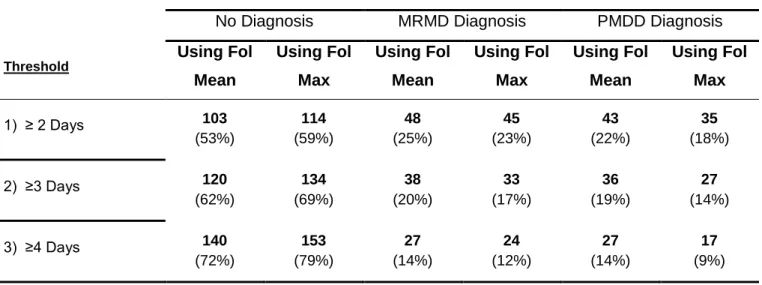
Duration Thresholds. The duration of symptoms was varied from two to five days and frequencies of PMDD and MRMD diagnosis generally decreased as the threshold of days increased (Table 4). Trends were similar when follicular maximum was used.
Table 4. Duration of Symptoms
C-PASS Diagnosis with Absolute Severity and Clearance Varied
No Diagnosis MRMD Diagnosis PMDD Diagnosis
Threshold Using Fol Mean Using Fol Max Using Fol Mean Using Fol Max Using Fol Mean Using Fol Max 1) Abs Severity > 3
Abs Clearance ≤ 3
91 (47%) 103 (52%) 49 (25%) 48 (24%) 54 (28%) 49 (19%) 2) Abs Severity > 4
Abs Clearance ≤ 4
103 (53%) 114 (59%) 48 (25%) 45 (23%) 43 (22%) 35 (18%) 3) Abs Severity > 5
Abs Clearance ≤ 5
132 (68%) 134 (74%) 32 (16%) 28 (15%) 30 (15%) 19 (11%)
C-PASS Diagnosis with Duration Varied
No Diagnosis MRMD Diagnosis PMDD Diagnosis
Threshold Using Fol Mean Using Fol Max Using Fol Mean Using Fol Max Using Fol Mean Using Fol Max
1) ≥ 2 Days 103 (53%) 114 (59%) 48 (25%) 45 (23%) 43 (22%) 35 (18%)
2) ≥3 Days 120 (62%) 134 (69%) 38 (20%) 33 (17%) 36 (19%) 27 (14%)
Symptom Thresholds. The number of severe symptoms needed for each cycle to meet C-PASS criteria was also varied. Table 5 shows the frequency results as number of symptom threshold was varied from two to five. The current threshold is set at five symptoms. As one would expect, as the stringency of the threshold is increased, the frequency of diagnosis decreases.
Table 5. Number of Symptoms meeting criteria to diagnose PMDD
C-PASS Diagnosis with No. of Total Symptoms Varied
No Diagnosis PMDD Diagnosis
Calculation Method Using Fol
Mean Using Fol Max Using Fol Mean Using Fol Max
1) # Total SX ≥ 2 114 (59%) 124 (64%) 80 (41%) 70 (36%)
2) # Total SX ≥ 3 126 (65%) 135 (70%) 68 (35%) 59 (30%)
3) # Total SX ≥ 4 140 (72%) 147 (76%) 54 (28%) 47 (24%)
Using Multilevel Logistic Regression and ROC Curves to Determine the Optimal Number of 1) DSM-5 Symptoms per Cycle and 2) Severe Days per Cycle to Predict the Presence of Moderate Cyclical Impairment
Next logistic multilevel models in which cycles were nested within women were used to predict cycle-level presence of significant cyclical interference from number of DSM-5 symptoms meeting C-PASS criteria in that cycle; number of symptoms meeting criteria was indeed predictive of whether or not the cycle was characterized by
impairment (Estimate: .59, SE = .049, t(295) = 11.99, p < .0001). Random effects for number of symptoms were not significant, suggesting that the size and direction of the effect of number of symptoms per cycle on impairment in a given cycle was similar across women. Information regarding predicted values was saved from this model and averaged across each number of symptoms. PROC LOGISTIC was utilized to calculate the area under the ROC curve (AUC = .9017, 95% CI: .87 to .92). Finally, the SAS ROCPLOT macro6 was utilized to graph the ROC curve (see Figure 1) and the
Figure 1. ROC Curve Predicting Presence of Impairment in this Cycle from Number of Symptoms Meeting DSM-5 Criteria this Cycle
Table 6. ROC Curve Analysis Results for Number of Symptoms Meeting DSM-5 Criteria Predicting the Presence of Impairment
AUROC Confidence Limit Cutpoint* Optimal Number of Symptoms
Therefore, despite the fact that the DSM-5 does not require the presence of interference to make the diagnosis of PMDD (this is a shift from DSM-IV), this ROC analysis
suggests that the number of DSM-5 symptoms per cycle at which significant cyclical impairment can be optimally predicted is 4, which is LOWER than the number of
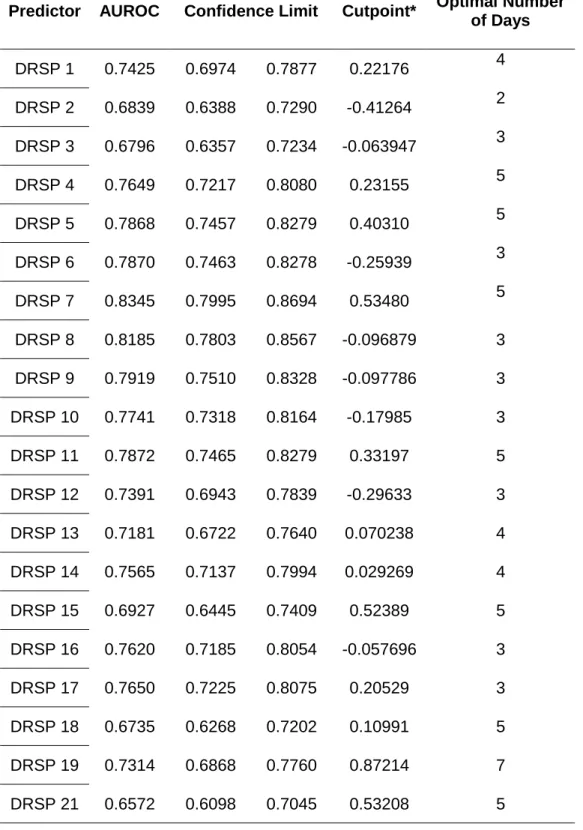
Table 7. Summary of ROC curve analyses results for number of severe days predicting the presence of at least moderate impairment cyclicity.
Predictor AUROC Confidence Limit Cutpoint* Optimal Number of Days
DRSP 1 0.7425 0.6974 0.7877 0.22176 4
DRSP 2 0.6839 0.6388 0.7290 -0.41264 2
DRSP 3 0.6796 0.6357 0.7234 -0.063947 3
DRSP 4 0.7649 0.7217 0.8080 0.23155 5
DRSP 5 0.7868 0.7457 0.8279 0.40310 5
DRSP 6 0.7870 0.7463 0.8278 -0.25939 3
DRSP 7 0.8345 0.7995 0.8694 0.53480 5
DRSP 8 0.8185 0.7803 0.8567 -0.096879 3
DRSP 9 0.7919 0.7510 0.8328 -0.097786 3
DRSP 10 0.7741 0.7318 0.8164 -0.17985 3
DRSP 11 0.7872 0.7465 0.8279 0.33197 5
DRSP 12 0.7391 0.6943 0.7839 -0.29633 3
DRSP 13 0.7181 0.6722 0.7640 0.070238 4
DRSP 14 0.7565 0.7137 0.7994 0.029269 4
DRSP 15 0.6927 0.6445 0.7409 0.52389 5
DRSP 16 0.7620 0.7185 0.8054 -0.057696 3
DRSP 17 0.7650 0.7225 0.8075 0.20529 3
DRSP 18 0.6735 0.6268 0.7202 0.10991 5
DRSP 19 0.7314 0.6868 0.7760 0.87214 7
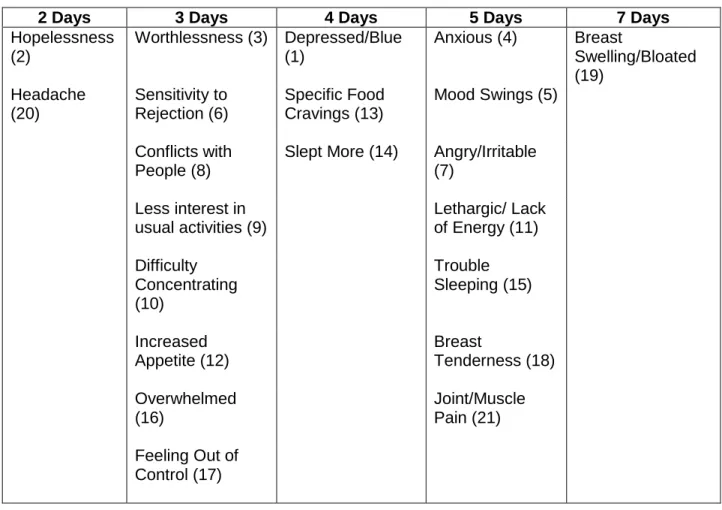
Table 8. The number of severe days required on each DRSP item to optimally predict the presence of at least moderate impairment cyclicity.
Discussion
Variations in approaches to making the diagnosis of premenstrual dysphoric disorder compromise the validity of PMDD and undermine our ability to identify and treat women suffering from the disorder. The Carolina Premenstrual Assessment Scoring System (C-PASS) seeks to streamline the diagnosis process and create diagnostic uniformity within the field. Although many of the diagnostic decisions made within the PASS have been recommended by the DSM-5, certain decisions made within the C-PASS required further inspection to understand how changing them might alter the
2 Days 3 Days 4 Days 5 Days 7 Days
Hopelessness (2)
Worthlessness (3) Depressed/Blue (1)
Anxious (4) Breast
Swelling/Bloated (19) Headache (20) Sensitivity to Rejection (6) Specific Food Cravings (13)
Mood Swings (5)
Conflicts with People (8)
Slept More (14) Angry/Irritable (7)
Less interest in usual activities (9)
Lethargic/ Lack of Energy (11)
Difficulty Concentrating (10) Trouble Sleeping (15) Increased Appetite (12) Breast Tenderness (18) Overwhelmed (16) Joint/Muscle Pain (21)
prevalence of diagnosis. The sample used consisted of women seeking evaluation for PMDD and willing to participate in a research study.
Descriptive statistics were calculated for a variety of permutations of thresholds and methods to provide information about how changing these thresholds and methods might influence diagnostic prevalence. ROC curves were examined regarding the number of symptoms per cycle needed to predict moderate impairment, which is an outcome used in order to identify a subgroup of women who require treatment. ROC curves were also created for each DRSP symptom to determine the optimal number of severe days required to see at least moderate impairment.
Findings and Implications
The ROC in figure 1 shows that four symptoms is the optimal number of symptoms that should be required to diagnose PMDD. This finding is consistent with findings from the Harvard Study of Moods and Cycles, which found that a community-based sample needed six symptoms while a clinical sample only required two
symptoms7. The average value of these two very different samples once again confirms
that four symptoms is likely the ideal number for diagnosing PMDD. This threshold of four symptoms differs from the five symptom requirement by the DSM-5. Our findings suggest that the current five symptom threshold in the DSM-5 may be too stringent and cause missed diagnoses.
impairment by that item. Therefore, the current DSM-5 requirement of 2 severe days per symptom might potentially be too lax.
Variations of threshold produced the expected effect of diagnosing more patients as the thresholds were made more stringent. It does not appear that utilizing the
follicular maximum versus the follicular mean creates a large, substantial difference in the number of PMDD diagnoses made. The C-PASS utilizes follicular maximum, and this decision appears to be justified at the present time.
Limitations of this study
Conclusions
Table 9. Mapping the Items of the DRSP onto DSM-5 Diagnostic Content
DRSP DSM-5
CORE SYMPTOMS / CRITERION B
DRSP 5. Had mood swings (e.g. suddenly felt sad or tearful)
1. Marked affective lability (e.g., mood swings; feeling suddenly sad or tearful, or increased sensitivity to rejection) DRSP 6. Was more sensitive to rejection or my feelings were
easily hurt
DRSP 7. Felt angry, irritable
2. Marked irritability or anger or increased interpersonal
conflicts
DRSP 8. Had conflicts or problems with people DRSP 1. Felt depressed, sad, “down” or blue
3. Marked depressed mood, feelings of hopelessness, or self-deprecating thoughts
DRSP 2. Felt hopeless DRSP 3. Felt worthless or guilty
DRSP 4. Felt anxious, “keyed up”, or “on edge” 4. Marked anxiety, tension, and/or feelings of being keyed up or on edge
ADDITIONAL SYMPTOMS / CRITERION C
DRSP 9. Had less interest in usual activities (e.g. work, school, friends, hobbies)
1. Decreased interest in usual activities (e.g. work, school, friends, hobbies)
DRSP 10. Had difficulty concentrating 2. Subjective difficulty in concentration
DRSP 11. Felt lethargic tired, fatigued, or had a lack of energy 3. Lethargy, easy fatigability, or marked lack of energy
DRSP 12. Had increased appetite or overate
4. Marked change in appetite; overeating; or specific food cravings
DRSP 13. Had specific food cravings
DRSP 14. Slept more, took naps, found it hard to get up
5. Hypersomnia or Insomnia DRSP 15. Had trouble getting to sleep, staying asleep
DRSP 16. Felt overwhelmed, that I couldn’t cope
6. A sense of being overwhelmed or out of control DRSP 17. Felt out of control
DRSP 18. Had breast tenderness
7. Physical symptoms such as breast tenderness or swelling, joint or muscle pain, sensation of “bloating”, or weight gain DRSP 19. Had breast swelling, felt bloated, or had weight gain
Table 10. Diagnostic Dimensions of DSM-5 Premenstrual Dysphoric Disorder
DIAGNOSTIC DIMENSIONS Diagnosis Based on DRSP DSM-5
Content
Symptoms
Core symptoms:
felt depressed/sad/down/blue, felt hopeless, felt worthless/guilty, felt anxious/keyed up/on edge, had mood swings, was more sensitive to rejection/feelings were easily hurt, felt angry/irritable, had conflicts/problems with other people
Secondary symptoms:
less interest in usual activities, difficulty concentrating,
lethargic/fatigue/tired/lack of energy, increased appetite/overate, specific food cravings, slept more/took naps/hard to get up, trouble getting to sleep/staying asleep, felt overwhelmed/couldn’t cope, felt out of control, breast tenderness, breast swelling/felt bloated/weight gain, headache, joint or muscle pain Impairment symptoms:
“Less productivity at work, school, home or in daily routine” “Interference with hobbies or social activities (avoid, do less)” “Interference with relationships”
Criterion B:
affective lability, irritability/anger/increased interpersonal conflicts, depressed mood/feelings of hopelessness/self-deprecating thoughts, anxiety/tension/feelings of being keyed up/on edge
Criterion C:
decreased interest, difficulty in concentration, lethargy/easy fatigability/lack of energy, change in appetite,
hypersomnia/insomnia, overwhelmed/out of control, physical symptoms (breast tenderness, muscle pain, bloating, weight gain)
Number
MRMD ≥ 1 core symptom
PMDD ≥ 1 core symptom ≥ 5 total symptoms
Criterion A:
A total of 5 [at least (one or more) of each subgroup]
Cyclicity
Relative Premenstrual
Elevation
30% (relative to range of scale used) decrease from pre-menstrual week (days -7 -1) to postmenstrual week (days 4 10) where -1 is the day prior to menstrual onse and 1 is menstrual onset
Criterion A:
“…present in the week before menses…improve within a few days after the onset of menses”
Absolute Postmenstrual
Clearance
Symptoms must not exceed a value of 3 on any day during days 4 10 Criterion A:“minimal or absent in the week postmenses”
Postmenses = following menstrual onset
Clinical Significance
Absolute Premenstrual
Severity
4 or more (on a Likert-scale from 1 to 6) Criterion D: “symptoms are associated with clinically significant distress
OR interference with work, school, usual social activities, or relationships with others”
Premenstrual Duration
At least 2 days (doesn’t have to be consecutive) Criterion D: “in the final week before the onset of menses”
Not Simply Cyclicity of Other Disorder
Rule out dysmenorrhea using prospective ratings.
Rule out mood and anxiety disorder with SCID-1.
Rule out Borderline Personality Disorder with SCID-2.
Criterion E:
“not merely an exacerbation of the symptoms of another disorder.”
“Key differential diagnoses: dysmenorrhea, bipolar disorder, MDD, dysthymia, and BPD.”
Chronicity
≥ 2 symptomatic months Criterion A and F:
“In the majority of menstrual cycles…”
1. Pearlstein T, Steiner M. Premenstrual dysphoric disorder: burden of illness and treatment update. J Psychiatry Neurosci. 2008;33(4):291-301.
2. Halbreich U, Borenstein J, Pearlstein T, Kahn LS. The prevalence, impairment, impact, and burden of premenstrual dysphoric disorder (PMS/PMDD). Psychoneuroendocrinology. 2003;28:1-23. doi:10.1016/S0306-4530(03)00098-2.
3. Smith MJ, Schmidt PJ, Rubinow DR. Operationalizing DSM-IV criteria for PMDD: selecting symptomatic and asymptomatic cycles for research. Journal of Psychiatric Research. 2003;37(1):75-83.
4. Hartlage SA, Freels S, Gotman N, Yonkers K. Criteria for Premenstrual Dysphoric Disorder: Secondary Analyses of Relevant Data Sets. Arch Gen
5. Dean BB, Borenstein JE, Knight K, Yonkers K. Evaluating the Criteria Used for Identification of PMS. http://dxdoiorg/101089/jwh200615546. 2006;15(5):546-555.
doi:10.1089/jwh.2006.15.546.
6. 25018 - Plot ROC curve with cutpoint labeling and optimal cutpoint analysis. (n.d.). Retrieved March 10, 2016, from http://support.sas.com/kb/25/018.html