Rhodes Must Fall and the Politics of Identity in Contemporary South Africa By: David Farrow
Senior Honors Thesis Cultural Studies
University of North Carolina at Chapel Hill March 29, 2017
Approved:
_________________ Lawrence Grossberg, Thesis Advisor
Table of Contents
Chapter 1: Rhodes Must Fall!---Page 3
Chapter 2: Intersectionality---Page 22
Chapter 3: From Intersectionality to Essentialism---Page 31
Chapter 4: Critique---Page 45
Chapter 5: Intersectionality and Articulative Politics in South Africa---Page 63
Acknowledgement---Page 79
Works Cited---Page 80
Chapter 1: Rhodes Must Fall!
In March 2015, student protests erupted at the University of Cape Town concerning a statue of the colonizer Cecil Rhodes. The protesters demanded the dismantling of the statue and a renewed commitment from the University towards rectifying the continued inequalities produced by Apartheid. Protests continued until April 9th when the University removed the statue. The success of the movement, named Rhodes Must Fall, inspired similar protests activity throughout South African universities and even resulted in the formation of a Rhodes Must Fall movement at Oxford University (England). Academic, media, and public commentators declared the movement an important force in the South Africa left, especially in light of the neoliberal inclinations of the African National Congress and the Pan-African nationalism of the self-professed radical party, the Economic Freedom Fighters. 1
Following their initial success in orchestrating the removal of the Rhodes’s statue, Rhodes Must Fall quickly became a force within a burgeoning radical youth politics. In October 2015, Rhodes Must Fall, in conjunction with other student organization, protested a proposed increase to public university tuition and fees. The coordinated effort, called Fees Must Fall, successfully pressured the government to suspend the planned fee increase until 2016 (Hauser). Not content with the successes of Fees Must Fall, Rhodes Must Fall launched a series of protests and public art interventions aimed at exposing the lack of accessible housing for students on the University of Cape Town campus. These protests are all defined by a commitment to
decolonization through targeted education reform within South Africa.
Rhodes Must Fall movement descend into a group riddled with infighting and left divided” (RMF). In place of a coordinated Rhodes Must Fall movement, various similarly minded groups have developed focusing on identity politics and issue specific mobilization, including the Trans Collective, Patriarchy Must Fall, Fees Must Fall, and Disrupting Whiteness.
My thesis seeks to examine the dissolution of Rhodes Must Fall through critically evaluating the role of identity and difference within the movement. I examine the theoretical debates surrounding intersectional identity formation and the relevancy of these debates to political action in South Africa. In particular, I will place intersectional understandings of identity in conversation with the critiques of identity offered by Stuart Hall. My thesis will first, in this chapter, outline the relevant elements of the South African context and then offer a timeline of Rhodes Must Fall. In Chapter 2, I will examine how intersectionality serves as both an organizing principle within the movement and as a strategy employed to advance the
movement’s decolonial agenda. In Chapter 3, I will argue that the means by which Rhodes Must Fall constructs intersectional identities relies on essentialist constructions of identity that hinder movement building and political efficacy. In Chapter 4, I will develop both a general critique of intersectionality drawing on Stuart Hall’s theorization of discourse, interpellation, representation, difference, and hybridity in relation to theories of identification, and a specific critique of
intersectionality within the Rhodes Must Fall Movement. Finally, in Chapter 5, I will examine the governance strategies employed by the ruling African National Congress to contain dissent in order to further demonstrate the inadequacy of intersectional identity politics to radically alter status quo politics in South Africa.
Universities within South Africa served as concrete representations of the slow progress away from Apartheid. In 1989, as Apartheid entered its final violent years, black students represented 24.7% of the student population at the University of Cape Town (UCT) (Luescher cited in Kessi and Cornell). In 2011, black students constituted slightly over 50% of the population at UCT (DHET cited in Kessi and Cornell). While the growth in black student representation is admirable, the rate of change fails to keep up with the demographics of South Africa, in which black Africans represent 80.2% of the overall population (CIA World
Factbook).
The statistical discrepancy at UCT contradicts the discursive narratives surrounding race in post-apartheid South Africa. The transition away from Apartheid has been narrated by
invocations of the “Rainbow Nation,” a term coined by anti-Apartheid leader Archbishop
Desmond Tutu to signify “his belief in the ability of all South Africans (Black, White, Coloured, and Asian) to co-exist in spite of and because of difference” (Palmer 1). The idea of the Rainbow Nation is further entangled with the concept of Ubuntu, which Tutu roughly translates as “a person is a person through other people” meaning that any sense of humanity can only be
achieved through mutual recognition and the acknowledgement of others (Tutu 2011 in Buqa 4). Together, these two principles attempt to articulate harmoniousness between the different races in South Africa as the precondition of a stable civil society.
white South African nationalism through appeals to masculinity, “ruggedness, endurance, forcefulness, and determination, which Afrikaner nationalist cultural entrepreneurs had long suggested epitomized the ‘Afrikaner character’” (Stevenson and Vincent 290). The 1995 Rugby World Cup thus represented a site of change in which rugby as an expression of white, Afrikaner culture was being incorporated into the new, Rainbow Nation culture through Mandela’s
involvement. Following the Springbok’s, the South African national team, victory, Mandela, clad in Springbok colors, held aloft the Rugby World Cup to symbolize “a possible united nationalist consciousness” (Reddy 177). While Mandela acted in order to bolster the Rainbow Nation narrative developed to ease the transition away from apartheid, the true symbolic
currency of the symbol was highly contested as the team itself remained predominantly white,the ownership of the team remained entirely white, and the culture surrounding rugby still remains predominately white (Stevenson and Vincent). Despite the inefficacy of Mandela’s gesture, the discourse of the Rainbow Nation and ubuntu sought to promote the formation of the nation-state through an “ecclesiastical abstraction from historicity,” positioning the post-Apartheid state as transcending, in an almost metaphysical sense, the Apartheid state (Sitas 2010, 31 cited in Hart 169). Such metaphysical preoccupations obscure the unfinished project of transformation within South Africa as land, wealth, and economic and political power have failed to be redistributed.
As such, the achievement of a structurally different, and therefore transcendent state, has never occurred. In place of transformation, post-Apartheid policies such as Affirmative Action and Black Economic Empowerment, advocated by the ANC, have achieved limited
protections through a “Bill of Rights that guaranteed social, economic, civil, and political rights to all citizens and that forbade discrimination,” the ANC as a political power has emphasized economic growth and integration into global markets through adopting characteristically
neoliberal policies, thus amplifying rather than correcting “apartheid capitalism’s main economic distortions” (Brown 36; Bond 13).
The discursive appeal of the Rainbow Nation, however, attempts to mask these material inequalities through failing to restructure unequal systems of economic and political power. At universities in particular, the failure of transformation has manifested as “insecurity associated with available funds for tuition, accommodation, academic material, and subsistence” in addition to “the prospect of large debt, high drop-out rates, poor throughput rates, inadequate facilities and accommodations” (Badat 10). The reality of an unfinished transformation is therefore always present, affecting the lived experience of many black students at universities throughout the country.
For the university system, the failure of transformation positions black students as strangers within their own homes. Activist Panashe Chigumadzi describes this sense of alienation in an August 2015 lecture, stating:
In these schools we find a certain universalism rooted in the white child and white
culture, despite the schools now having black pupils. Formerly white schools include
black children under the same assumptions despite the different names, different bodies,
different hair, different socio-economic backgrounds. I call it the “add blacks and stir”
model. Stir, while continuing with the same structure, same rules (Chigumadzi 2015)
For Chigumadzi, the university’s unfilled commitment to transformation and the Rainbow
notion of “add blacks and stir” conjures the imaginary possibility of the Rainbow Nation as a
transcendent entity, able to integrate through difference and achieve a unique national identity. In
reality, black students experience financial precarity, racism in the form of “historical exclusion
from decision-making, microaggressions, and psychic anguish of being surrounded by Whiteness
and White Supremacy,” and a sense of institutional discrimination manifesting “as perpetual loss
of power and access even once Black and non-White students or citizens achieved initial entry
into White spaces” (Irvine 292).
As the result of these experiences, black student feel undeserving of a place within the university. In turn, black students cannot avoid constructing at least part of their individual identities in relation to this already alienating discourse. Using photovoice methodology to enable students to express their experiences at UCT, Kessi and Cornell identify one student's internalizations of "discourses of low standards and reverse racism[towards whites]" as resulting in his description of "how ideas of incompetency are associated with the guilt of talking the place of white students" (Kessi and Cornell 6).2 In a broader sense, these feelings of incompetancy, isolation, and "a lack of belonging and low self-esteem" contribute to the construction of "black identities in relation to white identities" as black students "take on the responsibility of reverse racism" (Kessi and Cornell 6-7). Achille Mbembe, reflecting on the conditions productive of student uprisings in which Rhodes Must Fall played a central role, goes farther than Kessi and Cornell, arguing:
Ironically among the emerging black middle class, current narratives of selfhood and identity are saturated by the tropes of pain and suffering. The latter have become the
register through which many now represent themselves to themselves and to the world. To give account of who they are, or to explain themselves and their behavior to others, they increasingly tend to frame their life stories in terms of how much they have been injured by the forces of racism, bigotry and patriarchy (Mbembe 2015a)
Mbembe’s reflection links the concerns expressed by Kessi and Cornell with the broader social
conditions within South Africa to account for the unique expression of identity defined by pain
and suffering. A full discussion of how pain informs constructions of identity appears in Chapter
3. The failure of transformation, the Rainbow Nation, and ubuntu is, therefore, not only a
socio-political crisis, but a crisis occurring at the level of identity and subjectivity. These failures,
occurring at the micro-level of university politics and at the macro-level of statecraft, have
fundamentally shaped the conditions and possibility of blackness for a specific set of South
African youths.
For black students, universities have come to represent the failure of transformation and
the rainbow nation. The work of Franz Fanon and Steve Biko resonates with students as they
become aware of the continued existence of Apartheid era injustices (Irvine 287-288; Gibson
2016). As such, students began to see the University as part and parcel of the lingering colonial
trappings defining contemporary South Africa. When students enter the University, they are
haunted by Fanon’s argument that “in order to assimilate the culture of the oppressor and venture
into his fold, the colonized subject has to leave certain of his intellectual possessions in pawn,”
thus requiring the colonized subject to adopt “the forms of thought of the colonialist bourgeoisie”
(Fanon 38). Universities, in this sense, not only render students economically precarious and
produce feels of inadequacy, but further compel students to abandon their identities to integrate
further the play of colonialism on consciousness in establishing certain forms of thought that
benefit the settler colonist.3 In this way, according to students’ readings of Fanon, education
serves as a mechanism of control for settler colonialism by imposing certain ideologies and
discursive constructs onto the colonized subject.4
This perspective locates students within debates amongst contemporary African scholars
on the university as a continuation of the colonial apparatus. Saleem Badat, former
vice-chancellor of Rhodes University, notes that “critical epistemological and ontological questions
related to curriculum and pedagogy have received little attention, either because of the refusal on
the part of academics to do so (sometimes in the name of ‘academic freedom’), or a lack of the
capabilities and/or support to do so” (Badat 8). Nyamjoh positions the university as the
continuation of colonial apparatuses established to promote assimilation into whiteness
(Nyamjoh 66). In this capacity, he locates the South African university system and UCT in
3 Within Rhodes Must Fall’s writing, settler colonialism serves as the mechanism to distort and diminish black life psychically, economically, politically, and materially. Writing on the violence within Zulu communities against other Africans, Rhodes Must Fall member Thembinkosi Okonko notes that, “black on black violence and the contorted reality of black life has its genesis in white society and white supremacy” (33). This commentary demonstrates RMF’s understanding of settler colonialism as the continued elevation of “white society” for the sake of maintaining white supremacy. Within their writings, RMF lacks a comprehensive account of settler colonialism, instead simply referencing the concept in passing. For a sustained argument on the relevancy of settler colonialism to contemporary South Africa, see Thiven Reddy’s South Africa, Settler Colonialism, and the Failures of Liberal Democracy.
4 Fanon scholar Nigel Gibson, in an article entitled “The Specter of Fanon: the student movements and the rationality of revolt in South Africa,” outlines the usage of and contestations surrounding Fanon in relation to Rhodes Must Fall. Gibson notes that the movement opened “on a national level the question of decolonization in South Africa” with Fanon and Steve Biko “heralded by many in almost iconic terms,” with this exaltation
represented in “the Johannesburg library [reporting] that Biko’s I write what I like and Fanon’s
particular within a “colonising epistemology, which takes the form of science as ideology and
hegemony” to the detriment of African forms of knowledge, ways of being, and pedagogies,
including the erasure of recent South African epistemologies such as the Black Consciousness of
Steve Biko, which emphasized “the popular creativity of everyday life (music, song, poetry, etc)
[…] the promotion of knowledge of protest history” and the importance of “affirming the
integrity and humanity of marginalized black masses and their cultures” (Nyamjoh 69). Suren
Pillay, professor at the University of the Western Cape, furthers this way of thinking when
noting in a lecture delivered to an audience of Rhodes Must Fall members that “because the
university is a place of authoritative knowledge, certified knowledge, it is at the heart of
epistemic violence” (Pillay), In Pillay’s view, the university serves to destroy the ways of
knowing and being that exist outside of the domain of colonial and postcolonial power.
The roots of this epistemic violence lie in the failure to transform the curriculum at many
South African universities. Efforts to transform curricula and institute programs focusing on
African history, philosophy, and culture have consistently been met with resistance. For
example, when Mahmood Mamdani, former professor of African Studies and former Director of
the Centre for African Studies at UCT, was approached by the Assistant Dean of the Faculty of
Social Science and Humanities to design a Foundation Seminar on Africa in 1997, Mamdani
struggled in vain for 10 years to get the syllabus he designed adopted, only to finally leave the
University upon realizing the University’s commitment to transformation was largely superficial
(Nyamjoh 80; Badat 8). Popular discourse such as articles in the Mail & Guardian, GrondUp,
and Africa is a Country entitled “Decolonizing knowledge doesn’t contradict ideal of academic
excellence,” “UCT’s economics curriculum in crisis,” “Decolonizing the Teaching of
curriculum and institutional structures of UCT have not responded to the need to alter the
University to fit a post-Apartheid South Africa (Kessi; Bassier; Chelwa; Lalu)
The failure of epistemic transformation is intertwined with the failure of transformation
writ large. In the final article listed above, Premesh Lalu, a Professor at the University of the
Western Cape, points to the longer history over epistemic debates that have increasingly been
replaced by debates over ‘efficiency’ and ‘excellence’ (Lalu). The deployment of efficiency,
standards, and excellence as buzzwords leads to the “sense of isolation, a lack of belonging and
low self-esteem amongst black students” as black students feel as if they lack either the
capabilities or work ethic to succeed (Kessi and Cornell 2,7). In reality, black students are no
more or less capable than white students. Instead, their feelings of inadequacy derive from the
absence of structural reforms within higher education in the post-Apartheid period.
The experience of black students within a university that has resisted transformation
efforts is central to understanding the appearance of Rhodes Must Fall at UCT. The university
becomes the site at which students experience the failure of transformation, the Rainbow Nation,
and ubuntu. Despite its representation as a mechanism for social mobility and the harmonious
coexistence of the races as imagined by the Rainbow Nation narrative, the University reveals
itself as the site of continued psychic, epistemic, and material violence. It is in this context that
Chigumadzi (2015) observes the central shift in conceptualizations of the self signaled by
Rhodes Must Fall:
nation. The fantasy of a colour-blind, post-racial South Africa has been projected into us coconuts, but our lived experiences are far from free of racism5
With the Rainbow Nation shattered, what follows is the complete rejection of the dream of a harmonious existence.
Timeline of Rhodes Must Fall
The origin of Rhodes Must Fall (RMF) can be traced to Chumani Maxwele who. on March 9th 2015, threw excrement at the statue of Cecil Rhodes located on the upper campus of UCT (see Figure 1). Maxwele, a politics student at UCT, locates himself within the ideological lineage of Steve Biko and Frantz Fanon, arguing, in an interview directly after the protest act, “Fanon made it clear decolonization must happen through violence. I think it highly unlikely South African can avoid this.”6 For Maxwele, Rhodes represents the racism and violence central to the colonial state-building project of South Africa, bluntly stating “he dispossessed and killed black people. His footprints are all over our country.” Maxwele is quick, however, to note that his action extends beyond the symbol of Rhodes, arguing “It is not just a statue, as many claim— Rhodes didn’t want black people. Remember that, at some point, UCT also didn’t want black people. Remember Professor [Archibald] Jordan, remember Archie Mafeje, remember Professor [Mahmood] Mamdani.” 7 In this way, Maxwele consciously locates himself in the transformation
5 A coconut is the same as the concept of an Oreo in American racial discourse, an individual who is ‘black’ on the outside but ‘white’ on the inside.
6 http://www.news24.com/Archives/City-Press/Newsmaker-Chumani-Maxwele-No-regrets-for-throwing-faeces-at-Rhodes-statue-20150429
7 Archibald Jordan was a linguistic professor at UCT who, in the 1960s, was refused
and Rainbow Nation debates discussed above, seeking to signal the failure of these narratives though his act.
By invoking the larger community through these broader questions of transformation, Maxwele’s act triggered the development of the broader RMF. The RMF Mission Statement, in turn, reads Maxwele’s action as “radical performative intervention” which “catalyzed and brought to surface […] an undercurrent of pain and anger amongst the black student body.”8 Finding the expression of their frustration, predominantly black students began organizing protests, disruptions, and political interventions. As students joined the burgeoning movement, the public space around the university was transformed to stimulate further conversation. On March 19th, protesters organized a “Have your Say” board next to the Rhodes statue to create a space for other students to express their feelings concerning the statue and protest activity (Dimitra)9.
As more and more students joined the protest, Maxwele’s action shifted from a discursive intervention to a material intervention in the everyday life of the University. Following Deleuze and Guattari, Maxwele’s performative intervention can be read as a form of art that was “used to short-circuit social production, and to interfere with the reproductive function of technical machines by introducing an element of dysfunction” (31). The University requires students, and to an even greater extent black students, to accept the settlement of the Rainbow Nation and proceed with their everyday lives in order to preserve its “reproductive function.” The
interruption of the University’s reproduction achieved concrete expression on March 20th, when students marched to and then occupied Bremmer Building on the upper campus, renaming it
Azania House10 (Dimitra). The occupation raised concerns across multiple dimensions in the March 23rd Bremmer Occupation Statement: first, a strategic dimension including “1) disrupt the normal process of management and 2) force management to accept our demands,” second, an affective dimension aimed at creating safe spaces for black students as the ‘”Have your Say” boards quickly became “a space that allows students to be blatantly racist with impunity, at the expense of a safe space for black people”; and, finally, an organizational function of serving as a site for conversation and planning for the burgeoning Rhodes Must Fall Movement. Speaking to these functions, RMF member Khumon Sebambo wrote, a in piece entitled “Azania House as a Symbol of Thee Black Imagination,”:
Azania house became a important space for black people to construct their own identities. It was a fantasy world in some ways because it was removed from the white gaze and also from the violent constructions of blackness which other University spaces inform. Azania House served as a space, which refused external forces of these
exclusively, mapped spaces—it promised a spatial safety to black identities, which are otherwise formed on precarious grounds. That spacial safety allowed for the imagination of blackness to flourish (Sebamo 108)
Azania House therefore continued and built upon the Maxwele’s performative intervention by creating an new space of becoming for RMF members. In this way, it targeted not only the material reproduction of UCT, but the reproduction of desire and affect that consistently situated black students in certain relations to the racism of UCT. Movement member Thuli Gamedze describes this capacity when noting that “Azania House stands ideologically as a space in which we refuse to perpetuate the oppressions of institutionalized patriarchy, racism and
heteronormativity,” continuing that Azania House “is a space that continues to be self-reflexive, and aware that this kind of exclusionary phenomena [e.g. patriarchy, racism, heteronormativity] can only be the result of an adherence to violent and ignorant colonial structures that we are already subject to in institutional space”11 (122-123).
In this way, RMF attempted to reformulate understandings of oppression with Azania House used as a space in which a new way of living that does not promulgate such oppression structures could be enacted. In this way, following Deleuze and Guattari, Azania House created “veritable group fantasies” in order to “short-circuit social production” (31). Azania House exploited the capacity for the process of social reproduction to breakdown by creating relations to allow expression of a desire for an alternative space to the racially hostile UCT atmosphere. In turn, Azania house produced “fantasy world in some ways because it was removed from the white gaze and also from the violent constructions of blackness which other University spaces inform” described by Sebambo as “group fantasy” used to restructure social production. As Deleuze and Guattari note, “the revolutionary pole of group fantasy becomes visible, on the contrary, in the power to experience institutions themselves as mortal, to destroy them or change them according to the articulations of desire and the social field, by making the death instinct into a veritable institutional creativity” (63). Azania House serves as a group fantasy therefore in revealing an alternative possibility lived through the destruction the “white gaze” and “violent constructions of blackness” implicit within the UCT’s institutional structure. The mortality of UCT as an institution is emphasized through Azania House’s transcendence of the University’s racist dynamics and creation of new ways of being. This restructuring of social production
occurs through the interventions into campus and national politics such as marches, occupations, and interruptions of campus activity. In promoting self-reflection and critical action, Azania House, according to activists, enabled the productions of a new black identity through the constitution of alternative social space bolstered by Azania House as group fantasy (Gamedze; Sebamo).
From Azania House, RMF wrote and released, on March 25th, their mission statement. The RMF Mission Statement outlined the theoretical positions and strategic intentions of the movement. Similar to Maxwele’s interview comments, the Statement explicitly expanded the scope of RMF action beyond the immediate desire for the removal of the Rhodes Statue, stating that Maxwele’s actions “brought to the surface and justified rage of black students in the
oppressive space cultivated and maintained by UCT, despite its rhetoric of “‘transformation’,” and that the “movement is not just concerned with the removal of a statue” but instead the “broader dynamics of racist and patriarchal society that has remained unchanged since the end of formal apartheid” (Salon 6). In this way, the statement argued that “the removal of the statue will not be the end of the movement, but rather the beginning of the decolonisation of the university” (Salon 6). In the sections of the statement that follow—“Centering Black Pain,” “An
Intersectional Approach,” “On ‘Reverse Racism’,” “Student Leadership,” “Engagement with Management,” ”Our Demands,” and “Our Long-Term Goals,”—the movement positioned itself as involved in the broader conversation of transformation in South Africa.
delivered his aforementioned lecture “Decolonizing the University,” and, on April 29th, Achille Mbembe delivered his lecture on “Decolonizing Knowledge and The Question of Archive.”12 These lectures, while contested by some members of the movement such as Shose Kessi’s critique of Mbembe’s lecture (Kessi 2015b), served to spark conversation, fulfilling the productive dimension of Azania House. 13
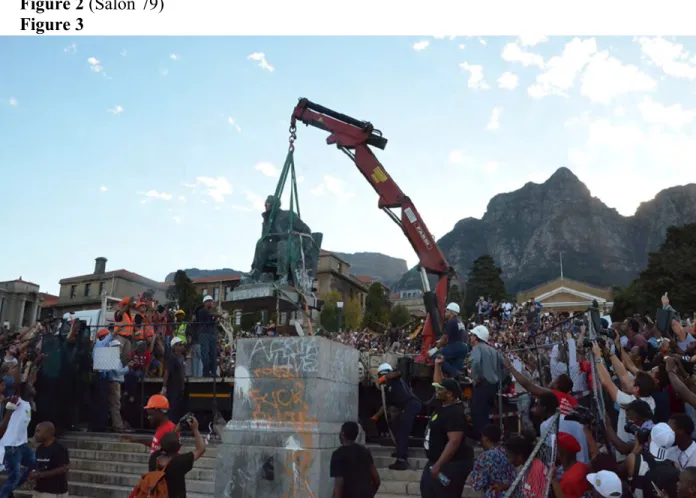
As the protests intensified, the administration responded with a complicated mixture of support and consternation. By March 18th, one week after Maxwele’s protest but prior to the Azania House occupation, Vice Chancellor Max Price released a statement supporting the removal of the statue, but warning that it would not be appropriate for the UCT executive, or council, to make such a recommendation without undertaking” an extensive review of the statue and its effects (Legg and Bester). While the University conducted internal discussions, the protest and occupation increasingly gained media traction, resulting in a national debate on transformation and decolonization (Nyamnjoh 145). With pressure from students, the press, and the national public mounting, on April 7th the university senate voted 181 in favor of removal, with 1 vote against, and 3 abstentions; on April 8th, the UCT council voted unanimously for removal and temporary “safekeeping in an unnamed storeroom approved by the Western Cape Heritage Resources Council” (Nyamjoh 145). On April 9th, the statue was lifted away by crane as onlookers pelted it with objects, sang, danced, and took selfies (Figure 2).14
12 https://www.facebook.com/RhodesMustFall/videos/1570887116520114/ https://m.youtube.com/watch?v=g-lU4BCsL8w
13In an article entitled “Of black pain, animal rights and the politics of the belly,” Kessi argues against Mbembe’s critique of black pain as antithetical to political action by arguing that “engaging with black pain develops a new level of consciousness where the affect experience are the root of how critical reasoned argument can emerge and lead to decolonising and transformative practices” (Kessi 2015b).
With RMF having achieved its short-term goal, the occupation of Azania Hosue became a more contentious issue. On April 10th, the University issued a statement demanding RMF end its occupation of Bremmer Building by 2pm, while also articulating a “renewed commitment to the project of transformation [original emphasis].”15 In spite of the threat of administrative and legal action, RMF used social media to gather support to continue the occupation. The resistance was short lived and, on by April 13th, the movement decided to end the occupation. At a press conference organized to explain the decision, RMF speakers emphasized that the decision was related to threats by the administration and that the movement would continue to fight for the decolonization of the University and South African society.
Following the initial series of protest, Rhodes Must Fall consistently engaged in protests and demonstrations throughout 2015. In October 2015, the Fees Must Fall movement developed in response to proposed tuition increases at public universities throughout South Africa. The movement was composed of a coalition between students and labor as the protest platform expanded beyond opposing tuition increases to demand “living wages, fair labor practices, [the] insourcing of outsourced/subcontracted service laborers, and [an] end [to] outsourcing entirely” (Irvine 253). While not within the leadership of the movement, Rhodes Must Fall mobilized its members and social media network to support the objectives of Fees Must Fall. As protests raged and shut down universities throughout October, the Fees Must Fall movement attracted national and international attention as it expanded (Lyster).
As the size of the Fees Must Fall protests grew and shut down universities for weeks at a time, the ANC became increasingly concerned with the disruptive character of the protests. On October 19th, a request by UCT to authorize police to use force against protesters “interfering
15https://www.facebook.com/RhodesMustFall/photos/
with university operations” was approved by the high court (Irvine 258). In spite of the increasingly hostile atmosphere, the Fees Must Fall protest continued until October 21st when President Jacob Zuma announced a 0% tuition and fee increase for the coming year (Irvine 261).
In February and March 2016, Rhodes Must Fall began a new series of protest
surrounding the availability of housing for students. The removal of a student art installation depicting “South Africa’s common shanty-town dwellings: a shack made of corrugated tin, no more than ten by fifteen by eight feet” set off the protests (Irvine 273). For RMF, the removal of the shack reflected a broader unwillingness on the part of UCT to engage with students’ needs for more accessible housing on campus. These protests represented RMF at its most ‘radical’ in so far as protesters turned to burning works of art from the colonial period in order to express their frustration with the administration and to enact their desire for a decolonized university (Shobane).
The housing protests, often referred to as the “Shackville” protests, reflected an
especially contention moment within the movement. As such, they represented a turning point within the movement as, following “Shackville,” the movement devolved into various other groups such as Fees Must Fall, Patriarchy Must Fall, the Trans Collective (discussed in the next chapter), and Disrupting Whiteness. By July 2016, the movement was declared officially dead on the RMF Facebook page, with the post noting that “over the past few months, we have watched the Rhodes Must Fall movement descend into a group riddled with infighting and left divided. As learners who have been inspired by RMF for tis dedication to the struggle for the black child, we are horrified at the prospect of witnessing the complete destruction of what we see as an amazing movement.”16 After this post, Rhodes Must Fall continued to maintain a social media
16https://www.facebook.com/RhodesMustFall/photos/
presence, but they appeared to have lost the membership and resources necessary to sustain the movement.
Chapter 2: Intersectionality
Intersectional identity politics is central to the thought and action of Rhodes Must Fall. This chapter will briefly examine the tenants and theorists of intersectionality before tracing the role of intersectionality within Rhodes Must Fall. In this way, I will establish the general principles of intersectionality before examining the specificities of intersectionality within the movement. Examining the principles and their contextual application is essential to
understanding how a concept like intersectionality is taken up within a context in which Apartheid made questions of identity unavoidable. In this way, Rhodes Must Fall views
intersectionality as central to correcting the wrongs of Apartheid. Featuring writings by members of Rhodes Must Fall, the Johannesburg Salon journal organized by the Johannesburg Workshop in Theory and Criticism at the University of Witwatersrand illustrates the centrality of
intersectionality to the movement’s critique of contemporary South Africa. Writing in the journal, Thuli Gamedze, a Cape Town based writer and movement member, argues that intersectionality defines the process of decolonization:
[Intersectionality] is an approach that acknowledges that people experience oppression at the intersections of their identities, but even so, oppressed people need not
compartmentalise and fragment their personhoods, deconstructing these aspects of their identities for the purpose of struggle. In fact, intersectionality tells us that this is
impossible- we need to be decolonised as completed units; we cannot separately
decolonise each aspect of our persons. So while intersectionality must acknowledge the process of saying ‘I am a woman, and therefore I experience oppression’, ‘I am
experience oppression’, etc, it wholly affirms the entire identity of the homosexual black woman whose person is oppressed by the space in which she finds herself (Gamedze 122) For activists and scholars of intersectional identity, intersectionality provides a key opening to politics in that a focus on multiple overlapping axes of oppression offers “the most effective way to resist efforts to compartmentalize experiences and undermine potential collective action” (Crenshaw 167). The theorization of intersectionality within academic institutions is often traced to bell hooks’ 1981 book Ain’t I a Woman?, and Kimberlé Crenshsaw’s 1989 essay
“Demarginalizing the Intersection of Race and Sex: A Black Feminist Critique of Anti-Discrimination Doctrine, Feminist Theory, and Anti-Racist Politics” and her 1991 essay “Mapping the Margins: Intersectionality, Identity. Politics, and Violence against Women of Color (Collins and Bilge 81).
While important, hook’s book and Crenshaw’s essays, contrary to many discussions of the history of intersectionality, did not “invent” intersectionality, but instead “demonstrated the ability to fuse the sensibilities of social movement politics and its commitments to social justice initiatives with sophisticated theoretical perspectives, in particular the growing significance of post-modern and post-structural analysis in the late-twentieth century academy and beyond” 17(Collins and Bilge 84). Crenshaw’s 1989 essay specifically examines the means by which anti-racist and feminist frameworks exclude black women in focusing on oppression solely deriving from either race or gender. In response to the inadequacies of separate frameworks of anti-racism and feminism, Crenshaw argues for an intersectional approach that acknowledges “the
intersectional experience of those whom the movements claim as their respective constituents”
(Crenshaw 166). hook’s book further attempts to subvert the predominantly white character of feminist movements throughout the 1960s and 1970s by creating a space for black women within feminism. Taken together, black feminists developed intersectional theory as a means of
reconciling their experience of sexist and racist oppression both from society writ large and from within feminist activism.
With the advent of various liberation struggles beyond gender and race, intersectional theory attempts to reflect the multiple identity positions an individual occupies. In this way, “race, class, gender, sexuality, dis/ability, ethnicity, nation, region, and age” all enter into intersectional analysis to examine how discrimination and systems of oppression overlap and intersect within an individual (Collins and Bilge 7). From understanding identities as constituted at the intersection of various identity categories, intersectionality attempts to conceptualize power relations “both via their intersections, for example, of racism and sexism, as well as across domains of power, namely structural, disciplinary, cultural, and interpersonal power” (Collins and Bilge 27). In this way, intersectionality functions as a theory of identity and power through understanding both as constituted as points of intersection between different identity categories.
Intersectionality in Rhodes Must Fall
“Dear History This Revolution Has Women, Gays, Queers, & Trans Remember That #RhodesMustFall” (Figure 3)18
Displayed prominently in protests and currently enshrined as the profile picture of the RMF Facebook page, the above slogan signals the centrality of intersectionality to RMF. The above story is not acted out solely by black men, but instead composed of individuals of many
18https://www.facebook.com/RhodesMustFall/photos/
different, intersecting identity positions. As Nyamnjoh, focusing specifically on the gendered composition of RMF, notes, “women students were at the forefront of the occupation of Bremmer building and along with their male counterparts staged many protests to summon university management to address transformation concerns, including patriarchy and sexism at the institution and nationally” (Nyamnjoh 135). The composition of the movement is not incidental, but instead by design. The Rhodes Must Fall Mission Statement includes the following section entitled “An Intersectional Approach”:
We want to state that while this movement emerged as a response to racism at UCT, we recognise that experiences of oppression on this campus are intersectional and we aim to adopt an approach that is cognisant of this going forward. An intersectional approach to our blackness takes into account that we are not only defined by our blackness, but that some of us are also defined by our gender, our sexuality, our able-bodiedness, our mental health, and our class, among other things. We all have certain oppressions and certain privileges and this must inform our organising so that we do not silence groups among us, and so that no one should have to choose between their struggles. Our movement
endeavours to make this a reality in our struggle for decolonisation. (Salon 6)
Intersectionality has thus been used to justify a vanguardist approach to movement building by arguing that intersectionality provides both the best mode of organization and the best
knowledge concerning the nature of oppression within South African society. In this sense, only those ‘intersectional people’ who understand their intersectionality can lead the movement. For the moment, I will set aside the question of vanguardism and focus on the centrality of
intersectionality identity politics within the movement. To examine the degree to which Rhodes Must Fall enacted their mission statement through their activism, I will briefly outline key moments in which intersectionality played out within the movement.
The elephant in the room concerning intersectionality within Rhodes Must Fall is Chumani Maxwele. While certainly a formative figure in the movement, Maxwele has come to embody violent masculinity and the creeping influence of patriarchy within anti-colonial struggles. On April 7th 2016, while protesting under the banner of Rhodes Must Fall at Wits University, Maxwele assaulted a black, queer woman, Thenjiwe Mswane, who was part of the protest. The assault, according to Mswame, involved Maxwele and five other men who choked, kicked and punched her. Following the incident, prominent RMF figure Mohammad Abdulla declared that Maxwele was no longer part of RMF as he consistently failed to uphold their principles of equality across race, gender, sexuality, class, etc. Following media coverage of the incident, the RMF social media network widely condemned Maxwele for his insufficient commitment to an intersectional approach (Kim). UCT activist Wanelisa Xaba most succinctly summarizes the response by proponents of intersectionality within RMF when stating that:
the feminist community is outraged. This is not an isolated incident. Homophobia and transphobia have been prevalent in the [Fees Must Fall] and Rhodes Must Fall
history of black radical action is designed to silence women. It won’t work because we built the movement. We built the foundation of the movement19
The concerns expressed by Xaba had bubbled up to the surface before. Most notably, on January 21st 2016, while RMF was occupying Bremmer Building for a second time to provide support for ongoing protests related to on-campus housing, women, trans, and non-binary members of RMFt made the collective decision to declare Azania house a space only for “black trans womxn, cis womxn and non binary” people.20 The movement’s commitment to intersectionality was central to this decision. In the Facebook post following the event, RMF explained the decision:
It is through this commitment to intersectionality that the cisgender men of the space were kicked out. At this stage in time, it seems that the cis men of this space have yet to rise to the challenge of enacting/performing intersectionality throughout all their actions, yet alone acknowledge their male privilege and entitlement, and their persistent violence towards cis womxn, trans womxn and non-binary people of the movement. Until such a day comes, Azania will return to the people who build the foundations of the politics that have reverberated across the country.
The trans womxn, cis womxn and non-binary people of Rhodes Must Fall refuse to live in the violent shadow of the cis men of the movement any longer. Our bodies and our minds have built and sustained this movement and thus it is only just for us to assume our rightful place as the true vanguards of the Rhodes Must Fall movement. We remain firm in our decolonial mandate recognizing that we are fighting for the emancipation of all
19 Fees Must Fall is a separate movement aimed at stopping tuition and fee increases at public universities throughout South Africa. While there is overlap in membership between Rhodes Must Fall and Fees Must Fall, the two are treated as distinct entities within this thesis in order to focus on protests organized by Rhodes Must Fall
black people including black cis men, but this time without availing ourselves to their violence.
The final, striking example of the dynamic interplay of intersectionality within Rhodes Must Fall concerns the March 9th 2016 art exhibition “Echoing the Voices Within.” Organized by the Centre for African Studies, the exhibit presented itself as “a moment of reflection and commemoration of a movement that impacted significantly on UCT and potentially other universities” (CAS). With these ambitions in mind, the exhibit gathered “photographs, videos, banners and artifacts” to create an archive of the protests mentioned in Chapter 1. As the exhibit’s opening ceremony began, a dozen students “most naked, some wearing only underwear, all painted with red words” disrupted the ceremony and proceeded to position themselves in front of entrances, smear red paint on pieces within the exhibit, and takeover the space (See Figure 4; Ramji). The group later identified themselves as the Trans Collective and released a manifesto. Reflecting on the disruption, the Trans Collective described an attempt to problematize the narrative of Rhodes Must Fall, stating:
The intervention was the performance of justified rage against their erasure, against the co-option of their bodies as public persuasion rhetoric, against the hypocrisy of
trans contributions to decolonial struggles, but they have also stuck a thorn in the side of what liberation might mean, forcing decolonisation to face that which it has over-looked and, in doing so, become much stronger. 21
The Trans Collective can thus be read as the logical end of internal critiques of the lack of real intersectionality within RMF. In this way, the intervention signaled the state of the movement and the increasing absolutization of intersectionality, ironically resulting in an apparent decline of solidarity across identities.
These examples indicate that intersectionality within Rhodes Must Fall served a dual purpose of mobilization and critique. The Rhodes Must Fall Mission Statement outlined a commitment to intersectionality for the sake of building an identity politics. In the movement’s view, an intersectional identity politics best confronted the complexity of social problems within contemporary South Africa. Thus, mobilization and, as indicated in the decision to expel black men from Azania House, leadership centered on intersectional identities.
Beyond mobilization, intersectionality enabled a critique of the unsatisfactory
commitment to RMF’s founding principles and envisaged image of mobolization. The internal intersectional critiques discussed demonstrates the application of intersectional frameworks to alter the composition of the movement. These critiques, in turn, are constitutive of the type of identity politics pursued by Rhodes Must Fall in that they determine who was included within the movement, who the movement served, and whose perspectives the movement prioritized.
I will examine the various identity positions used to construct an intersectional identity in service of mobilization and designed to live up to the standards of the aforementioned critiques. Rhetorical commitments to intersectionality, in this sense, are not constitutive of an
Chapter 3: From Intersectionality to Essentialism
This chapter seeks to explore the usefulness of identity as a political strategy within contemporary South Africa. For the members of Rhodes Must Fall, intersectional identity becomes the place in which the experience of multiple oppressions related to different identity constructs—gender, sexuality, class, race, and generational position in relation to the end of Apartheid in 1994—find meaning and expression. Following Gamedze writing for the Rhodes Must Fall Salon, intersectionality acknowledges the “need to be decolonized as complete units” in order “ wholly affirms the entire identity” of an individual (122).
The “entire identity” provided by intersectionality is the object of critique within this chapter. Through recourse to identity in its components and as a whole, intersectional identity politics constructs essentialized identities that are neither theoretically coherent nor strategically useful given the political logics of ANC and other political parties. Moreover, the use of
essentialism reifies the exact identity position that enable the continuation of violence against such identities from the very systems of power identified by Rhodes Must Fall. Thus, when movement activists oNe StAB argues that “ UCT is embedded in a patriarchal white supremacist capitalist society, the values of which are based on relations of domination and oppression of particular groups- women, poor people and Black people,” the logics of the exact system the movement struggles against is already poised to utilize the essentailzed identity categories to contain opposition (56)
To make this case, I will therefore outline the essentialism present within the
Essentialized Black Identities and the Politics of Pain
Identity politics can create an essentialized understanding of identity to produce workable political categories. For Collins and Bilge, intersectionality provides oppressed groups the ability to articulate an identity politics, “because they lacked a political identity and accompanying analysis to attach to these experiences, they couldn’t articulate a collective identity politics to raise their concerns” (24). The desire for “a collective identity politics” is central to the strategic choice to employ identity within Rhodes Must Fall. In their mission statement, the movement declares that “at the root of this struggle is the dehumanizations of black people at UCT” and that, through this violent dehumanization and the experience of black pain, they “adopt this political identity not to disregard the huge differences that exist between us, but precisely to interrogate them, identify their roots in the divide and conquer tactics of white supremacy, and act in unity to bring about our collective liberation”(22).
Given the emphasis on “the dehumanizations of black people at UCT,” blackness, as an identity position, must be understood as the basis for developing a more complex, intersectional identity position. RMF centers on the experience of black pain as the means for grounding an intersectional identity politics. Within RMF writing, black pain is constructed as an essentialized concept, affixing itself to the nature of being for black, brown, and colored people in South Africa, as well as women, trans, non-binary, and queer people. When narrating Maxwele’s protest, the statement delivered on the day of the Rhodes’ statues removal notes that “exactly a month ago, the pain of one black student led to an action that implicated the university
a single black student, and the pain of millions of black South Africans has now culminated into the movement known as Rhodes Must Fall” (Salon 12).
The double emphasis on the pain of the individual and the pain of the collective works to essentialize pain within the construction of RMF political subjects and the subjects on whose behalf RMF works. Within the philosophical salon highlighting RMF writings, the opening poem entitled “The Black Imagination” furthers the work of essentializing black pain when writing “Liberating oneself from the oppressor/liberating yourself from the liberator/Taglines of the black imagination:/ “Blackness is everything”/ “Black pain”/ “We cannot breathe” […] The black imagination is omni [present]/ It is the convergence of all existence based on the
experience of blackness” (3). By situating black pain as a precondition of blackness, the poem furthers and essentializes blackness as the experience of pain through converting Eric Garner’s, the African American man strangled by the NYPD for selling loose cigarette, dying plea “I can’t breathe” to “We cannot breathe.” In evoking the iconic phrase, the poet draws a link between black identity and the nature of black pain within South Africa and black identity in the United States.
The symbolic power of the line within the poem derives from the interactions with a differently situated individual who experiences different social conditions. Writing on the mobility of Garner’s plea, Powell argues “the affective ecologies of death erected during the Transatlantic Slave Trade continue to have authority over ontological imaginings of blackness” (254). The “ontological imaginings of blackness” foreground an essentialized notion of
blackness by erasing the locally situated specificities of experiencing pain. The poet must situate herself within a racialized ideological field in order to articulate Eric Garner’s pain as
“affective ecologies of death,” he is suggesting that black pain is intelligible across contexts, as black pain is ontological, an essential condition of blackness.
The mobility of black pain as affect follows less from essence than from the specific ideologies and discursive formations related to race in which individuals find themselves as black. Within these ideologies and discursive formation, black pain appears an essentialized condition of blackness through its collective intelligibility due to the naturalizing effects of ideology. That is black pain is not ontology but the material effect of ideology. Following Hall, “ideologies tend to disappear from view into the taken-for-granted ‘naturalized’ world of common sense. Since (like gender) race appears to be ‘given’ by Nature, racism is one of the most profoundly ‘naturalized’ of existing ideologies” (Hall 1981, 32).
The ease with which a differently situated experience of pain can be invoked
In this way, pain as the essence of blackness is established through the construction of pain as a representational form for the purpose of identity construction. At the point at which pain is associated with blackness as a matter of identity, pain enters into the discursive
construction of blackness. Following Kessi (2015b), critical reflection on black pain “develops a new level of consciousness where the affective experiences of exclusion are at the root of how critical reasoned argument can emerge and lead to decolonising and transformative practice.” In this sense, the articulation of social identity through pain works to construct an inter-subjective political consciousness. With this, an epistemic priority is given to experience in so far as experience enables the production of political consciousness.
This line of logic, largely supported by Steve Biko’s theorization of Black Consciousness, is central to the political application of black pain. For Biko, Black
Consciousness is the precondition for anti-racist action. In his essay “Black Consciousness and the Quest for a True Humanity,” Biko writes that Black Consciousness “is the realization by the black man of the need to rally together with his brothers around the cause of their oppression— the blackness of their skin—and to operate as a group to rid themselves of the shackles that bind them to perpetual servitude. It is based on a self-examination which has ultimately led them to believe that by seeking to run away from themselves and emulate the white man, they are insulting the intelligence of whoever created them black” (Biko 92).
in as diverse contexts as Kenya and the United States and the suicide of black students at UCT as “the consequence of an inarticulate pain that is not only suppressed but condemned by society —the pain of being black in the world” (Salon 13). In this sense, pain is universalized, to be black is to be in pain, following RMF’s construction of blackness. The intersubjective experience of Black Consciousness results in the ability to truly be black for the first time as previously blackness was denied by the power of whiteness. Biko then argues that “the philosophy of Black Consciousness, therefore, expresses group pride and the determination by blacks to rise and attain the envisaged self” (Biko 68).
This desire to find the “envisaged- self” through an essentialized pain, however is problematic. Following Hall, post-colonial societies often approach identity
in terms of […] a sort of collective ‘one true self’, hiding inside the many other, more superficial or artificially imposed ‘selves’, which people with a shared history and ancestors hold in common. Within the terms of this definition, our cultural identities reflect the common historical experiences and shared cultural codes which provide us, as ‘one people’, with stable, unchanging and continuous frames of reference and meaning, beneath the shifting divisions and vicissitudes of actual history. The ‘oneness’,
underlying all the other, more superficial difference, is the truth, the essence, of ‘Caribbean-ness’, of the black experience (1990, 223)
In Hall’s view, the search for this essence is more accurately understood as the imposition of an essence or unity across difference.
Essentialized Gender Identity
Consciousness as an organizing principle. Biko’s articulation of Black Consciousness is also a project concerning the reconstitution of black men as men. To this purpose, Biko writes that “Black Consciousness makes the black man see himself as a being complete in himself. It makes him less dependent and more free to express his manhood. At the end of it all he cannot tolerate attempts by anybody to dwarf the significance of his manhood” (92). An intersectional focus on gender and race therefore responds directly to the overbearing masculinity found within the Black Consciousness movement, with the RMF Mission Statement arguing that “an
intersectional approach to our blackness takes into account that we are not only defined by our blackness, but that some of us are also defined by our gender, our sexuality, our able-bodied news, our mental health, and our class” (Salon 6).
For Rhodes Must Fall, gender and race are articulated as distinct experiences of pain. For movement member and UCT Ph.D. student Lwando Scott, non-male gendered positions
experience their identity through the violence inflicted upon them by black men, writing that The psychological, emotional, and sexual violence that black women, gender non-conforming people, transgendered people are subjected to is from predominantly black men. And this needs to be addressed. The violence these groups of people are subjected to is because of the systemic patriarchal order in this country that black men are part of and need to be part of its undoing. And so it is critical then that a movement created for the dismantling of white supremacist patriarchy embodied by the Cecil John Rhodes statue must include the dismantling of black patriarchy
blackness, the lack of representation of women and queer bodies makes these positionalities especially interesting. We find ourselves in a unique position—permanently existing in the in-betweens, operating around white patriarchal symbols but, as humans, still having always to create, to imagine, and to progress” (Gamedze 120). Haunted by “white patriarchal symbols” and “black patriarchy,” a space for black women and gender non-conforming people to define themselves is increasingly difficult.
Movement members navigated this space through defining gender as the experience of a unique form of pain. Mbali Matandela, writing for the Mail & Guardian in an article entitled “Rhodes Must Fall: How black women claimed their place,” argues that feminists within the movement felt that their “intelligence and knowledge would either be questioned or dismissed” due to their gender. As such, feminists felt the need “to voice the pain that black females
experience based on how the ‘ideal’ personality of an elite white man has influenced how black men treat black women and LBTQIA people.” Black feminists, in this way, felt the need to voice “their pain, which at times is different to men’s pain.”
Thus, gender identity is constructed through a different experience of pain. The January 21st 2016 decision to expel all black men from Azania house (discussed in Chapter 2) represents the expression of this gender identity. In the Facebook post on the subject, the movement notes that “pressed on the minds of the cis womxn, trans womxn and non-binary people was to not have a repeat of the physiological, physical and sexual violence of the previous year, and this begins with foregrounding accountability (or lack thereof) in the space.”22 The experience of violence therefore becomes a principle of unity enabling “cis womxn, trans womxn and non-binary people” to act collectively to expel men from Azania house.
The structuring of gender as the experience of patriarchal violence, in conjunction with decision to expel men from Azania house, reveals an essentialized construction of gender. For Butler, feminism’s proclivity to lapse into essentialism is intertwined with its emphasis on patriarchy, as “the urgency of feminism to establish a universal status for patriarchy in order to strengthen the appearance of feminism’s own claims to be representative has occasionally motivated the shortcut to a categorical or fictive universality of the structure of domination, held to produce women’s common subjugated experience” (Butler 5). The invocation of pain as the common experience of patriarchy, therefore, justifies the construction of a false unity amongst feminists. Pain as the universal essence of gender—or, for that matter, any identity construction —produces this false unity through assuming that pain is only intelligible to others who
experience the same pain, inflicted by the patriarchy, or other systems of domination. While there are distinct gender identities within the group that expelled men from the movement, they achieve coherence and unity in relation to blackness through appeals to an essentialized pain that is distinct from the black pain.
The articulation of a unique, but patriarchally inflicted form of pain as means of absolute differentiation masks a broader essentialist move. Sex as “a substance” is preserved in so far as the “metaphysics of substance that is responsible for the production and naturalization of the category of sex itself” is invoked to justify exclusion (Butler 28). The act of exclusion itself then operates through an essentialist logic in which all non-men are objects of the same type of patriarchal violence and all men are implicated within the same patriarchal modes of violence. The desire to escape essentialism through recourse to non-binary forms of genders therefore fails to solve the problem of gender itself conceptually containing an essence.
Class and generation represent the final component of the intersectional identity
employed by Rhodes Must Fall (at least for the purposes of this study). Class and generation are best understood together within South Africa as the experience of class is mediated by one’s generational position in relation to Apartheid. As discussed in Chapter 2, the invocations of the Rainbow Nation and ubuntu undergirded the production of South Africa as a nation within the post-Apartheid period. These discursive constructions mobilized in support of the nation have varied degrees of symbolic currency depending on one’s generational position. The tension between generations therefore centers on debates over the pace of combating lingering Apartheid inequalities and the efficacy of the ANC as the ruling party in addressing these inequalities. Within the RMF protests, the placard reading “Our parents were SOLD dreams in 1994. We are just here for the REFUND” highlights the disjunction between generations as South African youth increasingly realize that the promise of higher education as “contributing to social justice, economic and social development, and democratic citizenship” has failed to materialize. Indeed, higher education functions as a “powerful mechanism of social exclusion and injustice” (Badat 8).
rainbow nation mythology” represents an expression of an identity increasingly mediated by the generational divide. Movement member Panashe Chigumadzi (2016) speaks to this divide when describing a screening of a documentary on Nelson Mandela at the University of Cape Town, writing that
When I was given the opportunity to express my thoughts, I shared my negative
experience of the ways in which the Mandela name is evoked in the post-apartheid era. In particular, I spoke about how, for many of us "born-frees", there is a sense that Mandela was used as a silencing tool for black pain and dissension.Very quickly an older black member of the audience dismissed my reflection, saying that I was a racist and did not understand blackness. He and a number of his counterparts continued in this vein as other black students shared similar sentiments of resentment and frustration with the
compromises of 1994.
Chigumadzi’s experience demonstrates how generation mediates the experience of history and the transition to democracy. The symbols of democracy, anti-apartheid action, and anti-racist protest such as Mandela, the ANC, and the Rainbow Nation increasingly become symbols of resentment as the generation born after the end of Apartheid, referred to as “free-borns,” experience a failed democratic and economic transition.
aspirations of the struggle” and can be articulated to the desire to return to those aspirations as “the motive for radical action” (Veriava 433). In this way, historical identity through a
generational positioning acts as a subject position from which a sense of betrayal can be spoken. Class, in turn, extends beyond the material experience of the present organization of the means of production to constitute a historized political experience. When speaking with
protesters, Fairbanks notes the historicized character of class when writing that movement members observed that “there had been a series of small experiences that made them aware they were not tabulae rasae, but black people enmeshed in a long history of black deprivation” (Fairbanks). Historical identity, in this sense, locates class's within the history of subjugation through an appeal to a unified experience across history.
The historical identity constructed across different experience therefore does not serve to adjudicate different ways of experiencing the present relative to generational position, but instead to justify the dismissal of different experiences. Returning to Chigumadzi’s writings, the generational divide is already constructed as one defined by antagonism in so far as the older generations fail to inhabit history in the same way as the younger generations. When describing the youths’ frustration with the Truth and Reconciliation Commission—the tribunal system created to document Apartheid injustices and, when possible, prosecute offenders—Chigumadzi (2016) first describes the older generation’s critique of youths as lacking wisdom and then proceeds to dismiss dialogue as an option, writing that
needed us to sing Kumbaya and have consensus on issues and approach, but because I felt that the tension was important to spur actions that would decisively dismantle our post-apartheid apartheid. However, as things stand, where "our parents", the generation of black intellectual and political leaders, continue to fail us by choosing respectability politics and race transcendence over the pressing demands of decolonisation, that interest is no longer as keen. They are losing the little moral authority they had. Very soon we will not be willing to listen to them any more.
Chigumadzi’s framing of the inter-generational debate indicates an essentialism underpinning the construction of historical identity within the RMF free-borns. The terms with which the older generation engages with the free-borns fail to work through history in the way desired by the free-borns. The desire for a specific conversation outlined prior to the conversation itself implies a fixed notion of history from which a conversation can proceed. The assumption of a fixed-notion of history requires an essentialized historical identity. For Hall, this usage of history to create an identity attempts to articulate “the common historical experience and shared cultural codes which provide us, as ‘one people’, with stable, uncaring and continuous frames of reference and meaning, beneath the shifting divisions and vicissitudes of our actual history” (1990, 223). An essence is therefore assumed through which a historical identity can operate to orchestrate an already defined conversation on history.
of a political project not in the present but in the transcendent unity of the people in the struggle against apartheid, in the moment of the Freedom Charter, or even simply in the abstract fullness of ‘the struggle’” (434). The “transcendent unity,” the oneness of history, and the appeal to a common experience are therefore all terms reflecting an essentialism at play within historical identity.