Data Sheet
Cisco Wide Area Application Services Version 4.0
Cisco
®Wide Area Application Services (WAAS) is a powerful new application acceleration and WAN optimization
solution that enables branch office server consolidation, performance improvements for centralized applications
and services, and LAN-like service levels for remote users.
PRODUCT OVERVIEW
Distributed organizations face significant challenges in the deployment, management, and protection of remote office infrastructure, while
at the same time needing to deliver increasingly rich application content and services to remote users. Performance and scalability
constraints imposed by the Wide Area Network (WAN) directly impact the ability of a remote worker to maintain productivity, yet there is
conflicting pressure to centralize distributed application and file services infrastructure into corporate data centers—where IT personnel
and data protection infrastructure are readily available—for both economic and regulatory compliance reasons. Furthermore, enterprises are
looking for ways to control the explosive growth in bandwidth requirements generated by new applications and business processes, while
also improving throughput and responsiveness for existing applications in a transparent manner.
The Cisco
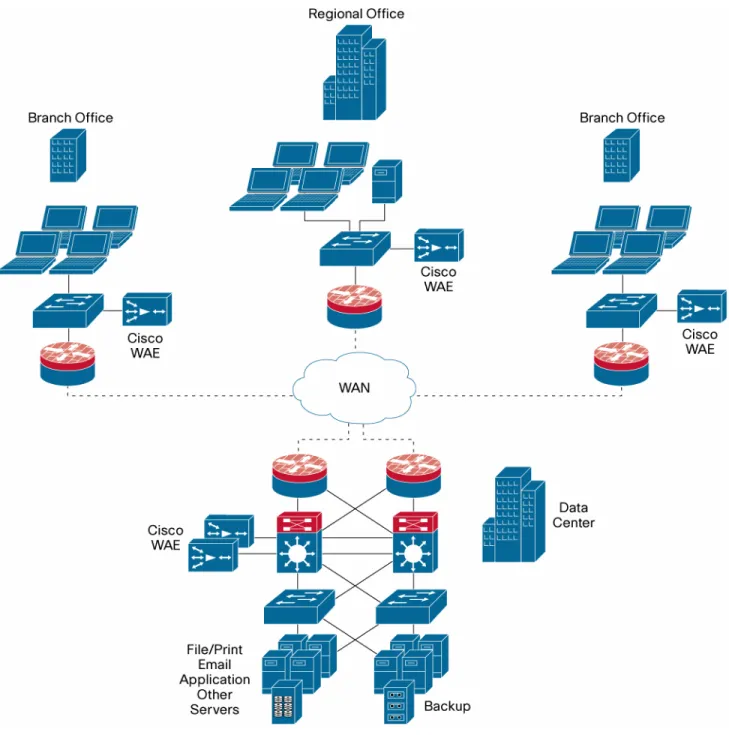
®Wide Area Application Services (WAAS) solution facilitates the consolidation of remote office application infrastructure and
services back into the data center while providing LAN-like service levels that remote users are accustomed to. Cisco WAAS overcomes
the performance barriers created by the WAN through a sophisticated combination of application acceleration and WAN optimization
techniques that mitigate application and transport latency, improve throughput, and minimize WAN bandwidth consumption for any
TCP-based application.
Deployment and management are also simplified through Cisco WAAS’ transparent integration—both logically and physically—with the
existing network, allowing preservation of existing network policies, automatic discovery across any network topology, and end-to-end
visibility for ease of monitoring or troubleshooting. The result is a significantly lower total cost of ownership (TCO), greater application
performance, more efficient WAN utilization and simplified data protection in an easy to implement package.
Benefits of the Cisco WAAS solution include:
Cost Savings through Infrastructure Consolidation: Cisco WAAS helps organizations consolidate remote office server
infrastructure into the data center, including file servers, web servers, email servers, application servers, and database servers.
Consolidating server infrastructure minimizes deployment, operational and management costs, improves data availability and
facilitates compliance with regulatory mandates
Improved Productivity through LAN-like Performance: Cisco WAAS incorporates application-specific acceleration as well
as WAN optimization that enable near-LAN like performance levels when accessing centralized applications over the WAN,
increasing employee productivity and collaboration across all branch application services including web, file, video, email and
enterprise applications
Simplified Data Protection: With Cisco WAAS IT organizations can apply standard backup, retention, storage management
and recovery procedures while reducing the IT overhead required to support remote locations. Business continuity and disaster
recovery policies can be maintained at lower costs and risks than before
Designed for the Enterprise: Cisco WAAS has been designed using experience gathered from thousands of enterprise
deployments to be part of an extensible architecture for the branch office. It is highly synergistic with existing hardware, software
and administrative procedures to ensure minimal disruption and accelerated time to deployment, while transparently preserving
network policies such as NetFlow, QoS classification, prioritization, queueing, shaping, policing, access lists, load balancing and
high availability
TRANSPARENT INTEGRATION
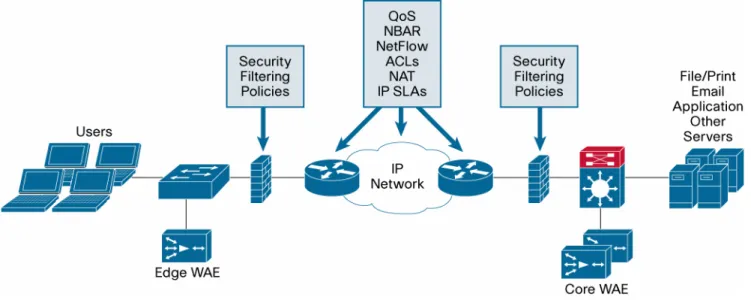
Cisco WAAS integrates seamlessly and transparently with existing client, server, storage, and network infrastructure. Optimizations
provided by Cisco WAAS are transparent and require no changes to the infrastructure. Unlike many WAN optimization products that use
TCP encapsulation, NAT, static tunnels, or dynamic tunnels, the Cisco WAAS solution provides WAN optimization capabilities without
manipulating information that is vital for enabling value-added services that are hosted within network infrastructure. By ensuring packet
network transparency and preserving IP and TCP header information, Cisco WAAS is able to interoperate with current and future
IOS-based feature deployments of advanced network services such as:
Quality of Service (QoS): Compliance with network-based QoS allows Cisco WAAS to interoperate with existing traffic
differentiation and priorization features, including classification, DSCP marking, queuing, policing, and shaping
NetFlow: By preserving packet header information, Cisco WAAS provides compliance with network-based NetFlow collection and
export, and does not impede on the ability to see which users and servers have connections and the amount of traffic that is carried
over these connections before and after WAN optimizations are applied. Cisco WAAS does not require modifications to existing
Netflow probe settings and is compatible with any Cisco-certified 3
rd-party Netflow monitoring, alarming and analysis solution.
Access Control Lists (ACLs) and Firewalls: Through transparent integration, Cisco WAAS maintains compliance with security
policies that require visibility to IP address and TCP port information, such as access-lists or firewall policies
Cisco Optimized Edge Routing (OER) and IP SLAs: Cisco WAAS is transparent to any dynamic changes in the IP network and
routing topology, accommodating intelligent, real-time routing changes, dynamic WAN link load distribution and failure detection.
CISCO WAAS SOFTWARE 4.0 FEATURES
Table 1.
Key Features and Benefits of Cisco WAAS
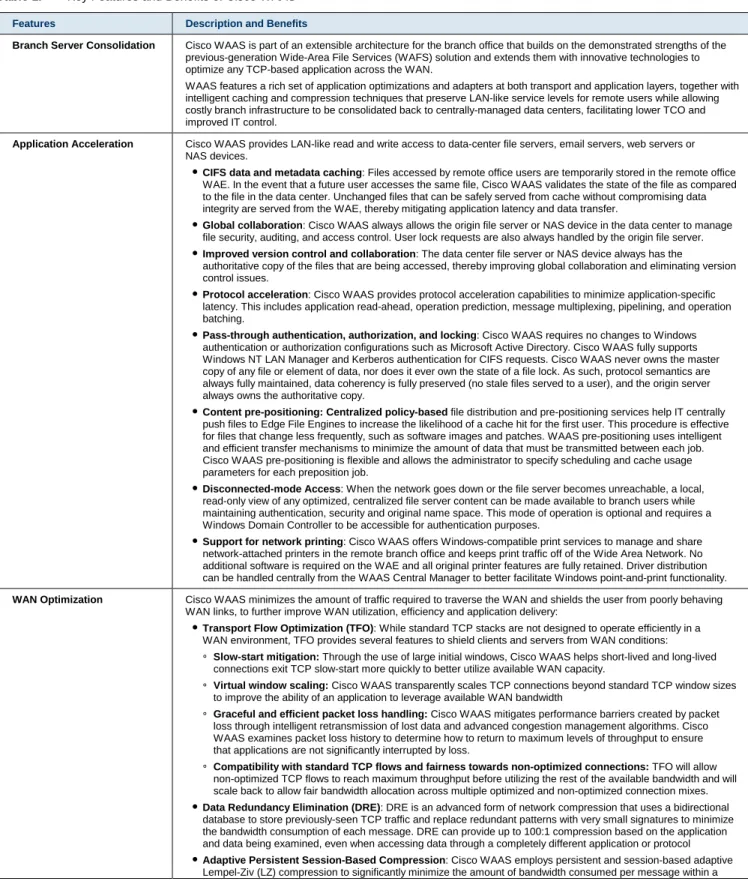
Features Description and Benefits
Branch Server Consolidation Cisco WAAS is part of an extensible architecture for the branch office that builds on the demonstrated strengths of the previous-generation Wide-Area File Services (WAFS) solution and extends them with innovative technologies to optimize any TCP-based application across the WAN.
WAAS features a rich set of application optimizations and adapters at both transport and application layers, together with intelligent caching and compression techniques that preserve LAN-like service levels for remote users while allowing costly branch infrastructure to be consolidated back to centrally-managed data centers, facilitating lower TCO and improved IT control.
Application Acceleration Cisco WAAS provides LAN-like read and write access to data-center file servers, email servers, web servers or NAS devices.
CIFS data and metadata caching: Files accessed by remote office users are temporarily stored in the remote office WAE. In the event that a future user accesses the same file, Cisco WAAS validates the state of the file as compared to the file in the data center. Unchanged files that can be safely served from cache without compromising data integrity are served from the WAE, thereby mitigating application latency and data transfer.
Global collaboration: Cisco WAAS always allows the origin file server or NAS device in the data center to manage file security, auditing, and access control. User lock requests are also always handled by the origin file server. Improved version control and collaboration: The data center file server or NAS device always has the
authoritative copy of the files that are being accessed, thereby improving global collaboration and eliminating version control issues.
Protocol acceleration: Cisco WAAS provides protocol acceleration capabilities to minimize application-specific latency. This includes application read-ahead, operation prediction, message multiplexing, pipelining, and operation batching.
Pass-through authentication, authorization, and locking: Cisco WAAS requires no changes to Windows authentication or authorization configurations such as Microsoft Active Directory. Cisco WAAS fully supports Windows NT LAN Manager and Kerberos authentication for CIFS requests. Cisco WAAS never owns the master copy of any file or element of data, nor does it ever own the state of a file lock. As such, protocol semantics are always fully maintained, data coherency is fully preserved (no stale files served to a user), and the origin server always owns the authoritative copy.
Content pre-positioning: Centralized policy-based file distribution and pre-positioning services help IT centrally push files to Edge File Engines to increase the likelihood of a cache hit for the first user. This procedure is effective for files that change less frequently, such as software images and patches. WAAS pre-positioning uses intelligent and efficient transfer mechanisms to minimize the amount of data that must be transmitted between each job. Cisco WAAS pre-positioning is flexible and allows the administrator to specify scheduling and cache usage parameters for each preposition job.
Disconnected-mode Access: When the network goes down or the file server becomes unreachable, a local, read-only view of any optimized, centralized file server content can be made available to branch users while maintaining authentication, security and original name space. This mode of operation is optional and requires a Windows Domain Controller to be accessible for authentication purposes.
Support for network printing: Cisco WAAS offers Windows-compatible print services to manage and share network-attached printers in the remote branch office and keeps print traffic off of the Wide Area Network. No additional software is required on the WAE and all original printer features are fully retained. Driver distribution can be handled centrally from the WAAS Central Manager to better facilitate Windows point-and-print functionality.
WAN Optimization Cisco WAAS minimizes the amount of traffic required to traverse the WAN and shields the user from poorly behaving WAN links, to further improve WAN utilization, efficiency and application delivery:
Transport Flow Optimization (TFO): While standard TCP stacks are not designed to operate efficiently in a WAN environment, TFO provides several features to shield clients and servers from WAN conditions:
Slow-start mitigation: Through the use of large initial windows, Cisco WAAS helps short-lived and long-lived
connections exit TCP slow-start more quickly to better utilize available WAN capacity.
Virtual window scaling: Cisco WAAS transparently scales TCP connections beyond standard TCP window sizes
to improve the ability of an application to leverage available WAN bandwidth
Graceful and efficient packet loss handling: Cisco WAAS mitigates performance barriers created by packet
loss through intelligent retransmission of lost data and advanced congestion management algorithms. Cisco WAAS examines packet loss history to determine how to return to maximum levels of throughput to ensure that applications are not significantly interrupted by loss.
Compatibility with standard TCP flows and fairness towards non-optimized connections: TFO will allow
non-optimized TCP flows to reach maximum throughput before utilizing the rest of the available bandwidth and will scale back to allow fair bandwidth allocation across multiple optimized and non-optimized connection mixes. Data Redundancy Elimination (DRE): DRE is an advanced form of network compression that uses a bidirectional
database to store previously-seen TCP traffic and replace redundant patterns with very small signatures to minimize the bandwidth consumption of each message. DRE can provide up to 100:1 compression based on the application and data being examined, even when accessing data through a completely different application or protocol Adaptive Persistent Session-Based Compression: Cisco WAAS employs persistent and session-based adaptive
Features Description and Benefits
connection, and works in tandem with DRE for maximum efficiency. Cisco WAAS adaptive persistent session-based compression can provide up to an additional 5:1 compression even for traffic that has been optimized by DRE WAN Quality of Service (QoS): WAN QoS allows interactive CIFS messages to be set at higher priority than large
bulk-data messages, resulting in higher throughput and a better interactive user experience
Investment Protection Customers can upgrade their existing Cisco WAE appliances to support the full range of Cisco Wide Area Application Services features that will be offered by Cisco in the future. Furthermore, Cisco WAAS integrates transparently with existing network infrastructure,requires no installation of software or configuration changes on client machines or file servers, and requires no configuration of complicated overlay network topologies.
Network Transparency: Unlike many solutions that obfuscate vital packet header information through
encapsulation, tunneling, or NAT, Cisco WAAS integrates cleanly with the packet network and preserves vital packet header information. This enables value-added network features to continue operating in the network without interruption and without requiring such features to be deployed on an acceleration device. Features that require such visibility include Quality of Service (classification, policing, shaping, queuing, NBAR), access control lists, firewall policies, policy based routing, and NetFlow.
Client, Server, and Application Transparency: Cisco WAAS requires no modifications to clients or servers to provide acceleration services. Furthermore, Cisco WAAS requires no modifications to applications to provide acceleration services.
Automatic Peer Discovery: Cisco WAE devices automatically discover other depoyed Cisco WAE devices that can participate in optimizations and donot require specifying an overlay topology that most other competing products require.
Microsoft Windows Network: Cisco WAAS integrates transparently with the Microsoft Windows network to ensure support for usage quota, access control, file-server naming, name resolution, and client redirection using Microsoft DFS. A unique, dedicated caching technology allows better service level guarantees for large-file applications, such as Microsoft SMS and other centralized software distribution solutions.
Simplified Central
Management and Monitoring
The Cisco WAAS solution provides exceptional ease of management and troubleshooting:
No Complex Overlay Networks: Cisco WAEs automatically discover one another during the establishment of each TCP connection to minimize system configuration requirements. By automatically discovering devices, administrators are not required to configure complex overlay network topologies, and virtually any network topology is supported WAAS Central Manager (WAAS CM): The Cisco WAAS CM is a secure and scalable web-based central
management tool deployable in high availability configurations that provides simplified configuration, provisioning, monitoring, fault-management, logging and reporting of up to 2500 WAEs within a Cisco WAAS topology Application Traffic Policy Engine (ATP): Cisco WAAS provides administrators with the flexibility to define how
specific traffic types should be handled, and includes pre-defined default policies for over 140 application classifiers and types, each mapped to a specific set of optimizations that provide the most improvement for that application. In addition to the ease of initial setup with defaults, ATP gives administrators fine-grained control over which optimizations to apply to application names, traffic classifiers and optimization maps
Comprehensive statistics: Cisco WAAS provides comprehensive logs, reports, graphs, and statistics for every function of the Cisco WAE device and optimization framework to allow IT administrators to optimize system performance and troubleshoot
Monitoring, reporting, traps, and alerts: Cisco WAAS integrates with third-party management tools and can provide notifications and reporting information using Simple Network Management Protocol (SNMP) versions 2c and 3, Simple Mail Transport Protocol (SMTP), authenticating SMTP, and syslog
Centralized software upgrades: Cisco WAAS CM allow administrators to remotely schedule software distribution, upgrade, or version rollback
Scalability and High Availability
Cisco WAAS is designed to support deployments of thousands of nodes and the high availability requirements of the most demanding enterprise organizations:
Web Cache Coordination Protocol version 2 (WCCPv2): WCCPv2 provides transparent network interception and redirection of packets to be optimized and also provides high availability clustering and load-sharing. With WCCPv2 clustering, the network automatically load-balances traffic amongst all available Cisco WAEs, and should one fail, the workload is redistributed to the remaining Cisco WAEs. In the event that no Cisco WAEs are available, traffic is routed without optimization. Up to 32 Cisco WAEs and 32 WCCP service devices (routers, switches) are supported within a WCCPv2 service group.
Policy Based Routing (PBR): PBR is another interception and redirection mechanism that can be employed with Cisco WAAS. By using PBR, the Cisco WAE is treated as a next-hop router for specific traffic types that are to be optimized. Cisco WAAS can be deployed in a high availability configuration using PBR. PBR provides fail-over from one Cisco WAE to the next configured Cisco WAE, and should no Cisco WAEs be available, the policy route is not used and traffic is routed normally without optimization.
Physical Inline Interception: Using Cisco WAAS, Cisco WAE devices can be transparently deployed with the ability to fail-to-wire in the event of a software or hardware failure, preserving traffic flow in both directions and ensuring no loss in network connectivity. When using the inline option at the edge, the Cisco WAE device is typically deployed between the switch and WAN router such that all packets leaving the remote office pass through the Cisco WAE appliance and are optimized before reaching the WAN router. Cisco WAE devices deployed using the in-line option provide high scalability and active-active failover through daisy-chain clustering, where one or more Cisco WAEs serially clustered to the first Cisco WAE that may have failed or is overloaded continue to provide the full benefits of Cisco WAAS optimizations.
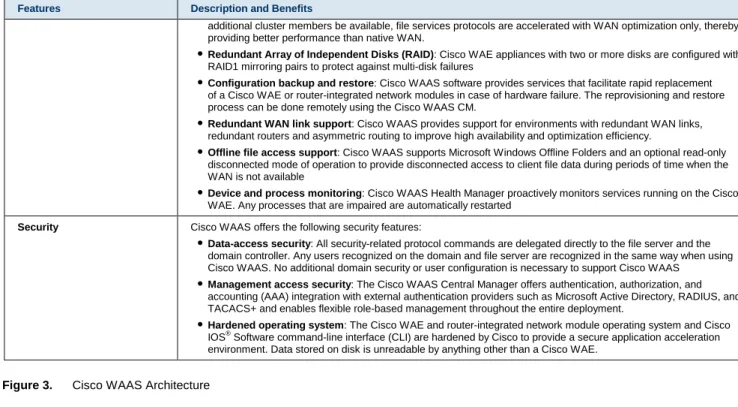
File Services Acceleration: Cisco WAE devices deployed in proximity to origin file servers can be clustered, and remote devices are made aware of each of the Cisco WAEs in the core cluster. Should a node in the core cluster become unavailable, the remote Cisco WAE automatically reconnects to another node in the cluster. Should no
Features Description and Benefits
additional cluster members be available, file services protocols are accelerated with WAN optimization only, thereby providing better performance than native WAN.
Redundant Array of Independent Disks (RAID): Cisco WAE appliances with two or more disks are configured with RAID1 mirroring pairs to protect against multi-disk failures
Configuration backup and restore: Cisco WAAS software provides services that facilitate rapid replacement of a Cisco WAE or router-integrated network modules in case of hardware failure. The reprovisioning and restore process can be done remotely using the Cisco WAAS CM.
Redundant WAN link support: Cisco WAAS provides support for environments with redundant WAN links, redundant routers and asymmetric routing to improve high availability and optimization efficiency.
Offline file access support: Cisco WAAS supports Microsoft Windows Offline Folders and an optional read-only disconnected mode of operation to provide disconnected access to client file data during periods of time when the WAN is not available
Device and process monitoring: Cisco WAAS Health Manager proactively monitors services running on the Cisco WAE. Any processes that are impaired are automatically restarted
Security Cisco WAAS offers the following security features:
Data-access security: All security-related protocol commands are delegated directly to the file server and the domain controller. Any users recognized on the domain and file server are recognized in the same way when using Cisco WAAS. No additional domain security or user configuration is necessary to support Cisco WAAS
Management access security: The Cisco WAAS Central Manager offers authentication, authorization, and accounting (AAA) integration with external authentication providers such as Microsoft Active Directory, RADIUS, and TACACS+ and enables flexible role-based management throughout the entire deployment.
Hardened operating system: The Cisco WAE and router-integrated network module operating system and Cisco IOS® Software command-line interface (CLI) are hardened by Cisco to provide a secure application acceleration environment. Data stored on disk is unreadable by anything other than a Cisco WAE.
LICENSING INFORMATION
Unlike many solutions that license based on bandwidth, Cisco WAAS is licensed based on feature capabilities, and the full capacity of
the Cisco WAE appliance chosen is available immediately.
Transport License: The Cisco WAAS Transport license provides all of the WAN optimization capabilities of Cisco WAAS to
help organizations improve performance for applications that are already centralized. The Transport license includes the Data
Redundancy Elimination (DRE) feature, session based adaptive LZ compression, Transport Flow Optimizations (TFO), and the
ability to be centrally managed.
Enterprise License: The Cisco WAAS Enterprise license provides all of the capabilities of the Transport license and additionally
provides application-specific acceleration to help IT organizations consolidate costly remote office server and storage infrastructure
including acceleration services for CIFS as well as Windows printing services.
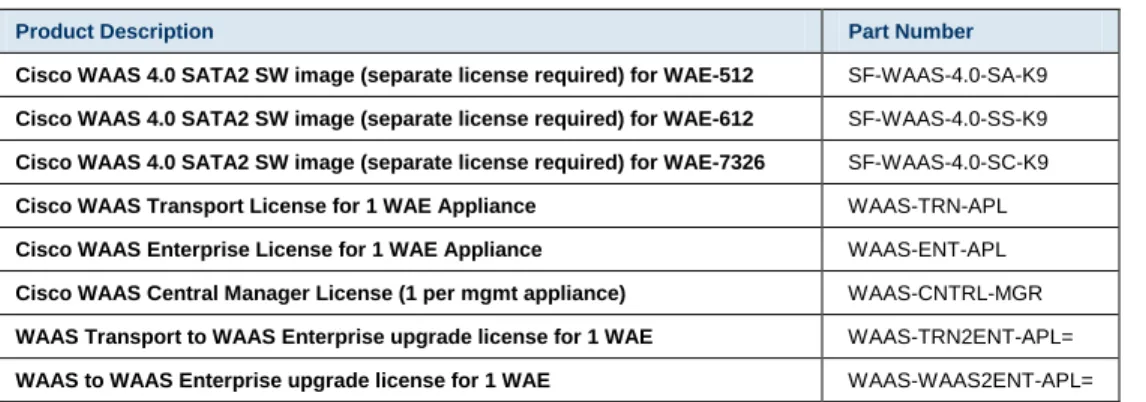
ORDERING INFORMATION
Table 2.
Part Numbers for Cisco WAAS Software Options
Product Description Part Number
Cisco WAAS 4.0 SATA2 SW image (separate license required) for WAE-512 SF-WAAS-4.0-SA-K9
Cisco WAAS 4.0 SATA2 SW image (separate license required) for WAE-612 SF-WAAS-4.0-SS-K9
Cisco WAAS 4.0 SATA2 SW image (separate license required) for WAE-7326 SF-WAAS-4.0-SC-K9
Cisco WAAS Transport License for 1 WAE Appliance WAAS-TRN-APL
Cisco WAAS Enterprise License for 1 WAE Appliance WAAS-ENT-APL
Cisco WAAS Central Manager License (1 per mgmt appliance) WAAS-CNTRL-MGR
WAAS Transport to WAAS Enterprise upgrade license for 1 WAE WAAS-TRN2ENT-APL=
WAAS to WAAS Enterprise upgrade license for 1 WAE WAAS-WAAS2ENT-APL=