Body of Knowledge
A Straw Man Version
Pierre Bourque, Université du Québec à Montréal
Robert Dupuis, Université du Québec à Montréal
Alain Abran, Université du Québec à Montréal
James W. Moore, The MITRE Corporation
Leonard Tripp, IEEE Computer Society
Karen Shyne, The Boeing Company
Bryan Pflug, The Boeing Company
Marcela Maya, Université du Québec à Montréal
Guy Tremblay, Université du Québec à Montréal
Executive Summary
Consensus on a Core Body Knowledge Is Crucial
Software engineering has not reached the status of a legitimate engineering discipline and a recognized profession. Since 1993, the IEEE Computer Society and the ACM have been actively promoting software engineering as a profession, notably through their involvement in the Joint IEEE Computer Society and ACM Steering Committee for the Establishment of Software Engineering as a Profession.
Achieving consensus by the profession on a core body of knowledge is a key milestone in all disciplines and has been identified by the Steering Committee as crucial for the evolution of software engineering toward a professional status. This report, written under the auspices of this committee, is the first step in a four-year project designed to reach this consensus.
Focus on Generally Accepted Knowledge
The software engineering body of knowledge is an all-inclusive term that describes the sum of knowledge within the profession of software engineering. Since it is usually not possible to put the full body of knowledge of even an emerging discipline, such as software engineering, into a single document, there is a need for a Guide to the Software Engineering Body of Knowledge. This Guide will seek to identify and describe that subset of the body of knowledge that is generally accepted, even though software engineers must not only be knowledgeable in software engineering, but also of course in other, related disciplines.
Guide to the Software Engineering Body of Knowledge Project
The objectives of the Guide to the Software Engineering Body of Knowledge project are therefore to:
Ÿ characterize the contents of the Software Engineering Body of Knowledge
Ÿ provide a topical access to the Software Engineering Body of Knowledge;
Ÿ promote a consistent view of software engineering worldwide;
Ÿ clarify the place of, and set the boundary of, software engineering with respect to other disciplines such as computer science, project management, electrical engineering and mathematics;
Ÿ provide a foundation for curriculum development and individual certification and licensing material. The intended audience for the Guide to the Software Engineering Body of Knowledge includes: private and public organizations, practicing software engineers, makers of public policy, professional societies, students and educators, as well as researchers.
A three-phase approach is proposed to develop the Guide to the Software Engineering Body of Knowledge. These three phases will respectively produce the “Straw Man”, “Stone Man” and “Iron Man” versions of the Guide.
Phase 1: Straw Man Version
The objectives of the first phase are to define the strategy, to deliver what is referred to as the Straw Man version of the Guide, and to gather momentum in the profession for the project. The present report constitutes this Straw Man version.
The main goal of this initial report is to propose a list of Knowledge Areas for the Guide to the Software Engineering Body of Knowledge (SWEBOK). This report also proposes a draft list of the disciplines that interact with software engineering. As its name implies, this Straw Man version is intended to be challenged and to stimulate a vigorous debate.
Knowledge Areas are the major components of a discipline, or sub-fields of study. Related Disciplines are the other disciplines with which software engineering has a non-empty intersection or shares a common boundary.
In order to propose Knowledge Areas and Related Disciplines for “generally accepted” knowledge and to do so based on recognized, public and verifiable sources of information, it was decided that the tables of contents of general software engineering textbooks, the curricula of undergraduate and graduate programs in software engineering, and the admission criteria for graduate programs would constitute the input to our analysis. A total of 24 textbooks and 29 programs were examined.
For the purposes of this Straw Man version, a potential knowledge area had to be mentioned in the table of contents of at least one quarter of the textbooks sampled to qualify as a proposed Knowledge Area. The ISO/IEC 12207 standard on Software Life Cycle Processes is used as the basis and vocabulary for the classification of the different topics related to the life cycle. A number of other topics not related to the life-cycle were also considered.
The list of proposed Knowledge Areas based on ISO/IEC 12207 is:
Ÿ Development Process Ÿ Requirements Analysis Ÿ Detailed Design Ÿ Coding Ÿ Testing Ÿ Maintenance Process Ÿ Configuration Management Ÿ Quality Assurance
Ÿ Verification and Validation
Ÿ Improvement Process
The list of proposed Knowledge Areas that do not converge well with ISO/IEC 12207 is:
Ÿ Software Development Methods − Object Oriented
− Formal Methods − Prototyping
Ÿ Software Development Environments
Ÿ Software Engineering Overview & Definition
Ÿ Measurement/Metrics
Ÿ Software Reliability The list of proposed Related Disciplines is:
Ÿ Computer Science Ÿ Project Management Ÿ Electrical Engineering Ÿ Mathematics Ÿ Telecommunications/Networks Ÿ Management Ÿ Science
Ÿ Other Engineering Disciplines
Ÿ Cognitive Sciences
Phase 2: Stone Man Version
The deliverables of the second phase (Stone Man) under the stewardship of the Industrial Advisory Board are:
Ÿ an approved list of Knowledge Areas of software engineering;
Ÿ an approved list of topics and relevant reference materials for each Knowledge Area;
Ÿ an approved list of disciplines related to Software Engineering, and the Knowledge Areas and topics lying at the junction of Software Engineering and one or more of these Related Disciplines.
To ensure relevance of the Guide, to continue building consensus and momentum for the Guide and to encourage its quick uptake in the marketplace, three components are key to the proposed strategy of the Stone Man phase: an Industrial Advisory Board, a series of specialized subcommittees and a broad comment-gathering and consensus-building process.
The Industrial Advisory Board will include key representatives from industry, major professional societies, international standards-setting bodies and academia, as well as authors of widely sold textbooks on
software engineering. It will be responsible, among other things, for the overall strategy of the project, for the selection criteria for the Knowledge Areas and the Related Disciplines, and the selection criteria for topics included in each Knowledge Area, for the selection of the subcommittee chairs for each Knowledge Area and for promoting the Guide to the SWEBOK.
Phase 3: Iron Man Version
A subsequent Iron Man version should be completed roughly two years after the Stone Man version. The development of this version will once again probably involve an Industrial Advisory Board and various expert panels. However, an even more exhaustive review and consensus-building process to gather comments and insights from members of the profession will have to be defined for this phase of the project.
Involvement By All Parties is Critical
Many long hours of work, debate and consensus-building will be required to develop the Stone Man and subsequent Iron Man versions of the Guide to the Software Engineering Body of Knowledge. Achieving consensus on the core body of knowledge is a key milestone in all disciplines and is pivotal for the evolution of software engineering toward a professional status. Involvement by all parties, industry, professional societies, standards-setting bodies and academia, is critical to ensure the relevancy and the credibility of results, and for a quick uptake of the results.
TABLE OF CONTENTS
Executive Summary ... i
Acknowledgments ... 1
1. Introduction ... 2
2. The Guide to the Software Engineering Body of Knowledge Project... 3
3. Context and Relationships... 8
4. Development Methodology for Identifying Knowledge Areas and Related Disciplines... 17
5. Proposed Knowledge Areas ... 23
6. Proposed Related Disciplines ... 26
7. Summary and Next Steps... 27
8. References... 30
9. Appendices ... 32
Appendix A. List of General Textbooks and Tutorials on Software Engineering ... 33
Appendix B. URLs of Undergraduate and Graduate Programs in Software Engineering... 34
Appendix C. General Textbooks and Tutorials on Software Engineering - Classification of Table of Contents Entries According to Potential Knowledge Areas... 37
Appendix D. Undergraduate Programs in Software Engineering - Classification of Courses According to Potential Knowledge Areas... 54
Appendix E. Undergraduate Programs in Software Engineering - Classification of Courses by Related Discipline... 59
Appendix F. Graduate Programs in Software Engineering - Admission Requirements by Related Discipline ... 64
Appendix G. Graduate Programs in Software Engineering - Classification of Courses According to Potential Knowledge Areas... 69
Appendix H. Graduate Programs in Software Engineering - Classification of Courses by Related Discipline ... 84
Appendix I. Draft Classification of Knowledge on Formal Methods Based on the Proposed Four-Category Schema... 96
Acknowledgments
The authors would like to thank the following reviewers for providing us with insightful comments and suggestions based on a draft version of this document. These reviewers are in alphabetical order: Denis Bourdeau (Bell Canada), Gilles Gauthier (Université du Québec à Montréal), John Harauz (Ontario Hydro), David Longstreet (Longstreet Consulting), Stephen MacDonnell (University of Otago), Serge Oligny (Université du Québec à Montréal), Lyn VanHoozer (The MITRE Corporation), Dolores Wallace (National Institute of Standards and Technology) and Laurie Werth (University of Texas at Austin). This does not imply, however, that these reviewers or their organizations agree with the positions and proposals put forward in this document.
Funding for this work was provided by the IEEE Computer Society and the Software Engineering Management Research Laboratory of the Université du Québec à Montréal. This laboratory is supported through a partnership with Bell Canada. Additional funding for the laboratory is provided by the Natural Sciences and Engineering Research Council of Canada.
1. Introduction
In spite of the millions of software professionals worldwide and the ubiquitous presence of software in our society, software engineering has not reached the status of a legitimate engineering discipline and a recognized profession.
Since 1993, the IEEE Computer Society and the ACM have been actively promoting software engineering as a profession and a legitimate engineering discipline, notably through its involvement in the Joint IEEE Computer Society and ACM Steering Committee for the Establishment of Software Engineering as a Profession. A draft version of accreditation criteria for software engineering university programs [1] and a draft Code of Ethics for software engineers [2] have already been produced.
Achieving consensus by the profession on a core body of knowledge is a key milestone in all disciplines and has been identified by the Steering Committee as crucial for the evolution of software engineering toward a professional status. This report, written under the auspices of this committee, is the first step in a four-year project designed to reach this consensus.
In other engineering disciplines, the accreditation of university curricula and the licensing and certification of practicing professionals are taken very seriously1. These activities are seen as critical to the constant upgrading of professionals and, hence, the improvement of the level of professional practice. Recognizing a core body of knowledge is pivotal to the development and accreditation of university curricula and the licensing and certification of professionals.
The main goal of this initial report is to propose a draft list of Knowledge Areas for the Guide to the Software Engineering Body of Knowledge (SWEBOK). This report also proposes a draft list of the disciplines that interact with software engineering. As its name implies, this Straw Man version is intended to be challenged and to stimulate a vigorous debate.
The report begins with a statement of the objectives of the project, its intended audience and the proposed three-phase development and consensus-building for producing the deliverables. Chapter 3 discusses in more detail the problem being addressed and the reasoning leading up to it, other body of knowledge proposals, as well as the intended impact of the deliverables downstream. It is followed by a description in Chapter 4 of the methodology used to identify the proposed lists of Knowledge Areas and Related Disciplines. Knowledge Areas and Related Disciplines are then proposed in Chapters 5 and 6. The report closes with some brief concluding remarks and a discussion on the next steps
1
For a more detailed discussion on the accreditation of university engineering curricula and the licensing and certification of practicing engineers, see the websites of the Accreditation Board for Engineering and Technology at www.abet.org or the Canadian Council of Professional Engineers at www.ccpe.ca
2. The Guide to the Software Engineering Body of Knowledge
Project
Body of Knowledge
The software engineering body of knowledge is an all-inclusive term that describes the sum of knowledge within the profession of software engineering. As with other professions such as law, medicine and accounting, the body of knowledge rests with the practitioners and academics who apply and advance it.
Guide to a Body of Knowledge
Since it is usually not possible to put the full body of knowledge of even an emerging discipline, such as software engineering, into a single document, there is a need for a Guide to the Software Engineering Body of Knowledge. This Guide will seek to identify and describe that subset of the body of knowledge that is generally accepted or, in other words, the core body of knowledge of the discipline.
Software engineering body of knowledge and
curriculum are not the same
Software engineers must not only be knowledgeable in what is specific to their discipline, but they also, of course, have to know a lot more. The goal of this initiative is not, however, to inventory everything that software engineers should know, but to identify what forms the core of software engineering.
It is the responsibility of other organizations and initiatives involved in the licensing and certification of professionals and the development and accreditation of curricula to define what a software engineer must know outside software engineering. We believe that a very clear distinction must be made between the software engineering body of knowledge and the contents of software engineering curricula.
Project Objectives
The objectives of the Guide to the Software Engineering Body of Knowledge project are therefore to: • characterize the contents of the Software Engineering Body of Knowledge;
• provide a topical access to the Software Engineering Body of Knowledge; • promote a consistent view of software engineering worldwide;
• clarify the place of, and set the boundary of, software engineering with respect to other disciplines such as computer science, project management, electrical engineering and mathematics;
• provide a foundation for curriculum development and individual certification and licensing material.
Intended Audience
The intended audience for the Guide to the Software Engineering Body of Knowledge includes:
• public and private organizations wishing to use and promote a consistent view of software engineering internally, notably when defining education and training, job classification and performance evaluation policies;
• practicing software engineers wishing to enhance their professional skills;
• makers of public policy engaged in defining software engineering licensing rules and guidelines for professionals: consensus on a Guide to the Software Engineering Body of Knowledge is crucial to ensure the coherence of licensing and accreditation guidelines and policies across national and state boundaries;
• professional societies engaged in defining software engineering university program accreditation guidelines, and certification rules and guidelines for professionals;
• software engineering students learning the discipline;
• educators and trainers engaged in defining curricula and course content; • researchers looking for an agreed-upon framework when discussing their work.
A Three-Phase Development and Consensus-Building Approach
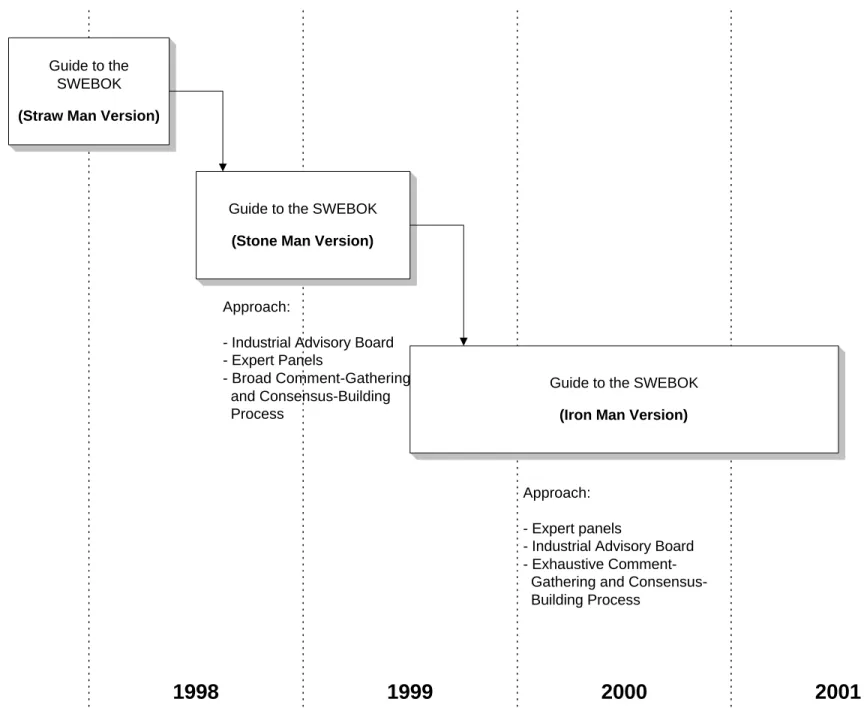
The three-phase approach outlined in Figure 1 is proposed to develop the Guide to the Software Engineering Body of Knowledge. Total duration of the three phases is expected to be four years. These three phases will respectively produce the “Straw Man”, “Stone Man” and “Iron Man” versions of the Guide.
Two principles underlie this three-phase approach:
- transparency: the development process is itself published and fully documented;
- consensus-building: the development process is designed to build, over time, consensus in industry, among professional societies and standards-setting bodies and in academia.
It is in this spirit that communication channels are constantly kept open between our project and the Joint Task Force on Software Engineering Curriculum which is also under the auspices of the Joint IEEE Computer Society and ACM Steering Committee for the Establishment of Software Engineering as a Profession.
A startup phase to develop an initial version of the Guide began at the outset of 1998. The objectives of this phase are to define the strategy, to deliver what is referred to as the Straw Man version of the Guide, and to gather momentum in the profession for the project. The present report constitutes this Straw Man version. As will be described in detail in Chapter 4, the adopted methodology used for this version is based on an analysis of a large number of software engineering textbooks, undergraduate and graduate software engineering curricula and graduate admission requirements. Additionally, the framework used to analyze these textbooks and academic programs is a joint ISO/IEC and IEEE standard which has itself been adopted through a rigorous and international consensus building, review and balloting process. In essence, one can say that the Straw Man version tries to identify where there is already consensus. The Straw Man version will serve as the primary input for the subsequent “Stone Man” phase of the project expected to end by mid-1999. The deliverables of the Stone Man phase of this project will be:
Ÿ a list of Knowledge Areas of software engineering (Knowledge Areas are the major components of a discipline, or subfields of study).
Ÿ a list of topics and relevant reference materials for each Knowledge Area;
Ÿ a list of disciplines related to Software Engineering, and the Knowledge Areas and topics at the junction of Software Engineering and one or more of these Related Disciplines; however, the Stone Man version will not point to any reference materials from a Related Discipline unless it is specifically adapted to software engineering.
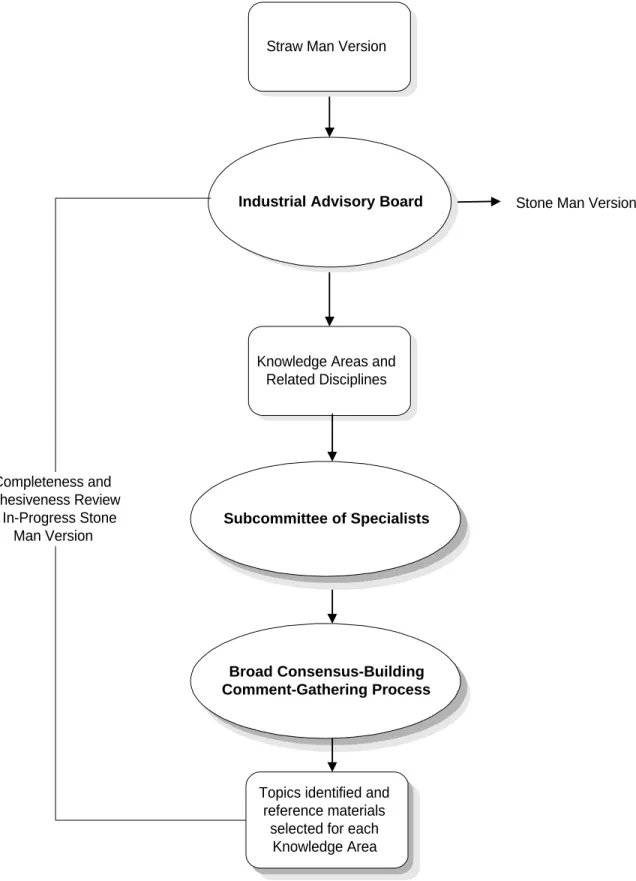
To ensure relevance of the Guide, to continue building consensus and momentum for the Guide and to encourage its quick uptake in the marketplace, three components are key to the proposed strategy of this Stone Man phase. They are, as shown in Figure 2, an Industrial Advisory Board, a series of specialized subcommittees and a broad comment-gathering and consensus-building process.
The Industrial Advisory Board will include key representatives from industry, major professional societies, international standards-setting bodies and academia, as well as authors of widely sold textbooks on software engineering. The draft definition of the responsibilities for the Industrial Advisory Board consists of the following:
Ÿ Review and approve the scope and development strategy of the Guide to the Software Engineering Body of Knowledge;
Ÿ Review and approve the selection criteria for Knowledge Areas;
Ÿ Review and approve the list of proposed of Knowledge Areas;
Ÿ Review and approve the selection criteria for Related Disciplines;
Ÿ Review and approve the proposed list of Related Disciplines;
Ÿ Review and approve the selection criteria and the list of topics for each Knowledge Area;
Ÿ Review and approve the reference material selection criteria;
Ÿ Review and approve the list of subcommittee Chairs;
Ÿ Review and approve a broad comment-gathering and consensus-building process for the Stone Man version;
Ÿ Oversee the broad comment-gathering and consensus-building process for the Stone Man version;
Ÿ Assist in promoting the Guide to the Software Engineering Body of Knowledge.
A number of subcommittees made up of subject matter experts will be established during the Stone Man phase and these will be responsible for selecting key reference material in the existing software engineering literature based on predefined reference selection criteria. These references could be book chapters, journal articles, public reports from industry, etc. The incorporation of these subcommittees in the design of the approach is an additional step in building consensus.
To inform software engineering professionals about the Guide, to promote it, to continue building consensus and to gather comments from a broad sample of professionals, a broad comment-gathering and consensus-building process will also be completed electronically during the Stone Man phase among the membership of the Computer Society and possibly other professional societies. The Industrial Advisory Board will ensure that due process is followed regarding this consultation and comment-gathering step.
A subsequent Iron Man version should be completed roughly two years after the Stone Man version. The development of this version will once again probably involve an Industrial Advisory Board and various expert panels. However, an even more exhaustive review and consensus-building process to gather comments and insights from members of the profession will have to be defined for this phase of the project. This review and consensus-building process should be somewhat akin to the already existing software engineering standards development and review process.
»
1998
1999
2000
2001
Approach:
- Industrial Advisory Board - Expert Panels
- Broad Comment-Gathering and Consensus-Building Process
Guide to the SWEBOK
(Stone Man Version)
Guide to the SWEBOK
(Straw Man Version)
Guide to the SWEBOK
(Iron Man Version)
Approach: - Expert panels
- Industrial Advisory Board - Exhaustive Gathering and Building Process
Figure 2 Proposed Strategy for Developing the Stone Man Version Straw Man Version
Knowledge Areas and Related Disciplines
Industrial Advisory Board Stone Man Version
Subcommittee of Specialists Broad Consensus-Building Comment-Gathering Process Completeness and Cohesiveness Review of In-Progress Stone Man Version
Topics identified and reference materials
selected for each Knowledge Area
3. Context and Relationships
What is software engineering?
The IEEE Computer Society defines software engineering as2:
“(1) The application of a systematic, disciplined, quantifiable approach to the development, operation, and maintenance of software; that is, the application of engineering to software.
(2) The study of approaches as in (1).” [3]
What is a recognized profession?
For software engineering to be known as a legitimate engineering discipline and a recognized profession, consensus on a core body of knowledge is imperative. This fact is well illustrated by Starr [4] when he defines what can be considered a legitimate discipline and a recognized profession. In his Pulitzer-prize-winning book on the history of the medical profession in the USA, he states that:
“the legitimation of professional authority involves three distinctive claims: first, that the knowledge and competence of the professional have been validated by a community of his or her peers; second, that this consensually validated knowledge rests on rational, scientific grounds; and third, that the professional’s judgment and advice are oriented toward a set of substantive values, such as health. These aspects of legitimacy correspond to the kinds of attributes — collegial, cognitive and moral — usually cited in the term
“profession.”3
The software engineering profession is still immature
The term “software engineering” has now been in use for 30 years, since it was officially coined at an October 1968 conference held in Garmisch, Germany [5]. Since then, considerable progress has been made. Evidence of this progress can be found in the list of 24 general software engineering textbooks found in Appendix A. Additionally, Appendix B lists 5 undergraduate and 24 graduate programs now being offered in software engineering and that were found described on the World Wide Web. A multitude of conferences and workshops are given on the topic of software engineering yearly. As well, the discipline has now accumulated a significant number of national and international standards [6].
This progress does not, of course, imply that software engineering is, as currently practiced by individuals or by organizations, at a level sufficient to ensure consistent and reliable outcomes. The industry is still plagued by significant cost and schedule overruns. Unreliable software continues to be delivered, often with dire consequences. Projects are regularly canceled or deliver only a subset of the expected benefits. Maintenance costs, best exemplified by the Year 2000 bug, are very often prohibitive .
In 1996, Ford and Gibbs [7] wrote an in-depth report on the level of maturity of the software engineering profession. In order to discuss the maturity of a profession in a more objective and constructive manner
2
Of course, there are many other definitions of software engineering. Since this effort originates from a joint committee of the ACM and the IEEE Computer Society and since this definition was agreed upon by a wide consensus within the Computer Society, it seems reasonable to start from it. The Industrial Advisory Board may find it inadequate for the purposes of the Guide to the Software Engineering Body of Knowledge or this definition may prove to be insufficient later on in the project
3
and to better predict its future evolution, they begin by proposing a model of its maturity in terms of eight infrastructure components. These components are:
− Initial professional education system;
− Accreditation of professional education programs;
− Skills development mechanisms for professionals entering the practice; − Certification of professionals administered by the profession;
− Licensing of professionals administered by government authorities;
− Professional development programs to maintain currency of knowledge and skills; − Code of ethics;
− Professional society or societies.
Their report states that nearly all these components have existed for many years and are being continually improved for more established professions such as medicine, law, engineering, architecture and accounting. They then analyze the software engineering profession using this eight-component taxonomy and conclude that only the professional development and professional society components have advanced past the ad hoc level. They therefore infer that the software engineering profession is still immature.
Increasing interest in program accreditation, certification and licensing
There is without any doubt increasing interest in university program accreditation and the licensing and the certification of software professionals. The Cutter IT Journal published by Ed Yourdon recently devoted an entire issue to the certification and licensing of software professionals [8]. In 1996, the Institution of Engineers, Australia, began granting full accreditation to undergraduate software engineering programs [9]. Some authors have even stated recently that we in the software industry had better take these issues very seriously, otherwise government officials will do it themselves. The following citations from these authors illustrate their point of view well:
“If the profession does not provide an effective mechanism such as certification to assure that its practitioners are doing everything possible to promote safety and security, then government will try to do it with licensing.” [7]
“In my opinion, the licensing or certification of at least some software engineering specialties (e.g. safety-critical systems, secure systems) is inevitable. In the current climate, licensing will probably emerge first. The only decision that we need to make is whether we want to be part of the solution or part of the problem” [10]
“If the software community cannot organize itself to become a recognized profession, we will have this done for us by legislatures and others without the necessary technical expertise and understanding of the issues” [11]
“If the software engineering community cannot rise to the level of becoming a recognized profession and an engineering discipline, we face an uncertain future with ever-mounting prospects of unfriendly legislation and harmful government actions.” [12]
“… but society might believe that severe regulation and licensing of software activities are the only way to avoid a repetition of the Year 2000 catastrophe .”[13]
It is important to note that on June 17, 1998, the Texas Board of Professional Engineers unanimously approved a proposal to recognize software engineering as a legitimate engineering discipline and to begin licensing professional engineers in this area4.
Consensus on a core body of knowledge is an inescapable first step
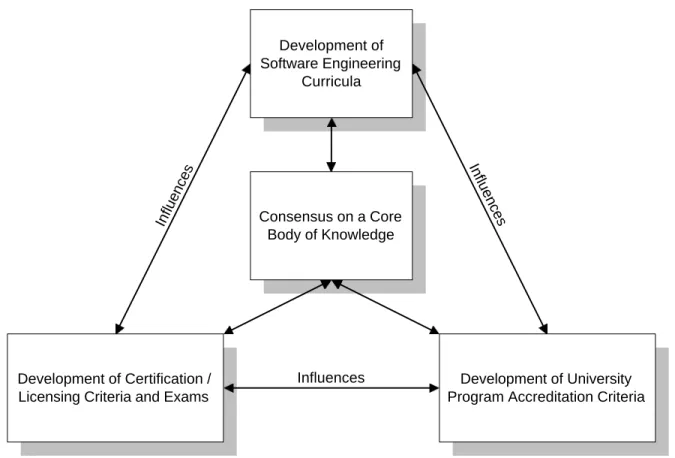
Figure 3 shows that to correctly address the development of software engineering curricula, the accreditation of professional education programs and the licensing and certification of professionals, consensus by the profession on a core body of knowledge is an inescapable step. The necessity of a consensus on a core body of knowledge when discussing professional education program accreditation and the licensing or certification of professionals is well illustrated by these two citations:
“The discipline of software engineering is still immature, but pressures from regions where engineers are licensed will add urgency to this issue. Clearly, some judgment about core material is required to perform an accreditation…” [9]
“If we accept that licensing is inevitable, then we believe it is important that the profession be prepared to advise the state legislatures about the nature of software engineering and the appropriate contents of a licensing examination.” [7]. 4 See http://www.main.org/peboard/sofupdt.htm Development of Software Engineering Curricula Development of Certification / Licensing Criteria and Exams
Development of University Program Accreditation Criteria Consensus on a Core
Body of Knowledge Influences
Influences
Influences
Computer science is the underlying discipline of software engineering
History has shown that a professional engineering discipline emerges when there is a sufficient scientific basis to enable a core of educated professionals to apply not only craft, experience and skill, but also theory to the analysis of problems and synthesis of solutions [14]. For most engineering disciplines, this emergence occurred in the 18th and 19th centuries with the increased scientific understanding of our physical world. Based on this criterion, Shaw [14] argues that, though software engineering has not yet matured to the state of a professional engineering discipline, this is an achievable goal. Baber [15] argues that software engineering is currently in a “pre-engineering” phase of its development, in many ways similar to the “pre-engineering” phases of shipbuilding, bridge construction and electrical technology. The availability and regular use by professionals of predictive models that have a scientific and mathematical basis is a distinguishing characteristic of “engineering” from “pre-engineering” practice.
Computer science has also evolved significantly over the past decades. Advances in the areas of algorithm design, compilers, data structures, database management systems, operating systems and programming languages, among others, testify to the ever-increasing depth and breadth of knowledge in computer science.
Parnas [16] is of the opinion that it is notably because of the maturity of computer science that we can now offer software engineering university programs. In fact, he argues that due to distinct fundamental goals, it is in the interests of both communities to separate the disciplines. Precedents for this position have been established in other engineering disciplines, such as in the separation of physics and electrical engineering.
When discussing the relationship of software engineering to its underlying science, Maibaum [17] states:
“It is clear that the important symbiotic relationship between analysis, physics and engineering that we have experienced over more than 200 years will be repeated in the next century between logic, theoretical computer science and software engineering.”
Distinct fundamental goals of computer science and software engineering
The fundamental goals of computer science and software engineering differ, as do the fundamental goals of science and engineering.5 Science as a whole seeks to better understand and explain various phenomena. In essence, knowledge is the product of science. In his seminal book entitled “What Engineers Know and How They Know It” [20], Vincenti declares “For engineers, in contrast to scientists, knowledge is not an end in itself or the central objective of its profession.”6 He then goes on to say that, for engineering, science is “a means to a utilitarian end.” Brooks describes this difference in goals very clearly by stating: “A scientist builds in order to learn; an engineer learns in order to build.”7 In essence, artifacts rather than knowledge are therefore the product of engineering, be they bridges, ships, airplanes, oil refineries, computer chips or software.
An illustration of this difference in goals is the importance given to professional education program accreditation in engineering and in science. On this issue, Parnas [16] states:
“The work of scientists will be usually judged by other scientists, but engineers often deal with customers who are neither engineers nor scientists. Thus, while nobody has ever felt it necessary to hold science
5
As one can debate the true engineering underpinnings of software engineering by discussing, for instance, its use of quantitative methods, one could also debate the true scientific underpinnings of computer science by discussing, for instance, its use of the scientific method. This report will leave these worthy debates to others. For an excellent discussion of the application of the scientific method in computer science and in software engineering, see [18] and [19].
6
p. 6
7
programmes to rigid standards, accreditation has always been an important consideration for engineering programmes.”
Computer science therefore seeks to better understand and to extend our knowledge in the area of computing. Extending our knowledge of software or computing is not the fundamental goal of software engineering, but rather applying this knowledge to building software.
Shaw [14] declares that although there are many definitions of engineering they all share these common elements: creating cost-effective solutions to practical problems by applying scientific knowledge to building things in the service of mankind. She then states that, for software, the problem is, appropriately, an engineering problem.
The definition given by the ACM/IEEE Computer Society Task Force on the Core of Computer Science for computing [21] is different from the definition of software engineering8. The Task Force states that:
“The discipline of computing is the systematic study of algorithmic processes that describe and transform information: their theory, analysis, design, efficiency, implementation and application. The fundamental question underlying all of computing is “What can be (efficiently) automated?”
Engineering is much more than applied science
Vincenti in [20] argues at length that engineering is much more than applied science. The following quote from the opening paragraph of his book illustrates his argument:
“Engineering knowledge, though pursued at great length and expense in schools of engineering, receives little attention from scholars in other disciplines. Most such people, when they pay heed to engineering at all, tend to think of it as applied science. Modern engineers are seen as taking over their knowledge from scientists and, by some occasionally dramatic but probably intellectually uninteresting process, using this knowledge to fashion material artifacts. From this point of view, studying the epistemology of science should automatically subsume the knowledge content of engineering. Engineers know from experience
that this view is untrue…”9
Vincenti categorizes the elements of engineering design knowledge in the following manner: − Fundamental design concepts;
− Criteria and specifications; − Theoretical tools;
− Quantitative data; − Practical considerations; − Design instrumentalities.
He then goes on to classify engineering knowledge-generating activities into seven categories, of which only one is directly linked to the underlying science. The categories are:
− Transfer from science;
8
As cited on p. 8, the IEEE Computer Society definition of software engineering is “(1) the application of a systematic, disciplined, quantifiable approach to the development, operation, and maintenance of software; that is, the application of engineering to software. (2) The study of approaches as in (1).”
9
− Invention;
− Theoretical engineering research; − Experimental engineering research; − Design practice;
− Production; − Direct trial.
These two lists illustrate well that an engineering discipline has a body of knowledge different from the body of knowledge of its underlying science. They obviously interact heavily and often have overlapping content. However, their respective categories of knowledge and types of knowledge-generating activities differ greatly. As discussed in Chapter 7, an adaptation of Vincenti’s classification schema for engineering design knowledge is proposed as a common framework for structuring topics and reference materials within Knowledge Areas.
Other body of knowledge proposals
A number of groups, professional societies and individuals have proposed a number of views regarding the software engineering body of knowledge. These proposals are described in more detail in Appendix J. The Joint Steering Committee of the IEEE Computer Society and the ACM for the Establishment of Software Engineering as a Profession established a task force in 1996 to conduct exploratory work on the issue of a software engineering body of knowledge. The task force designed and conducted a pilot survey on a sample of tasks that could be considered to be within the scope of software engineering10. The survey asked whether each task described would be expected to be performed by a “novice software engineer”, an “expert software engineer”, a “software engineering specialist” or a “manager” in the organization.
Certain proposals are incorporated into certification programs, either for a broader field as is the case with the Certified Computing Professional program of the Institute for Certification of Computer Professionals, or a more specialized field related to software engineering such as the Software Quality Engineers program of the American Society for Quality, and the Certified Quality Analyst and Certified Software Test Engineer programs of the Quality Assurance Institute.
Other proposals are being made within the context of developing software engineering curricula. Parnas for instance, while describing a new undergraduate program in the field, proposes a list of knowledge areas related to tasks performed by software engineers. The Working Group on Software Engineering Education and Training, which includes members from industry and academia, proposed a set of guidelines last spring for software education which included their view of the software engineering body of knowledge areas and knowledge components. The Australian Computer Society also includes ‘Software Engineering and Methodologies’ as a Knowledge Area within its Core Body of Knowledge for Information Technology Professionals. Finally, a collaborative effort of the ACM and other organizations recently published a model for undergraduate degree programs in information systems entitled IS’97 which included many software engineering elements.
These proposals regarding the software engineering body of knowledge cannot be used in their totality either, because:
Ÿ the focus is more on curriculum development than on the core body of knowledge of software engineering itself;
Ÿ the focus is not directly on software engineering but rather on perhaps broader or narrower disciplines such as computing, information technology, information systems, software quality engineering and test engineering;
Ÿ the consensus building process is not documented.
10
However, these proposals are an excellent input to the Industrial Advisory Board to ensure the soundness of the list of Knowledge Areas and Related Disciplines proposed in the Straw Man version of the Guide to the Software Engineering Body of Knowledge. Additionally, they should be examined when identifying topics and selecting reference materials for the Stone Man version.
Consensus on a body of knowledge is a must
The Joint IEEE Computer Society and ACM Steering Committee for the Establishment of Software Engineering as a Profession has recognized that the body of knowledge of the emerging software engineering discipline, as for other disciplines of engineering, is an autonomous body of knowledge distinct from that of computer science. This committee has identified that consensus by the profession on this body of knowledge is key to the maturation of the discipline, and improvement in the level of professional practice.
Offering a much more detailed and complete view, Figure 4 enables us to understand better how this Guide to the Software Engineering Body of Knowledge may eventually impact education and training, enterprise human resources management, professional development, professional societies and licensing boards in the field of software engineering.
Subject matter Education and Training Enterprise Human Resources Management Professional Development Professional Societies Other Fields upon
which SWEBOK relies
Licensing Boards Testing Influences Performance Assignments Software Engineering Body of Knowledge Project Management
Skills Requirements Code of ethics (developedby Professional Society)
Certification
Professional Society Manages
Workforce Skills Total Skill Capabilities Skill Requirements Met
Initial Education Establishes Standards / Curriculum Accreditation
organized as Professional Practices Experience Establishes Influences Influences
The Interrelationships of the Software Engineering Body of Knowledge Stakeholders Context Diagram Underlying Scientific Concepts Fundamental Principles Proven Techniques (empirically validated) Maturing Discipline Standardized Best Practices (universally recognized) Data Process Document Database Legend of Shapes SWE = Software Engineering Standards community should ensure:
Influences and Advances
provide basis for
allow consensus on
provide basis for
Enterprise Strategies
Education & Training
Skills
Job Classifications Learning Defines basic
skills for
Imparted through framework forProvides
enhances Compensation Experience Evaluation Standards provides opportunities for focuses
sets expectations for
accumulates as measured by performed within rewards Curriculum taught through Delivery Mechanisms assured through impart Accreditation Knowledge Students Examinations acquire verified through Consistent licensing criteria Industry/Academic Survey test questions Evaluation / Review Standardized across the nation Accredited education Specific Project Experience Licensed in another state Years in profession Influences Computer Science Research Investigations Refine enable through application prescribe through learning Skill Inventory Monitoring/ Enforcement Civil Penalties enhances institutionalized through
Lay the Groundwork for
set the context of Electrical Engineering Mathematics Telecommunications/ Networks Management Science Other Engineering Disciplines Cognitive Sciences
4. Development Methodology for Identifying Knowledge
Areas and Related Disciplines
Introduction
This chapter describes the methodology used for identifying the Knowledge Areas and Related Disciplines. Knowledge Areas are the major components of a discipline, or sub-fields of study. Related Disciplines are the other disciplines with which software engineering has a non-empty intersection or shares a common boundary.
Criteria used in selecting our identification methodology
The following criteria were used in defining the methodology for identifying Knowledge Areas and Related Disciplines:
Ÿ The identification methodology had to be based on public and verifiable sources of information and had to follow a well-documented and reproducible procedure. The authors have tried to make as few editorial decisions as possible.
Ÿ The identification methodology had to be as inclusive as possible. For this Straw Man version, it was deemed better to suggest too many Knowledge Areas and Related Disciplines and for them to be abandoned later than the reverse.
Focus is on generally accepted knowledge
As stated earlier, the software engineering body of knowledge is an all-inclusive term that describes the sum of knowledge within the profession of software engineering. However, the Guide to the Software Engineering Body of Knowledge seeks to identify and describe that subset of the body of knowledge that is generally accepted or, in other words, the core body of knowledge. To better illustrate what “generally accepted knowledge” is relative to other types of knowledge, Figure 5 proposes a draft four-category schema for classifying knowledge. As an example, Appendix I proposes a classification of the knowledge on formal methods based on this schema.
Generally Accepted
Established traditional practices used by many organizations
Advanced
Innovative practices tested and used only by some organizations
Specialized
Practices used only for certain types
of software
Research
Concepts still being developed and tested in research organizations
» Figure 5 Categories of knowledge in the SWEBOK
The Project Management Institute in its Guide to the Project Management Body of Knowledge11 [22] defines “generally accepted” knowledge for project management in the following manner:
“Generally accepted means that the knowledge and practices described are applicable to most projects most of the time, and that there is widespread consensus about their value and usefulness. Generally accepted does not mean that the knowledge and practices described are or should be applied uniformly on all projects; the project management team is always responsible for determining what is appropriate for any
given project.”12
11
This guide is currently adopted as an IEEE standard. See Chapter 7 of [6].
12
Knowledge Area and Related Discipline identification methodology
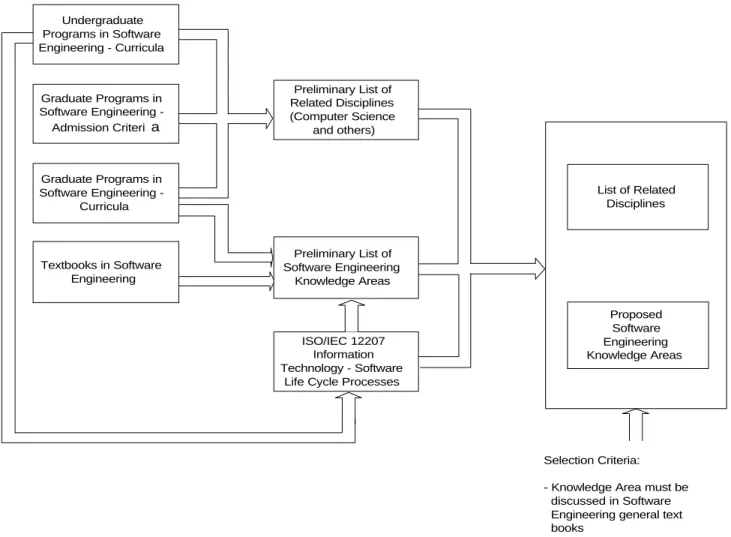
In order to propose Knowledge Areas and Related Disciplines for “generally accepted” knowledge and to do so based on recognized, public and verifiable sources of information, it was decided that the tables of contents of general software engineering textbooks, the curricula of undergraduate and graduate programs in software engineering, and the admission criteria for graduate programs would constitute the input to our analysis. Certainly, no one can question that general textbooks and academic curricula are an excellent source of information for better understanding any discipline.
Figure 6 Knowledge Area and Related Discipline Identification Methodology
In fact, it is proposed that a Knowledge Area must be discussed in a significant number of general software engineering textbooks to be considered as “generally accepted”.
General software engineering textbooks may not be the only source of generally accepted knowledge. However, textbooks are expected to contain a synthesis of what is currently considered to be the best thinking in a given field. The Industrial Advisory Board will decide if this collection of documents is sufficient or if a wider spectrum should be considered. Additionally, the various subcommittees involved in producing the Stone Man version will certainly not limit themselves to general software engineering textbooks when identifying topics and selecting reference materials within each Knowledge Area.
Graduate Programs in Software Engineering -Admission Criteri a Graduate Programs in Software Engineering -Curricula Undergraduate Programs in Software Engineering - Curricula Preliminary List of Related Disciplines (Computer Science and others) Textbooks in Software Engineering Preliminary List of Software Engineering Knowledge Areas ISO/IEC 12207 Information Technology - Software
Life Cycle Processes
Selection Criteria: - Knowledge Area must be discussed in Software Engineering general text books
- If Knowledge Area comes from another area, it is included if specifically adapted to Software Engineering Proposed Software Engineering Knowledge Areas List of Related Disciplines
other than software engineering, they have to be specifically adapted to software engineering to be included in the Guide to the Software Engineering Body of Knowledge. For example, statistics are used in software engineering, but there is no specific type of statistics for this discipline. By contrast, project cost estimation is different in software engineering from that in electrical engineering. Another example would be formal methods, which have a strong relationship with computer science and even mathematics, but are specifically created to solve software engineering problems.
The general methodology used to identify the software engineering Knowledge Areas and Related Disciplines is illustrated in Figure 6. The left-hand portion shows that information was first gathered from recognized, public and verifiable source: general software engineering textbooks and academic programs. The middle portion shows that this material was synthesized into lists of Knowledge Areas and Related Disciplines. The right hand portion shows that these were organized using another well recognized standard, ISO/IEC 12207 [23], wherever applicable.
Collected information
Using the Internet, the following information was collected:
Ÿ The tables of contents of general textbooks13 in software engineering, which present the authors’ opinions on what the boundary of software engineering is and on how to classify the topics into candidate Knowledge Areas. However, these books seldom explicitly identify the Related Disciplines, even though these implicitly reveal the authors’ opinions of where the discipline ends.
Ÿ The curricula of undergraduate and graduate programs in software engineering, which are another public source of information for identifying Knowledge Areas. They also provide an excellent basis for setting the boundary of software engineering and identifying the Related Disciplines. Software engineering curricula include not only courses in software engineering, but also courses in the other disciplines in which a software engineer should be educated. This is especially true at the undergraduate level. Graduate programs are generally much more focused on the discipline itself. Information on compulsory and elective courses was collected separately, since it was believed that compulsory courses would be a better basis for identifying the core body of knowledge than electives and because of the widely varying nature of elective courses due notably to which faculty and department offered the program.
Ÿ Admission criteria to graduate software engineering programs also indicate what the institutions think students should know outside software engineering. This information is useful for identifying the Related Disciplines and for setting the boundary of software engineering.
A total of twenty-four (24) general textbooks, five (5) undergraduate programs and twenty-four (24) graduate programs in software engineering were found and examined. For the undergraduate and graduate programs, only those having the list of required courses on the website were retained. There is no reason to believe that there would be any substantial differences between programs which have a website and those which don’t. These programs are offered by universities in the United States, Canada, the United Kingdom, Australia and Sweden. Appendix A lists the general textbooks used for this report and Appendix B lists the URLs of the retained undergraduate and graduate programs.
ISO/IEC 12207
Initially, it was expected that various approaches – even paradigms – would be found by analyzing the tables of contents of general software engineering textbooks, but such was not the case. It was found that textbooks generally present most of the subject matter of software engineering around a life-cycle model. Often, more advanced material or material pertinent to the entire life cycle and not to one particular phase is presented in additional chapters.
13
the ISO/IEC 12207 standard on Software Life Cycle Processes [23] be used as the basis and vocabulary for the classification of the different topics related to the life cycle14.
ISO/IEC 12207 was chosen for the following reasons:
Ÿ It is considered the key standard regarding the definition of life cycle process and has been adopted by the two main standardization bodies in software engineering: ISO/IEC JTC1 SC7 and the IEEE Computer Society Software Engineering Standards Committee15.
Ÿ It has been designated as the pivotal standard around which the Software Engineering Standards Committee (SESC) is currently harmonizing its entire collection of standards [6].
Ÿ It is designed to be independent of any specific software development method or life-cycle model. Regarding ISO/IEC 12207, Moore states in [6] that:
“The standard is intended to be independent of development technologies and methodologies and useful for any form of life cycle model, for example, waterfall, incremental, spiral, etc. In fact, one of the specified responsibilities of the supplier’s role is to select the life cycle model and map the requirements of the
standards to that model.”16
Ÿ It covers the entire life cycle from concept to retirement.
Ÿ It provides roles for the acquirer, supplier, developer, maintainer and operator.
Intermediate Steps: Inventory of prepared tables
In the course of writing this report, several tables were prepared:
Ÿ General textooks on software engineering. First, a list of the topics covered by the various authors was produced. The majority of the books present the different topics using a software life-cycle approach. Within each category the specific topics were listed according to the number of books covering the given topic. The resulting table is presented in Appendix C.
Ÿ Undergraduate and graduate programs in software engineering. First, a list of the courses offered by the different programs was produced. A differentiation between required courses (those which the institutions consider to be the core knowledge) and optional courses was made. The courses were then classified according to two criteria: the software life-cycle processes, as described by ISO/IEC 12207, and the disciplines to which the courses were related. A total of five (5) tables were produced:
− Undergraduate Programs in Software Engineering
-Classification of Courses According to Potential Knowledge Areas in Appendix D.
14
The authors are aware that ISO/IEC TR-15504 Information Technology Software Process Assessment also defines life cycle processes. However, ISO/IEC 12207 was preferred over ISO/IEC 15504 for the purposes of this Straw Man version since it has been adopted by both IEEE/EIA and ISO/IEC and because it has the status of a standard while ISO/IEC TR-15504 has the status of a Technical Report Type 2. However, the Industrial Advisory Board may wish to consider as potential Knowledge Areas the following additional processes defined in 15504 but not included in 12207[24]:
- Primary processes: Requirements elicitation process
- Support processes: Measurement process
Reuse process - Organizational processes: Quality management
Risk management process Organizational alignment process
15
IEEE/EIA is an adaptation of ISO/IEC 12207 with the same number and name.
16
Classification of Courses by Related Discipline in Appendix E − Graduate Programs in Software Engineering
-Admission Requirements by Related Discipline in Appendix F − Graduate Programs in Software Engineering
-Classification of Courses According to Potential Knowledge Areas in Appendix G
− Graduate Programs in Software Engineering
5. Proposed Knowledge Areas
Using the methodology described in the previous chapter, a compilation of topics included in the tables of contents of general textbooks and in university software engineering curricula is presented in Tables 1, 2 and 3. These tables, compiled from Appendix C, Appendix D and Appendix G, show the number of textbooks that cover a given topic at the Table of Contents level, and the number of programs that include required and elective courses on this topic.
As stated earlier, a proposed Knowledge Area must be covered in a significant number of textbooks to be considered as “generally accepted”. For the purposes of this Straw Man version, this significant number is set at 6, or one quarter of the textbooks listed in Appendix A. Potential Knowledge Areas meeting this requirement and that converge well with the ISO/IEC 12207 standard are shaded in Table 1.
However, a number of topics do not converge well with ISO/IEC 12207. The list of potential Knowledge Areas that do not converge well with the ISO/IEC 12207 standard but that meet the requirement for “generally accepted” are shown in Table 2. The list of potential Knowledge Areas that do not converge well with the ISO/IEC 12207 standard and that do not meet the requirement for “generally accepted” are shown in Table 3.
Since university programs of different types (undergraduate and graduate, professional and research, etc.) were surveyed, it was decided not to include this information in the selection criterion for considering a Knowledge Area as “generally accepted”. Additionally, a limited number of courses are often offered in one program, especially the graduate level. This information, however, may be useful to the Industrial Advisory Board in their review and approval of Knowledge Areas.
The following two elements where taken into consideration in setting the significant number at 6, or one-quarter of the textbooks:
− As discussed earlier, the identification methodology had to be as inclusive as possible and it was deemed better to suggest too many Knowledge Areas than too few.
− many topics are covered in a textbook without them being included in the table of contents; a more detailed analysis of the textbooks would surely be most insightful and would better represent each book.
Also, these limitations must be kept in mind in interpreting the proposed list of Knowledge Areas:
− The survey of the textbooks only considered tables of contents of textbooks written in English and accessible through the Internet. This means that it is quite possible that many excellent textbooks not listed on the website of the online library were omitted from this analysis, especially textbooks in languages other than English. This is because the objective here was not to exhaustively survey all general software engineering textbooks, but rather to collect a representative sample of them.
− Many excellent university programs not found or not described on the Internet have surely been omitted from this analysis, especially programs taught in languages other than English.
− Analysis of university software engineering programs was based on course titles only. Once again, a more detailed analysis of the course syllabuses would surely be most insightful.
− There is occasionally overlap, and some topics belonging to more than one category are counted more than once. For instance, Formal Methods is sometimes presented in the appendices as a separate topic, and sometimes it is included within the life-cycle classification (e.g. Formal methods/specification languages, Object-oriented topics, etc.). This information is presented this way to better evaluate the coverage of these topics not to create redundancy. − The importance of some specialized topics (e.g. Fault-tolerant software, Real-time software,
etc.) may be underestimated since the analysis is based on general software engineering textbooks.
Process Class Life Cycle Processes and Activities Textbooks (24) Programs(29) with Required Courses17 Programs(29) with Optional Courses
Primary Software Acquisition 2 2
Software Supply
Development Process 11 (general)18 9 (general)
Requirements Analysis1920 22 22 10 Architectural Design 2 Detailed Design21 23 14 14 Coding 18 4 12 Integration 4 Testing 16 9 7 Installation 3 Acceptance Support 3 Operation Process System Operation 2 User Support Maintenance Process22 14 4 5 Supporting Documentation Configuration Management 10 Quality Assurance 15 11 7 V&V 12 9 7 Joint Review 5 Audits 3 Problem Resolution Processes
Organizational Management Process 20 20 10
Infrastructure Process Improvement Process 16 5 2 Training Process
Table 1 Proposed Knowledge Areas based on ISO/IEC 1220723
17
Includes 24 graduate and 5 undergraduate programs
18
Courses discussing the development process in general
19
The activity entitled Process Implementation is omitted from this table since no book chapters or courses refer directly to this activity.
20
Since in this report we did not wish to engage in the worthy debate of distinguishing “systems engineering” from “software engineering”, the activity entitled “systems requirements analysis” is not listed in this table.
21
Please note that many of the topics in the tables of contents and course titles that we assigned to detailed design could arguably be assigned to architectural design. A more detailed analysis of the textbook chapters themselves and the course syllabuses would enable a better assignment of these topics and often resolve the differences in vocabulary.
22
The material in the textbooks is never organized according to the ISO/IEC 12207 classification of activities for maintenance and therefore no analysis is performed at the activity level for maintenance.
23
Proposed Knowledge Areas considered as generally accepted are shaded. A proposed Knowledge Area must be covered in a
significant number of textbooks to be considered as “generally accepted”. For the purposes of this Straw Man version, this
Potential Knowledge Areas Textbooks (24) Programs(29) with Required courses Programs(29) with Optional courses
Software Development Methods 14 2
Object Oriented 14 4 14 Formal Methods 9 11 7 Prototyping 9 Software Development Environments 13 1 3
Software Engineering Overview & Definition
11 11 5
Measurement/Metrics 9 4 9
Software Reliability 6 1 5
» Table 2 Potential Knowledge Areas for non-ISO 12207 Topics That Meet the Selection Criteria
for “Generally Accepted”
Potential Knowledge Areas Textbooks (24) Programs(29)
with Required courses Programs(29) with Optional courses Software Products 5 Software Reuse 5 2 4 Real-Time/Embedded Software 4 2 7 Reengineering 4 2 Human Factors 3 5 10 Standards 3 Fault-Tolerant Software 2 Ethics 1 1 Legal Aspects 2 Software Security/Safety 2 7
» Table 3 Potential Knowledge Areas for non-ISO 12207 Topics That Do Not Meet The Selection
Criteria for “Generally Accepted”
6. Proposed Related Disciplines
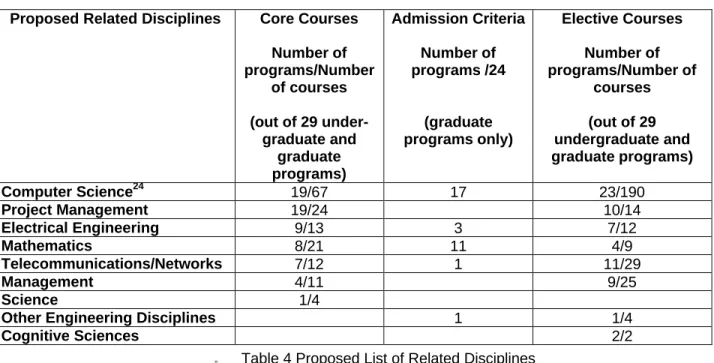
Based on a synthesis of the courses taught in undergraduate and graduate programs in software engineering and on the admission criteria for graduate programs, Table 4 proposes a list of Related Disciplines for software engineering. The complete list of courses and the details of the admission criteria are listed in Appendix E, Appendix H and Appendix F.
Table 4 is sorted in order of number of required courses in the discipline, then by number of graduate programs requiring knowledge in the discipline as an admission criterion, followed by the number of programs containing optional courses in the discipline.
Table 4 shows a strong bias toward Computer Science in the list of elective courses. This is probably explained by the fact that most software engineering programs are offered by Computer Science departments. It follows that the electives offered are very often a subset of the courses offered by these departments. Consequently, the relatively small number of courses in electrical engineering and in “other engineering disciplines” is probably due to the fact that few of these programs are taught in engineering schools.
When interpreting the list of proposed Related Disciplines, the reader must always keep in mind the following limitations:
Ÿ Many excellent university programs were not an input to this survey, especially those not taught in English. The purpose of this survey is to build a representative sample of university programs in software engineering, not to establish a definitive list of university programs.
Ÿ Analysis of software engineering university programs was based on course titles only, and an analysis of their syllabuses would surely provide additional insight. However, such a further analysis was not within the scope of this Straw Man phase.
Proposed Related Disciplines Core Courses Number of programs/Number of courses (out of 29 under-graduate and graduate programs) Admission Criteria Number of programs /24 (graduate programs only) Elective Courses Number of programs/Number of courses (out of 29 undergraduate and graduate programs) Computer Science24 19/67 17 23/190 Project Management 19/24 10/14 Electrical Engineering 9/13 3 7/12 Mathematics 8/21 11 4/9 Telecommunications/Networks 7/12 1 11/29 Management 4/11 9/25 Science 1/4
Other Engineering Disciplines 1 1/4
Cognitive Sciences 2/2
» Table 4 Proposed List of Related Disciplines
24
The list of topics included in Computer Science is listed in the Appendices. Although there is always room for interpretation, this
list is similar to the one used by Glass [25], for instance, which is derived from the CS Curriculum of the ACM/IEEE-CS Joint
Task Curriculum Task Force. For some, Software Engineering includes everything related to the development of software, including programming languages, for example. This is not the view here, the precise goal being rather to distinguish between Computer Science and Software Engineering.
7. Summary and Next Steps
Given the pervasive presence of software in our society and the increased concerns over the necessity for certification and licensing, consensus on a Guide to the Software Engineering Body of Knowledge is a must. It is critical that leadership on this important issue be on a worldwide scale, otherwise future university program accreditation guidelines and certification and licensing rules for professionals will differ widely.
A three-phase project has been initiated to develop the Guide to the Software Engineering Body of Knowledge. This report is the result of the first phase and was written with the premise that such a Guide must contain “consensually validated” knowledge and practices and rest on rational grounds. Consequently, it is based on the analysis of general software engineering textbooks and university programs offered in the field. The compilation was carried out as objectively as possible and in a reproducible manner. The process produced a list of potential Knowledge Areas and Related Disciplines. The list of proposed Knowledge Areas based on ISO/IEC 12207 is:
Ÿ Development Process − Requirements Analysis − Detailed Design − Coding − Testing Ÿ Maintenance Process Ÿ Configuration Management Ÿ Quality Assurance
Ÿ Verification and Validation
Ÿ Improvement Process
The list of proposed Knowledge Areas that do not converge well with ISO/IEC 12207
Ÿ Software Development Methods − Object Oriented
− Formal Methods − Prototyping
Ÿ Software Development Environments
Ÿ Software Engineering Overview & Definition
Ÿ Measurement/Metrics
Ÿ Software Reliability
The list of proposed Related Disciplines is:
Ÿ Computer Science
Ÿ Project Management
Ÿ Electrical Engineering
Ÿ Mathematics