Busine
ss Whit
e P
aper
Using a Procure-to-Pay Process Framework
to Improve Your Financial Supply Chain
Deb Miller
Director, Manufacturing & Retail Strategy, Software AG
Mike Shumpert
Sr. Director, Global Strategic Business Solutions, Software AG
August 2008
ContentS
IntRoDuCtIon
4
BuSIneSS ChAllenGeS
5
ADAptIve SolutIon AppRoACh
6
Key peRfoRMAnCe InDICAtoRS
8
pRoCeSS fRAMewoRK CoMponentS
8
pRoCuRe-to-pAy uSe CASe
9
BUSINESS WHITE PAPER | CoRPoRATE P2P PRoCESS FRAmEWoRk
ABStRACt
To improve performance, your business needs to have the same control and visibility over financial processes, those that drive your company’s cash, accounts, and working capital, as you do over the physical movement of goods. Leading corporations recognize that streamlining the financial supply chain, including the process from procurement to payment, is an area that offers significant potential for bottom-line improvements and competi-tive advantage.
This white paper describes Software AG’s Procure-to-Pay (P2P) Process Framework. Using a P2P process framework based on industry standards, best practices and peer experience can dramatically assist a corporation in improving its financial supply chain processes. Discover how your business can reduce operating costs while at the same time achieving end-to-end process visibility and control.
IntRoDuCtIon
As costs rise in today’s challenging economic envi-ronment, business and IT executives are pursuing strategies to streamline the financial supply chain. Improving financial supply chain processes means having the same control and visibility over busi-ness financial transactions, those that drive your company’s cash, accounts, and working capital, as you do over the physical movement of goods. Leading corporations recognize that the financial supply chain, including the process from procure-ment to payprocure-ment, is an area that can offer sig-nificant potential for bottom-line improvements. The Software AG Procure-to-Pay (P2P) Process Framework applies best practices in procure-to-pay, with a focus on the accounts payable (A/P) portion of the P2P process, to drive improvements for the corporation.
Why focus on accounts payable?
This question brings to mind an apocryphal yet il-luminating story about the gentleman bank robber Willie Sutton. When asked why he robbed banks, he answered simply, “Because that’s where the money is.” This amusing legend actually resulted in the “Willie Sutton rule” in accounting1 to be
applied “where the money is,” meaning where the highest costs are incurred, and thus having the highest potential of overall cost reduction. When it comes to buying goods and services, it is pre-cisely because businesses face significant, costly, and flawed A/P processes that improvements there can have such a big impact for the corpora-tion. Consider that:
Accounts payable professionals process more
•
than a billion business-to-business invoices each week, and 97% of those are still pro-cessed manually.2
The average cost to process and pay a supplier
•
invoice is between $5 and $15, with 10% pro-cessed too late to be paid within discounting terms, and nearly 2% containing errors.3
1 Cost and Effect, Kaplan, R.S. and Cooper, R., Harvard Business School Press
2 Forrester Research cites a Billentis estimate that there are more than 60 billion business-to-business invoices per year in the US and Europe combined, of which 97% are processed manually.
3 Estimates from US Institute of Management and Administration Survey
Clearly, manual A/P processes can be expen-sive, slow, and error-prone. Improvements in the A/P process itself, and better integration across functions in procure-to-pay, can help companies achieve a much higher degree of reliability and confidence in sourcing decisions, as well as lower their costs and maximize service delivery. Software AG is working with companies who have made outstanding progress in coordinating product and information across their physical supply chains and realize that a next source of competitive advantage is financial supply chain automation. The Software AG Procure-to-Pay Process Frame-work uses industry standards as a baseline and leverages our domain expertise to help companies increase automation, visibility, and compliance, while improving productivity and lowering trans-action costs. The process framework reflects an understanding of the subject process and the chal-lenges corporations’ face in improving the process. It includes the set of key performance indicators4
(kPIs) that are significant to understanding and improving the process, and the related technology assets and artifacts that help advance require-ments discovery and definition.
.
4 Key Performance Indicators (KPIs) are a list of metrics that a company‘s managers have identified as the most important variables reflecting operational or organizational performance.
BUSINESS WHITE PAPER | CoRPoRATE P2P PRoCESS FRAmEWoRk
BuSIneSS ChAllenGeS
Corporations want to acquire direct and indirect goods and services at the best possible total cost of ownership5, in the right quantity and quality, at
the right time, and in the right place for the direct benefit or use of the business. They face execu-tion challenges throughout their procure-to-pay process, from the point where a purchase order, or other demand signal, is submitted to a supplier for fulfillment, through the eventual receipt, verifica-tion, and put away (of the product), to payment for goods or services received. SCoR6 refers to this
pro-cess as the Source activity within the Fulfill Demand process (Figure 1).
Software AG has created the Procure-to-Pay Process Framework to assist our corporate customers in their efforts to eliminate paper driven processes, streamline and monitor purchasing, automate ap-provals, and – last but not least – cut costs. Through a coordinated approach, companies seek to:
Reduce total procurement costs by shortening
•
cycle times and through better supplier integra-tion and performance management
Reduce inventory of components through less
•
latency in communicating Purchase orders (Po’s) and status
Improve productivity of buyers, program and
•
product managers, and A/P personnel via auto-mated tasks and monitoring of potential issues.
5 Total cost of ownership includes costs associated with ordering/ purchasing, delivery, repair, maintenance, and disposal. 6 SCOR (Supply-Chain Operations Reference model) is a process
reference model that has been developed and endorsed by the Supply-Chain Council as the cross-industry standard diagnostic tool for supply-chain management. SCOR enables users to address, improve, and communicate supply-chain management practices within and between all interested parties. www.supply-chain.org
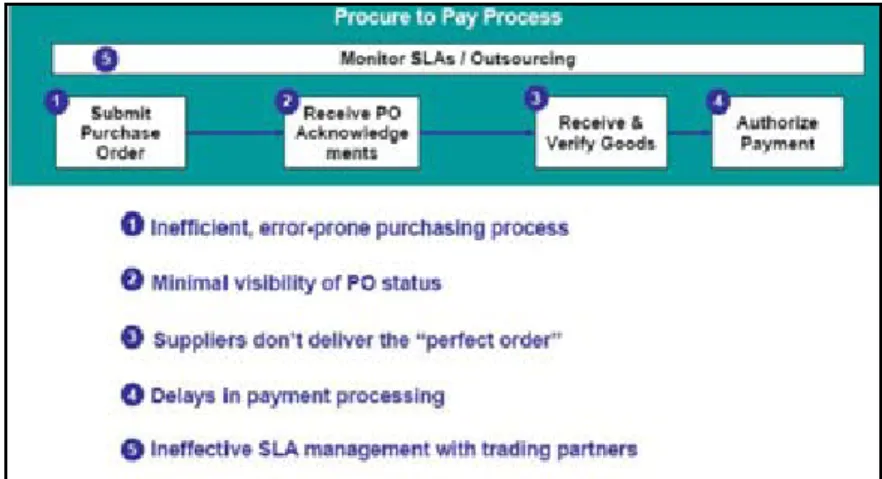
However, fragmented organizations, legacy tools, and technology – not to mention non-uniform processes – prevent corporations from optimizing spend leverage and procurement processes. For the purposes of this white paper discussion, a simplified P2P flow is provided in Figure 2 that highlights the main pain points a business is con-fronted with in the procure-to-pay process. Businesses need to consider the following chal-lenge areas as they move to improve their procure-to-pay process.
1. Inefficient, error-prone purchasing process.
How easy is the entire process to track? Does
•
the business lack real-time or “Just in Time” visibility of the end-to-end process, including visibility into spend vs. budget and jeopardy of late receipt of key goods?
Is the overall procurement cycle time too long?
•
Are the costs of Pos (purchase orders) too high?
•
Are orders consistently placed only with
autho-•
rized vendors?
Are purchase orders often out of compliance
•
with other internal or external policies? P2P is one of the key processes subjected to compli-ance requirements.
2. Minimal visibility of PO status.
Do suppliers provide quick, accurate
acknowl-•
edgement of orders at various stages of fulfill-ment?
Is a significant amount of time spent manually
•
monitoring the status of purchase orders via phone calls, emails, etc.?
Figure 1 – Procure-to-Pay within the Supply
Chain
3. Suppliers don’t deliver the “perfect order.”
How many orders arrive when originally
•
promised?
How many orders are received in full?
•
How many orders returned for various reasons?
•
Is all shipping documentation in order?
•
4. Delays in payment processing.
Is the timing of payments such that the
busi-•
ness can maximize cash flow, capture volume discounts, etc.?
Does the company have excessive adjustments
•
to account payables? Are there errors in the transactional process, such as goods being received but for which no invoice has been generated, or vice versa?
5. Ineffective SLA management with trading partners.
Does the business have sufficient visibility into
•
outsourced manufacturing or other contract-based activities and the means to monitor Service Level Agreements (SLAs)? Is there insufficient control of SLAs with suppliers, with performance management happening well after the fact?
Does the business understand how company
•
behavior affects suppliers’ ability to meet SLAs and vice versa?
In order to improve their Procure-to-Pay processes, organizations need to address the above men-tioned challenges and transform their A/P pro-cesses to reduce transactional costs and shorten cycle times, enabling full visibility as well as full monitoring and process automation.
While many enterprise, e-procurement, or finan-cial systems vendors might claim that these chal-lenges are addressed within their structural logic, the truth is that there are many opportunities for error and that without state-of-the-art tools for au-tomating, streamlining, managing and monitoring across the financial supply chain, an organization might be bearing significant costs due to manual steps and non-compliance with respect to system or process requirements.
ADAptIve SolutIon AppRoACh
Each company’s financial supply chain is unique; however, businesses do face a common set of process challenges (as discussed in the previous section) and can benefit by taking an adaptive so-lution approach that leverages best practices and industry knowledge within a process framework solution reference model.
An effective P2P process framework is all about integration, standardization, process streamlining, and visibility, because these allow a business to improve and increase transparency and account-ability, achieve cost savings, and simplify proce-dures.
For example, as brand owners or retailers race for competitive advantage, they look for diverse global sourcing, as well as the flexibility to move sourcing back locally or chose alternative trans-portation modes to respond to rising fuel costs. At the same time, major buyers are dependent on strategic sourcing, linking information and systems more tightly with fewer key suppliers. Success for all these groups depends on automation of key financial processes, compliance to corporate poli-cies, and access to critical information to ensure consistency of vendor payment terms, prevent purchase order splitting, and flag purchase orders that are created on-the-fly just to pay invoices. As our Software AG customers pursue procure-to-pay process improvement, they all cite the following capabilities of our process framework technology as key enablers.
visibility into business processes
To begin improving processes, a business needs to start by understanding the as-is state of its processes. A Business Process management (BPm) suite with Business Activity monitoring (BAm) al-lows an organization to get clear insight into areas needing dramatic improvement, and rich, interac-tive interfaces quickly reveal the root cause of process problems. Before making any changes to current processes and systems, the company can model and visualize the way new processes, pro-cess improvements, and new resource allocations
BUSINESS WHITE PAPER | CoRPoRATE P2P PRoCESS FRAmEWoRk will operate when deployed, using rich, graphi-cal simulation. And Software AG technology delivers global P2P visibility, allowing corpora-tions to track a purchase order from submission to a supplier, through the receipt of goods and services, and to the eventual payment.
Seamless end-to-end management
management of human tasks, automated system-based processes, and rapid process application development within the same environment is critically important. Process requirements rarely fit neatly into pre-defined categories of system-centric, human-centric, or document-centric. Since processes rely on systems, data, and people for handling transac-tions, human-centric workflows must seamlessly integrate with system-centric processes and support the role played by people in processes. Greater operational efficiency can be achieved with automated system steps and guided human interactions throughout the process framework. Intuitive end-user interfaces provide all informa-tion needed for process participants to col-laborate and perform their associated tasks. In addition, end-to-end management is achieved through strong systems and data integration
capabilities, including Enterprise Services Bus (ESB), business-to-business communication, and application modernization tools.
Automation of decision-making through
integrated KpIs
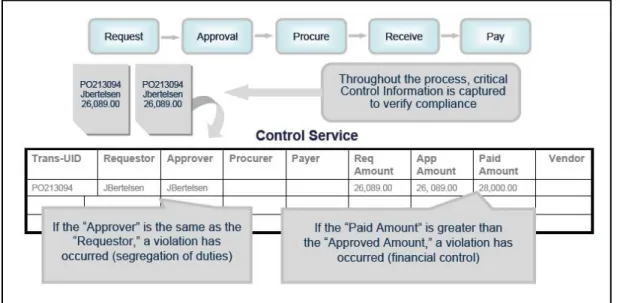
once implemented, newly automated P2P process steps must be monitored on an ongoing basis to optimize performance and guarantee observance of corporate policies and compliance with SLAs. Business issues and opportunities can be discovered quickly by automatically identify-ing problems in real time, instead of via after-the-fact analysis. And by monitoring end-to-end processes, a business can identify deviations from the designed process in early process steps that on their own have no impact, but are likely to contribute to future process breakdowns. Based on this knowledge, it is possible to predict and alert about process errors before they occur. Built-in document management capabilities sup-port the processing of purchase orders and fully integrated rules within the process allow for the automation of steps (i.e. defining the purchase allowance per user) and compliance to corporate A/P controls (as illustrated in Figure 3).
Key peRfoRMAnCe InDICAtoRS
There are industry standard models like the Sup-ply Chain Reference model (SCoR) that have a standard set of metrics relating to the procure-to-pay (Source) process, and certain metrics con-tinually emerge in and across industries as very important in practice. Following is a sampling of the process framework kPIs and considerations that Software AG has found to be critical to out-comes for our customers in this area:
KPIs
Average Cycle Time
•
order Volume
•
Total Spend, Spend by Category, SBA Status
•
% Touchless orders
•
% orders by channel (E-Transactions, Portal)
•
Average Cycle time for Touchless Pos
•
Average Cycle Time for Pos Requiring
Inter-•
vention
order Defects (Ship, matching, Validation)
•
Transaction Cost
•
Planned vs. Actual Payment Date
•
% Early/Late Payments
•
Alerts
Slow Average Cycle Time
•
Po not acknowledged within 24 hours
•
Auto matching Failure
•
Early Payments
•
Late Payments
•
Abnormally Large order Amounts
•
order Defects (Ship, matching, Validation)
•
The Software AG Procure-to-Pay Process Frame-work incorporates the operations and business kPIs that are critical to achieving the benefits of financial supply chain integration, automa-tion, and visibility. Perhaps more importantly, Software AG provides the software capabilities necessary to integrate kPI data and implement a solution for real-time alerts and decision-making.
pRoCeSS fRAMewoRK CoMponentS
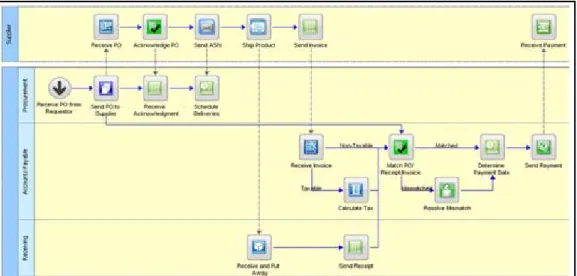
The Software AG Procure-to-Pay Process Frame-work includes a baseline process model, with swim lanes for different users/roles (as illus-trated in Figure 4), selected kPIs for the process as a whole and for steps within the process, rules to allow for different processing paths, and dashboards for visibility to enable exception management.
The design flow illustrated in Figure 4 focuses on A/P matching within the overall automa-tion, monitoring, and control of the end-to-end purchasing life cycle. Process framework components are designed to save time with an easy-to-use user interface and built-in approval workflows and policies. This enables corpora-tions to minimize maverick off-contract purchas-ing, facilitate electronic Po submission, invoic-ing, reconciliation, and payment with a network of suppliers, and gain visibility into the P2P process and stakeholder performance.
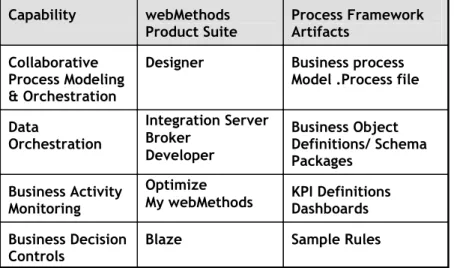
BUSINESS WHITE PAPER | CoRPoRATE P2P PRoCESS FRAmEWoRk The Process Framework Technology table in Figure 5 highlights key capabilities and the as-sociated Software AG technology and artifacts that have been created for the solution refer-ence model.
pRoCuRe-to-pAy uSe CASe
Following is one example of how the Software AG Process Framework can be applied to im-prove A/P processes in a corporate procure-to-pay environment. To illustrate the case, we will refer to the subject company as the “Galaxy” Corporation.
Galaxy wants to replace its invoice payment process with an automated workflow system that will provide a paperless solution. Currently, the Finance Department has multiple separate purchasing systems (e.g. non-inventory procure-ment, technical services procureprocure-ment, food in-ventory procurement) and one manual payment process that requires the processing of paper invoices along with manual data entry. The solution would need to reduce workflow in-efficiencies, eliminate labor-intensive activities, and ensure the high quality of operations. Less manual interaction and a lower number of errors and discrepancies would translate into reduced costs of operations, and the use of standards-based technology would permit connection to online marketplaces and procurement hubs.
After an analysis of the current situation and the existing processes, the webmethods process framework and technology is able to assist the requirements definition and implementation to automate the data entry of the paper invoice, to perform a 2-, 3- or 4-way match, to route in-voices based on defined workflows, and process price or receiving discrepancies.
With automated processes in place, Galaxy can use the new technology to provide tracking and analysis of key control objectives at executive, management, and technical levels within the corporation. monitoring capabilities identify and reduce/eliminate transactional errors, misuse, and potential fraud in the P2P process. And integrated dashboards and audit capabilities highlight critical kPIs and ensure compliance with policies and spending limits.
From an IT perspective, applications from mul-tiple business units and systems can be integrat-ed, along with information from legacy systems via application modernization capabilities. Service oriented Architecture (SoA) capabilities can promote re-use and ensure governance for the corporation in the implementation. IT is also able to implement role-based security to cater to a large multi-role organization (defining spend-ing limits and approval rights on a user-by-user basis).
Capability webMethods
Product Suite Process Framework Artifacts Collaborative
Process Modeling & Orchestration
Designer Business process
Model .Process file Data Orchestration Integration Server Broker Developer Business Object Definitions/ Schema Packages Business Activity Monitoring Optimize
My webMethods KPI Definitions Dashboards Business Decision
Controls Blaze Sample Rules
What are the results Galaxy can expect from the process framework and implementation? Galaxy will achieve benefits from streamlined processes and concomitant cost savings, enhanced data management, and increased controls, including:
Decreased processing time for purchase,
rec-•
onciliation, and payment, decreasing signifi-cantly as each step in the P2P process is made more efficient
Reduced spend, with business rules that
•
monitor and control maverick purchasing Reduced invoice processing costs (Accounts
•
Payable and buyer); as the number of paper invoices decreases, the number of resources needed to receive/sort mail, manually enter invoice information, and produce/mail checks is lower, providing an opportunity to reduce or reallocate staff
Improved reconciliation through automation
•
Availability of detailed data for spend analysis
•
and decision-making; plus, a comprehensive view of full spend activity by supplier enables improved vendor negotiations, and access to total spend provides senior officials the ability to drill down to total spending by business unit and function. This can enhance decision-making and budgeting
Enhanced compliance with buying policies and
•
procedures, and with regulatory requirements such as Sarbanes-oxley
Increased productivity, reporting flexibility and
•
visibility; as manual processes are eliminated, the time to accurately report data decreases Increased purchasing efficiency through
mea-•
suring and tracking cycle times
next StepS foR youR p2p pRoCeSS
Every element of the use case shared here illus-trates the advantages of working with Software AG to make financial supply chain improvements. By leveraging the knowledge learned from ex-perience, the Procure-to-Pay Process Framework can help guide and accelerate the solution, from modeling of critical process flows, to tracking of key performance metrics through integrated dashboards (as illustrated in Figure 6), to root cause analysis and exception handling, and trans-actional activity management across multiple systems.
To learn how your organization can take the next steps with the Procure-to-Pay Process Framework and Software AG’s business infrastructure soft-ware and services, contact Softsoft-ware AG and ask about our CustomerFirst Program.
For more information on the CustomerFirst Program, email: [email protected]
BUSINESS WHITE PAPER | CoRPoRATE P2P PRoCESS FRAmEWoRk
About the Authors
Deb Miller is with the Software AG Industry Solutions team, focused on the supply chain. Her career includes more than 20 years of global industry experience with GE. Since 2002, she has been a study group contributor to the President’s National Infrastructure Advisory Council. Ms. Miller is a Phi Beta Kappa graduate of Syracuse University with a degree in Mathematics and a dual Masters in Education and Mathematics. She attended GE’s Manage-ment DevelopManage-ment Institute and is a Six Sigma Green Belt.
Mike Shumpert is a Senior Director in Strategic Business Solutions for Software AG. He leads the development of value assessment tools for capturing and proving quantifiable ROI for Software AG customers. His responsibilities also include solution design and packaging repeat-able solutions into best practice modules to speed customer implementations. Mike has served in numerous management roles at Software AG, including product management and marketing. He has 25 years of global product management experience in business-to-business industries, including 10 years at Dun & Bradstreet as VP of global product management and 10 years of industry experience in aero-space for the Department of Defense. Mr. Shumpert holds a Masters of Business Adminis-tration degree from Georgetown University and a Bachelors of Science degree in Systems Engineering from the University of Virginia (via the US Naval Academy).
ABoUT SoFTWARE AG PRoCESS FRAmEWoRkS
Software AG Process Frameworks are solution reference models designed to guide
requirements discovery and definition, and enable users to build quickly and confidently upon Software AG’s knowledge and experi-ence base in key process areas such as order-to-cash. Built upon Software AG technology and practices, and informed by our collective customer experiences, the frameworks reflect a deep understanding of the subject process and the challenges companies face in improving the process. The Process Framework artifacts use industry standards as a baseline and leverage Software AG’s unique domain expertise to help accelerate the requirements discovery and definition process for our customers. For key process areas, Software AG Process Frameworks can assist with selection and modeling of critical process flows, definition of Key Process Indicators and metrics that allow measurement of progress on key success factors, and guidance for activity and task management, root cause analysis and exception handling.
The goal of the frameworks is to maximize our customers’ efforts in addressing their process improvement strategies and to help them gain control over their performance in the challenge areas most critical to their business.
T O F I N D T H E S O F T W A R E A G O F F I C E N E A R E S T Y O U ,
P L E A S E V I S I T
W W W . S O F T W A R E A G . C O M
Take the next step to get there – faster. ABoUT SoFTWARE AG
Software AG is the world’s largest independent provider of Business Infrastructure Software. Our 4,000 global customers achieve business results faster by modernizing, automating and improving their IT systems and processes to rapidly build measurable business value and meet changing business demands. Using our solutions, organizations are able to libe-rate and govern their data, systems, applications, processes and services – achieving new levels of business automation and transparency.
Our industry-leading product portfolio includes best-in-class solutions for managing data, developing and modernizing applications, enabling service oriented architecture, and improving business processes. By combining this proven technology with industry expertise and best practices, our customers improve and differentiate their businesses – faster.
Software AG – Get There Faster
Copyright © 2008 Software AG, Darmstadt, Germany and/or Software AG USA, Inc., Reston, VA, United States of America, and/or their suppliers. All rights reserved.
The name Software AG™, webmethods™, Adabas™, Natural™, ApplinX™, EntireX™ and/or all Software AG product names are either trademarks or registered trade-marks of Software AG and/or Software AG USA, Inc. other company and product names mentioned herein may be trademarks of their respective owners. SAG_C
orp_ p2 p_ pf _wp _Aug08