! "# $ #"# %
&
' %
$((() * *
%+,+-&
&
&
$(((
CHRA MANUAL 2nd EDITION
TABLE OF CONTENT
Page
Chapter 1 : Introduction 1
Chapter 2 : Concepts 4
Chapter 3 : Steps in Assessment 7
Chapter 4 : Deciding the Assessor 10
Chapter 5 :Gather Information 12
Chapter 6 : Divide into Work Units 15
Chapter 7 : Determine Degree of Hazard 17
Chapter 8 : Evaluate Exposure 22
Chapter 9 : Control Measures 32
Chapter 10 : Concluding The Assessment 37
Chapter 11 : Action to be taken 41
Chapter 12 : Record Keeping 45
Chapter 13 : Review Assessment 46
References Appendices Forms
CHRA MANUAL 2nd EDITION
LIST OF APPENDICES & FORMS
APPENDICES
Appendix 1 : Routers of entry Appendix 2 : Health Effects
Appendix 3 : Procedure for CHRA Appendix 4 : Registration as Assessor
Appendix 5 : Format of the Chemical Register Appendix 6 : CSDS Requirements under CPL 1997 Appendix 7 : HR Determination & Exposure Appendix 8 : Sampling Strategy
Appendix 9 : Occupational Exposure Limits
Appendix 10: Quantitative determination of inhalation exposure magnitude from airborne measurement result
Appendix 11: Estimation of Exposure
Appendix 12: Factors Affecting Inhalation Exposure Appendix 13: Factors Affecting Dermal Exposure Appendix 14: Solvent Drying Time
Appendix 15: Odour Level Thresholds
Appendix 16: Degree of physical activities & breathing rate Appendix 17: Procedure for Estimating the Degree of Exposure
FORMS
Form A : List of chemicals Form B : Work unit description
Form C : Task description
Form D : Workplace exposure assessment Form E : Risk matrix
CHRA MANUAL 2nd EDITION
PREFACE
These guidelines may be cited as the Manual for the Assessment of the Health Risks arising from the use of Hazardous Chemicals in the Workplace: Second Edition (hereinafter referred to as “the Manual”). The purpose of this Manual is to provide guidance for assessors to conduct an assessment of the health risks arising from the use, handling, storage or transportation of chemicals hazardous to health at the workplace as required by the Occupational Safety and Health (Use and Standard of Exposure of Chemicals Hazardous to Health) Regulation 2000 [P.U.(A) 131].
This is the revised edition of the 1996 manual. This revision is necessary due to the enforcement of the Occupational Safety and Health (Classification, Packaging and Labelling of Hazardous Chemicals) Regulations in 1997 and the Occupational Safety and Health (Use and Standard of Exposure of Chemicals Hazardous to Health) Regulations in 2000.
Among the changes to the first edition are :
• Hazard rating standardized with classification under Occupational Safety and Health (Classification , Packaging and Labelling of Hazardous Chemical) Regulations1997
• Changes sequence of t opics and topics now follow closely assessment steps
• Use of risk matrix to ease risk making decision & to prioritise control actions
• Additional information e.g toxicological principles, sampling strategies, exposure limits, etc
To keep it up to date, it will be review from time to time
I would like to thanks the staffs of the Division of Industrial Health for their effort in the preparation and publication of this Manual.
Director General
Depatment of Occupational Safety and Health Malaysia
CHRA MANUAL 2nd EDITION
Chapter 1
Protecting employees from the adverse effects of chemicals is one of the primary duties of an employer under the Occupational Safety and Health Act 1994. To perform this duty, an assessment of all chemicals used in the workplace must be carried out in order to identify, evaluate and control any health risk associated with work activities involving the use of the chemicals.
Under the Occupational Safety and Health (Use and Standard of Exposure of Chemicals Hazardous to Health) Regulations 2000, hereinafter referred to as USECHH Regulations 2000, the duty to perform an assessment of health risks arising from the use of chemicals hazardous to health at the place of work is mandatory whereby employers are not permitted to use any chemicals hazardous to health unless an assessment has been conducted. To provide guidelines for employers and safety and health practitioners, this manual has been compiled to assist them on the procedures and protocol for conducting an assessment, hereinafter referred to as chemical health risk assessment or in short CHRA.
1.1. Purpose and Objectives of a Chemical Health Risk Assessment
A CHRA is conducted with the purpose of enabling decisions to be made on appropriate control measures, induction and training of employees, monitoring and health surveillance activities as may be required to protect the health of employees who may be exposed to chemicals hazardous to health at work.
A CHRA has the following objectives:
a) To identify the hazards posed by each chemical substance used, stored, handled or transported within the place of work;
b) To evaluate the degree of exposure of employees to the chemicals hazardous to health, either through inhalation, skin absorption or ingestion;
c) To evaluate the adequacy of existing control measures;
d) To conclude on the significance of the health risk posed by the chemicals hazardous to health; and
CHRA MANUAL 2nd EDITION
1.2. Content of Assessment
The USECHH Regulations 2000 stipulates that the assessment conducted must contain the following: -
(a) The potential risks to an employee as a result of exposure to chemicals hazardous to health;
(b) The method and procedures adopted in the use of the chemicals hazardous to health;
(c) The nature of the hazard to health;
(d) The degree of exposure to such chemicals hazardous to health;
(e) The risk to health created by the use and the release of chemicals from work processes;
(f) Measures and procedures required to control the exposure of an employee to chemicals hazardous to health;
(g) The measures, procedures, and equipment necessary to control any accidental emission of a chemical hazardous to health as a result of leakage, spillage, or process or equipment failure;
(h) The necessity for employee monitoring programme; (i) The necessity for health surveillance programme; and
(j) The requirement for the training and retraining of employees. 1.3. Application
This manual had been prepared to provide guidance for assessors to conduct a CHRA
by going through a step-by-step procedure and using prescribed techniques and format. This manual is to be used by an assessor for the purpose of conducting assessment of health risks arising from the use, handling, storage or transportation of chemicals hazardous to health in the place of work as required by the USECHH Regulations 2000.
CHRA MANUAL 2nd EDITION
1.4. Types of Assessment
The steps described in this Manual are appropriate for all type of assessment. However the amount of work and detail of a particular assessment will depend on the chemicals hazardous to health involved and the complexity of the work processes in which there are used. There are basically two types of assessments depending on the chemical use situation and the complexity of the work process: -
a) Generic assessment; and b) Full assessment
1.4.1. Generic Assessment
A generic assessment may be used where a chemical hazardous to health or a group of chemicals hazardous to health are used in the same way in several workplaces provided that the control measures in place are similar. In generic assessment, an assessment is made of a representative workplace or job, and this assessment is then used for the similar work activities that involve comparable risks.
Generic assessments may be done for a number of similar workplaces such as a chain of fast-food outlets or service stations.
It should be emphasized that generic assessment is only valid for work activities that are clearly similar, with comparable levels of risk, and which have the same type of control measures to control those risks.
1.4.2. Full Assessment
For other situations, a full assessment should be conducted for each and every workplace where chemicals hazardous to health are used. A report must be made of the assessment and presented to the employer.
CHRA MANUAL 2nd EDITION
Chapter 2
Before going into assessment there are a few basic concepts that the assessor must understand. These are:
a) Hazard, exposure and risk b) Rating hazard, exposure and risk c) Similar risk groupings or Work units 2.1. Hazard, Exposure and Risk
2.1.1. Hazard
Chemical health hazard is the potential of a chemical to cause harm or adversely affect health of people in the workplace. Adverse health effect ranges from fatality, permanent and serious health impairment to mild skin irritation at the other end. For example, the hazard of cyanides is that they are very toxic and a small quantity, if ingested, can cause death. Chemicals that can adversely affect the health of an exposed person is termed as chemicals hazardous to health. Under the USECHH Regulations 2000, a chemical hazardous to health is defined as any:
a) Chemical listed in Schedule I to USECHH Regulations 2000; b) Chemical categorised under Part B of the CPL Regulations 1997;
- those classified as very toxic, toxic, harmful, corrosive and irritant (and sensitising); and include carcinogens, mutagens, and teratogens.
c) Pesticide as defined under the Pesticides Act 1974; and
d) Scheduled waste listed in the First Schedule to the Environmental Quality (Scheduled Wastes) Regulations 1989.
For further discussion on the health effects of chemicals, please refer to Appendix 2.
2.1.2. Exposure
A worker is exposed to a chemical if there is a possibility of the chemical being breathed in; getting it on the eye or skin or absorbed through the skin; or being swallowed. A chemical may exert its effect either at the site of contact; or at a site away from the initial point of contact and takes place after it has entered the body through the various routes of entry. Exposure through inhalation is most common, especially for airborne chemicals such as gases, vapours and particulate. Skin absorption is common for lipid soluble chemical especially in the form of liquid or mist. Ingestion is not as common as inhalation or skin absorption, but nevertheless through poor personal hygiene and work practices it could be an important route of exposure. Injection through the skin can also occur, for example, when syringes are used. Refer to Appendix 1 for further discussion.
CHRA MANUAL 2nd EDITION
2.1.3. Risk
Risk is the likelihood that a substance will cause adverse health effects or illness in the conditions of its use. The risk to health usually increases with the severity of the hazard, the amount used, and the duration and frequency of exposure.
Mesch and Kugele (1992) have suggested a risk equation as follows:
Risk = [How x How Bad x How Much] --- (1) Which proposes that health risk is a function of three (3) things, i.e.:
a) The likelihood of exposure or contact with the chemical (How);
b) The potential of the chemical to cause harm or its hazard (How Bad); and c) The degree of exposure to the chemical (How Much).
Risk has also been defined as the probability of over exposure and the consequences of that exposure. This is so because a potentially toxic chemical may cause death or serious health effects if the exposure is substantial. Therefore the risk equation can also be defined as
Risk = Hazard x Exposure --- (2) The hazard component will take into consideration the nature of hazard and the potential adverse health effects from the possible routes of entry or contact,.
The exposure component looks at the chance of overexposure occurring by taking into account the frequency of exposure, the duration of exposure, and the intensity or magnitude of exposure.
Before any risk conclusion is made one has to take into account the work practices and personal factors including individual susceptibility.
2.2. Rating Hazard, Exposure & Risk
The approach adopted by this manual is qualitative with a rating system, in that the severity of hazard and the chance of overexposure are rated on a five- (5) scale rating. To ensure that the risk rating value is consistent with the hazard or exposure rating, the above equation (2) is redefined thus:
RR = √ (HR x ER) ---(3) Where RR is the risk rating (1 to 5) indicating the likelihood of injury or illness;
HR is the hazard rating (1 to 5) indicating the severity of adverse effects; and ER is the exposure rating (1 to 5) indicating the chance of overexposure to the chemical hazardous to health.
(Note the scale of 1 to 5 is in an increasing order of magnitude, i.e. a rating of 1 means very low and 5 means very high and 3 is medium)
CHRA MANUAL 2nd EDITION
2.3. Similar Risk Groupings or Work Units for Assessment
In the evaluation of exposure to a particular chemical, the worker or person exposed to the risk should be identified. Ideally the risk of each worker exposed to the chemical hazardous to health should be assessed. However, this practice of assessing each individual worker would be too time consuming and a burden not only to the assessor but also to the employer. In order to avoid these problems, workers are to be assessed in groups whom the employer believes to be exposed to similar health risk arising from the use of a particular chemical hazardous to health. This manual describes such grouping of workers as a work unit.
A work unit must fulfil two basic requirements: - i) Work similarity
- Workers in the work unit must perform similar tasks ii) Similarity with respect to the hazardous agent
- Workers using or are exposed to the same chemicals hazardous to health.
Similar tasks means that the workers are having similar potential for exposure.
Exposed to the same chemical hazardous to health means that the workers are potentially exposed to the same hazard. Even though the workers are exposed to the same chemical hazardous to health the risk may not be the same as other factors may affect the severity of the health effects, such as susceptibility. Therefore the risk to health could only be said to be similar.
CHRA MANUAL 2nd EDITION
Chapter 3
3.1. Steps in Chemical Health Risk Assessment
The procedures in carrying out a CHRA is given in Appendix 3, which consists of ten steps:
Step 1: Deciding the assessor
Step 2: Gather information about chemicals, work & work practices Step 3: Divide into work units
Step 4: Determine degree of hazards Step 5: Evaluate exposure
Step 6: Assess adequacy of control measures Step 7: Conclude the assessment
Step 8: Identify actions to be taken Step 9: Reporting the assessment Step 10: Review assessment
3.1.1. Step 1: Deciding the Assessor
The employer of a place of work is to appoint an assessor who has the knowledge and basic skills in doing an assessment. The appointed assessor must be given the authority to do the work, and should have enough resources to gather information, consult the appropriate people, review existing records and examine the workplace. The employer should be aware of the limitations in the experience and knowledge of the personnel conducting an assessment and should be willing to engage specialist assistance, if necessary. Refer Chapter 4.
3.1.2. Step 2: Gather Information about Chemicals, the Work and Work Practices
The purpose of this step is to identify all chemicals hazardous to health found in the workplace and to gather information about the work and work practices involving chemicals hazardous to health. Refer Chapter 5.
3.1.3. Step 3: Divide into Work Units
An inspection of the work areas where chemicals are used, handled, or released into the working environment is necessary before the workers is divided into work units for assessment.
CHRA MANUAL 2nd EDITION
During this inspection identify where and how chemicals hazardous to health are used or handled or released; who are exposed to the chemicals hazardous to health; and how they are exposed. Refer Chapter 6.
3.1.4. Step 4: Determine Degree of Hazard
Identify all the chemicals hazardous to health to which the work unit is exposed to, either from the chemicals used or handled by the work unit or chemicals released from the work activities. Refer Chapter 7.
3.1.5. Step 5: Evaluate Exposure
The purposes of this step are to assess the exposure of the work unit to each of the chemical hazardous to health used/handled by or exposed to the work unit and at the same time assess the adequacy of the existing control measures (Step 6). Refer to Chapter 8.
3.1.6. Step 6: Assess Adequacy of Control Measures
The presence and adequacy of existing control measures are evaluated for each work unit. This assessment is to be conducted simultaneously with the exposure assessment. The adequacy of existing control measures is assessed by inspecting the existing control measures; checking records of air sampling, biological monitoring; and checking records on the inspection, testing and examination of control equipment. Refer to Chapter 9.
3.1.7. Step 7: Concluding the Assessment
Conclude the assessment for each work unit. This will be useful in determining whether actions to control risk need to be identified. Before concluding the assessment the assessor needs to consider the following:
a) Whether there is sufficient information to decide on the degree of hazard b) Whether there is certainty in evaluating or estimating the degree of exposure; c) Whether the risk is “significant” or “not significant”; and
d) Whether the existing control measures are adequate.
The risk to each hazardous chemical is evaluated by combining the hazard rating and the exposure rating to give the risk rating. A risk rating of 3 or greater is considered to be significant while below that the risk is considered as not significant. Refer to Chapter 10.
3.1.8. Step 8: Identify Actions to be taken
Identify possible action to be taken including suggesting further precautions and control measures based on the conclusion of assessment from Step 7. Refer to Chapter 11.
CHRA MANUAL 2nd EDITION
3.1.9. Step 9: Reporting the Assessment
Recording of an assessment is important because it will be useful for the purpose of follow-up action, review and compliance with legal requirements. The USECHH Regulations 2000 stipulates that the assessor must submit a report to the employer within one month of the completion of the assessment. The information to be recorded in the report include:
a) Name and address of the workplace;
b) Particulars of chemicals being assessed including their hazard description and hazard rating;
c) Description of work units;
d) Particulars of the workplace assessment including exposure description and rating and adequacy of existing control measures;
e) Risk evaluation and conclusion of assessment; f) Recommendations for further action;
g) Date of the CHRA; and
h) Name and position of the assessor/assessor team.
The assessor should not only submit but also present his assessment report to the employer so as to inform and highlight him on his findings and recommendations. Refer Chapter 12 for details of the records to be kept.
3.1.10.Step 10: Review Assessment
The assessment made will not be applicable for all times or changing situations. Therefore the assessment needs to be reviewed from time to time. The USECHH Regulations 2000 stipulate the requirements for reviewing an assessment. An assessment needs to be reviewed:
1. When there has been a significant change in the work to which the assessment relates. A significant change in the work means that the risk situation has changed, such as due to:
• Changes in the chemicals used or handled;
• A significant change in the quantity of chemicals hazardous to health used;
• Changes in methods or rate of work
• Deterioration in the efficiency of control equipment; or
• Plant failure or system failure. 2. Every five years;
3. When so directed by the Director General, Deputy Director General, or the Director of Occupational Safety and Health.
CHRA MANUAL 2nd EDITION
Chapter 4
In carrying an assessment involving a large number of chemical substances, chemical mixtures or preparations or complex chemical processes, a team comprising of assessors or comprising an assessor and specialists or competent person is recommended. However, for a simple assessment formation of a team may not be necessary.
4.1. The Assessment Team
It is recommended that an assessment team be set up to ensure that the assessment can run smoothly. This team is to be headed by a registered assessor and assisted by one or more of the following team members where appropriate:
a) The company’s safety and health officer or safety engineer;
b) The company’s doctor, preferably a registered occupational health doctor; c) The company’s process/chemical engineer or chemist;
d) An experienced and knowledgeable member of the safety and health committee;
e) An industrial/occupational health nurse. 4.2. Competency of an Assessor
The would-be assessor should have the abilities to:
a) Interpret the information in the Chemical Safety Data Sheets (CSDS) and labels;
b) To understand the hazard classification as prescribed by the Occupational Safety and Health (Classification, Packaging and Labelling of Hazardous Chemicals) Regulations 1997;
c) Observe the conditions of work and foresee potential problems;
d) Communicate effectively with employees, contract workers, managers, specialists and others;
e) Draw all the information together in a systematic way to form valid conclusions about exposures and risks;
CHRA MANUAL 2nd EDITION
For the purpose of complying with the USECHH Regulations 2000, the appointed assessor must be registered with the Director General of Occupational Safety and Health, Malaysia. For details please refer to the Guidelines for the Registration of Assessors, Hygiene Technician and Occupational Health Doctor (ISBN:983-2014-06-9). Refer to Appendix 4.
4.3. Duties of an Assessor
The Assessor is expected to: -
a) Carry out assessment of health risks arising from the use of chemicals hazardous to health at the workplace;
b) Furnish a report of the assessment to the employer of a place of work appointing him as the registered assessor within one month of the completion of the assessment;
c) Without any delay inform the respective employer of the immediate danger discovered during the assessment process;
d) Make recommendations on the necessity to: -
i) make changes or institute a programme to control exposure of employees to chemical hazardous to health;
ii) control any accidental emission of a chemical hazardous to health as a result of leakage, spillage, or process or equipment failure;
iii) carry out a health surveillance programme; iv) conduct exposure monitoring programme; and v) institute a training programme for employees.
e) Present his findings and recommendations to the employer upon completion of the assessment report; and
f) Submit, within thirty (30) calendar days upon completion of the assessment, a summary to the Director of the nearest DOSH office and forward a copy to the Director General. The format of this summary is set out in Appendix 4b. 4.4. Specialist Advice
In certain cases, an assessor may not be able to conclude the assessment due to lack of expertise or information. The assessor is not expected to conduct employee exposure monitoring, biological monitoring or health surveillance unless he/she is competent to do so. The assistance of a specialist may be required. The common specialist who may be consulted upon may include, but is not limited to, the following:
a) An industrial hygienist – an expert on the exposure evaluation and control b) An occupational health physician – expertise on health surveillance programme. c) A hygiene technician −expertise on the inspection and testing of local exhaust
ventilation system and the monitoring of airborne contaminants; and d) A toxicologist – an expert on chemical toxicity.
CHRA MANUAL 2nd EDITION
Chapter 5
5.1. Information to be gathered
The assessment begins with the gathering of the following information: a) Chemicals hazardous to health used or released in the workplace b) Layout plan of work area
c) Process flow chart d) Employees at risk
e) Control equipment design parameter and maintenance f) Accident and incidence
g) Monitoring record
h) Health surveillance programme i) Training programme
j) Personal protective equipment programme 5.1.1. Chemical Hazardous to Health
The information required on the chemical hazardous to health are: -
a) List of chemicals used or released in the workplace and their harmful effects; b) The nature and degree of exposure to the chemicals;
c) Exposure standards and performance criteria against which to evaluate the risk to health; and
d) Recommended control measures for the chemical substance.
Create an inventory of all chemicals hazardous to health used or released in each work area and obtain health hazard information on each. Use Form A to capture the necessary information. This information may be obtained from the chemical register, which is mandatory to be kept by the employer under the USECHH Regulations 2000. A detailed discussion on the register is found under paragraph 5.2.1.
5.1.2. Layout Plan
Obtain the layout plan for each work area where chemicals hazardous to health are used or released. In the absence of such layout plan, a sketch should be made showing the locations of the machinery, tanks or vessels, engineering control equipments, barriers or enclosures, the locations of chemicals hazardous to health and the locations of employees.
CHRA MANUAL 2nd EDITION
5.1.3. Process Flowchart
Obtain the process flowchart for all work processes carried out in the premise. The flowchart should show the various steps in the process starting from the raw material to the finished product or starting from the preparatory stage to the completion of the tasks.
5.1.4. Employees at Risk
Obtain information on those employees that are exposed to chemicals hazardous to health and should include the following: -
a) Number of male and female employees in each work area; b) Working hours: and
c) List of job categories handling or exposed to chemical hazardous to health and the number of male and female employees for each job categories for each work shift.
5.1.5. Engineering Control Equipment
Obtain information on the design parameters of the engineering control equipments and the records of their maintenance. This should include: -
a) Design parameters such as the hood face velocity and duct transport velocity for a local exhaust ventilation system;
b) Record of inspection by the employer;
c) Record of examination and testing of the control equipment by a registered hygiene technician;
5.1.6. Accident and Incidences
Obtain the accident and incidence records. This record gives information on the nature of accidents or incidences occurring.
5.1.7. Monitoring Programme
Obtain monitoring reports by competent persons, if such monitoring was carried out. 5.1.8. Health Surveillance
Obtain health surveillance records. This record should include the biological monitoring results, biological effect monitoring results, and summary of complaints and cases of occupational illnesses diagnosed.
5.1.9. Training Programme
Obtain records of training conducted. The record should include the training syllabus, training schedules and attendance.
CHRA MANUAL 2nd EDITION
5.1.10.PPE Programme
Obtain specifications on the personal protective equipments provided to employees, the issuance record of these equipments, and the record of personal protective equipment training provided.
5.2. Sources of Information
5.2.1. Information on Chemicals
An important source of information is the chemical register kept by the enterprise. Under the USECHH Regulations 2000, it is mandatory to keep a chemical register of the chemicals used, handled or stored at the workplace. The chemical register in the workplace will provide information on the trade and common names, chemical compositions, quantities used or stored and locations where chemicals are used or stored. The register must include the Chemical Safety Data Sheets (CSDS) for each of the chemicals hazardous to health listed. Refer to Appendix 5.
Where a CSDS is not available, the supplier should be contacted to get a copy of the CSDS. Under the OSH (Classification, Packaging & Labelling of Hazardous Chemicals) Regulations 1997 it is the supplier’s duty to furnish an up-to-date CSDS. Refer to Appendix 6 for explanation on the CSDS requirements.
Where the required information is not available or suspected to be inaccurate, other information sources should be consulted. These sources of information include a) Chemical hazard or toxicity reference book;
b) Material safety data sheets (MSDS) from the national CIS centre (currently managed by the Department of Occupational Safety and Health);
c) The International Chemical Safety Data Card (ICS Card) published by the International Programme on Chemical Safety (IPCS);
d) Chemical information from the International Registry of Potentially Toxic Chemical (IRPTC) database (managed by the Department of Environment); e) MSDS from Internet sites; and
f) National Poison Centre, Universiti Sains Malaysia (by subscribing to TELITA). 5.2.2. Other Information
For other information the sources of information will depend on the type of information. The Personnel or Human Resources Department will most probably keep the employees’ particulars and training records; the Maintenance Department will probably have records on the maintenance of the engineering control equipment; the Medical Department or clinic will probably keep the health surveillance records, and the Production Department should have the plant layout and the process flow chart.
CHRA MANUAL 2nd EDITION
Chapter 6
In this chapter the discussion is on the assigning of workers into similar risk groups or work unit so that assessment could be conducted for each work unit where there are exposures to chemical hazardous to health.
6.1 Categorisation of a Work Unit
In the evaluation of exposure to a particular chemical, the worker or person exposed to the risk should be identified. Workers should be assigned work units for evaluation based on similar risks. A work unit is essentially a group of workers doing similar tasks (i.e. having similar potential for exposure) whether in one work area covering several work areas and exposed to the same chemicals hazardous to health.
Identify all potential exposures by reviewing the various tasks carried out by the work unit in normal operations and any foreseeable abnormal exposures such as from leaks or accidental releases. Likelihood of an increase in exposure such as change in the physical form of the chemical as a result of the task (e.g. grinding, spraying), increase in exposure duration due to increased workload, heavy intake by doing heavy work or malfunctioning of control equipment need to be considered.
Assess how frequent job or task is carried out. Whether it is a routine or non-routine task; production of one-off items or isolated batches, trials; maintenance work, repair operations; etc.
For a complete assessment the work units should not only be limited to production or maintenance workers but those persons who may be in the work area and exposed to chemicals hazardous to health. Work units are to be considered from these groups of people:
- Production employees
- Ancillary or support employees (e.g. cleaners, maintenance staff, laboratory staff)
- Contractors on site - Visitors
- Supervisors and managers - Students
CHRA MANUAL 2nd EDITION
6.2. Work Unit Identification
This is where the assessor needs to identify and observe the tasks carried out by workers in a certain work area where workers are exposed to chemical hazardous to health and should be assigned work units for evaluation based on similar risks Employees and other workers should be assigned work units based on the same chemical substances used or handled and carrying out similar job tasks. The steps to categorise a work unit is as follows:
a) Conduct a ‘walk-through’ inspection to identify all persons who might be exposed, this might include persons who
• Work directly with the chemical;
• Work near or pass through areas in which the chemical is used, produced (including discharge of emissions), stored, transported or disposed of;
• Enter a confined space in which the chemical might be present; or
• Clean, perform maintenance or other work in areas where the chemical might be present
b) For each department or work area get the list of job title groups;
c) For each job title groups identify the chemical hazardous to health they were using or exposed to, the tasks carried out and the location within the work area;
d) Talk to supervisors and employees at each work location regarding practical information about work practices and procedures;
e) Characterise the work unit as follows:
Work area + work performed = work unit
(E.g. mixing area) (E.g. operator) (E.g. mixing operator) f) Where the chemical hazardous to health used or exposed to and the tasks are
similar for a number of job title groups, they may be group together and considered as a single work unit (e.g. a line leader and the production operators under his supervision may be considered a work unit);
CHRA MANUAL 2nd EDITION
Chapter 7
The hazard rating is used to prioritise hazard based on the potential health effect of the chemical. The hazard of a chemical is rated on a 1 to 5 scale with a rating of 1 implying not hazardous and a rating of 5 implying most hazardous to health. This hazard rating is harmonised with the classification of hazardous chemical for Part B hazardous chemicals (categories of hazard based on health effect) under the Occupational Safety and Health (Classification, Packaging and Labelling of Hazardous Chemicals) Regulations 1997, hereinafter referred to as CPL Regulations. 7.1 Hazard Information
Hazard information can be obtained from various sources. A complete CSDS provides useful information such as the hazard description, the toxicity data, and the acute and chronic health effects. Based on the toxicity data, the health effects and the risk phrases assigned to each hazardous, the hazard of each chemical can be evaluated and assigned a hazard rating (HR).
However, for chemicals released into the work environment as a result of chemical reaction, decomposition or thermal degradation, hazard information may need to be obtained from other sources as the supplier’s CSDS only provides information on the supplied products.
The sources of information have already been discussed under Chapter 5. However, a summary of the necessary information and its sources is given below:
Information Source
Chemical classification
Health effects, LC50 and LD50 Risk phrases
Label, CSDS, ICS card
CSDS, MSDS, ICS card, Poison centre, chemical safety literature
CHRA MANUAL 2nd EDITION
7.2 Hazard Rating Determination
For the purpose of assigning a hazard rating, chemicals hazardous to health need to be categorised into two groupings based on systemic effects and local effects. These groupings are meant to separate those chemicals that may be absorbed into the body and causing damage to organs or systems of the body and those that may cause effect at the site of contact either on the skin or eyes.
The procedure to assign a hazard rating to a pure chemical or a preparation containing a mixture of chemicals is as follows: -
a) Get information on the hazard categories, hazard classification; risk phrases, the acute and chronic effects, and the LD50 and LC50 for the chemical substance or preparation;
b) Use Table 1 to get hazard rating based on the health effect description or use Table 2 to get hazard rating based on the hazard classification or hazard categories, or risk phrases;
c) List the hazard ratings obtained in descending order;
d) Assign a single hazard rating based on the greatest degree of hazard from Group 1 hazard categories: -
Group 1: Very toxic R26-28, 39, 45(1), 46(1), 47(1), 49(1) Toxic R23-25,39, 48, 45(2), 46(2), 47(2), 49(2) Harmful R20-22, 40, 40(3), 40(M2), 48,
Respiratory sensitiser R42 Respiratory irritant R37
e) Assign an “sk” notation for those chemicals in Group 2 hazard categories: - Group 2: Corrosive to skin/eye R34, 35
Skin and eye irritants R41, 38, 36
f) For a chemical substance or preparation that fall solely under Group 2, i.e. do not fall into Group 1, the hazard rating assigned is to be based on Group 2.
Note:
Tables 1 and 2 describe the assignment of hazard rating:
• Table 1 describes the assignment of hazard rating based on health effects and hazard categories.
• Table 2 describes the assignment of hazard rating based on risk phrases assigned to the hazardous chemical substance under the CPL Regulations.
CHRA MANUAL 2nd EDITION
The risk phrases used in Table 2 are: Acute effects:
Acute lethal effects (R20 to 28)
Non-lethal irreversible effects after single exposure (R39, 40)
Corrosive (R34, R35)
Irritant (R36 to 38, R41)
Sensitiser (R42, R43)
Chronic effects:
Severe effects after repeated or prolonged exposure (R48)
Carcinogen (R40, R45, R49)
Mutagen (R46, R40)
Reproductive hazards (R60 to 64) including
teratogen (R47 – this r-phrase no
longer in use in EU)) 6.3. Example of Determining Hazard Rating
Example of Determining the Hazard of a Pure Chemical
As an example, ethyl dimethylamine is harmful through inhalation and if swallowed (R20/22) and at the same time corrosive to skin (R34).
According to the CPL Regulations, corrosive is of a higher degree of hazard as compared to harmful and so this chemical is classified as corrosive.
For assessment purposes these health hazard categories (i.e. harmful and corrosive) will be used to determine the hazard rating.
From Table 2, the hazard ratings are as follows: -
Group 1: Harmful R20/22 gives a hazard rating of 3 Group 2: Corrosive R34 gives a hazard rating of 3. Assign a hazard rating of 3 (based on Group 1)
Assign a “sk” notation (based on Group 2)
Since this chemical is harmful if inhaled or ingested, the exposure through these two routes must be assessed. Even though exposure to skin is not assessed, control of skin contact is mandatory because of the “sk” notation.
Examples of determining the hazard rating for preparations or mixtures of chemicals hazardous to health are given in Appendix 7.
CHRA MANUAL 2nd EDITION
Table 1: Hazard Rating
HR HEALTH EFFECTS HAZARD CATEGORY
5
Local: Injury to the skin, eyes, or mucous membranes of sufficient severity to
threaten life by single exposure Systemic: Severe irreversible effects (e.g.
central nervous system effects, kidney necrosis, liver lesions, anemia or paralysis) after a single exposure
Known human carcinogens, mutagens or teratogens
*Very Toxic chemicals:- -LD50<25 mg/kg (oral) -LD50<50 mg/kg (skin) -LC50<0.5 mg/litre
*Category 1 carcinogen, mutagen and teratogen
4
Local: Injury to the skin, eyes, or mucous
membranes of sufficient severity to cause permanent impairment, disfigurement or irreversible change from single or
repeated exposure
Systemic: Very serious physical or health impairment by repeated or prolonged exposure
Probable human carcinogens, mutagens or teratogens based on animal studies
*Very Corrosive (R35: Causes severe burn) *Toxic chemicals:-
-LD50: 25-200mg/kg(oral) -LD50: 50-400mg/kg(skin) -LC50: 0.5-2 mg/litre
*Category 2 carcinogen, mutagen and teratogen
3
Local: Serious damage to skin, eyes or mucous membranes from single or repeated exposure
Systemic: Severe effects after repeated or prolonged exposure
Possible human or animal carcinogens or mutagens, but for which data is inadequate
*Corrosive(R34:Cause burn) *Respiratory sensitisers *Irritant-serious eye damage *Harmful chemicals:- -LD50:200-500mg/kg(oral) -LD50:400-2000mg/kg(sk) -LC50: 2-20 mg/litre *Category 3 carcinogen and mutagen
2
Local: Reversible effects to the skin, eyes or mucous membranes not severe enough to cause serious health impairment
Systemic: Changes readily reversible once exposure ceases
*Skin sensitisers *Skin irritants
CHRA MANUAL 2nd EDITION
Table 2: Hazard Rating Based on Risk Phrases
Note: For R39 and R48, the classification of the chemical or preparation need to be considered together in determining the hazard rating.
ROUTES OF EXPOSURE DERMAL
EFFECT ACUTE/
CHRONIC INH.
SKIN EYE ING. NOT SPECIFIED
HAZARD RATING (HR)
Acute R26 R27 R28 R39
Very Toxic
Chronic - - - -
5
Acute R23 R24 R25 R39
Toxic
Chronic - - - R48, R39
4
Acute R20 R21 R22 R40
Harmful
Chronic - - - R48, R40
3
R35 4
Corrosive Acute
R34 3
R37 - R41 3
Irritant Acute
- R38 R36 2
R42 - 3
Sensitising Acute
- R43 2
R49(1) R45(1) 5
R49(2) R45(2) 4
Carcinogenic Chronic
- R40(3) 3
R46(1) 5
R46(2) 4
Mutagenic
R40(M2) 3
R47(1) 5
Teratogenic R47(2) 4
EXPOSURE ASSESSMENT
CHRA MANUAL 2nd EDITION
Chapter 8
The purpose of determining exposure rating is to assess the potential of the chemical hazardous to health entering the body through the various routes of entry causing systemic effects or potential for contact with the eyes, skin or the respiratory tract causing localised effects.
8.1. Exposure Parameters
The first step is to identify who are exposed and what chemicals hazardous to health used or formed in the process carried out by the work unit.
The next step is to identify the tasks in which chemicals hazardous to health are being used or where there is likely exposure to chemicals hazardous to health during normal operation by going through their work procedures, observation of the various tasks performed and interviewing the members of the work unit.
Important considerations in the assessment of an exposure in the workplace are: a) Degree of Exposure
- Who is exposed?
- How and in what circumstances is the exposure - Frequency of exposure
- Duration of exposure; and
- Intensity or magnitude of exposure
b) Other factors, such as training & information of employees, monitoring of exposure, and health surveillance.
Exposures are evaluated by assessing the likelihood of contact of the work unit with the hazardous chemical; how the chemicals are released into the work environment; the method of handling the chemical; the way the chemical enters the body; the frequency and duration of exposure; and the intensity or magnitude of each exposure. Apart from assessing exposures during normal operation, the possibility of exposure due to spillage, leaks or accidental entry into the body such as through injection is to be considered.
Special consideration is required for some person who may be at increased risk, such as pregnant women; person with medical condition such as suffering from bronchitis or asthma; untrained or inexperienced workers; smokers, who may be at increased risk of additive or synergistic effects.
CHRA MANUAL 2nd EDITION
8.2. Degree of Exposure
The degree of exposure is to be estimated for the various probable route(s) of exposure. The probable routes of entry or contact are decided by taking into consideration the physical form of the chemical and the effects it could have through the various routes of entry or contact, as described by the risk phrases assigned to it. This has been discussed under Chapter 5. Examples of decision to be taken with respect to which route of entry or contact to be assessed is given in Appendix 7.
Where a chemical exerts a direct effect on the skin or the eyes, such as corrosives and irritants, an ‘Sk’ notation should be made to indicate that skin and eye exposure needs control regardless of absorbed dose.
Estimation of the degree of exposure is primarily based on these parameters: a) Frequency of exposure, F;
b) Duration of exposure, D; and
c) Intensity or magnitude of exposure, M.
The more frequent or the longer the duration a hazardous chemical is used, the higher is the degree of exposure. The greater the amount of chemical being absorbed into or enters the body or in contact with the eye/skin the higher is the degree of exposure. 8.3. Frequency of Exposure
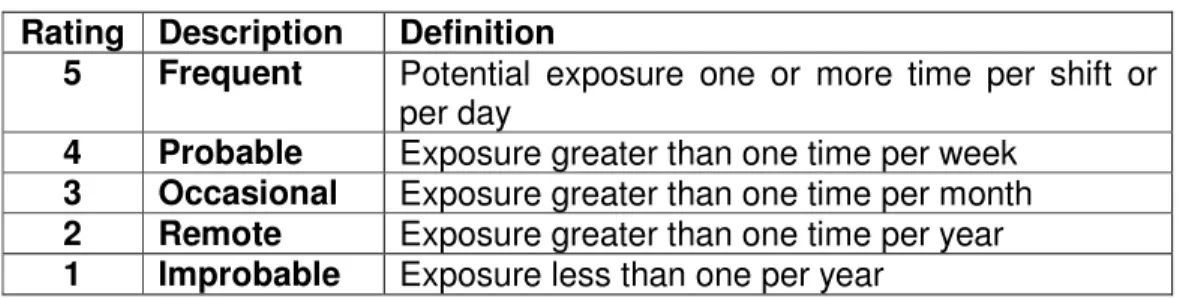
For assessing the likelihood of acute effects, the frequency of exposure is determined as the frequency of exposure has a significant effect on the degree of exposure. For example, twice the frequency would yield a two-fold increase in exposure. The frequency of potential exposure can be estimated from observation of the work activities and feedback from the workers and management. Frequency rating is used and is determined from Table 3:
Table 3: Frequency Rating
Rating Description Definition
5 Frequent Potential exposure one or more time per shift or per day
4 Probable Exposure greater than one time per week 3 Occasional Exposure greater than one time per month 2 Remote Exposure greater than one time per year 1 Improbable Exposure less than one per year
CHRA MANUAL 2nd EDITION
8.4. Duration of Exposure
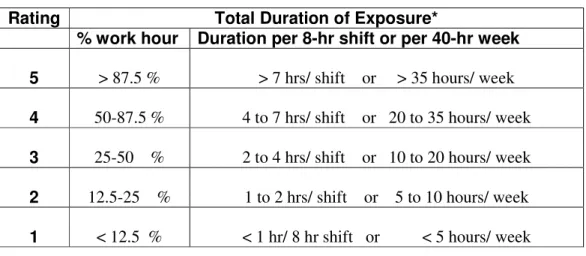
A duration rating is used to assess chronic or routine exposures. Duration of exposure also has a significant effect on the exposure. Twice the exposure duration results in twice the exposure. For assessing chronic exposures use the total exposure duration rather than the frequency of exposure. The total exposure duration is the product of the number of exposures and the average duration of each exposure. Refer to Table 4 below.
Table 4: Duration Rating
Rating Total Duration of Exposure*
% work hour Duration per 8-hr shift or per 40-hr week 5 > 87.5 % > 7 hrs/ shift or > 35 hours/ week 4 50-87.5 % 4 to 7 hrs/ shift or 20 to 35 hours/ week 3 25-50 % 2 to 4 hrs/ shift or 10 to 20 hours/ week 2 12.5-25 % 1 to 2 hrs/ shift or 5 to 10 hours/ week 1 < 12.5 % < 1 hr/ 8 hr shift or < 5 hours/ week *Note: Total exposure duration per week (TD)
= (Number of exposure per week) x (Average duration of each exposure)
8.5. Intensity or Magnitude of Exposure
For estimating exposure intensity or magnitude there are two possible ways, either quantitatively or qualitatively. In the presence of quantitative inhalation exposure data, this will form the basis of the estimate.
In the absence of quantitative data, a qualitative estimate of exposure will be used. 8.5.1. Quantitative Evaluation- inhalation exposure
Quantitative evaluation of exposure is carried out for inhalation exposures if air-sampling data for the exposed employees are available. Where exposure data is limited or unavailable the assessor should assess the exposure qualitatively. The evaluation of inhalation exposure is without regards to the use of respirators.
CHRA MANUAL 2nd EDITION
Inhalation exposure evaluation is based on
Current measurement of personal airborne exposure
Estimation from previous measurement of personal airborne exposure Estimation of personal exposure from ambient or general air levels
Estimation of personal exposure can be made from breathing zone measurements by the use of direct reading instruments (such as multiple gas infrared analysers or respirable dust monitors). Refer to Appendix 8 for discussion on sampling strategies.
The flowchart for assigning an exposure rating by using quantitative data is given in Appendix 17.
8.5.1.1. Rating Acute Exposure
For chemicals with acute effects, the exposure will be based on instantaneous measurement result. The magnitude rating is assigned based on the fraction of the measurement result to the ceiling limit or the maximum exposure limit, whichever results in a higher exposure rating. Refer Table 5.
8.5.1.2. Rating Chronic Exposure
For chemicals with chronic exposures the time period for assessment period is one week and will be based on the 8 hours time-weighted-average (TWA) exposure. The magnitude rating is assigned based on the ratio of the TWA to the 8-hour TWA limit. Refer to Table 5.
The TWA is calculated as follows:
TWA = C1T1 + C2T2 + … + CnTn
T1 + T2 + … + Tn
Where C is the concentration of each sample and T is the sampling time for that sample.
8.5.1.3. Estimation of 8-hour Exposure Using Direct-reading Instruments
For a work unit exposed to a particular chemical at various job tasks, estimation of the 8-hour exposure may be determined by measuring the average concentration for each task (C) and the average duration (D) for each task exposure.
TWA = (D1 x C1) + (D2 x C2) + ... + (Dnx Cn ) --- (4) D1 + D2 + … + Dn
CHRA MANUAL 2nd EDITION
Table 5: Inhalation Exposure based on Airborne Exposure Measurement Time-weighted average (TWA) or
Maximum Concentration Magnitude Rating
≥ 3 x O.E.L*
5
≥ O.E.L but < 3 x O.E.L
4
≥ 0.5 O.E.L. but < O.E.L
3
≥ 0.1 O.E.L, but < 0.5 O.E.L.
2
< 0.1 O.E.L
1
*Note that (a) OEL is used because the limit used is not only limited to the Malaysian Permissible Exposure Limits (PEL) as in the absence of a Malaysian PEL, other exposure limits may be adopted;
(b) 3xPEL is the Maximum Exposure Limit under the USECHH Regulations 2000
A discussion on the Occupational Exposure Limit (OEL) is given in Appendix 9. 8.5.1.4. Rating Exposure Immediately Dangerous to Life or Health
(IDLH)
An exposure magnitude of 5 is assigned when the potential exists for an exposure at a concentration level that is immediately dangerous to life and health, such as entry into confined spaces or other workplaces where workers would be expected to don self-contained breathing apparatuses to prevent acute exposure. An exposure is rated 1 when no reasonable potential exposure exists. The basis for this determination is professional judgement and/or exposure measurement.
8.5.1.5. Rating Additive Effects
Where workers are exposed to two or more chemicals that are not known to act independently of each other, they should be treated as acting additively and a “combined OEL’ can be made which should not exceed unity.
For example, toluene and methyl ethyl ketone (MEK) are common solvents that act on the same target organ i.e. the central nervous system. OEL of toluene is 100 ppm and MEK is 200 ppm. If 50 ppm of toluene and 80 ppm of MEK are present in the workplace air, then
CHRA MANUAL 2nd EDITION
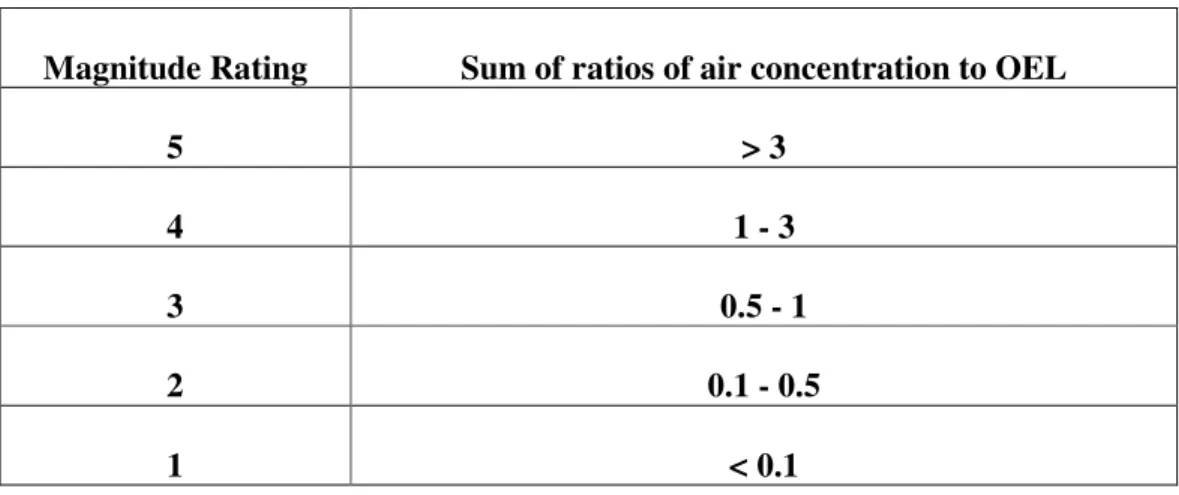
Which means that the combined exposure is above the OEL. From Table 6 below, the Magnitude Rating assigned for exposure to the MEK and toluene exposure is 4. Table 6: Magnitude of Exposure rating for additive effects
Magnitude Rating Sum of ratios of air concentration to OEL
5 > 3
4 1 - 3
3 0.5 - 1
2 0.1 - 0.5
1 < 0.1
Examples on how to use the exposure measurement results to determine the magnitude of exposure are given in Appendix 10.
If a chemical hazardous to health do not have an OEL, then the qualitative assessment method for estimating exposure should be used.
8.5.2. Qualitative Estimation Of Magnitude Of Exposure
The estimation of exposure is made for the two main routes of entry, i.e. the inhalation route and dermal route of exposure. If the contribution to the overall exposure by ingestion is significant, record the finding and suggest appropriate actions to be taken. The flowchart to determine exposure is given in Appendix 17. The magnitude of exposure is assessed based on the estimated absorbed dose through inhalation and skin absorption. It must be borne in mind that skin or eye absorption is not only from direct contact with liquid substances but also from airborne gas, vapour or particulate. Where this is the case, the airborne chemical concentration may be considered when assessing the degree of skin or eye exposure.
For this estimation we can look at the degree of chemical release or presence and the degree of chemical absorbed or likely to be absorbed at the exposure boundary. As a rule of thumb, twice the volumes of material released will double the concentration.
CHRA MANUAL 2nd EDITION
8.5.2.1. Degree Of Chemical Release Or Presence
The degree of chemical release or presence in the environment can be estimated from the chemical's physicochemical properties, the process characteristics, the quantity used, the method of handling, and the atmospheric conditions. This information may be obtained from the Chemical Safety Data Sheet, process descriptions, and from observation of environmental conditions. Refer to Appendix 11 and 12.
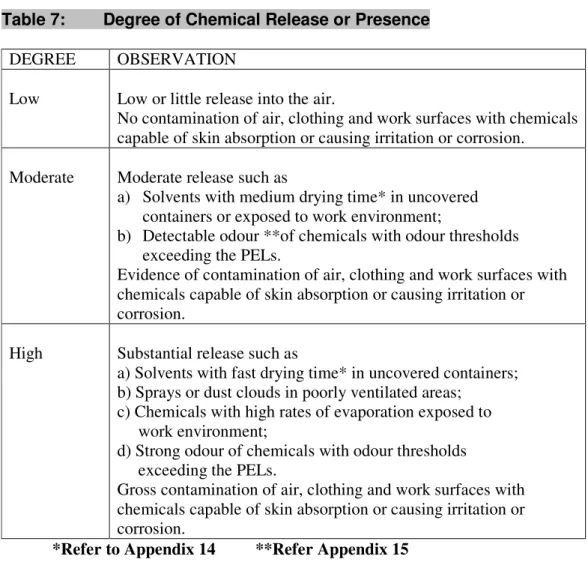
Use Table 7 to determine the degree of release or presence for inhalation exposure. The degree of release assigned will be based on the observation resulting in the greatest degree of release.
For example a worker frequently contaminated his clothing while using Chemical B, a non-volatile liquid (i.e. low release into the air) but is lipophilic (high ability to dissolve fat and hence able to be absorbed through the skin). The degree of release is assigned is Moderate.
Table 7: Degree of Chemical Release or Presence
DEGREE OBSERVATION
Low Low or little release into the air.
No contamination of air, clothing and work surfaces with chemicals capable of skin absorption or causing irritation or corrosion.
Moderate Moderate release such as
a) Solvents with medium drying time* in uncovered containers or exposed to work environment;
b) Detectable odour **of chemicals with odour thresholds exceeding the PELs.
Evidence of contamination of air, clothing and work surfaces with chemicals capable of skin absorption or causing irritation or corrosion.
High Substantial release such as
a) Solvents with fast drying time* in uncovered containers; b) Sprays or dust clouds in poorly ventilated areas;
c) Chemicals with high rates of evaporation exposed to work environment;
d) Strong odour of chemicals with odour thresholds exceeding the PELs.
Gross contamination of air, clothing and work surfaces with chemicals capable of skin absorption or causing irritation or corrosion.
CHRA MANUAL 2nd EDITION
8.5.2.2. Degree Of Chemical Absorbed Or Contacted
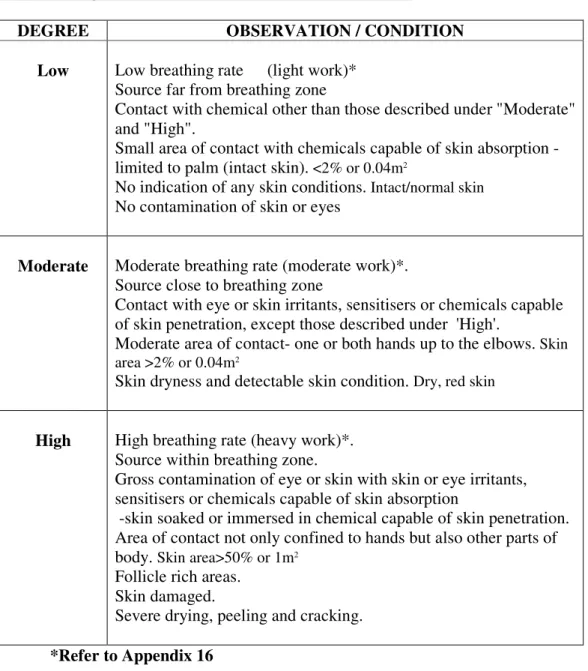
Use Table 8 below to assess the degree of chemicals being inhaled and absorbed through skin. Chemical substances with the ability to be absorbed through the skin include organic solvents and many pesticides. The degree of chemical absorbed or contacted should be based on the observation resulting in the greatest degree.
Table 8: Degree of Chemical absorbed or contacted
DEGREE OBSERVATION / CONDITION
Low Low breathing rate (light work)* Source far from breathing zone
Contact with chemical other than those described under "Moderate" and "High".
Small area of contact with chemicals capable of skin absorption -limited to palm (intact skin). <2% or 0.04m2
No indication of any skin conditions. Intact/normal skin
No contamination of skin or eyes
Moderate Moderate breathing rate (moderate work)*. Source close to breathing zone
Contact with eye or skin irritants, sensitisers or chemicals capable of skin penetration, except those described under 'High'.
Moderate area of contact- one or both hands up to the elbows. Skin area >2% or 0.04m2
Skin dryness and detectable skin condition. Dry, red skin
High High breathing rate (heavy work)*. Source within breathing zone.
Gross contamination of eye or skin with skin or eye irritants, sensitisers or chemicals capable of skin absorption
-skin soaked or immersed in chemical capable of skin penetration. Area of contact not only confined to hands but also other parts of body. Skin area>50% or 1m2
Follicle rich areas. Skin damaged.
Severe drying, peeling and cracking. *Refer to Appendix 16
CHRA MANUAL 2nd EDITION
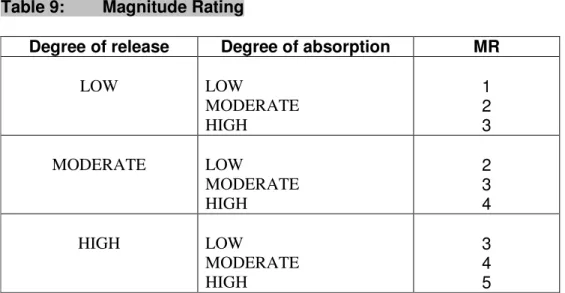
8.5.2.3. Assigning Magnitude Rating (MR) This table is to be used to assign the magnitude rating: Table 9: Magnitude Rating
Degree of release Degree of absorption MR
LOW LOW
MODERATE HIGH
1 2 3
MODERATE LOW
MODERATE HIGH
2 3 4
HIGH LOW
MODERATE HIGH
3 4 5
The magnitude (MR) above may however be modified by other factors such as bad work habits, poor personal hygiene, complaints of ill effects, results of biological monitoring or biological effect monitoring, signs and symptoms of related disease or illness or confirmed cases of occupational disease or illness. Use Table 10 below to modify the magnitude rating before assigning the exposure rating.
Table 10: Modifying Factors MR
adjustment
factor MODIFYING FACTORS
+ 1 (maximum
MR not to exceed 5)
Bad work practice or poor personal hygiene including partaking of food or drink in the work area or using contaminated hand. Reported cases of chemical exposure incidences- e.g. splashes Results of biological monitoring exceeds the Biological Exposure Index (such as those described by the ACGIH)
Widespread complaints of ill effects related to the chemical being exposed, in the work unit.
Reported cases of employees with pre-clinical symptoms related to the chemical exposure.
CHRA MANUAL 2nd EDITION
8.6. Assigned Exposure Rating
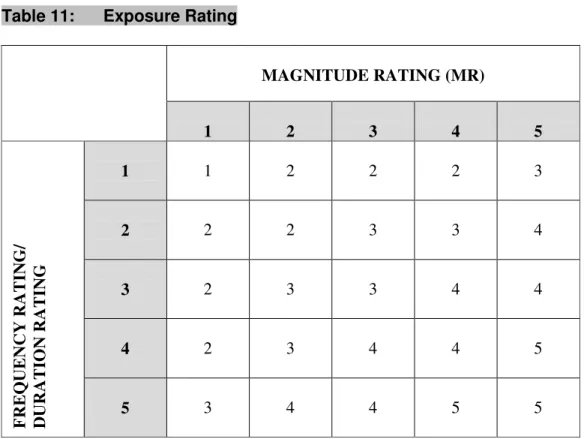
Based on the frequency or duration rating and the magnitude rating, an exposure rating may be assigned. Use Table 11 below to assign the exposure rating:
Table 11: Exposure Rating
MAGNITUDE RATING (MR)
1 2 3 4 5
1 1 2 2 2 3
2 2 2 3 3 4
3 2 3 3 4 4
4 2 3 4 4 5
FR
E
Q
U
E
N
C
Y
R
A
T
IN
G
/
D
U
R
A
T
IO
N
R
A
T
IN
G
5 3 4 4 5 5
Note: Assign ER=5 if confirmed case(s) of occupational disease due to exposure to the chemical hazardous to health have been reported for the particular work unit.
CHRA MANUAL 2nd EDITION
Chapter 9
Control measures are all the steps taken to prevent or minimise risks. They include elimination of the hazardous chemical; substitution of the chemicals hazardous to health with a less hazardous chemical; isolation of the process releasing hazardous chemical; the use of engineering control equipment; adoption of safe work practices and procedures; and the use of personal protection. Control equipment is equipment used for controlling risks, such as a local exhaust ventilation system, water spray or enclosure. In trying to control the identified risks, the measures taken should be in a certain hierarchy or order of priority and an assessment of the adequacy of the control measures need to be made.
9.1. Hierarchy of Control Measures
Significant risk arising from the use of chemical hazardous to health is to be controlled, in this following order: -
a) Elimination of chemical hazardous to health from the workplace;
b) Substitution of chemical hazardous to health with a less hazardous chemical; c) Total enclosure of process and handling systems;
d) Isolation of the work to control the emission of chemicals hazardous to health; e) Modification of the process parameters;
f) Application of engineering control equipment;
g) Adoption of safe work systems and practices that eliminate or minimise the risk to health; and
h) Provision of approved personal protective equipment. a) Elimination of chemicals hazardous to health
This includes the total removal of a hazardous chemical by the use of other processes not involving chemicals hazardous to health.
CHRA MANUAL 2nd EDITION
b) Substitution
The substitution here is the substitution of a chemical hazardous to health with a less hazardous substitute such as the use of a water-based detergent instead of the neurotoxic n-hexane.
c) Total enclosure of process and handling systems
Totally enclosing the process and handling systems emitting chemical hazardous to health can prevent or minimise their release into the work environment.
d) Isolation of the work to control the emission of chemicals hazardous to health
This can be achieved by segregation, either by distance or a physical barrier, of the hazardous work, process or chemical hazardous to health from workers. e) Modification of the process parameters
Such as the use of lower operating temperature or pressure to minimise the release of chemical hazardous to health into the workplace environment. f) Application of engineering control equipment
This is control through the application of engineering control equipment such as local exhaust system, general ventilation, and water spray.
g) Adoption of safe work systems and procedures
Safe work system and procedures that eliminate or minimises the risk to health can be adopted.
h) Provision of personal protective equipment
Provision of personal protective equipment and clothing includes the proper selection, correct fit, proper use, care and maintenance, and available replacement when required.
9.2. Other Control Measures
Other measures although do not directly remove or minimise the risk, are equally important as they support or strengthen the above control measures and are part of a chemical health risk management.
CHRA MANUAL 2nd EDITION
Such measures include: - a) Personal hygiene;
Washing hands before partaking of food by hand Keeping fingernails short and clean
Bathing, where contamination is widespread b) Maintenance of the control equipment;
Regular inspection, examination and testing Immediate repair on breakdown of equipment c) Providing information, instruction and training to workers;
Those handling or exposed to chemicals hazardous to health Safe use and handling of chemicals
Proper use and care of personal protective equipment d) Monitoring of personal exposures and general air levels
Personal exposures on those work units where an assessment indicates the necessity to determine personal exposure; and the availability of an approved method of sampling and analysis and an OEL
General air levels, where appropriate, to check on the effectiveness of control measures;
e) Health surveillance on those workers handling any chemicals hazardous to health listed in schedule 2 of the USECHH Regulations 2000 and where an assessment shows that:
There is an identifiable work-related disease or adverse health effects for that hazardous chemical used in the work;
It is likely that the disease or condition might occur during the conduct of the work; and
Valid techniques are available to detect early signs of the disease or condition.
f) Emergency procedures and first aid.
To minimise the consequences of chemical accidents Availability of emergency response plan or procedures Emergency eye wash and shower
First aid facilities 9.3. Adequacy of Control Measures
The existing control measures need to be assessed whether they are adequate or not. Taking into consideration the following factors we can assess whether the control measures are adequate or not: -
CHRA MANUAL 2nd EDITION
a) Suitability; b) Use
c) Effectiveness; and d) Maintenance.
A control measure is considered adequate if
a) It is suitable for protecting the employees, taking into consideration the physical form and toxicity of the chemical, the nature of work, the routes of entry of the chemical and not prejudice to the health of the employees;
b) It is used according to the manufacturers’ instructions & recommendations; c) It is effective in preventing or minimising exposure; and
d) It is regularly maintained in good working condition. 9.3.1. Suitability
Suitability of control measures depends on: i) The toxicity of chemical
For high toxicity chemicals the use of local exhaust ventilation is suitable while the use of general ventilation is not.
The use of job rotation is not suitable for chemical hazard
For personal protective equipment, the degree of protection must match the level of risk.
ii) The physical and chemical properties of the chemical
The control equipment is designed to control the chemical in the physical form employees is exposed to.
E.g. use of dust mask is not suitable to protect against organic solvent vapour.
iii) Nature of work
Suitable if the nature of work does not hinder the efficiency of the control measure or the control measure does not give rise to the potential for an accident or to another hazard.
iv) Adaptability
Suitable if control measures are adapted to the work capacity and capability of the workers involved.
v) Route of entry
Control measures selected prevent entry of the chemical through the probable entry route.