21
RESEARCH ON THE GROWTH AND MATURATION OF SEEDLINGS
OLDER THAN 3 YEARS IN THE NATURAL HUNGARIAN AND TURKEY
OAK REGENERATION AREAS IN THE WESTERN PART
OF THE GETIC PLATEAU
BERCEA IULIAN1, COJOACĂ FLORIN2
1 Faculty of Agriculture and Horticulture, University of Craiova, [email protected]
2 ICAS, Research Centre of Craiova, f_cojoacă@yahoo.com
Key words: Hungarian oak, Turkey oak, growth, seedlings, regeneration
ABSTRACT
The research findings indicated the influence of size, position on the axes and zoning on the growth and maturation of Hungarian and Turkey oak seedlings older than 3 years in natural regeneration areas.
The main research outputs run as follows:
- the growth and maturation of Hungarian and Turkey oak seedlings older than 3 years is directly influenced by the size of the group cuts and by the interaction between the group cut size and position on the group cut axis;
- the size, height and diameter of the seedlings depend heavily on the size of the group cuts.
INTRODUCTION
The Hungarian and Turkey oak are among the forest tress deeply affected by the climatic changes of the last decades. The Hungarian and Turkey withering during 1988-1994 characterises all the young tree species irrespective of age (Badea, 2008). The exteme climatic conditions (temperature and rainfall) that affected the natural regeneration process may be softened and remedied through research-driven regeneration methods and techniques in relation to the optimisation of the size, shape and zoning of the group cuts. (Bercea, 2008). The natural regeneration of the two species is a topical issue due to the fact that the Hungarian and Turkey oak are the only basic species to take advantage of the hard compact clay soils in the western part of the Getic Plateau. Furthermore, there are few research papers on this topic. Our research aims to determine how the group cut size, zoning, the position on the group cut axes and their interation influence the natural regeneration of the Hungarian and Turkey oak older than 3 years, with a view to establish the size, shape and orientation of thre group cuts. It underpins the identification of the optimal conditions for the growth of the seedlings to replace the seed trees.
MATERIALS AND RESEARCH METHOD
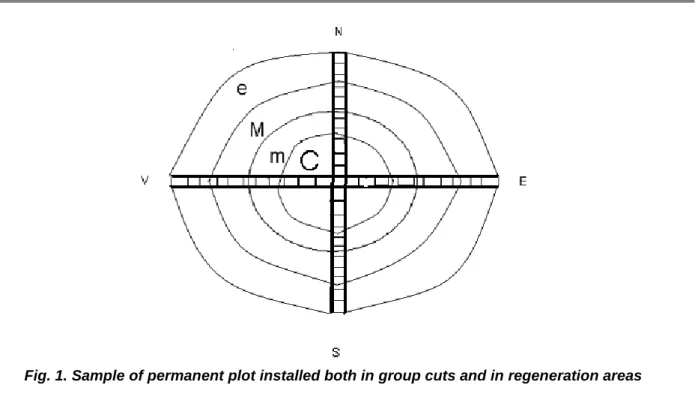
The sample area covers the western part of the Getic Plateau in the hydrographic basin of the Jiu river. The growth and maturation of the Hungarian and Turkey oak seedlings older than 3 years in group cuts of different sizes and their differentiation within the group cuts oriented to north-south and east-west, in the central part (C), at the midpoints (m), peripheral (P) outer (o) parts of the two axes (Fig. 1), was examined in
highly similar sample areas – woodlands. The height, diameter and density of the
seedlings were determined.
22
Fig. 1. Sample of permanent plot installed both in group cuts and in regeneration areas
RESEARCH FINDINGS
The maturation of Hungarian and Turkey oak seedlings older than 3 years is directly
influenced by the size of the group cut (p = .000000***) and by the interaction between the
group cut sized and position on the axis ((p =.049887*). The influence of the group cut on
the seedling height in 2006, on the seedling diameter, on the increase of height and diameter during 2004–2006, as well as on the density of seedlings points to "extremely important” (***). In the light of the arguments above, the interaction of the group cut size and axes reads "important" (*).
The maturation of Hungarian and Turkey oak seedlings older than 3 years is less influenced by zoning, by the interaction between group cuts axes and position on the axes, the results of the analysis of variance being unimportant (Table 1).
Overall result of the analysis of triple variance on the characteristic traitsof
Hungarian and Turkey oak seedlings older than 3 years
Table 1
Independent variables Degrees
of freedom
Degree of importance
(p)
df1 df 2
1 2 3 4
1 – group cut size 20 518 .000000***
2 – group cut axis 15 431 .325075
3 – position on the axis 15 431 .424886
1x2 – interaction between group cut size and axis 60 734 .049887*
1x3 – interaction between group cut size and position on the axis
60 734 .362120
2x3 - interaction between axis and position on the axis 45 700 .894090
1x2x3 – interaction between group cut size, axis and position on the axis
23
Result of the analysis of triple variance on the charactersitic traitsof Hungarian and
Turkey oak seedlings older than 3 years in regeneration group cuts
Table 2 Independent
variables
Degree of importance (p) of dependent variables: *** - extremely important, ** - highly important, * - important, - unimportant
Seedling initial height (H 2006)
Height increase 2006 (IH 2006)
Initial diameter (D 2006
Aggregate diameter increase (ID 2006)
Seedling density (no./mp)
1 2 3 4 5 6
1– group cut diameter (GROUPCUTDIAM)
.000000*** .000000*** .000000*** .000000*** .615474
2 – group cut axis (GROUPCUTAXIS)
.023098* .546945 .017777* .042404* .150007
3 position on axes (POSAXIS)
.184045 .016696* .392979 .409054 .647034
Interaction 1x2 .691583 .714316 .763988 .772539 .379721
Interaction 1x3 .021441 .011619 .073512 .536997 .415395
Interaction 2x3 .876001 .978663 .703948 .350902 .909774
Interaction 1x2x3 .999913 .999900 .914854 .409381 .869582
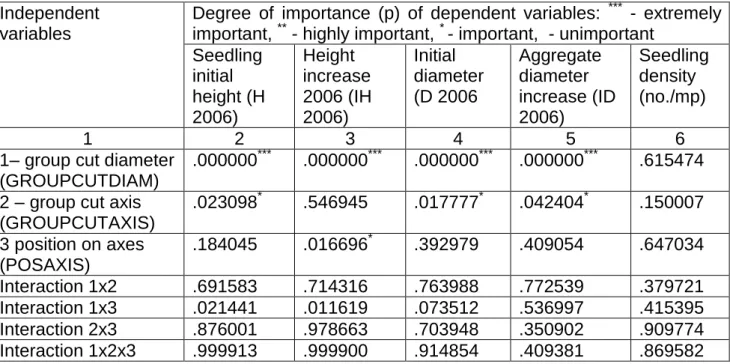
Table 2 shows that:
- the size of seedlings and the height and diameter increase are strongly influenced by the group cut size, the degree of importance (p) deriving from the analysis of variance "extremely important” (***).
- the height, diameter and diameter increase of seedlings are influenced by the group cut axes, the degree of importance (p) being "important" (.023098* .017777* .042404*).
- the position of seedlings on the axes (zoning) directly influences the height increase, the degree of importance (p) being "important" (.016696*).
- the interaction between the group cut size and zoning directly influences the height, diameter and height increase of the Hungarian and Turkey oak seedlings, the degree of importance (p) being "important" (.021441 .011619 .073512).
- the other interaction types are unimportant.
Size of Hungarian and Turkey oak seedlings older than 3 years according to
the size of the group cuts
The height and height increase of Hungarian and Turkey oak seedlings older than 3 years is directly influenced by the group cut size.
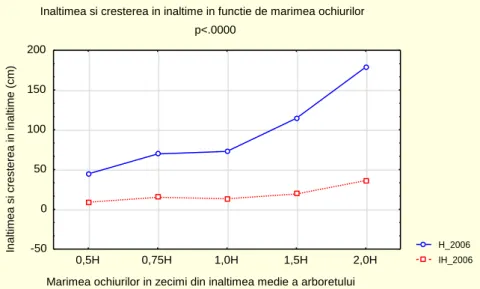
The height of the seedlings older than 3 years (H 2006) shows the highest values in large-sized group cuts, starting from group cuts of 1.0 H up to group cuts of 2.0 H (Fig. 2). In group cuts of 0.5 H and 0.75 H, we encounter the same height. The height increase of Hungarian and Turkey oak seedlings older than 3 years (Fig. 63) is insignificant in group cuts of 0.5 H – 1.0 H, and higher starting from group cuts of 1.5 H, wehereas the highest value belongs to group cuts of 2.0 H.
24
The height and diameter increase of Hungarian and Turkey oak seedlings older than 3 years depends on the group cut size, the degree of importance (p), deriving from the analysis of variance, being "extremely important", thus, infering that this influence is very likely to happen (99.999999 %).
In the large-sized group cuts, the seedlings reach considerable height and pass from individual growth to gregarious existence, when the height increase is higher than the diameter increase if we keep the proportions.
Fig.2. Height and height increase of seedlings older than 3 years according to group cut size
Fig. 3. Diameter and diameter increase of seedlings older than 3 years according to group cut size
Size of Hungarian and Turkey oak seedlings older than 3 years according to
the group cut axis
Hungarian and Turkey oak seedlings older than 3 years showed significant values of the static parameters with respect to the seedlings height, diameter and diameter increase (Table 2).
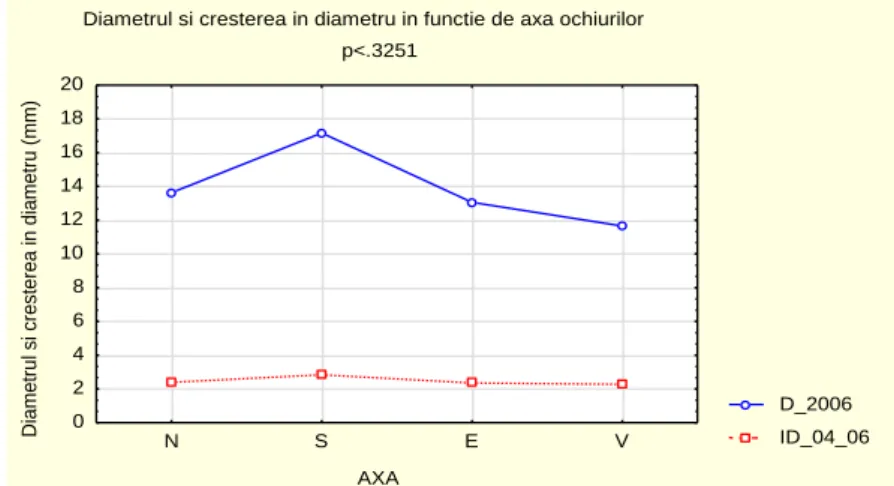
The highest values of height and diameter are recorded on the axis centre - south (S), followed the axis centre - north (N) and centre - east (E), whereas the lowest values are on the axis centre – west (V) – See fig. 4, 5.
D_2006 ID_04_06
Diametrul si cresterea in diametru in functie de marimea ochiurilor p<.0000
Marimea ochiurilor in zecimi din inaltimea medie a arboretului
Di
am
et
rul
si
cr
est
er
ea
in
dia
m
et
ru
(m
m
)
-5 0 5 10 15 20 25 30
0,5H 0,75H 1,0H 1,5H 2,0H
H_2006 IH_2006
Inaltimea si cresterea in inaltime in functie de marimea ochiurilor p<.0000
Marimea ochiurilor in zecimi din inaltimea medie a arboretului
Inalt
im
ea
si
c
res
ter
ea
in
inalt
im
e
(c
m)
-50 0 50 100 150 200
25
Fig. 4 Height and height increase of seedlings older than 3 years according to the group cuts axis (N, S, E, W)
Fig. 5. Diameter and diameter increase of seedlings older than 3 years according to the group cut axis (N, S, E, W)
The height and diameter increase is almost levelled down and steady on all directions, showing a rising tendency on the axis centre - south, while falling on the axis centre - east (E) – see Fig. 4, 5.
The degree of importance deriving from the analysis of variance (Table 2) is "important" (*).
Size of Hungarian and Turkey oak seedlings older than 3 years according to
zoning
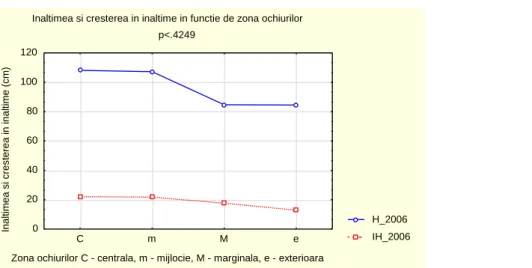
The influence of zoning is extremely important with respect to height increase in the case of Hungarian and Turkey oak seedlings older than 3 years (Table 2, Fig. 6).
In the central part (C) and at the midpoint (m) of the group cuts, seedlings older than 3 years show the highest values in point of height.
H_2006 IH_2006 Inaltimea si cresterea in inaltime in functie de axa ochiurilor
p<.3251
AXA
Inalt
im
ea
si
c
res
ter
ea
in
inalt
im
e
(c
m)
0 20 40 60 80 100 120 140
N S E V
D_2006
ID_04_06 Diametrul si cresterea in diametru in functie de axa ochiurilor
p<.3251
AXA
Di
amet
rul
si
cr
es
ter
ea
in
diamet
ru
(mm)
0 2 4 6 8 10 12 14 16 18 20
26
Fig. 6. Height and height increase of seedlings older than 3 years according to zoning
Size of Hungarian and Turkey oak seedlings older than 3 years according to
the interaction between group cut size and zoning
The interaction between group cut size and zoning impacts on the height, height increase and diameter of seedlings (Table 2).
The height of seedlings older than 3 years depends on the interaction between the group cut size and position on the axes. In the central part of the group cut, height is higher in large-sized group cuts, being on the rise from group cuts of 0.5 H to group cuts of 2.0 H. At the midpoint (m) and at the periphery (P), there is a rising tendency from small-sized group cuts to large-small-sized ones, whereas in the outer circle (o), height has a constant value, irrespective of the size of the group cuts.
Fig. 7. Height and height increase of seedlings older than 3 years according to the interaction between the group cut size and zoning C- central, m - midpoint, P – periphery, o – outer circle
There is height increase from the small-sized group cuts to the large-sized ones, but it does not follow a rising curve of height, tending to become flat.
The diameter of seedlings older than 3 years is influenced by the interaction between the group cut size and position on the axes (zoning). Accordingly, larger diameter is recorded in group cuts of 2.0 H and of 1.5 H in the central parts (C), at the midpoints (m) and at the periphery (P).
The influence of the interaction betwen the group cut size and position on the axes (zoning) with reference to Hungarian and Turkey oak seedlings older than 3 years does not impact on the seedling diameter and diameter increase. The vast majority of seedlings
H_2006 IH_2006 Inaltimea si cresterea in inaltime in functie de zona ochiurilor
p<.4249
Zona ochiurilor C - centrala, m - mijlocie, M - marginala, e - exterioara
Inal tim ea si c res ter ea in inal tim e (c m ) 0 20 40 60 80 100 120
C m M e
H_2006
IH_2006
Inaltimea si cr. in h. functie de interactiunea dintre marimea si zona ochiurilor (cm) p<.3621
27
older than 3 years pass to gregarious existence, and height increase becomes crucial due to competion during this maturation stage.
Densityof Hungarian and Turkey oak seedlings older than 3 years
If in the first 3 years of existence, the density of seedlings is determined by the group cut size and zoning, in the coming years density is relatively constant, depending solely on the mutual interaction of the seedlings now in the gregarious stage. Before 3 years old the elimination of seedlings occurs due to the negative effect of ecological factors, later on their elimination being caused by the struggle for water, light and warmth.
CONCLUSIONS
The growth and maturation of Hungarian and Turkey oak seedlings older than 3 years is directly influenced by the group cut size and by the interaction between the group cut size and zoning. The influence of the group cut size on the seedling height, diameter, height increase and diameter increase as well as on the seedlings density is extremely important. The interaction between the group cut size and axes is important.
The growth and maturation of Hungarian and Turkey oak seedlings older than 3 years is little influenced by zoning, by the interaction between the group cut size and zoning, between group cut axes and zoning or by the interaction between group cut size, axis and zoning, due to the changes of the characteritic traits of the seedlings. Hungarian and Turkey oak seedlings older than 3 years become firmly rooted and pass to the collective existence at a fast pace, which means another type of rule-governed behaviour as compared to the first 3 years of existence. The group cut size and the interaction between group cut size and axes are independent variables which will continue to influence the size and growth of seedlings until the complete removal of seed trees.
The evolution of characteristic traits according to the group cut size, axes and zoning clearly indicate that progressive clearcut is more effective in the natural regeneration of the Hungarian and Turkey oak. The optimal size of group cuts is based on the compromise between higher values of seedling size and growth in the first years of existence, on the one hand, and the necessary density to stop regeneration as soon as possible, on the other hand.
The optimal size to secure the balance between the size and growth of the seedlings, on the one hand, and their density, on the other hand, ranges from 0.75 to 1.0 of the average height of the seed trees (H) in the case of the Hungarian oak, and from 1.0 to 1.5 of the average height of the seed trees (H) in the case of the Turkey oak. The group cuts will widen to the south and west.
BIBLIOGRAPHY
Badea, O., 2008. Manual privind metodologia de supraveghere pe termen lung a stării
ecosistemelor forestiere aflate sub acţiunea poluării atmosferice şi modificărilor climatice
(Handbook of the methodology of long-term monitoring of forest ecosystems under the
influence of air pollution and climatic changes). Bucharest: Editura Tehnică Silvică.
Bercea, I., 2007. Cercetări privind regenerarea arboretelor de gârniţă şi cer din partea
vestică a Podişului Getic. (Research on the regeneration of Hungarian and Turkey oak
seed trees in the western part of the Getic Plateau). Doctoral Thesis. University
,,Transilvania"of Braşov.
Bercea, I., 2008. Silvobiologia (Silvobiology). Craiova:Editura Sitech.
Bercea, I., 2008. Hungarian oak and Turkey oak fructification in the Western part of the
Getic Plateau. ICAS Bucharest, Sustainable forestry in a changing environment,