R E V I E W A R T I C L E
Save cells before tooth replantation: A review
P. Poornima, Shilpa Kotari, Shilpa S. Sasalawad, N. B. Nagaveni, N. M. Roshan, V. V. Subba Reddy
1Department of Pedodontics and Preventive Dentistry, College of Dental Sciences, Davangere, Karnataka, IndiaAbstract
Avulsion is one of the most complex traumatic injury a
ff
ecting both teeth and children.
Avulsed teeth can be replanted. Treatment for avulsed teeth should include, pulp and
periodontal ligament (PDL) cell management to increase the survival rate of these teeth.
If immediate replantation is not possible, the clonicity and progenicity of the viable PDL
cells can be maintained with the aid of suitable storage medium at the place of trauma.
The incorrect use of a storage medium leads to PDL cell necrosis eventually resulting in
ankylosis and replacement resorption of the tooth root. Due to the importance of the
storage media in long-term prognosis of the avulsed teeth, an informed choice of a media
is essential for a favorable outcome. This review discusses available storage media and
their unique features along with pros and cons of each medium.
Keywords: Avulsion, replantation, storage media
Correspondence
Dr. P. Poornima, Department of Pedodontics and Preventive Dentistry, College of Dental Sciences, Davangere, Karnataka, India. Email: [email protected]
Received 23 January 2015; Accepted 02 March 2015
doi: 10.15713/ins.ijcdmr.61
How to cite the article:
P. Poornima, Shilpa Kotari, Shilpa S. Sasalawad, N. B. Nagaveni, N. M. Roshan, V. V. Subba Reddy, “Save cells before tooth replantation: A review,” Int J Contemp Dent Med Rev, vol. 2015, Article ID: 260115, 2015. doi: 10.15713/ins.ijcdmr.61
Introduction
According to WHO classifi
cation, avulsion or ex-articulation is
complete displacement of the tooth from its alveolar socket.
[1,2]Avulsion of permanent teeth accounts for 0.5-3% of all dental
injuries. Andreasen and Andreasen stated that, the incidence
of these traumatic injuries in future may eventually surpass
the incidence of dental caries. Various studies have reported,
trauma as one of the most serious dental injuries and the
prognosis is very much dependent on the treatment given at
the place of accident and after the avulsion. The immediate
replantation of teeth is the ideal treatment of choice for the
avulsed teeth to prevent post replantation complications
such as infl
ammatory resorption, ankylosis or replacement
resorption. If immediate replantation is not possible, the
clonicity and progenicity of the viable periodontal ligament
(PDL) cells can be maintained with the aid of suitable storage
medium at the place of trauma. The lack of fi
rst aid knowledge
about the avulsion among the public and health care centers
delays immediate replantation and limits the prognosis of the
avulsed tooth. Various storage media are available maintain
the progenicity and clonicity of PDL cells to improve the
outcome of the replantation. The purpose of this article is to,
review the current storage media with their pros and cons and
to provide an insight about the e
ffi
cacy of newer storage media
available.
Historical Perspective
Cvek
et al
.
[3]stated that saline as a storage medium for avulsed
teeth helps to improve the outcome of replanted teeth.
Lindskog
et al
.
[4]reported that the key success of avulsed teeth
was dependent on viable PDL cells on the root of avulsed
teeth. Andreasen
[5]also mentioned that crushing injuries on
root could cause death of the cells and lead to resorption and
reduction in prognosis. Blomlof,
[6]reported a medical research
fl
uid called Hank’s Balanced Salt Solution (HBSS) as the best
storage medium, which maintained the PDL cells viability
for 2 h. Matsson
et al
.
[7]suggested soaking of avulsed teeth
in Hank’s balanced solution for 30 min prior to replantation,
which could revitalize extracted dog’s teeth, which were dry for
60 min. Blomlof
[8]recommended milk as a storage media prior
to reimplantation when immediate replantation is not possible.
Krasner
et al
.
[9]reported that the systematic storage device “Save
A Tooth” was designed to store and preserve the avulsed teeth.
Layug
et al
.
[10]quoted that milk packed in ice seems to be the best
alternative, due to its wide availability and minimum detrimental
e
ff
ect. Marino
et al
.
[11]showed that long shelf life milk is more
e
ff
ective than Save A Tooth. Pearson
et al
.
[12]mentioned that
baby milk formula (Enfamil) is more e
ff
ective storage media
than pasteurised milk for at least 4 h. Al-Shaher
et al
.
[13]reported
a storage medium for avulsed tooth when no medium is present
at accidental site. Khademi
et al
.
[15]introduced egg albumin as
a storage medium for up to 10 h. Gopikrishna
et al
.
[16]studied
coconut water and suggested it as potential storage medium
due to its readily available, acceptable by the body and sterile in
nature. Hwang
et al
.
[17]invented green tea extract as a suitable,
alternative storage media for avulsed teeth. Similarly, there are
many storage media available for the success of replanted tooth
[Table 1].
Factors Considered for Storage Media
The prognosis of the tooth re-implantation depends on the
existence of viable cells in the PDL and also on undamaged cells
on the root surface, which can proliferate.
[17,18]Therefore, either
immediate replantation or storage of the tooth should be done in
an appropriate storage media.
Two important factors considered for the storage medium
are hydrogen ionic potential/pH and osmolality. According
to Marino
et al
., the pH and the osmolality of the storing
environments must be physiologic, for both interfere in the
surviving of cells of the PDL. Each storage media has di
ff
erent
pH and osmolality based on which the survival of PDL cells
is assessed. Authors have reported that the cellular growth
may occur between 290 and 330 mosm/kg. The pH must be
between 7.2 and 7.4, but growth may occur between pH 6.6
and 7.8.
[19]Ideal Requirements of Storage Media
An ideal storage media should have the osmolality and pH
closer to physiological conditions to maintain the viability,
clonogenic capacity and mitogenicity of the PDL cells.
It should be readily available at the site of accident
[1]and
hence that, the tooth can be immediately placed into it, should
have a longer shelf life,
[20]should have anti-infl
ammatory and
anti-microbial properties, which reduces infl
ammation and
replacement resorption.
[21,22]It should also have an antioxidant
property which will protect the cells from oxygen
radical-mediated damage.
[23]Finally last but not the least the storage
media should be economical. Not a single storage media fulfi
ll
all the ideal requirements, so various comparable studies been
conducted to evaluate the e
ffi
ciency in maintaining the cell
viability of PDL cells of replanted teeth.
Container for the transport of avulsed teeth along with the
medium must be unbreakable, non-toxic to the cells of PDL,
should be leaking proof, easy handling, should be sterile as well
the internal walls must be made of soft material.
[24]Some of
the commercially available are “tooth rescue box” (dentosafe)
containing a culture medium, salts, amino acids, glucose
and vitamins
[25]and “Save A Tooth” system, a 6-part system
containing HBSS media, developed to preserve PDL cells of
an avulsed teeth.
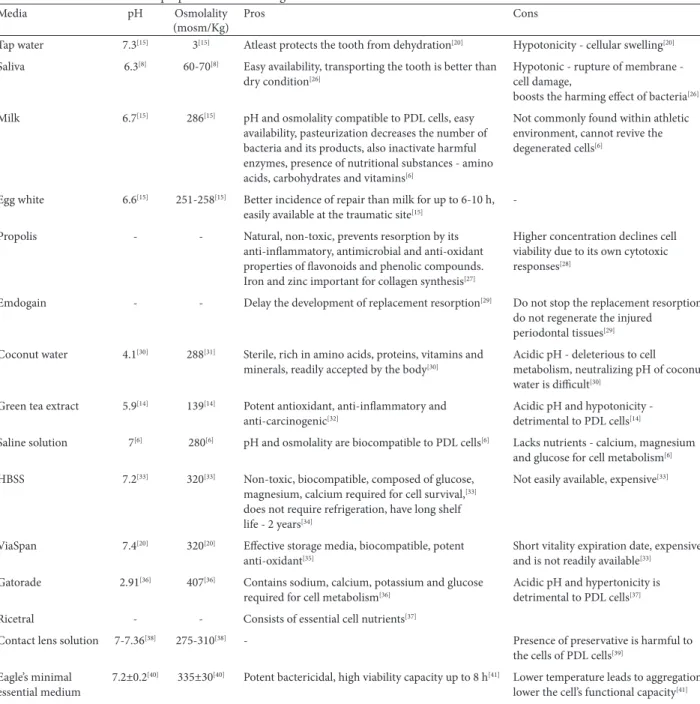
[24]The pH,osmolality and properties of each
storage media has been elaborated in [Table 2].
Wide range of research has been conducted to study the
e
ffi
cacy of available and newer storage media. [Table 3],
describes comparative studies carried out on various storage
media.
Research on newer storage media
a. Ascorbic acid: Ascorbic acid stimulates osteoblasts to
lay down Type I collagen and also helps in expression of
specifi
c markers associated with osteoblastic phenotypes
such as alkaline phosphates (ALP) and osteocalcin.
Ishikawa
et al
.
[60]studied the e
ff
ect of ascorbic acid on
PDL cells and stated that ascorbic acid increased the ALP
activity, which is required for binding of PDL cells to
Type 1 collagen via
α
2
β
1 integrin whose expression is again
increased by ascorbic acid, so it may serve as potential
storage media
b. L-DOPA (Levodopa; Sigma chemical, Perth, WA,
Australia): Is drug with possible mitogenic e
ff
ect. It
stimulates the secretion of growth hormone from the
pituitary gland which aids in the healing process. Partovi
et al
.
[61]observed the e
ff
ect of levodopa on human PDL
fi
broblasts and stated that it can also have a local e
ff
ect
on growth of cells and can act as preserving medium for
avulsed teeth
c. Cryoprotective agents: The e
ff
ect of low-temperature
storage on clinical success of reimplantation has been
studied. Schwart and Andreasen
[62]studied the e
ff
ects of the
cryopreserving agents, 5% and 10% dimethyl sulfoxide and
10% glycerol on PDL. They observed that use of di
ff
erent
cryoprotectives, combined with controlled freezing rates can
preserve the PDL of reimplanted teeth.
Conclusion
The success of dental reimplantation depends on the existence
of viable cells on the PDL, which are able to proliferate on the
denuded areas of the root surface. This can be reached through
immediate reimplantations taking place within up to 30 min or
Table 1: Classifi cation of storage mediaNatural Synthetic
Tap water Saline solution
Saliva HBSS
Milk Gatorade
Egg white Ricetral
Emdogain ViaSpan
Propolis Contact lens solution
Coconut water Eagle’s minimal essential medium
Green tea extract Culture medium
Morusrubra fruit Probiotic solution
Saliva offi cinalis extract Custodial
transporting the tooth in an adequate storage medium for dental
reimplantation.
Tap water, saliva and saline must be avoided for the storage
of avulsed teeth because they do not o
ff
er any benefi
t to the
healing. Contact lens solutions and emdogain also do not o
ff
er
any good results over other media. Propolis and egg white needs
additional studies where the propolis is not easily available in
emergency situations whereas egg white is a promising media
considering its availability. Milk is signifi
cantly better than
other storage media, but it is not so e
ffi
cient as HBSS, ViaSpan
and eagle’s medium as storage medium for avulsed teeth for
the maintenance of vitality and proliferative capacities of PDL
cells. Although HBSS, ViaSpan and Eagle’s medium are ideal
choice for storage of avulsed teeth, but due to lack of ready
availability to public, as well the cost makes them less than
ideal for developing countries like India. Milk is cheapest,
convenient and most readily accessible storage solution in all
the circumstances, and has the potential to maintain the vitality
of PDL cells.
Table 2: Th e characteristics and properties of each storage media available
Media pH Osmolality
(mosm/Kg)
Pros Cons
Tap water 7.3[15] 3[15] Atleast protects the tooth from dehydration[20] Hypotonicity - cellular swelling[20]
Saliva 6.3[8] 60-70[8] Easy availability, transporting the tooth is better than
dry condition[26]
Hypotonic - rupture of membrane -cell damage,
boosts the harming eff ect of bacteria[26]
Milk 6.7[15] 286[15] pH and osmolality compatible to PDL cells, easy
availability, pasteurization decreases the number of bacteria and its products, also inactivate harmful enzymes, presence of nutritional substances - amino acids, carbohydrates and vitamins[6]
Not commonly found within athletic environment, cannot revive the degenerated cells[6]
Egg white 6.6[15] 251-258[15] Better incidence of repair than milk for up to 6-10 h,
easily available at the traumatic site[15]
-Propolis - - Natural, non-toxic, prevents resorption by its
anti-infl ammatory, antimicrobial and anti-oxidant properties of fl avonoids and phenolic compounds. Iron and zinc important for collagen synthesis[27]
Higher concentration declines cell viability due to its own cytotoxic responses[28]
Emdogain - - Delay the development of replacement resorption[29] Do not stop the replacement resorption,
do not regenerate the injured periodontal tissues[29]
Coconut water 4.1[30] 288[31] Sterile, rich in amino acids, proteins, vitamins and
minerals, readily accepted by the body[30]
Acidic pH - deleterious to cell metabolism, neutralizing pH of coconut water is diffi cult[30]
Green tea extract 5.9[14] 139[14] Potent antioxidant, anti-infl ammatory and
anti-carcinogenic[32]
Acidic pH and hypotonicity - detrimental to PDL cells[14]
Saline solution 7[6] 280[6] pH and osmolality are biocompatible to PDL cells[6] Lacks nutrients - calcium, magnesium
and glucose for cell metabolism[6]
HBSS 7.2[33] 320[33] Non-toxic, biocompatible, composed of glucose,
magnesium, calcium required for cell survival,[33] does not require refrigeration, have long shelf life - 2 years[34]
Not easily available, expensive[33]
ViaSpan 7.4[20] 320[20] Eff ective storage media, biocompatible, potent
anti-oxidant[35]
Short vitality expiration date, expensive and is not readily available[33]
Gatorade 2.91[36] 407[36] Contains sodium, calcium, potassium and glucose
required for cell metabolism[36]
Acidic pH and hypertonicity is detrimental to PDL cells[37]
Ricetral - - Consists of essential cell nutrients[37]
Contact lens solution 7-7.36[38] 275-310[38] - Presence of preservative is harmful to
the cells of PDL cells[39]
Eagle’s minimal essential medium
7.2±0.2[40] 335±30[40] Potent bactericidal, high viability capacity up to 8 h[41] Lower temperature leads to aggregation, lower the cell’s functional capacity[41]
Media Authors Conclusion Tap water, normal saline and
human saliva
Andreasen et al.[5] 1981 Ankylosis was rarely found with saline or saliva, increased among tap water
Milk and saliva Blomlof et al.[6] 1980 Milk was found to be superior to saliva as storage medium
Long shelf-life milk, pasteurized milk, save-a-tooth system
Marino et al.[11] 2000 Long shelf-life milk is more eff ective than Save A Tooth
Powdered milk, evaporated milk, or one of two baby formulas (similac or enfamil) compared to whole milk
Pearson et al.[12] 2003 Enfamil is more eff ective storage medium for avulsed teeth than pasteurized milk for at least 4 h
Soymilk, powdered milk, and HBSS Moazami et al.[42] 2012 Soymilk and powdered baby formula recommended as suitable storage
media upto 8 h
Custodial and HBSS Alacam et al.[25] 1996 Custodial is comparable to HBSS for cell preservation
Opti-Free, K-Mart contact lens solution, milk, saline and HBSS
Huang et al.[43] 1996 Saline was superior to all contact lens solutions. Milk at 4°, a good short-term storage medium
Soft wear contact lens solution, gatorade, milk and HBSS
Chamorro et al.[36] 2008 Gatorade and the contact lens solution were less eff ective when compared to milk and HBSS
Oral rehydration fl uid, gatorade and fat content of milk
Harkacz et al.[44] 1997 Oral rehydration fl uid was not suitable and lower fat content milk may be more appropriate
Gatorade, milk, Save-A-Tooth, Save-A-Tooth with PDGF
Olson et al.[45] 1997 Milk and save-a-tooth withPDGF are suitable, gatorade was unsuitable as a transport medium
Oral rehydration solution “Ricetral,” HBSS and milk
Rajendran et al.[37] 2011 Cell vitality was higher with Ricetral and HBSS, but poor with milk
Egg albumen, bovine milk, human saliva, and tissueculture medium MEM
Rozenfarb et al.[46] 1997 Milk and albumen showed high cell viability, saliva showed decreased cell viability
Chicken egg white, saliva, milk, milk packed in ice
Layug et al.[10] 1998 Egg white is a suitable, milk packed in ice seems to be the best alternative
Egg albumin and milk Khademi et al.[15] 2008 Egg albumen is an excellent storage media for up to 10 h
Egg white, milk, HBSS Khademi et al.[47] 2008 Egg white and HBSS media were equally eff ective
HBSS, ViaSpan Pettiette et al.[48] 1997 Teeth dried for 45 or 60 min would benefi t from soaking for 30 min in
ViaSpan when compared with HBSS
Culture medium, alpha minimal essential medium (alpha-MEM), milk, HBSS, ViaSpan
Ashkenazi et al.[41] 1999 HBSS and milk were the most eff ective media for up to 24 h at 4°C
HBSS culture medium, alpha (alpha-MEM) and ViaSpan
Ashkenazi et al.[20] 2000 Culture medium, followed by HBSS and ViaSpan, was the most eff ective media, lowest PDL vitality with alpha-MEM
HBSS, with no antioxidant), ViaSpan, and HBSS with catalase
Buttke and Trope[49] 2003 Teeth stored in media containing antioxidant undergo less surface resorption
HBSS storage time de Souza et al.[50] 2010 6 h - HBSS was signifi cantly more eff ective than HBSS 6 M, HBSS 12 M
and save a tooth
Condition medium, HBSS and ViaSpan Pettiette et al.[48] 1997 Healing rates were lower for roots that had been soaked in condition medium compared with ViaSpan and HBSS
Enamel matrix derivative (EMD) Iqbal and Bamaas,[51] 2001 Eff ect of emdogain was more pronounced at the 12 weeks interval
EMD Ashkenazi and Shaked[29] 2006 EMD can delay, but not stop the development of replacement resorption
EMD Fridström etal.[52] 2008 Emdogain might still be of value for an uncomplicated healing aft er
replantation
Propolis (50% and 100%), HBSS, milk, saline
Martin and Pileggi[53] 2004 Propolis appeared to be a better alternative to HBSS, milk or saline
Propolis (10% and 20%) Ozan et al.[28] 2007 10% propolis was a more eff ective storage medium but not 20% propolis
Propolis, milk, saliva, HBSS, and DMEM and water
References
1. World Health Organization. Application of the International Classifi cation of Disease and Stomatology. Geneva: World Health Organization; 1992.
2. Andreasen JO, Andreasen FM. Textbook and Color Atlas
of Traumatic Injuries to the Teeth. 4th ed. Copenhagen:
Munksgaard; 2007.
3. Cvek M, Granath L, Holender L. Treatment of non-vital permanent incisors with calcium hydroxide. Part III. Variations of occurrence of ankylosis of implanted teeth with duration of extra-alveolar period and storage environment. Odontol Revy 1974;25:43-56.
4. Lindskog S, Pierce AM, Blomlof L, Hammarstrom L. Th e role
of the necrotic periodontal membrane in cementum resorption and ankylosis. Endod Dent Traumatol 1985;1:96-101.
5. Andreasen JO. Eff ect of extra-alveolar period and storage media upon periodontal and pulpal healing aft er replantation of mature permanent incisors in monkeys. Int J Oral Surg 1981; 10:43-53. 6. Blomlof L, Otteskog P. Viability of human periodontal ligament
cells aft er storage in milk or saliva. Eur J Oral Sci 1980;88:436-40. 7. Matsson L, Andreasen JO, Cvek M, Granath LE. Ankylosis
of experimentally reimplanted teeth related to extra-alveolar period and storage environment. Pediatr Dent 1982;4:327-9. 8. Blomlöf L, Lindskog S, Andersson L, Hedström KG,
Hammarström L. Storage of experimentally avulsed teeth in milk prior to replantation. J Dent Res 1983;62:912-6.
9. Krasner PR, Rankow HJ, Ehrenreich A. Apparatus for storing and transporting traumatically avulsed teeth. Compend 1989;10:232-4, 237.
10. Layug ML, Barrett EJ, Kenny DJ. Interim storage of avulsed permanent teeth. J Can Dent Assoc 1998;64:357-63, 365. 11. Marino TG, West LA, Liewehr FR, Mailhot JM, Buxton TB,
Runner RR, et al. Determination of periodontal ligament cell
viability in long shelf-life milk. J Endod 2000;26:699-702. 12. Pearson RM, Liewehr FR, West LA, Patton WR, McPherson JC
3rd, Runner RR. Human periodontal ligament cell viability in
milk and milk substitutes. J Endod 2003;29:184-6.
13. Al-Shaher A, Wallace J, Agarwal S, Bretz W, Baugh D. Eff ect of propolis on human fi broblasts from the pulp and periodontal ligament. J Endod 2004;30:359-61.
14. Sonoda CK, Poi WR, Panzarini SR, Sottovia AD, Okamoto T. Tooth replantation aft er keeping the avulsed tooth in oral environment: Case report of a 3-year follow-up. Dent Traumatol 2008;24:373-6.
15. Khademi AA, Saei S, Mohajeri MR, Mirkheshti N, Ghassami F, Torabinia N, et al. A new storage medium for an avulsed tooth. J Contemp Dent Pract 2008;9:25-32.
16. Gopikrishna V, Th omas T, Kandaswamy D. A quantitative
analysis of coconut water: A new storage media for avulsed teeth. Oral Surg Oral Med Oral Pathol Oral Radiol Endod 2008;105:61-5.
17. Hwang JY, Choi SC, Park JH, Kang SW. Th e use of green tea extract as a storage medium for the avulsed tooth. J Endod 2011;37:962-7.
18. Andreasen JO, Kristerson L. Th e eff ect of limited drying or removal of periodontal ligament. Periodontal healing aft er replantation of mature permanent incisors in monkeys. Acta Odontol Scand 1981;39:1-13.
19. Andreasen JO. Relationship between cell damage in the
periodontal ligament aft er replantation and subsequent
development of root resorption. A time-related study in monkeys. Acta Odontol Scand 1981;39:15-25.
20. Ashkenazi M, Marouni M, Sarnat H. In vitro viability,
mitogenicity and clonogenic capacity of periodontal ligament cells aft er storage in four media at room temperature. Endod Dent Traumatol 2000;16:63-70.
21. Ramos AF, Miranda JL. Propolis: A review of its
anti-Media Authors Conclusion
Combination of propolis 10%+DMEM, propolis 20%+DMEM and DMEM alone
Payal Saxena et al.[27] 2011 Combination of propolis 10% + DMEM, propolis 20% + DMEM, and DMEM alone are equally good up to 24 h
Coconut water, propolis, HBSS, and milk Gopalkrishna et al.[55] 2008 Coconut water can be used as a superior transport medium for avulsed teeth
Coconut water, HBSS, and milk Gopikrishna et al.[16] 2008 Coconut water may be better alternative to HBSS, milk
Coconut water, coconut water with sodium bicarbonate, milk, saline and still mineral water
Moreira-Neto et al.[30] 2009 Coconut water was worse compared to milk, coconut water with sodium bicarbonate and saline
Saliva extract, HBSS, phosphate buff ered saline and tap water
Ozan et al.[56] 2008 PDL cells were more viable in salvia extract than in HBSS, phosphate buff ered saline and tap water over 3, 6,12 or 24 h
Novel probiotic solution, HBSS, saline and milk
Caglar et al.[57] 2010 Probiotic may be able to maintain PDL cell viability as HBSS, milk, or saline
M. rubra fruit Ozan et al.[58] 2008 4% juice of the M. rubra could be recommended as a suitable transport medium
GTE, commercial green tea, HBSS, tap water, milk
Hwang et al.[17] 2011 GTE could be a suitable, alternative storage medium for avulsed teeth
EGCG, HBSS and milk Chen and Huang[59] 2012 EGCG had the highest percentage of cell viability, followed by HBSS
and milk group
HBSS: Hank’s balanced salt solution, EGCG: Epigallocatechin-3-gallate, GTE: Green tea extract, M. rubra: Morus rubra, PDL: Periodontal ligament, DMEM: Dulbecco’s modified Eagles medium, EMD: Emdogain, PDGF: Platelet derived growth factor
infl ammatory and healing actions. J Venom Anim Toxins Incl Trop Dis Botucatu 2007;13:697-710.
22. De Vecchi E, Drago L. Propolis’ antimicrobial activity: What’s new?. Infez Med 2007;15:7-15.
23. Halliwell B, Gutteridge JM. Role of free radicals and catalytic metal ions in human disease: An over view. Methods Enzymol 1990:186:1-85.
24. Krasner PR. Management of tooth avulsion in the school setting. J Sch Nurs 1992;8:20, 22-4,26.
25. Alaçam T, Görgül G, Omürlü H, Can M. Lactate dehydrogenase activity in periodontal ligament cells stored in diff erent transport media. Oral Surg Oral Med Oral Pathol Oral Radiol Endod 1996;82:321-3.
26. Andreasen JO, Borum MK, Jacobsen HL, Andreasen FM. Replantation of 400 avulsed permanent incisors 1. Diagnosis of healing complications. Endod Dent Traumatol 1995;11:51-8. 27. Saxena P, Pant VA, Wadhwani KK, Kashyap MP, Gupta SK,
Pant AB. Potential of the propolis as storage medium to preserve the viability of cultured human periodontal ligament cells: An in-vitro study. Dent Traumatol 2011;27:102-8.
28. Ozan F, Polat ZA, Er K, Ozan U, Deger O. Eff ect of propolis on survival of periodontal ligament cells: New storage media for avulsed teeth. J Endod 2007;33:570-3.
29. Ashkenazi M, Shaked I. In vitro clonogenic capacity of
periodontal ligament fi broblasts cultured with emdogain. Dent Traumatol 2006;22:25-9.
30. Moreira-Neto JJ, Gondim JO, Raddi MS, Pansani CA. Viability of human fi broblast in coconut water as a storage medium. Int Endod J 2009;42:827-30.
31. Chavalittamrong B, Pidatcha P, Th avisri U. Electrolytes, sugar, calories, osmolarity and pH of beverages and coconut water. Southeast Asian J Trop Med Public Health 1982;13:427-31. 32. Dreosti IE. Bioactive ingredients: Antioxidants and polyphenols
in tea. Nutr Rev 1996;54:S51-8.
33. Gomes MC, Vania PD, Fernando HW, Neto UX, Luis FF,
Everdan C. Study of storage media for avulsed teeth. Braz J Dental Traumatol 2009;1:69-76.
34. Krasner PR. Management of tooth avulsion in the school setting. J Sch Nurs 1992;8:20, 22-4, 26.
35. Ota C, Unterkircher C, Fantinato V, Shimizu MT. Antifungal activity of propolis on diff erent species of Candida. Mycoses 2001;44:375-8.
36. Chamorro MM, Regan JD, Opperman LA, Kramer PR. Eff ect of storage media on human periodontal ligament cell apoptosis. Dent Traumatol 2008;24:11-6.
37. Rajendran P, Varghese NO, Varughese JM, Murugaian E. Evaluation, using extracted human teeth of ricetral as a storage
medium for avulsions an in vitro study. Dent Traumatol
2011;279:217-20.
38. Dalton K, Subbaraman LN, Rogers R, Jones L. Physical properties of soft contact lens solutions. Optom Vis Sci 2008;85:122-8.
39. Sigalas E, Regan JD, Kramer PR, Witherspoon DE,
Opperman LA. Survival of human periodontal ligament cells in media proposed for transport of avulsed teeth. Dent Traumatol 2004;20:21-8.
40. ALLCELLS Resource centre. Product Catalogue - 2013-14. Available from: http://www.ccf.ucsf.edu/protocols/ccfac001.pdf [Last accessed on 2015 Mar 17].
41. Ashkenazi M, Sarnat H, Keila S. In vitro viability mitogenicity and clonogenic capacity of periodontal ligament cells aft er storage in
six diff erent media. Dent Traumatol 1999;15:149-56.
42. Moazami F, Mirhadi H, Geramizadeh B, Sahebi S. Comparison of soymilk, powdered milk, Hank’s balanced salt solution and tap water on periodontal ligament cell survival. Dent Traumatol 2012;28:132-5.
43. Huang SC, Remeikis NA, Daniel JC. Eff ects of long-term exposure of human periodontal ligament cells to milk and other solutions. J Endod 1996;22:30-3.
44. Harkacz OM, Carnes DL, Walker WA. Determination of periodontal ligament cell viability in the oral rehydration fl uid Gatorade and milks of varying fat content. J Endod 1997;23:687-90.
45. Olson BD, Mailhot JM, Anderson RW, Schuster GS, Weller RN. Comparison of various transport media on human periodontal ligament cell viability. J Endod 1997;23:676-9.
46. Rozenfarb N, Kupietzky A, Shey Z. Milk and egg albumen are superior to human saliva in preserving human skin fi broblasts. Pediatr Dent 1997;19:347-8.
47. Khademi AA, Atbaee A, Razavi SM, Shabanian M. Periodontal healing of replanted dog teeth stored in milk and egg albumen. Dent Traumatol 2008;24:510-4.
48. Pettiette M, Hupp J, Mesaros S, Trope M. Periodontal healing of extracted dogs’ teeth air-dried for extended periods and soaked in various media. Endod Dent Traumatol 1997;13:113-8. 49. Buttke TM, Trope M. Eff ect of catalase supplementation in
storage media for avulsed teeth. Dent Traumatol 2003;19:103-8. 50. de Souza BD, Bortoluzzi EA, da Silveira Teixeira C, Felippe WT,
Simões CM, Felippe MC. Eff ect of HBSS storage time on human
periodontal ligament fi broblast viability. Dent Traumatol
2010;26:481-3.
51. Iqbal MK, Bamaas N. Eff ect of enamel matrix derivative (EMDOGAIN) upon periodontal healing aft er replantation of permanent incisors in beagle dogs. Dent Traumatol 2001;17:36-45.
52. Fridström M, Schollin J, Crossner CG. Evaluating Emdogain and healing of replanted teeth using an intra-individual experimental-control study design. Dent Traumatol 2008;24:299-304.
53. Martin MP, Pileggi R. A quantitative analysis of Propolis: A promising new storage media following avulsion. Dent Traumatol 2004;20:85-9.
54. Casaroto AR, Hidalgo MM, Sell AM, Franco SL, Cuman RK, Moreschi E, et al. Study of the eff ectiveness of propolis extract as a storage medium for avulsed teeth. Dent Traumatol 2010;26:323-31.
55. Gopikrishna V, Baweja PS, Venkateshbabu N, Th omas T,
Kandaswamy D. Comparison of coconut water, propolis, HBSS, and milk on PDL cell survival. J Endod 2008;34:587-9.
56. Ozan F, Polat ZA, Tepe B, Er K. Infl uence of storage media containing Salvia offi cinalis on survival of periodontal ligament cells. J Contemp Dent Pract 2008;9:17-24.
57. Caglar E, Sandalli N, Kuscu OO, Durhan MA, Pisiriciler R, Caliskan EA, et al. Viability of fi broblasts in a novel probiotic storage media. Dent Traumatol 2010;26:383-7.
58. Ozan F, Tepe B, Polat ZA, Er K. Evaluation of in vitro eff ect of Morus rubra (red mulberry) on survival of periodontal ligament cells. Oral Surg Oral Med Oral Pathol Oral Radiol Endod 2008;105:66-9.
59. Chen H, Huang B. (-) Epigallocatechin-3-gallate: A
2012;28:158-60.
60. Ishikawa S, Iwasaki K, Komaki M, Ishikawa I. Role of ascorbic acid in periodontal ligament cell diff erentiation. J Periodontol 2004;75:709-16.
61. Partovi M, Sadeghein A, Azizi E, Ostad SN. Mitogenic eff ect of
L-dopa on human periodontal ligament fi broblast cells. J Endod 2002;28:193-6.
62. Schwart O, Andreasen JO. Cryopreservation of mature