337 Journal of Business on Hospitality and Tourism
Submitted 17th November 2019 Accepted 2th December 2019
THE INFLUENCE OF TOURISM INFORMATION
EXPOSURE ON COMMUNITY INVOLVEMENT IN
PANGLIPURAN TOURISM VILLAGE
I Nengah Laba, I Made Trisna Semara, I Wayan Pantiyasa, Komang Ratih Tujungsari
Sekolah Tinggi Pariwisata Bali Internasional [email protected]
ABSTRACT
Sustainable tourism development is becoming an international commitment to ensure the sustainability development for social welfare. Bali has experienced significant development growth in the past 20 years. The growth of the tourism development directly led to the development of the tourism village in Bali. This cannot be separated due to the community involvement. One of the tourism villages that experienced significant growth and development in Bali is Panglipuran tourism village. This research was designed with the aim of identifying and analyzing the influence of tourism information exposure on Community Involvement. Closed questionnaire technique was used to collect the data with measurement scale using Likert scale. There were 100 respondents used in this research. SmartPLS software was used to analyze the data. The results obtained from the Path Coefficients table show X Y values of 22,985, which means that tourism information exposure has a positive and significant effect on community involvement in the development of Panglipuran Tourism Village.
Keywords: Exposure, Community Involvement, Panglipuran
INTRODUCTION
Changing development is often seen as an activity designed to improve local economy performance. This will directly and indirectly have an impact on the character of the local community in accepting these changes. Village tourism development needs community involvement to achieve the goals. This due to the fact that poverty rates are still a problem. Poverty can be characterized by unemployment, underdevelopment, and powerlessness of the community (Kurniawaty, 2011). The problem of land conversion is a classic problem which clearly indicates the powerlessness of the community. The powerlessness is caused by the existence of forced or voluntary land conversion which causes the loss of local cultural links so that the cultural roots can be potentially uprooted.
338 Journal of Business on Hospitality and Tourism
intensively discussed in the 1970s. It was remarked that Bali declared as cultural tourism supported by the agricultural sector. The ideal form of the expected development is the balance economic growth between tourism sector and the agricultural sector.
The large number and type of tourism products make tourism industry very complex. The high demand for tourism products is triggered by the growing number of tourists. This is causing many changes in land use. Land limitations do not necessarily stop development, but instead lead to higher rates of land conversion in the surrounding area and threaten the existence of space in the region. The facts indicated that tourism development is merely designed to increase regional income and meet tourist needs for the measurement of development success. A study on the relation between the development of tourism destinations and the level of welfare indicates a positive relationship (see Kim, 2002; Eraqi, 2007; Aref, 2011). This shows that tourism is in the right position for community welfare. Even though the true success of development should focus on the level of welfare of the local community.
Tourism development in Bali should be carried out using an economic growth approach for equity. Tourism development is expected to have a positive impact with the redistribution of income from cities to villages, re-urbanization of productive labor, and increase investment in tourism destinations.
In the context of development, the whole area of Bali is a village territory so that villages should be given a significant role. Various themes of village development have been carried out such as tourist villages, agricultural villages, craft villages and so on. The main criterion that can be seen from village development is community involvement which is usually caused by positive trends in tourism development.
Tourism Information Exposure (TIE) is continually exposed to community in this digital era. This exposure will attract the community to participate in tourism development. TIE is a communicative approach pattern accepted by the community so that they are willing to participate in tourism development. The prerequisite for developing the concept of tourism in the village requires this approach for its success. Therefore this study examines the influence of TIE on community involvement in tourism villages. The chosen research object is Panglipuran Village in Bangli. It is choosen because this village has successfully developed itself as a major tourism destination in Bali. The purpose of this study is to identify and analyze the influence of TIE on community involvement in the development of the Panglipuran Tourism Village.
LITERATURE REVIEW 1. Tourism Village
According to Julisetiono (2007), a tourism village is a tourist activity which is managed by and starts from the community. It has a shared commitment to the community. It has an institution and involves community members. In short, it develops local potentials for tourism development. Referring to the Ministry of Culture and Tourism (2001), the development of tourism village is expected to contain the following principles:
339 Journal of Business on Hospitality and Tourism
b) Physical development to improve the quality of the village environment c) Pay attention to the elements of locality and authenticity
d) Empowering rural tourism communities
e) Pay attention to the carrying capacity and environmental insight
2. Community Involvement
The process of community involvement can be interpreted as community participation in tourism development activities. Mikkelsen (1999) provides the characteristics of community involvement in development. They are a) Engagement is the voluntary contribution of the community to the programs; b) Involvement to accept and respond to development programs; c) Involvement to take the initiative and use their freedom to do so d) Involvement to strengthen dialogue between local communities and other parties in preparing, implementing and monitoring the programs in order to obtain actual information about development in the local context and its effects; e) Involvement to self-determined changes; f) Involvement in developing themselves, their lives and their environment.
This means that the community is involved since planning, implementing, evaluating and utilizing results. It is often that the community involved in the implementation of the program only. According to Damanik & Weber (2006:17) community involvement in tourism development can be measured by their participation in decision making, carrying out decisions in the form of development, and obtaining development results. In addition, the process of involving the community can be carried out by disseminating information and gathering information related to the development plan and mentoring the community wisely at the preparation stage.
Physically, the possibility of the community being present at the planning and coordination meetings. However, the discussion of the problem is more dominated by certain figures, so the final decision does not represent whole community interests and expectations. The dimensions of community involvement are as follows:
a) The community follows the initial planning (M1)
b) The community is involved in making decisions to determine the achieved goals (M2)
c) The community is involved in the implementation (M3) d) The community receives the results directly (M4)
e) The community participates in the implementation evaluation (M5)
3. Tourism Information Exposure
According to Widyatama (2009) information exposure is a symbolic awareness to raise consumptive awareness, and consumptive awareness leads consumers to actual awareness (behavior). The dimensions of TIE according to Rachmat (2009) are as follows:
a) Frequency, which includes routine or how many times someone uses the media and communicates the contents of messages and media (1st)
b) Duration, which includes how long someone uses the media and communicates the contents of messages from the media (2nd)
340 Journal of Business on Hospitality and Tourism
4. Research Hypothesis Model
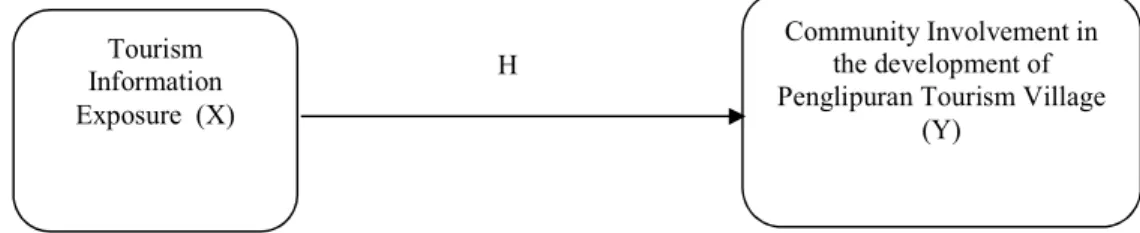
Based on the literature review, the proposed research hypothesis model for this study is as follows.
Figure 1. Research Hypothesis Model
The model in Figure 1 above illustrates the relationship between community involvement with its constituents, TIE.
METHODOLOGY
This study designed a self-administered questionnaire based on the literature review to collect data. The method was to describe the profile of respondents from the village and to collect the data thorough questionnaires to answer the question regarding the TIE and community involvement. Respondents in this study were 100 local people of Panglipuran Village.
Data analysis was performed by modeling using Partial Least Square (PLS). A multivariate statistical technique used to handle multiple response variables and explanatory variables at the same time. This analysis is a good alternative to the method of multiple regression analysis and principal component regression since this method is more robust or invulnerable. Robust means that the parameters of the model do not change much when new samples are taken from the total population (Geladi and Kowalski, 1986). Partial Least Square is a predictive technique that can handle many independent variables, including when there is multicollinearity between these variables (Ramzan and Khan, 2010). According to Wold, PLS is a powerful analysis method because it is not based on many assumptions or conditions, such as normality and multicollinearity tests. The method has its own advantages, among others: data does not have to be multivariate and normally distributed. Even indicators with a scale of data categories, ordinal, intervals to ratios can be used.
RESULTS AND DISCUSSION
Model of the Effect of Tourism Exposure on Community Involvement
Based on the operational variables of this research, a model was formed which was then analyzed using PLS-Algorithm to test the feasibility of the model, the results can be seen in Figure 1.
H Tourism
Information Exposure (X)
Community Involvement in the development of Penglipuran Tourism Village
341 Journal of Business on Hospitality and Tourism
Figure 2. SmartPLS Structural Model
Table 1. Value of Loading Factor Indicators
Indicators Leadership Indicators Community
Involvement
Ke1 0.932 M1 0.915
Ke2 0.949 M2 0.946
Ke3 0.936 M3 0.932
M4 0.904
M5 0.952
Validity testing for reflective indicators uses the correlation between item scores and construct scores. Measurement with reflective indicators shows a change in an indicator in a construct when other indicators in the same construct change (or are excluded from the model). Reflective indicators are suitable for measuring perceptions, so this study uses reflective indicators. Table 1 above shows that the loading factor gives a value above the recommended value which is equal to 0.5.
Table 2. Result for Cross Loading
Indicators Community Involvement (Y)
Tourism Information
Exposure (X)
Ke1 0.754 0.932
Ke2 0.894 0.949
Ke3 0.785 0.936
M1 0.915 0.773
M2 0.946 0.843
M3 0..932 0.832
M4 0.904 0.768
M5 0.952 0.814
342 Journal of Business on Hospitality and Tourism
is 0.932 which is higher than the loading factor to Community Engagement of 0.754. The same thing also appears in other indicators.
Table 3. AVE values and AVE roots
VARIABEL Average Variance Extracted
(AVE)
Community Involvement 0.864
Tourism Information Exposure 0.881
Table 3 above gives the root value AVE above 0.5 for all constructs contained in the research model. This states that all constructs contained in the study have good convergent validity.
Table 4. Composite Reliability Value
VARIABEL Composite Reliability
Community Involvement 0.970
Tourism Information Exposure 0.957
Table 4 above shows that the composite reliability value for all constructs is above 0.7 which shows that all constructs in the model meet the discriminated validity criteria.
Table 5. Alpha Croncachs Value
VARIABEL Cronbachs Alpha
Community Involvement 0.961
Tourism Information Exposure 0.933
The recommended value is above 0.6 and in table 5 above shows that the Cronbach’s Alpha value for all constructs is above 0.6. Thus, all the variables above can be included in the model to analyze the factors that influence Community Engagement. This has been proven from the results of the validity and reliability tests using the loading factor, discriminant validity and homology tests.
Table 6. R-Square Values
VARIABEL R Square
Community Involvement 0.753
343 Journal of Business on Hospitality and Tourism
Construct
Original Sample (O)
Sample Mean (M)
Standard Deviation (STDEV)
T Statistics (IO/STERRI)
Tourism Information
Exposure
Community Involvement
0.868 0.865 0.038 22.985
Based on Table 7 above, the equation can be built as follows: Community Involvement = 0.038 + 0.868 Tourism Information Exposure
Understanding the data analysis above and looking at the hypothesis, TIE has a positive and significant influence on community involvement. Based on the Path Coefficients table, X (Tourism Information Exposure) to Y (Community Involvement) produces a positive original sample value of 0.868 and a t-statistic value of 22,985 (> 1.64). This can prove that TIE can be determined as a variable that has a dominant influence on Community Involvement and it is in line with the research hypothesis.
This can be generated that TIE affects Community Involvement. Based on the R-square table which shows a value of 0.753 for the construct of community involvement. The remaining 24.7% is influenced by other factors that is not examined in this study.
CONCLUSION
Based on the results of research conducted by the author in Panglipuran Tourism Village regarding the effect of TIE on Community Involvement, it is concluded that Tourism information Exposure has a positive and significant effect on Community Involvement in Managing Tourism Villages in Panglipuran Tourism Village.
ACKNOWLEDGEMENT
The authors wish to thank the Directorate General for Strengthening Research and Development for its grant, Center for Research and Community Service, Sekolah Tinggi Pariwisata Bali Internasional and editor-in-chief of the International Journal of Business on Hospitality and Tourism for publishing this work.
REFERENCES
Effendy, Onong Uchjana. 2003. Ilmu, Teori dan Filsafat Komunikasi. Bandung: Remaja Rosdakarya.
Damanik, J., & Weber, H. F. (2006). Perencanaan Ekowisata. Yogyakarta: Penerbit Andi.
344 Journal of Business on Hospitality and Tourism
Mikkelsen, B. (1999). Metode Penelitian Partisipatoris dan Upaya-upaya Pemberdayaan: sebuah buku pegangan bagi para praktisi lapangan. Jakarta: Yayasan Obor.
Peraturan Menteri Kebudayaan Dan Pariwisata Nomor: KM.18/HM.001/MKP/2011. Pedoman Pemberdayaan Masyarakat Desa Wisata
Rakhmat, Jalaluddin. 2009. Metode Penelitian Komunikasi. Badung: PT. Remaja Rosdakarya.
Ramzan, M., & Khan, F. (2010). Depression, Anxiety, and Their Associated Factors Among Medical Students. Journal of The College oh Physicians and Surgeons Pakistan, 20, 122-6.
Sastropoetro, Santoso. (1988). Partisipasi, Komunikasi, Persuasi, dan Disiplin dalam Pembangunan Nasional. Bandung: Alumni.
Soedjatmoko. (1985). Etika Pembebasan. Jakarta: LP3ES
Suryadi, A.Y (2013). Kehidupan Sosial Keagamaan Masyarakat Hindu Bali (Studi Pada Masyarakat Transmigran Bali di Desa Air Talas Kecamatan Rambang Dangku Kabupaten Muara Enim). Fakultas Ilmu Sosial dan Ilmu Politik Universitas Sriwijaya
Tjokroamidjojo. (1977). Perencanaan pembangunan. Aksara Baru. Jakarta. UNWTO. (2015). UNWTO Tourism Highlight 2015. New York: UNWTO
Publications Department.