Journal of Global Pharma Technology
Available Online at:
www.jgpt.co.in
RESEARCH ARTICLE
Preparation, Characterization, and Biological Evaluation of New
Schiff Base Ligand and their Complexes with iron(II), cobalt(II),
nickel(II) and Copper(II) ions
Mohammed Hamid Said
College of Science for Woman -University of Babylon-Iraq.
Abstract
In the present work a new schiff base ligand was prepared by reaction of 6-amino penicillinic acid with 5-chlorosalicyldehde. The new ligand was characterized by using various techniques UV/ Visible, FT IR ,
Mass spectral ,1H NMR, and 13C NMR , It was also preparing four new complexes by interaction of ligand
with transition metals ions ( Fe2+, Co2+, Ni2+, Cu2+ ) and characterized by UV/ Visible, FT IR, Magnetic
moment and molar conductance. Ligand shows tridentate behavior demonstrated by the presence of three effective groups and complexes have taken octahedral form. The biological effectiveness was measured for ligand and coordination complexes against two types of bacteria ( Staphyllococcus aureus and Pseudomonas aeruginosa ) showed good effectiveness.
Keyword:β-Lactam, Schiff base, 6.Amino Penicillinic, and tridentate ligand.
Introduction
Schiff base was prepared in 1864 by researcher Hugo Schiff by Interaction of primary amines with carbonyl compounds (aldehydes and ketones), Rules can be named schiff base by other names such as Azomethene and Anils and Imines [1]. In general, the schiff base prepared from aldehydes has a faster reaction than those prepared from ketones [2]. The reason is that aldehydes have a lower Steric hindrance impairment than ketones. Also the compounds produced from aldehydes are also high stability stabilizers with metals in various oxidation states [3, 4].
Schiff base was used in Various fields, have been used in industry [5, 7] and agriculture [8,9] also used in the pharmaceutical and pharmaceutical industries [10,11] Where the most important role of Schiff base rules was with the beginnings of pharmacologic action of antibiotics by employing β-Lactam compounds [12]. Lactam antibiotics is an important class of antibiotics containing the lactam ring, the first preparation of β-lactam compounds was in 1907 by researcher Hemann Staudinger [13,14] Many of the compounds of Schiff base containing β- Lactam ring have an effective Anticancer effect because they contain effective groups
such as azumethin group, β-lactam and carbonyl [15,16]. This study focused on the preparation of β-Lactam complexes with a number of elements of the first transitional series, such as iron, cobalt, nickel and copper, and study their biological effectiveness. Experimental
All chemicals used were reagent grade (Sigma Aldrich, B.D.H, C.D.H. and S.L. Company)
Preparation of Schiff base ligand
The Ligand were synthesized by dissolving (2.16g,0.01mole) 6-Amino Penicillinic acid in absolute ethanol (basic medium), then it added to (1.06g, 0.01mole) of 5-Chloro-Salicyldehyde of climb thermally for 12hrs then it filtered out put formed , dried and recrystallization from absolute ethanol.
Preparation of Complexes
The mixture was refluxed for 30min, and then filtered, dried and recrystallization from absolute ethanol.
Biological Activity
Disk Diffusion Method was applied for evaluation of the inhibitor ability of the original ligand and its complexes in the biological activity of the most active plantation of the bacteria (Staphylococcus aureus, pseudomonas aeruginosa).
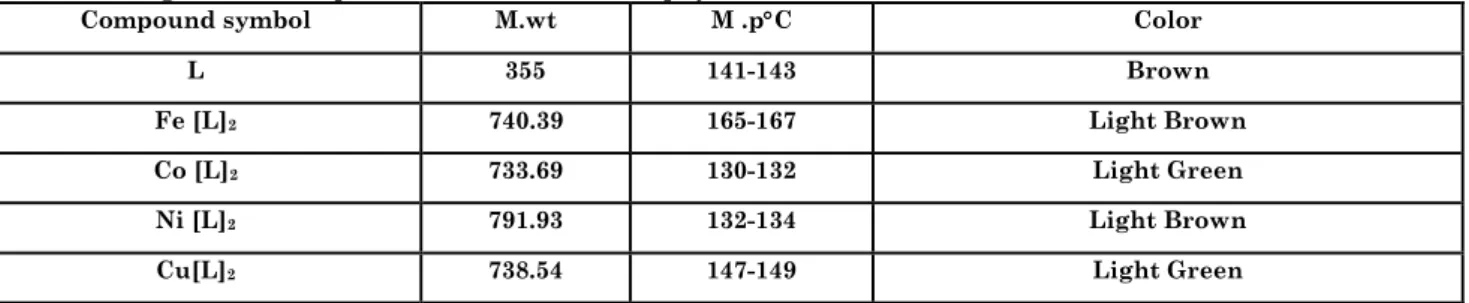
Table1:Data ligand and complexes show chemical and physical characterizations
Color M .pC
M.wt Compound symbol
Brown 141-143
355 L
Light Brown 165-167
740.39 Fe [L]2
Light Green 130-132
733.69 Co [L]2
Light Brown 132-134
791.93 Ni [L]2
Light Green 147-149
738.54 Cu[L]2
Results and Discussion
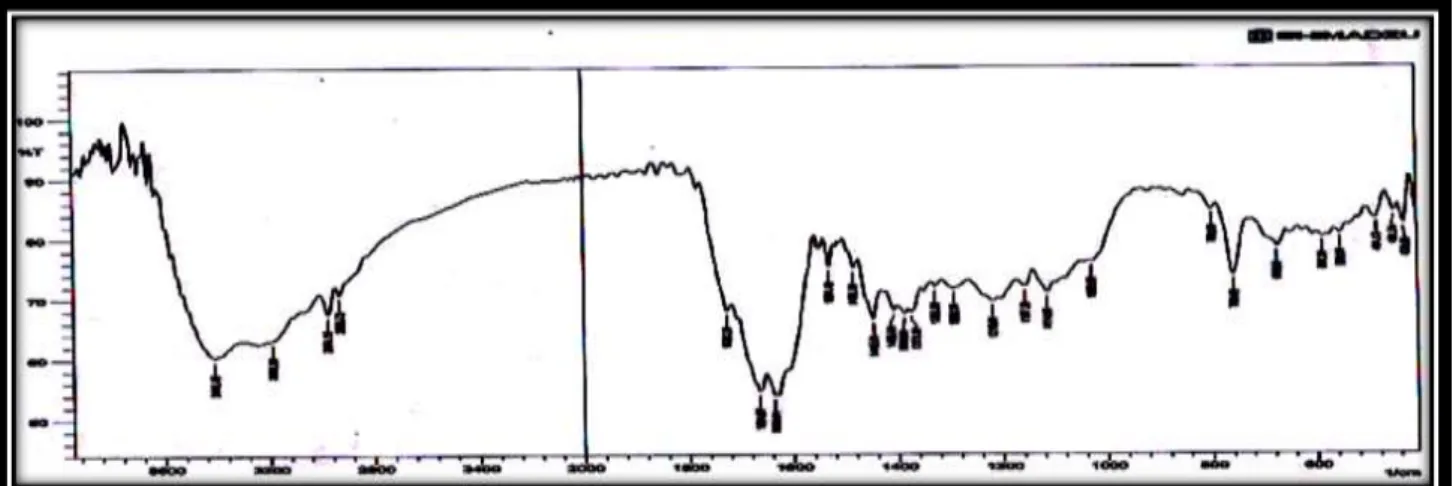
Infrared SpectraFTIR spectrum includes appearance extensive of vibration Pack low density at 3295 cm-1. This pack because of the vibration of hydroxyl group, Also note other Pack low density to ν (C-H) aromatic at 3084 cm -1.While the β-Lactam group appeared at a frequency of 1732 cm-1. The band was set in 1629cm-1 to stretch vibration of υ (-CH = N-) azomethene complexation, the Bands of (β-
Lactam and azomethene) group shifted to a higher frequency in all spectra of complexes [17]. The emergence of new bands between the frequencies (443-557) in the prepared spectrum of the complexities denote get of coordination , and the change in location and shape of the spectrum bunds for hydroxyl, isomethine and lactam groups indicates that the metal is consistent with these groups [18, 19]. The FTIR frequencies of free ligand and complexes are reported in Table 2, Figures 1 and 2 show a spectrum of free ligand and copper complex.
Table 2: FTIR Data of Schiff Base Ligand and Metal Complexes
M-N M-O (C=N)
Azomethene C=O) Lactam
)
ν C-H)arm.
)
ν
C-H)alph.
)
ν OH)
)
ν Compound
-1629 1732
3084 2974
3295 L
532
455 1635
1740 3070
2974 3379
Fe [L]2
550 443 1635
1741 3070
2974 3232
Co[L]2
554 440 1631
1742 3064
2976 3236
Ni [L]2
557
451 1635
1740 3064
2976 3190
Fig. 1: FTIR Spectra of Ligand
Fig. 2: FTIR Spectra of Copper (II) Complex
Electronic Spectra
The electron spectrum of ligand and complexes in DMSO solution was measured between 200-1100 nm at room temperature. The UV-Visible spectra of free ligand include two absorption bands at wavelength 262 nm and 325 nm. The first transmission due to transition electron to π-π⃰ (aromatic ring) and the second transition due to transmission electron n-π⃰ (azomethene group) respectively
[20, 22].The spectra of the complexes were compared with the ligand spectrum. A change was observed in the absorbent peaks by the disappearance of the absorption peaks and the emergence of new absorption packs through which the complications could be extracted. Reported data UV-Vis of ligand and complexes in Table 3 and Figures 3 and 4 shows a Uv-Vis spectrum of free ligand and copper complex.
Table3: Electronic Spectra Data of Schiff Base Ligand and Metal Complexes
Assignment
max λ
Absorption Bandnm Complexes
π-π*, n-π* 262,325
L
C.T 466,424
Fe[L]2
C.T 429
Co[L]2
C.T 409
Ni[L]2
C.T 418,287
Cu[L]2
Fig. 4: Electronic Spectra of Copper (II) Complex Mass Spectrum
The ligand mass spectrum showed the highest peak at 355 z /(m). This peak is attributed to the ion of the parent molecule, which compatible with the molecular formula
is proposed to a ligand, and record the spectrum other peaks appear consistent with the literature [23, 24]. Figure.5 shows the proposed fragmentation of ligand process. The general pattern of fragmentation for ligand is summarized in Scheme1.
Fig.5: Mass Spectrum of Ligand
A A
A
A
N C
H OH Cl
O N S
COOH N
C
H OH Cl
O N S
COOH
N C
H OH Cl
O N S
COOH
N C
H OH Cl
O N S
COOH
N C
H OH Cl
O N S
COOH
N C
H OH Cl
O N S
COOH A
A
A
A
A
A
210 145
L = 355
266 129 127
228 45 310
201 154
Scheme 1: Fragmentation Pattern of Ligand
1H-NMR Spectra of the Ligand
The 1HNMR spectra are used to determine the type of hydrogen in the free ligand and the complexes, on the other hand, to determine the ligand structure, finally to take advantage of it in the case of displacement or disappearance of these peaks in the spectra of complexities to investigate
Fig.6: 1H-NMR Spectrum of Ligand
Table4: Proton Nuclear Magnetic Resonance Spectra of The Schiff Base Ligand
1HNMR
Compound
CH3(1.5ppm,S, 6H)
L Aromatic(7.2-7.8ppm ,m,5H)Azomethene(8.6ppm,S,H) CHN(4.1ppm,d,H) CHCO(4.3ppm,d,H) DMSO (3.5,2.5ppm)
13C-NMR Spectra of the Schiff Base
Ligand
The 13C-NMR spectrum for the ligand base is recorded in DMSO-d6.The 13C-NMR spectrum showed the peak of azomethane carbon at (δ 153) ppm.
The peak appearance at (δ180) ppm is due to the C = O group of the lactam ring. Carbon atoms in the phenyl ring have shown a different peak in (δ 124, 130, 124, 130, 116, 168) ppm [25, 26]. Figure 7 and Table 5 shows the data of 13C-NMR for ligand.
F ig.7: 13C-NMR Spectrum of Ligand
Table5: Carbon Nuclear Magnetic Resonance Spectra of the Schiff Base Ligand
Compound 13C-NMR
L
(aromatic) 124 ,130 ,124 ,130 ,116 ,168 (azomethene) 153
(COOH) 167 (CH3) 25
(CH)79 (β-Lactam CO ) 180
(CH)64
)CHN)76
)CHCO)62
Magnetic Susceptibility and Molar
Conductivity for Coordination
Complexes
The magnetic susceptibility measurements of the complexes include calculation of both magnetic and atomic susceptibility as well as molecular sensitivity and comparison with theoretical values. The molecular conductivity of the complexes was limited
Table 6: Magnetic moments and Molar Conductivity data of Schiff base ligand and metal complexes Geometry Molar Conductivity
Magnetic moment Complexes
Octahedral 5.8
Diamagnetic Fe [L]
Octahedral 8.2
4.0 Co[L]
Octahedral 8.5
3.01 Ni[L]
Octahedral 5.9
1.7 Cu[L]
Anti-Bacterial Activity
The complexes prepared with Fe, Co, Ni and Cu were studied against the biological activity of two type of bacteria (Streptococcus Facials and Proteus mirabilis) at
concentrations 1×10⁻⁶, 1×10⁻⁵, 1×10⁻⁴, 1×10⁻³ (M) and compared with the inhibitory effect of ligand (L).The ligand and its complexes were applied on the plantation of
Staphylococcus aureus as shown in Figure 8 and Table 7.
Table 7: Vital effect of Ligand and Complexes in Vital Work of bacterial Staphylococcus aureus
Concentration (M) Compound Symbol
L = Fe Zn[L] Co[L] Ni[L] Cu[L] 1×10⁻⁶
1×10⁻⁵
1×10⁻⁴
1×10⁻³
- - - +
- + ++ +++
- + + +++
- + ++ +++
- - - +++
Fig.8: Effect of Original Ligand (L) and Its Four Complexes In The Biological Activity of The of Staphylococcus aureu Bacteria
The complex of Iron illustrated the highest inhibitory effect among the four complexes, on the other hand results of the inhibition ability of the cobalt, nickel and Copper complexes were so convergent at the four examined concentrations. Figure 9 exposes the ability of inhibition data for the ligand and its complexes at they applied in the
plantation of Proteus mirabilis, the complex of iron were illustrated the highest inhibitory effect followed by the complexes of cobalt then nickel respectevily, while complex of copper demonstrated approximate inhibitory effects at different concentrations, as shown in Table 8.
Table8: Vital Effect of the Ligand and Complexes in The Biological Activity of Pseudomonasaeruginosa
Concentration (M) Compound Symbol
L Fe [L] Co[L] Ni[L] Cu[L]
1×10⁻⁶
1×10⁻⁵
1×10⁻⁴
1×10⁻³
- - - +
- + ++ +++
- - ++ +++
- - ++ +++
- - ++ +++
Conclusions
The prepared ligand and it's complexes illustrated a good inhibitory ability towards the varieties bacteria (Staphyllococcus
aureus and Pseudomonas aeruginosa) so, the prepared compounds could be good alternatives to the common drugs which are used in treatment of ulcers.
C Cl
H
N N
O
S
CH
CH
COOH
O
M
C
Cl H
N
N
O
S CH
CH
COOH O
References
1. Muhammad Aqeel Ashraf, Karamat Mahmood, Abdul Wajid (2011) Synthesis, Characterization and Biological activity of schiff bases, International Conference on Chemistry and Chemical Process, 10: (1-7). 2. M Abirami, V Nadaraj (2014) Synthesis of schiff base under solvent-free condition as green approach, International Journal Of Chem. Tech. Research, ISSN 0974-4290 4(6):(2534-2538).
3. Jitendra Singh, Sangeeta Agarwal (2015) Lanthanide (III) complexes of schiff bases of dithiocarbazate derivatives: synthesis, spectral characterization and biological evaluation, International Journal Of Advanced Engineering and Global Technology, ISSN 2309-4893 03 (03): 387-396.
4. R Shakru, Sathish Kumar K, Vijay Kumar, Chityala Shivraj (2011) Potentiometric studies of 3-amino -5-methyl isoxazole schiff bases and their metal complexes in solution , Journal Of Advanced Scientific Research , ISSN 0976-9595, 2(4): (58-62).
5. Mohamed A Abbas Khaled Zakaria, A Hamdy OM Abo-Elenien, Olfat E, El-Azabawy (2015) Synthesis of novel schiff base silicon compound for employing as corrosion inhibitor for carbon steel in the 1 M HCl and 3.5% NaCl Aqueous media, International Journal Of Chemical, Environmental and Biological Sciences, 2 (3): (145-154).
6. N Madhavi, B Lourdu Rani (2014) Antioxidant activity of novel 4-oxo-azetidine derivatives synthesis from schiff bases, International Journal of Research and Development in Pharmacy and Life Sciences, ISSN 2278-0238, 3(2): 905-908.
7. Lu Bai, Min Li, Jingqi Guan (2018) Co(II) or Cu(II) Schiff Base Complex Immobilized onto Carbon Nanotubes as a Synergistic Catalyst for the Oxygen Reduction Reaction, chemistry select 3 (2) 17 (581-585).
8. Roya Ranjine Khojasteh, Marzieh Hanjani Bagheri (2012) Synthesis and structure of chromium complexes with new Tetradentate schiff base N2O2-Type Ligand, J. Chem. Eng., 6: (259-262).
9. Md Arifuzzaman, Mohammad R Karim, Tasneem A Siddiquee, Aminul H Mirza, Mohamd A Ali (2013) Synthesis and characterization of new schiff bases formed by condensation of 2,9-phenathroline-1,10-dialdehyde with sulfur-containing amines ,International Journal Of Organic Chemistry, 3: (81-86). 10.Selami Demirci, Dilek Telci,
Serli Canikyan, Merve Kongur, Bülent Dede, Fikrettin Şahin (2018) Anticancer activity of Schiff base-Poloxamer P85 combination against kidney cancer, International Urology and Nephrology, 50(2): 247-255.
11.Anchal Kulshrestha, Shipra Baluja (2010) Micro promoted synthesis of some schiff bases, Scholars Research Library Archives Of Applied Science Research , ISSN 0975-508x, 2(3): 221-224.
13.Arun Kumar Kaura, Lalit Sharma, Monika Kaura (2013) Synthesis and comparative antimicrobial study of beta lactam derivatives , International Journal Of Pharmaceutical and Chemical Sciences , ISSN 2277-5005, 2(2): 560-565.
14.Mohammad Nasir Uddin, DidarulAlam Chowdhury, Md Moniruzzman Rony, Md Ershad Halim (2014) Matal Complexes Of Schiff Basees Derived From 2-Thiophenecarboxaldehyde And Mono /Diamine As The Antibacterial Agents, Modern Chemistry, 2(2): 6-14.
15.AM Hassan, A Nasser, YZ Ahmed, AN Elkmash (2012) Synthesis, characterization and biological evaluation of binuclear Fe(III) , Co(II) , Ni(II) , Cu(II) and Zn(II) complexes with Schiff base (E) -4-[(hydroxyl phenylimino)Methyl] benzene -1,2- diol ,International Journal Pharmaceutical Sciences and Research ,ISSN 0975-8232, 3(7): 2243-2251.
16.Ai-Juan Guo, Xiao-Shan Xu, Ying-Hui Hu, Ming-Zhao Wang, Xin Tan (2009) Effects of ternary complexes of copper with salicylaldehyde-amino acid Schiff base coordination compound on the proliferation of BGC823 cells , Chinese Journal of Cancer, 277-282.
17.Rasheeda M Ansari,
Badekai Ramachandra Bhat (2017) Schiff base transition metal complexes for Suzuki-Miyaura cross-coupling reaction,
Journal of Chemical Sciences, 129 (9): 1483-1490.
18.Saikat Sarkar, KamalenduDey (2005) Synthesis And Spectroscopic Characterization Of Some Transition Metal Complexes Of A New Hexadentate N2S2O2 Schiff Base Ligad, Spectrochimica Acta Part, 62: 383-393.
19.Siddeshwar SS, Pattan SR, Wabale NB, Pattan JS, Dighe SB, Bhavar SB, Gude RS (2013) Need And Scope Of Development Of β-Lactams, International Journal of Pharmacy and Natural Medicines, 1(1): 52-61.
20.Noureddine Charef, Fouzia Sebti, Lekhmici Arrar, Meriem Djarmouni, Naouel Boussoualim, Abderrahmane Baghiani, Seddik Khennouf, Ali Ourari, Murad A Aldamen, Mohammad S. Mubarak, Dennis G Peters (2015) Journal Homepage :www. Elsevier Com /Locate /Poly, 85: 450-456.
21.E Akila, M Usharani, R Ashokan, R Rajavel (2013) International Journal Of Metallurgical and Materials, ISSN 2278-2516 4(3): 27-38.
22.Amna SA Zidan, Nagwa Abo El-Maali (2015) Spectral Thermal, Voltammetric And Biological Studies On Mn (II), Fe (II), Co (II), Cu (II) And Zn (II) With Cefazolin Antibiotic, Assiut University Journal Of Chemistry (AUJC), ISSN 1678-4919, 1 (44):13-26.
23.Qiaoli Yue, Tongfei Shen, Changna Wang, Chaohui Gao, Jifeng Liu (2012) Study On The Interaction Of Bovine Serum Albumin With Ceftriaxone And The Inhibition Effect Of Zinc (II), International Journal Of Spectroscopy, Article ID 284173 9. 24.NarjisNaz, Muhammad Zafar Iqbal (2011)
Synthesis, Spectroscopic And Biological Studies Of Transition Metal Complexes Of Novel Schiff Basees Derived From Cephradine And Sugars ,Sci. In.(Lahore ), ISSN 1013-5316, 23(1): 27-31.
25.Ghulam Fareed, Mahboob A Kalhoro, Muhammad A Versiani, NighatAfza, Nazia Fareed (2012)7-{[2-(4- Hydroxyphenyl)Methylidene]Amino}-1,3-Thiazol-4-Yl)-2 (Methoximino) Acetyl] Amino}-3-{[2-Methyl-5,6-Dioxo-1,2,5,6-Tetrahydro-1,2,4-Triazin-3-Yl) Sulfanyl]
Methyl}-8-Oxo-5-Thia-1-Azabicyclo[4.2.0]Oct-2-Ene-2-Carboxylic Acid, am Molbank, ISSN 1422-8599, 1-3. 26.Taghreed H Al- Noor, Amer J Jarad,
AbaasObaid Hussein (2014) Synthesis, Spectroscopic And Antibacterial Studies Of Fe(II), CO(II), Ni(II) Cu(II), Zn(II), Cd(II) and Hg(II) Mixed Ligand Complexes Of Saccharin And Amoxicillin (Antibiotics), Chemistry and Materials Research, ISSN 2224- 3224, 3: 6.
27.SK Upadhyay, SM Ali (2010) NMR Investigation On The Interaction Of Β-Cyclodetrin And Ampecillin , UDC, 5 (15): 1003-1006.