242
RESEARCH ON THE WORKING PROCESS OPTIMIZATION OF A
COMBINED INSTALLATION FOR GRAINS CLEANING /
CERCETǍRI PRIVIND OPTIMIZAREA PROCESULUI DE LUCRU AL
INSTALAŢIEI COMBINATE DE CURAŢARE A CEREALELOR
BRĂCĂCESCU C.1), PǍUN
A.1), SORICǍ C.1), GANEA I.1), MANEA D.1),
DANCIU A.1), BORUZ S.2)
1)
INMA Bucharest / Romania; 2)
University of Craiova /Romania Tel: 031.805.32.13; E-mail: [email protected]
Keywords: gravity separator, grains, cleaning,
REZUMAT
Lucrarea prezintă cercetările experimentale asupra indicilor calitativi de separare a impuritǎţilor din seminţele de cereale pentru o instalaţie care utilizeazǎ principii combinate de separare (în funcție de masa specifică și de proprietățile aerodinamice ale semințelor). Instalația folosită în cadrul cercetǎrilor experimentale este compusă dintr-un separator gravitațional și o instalație de aspirație. Pe baza datelor obținute prin măsurători şi ai indiciilor calitativi reglementaţi au fost determinaţi indicatorii de calitate ai procesului de curǎţare.
ABSTRACT
This paper presents experimental research of qualitative indexes of impurities separation out of grains seeds for one installation which used combined principles of separation (according to specific mass and aerodynamic properties of seeds). The installation used on the experimental research was composed of a gravity separator and an aspiration installation. Based on data obtained by measurements and regulated qualitative indicators the cleaning process indexes have been determined.
INTRODUCTION
The cereals used as raw material for milling represent a heterogeneous mass consisting of basic culture grains (which are to be milled) and foreign bodies (impurities). Therefore, before being milled, the grains are subjected to cleaning operations aiming mainly the elimination of foreign bodies from the mass of seeds [6].
To reduce the number of technical equipments and implicitly of technological spaces, the modern milling units performing use complex installations carrying out the separation by combined principles, the most used following the specific mass difference being the ones and aerodynamic properties of various components of seed mixtures [5].
In the most general case, a vibrating separator is designed as a oscillating platform suspended on elastic elements who works in the separation process like a vibrating conveyors whose surface linear vibrations (chute or flat sieve) are generated by a mechanism endowed with non-balanced masses attached to frame [4].
MATERIAL AND METHOD
243
Fig. 1. The principle scheme of a separator with vibratory platform operated by unbalanced centrifugal vibrating masses :
1 - vibrator with unbalanced centrifugal masses (electric motovibrator); 2 – vibratory platform
The working process diagram of a combined installation for grains cleaning is shown in Figure 2.
Fig. 2. The working diagram of the gravity separator connected to the suction system [1]:
1 - working platform, 2 suction room (hood), 3 - product supplying, 4 - aspirated air currents, 5-heavy impurities particles, 6-cleaned product
In the following is presented the installation and the experimental determination research methodology used to determine the qualitative indices of the cleaning process (separation of impurities from cereal seeds) in the case of combined separation systems (relative to the specific mass and the aerodynamic properties of seeds) [2].
The combined installation, consists of the gravity separator 1, model SP-00, design and manufactured at INMA Bucharest (Figure 3), connected to a suction installation with air composed of suction fan 2 and dedusting cyclone 3.
244
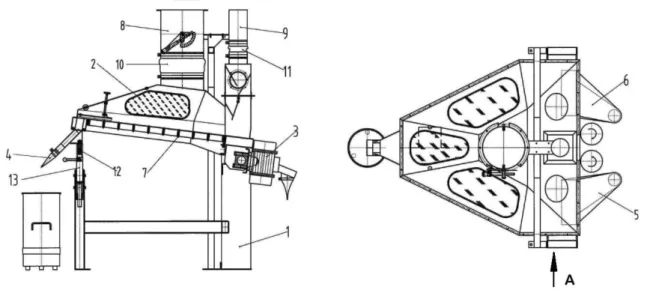
The main component parts of the gravity separator SP-00 are shown in the constructive scheme in Figure 4.
Fig. 4. Constructive sketch of gravity separator:
1 - sustaining frame; 2 - separator case; 3 - driving system with electric motovibrator; 5, 6 – finished (cleaned) product discharging pipe; 10- air aspiration pipe;11 - product feeding pipe; 12 - pipe for discharging
heavy impurities; 13 - screw mechanism
For experimental measurements were used measurement devices and / or registration of the following sizes (parameters):
masses of products and impurities in the separation process;
inclination angle respect to the horizontal of the working surface;
air flow rate of the suction installation by determining the velocity of air currents in the suction pipe;
oscillation amplitude of the working surface;
frequency of oscillation of electrical motovibrators, by determining their rotation speed;
power consumption of installation ;
humidity and temperature of processed product. (wheat grains). The coefficient of loss of good seeds Cps is calculated with the relation:
Cps (m/M)100 [%] (1)
where: m is the good seeds mass which are found at the exit from equipment in the quantity of total impurities eliminated; M- good seeds mass at the entry into equipment. The index of technological effect Ecs is determined with the relation:
C C /C
x100Ecs csi cse csi [%] (2)
where: Ccsi is content foreign bodies (impurities) at the entrance of the material in
equipment, %;
Ccse - content foreign bodies (impurities) at evacuation of material from equipment, %.
Specific electricity consumption q represents the amount of electricity (in kWh) consumed to process one kilogram of product and was determined by calculation with the following formula:
me u
Q
P
q
[kWh/kg] (3)where Pu is the effective power of the equipment, kW;
245
Table 1 The results of the tests effected for the determination of optimal regime of the gravity separator
Product feed rate (kg/h)
Air flow (m3/min)
Angle of operation surface (degrees) Amplitude of operation surface (mm) Quantity of impurities separated at 1000kg of wheat processed (kg) Observations
0 1 2 3 4 5
1500
100
5
1,5 35,5
It is observed that for small air flow and the
inclination angle
reduced in the
impurities mass are eliminated grain. In the same time with the
increasing of the
oscillatory amplitude and the reducing of the air flow, grain are
eliminated by the
impurities pipes
2,0 38,6
2,5 41,2
7,5
1,5 33,4
2,0 35,1
2,5 37,2
10
1,5 31,6
2,0 33,7
2,5 34,8
125
5
1,5 26,3
2,0 29,2
2,5 33,1
7,5
1,5 24,5
2,0 25,8
2,5 27,6
10
1,5 21,3
2,0 22,8
2,5 23,6
150
5
1,5 29,7
2,0 21,4
2,5 23,8
7,5
1,5 16,4
2,0 18,2
2,5 19,4
10
1,5 15,6
2,0 16,8
2,5 17,9
2000
100
5
1,5 37,6
2,0 40,2
2,5 43,4
7,5
1,5 35,6
2,0 38,9
2,5 39,9
10
1,5 33,3
2,0 35,4
2,5 36,7
125
5
1,5 28,1
2,0 31,4
2,5 34,9
7,5
1,5 26,6
2,0 27,4
2,5 29,1
10
1,5 23,1
2,0 25,1
246
RESULTS AND DISCUSSIONS
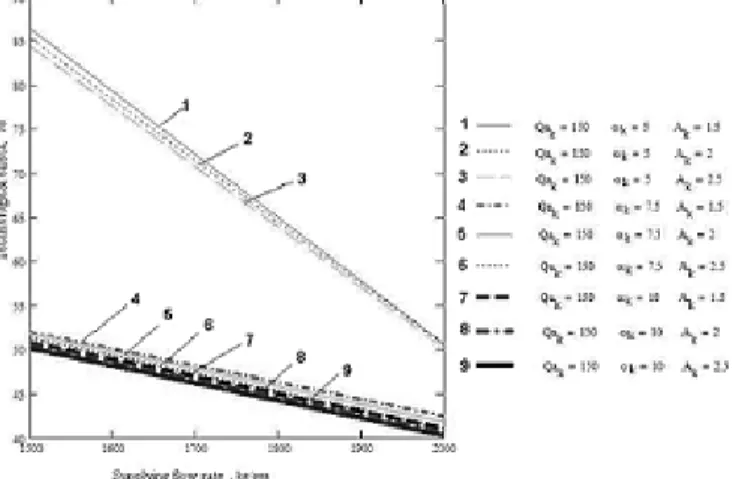
The influence of functional parameters variation on the value of technological index values ECS are shown in Figures 5, 6 and 7.
Fig.5. Variation of the values of technological effect index ECS
depending on the supplying flow rate with material (wheat grains) Qg at suction installation flow rate of Qa=150 m3/min, for the following adjustment parameters: inclination angle of the working surface α= 5º;
7º. 5; 10° and working surface amplitude A= 1.5; 2; 2.5 mm.
Fig. 6. Variation of the values of technological effect index ECS
depending on the air flow rate Qa for the suppling flow rate with material (wheat grains) Qg=2000 kg/h for the following adjustment parameters: inclination angle of the working surface α= 5º; 7º. 5; 10° and
working surface amplitude A= 1.5; 2; 2.5 mm
247
depending on the angle of the working surface α at the supplying flow rate with material Qg=2000 kg/h, for the following adjustment parameters: air flow rate Qa=100; 125;150 m3/min and working surface
amplitude A=1.5; 2; 2.5 mm.
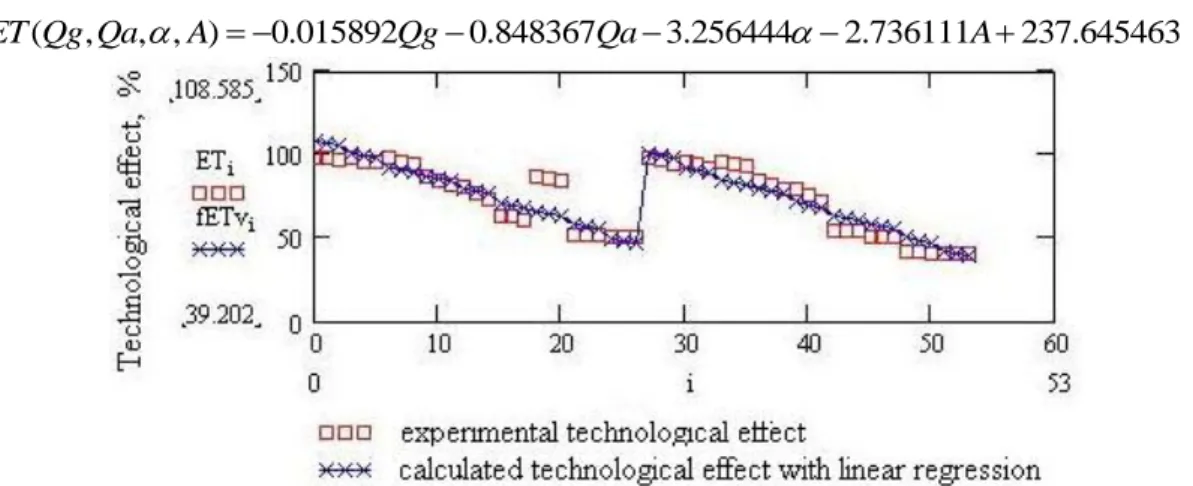
Applying linear regression method at determined experimental data processing is obtained the technological effect function ET expressed by the relation:
( , , , ) 0.015892 0.848367 3.256444 2.736111 237.645463
ET Qg Qa A Qg Qa A (4)
Fig. 8. Comparison of the experimental data with those obtained by linear regression at the determination of the technological effect index
From the graphical representation in Figure 8 of the formulas (4) result that the index of global technological effect decreases with the increase of the supplying flow rate with material, of the working surface angle, of the working surface amplitude and of the suction air flow rate.
CONCLUSIONS
The separator designed and achieved is a rugged construction; it operates non-vibrantly and allows the easy adjustment. The working process of the gravity separator is efficient and it achieves a high cleaning of the wheat for milling. The technological parameters obtained during tests depend on the regulation of the operation surface (oscillations amplitude and inclination angle), of aspiration air flow as well as wheat feed flow. It recommends for a optimal operation the following regulation parameters: wheat feeding flow: 1500…200 kg/h; air flow 125… 135 m3/h; oscillations amplitude 1.8…2.2 mm
and the inclination angle of the operation surface of 6…80
.
The results obtained during the experimental researches reveal that the entire installation for grains cleaning comply with the requirements in terms of destination, of the purpose and functioning mode, of the possibilities for adjustment and servicing, working having a working capacity suitable to deposits from agricultural farms, cereal seeds conditioning stations as well as technological flows from milling units.
BIBLIOGRAPHY
1. Brǎcǎcescu, C., Sorică, C., Manea, D., Yao, Guanxin, 2014 - Theoretical contributions to the drive of cereal cleaning technical equipment endowed with non balanced vibration generating systems, INMATEH, vol.42, p.69-77;
2. Căsăndroiu, T., David, L., 1994 - Equipments for primary processing and preservation of agricultural products. Guidelines for laboratory work, „POLITEHNICA” University of Bucharest;
3. KeShun, Liu, 2009 - Some factors affecting sieving performance and efficiency, Powder Technology, 193, p. 208-213
248
5. Miskelly, D., Batey, I.L., Suter, D.A.I., 2010 - Processing wheat to optimise product quality, Cereal Grains, p. 431-457;
![Fig. 2. The working diagram of the gravity separator connected to the suction system [1]: 1 - working platform, 2 suction room (hood), 3 - product supplying, 4 - aspirated air currents,](https://thumb-us.123doks.com/thumbv2/123dok_us/8073038.2138645/2.893.275.619.372.532/diagram-separator-connected-platform-suction-supplying-aspirated-currents.webp)