Houcine OUDIRA, Aissa
CHOUDERand Amar MEZACHE
Abstract— The use of a reliable model of a photovoltaic
(PV) module is the main step for energy prediction and an important tool for monitoring and supervision. To this end, PV modeling primarily involves the formulation of the non-linear current versus voltage (I-V) curve. This paper presents the application of the Nelder-Mead simplex search method for identifying the parameters of solar cell and photovoltaic module models. The proposed technique allows the extraction of the unknown model parameters, namely, the generated photocurrent, saturation current, series resistance, shunt resistance, and ideality factor that govern the current-voltage relationship of a solar cell. The extracted parameters have been tested against several static IV characteristics of the PV module collected at different operating condition. Comparative study among different parameter estimation techniques is presented to demonstrate the effectiveness of the proposed approach. The dynamic MPP model has also been derived and simulated using the extracted parameters against MPP real dynamic measurements of a grid connected system located in the Centre de Developpement des Energies Renouvelables (CDER) in Algiers.
Index Terms— N-M algorithm, Optimization, Parameters
extraction, Photovoltaic module, dynamic MPP model. I. INTRODUCTION
Renewable energy is expected to be an important source of energy in the future because it replaces the depletion of the fossil fuel reserves and mitigates the pollution caused by the conventional energy sources. In particular, photovoltaic power systems could be a suitable solution to meet local energy demand. The possibility of predicting a photovoltaic array’s performance in various irradiance and temperature conditions is very important for sizing the PV arrays as well as for the design of the Maximum Power Point Tracking and control strategies [1].
Houcine Oudira is with Département d’Electronique, Université Mohamed Boudiaf-M’sila, 28000 M’sila, Algérie. Laboratoire de Génie Electrique (LGE) ([email protected]).
Aissa Chouder is with electrical engineering departement, Université Mohamed Boudiaf-M’sila, 28000 M’sila, Algérie. Laboratoire de Génie Electrique (LGE).
Amar mezache is with Département d’Electronique, Université Mohamed Boudiaf-M’sila, Laboratoire SISCOM, Université de Constantine ([email protected])
For this end, several research papers have focused on the modeling and parameters extraction of the PV modules as it is the key element in the energy production chain, not only to increase their performance, but also to simulate their behavior and optimize their different characteristics [2-7].
In the literature, there are two main equivalent circuit models used to describe the non-linear I–V relationship, the model with five parameters commonly called the single diode model and the one with seven parameters commonly called double diode model. Therefore, to provide an accurate modeling and reliable performance evaluation of a given solar system, a valid estimation of these models parameters is always required. The methods employed to solve the problem of PV parameter identification can be divided in two groups; deterministic and heuristic approaches [8]. Metaheuristic algorithms are suitable choices for solving this problem due to their global search power as well as derivative-free advantage. In [9], it is stated that the heuristic algorithms give better results than classical methods in term of accuracy with a high probability to converge toward the global optimum.
This paper presents the application of the Nelder-Mead simplex search method for identifying the parameters of solar cell and photovoltaic module models. The proposed technique is a simple and direct search method that does not require calculation of any derivatives. For these reasons, it is used to identify the unknown models parameters, namely, the generated photocurrent, saturation current, series resistance, shunt resistance, and ideality factor that govern the current-voltage relationship of a solar cell. Real measurements data are used to test and verify the consistency of accurately estimating the unknown parameters of the single and double diode models respectively.
Moreover, the characteristic equation with the extracted parameters has been tested against several static IV
A prediction Model Based on Nelder-Mead
Algorithm for the Energy Production of PV
characteristics of a PV module collected at different operating condition.
Finally, the extracted parameters are used in a behavioral model of the maximum power point of a PV generator and compared against reel measured data from an operating PV grid connected system located at Centre de Developpement des Energies Renouvelables situated in Algiers (Algeria). The results prove that the N-M is very suitable tool for estimating electrical parameters needed for modeling the PV array for long term prediction.
The rest of this paper is organized as follows: brief description of the single and double diode models are provided in section II. In section III, election of the cost function and optimization principle is given. Brief description of N-M optimization algorithm is given in section IV. Simulation results and related discussions are provided in section V. Finally, the drawn conclusions
from this work are provided in section VI
.
II. PHOTOVOLTAIC MODULE MODELING
Although various models have been developed in the literature to describe the behavior of solar cells, a special attention has been made, in this paper, to single and double diode models.
A. Single diode model
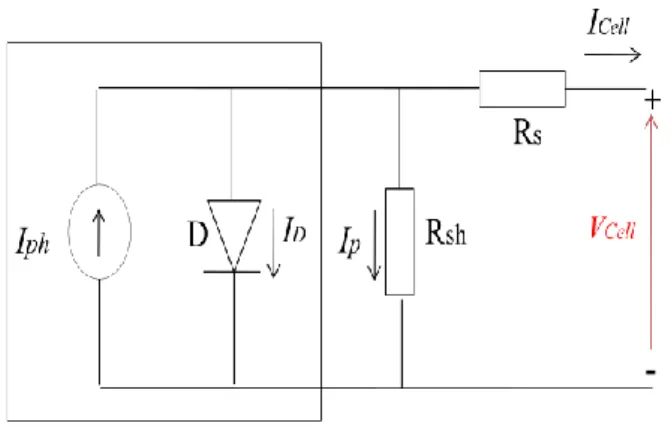
The single diode model is the most commonly used for modeling purposes [10]. As shown in Fig. 1, this model is simple, easy to solve, and suitable for electrical engineering applications.
The behavior of photovoltaic module is generally described by its current-voltage characteristic, in which their shapes are dependent on the value of the five parameters, solar irradiance and module temperature.
Fig. 1.The equivalent circuit model of the single diode model
The output current versus output voltage characteristics is given by the following expression [11]:
𝐼 = 𝐼𝑝ℎ− 𝐼0[exp ( 𝑞(𝑉+𝑅𝑠𝐼)
𝑛𝑘𝑇 ) − 1] − 𝑉+𝑅𝑆𝐼
𝑅𝑠ℎ (1)
Where 𝐼𝑝ℎ is the photocurrent in (A), 𝐼0 the diode
saturation current (A), 𝑛 the diode ideality factor, k the constant of Boltzmann (1.38x10⁻²³ JK-1), q the electric
charge (1.602 x10⁻¹⁹ C), T the cell temperature (K), V t
(V) the thermal voltage (Vt =kT/q), Rs the series
resistance (Ω) and Rsh is the shunt resistance (Ω).
The five parameters of the characteristic equation namely 𝐼𝑝ℎ, 𝐼0, 𝑅𝑠, 𝑅𝑠ℎ and 𝑛 are usually given by
module manufacturers in standard test conditions (STC). However, experience has proved that real values obtained in real working conditions are different from the nominal ones. Therefore, the need of matching the PV module model given by (1) with experimental data, for prediction purpose, passes inevitably by finding out the correct values of the five parameters.
B. Double diode model
In this model, an extra diode is added in parallel to the circuit of single-diode model as shown in Fig. 2. The inclusion of an additional diode increases the number of computed parameters.
Fig. 2. The equivalent circuit model of double diode model
The output current versus output voltage characteristics is described by the following expression [12]:
𝐼 = 𝐼𝑝ℎ− 𝐼01[exp ( 𝑞(𝑉+𝑅𝑠𝐼)
𝑛1𝑘𝑇 ) − 1] −
𝐼02[exp ( 𝑞(𝑉+𝑅𝑠𝐼)
𝑛2𝑘𝑇 ) − 1] − 𝑉+𝑅𝑆𝐼
𝑅𝑠ℎ (2)
Where 𝐼𝑝ℎ is the photocurrent in (A), 𝐼01 and 𝐼02 are the
In the double diode model, the number of the unknown parameters increases to seven, namely 𝑅𝑠, 𝑅𝑠ℎ, 𝐼𝑝ℎ, 𝐼01,
𝐼02, 𝑛1 and 𝑛2. To reflect the solar cell performance as well as that of the actual system, the identification of the parameters is of prime interest.
III. OPTIMIZATION PRINCIPLE
Parameters extraction process can be transformed to an optimization problem which can be solved by the N-M algorithm. In this paper, the root mean square error (RMSE) is chosen as a criterion to quantify the difference between the model results based on equations (1) or (2) and the measurement data. The RMSE is evaluated for each pair of the experimental (I, V) values as the difference between the real measured current and the calculated current based on the N-M algorithm as follow:
𝑅𝑀𝑆𝐸 = √1
𝑁(∑ (𝑓(𝑉, 𝐼, 𝑥)) 2 𝑁
𝑖=1 ) (3)
In the case of single diode model
𝑓(𝑉, 𝐼, 𝑥) = 𝐼 − (𝐼𝑝ℎ− 𝐼0[exp ( 𝑞(𝑉+𝑅𝑠𝐼)
𝑛𝑘𝑇 ) − 1] − 𝑉+𝑅𝑆𝐼
𝑅𝑠ℎ ) (4)
In the case of double diode model
𝑓(𝑉, 𝐼, 𝑥) = 𝐼 − (𝐼𝑝ℎ− 𝐼01[exp ( 𝑞(𝑉+𝑅𝑠𝐼)
𝑛1𝑘𝑇 ) − 1] −
𝐼02[exp ( 𝑞(𝑉+𝑅𝑠𝐼)
𝑛2𝑘𝑇 ) − 1] −
𝑉+𝑅𝑆𝐼
𝑅𝑠ℎ ) (5)
𝑥 denotes the optimal parameters’ vector of the calculated current based on N-M algorithm. Where 𝑥 = [𝐼𝑝ℎ, 𝐼0, 𝑅𝑠ℎ, 𝑅𝑠, 𝑛]/𝑥 = [𝐼𝑝ℎ, 𝐼01, 𝐼02, 𝑅𝑠ℎ, 𝑅𝑠, 𝑛1, 𝑛2 ] and N is the number of data points.
IV. NELDER-MEAD ALGORITHM
Due to the implicit form of the characteristic equations given by (1) or (2), the Newton-Raphson iterative method based on the N-M simplex search algorithm is used, in this paper, in order to match the predicted current and the measured one (i.e., the N-M algorithm minimizes the residuals between the theoretical models and the measured data)
The N-M algorithm is one of the best known algorithms for multidimensional unconstrained optimization without derivatives [13]. The N-M algorithm was proposed as a method for minimizing a real-valued
function f(x) for xn where four scalar parameters
must be specified to define a complete method:
coefficients of refection (), expansion(),
contraction (
), and shrinkage (
). These parametersare fixed so that
=1,
=2,
=1/2 and
=1/2. TheStatement of the N-M algorithm for one iteration is detailed in [14 and references therein].
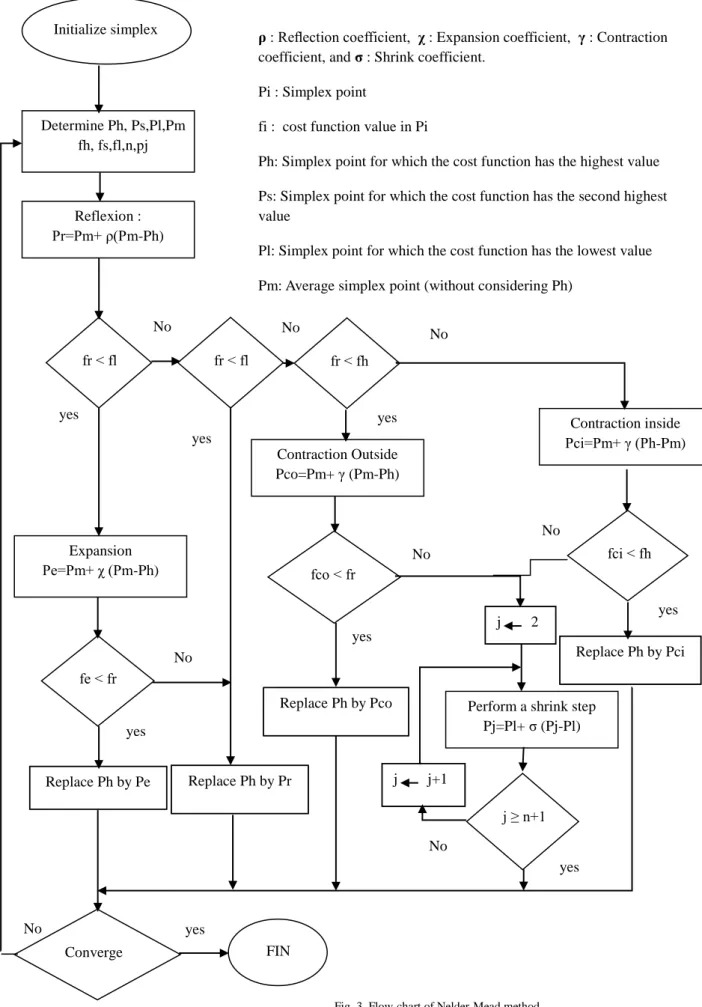
The basic steps of the N-M algorithm are given by the flowchart of Fig.3.
In the following section, several modeling comparisons are conducted using the models given by (1) and (2) for several scenes of the PV database.
V. SIMULATION RESULTS
The Nelder-Mead algorithm has been coded in Matlab environment to extract the PV module parameters using real I-V data. In order to check the effectiveness of the parameters extraction obtained by the application of this algorithm, the collected measurement data from
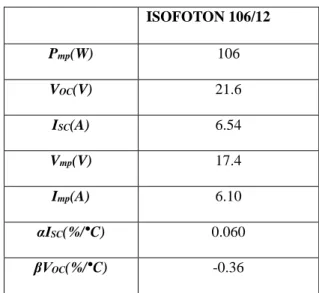
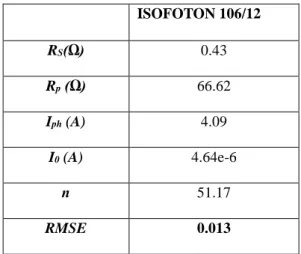
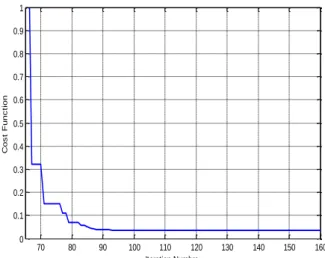
ISOFOTON 106/12 module has been used, where its electrical characteristic are summarized in Table I. Table II summarizes the upper and the lower band of the PV module parameters. In table III, the extracted parameters using N-M algorithm are depicted for the single diode model, while table IV depicts the extracted parameters of the double diode model. A comparison between the measured (I-V), (P-V) characteristics and the estimated ones using the extracted parameters of PV models given by (1) and (2) are presented in Fig.4, Fig.5, Fig.6 and Fig.7 respectively. The validation test using different meteorological conditions is presented in Fig.8. Finally during the extraction process, convergence rate of N-M algorithm is illustrated in Fig.9.
TABLEIELECTRICAL CHARACTERISTIC OF ISOFOTON106/12PV MODULE
ISOFOTON 106/12
Pmp(W) 106
VOC(V) 21.6
ISC(A) 6.54
Vmp(V) 17.4
Imp(A) 6.10
αISC(%/°C) 0.060
Fig. 3. Flow-chart of Nelder-Mead method
ρ : Reflection coefficient, χ : Expansion coefficient, γ : Contraction coefficient, and σ : Shrink coefficient.
Pi : Simplex point
fi : cost function value in Pi
Ph: Simplex point for which the cost function has the highest value
Ps: Simplex point for which the cost function has the second highest value
Pl: Simplex point for which the cost function has the lowest value
Pm: Average simplex point (without considering Ph)
No
yes
No
yes yes
No
yes No
yes
yes
yes
No
No
yes
No
No
Replace Ph by Pco
Replace Ph by Pr j j+1
FIN Converge
Replace Ph by Pe
Replace Ph by Pci j 2
Perform a shrink step Pj=Pl+ σ (Pj-Pl)
j ≥ n+1
fci ˂ fh fr ˂ fh
Contraction inside Pci=Pm+ γ (Ph-Pm) Contraction Outside
Pco=Pm+ γ (Pm-Ph)
Expansion Pe=Pm+ χ (Pm-Ph)
fr ˂ fl fr ˂ fl
Initialize simplex
Determine Ph, Ps,Pl,Pm fh, fs,fl,n,pj
Reflexion : Pr=Pm+ ρ(Pm-Ph)
fco ˂ fr
TABLEIIUPPER AND LOWER VALUES OF THE ISOFOTON106/12PV MODULE
ISOFOTON 106/12
RS(Ω) [0 – 1]
Rp (Ω) [0 - 400]
Iph (A) [0 - 10]
I01/02 (A) [10-7 – 10-4]
n1/2 [0 - 75]
TABLEIII THE EXTRACTED PARAMETERS (SINGLE DIODE MODEL)
ISOFOTON 106/12
RS(Ω) 0.43
Rp (Ω) 66.62
Iph (A) 4.09
I0 (A) 4.64e-6
n 51.17
RMSE 0.013
TABLEIV.THE EXTRACTED PARAMETERS (DOUBLE DIODE MODEL)
ISOFOTON 106/12
RS(Ω) 0.359
Rp (Ω) 70.306
Iph (A) 4.060
I01 (A) 2.971e-06
I02 (A) 2.080e-06
n1 52.111
n2 69.104
RMSE 0.018
Fig. 4. Measured and calculated IV curve of ISOFOTON106/12 PV module (single diode model)
Fig. 5. Measured and calculated PV curve of ISOFOTON106/12 PV module (single diode model)
Fig. 6. Measured and calculated IV curve of ISOFOTON106/12 PV module (double diode model)
0 2 4 6 8 10 12 14 16 18 20
0 0.5 1 1.5 2 2.5 3 3.5 4 4.5
Voltage (V)
C
u
rr
e
n
t
(A
)
Measured I Calculated I
0 2 4 6 8 10 12 14 16 18 20
0 10 20 30 40 50 60
Voltage (V)
P
o
w
e
r
(W
)
Measured P Calculated P
0 2 4 6 8 10 12 14 16 18 20
0 0.5 1 1.5 2 2.5 3 3.5 4 4.5
V (Volt)
I
(A
)
I(V) caracteristic of the PV pannel
Fig. 7. Measured and calculated PV curve of ISOFOTON106/12 PV module (double diode model)
Fig. 8. Measured and calculated IV curve of ISOFOTON106/12 PV module for different meteorological condition
Fig. 9. Convergence speed of N-M algorithm during the extraction process
From the obtained figures (4, 5 and 8) in the case of single diode model, one can see that the theoretical (I-V) characteristics are very close to the experimental measured (I-V) characteristics. The same remark is observed when the double diode model is considered (Fig. 6 and Fig. 7). The results prove the effectiveness of the proposed technique to extract, with good precision, the parameters of the equivalent circuit models.
A comparative study in the case of single diode model with three others optimization algorithms found in the literature [14, 15, 10] has been carried out to check the performance of the proposed algorithm. The algorithms are: Deferential Evolution (DE), Particle Swarm Optimization (PSO) and Bee Colony. From the obtained results, given in table V, and based on the RMSE value, as a test criterion, which is equal to 0.013, we conclude the good quality of the identified parameters using the N-M algorithm with respects to those obtained by DE, PSO and ABC.
TABLEV COMPARATIVE STUDY OF THE OPTIMIZATION ALGORITHMS
Another study to verify the accurateness of the extracted parameters using N-M algorithm is considered where an experiment was carried out on a dynamic maximum power point evolution in a real operating grid connected photovoltaic system. The PV system is situated in the roof top of the administrative building of the "Centre De Développement des Energies Renouvelables (CDER)" in Algiers, Algeria, as shown in Fig.10. It consists of three sub-arrays of 30 PV modules each. The output of each sub-array is
0 2 4 6 8 10 12 14 16 18 20
0 10 20 30 40 50 60
Voltage (V)
P
o
w
e
r
(W
)
Measured P Calculated P
0 5 10 15 20 25
0 1 2 3 4 5 6
Voltage (V)
C
u
rr
e
n
t
(A
)
Measured I for T=48.8C, G=959w/m Calculated I for T=48.8C, G=959w/m Measured I for T=58.2C, G=816w/m Calculated I for T=58.2C, G=816w/m Measured I for T=27.9C, G=752w/m Calculated I for T=27.9C, G=752w/m
70 80 90 100 110 120 130 140 150 160
0 0.1 0.2 0.3 0.4 0.5 0.6 0.7 0.8 0.9 1
Iteration Numbre
C
o
s
t
F
u
n
c
ti
o
n
N-M DE PSO ABC
RS(Ω) 0.43 0.12 0.13 0.12
Rp (Ω) 66.62 120 95.50 103
Iph (A) 4.09 6.71 6.73 6.73
I0 (A) 4.64e-6 1.62e-5 1e-5 1.38e-5
n 51.17 62.53 60.24 61.76
connected to a 2.5 kW single-phase grid connected PV inverter type Fronius IG30.
Fig. 10. The PV system diagram
For this purpose, the adapted model based on MPP daily evolution has been plotted against real MPP profiles obtained for two typical Algerian sky: a clear sky condition and cloudy sky condition. The real PV system is formed by two parallel strings; each string is composed of fifteen serially connected ISOFOTON 106/12 PV modules. The data were recorded with a sampling period of 1 minute.
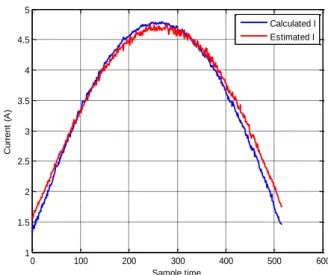
Fig.11 and Fig.12 report the time evolution for the extracted current and power using the NM adapted model and measured ones respectively for a clear sky day profile. While, time evolution of the same quantities for a cloudy day profile is shown in Fig.13 and Fig.14 respectively.
From the simulation results and for the two tests (clear sky and semi-cloudy day), we observe a good agreement between the measured and the estimated values of maximum power point current and power, which prove the effectiveness of the identification process and the powerful of the proposed approach.
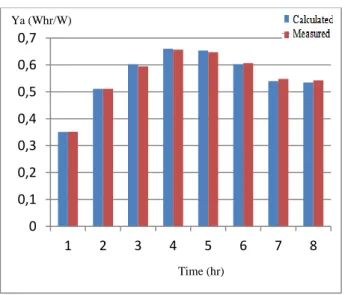
The effectiveness of the proposed approach is more clearly highlighted in the bar-graph of Fig. 15 and Fig. 16, in which it is, reported the predicted and measured hourly array yield (𝑌𝑎) of the clear sky and semi-cloudy day respectively. The hourly array yield (𝑌𝑎) is defined
as the hourly power output of the PV array divided by the nominal rated power of the installed PV array, it is given by:
𝑌𝑎=
∑𝑛𝑖=1∆𝑡.𝑃𝑖 𝑛 ⁄
𝑟𝑎𝑡𝑒𝑑 𝑝𝑜𝑤𝑒𝑟 (6)
where 𝑛 is the number of samples and the rated power is the peak power of the installed PV array.
Fig. 11. Comparison between measured and estimated IMPP for a clear
sky day.
Fig. 12. Comparison between measured and estimated PMPP for a clear
sky day.
0 100 200 300 400 500 600
1 1.5 2 2.5 3 3.5 4 4.5 5
Sample time
C
u
rr
e
n
t
(A
)
Calculated I Estimated I
0 100 200 300 400 500 600
20 30 40 50 60 70 80
Sample time
P
u
is
s
a
n
c
e
(
W
)
Fig. 13. Comparison between measured and estimated IMPP for a
semi-cloudy day.
Fig. 14. Comparison between measured and estimated PMPP for a
semi-cloudy day.
Fig. 15. Hourly array yield for a clear sky day.
Fig. 16. Hourly array yield for a semi-cloudy day.
VI. CONCLUSION
This paper proposes the application of the Nelder Mead algorithm to extract the electrical parameters of a PV module: 𝐼𝑝ℎ, 𝐼0, 𝑅𝑠, 𝑅𝑠ℎ and 𝑛. The proposed
algorithm has been applied to ISOFOTON 106/12 module. The extracted parameters have been integrated in the characteristic equations and then tested against IV curves measurements. The obtained results show clearly the effectiveness of the proposed N-M algorithm to extract PV module parameters. Furthermore a comparison study with other heuristic algorithms such as DE, PSO and ABC has shown the good results of N-M algorithm.
Additional analysis using an experimental test based on the comparison of the adapted model to the MPP evolution against MPP with real weather profiles of typical Algerian sky for two conditions: a clear sky condition and cloudy sky condition. The relative error associated with the simulation results obtained shows that the simulation results are in good agreement with the experimental data at real working condition and justify its use for deeper investigation such as energy prediction of photovoltaic modules.
REFERENCES
[1] D. Sera, R. Teodorescu, and P. Rodriguez, “PV Panel Model Based on Datasheet Values”, IEEE International Symposium on Electronics, ISIE 2007, Vigo, Spain, June 4-7, 2007.
[2] M. Chegaar, Z. Ouennough, F. Guechi, and H. Langueur, “Determination of Solar Cells Parameters Under Illuminated
0 50 100 150 200 250 300 350 400
0 1 2 3 4 5 6 7
Sample time
C
u
rr
e
n
t
(A
)
Calculated I Estimated I
0 50 100 150 200 250 300 350 400
0 20 40 60 80 100 120
Sample time
P
u
is
s
a
n
c
e
(
W
)
Calculated P Estimated P
0 0,1 0,2 0,3 0,4 0,5 0,6 0,7
1 2 3 4 5 6 7 8
Ya (Whr/W)
Time (hr)
0 0,1 0,2 0,3 0,4 0,5 0,6 0,7 0,8 0,9
1 2 3 4 5 6 7
Conditions”, Journal of Electron Devices, vol. 2, pp. 17 – 21, 2003.
[3] L. Han, N. Koide, Y. Chiba and T. Mitate, “Modeling of an Equivalent Circuit for Dye Sensitized Solar Cells”, Applied Physics Letters, vol. 84, no.13, 2433.
[4] W. Xiao, MGJ Lind, W.G. Dunford and A. Capel, “Real-time Identification of Optimal Operating Points in Photovoltaic Power Systems”. IEEE Transactions on Industrial Electronics, vol. 53, no.4, pp. 1017 – 1026, 2006.
[5] M. Ye, X. Wang and Y. Xu, “Parameter Extraction of Solar Cells Using Particle Swarm Optimization”, Journal of Applied Physics, vol. 105, no. 9, 094502, 2009.
[6] T. Huld, R. Gottschalg and H.G. Beyer, “Topic M. Mapping the Performance of a PV modules, Effects of Module Type and Data Averaging”, Solar Energy, no.84, pp. 324 -328, 2010.
[7] T. Easwarakhanthan, J. Bottin, I. Bouhouch and C. Boutrit, “Nonlinear Minimization Algorithm for Determining the Solar Cell Parameters with Microcomputers”, International Journal of Solar Energy, vol. 4, no.1, pp. 1 – 12, 1986.
[8] A. Askarzadeh and A. Rezazadeh, "Extraction of maximum power point in solar cells using bird mating optimizer-based parameters identification approach," Solar Energy, vol. 90, pp. 123-133, 2013
[9] D. Oliva, E. Cuevas, and G. Pajares, "Parameter identification of solar cells using artificial bee colony optimization," Energy, vol. 72, pp.93-102, 2014.
[10] E. Garoudja, K. Kara, A. Chouder and S. Silvestre, "Parameters Extraction of Photovoltaic Module for Long-Term Prediction Using Artifical Bee Colony Optimization," 3rd International Conference on Control, Engineering & Information Technology
(CEIT), 2015, Tlemcen, Algeria, 25-27 May, 2015.
[11] J.-P. Charles, I. Mekkaoui-Alaoui, G. Bordure, and P. Mialhe, "A critical study of the effectiveness of the single and double exponential models for I–V characterization of solar cells," Solid-State Electronics, vol. 28, pp. 807-820, 1985.
[12]Ishaque, Zainal Salam. A comparative MATLAB Simulink PV system simulator with partial shading capability based on two diode model. Solar energy, vol. 85,pp. 2217–2227. 2011.
[13] A. Mezache, M. Sahed, T. Laroussi, D. Chicouche, “Two novel methods for estimating the compound K-clutter parameters in presence of thermal noise”, IET Radar Sonar Navig, vol.5, no.9, pp. 934-942, 2011
[14] K. Ishaque, Z. Salam, H. Taheri, and A. Shamsudin, "Parameter extraction of photovoltaic cell using differential evolution method," in Applied Power Electronics Colloquium (IAPEC), IEEE, 2011, pp.10-15. 2011.
[15] N. F. Abdul Hamid, N. A. Rahim, and J. Selvaraj, "Solar cell parameters extraction using particle swarm optimization algorithm," in Clean Energy and Technology (CEAT), IEEE Conference, pp. 461-465. 2013.
Houcine Oudira was born in Constantine, Algeria, on November 05,1980. He received the Engineering degree in Electronics/Communication, Magister degree and the Doctorate degree in semiconductor sensor in biomedicine from the University of Constantine, Algeria, in 2003, 2005 and 2009 respectively.
He joined the Department of Electronics, the University Mohamed Boudiaf of M’sila, in 2009 as a full-time Professor. He is a member of the LGE (Laboratoire de Génie Electrique) Laboratory, University Mohamed Boudiaf of M’sila, Currently his main research interests include signal processing and renewable energy.
Aissa Chouder received the Ingénieur in Electronics and Magister in Electronics degrees from Ferhat Abbas University, Sétif, Algeria, in 1991 and 1999, respectively, and the Ph.D. degree in electronic engineering from the Universitat Politècnica de Catalunya (UPC), Barcelona, Spain, in 2010. He is currently an associate professor at the electrical engineering department,
University of M’sila, Algeria.