CHAPTER 4 RF/IF CIRCUITS
INTRODUCTION 4.1
SECTION 4.1: MIXERS
4.3THE IDEAL MIXER 4.3
DIODE-RING MIXER 4.6
BASIC OPERATION OF THE ACTIVE MIXER 4.8
REFERENCES 4.10
SECTION 4.2: MODULATORS
4.11SECTION 4.3: ANALOG MULTIPLIERS
4.13REFERENCES 4.20
SECTION 4.4: LOGARITHMIC AMPLIFIERS
4.21REFERENCES 4.28
SECTION 4.5: TRUE-POWER DETECTORS
4.29SECTION 4.6: VARIABLE GAIN AMPLIFIER
4.33VOLTAGE CONTROLLED AMPLIFIERS 4.33
X-AMPS 4.35
DIGITALLY CONTROLLED VGAs 4.38
REFERENCES 4.40
SECTION 4.7: DIRECT DIGITAL SYNTHESIS
4.41DDS 4.41
ALIASING IN DDS SYTEMS 4.45
DDS SYSTEMS AS ADC CLOCK DRIVERS 4.46 AMPLITUDE MODULATION IN A DDS SYSTEM 4.47 SPURIOUS FREE DYNAMIC RANGE CONSIDERATIONS 4.47
REFERENCES 4.50
SECTION 4.8: PHASE-LOCKED LOOPS
4.51PLL SYNTHESIZER BASIC BUILDING BLOCKS 4.53
THE REFERENCE COUNTER 4.56
THE FEEDBACK COUNTER, N 4.56
FRACTIONAL-N SYNTHESIZERS 4.59
NOISE IN OSCILLATOR SYSTEMS 4.60 PHASE NOISE IN VOLTAGE-CONTROLLED OSCILLATORS 4.61
LEESON'S EQUATION 4.62
CLOSING THE LOOP 4.64
PHASE NOISE MEASUREMENTS 4.67
REFERENCE SPURS 4.69
SECTION 4.8: PHASE-LOCKED LOOPS (cont.)
INTRODUCTION
CHAPTER 4: RF/IF CIRCUITS
Introduction
From cellular phones to 2-way pagers to wireless Internet access, the world is becoming more connected, even though wirelessly. No matter the technology, these devices are basically simple radio transceivers (transmitters and receivers). In the vast majority of cases the receivers and transmitters are a variation on the superheterodyne radio shown in Figure 4.1 for the receiver and Figure 4.2 for the transmitter.
Figure 4.1: Basic Superheterodyne Radio Receiver
Figure 4.2: Basic Superheterodyne Radio Transmitter
LO LO
IF AGC
RF DEMOD
LO
LO LOLO
IF AGC
RF DEMOD
LO LO
IF
RF MOD
LO
LO LOLO
IF
The basic concept of operation is as follows. For the receiver, the signal from the antenna is amplified in the radio frequency (RF) stage. The output of the RF stage is one input of a mixer. A Local Oscillator (LO) is the other input. The output of the mixer is at the Intermediate Frequency (IF). The concept here is that is much easier to build a high gain amplifier string at a narrow frequency band than it is to build a wideband, high gain amplifier. Also, the modulation bandwidth is typically very much smaller than the carrier frequency. A second mixer stage converts the signal to the baseband. The signal is then demodulated (demod). The modulation technique is independent from the receiver technology. The modulation scheme could be amplitude modulation (AM), frequency modulation (FM), phase modulation or some form of quadrature amplitude modulation (QAM), which is a combination of amplitude and phase modulation.
To put some numbers around it, let us consider a broadcast FM signal. The carrier frequency is in the range of 98 MHz to 108 MHz. The IF frequency is almost always 10.7 MHz. The baseband is 0 Hz to 15 kHz. This is the sum of the right and left audio frequencies. There is also a modulation band centered at 38 kHz that is the difference of the left and right audio signals. This difference signal is demodulated and summed with the sum signal to generate the separate left and right audio signals.
On the transmit side the mixers convert the frequencies up instead of down.
These simplified block diagrams neglect some of the refinements that may be incorporated into these designs, such as power monitoring and control of the transmitter power amplifier as achieved with the “True-Power” circuits.
As technology has improved, we have seen the proliferation of IF sampling. ADCs of sufficient performance have been developed which allows the sampling of the signal at the IF frequency range, with demodulation occurring in the digital domain. This allows for system simplification by eliminating a mixer stage.
In addition to the basic building blocks that are the subject of this chapter, these circuit blocks often appear as building blocks in larger application specific integrated circuits (ASIC).
MIXER
SECTION 4.1: MIXERS
The Ideal Mixer
An idealized mixer is shown in Figure 4.3. An RF (or IF) mixer (not to be confused with video and audio mixers) is an active or passive device that converts a signal from one frequency to another. It can either modulate or demodulate a signal. It has three signal connections, which are called ports in the language of radio engineers. These three ports are the radio frequency (RF) input, the local oscillator (LO) input, and the intermediate frequency (IF) output.
Figure 4.3: The Mixing Process
A mixer takes an RF input signal at a frequency fRF, mixes it with a LO signal at a frequency fLO, and produces an IF output signal that consists of the sum and difference frequencies, fRF ± fLO. The user provides a bandpass filter that follows the mixer and selects the sum (fRF + fLO) or difference (fRF – fLO) frequency.
Some points to note about mixers and their terminology:
• When the sum frequency is used as the IF, the mixer is called anupconverter; when the difference is used, the mixer is called a downconverter. The former is typically used in a transmit channel, the latter in a receive channel.
• In a receiver, when the LO frequency is below the RF, it is calledlow-side injection and the mixer a low-side downconverter; when the LO is above the RF, it is called high-side injection, and the mixer a high-side downconverter.
RF INPUT IF OUTPUT
IDEAL MIXER
LO INPUT fLO
fRF + fLO fRF - fLO fRF
• Each of the outputs is only half the amplitude (one-quarter the power) of the individual inputs; thus, there is a loss of 6 dB in this ideal linear mixer. (In a practical multiplier, the conversion loss may be greater than 6 dB, depending on the scaling parameters of the device. Here, we assume a mathematical multiplier, having no dimensional attributes.) A mixer can be implemented in several ways, using active or passive techniques.
Ideally, to meet the low noise, high linearity objectives of a mixer we need some circuit that implements a polarity-switching function in response to the LO input. Thus, the mixer can be reduced to Figure 4.4, which shows the RF signal being split into in-phase (0°) and anti-phase (180°) components; a changeover switch, driven by the local oscillator (LO) signal, alternately selects the in-phase and antiphase signals. Thus reduced to essentials, the ideal mixer can be modeled as a sign-switcher.
Figure 4.4: An Ideal Switching Mixer
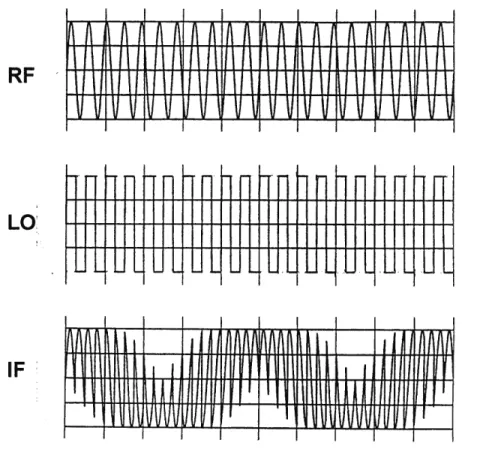
In a perfect embodiment, this mixer would have no noise (the switch would have zero resistance), no limit to the maximum signal amplitude, and would develop no intermodulation between the various RF signals. Although simple in concept, the waveform at the intermediate frequency (IF) output can be very complex for even a small number of signals in the input spectrum. Figure 3.43 shows the result of mixing just a single input at 11 MHz with an LO of 10 MHz.
The wanted IF at the difference frequency of 1 MHz is still visible in this waveform, and the 21 MHz sum is also apparent. How are we to analyze this?
We still have a product, but now it is that of a sinusoid (the RF input) at ωRF and a variable that can only have the values +1 or –1, that is, a unit square wave at ωLO. The latter can be expressed as a Fourier series
SLO = 4/π{ sinω
LOt - 1/3 sin3ωLOt + 1/5 sin5ωLOt – . . . . } Eq. 4-1
RF INPUT IF OUTPUT
SWITCH, fLO +1
MIXER
Figure 4.5: Inputs and Output for an Ideal Switching Mixer for fRF = 11MHz, fLO= 10MHz
Thus, the output of the switching mixer is its RF input, which we can simplify as sinωRFt, multiplied by the above expansion for the square wave, producing
SIF = 4/π{ sinω
RFt sinωLOt – 1/3 sinωRFt sin3ωLOt
+ 1/
5 sin5ωRFt sin5ωLOt – . . . . } Eq. 4-2
Now expanding each of the products, we obtain SIF = 2/
π{ sin(ωRF + ωLO)t + sin(ωRF – ωLO)t
– 1/
3 sin(ωRF + 3ωLO)t – 1/3 sin(ωRF – 3ωLO)t
+ 1/
5 sin(ωRF + 5ωLO)t + 1/5 sin(ωRF – 5 ωLO)t – . . . } Eq. 4-3
or simply
SIF = 2/π { sin(ω
RF + ωLO)t + sin(ωRF – ωLO)t + harmonics } Eq. 4-4
The most important of these harmonic components are sketched in Figure 4.6 for the particular case used to generate the waveform shown in Figure 4.5, that is, fRF = 11 MHz and fLO = 10 MHz. Because of the 2/π term, a mixer has a minimum 3.92 dB insertion loss (and noise figure) in the absence of any gain.
Figure 4.6: Output Spectrum for a Switching Mixer for fRF = 11MHz and fLO = 10MHz
Note that the ideal (switching) mixer has exactly the same problem of image response to
ωLO – ωRF as the linear multiplying mixer. The image response is somewhat subtle, as it does not immediately show up in the output spectrum: it is a latent response, awaiting the occurrence of the “wrong” frequency in the input spectrum.
Diode-Ring Mixer
For many years, the most common mixer topology for high-performance applications has been the diode-ring mixer, one form of which is shown in Figure 4.7. The diodes, which may be silicon junction, silicon Schottky-barrier or gallium-arsenide types, provide the essential switching action. We do not need to analyze this circuit in great detail, but note in passing that the LO drive needs to be quite high—often a substantial fraction of one watt—in order to ensure that the diode conduction is strong enough to achieve low noise and to allow large signals to be converted without excessive spurious nonlinearity. Because of the highly nonlinear nature of the diodes, the impedances at the three ports are poorly controlled, making matching difficult. Furthermore, there is considerable coupling between the three ports; this, and the high power needed at the LO port, make it very likely that there will be some component of the (highly-distorted) LO signal coupled back toward the antenna. Finally, it will be apparent that a passive mixer such as this cannot provide conversion gain; in the idealized scenario, there will be a conversion loss of 2/π
[as Eq. 4-4 shows], or 3.92 dB. A practical mixer will have higher losses, due to the resistances of the diodes and the losses in the transformers.
LINEAR AMPLITUDE
0 10 20 30 40 50 60 FREQUENCY (MHz)
0.127 0.8
0.6
0.4
0.2
0
0.637 = -3.9dB 0.212 = -13.5dB 0.127 = -17.9dB 0.090 = -20.9dB
0.09 0.212
0.127 0.212
0.637 0.637
SUM AT 21MHz WANTED IF
MIXER
Figure 4.7: Diode-Ring Mixer
Users of this type of mixer are accustomed to judging the signal handling capabilities by a Level rating. Thus, a Level-17 mixer needs +17 dBm (50 mW) of LO drive and can handle an RF input as high as +10 dBm (±1 V). A typical mixer in this class would be the Mini-Circuits LRMS-1H, covering 2 MHz to 500 MHz, having a nominal insertion loss of 6.25 dB (8.5 dB max), a worst-case LO-RF isolation of 20 dB and a worst-case LO-IF isolation of 22 dB (these figures for an LO frequency of 250 MHz to 500 MHz). The price of this component is approximately $10.00 in small quantities. Even the most expensive diode-ring mixers have similar drive power requirements, high losses and high coupling from the LO port.
The diode-ring mixer not only has certain performance limitations, but it is also not amenable to fabrication using integrated circuit technologies, at least in the form shown in Figure 4.7. In the mid sixties it was realized that the four diodes could be replaced by four transistors to perform essentially the same switching function. This formed the basis of the now-classical bipolar circuit shown in Figure 4.8, which is a minimal configuration for the fully-balanced version. Millions of such mixers have been made, including variants in CMOS and GaAs. We will limit our discussion to the BJT form, an example of which is the Motorola MC1496, which, although quite rudimentary in structure, has been a mainstay in semi-discrete receiver designs for about 25 years.
Theactive mixer is attractive for the following reasons:
• It can be monolithically integrated with other signal processing circuitry.
• It can provide conversion gain, whereas a diode-ring mixer always has an insertion loss. (Note: Active mixers may have gain. The Analog Devices' AD831 active mixer, for example, amplifies the result in Eq. 4-4 by π/2 to provide unity gain from RF to IF.)
• It requires much less power to drive the LO port.
• It provides excellent isolation between the signal ports.
RF IN IF
OUT LO
• Is far less sensitive to load-matching, requiring neither diplexer nor broadband termination.
Using appropriate design techniques it can provide trade-offs between third-order intercept (3OI or IP3) and the 1 dB gain-compression point (P1dB), on the one hand, and total power consumption (PD) on the other. (That is, including the LO power, which in a passive mixer is hidden in the drive circuitry.)
Basic Operation of the Active Mixer
Unlike the diode-ring mixer, which performs the polarity-reversing switching function in the voltage domain, the active mixer performs the switching function in the current domain. Thus the active mixer core (transistors Q3 through Q6 in Figure 4.8) must be driven by current-mode signals. The voltage-to-current converter formed by Q1 and Q2 receives the voltage-mode RF signal at their base terminals and transforms it into a differential pair of currents at their collectors.
Figure 4.8: Classic Active Mixer
A second point of difference between the active mixer and diode ring mixer, therefore, is that the active mixer responds only to magnitude of the input voltage, not to the input power; that is, the active mixer is not matched to the source. (The concept of matching is that both the current and the voltage at some port are used by the circuitry which forms that port). By altering the bias current, IEE, the transconductance of the input pair Q1–Q2
LO INPUT
IF OUTPUT
Q2
IEE
Q6 Q5
Q4 Q3
Q1
RF INPUT
MIXER
can be set over a wide range. Using this capability, an active mixer can provide variable gain.
A third point of difference is that the output (at the collectors of Q3–Q6) is in the form of a current, and can be converted back to a voltage at some other impedance level to that used at the input, hence, can provide further gain. By combining both output currents (typically, using a transformer) this voltage gain can be doubled. Finally, it will be apparent that the isolation between the various ports, in particular, from the LO port to the RF port, is inherently much lower than can be achieved in the diode ring mixer, due to the reversed-biased junctions that exist between the ports.
Briefly stated, though, the operation is as follows. In the absence of any voltage difference between the bases of Q1 and Q2, the collector currents of these two transistors are essentially equal. Thus, a voltage applied to the LO input results in no change of output current. Should a small dc offset voltage be present at the RF input (due typically to mismatch in the emitter areas of Q1 and Q2), this will only result in a small feedthrough of the LO signal to the IF output, which will be blocked by the first IF filter. Conversely, if an RF signal is applied to the RF port, but no voltage difference is applied to the LO input, the output currents will again be balanced. A small offset voltage (due now to emitter mismatches in Q3–Q6) may cause some RF signal feedthrough to the IF output; as before, this will be rejected by the IF filters. It is only when a signal is applied to both the RF and LO ports that a signal appears at the output; hence, the term doubly-balanced mixer.
Active mixers can realize their gain in one other way: The matching networks used to transform a 50 Ω source to the (usually) high input impedance of the mixer provides an impedance transformation and thus voltage gain due to the impedance step up. Thus, an active mixer that has loss when the input is terminated in a broadband 50 Ω termination can have “gain” when an input matching network is used.
REFERENCES:
1. Barrie Gilbert, ISSCC Digest of Technical Papers 1968, pp. 114-115, February 16, 1968. 2. Barrie Gilbert, Journal of Solid State Circuits, Vol. SC-3, December 1968, pp. 353-372. 3. C.L. Ruthroff, Some Broadband Transformers, Proc. I.R.E., Vol.47, August, 1959,
pp.1337-1342.
4. James M. Bryant, Mixers for High Performance Radio, Wescon 1981: Session 24 (Published by Electronic Conventions, Inc., Sepulveda Blvd.,El Segundo, CA)
5. P.E. Chadwick, High Performance IC Mixers, IERE Conference on Radio Receivers and Associated Systems, Leeds, 1981, IERE ConferencePublication No. 50.
6. P.E. Chadwick, Phase Noise, Intermodulation, and Dynamic Range, RF Expo, Anaheim, CA, January, 1986.
MODULATOR
SECTION 4.2:
MODULATORS
Modulators (sometimes called balanced-modulators, doubly-balanced modulators or even on occasions high level mixers) can be viewed as sign-changers. The two inputs, X and Y, generate an output W, which is simply one of these inputs (say, Y) multiplied by just the sign of the other (say, X), that is W = Y* sign (X). Therefore, no reference voltage is required. A good modulator exhibits very high linearity in its signal path, with precisely equal gain for positive and negative values of Y, and precisely equal gain for positive and negative values of X. Ideally, the amplitude of the X input needed to fully switch the output sign is very small, that is, the X-input exhibits a comparator-like behavior. In some cases, where this input may be a logic signal, a simpler X-channel can be used.
As an example, the AD8345 is a silicon RFIC quadrature modulator, designed for use from 250 MHz to 1000 MHz. Its excellent phase accuracy and amplitude balance enable the high performance direct modulation of an IF carrier.
The AD8345 accurately splits the external LO signal into two quadrature components through the polyphase phase-splitter network. The two I and Q LO components are mixed with the baseband I and Q differential input signals. Finally, the outputs of the two mixers are combined in the output stage to provide a single-ended 50 Ω drive at VOUT.
ANALOG MULTIPLIERS
S
ECTION 4.3: ANALOG MULTIPLIERS
A multiplier is a device having two input ports and an output port. The signal at the output is the product of the two input signals. If both input and output signals are voltages, the transfer characteristic is the product of the two voltages divided by a scaling factor, K, which has the dimension of voltage (see Figure 4.10). From a mathematical point of view, multiplication is a four quadrant operation—that is to say that both inputs may be either positive or negative and the output can be positive or negative. Some of the circuits used to produce electronic multipliers, however, are limited to signals of one polarity. If both signals must be unipolar, we have a single quadrant multiplier, and the output will also be unipolar. If one of the signals is unipolar, but the other may have either polarity, the multiplier is a two quadrant multiplier, and the output may have either polarity (and is bipolar). The circuitry used to produce one- and two-quadrant multipliers may be simpler than that required for four quadrant multipliers, and since there are many applications where full four quadrant multiplication is not required, it is common to find accurate devices which work only in one or two quadrants. An example is the AD539, a wideband dual two-quadrant multiplier which has a single unipolar Vy input with a relatively limited bandwidth of 5 MHz, and two bipolar Vx inputs, one per multiplier, with bandwidths of 60 MHz. A block diagram of the AD539 is shown in Figure 4.12.
Figure 4.10: An Analog Multiplier Block Diagram
Figure 4.11: Definition of Multiplier Quadrants V
V
Vout y
x
= V Vx y
K K = SCALE FACTOR
Type Single Quadrant Two Quadrant Four Quadrant VX Unipolar Bipolar Bipolar VY Unipolar Unipolar Bipolar Vout Unipolar Bipolar Bipolar Type Single Quadrant Two Quadrant Four Quadrant VX Unipolar Bipolar Bipolar VY Unipolar Unipolar Bipolar Vout Unipolar Bipolar Bipolar
Figure 4.12: AD539 Block Diagram
The simplest electronic multipliers use logarithmic amplifiers. The computation relies on the fact that the antilog of the sum of the logs of two numbers is the product of those numbers (see Figure 4.13).
Figure 4.13: Multiplication Using Log Amps
Z1 VX1 VY VX2 Z2 CH1 CH2 MULT MULT EXTERNAL OP AMPS W1 W2 VW1= -VX1 VY
VW2= -VX2 VY Z1 VX1 VY VX2 Z2 CH1 CH2 MULT MULT EXTERNAL OP AMPS W1 W2 VW1= -VX1 VY
VW2= -VX2 VY
MULTIPLICATION
RAISING TO A POWER A
+
−
ANTILOG ANTILOG ANTILOG DIVISION LOG LOG LOG LOG LOG XA XY X Y XA X Y X X Y MULTIPLICATIONRAISING TO A POWER A
+
−
ANTILOG ANTILOG ANTILOG DIVISION LOG LOG LOG LOG LOG XA XY X Y XA X Y X X YANALOG MULTIPLIERS
The disadvantages of this type of multiplication are the very limited bandwidth and single quadrant operation. A far better type of multiplier uses the Gilbert Cell. This structure was invented by Barrie Gilbert, now of Analog Devices, in the late 1960s. (See References 1 and 2).
There is a linear relationship between the collector current of a silicon junction transistor and its transconductance (gain) which is given by
dIc / dVbe = qIc / kT where
Ic = the collector current
Vbe = the base-emitter voltage
q = the electron charge (1.60219x10⁻¹⁹)
k = Boltzmann's constant (1.38062x10⁻²³)
T = the absolute temperature.
This relationship may be exploited to construct a multiplier with a differential (long-tailed) pair of silicon transistors, as shown in Figure 4.14.
This is a rather poor multiplier because (1) the Y input is offset by the Vbe—which changes nonlinearly with Vy; (2) the X input is nonlinear as a result of the exponential relationship between Ic and Vbe; and (3) the scale factor varies with temperature.
Figure 4.14: Basic Transconductance Multiplier
VX
IC1 IC2
10Ω
4.7k 10k
VY(NEGATIVE)
IC1 - IC2 = ΔIC = q kT
VY + Vbe 4.7 x 10³
10 10,010
VX
= 8.3 x 10⁻⁶ (VY+ 0.6) VX@ 25° C VX
IC1 IC2
10Ω
4.7k 10k
VY(NEGATIVE)
IC1 - IC2 = ΔIC = q kT
VY + Vbe 4.7 x 10³
10 10,010
VX
= 8.3 x 10⁻⁶ (VY+ 0.6) VX@ 25° C
Gilbert realized that this circuit could be linearized and made temperature stable by working with currents, rather than voltages, and by exploiting the logarithmic Ic/Vbe properties of transistors (See Figure 4.15.) The X input to the Gilbert Cell takes the form of a differential current, and the Y input is a unipolar current. The differential X currents flow in two diode-connected transistors, and the logarithmic voltages compensate for the exponential Vbe/Ic relationship. Furthermore, the q/kT scale factors cancel. This gives the Gilbert Cell the linear transfer function
ΔIc = ΔΙx Iy Ix
Figure 4.15: Gilbert Cell
As it stands, the Gilbert Cell has three inconvenient features: (1) its X input is a differential current; (2) its output is a differential current; and (3) its Y input is a unipolar current—so the cell is only a two quadrant multiplier.
By cross-coupling two such cells and using two voltage-to-current converters (as shown in Figure 4.16), we can convert the basic architecture to a four quadrant device with voltage inputs, such as the AD534. At low and medium frequencies, a subtractor amplifier may be used to convert the differential current at the output to a voltage. Because of its voltage output architecture, the bandwidth of the AD534 is only about 1 MHz, although the AD734, a later version, has a bandwidth of 10 MHz.
In Figure 4.16, Q1A and Q1B, Q2A and Q2B form the two core long-tailed pairs of the two Gilbert Cells, while Q3A and Q3B are the linearizing transistors for both cells. In Figure 3.35 there is an operational amplifier acting as a differential current to single-ended voltage converter, but for higher speed applications, the cross-coupled collectors of Q1 and Q2 form a differential open collector current output (as in the AD834 500 MHz multiplier).
ID1
IX + ΔIX IC1 IC2 IX -ΔIX
ID2 D2 D1 Q1 Q2 V2 V1 IREF IY /α +
+ +
+
-- - V4
V3
ΔIC= IC1- IC2
DIC= DIXIY IX ID1
IX + ΔIX IC1 IC2 IX -ΔIX
ID2 D2 D1 Q1 Q2 V2 V1 IREF IY /α +
+ +
+
-- - V4
V3
ΔIC= IC1- IC2
DIC= DIXIY IX
ANALOG MULTIPLIERS
Figure 4.16: A 4-Quadrant Translinear Multiplier
The translinear multiplier relies on the matching of a number of transistors and currents. This is easily accomplished on a monolithic chip. Even the best IC processes have some residual errors, however, and these show up as four dc error terms in such multipliers. Offset voltage on the X input shows up as feedthrough of the Y input. Conversely, offset voltage on the Y input shows up as feedthrough of the X input. Offset voltage on the Z input causes offset of the output signal and resistor mismatch causes gain error. In early Gilbert Cell multipliers, these errors had to be trimmed by means of resistors and potentiometers external to the chip, which was somewhat inconvenient. With modern analog processes, which permit the laser trimming of SiCr thin film resistors on the chip itself, it is possible to trim these errors during manufacture so that the final device has very high accuracy. Internal trimming has the additional advantage that it does not reduce the high frequency performance, as may be the case with external trim potentiometers. Because the internal structure of the translinear multiplier is necessarily differential, the inputs are usually differential as well (after all, if a single-ended input is required it is not hard to ground one of the inputs). This is not only convenient in allowing common-mode signals to be rejected, it also permits more complex computations to be performed. The AD534 (shown previously in Figure 4.16) is the classic example of a four-quadrant multiplier based on the Gilbert Cell. It has an accuracy of 0.1% in the multiplier mode, fully differential inputs, and a voltage output. However, as a result of its voltage output architecture, its bandwidth is only about 1 MHz.
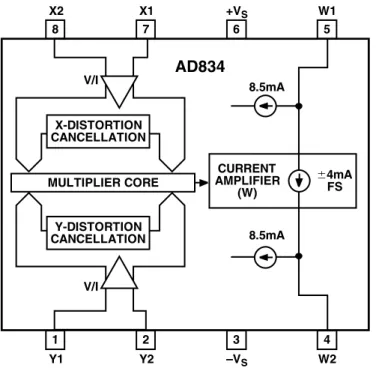
For wideband applications, the basic multiplier with open collector current outputs is used. The AD834 is an 8-pin device with differential X inputs, differential Y inputs, differential open collector current outputs, and a bandwidth of over 500 MHz. A block diagram is shown in Figure 4.17.
+VS
A Q1
A A
A1 B B
Q2
VY
Q3 B
EO
VREF -VS
VX
+VS
A Q1
A A
A1 B B
Q2
VY
Q3 B
EO
VREF -VS
X-DISTORTION CANCELLATION
AD834
MULTIPLIER CORE
CURRENT AMPLIFIER
(W)
±4mA FS
X2 X1 +VS W1
Y1 V/I V/I
Y2 –VS W2
8.5mA 8.5mA
8 7 6 5
1 2 3 4
Y-DISTORTION CANCELLATION
Figure 4.17: AD834 500 MHz 4 Quadrant Multiplier The AD834 is a true linear multiplier with a transfer function of
Iout = VVx Vy• •
1 250Ω
Its X and Y offsets are trimmed to 500 µV (3 mV max), and it may be used in a wide variety of applications including multipliers (broadband and narrowband), squarers, frequency doublers, and high frequency power measurement circuits. A consideration when using the AD834 is that, because of its very wide bandwidth, its input bias currents, approximately 50 µA per input, must be considered in the design of input circuitry lest, flowing in source resistances, they give rise to unplanned offset voltages.
A basic wideband multiplier using the AD834 is shown in Figure 4.18. The differential output current flows in equal load resistors, R1 and R2, to give a differential voltage output. This is the simplest application circuit for the device. Where only the high frequency outputs are required, transformer coupling may be used, with either simple transformers see Fig. 4.19), or for better wideband performance, transmission line or "Ruthroff" transformers.
Low speed multipliers are also discussed in Chapter 2 (Section 2.11).
ANALOG MULTIPLIERS
Figure 4.18: Basic AD834 Multiplier
Figure 4.19: Transformer Coupled AD834 Multiplier
Y-INPUT ±1V FS OPTIONAL TERMINATION RESISTOR OPTIONAL TERMINATION RESISTOR X-INPUT ±1V FS AD834
8 7 6 5
1 2 3 4
W2 -VS Y2 Y1
X2 X1 +VS W1
R3 62Ω
1μF CERAMIC
1μF CERAMIC
R4 4.7Ω -5V W OUTPUT ±400mV FS R1
49.9Ω 49.9R2Ω
+5V
AD834
8 7 6 5
1 2 3 4
W2 -VS Y2 Y1
X2 X1 +VS W1 OPTIONAL TERMINATION RESISTOR X-INPUT ±1V FS Y-INPUT ±1V FS OPTIONAL TERMINATION RESISTOR 1μF CERAMIC +5V 1μF CERAMIC -5V LOAD 4.7Ω 49.9Ω AD834
8 7 6 5
1 2 3 4
W2 -VS Y2 Y1
X2 X1 +VS W1 OPTIONAL TERMINATION RESISTOR X-INPUT ±1V FS Y-INPUT ±1V FS OPTIONAL TERMINATION RESISTOR 1μF CERAMIC +5V 1μF CERAMIC -5V LOAD 4.7Ω 49.9Ω
REFENCES:
1. Daniel H. Sheingold, Editor, Nonlinear Circuits Handbook, Analog Devices, Inc., l974. 2. AN-309: Build Fast VCAs and VCFs with Analog Multipliers.
LOGARITHMIC AMPLIFIERS
SECTION 4.4: LOGARITHMIC AMPLIFIERS
In Chapter 2 (Section 2.8) we discussed low frequency logarithmic (log) amps. In this section we discuss high frequency applications.
The classic diode/op amp (or transistor/op amp) log amp suffers from limited frequency response, especially at low levels. For high frequency applications, detecting and true log
architectures are used. Although these differ in detail, the general principle behind their design is common to both: instead of one amplifier having a logarithmic characteristic, these designs use a number of similar cascaded linear stages having well-defined large signal behavior.
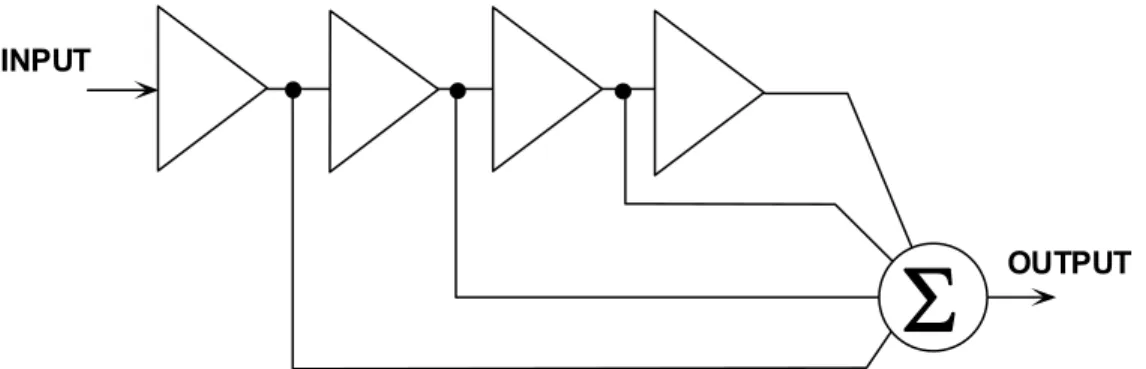
Consider N cascaded limiting amplifiers, the output of each driving a summing circuit as well as the next stage (Figure 4.20). If each amplifier has a gain of A dB, the small signal gain of the strip is NA dB.
If the input signal is small enough for the last stage not to limit, the output of the summing amplifier will be dominated by the output of the last stage.
Figure 4.20: Basic Multistage Log Amp Architecture
As the input signal increases, the last stage will limit, and so will not add any more gain. Therefore it will now make a fixed contribution to the output of the summing amplifier, but the incremental gain to the summing amplifier will drop to (N − 1)A dB. As the input continues to increase, this stage in turn will limit and make a fixed contribution to the output, and the incremental gain will drop to (N − 2)A dB, and so forth—until the first stage limits, and the output ceases to change with increasing signal input.
The response curve is thus a set of straight lines as shown in Figure 4.21. The total of these lines, though, is a very good approximation to a logarithmic curve, and in practical cases, is an even better one, because few limiting amplifiers, especially high frequency ones, limit quite as abruptly as this model assumes.
OUTPUT INPUT
Figure 4.21: Basic Multistage Log Amp Response (Uniploar Case)
The choice of gain, A, will also affect the log linearity. If the gain is too high, the log approximation will be poor. If it is too low, too many stages will be required to achieve the desired dynamic range. Generally, gains of 10 dB to 12 dB (3× to 4×) are chosen. This is, of course, an ideal and very general model—it demonstrates the principle, but its practical implementation at very high frequencies is difficult. Assume that there is a delay in each limiting amplifier of t nanoseconds (this delay may also change when the amplifier limits but let's consider first order effects!). The signal which passes through all N stages will undergo delay of Nt nanoseconds, while the signal which only passes one stage will be delayed only t nanoseconds. This means that a small signal is delayed by Nt nanoseconds, while a large one is “smeared,” and arrives spread over Nt nanoseconds. A nanosecond equals a foot at the speed of light, so such an effect represents a spread in position of Nt feet in the resolution of a radar system—which may be unacceptable in some systems (for most log amp applications this is not a problem).
A solution is to insert delays in the signal paths to the summing amplifier, but this can become complex. Another solution is to alter the architecture slightly so that instead of limiting gain stages, we have stages with small signal gain of A and large signal (incremental) gain of unity (0 dB). We can model such stages as two parallel amplifiers, a limiting one with gain, and a unity gain buffer, which together feed a summing amplifier as shown in Figure 4.22.
OUTPUT
INPUT
G = 0 G = (N-4)A dB G = (N-3)A dB
G = (N-2)A dB G = (N-1)A dB G = NA dB
}
}
}
LOGARITHMIC AMPLIFIERS
Figure 4.22: Structure and Performance of True Log Amp Element, and of a Log Amp Formed by Several Such Elements
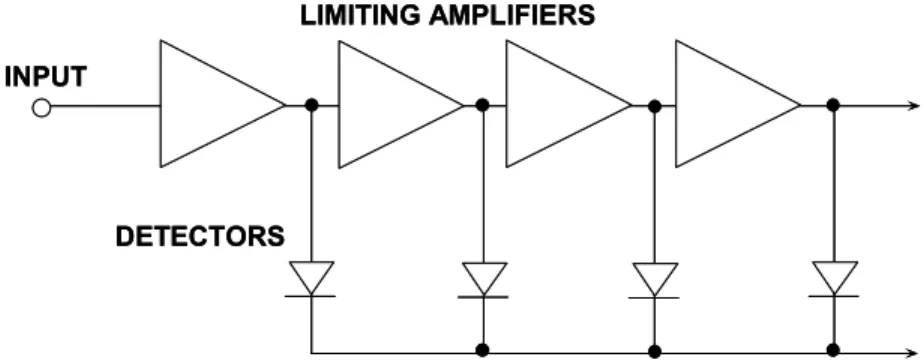
The successive detection log amp consists of cascaded limiting stages as described above, but instead of summing their outputs directly, these outputs are applied to detectors, and the detector outputs are summed as shown in Figure 4.23. If the detectors have current outputs, the summing process may involve no more than connecting all the detector outputs together.
Figure 4.23: Successive Detection Log Amp with Log and Limiter Outputs
Log amps using this architecture have two outputs: the log output and a limiting output. In many applications, the limiting output is not used, but in some (FM receivers with
OUTPUT
OUTPUT
OUTPUT
INPUT INPUT
INPUT
Σ
UNITY GAIN AMPLIFIER GAIN = 1 LIMITING AMPLIFIER
GAIN = 3
UNITY GAIN (LARGE SIGNAL) GAIN = 4
(SMALL SIGNAL)
INPUT
DETECTORS
LIMITING AMPLIFIERS
DETECTORS MAY BE FULL OR HALF WAVE SHOULD BE CURRENT OUTPUT DEVICES (NOT SIMPLE DIODES) SO THAT OUTPUTS MAY BE SUMMED WITHOUT ADDITIONAL SUMMING COMPONENTS BEING NECESSARY INPUT
DETECTORS
LIMITING AMPLIFIERS
DETECTORS MAY BE FULL OR HALF WAVE SHOULD BE CURRENT OUTPUT DEVICES (NOT SIMPLE DIODES) SO THAT OUTPUTS MAY BE SUMMED WITHOUT ADDITIONAL SUMMING COMPONENTS BEING NECESSARY
“S”-meters, for example), both are necessary. The limited output is especially useful in extracting the phase information from the input signal in polar demodulation techniques. The log output of a successive detection log amplifier generally contains amplitude information, and the phase and frequency information is lost. This is not necessarily the case, however, if a half-wave detector is used, and attention is paid to equalizing the delays from the successive detectors—but the design of such log amps is demanding. The specifications of log amps will include noise, dynamic range, frequency response
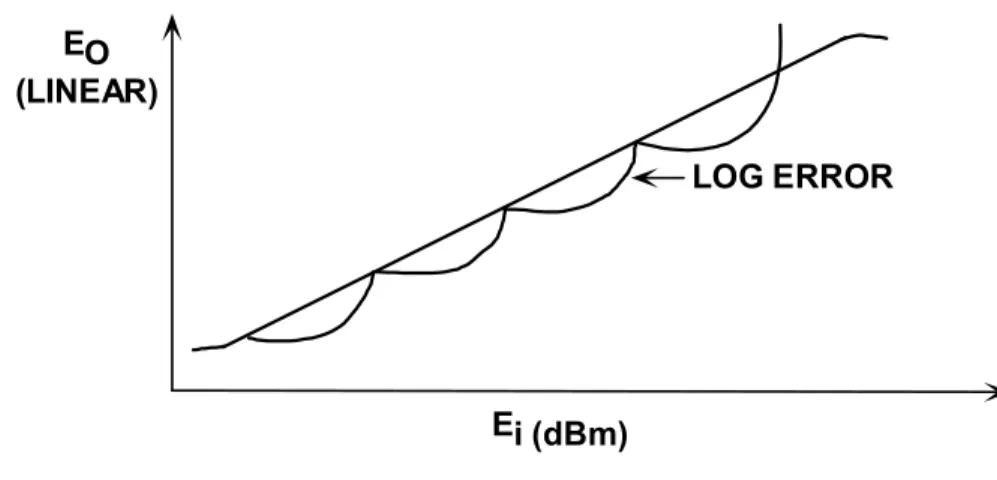
(some of the amplifiers used as successive detection log amp stages have low frequency as well as high frequency cutoff), the slope of the transfer characteristic (which is expressed as V/dB or mA/dB depending on whether we are considering a voltage- or current-output device), the intercept point (the input level at which the output voltage or current is zero), and the log linearity. (See Figures 4.23 and 4.24.)
Figure 4.24: Successive Detection Log Linearity
In the past, it has been necessary to construct high performance, high frequency successive detection log amps (called log strips) using a number of individual monolithic limiting amplifiers such as the Plessey SL-1521-series. Recent advances in IC processes, however, have allowed the complete log strip function to be integrated into a single chip, thereby eliminating the need for costly hybrid log strips.
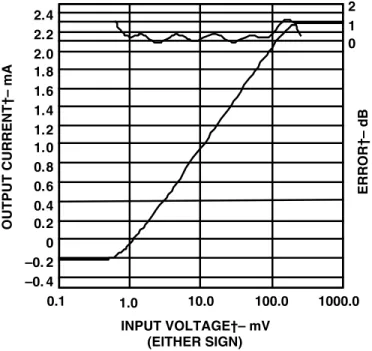
The AD641 log amp contains five limiting stages (10 dB per stage) and five full-wave detectors in a single IC package, and its logarithmic performance extends from dc to 250 MHz. Furthermore, its amplifier and full-wave detector stages are balanced so that, with proper layout, instability from feedback via supply rails is unlikely. A block diagram of the AD641 is shown in Figure 4.25. Unlike many previously integrated circuit log amps, the AD641 is laser trimmed to high absolute accuracy of both slope and intercept, and is fully temperature compensated. The transfer function for the AD641 as well as the log linearity is shown in Figure 4.26.
EO (LINEAR)
Ei (dBm)
LOGARITHMIC AMPLIFIERS ATN LO ATN COM SIG +IN SIG†–IN ATN COM COM 27Ω
30Ω 270Ω
ATN IN
1kΩ 1kΩ
RG1 RG0 RG2
–VS BL1
+VS LOG OUT LOG COM
SIG +OUT SIG†–OUT
BL2 ITC 20
GAIN BIAS REGULATOR
AMPLIFIER/LIMITER 10d B AMPLIFIER/LIMITER 10dB AMPLIFIER/LIMITER 10d B AMPLIFIER/LIMITER FULL-WAVE DETECTOR FULL-WAVE DETECTOR FULL-WAVE DETECTOR FULL-WAVE DETECTOR 10dB AMPLIFIER/LIMITER FULL-WAVE DETECTOR 10d B ATN OUT 1 2 3 6 4 5 19 18 13 9 8 11 10 12
SLOPE BIAS REGULATOR I NTERCEPT POSITIONING BIAS 14
15 16
17
7
Figure 4.25: Block Diagram of the AD641 Monolithic Log Amp
INPUT VOLTAGE†– mV (EITHER SIGN) OUTPUT C URR ENT†– mA 2 1.0
0.1 10.0 100.0 1000.0 1 1.2 1.4 1.6 1.8 2.0 2.2 2.4 0.8 0.6 0.4 0.2 0 –0. 2 –0. 4 ER ROR†– dB 0 1.0
Figure 4.26: DC Logarithmic Transfer Function and Error Curve for a Single AD641
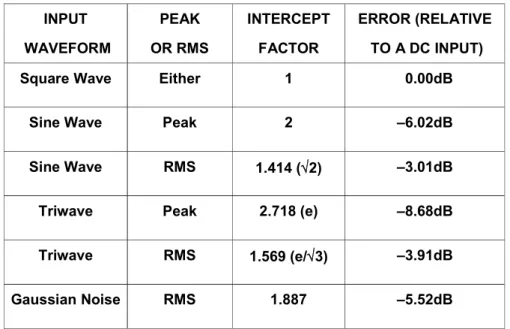
Because of its high accuracy, the actual waveform driving the AD641 must be considered when calculating responses. When a waveform passes through a log function generator, the mean value of the resultant waveform changes. This does not affect the slope of the response, but the apparent intercept is modified.
The AD641 is calibrated and laser trimmed to give its defined response to a dc level or a symmetrical 2 kHz square wave. It is also specified to have an intercept of 2 mV for a sine wave input (that is to say a 2 kHz sine wave of amplitude 2 mV peak [not peak-to-peak] gives the same mean output signal as a dc or square wave signal of 1 mV).
The waveform also affects the ripple or nonlinearity of the log response. This ripple is greatest for dc or square wave inputs because every value of the input voltage maps to a single location on the transfer function, and thus traces out the full nonlinearities of the log response. By contrast, a general time-varying signal has a continuum of values within each cycle of its waveform. The averaged output is thereby “smoothed” because the periodic deviations away from the ideal response, as the waveform “sweeps over” the transfer function, tend to cancel. As is clear in Figure 4.27, this smoothing effect is greatest for a triwave.
Figure 4.27: The Effects of Waveform on Intercept Point 2 0 –2 –4 –6 –8 –10
–70 –60 –50 –40 –30 –20 –10 –80
INPUT AMPLITUDE IN dB ABOVE 1V, AT 10kHz SQUARE WAVE INPUT SINE WAVE INPUT TRIWAVE INPUT D E V IA T ION F R OM E X A C T L OGA R IT H M IC T RA N S F E R F UNCT IO N† – d B
Figure 4.28: The Effect of the Waveform on AD641 Log Linearity INPUT WAVEFORM PEAK OR RMS INTERCEPT FACTOR ERROR (RELATIVE TO A DC INPUT)
Square Wave Either 1 0.00dB
Sine Wave Peak 2 –6.02dB
Sine Wave RMS 1.414 (√2) –3.01dB
Triwave Peak 2.718 (e) –8.68dB
Triwave RMS 1.569 (e/√3) –3.91dB
LOGARITHMIC AMPLIFIERS
Each of the five stages in the AD641 has a gain of 10 dB and a full-wave detected output. The transfer function for the device was shown in Figure 4.26 along with the error curve. Note the excellent log linearity over an input range of 1 mV to 100 mV (40 dB). Although well suited to RF applications, the AD641 is dc-coupled throughout. This allows it to be used in LF and VLF systems, including audio measurements, sonar, and other instrumentation applications requiring operation to low frequencies or even dc. The limiter output of the AD641 has better than 1.6 dB gain flatness (-44 dBm to 0 dBm @ 10.7 MHz) and less than 2° phase variation, allowing it to be used as a polar demodulator.
REFERENCES:
1. Daniel H. Sheingold, Editor, Nonlinear Circuits Handbook, Analog Devices, Inc., l974. 2. Richard Smith Hughes, Logarithmic Amplifiers, Artech House, Inc., Dedham, MA., 1986. 3. William L. Barber and Edmund R. Brown, A True Logarithmic Amplifier for Radar IF
Applications, IEEE Journal of Solid State Circuits, Vol. SC-15, No. 3, June, 1980, pp. 291-295.
4. Broadband Amplifier Applications, Plessey Co. Publication P.S. 1938, September, 1984. 5. M. S. Gay, SL521 Application Note, Plessey Co., 1966.
6. Amplifier Applications Guide, Analog Devices, Inc., 1992. Section 9.
7. Ask The Applications Engineer—28 Logarithmic Amplifiers-Explained (Analog Dialogue, Vol. 33, No. 3, March, 1999)
8. Detecting Fast RF Bursts Using Log Amps (Analog Dialogue, Vol. 36, No. 5, September-October, 2002)
TRU-POWER DETECTORS
SECTION 4.5:
TRUE-POWER DETECTORS
In many systems, cellular phones as an example, monitoring of the transmit signal amplitude is required. The AD8362 is a true rms-responding power detector that has a 60 dB measurement range. It is intended for use in a variety of high frequency communication systems and in instrumentation requiring an accurate response to signal power. It can operate from arbitrarily low frequencies to over 2.7 GHz and can accept inputs that have rms values from 1 mV to at least 1 V rms, with peak crest factors of up to 6, exceeding the requirements for accurate measurement of CDMA signals. Unlike earlier rms-to-dc converters, the response bandwidth is completely independent of the signal magnitude. The –3 dB point occurs at about 3.5 GHz.
The input signal is applied to a resistive ladder attenuator that comprises the input stage of a variable gain amplifier. The 12 tap points are smoothly interpolated using a proprietary technique to provide a continuously variable attenuator, which is controlled by a voltage applied to the VSET pin. The resulting signal is applied to a high performance broadband amplifier. Its output is measured by an accurate, square law detector cell. The fluctuating output is then filtered and compared with the output of an identical squarer, whose input is a fixed dc voltage applied to the VTGT pin, usually the accurate reference of 1.25 V provided at the VREF pin.
Figure 4.29: AD8362 Block Diagram BIAS
x2
VOUT
VSET
PWDN COMM
VREF
AD8362
INHI INLO
VTGT
VPOS CLPF CHPF
x2
ACOM DECL
The difference in the outputs of these squaring cells is integrated in a high gain error amplifier, generating a voltage at the VOUT pin with rail-to-rail capabilities. In a controller mode, this low noise output can be used to vary the gain of a host system’s RF amplifier, thus balancing the setpoint against the input power. Optionally, the voltage at VSET may be a replica of the RF signal’s amplitude modulation, in which case the overall effect is to remove the modulation component prior to detection and low-pass filtering. The corner frequency of the averaging filter may be lowered without limit by adding an external capacitor at the CLPF pin.
Figure 4.30: AD8362 Internal Structure
The AD8362 can be used to determine the true power of a high frequency signal having a complex low frequency modulation envelope (or simply as a low frequency rms voltmeter). The high-pass corner generated by its offset-nulling loop can be lowered by a capacitor added on the CHPF pin.
Used as a power measurement device, VOUT is strapped to VSET, and the output is then proportional to the logarithm of the rms value of the input; that is, the reading is presented directly in decibels, and is conveniently scaled 1 V per decade, that is, 50 mV/dB; other slopes are easily arranged. In controller modes, the voltage applied to VSET determines the power level required at the input to null the deviation from the setpoint. The output buffer can provide high load currents.
VGA
BAND GAP REFERENCE INHI
INLO
CHPF
SETPOINT INTERFACE OFFSET
NULLING
VSET
VREF 1.25V
× 0.06
ACOM VTGT
X2 X2
VSIG VATG
OUTPUT FILTER CF
CLPF
CLPF
EXTERNAL
INTERNAL RESISTORS SET BUFFER GAIN TO 5
VOUT
ACOM
ISQU ITGT
–25dB TO +43dB
MATCH WIDE-BAND SQUARERS
AMPLITUDE TARGET FOR VSIG
TRU-POWER DETECTORS
The AD8362 can be powered down by a logic high applied to the PWDN pin, i.e., the consumption is reduced to about 1.3 mW. It powers up within about 20 µs to its nominal operating current of 20 mA at 25ºC.
VARIABLE GAIN AMPLIFIERS
SECTION 4.6: VARIABLE GAIN AMPLIFIERS
Voltage Controlled Amplifiers
Many monolithic variable-gain amplifiers use techniques that share common principles that are broadly classified as translinear, a term referring to circuit cells whose functions depend directly on the very predictable properties of bipolar junction transistors, notably the linear dependence of their transconductance on collector current. Since the discovery of these cells in 1967, and their commercial exploitation in products developed during the early 1970s, accurate wide bandwidth analog multipliers, dividers, and variable gain amplifiers have invariably employed translinear principles.
While these techniques are well understood, the realization of a high performance variable-gain amplifier (VGA) requires special technologies and attention to many subtle details in its design. As an example, the AD8330 is fabricated on a proprietary silicon-on-insulator, complementary bipolar IC process and draws on decades of experience in developing many leading-edge products using translinear principles to provide an unprecedented level of versatility. Figure 4.32 shows a basic representative cell comprising just four transistors. This, or a very closely related form, is at the heart of most translinear multipliers, dividers, and VGAs. The key concepts are as follows: First, the ratio of the currents in the left-hand and right-hand pairs of transistors are identical; this is represented by the modulation factor, x, which may have values between –1 and +1. Second, the input signal is arranged to modulate the fixed tail current ID to cause the variable value of x introduced in the left-hand pair to be replicated in the right-hand pair, and thus generate the output by modulating its nominally fixed tail current IN. Third, the current-gain of this cell is very exactly G = IN/ID over many decades of variable bias current.
In practice, the realization of the full potential of this circuit involves many other factors, but these three elementary ideas remain essential. By varying IN, the overall function is
that of a two-quadrant analog multiplier, exhibiting a linear relationship to both the signal modulation factor x and this numerator current. On the other hand, by varying ID, a two-quadrant analog divider is realized, having a hyperbolic gain function with respect to the input factor x, controlled by this denominator current. The AD8330 exploits both modes of operation. However, since a hyperbolic gain function is generally of less value than one in which the decibel gain is a linear function of a control input, a special interface is included to provide either increasing or decreasing exponential control of ID.
The VGA core of the AD8330 contains a much elaborated version of the cell shown in Figure 4.32. The current called ID is controlled exponentially (linear in decibels) through
the decibel gain interface at the pin VDBS and its local common CMGN. The gain span (that
is, the decibel difference between maximum and minimum values) provided by this control function is slightly more than 50 dB. The absolute gain from input to output is a function of source and load impedance and also depends on the voltage on a second gain- control pin, VMAG.
VARIABLE GAIN AMPLIFIERS
X-AMP
®Most VCAs made with analog multipliers have gain which is linear in volts with respect to the control voltage, moreover they tend to be noisy. There is a demand, however, for a VCA which combines a wide gain range with constant bandwidth and phase, low noise with large signal-handling capabilities, and low distortion with low power consumption, while providing accurate, stable, linear-in-dB gain. The X-AMP family achieve these demanding and conflicting objectives with a unique and elegant solution (for exponential amplifier). The concept is simple: A fixed-gain amplifier follows a passive, broadband attenuator equipped with special means to alter its attenuation under the control of a voltage (see Figure 4.34). The amplifier is optimized for low input noise, and negative feedback is used to accurately define its moderately high gain (about 30 dB to 40 dB) and minimize distortion. Since this amplifier's gain is fixed, so also are its ac and transient response characteristics, including distortion and group delay; since its gain is high, its input is never driven beyond a few millivolts. Therefore, it is always operating within its small signal response range.
Figure 4.34: X-AMP Block Diagram
The attenuator is a 7-section (8-tap) R-2R ladder network. The voltage ratio between all adjacent taps is exactly 2 dB, or 6.02 dB. This provides the basis for the precise linear-in-dB behavior. The overall attenuation is 42.14 linear-in-dB. As will be shown, the amplifier’s input can be connected to any one of these taps, or even interpolated between them, with only a small deviation error of about ±0.2 dB. The overall gain can be varied all the way from the fixed (maximum) gain to a value 42.14 dB less. For example, in the AD600, the fixed gain is 41.07 dB (a voltage gain of 113); using this choice, the full gain range is –1.07 dB to +41.07 dB. The gain is related to the control voltage by the relationship GdB = 32 VG + 20 where VG is in volts.
PRECISION PASSIVE
INPUT ATTENUATOR INTERFACEGATING SCALING
REFERENCE
GAT1
A1OP A1CM C1HI
C1LO
A1HI A1LO
VG
R-2R LADDER NETWORK GAIN CONTROL
INTERFACE RF2
2.24kΩ(AD600) 694Ω(AD602) RF1
20Ω
FIXED-GAIN AMPLIFIER 41.07dB (AD600) 31.07dB (AD602)
500Ω 62.5Ω
(RO= 100Ω ±2%2%)
The gain at VG = 0 is laser trimmed to an absolute accuracy of ±0.2 dB. The gain scaling is determined by an on-chip band gap reference (shared by both channels), laser trimmed for high accuracy and low temperature coefficient. Figure 4.35 shows the gain versus the differential control voltage for both the AD600 and the AD602.
Figure 4.35: X-AMP Transfer Function
In order to understand the operation of the X-AMP family, consider the simplified diagram shown in Figure 4.36. Notice that each of the eight taps is connected to an input of one of eight bipolar differential pairs, used as current-controlled transconductance (gm) stages; the other input of all these gm stages is connected to the amplifier’s gain-determining feedback network, RF1/RF2. When the emitter bias current, IE, is directed to one of the eight transistor pairs (by means not shown here), it becomes the input stage for the complete amplifier.
VARIABLE GAIN AMPLIFIERS
When IE is connected to the pair on the left-hand side, the signal input is connected directly to the amplifier, giving the maximum gain. The distortion is very low, even at high frequencies, due to the careful open-loop design, aided by the negative feedback. If IE were now to be abruptly switched to the second pair, the overall gain would drop by exactly 6.02 dB, and the distortion would remain low, because only one gm stage remains active.
In reality, the bias current is gradually transferred from the first pair to the second. When IE is equally divided between two gm stages, both are active, and the situation arises where we have an op amp with two input stages fighting for control of the loop, one getting the full signal, and the other getting a signal exactly half as large.
Analysis shows that the effective gain is reduced, not by 3 dB, as one might first expect, but rather by 20log1.5, or 3.52 dB. This error, when divided equally over the whole range, would amount to a gain ripple of ±0.25 dB; however, the interpolation circuit actually generates a Gaussian distribution of bias currents, and a significant fraction of IE always flows in adjacent stages. This smoothes the gain function and actually lowers the ripple. As IE moves further to the right, the overall gain progressively drops.
The total input-referred noise of the X-AMP is 1.4 nV/√Hz; only slightly more than the thermal noise of a 100 Ω resistor which is 1.29 nV/√Hz at 25°C. The input-referred noise is constant regardless of the attenuator setting, therefore the output noise is always constant and independent of gain.
The AD8367 is a high performance 45 dB variable gain amplifier with linear-in-dB gain control for use from low frequencies up to several hundred megahertz. It includes an onboard detector which is used to build an automatic gain controlled amplifier. The range, flatness, and accuracy of the gain response are achieved using Analog Devices’ X-AMP architecture, the most recent in a series of powerful proprietary concepts for variable gain applications, which far surpasses what can be achieved using competing techniques.
The input is applied to a 200 Ω resistive ladder network, having nine sections each of 5 dB loss, for a total attenuation of 45 dB. At maximum gain, the first tap is selected; at progressively lower gains, the tap moves smoothly and continuously toward higher attenuation values. The attenuator is followed by a 42.5 dB fixed gain feedback amplifier—essentially an operational amplifier with a gain bandwidth product of 100 GHz—and is very linear, even at high frequencies. The output third order intercept is +20 dBV at 100 MHz (+27 dBm re 200 Ω), measured at an output level of 1 V p-p with
VS = 5 V. The analog gain-control interface is very simple to use. It is scaled at 20 mV/dB, and the control voltage, VGAIN, runs from 50 mV at –2.5 dB to 950 mV at
+42.5 dB. In the inverse-gain mode of operation, selected by a simple pin-strap, the gain decreases from +42.5 dB at VGAIN = 50 mV to –2.5 dB at VGAIN = 950 mV. This inverse
mode is needed in AGC applications, which are supported by the integrated square-law detector, whose set point is chosen to level the output to 354 mV rms, regardless of the wave shape. A single external capacitor sets up the loop averaging time.
Figure 4.37: AD8367 Block Diagram
Digitally Controlled VGAs
In some cases it may be advantageous to have the control of the signal level under digital control. The AD8370 is a low cost, digitally controlled, variable gain amplifier that provides precision gain control, high IP3, and low noise figure. The AD8370 has excellent distortion performance and wide bandwidth. For wide input, dynamic range applications, the AD8370 provides two input ranges: high gain mode and low gain mode. A vernier 7-bit transconductance (Gm) stage provides 28 dB of gain range at better than 2 dB resolution, and 22 dB of gain range at better than 1 dB resolution. A second gain range, 17 dB higher than the first, can be selected to provide improved noise performance. The AD8370 is powered on by applying the appropriate logic level to the PWUP pin. When powered down, the AD8370 consumes less than 4 mA and offers excellent input to output isolation. The gain setting is preserved when operating in a power-down mode.
Gain control of the AD8370 is through a serial 8-bit gain control word. The MSB selects between the two gain ranges, and the remaining seven adjust the overall gain in precise linear gain steps.
VPSI 12
VPSO 11
ENBL 2
DETO 6 GAIN
5 MODE
4
ICOM 14
ICOM 1
INPT 3
ICOM 7
DECL 9
HPFL 13
VOUT 10
OCOM 8
9-STAGE ATTENUATOR BY 5dB
GAUSSIAN INTERPOLATOR
BIAS
SQUARE LAW DETECTOR gm
CELLS
VARIABLE GAIN AMPLIFIERS
Figure 4.38: AD8370 Block Diagram
Variable gain amplifiers are also discussed in Chapter 2 (Sections 2.3 and 2.14)
INHI INLO
OPHI OPLO VCCO
OCOM ICOM
VOCM PWUP
VCCO
OCOM VCCI
ICOM
BIAS CELL
SHIFT REGISTER AND LATCHES PRE
AMP TRANSCONDUCTANCE OUTPUTAMP
11 6
1
16 4
14 13 12
5
9 8 3
2
10 7
15
DATA CLCK LTCH
REFERENCES:
1. Gilbert, Barrie, “A Low Noise Wideband Variable-Gain Amplifier Using an Interpolated Ladder Attenuator,” IEEE ISSCC Technical Digest, 1991, pp. 280, 281, 330.
2. Gilbert, Barrie, “A Monolithic Microsystem for Analog Synthesis of trigonometric Functions and their Inverses,” IEEE Journal of SolidState Circuits, Vol. SC-17, No. 6, December, 1982, pp. 1179-1191.
3. Linear Design Seminar, Analog Devices, 1995, Section 3.
4. “X-amp, A New 45-dB, 500-MHz Variable-Gain Amplifier (VGA) Simplifies Adaptive Receiver Designs” (Analog Dialogue, Vol. 36, No. 1, January-February, 2002)
5. Gilbert, Barrie and Nash, Eamon, “A 10.7 MHz, 120 dB Logarithmic Amp”... An extract from “Demodulating Logamps Bolster Wide-Dynamic-Range Measurements” (Microwaves and RF, March 1998)
6. Newman, Eric, “X-Amp, A New 45-dB, 500-MHz Variable-Gain Amplifier (VGA) Simplifies Adaptive Receiver Designs,” Analog Devices, Inc.
7. Bonadio, Steven and Newman, Eric, “Variable Gain Amplifiers Enable Cost Effective IF Sampling Receiver Designs” (Microwave Product Digest, October 2003)
8. Newman, Eric and Lee, Stephan, “Linear-in-dB Variable Gain Amplifier Provides True RMS Power nts” (Wireless Design 2004)
9. Halford, Phillip and Nash, Emmon, “Integrated VGA Aids Precise Gain Control” (Microwaves & RF, March 2002
DIRECT DIGITAL SYNTHESIS
SECTION 4.7: DIRECT DIGITAL SYNTHESIS
A frequency synthesizer generates multiple frequencies from one or more frequency references. These devices have been used for decades, especially in communications systems. Many are based upon switching and mixing frequency outputs from a bank of crystal oscillators. Others have been based upon well understood techniques utilizing phase-locked loops (PLLs). These will be discussed in the following section.
DDS (Direct Digital Synthesis)
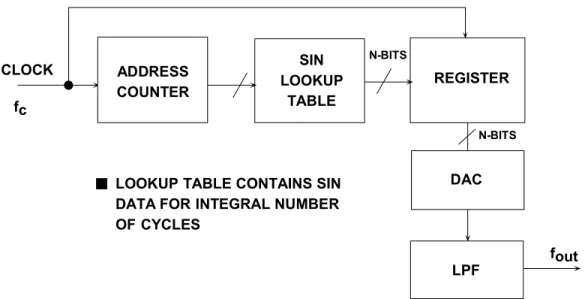
With the widespread use of digital techniques in instrumentation and communications systems, a digitally-controlled method of generating multiple frequencies from a reference frequency source has evolved called Direct Digital Synthesis (DDS). The basic architecture is shown in Figure 4.39. In this simplified model, a stable clock drives a programmable-read-only-memory (PROM) which stores one or more integral number of cycles of a sine wave (or other arbitrary waveform, for that matter). As the address counter steps through each memory location, the corresponding digital amplitude of the signal at each location drives a DAC which in turn generates the analog output signal. The spectral purity of the final analog output signal is determined primarily by the DAC. The phase noise is basically that of the reference clock.
Because a DDS system is a sampled data system, all the issues involved in sampling must be considered: quantization noise, aliasing, filtering, etc. For instance, the higher order harmonics of the DAC output frequencies fold back into the Nyquist bandwidth, making them unfilterable, whereas, the higher order harmonics of the output of PLL-based synthesizers can be filtered. There are other considerations which will be discussed shortly.
Figure 4.39: Fundamental Direct Digital Synthesis System fc
ADDRESS COUNTER
SIN LOOKUP
TABLE
N-BITS
CLOCK REGISTER
LPF DAC
fout LOOKUP TABLE CONTAINS SIN
DATA FOR INTEGRAL NUMBER OF CYCLES
A fundamental problem with this simple DDS system is that the final output frequency can be changed only by changing the reference clock frequency or by reprogramming the PROM, making it rather inflexible. A practical DDS system implements this basic function in a much more flexible and efficient manner using digital hardware called a Numerically Controlled Oscillator (NCO). A block diagram of such a system is shown in Figure 4.40.
Figure 4.40:
A Flexible DDS System
The heart of the system is the phase accumulator whose contents are updated once each clock cycle. Each time the phase accumulator is updated, the digital number, M, stored in the delta phase register is added to the number in the phase accumulator register. Assume that the number in the delta phase register is 00...01 and that the initial content of the phase accumulator is 00...00. The phase accumulator is updated by 00...01 on each clock cycle. If the accumulator is 32-bits wide, 232 clock cycles (over 4 billion) are required before the phase accumulator returns to 00...00, and the cycle repeats.
The truncated output of the phase accumulator serves as the address to a sine (or cosine) lookup table. Each address in the lookup table corresponds to a phase point on the sine wave from 0° to 360°. The lookup table contains the corresponding digital amplitude information for one complete cycle of a sine wave. (Actually, only data for 90° is required because the quadrature data is contained in the two MSBs). The lookup table therefore maps the phase information from the phase accumulator into a digital amplitude word, which, in turn, drives the DAC.
fc
SERIAL OR BYTE
LOAD REGISTER
n n
FREQUENCY CONTROL
PHASE REGISTER
LPF DAC PARALLEL
DELTA PHASE REGISTER
M CLOCK
n n SIN ROM
LOOKUP TABLE
PHASE ACCUMULATOR
n
PHASE TRUNCATION 14-16 BITS
AMPLITUDE TRUNCATION
2n =
fo M • fc
n = 24-32 BITS