Higher Education Pays:
But a Lot More for Some Graduates Than for Others
Mark Schneider
President, College Measures
Vice President, American Institutes for Research®
Contents
List of Figures ...iv
List of Tables ...v
Introduction ... 1
Lesson 1: Some Short-Term, Higher Education Credentials Are Worth as Much as Long-Term Ones ... 2
Lesson 2: Where You Study Affects Earnings—But Less Than Usually Thought ... 3
Lesson 3: What You Study Matters More Than Where You Study ... 3
Lesson 4: The S in STEM (Science, Technology, Engineering, and Mathematics) Is Oversold ... 4
First-Year Earnings of Completers of Subbaccalaureate Credentials: Certificates and Associate’s Degrees ... 5
Certificates ... 6
Highest Paying Certificate Programs ... 8
Associate’s Degrees ...10
The Differences Can Be Substantial ...12
Conclusions ...16
First-Year Earnings of Graduates With Bachelor’s Degrees ...17
Variation by Institution ...17
First-Year Earnings of Graduates With Master’s Degrees ...25
Variation by Institution ...26
Where You Study Versus What You Study: Variation by Program ...28
Conclusions ...32
When It Comes to Earnings, Is It Stem or Tem? ...33
How Well Are STEM Graduates From Texas Faring in the Labor Market? ...33
How Well Are STEM Graduates From Virginia and Colorado Faring in the Labor Market? ....35
Conclusions ...37
Earnings Data Are Essential: Students Need to Know Before They Go ...38
List of Figures
Figure 1: First-Year Earnings of Completers With Subbaccalaureate Credentials, by State ... 7 Figure 2: First-Year Earnings of Completers of the Highest Paying Longer Term Certificate
Programs, by State ... 9 Figure 3: First-Year Earnings of Completers of the Lowest Paying Longer Term Certificate
Programs, by State ...10 Figure 4: First-Year Earnings of Graduates With Associate’s Versus Bachelor’s Degrees,
by State ...11 Figure 5: First-Year Earnings of Graduates With Associate’s Degrees in Virginia:
Occupational/Technical Versus Bachelor’s Credit ...13 Figure 6: First-Year Earnings of Graduates With Associate’s Degrees in Selected Colleges
in Texas: Academic Versus Technical Degrees ...14 Figure 7: Programs With the Highest and Lowest Paid Graduates, by State ...15 Figure 8: First-Year Earnings Among Bachelor’s Degree Graduates From the Most Popular
Fields of Study, by State ...23 Figure 9: First-Year Earnings Between Graduates With Master’s and Bachelor’s Degrees,
by State ...25 Figure 10: Range of First-Year Earnings Among Graduates With Master’s Degrees, by State ...28 Figure 11: First-Year Earnings Among the Lowest Earning Master’s Degree Graduates,
by State and Program ...30 Figure 12: First-Year Earnings Among the Highest Earning Master’s Degree Graduates,
by State and Program ...31 Figure 13: First-Year Earnings Among Graduates in Texas, by Degree Level and Major ...34 Figure 14: First-Year Earnings Among Graduates in Virginia, by Degree Level and Major ...36
Table 1: Lowest and Highest First-Year Earnings of Graduates With Bachelor’s Degrees,
by Institution and State ...19 Table 2: Bachelor’s Degree Graduates From Many Institutions Earn Roughly the Same
Amount in Colorado ...20 Table 3: Bachelor’s Degree Graduates From Many Institutions Earn Roughly the Same
Amount in Arkansas ...21 Table 4: Fields of Study With the Highest and Lowest First-Year Earnings, by State ...22 Table 5: Lowest and Highest First-Year Earnings Among Graduates With Master’s Degrees,
by State and Institution ...27 Table 6: Lowest and Highest Earnings in Each State and Size of Differential, by Field of Study ..29
List of Tables
Executive Summary
Introduction
Higher education is one of the most important investments that people make. And most students make this investment because they want a better chance to land a good career and higher earnings.1 But as they enter the labor market, some graduates earn far more than others. Graduates with the same major but from different schools can take home substantially different amounts of money. And earnings vary widely among graduates from the same school who have chosen different majors.
Based on information from five states that have shared earnings data with College Measures, this report shows that several factors influence earnings, including what degree graduates earn, what school awarded their degree, and the field in which the degree is earned.2 Right choices can lead to good careers and high earnings, but wrong ones can leave graduates with mountains of debt and poor prospects of ever paying off their student loans. Meanwhile, high debt is a national problem: cumulative student debt now tops $1 trillion, and increasing numbers of students are not paying back their loans on time.3
Because college credentials are usually associated with higher earnings, taking on reasonable debt or paying high tuition are not necessarily bad choices. Instead, the problem is that too few students know their potential earnings before they enroll in a postsecondary institution and
before they take out loans to pay for their education.
Prospective students need sound information about where their educational choices are likely to lead. This information can save students money, keep them from making bad choices, and prevent a lot of future financial headaches.
Parents, students, and political leaders have been asking for better evidence of what happens to graduates after they enter the labor market. Although the federal government is making strides in this area,4 many states are far ahead on collecting earnings data about graduates of colleges and universities. College Measures is working with many of these leading states to make available to the public information about how much graduates earn.
1 In a survey of incoming freshmen at four-year colleges and universities, 88% agreed that the most important reason to go to college is to get a good job. See Jaschik, S. (2013, July 19). Jobs mismatch. Retrieved from
http://www.insidehighered.com/news/2013/07/19/do-faculty-members-share-students-and-parents-focus-Since mid-2012, with the support of the Lumina Foundation, College Measures has partnered with the states of Arkansas, Colorado, Tennessee, Texas, and Virginia to put the earnings of graduates in the public’s eye. With these data, anyone can learn about the earnings that graduates will likely earn for every program of study among colleges and universities in the state. In all states, earnings data now cover only the early careers of graduates.
These five states differ from each other in important ways—for example, in the strength of their overall and regional economies. But earnings data reveal some patterns across these states. Four lessons can be culled from these patterns. These lessons should help students make smarter decisions about what to study and how much to borrow.
Lesson 1: Some Short-Term, Higher Education Credentials Are Worth
as Much as Long-Term Ones
Most people likely think of a bachelor’s degree when they think of a college credential. But in 2012, the nation’s system of higher education—mostly through community colleges—granted nearly as many short-term credentials as bachelor’s degrees.
Short-term (or “subbaccalaureate”) credentials include associate’s degrees and occupationally oriented certificates, and many who hold them will out-earn graduates with bachelor’s degrees, for example5:
• In Texas, graduates with technical associate’s degrees earned on average over $11,000 more in their first year after graduation than did graduates with bachelor’s degrees. Graduates with career-oriented associate’s degrees in Applied Sciences out-earned their counterparts with bachelor’s degrees in Colorado by more than $7,000 and in Virginia by more than $2,000.
• Evidence suggests that certificates that take 1–2 years to complete carry more market value than those that can be completed in less than 1 year.6 The longer term certificates may
represent a competitive alternative to an associate’s degree, particularly if the comparison is to academically or transfer-oriented associate’s degrees. In Virginia and Colorado, graduates with longer term certificates earned about $3,000 more on average in their first year of employment than graduates with transfer-oriented associate’s degrees.
5 All earnings in this report are adjusted to 2011 dollars.
6 Dadgar, M., & Weiss, M. J. (2012). Labor market returns to subbaccalaureate credentials: How much does a community college degree or certificate pay? (CCRC Working Paper No. 45). Retrieved from http://capseecenter.org/wp-content/uploads/downloads/2012/07/332_1101.pdf.
Lesson 2: Where You Study Affects Earnings—But Less Than
Usually Thought
Two consistent patterns emerged from looking at institutions in the five states:
• Earnings vary widely among first-year graduates. In each state, at least $18,000 separated institutions with the lowest and highest paid first-year bachelor’s graduates. The difference in earnings between graduates with master’s degrees from different institutions ranged from more than $10,000 in Arkansas to more than $40,000 in Tennessee and Texas.
• Each state has schools whose graduates fall far below their peers in terms of earnings, and, conversely, each state hosts institutions whose graduates outperform their peers from other schools. Despite a large range, the earnings of graduates from a significant proportion of schools within each state are roughly identical. For example, at 6 of the 15 four-year institutions in the study from Colorado, median earnings among graduates with bachelor’s degrees were tightly clustered between $37,000 and $39,000. Similarly, at 10 of the 22 four-year institutions in the study from Arkansas median earnings among graduates with bachelor’s degrees ranged from $30,000 and $34,000. Compared with regional campuses, many more graduates from the flagship campuses in each state go on to professional or advanced training. However, graduates from flagship campuses who go straight into the labor market, on average, do not earn more than graduates from many of the regional campuses.
Lesson 3: What You Study Matters More Than Where You Study
In addition to short-term certificates, the study focused on three levels of degrees: associate’s, bachelor’s, and master’s. The labor market rewards technical and occupational skills at all three degree levels.
Graduates with bachelor’s degrees in Music, Photography, Philosophy, and other liberal arts almost always earn the least among the major fields of study. Graduates with engineering degrees earned the most in every state. Graduates with degrees in health-related fields, especially
question depends on data not yet in hand, the data from graduates with master’s degrees suggest that those in technical fields continue to fare better earnings wise than their counterparts that far up the educational ladder, for example:
• First-year graduates with master’s degrees in Creative Writing earned less than $30,000 in Arkansas and less than $32,000 in Virginia. In both states, this was the lowest paid major while Nurse Anesthesiologist (at about $130,000) the highest.
• In Tennessee, more than $36,000 separated the earning of master’s degree graduates in the lowest paid fields (foreign languages, literatures, and linguistics) and the highest paid fields (health professions and related programs).
Across all three levels of degrees, degrees in technical fields yield far greater returns than degrees in liberal arts.
Lesson 4: The S in STEM (Science, Technology, Engineering, and
Mathematics) Is Oversold
Politicians, policy makers, governors, and many others trumpet the need for STEM education to feed the STEM workforce. Despite such rhetoric and clamoring, the labor market is far more discriminating in the kinds of degrees it rewards. Data from College Measures show that employers are paying more—often far more—for degrees in the fields of technology, engineering, and mathematics (TEM). Evidence does not suggest that graduates with degrees in Biology earn a wage premium—in fact, they often earn less than English majors. Graduates with degrees in Chemistry earn somewhat more than Biology majors, but they do not command the wage premium typically sought by those who major in engineering, computer/information science, or mathematics.
In a market-based economy, earnings data indicate what employers are seeking in first-year graduates. These data are reliable and useful, because they are objective and not subject to the political whims of government officials and leaders of postsecondary institutions.
The remainder of this report analyzes earnings data from graduates in Arkansas, Colorado, Tennessee, Texas, and Virginia on several fronts: (1) earnings of graduates with subbaccalaureate certificates and associate’s degrees; (2) earnings of graduates with bachelor’s and master’s degrees, and (3) earnings of STEM graduates versus graduates from other fields.
First-Year Earnings of Completers of Subbaccalaureate
Credentials: Certificates and Associate’s Degrees
The bachelor’s degree is the most commonly granted postsecondary credential in the United States. But more and more students are earning subbaccalaureate credentials, including certificates and associate’s degrees.
Certificates are becoming increasingly common.7 Certificates can be earned in less than 1 year to as many as 2 years. As demonstrated below, evidence suggests that certificates that take 1–2 years to complete carry more market value than those that can be completed in less than 1 year.8
In general, to attain an associate’s degree, a student must successfully complete 60 credits. The associate’s is officially a “two-year” degree but students often take 3, 4 or even more years to complete (if they complete at all). Across the states in the study, associate’s degrees are generally designed to meet one of two purposes: prepare students to transfer to a four-year college (e.g., in Virginia, these programs are specifically classified as “bachelor’s credit”) or prepare students to enter the job market (e.g., in Virginia, these programs are called “occupation/technical credit”). This nomenclature is an update of the traditional Associate’s of Art/Sciences (AA/AS) degree that is part of the “junior college” transfer function of two-year institutions versus the Associate’s of Applied Sciences (AAS) degree that is occupational or career oriented. Colorado awards an associ-ate’s degree with another purpose: The Associassoci-ate’s of General Studies degree allows students to create their own program of study but is more aligned with the pursuit of a career than a transfer. Tennessee and Arkansas do not divide their associate’s degrees into these categories.
From the complex set of subbaccalaureate credentials, the following
pages highlight only some of the patterns evident from the data in the
study. For more comparisons than are presented in this report, go to
http://www.collegemeasures.org/esm
Certificates
Certificates are the fastest growing postsecondary credential in the nation. More than 600,000 certificates were awarded in 2012.9 Given the ballooning cost of college and an uncertain job market, students, not surprisingly, are enrolling in these programs in growing numbers, especially at community colleges. Certificates often cost less to attain than an associate’s degree and
generally lead to jobs that pay higher salaries than those received by job candidates with only a high school diploma. Certificates, as discussed below, can also result in higher earnings than those experienced by graduates with associate’s or even bachelor’s degrees.10
Despite their rapid growth, little information is available about certificate programs across the nation. An associate’s degree generally encompasses 60 hours of study and a bachelor’s degree, on average, 120 hours. Certificate programs require different lengths of time. Certificate programs can last from a few months to 2 years and reach a variety of fields, from cosmetologist to aircraft mechanic. The growing importance of this credential is only slowly being recognized. As Anthony Carnevale noted in a study on certificates, “only one of the major government socioeconomic surveys has information on certificate holding” (p. 1) and, certificates have received only limited evidence-based attention.11
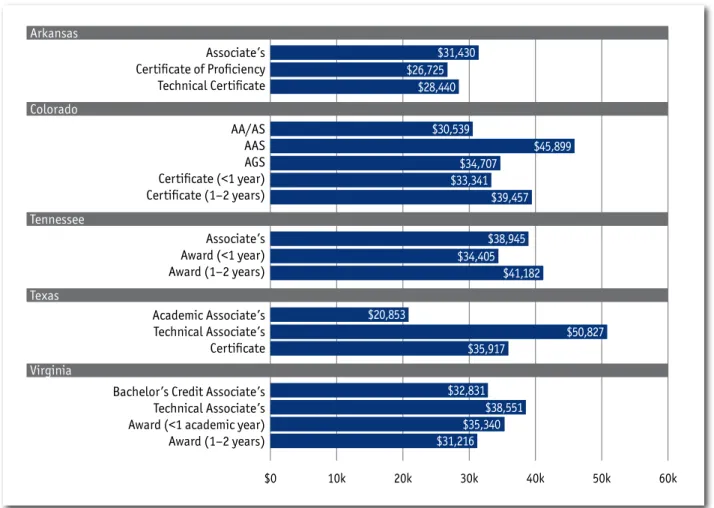
Figure 1 shows the overall first-year earnings of certificate holders compared with that of graduates with associate’s degrees. Remember that not all states grant all types of certificates, nor do they all distinguish between technical- and transfer-type associate’s degrees. With that in mind, several patterns can be observed at the level of aggregation used for Figure 1.
9 The number of certificates includes longer term certificates (1–2 years) and short-term ones as reported in the Integrated Postsecondary Education Data System (or IPEDS).
10 See Mangan, K. (2013, April 25). Tech training may provide fatter paychecks than 4-year degrees, study finds.
Retrieved from http://chronicle.com/article/Tech-Training-May-Provide/138831/?cid=cc&utm_source= cc&utm_medium=en; Greenhouse, S. (2013, March 18). The great aid gap. The New York Times. Retrieved from http://www.nytimes.com/2013/03/19/education/financial-aid-is-scarce-for-job-training-certificates. html?pagewanted=all&_r=0.
11 Carnevale, A., Rose, S., & Hanson, A. (2012, June). Certificates: Gateway to gainful employment and college degrees.
Washington, DC: Center on Education and the Workforce, Georgetown University. Retrieved from http://www9. georgetown.edu/grad/gppi/hpi/cew/pdfs/Certificates.ExecutiveSummary.071712.pdf. Additionally, a federal interagency working group is working on definitions and a unified approach to data collection. This working group estimates that in 2010–11, 38% of adults in the United States were certified (i.e., had a license or a certificate), which translates to 82 million Americans. The working group also estimates that 14% of Americans have a certifi-cate. As the working group’s report makes clear, certificates are actually hard to measure. However, in the past few years there has been a significant effort to obtain better measures on subbaccalaureate certificates and certifications: See National Center for Education Statistics. (n.d.). Strand 2: Education certificates. Retrieved from http://nces.ed.gov/surveys/gemena/strand2.asp.
The argument that certificates of less than 1 year carry less market value than longer term certificates is confirmed in Arkansas, Colorado, and Tennessee. In Arkansas, attaining Technical Certificates, on average, takes about twice as long as obtaining Certificates of Proficiency, which typically require 15 credits. Virginia offers an anomaly, wherein completers of shorter certificate programs have higher earnings than those who complete longer studies. However, Virginia has only one such certificate program (Mental and Social Health Services and Allied Professions) in the study’s database. As evidenced throughout this report, graduates with health-related credentials tend to have higher earnings than those in most other fields.
Colorado Arkansas
Texas
Virginia
Associate’s Certificate of Proficiency Technical Certificate AA/AS AAS AGS Certificate (<1 year) Certificate (1–2 years) Associate’s Award (<1 year) Award (1–2 years) Academic Associate’s Technical Associate’s Certificate Bachelor’s Credit Associate’s Technical Associate’s Award (<1 academic year) Award (1–2 years)
Tennessee
$0 10k 20k 30k 40k 50k 60k
$26,725 $28,440 $31,430 $45,899 $34,707 $39,457 $33,341 $30,539 $38,551 $35,340 $31,216 $32,831 $34,405 $41,182 $38,945 $50,827 $35,917 $20,853
Perhaps the most interesting comparison is between certificate holders and associate’s degree graduates. One argument often put forward in support of certificates is that they can produce high earnings while requiring less time than traditional associate’s degrees. This study finds some evidence of this, but much of the truth of this statement depends on the type of associate’s degree and the length of the certificate being compared.
In Colorado, for example, both short- and long-term certificate holders have higher first-year earnings than students with the transfer-oriented AA/AS degree who are in the labor market. Similarly, in Virginia, completers of a short-term certificate in Mental and Social Health Services and Allied Professions have higher earnings than those who graduated with a bachelor’s credit associate’s degree. In Texas, certificate holders earned almost $15,000 more on average than graduates with academic associate’s degrees, but about $15,000 less than graduates with technical associate’s degrees. In Tennessee, holders of long-term certificates out-earned gradu-ates with associate’s degrees by approximately $2,000, but holders of short-term certificgradu-ates earned about $4,500 less than graduates with associate’s degrees.
Clearly, certificates of longer duration (1–2 years) may represent a viable alternative to an associate’s degree. This is particularly true when comparing certificates with academic transfer-oriented associate’s degrees.
Highest Paying Certificate Programs
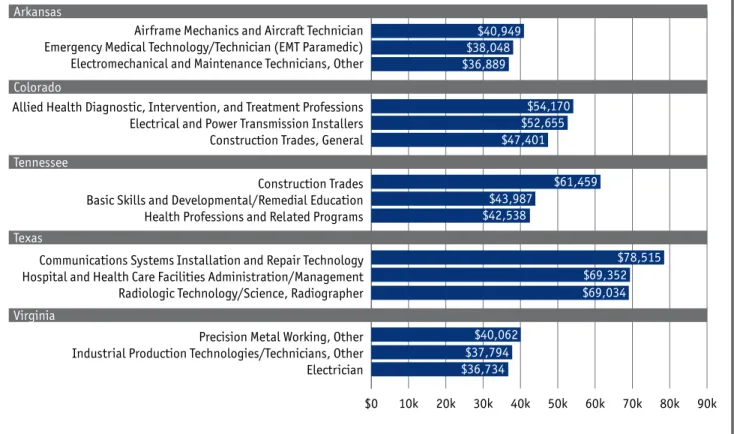
Figure 2 shows the first-year earnings of completers of the three highest paying, longer term certificate programs in each state. Among the earnings of these top paying programs, the lowest still exceeds $36,500; several are greater than $45,000; and four (three of which are in Texas) are greater than $61,000.12
These programs focus mostly on specific careers, with concentrations in the fields of health care and construction. Tennessee is the exception, where students who complete certificates in Basic Skill and Developmental/Remedial Education achieve the second highest earnings in the state.
12 In the interest of brevity, the study did not repeat this analysis for certificate programs of shorter lengths. These data can be found at www.collegemeasures.org/esm
In contrast, Figure 3 shows the first-year earnings of certificate completers from the three lowest paying, longer term certificate programs in each state. The differences are dramatic: First-year earnings of certificate completers from the lowest paying, longer term certificate programs are a fraction of those experienced by completers of the highest paying certificates. With the one exception of business certificates awarded in Tennessee (slightly above $35,000), completers from only two programs earn more than $25,000 and completers from only seven others earn more than $20,000. Completers of the remaining programs earn less than $20,000, and in Texas, which counts part-time workers, completers from two programs earned less than $10,000.
Arkansas
$0 10k 20k 30k 40k 50k 60k 70k 80k 90k
Airframe Mechanics and Aircraft Technician Emergency Medical Technology/Technician (EMT Paramedic) Electromechanical and Maintenance Technicians, Other Allied Health Diagnostic, Intervention, and Treatment Professions Electrical and Power Transmission Installers Construction Trades, General Construction Trades Basic Skills and Developmental/Remedial Education Health Professions and Related Programs Communications Systems Installation and Repair Technology Hospital and Health Care Facilities Administration/Management Radiologic Technology/Science, Radiographer Precision Metal Working, Other Industrial Production Technologies/Technicians, Other Electrician
Colorado
Tennessee
Texas
Virginia
$40,949
$54,170 $52,655 $47,401
$61,459 $43,987
$42,538
$40,062 $37,794 $36,734
$78,515 $69,352 $69,034 $38,048
$36,889
Figure 2: First-Year Earnings of Completers of the Highest Paying Longer Term Certificate Programs, by State
Associate’s Degrees
More than 1 million students graduated with an associate’s degree in 2012, making it the second most common degree granted in the nation. Community colleges award most of the nation’s associate’s degrees and they have disparate missions, but at their core, lie two different tasks: preparing students to transfer to four-year institutions and preparing students to enter the job market. As noted previously among the states in this study, Virginia clearly articulates this distinction by labeling courses of study as “bachelor’s credit” versus “occupational/technical credit.” Similarly, Texas recognizes associate’s degrees as either “academic” or “technical,” and Colorado offers the transfer-oriented AA/AS and the occupational or career-oriented AAS. Figure 3: First-Year Earnings of Completers of the Lowest Paying Longer Term Certificate Programs, by State
Colorado Texas Virginia Tennessee Arkanas Phlebotomy Technician/Phlebotomist Cosmetology/Cosmetologist, General Computer Technology/Computer Systems Technology Culinary Arts and Related Services Dental Support Services and Allied Professions Health and Medical Administrative Services Family and Consumer Sciences/Human Sciences Visual and Performing Arts Business, Management, Marketing, and Related Services Nail Technician/Specialist and Manicurist Plant Nursery Operations and Management Network and System Administration/Administrator Business Operations Support and Secretarial Services, Other Child Care Provider/Assistant Automobile/Automotive Mechanics Technology/Technician
$0 5k 10k 15k 20k 25k 30k 35k 40k
$17,331 $19,318 $16,924 $21,555 $22,773 $20,764 $25,367 $35,284 $22,877 $9,940 $11,597 $9,768 $23,590 $25,452 $22,621
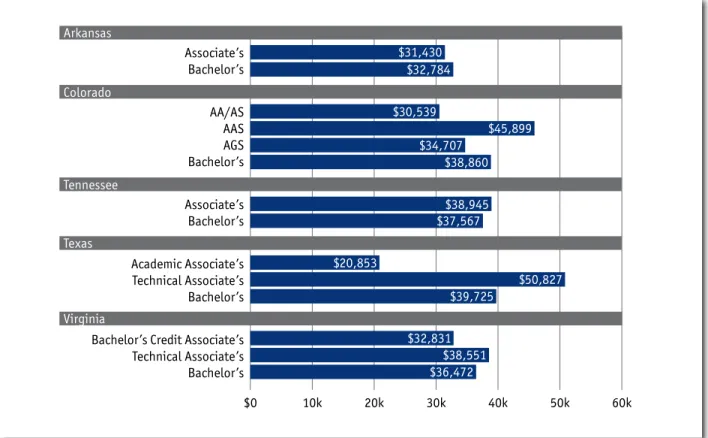
Understanding these two missions is important when analyzing the earnings related to associate’s degrees. For example, per Figure 4, graduates with technical associate’s degrees out-earn their peers who are preparing to transfer to four-year schools but who are in the labor market. Perhaps even more important, the first-year earnings of graduates with technical degrees in Virginia, Texas, and Colorado are higher than that of their counterparts with bachelor’s degrees.
Colorado
Texas
Virginia Tennessee Arkansas
$0 10k 20k 30k 40k 50k 60k
Associate’s Bachelor’s AA/AS AAS AGS Bachelor’s Associate’s Bachelor’s Academic Associate’s Technical Associate’s Bachelor’s Bachelor’s Credit Associate’s Technical Associate’s Bachelor’s
$38,551 $32,784 $31,430
$45,899 $30,539
$38,860 $34,707
$50,827 $20,853
$39,725 $32,831
$36,472 $37,567
$38,945
The Differences Can Be Substantial
In Texas, the first-year earnings of graduates with technical associate’s degrees are on average more than $11,000 higher than that of graduates with bachelor’s degrees. In Colorado, graduates with AAS degrees out-earn graduates with bachelor’s degrees by more $7,000. In Virginia, the gap in earnings between associate’s and bachelor’s degrees is smaller (only $2,000), but the technical associate’s degree is faster and cheaper to earn than a bachelor’s degree, so even a $2,000 gap implies a better early return on investment. In Tennessee, which does not distinguish between technical and academically oriented degrees, the first-year earnings of graduates with associate’s degrees are more than $1,300 higher than graduates with bachelor’s degrees.
In contrast, the earnings of graduates with transfer-oriented associate’s degrees who are in the job market lag behind that of their peers with technical associate’s degrees and graduates with bachelor’s degrees. For example, earnings among graduates with AA/AS degrees in Colorado fall below those with technical/career oriented associate’s degrees by $15,000 and graduates with bachelor’s degrees by $8,000. In Virginia, the gap is smaller but still substantial: $6,000 between graduates with technical associate’s degrees and those with bachelor’s credit associate’s
degrees; and $4,000 between graduates with bachelor’s degrees and those with bachelor’s credit associate’s degrees. The biggest gaps are in Texas, where more than $30,000 separates graduates with academic associate’s degrees from graduates with technical associate’s degrees, and $19,000 separates graduates with academic associate’s degrees from graduates with bachelor’s degrees.
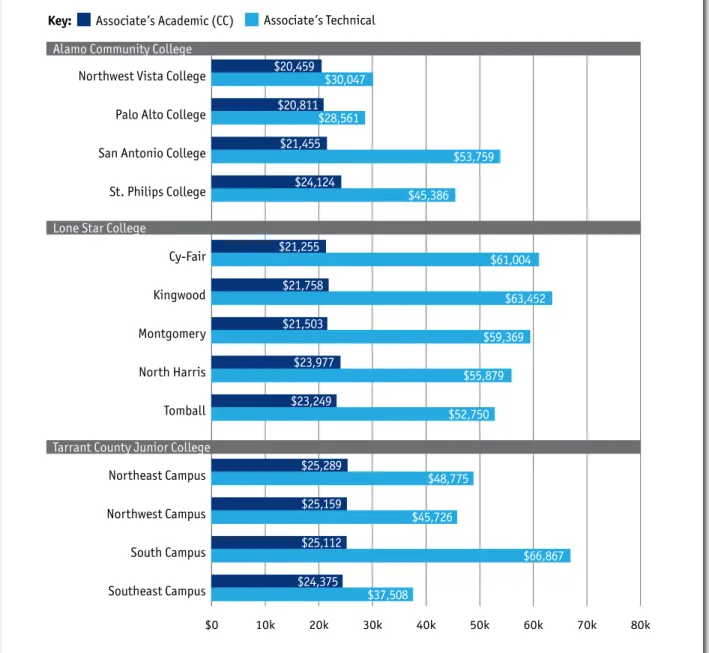
Clearly, technical associate’s degrees have higher short-term market value than transfer-oriented associate’s degrees. Figures 5 and 6 compare the earnings of graduates from the same institutions who completed the two different tracks. Among other factors, this comparison “controls” for re-gional variation in the local labor market—because most community college students do not travel long distances to attend college and often stay in the same region when they are finished.
Figure 5 shows the first-year earnings of graduates from bachelor’s credit associate’s
degree programs versus those from occupational/technical credit associate’s degree programs in Virginia. Data are shown for 18 institutions that grant both types of associate’s degrees. In every instance, graduates with technical associate’s degrees earn more than their peers with bachelor’s credit associate’s degrees. The smallest differences occur at Thomas Nelson Community College ($2,600) and Tidewater Community College ($6,000). In most other schools, differences exceed $10,000. However, at Germanna and John Tyler Community Colleges, the differences reach more than $14,000.
Figure 6 presents data similar to that of Figure 5 but for the schools in a few large community college systems in Texas. Data from Texas confirm that findings from Virginia are not a fluke—that is, graduates with technical associate’s degrees earn more—often far more—than their peers with academic associate’s degrees. Despite some sizable differences in earnings between the two sets of graduates in Virginia, the differences in Texas are far larger. For example, in two Alamo Community College campuses (Palo Alto and Northwest), the gap is less than $10,000, but in other compari-sons, students with technical associate’s degrees earn as much as $40,000 more than graduates from the same school with academic associate’s degrees.
Key: Associate’s Degree Oriented toward: Bachelor’s Credit Occupational/Technical Credits
Central Virginia Community College Germanna Community College J. Sargeant Reynolds Community College John Tyler Community College Lord Fairfax Community College Paul D. Camp Community College Rappahannock Community College Thomas Nelson Community College Tidewater Community College
$0 5k 10k 15k 20k 25k 30k 35k 40k 45k 50k
$28,782
$37,784 $31,881
$45,522 $42,274 $30,911
$30,567
$44,652 $29,012
$41,839 $27,448
$38,495 $31,355
$40,161 $35,143
$37,779 $30,883
$36,550
Figure 5: First-Year Earnings of Graduates With Associate’s Degrees in Virginia: Occupational/ Technical Versus Bachelor’s Credit
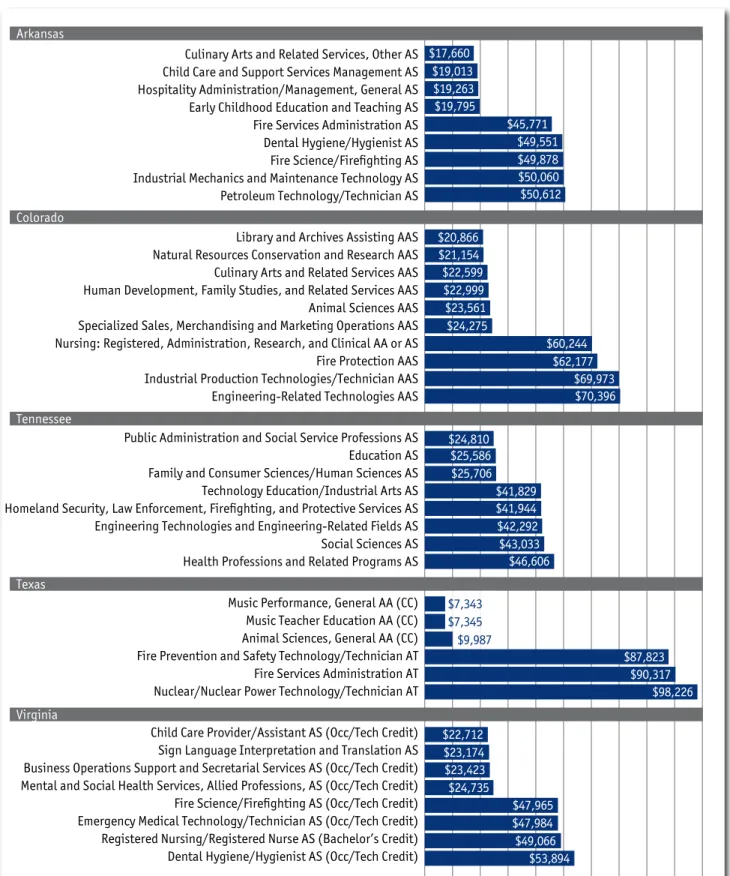
Figure 7 displays the associate’s degree programs of study in each state that garner the lowest and highest first-year earnings. Graduates in the higher paying fields—most of them in Health Care, Engineering, and Fire Sciences—make far more than graduates from such programs as Music, Child Care, Education, and Culinary Arts. In most states, at least $20,000 separates the earnings of graduates of programs from the highest paying fields from graduates of programs from the lowest paying fields.
Key: Associate’s Academic (CC) Associate’s Technical
Lone Star College Alamo Community College
Tarrant County Junior College
$0 10k 20k 30k 40k 50k 60k 70k 80k
Northwest Vista College Palo Alto College San Antonio College St. Philips College
Cy-Fair Kingwood Montgomery North Harris Tomball Northeast Campus Northwest Campus South Campus Southeast Campus $28,561 $30,047 $53,759 $45,386 $61,004 $63,452 $59,369 $55,879 $52,750 $48,775 $45,726 $37,508 $66,867 $20,459 $20,811 $21,455 $24,124 $21,255 $21,758 $21,503 $23,977 $23,249 $25,289 $25,159 $24,375 $25,112
Figure 6: First-Year Earnings of Graduates With Associate’s Degrees in Selected Colleges in Texas: Academic Versus Technical Degrees
Arkansas
Colorado
Tennessee
Culinary Arts and Related Services, Other AS Child Care and Support Services Management AS Hospitality Administration/Management, General AS Early Childhood Education and Teaching AS Fire Services Administration AS Dental Hygiene/Hygienist AS Fire Science/Firefighting AS Industrial Mechanics and Maintenance Technology AS Petroleum Technology/Technician AS Library and Archives Assisting AAS Natural Resources Conservation and Research AAS Culinary Arts and Related Services AAS Human Development, Family Studies, and Related Services AAS Animal Sciences AAS Specialized Sales, Merchandising and Marketing Operations AAS Nursing: Registered, Administration, Research, and Clinical AA or AS Fire Protection AAS Industrial Production Technologies/Technician AAS Engineering-Related Technologies AAS Public Administration and Social Service Professions AS Education AS Family and Consumer Sciences/Human Sciences AS Technology Education/Industrial Arts AS Homeland Security, Law Enforcement, Firefighting, and Protective Services AS Engineering Technologies and Engineering-Related Fields AS Social Sciences AS Health Professions and Related Programs AS Music Performance, General AA (CC) Music Teacher Education AA (CC) Animal Sciences, General AA (CC) Fire Prevention and Safety Technology/Technician AT Fire Services Administration AT Nuclear/Nuclear Power Technology/Technician AT
Texas $7,343 $17,660 $19,263 $19,795 $20,866 $23,561 $24,275 $24,810 $25,586 $25,706 $41,829 $41,944 $42,292 $43,033 $87,823 $90,317 $98,226 $46,606 $7,345 $9,987 $60,244 $62,177 $69,973 $70,396 $21,154 $22,599 $22,999 $45,771 $49,551 $49,878 $50,060 $50,612 $19,013
Conclusions
Certificates of 1-2 year duration can lead to high earnings, especially in areas such as manufactur-ing, construction trades, and health. Yet even as certificates become increasingly common and as their market value is being proved, they are still terra incognita. Clearly students need better information about which certificates add value to wages and, just as clearly, efforts to better classify and track the expanding number of certificate programs must continue.
Technical associate’s degrees carry a far higher value in the labor market than transfer-oriented associate’s degrees. Perhaps more surprising is the fact that in the time frame captured by the data in this report, technical associate’s degree often carry a far higher value than bachelor’s degree. Together, the high wages accruing to graduates completing many certificate programs and technical associate’s degrees demonstrate a faster, cheaper route to the labor market that many students should consider before enrolling in academically oriented associate’s degrees or even bachelor’s degrees.
That said, data from this study do not indicate how graduates with technical associate’s degrees fare further in the future (a measurement task currently in progress), nor do data tell how well students who complete transfer-oriented studies do if they successfully transfer and complete their bachelor’s degrees. However, national data from a Beginning Post-Secondary Student Study show that about half of community college students never complete any degree, and data from Virginia show that half of all students in transfer-oriented bachelor’s credit programs never transfer. For these students, the academically oriented associate’s degree may have been a less than optimal choice.
First-Year Earnings of Graduates With
Bachelor’s Degrees
The bachelor’s degree is the most common postsecondary degree granted in the United States. Four-year colleges are perceived to vary widely in quality and in the rewards that their students reap after graduation. In terms of how much graduates with bachelor’s degrees earn, data show that much of this is folkloric—that is, where a student attends matters but nowhere near as much as is commonly believed.13
Two consistent patterns of first-year earnings emerge at the institutional level across the five states in this study:
• First-year earnings vary widely among graduates. Among graduates across the five states, the high and low ends of first-year earnings calculated at the institution level are separated by at least $18,000.
• While this range is large, earnings of graduates from a large proportion of schools within each state are roughly the same after graduating. This finding indicates that there are many successful paths into the labor market aside from graduating from the most prestigious schools.
Variation by Institution
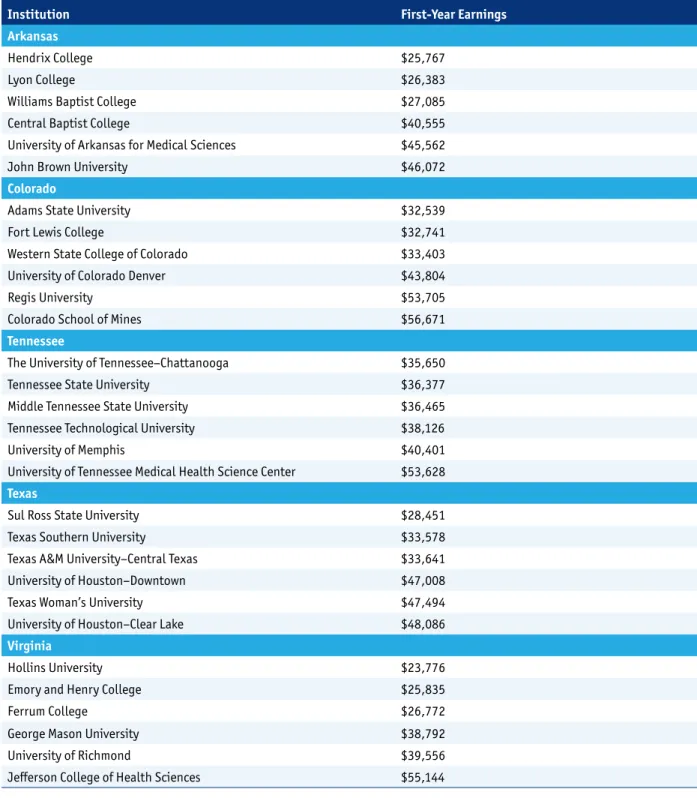
In each state, the first-year earnings of bachelor’s degree graduates vary across schools. Table 1 shows the three schools in each state with the lowest and highest first-year earnings among graduates with bachelor’s degrees.
Again, this report does not focus on why this variation occurs, but some factors are evident. First, location matters. Some of the schools with lowest paid bachelor’s graduates are located in poor rural areas of their respective state (e.g., Adams State in Colorado, Sul Ross in Texas), and some of the institutions with the highest paid graduates are located in urban or metropolitan areas (e.g., University of Colorado–Denver; University of Houston–Downtown). Moreover, some of the schools with the highest paid graduates have specialized curricula—for example, Colorado School of Mines (whose graduates overall out-earn the graduates of any other school in our study) and Virginia’s Jefferson College of Health Sciences (second highest first-year earnings).
Note too that the study’s database includes states, such as Arkansas and Virginia, with earnings data for private not-for-profit colleges. Graduates from these types of schools often have low first-year earnings. Despite this, the “net price” of attending these schools can be high. According to the National Center for Education Statistics, the average net price of attending Hendrix College in Arkansas is more than $20,000 per year, but graduates earn overall less than $26,000. Similarly, the average net price of attending Hollins University in Virginia is nearly $21,000, just about equal to the first-year earnings of its graduates ($23,800). In contrast, the net price of attending Central Baptist College in Arkansas is less than $11,000 but its graduates earn more than $40,000. In many states, the relationship between price and earnings is not always straightforward.14
Graduates From Many Schools Have Roughly Equal First-Year Earnings
Data from Table 1 show the extremes of the distribution of first-year earnings among graduates with bachelor’s degrees, demonstrating that a wide range exists.15 But another consistent pattern emerges: In every state, the earnings of graduates from many schools cluster tightly together. Despite a widespread assumption that graduates from the most prestigious schools in a state are going to succeed in the labor market, data from this study show that this is not necessarily the case.
Consider the data from Colorado presented in Table 2. Of the 15 four-year degree granting colleges in the study’s database, the first-year earnings of graduates from 6 of them are within 5% of the state median (highlighted in red). Note too that graduates of the state’s flagship campus (University of Colorado–Boulder) who are working in the state are doing about as well in the labor market as graduates from the other five campuses in the cluster.
14 See the analysis in Schneider, M., & Vivari, B. (2012, September). The earning power of graduates from Tennessee’s colleges and universities: How are graduates from different degree programs doing in the labor market? Retrieved from http://www.air.org/files/Earning_Power_TN_Graduates_Sept12.pdf.
Table 1: Lowest and Highest First-Year Earnings of Graduates With Bachelor’s Degrees, by Institution and State
Institution First-Year Earnings Arkansas
Hendrix College $25,767
Lyon College $26,383
Williams Baptist College $27,085
Central Baptist College $40,555
University of Arkansas for Medical Sciences $45,562
John Brown University $46,072
Colorado
Adams State University $32,539
Fort Lewis College $32,741
Western State College of Colorado $33,403
University of Colorado Denver $43,804
Regis University $53,705
Colorado School of Mines $56,671
Tennessee
The University of Tennessee–Chattanooga $35,650
Tennessee State University $36,377
Middle Tennessee State University $36,465
Tennessee Technological University $38,126
University of Memphis $40,401
University of Tennessee Medical Health Science Center $53,628
Texas
Sul Ross State University $28,451
Texas Southern University $33,578
Texas A&M University–Central Texas $33,641
University of Houston–Downtown $47,008
Texas Woman’s University $47,494
University of Houston–Clear Lake $48,086
A similar situation occurs in Arkansas. As evident in Table 3, earnings of bachelor’s degree graduates from half of the state’s four-year colleges are within 5% of the state average. In short, there are many ways for graduates to do about equally well in the labor market, and strong earnings are not tied just to the most prestigious campuses in the state.
Table 2: Bachelor’s Degree Graduates From Many Institutions Earn Roughly the Same Amount in Colorado
Institution First-Year Earnings
Adams State University $32,539
Fort Lewis College $32,741
Western State College of Colorado $33,403
University of Northern Colorado $34,918
Colorado Christian University $36,065
Colorado State University $36,777
Colorado Mesa University $37,003
University of Colorado–Colorado Springs $37,331
Colorado State University–Pueblo $37,726
University of Colorado–Boulder $37,735
Metro State University of Denver $38,547
Colorado Statewide $38,860
University of Denver $39,094
University of Colorado–Denver $43,804
Regis University $53,705
What You Study Matters—and Maybe More Than You Think
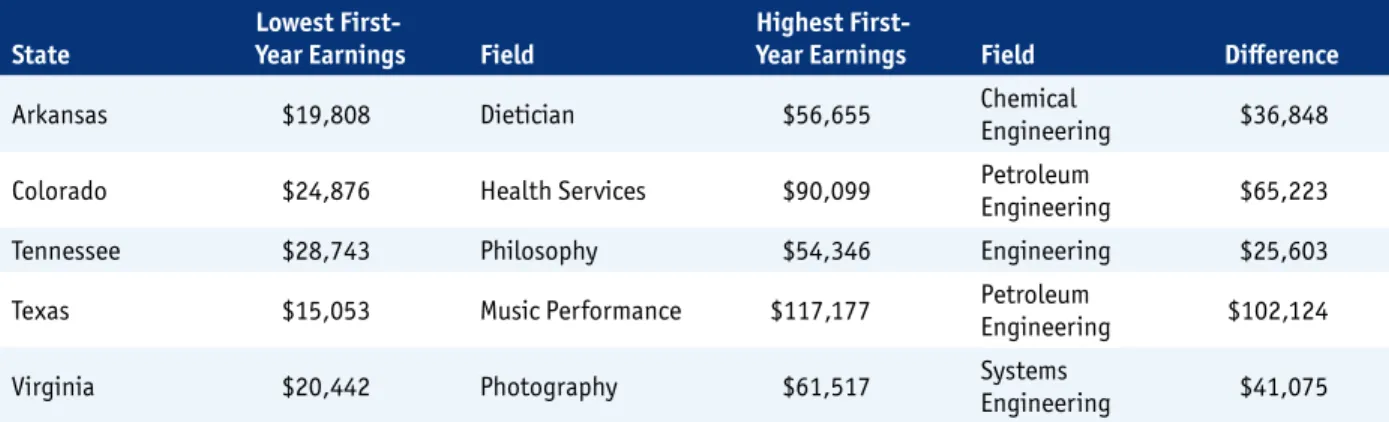
The first-year earnings of graduates with bachelor’s degrees vary widely across different fields of study. Table 4 shows the fields in each state that garner the lowest and highest first-year earnings among graduates with bachelor’s degrees. In three of the states, the fields with the lowest first-year earnings are liberal arts related: Music Performance (Texas), Photography (Virginia), and Philosophy (Tennessee). Graduates who become Dieticians in Arkansas and Table 3: Bachelor’s Degree Graduates From Many Institutions Earn Roughly the Same Amount in Arkansas
Institution First-Year Earnings
Hendrix College $25,767
Lyon College $26,383
Williams Baptist College $27,085
University of the Ozarks $27,266
Ouachita Baptist University $27,868
University of Arkansas–Pine Bluff $27,876
Arkansas Baptist College $28,255
Philander Smith College $28,585
Henderson State University $30,019
Southern Arkansas University–Main Campus $30,172
University of Central Arkansas $30,896
Harding University $31,262
Arkansas State University–Main Campus $31,336
University of Arkansas–Monticello $31,524
Arkansas Tech University $32,172
University of Arkansas–Fort Smith $32,418
Arkansas Statewide Average $32,784
University of Arkansas–Little Rock $33,239
University of Arkansas–Main Campus $33,956
Central Baptist College $40,555
University of Arkansas for Medical Sciences $45,562
Although engineering-related studies dominate the highest paying fields, these tend to be relatively small programs in terms of enrollment. Figure 8 shows the first-year earnings among graduates in the three most popular fields of study in each state. The popularity of programs varies somewhat by state. However, Psychology is one of the most popular programs of study in four of the five states. Business Administration is among the most popular programs in three of the states and the related field of study—Business, Management, Marketing and Related Support Services—in another. Biology is among the most popular programs in two states, as is Multi-/ Interdisciplinary Studies. Programs related to Health, including Registered Nursing, are popular in Arkansas.
Psychology is one of the most popular programs in every state except Tennessee. Despite its popularity, graduates with degrees in Psychology experience lower first-year earnings compared with all graduates in the state, typically by approximately $6,000 or $7,000 but as much as $10,000 (in Texas). In three of the four states in which Business is among the most popular fields of study, graduates with such degrees out-earn their peers, although sometimes by a small margin. However, in Arkansas, graduates with bachelor’s degrees in Business experience lower first-year earnings than their peers, typically by $1,300 or so.
One interesting case to observe is the difference in first-year earnings between graduates in Multi-/Interdisciplinary Studies in Tennessee and Texas. Among the three most popular programs in Tennessee (as in most other states), graduates in this field of study have lower first-year earnings than the statewide median. However, in Texas, the first-year earnings of Multi-/Interdisciplinary Study graduates exceed the statewide median by nearly $6,000. The reason: this field is the pathway that many students take into the teaching profession— which is relatively well-paid in Texas.
Table 4: Fields of Study With the Highest and Lowest First-Year Earnings, by State
State Lowest First- Year Earnings Field Highest First- Year Earnings Field Difference
Arkansas $19,808 Dietician $56,655 Chemical Engineering $36,848
Colorado $24,876 Health Services $90,099 Petroleum Engineering $65,223
Tennessee $28,743 Philosophy $54,346 Engineering $25,603
Texas $15,053 Music Performance $117,177 Petroleum Engineering $102,124
Biology is one of the most popular fields of study in Virginia and Texas, but in each state, graduates with bachelor’s degrees in Biology experience lower first-year earnings than the statewide median. Results among graduates with degrees in Biology are discussed in more detail in the section below about STEM. Finally, fields of study related to health professions are among the most popular programs in Arkansas and Tennessee. Graduates from such programs in these states experience far higher first-year earnings than the statewide median and graduates from
$0 10k 20k 30k 40k 50k 60k
Arkansas
Business Administration and Management, General Registered Nursing/Registered Nurse Psychology, General Arkansas Statewide Business Administration, Management, and Operations Psychology, General Business/Commerce, General Colorado Statewide Business, Management, Marketing, and Related Support Services Health Professions and Related Programs Multi-/Interdisciplinary Studies Tennessee Statewide Multi-/Interdisciplinary Studies, Other Psychology, General Biology/Biological Sciences, General Texas Statewide Psychology, General Business Administration and Management, General Biology/Biological Sciences, General Virginia Statewide Colorado Tennessee Texas Virginia $31,445 $44,827 $25,742 $32,784 $43,386 $31,594 $39,388 $38,860 $37,688 $51,095 $35,539 $37,567 $45,671 $29,141 $26,430 $39,725 $27,232 $35,565 $25,347 $33,122
Figure 8: First-Year Earnings Among Bachelor’s Degree Graduates From the Most Popular Fields of Study, by State
Conclusions
Based on earnings outcomes, some colleges and universities are producing graduates who earn far less than graduates from other schools and graduates from some institutions earn far more. But a surprising number of colleges and universities in every state produce graduates with roughly identical earnings. This should be encouraging news for the many students across the nation who attend regional comprehensive campuses instead of flagship campuses.
But field of study appears to affect earnings more so than choice of institution. Graduates of some very popular programs (in particular, Psychology) do not earn high wages initially in the job market. Choosing a field of study should be driven by more than just the economic reward— but students should be aware of the potential earnings associated with their choices and factor those considerations into their decisions about where to go, what major to pursue, and how much to borrow.
First-Year Earnings of Graduates With Master’s Degrees
In 2012, more than 725,000 master’s degrees were awarded across the United States. These advanced degrees are associated with higher earnings. This is not surprising since graduates with master’s degrees, in addition to completing advanced training, on average, are older than graduates with bachelor’s degrees and are likely to be further along in their careers.According to Figure 9, graduates with master’s degrees earn more than graduates with bachelor’s degrees—but the earnings vary substantially across states. On average, only in Arkansas is the earnings differential between the degrees substantially less than $15,000. In Colorado, Tennessee, and Virginia, the differential is approximately $15,000. In Texas, the differential exceeds $20,000.
As demonstrated in the discussion about earnings between graduates with associate’s degrees
Key: Master’s Degree Bachelor’s Degree
Arkansas
Colorado
Tennessee
Texas
Virginia
$0 10k 20k 30k 40k 50k 60k 70k
$46,562 $32,784
$53,253 $38,860
$53,185 $37,567
$63,537 $39,725
$48,721 $33,122
Figure 9: First-Year Earnings Between Graduates With Master’s and Bachelor’s Degrees, by State
Variation by Institution
Table 5 presents the first-year earnings, by institutions, of the highest and lowest paid graduates with master’s degrees in each state. Overall, the data show a gap between the lowest and highest paid graduates that ranges from approximately $10,000 to more than $40,000. Remember, this difference reflects just one year of earnings.
Table 5 also shows substantial variation in the size of the gap between institutions across states. The spread between the institutions with the lowest and highest paid graduates is smallest in Arkansas, where only about $10,000 separates the earnings of master’s degree graduates from Hendrix College and the University of Arkansas–Pine Bluff from the higher paid graduates from the University of Arkansas–Little Rock and University of Arkansas–main campus.
In Colorado, a differential of more than $20,000 exists between the first-year earnings of master’s degree graduates from Adams State University and the University of North Colorado and graduates from Regis University and the specialized Colorado School of Mines; this spread is twice the size of the gap observed in Arkansas. In Tennessee, master’s degree graduates from Austin Peay University and University of Tennessee–Martin have first-year earnings below $48,000, or approximately $40,000 lower than graduates from the specialized University of Tennessee Medical Health Science Center and approximately $10,000 lower than graduates from University of Tennessee–Chattanooga. In Texas, master’s degree graduates from Texas Tech University, Angelo State University, and Texas A&M University–Galveston have first-year earnings below $55,000, approximately $16,000 lower than graduates from University of Houston–Downtown and University of Texas–Dallas.
Finally, in Virginia, master’s degree graduates from four campuses have first-year earnings lower than $40,000—which is about what bachelor’s degree graduates earn statewide and is lower than the first-year earnings of graduates with technical associate’s degrees. In contrast, master’s degree graduates from George Washington University’s specialized Virginia Science and Technology campus have first-year earnings that exceed $80,000. Master’s degree graduates from the University of Richmond have first-year earnings of $64,000, which is substantially lower than that observed among graduates from George Washington University’s Virginia campus.
Table 5: Lowest and Highest First-Year Earnings Among Graduates With Master’s Degrees, by State and Institution
Institution First-Year Earnings Arkansas
Hendrix College $37,023
University of Arkansas–Pine Bluff $37,990
University of Arkansas–Monticello $38,958
Henderson State University $39,802
Southern Arkansas University–Main Campus $40,932
University of Central Arkansas $43,079
Arkansas Tech University $43,670
Harding University $46,993
University of Arkansas–Little Rock $47,381
University of Arkansas–Main Campus $48,163
Colorado
Adams State University $42,208
University of Northern Colorado $44,056
Colorado Mesa University $45,791
Colorado State University–Pueblo $56,055
University of Colorado–Boulder $56,132
Regis University $64,089
Colorado School of Mines $67,031
Tennessee
Austin Peay State University $46,982
University of Tennessee–Martin $47,681
East Tennessee State University $48,713
Tennessee State University $48,867
Tennessee Technological University $48,916
University of Memphis $58,017
University of Tennessee–Chattanooga $59,368
University of Tennessee Medical Health Science Center $87,719
Texas
Texas Tech University $54,248
Angelo State University $54,909
Texas A&M University–Galveston $54,984
Where You Study Versus What You Study: Variation by Program
Despite wide variation between institutions, the choice of field is often more strongly associated with first-year earnings of graduates with master’s degrees. Figure 10 displays the lowest and highest statewide earnings of master’s degree graduates by program. This graph dramatically shows how the choice of majors matters.
The data in Table 6 supplement the graphical information in Figure 10. Table 6 shows the programs with the lowest and highest earnings in each state and the size of the differential in dollars.
Key: Min Max Statewide
0 20k 40k 60k 80k 100k 120k 140k 160k 180k 200k
$27,837
$37,883
$53,185
$13,218
$63,537
$31,756
$130,880
$48,721
$185,331
$74,561
$35,922
$53,253 $102,815
$46,562 $141,966
Arkansas
Colorado
Tennessee
Texas
Virginia
Table 6. Lowest and Highest Earnings in Each State and Size of Differential, by Field of Study
State
Minimum First-Year
Earnings Field of Study
Maximum First-Year
Earnings Field of Study Difference
Arkansas $27,837 Creative Writing $141,966 Nurse Anesthetist $114,129
Colorado $35,922 Human Development, Family Studies, and Related Services $102,815 Petroleum Engineering $66,894 Tennessee $37,883 Foreign Languages,
Literature, and Linguistics $74,561
Health Professions and
Related Programs $36,678
Texas $13,218 Jazz/Jazz Studies $185,331
Banking, Corporate, Finance, and Securities Law
$172,113
Virginia $31,756 Creative Writing $130,880 Nurse Anesthetist $99,124
Tennessee is the state with the smallest gap in earnings between graduates with master’s degrees from the lowest and highest paying programs. Master’s degree graduates specializing in Foreign Languages have the lowest first-year earnings ($37,800) statewide. In contrast, graduates with master’s degrees in Health Professions and Related Programs earn nearly twice as much as those in the lowest paying field.
Compared with Tennessee, the gap in earnings between the lowest and highest paying programs is larger in the other states. In part because Texas includes graduates who are not earning minimum wage, the range there is wider than any other state, where the ratio of the highest (Banking, Corporate, Finance, and Securities Law, $185,300) to lowest (Jazz/Jazz Studies, $13,200) paying programs is 14:1.
The differential between lowest and highest paying fields, although not as large, is still substantial in the other states. In Arkansas, the ratio is 5:1 (Nurse Anesthetist, $142,000 vs. Creative Writing, $27,800). In Virginia, the ratio is smaller, but is still more than 4:1 (Nurse Anesthetist, $130,900 vs. Creative Writing, $31,800). In Colorado, the ratio falls to approximately 3:1 (Petroleum Engineering, $103,000 vs. Human Development, Family Studies, and Related Services, $35,900).
Figure 11 shows the three fields of study with the lowest first-year earnings among master’s degree programs in each state. As anticipated by the data presented in Table 6, the fields in which master’s degree graduates earn the lowest are clustered in the humanities and social sciences: Creative Writing, Music, Psychology, Sociology, and a variant of Family Studies. Note that gradu-ates who earn master’s degrees in Biology are among the lowest paid in Virginia. Finally note how far behind the earnings of graduates from these lowest paying programs are compared with the statewide medians. Except for Texas, the first-year earnings of master’s degree graduates from these programs usually fall behind the statewide medians by more than $15,000—a gap of 30% or more. In Texas, the gaps are even larger because many of the graduates of these master’s degree programs work part time, either by choice or necessity, and are included in the dataset from Texas but not from the other states.
Figure 11: First-Year Earnings Among the Lowest Earning Master’s Degree Graduates, by State and Program
Arkansas
$0 10k 20k 30k 40k 50k 60k 70k
Creative Writing Sociology Psychology, Other Arkansas Statewide Human Development and Related Services Sociology Forensic Psychology Colorado Statewide Foreign Languages, Literatures, and Linguistics Family and Consumer Sciences/Human Sciences English Language and Literature/Letters Tennessee Statewide Jazz/Jazz Studies Music Theory and Composition Philosophy Texas Statewide Creative Writing Criminal Justice/Safety Studies Biology/Biological Sciences, General Virginia Statewide Colorado Tennessee Texas Virginia $27,837 $29,588 $31,797 $46,562 $35,922 $37,113 $37,257 $53,253 $37,883 $39,929 $40,100 $53,185 $13,218 $16,578 $19,876 $63,537 $31,756 $32,272 $32,384 $48,721
In sharp contrast, Figure 12 shows the three fields of study with the highest first-year earnings among master’s degree programs in each state. The highest paying fields are concentrated in the field of Health. In fact, in this study, health-related fields made up the top three highest earning spots in Arkansas and were found near the top in every state but Colorado. Engineering is also well represented, holding two of the three top spots in Colorado and one of the top three spots in Tennessee.
Colorado Arkansas
Virginia Texas Tennessee
$0 20k 40k 60k 80k 100k 120k 140k 160k 180k 200k
Nurse Anesthetist Physician Assistant Clinical Nurse Specialist Petroleum Engineering Engineering, Other Computer and Information Sciences, General Health Professions and Related Programs Business, Management, and Marketing Engineering Technologies and Related Fields Banking, Corporate, Finance, and Securities Law Energy, Environment, and Natural Resources Law Physician Assistant Nurse Anesthetist Project Management Management Information Systems, General
$79,405 $73,565
$141,966
$85,540 $85,274
$102,815
$69,483 $66,689
$74,561
$128,480 $126,047
$185,331
$115,544 $108,233
$130,880
Figure 12: First-Year Earnings Among the Highest Earning Master’s Degree Graduates, by State and Program
Conclusions
The analysis of associate’s and bachelor’s degree programs finds that high paying programs are all technical and career-oriented and low paying ones are concentrated in the liberal arts and social sciences. Critics of previous College Measures reports have argued that first-year earnings of bachelor’s degree graduates will systematically discriminate against graduates with liberal arts degrees, because it may take them more time to launch careers (and possibly achieve higher earnings). However, this analysis finds that even at the master’s degree level, where students are older and more likely to be further along in their careers, earnings of graduates with master’s degrees in liberal arts lag behind overall state averages and the earnings of graduates with more technical and career-oriented credentials.
When It Comes to Earnings, Is It Stem or Tem?
The contemporary wisdom is that the nation needs to increase the number of students in postsec-ondary education who study in STEM fields.16 Support for this argument rests on two foundations: first, the nation’s economic competitiveness requires more STEM workers—and the best way to get more STEM workers is by training more students in STEM fields; and second, since STEM workers, on average, earn more money and are less likely to be unemployed, STEM training is beneficial for students.17
Because three states—Texas, Virginia, and Colorado—have sufficient numbers of students in large STEM fields, this study was able to explore the link between STEM education and first-year earnings.
Overall, data show that graduates with degrees in the fields of technology, engineering, and mathematics (or TEM) experience greater labor market success than graduates in other fields and that graduates with degrees in science-related fields (or S) do not generate any greater labor market returns than, for example, the non-STEM field of English Language and Literature.18
How Well Are STEM Graduates From Texas Faring in the Labor Market?
For Texas, Figure 13 displays the median first-year earnings of graduates with degrees in the following fields: Computer/Information Sciences, Mechanical Engineering, Mathematics, Biology/ Biological Sciences, Chemistry, Sociology, Psychology, and English Language and Literature. Despite the variation across subfields (e.g., petroleum engineers on average earn far more than other engineers; industrial psychologists earn more than graduates in most other fields of psychology), the fields presented in Figure 13 are usually the largest majors in each of the key STEM areas covered by the acronym. The first-year earnings of graduates in English Language and Literature serve as a baseline for comparing the labor market success of STEM graduates with that of earnings from graduates of an archetypical non-STEM field of study.
16 Defining what is in STEM and what is not is highly elastic, and thus can be problematic. The National Science Foundation offers a broad definition to include subjects in the fields of Chemistry, Computer and Information Technology Science, Engineering, Geosciences, Life Sciences, Mathematical Sciences, Physics and Astronomy, Psychology, Social Sciences, and STEM Education and Learning Research (see http://www.nsf.gov/pubs/2012/ nsf12599/nsf12599.htm#appendix)
Because of the large number of graduates in Texas, this study reports the earnings of graduates with associate’s, bachelor’s, and master’s degrees in the major STEM fields of study. As discussed previously, Texas, like most states, offers two associate’s degree tracks: academic, which is mostly taken by students who are seeking to transfer to a four-year college or university, and occupation-al/technical-oriented, which is designed to help graduates enter directly into the labor market. The discussion here focuses on the academic track, because it is the track that trains students in most of the fields investigated by this study.
At the associate’s degree level, graduates with two-year degrees in Computer/Information Sciences generally experience a substantial wage increment, usually more than $10,000,
compared with the other disciplines. Of note, the low earnings paid to graduates with a degree in Biology do not differ greatly from the earnings of graduates with a degree in English. Furthermore, a two-year degree in Mathematics garners some added value compared with a degree in Biology,
Computer and Information Sciences, General
Mechanical Engineering
Mathematics, General
Biology/Biological Sciences, General
Chemistry, General
Sociology
Psychology, General
English Language and Literature, General
$0 10K 20K 30K 40K 50K 60K 70K 80K 90K
Key: Associate’s Academic (CC) Bachelor’s Degree Master’s Degree
$30,301 $58,483 $66,113 $18,177 $15,519 $26,430 $39,980 $17,691 $36,090 $49,421 $22,043 $32,994 $38,974 $17,418 $29,141 $37,759 $14,586 $31,770 $37,681 $48,875 $59,113 $31,953 $74,818 $78,755
but not at a substantial increase over degrees in Chemistry or Psychology, and less than the average earnings of graduates with degrees in Sociology.
At the bachelor’s degree level, graduates with degrees in Mechanical Engineering earn more than those in any other field—often by a factor of two. Graduates with degrees in Mechanical Engineering also earn, on average, at least $10,000 more than graduates with degrees in Computer/Information Sciences. Graduates with bachelor’s degrees in Mathematics earn less than graduates with degrees in either Computer/Information Sciences or Mechanical Engineering but more than graduates in the other fields. Graduates with degrees in Chemistry earn more than graduates with degrees in Biology, Sociology, Psychology, and English. In contrast, graduates with degrees in Biology earn less, on average, than graduates of the remaining STEM fields and even less than graduates with degrees in English.
At the master’s degree level, the highest paying fields are, in order, Mechanical Engineering, Computer/Information Sciences, Mathematics, and Chemistry. Although graduates with master’s degrees in Biology earn approximately 50 percent more than their counterparts with bachelor’s degrees, their earnings fall within $2,000 of graduates with degrees in Sociology, Psychology, or English.
How Well Are STEM Graduates From Virginia and Colorado Faring in the
Labor Market?
Findings on the first-year earnings of STEM graduates from Virginia and Colorado are not reported across three levels of degrees (as was done for Texas), because the database contained insufficient data on graduates from two-year programs in Virginia and on graduates with master’s degrees in Chemistry in Virginia and Colorado. However, based on the available data, many similarities exist between the STEM degree-based earning patterns of graduates in Virginia and Colorado with those in Texas.
According to Figure 14, graduates with degrees in Engineering and Computer/Information Sciences had the greatest earnings at the bachelor’s and master’s degree levels, followed by graduates with degrees in Mathematics. At either degree level, graduates with degrees in Biology
Per Figure 15, patterns of first-year earnings among STEM graduates from Colorado are similar to those reported for Virginia. For example, graduates with degrees in Engineering, Computer/ Information Sciences, and Mathematics earn the most. Graduates with degrees in Chemistry earn slightly more than graduates from the other fields, and graduates with degrees in Biology earn about the same as graduates in the other fields.
Figure 14: First-Year Earnings Among Graduates in Virginia, by Degree Level and Major
$0 10K 20K 30K 40K 50K 60K 70K 80K
Computer and Information Sciences, General Engineering* Mathematics, General Biology/Biological Sciences, General Chemistry, General Sociology Psychology, General English Language and Literature, General
* “Mechanical Engineering”, “Engineering, General” and “Mechanical Engineering Related Technologies/Technicians, Other” are combined.
Key: Bachelor’s Degree Master’s Degree
$52,200
$76,289
$38,673 $27,893
$31,070 $36,334 $29,040
$44,124 $29,222
$34,549
$49,280 $51,378
$64,146
$35,788
Conclusions
These patterns show the power of linking student data with earnings data. Prospective students who are bombarded by the rhetoric invoking the critical importance of STEM education might assume that majoring in any STEM field will lead to higher earnings. Yet the objective earnings data
show that in each state and at each level of postsecondary credential, graduates with degrees in Biology—the field with the largest number of science graduates—earn no more than graduates with degrees in Sociology or Psychology. Chemistry graduates are fewer in number and often their earnings data are insufficient to report. However, when data are available, they show that graduates with degrees in Chemistry usually experience slightly higher earnings than graduates with degrees in Biology but lower earnings than graduates in TEM fields of study.
Figure 15: First-Year Earnings Among Graduates in Colorado, by Degree Level and Major
$0 10K 20K 30K 40K 50K 60K 70K 80K 90K
Computer and Information Sciences, General Mechanical Engineering Mathematics Biology, General Chemistry Sociology Psychology, General English Language and Literature, General
Key: Bachelor’s Degree Master’s Degree
$57,352
$85,274
$39,112 $33,060
$35,285 $33,942 $31,594
$32,117 $40,467 $37,113
$58,117 $53,344
$67,034
$40,561 $47,045