NOVEL INTEGRATION IN TIME METHODS VIA DEFERRED
CORRECTION FORMULATIONS AND SPACE-TIME
PARALLELIZATION
Namdi Brandon
A dissertation submitted to the faculty at the University of North Carolina at Chapel Hill in partial
fulfillment of the requirements for the degree of Doctor of Philosophy in the Department of
Mathematics in the College of Arts and Sciences.
Chapel Hill
2015
ABSTRACT
Namdi Brandon: Novel Integration in Time Methods via Deferred
Correction Formulations and Space-Time Parallelization
(Under the direction of Jingfang Huang)
ACKNOWLEDGEMENTS
First of all, I would like to thank my adviser, Jingfang Huang, for his support and wisdom over
these years. I also would like to thank my committee members David Adalsteinsson, Gregory Forest,
Laura Miller, and Jan Prins. I would also like to thank Michael Minion and Matthew Emmett for
their help and patience in helping me with the beginning of my research. I would like to thank the
NSF for providing me financial support during my studies.
I would like to sincerely thank all of my friends that I made during this program. Without their
support at work or at play, I could not have made it.
TABLE OF CONTENTS
LIST OF FIGURES . . . .
x
LIST OF TABLES . . . .
xii
INTRODUCTION . . . .
1
0.1
The State of Computing . . . .
1
0.2
Overview of Numerical Methods
. . . .
1
0.3
Stiff Ordinary Differential Equations . . . .
2
0.4
Overview of Dissertation . . . .
3
CHAPTER 1: FAST MULTIPOLE METHOD . . . .
5
1.1
Poisson Equation . . . .
5
1.1.1
Green’s Function . . . .
6
1.1.2
Coulomb Potential . . . .
7
1.2
Multipole and Local Expansions
. . . .
8
1.2.1
Multipole Expansion . . . .
9
1.2.2
Local Expansion . . . .
11
1.3
The
O
(
N
) Algorithm . . . .
12
1.3.1
Translation of the Multipole Expansion . . . .
13
1.3.2
Conversion to a Local Expansion . . . .
14
1.3.3
Translation of the Local Expansion . . . .
14
1.3.4
The Algorithm Outline
. . . .
15
1.4
Multirate FMM . . . .
15
CHAPTER 2: DEFERRED CORRECTION METHODS . . . .
19
2.1
Collocation Formulations and Properties . . . .
20
2.1.1
Gauss Collocation Method . . . .
21
2.1.2
Different Collocation Formulations . . . .
23
2.2
Deferred Correction Methods and Properties
. . . .
26
2.2.1
Backward Euler Preconditioned SDC for yp-Gauss Collocation Formulation .
26
2.2.2
Backward Euler Preconditioned SDC for integral-Gauss Collocation Formulation 28
2.2.3
Understanding Deferred Correction Iterations . . . .
30
2.2.4
Properties of Deferred Correction Iterations . . . .
34
2.2.5
Different Deferred Correction Methods . . . .
42
2.2.6
Integral Formulation, yp-formulation, and Convergence
. . . .
51
2.3
Algorithm Design Guidelines and Numerical Experiments . . . .
52
2.3.1
Optimal Collocation Formulation . . . .
53
2.3.2
Techniques for Convergence Procedure . . . .
54
2.4
Mapping Between Different Node Points . . . .
59
CHAPTER 3: A NEW JACOBIAN-FREE NEWTON-KRYLOV METHOD
. .
61
3.1
Krylov Methods
. . . .
61
3.1.1
GMRES . . . .
61
3.1.2
Inexact GMRES . . . .
62
3.2
General JFNK Methods . . . .
65
3.3
Modified JFNK Method . . . .
67
3.3.1
Deferred Correction Methods . . . .
67
3.3.2
Properties . . . .
68
3.3.3
The Krylov Subspace
. . . .
69
3.3.4
Newton’s Method . . . .
69
3.4
Algorithm Design . . . .
73
3.5
Numerical Experiments
. . . .
75
3.5.1
Cosine Problem . . . .
76
3.5.3
Nonlinear Multimode Problem . . . .
78
3.5.4
Van der Pol Oscillator . . . .
79
CHAPTER 4: PARALLEL FULL APPROXIMATION SCHEME IN SPACE AND
TIME . . . .
82
4.1
Temporal Methods . . . .
82
4.1.1
Spectral Deferred Corrections . . . .
82
4.1.2
Parareal . . . .
83
4.1.3
Full Approximation Scheme . . . .
86
4.1.4
Parallel Full Approximation Scheme in Space and Time . . . .
87
4.2
Spatial Methods
. . . .
89
4.2.1
Grid Systems . . . .
90
4.2.2
Gridless Systems . . . .
90
CHAPTER 5: A PFASSTER APPLICATION: GEOCHEMICAL PROBLEM . .
91
5.1
Formulation . . . .
91
5.2
PFASST Simulation . . . .
94
5.2.1
Results
. . . .
95
CHAPTER 6: A PFASSTER APPLICATION: N-BODY SOLVER
. . . .
98
6.1
PFASST Simulation . . . .
98
6.1.1
Temporal Coarsening
. . . .
99
6.1.2
Multirate Fast Multipole Method . . . .
99
6.1.3
Step size . . . 100
6.1.4
Spatial Coarsening . . . 101
6.2
Numerical Results
. . . 102
6.2.1
Numerical Setup . . . 102
6.2.2
Results
. . . 103
6.2.3
The Residual Equation
. . . 107
6.2.4
Gravitational Forces . . . 110
6.3
Speedup . . . 112
CHAPTER 7: FUTURE WORK . . . 115
APPENDIX A: PROOFS OF THEOREMS . . . 117
A.1 Proof of Theorem 2.2.3. . . 117
A.2 Proof of Theorem 2.2.4. . . 117
LIST OF FIGURES
1.1
Results of the multirate test . . . .
17
2.1
Accuracy in
x1
for different step sizes using (a) traditional BDF methods, orders 2,
3, 4 (from [1]) and (b) Gauss collocation methods using 3, 4, 5 Gaussian nodes. . . .
23
2.2
Contour of
ρ
(
C
(
λ
∆
t
)) for
p
= 4 for
SDC,
λ
∆
t
=
x
+
iy
. . . .
35
2.3
Contour of
ρ
(
C
(
λ
∆
t
)) for
p
= 10 for
SDC,
λ
∆
t
=
x
+
iy
.
. . . .
35
2.4
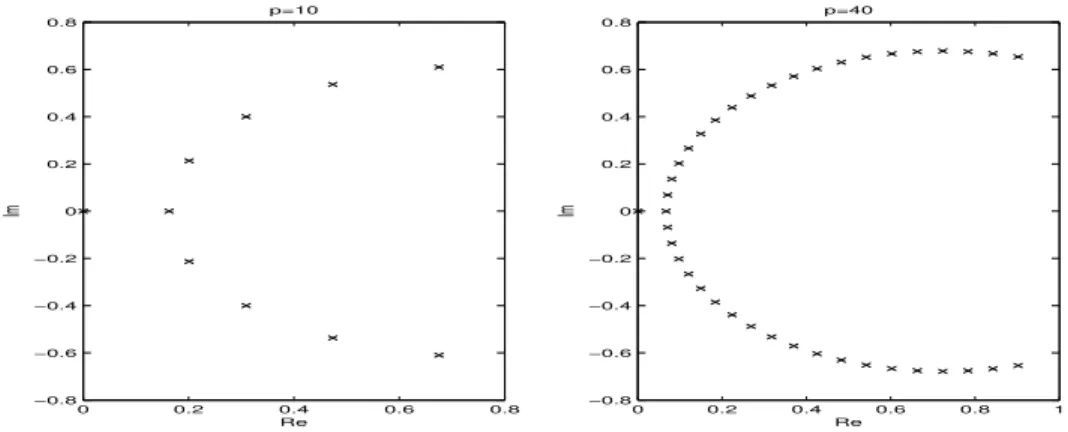
Distributions of correction matrix eigenvalues for
p
= 10 and
p
= 40, stiff case,
SDC.
37
2.5
Modulus of the (a) largest and (b) second largest eigenvalues for different numbers of
nodes,
SDC vs. Picard for the Gauss collocation formulation
. . . .
37
2.6
Eigenvalue distributions of SDC and Picard iterations for (a) 10 nodes and (b) 20
nodes
. . . .
38
2.7
S
−
S
˜
: Real (
o
) and imaginary (+) components of each eigenvector at the collocation
points, non-stiff case,
p
= 15,
SDC.
. . . .
39
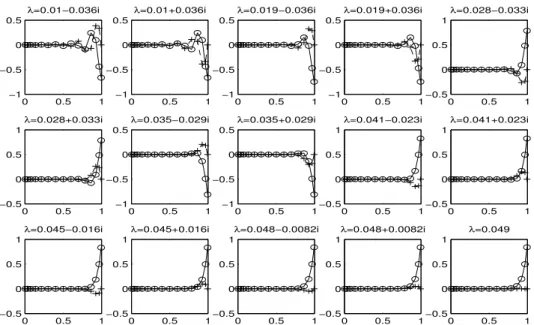
2.8
S
: Real (
o
) and imaginary (+) components of each eigenvector at the collocation
points, non-stiff case,
p
= 15,
Picard iteration
. . . .
39
2.9
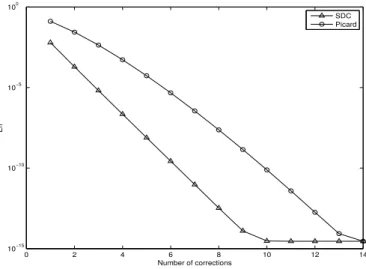
How errors decay after each SDC or Picard iteration.
. . . .
40
2.10 Real (
o
) and imaginary (+) components of each eigenvector at the collocation points,
stiff case,
p
= 15,
backward Euler preconditioned Gauss collocation formulation.
. . .
41
2.11 Contour of
ρ
(
C
) for
p
= 4 for
SDC-Radau,
λ
∆
t
=
x
+
iy
.
. . . .
43
2.12 Contour of
ρ
(
C
) for
p
= 10 for
SDC-Radau,
λ
∆
t
=
x
+
iy
.
. . . .
44
2.13 Contour of
ρ
(
C
) for
p
= 4, SDC-Lobatto methods,
λ
∆
t
=
x
+
iy
.
. . . .
45
2.14 Contour of
ρ
(
C
) for
p
= 10, SDC-Lobatto methods,
λ
∆
t
=
x
+
iy
.
. . . .
46
2.15 Contour of
ρ
(
C
) for
p
= 4 for
InDC-yp,
λ
∆
t
=
x
+
iy
. . . .
47
2.16 Contour of
ρ
(
C
) for
p
= 5 for
InDC-yp,
λ
∆
t
=
x
+
iy
. . . .
48
2.17 Contour of
ρ
(
C
) for
p
= 10 for
InDC-yp,
λ
∆
t
=
x
+
iy
.
. . . .
49
2.18 Spectral Radius
ρ
(
S
−
S
˜
) for different numbers of nodes,
Lobatto and
SDC-Lobatto-T.
. . . .
50
2.19 Convergence rate for backward Euler preconditioned Gauss (a) and uniform (b)
collocation formulations for different stiffness parameters
λ
. . . .
59
the relative error of the final iteration vs. the collocation formulation . . . .
78
3.3
Nonlinear multimode problem. (a): the magnitude of the deferred correction
kkδy˜˜kk.
(b): the relative error of the final iteration vs. exact solution
. . . .
79
3.4
Van der Pol oscillator. (a): the magnitude of the deferred correction
kkδy˜˜kk. (b): the
relative error of the final iteration vs. the collocation formulation . . . .
80
5.1
Relative error of
L
∞(c) per iteration over time using SDC . . . .
95
5.2
Relative error per iterations for each
c
iat
t
f inal. . . .
96
5.3
Relative error of
L
∞(c) per iteration over time, PFASST . . . .
96
5.4
Relative error per iterations for each
c
iat
t
f inal. . . .
97
6.1
Multirate test for electrostatic case . . . 101
6.2
Absolute error of velocity per iteration compared to the reference solution.
Coarse-level FMM precision is
1= 0
.
5
×
10
−9. . . 104
6.3
Absolute error of velocity per iteration compared to the reference solution.
Coarse-level FMM precision is
1= 0
.
5
×
10
−6. . . 105
6.4
Absolute error of velocity per iteration compared to the reference solution.
Coarse-level FMM precision is
1= 0
.
5
×
10
−2. . . 105
6.5
Relative error of velocity per iteration to
V
f mm[k] 0with coarse-level FMM precision
1= 0
.
5
×
10
−2. . . 105
6.6
Relative error of velocity per iteration to
V
f mm[k] 0with coarse-level FMM precision
1= 0
.
5
×
10
−6. . . 106
6.7
Relative error of velocity per iteration to
V
f mm[k] 0with coarse-level FMM precision
1= 0
.
5
×
10
−9. . . 106
6.8
Multirate test for gravitational case . . . 110
6.9
Absolute error of velocity per iteration compared to the reference solution.
Coarse-level FMM precision is
1= 0
.
5
×
10
−9. . . 111
LIST OF TABLES
2.1
ρ
(
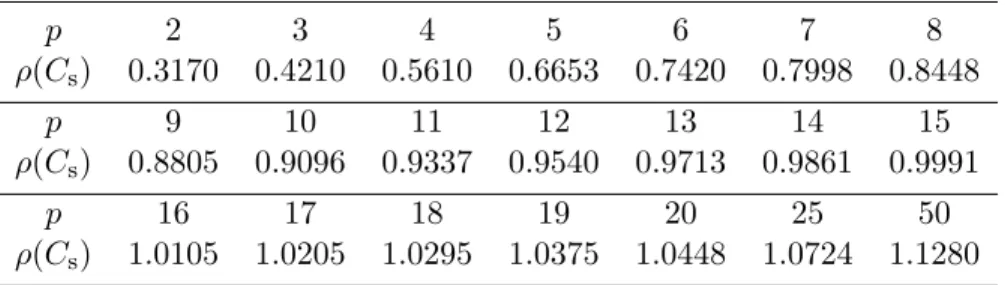
Cs
) for different numbers of Gaussian nodes, stiff case,
SDC.
. . . .
36
2.2
ρ
(
C
) for different numbers of nodes,
SDC-Radau.
. . . .
42
2.3
ρ
(
C
) for different numbers of nodes,
SDC-Lobatto methods.
. . . .
45
2.4
ρ
(
C
) of SDC-Lobatto-T, strongly stiff limit case. . . .
48
2.5
Errors from Gauss and uniform collocation formulations for different numbers of nodes.
53
2.6
Errors and Orders of the backward Euler and trapezoidal rule preconditioned deferred
correction iterations for different collocation formulations, non-stiff case. . . .
55
2.7
Errors and orders of the backward Euler preconditioned deferred correction iterations
for different collocation formulations, stiff case. . . .
58
3.1
The number of
H
(˜
y) needed to converge.
. . . .
80
3.2
The relative correction log
10 k˜ δk ky˜kof the converged solution. . . .
80
5.1
Timing results for SDC and PFASST . . . .
97
6.1
Runtime for various FMM precisions . . . 101
6.2
Serial SDC, 6 iterations . . . 112
6.3
PFASST, 7 iterations . . . 112
INTRODUCTION
0.1
The State of Computing
In 1965, the co-founder of Intel, Gordon Moore, predicted that the transistor density of
semi-conductor chips, hence the CPU speed, would double roughly every 1
.
5 years. This prediction has
become known as
Moore’s law; and from 1965 to about 2002, Moore’s law was upheld [45]. However,
as the transistor density increased, the power density of the chip increased causing greater levels of
heat on the chip. Technology has reached a point where the speed of processors cannot increase
much further due to this limitation. Hence in 2005, a paradigm shift occurred in processor design
in hopes of further increasing computational performance. Instead of creating ever-faster CPUs
running computations in
serial, additional performance can be gained by having
multiple
processors
work together, or in
parallel
[45].
The ability of having ever increasing computational power and efficient numerical methods
that can take advantage of this power has lead to great advances in science. As computational
power increases, so does the number of problems previously considered impractical to solve become
feasible. Therefore, creating methods to solve these problems is also an increasingly important
field of research. The following are a few examples of areas of open problems that require much
computational power: climate modeling, data analysis, and molecular dynamics (protein folding
and drug discovery).
0.2
Overview of Numerical Methods
ODE IVPs such as DASPK, a backward differentiation formula (BDF) based solver [10, 41], and
Runge-Kutta method based Radau5 solvers [24]. Numerical solvers have been successfully applied in
research and have advanced our knowledge in science and engineering. However, there still presides
attributes that limit the effectiveness of existing numerical algorithms. For example, to understand
the evolution of charged particles in systems containing thousands of particles, current molecular
dynamics simulation tools usually require millions of time steps to accurately capture the motion of
particles using existing low order time stepping schemes (e.g., the Verlet integration scheme). Even
with the acceleration of the fast
N
-body solvers [22, 43] for each time step, simulations may require
weeks or longer to get physically relevant results.
In recent years, several schemes were introduced to address the challenges in designing accurate
and efficient algorithms for large-scale long-time simulations.
Examples include the parareal
algorithm for parallelization in time [18, 42]; the high order temporal discretization using an
orthogonal basis and pseudo-spectral formulations for each time step, to allow larger step sizes
[6, 43, 38]; the spectral deferred correction (SDC), integral deferred correction (InDC), iterated
defect correction (IDeC), and Krylov deferred correction (KDC) methods for their efficient solutions
[3, 14, 16, 30]; and the parallel full approximation scheme in space and time (PFASST), which
utilizes parallel computing while combining several preconditioners [17]. The aim of the research
presented in this dissertation is to understand the properties of these existing methods and create
new methods that take advantage and possibly enhance their favorable traits such as high accuracy,
high efficiency, and parallelism.
0.3
Stiff Ordinary Differential Equations
slightly at any time, the resulting curve through the perturbed data has rapid variation. Typically
this takes the form of a short lived “transient” response that moves the later solution back toward a
smooth solution.” To understand stiffness, consider the following ODE
y
0(
t
) =
λ
(
y
(
t
)
−
cos(
t
) )
−
sin(
t
)
.
(1)
where
<(
λ
)
<
0. A solution to this equation is
y
(
t
) = cos(
t
) with the initial condition
y
(0) = 1.
Notice that this smooth solution is the solution for any value of
λ
. If the initial data is
y
(
t0
) =
η
,
which does not lie on the curve cos(
t
), then the solution through this point is
y
(
t
) =
e
λ(t−t0)(
η
−
cos(
t
0) ) + cos(
t
)
(2)
One can verify that this is true through differentiation. Since
<(
λ
)
<
0, the function approaches
cos(
t
) exponentially with decay rate
λ
. When one perturbs the solution at some point, the perturbed
solution approaches the slow changing particular solution cos(
t
).
The reason why stiff systems pose hardships on numerical methods for time dependent differential
equations is because stiff systems require algorithms to take a much smaller time step in order for
an algorithm to be stable. Although the true solution is smooth and it seems that a large time step
would suffice, the numerical method must handle the rapidly changing signal by taking smaller time
steps in order to attain accuracy. This property of stiff systems increases the runtime of simulations
and limits their effectiveness. This documents presents research aimed at overcoming the limitations
given by stiff systems.
0.4
Overview of Dissertation
CHAPTER 1
Fast Multipole Method
In this chapter, we will present a brief overview of the spatial method used for modeling the
evolution of charged particles in a vacuum. In this dissertation, we are using the electrostatics
assumption, which states that the charge density, denoted by
ρ
, is stationary or the charge density
does not change quickly in time. That is,
∂ρ∂t= 0 or
∂ρ∂t1.
With that being said, the evolution of
N
charged particles in space is given by Newton’s 2
ndlaw. For the
i
thparticle, the equation of motion is
d
2x
i(
t
)
dt
2=
q
im
iE(x
i(
t
))
(1.1)
where
x
iis the position,
E
iis the electric field,
q
iis the charge, and
m
iis the mass of the
i
thparticle.
Therefore, solving this system consists of two steps. (1) Finding an expression for the electric field.
We will designate this as the
spatial calculation. (2) Once the electric field is calculated, integrating
in time to find the new position of the particle. We will designate this as the
temporal calculation.
What follows is an explanation on how to solve for the electric field.
1.1
Poisson Equation
The electrostatic field in a vacuum is described by two of the Maxwell’s equations
∇ ·
E
=
ρ
0(1.2)
where
ρ
(
x
) is the charge density within a volume and the constant
0is the permeability of free
space [32]. Eq. (1.3) is equivalent to expressing
E
as the gradient of a scalar function Φ(x) such that
E
=
−∇Φ
.
(1.4)
Φ is called the electrostatic potential. Combining Eq. (1.4) and Eq. (1.2), we can write the vector
equation for
E
in terms of a scalar equation for Φ
∇
2Φ =
−
ρ
0
.
(1.5)
The above equation is called the
Poisson equation. In regions of space lacking a charge density,
Poisson’s equation becomes the
Laplace equation
∇
2Φ = 0
.
(1.6)
Hence, solving the spatial calculation for
E
in Eq. (1.1) is equivalent to solving the Poisson equation.
1.1.1
Green’s Function
The solution to the Poisson equation Eq. (1.5) within a volume
V
bounded by a surface
S
can
be found by using a construct called a
Green’s function,
G
(x
,
x
0). The Green’s function for Eq. (1.5)
has the property that it is a fundamental solution to the following equation
∇
0G
(x
,
x
0) =
−4
πδ
(x
−
x
0)
.
(1.7)
Assuming we have found the solution
G
(x
,
x
0) to the above equation, the general solution Φ to the
Poisson equation is
Φ(x) =
1
4
π0
Z
V
ρ
(x
0)
G
(x
,
x
0) d
3x
0+
1
4
π
I
S
G
(x
,
x
0)
∂
Φ
∂n
0−
Φ(x
0)
∂G
(x
,
x
0)
∂n
0where
n
0is the normal direction pointing out of the surface and d
a
0is the area element [32].
Fortunately, there is an explicit formulation of the Green’s function for electrostatic problems; it is
G
(x
,
x
0) =
1
|x
−
x
0|
.
(1.9)
1.1.2
Coulomb Potential
Recall that we are interested in finding the potential in free space. The relevant boundary
conditions are the Dirichlet conditions. Therefore, we must have that Φ(x)
→
0 as
x
→ ∞. In
addition, we also have the Green’s function satisfy Dirichlet conditions
G
|
S= 0 in Eq. (1.7).
Applying the Dirichlet boundary conditions and the appropriate Green’s function, Eq. (1.8) becomes
Φ(x) =
1
4
π
0Z
V
ρ
(x
0)
|x
−
x
0|
d
3
x
0.
(1.10)
The above equation is called the
Coulomb potential, and it gives the electrostatic potential subject
to the Dirichlet condition in free space for a general charge distribution
ρ
(x).
By modeling a charged particle as a point charge, we can write the charge density distribution
of
N
charged particles as
ρ
(x) =
N
X
i=1
q
iδ
(x
−
x
i)
where
q
iis the charge of a particle located at
x
i[32]. Using the above charge distribution in
Eq. (1.10) leads to the Coulomb potential for
N
charged particles
Φ(x) =
1
4
π
0N
X
j=1
q
j|x
−
x
j|
.
(1.11)
We now have all of the components needed to write an explicit formulation for the equations of
motion for a system of
N
charges. Using
E
=
−∇Φ and Eq. (1.11), we can express Eq. (1.1) as
d
2x
i(
t
)
dt
2=
−
q
im
iwhere
Φ
i(x
i) =
1
4
π
0N
X
j6=i
q
j|x
i−
x
j|
.
(1.13)
Occasionally in this dissertation, we will make reference to the forces instead of the potential in
Eq. (1.12). The force
F
is related to the electric field, and hence, the electrostatic potential by
F
=
q
E
=
−
q
∇Φ. Using the identity
∇
1
|x
−
x
0|
=
−
x
−
x
0|x
−
x
0|
3,
the force of the
i
thparticle is given by
F
i(x
i) =
−
q
i∇Φ
i(x
i) =
q
i NX
j6=i
q
jx
i−
x
j|x
i−
x
j|
3.
(1.14)
1.2
Multipole and Local Expansions
The cost of directly calculating the potentials Φ
i(x
i) in Eq. (1.12) for all
N
particles is
O
(
N
2).
When
N
is large, this cost is too high. In actual applications, we avoid the direct
O
(
N
2) calculation
by using approximations. The approximation technique that this dissertation uses is the fast
multipole method (FMM), which approximates Eq. (1.13) over all particles with cost
O
(
N
) [22, 43].
The FMM takes advantage of the fact that the potential Φ(x) can be written as a a sum of
potentials from two different spatial domains. This property comes from the Green’s function
G
(x
,
x
0) =
1
|x
−
x
0|
which has spatial multirate properties. We define the following spatial domains Ω
nearand Ω
f ar,
which we will denote as the near-field and the far-field, respectively. For a given location
x, a charge
found at
x
ihas
x
i∈
Ω
nearwith respect to
x
if
|x
−
x
i|
< R
. And we consider
x
i∈
Ω
f arwith
respect to
x
if
|x
−
x
i| ≥
R
where
R
is the characteristic distance that determines the near-field
and far-field. In Ω
f ar, the Green’s function is smooth; and in Ω
near, the Green’s function is more
1.2.1
Multipole Expansion
Assuming that
|x|
>
|x
0|, it is convenient to express the Green’s function in terms of the series
1
|x
−
x
0|
=
1
|x|
∞
X
n=0
P
n(cos
θ
)
|x
0|
|x|
n(1.15)
where
P
nare the Legendre polynomials and
θ
is the angle between
x
and
x
0. Normally,
x
0corresponds
to the position of a source charge, so our assumption implies that
x
is far from a charge found at
x
0.
This expansion is especially useful in describing far field interactions, since the expansion converges
quickly when
||xx0||<
1.
The Legendre polynomial
P
n(
u
) is the solution to the following recursion formulation
(2
n
+ 1)
uP
n(
u
) = (
n
+ 1)
P
n+1(
u
) +
nP
n−1(
u
)
with
P
0(
u
) = 1. We can further expand the Legendre polynomials in terms of spherical harmonic
functions
P
n(cos
θ
) =
m=nX
m=−n
Y
n−m(x
0)
Y
nm(x)
(1.16)
to obtain a new formulation of the Green’s function in Eq. (1.15)
1
|x
−
x
0|
=
∞
X
n=0
m=n
X
m=−n
|x
0|
nY
n−m(x
0)
Y
m n
(x)
|x|
n+1.
(1.17)
If we express
x
in spherical coordinates (
r, θ, φ
), the spherical harmonic function
Y
nm(x) is
defined as
Y
nm(
θ, φ
) =
s
(2
n
+ 1)
4
π
(
n
−
m
)!
(
n
+
m
)!
·
P
|m|
n
(cos
θ
)
e
imφ(1.18)
where
P
mn
are the
associated Legendre polynomials
[32, 52, 31]. The associated Legendre polynomials
P
nmare found by the following formulations
P
nm(
u
)
= (1
−
u
2)
m2 ∂m
∂um
P
n(
u
)
P
−mn
(
u
)
= (−1)
m(n−m)!
(n+m)!
P
nm(
u
)
.
expressed in spherical coordinates due to
N
charged particles at positions
x
i= (
r
i, θ
i, φ
i) in
Eq. (1.11) as
Φ(x) =
1
4
π0
NX
i=1q
i ∞X
n=0m=n
X
m=−n
|x
i|
nY
−m n(x
i)
Y
nm(x)
|x|
n+1(1.19)
=
1
4
π0
∞
X
n=0
m=n
X
m=−n N
X
i=1
q
i|x
i|
nY
n−m(x
i)
Y
m n(x)
|x|
n+1.
The terms
|x|1n+1are called “multipoles,” and their coefficients
M
nm=
N
X
i=1
q
i|x
i|
nY
n−m(x
i)
(1.20)
are called
moments
of the expansion. Using the the moments
M
mn
, we can rewrite the potential as
Φ(x) =
1
4
π
0∞
X
n=0
m=n
X
m=−n
M
nmY
m n
(x)
|x|
n+1.
(1.21)
The above formulation for the potential is called the
multipole expansion. Notice that if
|x|
is
large when compared to the charge locations
|x
i|, the multipole expansion will converge quickly.
Due to this property, we can approximate the infinite sum by truncating the series with
p
terms
Φ
p(x) =
1
4
π
0p−1
X
n=0
m=n
X
m=−n
M
nmY
m n
(x)
|x|
n+1;
(1.22)
and the residual error of the truncated series is bounded by
|Φ(x)
−
Φ
p(x)|
=
Q
|x| − |x
min|
|x
max|
|x|
p(1.23)
where
Q
=
N
P
i=1
|
q
i|
,
|x
min|
and
|x
max|
are the minimum and maximum magnitude of
|x
i|, respectively.
Note that the amount of calculations needed to calculate Φ
p(x) is
O
(
p
2).
If we partition space into regions or “boxes” Ω
jof radius
R
that contain various charges found
at
x
i∈
Ω
j, the multipole expansion approximation Φ
p(x) is useful in expressing the potential Φ
due to the particles within Ω
jwhen the point of interest
x
is far from region Ω
j. By far, we mean
expansion” with the respect to region Ω
j.
1.2.2
Local Expansion
The multipole expansion approximation assumes that the source particles are in the near field
with respect to an origin,
x
i∈
Ω
near; and the point of interest is in the far field from the origin
x
∈
Ω
f ar. However, when the case is reversed,
x
iΩ
f arand
x
Ω
nearwith respect to an origin, we
will need a new formulation for the potential Φ. We can use Eq. (1.19) and exchange the vectors
x
and
x
ito obtain
Φ(x) =
1
4
π
0N
X
i=1q
i ∞X
n=0m=n
X
m=−n
|x|
nY
nm(x)
Y
−m n(x
i)
|x
i|
n+1(1.24)
=
1
4
π
0∞
X
n=0
m=n
X
m=−n N
X
i=1
q
iY
n−m(x
i)
|x
i|
n+1|x|
n
Y
m n(x)
.
The above series converges when
||xix||<
1. We can express the moments of this expansion
L
mnas
L
mn=
N
X
i=1
q
iY
n−m(x
i)
|x
i|
n+1and rewrite the potential as
Φ(x) =
1
4
π0
∞
X
n=0
m=n
X
m=−n
L
mn|x|
nY
mn
(x)
.
(1.25)
The above formulation for the potential is called the
local expansion. Notice that if
|x|
is small
when compared to the charge locations
|x
i|, the local expansion will converge quickly. Due to this
property, we can approximate the infinite sum by truncating the series with
p
terms
Φ
p(x) =
1
4
π
0p−1
X
n=0
m=n
X
m=−n
L
mn|x|
nY
nm(x)
.
(1.26)
1.3
The
O
(
N
)
Algorithm
The FMM works by using a tree structure to partition space into boxes that contain certain
numbers of particles [22]. For each box
m
, we define the following spatial domains Ω
nearand Ω
f ar,
which we will denote as the near-field and the far-field, respectively. For a given location
x, a charge
found at
x
ihas
x
i∈
Ω
nearwith respect to
x
if
|x
−
x
i|
< R
. And we consider
x
i∈
Ω
f arwith
respect to
x
if
|x
−
x
i| ≥
R
where
R
is the characteristic distance that determines the near-field
and far-field.
In short, the FMM approximates Eq. (1.11) by directly calculating potential due to particles in
the near-field and approximating the potential due to particles in the far-field. We can express the
FMM approximation Ψ(x) such that Ψ(x)
≈
Φ(x) as
Ψ(x) =
1
4
π
0
X
xiΩnear
q
i|x
−
x
i|
+
p−1
X
j=0
a
j|x
−
x
c|
j
.
(1.27)
We will call Eq. (1.27) the
fast multipole approximation. In the expansion,
x
cis the position
of the box center on the finest level containing
x; and
a
jare coefficients that depend on
∀x
i∈
Ω
f ar.
p
is the number of terms in the expansion, and it controls the accuracy of Ψ(
x
). The larger
p
is,
the more accurate the FMM becomes. The first summation in Ψ(x) is the direct calculation of
the potential due to the near-field charges. The second summation in Ψ(x) is the approximation
of the potential due to the far-field. We will give a brief explanation of the FMM; but for more
information on the FMM, the reader is encouraged to read [22, 31].
For an arbitrary distribution of particles, the FMM uses a hierarchical oct-tree so that each
particle is associated with a box at different levels. Each box
i
has a “parent box” on the next-coarse
level to which the
i
thbox is a subset. A box
i
is a “child box” of box
j
if
i
is on the
j
’s subsequent
fine level and
i
is a subset of
j
. A divide-and-conquer strategy is used to account the far-field
interactions of each box on each level by accumulating multipole expansions. Afterwards, the local
expansion of a parent box receives the far-field contributions and transmits it to its children [52].
The fast multipole method needs the following properties to approximate the
O
(
N
2) calculation
in Eq. (1.13) in
O
(
N
) [31].
coarse-grid expansion.
2. The FMM needs a way to combine several multipole expansions into a single local expansion
about origin of a target box on the same level.
3. The FMM needs a way to translate a box’s local expansion to an origin within each of the
child boxes at the following fine level of the tree.
1.3.1
Translation of the Multipole Expansion
The following expansion allows us to combine several multipole expansions of one level into a
single expansion on a coarser level. If we have a multipole expansion about the origin, we can shift
the expansion and center it at a point
z
[31]. The original expansion about the origin
Φ(x) =
1
4
π
0∞
X
n=0
m=n
X
m=−n
M
nmY
m n
(x)
|x|
n+1can be written as an expansion about
z
as
Φ(x) =
1
4
π0
∞
X
n=0
m=n
X
m=−n
˜
M
nmY
m
n
(x
−
z)
|x
−
z|
n+1where
˜
M
nm=
n
X
j=0
j
X
k=−j
M
nm−−jki
|m|
i
|k|i
|m−k|A
kjA
mn−−jkA
m n|z|
jY
jk(z)
and the constant
A
mnis defined by
A
mn=
(−1)
n
p
(
n
−
m
)!(
n
+
m
)!
.
The error bounds of the truncated expansion is
|Φ(x)
−
Φ
p(x)| ≤
Q
|x
−
z| − |x
i| − |z|
|x
i|
+
|z|
|x
−
z|
p1.3.2
Conversion to a Local Expansion
The following shows how to convert a multipole expansion to a local expansion on the same
level. We must assume that the new center at
−z
must be far enough away from the multipole
expansion assumed at the origin such that
|z|
>
(1 +
c
)|x|.
Φ(x) =
1
4
π
0∞
X
n=0
n
X
m=−n
L
mn|z
−
x|
Y
nm(z
−
x)
where
L
mn=
∞X
j=0
j
X
k=−j
M
jk(−1)
ji
|m−k|i
|k|i
|m|A
kjA
mnA
kj−−nmY
jk+−nm(z)
|z|
j+n−1and
A
kj
is defined as before. The error bounds of a truncated expansion with
p
terms, Φ
pis
|Φ(x)
−
Φ
p(x)| ≤
Q
(
c
−
1)|x|
1
c
p.
1.3.3
Translation of the Local Expansion
To shift a local expansion of a box on the parent level to a box center of the child box at
−z, we
start with the local expansion given by
Φ
p(x) =
1
4
π0
p−1
X
n=0
m=n
X
m=−n
L
mn|x|
nY
nm(x)
.
We can express the truncated expansion
Φ
p(x) =
1
4
π0
p−1
X
n=0
m=n
X
m=−n
˜
L
mn|x
−
z|
nY
nm(x
−
z)
where
˜
L
mn=
∞X
j=0
j
X
k=−j
L
kj(−1)
j+ni
|k|i
|k−m|i
|m|A
kj−−nmA
mnA
kjY
k−m
j−n
(−z)|z|
j−n1.3.4
The Algorithm Outline
The FMM consists of the following steps [31]:
1. Form multipole expansions (moments) at the finest scale.
2. Merge (translate) expansions to form expansions on the next coarser level until the coarsest
scale is reached.
3. Starting at the coarsest level, for each target region, convert the multipole expansion into
local expansion at the center of each target box.
4. For each box, merge (translate) the local expansion to the center of each of a box’s children
until the finest level is reached.
5. Add the near-field potential contribution from the nearest neighbors to the approximated
far-field potentials to obtain Eq. (1.27).
1.4
Multirate FMM
The FMM is an extremely useful method that takes advantage of the spatial properties of
the Coulomb potential Φ(x(
t
)). However, we can take advantage of the temporal properties of
the Coulomb potential and fast multipole approximation Ψ(x(
t
)) to make a less computationally
expensive algorithm.
From Eq. (1.14), one can see that the magnitude of the forces is proportional to
r12where
r
=
|x
j−
x
i|. When
x
j∈
Ω
nearwith respect to
x
i, we can expect that the near-field forces should
change rapidly in time due to the
r12force with
r
small. When
x
j∈
Ω
f arwith respect to
x
i, we can
expect that the far-field forces should change slowly in time due to the
r12force with
r
large. Thus,
we can represent the forces in Eq. (1.1) as
d
2x
idt
2=
−
q
im
iThis can be rewritten as
d
2x
idt
2=
−
q
i4
π0m
i∇
X
xj∈Ωnear
q
j|x
j−
x
i|
+
X
xj∈Ωf ar
q
j|x
j−
x
i|
.
This formulation suggests that the forces have a dual behavior as they change in time, reminiscent
of a stiff system. The total force has two different time scales: a fast changing near-field and a slow
changing far-field. Since the FMM approximation Ψ, defined in Eq. (1.27), approximates the right
hand side of Eq. (1.28), we should expect Ψ to uphold this multirate behavior. More importantly,
it should be possible to take account of this multirate behavior in time integration schemes. We
will call the process of exploiting the temporal multirate behavior of the FMM as the
multirate
FMM
(MRFMM).
1.4.1
Numerical Evidence
To test our hypothesis of the inherent temporal multirate behavior of the FMM, we ran numerical
experiments to see how the far-field and near-field potentials change in time. To do this, we simulated
the the motion of particles while keeping track of Ψ
near(x(
t
)) and Ψ
f ar(x(
t
)) for each time step. Once
the simulation is over, for a given particle, we calculated the respective least-squares polynomial that
approximates Ψ
near(x(
t
)) and Ψ
f ar(x(
t
)) over time. Afterwards for each time step, we calculated
the
L
∞norm of the error between Ψ
near(x(
t
)) and Ψ
f ar(x(
t
)) and their respective least-squares
approximating polynomial over all particles.
For a fixed
L
∞error, the slower a potential varies in time (ie. a smoother potential), the lower
the degree of the least-squares polynomial is needed. Our intuition says that for a fixed error
between the numerical FMM solution and the least-squares polynomial, the least squares polynomial
corresponding to Ψ
f ar(x) should have a lower degree than that of Ψ
near(x). The results of the
experiment show this to be true. That is, for a fixed error, there is a difference in scale between
Ψ
f ar(x) and Ψ
near(x). One needs a least-squares polynomial of lower degree for Ψ
f ar(x) than that
of Ψ
near(x).
charge 1. They simply moved in space but did not have any effect on the potential due to neither
the source particles nor due the other target particles. The potential at the all locations were due
solely to the source particles. We also assumed that all particles have mass equal to 1.
The numerical experiment was done using 16,000 source particles and 16,000 target particles
randomly distributed in a unit cube. We used the FMM approximation Ψ(x) to approximate the
Coulomb potential Φ(x) such that the error tolerance in Ψ(x) was 0
.
5
×
10
−9. During the simulation,
the FMM tree was fixed as well. The simulation consisted of 200 time steps with size ∆
t
= 10
−7so
that
t
start= 0 and
t
f inal= 2
×
10
−5. And the time-marching scheme that we used was the velocity
Verlet method, which is as follows
x(
t
n+1)
=
x(
t
n) +
v(
t
n)∆
t
+
a(
t
n)
2
∆
t
2
v(
t
n+1)
=
v(
t
n) +
∆
t
2
(a(
t
n+1) +
a(
t
n))
(1.29)
where ∆
t
=
t
n+1−
t
n;
x(
t
n),
v(
t
n), and
a(
t
n) are the position, velocity, and acceleration, respectively
at time
t
=
t
n[26]. The velocity Verlet method has many favorable properties. Namely, it is explicit,
O
(∆
t
2), and symplectic [26]. For future reference, we will call running this experiment as the
multirate test.
Figure 1.1 shows the results of our experiment. We plot the
L
∞error over all target particles
between Ψ
f ar(x) and Ψ
near(x) and their respective least squares approximating polynomials for
various degrees. We represent the error logarithmically, showing the digits of precision in the error.
These results provide numerical evidence of the inherit temporal multirate behavior in the
FMM. We can see that for the same error, there is about a 3-degree separation in the least squares
polynomial between the smoother Ψ
f ar(x) than Ψ
near(x). That is for a fixed error, Ψ
f ar(x) needs
a lower degree least-squares polynomial than that for Ψ
near. This agrees with our intuition; the
CHAPTER 2
Deferred Correction Methods
It is desirable for algorithms to efficiently converge to solutions of large-scale long-time simulations
for ODEs with high accuracy. One way to obtain such high accuracy solutions is to create methods
that converge to high order temporal collocation formulations. Solvers that have been made to
directly calculate accurate collocation formulation solutions have shown to not be able to do so
efficiently. For example in [23, 25], the Gauss collocation formulations using only 2, 4, and 6 nodes
were implemented as geometric integrators for Hamiltonian systems. Unfortunately, numerical
results show that without the aid of deferred correction or other acceleration techniques, these
solvers may not be able to calculate a highly accurate solution as efficiently as other linear multistep
methods (see Fig. 5.1 in [23]). If an algorithm can obtain high accuracy at the cost of severely
reduced efficiency, the algorithm becomes impractical in application. Hence, it is of great importance
to create algorithms that obtain high accuracy while at the same time obtaining high efficiency.
This chapter is organized as follows. In Sec. 2.1, we study the
converged solution
by developing
the “collocation formulations database” for the numerical framework for solving ODE initial value
problems and by discussing the properties of each formulation. In Sec. 2.2, we start from the
backward Euler based spectral deferred correction methods and their convergence properties, and
then study different deferred correct methods to form the “deferred correction methods database” in
the
convergence procedure, an iterative procedure to reduce the errors in the provisional solution.
In Sec. 2.4, we discuss several algorithm design guidelines to integrate different components to
efficiently converge
to the solution of an
“optimal” discretization
in the numerical framework.
2.1
Collocation Formulations and Properties
For long time simulations, it is in general impractical to use one single step for the entire
interval from
t
= 0 to
t
f inal(e.g., by using a spectral formulation for [0
, t
f inal]). What is done
in practice is that the entire time interval is divided into a sequence of subintervals (time steps)
based on the properties of the solution and any step size constraints. In this section, we discuss
different collocation formulations for each time step. These collocation formulations differ in the
mathematical formulations, choices of collocation points, and numerical integration or differentiation
strategies. We leave the discussions of their accurate and efficient solutions to later sections.
(up to a prescribed precision), the numerical properties of the solution are then determined by the
properties of the collocation formulation, not the convergence procedure. Unlike existing analysis of
the deferred correction methods, this new viewpoint allows us to study the mathematical properties
of the framework (e.g., order and stability) by focusing on the converged solution of the collocation
formulation, and to consider the
convergence procedure
(describing how the iterations converge)
separately.
2.1.1
Gauss Collocation Method
We first present a variant of the well-studied Gauss collocation formulation (also referred to
as the Gauss Runge-Kutta (GRK) method) for ODE initial value problems
y
0(
t
) =
f
(
t, y
(
t
)) with
given initial data
y
(0) [25, 28]. To march one step from
t
= 0 to
t
= ∆
t
, we define
Y
(
t
) =
y
0(
t
) as
the new unknown function and recover
y
(
t
) using
y
(
t
) =
y
(0) +
R
t0
Y
(
τ
)
dτ
. This will give what we
call the
“yp-formulation”
as
Y
(
t
) =
f
(
t, y
(0) +
Z
t0
Y
(
τ
)
dτ
)
.
(2.1)
In the Gauss collocation formulation,
p
Gaussian quadrature nodes
t
= [
t
1, t
2,
· · ·
, t
p]
Tare used
to discretize the yp-formulation in [0
,
∆
t
]. For the given function values
Y
= [
Y1, Y2,
· · ·
, Y
p]
Tat the Gaussian nodes, we can construct the (
p
−
1)
thdegree Legendre polynomial expansion to
approximate
Y
(
t
) =
y
0(
t
) where the coefficients are computed using the Gaussian quadrature rules.
We can integrate this interpolating polynomial analytically from 0 to
t
m, where 1
≤
m
≤
p
, to
form a linear mapping that maps the function values
Y
to the integral of
Y
(
t
) at the node points.
Taking out the scalar factor ∆
t
in this mapping, the integral
R
t0
Y
(
τ
)
dτ
can be approximated by
∆
tS
Y, where
S
is called the
“spectral integration matrix”
[21] which can be precomputed. The
discretized Gauss collocation formulation using
p
node points in the time interval [0
,
∆
t
] is given by
Y
=
F(t
,
y
0+ ∆
tS
Y)
.
(2.2)
Theorem 2.1.1.
For ODE initial value problems, the Gauss collocation formulation in Eq. (2.2)
with
p
nodes is of order
2
p
(super convergence),
A
-stable,
B
-stable, symplectic (structure preserving),
and symmetric (time reversible). In addition, the error decays exponentially when
p
increases.
Interested readers are referred to [5, 27] for the proof of the theorem. These nice properties
allow the use of very large time step sizes when solving ordinary differential equation initial value
problems.
Comment:
The yp-formulation can be easily generalized to differential algebraic equations
(DAEs) of the form
F
(
t, y, y
0) = 0, and the discretized system becomes
F(t
,
y
0+ ∆
tS
Y
,
Y) =
0
.
Similar to the ODE case, the pseudo-spectral type collocation formulation allows much larger time
step sizes in the numerical simulation. In Fig. 2.1, we compare the Gauss collocation formulation
with traditional BDF methods for the DAE system from [1]
x
01x
020
=
10
−
2−1t0
10(2
−
t
)
9
2−t
−1
9
t
+ 2
t
2−
4
0
x1
x2
z
+
3−t
2−t
e
t2
e
te
t(2
−
t
−
t
2)
(2.3)
whose analytical solution is given by (
x
1, x
2, z
) =
e
t, e
t,
−
e
t/
(2
−
t
)
10−4 10−3 10−2 10−1 10−12
10−10 10−8 10−6 10−4 10−2 100
Time Step ∆ t
Max Error
Errors in x 1(t)
Order 2
Order 3 Order 4
(a)
10−0. 9 10−0.8 10−0. 7
10−15 10−10 10−5
Errors in x 1 (t)
Time step ∆ t
Max Error
p=3 p=4 p=5
(b)
![Figure 2.1: Accuracy in x 1 for different step sizes using (a) traditional BDF methods, orders 2, 3, 4 (from [1]) and (b) Gauss collocation methods using 3, 4, 5 Gaussian nodes.](https://thumb-us.123doks.com/thumbv2/123dok_us/8287487.2194596/35.918.189.726.117.401/figure-accuracy-different-traditional-methods-collocation-methods-gaussian.webp)