Nicotinamide benefits both mothers and pups in two
contrasting mouse models of preeclampsia
Feng Lia,1, Tomofumi Fushimab,1, Gen Oyanagib,2, H. W. Davin Townley-Tilsonc,3, Emiko Satob,d, Hironobu Nakadab, Yuji Oed,4, John R. Hagamana, Jennifer Wildera, Manyu Lie, Akiyo Sekimotob,d, Daisuke Saigusaf, Hiroshi Satob,d, Sadayoshi Itod, J. Charles Jennettea, Nobuyo Maedaa, S. Ananth Karumanchig, Oliver Smithiesa,5,
and Nobuyuki Takahashia,b,d,e,5
aDepartment of Pathology and Laboratory Medicine, The University of North Carolina, Chapel Hill, NC 27599;bDivision of Clinical Pharmacology and Therapeutics, Tohoku University Graduate School of Pharmaceutical Sciences, Sendai 980-8578, Japan;cDepartment of Cell and Developmental Biology, The University of North Carolina, Chapel Hill, NC 27599;dDivision of Nephrology, Endocrinology, and Vascular Medicine, Department of Medicine, Tohoku University, Sendai 980-8574, Japan;eDepartment of Cell and Molecular Physiology, The University of North Carolina, Chapel Hill, NC 27599;fDepartment of Integrative Genomics, Tohoku Medical Megabank Organization, Tohoku University, Sendai 980-8573, Japan; andgDepartment of Medicine, Beth Israel Deaconess Medical Center, Harvard Medical School, Boston, MA 02215
Contributed by Oliver Smithies, September 9, 2016 (sent for review July 14, 2016; reviewed by Thomas M. Coffman and Shigeru Saito)
Preeclampsia (PE) complicates∼5% of human pregnancies and is one of the leading causes of pregnancy-related maternal deaths. The only definitive treatment, induced delivery, invariably results in prematurity, and in severe early-onset cases may lead to fetal death. Many currently available antihypertensive drugs are tera-togenic and therefore precluded from use. Nonteratera-togenic antihy-pertensives help control maternal blood pressure in PE, but results in preventing preterm delivery and correcting fetal growth restric-tion (FGR) that also occurs in PE have been disappointing. Here we show that dietary nicotinamide, a nonteratogenic amide of vita-min B3, improves the maternal condition, prolongs pregnancies,
and prevents FGR in two contrasting mouse models of PE. The first is caused by endotheliosis due to excess levels in the mothers of a soluble form of the receptor for vascular endothelial growth factor (VEGF), which binds to and inactivates VEGF. The second is caused by genetic absence of Ankiryn-repeat-and-SOCS-box– containing-protein 4, a factor that contributes to the differentiation of tropho-blast stem cells into the giant trophotropho-blast cells necessary for embryo implantation in mice; its absence leads to impaired placental devel-opment. In both models, fetal production of ATP is impaired and FGR is observed. We show here that nicotinamide decreases blood pressure and endotheliosis in the mothers, probably by inhibiting ADP ribosyl cyclase (ADPRC), and prevents FGR, probably by normal-izing fetal ATP synthesis via the nucleotide salvage pathway. Be-cause nicotinamide benefits both dams and pups, it merits evaluation for preventing or treating PE in humans.
preeclampsia
|
sFLT1|
placentation|
fetal growth restriction|
nicotinamideT
he maternal hypertension and proteinuria characterizing preeclampsia (PE) are primarily consequences of an imbal-ance between proangiogenic growth factors that promote vas-cular well-being (such as VEGF), and antiangiogenic factors that sequester the growth factors (such as the soluble form of VEGF receptor-1, now referred to as sFLT1) (1). Both the hypertension and the proteinuria of PE are caused by abnormally high amounts of antiangiogenic factors derived from the placenta. Fetal growth restriction (FGR), an additional feature of PE, is a consequence of reduced placental blood flow resulting from damage to the pla-cental vasculature caused by antiangiogenic factors and/or to im-paired development of the placenta. Endothelin-1 (EDN1) is the most powerful naturally occurring prohypertensive peptide, and antagonists of the endothelin type A receptor (EDNRA) greatly ameliorate the PE-like condition that develops in the kidneys of rodents with excess sFLT1 (2, 3). Unfortunately, these antagonists are teratogenic (4) and consequently unacceptable for use in treating PE.Nicotinamide is a potential nonteratogenic alternative because it relaxes blood vessels constricted with EDN1 (5) and because it
has been extensively tested at high oral doses in men and (non-pregnant) women and found safe (6).
Results and Discussion
Nicotinamide Ameliorates the Hypertension, Albuminuria, and Renal Abnormalities in PE Caused by Increased Maternal Production of
Flt1(1-3).To explore the potential of nicotinamide for treating PE,
we first evaluated its effects on the PE-like condition induced in nonpregnant female inbred strain C57BL/6J mice by adminis-trating 109plaque forming units (pfu) of a recombinant adenovi-rus, rAdV Flt1(1-3), that infects the liver and causes production of Flt1(1-3) and increases its concentration in the plasma (7).
Significance
Preeclampsia (PE), high blood pressure and protein in the urine in the last third of pregnancy, complicates about 1 in 20 human pregnancies, and it is one of the leading causes of pregnancy-related maternal deaths. The only definitive treatment, in-duced delivery, invariably results in premature babies. Blood pressure-lowering drugs help, but results in preventing pre-term delivery and correcting the fetal growth restriction (FGR) that also occurs in PE have been disappointing. Here we show that feeding high doses of nicotinamide, a vitamin, improves the maternal condition, prolongs pregnancies, and prevents FGR in mice having PE-like conditions due to two contrasting causes. Because nicotinamide benefits both mothers and pups, it merits evaluation for preventing or treating PE in humans.
Author contributions: F.L., T.F., G.O., E.S., N.M., O.S., and N.T. designed research; F.L., T.F., G.O., H.D.T.-T., E.S., H.N., Y.O., J.R.H., J.W., A.S., and H.S. performed research; H.D.T.-T., E.S., M.L., D.S., and S.A.K. contributed new reagents/analytic tools; F.L., T.F., G.O., E.S., Y.O., A.S., J.C.J., O.S., and N.T. analyzed data; and F.L., T.F., H.S., S.I., J.C.J., N.M., S.A.K., O.S., and N.T. wrote the paper.
Reviewers: T.M.C., Duke-National University of Singapore Medical School Singapore; and S.S., University of Toyama.
Conflict of interest statement: S.A.K. is a coinventor of several patents related to angio-genic biomarkers that are held by Beth Israel Deaconess Medical Center. S.A.K. reports serving as a consultant to Siemens, Roche, Thermofisher, and Aggamin LLC. All other authors declare no competing financial interests.
Freely available online through the PNAS open access option.
1F.L. and T.F. contributed equally to this work.
2Present address: Pharmaceutical Department, Tohoku University Hospital, Miyagi
980-8574, Japan.
3Present address: Department of Medicine, Baylor College of Medicine, Houston, TX 77030. 4Present address: Division of Feto-Maternal Medical Science, Tohoku Medical Megabank
Organization, Tohoku University, Sendai 980-8573, Japan.
5To whom correspondence may be addressed. Email: [email protected] or
This article contains supporting information online atwww.pnas.org/lookup/suppl/doi:10.
[Flt(1-3) is a synthetic protein that includes a signal sequence, the first 328 amino acids of FLT1, and six copies of a His tag.] These experiments showed that 500 mg/kg per day of oral nic-otinamide has significant beneficial effects on the hypertension, albuminuria, damage to the endothelium of the renal glomerular capillaries, and glomerular mesangial expansion caused by the Flt1(1-3) (Fig. S1). [The amount of nicotinamide used in these and all of our other experiments (500 mg/kg per day) is equiv-alent to 2.5 g/d in a 60-kg human, when corrected for body surface area (8), and consequently does not exceed doses (3–9 g daily) that are commonly used (9, 10).]
We next tested the effects of nicotinamide in pregnant C57BL/ 6J mice receiving 109 pfu of the Flt1(1-3) virus at 7.5 d post-coitum (dpc). However, this led to miscarriages by 10.5 dpc. Accordingly, the experiment was repeated using out-bred mice
(ICR) and less virus. The results show that nicotinamide pre-vents the Flt1(1-3)–induced increase in telemetrically measured systolic blood pressure (SBP; Fig. 1A) and reduces the urinary excretion of albumin [albumin/creatinine ratio (ACR)] to a level indistinguishable from control pregnant mice not receiving nic-otinamide (Fig. 1B).
Widespread endothelial damage is an invariable finding in PE; indeed, renal glomerular endotheliosis is the most char-acteristic morphologic lesion of the human condition (11). The same type of endotheliosis develops in pregnant mice receiving the Flt1(1-3) virus, and this is ameliorated by nico-tinamide. Thus, the glomerular open capillary area (an in-dicator of the status of the capillary endothelium) was decreased to ∼60% normal in the pregnant mice receiving the Flt1(1-3) virus alone, but was improved to∼80% normal if the mice also received nicotinamide (Fig. 1C). Likewise in the same samples, the marked increase in periodic acid-Schiff (PAS) stain-pos-itive area (an indicator of mesangial expansion) was prevented by nicotinamide (Fig. 1D). Representative light and electron micrographs of the renal glomeruli directly illustrate the endotheliosis and mesangial expansion caused by the virus and confirm that nicotinamide substantially reduces their severity (Fig. 1 E and F). These beneficial effects were seen despite
E
F
Flt1(1-3)+Nam
Control Nam
Flt1(1-3)
20μm 1μm
Control Nam
En Ep
Ep En
En 0 0.05 0.10 0.15
ACR (mg/mg)
p=0.006 p=0.008
p=0.80
p=0.02
p=1.0 p=0.78
8 9 15 15
B
D
P
AS positive
area
(%)
0 20 40 60
80 p<0.0001
p<0.0001
p=0.016 p<0.0001
p<0.0001 p=0.011
83/3 147/5 150/4 98/3
SBP
(mmHg)
A
p<0.0001 p=0.12 p=0.0059 p=0.14
0 40 80 120 160
6 6 6 6
p=0.99
C
Open capillary area
(%)
p=0.73 p<0.0001
p<0.0001 p<0.0001 p<0.0001
p<0.0001
0 10 20 30
83/3 147/5 150/4 98/3
Flt1(1-3)+Nam Flt1(1-3)
Fig. 1. Nicotinamide (Nam) ameliorates the high BP, urinary albumin ex-cretion, endotheliosis, and mesangial expansion induced in pregnant mice by Flt1(1-3). (A) SBPs of pregnant outbred ICR mice before and after receiving 6×10⁸pfu rAdV Flt1(1-3) at 14.5 dpc and given or not given Nam daily by gavage (500 mg/kg per day) starting at 12.5 dpc. Nam prevented the Flt1(1-3) induced increase in SBP. Data are average of 3 d [9.5–11.5.dpc for previrus and 16.5–18.5 dpc after rAdV Flt1(1-3)]. (B) ACRs of urine samples at 17.5 dpc from pregnant mice that received 6×10⁸pfu rAdV GFP alone (Control), rAdV GFP plus Nam (Nam), Flt1(1-3) virus alone [Flt1(1-3)], or Flt1(1-3) virus plus Nam [Flt1(1-3)+Nam]. Nam prevented the Flt1(1-3) induced increase in ACR. (C) Open capillary area (an indicator of the status of the endothelium of the glomerular capillaries) from the four groups of mice as percentage of glomerular tuft area. (D) PAS-positive area in the kidneys (an indicator of mesangial expansion). Nam increased the open capillary area and de-creased the mesangial expansion. (Eand F) Light and electron micro-graphs of illustrative glomeruli from the four groups of mice. Note the endotheliosis and loss of fenestrae caused by Flt1(1-3), and their ame-lioration by Nam. InAandB, numbers of mice are within the bars. In
CandD, numbers of glomeruli/number of mice are within the bars. En, glomerular endothelium; Ep, glomerular epithelium; arrows, endothelial fenestrae. Data are mean±SEM. Multiple comparisons,A–D, used the Tukey–Kramer test.
A
C
1.0 1.2 1.4 1.6 1.8
Fetal
w
eight (g)
(140/10) (144/10) (86/6) (84/6) p<0.0001 p=0.0006 p=0.97 p<0.0001
p=0.93
Continuing pregnancies (%)
p=0.004
Day after virus 0
0 2 4 6 8
20 40 60 80 100
Flt1(1-3)+Nam (15) Flt1(1-3) (22)
B
P
lasma sFL
T
1 (
g
/ml)
0 10 20 30
p<0.0001
Delivery day (dpc)
D
Relative
Flt
1
expression
0 0.5 1.0 1.5
p=0.03 p=0.03 p=0.04
(26/7) (17/5) (25/7) (23/6)
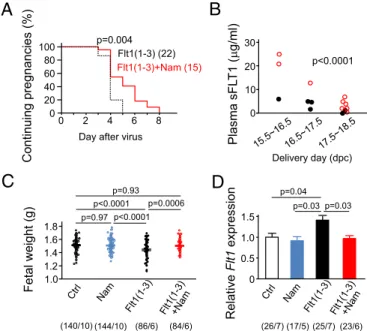
Fig. 2. Nicotinamide delays miscarriages and prevents fetal growth restriction induced by Flt1(1-3) and decreases expression ofFlt1in placentas. (A) Con-tinuing pregnancies in outbred ICR mice receiving rAdV Flt1(1-3) (1×10⁹pfu) at 8.5 dpc with or without Nam daily by gavage beginning on 6.5 dpc. We determined the termination of pregnancy by a decrease in BW. Miscarriages involve almost all of the fetuses. We never encountered miscarriages in which only a few fetuses were involved. Parentheses show numbers of pregnancies. Nam delayed the miscarriages (Mantel–Cox log-rank test). (B) Maternal plasma sFLT1 concentrations versus delivery day of ICR mice receiving 6×10⁸pfu of rAdV Flt1(1-3) at 14.5 dpc with (red open circles) or without Nam by gavage beginning on 12.5 dpc (black filled circles). Dams given Nam had higher sFLT1 levels than dams which delivered their pups on the same day but were not given Nam (by ANCOVA). (C) Fetal weights at 18.5 dpc from dams receiving 6×10⁸pfu of rAdV GFP alone at 14.5 dpc (Ctrl), or rAdV GFP at 14.5 dpc and Nam beginning at 12.5 dpc (Nam), or 6×10⁸pfu of Flt1(1-3) virus at 14.5 dpc [Flt1(1-3)], or dams receiving both virus and Nam [Flt1(1-3)+Nam]. Fetal weights were normalized by Nam. The numbers of fetuses/number of pregnancies are shown in parentheses. (D) mRNA expression (relative to expression in the pla-centas from control mice) ofFlt1in placentas at 18.5 dpc from mice that received rAdV Flt1(1-3) (6×10⁸pfu) at 14.5 dpc with or without Nam starting at 12.5 dpc. Nam decreasedFlt1expression. Data are means±SEM. Multiple comparisons,
CandD, used the Tukey–Kramer test.
MEDI
CAL
SC
our finding that plasma levels of sFLT1, VEGF, and placental growth factor (PGF) in pregnant mice at 18.5 dpc were not al-tered by nicotinamide (Fig. S2).
Nicotinamide Prolongs Pregnancies and Lessens FGR in PE Caused by
Increased Maternal Production of Flt1(1-3). Any treatment in a
pregnant woman with severe early-onset PE that postpones the need to induce labor to save her life or benefit her baby is beneficial because it decreases the prematurity of the neonate. We therefore tested whether nicotinamide can prolong preg-nancy in mice with increased Flt1(1-3) expression induced at different times during pregnancy. Our first test was with 109pfu
of rAdV Flt1(1-3) administered at 8.5 dpc to pregnant mice that were receiving or not receiving nicotinamide daily by gavage beginning at 6.5 dpc. This test allowed us to assess the effects of nicotinamide under conditions of exposure to high Flt1(1-3) relatively early in pregnancy. The results show that nicotinamide had highly significant effects in prolonging pregnancies under these circumstances, although none of the pregnancies went to term (Fig. 2A). Interestingly, the plasma sFLT1 levels in mice given nicotinamide and Flt1(1-3) virus were higher than in mice given the virus alone (Fig. 2B); nevertheless, mice exposed to increased levels of sFLT1 maintain their pregnancies longer if given nicotinamide.
To have pregnancies in which the effects of nicotinamide on PE-induced FGR could be measured, we reduced the dose of Flt1(1-3) virus to 6×10⁸pfu, administered it at a later time in the pregnancy (14.5 dpc) when placental development is more complete, and harvested the fetuses at 18.5 dpc. We found that Flt1(1-3) virus administered at this later stage of pregnancy with or without nicotinamide did not significantly affect maternal weight gain, uterine weights at the time of harvest, or number of fetuses per pregnancy, indicating that Flt1(1-3) has few harmful events once the placenta is fully matured (Table S1). Never-theless, fetal weights at 18.5 dpc were decreased by the Flt1(1-3) virus (Fig. 2C), and nicotinamide protected the fetuses from this growth restriction (Fig. 2C). Placental expression of Flt1 was increased by maternal Flt1(1-3) (Fig. 2D) and was corrected by nicotinamide (Fig. 2D), suggesting that nicotinamide alleviated placental ischemia. We conclude that nicotinamide significantly lessens the FGR that occurs in the fetuses of dams exposed to Flt1(1-3).
Nicotinamide Prevents the Hypertension, Albuminuria, and Renal
Abnormalities in PE Caused by Absence of ASB4. A substantial
body of data indicates that PE in humans is a consequence of placental abnormalities caused by inadequate invasion of the maternal uterine endometrium by embryonic cytotrophoblasts (12, 13). In mice, giant trophoblast cells (GTCs), differentiated from trophoblast stem cells, mediate the early stages of this in-vasion, by producing matrix metalloproteinases (14, 15). This differentiation pathway is compromised in mice that genetically lack ASB4 (Ankiryn-repeat-and-SOCS-box-containing-protein 4), and pregnantAsb4−/−mice have shallow placentas and de-velop a PE-like condition (14).Asb4−/−mice therefore provide a model of PE in which the condition is initiated by inadequate placentation, which contrasts with the Flt1(1-3) model in which the condition is initiated by maternal overproduction of anti-angiogenic factors. ASB4 ubiquitinates inhibitor of DNA binding 2 (ID2) and causes it to be degraded in the proteasome. In the absence of ASB4, ID2 inhibition persists, and the differentiation of trophoblast stem cells into GTCs is impaired. Abnormal persistence of ID2 expression is also observed in placental bi-opsies from human PE patients (16), further exemplifying the similarities between the human condition and theAsb4−/−mouse model. Many Asb4−/− embryos die and are resorbed, so that Asb4−/−dams produce fewer pups and, like human PE patients, they exhibit hypertension and proteinuria (14).
Using this second model of PE, we first assessed the effects of nicotinamide on the maternal hypertension and albuminuria that develop in theAsb4−/−mice mated with theAsb4−/−males, and
given or not given nicotinamide in their drinking water starting at the beginning of the pregnancy (0.5 dpc). Tail cuff-measured SBP of both groups was close to normal in the first week of pregnancy, but had increased by about 25 mmHg in the un-treatedAsb4−/−mice by the third week (Fig. 3A). Nicotinamide prevented this increase (Fig. 3A). By the third week of preg-nancy, the untreated Asb4−/− dams had developed albumin-uria (Fig. 3B), which was also completely prevented by the dietary nicotinamide (Fig. 3B). Absence of ASB4 also resulted in endotheliosis as judged by a decrease in the open capillary areas of the renal glomeruli of the dams (Fig. 3C) and in mesangial expansion as judged by an increase in PAS-positive area in the
E
Asb4-/-+Nam
20 μm
Asb4
-/-WT WT+Nam
F
2 μmWT WT+Nam
Asb4-/- Asb4-/-+Nam
B
ACR
(mg/mg)
Asb4-/- Asb4 -/-+Nam 0
0.07 0.14 0.21
p=0.76 p=0.0003 p=0.001
p=0.88
10 7 6 9
p<0.0001
A
Asb4 -/-+Nam 0
40
SBP
(mmHg) 80
120
Asb4
-/-p=0.18 p=0.77
p=0.015
160 p=0.36
10 10 7 7
p=0.0032
C
D
p<0.0001 p=0.0003
p<0.0001 p=0.002
p<0.0001 p=0.60
P
A
S positive area
(%)
0 20 40 60
87 90 92 87
p<0.0001 p<0.0001
p<0.0001 p<0.0001
p<0.0001 p=0.48
Open capillary
area (%)
0 10 20 30 40
87 90 92 87
Fig. 3. Nicotinamide prevents the increases in BP and urinary albumin excretion, and ameliorates glomerular pathology in pregnant mice lacking ASB4.Asb4−/−females mated withAsb4−/−males and WT females mated with WT males were randomly enrolled into two groups given or not given 0.3% Nam in their drinking water starting at 0.5 dpc. (A) Average SBP during the first week and third week of pregnancy ofAsb4−/−mice with or without Nam. Nam prevented the increase in SBP caused by absence of ASB4. (B) Average ACR of urine samples from virginAsb4−/−females and from pregnantAsb4−/−
same glomeruli (Fig. 3D). Nicotinamide prevented the endothe-liosis, as judged by normalization of the open capillary area (Fig. 3C) and prevented the mesangial expansion, as judged by normalization of the PAS-positive area (Fig. 3D). The beneficial effects of nicotinamide in protecting the kidneys of the pregnant mice from the deleterious effects of absence of ASB4 are illustrated by the light and electron micrographs shown in Fig. 3E and F. These beneficial effects of nicotin-amide in the pregnant Asb4−/− mice, like those in the mice receiving Flt1(1-3) virus, were seen even though plasma levels of sFLT1 and VEGF were not altered by the nicotinamide
(Fig. S3).
Nicotinamide Prolongs Pregnancies and Prevents Loss of Embryos in
PE Caused by Absence of ASB4.Fetal distress is as likely as
ma-ternal hypertension to be the reason for induction of delivery in patients with severe early onset PE, but overall results in pro-longing pregnancies to improve fetal well-being have been disappointing (17, 18). Accordingly, we tested whether nico-tinamide can prolong and improve the outcome of pregnancies in the Asb4−/−mice. The results show that Asb4−/− mice not given nicotinamide delivered prematurely at 19.5 dpc, whereas their littermates given nicotinamide in the drinking water throughout pregnancy delivered their pups at 20.5 dpc, which is close to the normal time for WT mice (Fig. 4A). The beneficial effects of nicotinamide were also apparent in dams at 18.5 dpc. Thus,Asb4−/−dams have about half the number of live fetuses at 18.5 dpc than WT dams (Fig. 4B), and nicotinamide throughout the pregnancy overcomes this deficiency (Fig. 4B). In contrast, the numbers of embryonic implants (dead+alive) in theAsb4−/− mutant mice did not differ from that in WT mice (Fig. 4C), and
nicotinamide had no effect (Fig. 4C). However, the proportion of living embryos changed with developmental stage. Thus, using the criteria illustrated in Fig. 4Dto determine whether an embryo or fetus is alive or dead, we found that the pro-portion of live embryos at 11.5 dpc and earlier was not affected by genotype or by feeding nicotinamide (Fig. 4E). However, by 12.5 dpc, the proportion of live embryos was less than 40% in the dams lacking ASB4 (Fig. 4F), and nicotinamide increased this proportion to ∼80% (Fig. 4F). Together these results dem-onstrate that the deleterious event(s) causing loss of Asb4−/− embryos and the beneficial effects of nicotinamide both occur before 12.5 dpc.
A
Continuing pregnancies (%) dpc 20 40 60 80
0 100
17.5 19.5 21.5
Asb4-/-(5)
p=0.012
Asb4
-/-+Nam (9)
WT WT+Nam
1cm
Asb4-/- Asb4-/-+Nam
D
p=0.91
E
11
A
v
erage proportion of live
embryos from 9.5 to1
1
.5 dpc
0.2 0.4 0.6 0.8
0
p=0.49 p=1.0
184/25 11
7/5
196/27 150/21
B
11
A
v
erage number of live fetuses at 18.5 dpc
2 4 6 8
0
p=0.02 p=0.10
p=0.023 p=0.99
p=0.94
29/10
35/6 41/7 48/9
p=0.99
C
11
A
v
erage number of
implanted embryos
2 4 6 8
0 232/31 150/20 253/34 191/26
p=1.0 p=0.99
F
11
A
v
erage proportion of live embryos at 12.5 dpc 0.2
0.4 0.6 0.8 1.0
0
p=0.20 p=1.0 p=0.25
p<0.0001
31/5 17/6 26/5 p=0.0005
1.0
p=0.98 p=0.98
41/6
Fig. 4. Nicotinamide prolongs the pregnancy and reduces embryonic deaths in pregnant mice lacking ASB4. (A) Continuing pregnancies in mice lacking ASB4 with or without 0.3% Nam in their drinking water starting at 0.5 dpc; parentheses show the numbers of pregnancies studied. Nam pro-longed the pregnancies of theAsb4−/− dams (Mantel–Cox log-rank test). (B) Average number of live fetuses per pregnancy at 18.5 dpc in WT×WT andAsb4−/−×Asb4−/−matings with or without Nam. The number of sur-viving fetuses in theAsb4−/−pregnancies was normalized when the dams received Nam. (C) A compilation of average number of implants (dead+ alive) in the four groups of mice at 10.5–12.5 dpc. The number of implants is not affected by genotype or nicotinamide. (D) Images of uteri harvested at 12.5 dpc, when dead embryos have not yet been resorbed. The chocolate brown color of methemoglobin vs. the red color of oxyhemoglobin enables determination of whether a fetus is alive or dead. (E) A compilation of average proportion of live embryos at 9.5, 10.5, and 11.5 dpc in WT and
Asb4−/− matings with or without Nam. Very few embryos are dead. (F) Average proportion of live embryos at 12.5 dpc in WT andAsb4−/−matings with or without Nam. The proportion of living embryos in theAsb4−/−
pregnancies not receiving Nam is now only about 40% normal; Nam more than doubles this proportion. Multiple comparisons used the Tukey– Kramer test. Error bars are SEM.
A
B
p=0.60 p=0.025
p=0.40 p<0.001
T
a
il-cuf
f
B
P
(mmHg)
0 100 150
50
6 6 7 7
Cd38 -/-Cd38+/+
0
SBP
(mmHg)
7
11 11
p<0.001 p=0.005
p=0.001
p=0.6 100
150
50
7
Flt1(1-3) Nam
Cd38 -/-Nam
pre pre
Cd38+/+
C
Cd38-/-Flt1(1-3) 60
80 100 120
-20 0 20 40 60
160
140
Cd38+/+Flt1(1-3)
time (min)
SBP
(mmHg)
Nam
D
SBP
(mmHg)
WT+Flt1(1-3) 60
80 100 120 140
DAB
0 20 40 60
time (min) -20
E
10
-40 -30 -20 -10 0
ΔSBP
(mmHg)
Nam DAB
10 30 60 10 30 60
p=0.98 p<0.0001 p<0.0001 p=0.0006
10 10 10 6 6 6
0 0
p=0.98 p=0.012 p=0.0095 p=0.22
p=0.0002
10 6
(min)
Fig. 5. Roles of ADPRC and its inhibitors on hypertension induced by Flt1(1-3). (A) Tail-cuff BP immediately before (open black bar) and 5 d (filled black bar) after administering rAdV Flt1(1-3) (1 ×10⁹ pfu) to female nonpregnant WT mice and to mice lacking CD38,Cd38−/−(open and filled yellow bars), which codes for the major form of ADPRC. Absence of CD38 prevents the Flt1(1-3)–induced hypertension. (B) Telemetrically mea-sured SBP of nonpregnant CD38 WT (Cd38+/+) mice andCd38−/− mice that had been given rAdV Flt1(1-3) (pre) and were then treated with nicotinamide by gavage (Nam). Absence of CD38 made the SBP insensi-tive to virus (pre; filled yellow bar) or virus plus nicotinamide (Nam; cross-hatched yellow bar). (C) Telemetrically measured SBPs of a female nonpregnant CD38 WT mouse and a mouse lacking CD38 given Nam by gavage 5 d after receiving 1×10⁹pfu of Flt1(1-3) virus. The SBP of the CD38 WT mice receiving the Flt1(1-3) virus rapidly decreased from∼140 to∼100 mmHg followed by a rise to∼110 mmHg. Nam had no demon-strable effect on the near normal SBP of the Flt1(1-3)–treated mutant mouse lacking CD38. (D) SBP of a WT female treated intraperitoneally with DAB, a specific inhibitor of ADPRC. The SBP was decreased by DAB, but the effect did not persist. (E) A comparison of the time courses of the effects of Nam and DAB on the SBP of mice that had already been given Flt1(1-3) virus, averaged from tests with 10 and 6 mice each group. The BP-lowering effect of Nam increases over the 60-min test period, whereas that of DAB decreases.
MEDI
CAL
SC
Mechanisms Underlying the Effects of Nicotinamide on BP. Nicotin-amide is an inhibitor of ADP ribosyl cyclase (ADPRC) (5) and is an effective vasodilator of vessels already constricted by EDN1 (5). Because EDN1 increases cytosolic calcium by activating ADPRC (2, 3, 19), we used mice lackingCd38(which codes for the major form of ADPRC) to investigate the mechanism of action of nicotinamide in Flt1(1-3)–treated mice. In non-pregnant CD38 WT females, the Flt1(1-3) virus increased tail cuff BP by ∼20 mmHg (Fig. 5A). However, in the CD38-null mice, Flt1(1-3) expression no longer increased BP (Fig. 5A). Telemetrically measured SBP of mice lacking CD38 was likewise not increased by the Flt1(1-3) virus, and nicotinamide no longer had any effect (Fig. 5B).
The time course of the effects of nicotinamide on the high SBP of mice that received the Flt1(1-3) virus was evaluated tele-metrically. A typical result shows that the SBP rapidly decreased from ∼140 to ∼95 mmHg immediately after administering nicotinamide at the usual dose of 500 mg/kg per day by gavage as a bolus and that this decrease was followed shortly by a rise of∼15 to∼110 mmHg, a level that persisted for at least 1 h (Fig. 5C). Nicotinamide had much less effect on the already near normal SBP of the Flt1(1-3)–treated mutant mice lacking CD38 (Fig. 5C). This type of experiment, which was repeated at least six times, shows that the increase in BP caused by Flt1(1-3) and the effects of nicotinamide on BP are largely dependent on the presence of CD38. The results also indicate that, when nicotinamide is administered as a bolus by gavage to Flt1(1-3) virus-treated mice, BP decreases in two phases: one that persists for a few minutes and a second that persists for at least 1 h.
Comparable experiments in which DAB (2,2’ -dihydrox-yazobenzene, a specific inhibitor of ADPRC) was administered by gavage show that it also decreases Flt1(1-3)–induced hypertension (Fig. 5D). However, although the effects of nicotinamide increase with time, the effects of DAB decrease with time (Fig. 5E). Sur-prisingly, the effects on SBP of giving nicotinamide or DAB by gavage to mice not receiving the Flt1(1-3) virus (Fig. S4) were al-most identical in their time course and magnitude to those observed in mice that received the virus, showing that nicotinamide is a
hypotensive agent when administered as a bolus by gavage. However, when mice not receiving the Flt1(1-3) virus were given the same total dose of nicotinamide over the course of a day via the drinking water, BP was not affected (data not shown).
Mechanisms Underlying the Effects of Nicotinamide on FGR and
Pregnancy Outcome.Nicotinamide is converted in two enzymatic
steps into NAD+via the nucleotide salvage pathway, and even in the absence of deliberate dietary supplementation is considered to be the main source of NAD+in mammals (20). During oxi-dative metabolism, NAD+is converted via the tricarboxylic acid (TCA) cycle into NADH, which provides electrons used in the electron transfer system to generate ATP. During glycolysis, NAD+ is an essential participant in the reactions that lead to the generation of ATP. NAD+is also a substrate for sirtuin 1 (SIRT1), a deacetylase that modulates cellular responses to hypoxia by deacetylating and inactivating the hypoxia inducible transcription factor 1α(HIF1A) (21), which mediates physio-logical and pathophysiophysio-logical responses to hypoxia and controls many of the metabolic activities that generate ATP (22).
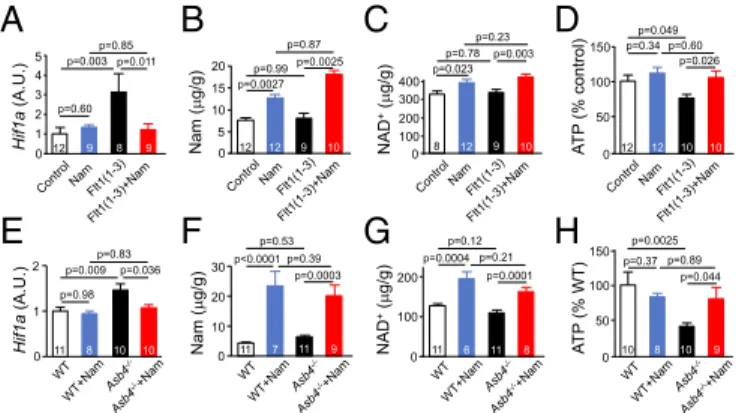
Accordingly, we expected that nicotinamide would improve the status of hypoxic embryos and fetuses by its metabolic ef-fects independently of its efef-fects in decreasing the blood pres-sure and endotheliosis of their mothers. To test whether this expectation is met, we harvested brains from 18.5-dpc fetuses, measured the expression ofHif1a, and performed an extensive metabolomic analysis of brains. The results showed that administration of nicotinamide to the mothers completely pre-vented the increased expression levels of Hif1a caused in the fetal brain by Flt1(1-3) (Fig. 6A). Fetal brain content of nico-tinamide was increased by administration of niconico-tinamide to the mothers (Fig. 6B), as was the brain content of NAD+(Fig. 6C). The combined result of these effects is that nicotinamide completely averts the decrease in ATP content that occurs in the brains of the fetuses of Flt1(1-3)–expressing dams (Fig. 6D), thereby preventing the FGR. More details of the metab-olomics analysis are presented inFig. S5, which shows that the increased production of ATP in the fetuses of mothers re-ceiving nicotinamide was due to enhanced glycolysis and TCA cycling caused by increases in NAD pools.
Comparable effects of nicotinamide are demonstrable in our second model of PE. Thus, administration of nicotinamide to the mothers completely prevented the increased expression levels of
Hif1acaused in 11.5-dpc embryos of ASB4-null mice (Fig. 6E).
Fetal content of nicotinamide was increased by administration of nicotinamide to the mothers (Fig. 6F), as was the content of NAD+(Fig. 6G). Absence of ASB4 significantly decreases the ATP content of the 11.5-dpc fetuses of ASB4-null females mated with ASB4-null males (Fig. 6H), and 0.3% nicotinamide in their drinking water throughout pregnancy completely pre-vented this decrease (Fig. 6H).
Mechanisms Underlying the Effects of Nicotinamide on Pregnancy
Outcomes in ASB4-Deficient Mice.The importance of ubiquitin
li-gase ASB4 in facilitating the steps leading from trophoblast precursor cells to GTCs is well documented (14), as is the role of GTCs in the production of matrix metalloproteinases (15) that participate in the degradation of the interstitial matrix of the maternal endometrium, which occurs during implantation. Lack of ASB4 impairs the production of GTCs, leading to shallow placentation (14), which in human PE is associated with fetal hypoxia and increased oxidative stress (23, 24). However, our observations suggest that absence of ASB4 in pregnant mice has two outcomes: either the embryo dies or it survives and subse-quent growth is sufficient that the fetus is not growth retarded. Thus, although the number of fetuses surviving to term is greatly decreased when the mother is ASB4 null and is much improved when she is given nicotinamide, none of the surviving fetuses of ASB4-null mothers are growth retarded at 18.5 dpc whether or not the mothers received nicotinamide.
A
C
D
E
G
H
0 1 2 3 4 5
12 9 8 9
Hif1a
(A.U.)
p=0.003
p=0.60 p=0.85
p=0.011
8 9
Hif1a
(A.U.)
0
NAD
+(
g/g)
100 200
p=0.78 p=0.023
p=0.23
p=0.003
12 9 10 8
Nam (
g/g) 300
400
0 5 10 15 20 p=0.99
p=0.0027 p=0.87
p=0.0025
9 12
Nam (
g
/g)
12
p=0.53
p<0.0001 p=0.39 p=0.0003
0 10 20 30
11 7 9 NAD
+(
g/g)
p=0.12 p=0.0004 p=0.21
p=0.0001
11
0 100 200
11
6 8
11
B
F
A
T
P
(% control)
p=0.049 p=0.34 p=0.60
p=0.026
0 50 100
12 12 10 10
150
A
TP
(% WT)
p=0.0025
p=0.37 p=0.89 p=0.044
0 50 100 150
10 8 10 9
0 1
11 8 10 10 p=0.036 p=0.009
2
p=0.98 p=0.83
10
Nicotinamide, acting via nucleotide salvage pathway, benefits ASB4-null mothers and their progeny, by improving the metabolic status of the hypoxic embryos in the same way that it benefits the progeny of pregnant mice with Flt1(1-3)-induced PE. This effect is demonstrable in 11.5 dpc embryos in which the decrease in ATP levels caused by maternal absence of ASB4 is prevented by nico-tinamide in the drinking water (Fig. 6H). Accordingly, it is ap-parent that nicotinamide has beneficial metabolic effects which can improve the status of hypoxic embryos independently of its potential effects in improving implantation.
Nicotinamide Acts via Two Synergistic Pathways.Fig. S6 presents
diagrammatically an overview of the pathways via which nico-tinamide may benefit both mothers and pups in our two con-trasting mouse models of PE. Nicotinamide inhibits ADPR cyclase, relaxes blood vessels constricted by sFLT1 (2, 3), and improves the condition of the endothelium, thereby correcting the hypertension and the albuminuria caused in the mothers by PE. At the same time, acting through the NAD+salvage pathway, it improves the metabolic state of hypoxic embryos, normalizes their production of ATP, and prevents FGR. Nicotinamide probably ameliorates the consequences of PE-associated ische-mia in the same way that it protects the heart from ischemic reperfusion injury (25).
Concluding Remarks
Our experiments show that oral nicotinamide, a naturally oc-curring and well-tolerated form of vitamin B3, alleviates the
maternal problems and improves the status of the offspring in two contrasting mouse models of PE: a model in which Flt1(1-3)
is produced in the mother’s liver and a model in which placen-tation is compromised by absence of ASB4 in the embryos and mothers. The first model reproduces the consequences of having a high plasma level of sFLT1, which is an invariable feature of PE in humans. The second model reproduces the effects of impaired placentation, which is also observed in human pa-tients. The clear benefits of nicotinamide in the two models suggest that it should be evaluated for use in human PE. Be-cause there are only anecdotal reports that it is safe during pregnancy, safety tests have been initiated in pregnant women at 24- to 36-wk gestation with the diagnosis of hypertensive complications of pregnancy (#NCT02213094).
Materials and Methods
All animal experiments were conducted in accordance with the guidelines at University of North Carolina and at Tohoku University. We expressed Flt1(1-3) (7, 26) using adenovirus in nonpregnant female C57BL/6J WT mice and pregnant ICR mice, given or not given nicotinamide (Nam) daily by gavage. We also used
Asb4−/−females. Maternal phenotype, maintenance of pregnancy, and embry-onal phenotype were analyzed as described in detail inSI Materials and Methods andTable S2.
ACKNOWLEDGMENTS.We thank Drs. Joey P. Granger, Thomas M. Coffman, and Shigeru Saito for reviewing the manuscript. We thank G. C. McGhee, G.-W. Hwang, K. White, and H.-S. Kim for assistance. Our work was supported by a grant-in-aid from the Japan Society of Promotion of Science (24659409), Translational Research Network Program of Ministry of Education, Culture, Sports, Science and Technology of Japan (J140001192), a major grant from the NIH (HL049277), funds from the Department of Pathology and Lab Medicine at University of North Carolina (UNC), and the Naito Foundation. The histology core facility at UNC is supported by NIH Grant DK 034987.
1. Levine RJ, et al. (2004) Circulating angiogenic factors and the risk of preeclampsia.N Engl J Med350(7):672–683.
2. Li F, et al. (2012) eNOS deficiency acts through endothelin to aggravate sFlt-1-induced pre-eclampsia-like phenotype.J Am Soc Nephrol23(4):652–660.
3. Murphy SR, LaMarca BB, Cockrell K, Granger JP (2010) Role of endothelin in medi-ating soluble fms-like tyrosine kinase 1-induced hypertension in pregnant rats. Hypertension55(2):394–398.
4. Kingman M, Ruggiero R, Torres F (2009) Ambrisentan, an endothelin receptor type A-selective endothelin receptor antagonist, for the treatment of pulmonary arterial hypertension.Expert Opin Pharmacother10(11):1847–1858.
5. Thai TL, Arendshorst WJ (2008) ADP-ribosyl cyclase and ryanodine receptors mediate endothelin ETA and ETB receptor-induced renal vasoconstriction in vivo.Am J Physiol Renal Physiol295(2):F360–F368.
6. Knip M, et al.; European Nicotinamide Diabetes Intervention Trial Group (2000) Safety of high-dose nicotinamide: A review.Diabetologia43(11):1337–1345.
7. Maynard SE, et al. (2003) Excess placental soluble fms-like tyrosine kinase 1 (sFlt1) may contribute to endothelial dysfunction, hypertension, and proteinuria in preeclampsia. J Clin Invest111(5):649–658.
8. Reagan-Shaw S, Nihal M, Ahmad N (2008) Dose translation from animal to human studies revisited.FASEB J22(3):659–661.
9. Gale EA, Bingley PJ, Emmett CL, Collier T; European Nicotinamide Diabetes In-tervention Trial (ENDIT) Group (2004) European Nicotinamide Diabetes InIn-tervention Trial (ENDIT): A randomised controlled trial of intervention before the onset of type 1 diabetes.Lancet363(9413):925–931.
10. Hoffer A (1975) Nutrition and schizophrenia.Can Fam Physician21(4):78–82. 11. Stillman IE, Karumanchi SA (2007) The glomerular injury of preeclampsia.J Am Soc
Nephrol18(8):2281–2284.
12. McMaster MT, Zhou Y, Fisher SJ (2004) Abnormal placentation and the syndrome of preeclampsia.Semin Nephrol24(6):540–547.
13. Plaks V, et al. (2013) Matrix metalloproteinase-9 deficiency phenocopies features of preeclampsia and intrauterine growth restriction.Proc Natl Acad Sci USA110(27): 11109–11114.
14. Townley-Tilson WH, Wu Y, Ferguson JE, 3rd, Patterson C (2014) The ubiquitin ligase ASB4 promotes trophoblast differentiation through the degradation of ID2.PLoS One9(2):e89451. 15. Reponen P, et al. (1995) 92-kDa type IV collagenase and TIMP-3, but not 72-kDa type IV collagenase or TIMP-1 or TIMP-2, are highly expressed during mouse embryo im-plantation.Dev Dyn202(4):388–396.
16. Janatpour MJ, et al. (2000) Id-2 regulates critical aspects of human cytotrophoblast differentiation, invasion and migration.Development127(3):549–558.
17. Duley L (2003) Pre-eclampsia and the hypertensive disorders of pregnancy.Br Med Bull67:161–176.
18. von Dadelszen P, et al. (2000) Fall in mean arterial pressure and fetal growth re-striction in pregnancy hypertension: A meta-analysis.Lancet355(9198):87–92. 19. Arendshorst WJ, Thai TL (2009) Regulation of the renal microcirculation by ryanodine
receptors and calcium-induced calcium release.Curr Opin Nephrol Hypertens18(1): 40–49.
20. Rongvaux A, Andris F, Van Gool F, Leo O (2003) Reconstructing eukaryotic NAD metabolism.BioEssays25(7):683–690.
21. Lim JH, et al. (2010) Sirtuin 1 modulates cellular responses to hypoxia by deacetylating hypoxia-inducible factor 1alpha.Mol Cell38(6):864–878.
22. Semenza GL (2000) HIF-1: Mediator of physiological and pathophysiological responses to hypoxia.J Appl Physiol88(4):1474–1480.
23. Harsem NK, Braekke K, Staff AC (2006) Augmented oxidative stress as well as anti-oxidant capacity in maternal circulation in preeclampsia.Eur J Obstet Gynecol Reprod Biol128(1-2):209–215.
24. Chaiworapongsa T, Chaemsaithong P, Yeo L, Romero R (2014) Pre-eclampsia part 1: Current understanding of its pathophysiology.Nat Rev Nephrol10(8):466–480. 25. Yamamoto T, et al. (2014) Nicotinamide mononucleotide, an intermediate of NAD+
synthesis, protects the heart from ischemia and reperfusion.PLoS One9(6):e98972. 26. Kuo CJ, et al. (2001) Comparative evaluation of the antitumor activity of
anti-angiogenic proteins delivered by gene transfer. Proc Natl Acad Sci USA98(8): 4605–4610.
27. Takahashi N, Boysen G, Li F, Li Y, Swenberg JA (2007) Tandem mass spectrometry measurements of creatinine in mouse plasma and urine for determining glomerular filtration rate.Kidney Int71(3):266–271.
28. Fushima T, et al. (2016) Reduced Uterine Perfusion Pressure (RUPP) Model of Pre-eclampsia in Mice.PLoS One11(5):e0155426.
29. Wang CH, et al. (2011) A modest decrease in endothelial NOS in mice comparable to that associated with human NOS3 variants exacerbates diabetic nephropathy.Proc Natl Acad Sci USA108(5):2070–2075.
30. Oe Y, et al. (2016) Coagulation factor Xa and protease-activated receptor 2 as novel therapeutic targets for diabetic nephropathy.Arterioscler Thromb Vasc Biol36(8): 1525–1533.
31. Seifar RM, et al. (2013) Quantitative analysis of intracellular coenzymes in Saccharo-myces cerevisiae using ion pair reversed phase ultra high performance liquid chro-matography tandem mass spectrometry.J Chromatogr A1311:115–120.
32. Nishiumi S, et al. (2012) A novel serum metabolomics-based diagnostic approach for colorectal cancer.PLoS One7(7):e40459.
MEDI
CAL
SC