MYSTERY AND POSSIBILITY:
SPIRITUALISTS IN THE NINETEENTH-CENTURY SOUTH
Nancy Gray Schoonmaker
A dissertation submitted to the faculty of the University of North Carolina at Chapel Hill in partial fulfillment of the requirements for the degree of Doctor of Philosophy in the
Department of History.
Chapel Hill 2010
Approved by
Donald G. Mathews W. Fitzhugh Brundage William R. Ferris
© 2010
ABSTRACT Nancy Gray Schoonmaker
Mystery and Possibility: Spiritualists in the Nineteenth-century South (Under the direction of Donald G. Mathews)
Spiritualism, the belief that people could communicate with the spirits of the dead, swept through the United States and western Europe in the 1850s. Rooted in mankind’s timeless yearning to understand what becomes of the human spirit after death, it was complicated by the mid-nineteenth century’s urge to explain the world rationally and scientifically. The rage for scientific explanation was complicating the need to understand life and death within the comforting tenets of unquestioned Christian faith. Spiritualism promised what traditional religion could not: By asking questions of the dead through a medium, people sought proof that the spirits of departed loved ones—and personal immortality—awaited them in heaven. This dissertation examines the
interpretation of this phenomenon, long thought by scholars to have been unattractive to southerners because of its association with northeastern reform movements, by
ACKNOWLEDGMENTS
The road to a completed dissertation is no simple highway, but I had a lot of fun along the way. Thanks to everyone responsible for making it so. I thank my
undergraduate adviser for telling me not to pursue a graduate degree in English. He did not think I would like it, and he may have been right. Time there was and plenty to find direction; circumstances did in time show me the way and leave no doubt. I thank my mother, Ruth Verhulst Gray, for introducing me to family history. Learning that both my husband and I had family living near here in the eighteenth century ignited my curiosity and I began reading American history. One day I looked up from Albion’s Seed (thank you, David Hackett Fischer, for making me wonder why you thought your book would infuriate some people) and said, “Dave, I want to go to graduate school.” Might as well. I thank my husband, David R. Schoonmaker, for his unwavering support. He is, in the best ways, my enabler and a creature of infinite jest. Most of all, I thank Donald G. Mathews. In 2001 when I said Spiritualists, he said Methodists. It took several years of research to come to that conclusion on my own. I am grateful for his wisdom, patience and
friendship. The generous gift of his time and experience coaxed coherence from words half spoken and thoughts unclear.
The Center for the Study of the American South provided two summer research grants during the course of my graduate work, as well as employment. Harry L. Watson’s work ethic, attention to detail, academic rigor and kindness to all as director set high standards for the Center.
The first days were the hardest days, but the last months were spent trying just a little bit harder, just a little bit more. Many people were funny and supportive, helpful and generous along the way. Those who gave significant scholarly assistance are, I hope, acknowledged in the text and footnotes. To name all the people who made graduate school such fun would be impossible. Cheryl Junk is a reliable source of laughter,
friendship and good advice. Two members of my second writing group, Laura Micheletti Puaca and Pamella Lach, gave me an understanding of what lay in store when I finally started writing in earnest. Kim Hill offered a new perspective on race, gender and
religion. Tim Williams and Dwana Waugh, the ultimate writing group, nudged me closer to real productivity. The Beta Theta chapter of Delta Gamma at Duke University never let me forget that a woman can concurrently embrace a full social life, sincere dedication to philanthropic projects and academic excellence. You have a special place in my heart. Finally, thanks to Connie Nelms Diederich for decades of imagining that I was a
TABLE OF CONTENTS
List of Figures ... viii
Introduction ... ix
Chapter 1: Northeastern Beginnings, Southern Borrowings...17
Chapter 2: Abijah Alley and Moseley Baker ...65
Chapter 3: Early Years in the South, 1850–1854 ...114
Chapter 4: Jesse Babcock Ferguson ...172
Chapter 5: 1854: The Petition and The Christian Spiritualist ...221
Chapter 6: 1855–1860: Spiritualism in Southern Cities ...287
Chapter 7: 1855–1860: Investigation and Opposition ...340
Chapter 8: Impending Crisis and Civil War ...388
Chapter 9: Reconstruction...445
Chapter 10: Samuel Watson: Spiritualism Through a Methodist Lens ...496
Chapter 11: Samuel Watson: The Waxing and Waning of Christian Spiritualism ...563
Conclusion ...616
LIST OF FIGURES
Figure
1. The Fox Family cottage, birthplace of Modern Spiritualism ...22
2. The Fox Sisters: Margaret Fox, Catharine Fox and Leah Fox Fish ...23
3. Four States from The Magic Staff (1857) ...32
4. Celestial Spheres from The Magic Staff (1857) ...39
5. American Phrenological Journal (March 1848) ...62
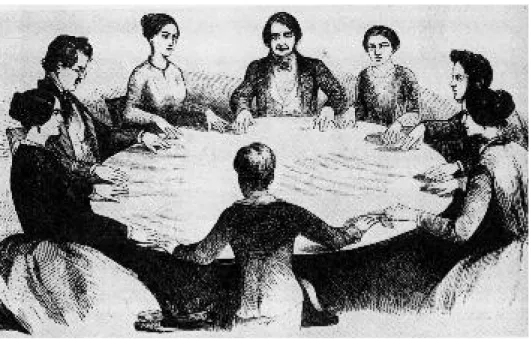
6. A Séance ...128
7. Mary Ann Maverick and Her Children ...154
8. Distribution of 1854 Petitioners in Slave States ...225
9. Distribution of 1854 Petition Signers In Kentucky ...231
10. Distribution of 1854 Petition Signers In Tennessee ...233
11. Steamboats on the Mississippi River ...317
12. “Cemetery in New Orleans—Widow and Daughters in Full Mourning,” engraving, Frank Leslie’s Illustrated Newspaper (April 25, 1863) ...441
INTRODUCTION
This project examines previously unexplored aspects of Spiritualism—the belief that one might communicate with the spirits of the dead—that were Christian,
metaphysical and southern. Historical discussions of Spiritualism have made the assumption that it found little purchase in the South, and was therefore not worth the effort required to understand it there. To be sure, Spiritualism did not have the same cachet among southerners that it did in the rest of the country; but there is considerable evidence that there were enough Spiritualists in the South to make them a visible and articulate minority well worth investigating. Valuable work on Spiritualism has
insightfully linked it to feminism, abolitionism and other reform movements, taking as a given the statements of earlier scholars about its failure to achieve influence in the nineteenth-century South. While it is true that Spiritualism was never a major religious movement in the American South, it was nonetheless a movement. Prominent and
ordinary southerners were Spiritualists. They printed newspapers, recruited members, and developed a sense of local and extended community with others who thought of
Wesley. When we acknowledge the very real presence of this community of believers in the South, every generalization about “Spiritualists” must be reexamined.
To understand Spiritualism in the nineteenth-century American South requires a knowledge of its antecedents. The phenomenon known as Modern Spiritualism dates to 1848, but the belief in spirits and angels communicating with mortals is intertwined with the religious traditions on which most American religions are constructed. Spiritualism was preconditioned by a particular set of religious and folk perspectives, not only in the North. The religious who were open to communing with spirits as an extension of their faith tended to embody elements of receptiveness to the miraculous, experiential religion authenticated by testimony, perfectionism, religious innovation and personal interaction with the Spirit as affirmation from the beyond. Spiritualism’s antecedents—
Swedenborgians; Shakers and other religions that grew out of European pietism;
phrenology; animal magnetism—were also a presence in the South and so there was also a nascent tradition of spirit communion among whites there even before the rage for Modern Spiritualism began in the North and trickled southward. Not only before
Spiritualism emerged, but throughout the nineteenth century, these antecedents remained a part of the southern repertoire of religious possibility. All over North America,
The South was, like the North, a largely Protestant and evangelical culture even though many who lived there were unchurched. Ties of kinship and commerce bound the regions, and many northerners had settled in the South after the Louisiana Purchase and the War of 1812. The locus of the print industry was the Northeast, so most of what southerners read was what northerners were also reading.
The South was different, though. There were millions of African Americans in the antebellum South, almost all of them the property of whites. Many, owned by farmers who could afford only a few, or house servants of the more prosperous, lived in intimate contact with whites. On larger plantations, the slave quarters gave a space for those who lived there to create cultural and religious traditions that combined elements of their various African survivals with borrowings from whites. Tracing the influence of black beliefs on the whites around them is a challenge, but scholars such as Mechal Sobel have made a strong case for such cross-cultural exchange. Spatially, southerners were more widely dispersed with fewer urban centers than the North and less infrastructure linking them. Northern religious and reformers saw the South as a mission field. By the 1830s, the South was hardening its position on slavery in response to salvos from abolitionists in the North.
the shelter of which a great number of different doctrines may flourish.”1 For those who came to mystical experience and spirit communion as an extension of evangelical seeking, it filled a desire for something more or something different than they had found through conversion. Many were open to creating their own formulation of Christian faith, receptive to new religious possibilities and willing to reconceptualize the meaning and potential of “spirit.” Like the Shakers, some would believe they had “spiritual gifts” like those of Christ and his Apostles, gifts such as visionary revelations and healing. The line between these beliefs and communicating with angels and spirits is not definitive, but for people such as the Shakers all these things were simply “spiritual gifts.” Spirit
communion was qualitatively different for those who approached it after the Fox sisters unleashed spirit rapping as phenomenological, as something to be planned and scheduled in advance and purposefully pursued, as an opportunity to converse with the dead rather than merely to passively receive visions, impressions and communications from the beyond. Many who sought messages from the spirit world were people of faith, but Modern Spiritualism’s appeal was greatest to those whose faith was inadequate to
assuage their grief following the death of loved ones. For those who approached it as part of their unfolding Christianity, it was proof—verified through experience, tests and testimony—of God’s promise of eternal life. Religion, while it has many meanings, was for the subjects of this project the belief that there is a higher power, generally called God, that created and watches over the universe. Conceived more broadly, religion is a cultural system within which individuals negotiate questions of faith and enact their beliefs in both institutional and personal settings. Spiritualism signified to Americans in
1
the second half of the nineteenth century the belief that the human spirit survived the death of the body and that people on earth could (and wished to) communicate with the spirits of the dead. It was a widespread and diverse cultural phenomenon that was for some a movement that created a new religion, to some humbuggery, and to still others a possibility with too much potential significance to be dismissed lightly. There were also people before the term Spiritualist came into use to whom it would be applied
retroactively. Culture is the shared, constructed context of lived experience inhabited by the subjects of this project, dominated by the mores and values of the whites who
controlled most resources but surrounded and influenced by the values and mores of poor whites and African Americans, and fed a steady stream of ideas from the North and western Europe. The South will refer to the states where people still owned slaves at the start of the Civil War: Arkansas, Alabama, Florida, Georgia, Kentucky, Louisiana, Maryland, Mississippi, Missouri, North Carolina, South Carolina, Tennessee, Texas and Virginia.
The stories told here are gleaned from those of hundreds of southerners who left evidence of interest and participation in Spiritualism. They are all different, but are mostly glimpses of people who were Protestant (often Methodist), white, and decidedly not living in want. A bit like pointillism, these small stories are bits of a bigger picture. The individuals’ encounters with the spirits combine into a larger, if necessarily
impressionistic, image when the observer steps back and views them as a whole. It is a narrative that moves across the broad canvas of a nation aborning, retracing the strands of mystery and possibility that would come together to produce a mid-nineteenth-century
The beginnings of the story are in the Northeast and its religious refugees and revivals. Some came to the South, providing a vocabulary and structure to use in discussing the marvelous. They arrived as migrants, missionaries, colporteurs, as books and newspapers. Once in the South, people, institutions and ideas became part of it, adapted to its climate and culture, or did not flourish. Among the earliest imports were Shakers and the ideas of Swedish scientist and theologian Emanuel Swedenborg, who bears responsibility for opening the western world to discussion of the spirit world as a reality. Swedenborg’s books describing his visits to heaven, his conversations with angels, and the details of spiritual progression through definite spheres of increasing purity and enlightenment in the afterlife mapped the world beyond the veil for the nineteenth-century imagination. His was among the most frequent spirit to visit circles seeking wisdom and guidance from the spirit spheres, and his name signified man’s ability to converse with the beyond. Never mind that Swedenborg warned against others trying it; that point was missed or overlooked by most people from the outset. The Shakers brought their own stream of mystical receptiveness to “spiritual gifts” to these shores, and like other pietists established beachheads in the South. The Shakers, who established a thriving business peddling seeds and straw hats and other products of their workshops, were a fixture in the Upper South.
though Joseph Smith took this same wellspring of mystical thought westward and laid the foundations of a religion that is still thriving today. If Swedenborg provided the early maps of heaven, Davis’s harmonialism gave it a vocabulary.
The religious revivals that grew evangelical religion are central to the story as well. The things people thought and felt in the physical and emotional release of a profound conversion experience baffled those outside their pull, and appeared to be symptomatic more of madness than faith. That African Americans were particularly susceptible and responsive to the evangelical message opened for a short time an evangelical southern worship where on Sunday morning master and slave were equal before God. Slaves, in fact, if they were more true to their faith and its behavioral
strictures, could in these moments of fellowship in Christ, believe themselves superior to their masters in answering to God’s laws. Whites frequently perceived blacks as more spiritual, or closer to the desirable “primitive” Christian experience of the early church of Christ and his Apostles.
John Buescher and others have studied the relationship between Universalism and Spiritualism in the North, and among the few Universalists in the South there were some who embraced spirit communication. And if an eternity of agony were ruled out, what of the great immediate cause of it in the nineteenth century, death? As ministers advised and an oft-repeated hymn adapting Psalm 141 affirmed,
Mine eyes are unto Thee, my God; Behold me humbled in the dust; I kiss the hand that wields the rod,
I own thy punishments are just.2
2
The Poetical Works of Rogers, Campbell, Montgomery, Lamb, and Kirke White: Complete in
Liberal theologians drawn to the possibilities of Spiritualism entertained the hope that, by opening communication between the worlds of the living and the dead, their loving God might be offering a balm for the great sufferings of the living. Eminent Philadelphia physician Benjamin Rush, after converting from Presbyterianism to belief in universal salvation, began writing in favor of reforming American systems of punishment,
including substituting “solitude and labour” for “the whipping-post and the gallows” for criminals and doing away with corporal punishment of schoolchildren. Drawing on the same streams of Enlightenment thought that led to Universalism, Rush reconsidered the model of a God of vengeance and its implications for American society. As historian Anne-Marie Cusac observed, “Instead of a vengeful God who demands physical hurt of those who disobey, Rush says painful punishment is Devilish.”3 It was not only
Universalists who were rethinking their ideas of God, questioning whether a loving God could or would consign the creatures created in His own image to an eternity of suffering. Even Christians who could not quite give up the idea of eternal punishment for the
unrepentant often preferred the more loving God of the New Testament to the smiting God of the Old, and as some imagined Him it was not out of character that He would permit faith-affirming communion with their dead.
The southern story of Spiritualism is heavily peopled by Methodists. Perhaps this was because early Methodists had an interest in understanding visions, trances, dreams and ghostly visitations. Furthermore, Methodist receptivity to the Holy Spirit sometimes allowed people who could testify to the power of God’s Spirit to bear witness to that power in such a way as to be assured they were indeed children of God. The Wesleyan
3
message encouraged those who believed themselves justified by God’s grace to be open to a further empowerment by the Spirit that resulted in a Holiness revival in the
postbellum North and South. For those awaiting the imprimatur of the Spirit, the domestic pietism that emphasized the family as an essential core of religious life promised believers a continuation of that familial connection into a life beyond death. The Reverend Samuel Watson, a Methodist minister from Memphis, was certain that the Gospel of Christian Spiritualism he preached was consistent with Wesleyan principles even if his annual conference was not as convinced as he.
Watson had come to spirit communication through loss. As a minister, his children’s deaths were understood as God’s will and his role as devout and humble acceptance. But, like a surprising number of southerners, he was brought into
communication with their spirits through the mediumship of a family slave. Watson, approaching the séance with reverence, spent time quietly exploring the mystery with other ministers, physicians and respected laymen at the same time Nashville Disciples of Christ minister Jesse Babcock Ferguson was publicly battling assaults from the orthodox element of his denomination and his congregation. Ferguson had made his own way to Spiritualism through mesmerism and his readings of liberal northeastern theologians. Ferguson’s rejection of the idea of hell and his embrace of universal salvation were a version of the liberal theology Richard Niebhur described as positing that “A God without wrath brought men without sin into a kingdom without judgment through the ministrations of a Christ without a cross.”4 Ferguson and Watson both ran afoul of their denominations when they proclaimed the joyous news of communion with the spirit
4
world as a new Christian dispensation, but Watson did not proclaim his belief to the world in a way Methodism could not contain until the 1870s.
The other stories here are of the great and the middling. The great are always easiest to find and flesh out. The papers of the elite indicated that the possibilities of communicating with the dead had made deeper inroads in the South than historians had previously acknowledged. If those who left records knew and thought about Spiritualism, it was likely that other southerners did too. Finding these people would require looking outside southern manuscript collections. One cannot, to paraphrase the historian Edward Ayers, write about people if one does not know who they were.
with Spiritualism—whatever their origin—were real. Every story is a dot on the canvas, and the more one can find, the more nuanced the final picture can be.
The first source of information about historical actors who have not been studied before is public records. The census, though the indexing is flawed and there are obvious errors and inconsistencies, is the natural first step. The on-line 1850 census is not indexed and searchable, but most of the people on the list showed up in the 1860 census. This tells us where they lived, what they did for a living, and the names, ages and places of birth of everyone in their households. Sometimes it also gives their declared financial worth. State libraries have a wealth of documentation in their collections, including court and tax records, marriage records, cemetery records, and militia and military rosters. There are also family histories tracing genealogies and sometimes giving more detailed information through anecdotes, newspaper stories or old family letters. The Goodspeed series of regional biographies of solid citizens tells the stories of many families that might otherwise have been lost. For larger urban areas, there are also city directories, the precursors of annual telephone books, listing the names, businesses, and home addresses of residents. Gleanings from all of these allow us to assemble a clearer picture of the lives of the petitioners and the southerners who wrote to antebellum Spiritualist newspapers, and for many of the latter we also have their thoughts on the subject as they appeared in the columns of those publications. There were more Spiritualists in the antebellum South than scholars had realized, even if it was rooted and concentrated in the Northeast.
stunned and devastated; summoning the spirits required a clear, focused mind and leisure to wait quietly for the spirits to come. Those were in short supply in the immediate aftermath of Confederate defeat. Interest, however, did begin to emerge in the post-war South first in places that had felt the impact of war least and had shifted during those years from being southern border cities to identifying most with the North: Baltimore and St. Louis. During Reconstruction, more southern voices emerged. Rev. Samuel Watson’s attempt to create an institutionalized Christian Spiritualism on the Methodist model—and how he came to do so—are the project’s capstone.
Historiography of Spiritualism
Emma Hardinge, a well-known medium, published a useful if uncritical early history of the Spiritualist movement in 1870. Frank Podmore published a more carefully considered two-volume history in 1902, concluding that most mediumistic activity that defied explanation under careful scrutiny could probably be attributed to clairvoyance and most poltergeist activity to the pranks of adolescent girls. Joseph McCabe, in
Spiritualism, a Popular History to 1847 (1920) offered a readable if unsparing chronicle
of Modern Spiritualism’s context and development. Alice Felt Tyler included Spiritualism in her 1944 compendium of nineteenth-century reforms, Freedom’s
Ferment: Phases of American Social History, treating as serious cultural phenomena a
number of movements that had been mocked by scholars for the past half-century.5 For the next quarter of a century, the subject lay fallow.
5 Emma Hardinge, Modern American Spiritualism: A Twenty Years’ Record of the Communion Between Earth and the World of Spirits (New York: 1870; reprinted New Hyde Park, New York:
Since the early 1970s Spiritualism in the North has been the focus of a growing body of scholarship as historians have sought to recover and explain individual
experience within the social and cultural matrices of the past. R. Laurence Moore led the way for modern scholars with an article probing the perceived links between
Spiritualism, religious discourse and scientific investigation in the 1850s, followed by a book on the history of Spiritualism and research into the paranormal in America. Spiritualists more recently have caught the attention of students of the various reform movements, who noticed that feminists, abolitionists and creators of intentional communities all showed a marked tendency to dabble in contact with “the other side.” Ann Braude probed the connection between Spiritualism and feminism in her 1989 book,
Radical Spirits: Spiritualism and Women’s Rights in Nineteenth-century America, noting
the gendered implications of Spiritualist mediums’ passivity and receptivity. In her research in the 1980s, Braude found that of two hundred six Spiritualist newspapers in America, only twelve were published in the South. Bret E. Carroll, R. Laurence Moore’s student, argued with mixed success in 1997 that Spiritualism in Antebellum America was a serious form of organized religion. Alyson Winter’s entertaining and informative 1998 account of the scientific and cultural antecedents of Spiritualism in Mesmerized: Powers
of Mind in Victorian Britain offered solid scholarship to a popular audience. Kenneth
Caneva is a historian of science at the University of North Carolina at Greensboro with a research interest in feminism and Spiritualism. John Buescher, a researcher in
Washington, D. C., has written a biography of John Murray Spear, one of many Universalist ministers who turned to Spiritualism, and another book focused more
and Company, 1920); Alice Felt Tyler, Freedom’s Ferment: Phases of American Social History
broadly on Universalist involvement in Spiritualism, 1845–1875. Buescher’s web site, spirithistory.com, where he posted primary source transcriptions of Spiritualist
documents from the Library of Congress, was for years an invaluable source. Mark Lause at the University of Cincinnati has uncovered Spiritualism in antebellum labor
movements. Robert Cox’s Body and Soul: A Sympathetic History of American
Spiritualism (2003) uses nineteenth-century notions of sympathy as a way to understand
Spiritualism’s linkage of the earthly and spiritual worlds and a spur to personal and societal improvement, but only delves into the South in a chapter on the Spiritualists of color in New Orleans that re-examines much of what Karen Cossé Bell covered in
Revolution, Romanticism, and the Afro-Creole Protest Tradition in Louisiana, 1718–
1868 (1997). Barbara Weisberg performed a valuable service for historians of
Spiritualism by constructing an engaging narrative of the lives of the Fox sisters, Talking
to the Dead: Kate and Maggie Fox and the Rise of Spiritualism (2004). Fits, Trances,
and Visions: Experiencing Religion and Explaining Experience from Wesley to James
(1999), Ann Taves’s study of the mystical and bodily experience and expression of religion, charted debate and influences on whether they were or were not religious in nature. In A Republic of Mind and Spirit: A Cultural History of American Metaphysical
Religion (2007) Catherine L. Albanese synthesizes and contextualizes the history and
complexity of influences on and developments in extra-orthodox religious thought in America. Molly McGarry’s Ghosts of Futures Past: Spiritualism and the Cultural
Politics of Nineteenth-century America (2008) emphasizes the connection between the
Spiritualism. Russ Castronovo, an English professor at the University of Miami, in his work on antebellum northern abolitionists has also written about voodoo, death,
Spiritualism and abolition. His article on “The Antislavery Unconscious” demonstrates a clear, if narrow, linkage between survivals of African spiritism among slaves in the French West Indies and the evolution of Spiritualism in New England. Complementing these works is a smattering of other books and articles. All interesting work, but none of it took seriously the impact of Spiritualism on the South.6
Confederate women’s journals, Sarah Morgan’s and Mary Chesnut’s, mentioned Spiritualism; the former was fascinated, the latter disparaging. Apparently, there were southerners who took the subject seriously. Elizabeth and Eugene Genovese mentioned prominent South Carolinian Swedenborgians and Spiritualists in The Mind of the Master
Class. Local archives had a few things catalogued under Spiritualism. Alert to the
language of spirit rapping and mediums, reading elite sources soon made it clear many of
6 R. Laurence Moore, “Spiritualism and Science: Reflections on the First Decade of the Spirit
Rappings,” American Quarterly 24:4 (October 1972), 474–500, and In Search of White Crows:
Spiritualism, Parapsychology, and American Culture (New York: Oxford University Press, 1977); Ann
Braude, Radical Spirits: Spiritualism and Women’s Rights in Nineteenth-century America (Boston, Mass.: Beacon Press, 1989); Ann Braude, “News from the Spirit World: A Checklist of American Spiritualist Periodicals, 1847–1900,” Proceedings of the American Antiquarian Society 99:2 (1990), 399–462; Bret E. Carroll, Spiritualism in Antebellum America (Bloomington: Indiana University Press, 1997); Alison Winter, Mesmerized: Powers of Mind in Victorian Britain (Chicago: University of Chicago Press, 1998); John Benedict Buescher, The Remarkable Life of John Murray Spear, Agitator for the Spirit Land (Notre Dame, Ind.: University of Notre Dame Press, 2006); John B. Buescher, The Other Side of Salvation:
Spiritualism and the Nineteenth-century Religious Experience (Boston: Skinner House Books, 2004);
Robert Cox, Body and Soul: A Sympathetic History of American Spiritualism (Charlottesville: University of Virginia Press, 2003); Karen Cossé Bell, Revolution, Romanticism, and the Afro-Creole Protest Tradition
in Louisiana, 1718–1868 (Baton Rouge: University of Louisiana Press, 1997); Barbara Weisberg, Talking to the Dead: Kate and Maggie Fox and the Rise of Spiritualism (New York: HarperSanFrancisco, 2004);
Ann Taves, Fits, Trances, and Visions: Experiencing Religion and Explaining Experience from Wesley to
James (Princeton, New Jersey: Princeton University Press, 1999); Catherine L. Albanese, A Republic of Mind and Spirit: A Cultural History of American Metaphysical Religion (New Haven & London: Yale
University Press, 2007); Molly McGarry, Ghosts of Futures Past: Spiritualism and the Cultural Politics of
Nineteenth-century America (Berkeley: University of California Press, 2008); Russ Castronovo, “The
CHAPTER ONE
Northeastern Beginnings, Southern Borrowings
“I wonder if the dead can see us?” mused Sarah Morgan in 1863. Two years earlier her brother Harry, “the one I loved best of all,” had been killed in a duel. She tried to be resigned to God’s will, and feared that jealous God had taken Harry from her
because she had so idolized him. Desperate to be near him and finding the cemetery gates locked, Sarah, in bonnet and hoops, once clambered over the fence. Soon three remaining brothers went off to fight for the Confederacy. Before 1861 ended, Sarah’s doting father was buried next to Harry in Baton Rouge’s Magnolia Cemetery. Sarah tried to accept and make sense of these deaths within the bounds of her Episcopalian faith. Throughout the anxious years of the Civil War, forced by Yankee occupation to flee the Baton Rouge home that held family memories and mementos, her thoughts often returned to her dead father and brother. Clinging to her faith, she prayed that her remaining brothers would be spared; two were not. Sarah spent the 1860s mourning, first for Harry and her father, later for the two brothers who died in Confederate service.7
Sarah’s journals presented a historical puzzle. After Harry Morgan’s death in 1861, the very proper Morgan family did not “go into mourning,” putting on the black clothing that custom dictated and most people donned as a matter of course. Nor did they
7
do so after Judge Morgan died six months later. They grieved, visited the graves, and had no heart for most of their customary amusements, but they did not wear black. When brothers George and Gibbes died in 1864, they did go into traditional mourning. Sarah never wrote about how the decisions were made, only mentioning to a greater or lesser extent the reactions of people outside the family to their choices. Studies of death and mourning explain the rituals of grief that were set forth in advice manuals and seems to assume that conventional, proper, prosperous people such as the Morgans acted out their losses by the book. The Morgans chose to embrace some of the accepted rituals of
mourning but rejected others.8 In Sarah Morgan’s Civil War journals and family papers in the Special Collections Library at Duke University are descriptions of her visits to
mediums in New York, London and Rome and recountings of a friend’s prophecy and her husband’s dream that presaged his violent death. These suggest a lifelong fascination with the possibility of pulling aside the veil that separates the world of the living from the world of spirits, and her yearning for confirmation that those on the other side still loved her. A medium’s message reassuring Sarah that her late husband had always been faithful to her9 is particularly poignant when read with the knowledge that in the wake of his murder it was rumored he had dallied with their governess. In reconstructing the ways Sarah mourned in three different contexts—antebellum, Civil War and Lost Cause Era— it was impossible to ignore her references to clairvoyants, summoning the spirits as an amusement, and serious engagement with fortune tellers and spiritual mediums in a quest
8
Nancy Gray Schoonmaker, “As Though It Were Unto the Lord: Sarah Morgan Dawson and Nineteenth-century Southern Mourning.” Master’s thesis, University of North Carolina at Chapel Hill, 2002.
9
for foreknowledge and for contact with her lost loved ones. It was a desire to understand why Sarah persisted in this search for half a century despite religious proscriptions and her husband’s disapproval, all the while adhering unwaveringly to her Episcopalian faith, that led to this study.
Sarah Morgan’s older siblings were born in Baton Rouge, and her father had sold the family’s home on a bluff above the Mississippi River to furnish the site for the new state capitol. Sarah was born in New Orleans in 1842, while her father was Collector of Customs for the Port. He was active in Whig politics, a member of a Masonic order, and interacted daily with the city’s men of commerce. In 1850, when the new capitol was completed, the Morgans returned to Baton Rouge. Sarah’s father was a judge and a respected attorney, and they maintained close ties to New Orleans. Sarah’s half-brother Philip was a judge in the Crescent City, and it was there Sarah was presented to society in 1860 along with daughters of the city’s commercial elite.
Spiritualism and the paranormal were part of Sarah Morgan’s life and times. Her journal mentions the pre-war predictions of a clairvoyant in New Orleans. Her brother Jimmy wrote to her from England about hearing spirits rap, and she tried without success to summon rappings while alone. While entertaining a party of Confederate officers at the Louisiana plantation where the Morgan women sought refuge when they left Baton Rouge, “Some one suggested calling the Spirits, which game I had imagined had ‘played out’ long ago, and we derived a great deal of amusement from it.”10 Although some people took summoning the spirits very seriously, for others it apparently had been more in the nature of a trendy parlor amusement.
Sarah fretted when one of the family’s house servants gossiped about Sarah’s visits to the cemetery. The slave Lennice told the servants of another family that she knew there were spirits because Miss Sarah went to the graveyard every morning and evening with a basket of flowers and called the spirits of her dead brother and father to her. According to Lennice, Sarah wrote, their spirits “would all fly to me, and talk and sing with me for hours until I would tell them goodbye and go home, when they would go away too.” Sarah attributed the story to Lennice’s ignorance, and “some members of the family found it necessary to put an end to it at once.” Sarah’s acute discomfort over the story, read with a knowledge of her later, life-long enthusiasm for communicating with dead loved ones, suggests the possibility that Lennice and Sarah might merely have been interpreting Sarah’s visits to the graves within different cultural or religious frames of reference. Perhaps Sarah was already closer to that enthusiasm than she could admit, aware that those whose opinions she valued would not approve her dabbling in a system
10
of belief so easily dismissed as slaves’ superstitions about ghosts and magic. Nor could they concede to themselves the extent of cross-cultural “spiritual intimacies” that had developed through long years of close physical contact between white children and the African American slaves entrusted with their care.11
The precise meaning of Sarah’s anecdote about Lennice, the graveyard, and summoning spirits was another puzzle. The explanation had to lie in some combination of the antecedents that formed their belief systems, the Spiritualism mentioned in the
writings of many southerners in the nineteenth century, and the culture in which Lennice and Sarah functioned. Spiritualism’s promise exerted an attraction that was problematic in the context of southern religion and culture. Why this fascination, why was it a problem, how did devout southerners reconcile or integrate Spiritualist beliefs with their orthodox religious faith and practice, and how did their understanding of invisible worlds color their reality in the nineteenth century?
Nineteenth-century observers agreed that Modern Spiritualism was born on a chilly night in 1848 in a small rented house outside Hydesville, New York. Cracking their toe joints, Kate and Maggie Fox convinced their superstitious and devoutly Methodist mother that the rapping sounds were made by the spirit of a peddler buried in their cellar. Kate and Maggie’s mother, Margaret, was born to a long line of people gifted with second sight, and Mrs. Fox had grown up hearing her mother’s descriptions of phantom funerals that “always took place, just as she had envisioned them, within the next few
11
Ibid. , 278; Republic of Mind and Spirit, 113; Michael A. Gomez, Exchanging Our Country
Marks: The Transformation of African Identities in the Colonial and Antebellum South (Chapel Hill and
weeks.” Margaret Fox’s sister Elizabeth also had second sight, or clairvoyance, and predicted her own death.12
Figure 1. The Fox Family Cottage, Birthplace of Modern Spiritualism.
Neighbors flocked to observe these mysterious phenomena, and someone came up with a system for asking “yes” and “no” questions of the spirit and then of spelling out messages by reciting the alphabet and noting the letter at which a rap was heard—then doing it over and over until a message was spelled out. The credulity and receptivity of their neighbors was not surprising. The fires of religious revival had repeatedly swept this part of western New York with special intensity, earning the region the name “Burned-over District.” The area’s semi-frontier liminality allowed experimental communities, individual interpretations of existing ideas and faiths, and the emergence of new
cosmologies and systems of religious belief with deep roots in survivals of European folk religion. Spiritualism (some adherents called it “Modern Spiritualism,” to differentiate it from the panoply of uses to which the term “spiritualism” had been put in the past) was one of them. Among the Foxes’ early supporters were Hicksite Quakers Amy and Isaac
12
Post, also backers of women’s rights and other reform movements. Amy Post attended the women’s rights convention at nearby Seneca Falls, where Elizabeth Cady Stanton, Frederick Douglass and others in attendance had already heard of the rappings. One source claims raps were heard on the table where Stanton and Lucretia Mott wrote out the convention’s Declaration of Sentiments.13 This early association with northern reform movements was cemented as women’s rights and Spiritualism spread through the Posts’ network of Quaker abolitionists.
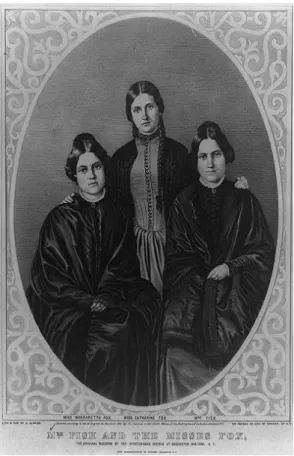
Figure 2. The Fox Sisters: Margaret Fox, Catharine Fox and Leah Fox Fish.
Within two years, despite rumors and outright accusations that their rappings were made by cracking their toe and knee joints, the Fox sisters were ensconced at Barnum’s
13 Mormonism was the most significant of these movements. For survivals of folk belief among
settlers in the Burned-over District, see John L. Brooke, The Refiner’s Fire: The Making of Mormon
Hotel, holding séances for New York’s literati and spawning a growth industry of imitators eager to cash in on the market the Foxes had created. Soon there were
Spiritualist newspapers, traveling lecturers and spirit mediums, then a flood of books on the subject. The books and newspapers trickled into the South. The appearance of a traveling Spiritualist lecturer or medium in a southern city always created a surge of interest in the community and an inevitable backlash from clergymen who warned that seeking forbidden knowledge was an invitation to Satan to ensnare unwary souls. All of it fed the curiosity of southerners such as Sarah Morgan. The first hints of her interest are in her published and widely read Civil War journal, but more surprising information had been waiting in the archives. Spiritualism in the South had never generated more than a few pages of serious scholarship. Historians agreed that Spiritualism’s ties to northern reform movements were enough to impede its appeal in the South amidst the escalating sectional tensions of the 1850s. But Sarah Morgan and others in elite antebellum Louisiana social circles had clearly dabbled in spirit summoning, and she had become a lifelong believer. Other southerners surely had shared her fascination. Finding them, and understanding how they came to believe in communicating with the dead within the religious, social and politically-charged context of the antebellum South, led back to the archives.
movement known as Modern Spiritualism, people thought of spiritualism as engagement with the mystical (Christianity) and feared it was being supplanted by materialism (Deism and its interpretation of the universe as a mechanism set in motion by God, who then ceased to be involved with it). You will also find Godfrey Barnsley, a British-born cotton broker of New Orleans and Georgia, whose family’s papers are scattered among several collections. He corresponded with a network of family and business associates about communicating with spirits, perhaps as early as 1846.14 Barnsley’s children were also interested in Spiritualism, and his two sons who fought in the Civil War took the belief with them when they became part of an expatriate Confederate colony in Brazil.
Sarah Norton Chilton lived in New Orleans and Mississippi; Mrs. Chilton
conversed with her dead son in the 1870s, but further research revealed she had probably been interested in Spiritualism as an antebellum resident of New Orleans. Anna Matilda Page King of St. Simons Island, Georgia left a record of her Spiritualist experiences, too. Thomas Butler King married her, sole heiress to plantations producing valuable Sea Island cotton, but found endless reasons to be away from home and did not write often enough to ease his wife’s anxiety. Apparently he had visited the Fox sisters in New York and relayed something of the experience to his wife. In 1856, Mrs. King experimented with a tipping table she had purchased specifically for summoning spirits, an activity at which anyone might try his or her mediumistic powers. What Mrs. King did in her parlor raises questions about how women who considered themselves good Christians
reconciled their inclination to experiment with the occult with stern admonitions from
14 Fisher Family Papers, 1758–1896 #00258, Southern Historical Collection, Louis Round Wilson
clergymen condemning spirit communication as heterodox and probably Satanic. There was clearly a disjuncture between the prescriptive and Mrs. King’s actual behavior. In her case, physical isolation on a Sea Island plantation, the need for reassurance that her husband was safe and well as he traveled extensively on business, and a futile desire to share in his life and interests took what was for some never more than a parlor
amusement to a level of potentially greater personal significance. Sarah Morgan’s journals and later reminiscences reveal a lifetime fascination with the world of spirits, and a lifelong yearning for reassurance that her lost loved ones not only lived on in the world of spirits but that they still loved her. Sarah Morgan married and lived in
Charleston, where she had at least one friend who was a medium. According to her son, Spiritualism was the only thing his parents disagreed about; after her husband was murdered Sarah consulted mediums in New York and Paris seeking messages from him.15 Ella Gertrude Clanton Thomas, the daughter of a wealthy Georgian, discovered the writings of Swedish mystic Emanuel Swedenborg in 1857 and later began to investigate Spiritualism. Her marriage was a series of disappointments, and after her idolized father died she visited mediums in New York to contact him.16 Le Spiritualiste de la Nouvelle
Orléans was the outgrowth of a society of mesmerists who became interested in how
trance states enabled communication with spirits.17
Young America was a restless place. The stories of southerners and their
engagement with Spiritualism and its precursors suggest a mentalité at mid-century that was groping to create from old and new possibilities an understanding of what lay beyond
15 Dawson Papers, Box 73, Duke. 16
Ella Gertrude Clanton Thomas Diaries, 1848–1889, Duke.
the mundane. What would cohere within five years as a clearly recognizable and fairly cogent (if always contentious and subject to individual experience and interpretation) Spiritualist movement was in 1850 a swirl of perspectives and beliefs and influences. For southerners, these included democracy, evangelical Christianity’s fascination with personal experience of the Spirit, Swedenborgianism, ghost stories, second sight, African traditions of spirit possession, Shaker spirit gifts, strains of European pietism and
mysticism, millennialism, Transcendentalism, mesmerism, harmonialism and emerging technologies such as electricity and the magnetic telegraph. Even how people imagined heaven was undergoing a transformation; more and more commonly, most Christians thought of the spirits of the dead as having left their bodies and gone directly to the spirit
world, which had become in popular parlance synonymous with heaven. The righteous
were in eternal bliss, waiting for their friends and families to join them. It was only a small leap to imagine the dead in heaven as angels who could watch over and guide the living, and did so because their love for those who were still in the flesh endured. Each of the people in this study cobbled together a workable personal belief system from their own combinations of these elements. Most of them purposefully created a structure that incorporated, and often enhanced, their understanding of themselves as Christians. Many sought spiritual guidance to clarify the meaning of God’s Word. Catherine L. Albanese has characterized American religious beliefs such as these, in which “the material world is organically linked to a spiritual one” as metaphysical religion.18 Metaphysical religions
incorporate elements of magic and their adherents are reliant on guidance that comes as
18
Inner Light or voices or inspiration or impressions, rather than from ministers. Albanese’s insights have been an invaluable source for this project.
The ways in which southerners approached and interpreted the confusing array of possibilities for making sense of faith and mystical experiences were highly individual. Orthodox southern churches did, as Elizabeth and Eugene Genovese write, reject the “doctrinal liberalism that was making steady headway in the North.”19 But “doctrinal Liberalism” was not the only alternative to traditional evangelical ways of being
religious. The subjects of this study shared a willingness to step outside orthodoxy—the interpretations of religion delivered by denominations and their ministers—into a private world of religiosity fed by personal experience and their own unique combination of cultural and religious influences. Sarah Morgan’s quest for contact with her dead alerts us to the importance of finding and studying the stories of those unknown southerners who asked similar questions about the afterlife before she did, and those who would formulate the questions anew throughout the nineteenth century. These people, products of a
Christian culture, managed to embrace what many would have believed was the
unorthodox while almost uniformly continuing to define themselves as Christians. Most remained within their traditional communities of faith; some did not. As we begin to read what southerners had to say about their search for knowledge of what lies beyond this world, we find clues to what influenced them in the language they used. All the
influential intellectual and religious precursors of Spiritualism originated elsewhere, but their ideas circulated and were reconfigured in the South.
Andrew Jackson Davis (1826–1910)
“The human Soul is a miniature God; the human Body is a miniature Universe; the human Desire is the rule of human action.” –Andrew Jackson Davis20
References to “the harmonial philosophy,” “harmonialism” and “harmonial societies” crop up in much of what was written about Spiritualism throughout the nineteenth century. Americans of every region who used these terms may have assumed readers would know they were invoking Andrew Jackson Davis’s evolving combination of Swedenborgian revelation, Fourierist social ideals and anticlericalism, for Davis’s name was only infrequently mentioned. It seems more likely that the term harmonialism became over time synonymous with Spiritualism for many who had not read extensively enough to tease the two concepts apart. The Fox sisters may have launched Modern Spiritualism as a movement in 1848, but Andrew Jackson Davis was already preaching spirit communication to a growing audience. Stories about his miraculous powers and his messages from spirits could easily have traveled along the Erie Canal from Poughkeepsie to Hydesville, and been overheard by bored and impressionable young girls.
Both timeless folk traditions and newer revelations about the mysteries of the mind and spirit had preconditioned a receptivity to knowing more than the fives senses could tell us, and to communication with spirits. Before either Davis or the Foxes, there was mesmerism. According to Spiritualist Emma Hardinge Britten, Davis and the Foxes developed independently, but, she insisted, it would be impossible to separate “the influence which the prevalence of the magnetic idea exercised upon minds prepared to receive Spiritualism and organisms already imbued with the necessary force to develop mediumship.”In Britten’s view, animal magnetism (mesmerism) had primed ordinary people to accept Spiritualism and those with the “necessary force,” such as Davis and the
20
Foxes, to develop their mediumistic powers. It was “despised itinerant lecturers on magnetism . . . even the unsophisticated children and rustics who were their subjects” who had been forerunners of A. J. Davis, “the culminating marvel of modern ages.”21
The Burned-over District of New York that nurtured Davis and the Foxes was home to more than the fires of evangelistic revivalism. Ideas that would later crop up in the South were incubated there. Freemasonry had spread Hermetic thought and
Enlightenment values in the Revolutionary era, changing its focus from “mysticism and angel-summoning” to a shared commitment to doing good. There were cunning folk and reputed witches, diviners and self-anointed prophets. Wandering mesmerists put people in a trance state and demonstrated the hidden potential of the human mind. As Catherine L. Albanese observed, “With books, newspapers, and people with metaphysical
knowledge readily available, a would-be magus could quickly absorb a varied portfolio in the magical trade.” Joseph Smith did just that, and was almost certainly influenced by the writings of Emanuel Swedenborg in his “conflation of religion and magic.” Albanese points to Smith as an exemplar of the “combinativeness that would be the preeminent feature of American metaphysical religion.”In 1827 Smith received the basic tenets of Mormon faith from the angel Moroni. The Shakers, believing the Second Coming had taken place and they were living in the end times, established come-outer settlements and prospered in the region. Theirs too was a faith based on mystical visions, and they
honored “spiritual gifts.” Beginning in the late 1830s, Shakers had experienced these gifts, including spirit visitations, with increasing frequency and in the presence of outsiders who came to their public meetings to observe Shaker worship. By 1842, the
21
public meetings were halted, but Shaker mediums, including those at two Shaker villages in Kentucky, continued their activities into the 1850s. A pervasive undercurrent of millennial belief had spread from the Puritans to the other British North American colonies during the Great Awakening. Millerism, which predicted the world would end on October 22, 1844, flourished in the Burned-over District. The Millerites suffered a “Great Disappointment” on that day, but in 1845 Miller helped found a new
denomination, Adventism. There were also “Perfectionists, New School Presbyterians, Christian Unionists, Anti-mission and Old School Baptists, Christianites and
Campbellites”22 staking out their own versions of religious truth. And of course there were the traditional Protestant denominations. Andrew Jackson Davis’s family moved to this part of New York when he was a young boy.
Recalling his childhood, Davis said his mother was gifted with second sight and that he had heard voices which he associated with “a tendency to spontaneous
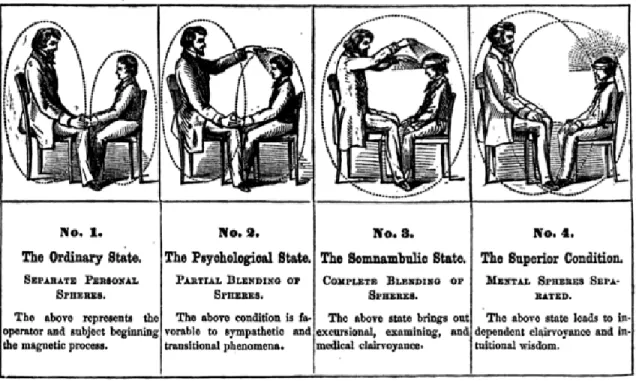
somnambulism.” His cosmology consisted of an “unconquerable dread” of death and “a vague, apprehensive faith in the Bible doctrine of eternal misery.” A Poughkeepsie mesmerist found Davis, a young shoemaker’s apprentice, to be an ideal subject, able in a trance state to read letters on a newspaper through his forehead and describe the physical ailments of those around him. People came to see these phenomena, seeking “tests and wonders.”23 As Davis described the effects of the mesmerist, or animal magnetist, or magnetizer, or operator—the terms were somewhat interchangeable—his “mental
22 Republic of Mind and Spirit, 133. 145. 136, 147, 149; Stephen J. Stein, The Shaker Experience in America: A History of the United Society of Believers (New Haven: Yale University Press, 1992), 142–
143; Ruth H. Bloch, Visionary Republic: Millennial Themes in American Thought, 1756–1800 (Cambridge: Cambridge University Press, 1985), 13; David L. Rowe, “A New Perspective on the Burned-over District: The Millerites in Upstate New York,” Church History 47:4 (December 1978), 412, 409.
23
sphere” blended with that of the subject in a partial, or psychological state, or more deeply in a complete, or somnambulic state. In the early 1840s, heralded as the
“Poughkeepsie Seer,” Davis became a successful clairvoyant for paying customers and displayed a knack for diagnosing illnesses.
Figure 3. Four States from The Magic Staff (1857).
Davis recorded the milestones in his clairvoyant development, and his writings would awaken a small readership to the potential to tap knowledge beyond the mundane. Davis’s books would also be the first source for people who wanted to read more about contemporary spiritual phenomena when word of the Fox sisters began to spread. He wrote that he awakened during the night of March 6, 1844. A voice instructed him to
“Arise! dress—thyself—and—follow—me!” He fell into a trance and wandered into the
of individual spirits,” but that was about to change. Rambling down to the frozen Hudson River and back up into the mountains, “I was under psychologic influence, and saw common things in a new light.”24 In time, someone approached. “He appeared advanced in years, and was attired in a style corresponding nearly to that of the Friends. His hair was of a silvery white, floating in shadowy locks over his brow, and hanging gracefully about his neck and shoulders. His face was full and expressive. His moral and intellectual developments were prominent. He was a spiritual being.” No words were spoken, but Davis knew this to be the spirit of a reformer.
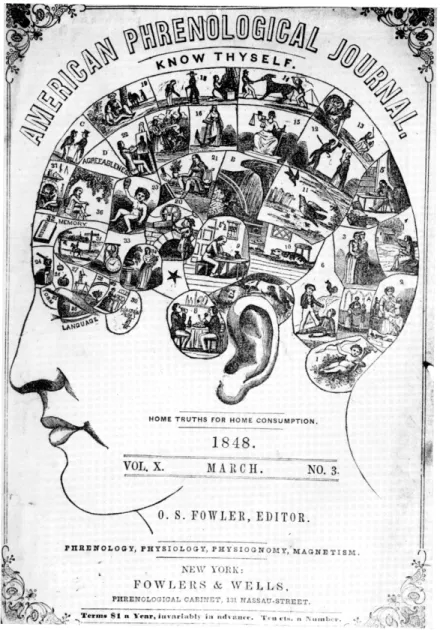
Peering back through time to 1844, we should pause to look closely at the images Davis is invoking. “The Eye of the Eternal Being” echoes the transparent eye-ball in Transcendentalist Ralph Waldo Emerson’s influential Nature (1836). “Psychologic influence” would have meant to Davis that an external force was acting on his mind. The Friends, or Quakers, were known for their silent, solemn worship and their plain manner of dress. Their pacifism and denunciation of chattel slavery, guided by each Quaker’s Inner Light, placed them in the faith-based vanguard of moral reform. The spirit visitor’s “visage was full and expressive,” signifying the transparency or sincerity so highly valued in the Early Republic,25 and his “moral and intellectual developments were prominent.” Among the new “sciences” to which Davis alluded at various points in his narrative were physiognomy and phrenology, which explained how the shape of the
24 Ibid., 227–235.
25 Ralph Waldo Emerson, Nature: Addresses and Lectures (Boston and New York: Houghton,
Mifflin and Company, 1903), 10: “I become a transparent eyeball; I am nothing; I see all; the currents of the Universal Being circulate through me; I am part or parcel of God.”; 50: “If the Reason be stimulated to more earnest vision, outlines and surfaces become transparent, and are no longer seen; causes and spirits are seen through them. The best moments of life are these delicious awakenings of the higher powers, and the reverential withdrawing of nature before its God.” On the importance of sincerity to the emerging antebellum middle class, see Karen Halttunen, Confidence Men and Painted Women: A Study of
countenance and prominence of various bumps on the skull, respectively, allowed one to determine the nature and character of an individual.
embarrassed, he asked the spirits for assistance and handed the staff to the healing spirit so he could use both hands to free himself. The spirit did not return the magic staff, but left Davis feeling assured that “the beautiful and comprehensive Staff would ultimately be mine, and that, too, because I should be worthy of its possession.”26
The next evening he told his magnetizer it was time to make some changes. First, Davis would spend no more time gratifying the “wonder-seekers” who nightly paid for his clairvoyant analyses of what they had eaten for supper or readings of the time indicated by the watches concealed in their pockets. Next, his powers were to be used exclusively for diagnosing and healing the sick. Third, the length of his trances would be limited to just two-and-a-half hours at each sitting. Finally, their time would be
compensated by “the charge of a moderate fee to those only who were in easy circumstances.”27
The highest and deepest mesmeric state Davis called “the superior condition.” He claimed to have first permanently entered the superior condition on November 28, 1845. A few people had been invited to “Lectures by A. J. Davis, the Clairvoyant.” Davis asked readers of his autobiography to imagine a small, sparsely appointed room on the island of Manhattan. Davis, a “pale-faced and thin-bodied youth,” sat near his new mesmeric operator, Dr. Lyon. At a table sat Rev. William Fishbough, a Universalist minister from New Haven, Connecticut, whose task it was to transcribe what Davis would say while entranced. There were also “three men half-fascinated with the ever-charming process of magnetization.” Dr. Lyon blindfolded Davis, and “the inner folds of
26 Magic Staff, 236–249.
27
his intellectual organ begin to tremble and expand like opening flowers. They emit a soft atmospheric ether, which rapidly saturates the air of the room, and ascends, like the water-spout at sea, toward the heavens,” a “radiant shaft of spiral light reaching all the way from the sleeping youth’s head to a Focus of Thought beyond the stars.” Drawing his readers into the experience, Davis wrote, “There! do you see that? An answering shaft Descends! His benumbed hands do quiver with a new sensation, and the muscles of his face do vibrate and tremble with the inflowing power.”The witnesses were “still as pall-bearers” and a “grim-visaged” Dr. Lyon asked what was happening. “This night” Davis replied, “I reach my superior condition.” Davis then invited his reader to review the magnetic diagrams that illustrated this part of his tale.28
Davis claimed that in the superior condition, “My intuitions ascend like a light column of ether toward the upper realm, and I come in contact with an atmosphere of Thought!” Any question, “scientific, ethical, psychical, poetical, prophetic, literary, &c.” with which he came “into intuitional rapport” was “subjectable to my voluntary
examination.”29
As Davis began to recount this experience he might almost have been describing an individual undergoing a religious conversion, and about to receive something of great value. But the process was definitely unlike that reported by evangelicals, who began their spiritual pilgrimage with a sense of overwhelming sin, and dread of the just condemnation from which Christ Jesus would save them. Davis was using a different vocabulary to conceptualize and convey how he came to the superior state. He did not repent of sin and pray for forgiveness through the grace of God. It was not spiritual
28
Ibid., 302–305.
oneness with Christ that Davis sought and found, but rather the ability for his mind to employ the newer concept of the ether. He was imagining the mysterious fluid that flowed from mesmerizer to subject, sometimes called odic fluid or thought to be electricity, as another way to reach a cosmically heightened state of clairvoyance that allowed him to connect with all knowledge, to see chemical structures, to read the record of the ages, to know everything. It is not surprising that on the verge of receiving such great powers he should have experienced the trembling and disorientation characteristic of some ecstatic conversion experiences.
Davis was influenced by, and attracted to his inner circle, Universalist ministers. Davis’s early exposure to religion had left him with a dread of death and an uneasiness about the afterlife that made Universalism’s promise of salvation for all by a loving creator comforting. His visions, explained historian John B. Buescher, “took on a
Universalist tone. He saw the sanctified glory in which all beings already partake through an indwelling of the spirit and by which they will, in the future, be brought into
salvation.” Universalist minister Samuel B. Brittan, while pastor of a congregation in Albany, New York, had spent twelve days in a “state of profound trance” in conjunction with an illness. After awakening, he described a spiritual visitor, majestic and benevolent, who had often stood near him during his long trance. Brittan was a changed man, and found himself drawn to the teachings of Andrew Jackson Davis. Leaving the ministry, Brittan helped find funding to publish Davis’s first book, The Principles of Nature, Her
Divine Revelations, and a Voice to Mankind. It appeared in late summer, 1847. The
obscure Davis became the ‘prophet’ of a ‘Harmonial’ dispensation which he continued to propagate in books, articles, and public addresses.” Davis had a theoretical structure in place when the Fox sisters started rapping, and his Harmonial philosophy “provided the foundation” for many believers in the Spiritualist movement as it began its rapid spread.30
Davis was part of the group that in late 1847 started what, though it predated the activities of the Fox sisters, is considered the first Spiritualist newspaper. The
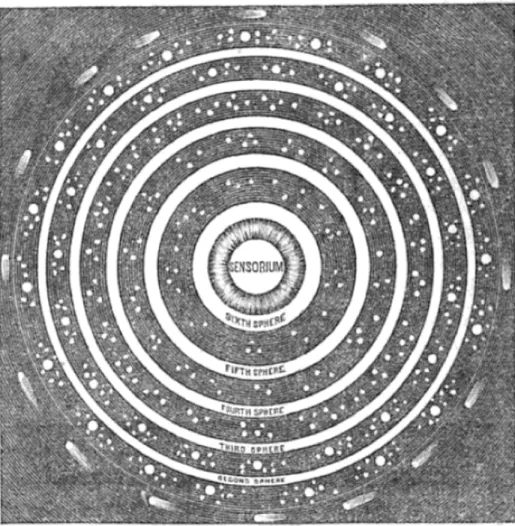
Univercoelum took its name from the spiritual sun at the center of the six spiritual
spheres that were revealed to Davis (and echoed the spiritual spheres described in the writings of Emanuel Swedenborg). Samuel B. Brittan became the editor. During its brief existence, the Univercoelum “extolled Fourierist socialism and millennialist rhetoric of a
30
Other Side of Salvation, 21; Modern American Spiritualism, 61–62; Other Side of Salvation, 38; Robert W. Delp, “A Spiritualist in Connecticut: Andrew Jackson Davis, the Hartford Years, 1850–1854,”
The New England Quarterly 53:3 (September 1980), 345. A summation of the Harmonial philosophy
appeared in an early number of The Spirit Messenger (August 31, 1850), 29: “The Law of Harmony.” Superior to all other laws established in creation, and existing as the legitimate result of their action, is the great law of Harmony. This law applies not only to the outward universe, but also to Deity himself, as it constitutes one of the essential and inherent principles of His nature. It is in fact the end attained by the innumerable parts of creation—the effect, produced by the natural operation of the grand WHOLE.
Figure 4: Celestial spheres from The Magic Staff (1857).
new age dawning ” and championed “mesmerism, phrenomagnetism, and
Swedenborgianism” as well as health reform. Like most of the Spiritualist publications that would come and go over the next decades, Spiritualist Emma Hardinge Britten (who was not, as is commonly but erroneously believed, Mrs. Samuel B. Brittan) reflected, it did not last long because the principals were “richer in mental than material
endowments.” But the names of many of those associated with it—Andrew Jackson Davis, Samuel B. Brittan, Thomas Lake Harris, Thomas Holley Chivers—reappear in this study.31
Thomas Holley Chivers also contributed poetry to The Spirit Messenger, which commenced publication August 10, 1850 in Springfield, Massachusetts to fill the void left by the demise of the Univercoelum and created a new vehicle for contributions from A. J. Davis when in the “superior condition.” The paper’s stated intention was “engaging in an earnest search for Truth, and unfolding in our humble way, the Religion of Nature and the Philosophy of Reason.” The contents of this first issue give a snapshot of the state of Spiritualist development and focus in 1850, filtered through the Harmonial influence of Andrew Jackson Davis. The lengthy lead item, written by Davis, was followed by one on “Spiritual Clairvoyance,” which promised “occasional communications emanating from minds which have been illuminated and impressed with truths of the highest importance to the human race, through the agency of what may be termed Spiritual Clairvoyance, a condition corresponding almost precisely with that of physical death.” Spiritual Clairvoyance was another name for the superior condition, which the writer explained had on many occasions been attained by Emanuel Swedenborg, whose philosophical writings “have been the admiration of the world,” and were the result of experiences in this condition. Swedenborg had called his awakening “the opening of his spiritual sight.” Through the writings of A. J. Davis in the superior condition, it had been revealed that man has both a natural body that is impermanent and a spiritual body that is eternal. Thus “death is stripped of its imaginary horrors, and the desire for proofs of immortality and ultimate beatification, which is felt by every human being whom God has created, is at once gratified.” A discussion of “Guardian Spirits” assured readers, “We are never alone. In our silent meditations, our solitary rambles, and even our hours of profoundest slumber, when no eye of the corporeal body rests upon us, we are not