Differences in Ventilatory Patterns between Overweight and Normal Weight Children during Rest, Low, Moderate and High Speed Exercise
Meghan Anastasia O’Brien
A thesis submitted to the faculty of the University of North Carolina at Chapel Hill in partial fulfillment of the requirement for the degree of Master of Arts in the Department of Exercise and Sport Science (Exercise Physiology).
Chapel Hill Spring 2010
Approved by:
ii ABSTRACT
MEGHAN O’BRIEN: Differences in Ventilatory Patterns between Overweight and Normal Weight Children during Rest, Low, Moderate and High Speed Exercise
(Under the direction of Robert McMurray, Ph.D)
iii
TABLE OF CONTENTS
Page
LIST OF TABLES……….v
LIST OF ABBREVIATIONS………...vi
Chapter I. BASIS OF STUDY………1
Introduction………....1
Delimitations………...4
Limitations………..4
Definition of Terms……….5
Significance of Study……….…...5
II. REVIEW OF LITERATURE……….…………....7
Introduction……….……….…..7
Ventilation……….……....….8
Differences between Adult and Youth Pulmonary Dynamics………….…...8
Effects of Obesity on Adult Respiration………...10
Effects of Obesity on Youth Respiration………..12
Summary………….………..14
III. METHODOLOGY………...15
iv
Instrumentation………16
Procedures………16
Data Analysis………17
IV. RESULTS……….18
Subject Characteristics………..18
Metabolic Efficiency……….………18
Pulmonary Variables……….19
Exploratory Analysis……….20
V. DISCUSSION……….….22
Introduction……….…….22
Metabolic Efficiency……….22
Pulmonary Efficiency………24
Exploratory Analysis……….…26
Strengths & Limitations………27
Conclusions………...28
Review of Hypotheses………...28
Clinical Relevance……….29
Recommendations……….29
v
LIST OF TABLES Tables
1. Mean (± SD) of physical characteristics presented by………..18 normal weight (NW) and overweight (OW) group
2. Mean (± SD) of metabolic efficiency variables for the……….19 normal weight (NW) and overweight (OW) groups
at rest, low, moderate and high speed exercise
3. Mean (± SD) of respiratory variables for the normal……….20 weight (NW) and overweight (OW) groups at rest,
low, moderate and high speed exercise
4. Pearson product correlation values of PETCO2 for……….21 normal weight (NW) and overweight (OW) groups
at rest, low, moderate and high speed exercise
5. Mean alveolar ventilation (VA) and ratio of…………...………25 alveolar ventilation to oxygen uptake (VA/VO2) in
normal weight (NW) and overweight (OW) groups during low, moderate and high speed exercise
vi
LIST OF ABBREVIATIONS Alveolar Ventilation = (VA)
Arterial Pressure of CO2 = (PaCO2) Breathing Frequency = (fR)
Minute Ventilation = (VE)
Partial Pressure of End Tidal CO2 = (PETCO2) Physiological Dead Air Space = (VD)
Tidal Volume = (VT)
CHAPTER I BASIS OF STUDY Introduction
The prevalence of overweight and obese children in the United States has become increasingly common, regardless of ethnicity and socioeconomic status (Ebbeling, Pawlak, & Ludwig, 2002). Definitions of overweight and obese within younger populations often differ between epidemiological studies due to the ongoing processes of growth and development (Ebbeling et al., 2002; Lazarus, Colditz, Berkey, & Speizer, 1997). Although the ideal characterization would be based on body fat percentage, more often percentiles based on body mass index (BMI) (weight (kg) /height (m2)) for a child’s age and sex are utilized, with a BMI above the 85th percentile being classified as overweight and those greater than the 95th percentile categorized as obese (Cole, Bellizi, Flegal, & Dietz, 2000). Between 2003-2006 an estimated 11.3% of children and adolescents aged 2 through 19 yearswere at or above the 97th percentile, 16.3% were at or abovethe 95th percentile, and 31.9% were ator above the 85th percentile (Ogden, Carroll, & Flegal, 2008). Similar to adults, obesity in youth is a multi-system disease with many adverse consequences, as illustrated in Figure 1.
2
Researchers rationalized that this increase is likely to be augmented during exercise (Kress et al., 1999).
Figure 1. Complications of childhood obesity. (Ebbeling et al., 2002)
Lazarus, Gore, Booth, & Owen (1998) examined the effects of body composition and fat deposition on ventilatory function in adults and found that forced vital capacity (FVC) (adjusted for age, height, smoking and bronchial symptoms) was negatively associated with percentage body fat in both men and women. Additionally, Salvadori et al. (1999)
investigated work tolerance, cardiac performance and ventilatory adaptation of obese vs. non-obese subjects during a graded cycle ergometer exercise test and found significantly higher VO2, heart rate and minute ventilation (VE) values in obese participants during exercise, denoting a reduced cardio-respiratory efficiency. A decrease in chest wall and total respiratory system compliance of obese subjects, particularly in the supine position, has been previously established (Naimark & Cherniack, 1960). Naimark and Cherniack (1960) also
Psychological Self Esteem Depression Eating Disorders Pulmonary Sleep apnea Asthma Exercise Intolerance Gastrointestinal Gallstones Liver Disease Renal Glomerulosclerosis Musculoskeletal Blount’s disease Forearm fracture Flat feet Arthritis Neurological Pseudotumor cerebri Cardiovascular Dyslipidemia Hypertension Coagulopathy Chronic inflammation Endothelial dysfunction Heart disease Endocrine
Type 2 diabetes Precocious puberty Polycystic ovary syndrome (girls)
3
found that an estimated one-third of the increase in the mechanical work of breathing in obesity is due to the greater elastic work done on the chest wall. These significant differences found previously among healthy, obese adults may be reason to suspect related discrepancies in certain respiratory parameters of overweight youth.
Although growth and development can complicate studies examining the ventilatory function of children (Ondrak & McMurray, 2006), Lazarus et al. (1997) established a negative association between height-adjusted FVC and forced expiratory volume in one second (FEV1) with total percent body fat in school children aged 9, 12 and 15 years. Marinov, Kostianex, & Turnovska (2002) also found that obese children had increased relative ventilation (VE/kg), tidal volume (VT/kg) and ratings of perceived exertion (RPE), in addition to significantly (p<0.001) lower anaerobic thresholds, as compared to non-obese children. These findings indicate that obese youth display greater ventilation during exercise, as well as a faster onset of fatigue (Marinov et al., 2002). However, despite these few studies published on selected samples of obese children (Lazarus et al., 1997; Marcus et al., 1996; Reybrouck, Mertens, Schepers, Vinckx, & Gewillig, 1997; Marinov et al., 2002), no randomized population samples have measured differences in respiratory function between overweight and normal weight youth at rest, low, moderate and high speed exercise. Fat deposits could have negative mechanical effects on ventilatory function by impeding the chest wall and diaphragm; therefore, overweight children may potentially have altered respiratory function at varying exercise speeds (Lazarus et al., 1998).
Purpose:
4 Null Hypotheses:
1) VE, fR and VT will be similar between overweight and normal weight youth during rest and low, moderate and high exercise speeds.
2) No significant differences exist in VE/VO2 and VE/VCO2 between normal weight and overweight youth during rest, low, moderate or high speed exercise.
3) No significant differences exist in PETCO2, VD and VD/VT ratio between overweight and normal weight youth at rest or during low, moderate and high speed exercise.
Delimitations:
1. The data was obtained from youth, aged 6 to 18 years of age, who participated in a previous study: Energy Expenditure of Physical Activity in Youth (PI: JS Harrell and RG McMurray)
2. Groups were assigned based on BMI with the overweight group having a BMI >85th percentile and the normal weight group having a BMI of ≤85th
percentile, but >5th percentile.
3. Pairs were matched for sex, age (±1 year) and height (±4 cm).
4. Not all subjects were able to perform all three exercise intensities and were therefore matched based on number of activities completed. If this was not possible, they were still matched to a member of the opposite group based on sex, age and height.
Limitations:
1. Not all subjects were able to perform at all exercise intensities. 2. Results may only be applicable to specified population.
5 Definitions of Terms:
1. Alveolar Dead Air Space (VA): volume of air that contacts alveoli (McArdle, Katch, & Katch, 2001)
2. Breathing Frequency (fR): number of breaths per minute
3. Minute Ventilation (VE): product of VT and fR; volume of air respired each minute (McArdle et al., 2001)
4. Partial Pressure of End Tidal CO2 (PETCO2): measure of the amount of carbon dioxide present in the exhaled air; reflective of arterial CO2 (McArdle et al., 2001) 5. Physiological Dead Air Space (VD): volume of air that is respired but does not
partake in gas exchange; has a ventilation-perfusion ratio that approaches zero (McArdle et al., 2001)
6. Tidal Volume (VT): air volume moved during either inspiratory or expiratory phase of each breathing cycle (McArdle et al., 2001)
7. Ventilatory Equivalent for Carbon Dioxide (VE/VCO2): ratio of the volume of air ventilating the lungs to the volume of carbon dioxide produced; can define ventilatory efficiency because it reflects the matching of ventilation and perfusion in the lung (McArdle et al., 2001; Marinov et al., 2002)
8. Ventilatory Equivalent for Oxygen (VE/VO2): ratio of the volume of air ventilating the lungs to the volume of oxygen consumed, represents the amount of ventilation required for the consumption of each liter of oxygen (McArdle et al., 2001) Significance of Study
6
respiratory muscle function during exercise may be compromised in these individuals as a result of increased load on the muscles, along with a diminished capacity to do work (Gibson 2000; Marinov et al., 2002; Salvadori et al., 1999). This adverse load to capacity ratio results in more energy being required for ventilation and less available for the working muscle. Research in adults has shown that the accumulation of fat can result in reduced exercise capacity, primarily from mechanical obstruction of the rib cage, lungs and diaphragm, leading to an increase in the mechanical work of breathing during exercise (Babb, Wyrick, DeLorey, Chase, & Feng, 2008; Naimark & Cherniack, 1960; Wang & Cerny, 2004).
These complications typically reported in adults may also extend to younger
CHAPTER II
REVIEW OF LITERATURE Introduction
Obesity has been acknowledged as a worldwide phenomenon that increases morbidity and reduces life expectancy (Parameswaran, Todd, & Soth, 2006). It can be defined as the excessive accumulation of body fat that causes a generalized increase in body mass (Luce, 1980). The prevalence of overweight and obese youth has increased exponentially in the last decade and has now become a common health crisis within the United States (Dehghan, Akhtar-Danesh, & Merchant, 2005). There are many adverse consequences of being overweight and obese including diabetes, dyslipidemia, hypertension and hyperinsulinemia (Ebbeling et al., 2002).
8
pulmonary systems are then outlined in order to provide a useful foundation for the impact of excess fat on pediatric respiratory physiology.
Ventilation
The respiratory system serves as the link between the ambient air and the blood circulation of oxygen to the muscles. Minute ventilation is the air entering or leaving the lungs and airways every minute and is the product of tidal volume (VT) and breathing frequency (fR). Tidal volume is the amount of air per breath and can be divided into air that reaches the alveoli (alveolar ventilation (VA)) and the air that simply fills air passages or does not partake in gas exchange (physiological dead space (VD)). The concept of compliance reflects the amount of work required to move the extrapulmonary structures while breathing (Luce, 1980; Naimark & Cherniack, 1960). Any obstruction on the respiratory components in the body can negatively impact an individual’s ability to breathe, in addition to negatively impacting VT, VD and VA.
Respiration must be tightly controlled, particularly during exercise when increased metabolic demands and excess CO2 production occurs within the body. The goal of ventilatory control is to maintain pH, O2 and CO2 partial pressure homeostasis (Keslacy, Carra, & Ramonatxo, 2008). Ventilation is controlled primarily by neural factors and
secondly by CO2 levels in the blood (Eldridge, Millhorn, Kiley, & Waldrop, 1985). Although the basic ventilatory components in adults and children are somewhat similar, their responses during exercise may differ depending on certain anatomical and functional aspects.
Differences between adult and youth pulmonary dynamics
9
Romanatxo, Dassonville, & Prefaut, 1993; Ondrak & McMurray 2006). Compared to adults, children have lower absolute VE, absolute VT and end-tidal CO2 (PETCO2) at rest and during submaximal and maximal exercise (Ondrak & McMurray 2006). Conversely, children display a greater fR, relative VE and ventilatory equivalent for oxygen (VE/VO2) compared to adults (Ondrak & McMurray 2006). Therefore, it is evident that the respiratory physiology of youth differs substantially from adults.
The shape, size and composition of the respiratory system changes dramatically from infancy to adulthood, thereby impacting the mechanical properties of ventilation (Lanteri & Sly, 1993). Alterations in rib cage configuration, chest wall maturation, respiratory muscle development and alveoli proliferation all occur within the first few years of life (Lanteri & Sly, 1993). Lung structure is not fully developed at birth, with the weight increasing three-fold and the surface area increasing 10-three-fold before adulthood is reached (Rowland, 1996). As a child increases in height, modifications in respiratory mechanics are associated with
decreased airway resistance and increased respiratory compliance (Lanteri & Sly, 1993). As a result, height becomes an important factor for ventilatory work, duration of inspiration and expiration, and the relation of VT to fR (Rowland, 1996). Thus, the discrepancy in size and pulmonary development between adult and pediatric populations impacts ventilatory mechanics.
10
compared to adults, demonstrate that younger individuals ventilate more than adults to meet a similar metabolic demand during exercise (Rowland, 1996). Since VE/VO2 is inversely proportional with age, individuals increase their ventilatory efficiency into adulthood. Greater VE values in children during exercise is due to increased sensitivity to CO2 as compared to adults (Cooper et al., 1987; Gratas-Delmarche et al., 1993). Less CO2 is required for children to elicit a response and modifications in ventilation must be made in order to maintain exercise and alter CO2 concentration (Cooper et al., 1987).
In summary, development of the respiratory system continues until adulthood.
Although pulmonary structures are sufficient to function outside the uterus at birth, the lungs continue to grow proportionally to height (Malina, Bouchard, & Bar-Or, 2004). The
differences that exist between the respiratory systems of youth and adults are reflected in each individual’s response and management of ventilation during exercise. In addition to dimensional disparities, excess fat can impose an impediment on the human body that requires an adjustment in ventilatory response, particularly during physical activity. Effects of Obesity on Adult Respiration
In adults, obesity has been found to have a profound effect on the physiology of breathing (Parameswaran et al., 2006). Respiratory problems associated with excess adiposity include decreased compliance, altered breathing patterns and lung volumes, and elevated work of breathing (Paramesawaran et al., 2006). These effects are amplified during exercise, when obese adults experience additional respiratory stress as a direct result of their increased body mass (Parameswaran et al., 2006).
11
capacity (FRC), total lung capacity (TLC) and vital capacity (VC) lung volumes have been the most consistent findings among obese adults (Babb et al., 2008; Costa, Barbalho, Miguel, Forti, & Azevedo, 2008; Gibson, 2000; Lazarus et al., 1998; Luce, 1980; Parameswaran et al., 2006; Zerah et al., 1993). Decreased EELV is one of the earliest and most prominent changes in pulmonary function with obesity and can greatly impact gas exchange and work of breathing during exercise (Babb et al., 2008). Babb et al. (2008) observed approximately 11% lower EELV in obese men and women, in comparison to lean individuals. FVC volumes decreased by almost two liters in obese subjects when Lazarus et al. (1998) compared
individuals based on body fat percentage. Additionally, the Costa et al. (2008) study found ERV to decrease by 5% per unit of increase in BMI, which is attributable to the reduction of diaphragm mobility and pulmonary compliance observed in obesity. MVV is a measurement of respiratory muscle endurance and is approximately 20% lower in obese, while TLC and VC are about 20-30% lower as body mass increases (Parameswaran et al., 2006; Zerah et al., 1993). These diminished lung volumes demonstrate the hazardous effects obesity can have on pulmonary function.
Some of the respiratory changes in obese individuals are related to a reduction in respiratory compliance by as much as two-thirds the normal value (Naimark & Cherniack, 1960). Lung volume abnormalities are related to changes in compliance since the end-expiratory position of the lungs, chest wall and diaphragm is determined by the balance of the elastic recoil forces of these structures (Zerah et al., 1993). This decreased compliance is primarily due to the central accumulation of fat, which increases the elastic resistance of the chest wall, decreasing the ability for chest expansion, and ultimately decreasing lung
12
pulmonary blood volume contributes to decreased lung compliance, which may also play a role in the reduced distensibility of extrapulmonary structures (Naimark & Cherniack, 1960). These findings support the idea that obesity requires extra respiratory work to expand the chest and ventilate the lungs adequately, particularly during exercise. Consequently, obese individuals must overcome these obstacles by modifying pulmonary function.
Obese adults tend to display a rapid, shallow breathing pattern that may increase their overall respiratory muscle work (Luce, 1980; Parameswaran et al., 2006; Wang & Cerny, 2004). A combination of smaller VT and higher fR attempts to reduce the oxygen cost of each breath, but is ultimately uneconomical because each breath contains a larger VD in proportion to VE (Luce, 1980). The respiratory muscles of an obese individual do not generate as much inspiratory and expiratory pressures as a normal weight individual, despite having to work against a less compliant chest wall (Parameswaran et al., 2006). Increased central adipose limits diaphragm function and prohibits the muscle from adequately contracting during ventilation (Babb et al., 2008; Parameswaran et al., 2006). Many of these respiratory consequences in adults may be translated to children, despite the morphological differences between the two populations.
Effects of Obesity on Youth Respiration
The effects of obesity on respiration have been well established in adults (Babb et al., 2008; Costa et al., 2008; Gibson, 2000; Lazarus et al., 1998; Luce 1980; Naimark &
(Gonzalez-13
Barcala et al., 2007; Lazarus et al., 1997; Marinov et al., 2002; Reybrouck et al., 1997; Zanconato et al., 1989).
Similar to adults, lung volumes in children are decreased relative to increasing body mass (Lazarus et al., 1997). Compared to normal weight children, overweight children in one study (Gonzalez-Barcala et al., 2007) were found to have 11% lower FVC and 10% lower forced expiratory volume in one second (FEV1), which is in accordance with similar values detected by Lazarus et al. (1997). Additionally, Inselman, Milanese, & Deurloo (1993) found decreased ERV and MVV in obese youth that were only 35 and 61% of predicted values, respectively. Investigators ascribe these reductions to the large extrinsic load on the chest wall that diminishes normal exhalation of the chest wall and lungs (Inselman et al., 1993). These findings indicate a decrease in ventilatory function with increasing proportions of body fat.
Increased metabolic cost during exercise has also been previously established in overweight youth (Inselman et al., 1993; Marinov et al., 2002; Reybrouck 1997; Zanconato et al., 1989). Marinov et al. (2002) found approximately 25% greater absolute peak VO2 values (L/min) in the obese group signifying a greater metabolic demand; however, once body weight was taken into account, obese subjects’ values became about 10% lower than the controls (29.2 vs. 33.6 mL/kg/min, respectively). Consequently, this suggests that obese youth require more oxygen and may be limited in their physical capacity, thereby making it more difficult for them to lose weight (Marinov et al., 2002).
14
contrast to lower VT values found in obese adults, although the reason explaining this finding is currently unknown (Luce, 1980; Parameswaran et al., 2002). However, research suggests that the same decreased chest wall compliance found in adults can account for increased fR in youth during exercise (Reybrouck et al., 1997). These findings suggest increased ventilatory requirements by overweight youth.
Summary
Excess adiposity can have detrimental effects on the human body and can greatly diminish exercise capacity. Lower ventilatory function and decreased physical activity, previously found within the pediatric population, are just two major components in the vicious cycle of obesity, leading to greater fat accumulation and increased risk of
cardiovascular disease (Lazarus et al., 1997). This chapter reviewed the effects of obesity on the respiratory system in adults and youth and examined the differences in pulmonary dynamics between the two populations. Few studies have examined the differences in
CHAPTER III METHODOLOGY Subjects
16 Instrumentation
Height was measured using a standard stadiometer (Perspective Enterprises, Portage, MI, USA) and body mass was obtained via a calibrated balance beam scale (Detecto Scales, Inc., Webb City, MO, USA). The children performed the submaximal walking and running exercises at low, moderate and high speeds on a calibrated Quinton, model Q65 treadmill (Quinton Instruments, Seattle, WA). Respiratory data was collected breath-by-breath from each child through a face mask (Hans Rudolph Inc., Kansas City, MO) that directed air into a 28 mm bidirectional digital turbine, which was part of the COSMED K4b2 portable metabolic analyzer (Rome, Italy). This lightweight system was calibrated to ensure accuracy and then harnessed to the subject’s torso in order to allow ample freedom of movement during the data collection periods.
Procedures
17
COSMED software in order to obtain metabolic rate. The tidal volume (VT) and respiratory frequency (fR) were measured directly from the turbine of the COSMED, while minute ventilation (VE) and end-tidal CO2 (PETCO2) were calculated by the COSMED software. The partial pressure of arterial CO2 (PaCO2), which is needed for the calculation of VD, was derived from PETCO2 and VT using the Jones, Robertson, & Kane (1979) equation (PaCO2 = 5.5 + 0.9 PETCO2 – 0.0021 VT (r=0.915)). Dead air to tidal volume ratio (VD/VT) and minute ventilation per unit CO2 output and O2 uptake ratios (VE/VCO2, VE/VO2) were all derived from collected values (Ondrak & McMurray, 2006). Breaths less than 200 mL or greater than the 95th percentile were eliminated from the data set.
Data Analysis
CHAPTER IV RESULTS Subject Characteristics
This study examined the potential differences in ventilatory patterns between
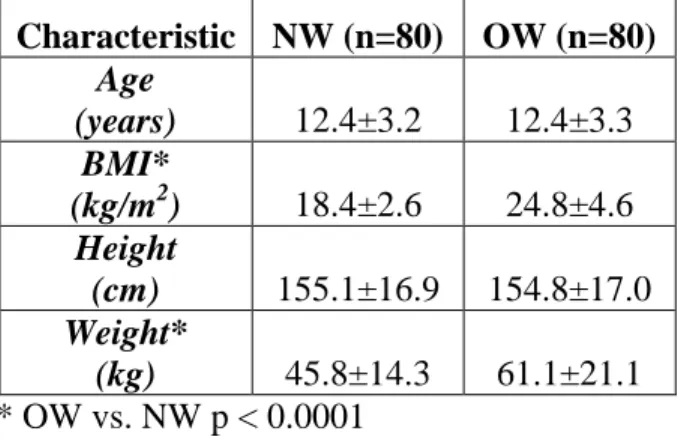
overweight and normal weight children during both rest and various exercise speeds. A total of 160 children were included in this study. They were separated into two groups of 80 children with 40 males and 40 females in each one. The descriptive data for the overweight (OW) and normal weight (NW) groups is presented in Table 1. As expected, age and height was similar between the two populations, while body mass index (BMI) and weight was significantly higher in the OW group (p < 0.0001).
Table 1. Mean (± SD) of physical characteristics presented by Normal Weight (NW) and Overweight (OW) groups.
Characteristic NW (n=80) OW (n=80) Age
(years) 12.4±3.2 12.4±3.3
BMI*
(kg/m2) 18.4±2.6 24.8±4.6
Height
(cm) 155.1±16.9 154.8±17.0
Weight*
(kg) 45.8±14.3 61.1±21.1
* OW vs. NW p < 0.0001 Metabolic Efficiency
19
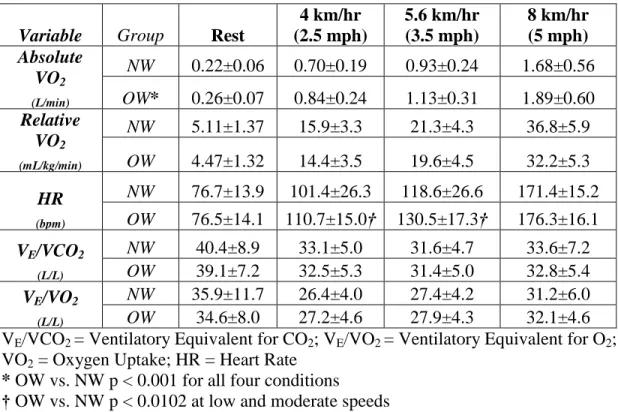
Heart rate was also significantly higher in the OW group at low and moderate speeds (p < 0.0102). However, no significant differences were found in either VE/VO2 or VE/VCO2 between the two groups (p > 0.05).
Table 2. Mean (± SD) of metabolic efficiency variables for the Normal Weight (NW) and Overweight (OW) groups during rest, low, moderate and high speed exercise.
Variable Group Rest
4 km/hr (2.5 mph) 5.6 km/hr (3.5 mph) 8 km/hr (5 mph) Absolute VO2 (L/min)
NW 0.22±0.06 0.70±0.19 0.93±0.24 1.68±0.56
OW* 0.26±0.07 0.84±0.24 1.13±0.31 1.89±0.60 Relative
VO2
(mL/kg/min)
NW 5.11±1.37 15.9±3.3 21.3±4.3 36.8±5.9
OW 4.47±1.32 14.4±3.5 19.6±4.5 32.2±5.3 HR
(bpm)
NW 76.7±13.9 101.4±26.3 118.6±26.6 171.4±15.2
OW 76.5±14.1 110.7±15.0† 130.5±17.3† 176.3±16.1 VE/VCO2
(L/L)
NW 40.4±8.9 33.1±5.0 31.6±4.7 33.6±7.2
OW 39.1±7.2 32.5±5.3 31.4±5.0 32.8±5.4 VE/VO2
(L/L)
NW 35.9±11.7 26.4±4.0 27.4±4.2 31.2±6.0
OW 34.6±8.0 27.2±4.6 27.9±4.3 32.1±4.6 VE/VCO2 = Ventilatory Equivalent for CO2; VE/VO2 = Ventilatory Equivalent for O2; VO2 = Oxygen Uptake; HR = Heart Rate
* OW vs. NW p < 0.001 for all four conditions † OW vs. NW p < 0.0102 at low and moderate speeds
Pulmonary Variables
Table 3 displays the means ± standard deviations (SD) for the pulmonary variables of each group during each condition (rest, low, moderate and high speed). Significant
20
0.004), but not at rest (p > 0.05). No significance was found in the PETCO2 or VD/VT between groups (p > 0.05) at rest or during exercise.
Table 3. Mean (± SD) of respiratory variables for the Normal Weight (NW) and Overweight (OW) groups at rest, low, moderate and high speed exercise.
Variable Group Rest
4 km/hr (2.5 mph) 5.6 km/hr (3.5 mph) 8 km/hr (5 mph) VE (L/min)
NW 7.52±1.5 18.3±3.8 25.2±4.9 50.7±12.7
OW* 8.77±1.8 22.3±4.4 31.1±6.0 59.6±15.2 fR
(breaths/min)
NW 19.9±5.5 29.2±7.7 34.7±10.3 51.1±12.8
OW 20.6±4.3 32.6±7.4** 38.9±9.4** 53.9±11.7 VT
(L)
NW 0.42±0.13 0.69±0.27 0.82±0.34 1.11±0.45
OW# 0.47±0.15 0.76±0.25 0.89±0.28 1.22±0.47 PETCO2
(mmHg)
NW 38.9±4.3 39.8±4.0 40.3±4.3 38.6±5.1
OW 38.4±5.1 40.5±4.2 41.0±4.1 38.8±4.6 VD
(mL)
NW 58.7±31.1 113.8±55.5 137.4±66.8 227.5±104.0
OW 69.7±41.9 133.2±72.5‡ 161.3±75.2‡ 262.6±126.7‡ VD/VT
(%)
NW 12.4±5.7 14.9±5.8 15.4±5.6 18.9±7.8
OW 12.4±6.2 15.3±7.4 16.1±7.4 18.9±7.9
VE = Minute Ventilation; fR = Breathing Frequency; VT = Tidal Volume; PETCO2 = Partial Pressure of End-Tidal CO2; VD = Physiological Dead Space; VD/VT = Dead Space to Tidal Volume Ratio
* OW vs. NW p < 0.0001 for all four conditions ** OW vs. NW p < 0.002 at low and moderate speeds # OW vs. NW p < 0.04 for all four conditions
‡ OW vs. NW p < 0.005 at low, moderate and high speeds
Exploratory Analysis
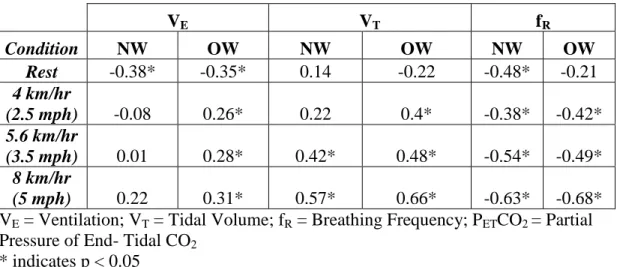
Table 4 displays the results from the Pearson Product correlation between PETCO2, VE, VT and fR for both groups at rest and each exercise speed. Significant positive
21
in the OW. The strongest correlations in both groups were found to be between PETCO2 and VT and PETCO2 and fR during high exercise speed.
Table 4. Pearson product correlation values of PETCO2 for Normal Weight (NW) and Overweight (OW) groups during rest, low, moderate and high speed exercise.
VE VT fR
Condition NW OW NW OW NW OW
Rest -0.38* -0.35* 0.14 -0.22 -0.48* -0.21
4 km/hr
(2.5 mph) -0.08 0.26* 0.22 0.4* -0.38* -0.42*
5.6 km/hr
(3.5 mph) 0.01 0.28* 0.42* 0.48* -0.54* -0.49*
8 km/hr
(5 mph) 0.22 0.31* 0.57* 0.66* -0.63* -0.68*
VE = Ventilation; VT = Tidal Volume; fR = Breathing Frequency; PETCO2 = Partial Pressure of End- Tidal CO2
CHAPTER V DISCUSSION Introduction
This is the first study to compare pulmonary and metabolic parameters in normal and overweight youth during rest and three speeds of exercise. The hypothesis was that there would be no differences in any of the measured pulmonary and metabolic variables between the overweight and normal weight groups at rest or during exercise. Walking and running exercises resulted in a higher metabolic cost for overweight youth than normal weight youth; however, VE/VO2 and VE/VCO2 were similar. Significantly higher VE, VT, fR, and VD were found in the OW group as compared to the NW. These results suggest that overweight children modify their pulmonary responses in order to compensate for their increased metabolic demands during exercise.
Metabolic Efficiency
23
& Whipp, 1999). Previous studies conducted in both adults (Salvadori et al., 1999; Wang & Cerny, 2004) and children (Gutin et al., 1994; Reybrouck et al., 1987; Rowland, 1991; Zanconato et al., 1989) found increasing absolute oxygen uptake values (VO2; L/min) with increasing weight. However, once body composition was taken into account, both the present and aforesaid studies found that relative VO2 (mL/kg/min) was inversely proportional to the subject’s weight.
Heart rate was elevated in the OW group compared to the NW group during low and moderate exercise, which is consistent with a higher VO2 requiring a greater cardiac output (Luce, 1980). The similarity in values between the two groups during high speed exercise was most likely due to the convergence towards maximum heart rate. Our findings are in agreement with previous studies that examined the heart rates of obese and normal weight adults (Dempsey, Reddan, Balke, & Rankin, 1966; Rowland, 1991; Salvadori et al., 1999) and youth (Marinov et al., 2002; Zanconato et al., 1989) during maximum work.
There were no significant differences in the ventilatory equivalents for O2 or CO2 between the two groups, suggesting that being overweight does not necessarily reduce ventilatory efficiency during exercise. The VE/VO2 values in this study are consistent with previous research in obese adults (Wang & Cerny, 2004; Wolfe, Hodgson, Barlett, Nicholas, & Buskirk, 1974) and adolescents (Rowland, 1991). Also consistent with the current
24
was able to meet their increased oxygen needs by increasing their VE in the same proportion as in the NW group.
Pulmonary Efficiency
The respiratory system must respond to the increase in metabolism during exercise by increasing VE via rate (fR) and volume (VT) (Rowland, 1996). VE is the product of VT and fR. Elevated fR was found in the OW group during low and moderate exercise speeds, similar to previous findings among obese adults (Chlif, Keochkerian, Choquet, Vaidie, & Ahmaidi, 2009) and youth (Rowland, 1991). At all four conditions, the OW group was found to have a greater absolute VT than the NW, which is consistent with similar studies in obese adults (Salvadori et al., 2008) and youth (Inselman et al., 1993; Marinov et al., 2002). Generally, normal weight individuals will adjust their respiratory patterns (VT and fR) in order to minimize their ventilatory work and muscle action during exercise (Dempsey et al., 1966). The increased values for VT and fR during exercise suggest that overweight individuals may increase their depth and rate of breathing in order to meet their metabolic demands, which could result in increased metabolic cost of breathing (Chlif et al., 2009; Dempsey et al., 1966; Luce, 1980; Wang & Cerny, 2004).
25
Salvadori et al., 2008). Other factors that contribute to decreased respiratory compliance include excess fat and greater pulmonary blood volume (Naimark & Cherniack, 1960;
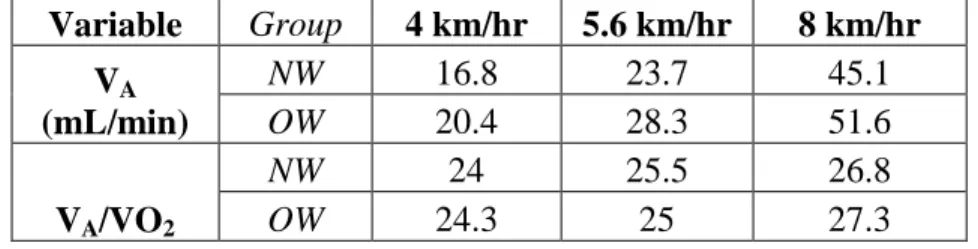
Parameswaran et al., 2006). Central abdominal obesity in and around the ribs, diaphragm and abdomen, physically impedes these pulmonary structures (Parameswaran et al., 2006). Consequently, obese individuals are forced to take deeper breaths more frequently (via increased fR and VT) in order to deliver enough oxygen to working muscle. In addition, increased blood volume and cardiac output are related to increased fat (Luce, 1980). Obese individuals require more blood vessels and a larger blood supply to distribute oxygen over a greater body mass area (Luce, 1980). Increased pulmonary blood volume, in particular, has been suggested to decrease lung compliance due to the recruitment of previously under-perfused vessels (Parameswaran et al., 2006). This can result in impaired gas exchange, increased intravascular lung water and further reduction in lung compliance (Luce, 1980). Table 5. Mean alveolar ventilation (VA) and ratio of alveolar ventilation to oxygen uptake (VA/VO2) in normal weight (NW) and overweight (OW) groups during exercise.
Variable Group 4 km/hr 5.6 km/hr 8 km/hr VA
(mL/min)
NW 16.8 23.7 45.1
OW 20.4 28.3 51.6
VA/VO2
NW 24 25.5 26.8
OW 24.3 25 27.3
26
To examine this “post hoc”, mean VA was estimated during exercise based on mean VT and VD values and normalized per unit of VO2 (L/min); see Table 5. These post hoc findings suggest that increased VT in the OW group is sufficient to compensate for their increased VD; thus, allowing for adequate gas exchange.
No significance was found in the partial pressure of end tidal CO2 (PETCO2) between groups. This is in agreement with the Salvadori et al. (2008) study that compared obese and normal weight adults. Wang & Cerny (2004) also found similar PETCO2 values between control and obese-simulated subjects, suggesting that obese subjects were able to maintain adequate ventilation during exercise. From these results changes in CO2 sensitivity cannot be determined; however, if CO2 sensitivity had changed, this could provide the additional stimulus for increased VT in the OW group (Cooper et al., 1987). The outcomes of the current and past studies indicate that ventilation of obese subjects is appropriate to remove the increased amount of CO2 produced by metabolism (Salvadori et al., 2008).
Exploratory Analysis
27
OW group to overcome their decreased respiratory compliance and increased VD to maintain appropriate ventilation throughout exercise. Thus, for overweight youth, CO2 is more closely related to ventilation, while neural input may be more dominant in the NW group.
In both the NW and OW groups, a strong negative correlation between PETCO2 and fR during exercise was found. This response indicates that neural input, rather than CO2
concentration, may be more closely linked to breathing rate in both groups. This finding is supported by the Eldridge et al., (1985) study that found neural command signals from the hypothalamus were primarily responsible for fast respiratory changes, such as fR, during exercise.
Strengths & Limitations
28
a classification system based solely on body fat percentage in children (Cole et al., 2000; Dehghan et al., 2005).
Conclusions
The purpose of this study was to determine whether excess body fat modifies the ventilation of children at rest and during exercise. The increased VE volumes in the OW group were attributed to increased VT and fR. The greater VT and fR were sufficient to compensate for the larger VD volumes found in overweight youth. The exploratory analysis revealed that during exercise CO2 may be responsible for the additional respiratory drive of overweight youth to increase VT. In summary, the most important finding of this study is that overweight youth have higher metabolic demands during exercise that are met via increased ventilation. Although the ventilation of overweight children adequately compensates for their increased metabolic demands during physical activity, this may not be the case for adults (Costa et al., 2008; Naimark & Cherniack, 1960; Rowland, 1991; Salvadori et al., 1999; Wang & Cerny, 2004; Zerah et al., 1993). Therefore, early treatment and prevention of further weight gain is imperative for long-term health and decreased risk of chronic disease later in life.
Review of Hypotheses
The first hypothesis stated that VE, VT, fR would be similar between the OW and NW groups at all conditions. Significant differences between the OW and NW children were found in all three variables requiring a failure to accept this hypothesis. The second
29
the OW and NW groups. Failure to accept this hypothesis is attributable to significantly higher VD values found in the OW group during exercise. Based on these findings, it can be concluded that excess adiposity causes alterations in ventilation during exercise in
overweight children, but the alterations are sufficient to meet the metabolic demands of exercise.
Clinical Relevance
Exercise is a vital component of a healthy lifestyle. Promoting health and physical activity at a young age are important factors for disease prevention later in life. Exercise prescriptions can help treat and prevent chronic disease, but they must be prescribed
appropriately and performed safely. In order for overweight children to become fit, they must exercise at a safe and comfortable level that does not exceed their physical capabilities. It was found that overweight children adequately increase their ventilation to meet increased demands during exercise. The increased ventilatory patterns utilized by overweight children should not be contraindications for exercise and clinicians should still encourage daily physical activity among pediatric populations for weight reduction and lifelong health benefits.
Recommendations
30
include more obese youth (>95th percentile) in future studies to see what further ventilatory modifications they have during exercise to compensate for an even greater mass.
31 References
Babb TG, Wyrick BL, DeLorey DS, Chase PJ, Feng MY (2008). Fat distribution and end expiratory lung volume in lean and obese men and women. Chest 134: 704-711. Bandini L, Schoeller D, Dietz W (1990). Energy expenditure in obese and nonobese adolescents. Pediatr Res 27: 198-203.
Chlif M, Keochkerian D, Choquet D, Vaidie A, Ahmaidi S (2009). Effects of obesity on breathing pattern, ventilatory neural drive and mechanics. Resp Physiol & Neurobiol
108: 198-202.
Chlif M, Keochkerian D, Feki Y, Vaidie A, Choquet D, Ahmaidi S (2007). Inspiratory muscle activity during incremental exercise in obese men. Intl J Obesity 31:
1456-1463.
Cole TJ, Bellizzi MC, Flegal KM, Dietz WH (2000). Establishing a standard definition for child overweight and obesity worldwide: international survey. BMJ 320: 1-6. Cooper DM, Kaplan MR, Baumgarten L, Weiler-Ravell D, Whipp BJ, Wasserman K (1987). Coupling of ventilation and CO2 production during exercise in children. Pediatr Res 21: 568-572.
Costa D, Barbalho MC, Miguel GPS, Forti EMP, Azevedo JLMC (2008). The impact of obesity on pulmonary function in adult women. Clinics 63: 719-24.
Dehghan M, Akhtar-Danesh N, Merchant AT (2005). Childhood obesity, prevalence and prevention. Nutrition Journal 4 (24). doi:10.1186/1475-2891-4-24
Dempsey JA, Reddan W, Balke B, Rankin J (1966). Work capacity determinants and physiologic cost of weight-supported work in obesity. J Appl Physiol 21: 1815-1820. Dempsey JA, Reddan W, Rankin J, Balke B (1966). Alveolar-arterial gas exchange during muscular work in obesity. J Appl Physiol 21: 1807-1814.
Ebbeling CB, Pawlak DB, Ludwig DS (2002). Childhood obesity: public health crisis, common sense cure. The Lancet 360: 473-479.
Eldridge FL, Millhorn DE, Kiley JP, Waldrop TG (1985). Stimulation by central command of locomotion, respiration and circulation during exercise. Respiratory Physiology 59: 313-337.
32
Gilliland FD, Berhane K, Islam T, McConnell R, Gauderman WJ, Gilliland SS, Avol E, Peters JM (2003). Obesity and the risk of newly diagnosed asthma in school-age children. Am J Epidemiology 158: 406-415.
Gonzalez-Barcala FJ, Takkouche B, Valdes L, Leis R, Alvarez-Calderon P, Cabanas R, Rodriguez Suarez JR, Tojo R (2007). Body composition and respiratory function in healthy non-obese children. Pediatrics International 49: 553-557.
Gratas-Delamarche A, Mercier J, Romanatxo M, Dassonville J, Prefaut C (1993). Ventilatory response of prepubertal boys and adults to carbon dioxide at rest and during exercise. Eur J Appl Physiol 66: 25-30.
Gutin B, Islam S, Manos T, Cucuzzo N, Smith C, Stachura M (1994). Relation of
percentage of body fat and maximal aerobic capacity to risk factors for atherosclerosis and diabetes in black and white seven-to-eleven year-old children. J Pediatr 125: 847-852.
Harrell JS, McMurray RG, Baggett CD, Pennell ML, Pearce PF, Bangdiwala SI (2005). Energy costs of physical activities in children and adolescents. Med Sci Sports Exerc
37: 329-336.
Inselman LS, Milanese A, Deurloo A (1993). Effect of obesity on pulmonary function in Children. Pediatr Pulm 16: 130-137.
Jones NL, Robertson DG, Kane JW (1979). Difference between end-tidal and arterial PCO2 in exercise. J Appl Physiol 47: 954-960.
Keslacy S, Carra J, Ramonatxo M (2008). Role of respiratory system impedance in the difference of ventilatory control between children and adults. Respir Phys & Neurobiol 161: 239-245.
Kress JP, Pohlman AS, Alverdy J, et al. (1999). The impact of morbid obesity on oxygen cost of breathing (VO2RESP) at rest. Am J Respir Crit Care Med 160: 883-886.
Lanteri CJ, Sly PD (1993). Changes in respiratory mechanics with age. J Appl Physiol 74: 369-378.
Lazarus R, Colditz G, Berkey CS, Speizer FE (1997). Effects of body fat on ventilatory function in children and adolescents: Cross-sectional finding from a random
33
Li AM, Chan D, Wong E, Yin J, Nelson EA, Fok TF (2003). The effects of obesity on pulmonary function. Arch Dis Child 88: 361-363.
Luce, J (1980). Respiratory complications of obesity. Chest 78: 626-631.
Malina RM, Bouchard C, Bar-Or O (2004). Heart, blood and lungs. In: Growth,
Maturation and Physical Activity (2nd ed). pp 189-193. Human Kinetics, Champaign.
Marcus C, Curtis S, Koerner C, Joffe A, Serwint J, Loughlin G (1996). Evaluation of pulmonary function and polysomnography in obese children and adolescents. Pediatr
Pulmonology 21: 176-183.
Marinov, B, Kostianex S, and Turnovska T (2002). Ventilatory efficiency and rate of perceived exertion in obese and non-obese children performing standardized exercise. Clinical Physiology and Functional Imaging 22: 254-260.
Martin CJ, Das S, Young AC (1979). Measurements of the dead space volume. J Appl. Physiol. 47: 319-324.
McArdle, WD, Katch FI, and Katch VL. Exercise Physiology: Energy, Nutrition
and Human Performance. (5th ed. pp. 154-196) Baltimore: Lippincott Williams & Wilkins, 2001.
Naimark A, Cherniack RM (1960). Compliance of the respiratory system and its components in health and obesity. J Appl Phys 15: 377-382.
Ogden CL, Carroll MD, Curtin LR, McDowell MA, Tabak CJ, Flegal KM (2006). Prevalence of overweight and obesity in the United States, 1999-2004. JAMA 295: 1549-1555.
Ogden CL, Carroll MD, Flegal KM (2008). High body mass index for age among US children and adolescents, 2003-2006. JAMA 299:2401-2405.
Ondrak KS, McMurray RG (2006). Exercise-induced breathing patterns of youth are related to age and intensity. Eur J Appl Physiol 98: 88-96.
Parameswaran K, Todd DC, Soth M (2006). Altered respiratory physiology in obesity. Can Respir J 13: 203-210.
Reybrouck T, Mertens L, Schepers D, Vinckx J, Gewillig M (1997). Assessment of cardiorespiratory exercise function in obese children and adolescents by body-mass independent parameters. Eur J Appl Physiol 75: 478-483.
34
Rowland TW (1991). Effects of obesity on aerobic fitness in adolescent females. AJDC
145: 764-768.
Rowland TW (1996). Response to endurance exercise: ventilation. In: Developmental
Exercise Physiology. pp 141-157. Human Kinetics, Champaign.
Rowland TW (2005). Ventilation responses. In: Children’s Exercise Physiology (2nd ed). pp 136-147. Human Kinetics, Champaign.
Sahebjami H (1998). Dyspnea in obese healthy men. Chest 114: 1373-7.
Salvadori A, Fanari P, Fontana M, Buontempi L, Saezza A, Baudo S, Miserocchi G, Longhini E (1999). Oxygen uptake and cardiac performance in obese and normal subjects. Respiration 66: 25-33.
Salvadori A, Fanari P, Tovaglieri I, Giacomotti E, Nibbio F, Belardi F, Longhini E (2008). Ventilation and its control during incremental exercise in obesity. Respiration
75: 26-33.
Shephard RJ, Bar-Or O (1970). Alveolar ventilation in near maximum exercise. Data on pre-adolescent children and young adults. Med. Sci. Sports 2: 83-92.
Wang LY, Cerny FJ (2004). Ventilatory response to exercise in simulated obesity by chest loading. Med Sci Sports Exerc 36: 780-786.
Wasserman K, Hansen J, Sue D, Casaburi R, Whipp B (1999). Pathophysiology of disorders limiting exercise. In: Principles of Exercise Testing and Interpretation.
pp 96-99. Lippinkott Williams & Wilkins, Baltimore.
Wolfe LA, Hodgson JL, Barlett HL, Nicholas WC, Buskirk ER (1974). Pulmonary Function at rest and during exercise in uncomplicated obesity. Res Q 74: 829-838. Xu Z, Jiaqing A, Yuchuan L, Shen K (2008). A case control study of obstructive sleep apnea-hypopnea syndrome in obese and non-obese Chinese children. Chest 133: 684-689.
Zanconato S, Baraldi E, Santuz P, Rigon F, Vido L, Da Dalt L, Zacchello F (1989). Gas exchange during exercise in obese children. Eur J Pediatr 148: 614-617.