Improving graduation rates and subsequent health through the creation of an Accountable Care Community in Robeson County, North Carolina
By
NATALIE BROWNE, DANA CORBETT, & SIMA MARZBAN A Capstone Project submitted to the faculty
of the University of North Carolina at Chapel Hill in partial fulfillment of the requirements for the degree of Master of Public Health in
the Public Health Leadership Program. Chapel Hill
April 13, 2020
______________________________________________________ First Reader: Dana Rice, DrPH, MS
______________________________________________________ Date
______________________________________________________ Second Reader: Vaughn Mamlin Upshaw, EdD, DrPH, MPH
© 2020
ABSTRACT
Natalie Browne, Dana Corbett, & Sima Marzban: Improving graduation rates and subsequent health through the creation of an Accountable Care Community in Robeson County, North
Carolina
(Under the Direction of Dana Rice, DrPH)
Social determinants of health (SDoH) are conditions that affect the places where people live, learn, work, and play, and impact a wide range of health risks and outcomes (CDC, 2018). Education is a SDoH, with higher levels of education contributing to better jobs, higher incomes, and access to health-promoting resources (NCIOM, 2009). In North Carolina (NC), low levels of education are a challenge for many communities. Within Robeson County, NC, the link between low educational attainment and poor health outcomes is evident (UWPHI, 2019). To address this, we performed a systems analysis to develop an Accountable Care Community (ACC) in Robeson County. The goal of the ACC is to define school indicators that are required for imposing an equitable system for resource allocation among county schools. By doing this, we hope to promote equity in establishing well-resourced learning environments and to improve educational attainment in Robeson County.
Table of Contents
GROUP GRANT PROPOSAL...1
GROUP PROBLEM STATEMENT...7
GROUP RICH PICTURE...15
GROUP RASCI ANALYSIS...16
ACC OVERVIEW PRESENTATION...19
APPENDIX A: INDIVIDUAL DELIVERABLES- NATALIE BROWNE...24
Problem Statement...24
CATWOE Narrative...31
RASCI Narrative...36
MOU...42
Outreach to Key Stakeholder...47
APPENDIX B: INDIVIDUAL DELIVERABLES- DANA CORBETT...49
Problem Statement...49
CATWOE Narrative...55
RASCI Narrative...59
MOU...62
Outreach to Key Stakeholder...67
APPENDIX C: INDIVIDUAL DELIVERABLES: SIMA MARZBAN...69
Problem Statement...69
CATWOE Narrative...75
RASCI Narrative...79
MOU...83
Outreach to Key Stakeholder...88
2
Group Grant Proposal Overview
Social determinants of health (SDoH) are conditions that affect the places where people live, learn, work, and play, and impact a wide range of health risks and outcomes (CDC, 2018). Education is one SDoH, with higher levels of education contributing to better jobs, higher incomes, and access to additional resources. Within Robeson County, North Carolina (NC), the link between low educational attainment and poor health outcomes is evident. The population of Robeson County is a majority-minority, with over 70% of residents identifying as American Indian, African American, or Latino (U.S. Census Bureau, 2019). Among all 100 NC counties, Robeson County is ranked last in overall health outcomes, with greater mortality due to chronic conditions, inflated birth rates among teenagers, and increased likelihood of premature death (UWPHI, 2019). Only 13.2% of the county’s population has completed some form of higher education (compared to the state average of 30.5%), and half of the public schools received a “low performing” score for the 2018-2019 academic year (U.S. Census Bureau, 2019).
Understanding the association between education as a SDoH and health outcomes, our Accountable Care Community (ACC) is asking for $500,000 from the Kate B. Reynolds
Charitable Trust to improve the education system in Robeson County and enhance the health of students throughout their lifespan. By collaborating with various stakeholders, the ACC’s mission is to promote equity in the distribution of resources to public schools within the county in an effort to establish well-resourced learning environments and promote educational
attainment. Ultimately, we aim to reduce high school dropout rates in Robeson County and improve longitudinal health outcomes for students.
3
Goal for ACC
The goal of the ACC is to define school indicators (specifically those related to low graduation rates) that are required for imposing an equitable system for resource allocation among county schools based on their true needs. The Organization for Economic Cooperation and Development (OECD) cited that improvements in equity in education are reliant on three policy domains: the design of the education system, practices both in and out of school, and resource allocation (OECD, 2008). The OECD also cited that these strategies have the potential to decrease school failure and dropout rates (OECD, 2008). Because Robeson County has a higher percentage of individuals living in poverty compared to the state, the ACC will first prioritize resource allocation to address educational disparities in resource allocation (US Census Bureau, 2019). The ACC seeks to accomplish this goal within the first year of the system
transformation. By the end of year one, the ACC will identify and prioritize potential school indicators and develop a package for equitable school assessment for resource allocation. The successful completion of this goal will be instrumental to ensure the developed system is
sustainable within the existing infrastructure and effectively evaluates schools’ individual needs. We will track several indicators throughout the first year of the project to evaluate the ACC’s progress towards this goal. First, we will ensure all ACC members understand and appreciate the ACC’s shared vision, values, goals, and expectations. Their adherence to these components will be monitored throughout the duration of the project to facilitate collective action and solidarity. In addition, we will track the number of ACC members present at each meeting and record which organizations/stakeholder groups they represent to evaluate
participation and monitor inclusivity and diversity at our meetings. ACC representatives will be given a myriad of opportunities to provide their satisfaction with meetings and progress toward
4
the goal. Their feedback will be used to improve the efficiency of meetings and expedite goal progress without impairing quality. To ensure representatives’ participation in the ACC is sustainable, we will fairly distribute responsibilities to each ACC member, especially those held responsible and accountable for achieving the collective goal. Each ACC member will be expected to adhere to the agreed-upon timeline for achieving the goal, including associated deadlines for their individual responsibilities. Finally, we will track the number of new community connections made by members of the ACC within the first year of formation to understand the efficacy and reach of our community outreach.
Potential Challenges
When working with a diverse group of stakeholders, there is the potential for challenges to occur. ACC partnership development between stakeholders that have different organizational cultures, roles, and formal processes can be a time- and energy-consuming process. In particular, the local funding process is subject to the administrative rules, regulations, and benefits that are directly related to organizational, political, and social affiliations/interests. Culturally, the same barriers that caused historical division and disparities in the county may be institutionalized in the managerial structures and resource allocation. To promote a shared decision-making approach to equitable resource allocation, many meetings and interactions will be planned and facilitated. While recipients of the generated resources will be delighted to improve the
graduation status of their students, others may be unsatisfied. Because of this, a balanced win-win policy for the engagement of all partners will be crucial (Cheminais, 2018).
Another challenge is the legal formality of the ACC, which involves advancements in contractual collaboration between two entities who legally should work independently. Additionally, the fragmented decision-making structure of federal and state governments are designed to maintain independence in planning, evaluation, and supervision. Consultation with 5
legal counsel will assist the ACC to formalize a partnership that promotes collaboration alongside independent decision-making. There also are potential challenges associated with maintaining transparency, while also maintaining confidentiality between partners when sharing data about perceived failures and best practices of the schools. Finally, an ongoing partnership needs sustainable funding for activities. This long-term sustainability will require leadership commitment and community awareness about the impact of equitable resource allocation on educational attainment (NCIOM, 2019).
Equity Concerns
When addressing education and its impacts on health, the ACC will remain cognizant of the equity concerns found within Robeson County communities. These communities face greater obstacles in improving their health; thus, the ACC will utilize multiple strategies to bring about greater equity in decision-making and resource allocation (Mullins et al, 2005). Ensuring equity remains at the center of organizational initiatives, utilizing a methodology that engages all members within the system, identifying key contributors, fostering trust, and transforming organizational culture, are all strategies for addressing disparities within this community (CDC, 2018).
Prior to outlining organizational initiatives, the ACC ensured its mission, values, and goals highlighted the importance of health equity within its governance and organizational initiatives. Although this may not appear as an actionable step in addressing disparities, the mission, values, and goals serve as an initial reference for ensuring ACC initiatives align with these guiding principles. The ACC also plans to use a Soft Systems Methodological (SSM) approach to understanding the needs of various stakeholders and eventually, a co-design approach to addressing these needs within the system of high school graduation in Robeson County (Burge, 2015). By doing this, the ACC will engage various members of the community, 6
especially those whose voice is often silenced, to ensure all stakeholder’s needs are identified no matter their level of power or influence. Utilizing an SSM and co-design approach can help facilitate this process and mitigate potential challenges by empowering all individuals to take ownership of this transformative process, including those who often feel silenced (Sheard, 2019). Bringing about transformative change also requires the ACC to identify the root causes of why some Robeson County schools perform better than others (CDC, 2018). When utilizing the SSM approach, the ACC will be vigilant in identifying the difference in needs between various middle and high schools. This will help the ACC identify the key contributors that impact the outcomes of the system of high school graduation. These differences will not only be identified in school-based settings but also in the family units. By doing this, the ACC can assure that it continues to foster trust among various stakeholders, which can allow future cooperation in establishing a co-design process for ACC initiatives.
To truly bring about lasting change, the ACC plans to transform the organizational culture surrounding decision-making about education in Robeson County. By changing the culture, the ACC hopes to break down the silos between governmental agencies and community organizations, allowing for greater transparency and two-way communication between county leaders and the larger Robeson County community. Doing this can lead to greater equity in funding and resource allocation, moving Robeson County schools one step closer to increasing educational attainment among middle and high school students and improving health outcomes for Robeson County residents.
7
References
Burge, S. (2015). An overview of soft system methodology. System Thinking: Approaches and Methodologies. Retrieved from
https://www.burgehugheswalsh.co.uk/Uploaded/1/Documents/Soft-Systems-Methodology.pdf
Centers for Disease Control and Prevention (CDC). (2018). A Practitioner's Guide for Advancing Health Equity: Community Strategies for Prevention Chronic Disease. Retrieved from https://www.cdc.gov/nccdphp/dnpao/state-local-programs/health-equity-guide/pdf/HealthEquityGuide.pdf
Cheminais. (2018).The Benefits and Challenges of Collaborative Multi-agency Working. Retrieved from
https://www.sagepub.com/default/files/upm-binaries/25241_02_Cheminais_Ch_02.pdf Mullins, C. D., Blatt, L., Gbarayor, C. M., Yang, H. W., & Baquet, C. (2005). Health disparities:
a barrier to high-quality care. American journal of health-system pharmacy : AJHP : official journal of the American Society of Health-System Pharmacists, 62(18), 1873– 1882. https://doi.org/10.2146/ajhp050064
North Carolina Institute of Medicine (NCIOM). (2009). Prevention for the Health of North Carolina: Prevention Action Plan. A Report of the North Carolina Institute of Medicine Task Force on Prevention. Morrisville, NC.
Organization for Economic Cooperation and Development (OECD). (2008). Ten Steps for Equity in Education. Retrieved from
https://www.oecd.org/education/school/39989494.pdf
Sheard, L., Marsh, C., Mills, T., et al. (2019). Using patient experience data to develop a patient experience toolkit to improve hospital care: a mixed-methods study. Health Services and Delivery Research, 36(7). Retrieved from
https://www.ncbi.nlm.nih.gov/books/NBK549224/
University of Wisconsin Population Health Institute (UWPHI) and The Robert Wood Johnson Foundation. (2019). North Carolina: Robeson County. County Health Rankings.
Retrieved from https://www.countyhealthrankings.org/app/north-carolina/2019/rankings/ robeson/co
nty/outcomes/overall/snapshot
U.S. Census Bureau. (2019). Quick Facts: Robeson County. U.S. Department of Commerce. Retrieved from
https://www.census.gov/quickfacts/fact/table/NC,robesoncountynorthcarolina/ IPE120218#IPE120218
8
Group Problem Statement
Social determinants of health (SDoH) are conditions that affect the places where people live, learn, work, and play, and impact a wide range of health risks and outcomes (CDC, 2018). Education is one of these SDoH, with higher levels of education contributing to better jobs, higher incomes, and access to health-promoting resources. In the United States, an individual’s level of education impacts his or her risk for chronic health conditions, poor mental health status, acute diseases, and other adverse health outcomes. As a result, life expectancies for individuals with and without higher education have become increasingly dissimilar over the past decade (NCIOM, 2009).
Education directly and indirectly impacts health, and there are multiple pathways this impact can occur. First, high-quality education influences an individual’s social network, which subsequently influences engagement in risky behaviors that may lead to negative health
outcomes (Cutler, 2007). Second, education is linked to increased knowledge and practice of healthy behaviors, which can reduce the risk for cancers, obesity-related illnesses, and other chronic diseases. Third, those with higher education face fewer daily stressors associated with economic and social hardships, resulting in better mental health. They also are more likely to have successful, long-term marriages and other social support structures to better cope with stress (Zajacova, 2018). Fourth, those with high levels of education typically obtain more stable, higher-paying jobs. This allows greater access to resources throughout life, such as safe
neighborhoods, green spaces and sidewalks, healthy stores and supermarkets, and accessible preventative healthcare services (VCU, 2015).
In North Carolina (NC), low levels of education serve as a challenge for many
communities, impacting the overall health of many NC residents. Located on its southern border lies the largest of the NC counties: Robeson County. It is characterized by its swampy marshland 9
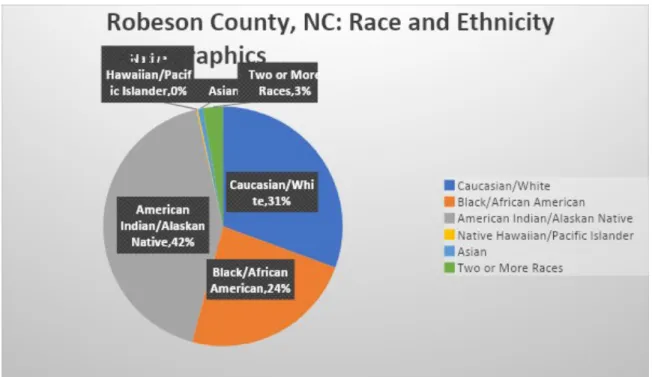
and is home to the state-recognized Lumbee Indian tribe (Robeson County Health Department, 2017). One unique attribute to Robeson County is its large minority population. It is often referred to as a “majority-minority,” with 70% of its population being American Indian, African American, or Latino (Figure 1) (U.S. Census Bureau, 2019). Out of the 100 NC counties,
Robeson County is ranked 100th in overall health outcomes. Its higher levels of uninsured individuals, greater mortality related to chronic health conditions, elevated shortages in the healthcare workforce, inflated rate births among teenagers, and increased likelihood of premature death all contribute to this poor overall health ranking (UWPHI, 2019) (Table 2).
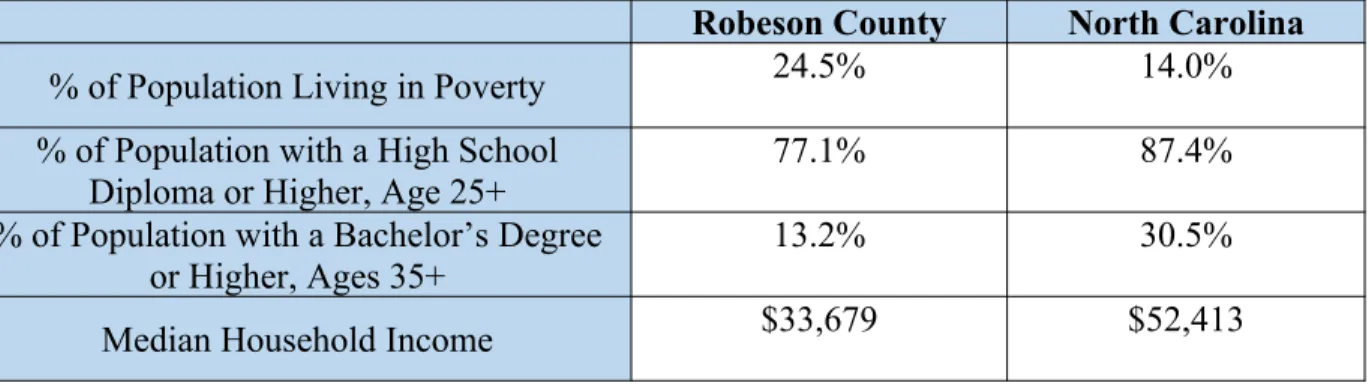
Like many NC counties, Robeson County is rural with 65% of its population living in a rural area. This type of landscape limits access to resources and is associated with a high prevalence of poverty among county residents. It was recently described as one of fifty US counties and cities “where the American dream is dead” due to the lack of intergenerational mobility among residents (Frohlich, 2020). As seen in Table 1, a higher percentage of Robeson County residents live in poverty (24.5%) compared to the state average (14.5%). Additionally, the median household income for county residents ($33,679) is significantly less than the state average ($52,413) (U.S. Census Bureau, 2019). Although the county's economy has grown slightly over the past few years, it still lags behind the state and national averages (Koirala, 2018). Robeson County also continues to recover from the devastating impact Hurricane
Matthew had on various communities. Although Hurricane Matthew caused widespread damage, it also helped bring unity and harmony to Robeson County. This sense of community exemplifies the social capital and resilience in this county, reflecting the strength found within the local communities (Robeson County Health Department, 2017).
In terms of education, Robeson County also trails behind the state average. As seen in
10
Table 1, only 77.1% of the population has a high school diploma, compared to the state average of 87.4%. Additionally, only 13.2% of the population has a bachelor's degree or higher,
compared to the state average of 30.5% (U.S. Census Bureau, 2019). A declining county population, budget deficits, a struggling economy, and hurricane-damaged buildings have resulted in the closure of multiple schools within the county, impacting the lives of parents, students, and teachers (Henderson, 2019). Additionally, for the 2018-2019 academic school year, half of the 44 public schools in Robeson County were scored as “low performing,” meaning they received a performance grade of a D or F and did not exceed their growth status. Despite these challenges, several community resources exist that promote education within the struggling academic and economic landscape of Robeson County. Children under five can receive free books monthly through the “Dolly Parton Imagination Library,” and parents can receive
additional educational resources and developmental screenings through in-home teacher visits as part of the “Parents as Teachers” program. This demonstrates how leaders within Robeson County are aware of these educational disparities and have championed efforts to address these areas of concern.
Despite best efforts to address early childhood education, there are few county resources and programs to promote education among adolescents. Students spend three formative years in middle school, and during this time their academic performance is vulnerable due to switching schools, developmental processes, and changing social networks (Hill, 2009). Poor academic performance can become internalized among adolescents and impact their perceived abilities and subsequent accomplishments. Given the potential for low educational attainment to have life-long impacts on the health and well-being of individuals, addressing education as a SDoH is a public health priority. Based upon the most recent Community Health Assessment (CHA),
11
leaders within Robeson County are aware of the poor health and educational outcomes and have prioritized efforts to address these areas of concern (Robeson County Health Department, 2017). The elevated high school drop-out rate in Robeson County compared to the state warrants identifying this county as a priority population, and the academic performance and demographics of middle and high school students justify the prioritization of this specific age group. By
addressing the systems and structures that have perpetuated these inequities, the county can ensure high-quality education for middle and high school students. This allows county leaders to take one step closer in addressing unjust disparities, giving individuals within these communities the potential to experience a higher quality of life.
12
References
Centers for Disease Control and Prevention (CDC). (2018). Social Determinants of Health: Know What Affects Health. Retrieved from https://www.cdc.gov/socialdeterminants/index.htm Cutler, D., & Lleras-Muney, A. (2007). Education and Health: National Poverty Center Policy
Brief #9. Ann Arbor, MI.
Frohich, T. (2020). Places where the American Dream is Dead. 24/7 Wall St. Retrieved from https://247wallst.com/special-report/2020/01/14/places-where-the-american-dream-is-dead-2/1/
Henderson, J. (2019). Multiple Factors Contribute to Closing of Five Robeson County Schools.
Fayetteville Observer. Retrieved from
https://www.fayobserver.com/news/20190817/multiple-factors-contribute-to-closing-of-five-robeson-county-schools
Hill, N. E., & Tyson, D. F. (2009). Parental involvement in middle school: A meta-analytic assessment of the strategies that promote achievement. Developmental Psychology, 45(3), 740–763. doi: 10.1037/a0015362
Koirala, B. (2018). Robeson County: Current Economic Picture. Office of Economic and Business Research, 12(1), 1-13. Retrieved from
https://www.uncp.edu/sites/default/files/2018-10/Economic%20Bulletin%20July %202018%20vol-12-Number%201.pdf
North Carolina Department of Public Instruction. (2019). North Carolina School Report Cards. Retrieved from https://ncreportcards.ondemand.sas.com/src/?
viewSelect=county&year=2019&type=Both&level=Middle&district=All&lng=en&count y=robeson
North Carolina Institute of Medicine (NCIOM). (2009). Prevention for the Health of North Carolina: Prevention Action Plan. A Report of the North Carolina Institute of Medicine Task Force on Prevention. Morrisville, NC.
Robeson County Health Department. (2017). Community Health Needs Assessment. Retrieved from http://www.robesoncountyhealthdepartment.com/wp-content/uploads/2018/02/ CHA-2017.pdf
University of Wisconsin Population Health Institute (UWPHI) and The Robert Wood Johnson Foundation. (2019). North Carolina: Robeson County. County Health Rankings. Retrieved from
https://www.countyhealthrankings.org/app/north-carolina/2019/rankings/robeson/co nty/outcomes/overall/snapshot
13
U.S. Census Bureau. (2019). Quick Facts: Robeson County. U.S. Department of Commerce. Retrieved from
https://www.census.gov/quickfacts/fact/table/NC,robesoncountynorthcarolina/ IPE120218#IPE120218
Virginia Commonwealth University (VCU). (2015). Why Education Matters to Health: Exploring the Causes. VCU Center of Society and Health. Retrieved from
https://societyhealth.vcu.edu/media/society-health/pdf/test-folder/CSH-EHI-Issue-Brief-2.pdf
Zajacova, A., & Lawrence, E. M. (2018). The Relationship Between Education and Health: Reducing Disparities Through a Contextual Approach. Annual Review of Public Health.
doi: 10.1146/annurev-publhealth-031816-044628
14
Appendix
Table 1: 2018 Comparison Poverty and Education Statistics for Robeson County and North Carolina
Robeson County North Carolina
% of Population Living in Poverty 24.5% 14.0%
% of Population with a High School
Diploma or Higher, Age 25+ 77.1% 87.4%
% of Population with a Bachelor’s Degree
or Higher, Ages 35+ 13.2% 30.5%
Median Household Income $33,679 $52,413
Source: US Census Bureau, 2019
Table 2: 2018 Comparison Health Indicators for Robeson County and North Carolina Robeson County North Carolina % of Adults (age 18+) without any type of
Health Care Coverage
28.3 15.4
% of Adults (age 18+) Who Could Not Afford Healthcare Costs to See a Doctor
23.4 15.5
Deaths due to Heart Disease 24.2% 20.7%
Deaths due to Cancer 19.0% 21.7%
Deaths due to Alzheimer’s Disease 5.6% 4.3%
Physicians per 10,000 Population 13.0 23.0
Rate of Teen Birth to Women Ages 15-19 Years Old per 1,000 Female Population,
2015
50.9 30.2
Premature Age-adjusted Mortality (number of deaths among residents under age 75 per
100,000)
560 270
Average Number of Mentally Unhealthy Days
4.9 3.7
Sources: UWPHI, 2019; Robeson County Health Department, 2017
15
Figure 1: 2019 Demographic Racial/Ethnic Breakdown of Robeson County, NC
Source: US Census Bureau, 2019
16
Group Rich Picture
Root Definition: The high school graduation system is a system to motivate young people to complete secondary education (P) by providing the appropriate resources and environment (Q) in order for students to better their education and health (R).
17
Group RASCI Analysis
System of High School Graduation in Robeson County, NC
Social Determinant of Health ● Education
Root Definition
● The high school graduation system is a system to motivate young people to complete secondary education (P) by providing the appropriate resources and environment (Q) in order for students to better their education and health (R).
Stakeholders ● Family Unit ● Teachers
● Robeson County Board of Education
Identify 2-3 common goals shared by stakeholders (SMART Goals)
1. Within the first year of transformation, the ACC will define a set of school criteria /indicators that are required for imposing an equitable formulation/pattern for resource allocation to the county schools based on their real needs, specifically criteria/ indicators related to the low-graduation-rate condition.
2. Within the second and third year of formation, the ACC will generate system structures that allocate appropriate resources to public schools. The allocation of these resources will be prioritized based on the above set of criteria/ indicators. These resources include, but are not limited to the following: new funds, trained teachers, textbooks, buses, field trips, SAT prep, etc.)
3. Within the first three years of formation, the ACC will create a community engagement plan that identifies and prioritizes short and long-term needs in the community. Once needs are established, the ACC will generate linkages with local organizations, businesses, and resources to create coalitions to build community capacity and sustainably to address those prioritized needs.
Additional Stakeholder Important to the System (will be part of ACC) 1. Robeson County HD (Parents as Teachers program)
2. Communities in Schools (dropout prevention organization in Robeson County) 3. School Administration (superintendent, principles)
4. Kate B. Reynolds Family Trust
5. Local Colleges (Robeson Community College and UNC Pembroke) 6. Robeson County Commissioners
RASCI Levels ACC Priorities for Systems Transformation Who is... Goal 1 Goal 2: Within the second
and third year of
Goal 3: Within the first three years of formation,
18
formation, the ACC will generate system structures that allocate appropriate resources to public schools. The allocation of these resources will be prioritized based on the above set of criteria/ indicators. These resources include, but are not limited to the following: new funds, trained teachers, textbooks, buses, field trips, SAT prep, etc.)
the ACC will create a community engagement plan that identifies and prioritizes short and long-term needs in the
community. Once needs are established, the ACC will generate linkages with local organizations, businesses, and resources to create coalitions to build community capacity and sustainably to address those prioritized needs.
Responsible - Owns the project/program
- Robeson County Board of Education - Family Unit - Teachers
- Robeson County Board of Education -Robeson County Commissioners
-Robeson County HD - Communities in Schools
Accountable - ultimately answerable for the correct and thorough completion of the deliverable or task, and the one who delegates the work to those responsible
- Robeson County Board of Education - School
administrators
- Robeson County Board of Education - School administrators
- Robeson County HD - Communities in Schools
Supportive - can provide resources or can play a
supporting role in
implementation
- Robeson County Dept. of Health - Communities in Schools
- Local Colleges - Family Unit - Teachers
- Robeson County Dept. of Health
- Communities in Schools
- Local Colleges
- Robeson County Board of Education - School administrators -Family Unit
-Teachers
- Robeson County Dept. of Health
- Communities in Schools
- Local Colleges Consulted
- has
information and/or
- Family Unit - Teachers
- Kate B. Reynolds Family Trust
- Family Unit - Teachers
- Kate B. Reynolds Family Trust
- Family Unit - Teachers
- Kate B. Reynolds Family Trust 19
capability necessary to complete the work
- School
administrators - School administrators - School administrators
Informed - must be notified of results, process, and methods, but need not be consulted
- Kate B. Reynolds Family Trust -Robeson County Commissioners
- Kate B. Reynolds Family Trust -Robeson County Commissioners
- Kate B. Reynolds Family Trust -Robeson County Commissioners
20
ACC Overview Presentation
21
22
23
24
25
APPENDIX A: INDIVIDUAL DELIVERABLES- NATALIE BROWNE Problem Statement
Social determinants of health (SDoH) are conditions that affect the places where people live, learn, work, and play, and impact a wide range of health risks and outcomes (Centers for Disease Control and Prevention, 2018). Education is one of these SDoH, with higher levels of education contributing to better jobs, higher incomes, and access to additional resources. In the United States, an individual’s level of education impacts their physical, mental, and emotional health, resulting in highly educated people living longer, healthier lives. One study published by the National Bureau of Economic Research found that four additional years of schooling can lower five-year mortality and reduce individual risk of developing chronic disease (Cutler & Lleras-Muney, 2006). Additionally, those with higher education face fewer daily stressors associated with economic and social hardships, resulting in better mental health. An individual’s level of education also impacts their built environment. Those with higher education tend to live in neighborhoods that better promote healthy behaviors, with easy access to stores and
supermarkets and to green spaces and sidewalks that promote outdoor physical activity. This is a stark contrast to low-income neighborhoods that are oversupplied with fast-food restaurants and encroached with high rates of crime. In North Carolina (NC), low levels of education serve as a challenge for many communities, impacting the population’s health and the intergenerational poverty found within these communities (Virginia Commonwealth University, 2015).
Located on its southern border lies the largest of the NC counties: Robeson County. It is characterized by its swampy marshland and is home to the state-recognized Lumbee Indian tribe (Robeson County Health Department, 2017). It also is the home to the University of North Carolina Pembroke, which enrolls approximately 7,600 students each year (UNC Pembroke,
26
2019). Robeson County also continues to recover from the devastating effects of Hurricane Matthew and the impact it had on various communities. Although Hurricane Matthew caused widespread damage, it also helped bring unity and harmony to Robeson County. This sense of community exemplifies the social capital and resilience in this county, reflecting the strengths found within the local communities (Robeson County Health Department, 2017).
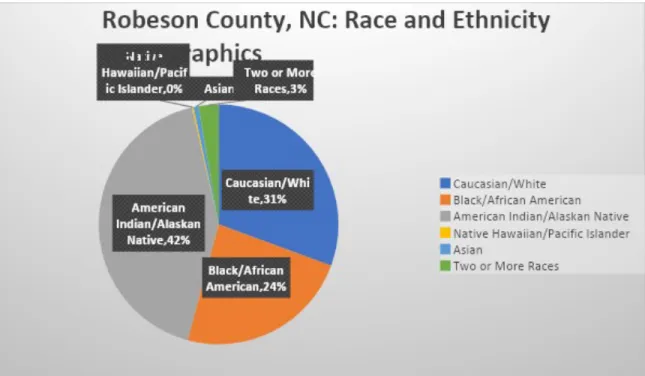
One unique attribute to Robeson County is its large minority population. It is often referred to as a majority-minority, with 70% of its population being American Indian, African American, or Latino (Figure 1) (U.S. Census Bureau, 2019). Like other minority populations, these individuals also face a higher incidence of disease, poorer health outcomes, and higher mortality. Out of the 100 NC counties, Robeson County is ranked 100th in overall health outcomes. Its higher levels of uninsured individuals, greater prevalence of chronic health
conditions, elevated shortages in the healthcare workforce, and increased likelihood of premature death, all contribute to this poor overall health ranking (University of Wisconsin Population Health Institute, 2019).
Like many NC counties, Robeson County is rural with 65% of its population living in a rural area. This county’s rural landscape and limited resources have resulted in a higher
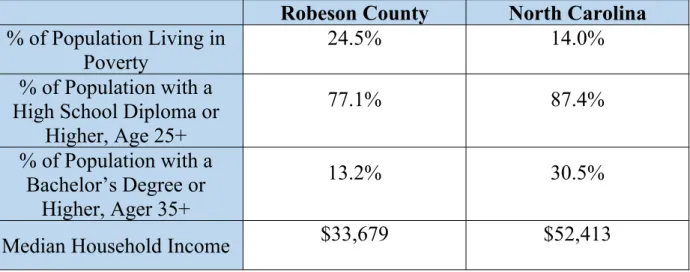
prevalence of poverty among county residents. It was recently described as one of fifty US counties and cities “where the American dream is dead” due to the lack of intergenerational mobility among residents (Frohlich, 2020). As seen in Table 1, a higher percentage of Robeson County residents live in poverty (24.5%) compared to the state average (14.5%). Additionally, the median household income for county residents ($33,679) is significantly less than the state average ($52,413) (U.S. Census Bureau, 2019). Although the county's economy has grown
27
slightly over the past few years, it still lags behind the state and national averages (Koirala, 2018).
In terms of education, Robeson County also trails behind the state average. As seen in Table 1, only 77.1% of the population has a high school diploma, compared to the state average of 87.4%. Additionally, only 13.2% of the population has a bachelor's degree or higher,
compared to the state average of 30.5% (U.S. Census Bureau, 2019). A declining county population, budget deficits, a struggling economy, and hurricane-damaged buildings have resulted in the closing of multiple schools within the county, impacting the lives of parents, students, and teachers (Henderson, 2019). The clear linkage between education and income is prevalent within this community. Based upon the most recent Community Health Assessment (CHA), leaders within Robeson County are aware of these poor numbers and have prioritized efforts to address these areas of concern by specifically addressing the linkage between an individual’s level of education and poverty (Robeson County Health Department, 2017).
Because approximately 70% of the Robeson County population is African American, Latino or American Indian, this project will specifically focus on improving the high school graduation rates among the non-white middle and high school students living in Robeson County. Additionally, some schools within Robeson County, which are made up of a
disproportionate number of students from economically disadvantaged households, struggle with meeting their yearly academic growth metrics. Thus, high schools and middle schools that did not meet their yearly goals of academic growth will be the focus of the intervention (Table 2) (Robeson County Health Department, 2017). By focusing on increasing high school graduation rates to decrease poverty, one of the root causes contributing to the county's poor population health can be better addressed. However, changes in the systems and structures that have
28
perpetuated these disparities are required to bring about lasting change within Robeson County. By doing this, health equity can be better achieved, allowing individuals within these
communities to live a higher quality of life and break free from the poverty cycle.
29
References
Centers for Disease Control and Prevention. (2018). Social Determinates of Health: Know What Affects Health. Retrieved from https://www.cdc.gov/socialdeterminants/index.htm
Cutler, D. & Lleras-Muney, A. (2006). Education and Health: Evaluating Theories and Evidence.
The National Bureau of Economic Research. Retrieved from https://www.nber.org/papers/w12352.pdf
Frohich, T. (2020). Places where the American Dream is Dead. 24/7 Wall St. Retrieved from https://247wallst.com/special-report/2020/01/14/places-where-the-american-dream-is-dead-2/1/
Henderson, J. (2019). Multiple Factors Contribute to Closing of Five Robeson County Schools.
Fayetteville Observer. Retrieved from
https://www.fayobserver.com/news/20190817/multiple-factors-contribute-to-closing-of-five-robeson-county-schools
Koirala, B. (2018). Robeson County: Current Economic Picture. Office of Economic and Business Research, 12(1), 1-13. Retrieved from https://www.uncp.edu/sites/default/files/ 2018-10/Economic%20Bulletin%20July%202018%20vol-12-Number%201.pdf
Musu-Gillette, L., de Brey, C., McFarland, J. Hussar, W. Sonnenberg, W., Wilkinson-Flicker, S. (2017). Status and Trends in the Education of Racial and Ethnic Groups 2017. U.S. Department of Education. Retrieved from https://nces.ed.gov/pubs2017/2017051.pdf North Carolina Department of Public Instruction. (2019). North Carolina School Report Cards.
Retrieved from https://ncreportcards.ondemand.sas.com/src/?
viewSelect=county&year=2019&type=Both&level=Middle&district=All&lng=en&count y=robeson
Robeson County Health Department. (2017). Community Health Needs Assessment. Retrieved from http://www.robesoncountyhealthdepartment.com/wp-content/uploads/2018/02/ CHA-2017.pdf
UNC Pembroke. (2019). What makes us Pembroke?. Retrieved from https://www.uncp.edu/sites/ default/files/2019-09/About%20UNCP%202019_2.pdf
University of Wisconsin Population Health Institute and The Robert Wood Johnson Foundation. (2019). North Carolina: Robeson County. County Health Rankings. Retrieved from https://www.countyhealthrankings.org/app/north-carolina/2019/rankings/robeson/county/ outcomes/overall/snapshot
U.S. Census Bureau. (2019). Quick Facts: Robeson County. U.S. Department of Commerce. Retrieved from
30
https://www.census.gov/quickfacts/fact/table/NC,robesoncountynorthcarolina/ IPE120218#IPE120218
Virginia Commonwealth University. (2015). Why Education Matters to Health: Exploring the Causes. VCU Center of Society and Health. Retrieved from https://societyhealth.vcu.edu/ media/society-health/pdf/test-folder/CSH-EHI-Issue-Brief-2.pdf
Appendix
31
Table 1: 2018 Comparison Poverty and Education Statistics for Robeson County and North Carolina
Robeson County
North Carolina
% of Population Living in
Poverty
24.5%
14.0%
% of Population with a
High School Diploma or
Higher, Age 25+
77.1%
87.4%
% of Population with a
Bachelor’s Degree or
Higher, Ager 35+
13.2%
30.5%
Median Household Income
$33,679
$52,413
Source: US Census Bureau. Quick Facts
Table 2: Middle and High Schools in Robeson County that did not meet the 2019 Academic Growth Metrics
School Name
Location
Fairmont High
Fairmont, NC
Lumberton Senior High
Lumberton, NC
Fairmont Middle
Fairmont, NC
Lumberton Junior High
Lumberton, NC
Orrum Middle
Orrum, NC
Pembroke Middle
Pembroke, NC
Source: North Carolina Department of Public Instruction. North Carolina School Report Cards.
32
Figure 1: 2019 Demographic Racial/Ethnic Breakdown of Robeson County, NC
Source: US Census Bureau: Quick Facts
33
CATWOE Narrative
CATWOE: Family Unit
Customers Middle and high school students Actors o Parents/Caregivers
o Teachers
o School Counselors
o Coaches
o School Enforcement Officers
o After School Program Personnel
o School Principles
o School Nurse
Transformation To provide families the appropriate resources, environment, and support that allows students to achieve success
Worldview The Robeson County School administration and county
commissioners do not care about the personal challenges faced by parents with limited resources and are indifferent to whether underachieving students from poor families graduate or not. Owners o Robeson County School Administration
o Robeson County Board of Education
o Robeson County Commissioners
Environment o Single-parent home
o Low family household income
o Intergenerational poverty
o Limited at-home academic support
o Lack of knowledge and resources to assist families and students
who need additional help
o Stressful home environment
Root Definition: The high school graduation system in Robeson County is a system that is indifferent to the success of poor middle and high school students (P) by creating an environment and schedule that is unaccommodating to students and families most at need, (Q) in order to focus resources for students positioned to achieve academic success (R).
Higher levels of education contribute to better jobs, higher incomes, and increased access to health-promoting resources. In a county where funding and resources are limited, there are inequities within communities surrounding an individual's ability to achieve their best health.
34
These inequities are seen within the system of high school graduation in Robeson County, a system that should provide the resources and environment needed for all students to succeed. At the center of this system are current and future middle and high school students, who are the key beneficiaries of any system changes. They are residing in communities plagued by destructive natural disasters, exportation of industries, and limited financial opportunities. Their ability to achieve success is largely dependent on the various actors within the system that impacts their living and learning environments, including parents and caregivers, teachers, school counselors and nurses, principals, coaches, school enforcement officers, and after school program personnel. Additionally, the environments and behaviors of these various actors can be largely dependent on pre-established policies, resources, and structures that dictate and impact various behaviors. The owners of this system, which have the decision-making power to make changes, can contribute to these structures established within the system. Some of these owners include the Robeson County Public School Administration, the Robeson County Board of Education, and the Robeson County Commissioners. Each of these owners has a role in budget approvals, curriculum changes, resource allocation, and personnel hiring; thus, any system transformation that occurs within the school system will require the owners' approval.
Because each of these groups of stakeholders has their own worldview of the system of high school graduation, each should be engaged to identify the various needs and gaps within the system. For this specific stakeholder analysis, emphasis will be placed on the family unit. The family unit consists of students and their families and caregivers, and they are at the center of this system. Since there is a positive association between family engagement and improved academic achievement, their voices need to be amplified during conversations involving this topic.
35
For this specific family unit, the worldview comes from a single mother of three children under the age of fourteen. The mother's name is Kathy, and she works two jobs to support her family. Kathy grew up in a broken home. She barely graduated high school and has worked multiple minimum-wage jobs throughout her life. Her husband left eight years prior, which created greater financial strain and stress on the family. Kathy's oldest son, Kevin, recently started working at a grocery store after school because he saw his mother struggling and wanted to help provide for his family. Kevin loves his mother and thinks she is doing the best she can but also sees how it is negatively impacting her physical and mental health. Since he started working, Kevin has had little time to focus on his studies, which has resulted in him falling behind in many of his classes. The classes are so large, and the teacher is so overburdened that Kevin does not feel he has any support at school or at home to help him catch up. Kathy sees this and is concerned, but she does not have the time nor the support to address Kevin's grades, while also ensuring her family has food on the table.
Simply based on this one family unit's account, it is evident how a family's environment can impact a student's ability to achieve academic success. From this scenario, it is clear that growing up in a single-parent home can create increased stressors when compared with a two-parent home. Having two two-parents in a household not only brings the possibility of additional income but also the emotional, physical, and mental support that is required to raise a family. Additionally, living in a household with limited income limits the at-home academic, mental, and emotional support a student can receive due to the parent's work schedule. This can impact a student's self-affect and self-confidence in their ability to achieve academic success. It also requires the student to make a difficult decision, weighing the pros and cons associated with supporting their family and performing well in school, decisions students from higher-income
36
households rarely have to make. Based on this scenario, it seems that Kathy and Kevin lack knowledge, understanding, and access to various community resources that can offer family and academic support. These resources are available, but there seems to be a disconnect between the family’s needs and available community resources. All of these factors increase the degree of stress experienced within the family, which could negatively impact Kevin's well-being, overall health, and sense of achievement.
Based on this specific worldview and scenario, it is clear that a transformation is needed within the system to specifically address the needs of Kathy's family. Currently, Kathy and her family see a system that only benefits families residing in stable households, both financially and socially. Because of this, the entire family's well-being is suffering, but it seems no one is available to offer them guidance or support. It is scenarios like this that further contribute to the intergenerational cycle of poverty that is found within communities in Robeson County. Thus, based on this family unit's worldview, the system should change in a way that is adaptable to the needs of families by providing the appropriate resources, environment, and support that allows students to achieve success, despite challenges or barriers found in a student's personal life. Various actors within the system need the training, resources, and support that is required to bridge the gap between family needs and community support services. In an effort to make sustainable change, decision-makers should focus less on equality and more on equity to ensure various programs, resources, and structures meet families where they are in life and help
communities that often feel underserved, powerless, and marginalized. RASCI Narrative
Overview
37
To advance population health, an accountable care community (ACC) will be used to
improve education within Robeson County, specifically the system of high school graduation's
impact on middle and high school students. Early adopters of this model have shown
improvements to healthcare utilization and improvements in population health (NCIOM, 2019).
The ACC aims to bring together a coalition of private, public, and community stakeholders who
will share the responsibility of addressing this specific social determinant of health (SDoH). The
team utilized a RASCI analysis to recognize each stakeholders' role and responsibility in
achieving the goals of this transformative process (see Appendix for RASCI Worksheet.).
Stakeholders identified as responsible and accountable play a crucial role in accomplishing the
ACC's goals for achieving success. These stakeholders include the Robeson County Board of
Education, the Robeson County Commissioners, the Robeson County Health Department,
Communities In Schools, school administrators, teachers, and members of the family unit. The
rationale for selecting these stakeholders' roles and responsibilities are further detailed below.
Key ACC Stakeholders
Robeson County Board of Education
The Robeson Board of Education is the decision-making body of the local public school
system. They have the final say in budget approval, curriculum changes, and personnel hiring.
They also are charged with carrying out the policies and regulations put in place by state and
federal governments. Because they also are under pressure to improve the educational outcomes
of the county's under-achieving schools and listen to the needs and concerns of the community,
the team identified the school board as both responsible and accountable for the achievement of
ACC goals one and two.
Robeson County Commissioners
38
The Robeson County Commissioners are another local decision-making body that has
both executive and legislative duties. They are responsible for implementing policies, approving
budgets, and allocating community resources. Because Robeson County has limited available
funding and resources, support from county commissioners is vital for ACC success.
Additionally, because ACC goals two and three involve the creation of systems for resource
allocation and community engagement, the Robeson County Commissioners are both responsible
and accountable for accomplishing these goals.
Robeson County Health Department (RCHD)
The RCHD is responsible for creating, improving, and maintaining community conditions
that result in improved population health. They also serve as a linkage between the community
and various local, state, and national governments and organizations. Additionally, the RCHD's
various health-promoting programs, including adolescent parenting, parents as teachers, and safe
kids programs, can offer resources and support to parents and students within the community.
Because of their interest and influence in addressing the SDoH in Robeson County, they are both
responsible and accountable for accomplishing ACC goal three, which emphasizes community
engagement strategies.
Communities In Schools
Communities In Schools is a non-profit that works directly in select schools in Robeson
County to address high school dropout and student success. Their emphasis on building
relationships both within the school systems and the greater community to meet student needs
brings an innovative approach to improving academic success, especially among low-income
students and families. Their experience, knowledge, personnel, connections, and expertise are
valuable in future initiatives proposed by the ACC to address high school drop-outs. Because
39
their current model parallels ACC goal three, Communities In Schools will be accountable and
responsible for achieving this goal.
School Administrators (Principals)
Although they have less decision-making power, school administrators, specifically
principals, provide strategic direction to the school system. Their role in developing curricula,
assessing teaching methods, monitoring student achievement, encouraging parent involvement,
implementing budgets, and hiring personnel, make school administrators an important
component of ensuring the school systems functions smoothly. Because of this, school
administrators will be accountable for ACC goals one and two due to their focus on building new
structures within the current public-school system.
Teachers
The public school system cannot function without the work of its dedicated teachers.
Limited resources and funding for these Robeson County Public Schools create system restraints
that hinder a teacher’s ability to accommodate the needs of struggling students and to maintain
student engagement with the class material. Additionally, outside of caregivers, teachers spend
the greatest amount of time interacting with students, which are the customers of the system.
This makes teachers significant influencers of a student’s academic performance. Because
teachers are the core of the education system and present a unique worldview, they are
responsible for ACC goal one, which will identify equitable indicators for resource allocation
within schools. This also should empower teachers to have a greater voice in how the
public-school system functions.
Family Unit
40
The family unit is found at the core of the identified system and includes the customers
(students) and actors (caregivers) of the system. Various proximal and distal contributors to the
system influence the home environment and family unit dynamics, which can impact students'
academic performance. This stakeholder group represents individuals with high interest and low
power within the system. Thus, by making them responsible for ACC goal one, they can ensure
that their voices are heard in efforts that influence how resources are distributed within schools
to ensure current gaps continue to be reduced in ACC initiatives.
ACC Stakeholder Expectations
Stakeholders held responsible and accountable should serve as the leadership body of the
ACC, and thus, are expected to actively participate in meetings and activities. To ensure all three
ACC goals are met, these stakeholders are charged with creating a project plan for each ACC
goal. This document should outline the timeline, tasks, and resources required to achieve that
specific ACC goal. Those who are responsible should be the project manager for the various
tasks outlined in the POS and are expected to collaborate with other members of the ACC and
Robeson County community to ensure these goals are met. They also are responsible for creating
a communication structure that allows for continuous feedback and information sharing within
the ACC. Finally, to ensure the ACC does achieve the ultimate goal of improving education in
the county, those who are responsible and accountable should collaborate to develop metrics and
an evaluation plan to monitor the ACC's impact on improving education in Robeson County.
Creating this at the beginning allows for monitoring and evaluation to occur throughout this
process, which could contribute to greater ACC success. Additionally, stakeholders identified as
supportive, consulted, or informed will play a vital role within the ACC due to the knowledge,
resources, experience, and power held by these individual stakeholders. This ensures a holistic
41
representation of the system of high school graduation in Robeson County, a representation that
includes individuals with varying levels of interest and influence.
References
North Carolina Institute of Medicine (NCIOM). (2019). Partnering to Improve Health: A Guide to Starting an Accountable Care Community. Retrieved from http://nciom.org/wp-content/uploads/2019/05/ACC-Guide-for-Communities_5.30.19.pdf
42
National Education Association (NEA). (2008). Preventing Future High School Drop Outs. Retrieved from http://www.nea.org/assets/docs/HE/dropoutguide1108.pdf
North Carolina Family impact Seminar. (NCFIS). (2008). Dropout Prevention: Strategies for improving high school dropout rates. Center for Child and Family Policy. Retrieved from https://www.hws.edu/about/pdfs/dropout_prevention.pdf
Memorandum of Understanding
between
Robeson County Board of Education
and
Robeson County School Administrators
43
Purpose
The purpose of this Memorandum of Understanding (MOU) is to develop educational and administrative cooperation to promote equity in the distribution of resources within Robeson County schools to promote improved educational attainment and health among public school students. This agreement is part of a larger transformative process to build a coalition of private, public, and community stakeholders within the structure of an Accountable Care Community (ACC). In addition to the Robeson County Board of Education and Robeson County School Administrators, key stakeholders within the ACC include teachers, members of the family unit, the Robeson County Health Department, Communities In Schools, Local Colleges, and Robeson County Commissioners.
Share Goals, Expectations, and Values Common Goals
Within the first year of transformation, the ACC will utilize policy initiatives to define school criteria/indicators (specifically those related to the low graduation rates) that are required for imposing an equitable system for resource allocation to county schools based on their true needs. Common Expectations
● All stakeholders should act in the best interest of the students and families within Robeson County.
● Transparency in information sharing between the ACC and the greater Robeson County community is expected and encouraged in the creation of communication, evaluation, and dissemination plans.
● Any proposed ACC initiative should be feasible and sustainable given the current social, political, economic, and environmental conditions found within the community.
● An equity lens should be used in the creation of policies and initiatives to ensure equitable distribution of costs and benefits, specifically to schools or communities in greatest need.
Common Values
● All stakeholders should work to achieve the mission of the ACC by making decisions that benefit students and families within the community.
● Stakeholders should ensure all proposed initiatives align with the identified needs of the community.
● The ACC should promote a shared decision-making model to encourage input from all members of the ACC, no matter their level of interest or power.
● To promote a mutual learning mindset, members of the ACC should promote and be receptive to diversity in ideas and experiences.
● Strong leadership is required to promote communication between stakeholders across various public, private, and community sectors.
Scope of Activities Responsibilities of Robeson County School Administrators.
● Representatives are responsible for attending and actively participating in ACC meetings.
44
● Representatives are responsible for obtaining feedback from school personnel and sharing information with school personnel.
● Representatives are responsible for performing a literature review to identify additional metrics to use for system transformation.
● Upon agreement on metrics/indicators for goal one, representatives are responsible for compiling and analyzing data for metrics identified by the ACC and sharing that data analysis with ACC.
● Representatives are responsible for maintaining the share vision, values, and expectations of the ACC.
Responsibilities of the Board of Education (BOE)
● The BOE is responsible for leading ACC meetings and activities.
● The BOE is responsible for overseeing the role and responsibilities assigned to various stakeholders and is responsible for being the point of contact if questions or concerns arise.
● The BOE is responsible for developing training tools for other members of the ACC for reviewing literature, evaluating the proposed metrics, and collecting data.
● The BOE is responsible for developing a dissemination plan for sharing information with county schools and community partners.
● The BOE is responsible for providing capacity support for school administrators if the scope of their responsibilities become too burdensome.
● The BOE is responsible for monitoring participation from various ACC members and Robeson County schools to ensure adherence toward the proposed timeline for meeting goal one.
● The BOE is responsible for creating a rubric for analyzing and prioritizing identified indicators that are generated from the school administrator's literature review.
Mutual Responsibilities
● Both parties will participate in respectful, open communication during ACC meetings to ensure a holistic understanding of various topics or issues.
● Both parties will create a timeline for accomplishing goal one.
● Both parties will compile indicators identified from the literature review and utilize an equitable screening process to prioritize metrics that will be used by the ACC to measure system changes.
● Both parties will actively participate in conversations with other members of the ACC to create a rubric for ranking identified indicators for prioritizing key indicators/metrics that will be tracked over time.
● Both partners will collaborate with other members of the ACC to generate a yearly newsletter that will be share will community stakeholders/funders.
● Both parties, along with other members of the ACC, will create a communication and conflict management plan.
● Both parties, along with other members of the ACC, will create a set of group norms to be followed during ACC meetings.
● Both parties will follow applicable local, state, and federal laws and regulations.
● Both parties will not discriminate on the basis of race, religion, color, sex, age, national origin, handicap, sexual preference, disabled/veteran status, or financial status.
45
Terms and Conditions Effective Date
The term of this MOU shall commence on the 27th day of March 2020, and shall continue
thereafter for an unlimited number of one-year terms, subject to annual review and such modifications as are hereafter made by agreement of the parties.
Termination of Agreement
This MOU can be terminated by either party if written notice is given to the other party at least 60 days in advance of the stated termination date. Termination of this MOU will not affect activities in progress pursuant to specific activity agreement, which shall continue until
concluded by the parties in accordance with their terms or as otherwise agreed to by the parties in writing
Amendment of Agreement
This MOU may be amended only by the written consent of the parties. Renewal of Agreement
This MOU shall remain in force for a period of one year from the date of the last signature. This MOU may be extended by the written consent of both parties.
Metrics and Evaluation Metrics
To ensure continuity in obtaining metric data, all metrics used for policy evaluation will be pulled from existing data collected by local, state, and national agencies. These metrics will be reflective of various levels within the system of high school graduation in Robeson County to ensure change is measured at all levels. Metrics pertaining to the ACC will be identified and collected by ACC members. A list of all identified metrics is found in the list below:
● Metrics to measure ACC compatibility
○ The number of ACC representatives present at each meeting.
o ACC representatives’ satisfaction with meetings and progress being made within
the ACC.
o The number of responsibilities allocated to each ACC member held responsible
and accountable to achieve goal one.
o ACC members adherence to shared vision, values, goals, and expectations.
● Metrics to measure accomplishment of goal
o ACC members adherence to the identified timeline for identifying and solidifying
metrics/indicators for resource allocation.
o The number of new school/community connections the ACC makes within year
one of formation.
o The number of identified metrics used to establish criteria for equitable allocation
of resources to county schools.
● Possible metrics to measure systems changes 46
These could be used in addition to indicators identified from the literature review.
o The Robeson County Schools student-teacher ratio within each school
o The Robeson County Schools student-teacher ratio within each school
o The number of school counselors within each school
o The number of teachers with advanced teaching degrees (e.g. Masters or Doctoral
degrees).
o The number of after-school clubs, sports, and activities at each school
o The number of continuing education opportunities provided to teachers,
counselors, and nurses every year.
o The percent of students that qualify for free and reduced lunches within each
school
o The ratio of available computers and/or textbooks to number of students within
each classroom
o The yearly per capita spending per student within each school
o The number of college preparatory courses (AP course) made available to high
school students
o The number of career-technical programs available to high school students within
each school
o The yearly amount allotted to Robeson County teachers’ bonuses
o The Robeson County Schools NC Report Card Grades (created by the North
Carolina Department of Public Instruction) Evaluation
The previously identified metrics will be reviewed on a yearly basis. Depending on the needs of the community, metrics can be added or removed from the identified list. To identify trends in the metric data, members of the evaluation team should pull the five previous years of data for each metric to graph on a trend line. The aggregation of this previously published data should be accomplished within the first year of ACC formation. At the end of every year, members of the ACC will draft a newsletter to share with community partners that summarize efforts made by the ACC in year one and to identify any changes that occurred in metrics compared to the previous years.
In witness thereof, the parties have offered their signatures hereto:
47
Robeson County Board of Education Date
Robeson County Schools Superintendent Date
Outreach to Key Stakeholder
48
49
50
APPENDIX B: INDIVIDUAL DELIVERABLES-DANA CORBETT Problem Statement
The relationship between educational attainment and health status later in life has been well-documented for over a decade. Research from the North Carolina Institute of Medicine Task Force on Prevention found that those with more education are less likely to experience death from chronic and acute conditions (NCIOM, 2009). Similarly, life expectancies for those with and without a college education have become increasingly dissimilar (NCIOM, 2009). Since quality education is a resource in the environment which can positively impact quality of life, health, and well-being, access to quality education is one of the many social determinants of health.
Education impacts health both directly and indirectly through relationships between social and physical variables. Low educational attainment is associated with worse general health, chronic conditions, functional disability, cardiovascular disease, increased death due to certain cancers, anxiety, depression, and increased risk of all-cause mortality (Zajacova, 2018; Kubota et al, 2017; Kinsey et al, 2008; & Bjelland et al, 2008). These negative health outcomes occur due to a variety of pathways. First, high-quality education during childhood influences one’s social networks, which subsequently influence engagement in risky behaviors that may lead to negative health (Cutler, 2007). Education is also linked to knowledge and practice of healthy behaviors such as not smoking and being active, which reduce risk of cancers and obesity-related illness. Those with high levels of education typically obtain more stable, high-paying jobs, which promote greater access to resources throughout life such as healthy food and preventative health care services. Finally, well-educated adults are more likely to have successful
51